Category: Issue Comments

Issue Comments

FFH Renews NCIB: Bid For FFH.PR.E Was Real

Fairfax Financial Holdings Limited has announced (emphasis added):

that the Toronto Stock Exchange (the “TSX”) accepted a notice filed by Fairfax of its intention to commence a Normal Course Issuer Bid for its Subordinate Voting Shares, Cumulative 5-Year Rate Reset Preferred Shares, Series C (“Series C Shares”), Cumulative Floating Rate Preferred Shares, Series D (“Series D Shares”), Cumulative 5-Year Rate Reset Preferred Shares, Series E (“Series E Shares”), Cumulative Floating Rate Preferred Shares, Series F (“Series F Shares”), Cumulative 5-Year Rate Reset Preferred Shares, Series G (“Series G Shares”), Cumulative 5-Year Rate Reset Preferred Shares, Series I (“Series I Shares”), Cumulative 5-Year Rate Reset Preferred Shares, Series K (“Series K Shares”) and Cumulative 5-Year Rate Reset Preferred Shares, Series M (“Series M Shares” and, together with the Series C Shares, Series D Shares, Series E Shares, Series F Shares, Series G Shares, Series I Shares and Series K Shares, the “Preferred Shares”) through the facilities of the TSX (or other alternative Canadian trading systems). Purchases will be made in accordance with the rules and policies of the TSX and Subordinate Voting Shares and Preferred Shares purchased will be cancelled.

The notice provides that Fairfax’s board of directors has approved the purchase on the TSX, during the period commencing September 28, 2015 and ending September 27, 2016, of up to 800,000 Subordinate Voting Shares, 601,538 Series C Shares, 398,361 Series D Shares, 405,134 Series E Shares, 357,204 Series F Shares, 1,000,000 Series G Shares, 1,200,000 Series I Shares, 950,000 Series K Shares and 920,000 Series M Shares, representing approximately 3.7% of the public float in respect of the Subordinate Voting Shares and 10% of the public float in respect of each series of Preferred Shares. As at September 21, 2015, Fairfax had outstanding 22,034,939 Subordinate Voting Shares, 6,016,384 Series C Shares, 3,983,616 Series D Shares, 4,051,346 Series E Shares, 3,572,044 Series F Shares, 10,000,000 Series G Shares, 12,000,000 Series I Shares, 9,500,000 Series K Shares and 9,200,000 Series M Shares. Under the bid, Fairfax may purchase up to 6,966 Subordinate Voting Shares, 1,881 Series C Shares, 1,426 Series D Shares, 1,908 Series E Shares, 1,151 Series F Shares, 2,695 Series G Shares, 3,394 Series I Shares, 2,919 Series K Shares and 5,713 Series M Shares on the TSX (or other alternative Canadian trading systems) during any trading day, each of which represents 25% of the average daily trading volume on the TSX calculated in accordance with the rules of the TSX. This limitation does not apply to purchases made pursuant to block purchase exemptions.

From time to time, when Fairfax does not possess material nonpublic information about itself or its securities, it may, in accordance with the requirements of applicable securities laws and the TSX, enter into a pre-defined plan with its broker to allow for the purchase of its Subordinate Voting Shares or Preferred Shares, as the case may be, under the bid at times when it ordinarily would not be active in the market due to its own internal trading blackout periods.

Fairfax is making this Normal Course Issuer Bid because it believes that in appropriate circumstances its Subordinate Voting Shares and Preferred Shares represent an attractive investment opportunity and that, with respect to the Subordinate Voting Shares, purchases under the bid will enhance the value of the Subordinate Voting Shares held by the remaining shareholders.

Pursuant to its existing normal course issuer bid for its Subordinate Voting Shares, Fairfax has purchased 127,309 of its Subordinate Voting Shares and 376,610 of its Series E Shares during the last twelve months at weighted average prices per share of Cdn.$671.76 and Cdn.$16.89, respectively.

Fairfax is a holding company which, through its subsidiaries, is engaged in property and casualty insurance and reinsurance and investment management.

It will be remembered that NCIBs, as a general rule, are public relations exercises by the announcing companies and are only rarely given effect. However, there was a real, if small, buy-back of BRF preferreds earlier this year and now it looks like there is another exception to the usual case.

FFH.PR.E was issued as a FixedReset FixedReset 4.75%+216, that commenced trading 2010-2-1 after being announced 2010-1-21. The dividend was reset to 2.91% effective 2015-3-31 and there was a 31% conversion to the FFH.PR.F FloatingReset, after which I reported:

there were 7,915,539 shares of FFH.PR.E outstanding relative to 3,572,044 shares of the FloatingReset FFH.PR.F.

This cannot be right since only eight million FFH.PR.E were originally issued! Oopsy.

TMXMoney now reports 4,074,543 shares of FFH.PR.E outstanding. compared to 3,572,044 of the FFH.PR.F; the total is 7,646,587, which although looking reasonable does not allow for the cancellation of the 376,610 shares of FFH.PR.E mentioned in the press release. So either there are some shares sitting in the FFH treasury that have not yet been cancelled, or there’s some kind of timing difference or (shock! horror!) the Toronto Stock Exchange has made a mistake, but I suppose these figures are close enough for government work.

The pricing behaviour for the prior year, combined with the average reported price of $16.89, suggests that the bulk of the buying was done in 2015:

FFHPRE_closePx
Click for Big

It is of interest to note that FFH.PR.E, resetting at +216bp over GOC-5, is the lowest-spread issue among the six FFH issues. The current comparison with other FFH FixedResets shows Implied Volatility is negligible:

impVol_FFH_150923
Click for Big

The Implied Volatility of the FFH series has been quite low all year, implying that the lower-spread issues, as a group have been cheap relative to the higher-spread issues.

Issue Comments

BSC.PR.C Firm On Good Volume

Scotia Managed Companies has announced:

BNS Split Corp. II (the “Company”) is pleased to announce that it has completed its public offering of Class B preferred shares, series 2 (“Preferred Shares”) raising $11,217,809 through the issuance of 569,143 Preferred Shares at a price per share of $19.71. In addition, the Company has redeemed all of its outstanding Class B preferred shares, series 1. The Preferred Shares were offered to the public on a best efforts basis by a syndicate of agents led by Scotiabank, which included CIBC and RBC Capital Markets.

BNS Split Corp. II is a mutual fund corporation created to hold a portfolio of common shares of The Bank of Nova Scotia. Capital Shares and Preferred Shares of BNS Split Corp. II are listed for trading on The Toronto Stock Exchange under the symbols BSC and BSC.PR.C, respectively.

The issue is a 4% Five-Year Split Share. It will be tracked by HIMIPref™ and has been assigned to the SplitShare subindex (although, given the size of the issue, I expect it to be permanently relegated to the Scraps subindex on volume concerns in fairly short order).

BSC.PR.C traded 65,570 shares today in a range of 19.71-72 before closing at 19.69-72, 1×10³. Vital statistics are:

BSC.PR.C SplitShare YTW SCENARIO
Maturity Type : Hard Maturity
Maturity Date : 2020-09-22
Maturity Price : 19.71
Evaluated at bid price : 19.69
Bid-YTW : 4.04 %

Note that BSC.PR.B has been redeemed.

Issue Comments

ALA Purchases Power Plants: New Issue Coming?

AltaGas Ltd. has announced:

that it and its indirect wholly owned subsidiary AltaGas Power Holdings (U.S.) Inc. have entered into a purchase and sale agreement with Highstar Capital IV, L.P. and certain of its affiliates to acquire GWF Energy Holdings LLC, which holds a portfolio of three natural gas-fired electrical generation facilities in northern California totalling 523 MW (the “Acquisition”), including the 330 MW Tracy facility, the 97 MW Hanford facility and the 96 MW Henrietta facility (collectively the “Facilities”). The purchase price of the Acquisition is US$642 million, subject to certain closing adjustments.

Acquisition Funding

AltaGas expects the cash to close the Acquisition will be provided from a combination of equity and debt, specifically from: (i) a portion of the proceeds of the Offering; (ii) AltaGas’ existing credit facilities; (iii) future debt and preferred share financings; and (iv) potential dispositions of non-core assets.

The Acquisition will be financed consistent with AltaGas’ current capital structure. AltaGas will continue to maintain its strong balance sheet and financial discipline and is committed to maintaining its investment grade credit rating.

Transaction Closing

The transaction is subject to customary approvals, including regulatory approvals from the Federal Energy Regulatory Commission of the United States government and the expiration or termination of the applicable waiting periods under the Hart-Scott-Rodino Antitrust Improvements Act of 1976. The acquisition is expected to close late in the fourth quarter of 2015.

Common Equity Offering

Pursuant to the Offering, AltaGas has agreed to sell, on a bought deal basis, an aggregate of 8,760,000 common shares at a price of $34.25 per common share (the “Offering Price”) for gross proceeds of approximately $300 million. The common shares will be offered through a syndicate of underwriters co-led by TD Securities Inc. and BMO Capital Markets as joint bookrunners. AltaGas has also granted the underwriters an option to purchase, in whole or part, up to an additional 1,314,000 common shares at the Offering Price to cover over-allotments, if any, for a period of 30 days following the closing of the Offering (the “Over-Allotment Option”). If the Over-Allotment Option is exercised in full, gross proceeds from the Offering will be approximately $345 million.

The Offering will be used, in part, to fund the Acquisition as well as to reduce indebtedness and for general corporate purposes.

DBRS comments:

DBRS views the Acquisition as modestly positive for the Company’s business risk profile as it would diversify AltaGas’ energy infrastructure portfolio through the addition of relatively low-risk, fully contracted and long-life gas-fired power assets in Northern California to its existing power generation assets located in Southern California (507 MW Blythe Energy Centre), thereby expanding its presence in the California power market. The PPAs with PG&E are structured as tolling arrangements for 100% of the energy, capacity and ancillary services, which eliminates price and volume risk. AltaGas benefits from a highly contracted portfolio of power assets, and the commissioning of Forest Kerr (195 MW in 2014) and Volcano Creek (16 MW in 2015) run-of-the-river projects supported by a 60-year PPA with British Columbia Hydro and Power Authority (rated AA (high), Stable, by DBRS) as well as the acquisition of three western U.S. gas-fired power assets (combined 164 MW in January 2015) have partially mitigated the impact of weaker realized Alberta power prices and volumes for the Company. DBRS estimates that, the Acquisition increases AltaGas’ power-generation capacity to 2,035 MW from the current 1,512 MW and, consequently, the Company’s EBITDA contribution from its Power segment is expected to increase to approximately 40% from 31%, resulting in a more diversified lower-risk asset portfolio. DBRS is moderately concerned that there is re-contracting risk on the GWF PPAs which expire in 2022. However, the California Renewable Portfolio Standard Policy requiring utilities to use 33% renewable energy by 2020 and state legislation to boost California’s greenhouse gas reduction target to 40% by 2030 could result in the retirement of coal-fired utilities, thereby supporting the continued existence of gas-fired utilities to ensure adequate power supply.

DBRS expects the Acquisition to have a neutral impact on the Company’s financial risk profile. DBRS notes that the funding for the acquisition is consistent with the Company’s current capital structure and that the Acquisition is expected to provide a stable stream of contracted EBITDA of approximately $95 million annually (approximately 17% of EBITDA for last 12 months ended June 30, 2015). While the Acquisition is being financed with an initial common share offering ($300 million to $345 million), the balance of the purchase price is likely to be financed by a combination of debt and preferred share issuance, resulting in minimal impact on leverage. DBRS does not expect the increase in dividends to $0.165 per share to have a meaningful impact on the Company’s cash flow.

DBRS estimates that, following the Acquisition, DBRS adjusted total debt-to-capital is likely to remain largely unchanged with cash flow and interest coverage ratios improving slightly on a 2015 full-year pro forma basis. Overall, the Acquisition is expected to maintain the Company’s credit metrics consistent with the current ratings.

AltaGas has three preferred share issues outstanding, all FixedResets: ALA.PR.A, ALA.PR.E and ALA.PR.G. ALA.PR.A will reset shortly at 3.38%.

I suspect a new issue will have to yield somewhere around 5.00%-5.25%, with a reset-floor-rate. The company is best known for having the most useless investor relations department on earth.

Issue Comments

TDS.PR.C To Be Redeemed

Timbercreek Asset Management Inc. has announced:

TD Split Inc. (the “Company”) announced today that, in accordance with the expiration of the term and as set out in the short form prospectus of the Company dated October 26, 2010 (the “Prospectus”), the Company will redeem all outstanding Class C Preferred Shares and Class C Capital Shares (collectively, the “Shares”) on November 15, 2015 (the “Redemption Date”) as scheduled and in accordance with their share provisions.

Prior to the Redemption Date, Timbercreek Asset Management Ltd. will sell the Company’s portfolio of TD Bank common shares to fund the redemptions. On the Redemption Date, in accordance with the share provisions for the Shares, holders of Class C Preferred Shares shall be entitled to receive a redemption price per share equal to the lesser of $10.00 and the Company’s unit value. Holders of Class C Capital Shares shall be entitled to receive a redemption price per share equal to the amount by which the unit value exceeds $10.00, or provided the holder tenders a cash amount of $10.00 for each Class C Capital Share to be redeemed at least 20 business days prior to the Redemption Date, TD Bank common shares represented by such holder’s pro rata share of the Company’s portfolio of TD Bank common shares plus (or minus) the pro rata share of the amount by which the value of the other assets of the Company exceed (or are less than) the liabilities of the Company as at the Redemption Date and the redemption value at the Class E Shares.

The Company was established to generate dividend income for the Class C Preferred Shares while providing holders of the Class C Capital Shares with a leveraged opportunity to participate in capital appreciation from a portfolio of common shares of The Toronto-Dominion Bank. In that respect, as of August 15, 2015, the Class C Preferred Shares, since their issuance in 2010, have generated a consistent 4.75% annual yield, with no change to the par value, while the Class C Capital Shares have delivered a net capital appreciation of 11.43% annualized, which compares to the underlying TD bank stock appreciation of 7.5%.

Information concerning TD Split Inc. is available on our website at http://www.timbercreek.com/td-split-inc.

TDS.PR.C was last mentioned on PrefBlog when it was confirmed at Pfd-2 by DBRS. The issue came to market five years ago with the refunding of TDS.PR.B.

Update, 2015-11-03: Final figures have been announced:

TD Split Inc. (TSX:TDS.C)(TSX:TDS.PR.C) (the “Company”) announced today that in connection with the previously announced upcoming maturity of the fund on November 15, 2015, 968,770 Class C Preferred Shares and 799,390 Class C Capital Shares have been tendered for redemption on November 13, 2015. The redemption price paid for the Class C Preferred Shares will be $10.00 per Class C Preferred Share, and the redemption price for the Class C Capital Shares will be $28.7964 per Class C Capital Share.

In addition, holders of Class C Capital Shares tendered 169,380 Class C Capital Shares (representing approximately 17.48% of the outstanding Class C Capital Shares), together with a cash amount of $10.00 per Class C Capital Share tendered (together, a “TD Split Unit”), in exchange for the holder’s pro rata share of the Company’s shares of TD Bank, resulting in payment of 0.7165 TD Bank Shares per TD Split Unit.

Payments of cash and delivery of the underlying portfolio shares owing to shareholders as a result of the final redemptions will be made by the Company on November 13, 2015.

Issue Comments

NSI.PR.D To Be Redeemed

Nova Scotia Power Incorporated has announced:

that effective October 15, 2015 (the “Redemption Date”) the Company will redeem all of its outstanding Cumulative Redeemable First Preferred Shares, Series D (the “Series D Shares”) for a redemption price of $25.00 per share. In addition, on July 10, 2015, the Company declared a dividend on the Series D Shares in the amount of $0.36875 per share for the quarter ending on September 30, 2015. The dividend will be paid in the usual manner on October 15, 2015 to holders of record on October 1, 2015.

Beneficial holders of the Series D Shares should contact the financial institution, broker or other intermediary through which they hold the Series D Shares to confirm how they will receive their redemption proceeds.

After the Redemption Date, holders of the Series D Shares will cease to be entitled to dividends or to exercise any rights of shareholders.

NSI.PR.D was mentioned last week on PrefBlog when S&P put the company on Outlook-Negative due to fears that its parent Emera, was overextending itself with an acquisition.

NSI.PR.D is a rather odd issue; it pays a flat rate of $1.475, which is 5.90% of par, was issued 2000-10-27 and becomes callable for the first time at par 2015-10-15. That’s a nice long lock-out period! Further, commencing 2016-01-15 it becomes retractible at $24.75 which is the odd part of the deal. Nice to have, certainly, and while the sub-par retraction price does make sense, I can’t think of any other issue that works this way. However, it will soon be off the books and I won’t have to worry about it any more.

Issue Comments

DGS.PR.A Semi-Annual Report, 2015

Dividend Growth Split Corp. has released its Semi-Annual Report to June 30, 2015.

The company is the issuer of DGS.PR.A

Figures of interest are:

MER: Expenses were $2,414,610 for six months on assets of $349.2-million (see below) or 1.38% p.a..

Average Net Assets: We need this to calculate portfolio yield and MER. There were negligible capital transactions, so we’ll just take the average of the beginning and end of period assets (including preferred shares) so: (364.6-million + 349.7-million)/2 = $357.2-million. Total preferred dividends paid were 4,965,998 at 0.525 p.a., implying an average of 18.92-million units outstanding, at an average NAVPU of (17.42 + 18.65) / 2 = 18.04, implying average assets of $341.3. Taking the average of two methods results in an approximate value of 349.2-million.

Underlying Portfolio Yield: Total Income (excluding capital gains and losses) of $6.612-million semi-annually divided by average net assets of $349.2-million is 3.78% p.a..

Income Coverage: Net income of $4.197-million (before capital gains and losses) to cover preferred dividends of $4.966-million is 85%.

Issue Comments

PVS Semi-Annual Report, 2015

Partners Value Split Corp. has released its Semi-Annual Report to June 30, 2015.

The company has the following issues outstanding: PVS.PR.A, PVS.PR.B, PVS.PR.C and PVS.PR.D.

Figures of interest are:

MER: I suggest it is best to include the amortization of share issue costs in MER – after all, this is a charge against the stated value of the company. Therefore, expenses were $215,000 (regular expenses) + $739,000 (amortization) = $954,000 for six months on assets of $3.301-billion (see below) or 4bp p.a..

Average Net Assets: We need this to calculate portfolio yield and MER. There were negligible capital transactions, so we’ll just take the average of the beginning and end of period assets (including preferred shares) so: [(2.733-billion + 0.761-billion) + (2.348-billion + 0.760-billon)]/2 = $3.301-billion

Underlying Portfolio Yield: Total Income of $23.3-million semi-annually divided by average net assets of $3,301-million is 1.41% p.a..

Income Coverage: Net income of $23.068-million less amortization of $0.739-million is $22.329-million to cover senior preferred dividends and debenture interest of $12.964-million is 172%. However, I consider it prudent to include the $10-million p.a. stated entitlement of the Junior preferreds, even though none of this was actually paid in 2015 to date because the Juniors can be retracted at any time, which could prove embarrassing in times of extreme stress. So I’d say income coverage is 124%.

Issue Comments

NPI.PR.A, FFH.PR.G, ALA.PR.A: Convert Or Hold?

It will be recalled that

The deadline for notifying the companies of the intent to convert is September 15 at 5pm; but note that these are company deadlines and that brokers will generally set their deadlines a day or two in advance, so there’s not much time to lose if you’re planning to convert! However, if you miss the brokerage deadline they’ll probably do it on a ‘best efforts’ basis if you grovel in a sufficiently entertaining fashion.

The most logical way to analyze the question of whether or not to convert is through the theory of Preferred Pairs, for which a calculator is available. Briefly, a Strong Pair is defined as a pair of securities that can be interconverted in the future (e.g., NPI.PR.A and the FloatingReset, NPI.PR.?, that will exist if enough holders convert). Since they will be interconvertible on this future date, it may be assumed that they will be priced identically on this date (if they aren’t then holders will simply convert en masse to the higher-priced issue). And since they will be priced identically on a given date in the future, any current difference in price must be offset by expectations of an equal and opposite value of dividends to be received in the interim. And since the dividend rate on one element of the pair is both fixed and known, the implied average rate of the other, floating rate, instrument can be determined. Finally, we say, we may compare these average rates and take a view regarding the actual future course of that rate relative to the implied rate, which will provide us with guidance on which element of the pair is likely to outperform the other until the next interconversion date, at which time the process will be repeated.

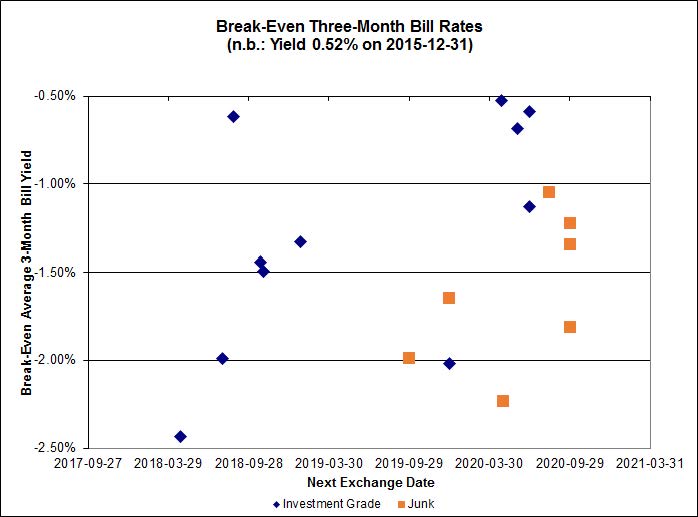
We can show the break-even rates for each FixedReset / FloatingReset Strong Pair graphically by plotting the implied average 3-month bill rate against the next Exchange Date (which is the date to which the average will be calculated).

pairs_FR_150910
Click for Big

The market appears to have a marked distaste at the moment for floating rate product; every single one of the implied rates until the next interconversion are lower than the current 3-month bill rate and nearly all pairs have a break-even yield significantly below zero! Whatever might be the result of the next few Bank of Canada overnight rate decisions, I suggest that it is unlikely that the average rate over the next five years will be lower than current – but if you disagree, of course, you may interpret the data any way you like.

Since credit quality of each element of the pair is equal to the other element, it should not make any difference whether the pair examined is investment-grade or junk, although we might expect greater variation of implied rates between junk issues on grounds of lower liquidity, and this is just what we see.

If we plug in the current bid price of the three FixedResets, we may construct the following table showing consistent prices for their soon-to-be-issued FloatingReset counterparts given a variety of Implied Breakeven yields consistent with issues currently trading:

Estimate of FloatingReset Trading Price In Current Conditions
  Assumed FloatingReset
Price if Implied Bill
is equal to
FixedReset Bid Price Spread -2.00% -1.00% 0.00%
NPI.PR.A. 14.71 280bp 12.08 13.05 14.02
ALA.PR.A 15.40 266bp 12.71 13.70 14.69
FFH.PR.G 14.50 256bp 11.79 12.78 13.76

Based on current market conditions, I suggest that the FloatingResets that will result from conversion are likely to be cheap and trading well below the price of their FixedReset counterparts. Therefore, I recommend that holders of NPI.PR.A, FFH.PR.G and ALA.PR.A continue to hold these issues and not to convert. I will note that current conditions make extant FloatingResets so cheap (in general) that it may be a good trade to swap the FixedReset for the FloatingReset in the market once both elements of each pair are trading and you can – presumably, according to this analysis – do it with a reasonably good take-out in price, rather than doing it through the company on a 1:1 basis. But that, of course, will depend on the prices at that time and your forecast for the future path of policy rates. There are no guarantees – my recommendation is based on the assumption that current market conditions with respect to the pairs will continue until the FloatingResets commence trading and that the relative pricing of the new pairs will reflect these conditions.

Note as well that conversion rights are dependent upon at least one million shares of each series being outstanding after giving effect to holders’ instructions; e.g., if only 100,000 shares of NPI.PR.A are tendered for conversion, then no conversions will be allowed; but if only 100,000 shares of NPI.PR.A will remain after the rest are all tendered, then conversion will be mandatory. However, this is relatively rare: all 30 Strong Pairs currently extant have some version of this condition and all but two have both series outstanding.

Issue Comments

NSI.PR.D on Review-Negative by S&P

As mentioned in the post EMA Outlook-Negative by S&P; Review-Developing by DBRS, Emera’s Canadian subsidiary Nova Scotia Power has been put on Outlook-Negative by S&P:

  • •On Sept. 4, Emera announced the US$10.4 billion proposed acquisition of TECO Energy, a Florida-based holding company that wholly owns regulated utilities Tampa Electric Co. and New Mexico Gas Co.
  • •The proposed acquisition is partly being financed with the issuance of convertible debentures, and the additional debt load pushes Emera’s adjusted funds from operations-to-debt ratio to below 11%, the downgrade trigger.
  • •As a result of the financing risk associated with this large acquisition that will double the size of the company, we are revising our outlook on Emera and its Canadian subsidiary Nova Scotia Power Inc. to negative from stable.
  • •We are also revising the financial risk profile to “aggressive” from “significant”. The business risk of the consolidated entity post acquisition remains “excellent”.
  • •We are affirming all ratings on Emera and NSPI, including our ‘BBB+’ long-term corporate credit ratings.


The negative outlooks on Emera and NSPI reflect the financing risk associated with this large acquisition and our expectation that the consolidated pro forma credit metrics will materially weaken due to the C$1.9 billion convertible debenture issuance to finance, in part, the purchase of TECO Energy.

Although we expect that the debentures have a high likelihood of conversion due to several factors including no interest after acquisition close, targeted sale to institutions that would be buyers of Emera equity, not debt), in the meantime credit metrics are expected to be below 11%. If conversion does not occur as expected and metrics remain below 11%, we could lower the ratings on Emera and NSPI.

We could revise our outlook to stable within our two-year outlook period if we expect consolidated AFFO-to-debt to be sustained comfortably above 11%, all else being equal. This could occur if the debentures are successfully converted.

The DBRS announcement regarding Emera made no mention of Nova Scotia Power.

Issue Comments

EMA Outlook-Negative by S&P; Review-Developing by DBRS

Emera Inc. announced on Friday:

a definitive agreement for Emera to acquire TECO Energy (the “Transaction”), creating a North American energy leader, with over US$20 billion of assets and more than 2.4 million electric and gas customers. Upon closing, TECO Energy will become a wholly owned subsidiary of Emera.

Under the terms of the all-cash deal, which has been unanimously approved by the Board of Directors of both companies, TECO Energy shareholders will receive US$27.55 per common share, a 48 percent premium based on TECO Energy’s unaffected closing stock price on July 15, 2015 (the last trading day prior to news reports regarding TECO Energy’s strategic review) and 25 percent above TECO Energy’s unaffected 52-week high. This represents an aggregate purchase price of approximately US$10.4 billion including assumption of approximately US$3.9 billion of debt.

The closing of the Transaction, which is expected to occur by mid-2016, is subject to TECO Energy common shareholder approval and certain regulatory and government approvals, including approval by the New Mexico Public Regulation Commission, the Federal Energy Regulatory Commission and compliance with any applicable requirements under the Hart-Scott-Rodino Antitrust Improvements Act of 1976, as amended, and the satisfaction of customary closing conditions.

… and announced today:

that its direct wholly-owned subsidiary, Emera Holdings NS Company (the “Selling Debentureholder”), has agreed to sell $1,900,000,000 aggregate principal amount of 4.00% convertible unsecured subordinated debentures (“Debentures”) of Emera in a secondary offering on a “bought deal” basis (the “Offering”). In connection with the Offering, the underwriters have also been granted an over-allotment option to purchase up to an additional $285,000,000 aggregate principal amount of Debentures at the offering price, within 30 days from the date of the closing of the Offering solely to cover over-allotments, if any, and for market stabilization purposes.

All Debentures are being sold on an instalment basis at a price of $1,000 per Debenture, of which $333 is payable on the closing of the Offering and the remaining $667 is payable on a date (the “Final Instalment Date”) to be fixed by the Company following satisfaction of all conditions precedent to the closing of Emera’s acquisition of TECO Energy, Inc. (NYSE:TE).

On September 4, 2015 Emera announced that it had entered into an agreement and plan of merger pursuant to which it will indirectly acquire TECO Energy, Inc. (“TECO Energy”), a Florida and New Mexico regulated electric and gas utilities holding company, for an aggregate purchase price of approximately US$10.4 billion including the assumption of approximately US$3.9 billion of debt.

As a result of this activity, S&P has announced:

  • •On Sept. 4, Emera announced the US$10.4 billion proposed acquisition of TECO Energy, a Florida-based holding company that wholly owns regulated utilities Tampa Electric Co. and New Mexico Gas Co.
  • •The proposed acquisition is partly being financed with the issuance of convertible debentures, and the additional debt load pushes Emera’s adjusted funds from operations-to-debt ratio to below 11%, the downgrade trigger.
  • •As a result of the financing risk associated with this large acquisition that will double the size of the company, we are revising our outlook on Emera and its Canadian subsidiary Nova Scotia Power Inc. to negative from stable.
  • •We are also revising the financial risk profile to “aggressive” from “significant”. The business risk of the consolidated entity post acquisition remains “excellent”.
  • •We are affirming all ratings on Emera and NSPI, including our ‘BBB+’ long-term corporate credit ratings.


The negative outlooks on Emera and NSPI reflect the financing risk associated with this large acquisition and our expectation that the consolidated pro forma credit metrics will materially weaken due to the C$1.9 billion convertible debenture issuance to finance, in part, the purchase of TECO Energy.

Although we expect that the debentures have a high likelihood of conversion due to several factors including no interest after acquisition close, targeted sale to institutions that would be buyers of Emera equity, not debt), in the meantime credit metrics are expected to be below 11%. If conversion does not occur as expected and metrics remain below 11%, we could lower the ratings on Emera and NSPI.

We could revise our outlook to stable within our two-year outlook period if we expect consolidated AFFO-to-debt to be sustained comfortably above 11%, all else being equal. This could occur if the debentures are successfully converted.

Prior to the announcement of the convertible debt issue, DBRS announced:

DBRS Limited (DBRS) has today placed the BBB (high) Issuer Rating, BBB (high) Medium-Term Notes and Pfd-3 (high) Preferred Shares – Cumulative ratings of Emera Inc. (Emera or the Company) Under Review with Developing Implications.

The primary focus of DBRS’s FRA [financial risk assessment] analysis is on Emera’ non-consolidated capital structure (parent level) and cash flow from the subsidiaries to the parent to service the parent’s debt and corporate expenses. On a non-consolidated basis, the cash flow-to-interest expense ratio was reasonable at 12.3x in LTM 2015, while debt-to-capital was approximately 19%. DBRS notes that the non-consolidated leverage of 19% is well within the 30% threshold.

Currently, it is uncertain as to how Emera plans to ultimately finance the Acquisition. As a result, DBRS has placed the ratings of Emera Under Review with Developing Implications. DBRS will further review the Company’s financing plan when it is finalized. Upon final review, if the Company finances the Acquisition in such a way that its non-consolidated debt-to-capital structure exceeds 30% and its other non-consolidated credit metrics deteriorate significantly without corrective action within a reasonable time frame, then a negative rating action is likely to occur.

Affected issues are EMA.PR.A, EMA.PR.B, EMA.PR.C, EMA.PR.E and EMA.PR.F. S&P’s announcement also affects NSI.PR.D, which will be posted separately.