Category: Issue Comments

Issue Comments

RY.PR.H To Be Extended

Royal Bank of Canada has announced:

that it does not intend to exercise its right to redeem all or any part of the currently outstanding Non-Viability Contingent Capital (NVCC) Non-Cumulative 5-Year Rate Reset First Preferred Shares, Series BB (the “Series BB shares”) on August 24, 2019. There are currently 20,000,000 Series BB shares outstanding.

Subject to certain conditions set out in the prospectus supplement dated May 27, 2014 relating to the issuance of the Series BB shares, the holders of the Series BB shares have the right to convert all or part of their Series BB shares, on a one-for-one basis, into NVCC Non-Cumulative Floating Rate First Preferred Shares, Series BC (the “Series BC shares”) on August 24, 2019. On such date, holders who do not exercise their right to convert their Series BB shares into Series BC shares, will continue to hold their Series BB shares. The conversion will occur on August 26 being the first business day following the conversion date of August 24 as identified in the prospectus, which falls on a Saturday. The foregoing conversion rights are subject to the following:

  • if Royal Bank of Canada determines that there would be less than 1,000,000 Series BC shares outstanding after taking into account all shares tendered for conversion on August 24, 2019, then holders of Series BB shares will not be entitled to convert their shares into Series BC shares, and
  • alternatively, if Royal Bank of Canada determines that there would remain outstanding less than 1,000,000 Series BB shares after August 24, 2019, then all remaining Series BB shares will automatically be converted into Series BC shares on a one-for-one basis on August 24, 2019.

In either case, Royal Bank of Canada will give written notice to that effect to holders of Series BB shares no later than August 17, 2019.

The dividend rate applicable for the Series BB shares for the 5-year period from and including August 24, 2019 to but excluding August 24, 2024, and the dividend rate applicable to the Series BC shares for the 3-month period from and including August 24, 2019 to but excluding November 24, 2019, will be determined and announced by way of a press release on July 25, 2019.

Beneficial owners of Series BB shares who wish to exercise their conversion rights should instruct their broker or other nominee to exercise such rights during the conversion period, which runs from July 25, 2019 until 5:00 p.m. (EST) on August 9, 2019.

Inquiries should be directed to Shareholder Relations Officer, Shirley Boudreau, at 416-955-7806.

RY.PR.H is a FixedReset, 3.90%+226, NVCC-Compliant issue that commenced trading 2014-6-3 after being announced 2014-5-23. The issue is tracked by HIMIPref™ and has been assigned to the FixedReset-Discount subindex.

I will have more to say when the reset rate is announced July 25.

Issue Comments

TD.PF.B : No Conversion to FloatingReset

The Toronto-Dominion Bank has announced:

that none of its 20 million Non-Cumulative 5-Year Rate Reset Preferred Shares, Series 3 (Non-Viability Contingent Capital (NVCC)) (the “Series 3 Shares”) will be converted on July 31, 2019 into Non-Cumulative Floating Rate Preferred Shares, Series 4 (NVCC) (the “Series 4 Shares”) of TD.

During the conversion period, which ran from July 2, 2019 to July 16, 2019, 350,885 Series 3 Shares were tendered for conversion into Series 4 Shares, which is less than the minimum 1,000,000 shares required to give effect to the conversion, as described in the prospectus supplement for the Series 3 Shares dated July 24, 2014. As a result, no Series 4 Shares will be issued on July 31, 2019 and holders of Series 3 Shares will retain their Series 3 Shares.

The Series 3 Shares are currently listed on the Toronto Stock Exchange under the symbol TD.PF.B. As previously announced on July 2, 2019, the dividend rate for the Series 3 Shares for the 5 year period from and including July 31, 2019 to but excluding July 31, 2024 will be 3.681%.

TD.PF.B is a FixedReset 3.80%+227, NVCC-compliant, issue that commenced trading 2014-7-31 after being announced 2014-7-22. TD provided notice of extension on 2019-6-25. The issue will reset At 3.681% effective July 31, 2019. I recommended against conversion. The issue is tracked by HIMIPref™ and is assigned to the FixedReset (Discount) subindex.

Issue Comments

BRF.PR.C : No Conversion to FloatingReset

Brookfield Renewable Partners L.P. has announced:

that after having taken into account all election notices received by the July 16, 2019 deadline for conversion of Brookfield Renewable Power Preferred Equity Inc.’s (“BRP Equity”) currently outstanding Class A Preference Shares, Series 3 (the “Series 3 Shares”) (TSX: BRF.PR.C) into Class A Preference Shares, Series 4 (the “Series 4 Shares”), no Series 3 Shares will be converted into Series 4 Shares. As of the July 31, 2019 conversion date, there would have been fewer than the minimum 1,000,000 Series 4 Shares outstanding required to give effect to the conversion.

As announced by Brookfield Renewable on July 2, 2019, after July 31, 2019, holders of the Series 3 Shares will be entitled to receive fixed quarterly dividends, as and when declared by the board of directors of BRP Equity. The dividend rate for the five-year period commencing on August 1, 2019 and ending July 31, 2024 will be 4.351% per annum ($0.2719375 per share per quarter).

BRF.PR.C is a FixedReset, 4.40%+294, that commenced trading 2010-10-11 after being announced 2010-10-1. The issue will reset at 4.351% effective August 1, 2019. I recommended against conversion. The issue has been tracked by HIMIPref™, but assigned to the Scraps – FixedReset (Discount) subindex on credit concerns.

Issue Comments

CM.PR.O : No Conversion to FloatingReset

The Canadian Imperial Bank of Commerce has announced:

that, during the conversion notice period which ran from July 1, 2019 to July 16, 2019, 350,312 Non-cumulative Rate Reset Class A Preferred Shares Series 39 (Non-Viability Contingent Capital (NVCC)) of CIBC (the “Series 39 Shares”) were tendered for conversion, on a one-for-one basis, into Non-cumulative Floating Rate Class A Preferred Shares Series 40 (Non-Viability Contingent Capital (NVCC)) of CIBC (the “Series 40 Shares”). As per the conditions set out in the prospectus supplement dated June 2, 2014 relating to the issuance of the Series 39 Shares, since less than 1,000,000 Series 40 Shares would be outstanding on July 31, 2019, holders of Series 39 Shares who tendered their Series 39 Shares for conversion will not be entitled to convert their shares into Series 40 Shares. As a result, Series 40 Shares will not be issued at this time.

On July 31, 2019, CIBC will have 16,000,000 Series 39 Shares issued and outstanding. The Series 39 Shares are currently listed on the Toronto Stock Exchange under the symbol CM.PR.O.

The quarterly fixed dividend rate applicable to the Series 39 Shares for the five-year period from and including July 31, 2019 to but excluding July 31, 2024 is 3.713%, payable quarterly as and when declared by the Board of Directors of CIBC.

CM.PR.O is a FixedReset, 3.90%+232, NVCC-compliant, that commenced trading 2014-6-11 after being announced 2014-6-2. The extension was announced 2019-6-12. The issue will reset At 3.713% effective July 31, 2019. I recommended against conversion. CM.PR.O is tracked by HIMIPref™ and is assigned to the FixedReset (Discount) subindex.

Issue Comments

BRF.PR.C : Convert or Hold?

It will be recalled that BRF.PR.C will reset At 4.351% effective August 1, 2019.

BRF.PR.C is a FixedReset, 4.40%+294, that commenced trading 2010-10-11 after being announced 2010-10-1. The issue has been tracked by HIMIPref™, but assigned to the Scraps – FixedReset (Discount) subindex on credit concerns.

The most logical way to analyze the question of whether or not to convert is through the theory of Preferred Pairs, for which a calculator is available. Briefly, a Strong Pair is defined as a pair of securities that can be interconverted in the future (e.g. BRF.PR.C and the FloatingReset that will exist if enough holders convert). Since they will be interconvertible on this future date, it may be assumed that they will be priced identically on this date (if they aren’t then holders will simply convert en masse to the higher-priced issue). And since they will be priced identically on a given date in the future, any current difference in price must be offset by expectations of an equal and opposite value of dividends to be received in the interim. And since the dividend rate on one element of the pair is both fixed and known, the implied average rate of the other, floating rate, instrument can be determined. Finally, we say, we may compare these average rates and take a view regarding the actual future course of that rate relative to the implied rate, which will provide us with guidance on which element of the pair is likely to outperform the other until the next interconversion date, at which time the process will be repeated.

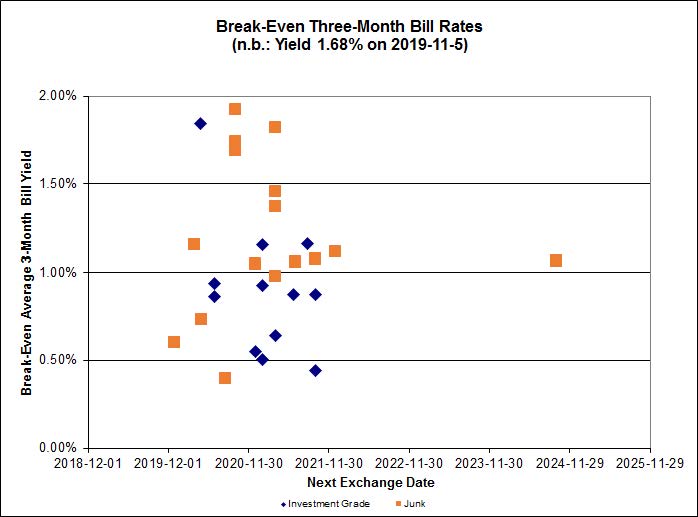
We can show the break-even rates for each FixedReset / FloatingReset Strong Pair graphically by plotting the implied average 3-month bill rate against the next Exchange Date (which is the date to which the average will be calculated).

pairs_fr_190712
Click for Big

The market appears to have lost its fleeting interest in floating rate product; the implied rates until the next interconversion are well below the current 3-month bill rate as the averages for investment-grade and junk issues are at +0.66% and +0.95%, respectively. Whatever might be the result of the next few Bank of Canada overnight rate decisions, I suggest that it is unlikely that the average rate over the next five years will be lower than current – but if you disagree, of course, you may interpret the data any way you like.

Since credit quality of each element of the pair is equal to the other element, it should not make any difference whether the pair examined is investment-grade or junk, although we might expect greater variation of implied rates between junk issues on grounds of lower liquidity, and this is just what we see.

If we plug in the current bid price of the BRF.PR.C FixedReset, we may construct the following table showing consistent prices for its soon-may-be-issued FloatingReset counterpart given a variety of Implied Breakeven yields consistent with issues currently trading:

Estimate of FloatingReset (received in exchange for BRF.PR.C) Trading Price In Current Conditions
  Assumed FloatingReset
Price if Implied Bill
is equal to
FixedReset Bid Price Spread 1.50% 1.00% 0.50%
BRF.PR.C 16.51 294bp 16.59 16.12 15.65

Based on current market conditions, I suggest that the FloatingResets that will result from conversion are likely to trade below the price of their FixedReset counterparts, BRF.PR.C. Therefore, I recommend that holders of BRF.PR.C continue to hold the issue and not to convert. I will note that once the FloatingResets commence trading (if, in fact, they do) it may be a good trade to swap one issue for the other in the market once both elements of each pair are trading and you can – hopefully – do it with a reasonably good take-out in price, rather than doing it through the company on a 1:1 basis. But that, of course, will depend on the prices at that time and your forecast for the path of policy rates over the next five years. There are no guarantees – my recommendation is based on the assumption that current market conditions with respect to the pairs will continue until the FloatingResets commence trading and that the relative pricing of the two new pairs will reflect these conditions.

Those who wish to convert are advised that the deadline for notifying the company of such a desire is 5:00 p.m. (Toronto time) on July 16, 2019. Brokers and other intermediaries generally set their internal deadlines a day or two in advance of this date, so if you wish to convert there’s no time to waste! Note that brokers will, in general, try to execute the instruction on a ‘best efforts’ basis if received between the two deadlines, provided that the procrastinating shareholder grovels entertainingly enough.

Issue Comments

CM.PR.O : Convert or Hold?

It will be recalled that CM.PR.O will reset At 3.713% effective July 31, 2019.

CM.PR.O is a FixedReset, 3.90%+232, NVCC-compliant, that commenced trading 2014-6-11 after being announced 2014-6-2. The extension was announced 2019-6-12. It is tracked by HIMIPref™ and is assigned to the FixedReset (Discount) subindex.

The most logical way to analyze the question of whether or not to convert is through the theory of Preferred Pairs, for which a calculator is available. Briefly, a Strong Pair is defined as a pair of securities that can be interconverted in the future (e.g. CM.PR.O and the FloatingReset that will exist if enough holders convert). Since they will be interconvertible on this future date, it may be assumed that they will be priced identically on this date (if they aren’t then holders will simply convert en masse to the higher-priced issue). And since they will be priced identically on a given date in the future, any current difference in price must be offset by expectations of an equal and opposite value of dividends to be received in the interim. And since the dividend rate on one element of the pair is both fixed and known, the implied average rate of the other, floating rate, instrument can be determined. Finally, we say, we may compare these average rates and take a view regarding the actual future course of that rate relative to the implied rate, which will provide us with guidance on which element of the pair is likely to outperform the other until the next interconversion date, at which time the process will be repeated.

We can show the break-even rates for each FixedReset / FloatingReset Strong Pair graphically by plotting the implied average 3-month bill rate against the next Exchange Date (which is the date to which the average will be calculated).

pairs_fr_190712
Click for Big

The market appears to have lost its fleeting interest in floating rate product; the implied rates until the next interconversion are well below the current 3-month bill rate as the averages for investment-grade and junk issues are at +0.66% and +0.95%, respectively. Whatever might be the result of the next few Bank of Canada overnight rate decisions, I suggest that it is unlikely that the average rate over the next five years will be lower than current – but if you disagree, of course, you may interpret the data any way you like.

Since credit quality of each element of the pair is equal to the other element, it should not make any difference whether the pair examined is investment-grade or junk, although we might expect greater variation of implied rates between junk issues on grounds of lower liquidity, and this is just what we see.

If we plug in the current bid price of the CM.PR.O FixedReset, we may construct the following table showing consistent prices for its soon-may-be-issued FloatingReset counterpart given a variety of Implied Breakeven yields consistent with issues currently trading:

Estimate of FloatingReset (received in exchange for CM.PR.O) Trading Price In Current Conditions
  Assumed FloatingReset
Price if Implied Bill
is equal to
FixedReset Bid Price Spread 1.50% 1.00% 0.50%
CM.PR.O 17.32 232bp 17.43 16.93 16.43

Based on current market conditions, I suggest that the FloatingResets that will result from conversion are likely to trade below the price of their FixedReset counterparts, CM.PR.O. Therefore, I recommend that holders of CM.PR.O continue to hold the issue and not to convert. I will note that once the FloatingResets commence trading (if, in fact, they do) it may be a good trade to swap one issue for the other in the market once both elements of each pair are trading and you can – hopefully – do it with a reasonably good take-out in price, rather than doing it through the company on a 1:1 basis. But that, of course, will depend on the prices at that time and your forecast for the path of policy rates over the next five years. There are no guarantees – my recommendation is based on the assumption that current market conditions with respect to the pairs will continue until the FloatingResets commence trading and that the relative pricing of the two new pairs will reflect these conditions.

Those who wish to convert are advised that the deadline for notifying the company of such a desire is 5:00 p.m. (Eastern Daylight Time) on July 16, 2019. Brokers and other intermediaries generally set their internal deadlines a day or two in advance of this date, so if you wish to convert there’s no time to waste! Note that brokers will, in general, try to execute the instruction on a ‘best efforts’ basis if received between the two deadlines, provided that the procrastinating shareholder grovels entertainingly enough.

Issue Comments

TD.PF.B : Convert or Hold?

It will be recalled that TD.PF.B will reset At 3.681% effective July 31, 2019.

TD.PF.B is a FixedReset 3.80%+227, NVCC-compliant, issue that commenced trading 2014-7-31 after being announced 2014-7-22. TD provided notice of extension on 2019-6-25. The issue is tracked by HIMIPref™ and is assigned to the FixedReset (Discount) subindex.

The most logical way to analyze the question of whether or not to convert is through the theory of Preferred Pairs, for which a calculator is available. Briefly, a Strong Pair is defined as a pair of securities that can be interconverted in the future (e.g. TD.PF.B and the FloatingReset that will exist if enough holders convert). Since they will be interconvertible on this future date, it may be assumed that they will be priced identically on this date (if they aren’t then holders will simply convert en masse to the higher-priced issue). And since they will be priced identically on a given date in the future, any current difference in price must be offset by expectations of an equal and opposite value of dividends to be received in the interim. And since the dividend rate on one element of the pair is both fixed and known, the implied average rate of the other, floating rate, instrument can be determined. Finally, we say, we may compare these average rates and take a view regarding the actual future course of that rate relative to the implied rate, which will provide us with guidance on which element of the pair is likely to outperform the other until the next interconversion date, at which time the process will be repeated.

We can show the break-even rates for each FixedReset / FloatingReset Strong Pair graphically by plotting the implied average 3-month bill rate against the next Exchange Date (which is the date to which the average will be calculated).

pairs_fr_190712
Click for Big

The market appears to have lost its fleeting interest in floating rate product; the implied rates until the next interconversion are well below the current 3-month bill rate as the averages for investment-grade and junk issues are at +0.66% and +0.95%, respectively. Whatever might be the result of the next few Bank of Canada overnight rate decisions, I suggest that it is unlikely that the average rate over the next five years will be lower than current – but if you disagree, of course, you may interpret the data any way you like.

Since credit quality of each element of the pair is equal to the other element, it should not make any difference whether the pair examined is investment-grade or junk, although we might expect greater variation of implied rates between junk issues on grounds of lower liquidity, and this is just what we see.

If we plug in the current bid price of the TD.PF.B FixedReset, we may construct the following table showing consistent prices for its soon-may-be-issued FloatingReset counterpart given a variety of Implied Breakeven yields consistent with issues currently trading:

Estimate of FloatingReset (received in exchange for TD.PF.B) Trading Price In Current Conditions
  Assumed FloatingReset
Price if Implied Bill
is equal to
FixedReset Bid Price Spread 1.50% 1.00% 0.50%
TD.PF.B 18.03 227bp 18.12 17.62 17.11

Based on current market conditions, I suggest that the FloatingResets that will result from conversion are likely to trade below the price of their FixedReset counterparts, TD.PF.B. Therefore, I recommend that holders of TD.PF.B continue to hold the issue and not to convert. I will note that once the FloatingResets commence trading (if, in fact, they do) it may be a good trade to swap one issue for the other in the market once both elements of each pair are trading and you can – hopefully – do it with a reasonably good take-out in price, rather than doing it through the company on a 1:1 basis. But that, of course, will depend on the prices at that time and your forecast for the path of policy rates over the next five years. There are no guarantees – my recommendation is based on the assumption that current market conditions with respect to the pairs will continue until the FloatingResets commence trading and that the relative pricing of the two new pairs will reflect these conditions.

Those who wish to convert are advised that the deadline for notifying the company of such a desire is 5:00 p.m. (Toronto time) on July 16, 2019. Brokers and other intermediaries generally set their internal deadlines a day or two in advance of this date, so if you wish to convert there’s no time to waste! Note that brokers will, in general, try to execute the instruction on a ‘best efforts’ basis if received between the two deadlines, provided that the procrastinating shareholder grovels entertainingly enough.

Issue Comments

TD.PF.B To Reset At 3.681%

The Toronto-Dominion Bank has announced (although not yet on their website):

the applicable dividend rates for its Non-Cumulative 5-Year Rate Reset Preferred Shares, Series 3 (Non-Viability Contingent Capital (NVCC)) (the “Series 3 Shares”) and Non-Cumulative Floating Rate Preferred Shares, Series 4 (NVCC) (the “Series 4 Shares”).

With respect to any Series 3 Shares that remain outstanding after July 31, 2019, holders of the Series 3 Shares will be entitled to receive quarterly fixed non-cumulative preferential cash dividends, as and when declared by the Board of Directors of TD, subject to the provisions of the Bank Act (Canada). The dividend rate for the 5-year period from and including July 31, 2019 to but excluding July 31, 2024 will be 3.681%, being equal to the 5-Year Government of Canada bond yield determined as at July 2, 2019 plus 2.27%, as determined in accordance with the terms of the Series 3 Shares.

With respect to any Series 4 Shares that may be issued on July 31, 2019, holders of the Series 4 Shares will be entitled to receive quarterly floating rate non-cumulative preferential cash dividends, calculated on the basis of the actual number of days elapsed in such quarterly period divided by 365, as and when declared by the Board of Directors of TD, subject to the provisions of the Bank Act (Canada). The dividend rate for the floating rate period from and including July 31, 2019 to but excluding October 31, 2019, will be 3.931%, being equal to the 90-day Government of Canada Treasury Bill yield determined as of July 2, 2019 plus 2.27%, as determined in accordance with the terms of the Series 4 Shares.

Beneficial owners of Series 3 Shares who wish to exercise their conversion right should communicate as soon as possible with their broker or other nominee to obtain instructions for exercising such right on or prior to the deadline for exercise, which is 5:00 p.m. (Toronto time) on July 16, 2019.

Inquiries should be directed to TD’s Registrar and Transfer Agent, AST Trust Company (Canada), at 1-800-387-0825 (or in Toronto 416-682-3860).

TD.PF.B is a FixedReset 3.80%+227, NVCC-compliant, issue that commenced trading 2014-7-31 after being announced 2014-7-22. TD provided notice of extension on 2019-6-25. The issue is tracked by HIMIPref™ and is assigned to the FixedReset (Discount) subindex.

The most logical way to analyze the question of whether or not to convert is through the theory of Preferred Pairs, for which a calculator is available. Briefly, a Strong Pair is defined as a pair of securities that can be interconverted in the future (e.g., TD.PF.B and the FloatingReset that will exist if enough holders convert). Since they will be interconvertible on this future date, it may be assumed that they will be priced identically on this date (if they aren’t then holders will simply convert en masse to the higher-priced issue). And since they will be priced identically on a given date in the future, any current difference in price must be offset by expectations of an equal and opposite value of dividends to be received in the interim. And since the dividend rate on one element of the pair is both fixed and known, the implied average rate of the other, floating rate, instrument can be determined. Finally, we say, we may compare these average rates and take a view regarding the actual future course of that rate relative to the implied rate, which will provide us with guidance on which element of the pair is likely to outperform the other until the next interconversion date, at which time the process will be repeated.

We can show the break-even rates for each FixedReset / FloatingReset Strong Pair graphically by plotting the implied average 3-month bill rate against the next Exchange Date (which is the date to which the average will be calculated).

pairs_fr_190702
Click for Big

The market has lost enthusiasm for floating rate product; the implied rates until the next interconversion are generally well below the current 3-month bill rate as the averages for investment-grade and junk issues are at +0.63% and +0.67%, respectively. Whatever might be the result of the next few Bank of Canada overnight rate decisions, I suggest that it is unlikely that the average rate over the next five years will be lower than current – but if you disagree, of course, you may interpret the data any way you like.

Since credit quality of each element of the pair is equal to the other element, it should not make any difference whether the pair examined is investment-grade or junk, although we might expect greater variation of implied rates between junk issues on grounds of lower liquidity, and this is just what we see.

If we plug in the current bid price of the TD.PF.B FixedReset, we may construct the following table showing consistent prices for its soon-may-be-issued FloatingReset counterpart given a variety of Implied Breakeven yields consistent with issues currently trading:

Estimate of FloatingReset (received in exchange for TD.PF.B) Trading Price In Current Conditions
  Assumed FloatingReset
Price if Implied Bill
is equal to
FixedReset Bid Price Spread 1.00% 0.50% 0.00%
TD.PF.B 17.75 227bp 17.34 16.83 16.33

Based on current market conditions, I suggest that the FloatingResets that will result from conversion are likely to trade well below the price of their FixedReset counterparts, TD.PF.B. Therefore, it seems likely that I will recommend that holders of TD.PF.B continue to hold the issue and not to convert, but I will wait until it’s closer to the July 16 notification deadline before making a final pronouncement. I will note that once the FloatingResets commence trading (if, in fact, they do) it may be a good trade to swap one issue for the other in the market once both elements of each pair are trading and you can – hopefully – do it with a reasonably good take-out in price, rather than doing it through the company on a 1:1 basis. But that, of course, will depend on the prices at that time and your forecast for the path of policy rates over the next five years. There are no guarantees – my recommendation is based on the assumption that current market conditions with respect to the pairs will continue until the FloatingResets commence trading and that the relative pricing of the two new pairs will reflect these conditions.

Issue Comments

BRF.PR.C To Reset at 4.351%

Brookfield Renewable Partners L.P. has announced:

that Brookfield Renewable Power Preferred Equity Inc. (“BRP Equity”) has determined the fixed dividend rate on its Class A Preference Shares, Series 3 (“Series 3 Shares”) (TSX: BRF.PR.C) for the five years commencing August 1, 2019 and ending July 31, 2024. If declared, the fixed quarterly dividends on the Series 3 Shares during that period will be paid at an annual rate of 4.351% ($0.2719375 per share per quarter).

Holders of Series 3 Shares have the right, at their option, exercisable not later than 5:00 p.m. (Toronto time) on July 16, 2019, to convert all or part of their Series 3 Shares, on a one-for-one basis, into Class A Preference Shares, Series 4 (the “Series 4 Shares”), effective July 31, 2019.

The quarterly floating rate dividends on the Series 4 Shares will be paid at an annual rate, calculated for each quarter, of 2.94% over the annual yield on three-month Government of Canada treasury bills. The actual quarterly dividend rate in respect of the August 1, 2019 to October 31, 2019 dividend period for the Series 4 Shares will be 1.15970% (4.601% on an annualized basis) and the dividend, if declared, for such dividend period will be $0.289925 per share, payable on October 31, 2019.

Holders of Series 3 Shares are not required to elect to convert all or any part of their Series 3 Shares into Series 4 Shares.

As provided in the share conditions of the Series 3 Shares, (i) if BRP Equity determines that there would be fewer than 1,000,000 Series 3 Shares outstanding after July 31, 2019, all remaining Series 3 Shares will be automatically converted into Series 4 Shares on a one-for-one basis effective July 31, 2019; and (ii) if BRP Equity determines that there would be fewer than 1,000,000 Series 4 Shares outstanding after July 31, 2019, no Series 3 Shares will be permitted to be converted into Series 4 Shares. There are currently 10,000,000 Series 3 Shares outstanding.

The Toronto Stock Exchange (“TSX”) has conditionally approved the listing of the Series 4 Shares effective upon conversion. Listing of the Series 4 Shares is subject to BRP Equity fulfilling all the listing requirements of the TSX and, upon approval, the Series 4 Shares will be listed on the TSX under the trading symbol “BRF.PR.D”.

BRF.PR.C is a FixedReset, 4.40%+294, that commenced trading 2010-10-11 after being announced 2010-10-1. The issue has been tracked by HIMIPref™, but assigned to the Scraps – FixedReset (Discount) subindex on credit concerns.

The most logical way to analyze the question of whether or not to convert is through the theory of Preferred Pairs, for which a calculator is available. Briefly, a Strong Pair is defined as a pair of securities that can be interconverted in the future (e.g., BRF.PR.C and the FloatingReset that will exist if enough holders convert). Since they will be interconvertible on this future date, it may be assumed that they will be priced identically on this date (if they aren’t then holders will simply convert en masse to the higher-priced issue). And since they will be priced identically on a given date in the future, any current difference in price must be offset by expectations of an equal and opposite value of dividends to be received in the interim. And since the dividend rate on one element of the pair is both fixed and known, the implied average rate of the other, floating rate, instrument can be determined. Finally, we say, we may compare these average rates and take a view regarding the actual future course of that rate relative to the implied rate, which will provide us with guidance on which element of the pair is likely to outperform the other until the next interconversion date, at which time the process will be repeated.

We can show the break-even rates for each FixedReset / FloatingReset Strong Pair graphically by plotting the implied average 3-month bill rate against the next Exchange Date (which is the date to which the average will be calculated).

pairs_fr_190702
Click for Big

The market has lost enthusiasm for floating rate product; the implied rates until the next interconversion are generally well below the current 3-month bill rate as the averages for investment-grade and junk issues are at +0.63% and +0.67%, respectively. Whatever might be the result of the next few Bank of Canada overnight rate decisions, I suggest that it is unlikely that the average rate over the next five years will be lower than current – but if you disagree, of course, you may interpret the data any way you like.

Since credit quality of each element of the pair is equal to the other element, it should not make any difference whether the pair examined is investment-grade or junk, although we might expect greater variation of implied rates between junk issues on grounds of lower liquidity, and this is just what we see.

If we plug in the current bid price of the BRF.PR.C FixedReset, we may construct the following table showing consistent prices for its soon-may-be-issued FloatingReset counterpart given a variety of Implied Breakeven yields consistent with issues currently trading:

Estimate of FloatingReset (received in exchange for BRF.PR.C) Trading Price In Current Conditions
  Assumed FloatingReset
Price if Implied Bill
is equal to
FixedReset Bid Price Spread 1.00% 0.50% 0.00%
BRF.PR.C 16.00 294bp 15.61 15.14 14.67

Based on current market conditions, I suggest that the FloatingResets that will result from conversion are likely to trade well below the price of their FixedReset counterparts, BRF.PR.C. Therefore, it seems likely that I will recommend that holders of BRF.PR.C continue to hold the issue and not to convert, but I will wait until it’s closer to the July 16 notification deadline before making a final pronouncement. I will note that once the FloatingResets commence trading (if, in fact, they do) it may be a good trade to swap one issue for the other in the market once both elements of each pair are trading and you can – hopefully – do it with a reasonably good take-out in price, rather than doing it through the company on a 1:1 basis. But that, of course, will depend on the prices at that time and your forecast for the path of policy rates over the next five years. There are no guarantees – my recommendation is based on the assumption that current market conditions with respect to the pairs will continue until the FloatingResets commence trading and that the relative pricing of the two new pairs will reflect these conditions.

Issue Comments

CM.PR.O To Reset at 3.713%

Canadian Imperial Bank of Commerce has announced:

the dividend rates applicable to its Non-cumulative Rate Reset Class A Preferred Shares Series 39 (Non-Viability Contingent Capital (NVCC)) (the “Series 39 Shares”) and Non-cumulative Floating Rate Class A Preferred Shares Series 40 (Non-Viability Contingent Capital (NVCC)) (the “Series 40 Shares”).

The fixed dividend rate applicable to the Series 39 Shares, should any remain outstanding after July 31, 2019, for the five-year period from and including July 31, 2019 to but excluding July 31, 2024 is 3.713%, payable quarterly as and when declared by the Board of Directors of CIBC.

The floating dividend rate applicable to the Series 40 Shares, should any be issued, for the three-month period from and including July 31, 2019 to but excluding October 31, 2019 is 3.981%, payable quarterly as and when declared by the Board of Directors of CIBC. CIBC has designated the Series 40 Shares as eligible to participate in the CIBC Shareholder Investment Plan.

Beneficial owners of Series 39 Shares who wish to exercise their conversion right should instruct their broker or other nominee to exercise such right during the conversion period, which runs from July 1, 2019 until 5:00 p.m. (Eastern Daylight Time) on July 16, 2019. Any notices received after this deadline will not be valid.

CM.PR.O is a FixedReset, 3.90%+232, NVCC-compliant, that commenced trading 2014-6-11 after being announced 2014-6-2. The extension was announced 2019-6-12. It is tracked by HIMIPref™ and is assigned to the FixedReset (Discount) subindex.

The most logical way to analyze the question of whether or not to convert is through the theory of Preferred Pairs, for which a calculator is available. Briefly, a Strong Pair is defined as a pair of securities that can be interconverted in the future (e.g., CM.PR.O and the FloatingReset that will exist if enough holders convert). Since they will be interconvertible on this future date, it may be assumed that they will be priced identically on this date (if they aren’t then holders will simply convert en masse to the higher-priced issue). And since they will be priced identically on a given date in the future, any current difference in price must be offset by expectations of an equal and opposite value of dividends to be received in the interim. And since the dividend rate on one element of the pair is both fixed and known, the implied average rate of the other, floating rate, instrument can be determined. Finally, we say, we may compare these average rates and take a view regarding the actual future course of that rate relative to the implied rate, which will provide us with guidance on which element of the pair is likely to outperform the other until the next interconversion date, at which time the process will be repeated.

We can show the break-even rates for each FixedReset / FloatingReset Strong Pair graphically by plotting the implied average 3-month bill rate against the next Exchange Date (which is the date to which the average will be calculated).

pairs_fr_190628
Click for Big

Frankly, I am not sure how seriously to take the results charted above. FixedResets had a very strong day on June 28 which was emphatically not shared by their FloatingReset counterparts, where extant, and thus the calculated break-even point for the FloatingReset dividend rates (determined by the average bill rate until the next Exchange Date) has declined dramatically from the last calculation as of June 10. It is not yet clear, of course, whether this represents an actual change in market sentiment or whether this is an artifact of a few players’ day’s trading which will be quickly reversed. The following discussion will assume that this is representative of an actual change in sentiment, but please note that this conclusion is highly provisional!

The market has lost enthusiasm for floating rate product; the implied rates until the next interconversion are below the current 3-month bill rate as the averages for investment-grade and junk issues are at +0.34% and +0.68%, respectively. Whatever might be the result of the next few Bank of Canada overnight rate decisions, I suggest that it is unlikely that the average rate over the next five years will be lower than current – but if you disagree, of course, you may interpret the data any way you like.

Since credit quality of each element of the pair is equal to the other element, it should not make any difference whether the pair examined is investment-grade or junk, although we might expect greater variation of implied rates between junk issues on grounds of lower liquidity, and this is just what we see.

If we plug in the current bid price of the CM.PR.O FixedReset, we may construct the following table showing consistent prices for its soon-may-be-issued FloatingReset counterpart given a variety of Implied Breakeven yields consistent with issues currently trading:

Estimate of FloatingReset (received in exchange for CM.PR.O) Trading Price In Current Conditions
  Assumed FloatingReset
Price if Implied Bill
is equal to
FixedReset Bid Price Spread 1.00% 0.50% 0.00%
CM.PR.O 17.17 232bp 16.78 16.28 15.78

Based on current market conditions, I suggest that the FloatingResets that will result from conversion are likely to trade well below the price of their FixedReset counterparts, CM.PR.O. Therefore, it seems likely that I will recommend that holders of CM.PR.O determine whether or not to convert based on their own portfolio considerations and forecast for policy rates continue to hold the issue and not to convert, but I will wait until it’s closer to the July 16 notification deadline before making a final pronouncement – particularly since, as noted above, the closing quotes for June 28 are highly suspect. I will note that once the FloatingResets commence trading (if, in fact, they do) it may be a good trade to swap one issue for the other in the market once both elements of each pair are trading and you can – hopefully – do it with a reasonably good take-out in price, rather than doing it through the company on a 1:1 basis. But that, of course, will depend on the prices at that time and your forecast for the path of policy rates over the next five years. There are no guarantees – my recommendation is based on the assumption that current market conditions with respect to the pairs will continue until the FloatingResets commence trading and that the relative pricing of the two new pairs will reflect these conditions.