Category: Market Action

Market Action

June 10, 2015

Today’s whining over liquidity focusses on investor homogeneity and the victory of deep pockets:

The size of the U.S. corporate-bond market has ballooned by $3.7 trillion during the past decade, yet almost all of that growth is concentrated in the hands of three types of buyers: mutual funds, foreign investors and insurance companies, according to Citigroup. That combination could lead to more selling than the market can absorb when the Federal Reserve raises interest rates for the first time since 2006, [Citigroup Inc. strategist Stephen] Antczak said.

“All the money is going to the same place, and when something adversely impacts one, chances are the same factor adversely impacts everyone else, and there’s nobody there to take the other side,” Antczak said in a telephone interview. “We used to have 23 types of investors in the market. Now we have three. In my mind, that’s the key driver.”

The three investor groups hold almost two-thirds of total corporate debt, Citigroup data show. Mutual funds, which are forced to sell when investors redeem cash, grew the fastest, more than doubling their share to 22 percent in 10 years. Overseas investors now hold almost a quarter of the market. Wells Fargo & Co. analysts warned last month that those buyers may be prompted to exit if the dollar weakened at the same time bond yields rose.

Hedge funds, government pension funds and securities brokers are among 20 other groups that hold 37 percent.

“A couple of investors have been acting like brokers, thinking about being a source of liquidity to the Street,” Antczak said. “They are big and able to hold less-liquid positions because they don’t have to mark it against the market and can hold until maturity.”

That’s what New York Life Insurance Co.’s investment arm, which oversees $215 billion of policyholder money, did during the so-called taper tantrum of 2013. The Fed’s move to end its unprecedented stimulus measures that year triggered a selloff that wiped out 5 percent from U.S. speculative-grade corporate bonds in less than two months.

The declines were “exaggerated because the need for liquidity was in excess of what the dealer community could provide,” Tom Girard, head of fixed-income investments at NYL Investors, said in a telephone interview. The firm stepped in to buy both investment-grade and speculative-grade securities, he said.

“New York Life acquired significant amounts of bonds at very attractive spreads and yield levels because we were able to provide liquidity,” he said. “If we get another situation similar to that taper tantrum, then from my perspective it starts to shift from a challenge to an opportunity.”

investorHomogeneity
Click for Big

And there is chatter that junk bond investors are getting nervous:

After providing a haven from the global bond-market selloff, speculative-grade securities have now joined the rout, tumbling almost 1 percent since the end of May. Investors are starting to flee, yanking $1.5 billion from the two biggest high-yield bond exchange-traded funds over the past week, according to data compiled by Bloomberg.

High-yield debt markets have “shown a degree of resiliency here to the shift in the inflation outlook,” Jeffrey Rosenberg, a managing director at BlackRock Inc.’s, said in a Bloomberg radio interview Tuesday. “That resilience could be challenged if we follow up this bout of higher rates with a shift in” expectations for when the Federal Reserve will lift rates.

Case in point: BlackRock’s $14.3 billion high-yield bond ETF plunged 1.6 percent in the six days through Monday as $940.5 million exited the fund, Bloomberg data show. State Street Corp.’s $10.7 billion junk-debt ETF dropped 1.7 percent, with $571.7 million of withdrawals.

Leveraged-loan investors aren’t too happy either:

Leveraged loans dropped to their lowest level in four months amid a pullback by buyers stung by borrowers such as Dollar Tree Inc. and Goodyear Tire & Rubber Co., who have taken advantage of a paucity of new deals by seeking to lower payments on existing debt. Barclays Plc last week cut its 2015 forecast for U.S. leveraged-loan issuance to as little as $250 billion as regulatory scrutiny slows the pace of buyout financings.

Investors who buy leveraged loans are caught in a bind. A push by regulators to curb risky underwriting practices has left them with fewer deals to chase, while the interest they earn on the loans they hold falls. Sentiment has also been weighed down by a global bond rout that has sent Treasury yields to levels not seen since October.

“Buyers are pulling back from paying a premium due to the fear they will be hurt by a refinancing in very short order,” said Jason Rosiak, head of portfolio management at Newport Beach, California-based Pacific Asset Management. “That weighs on the overall market.”

Loans prices dropped to 95.9 cents on the dollar on Wednesday, after falling each of the past three weeks in the longest such stretch since the fourth quarter, according to the Standard & Poor’s/LSTA U.S. Leveraged Loan 100 Index. The debt lost 0.36 percent this month, after gaining just 0.05 percent in May, the smallest monthly return of the year.

But at least there’s less debt with negative yield:

Everyone knew it defied logic to pay for the privilege of lending trillions of dollars to European governments.

But two months ago, that didn’t stop investors from doing exactly that, causing the pool of European bonds with negative yields to soar to almost 3 trillion euros ($3.4 trillion) as of mid-April, Bank of America Corp. data show.

That trade is now dying quickly. The amount of such securities in the market has shrunk nearly in half, to 1.6 trillion euros as of June 9.

The Lapdog’s boss has told him to step up the war on banks:

Bank of England Governor Mark Carney ordered the finance industry to observe new rules on market conduct and threatened an even tougher regime if traders and bankers fail to comply.

His comments came as the BOE published the Fair and Effective Markets Review in London Wednesday, which recommends a new code of practice and longer jail terms for infractions. He said individuals must be “held to account” and firms must also take greater responsibility.

“This is a major opportunity for the industry to establish common standards of market practice,” Carney said. “If firms and their staff fail to take this opportunity, more restrictive regulation is inevitable.”

The markets review was announced by Chancellor of the Exchequer George Osborne at the same event a year ago. In his comments, Carney said revelations of misconduct have appeared with a “depressing frequency.” Bankers’ “ethical drift” has led to higher borrowing costs and falling confidence, while the $150 billion in fines levied on global banks has reduced their lending capacity by $3 trillion.

I love the bit where the banks are being blamed for the effects of their payment of $150-billion in fines. Very Jesuitical.

Naturally, Osborne has a valuable ally in his campaign for eternal re-election:

The Justice Department has begun an examination of trading in the U.S. Treasury market, following the outlines of its successful cases against Wall Street’s illegal practices in foreign currencies and other businesses, said three people familiar with the inquiry.

The government is also continuing to look into possible collusion in gold and silver markets and in trading around certain oil benchmarks, the people said.

Though the latest inquiry into Treasury trading is in its earliest stages, investigators are said to be probing whether information is being shared improperly by financial institutions. Some of the world’s biggest banks and their subsidiaries pleaded guilty after traders were shown to be using chat rooms, which functioned as cartels, to coordinate positions on foreign-exchange markets. These practices violated federal antitrust laws. Some of the same banks were among those that settled fraud and antitrust investigations into manipulating key interest rates.

It remains unclear where in the Treasury markets prosecutors aim to find wrongdoing, or if any specific allegations against Wall Street banks prompted the inquiries.

The best part of that story is that individual traders will be blamed for liquidity problems:

The Treasury Market Practices Group, an advisory committee backed by the New York Fed, finalized additions to its best practices guidelines Wednesday. For example, on a list of trading practices to avoid, it now includes “those that give a false impression of market price, depth or liquidity.”

It also added an updated recommendation “that market participants who employ trading strategies that involve high-trading volume or quoting activity should be mindful of whether a sudden change in these strategies could adversely affect market liquidity and should seek to avoid changes likely to cause such disruption,” the TMPG wrote in a statement.

And the regulators are very concerned about ‘banging the close’:

It was a simple process, according to the CFTC: Barclays traders told their brokers to buy or sell as many interest-rate swaps as needed just before 11 a.m. New York time to push the benchmark in the desired direction.

Here’s how a broker described the process to a trader in 2007, according to the CFTC: “If you want to affect it at 11, you tell me which way you want to affect it we’ll, we’ll attempt to affect it that way.”

Another time that year, a Barclays trader told his broker to buy as much as $400 million worth of swaps to move the benchmark, according to the complaint.

For example, on June 25, 2007, the Barclays options desk in New York had a $635 million swaption contract that was coming due, according to the CFTC. “Barclays traders on multiple desks coordinated to employ three methods of manipulation in an attempt to maximize the amount paid to Barclays in the swaption cash settlement,” the CFTC said in the complaint.

At 10:50 a.m. that day, the trader told his broker, “Don’t let ’em go down. For the eleven o’clock fix I need to lift 5s up,” he said, referring to the five-year swap spread trade. This is the trader who told the broker he could buy as much as $400 million in notional value of the swaps to move the benchmark.

That’s also known as banging the close — or, as a Barclays trader put it on March 7, 2007: “What happens at 11 is the bloody thing moves like half a basis point up and down because everybody’s trying to bang the screen.”

The obvious solution to the problem – if there is indeed a problem, which is by no means clear – is to lengthen the period of time over which the fix is calculated … if indeed a fix is really required at all. Another excellent option is to ensure that expiring contracts can be exchanged for physicals, rather than automatic cash settlement. But this isn’t about logic; this is all about asshole regulators and politicians making names for themselves.

You don’t believe me? Then I must assume you also don’t believe in proportionality:

Jamie Forese, head of the Citigroup Inc. unit that houses trading and investment banking, said fines the firm paid for rigging foreign-exchange markets dwarfed the amount generated by the illegal conduct.

Revenue from the trades amounted to about $1 million, while Citigroup paid out $2.5 billion in fines and penalties, Forese estimated Wednesday at an investor conference in New York.

However, one guy has been brave enough to bite back:

JPMorgan Chase & Co. Chief Executive Officer Jamie Dimon took aim at U.S. Senator Elizabeth Warren, a critic of large banks, as he expressed broad concerns about leadership in Washington.

“I don’t know if she fully understands the global banking system,” Dimon, speaking Wednesday at an event in Chicago, said of the Massachusetts Democrat. Still, he said he agrees with some of her concerns about risks.

It looks like Lagarde isn’t the only one who wants to be a Fed governor:

The World Bank joined the IMF in urging the Federal Reserve to hold off raising rates until next year, citing an uneven U.S. recovery and the risks to emerging markets of tightening policy any sooner.

“My concern is that the signals coming out of the U.S. economy have been mixed,” World Bank Chief Economist Kaushik Basu told reporters Wednesday in Washington on a conference call to discuss the bank’s semiannual global economic forecasts.

A premature move by the Fed could cause the dollar to strengthen, which may slow the U.S. economy and sideswipe emerging and developing countries, he said.

The Washington-based development bank lowered its forecast for U.S. growth this year to 2.7 percent, from 3.2 percent in January. The bank also expects the U.S. to expand at a 2.8 percent pace next year, down from 3 percent in January.

And many sets of entrails are being examined:

Economists surveyed June 5-9 put the probability of a September increase in the benchmark federal funds rate at 50 percent, according to the median estimate. The odds were nine percent for October, 20 percent for December and 10 percent for some time in 2016.

Some investors making bets on interest-rate futures have a more hawkish view. The market-implied probability of liftoff by September is somewhere between 93 percent and 100 percent, according to Stan Jonas, who has been trading fed funds futures since he helped create them in 1988.

The Federal Open Market Committee gathers on June 16-17, and Chair Janet Yellen will hold a press conference after the meeting. Fed officials will also publish updated quarterly economic and interest-rate forecasts.

And, as some comic relief, Bloomberg presents a good story on medical billing:

Dealing with medical bills, like waiting for the cable guy or buying a used car, has become a cliché of consumer exasperation. Everything from electricity and phone bills to tax returns and parking tickets migrated to electronic payments years ago, but America’s $2.9 trillion health-care economy remains stubbornly stuck in the 1990s. The number of medical bills paid by paper check through the U.S. mail has even increased while payments for all other services have decreased dramatically. Medical payments are the only category to register an increase in paperwork since the start of the 21st century: [Chart]

It’s not just consumers who are paying by mail. Just 15 percent of commercial insurers make payments to medical providers electronically, according to a report last month from PricewaterhouseCoopers Health Research Institute. The largest insurers are usually the best at going digital, but Cigna, with 14.5 million customers, sends only 39 percent of payments electronically. That’s because many doctors aren’t signed up to receive electronic transfers, according to spokesman Joe Mondy. Aetna and UnitedHealth Group, in contrast, both say around 80 percent of payments are paperless.

Hospitals, medical offices, and insurance companies need an army of workers to push all that paper1increase click area, which is also frequently shuffled through middlemen like billing agencies2increase click area and clearinghouses3increase click area. One claims clearinghouse, Emdeon, which handles paper billing for many of its health plan clients, spent $87 million4increase click area on postage alone in the first three months of 2015—nearly a quarter of its total revenue—according to financial filings. All this bureaucracy pushed the cost of administering private insurance to $173 billion5increase click area in 2013, according to federal data.

medicalBilling
Click for Big

It was a mixed day for the Canadian preferred share market, with PerpetualDiscounts gaining 1bp, FixedResets off 15bp and DeemedRetractibles up 6bp. The Performance Highlights table is of average length – given recent standards – and features ENB FixedReset losers and BAM FixedReset winners. Volume was on the high side of average.

PerpetualDiscounts now yield 5.09%, equivalent to 6.62% interest at the standard equivalency factor of 1.3x. Long corporates now yield about 4.1%, so the pre-tax interest-equivalent spread (in this context, the “Seniority Spread”) is now about 250bp, a slight (and perhaps spurious) narrowing from the 255bp reported June 3.

For as long as the FixedReset market is so violently unsettled, I’ll keep publishing updates of the more interesting and meaningful series of FixedResets’ Implied Volatilities. This doesn’t include Enbridge because although Enbridge has a large number of issues outstanding, all of which are quite liquid, the range of Issue Reset Spreads is too small for decent conclusions. The low is 212bp (ENB.PR.H; second-lowest is ENB.PR.D at 237bp) and the high is a mere 268 for ENB.PF.G.

Remember that all rich /cheap assessments are:
» based on Implied Volatility Theory only
» are relative only to other FixedResets from the same issuer
» assume constant GOC-5 yield
» assume constant Implied Volatility
» assume constant spread

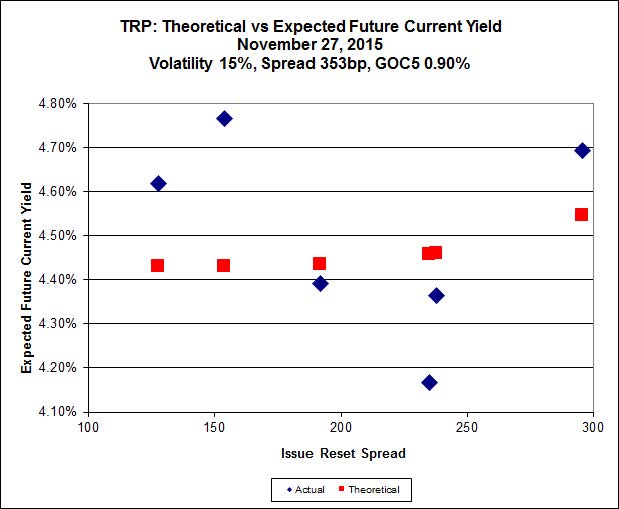
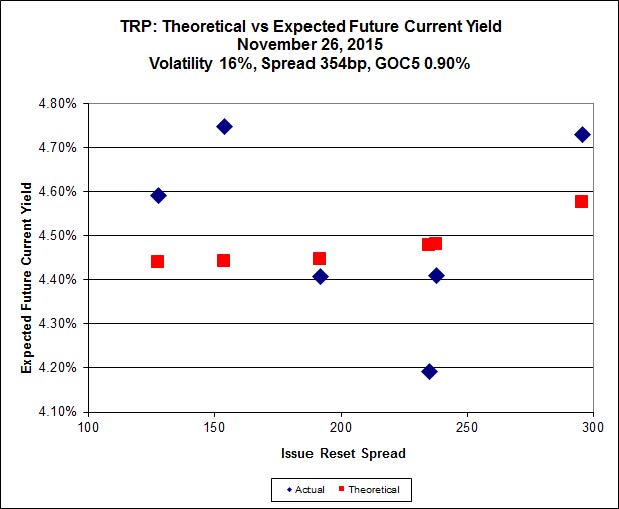
Here’s TRP:

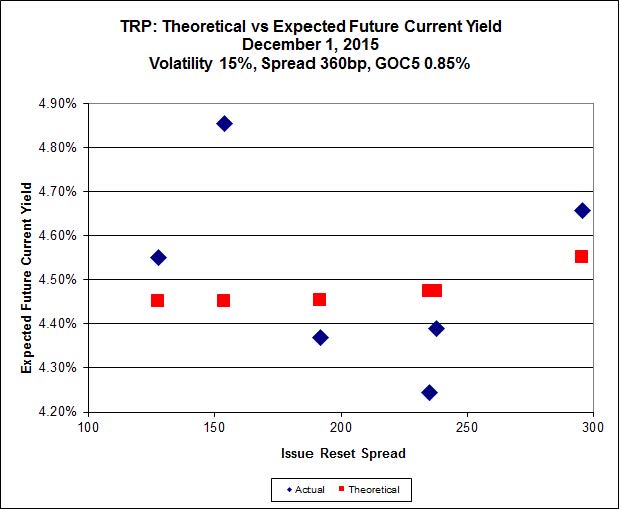
impVol_TRP_150610
Click for Big

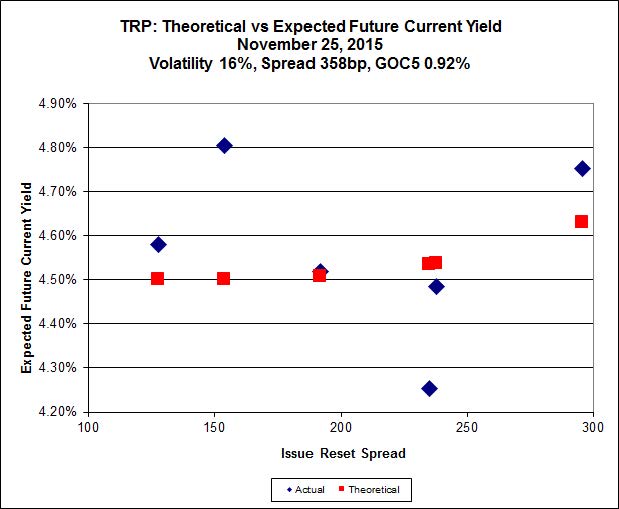
TRP.PR.E, which resets 2019-10-30 at +235, is bid at 23.52 to be $1.19 rich, while TRP.PR.B, which will reset June 30 at 2.152% (+128), is $0.85 cheap at its bid price of 14.60

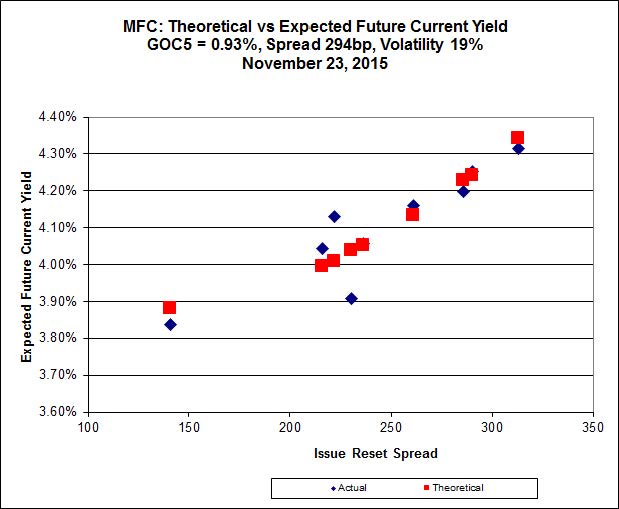
impVol_MFC_150610
Click for Big

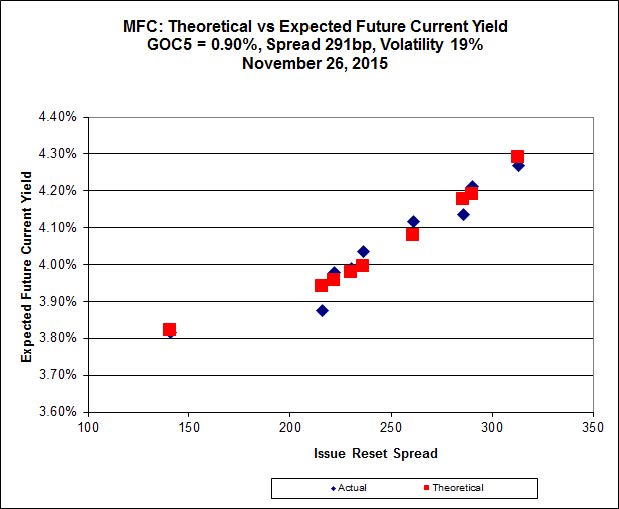
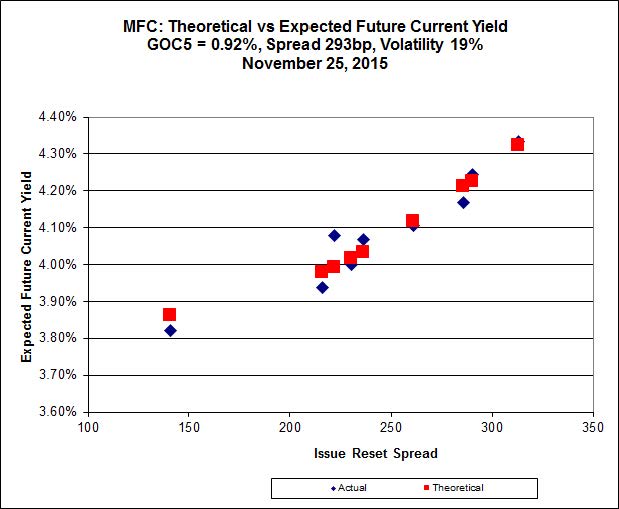
Another excellent fit, but the numbers are perplexing. Implied Volatility for MFC continues to be a conundrum. It is still too high if we consider that NVCC rules will never apply to these issues; it is still too low if we consider them to be NVCC non-compliant issues (and therefore with Deemed Maturities in the call schedule). It is clear that the lowest spread issue, MFC.PR.F, is well off the relationship defined by the other issues, but this doesn’t resolve the conundrum – it just makes it more conundrous.

Most expensive is MFC.PR.L, resetting at +216bp on 2019-6-19, bid at 23.27 to be $0.63 rich, while MFC.PR.H, resetting at +313bp on 2017-3-19, is bid at 25.46 to be $0.54 cheap.

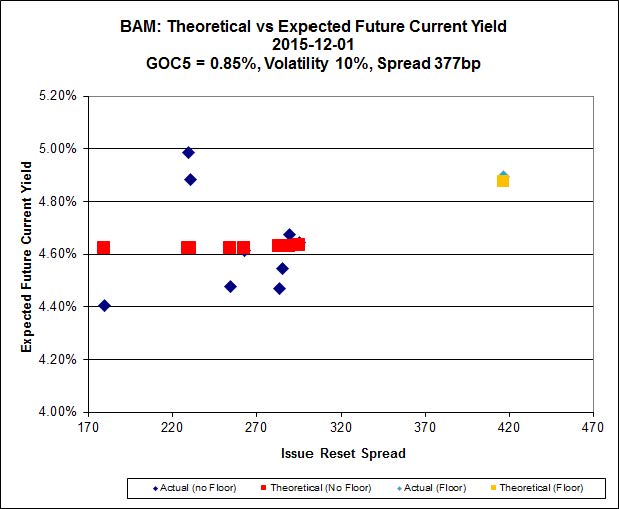
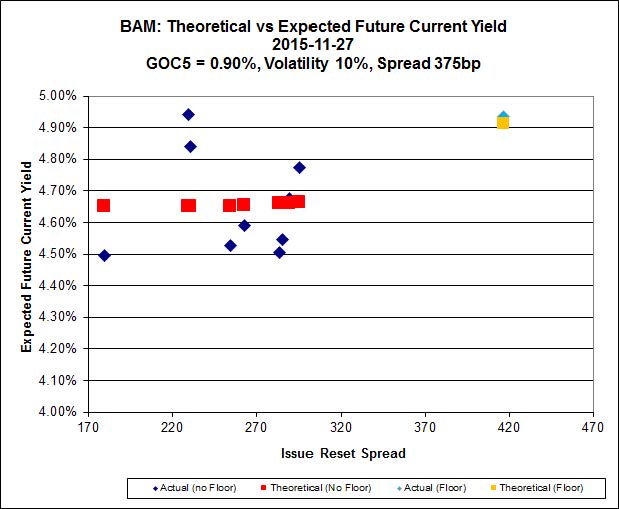
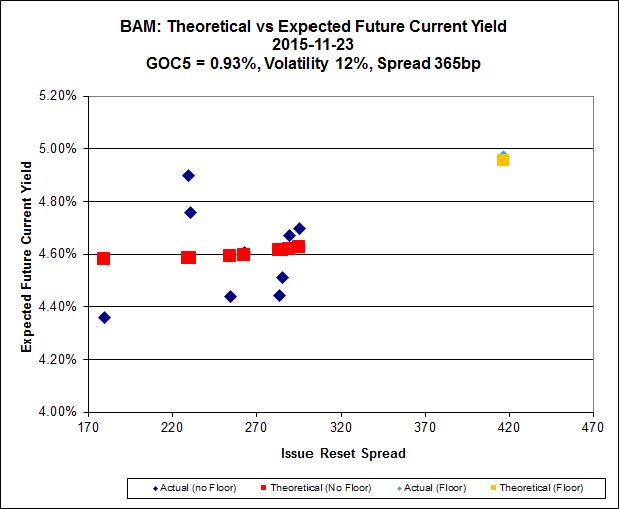
impVol_BAM_150610
Click for Big

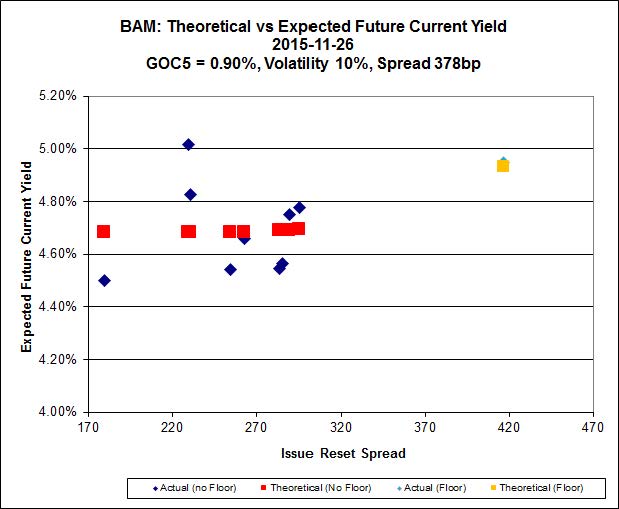
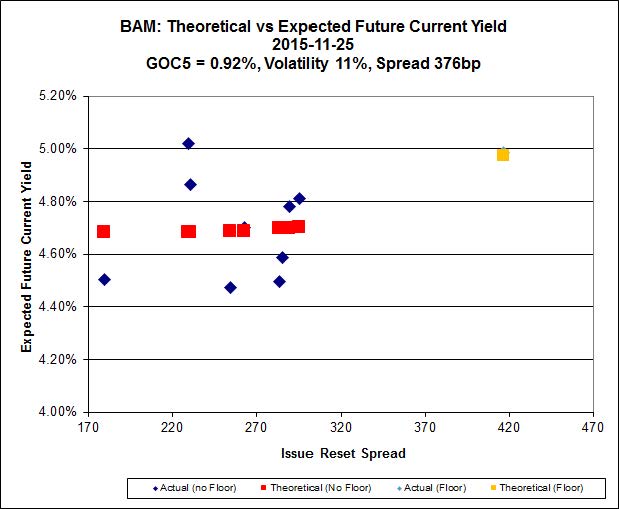
The cheapest issue relative to its peers is BAM.PF.B, resetting at +263bp on 2019-3-31, bid at 22.73 to be $0.42 cheap. BAM.PF.G, resetting at +284bp 2020-6-30 is bid at 24.88 and appears to be $0.70 rich.

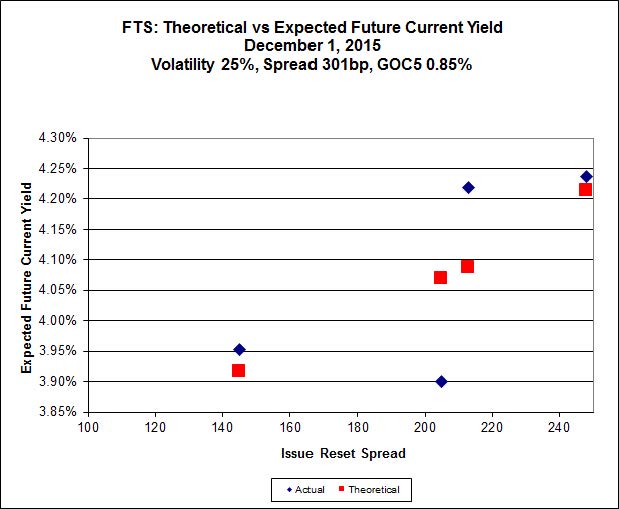
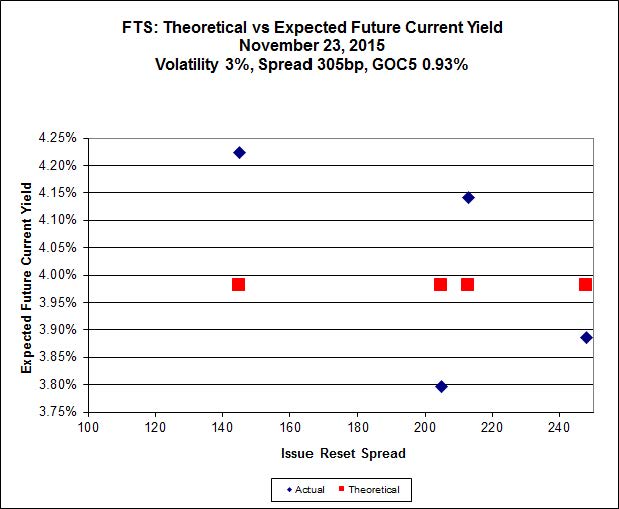
impVol_FTS_150610
Click for Big

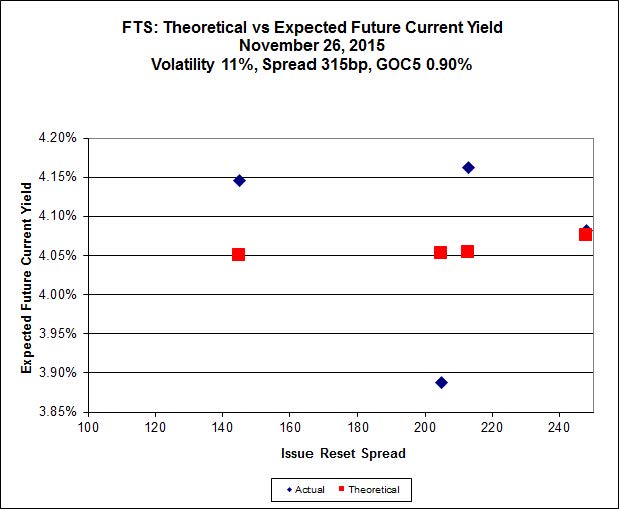
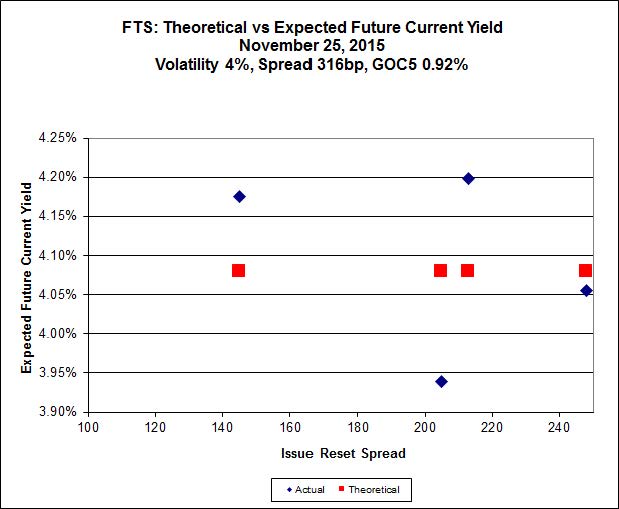
FTS.PR.H, with a spread of +145bp, and bid at 16.20, looks $0.89 cheap and resets 2020-6-1. FTS.PR.M, with a spread of +248bp and resetting 2019-12-1, is bid at 24.40 and is $0.35 rich.

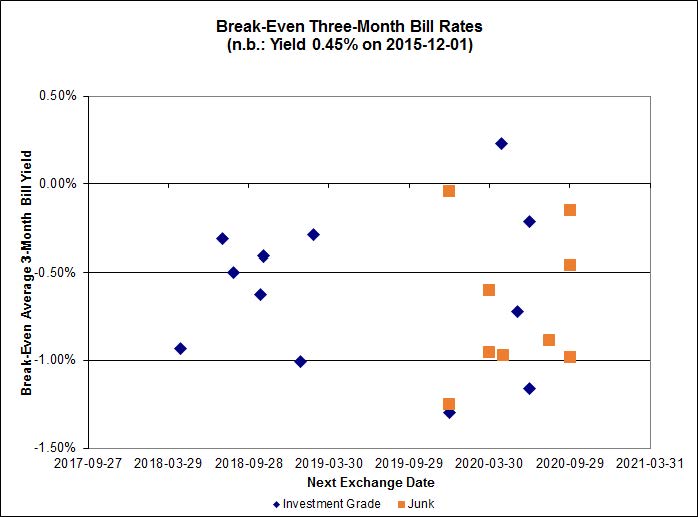
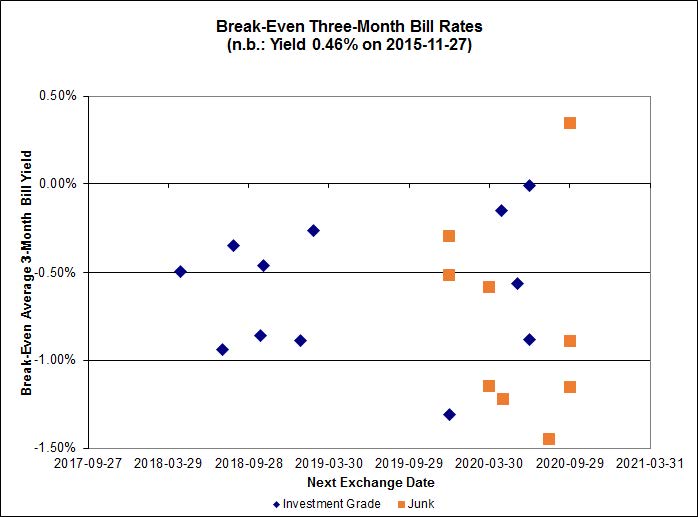
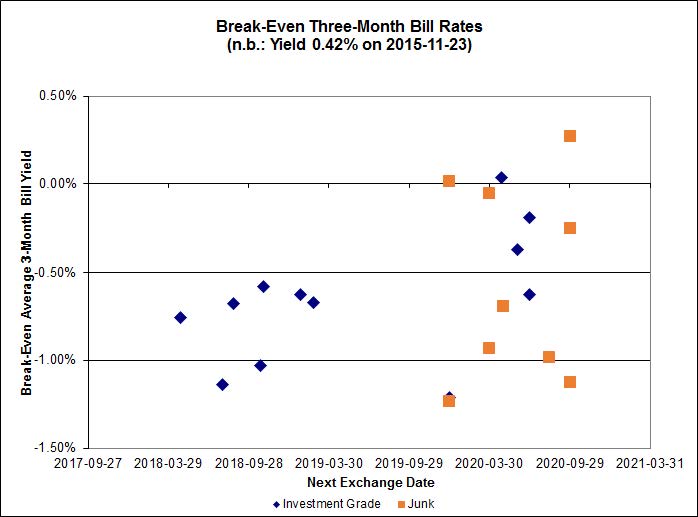
pairs_FR_150610
Click for Big

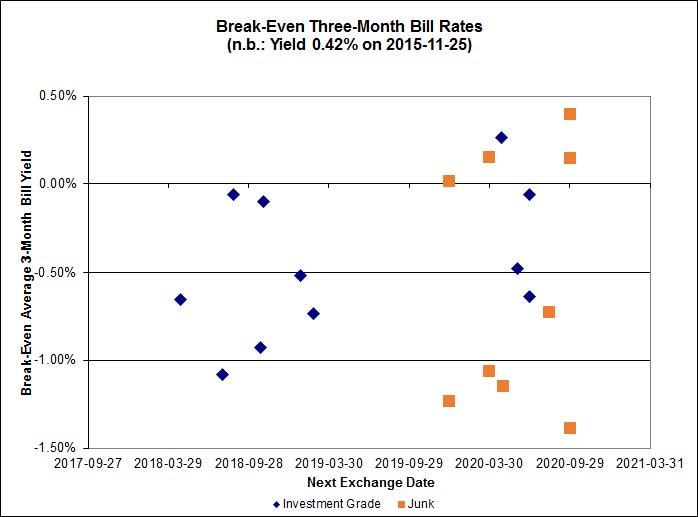
Investment-grade pairs predict an average three-month bill yield over the next five-odd years of about 0.45%, with no ridiculous outliers. On the junk side, four out of the six pairs are outside the range of the graph: FFH.PR.E / FFH.PR.F at -1.22%; AIM.PR.A / AIM.PR.B at -0.09%; BRF.PR.A / BRF.PR.B at -0.48%; and DC.PR.B / DC.PR.D at -1.37%.

pairs_FF_150610
Click for Big

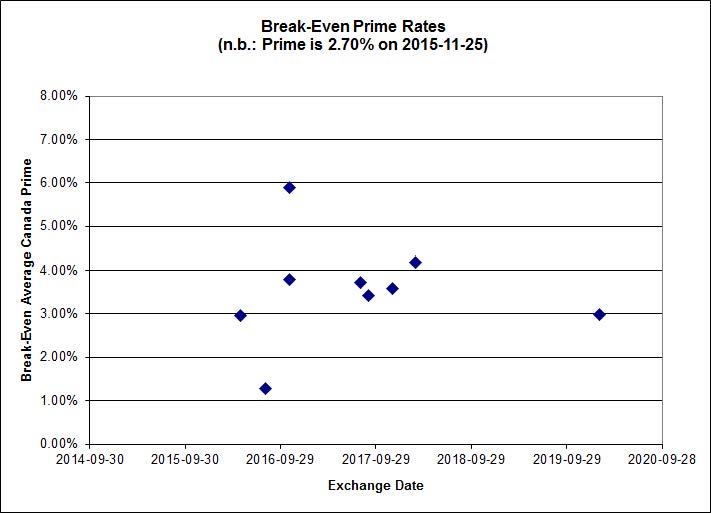
Shall we just say that this exhibits a high level of confidence in the continued rapacity of Canadian banks?

HIMIPref™ Preferred Indices
These values reflect the December 2008 revision of the HIMIPref™ Indices

Values are provisional and are finalized monthly
Index Mean
Current
Yield
(at bid)
Median
YTW
Median
Average
Trading
Value
Median
Mod Dur
(YTW)
Issues Day’s Perf. Index Value
Ratchet 0.00 % 0.00 % 0 0.00 0 -0.0233 % 2,197.4
FixedFloater 0.00 % 0.00 % 0 0.00 0 -0.0233 % 3,842.1
Floater 3.49 % 3.54 % 60,205 18.35 3 -0.0233 % 2,336.0
OpRet 4.44 % -12.44 % 28,675 0.08 2 0.0000 % 2,782.9
SplitShare 4.60 % 4.86 % 71,862 3.30 3 -0.1073 % 3,241.4
Interest-Bearing 0.00 % 0.00 % 0 0.00 0 0.0000 % 2,544.7
Perpetual-Premium 5.46 % 4.86 % 62,784 4.94 19 0.1495 % 2,513.3
Perpetual-Discount 5.07 % 5.09 % 113,344 15.34 15 0.0056 % 2,762.0
FixedReset 4.47 % 3.86 % 248,669 16.46 87 -0.1460 % 2,366.4
Deemed-Retractible 5.01 % 3.33 % 110,958 0.70 34 0.0597 % 2,620.4
FloatingReset 2.50 % 2.89 % 56,762 6.13 9 0.4783 % 2,341.4
Performance Highlights
Issue Index Change Notes
ENB.PF.A FixedReset -2.68 % YTW SCENARIO
Maturity Type : Limit Maturity
Maturity Date : 2045-06-10
Maturity Price : 19.95
Evaluated at bid price : 19.95
Bid-YTW : 4.87 %
FTS.PR.K FixedReset -2.31 % YTW SCENARIO
Maturity Type : Limit Maturity
Maturity Date : 2045-06-10
Maturity Price : 21.15
Evaluated at bid price : 21.15
Bid-YTW : 3.85 %
BAM.PR.K Floater -2.11 % YTW SCENARIO
Maturity Type : Limit Maturity
Maturity Date : 2045-06-10
Maturity Price : 13.93
Evaluated at bid price : 13.93
Bid-YTW : 3.62 %
ENB.PF.G FixedReset -2.04 % YTW SCENARIO
Maturity Type : Limit Maturity
Maturity Date : 2045-06-10
Maturity Price : 20.16
Evaluated at bid price : 20.16
Bid-YTW : 4.87 %
ENB.PR.J FixedReset -1.68 % YTW SCENARIO
Maturity Type : Limit Maturity
Maturity Date : 2045-06-10
Maturity Price : 19.86
Evaluated at bid price : 19.86
Bid-YTW : 4.76 %
MFC.PR.N FixedReset -1.43 % YTW SCENARIO
Maturity Type : Hard Maturity
Maturity Date : 2025-01-31
Maturity Price : 25.00
Evaluated at bid price : 23.51
Bid-YTW : 4.34 %
ENB.PF.E FixedReset -1.37 % YTW SCENARIO
Maturity Type : Limit Maturity
Maturity Date : 2045-06-10
Maturity Price : 20.12
Evaluated at bid price : 20.12
Bid-YTW : 4.85 %
SLF.PR.G FixedReset -1.17 % YTW SCENARIO
Maturity Type : Hard Maturity
Maturity Date : 2025-01-31
Maturity Price : 25.00
Evaluated at bid price : 16.11
Bid-YTW : 7.75 %
BMO.PR.W FixedReset -1.06 % YTW SCENARIO
Maturity Type : Limit Maturity
Maturity Date : 2045-06-10
Maturity Price : 22.45
Evaluated at bid price : 23.25
Bid-YTW : 3.57 %
TRP.PR.G FixedReset 1.06 % YTW SCENARIO
Maturity Type : Limit Maturity
Maturity Date : 2045-06-10
Maturity Price : 23.07
Evaluated at bid price : 24.81
Bid-YTW : 3.86 %
BAM.PR.X FixedReset 1.33 % YTW SCENARIO
Maturity Type : Limit Maturity
Maturity Date : 2045-06-10
Maturity Price : 18.28
Evaluated at bid price : 18.28
Bid-YTW : 4.21 %
BAM.PR.B Floater 1.52 % YTW SCENARIO
Maturity Type : Limit Maturity
Maturity Date : 2045-06-10
Maturity Price : 14.66
Evaluated at bid price : 14.66
Bid-YTW : 3.44 %
BAM.PF.E FixedReset 1.77 % YTW SCENARIO
Maturity Type : Limit Maturity
Maturity Date : 2045-06-10
Maturity Price : 22.29
Evaluated at bid price : 23.00
Bid-YTW : 4.13 %
BAM.PF.G FixedReset 2.60 % YTW SCENARIO
Maturity Type : Limit Maturity
Maturity Date : 2045-06-10
Maturity Price : 23.12
Evaluated at bid price : 24.88
Bid-YTW : 3.99 %
FTS.PR.I FloatingReset 3.90 % YTW SCENARIO
Maturity Type : Limit Maturity
Maturity Date : 2045-06-10
Maturity Price : 16.00
Evaluated at bid price : 16.00
Bid-YTW : 3.22 %
Volume Highlights
Issue Index Shares
Traded
Notes
BNS.PR.M Deemed-Retractible 142,980 Nesbitt crossed 28,800 at 25.47, then another 109,200 at 25.49.
YTW SCENARIO
Maturity Type : Call
Maturity Date : 2015-07-27
Maturity Price : 25.25
Evaluated at bid price : 25.45
Bid-YTW : 2.18 %
RY.PR.A Deemed-Retractible 139,529 RBC crossed 50,000 at 25.18; Nesbitt crossed 85,000 at 25.23.
YTW SCENARIO
Maturity Type : Call
Maturity Date : 2015-07-10
Maturity Price : 25.00
Evaluated at bid price : 25.21
Bid-YTW : -3.21 %
TD.PF.C FixedReset 98,165 Desjardins crossed 95,000 at 23.05.
YTW SCENARIO
Maturity Type : Limit Maturity
Maturity Date : 2045-06-10
Maturity Price : 22.30
Evaluated at bid price : 23.00
Bid-YTW : 3.66 %
GWO.PR.Q Deemed-Retractible 65,906 Nesbitt crossed 62,000 at 25.05.
YTW SCENARIO
Maturity Type : Hard Maturity
Maturity Date : 2025-01-31
Maturity Price : 25.00
Evaluated at bid price : 25.00
Bid-YTW : 5.14 %
RY.PR.N Perpetual-Discount 63,295 Recent new issue.
YTW SCENARIO
Maturity Type : Limit Maturity
Maturity Date : 2045-06-10
Maturity Price : 24.55
Evaluated at bid price : 24.94
Bid-YTW : 4.92 %
GWO.PR.I Deemed-Retractible 55,410 Nesbitt crossed 54,600 at 22.86.
YTW SCENARIO
Maturity Type : Hard Maturity
Maturity Date : 2025-01-31
Maturity Price : 25.00
Evaluated at bid price : 22.81
Bid-YTW : 5.69 %
There were 38 other index-included issues trading in excess of 10,000 shares.
Wide Spread Highlights
Issue Index Quote Data and Yield Notes
BAM.PR.K Floater Quote: 13.93 – 14.51
Spot Rate : 0.5800
Average : 0.3775

YTW SCENARIO
Maturity Type : Limit Maturity
Maturity Date : 2045-06-10
Maturity Price : 13.93
Evaluated at bid price : 13.93
Bid-YTW : 3.62 %

MFC.PR.M FixedReset Quote: 23.90 – 24.40
Spot Rate : 0.5000
Average : 0.3374

YTW SCENARIO
Maturity Type : Hard Maturity
Maturity Date : 2025-01-31
Maturity Price : 25.00
Evaluated at bid price : 23.90
Bid-YTW : 4.21 %

VNR.PR.A FixedReset Quote: 23.71 – 24.28
Spot Rate : 0.5700
Average : 0.4250

YTW SCENARIO
Maturity Type : Limit Maturity
Maturity Date : 2045-06-10
Maturity Price : 22.94
Evaluated at bid price : 23.71
Bid-YTW : 4.11 %

IFC.PR.C FixedReset Quote: 24.20 – 24.59
Spot Rate : 0.3900
Average : 0.2988

YTW SCENARIO
Maturity Type : Hard Maturity
Maturity Date : 2025-01-31
Maturity Price : 25.00
Evaluated at bid price : 24.20
Bid-YTW : 4.28 %

TRP.PR.C FixedReset Quote: 16.60 – 16.97
Spot Rate : 0.3700
Average : 0.2929

YTW SCENARIO
Maturity Type : Limit Maturity
Maturity Date : 2045-06-10
Maturity Price : 16.60
Evaluated at bid price : 16.60
Bid-YTW : 3.98 %

ENB.PR.B FixedReset Quote: 18.31 – 18.62
Spot Rate : 0.3100
Average : 0.2395

YTW SCENARIO
Maturity Type : Limit Maturity
Maturity Date : 2045-06-10
Maturity Price : 18.31
Evaluated at bid price : 18.31
Bid-YTW : 4.79 %

Market Action

June 9, 2015

There’s an interesting trend in US bank accounting:

Big U.S. banks have been shifting huge chunks of their securities portfolios from AFS to HTM as they seek to offset the coming impact of a rate rise. Bloomberg News reported last year that the share of securities that the five biggest banks keep in the HTM bucket jumped to 8.4 percent, the highest in almost two decades. The trend appears to have accelerated in the ensuing months, with almost a third of the MBS on bank balance sheets now classified as HTM, according to new research from JPMorgan.

As JPMorgan analysts note: “… [B]anks have shifted nearly a third of their MBS into HTM accounts, thanks to concern about capital volatility driven by recent regulatory changes. This means that banks should ultimately be less sensitive to rate moves, since fewer securities are being marked to market.” The shift makes some sense in the face of declining bank profit margins and the need to hold more lower-yielding assets that are considered super-liquid under other new banking rules.

Buying longer duration MBS and then stuffing them in HTM portfolios can help banks offset some of the lower returns on offer from investing in things such as shorter-term U.S. Treasuries.

HTMMBS
Click for Big

It is interesting that the freeze on trading implied by Hold-to-Maturity status for these liquidity buffers will make MBS less liquid as a group; this is just another one of the inherent contradictions of capitalism.

Matt Levine explains:

If you own that bond for investment purposes, and you don’t have any “intent of selling it within hours or days,” you have an investment loss on paper, but you get to treat it a bit more gently. (This is called “available for sale,” or AFS.) The loss doesn’t flow through your net income; instead it flows through a different place called “other comprehensive income,” and everyone agrees to treat that as somewhat less important than net income.3 Everyone except Basel III bank capital regulation: Last year, regulators ungallantly decided to require you to treat those unrealized investment losses as reducing your capital.

If you have the “positive intent and ability” to hold the bond until it matures, then you can just ignore the economic loss until maturity. (This is called “held to maturity,” or HTM.) You just keep the bond on your books at the price you paid for it,[4] and at maturity you get back par and your loss vanishes.5 You ignore the loss in net income, other comprehensive income, your balance sheet, your capital, whatever.

Footnote 4: Amortized cost, but let’s not split hairs

Footnote 5: Which makes a sort of sense: If you never sell the bond in the market, you never realize the loss in the form of getting fewer dollars for your bond than you paid for it. Your loss becomes just an opportunity cost: Instead of getting 5 percent interest and your money back, you got 4 percent interest and your money back. But you got your money back. Everything is fine.

So it would seem that banks are now doing with long-term MBS what retail loves to do with GICs – carry the position at historical cost and blithely ignore market marks.

So, as Mr. Levine points out, one immediate problem is:

First, one reaction to a rising interest rate environment might be to reduce one’s holdings of long-dated fixed-income securities. One might say “hmm, I should maybe sell my trillions of dollars of very liquid Fannie Mae bonds that I expect to lose value in the next few years.” Or not, I mean, I’m not advising anyone to predict the timing of interest rate rises. The point is though that banks seem to be reacting to their expectations of rising interest rates with the opposite of the economically rational strategy: Not “sell bonds to avoid losses later,” but rather “reclassify bonds as hold-forever to avoid recognizing losses later.” The accounting provides opposite incentives from the economics.

Another obvious problem is that, in a scenario of higher interest rates, there will be a good chunk of unrealized and unrecognized losses on the books. Therefore, in a crisis when bank investors change their valuation paradigm from ‘going-concern’ to ‘break-up value’ we might just see some problems!

As we’ve learned in Ontario with respect to gender quotas on boards of public companies, protecting the interests of investors is BORING. So US regulatory agencies have now become soldiers in the great battle of social change:

The OCC, Board, FDIC, NCUA, CFPB, and SEC are issuing a final interagency policy statement establishing joint standards for assessing the diversity policies and practices of the entities they regulate, as required by the Dodd-Frank Wall Street Reform and Consumer Protection Act of 2010.

My favourite part is:

In addition, entities’ prime contractors often use subcontractors to fulfill the obligations of various contracts. The use of minority-owned and women-owned businesses as subcontractors provides valuable opportunities for both the minority-owned and women-owned businesses and the prime contractor. Entities may encourage the use of minority-owned and women-owned subcontractors by incorporating this objective in their business contracts.

Just like South Africa, that paragon of economic development!

SEC Commissioner Luis A. Aguilar doesn’t like it:

For example, the Final Policy Statement fails to address the following concerns raised by commenters:

  • • First, that allowing the voluntary disclosure of information by regulated entities is prohibited under Section 342 of the Dodd-Frank Act because it renders the statute ineffective and fails to achieve the Congressional intent of advancing diversity in the financial services industry.
  • • Second, that voluntary self-assessments are ineffective because, without specific obligations and requirements, few regulated entities will conduct assessments or share assessment information.
  • • Third, that failing to include standard criteria and uniform metrics for assessing the diversity and inclusion practices at regulated entities will make it very difficult, if not impossible, to assess diversity at different firms.
  • • Fourth, that a purely voluntary requirement, and one without a reporting timeline, lacks transparency and accountability. Firms can therefore decide not to conduct any assessment and treat any OMWI oversight as optional or irrelevant.
  • • Fifth, that OMWI would fail to satisfy its Congressional mandate under Section 342 by simply monitoring voluntary reports that may or may not be filed by regulated entities.
  • • Finally, that a definition of “diversity” that is too narrow would fail to accomplish the goals of Section 342. In fact, the Final Policy Statement’s definition of “diversity” excludes people with disabilities and excludes the entire LGBT community.

It was a mostly negative day for the Canadian preferred share market, with PerpetualDiscounts gaining 2bp, FixedResets down 27bp and DeemedRetractibles off 26bp. The Performance Highlights table is fairly lengthy, with a mixed bag of entries, mostly losers. Volume was average.

But, I mean, Holy Smokes! Here’s a picture of CPD total returns for the past month. Don’t these damn things ever go up?

CPD_1Mo_150609A
Click for Big

For as long as the FixedReset market is so violently unsettled, I’ll keep publishing updates of the more interesting and meaningful series of FixedResets’ Implied Volatilities. This doesn’t include Enbridge because although Enbridge has a large number of issues outstanding, all of which are quite liquid, the range of Issue Reset Spreads is too small for decent conclusions. The low is 212bp (ENB.PR.H; second-lowest is ENB.PR.D at 237bp) and the high is a mere 268 for ENB.PF.G.

Remember that all rich /cheap assessments are:
» based on Implied Volatility Theory only
» are relative only to other FixedResets from the same issuer
» assume constant GOC-5 yield
» assume constant Implied Volatility
» assume constant spread

Here’s TRP:

impVol_TRP_150609A
Click for Big

TRP.PR.E, which resets 2019-10-30 at +235, is bid at 23.50 to be $1.21 rich, while TRP.PR.B, which will reset June 30 at 2.152% (+128), is $0.71 cheap at its bid price of 14.73

impVol_MFC_150609
Click for Big

Another excellent fit, but the numbers are perplexing. Implied Volatility for MFC continues to be a conundrum. It is still too high if we consider that NVCC rules will never apply to these issues; it is still too low if we consider them to be NVCC non-compliant issues (and therefore with Deemed Maturities in the call schedule). It is clear that the lowest spread issue, MFC.PR.F, is well off the relationship defined by the other issues, but this doesn’t resolve the conundrum – it just makes it more conundrous.

Most expensive is MFC.PR.M, resetting at +236bp on 2019-12-19, bid at 24.10 to be $0.49 rich, while MFC.PR.F, resetting at +141bp on 2016-6-19, is bid at 25.00 to be $0.50 cheap.

impVol_BAM_150609
Click for Big

The cheapest issue relative to its peers is BAM.PR.R, resetting at +230bp on 2016-6-30, bid at 21.00 to be $0.20 cheap. BAM.PR.T, resetting at +231bp 2017-3-31 is bid at 21.50 and appears to be $0.24 rich.

impVol_FTS_150609
Click for Big

FTS.PR.H, with a spread of +145bp, and bid at 16.15, looks $0.99 cheap and resets 2020-6-1. FTS.PR.K, with a spread of +205bp and resetting 2019-3-1, is bid at 21.65 and is $0.41 rich.

pairs_FR_150609
Click for Big

Investment-grade pairs predict an average three-month bill yield over the next five-odd years of about 0.45%, with no ridiculous outliers now that the awful performance of FTS.PR.I today has brought the FTS.PR.H / FTS.PR.I pair into the fold. On the junk side, five out of the six pairs are outside the range of the graph: FFH.PR.E / FFH.PR.F at -1.23%; AIM.PR.A / AIM.PR.B at -0.41%; BRF.PR.A / BRF.PR.B at -0.36%; DC.PR.B / DC.PR.D at -0.47%; and FFH.PR.C / FFH.PR.D at +1.14%.

pairs_FF_150609
Click for Big

Shall we just say that this exhibits a high level of confidence in the continued rapacity of Canadian banks?

HIMIPref™ Preferred Indices
These values reflect the December 2008 revision of the HIMIPref™ Indices

Values are provisional and are finalized monthly
Index Mean
Current
Yield
(at bid)
Median
YTW
Median
Average
Trading
Value
Median
Mod Dur
(YTW)
Issues Day’s Perf. Index Value
Ratchet 0.00 % 0.00 % 0 0.00 0 -0.2793 % 2,198.0
FixedFloater 0.00 % 0.00 % 0 0.00 0 -0.2793 % 3,843.0
Floater 3.49 % 3.54 % 61,028 18.34 3 -0.2793 % 2,336.6
OpRet 4.44 % -12.59 % 28,214 0.08 2 0.0988 % 2,782.9
SplitShare 4.59 % 4.78 % 70,975 3.31 3 -0.2142 % 3,244.9
Interest-Bearing 0.00 % 0.00 % 0 0.00 0 0.0988 % 2,544.7
Perpetual-Premium 5.47 % 5.09 % 63,766 4.25 19 -0.0270 % 2,509.6
Perpetual-Discount 5.07 % 5.05 % 112,689 15.40 15 0.0197 % 2,761.9
FixedReset 4.47 % 3.87 % 250,660 16.34 87 -0.2703 % 2,369.9
Deemed-Retractible 5.01 % 3.41 % 108,469 0.70 34 -0.2597 % 2,618.8
FloatingReset 2.51 % 2.90 % 57,234 6.13 9 -0.1280 % 2,330.3
Performance Highlights
Issue Index Change Notes
FTS.PR.I FloatingReset -3.14 % YTW SCENARIO
Maturity Type : Limit Maturity
Maturity Date : 2045-06-09
Maturity Price : 15.40
Evaluated at bid price : 15.40
Bid-YTW : 3.34 %
MFC.PR.L FixedReset -2.65 % YTW SCENARIO
Maturity Type : Hard Maturity
Maturity Date : 2025-01-31
Maturity Price : 25.00
Evaluated at bid price : 23.12
Bid-YTW : 4.48 %
BAM.PF.G FixedReset -2.10 % YTW SCENARIO
Maturity Type : Limit Maturity
Maturity Date : 2045-06-09
Maturity Price : 22.88
Evaluated at bid price : 24.25
Bid-YTW : 4.12 %
GWO.PR.I Deemed-Retractible -1.95 % YTW SCENARIO
Maturity Type : Hard Maturity
Maturity Date : 2025-01-31
Maturity Price : 25.00
Evaluated at bid price : 22.66
Bid-YTW : 5.77 %
GWO.PR.R Deemed-Retractible -1.84 % YTW SCENARIO
Maturity Type : Hard Maturity
Maturity Date : 2025-01-31
Maturity Price : 25.00
Evaluated at bid price : 23.95
Bid-YTW : 5.36 %
NA.PR.W FixedReset -1.71 % YTW SCENARIO
Maturity Type : Limit Maturity
Maturity Date : 2045-06-09
Maturity Price : 22.61
Evaluated at bid price : 23.60
Bid-YTW : 3.56 %
CM.PR.O FixedReset -1.67 % YTW SCENARIO
Maturity Type : Limit Maturity
Maturity Date : 2045-06-09
Maturity Price : 22.63
Evaluated at bid price : 23.55
Bid-YTW : 3.64 %
HSE.PR.E FixedReset -1.59 % YTW SCENARIO
Maturity Type : Limit Maturity
Maturity Date : 2045-06-09
Maturity Price : 23.11
Evaluated at bid price : 24.80
Bid-YTW : 4.50 %
MFC.PR.B Deemed-Retractible -1.51 % YTW SCENARIO
Maturity Type : Hard Maturity
Maturity Date : 2025-01-31
Maturity Price : 25.00
Evaluated at bid price : 22.80
Bid-YTW : 5.87 %
TRP.PR.C FixedReset -1.42 % YTW SCENARIO
Maturity Type : Limit Maturity
Maturity Date : 2045-06-09
Maturity Price : 16.63
Evaluated at bid price : 16.63
Bid-YTW : 3.98 %
PWF.PR.P FixedReset -1.35 % YTW SCENARIO
Maturity Type : Limit Maturity
Maturity Date : 2045-06-09
Maturity Price : 18.30
Evaluated at bid price : 18.30
Bid-YTW : 3.72 %
HSE.PR.C FixedReset -1.06 % YTW SCENARIO
Maturity Type : Limit Maturity
Maturity Date : 2045-06-09
Maturity Price : 22.94
Evaluated at bid price : 24.32
Bid-YTW : 4.27 %
ENB.PF.G FixedReset -1.06 % YTW SCENARIO
Maturity Type : Limit Maturity
Maturity Date : 2045-06-09
Maturity Price : 20.58
Evaluated at bid price : 20.58
Bid-YTW : 4.76 %
POW.PR.G Perpetual-Premium 1.25 % YTW SCENARIO
Maturity Type : Call
Maturity Date : 2021-04-15
Maturity Price : 25.00
Evaluated at bid price : 25.89
Bid-YTW : 5.09 %
MFC.PR.F FixedReset 2.42 % YTW SCENARIO
Maturity Type : Hard Maturity
Maturity Date : 2025-01-31
Maturity Price : 25.00
Evaluated at bid price : 18.20
Bid-YTW : 6.47 %
GWO.PR.N FixedReset 3.50 % YTW SCENARIO
Maturity Type : Hard Maturity
Maturity Date : 2025-01-31
Maturity Price : 25.00
Evaluated at bid price : 17.45
Bid-YTW : 6.73 %
Volume Highlights
Issue Index Shares
Traded
Notes
BMO.PR.Y FixedReset 116,300 Recent new issue.
YTW SCENARIO
Maturity Type : Limit Maturity
Maturity Date : 2045-06-09
Maturity Price : 23.04
Evaluated at bid price : 24.68
Bid-YTW : 3.69 %
BMO.PR.S FixedReset 85,217 Desjardins crossed blocks of 50,000 and 20,000, both at 24.45.
YTW SCENARIO
Maturity Type : Limit Maturity
Maturity Date : 2045-06-09
Maturity Price : 22.98
Evaluated at bid price : 24.28
Bid-YTW : 3.50 %
FTS.PR.M FixedReset 77,297 RBC crossed 74,000 at 24.40.
YTW SCENARIO
Maturity Type : Limit Maturity
Maturity Date : 2045-06-09
Maturity Price : 22.98
Evaluated at bid price : 24.40
Bid-YTW : 3.63 %
RY.PR.N Perpetual-Discount 72,757 Recent new issue.
YTW SCENARIO
Maturity Type : Limit Maturity
Maturity Date : 2045-06-09
Maturity Price : 24.52
Evaluated at bid price : 24.91
Bid-YTW : 4.93 %
RY.PR.F Deemed-Retractible 71,310 Desjardins crossed two blocks of 34,000 each, both at 25.35.
YTW SCENARIO
Maturity Type : Call
Maturity Date : 2015-07-09
Maturity Price : 25.25
Evaluated at bid price : 25.35
Bid-YTW : 1.93 %
BAM.PR.R FixedReset 58,306 RBC crossed 50,000 at 21.00.
YTW SCENARIO
Maturity Type : Limit Maturity
Maturity Date : 2045-06-09
Maturity Price : 21.00
Evaluated at bid price : 21.00
Bid-YTW : 4.17 %
There were 31 other index-included issues trading in excess of 10,000 shares.
Wide Spread Highlights
Issue Index Quote Data and Yield Notes
GWO.PR.S Deemed-Retractible Quote: 26.05 – 27.00
Spot Rate : 0.9500
Average : 0.6415

YTW SCENARIO
Maturity Type : Hard Maturity
Maturity Date : 2025-01-31
Maturity Price : 25.00
Evaluated at bid price : 26.05
Bid-YTW : 4.69 %

BAM.PF.G FixedReset Quote: 24.25 – 24.81
Spot Rate : 0.5600
Average : 0.3198

YTW SCENARIO
Maturity Type : Limit Maturity
Maturity Date : 2045-06-09
Maturity Price : 22.88
Evaluated at bid price : 24.25
Bid-YTW : 4.12 %

MFC.PR.F FixedReset Quote: 18.20 – 18.90
Spot Rate : 0.7000
Average : 0.4866

YTW SCENARIO
Maturity Type : Hard Maturity
Maturity Date : 2025-01-31
Maturity Price : 25.00
Evaluated at bid price : 18.20
Bid-YTW : 6.47 %

MFC.PR.B Deemed-Retractible Quote: 22.80 – 23.21
Spot Rate : 0.4100
Average : 0.2504

YTW SCENARIO
Maturity Type : Hard Maturity
Maturity Date : 2025-01-31
Maturity Price : 25.00
Evaluated at bid price : 22.80
Bid-YTW : 5.87 %

MFC.PR.L FixedReset Quote: 23.12 – 23.43
Spot Rate : 0.3100
Average : 0.1932

YTW SCENARIO
Maturity Type : Hard Maturity
Maturity Date : 2025-01-31
Maturity Price : 25.00
Evaluated at bid price : 23.12
Bid-YTW : 4.48 %

CM.PR.O FixedReset Quote: 23.55 – 23.90
Spot Rate : 0.3500
Average : 0.2425

YTW SCENARIO
Maturity Type : Limit Maturity
Maturity Date : 2045-06-09
Maturity Price : 22.63
Evaluated at bid price : 23.55
Bid-YTW : 3.64 %

Market Action

June 8, 2015

Nothing happened today … well, equities got banged up.

It was a poor day for the Canadian preferred share market, with PerpetualDiscounts off 3bp, FixedResets losing 25bp and DeemedRetractibles down 11bp. The lengthy Performance Highlights table is dominated by losing FixedResets. Volume was low.

For as long as the FixedReset market is so violently unsettled, I’ll keep publishing updates of the more interesting and meaningful series of FixedResets’ Implied Volatilities. This doesn’t include Enbridge because although Enbridge has a large number of issues outstanding, all of which are quite liquid, the range of Issue Reset Spreads is too small for decent conclusions. The low is 212bp (ENB.PR.H; second-lowest is ENB.PR.D at 237bp) and the high is a mere 268 for ENB.PF.G.

Remember that all rich /cheap assessments are:
» based on Implied Volatility Theory only
» are relative only to other FixedResets from the same issuer
» assume constant GOC-5 yield
» assume constant Implied Volatility
» assume constant spread

Here’s TRP:

impVol_TRP_150608
Click for Big

TRP.PR.E, which resets 2019-10-30 at +235, is bid at 23.50 to be $1.14 rich, while TRP.PR.B, which will reset June 30 at 2.152% (+128), is $0.62 cheap at its bid price of 14.77

impVol_MFC_150608
Click for Big

Another excellent fit, but the numbers are perplexing. Implied Volatility for MFC continues to be a conundrum. It is still too high if we consider that NVCC rules will never apply to these issues; it is still too low if we consider them to be NVCC non-compliant issues (and therefore with Deemed Maturities in the call schedule). It is clear that the lowest spread issue, MFC.PR.F, is well off the relationship defined by the other issues, but this doesn’t resolve the conundrum – it just makes it more conundrous.

Most expensive is MFC.PR.L, resetting at +216 on 2019-6-19, bid at 23.75 to be $0.94 rich, while MFC.PR.G, resetting at +290bp on 2016-12-19, is bid at 25.00 to be $0.70 cheap.

impVol_BAM_150608
Click for Big

The cheapest issue relative to its peers is BAM.PF.B, resetting at +263bp on 2019-3-31, bid at 22.75 to be $0.40 cheap. BAM.PF.G, resetting at +284bp 2020-6-30 is bid at 24.77 and appears to be $0.50 rich.

impVol_FTS_150608
Click for Big

FTS.PR.H, with a spread of +145bp, and bid at 16.05, looks $1.03 cheap and resets 2020-6-1. FTS.PR.K, with a spread of +205bp and resetting 2019-3-1, is bid at 21.81 and is $0.56 rich.

pairs_FF_150608
Click for Big

Investment-grade pairs predict an average three-month bill yield over the next five-odd years of about 0.45%, including FTS.PR.H / FTS.PR.I at 0.91%. On the junk side, five out of the six pairs are outside the range of the graph: FFH.PR.E / FFH.PR.F at -1.22%; AIM.PR.A / AIM.PR.B at -0.35%; BRF.PR.A / BRF.PR.B at -1.05%; DC.PR.B / DC.PR.D at -0.61%; and FFH.PR.C / FFH.PR.D at +1.24%.

pairs_FFA_150608
Click for Big

Shall we just say that this exhibits a high level of confidence in the continued rapacity of Canadian banks?

HIMIPref™ Preferred Indices
These values reflect the December 2008 revision of the HIMIPref™ Indices

Values are provisional and are finalized monthly
Index Mean
Current
Yield
(at bid)
Median
YTW
Median
Average
Trading
Value
Median
Mod Dur
(YTW)
Issues Day’s Perf. Index Value
Ratchet 0.00 % 0.00 % 0 0.00 0 0.5381 % 2,204.1
FixedFloater 0.00 % 0.00 % 0 0.00 0 0.5381 % 3,853.8
Floater 3.48 % 3.52 % 62,049 18.39 3 0.5381 % 2,343.1
OpRet 4.45 % -10.51 % 28,215 0.08 2 0.0198 % 2,780.2
SplitShare 4.59 % 4.71 % 70,391 3.31 3 0.2012 % 3,251.9
Interest-Bearing 0.00 % 0.00 % 0 0.00 0 0.0198 % 2,542.2
Perpetual-Premium 5.47 % 4.86 % 63,976 3.19 19 -0.2671 % 2,510.3
Perpetual-Discount 5.07 % 5.08 % 113,951 15.36 15 -0.0310 % 2,761.3
FixedReset 4.46 % 3.87 % 259,834 15.87 87 -0.2472 % 2,376.3
Deemed-Retractible 5.00 % 3.36 % 109,184 0.70 34 -0.1059 % 2,625.7
FloatingReset 2.51 % 2.91 % 56,279 6.13 9 -0.1917 % 2,333.3
Performance Highlights
Issue Index Change Notes
GWO.PR.N FixedReset -1.98 % YTW SCENARIO
Maturity Type : Hard Maturity
Maturity Date : 2025-01-31
Maturity Price : 25.00
Evaluated at bid price : 16.86
Bid-YTW : 7.15 %
MFC.PR.F FixedReset -1.82 % YTW SCENARIO
Maturity Type : Hard Maturity
Maturity Date : 2025-01-31
Maturity Price : 25.00
Evaluated at bid price : 17.77
Bid-YTW : 6.77 %
POW.PR.G Perpetual-Premium -1.80 % YTW SCENARIO
Maturity Type : Call
Maturity Date : 2020-04-15
Maturity Price : 25.25
Evaluated at bid price : 25.57
Bid-YTW : 5.47 %
HSE.PR.A FixedReset -1.75 % YTW SCENARIO
Maturity Type : Limit Maturity
Maturity Date : 2045-06-08
Maturity Price : 16.26
Evaluated at bid price : 16.26
Bid-YTW : 4.36 %
IFC.PR.A FixedReset -1.43 % YTW SCENARIO
Maturity Type : Hard Maturity
Maturity Date : 2025-01-31
Maturity Price : 25.00
Evaluated at bid price : 20.75
Bid-YTW : 5.66 %
TD.PF.A FixedReset -1.35 % YTW SCENARIO
Maturity Type : Limit Maturity
Maturity Date : 2045-06-08
Maturity Price : 22.53
Evaluated at bid price : 23.40
Bid-YTW : 3.61 %
GWO.PR.I Deemed-Retractible -1.32 % YTW SCENARIO
Maturity Type : Hard Maturity
Maturity Date : 2025-01-31
Maturity Price : 25.00
Evaluated at bid price : 23.11
Bid-YTW : 5.51 %
TD.PF.B FixedReset -1.31 % YTW SCENARIO
Maturity Type : Limit Maturity
Maturity Date : 2045-06-08
Maturity Price : 22.57
Evaluated at bid price : 23.44
Bid-YTW : 3.59 %
TD.PF.C FixedReset -1.28 % YTW SCENARIO
Maturity Type : Limit Maturity
Maturity Date : 2045-06-08
Maturity Price : 22.41
Evaluated at bid price : 23.20
Bid-YTW : 3.62 %
BAM.PF.A FixedReset -1.17 % YTW SCENARIO
Maturity Type : Limit Maturity
Maturity Date : 2045-06-08
Maturity Price : 23.14
Evaluated at bid price : 24.49
Bid-YTW : 4.08 %
CM.PR.P FixedReset -1.06 % YTW SCENARIO
Maturity Type : Limit Maturity
Maturity Date : 2045-06-08
Maturity Price : 22.46
Evaluated at bid price : 23.30
Bid-YTW : 3.59 %
GWO.PR.H Deemed-Retractible -1.04 % YTW SCENARIO
Maturity Type : Hard Maturity
Maturity Date : 2025-01-31
Maturity Price : 25.00
Evaluated at bid price : 23.85
Bid-YTW : 5.46 %
BAM.PF.F FixedReset -1.01 % YTW SCENARIO
Maturity Type : Limit Maturity
Maturity Date : 2045-06-08
Maturity Price : 23.03
Evaluated at bid price : 24.50
Bid-YTW : 4.06 %
PWF.PR.P FixedReset 1.37 % YTW SCENARIO
Maturity Type : Limit Maturity
Maturity Date : 2045-06-08
Maturity Price : 18.55
Evaluated at bid price : 18.55
Bid-YTW : 3.67 %
SLF.PR.G FixedReset 1.43 % YTW SCENARIO
Maturity Type : Hard Maturity
Maturity Date : 2025-01-31
Maturity Price : 25.00
Evaluated at bid price : 16.35
Bid-YTW : 7.56 %
BAM.PR.K Floater 1.85 % YTW SCENARIO
Maturity Type : Limit Maturity
Maturity Date : 2045-06-08
Maturity Price : 14.31
Evaluated at bid price : 14.31
Bid-YTW : 3.52 %
Volume Highlights
Issue Index Shares
Traded
Notes
BMO.PR.Y FixedReset 187,430 Recent new issue.
YTW SCENARIO
Maturity Type : Limit Maturity
Maturity Date : 2045-06-08
Maturity Price : 23.02
Evaluated at bid price : 24.65
Bid-YTW : 3.70 %
RY.PR.N Perpetual-Discount 121,736 Recent new issue.
YTW SCENARIO
Maturity Type : Limit Maturity
Maturity Date : 2045-06-08
Maturity Price : 24.42
Evaluated at bid price : 24.80
Bid-YTW : 4.95 %
RY.PR.C Deemed-Retractible 53,530 Scotia crossed 33,500 at 25.25; TD crossed 20,000 at the same price.
YTW SCENARIO
Maturity Type : Call
Maturity Date : 2015-11-24
Maturity Price : 25.00
Evaluated at bid price : 25.25
Bid-YTW : 2.82 %
MFC.PR.A OpRet 50,585 Called for redemption effective June 19.
YTW SCENARIO
Maturity Type : Call
Maturity Date : 2015-07-19
Maturity Price : 25.00
Evaluated at bid price : 24.99
Bid-YTW : 3.38 %
BAM.PF.G FixedReset 36,202 RBC crossed 25,000 at 24.80.
YTW SCENARIO
Maturity Type : Limit Maturity
Maturity Date : 2045-06-08
Maturity Price : 23.08
Evaluated at bid price : 24.77
Bid-YTW : 4.01 %
CU.PR.G Perpetual-Discount 31,960 Scotia crossed 30,000 at 22.70.
YTW SCENARIO
Maturity Type : Limit Maturity
Maturity Date : 2045-06-08
Maturity Price : 22.26
Evaluated at bid price : 22.60
Bid-YTW : 4.99 %
There were 19 other index-included issues trading in excess of 10,000 shares.
Wide Spread Highlights
Issue Index Quote Data and Yield Notes
POW.PR.G Perpetual-Premium Quote: 25.57 – 26.31
Spot Rate : 0.7400
Average : 0.5109

YTW SCENARIO
Maturity Type : Call
Maturity Date : 2020-04-15
Maturity Price : 25.25
Evaluated at bid price : 25.57
Bid-YTW : 5.47 %

GWO.PR.N FixedReset Quote: 16.86 – 17.57
Spot Rate : 0.7100
Average : 0.5030

YTW SCENARIO
Maturity Type : Hard Maturity
Maturity Date : 2025-01-31
Maturity Price : 25.00
Evaluated at bid price : 16.86
Bid-YTW : 7.15 %

IFC.PR.A FixedReset Quote: 20.75 – 21.26
Spot Rate : 0.5100
Average : 0.3345

YTW SCENARIO
Maturity Type : Hard Maturity
Maturity Date : 2025-01-31
Maturity Price : 25.00
Evaluated at bid price : 20.75
Bid-YTW : 5.66 %

ELF.PR.G Perpetual-Discount Quote: 23.17 – 23.72
Spot Rate : 0.5500
Average : 0.3884

YTW SCENARIO
Maturity Type : Limit Maturity
Maturity Date : 2045-06-08
Maturity Price : 22.87
Evaluated at bid price : 23.17
Bid-YTW : 5.19 %

GWO.PR.R Deemed-Retractible Quote: 24.40 – 24.89
Spot Rate : 0.4900
Average : 0.3322

YTW SCENARIO
Maturity Type : Hard Maturity
Maturity Date : 2025-01-31
Maturity Price : 25.00
Evaluated at bid price : 24.40
Bid-YTW : 5.11 %

GWO.PR.S Deemed-Retractible Quote: 26.05 – 26.50
Spot Rate : 0.4500
Average : 0.3033

YTW SCENARIO
Maturity Type : Hard Maturity
Maturity Date : 2025-01-31
Maturity Price : 25.00
Evaluated at bid price : 26.05
Bid-YTW : 4.69 %

Market Action

June 5, 2015

Jobs, jobs, jobs!

The American jobs machine has produced a spring spurt to banish the winter weakness.

Employers added 280,000 jobs in May, the most in five months, further dispelling fears that a first-quarter slowdown would take hold, figures from the Labor Department showed Friday. That followed a revised 221,000 April advance.

Hourly earnings climbed from a year ago by the most since August 2013, while an increase in the number of people entering the labor force caused the unemployment rate to creep up to 5.5 percent from 5.4 percent

The Bloomberg Dollar Spot Index added 0.8 percent, with the greenback rising to 125.64 yen at 4:03 p.m. in New York. The yield on the 10-year Treasury note climbed to 2.40 percent from 2.31 percent late Thursday. The Standard & Poor’s 500 Index fell 0.1 percent at the close.

The world’s largest economy shrank at a 0.7 percent annualized rate in the first quarter, according to the Commerce Department’s latest report on gross domestic product.

The Labor Department said average hourly earnings increased 0.3 percent in May from the prior month, the biggest gain since January. They were up 2.3 percent from May 2014, exceeding the 2 percent gain on average since the current expansion began six years ago.

The agency’s survey of households, used to derive the unemployment figure, showed the participation rate, which indicates the share of working-age people in the labor force, increased to a four-month high of 62.9 percent from 62.8 percent in April.

There were jobs in Canada, too:

The Canadian economy saw a burst in hiring last month as private-sector firms, such as factories, added to head count.

Employers created a stronger-than-expected 58,900 jobs in May, the most in seven months. The country’s jobless rate stayed at 6.8 per cent, Statistics Canada said Friday, as more people entered the labour market in search of work.

Average hourly wage growth accelerated to 3.1 per cent, year over year, from less 2 per cent as recently as March, BMO noted – well above the rate of inflation.

Productivity was a soft spot for Canada. Labour productivity fell in the first quarter, Statscan said in a separate release, the first drop in a year as output declined for the first time since 2011.

So the US derivatives market incorporated higher expectations of a 2015 hike:

U.S. bond traders had a very clear message for Christine Lagarde on Friday morning: Your advice to the Federal Reserve is wrong.

Lagarde, managing director of the International Monetary Fund, advised the Fed on Thursday to wait until 2016 before hiking interest rates.

Bond traders don’t think the U.S. central bank will heed that recommendation. On Friday, they quickly pulled forward their expectations for a rate increase — assigning better than even odds of a move in September after a jobs report showed American payrolls climbed the most in May in five months. That’s up from a 46 percent probability on Thursday, according to Bloomberg calculations.

Naturally, this caused great excitement among the Fed and its watchers:

The 280,000 rise in payrolls in May suggests that the central bank is making progress toward its goal of maximum employment, William C. Dudley, president of the Federal Reserve Bank of New York, said on Friday. The gains were widespread and were accompanied by a bit higher wages, he added.

“It is likely that conditions will be appropriate to begin monetary policy normalization later this year,” Dudley, who is vice chairman of the central bank’s policy-making Federal Open Market Committee, said in a speech in Minneapolis.

While Dudley hedged his forecast by saying a move wasn’t certain, his assertion was more definitive than comments earlier in the week by some other officials who voiced doubts about the strength of the economy. Fed watchers consider Dudley a confidant of Chair Janet Yellen and thus see his views as more indicative of where the central bank is heading.

Traders of money-market derivatives lifted the chance of the Fed raising rates this year following the jobs data. Futures show a 50 percent chance the Fed will increase interest rates by its October meeting, up from 43 percent Thursday, according to CME Group data.

So Treasuries got whacked:

Yields on 10-year notes climbed 10 basis points to 2.41 percent at 5 p.m. New York time, according to Bloomberg Bond Trader prices. They touched 2.43 percent, the highest since Oct. 6. The low yield for the year was 1.64 percent on Jan. 30.

“It’s sell, sell, sell,” said Thomas Simons, a government-debt economist at Jefferies Group LLC, a primary dealer. “This alleviates a lot of the concern that the economy was not going to bounce back in the second half.”

Matt Levine writes an interesting column on activist investor communication:

If corporate America thinks that activist investors have too much power to affect corporate policies and cause short-term thinking and other bad results, and if the SEC agrees, then it might want to just make it harder and riskier for activists to discuss companies with each other, and to solicit support from other investors. Here’s Phil Goldstein of Bulldog Investors, one of the targets of the SEC’s inquiries:

Scrutiny from the SEC could chill legal discussions between investors, he said, adding that it isn’t surprising that underperforming companies would draw interest from several activists.

“If you go to a Grateful Dead concert, you’re going to find a lot of Grateful Dead fans,” he said. “They’re not a group. They just like the same music.”

Activists make their living by being persuasive, and the less they can talk to other investors, the less opportunity they have to persuade. Cutting down on those opportunities is a little weird for corporate democracy: Shareholders can vote, but they’re afraid to talk to each other about how they’ll vote. But if you worry that activists have too much influence, this is a pretty direct way to fix that.

Meanwhile, the war on banks is having an effect:

Britain’s largest banks are urging the U.K. Treasury to start a formal review of taxes on the industry, amid concern HSBC Holdings Plc and Standard Chartered Plc could move overseas to avoid a levy on balance sheets.

A review of taxation could persuade HSBC CEO Stuart Gulliver to keep Europe’s largest bank based in London, after it started a formal evaluation of its domicile in response to a rising U.K. levy and tougher regulation. The tax on balance sheets, imposed after the financial crisis and which applies to banks’ assets globally, cost HSBC 750 million pounds ($1.1 billion) last year, more than any other bank.

Standard Chartered, which like HSBC makes most of its earnings in Asia, has said it’s also keeping its London headquarters under review and it’s one of the first issues shareholders have said they want new CEO Bill Winters to examine after he starts next week.

Matt Levine has a nice column on communication between activist investors:

If corporate America thinks that activist investors have too much power to affect corporate policies and cause short-term thinking and other bad results, and if the SEC agrees, then it might want to just make it harder and riskier for activists to discuss companies with each other, and to solicit support from other investors. Here’s Phil Goldstein of Bulldog Investors, one of the targets of the SEC’s inquiries:

Scrutiny from the SEC could chill legal discussions between investors, he said, adding that it isn’t surprising that underperforming companies would draw interest from several activists.

“If you go to a Grateful Dead concert, you’re going to find a lot of Grateful Dead fans,” he said. “They’re not a group. They just like the same music.”

Activists make their living by being persuasive, and the less they can talk to other investors, the less opportunity they have to persuade. Cutting down on those opportunities is a little weird for corporate democracy: Shareholders can vote, but they’re afraid to talk to each other about how they’ll vote. But if you worry that activists have too much influence, this is a pretty direct way to fix that.

TransCanada Corporation, proud issuer of TRP.PR.A, TRP.PR.B, TRP.PR.C, TRP.PR.D, TRP.PR.E, TRP.PR.F and TRP.PR.G, was confirmed at Pfd-2(low) by DBRS:

DBRS Limited (DBRS) has today confirmed the ratings of TransCanada Corporation (TCC or the Company) and its wholly owned subsidiary, TransCanada PipeLines Limited (TCPL), both with Stable trends. The preferred share rating of TCC, which owns 100% of TCPL and holds no other material assets, is based on the strength of TCPL and the expectation that no debt will be issued at TCC. The ratings primarily reflect (1) expected improvement in TCC’s overall business risk profile over the medium term, (2) potential medium-term pressure on its credit metrics and (3) environmental, regulatory and political risks with respect to its natural gas and liquids pipelines segments.

It was a mixed day for the Canadian preferred share market, with PerpetualDiscounts down 27bp, FixedResets gaining 12bp and DeemedRetractibles off 16bp. TRP FixedResets are notable winners on the Performance Highlights table. Volume was very low.

For as long as the FixedReset market is so violently unsettled, I’ll keep publishing updates of the more interesting and meaningful series of FixedResets’ Implied Volatilities. This doesn’t include Enbridge because although Enbridge has a large number of issues outstanding, all of which are quite liquid, the range of Issue Reset Spreads is too small for decent conclusions. The low is 212bp (ENB.PR.H; second-lowest is ENB.PR.D at 237bp) and the high is a mere 268 for ENB.PF.G.

Remember that all rich /cheap assessments are:
» based on Implied Volatility Theory only
» are relative only to other FixedResets from the same issuer
» assume constant GOC-5 yield
» assume constant Implied Volatility
» assume constant spread

Here’s TRP:

impVol_TRP_150605
Click for Big

TRP.PR.E, which resets 2019-10-30 at +235, is bid at 23.70 to be $1.28 rich, while TRP.PR.G, which resets 2020-11-30 at +296, is $0.60 cheap at its bid price of 24.77.

impVol_MFC_150605
Click for Big

Another excellent fit, but the numbers are perplexing. Implied Volatility for MFC continues to be a conundrum. It is still too high if we consider that NVCC rules will never apply to these issues; it is still too low if we consider them to be NVCC non-compliant issues (and therefore with Deemed Maturities in the call schedule). It is clear that the lowest spread issue, MFC.PR.F, is well off the relationship defined by the other issues, but this doesn’t resolve the conundrum – it just makes it more conundrous.

Most expensive is MFC.PR.L, resetting at +216 on 2019-6-19, bid at 23.75 to be $0.84 rich, while MFC.PR.G, resetting at +290bp on 2016-12-19, is bid at 25.08 to be $0.60 cheap.

impVol_BAM_150605
Click for Big

The cheapest issue relative to its peers is BAM.PF.B, resetting at +263bp on 2019-3-31, bid at 22.86 to be $0.46 cheap. BAM.PF.G, resetting at +284bp 2020-6-30 is bid at 24.94 and appears to be $0.53 rich.

impVol_FTS_150605
Click for Big

FTS.PR.H, with a spread of +145bp, and bid at 16.07, looks $0.96 cheap and resets 2020-6-1. FTS.PR.K, with a spread of +205bp and resetting 2019-3-1, is bid at 21.65 and is $0.50 rich.

pairs_FR_150605
Click for Big

Investment-grade pairs predict an average three-month bill yield over the next five-odd years of about 0.50%, including FTS.PR.H / FTS.PR.I at 1.00%. On the junk side, four pairs are outside the range of the graph: FFH.PR.E / FFH.PR.F at -1.03%; AIM.PR.A / AIM.PR.B at -0.35%; BRF.PR.A / BRF.PR.B at -0.80%; and DC.PR.B / DC.PR.D at -1.64%.

pairs_FF_150605
Click for Big

Shall we just say that this exhibits a high level of confidence in the continued rapacity of Canadian banks?

HIMIPref™ Preferred Indices
These values reflect the December 2008 revision of the HIMIPref™ Indices

Values are provisional and are finalized monthly
Index Mean
Current
Yield
(at bid)
Median
YTW
Median
Average
Trading
Value
Median
Mod Dur
(YTW)
Issues Day’s Perf. Index Value
Ratchet 0.00 % 0.00 % 0 0.00 0 1.7377 % 2,192.3
FixedFloater 0.00 % 0.00 % 0 0.00 0 1.7377 % 3,833.2
Floater 3.50 % 3.55 % 62,857 18.33 3 1.7377 % 2,330.6
OpRet 4.45 % -10.96 % 27,597 0.08 2 -0.1185 % 2,779.7
SplitShare 4.59 % 4.78 % 71,422 3.32 3 -0.0670 % 3,245.4
Interest-Bearing 0.00 % 0.00 % 0 0.00 0 -0.1185 % 2,541.7
Perpetual-Premium 5.45 % 4.22 % 64,066 0.40 19 0.0539 % 2,517.0
Perpetual-Discount 5.07 % 5.05 % 115,119 15.38 15 -0.2747 % 2,762.2
FixedReset 4.45 % 3.74 % 263,166 16.65 87 0.1163 % 2,382.2
Deemed-Retractible 4.99 % 3.32 % 110,127 0.71 34 -0.1556 % 2,628.4
FloatingReset 2.48 % 2.85 % 55,433 6.15 9 -0.1962 % 2,337.7
Performance Highlights
Issue Index Change Notes
SLF.PR.G FixedReset -2.36 % YTW SCENARIO
Maturity Type : Hard Maturity
Maturity Date : 2025-01-31
Maturity Price : 25.00
Evaluated at bid price : 16.12
Bid-YTW : 7.58 %
FTS.PR.I FloatingReset -2.02 % YTW SCENARIO
Maturity Type : Limit Maturity
Maturity Date : 2045-06-05
Maturity Price : 16.02
Evaluated at bid price : 16.02
Bid-YTW : 3.18 %
GWO.PR.N FixedReset -1.43 % YTW SCENARIO
Maturity Type : Hard Maturity
Maturity Date : 2025-01-31
Maturity Price : 25.00
Evaluated at bid price : 17.20
Bid-YTW : 6.77 %
BNS.PR.Y FixedReset -1.15 % YTW SCENARIO
Maturity Type : Hard Maturity
Maturity Date : 2022-01-31
Maturity Price : 25.00
Evaluated at bid price : 23.11
Bid-YTW : 3.14 %
MFC.PR.F FixedReset 1.12 % YTW SCENARIO
Maturity Type : Hard Maturity
Maturity Date : 2025-01-31
Maturity Price : 25.00
Evaluated at bid price : 18.10
Bid-YTW : 6.41 %
MFC.PR.H FixedReset 1.18 % YTW SCENARIO
Maturity Type : Call
Maturity Date : 2017-03-19
Maturity Price : 25.00
Evaluated at bid price : 25.80
Bid-YTW : 2.66 %
TD.PF.B FixedReset 1.19 % YTW SCENARIO
Maturity Type : Limit Maturity
Maturity Date : 2045-06-05
Maturity Price : 22.73
Evaluated at bid price : 23.75
Bid-YTW : 3.44 %
TRP.PR.A FixedReset 1.29 % YTW SCENARIO
Maturity Type : Limit Maturity
Maturity Date : 2045-06-05
Maturity Price : 19.60
Evaluated at bid price : 19.60
Bid-YTW : 3.74 %
TD.PF.C FixedReset 1.51 % YTW SCENARIO
Maturity Type : Limit Maturity
Maturity Date : 2045-06-05
Maturity Price : 22.56
Evaluated at bid price : 23.50
Bid-YTW : 3.47 %
TRP.PR.C FixedReset 1.52 % YTW SCENARIO
Maturity Type : Limit Maturity
Maturity Date : 2045-06-05
Maturity Price : 16.75
Evaluated at bid price : 16.75
Bid-YTW : 3.78 %
BAM.PR.C Floater 1.79 % YTW SCENARIO
Maturity Type : Limit Maturity
Maturity Date : 2045-06-05
Maturity Price : 14.20
Evaluated at bid price : 14.20
Bid-YTW : 3.55 %
TRP.PR.B FixedReset 1.92 % YTW SCENARIO
Maturity Type : Limit Maturity
Maturity Date : 2045-06-05
Maturity Price : 14.88
Evaluated at bid price : 14.88
Bid-YTW : 3.69 %
BAM.PR.B Floater 2.77 % YTW SCENARIO
Maturity Type : Limit Maturity
Maturity Date : 2045-06-05
Maturity Price : 14.49
Evaluated at bid price : 14.49
Bid-YTW : 3.48 %
Volume Highlights
Issue Index Shares
Traded
Notes
RY.PR.N Perpetual-Discount 497,115 New issue settled today.
YTW SCENARIO
Maturity Type : Limit Maturity
Maturity Date : 2045-06-05
Maturity Price : 24.37
Evaluated at bid price : 24.75
Bid-YTW : 4.96 %
BMO.PR.Y FixedReset 472,715 New issue settled today.
YTW SCENARIO
Maturity Type : Limit Maturity
Maturity Date : 2045-06-05
Maturity Price : 23.02
Evaluated at bid price : 24.65
Bid-YTW : 3.61 %
ENB.PR.D FixedReset 320,984 Desjardins crossed 312,700 at 18.55.
YTW SCENARIO
Maturity Type : Limit Maturity
Maturity Date : 2045-06-05
Maturity Price : 18.41
Evaluated at bid price : 18.41
Bid-YTW : 4.62 %
ENB.PF.C FixedReset 307,450 Desjardins crossed 300,000 at 20.55.
YTW SCENARIO
Maturity Type : Limit Maturity
Maturity Date : 2045-06-05
Maturity Price : 20.41
Evaluated at bid price : 20.41
Bid-YTW : 4.64 %
BNS.PR.L Deemed-Retractible 110,300 TD crossed two blocks of 50,000 each, both at 25.40.
YTW SCENARIO
Maturity Type : Call
Maturity Date : 2016-04-27
Maturity Price : 25.00
Evaluated at bid price : 25.37
Bid-YTW : 3.32 %
PWF.PR.T FixedReset 100,206 Nesbitt crossed 100,000 at 25.30.
YTW SCENARIO
Maturity Type : Limit Maturity
Maturity Date : 2045-06-05
Maturity Price : 23.34
Evaluated at bid price : 25.15
Bid-YTW : 3.32 %
There were 17 other index-included issues trading in excess of 10,000 shares.
Wide Spread Highlights
Issue Index Quote Data and Yield Notes
TRP.PR.C FixedReset Quote: 16.75 – 17.50
Spot Rate : 0.7500
Average : 0.5029

YTW SCENARIO
Maturity Type : Limit Maturity
Maturity Date : 2045-06-05
Maturity Price : 16.75
Evaluated at bid price : 16.75
Bid-YTW : 3.78 %

TRP.PR.B FixedReset Quote: 14.88 – 15.38
Spot Rate : 0.5000
Average : 0.3598

YTW SCENARIO
Maturity Type : Limit Maturity
Maturity Date : 2045-06-05
Maturity Price : 14.88
Evaluated at bid price : 14.88
Bid-YTW : 3.69 %

CU.PR.G Perpetual-Discount Quote: 22.51 – 22.94
Spot Rate : 0.4300
Average : 0.3119

YTW SCENARIO
Maturity Type : Limit Maturity
Maturity Date : 2045-06-05
Maturity Price : 22.18
Evaluated at bid price : 22.51
Bid-YTW : 5.01 %

PVS.PR.C SplitShare Quote: 25.05 – 25.40
Spot Rate : 0.3500
Average : 0.2478

YTW SCENARIO
Maturity Type : Hard Maturity
Maturity Date : 2017-12-10
Maturity Price : 25.00
Evaluated at bid price : 25.05
Bid-YTW : 4.78 %

GWO.PR.H Deemed-Retractible Quote: 24.10 – 24.34
Spot Rate : 0.2400
Average : 0.1550

YTW SCENARIO
Maturity Type : Hard Maturity
Maturity Date : 2025-01-31
Maturity Price : 25.00
Evaluated at bid price : 24.10
Bid-YTW : 5.32 %

ENB.PR.F FixedReset Quote: 18.91 – 19.15
Spot Rate : 0.2400
Average : 0.1614

YTW SCENARIO
Maturity Type : Limit Maturity
Maturity Date : 2045-06-05
Maturity Price : 18.91
Evaluated at bid price : 18.91
Bid-YTW : 4.67 %

Market Action

June 4, 2015

I have reiterated to the point of boredom (some might say past it) that exchange trading will give you tight spreads, sure, but thin brittle markets. And yet people keep trying:

The $7.8 trillion U.S. corporate bond market has yet to figure out how to trade large chunks of debt electronically, according to industry executives.

Alerting other investors that you want to buy or sell a certain security is the problem, said Robert Douglass, chief operating officer of U.S. corporate debt trading at Barclays Plc. Once that’s done, your competitors can steal a potentially profitable trade by executing an order ahead of yours.

“There is so much sensitivity about information leakage,” Douglass said Wednesday during a panel discussion at a Sandler O’Neill & Partners LP conference in New York. Being able to show the market a desire to buy or sell a large amount of an illiquid bond without the price immediately moving against you “would be a great market for everyone,” he said.

I mentioned the ding-dong Avon investors on May 14 … profits from their hair-trigger idiocy have been frozen:

The Securities and Exchange Commission today announced an emergency asset freeze of two U.S. brokerage accounts connected to schemes to manipulate Avon and other stocks, thwarting any ability to cash in on ill-gotten proceeds.

According to an SEC complaint filed in federal court in Manhattan, the agency has tracked a filing on its EDGAR system last month about a false Avon tender offer to a foreign entity using an IP address located in Sofia, Bulgaria. A Bulgarian trader named Nedko Nedev controlled at least one of the two now-frozen brokerage accounts, and his account held a substantial position in Avon contracts-for-difference (CFDs) that were losing value in recent months. The SEC alleges that Nedev generated approximately $5,000 in excess profits by selling almost half of the account’s Avon CFDs at inflated prices after the EDGAR filing led to a 20-percent increase in the value of Avon stock on May 14.

The court issued an order at the SEC’s request freezing the two accounts, which contain approximately $2 million in assets.

Can there possibly be a misprint there? “$5,000 in excess profits”? Really?

David Parkinson of the Globe passes on some poor Canadian economic news:

The merchandise trade report released by Statistics Canada on Wednesday was, in a word, grim. The April trade deficit of $2.97-billion was the second-biggest on record – trailing only the March deficit, which was revised to $3.85-billion from the originally reported $3.02-billion. That’s a $6.8-billion trade hole in just two months; for the year to date, the cumulative trade deficit is nearly $11-billion.

Yes, exports to the U.S. rose 1.6 per cent in April, but that comes after eight consecutive months of declines. Over the past 12 months, exports to the U.S. are down 4.3 per cent. While April’s upturn in U.S. shipments may provide a glimmer of hope, it appears largely driven by a rebound, from great depths, of the energy sector.

Several key non-energy sectors that were supposed to benefit from an accelerating U.S. economy this year have gone AWOL. Exports of metal ores fell 5.8 per cent in April; metal products fell 1.4 per cent. Building and packaging materials dropped 5.8 per cent. Consumer goods slumped 6 per cent. Industrial machinery and equipment flatlined in the month, after slipping 1.2 per cent in March.

There’s little question that the elements in trade for an economic recovery remain missing in action. Bank of Canada Governor Stephen Poloz has remained optimistic about a brighter second quarter and a strong second half, but with each new economic release, the doubts creep in. Maybe the cavalry won’t arrive on time; maybe reinforcements, in the form of another interest rate cut, might need to be called in.

And the IMF’s Lagarde has appointed herself a Fed governor, but it remains to be seen whether anybody’s listening:

The Federal Reserve should delay raising interest rates until the first half of 2016, the International Monetary Fund said as it cut its U.S. growth forecast for the second time this year.

The lender also said that the dollar was “moderately overvalued” and a further marked appreciation would be “harmful,” in a statement released in Washington on Thursday on its annual checkup of the U.S. economy.

“We still believe that the underpinnings for continued expansion are in place,” IMF Managing Director Christine Lagarde said at a press briefing in Washington. “The inflation rate is not progressing at a rate that would warrant, without risk, a rate hike in the next few months.”

That means the Fed should wait until early 2016, even if there’s a risk of “slight overinflation” relative to the central bank’s 2 percent target, Lagarde said.

The fund’s latest U.S. monetary-policy advice is among its most explicit on record. In 2012, for instance, IMF staff suggested that further easing might be warranted if the outlook worsened, while in the crisis of 2008 they said rates “should stay on hold” until a recovery is established.

“The IMF is making a pronouncement on the Fed because the U.S. economy is still so important to the globe,” said Joe LaVorgna, chief U.S. economist at Deutsche Bank Securities Inc. in New York, who expects a September rate increase. “The question is: Will the Fed listen and does it have any bearing on monetary policy decision-making? And my guess is no.”

And there’s more chatter about the global bond rout:

It all started with German government bonds. Yields on 10-year bunds, which move inversely to price, jumped as much as 51 basis points over the week to touch the highest in more than eight months on Thursday as investors reacted to signs of inflation in the eurozone. Mario Draghi, President of the European Central Bank, helped fuel the sell-off by saying investors should “get used” to bond market volatility thanks to very low interest rates that can exacerbate price swings on the debt.

Yields on U.S. 10-year Treasuries followed suit, rising about 30 basis points to the highest since October. With the rout spreading, traders cancelled meetings and rushed back to the office to deal with the swings.

“Traders” in the last sentence was a misnomer. Clearly, from the fact that these guys had meetings as a matter of routine and had to rush back to the office, they are “salesmen”. Salesmen with authority to trade, to be sure, but basically salesmen.

However, Lisa Abramowicz of Bloomberg mocks the idea that this decline can be called a rout:

Yes, German and U.S. bond yields have soared to their highest levels this year. And, yes, more than $626 billion of value has simply evaporated from an index of global sovereign bonds since the end of March.

But all bond owners aren’t racing to the exits just yet. Investors have actually poured almost $1 billion into fixed-income exchange-traded funds over the past week, just one proxy showing sustained demand for debt, according to data compiled by Bloomberg. While trading volumes are somewhat higher than average in Treasuries this year, they’re pretty typical for corporate bonds and not what you’d expect in the case of a wholesale exodus.

“Volume has been significant but not frenetic given the move in yields,” wrote Jim Vogel, an interest-rate strategist at FTN Financial, in a note Thursday. “It is still not clear to most market participants what is driving the intense sale” of European bonds.

Without a significant change in the fundamental backdrop of central-bank stimulus and relatively slow growth worldwide, big investors are showing they’re not quite ready to part ways with their bonds. When they are, that’s when the drama will really ensue.

That was a very good article, that was, and introduced me to the paper Investor Flows and Fragility in Corporate Bond Funds.

Brian Milner of the Globe comments:

The Canadian market has so far avoided the worst of the upheaval experienced in Europe and the U.S. But RBC sees longer-term yields climbing another 50 basis points in both Canada and the U.S. by the end of the year.

“We won’t quickly get back to yields of 4 to 5 per cent,” [head of Canadian fixed income and currency strategy at RBC Dominion Securities Inc.] Mr. [Mark] Chandler said. “But to expect us to rewind what we saw in the last six to eight weeks is wrong.”

Central banks have been “complicit” in the selloff, he said, because several took advantage of lower world oil prices and higher headline inflation to cut interest rates.

“For them to have piled on as they did exacerbated the rally that we saw in the first couple of months this year. Now that oil has sort of stabilized and turned the other way, they’re almost living by the sword and dying by the sword.”

Assiduous Readers will remember that Bernanke took some shots at the Wall Street Journal regarding fiscal and monetary policy, as reported April 30. Kevin Carmichael blames fiscal policy for the current woes:

The recovery from the financial crisis has been painfully slow for two reasons. One is private debt, which has weighed on households’ propensity to spend. The other is that governments have contributed almost nothing to gross domestic product since before the crisis.

Remember the 2010 Toronto G20 Summit? Canadian Prime Minister Stephen Harper used his influence as chairman to get the Group of 20 to endorse a pledge to quickly reduce budget deficits and pay debt. In retrospect, it was a bad idea. Mr. Harper and the G20 mistakenly assumed that the passing of the storm meant things would get back to normal. But the sun refused to shine. Private demand remained weak, forcing central banks to get ever more creative. Most governments carried on as if nothing was the matter. They restrained spending, exacerbating the situation.

Back to Canada. The country’s politicians accept no blame for the poor state of the economy. For many, this spring was a moment of triumph, for – in the face of that devastating oil shock – the federal government and some provincial ones were able to keep their budgets in check.

It was a mildly negative day for the Canadian preferred share market, with PerpetualDiscounts down 12bp, FixedResets flat and DeemedRetractibles off 8bp. The Performance Highlights table is quite short, by this year’s standards. Volume was below average.

For as long as the FixedReset market is so violently unsettled, I’ll keep publishing updates of the more interesting and meaningful series of FixedResets’ Implied Volatilities. This doesn’t include Enbridge because although Enbridge has a large number of issues outstanding, all of which are quite liquid, the range of Issue Reset Spreads is too small for decent conclusions. The low is 212bp (ENB.PR.H; second-lowest is ENB.PR.D at 237bp) and the high is a mere 268 for ENB.PF.G.

Remember that all rich /cheap assessments are:
» based on Implied Volatility Theory only
» are relative only to other FixedResets from the same issuer
» assume constant GOC-5 yield
» assume constant Implied Volatility
» assume constant spread

Here’s TRP:

impVol_TRP_150604
Click for Big

TRP.PR.E, which resets 2019-10-30 at +235, is bid at 23.50 to be $1.23 rich, while TRP.PR.G, which resets 2020-11-30 at +296, is $0.76 cheap at its bid price of 24.56.

impVol_MFC_150604
Click for Big

Another excellent fit, but the numbers are perplexing. Implied Volatility for MFC continues to be a conundrum. It is still too high if we consider that NVCC rules will never apply to these issues; it is still too low if we consider them to be NVCC non-compliant issues (and therefore with Deemed Maturities in the call schedule). It is clear that the lowest spread issue, MFC.PR.F, is well off the relationship defined by the other issues, but this doesn’t resolve the conundrum – it just makes it more conundrous.

Most expensive is MFC.PR.L, resetting at +216 on 2019-6-19, bid at 23.75 to be $0.88 rich, while MFC.PR.F, resetting at +141bp on 2016-6-19, is bid at 17.90 to be $0.75 cheap.

impVol_BAM_150604
Click for Big

The cheapest issue relative to its peers is BAM.PR.Z, resetting at +296bp on 2017-12-31, bid at 24.54 to be $0.36 cheap. BAM.PF.G, resetting at +284bp 2020-6-30 is bid at 24.93 and appears to be $0.62 rich.

impVol_FTS_150604
Click for Big

FTS.PR.H, with a spread of +145bp, and bid at 16.05, looks $0.90 cheap and resets 2020-6-1. FTS.PR.K, with a spread of +205bp and resetting 2019-3-1, is bid at 21.61 and is $0.42 rich.

pairs_FR_150604
Click for Big

Investment-grade pairs predict an average three-month bill yield over the next five-odd years of about 0.55%, including FTS.PR.H / FTS.PR.I at 1.34%. On the junk side, three pairs are outside the range of the graph: FFH.PR.E / FFH.PR.F at -0.78%; AIM.PR.A / AIM.PR.B at -0.89%; and BRF.PR.A / BRF.PR.B at -1.27%.

pairs_FF_150604
Click for Big

Shall we just say that this exhibits a high level of confidence in the continued rapacity of Canadian banks?

HIMIPref™ Preferred Indices
These values reflect the December 2008 revision of the HIMIPref™ Indices

Values are provisional and are finalized monthly
Index Mean
Current
Yield
(at bid)
Median
YTW
Median
Average
Trading
Value
Median
Mod Dur
(YTW)
Issues Day’s Perf. Index Value
Ratchet 0.00 % 0.00 % 0 0.00 0 -1.4081 % 2,154.9
FixedFloater 0.00 % 0.00 % 0 0.00 0 -1.4081 % 3,767.7
Floater 3.56 % 3.61 % 62,517 18.20 3 -1.4081 % 2,290.8
OpRet 4.44 % -13.79 % 26,594 0.09 2 0.0000 % 2,782.9
SplitShare 4.59 % 4.85 % 72,091 3.32 3 -0.5201 % 3,247.5
Interest-Bearing 0.00 % 0.00 % 0 0.00 0 0.0000 % 2,544.7
Perpetual-Premium 5.46 % 4.72 % 64,303 4.96 19 -0.1159 % 2,515.6
Perpetual-Discount 5.07 % 5.05 % 115,225 15.38 14 -0.1176 % 2,769.8
FixedReset 4.46 % 3.78 % 256,541 16.62 86 0.0047 % 2,379.4
Deemed-Retractible 4.99 % 3.36 % 109,308 0.71 34 -0.0760 % 2,632.5
FloatingReset 2.48 % 2.86 % 54,549 6.15 9 -0.0686 % 2,342.3
Performance Highlights
Issue Index Change Notes
TRP.PR.F FloatingReset -1.73 % YTW SCENARIO
Maturity Type : Limit Maturity
Maturity Date : 2045-06-04
Maturity Price : 18.75
Evaluated at bid price : 18.75
Bid-YTW : 3.32 %
BAM.PR.K Floater -1.69 % YTW SCENARIO
Maturity Type : Limit Maturity
Maturity Date : 2045-06-04
Maturity Price : 13.96
Evaluated at bid price : 13.96
Bid-YTW : 3.61 %
BAM.PR.B Floater -1.40 % YTW SCENARIO
Maturity Type : Limit Maturity
Maturity Date : 2045-06-04
Maturity Price : 14.10
Evaluated at bid price : 14.10
Bid-YTW : 3.58 %
PVS.PR.C SplitShare -1.23 % YTW SCENARIO
Maturity Type : Hard Maturity
Maturity Date : 2017-12-10
Maturity Price : 25.00
Evaluated at bid price : 24.98
Bid-YTW : 4.89 %
BMO.PR.T FixedReset -1.17 % YTW SCENARIO
Maturity Type : Limit Maturity
Maturity Date : 2045-06-04
Maturity Price : 22.63
Evaluated at bid price : 23.57
Bid-YTW : 3.44 %
BAM.PR.C Floater -1.13 % YTW SCENARIO
Maturity Type : Limit Maturity
Maturity Date : 2045-06-04
Maturity Price : 13.95
Evaluated at bid price : 13.95
Bid-YTW : 3.61 %
ENB.PR.H FixedReset -1.13 % YTW SCENARIO
Maturity Type : Limit Maturity
Maturity Date : 2045-06-04
Maturity Price : 17.56
Evaluated at bid price : 17.56
Bid-YTW : 4.58 %
BNS.PR.Y FixedReset 1.12 % YTW SCENARIO
Maturity Type : Hard Maturity
Maturity Date : 2022-01-31
Maturity Price : 25.00
Evaluated at bid price : 23.38
Bid-YTW : 2.95 %
ENB.PR.T FixedReset 1.20 % YTW SCENARIO
Maturity Type : Limit Maturity
Maturity Date : 2045-06-04
Maturity Price : 19.40
Evaluated at bid price : 19.40
Bid-YTW : 4.58 %
GWO.PR.N FixedReset 2.05 % YTW SCENARIO
Maturity Type : Hard Maturity
Maturity Date : 2025-01-31
Maturity Price : 25.00
Evaluated at bid price : 17.45
Bid-YTW : 6.59 %
Volume Highlights
Issue Index Shares
Traded
Notes
HSE.PR.C FixedReset 129,952 TD crossed blocks of 80,600 and 19,000, both at 25.00.
YTW SCENARIO
Maturity Type : Limit Maturity
Maturity Date : 2045-06-04
Maturity Price : 23.07
Evaluated at bid price : 24.65
Bid-YTW : 4.10 %
ENB.PR.F FixedReset 67,412 Scotia bought blocks of 10,000 and 10,400 at 19.00, then another 10,000 at 18.95, all from National.
YTW SCENARIO
Maturity Type : Limit Maturity
Maturity Date : 2045-06-04
Maturity Price : 18.95
Evaluated at bid price : 18.95
Bid-YTW : 4.66 %
ENB.PR.Y FixedReset 63,177 TD crossed 40,000 at 18.54.
YTW SCENARIO
Maturity Type : Limit Maturity
Maturity Date : 2045-06-04
Maturity Price : 18.52
Evaluated at bid price : 18.52
Bid-YTW : 4.69 %
MFC.PR.B Deemed-Retractible 33,665 RBC crossed 30,000 at 23.23.
YTW SCENARIO
Maturity Type : Hard Maturity
Maturity Date : 2025-01-31
Maturity Price : 25.00
Evaluated at bid price : 23.12
Bid-YTW : 5.68 %
BMO.PR.M FixedReset 31,600 Scotia crossed 30,000 at 25.12.
YTW SCENARIO
Maturity Type : Hard Maturity
Maturity Date : 2022-01-31
Maturity Price : 25.00
Evaluated at bid price : 25.12
Bid-YTW : 2.92 %
ENB.PF.A FixedReset 29,383 Scotia crossed 20,000 at 20.80.
YTW SCENARIO
Maturity Type : Limit Maturity
Maturity Date : 2045-06-04
Maturity Price : 20.59
Evaluated at bid price : 20.59
Bid-YTW : 4.60 %
There were 24 other index-included issues trading in excess of 10,000 shares.
Wide Spread Highlights
Issue Index Quote Data and Yield Notes
RY.PR.K FloatingReset Quote: 24.40 – 25.00
Spot Rate : 0.6000
Average : 0.4111

YTW SCENARIO
Maturity Type : Hard Maturity
Maturity Date : 2022-01-31
Maturity Price : 25.00
Evaluated at bid price : 24.40
Bid-YTW : 2.86 %

BMO.PR.T FixedReset Quote: 23.57 – 23.95
Spot Rate : 0.3800
Average : 0.2530

YTW SCENARIO
Maturity Type : Limit Maturity
Maturity Date : 2045-06-04
Maturity Price : 22.63
Evaluated at bid price : 23.57
Bid-YTW : 3.44 %

TRP.PR.G FixedReset Quote: 24.56 – 24.90
Spot Rate : 0.3400
Average : 0.2343

YTW SCENARIO
Maturity Type : Limit Maturity
Maturity Date : 2045-06-04
Maturity Price : 22.98
Evaluated at bid price : 24.56
Bid-YTW : 3.83 %

CU.PR.F Perpetual-Discount Quote: 22.57 – 22.99
Spot Rate : 0.4200
Average : 0.3166

YTW SCENARIO
Maturity Type : Limit Maturity
Maturity Date : 2045-06-04
Maturity Price : 22.22
Evaluated at bid price : 22.57
Bid-YTW : 4.99 %

TRP.PR.F FloatingReset Quote: 18.75 – 19.12
Spot Rate : 0.3700
Average : 0.2707

YTW SCENARIO
Maturity Type : Limit Maturity
Maturity Date : 2045-06-04
Maturity Price : 18.75
Evaluated at bid price : 18.75
Bid-YTW : 3.32 %

RY.PR.H FixedReset Quote: 23.85 – 24.19
Spot Rate : 0.3400
Average : 0.2546

YTW SCENARIO
Maturity Type : Limit Maturity
Maturity Date : 2045-06-04
Maturity Price : 22.77
Evaluated at bid price : 23.85
Bid-YTW : 3.41 %

Market Action

June 3, 2015

SEC Commissioner Daniel M. Gallagher has updated his Crazy Quilt Chart of Regulation:

quilt
Click for Full Version

SEC Chair Mary Jo White touts efforts to open up the market to smaller IPOs … but instead of simplifying the rules, they’re trying to create a web of exceptions:

Indeed, more than 20 states have enacted some form of intrastate crowdfunding legislation or rules, and a number of others are considering similar initiatives. As states are seeking to expand the avenues in which issuers may conduct intrastate offerings, we have focused on the fact that some of our laws and rules were put into place years ago prior to widespread use of the internet and may present challenges to the states’ efforts.

For example, Securities Act Rule 147, which you will be discussing today, created a safe harbor that issuers often rely on for intrastate offerings. Rule 147 was adopted in 1974, and how an issuer might conduct an intrastate offering using the internet was not contemplated at that time. The staff in the Division of Corporation Finance is currently considering ways to improve the rule, by looking at, among other things, the conditions included in the rule for an offering to be considered intrastate. Securities Act Rule 504, an exemption that could be used to facilitate regional crowdfunding offerings for up to $1 million that are registered in one or more states, is another rule that may benefit from modernization and the staff is considering ways to do that. We look forward to having your input on these topics and to hearing your thoughts on whether there are aspects of these or other rules that could be usefully updated or changed.

The global bond rout is becoming a headline standard:

The global bond rout gathered pace, with Japanese notes slipping a fourth day after Mario Draghi forecast faster euro-area inflation and continued market volatility. Australia’s dollar dropped as most Asian shares rose and oil held losses.

Yields on 10-year Japanese government bonds climbed 3 basis points to 0.49 percent by 11:51 a.m. in Tokyo, the highest level since November, while Australian yields increased for a third day. The Aussie declined 0.8 percent after data showed the nation’s exports slid in April. A measure of Chinese shares in Hong Kong and Japanese stocks advanced while U.S. index futures fell 0.1 percent. U.S. oil held below $60 a barrel before Friday’s OPEC meeting.

This year’s gains in global bonds evaporated as the European Central Bank chief inflamed a selloff in German bunds, saying price growth in the region would pick up further. Greece’s premier claimed to be near agreement with creditors, adding there was no need to worry about an International Monetary Fund payment due Friday.

Meanwhile – and related to the discussion on liquidity, below – there are dark mutterings about taper tantrum redux:

Prices on U.S. investment-grade bonds have fallen 1.1 percent in the first two days of June, a pace so fast it’s reminiscent of the notes’ 5 percent selloff in two months in 2013 when speculation emerged that the Federal Reserve was poised to scale back its bond buying. Bank of America Corp. strategists see the pain deepening from here.

The reason? Investors who like these bonds tend to prize safety and reliable returns above all. They plowed into corporate bonds, often instead of more-creditworthy notes such as U.S. Treasuries, for higher yields as the Fed purchased debt and held interest rates at record lows to ignite growth.

These buyers, in particular, don’t like to see losses on their monthly mutual-fund statements. When the prospects for their debt look shaky, they’ve often responded by yanking their money. And that’s what they’ll likely do now, according to Bank of America analysts.

“We expect high-grade fund flows to turn generally negative in line with the initial experience during the Taper Tantrum,” Hans Mikkelsen, a strategist in New York, wrote in a June 2 report. “Corporate bond prices are declining at a pace eerily similar to what we saw” during that selloff of 2013.

That year, U.S. bond funds reported record withdrawals as investors girded for a period of steadily rising debt yields — or, in other words, losses. Investors pulled more than $70 billion from bond mutual funds in 2013, according to TrimTabs Investment Research.

Matt Levine is one of my favourite columnists, if for no other reason than disproving the idea that PrefBlog hates everybody. He’s written a great column on bond market liquidity:

People are worried about bond market liquidity, is the point I’m trying to make here.

Should they be? I don’t know. I don’t even entirely know what the question means; it is really an assortment of interrelated questions. (What even is the “bond market”? Corporates? Treasuries? Loan ETFs?) Still I figured I would make a series of disconnected observations here, since this stuff keeps coming up.

The risk, it seems to me, can’t be located in the dealers (i.e. the banks). Volcker, capital requirements, etc., drive up the cost of immediacy, but they don’t increase the risk of a crash, because bond dealers were never in the business of buying all the bonds all the way down. If there’s a bond crash, the banks won’t be buying bonds, but they would never have been buying bonds in a crash. That was never their job.

People are also really worried about liquidity in the Treasury market, in ways that seem to me to be mostly unrelated to the worries about the corporate market. One obvious thing here is: Treasuries look much more like stocks than corporates do. Treasuries trade a lot on electronic exchanges, and banks are relatively unimportant in intermediating Treasury trades. “For Treasuries, the share of transactions by primary dealers has dwindled by more than half to 4 percent since the end of 2008,” with electronic traders like Citadel expanding their role as dealers, and the complaints about the Treasury market sound a lot like the complaints in the equity markets about human market makers being replaced by algorithmic traders.

The worries about the Treasury market seem to be largely microstructural; Pimco uses words like “flash crashes” and “air pockets,” not “crises” or “crashes.” The latest Treasury-market news is from ICAP, which “is studying the possibility of temporarily halting Treasurys trading following large price moves,” a classic idea imported from the equity markets. The idea is that sometimes algorithms lose their cool, and rather than letting markets chase the algorithms all the way down, you turn off the whole market for five minutes until human investors can get to their desks and realize that Treasuries are going for bargain prices. People hate flash crashes, and obviously they cause some people to lose money, but they have always struck me as sort of non-systemic, a technical glitch rather than a major fear. A sharp permanent drop in asset prices is scary. A sharp temporary drop in asset prices is kind of funny, honestly.

His first point, distinguishing the role of dealers in terms of liquidity provision vs. crash prevention, echoes the point I made yesterday when I mocked Nouriel Roubini.

Bloomberg published another illustration of the shift in holdings:

bondHoldings
Click For Big

It was a mixed day for the Canadian preferred share market, with PerpetualDiscounts up 7bp, FixedResets off 24bp and DeemedRetractibles gaining 4bp. The Performance Highlights table is dominated by losing FixedResets. Volume was slightly below average.

PerpetualDiscounts now yield 5.07%, equivalent to 6.59% interest at the standard equivalency factor of 1.3x. Long corporates now yield about 4.05%, so the pre-tax interest-equivalent spread (in this context, the “Seniority Spread”) is now about 255bp, a meaningful narrowing from the 265bp reported May 27.

For as long as the FixedReset market is so violently unsettled, I’ll keep publishing updates of the more interesting and meaningful series of FixedResets’ Implied Volatilities. This doesn’t include Enbridge because although Enbridge has a large number of issues outstanding, all of which are quite liquid, the range of Issue Reset Spreads is too small for decent conclusions. The low is 212bp (ENB.PR.H; second-lowest is ENB.PR.D at 237bp) and the high is a mere 268 for ENB.PF.G.

Remember that all rich /cheap assessments are:
» based on Implied Volatility Theory only
» are relative only to other FixedResets from the same issuer
» assume constant GOC-5 yield
» assume constant Implied Volatility
» assume constant spread

Here’s TRP:

impVol_TRP_150603
Click for Big

TRP.PR.E, which resets 2019-10-30 at +235, is bid at 23.50 to be $1.23 rich, while TRP.PR.B, which will reset June 30 at 2.152% (GOC5 + 128bp), is $0.64 cheap at its bid price of 14.57.

impVol_MFC_150603
Click for Big

Another excellent fit, but the numbers are perplexing. Implied Volatility for MFC continues to be a conundrum. It is still too high if we consider that NVCC rules will never apply to these issues; it is still too low if we consider them to be NVCC non-compliant issues (and therefore with Deemed Maturities in the call schedule). It is clear that the lowest spread issue, MFC.PR.F, is well off the relationship defined by the other issues, but this doesn’t resolve the conundrum – it just makes it more conundrous.

Most expensive is MFC.PR.L, resetting at +216 on 2019-6-19, bid at 23.75 to be $0.88 rich, while MFC.PR.H, resetting at +313bp on 2017-3-19, is bid at 25.42 to be $0.85 cheap.

impVol_BAM_150603
Click for Big

The cheapest issue relative to its peers is BAM.PR.Z, resetting at +296bp on 2017-12-31, bid at 24.50 to be $0.40 cheap. BAM.PF.G, resetting at +284bp 2020-6-30 is bid at 24.91 and appears to be $0.59 rich.

impVol_FTS_150603
Click for Big

FTS.PR.H, with a spread of +145bp, and bid at 16.10, looks $0.89 cheap and resets 2020-6-1. FTS.PR.K, with a spread of +205bp and resetting 2019-3-1, is bid at 21.62 and is $0.45 rich.

pairs_FR_150603
Click for Big

Investment-grade pairs predict an average three-month bill yield over the next five-odd years of about 0.65%, including TRP.PR.A / TRP.PR.F at 1.12% and FTS.PR.H / FTS.PR.I at 1.43%. On the junk side, four pairs are outside the range of the graph: FFH.PR.E / FFH.PR.F at -1.01%; AIM.PR.A / AIM.PR.B at -1.38%; BRF.PR.A / BRF.PR.B at -1.26%; and DC.PR.B / DC.PR.D at -1.75%.

pairs_FF_150603
Click for Big

Shall we just say that this exhibits a high level of confidence in the continued rapacity of Canadian banks?

HIMIPref™ Preferred Indices
These values reflect the December 2008 revision of the HIMIPref™ Indices

Values are provisional and are finalized monthly
Index Mean
Current
Yield
(at bid)
Median
YTW
Median
Average
Trading
Value
Median
Mod Dur
(YTW)
Issues Day’s Perf. Index Value
Ratchet 0.00 % 0.00 % 0 0.00 0 0.9476 % 2,185.6
FixedFloater 0.00 % 0.00 % 0 0.00 0 0.9476 % 3,821.5
Floater 3.51 % 3.55 % 61,508 18.34 3 0.9476 % 2,323.5
OpRet 4.44 % -13.94 % 27,689 0.09 2 0.0000 % 2,782.9
SplitShare 4.57 % 4.36 % 72,102 3.32 3 0.6847 % 3,264.5
Interest-Bearing 0.00 % 0.00 % 0 0.00 0 0.0000 % 2,544.7
Perpetual-Premium 5.45 % 4.72 % 64,310 1.50 19 0.0538 % 2,518.5
Perpetual-Discount 5.07 % 5.07 % 116,220 15.37 14 0.0694 % 2,773.0
FixedReset 4.46 % 3.75 % 257,019 16.63 86 -0.2377 % 2,379.3
Deemed-Retractible 4.98 % 3.30 % 110,465 0.71 34 0.0404 % 2,634.5
FloatingReset 2.48 % 2.89 % 54,135 6.15 9 0.4976 % 2,343.9
Performance Highlights
Issue Index Change Notes
CIU.PR.C FixedReset -3.85 % YTW SCENARIO
Maturity Type : Limit Maturity
Maturity Date : 2045-06-03
Maturity Price : 15.75
Evaluated at bid price : 15.75
Bid-YTW : 3.72 %
TD.PF.B FixedReset -2.14 % YTW SCENARIO
Maturity Type : Limit Maturity
Maturity Date : 2045-06-03
Maturity Price : 22.52
Evaluated at bid price : 23.35
Bid-YTW : 3.51 %
FTS.PR.M FixedReset -2.08 % YTW SCENARIO
Maturity Type : Limit Maturity
Maturity Date : 2045-06-03
Maturity Price : 22.81
Evaluated at bid price : 24.00
Bid-YTW : 3.61 %
GWO.PR.N FixedReset -1.72 % YTW SCENARIO
Maturity Type : Hard Maturity
Maturity Date : 2025-01-31
Maturity Price : 25.00
Evaluated at bid price : 17.10
Bid-YTW : 6.84 %
TD.PF.C FixedReset -1.62 % YTW SCENARIO
Maturity Type : Limit Maturity
Maturity Date : 2045-06-03
Maturity Price : 22.37
Evaluated at bid price : 23.14
Bid-YTW : 3.54 %
VNR.PR.A FixedReset -1.53 % YTW SCENARIO
Maturity Type : Limit Maturity
Maturity Date : 2045-06-03
Maturity Price : 22.95
Evaluated at bid price : 23.74
Bid-YTW : 3.99 %
TRP.PR.A FixedReset -1.53 % YTW SCENARIO
Maturity Type : Limit Maturity
Maturity Date : 2045-06-03
Maturity Price : 19.30
Evaluated at bid price : 19.30
Bid-YTW : 3.80 %
GWO.PR.P Deemed-Retractible -1.20 % YTW SCENARIO
Maturity Type : Hard Maturity
Maturity Date : 2025-01-31
Maturity Price : 25.00
Evaluated at bid price : 25.45
Bid-YTW : 5.14 %
TD.PF.A FixedReset -1.09 % YTW SCENARIO
Maturity Type : Limit Maturity
Maturity Date : 2045-06-03
Maturity Price : 22.60
Evaluated at bid price : 23.53
Bid-YTW : 3.48 %
ENB.PR.B FixedReset -1.07 % YTW SCENARIO
Maturity Type : Limit Maturity
Maturity Date : 2045-06-03
Maturity Price : 18.56
Evaluated at bid price : 18.56
Bid-YTW : 4.58 %
HSE.PR.A FixedReset 1.00 % YTW SCENARIO
Maturity Type : Limit Maturity
Maturity Date : 2045-06-03
Maturity Price : 16.64
Evaluated at bid price : 16.64
Bid-YTW : 4.09 %
BAM.PR.N Perpetual-Discount 1.03 % YTW SCENARIO
Maturity Type : Limit Maturity
Maturity Date : 2045-06-03
Maturity Price : 22.13
Evaluated at bid price : 22.54
Bid-YTW : 5.34 %
PVS.PR.D SplitShare 1.40 % YTW SCENARIO
Maturity Type : Hard Maturity
Maturity Date : 2021-10-08
Maturity Price : 25.00
Evaluated at bid price : 24.60
Bid-YTW : 4.81 %
BAM.PF.D Perpetual-Discount 2.09 % YTW SCENARIO
Maturity Type : Limit Maturity
Maturity Date : 2045-06-03
Maturity Price : 23.12
Evaluated at bid price : 23.44
Bid-YTW : 5.30 %
BAM.PR.K Floater 2.16 % YTW SCENARIO
Maturity Type : Limit Maturity
Maturity Date : 2045-06-03
Maturity Price : 14.20
Evaluated at bid price : 14.20
Bid-YTW : 3.55 %
FTS.PR.I FloatingReset 5.10 % There was real trading today, with 4,636 shares changing hands, as opposed to yesterday’s quote, which was just a reasonable guess.
YTW SCENARIO
Maturity Type : Limit Maturity
Maturity Date : 2045-06-03
Maturity Price : 16.50
Evaluated at bid price : 16.50
Bid-YTW : 3.09 %
Volume Highlights
Issue Index Shares
Traded
Notes
ENB.PR.B FixedReset 227,636 Scotia crossed 205,700 at 18.50.
YTW SCENARIO
Maturity Type : Limit Maturity
Maturity Date : 2045-06-03
Maturity Price : 18.56
Evaluated at bid price : 18.56
Bid-YTW : 4.58 %
CM.PR.Q FixedReset 87,491 RBC crossed two blocks of 40,000 each, both at 24.91.
YTW SCENARIO
Maturity Type : Limit Maturity
Maturity Date : 2045-06-03
Maturity Price : 23.08
Evaluated at bid price : 24.80
Bid-YTW : 3.64 %
BMO.PR.Q FixedReset 62,859 TD Crossed blocks of 22,600 and 30,000, both at 23.50.
YTW SCENARIO
Maturity Type : Hard Maturity
Maturity Date : 2022-01-31
Maturity Price : 25.00
Evaluated at bid price : 23.50
Bid-YTW : 3.44 %
BNS.PR.M Deemed-Retractible 55,025 Nesbitt crossed 15,000 at 25.45; TD crossed 31,300 at the same price.
YTW SCENARIO
Maturity Type : Call
Maturity Date : 2015-07-27
Maturity Price : 25.25
Evaluated at bid price : 25.45
Bid-YTW : 1.89 %
TRP.PR.B FixedReset 50,563 Desjardins crossed 35,000 at 14.60.
YTW SCENARIO
Maturity Type : Limit Maturity
Maturity Date : 2045-06-03
Maturity Price : 14.57
Evaluated at bid price : 14.57
Bid-YTW : 3.77 %
ENB.PR.Y FixedReset 46,616 Scotia crossed 40,000 at 18.55.
YTW SCENARIO
Maturity Type : Limit Maturity
Maturity Date : 2045-06-03
Maturity Price : 18.53
Evaluated at bid price : 18.53
Bid-YTW : 4.68 %
There were 28 other index-included issues trading in excess of 10,000 shares.
Wide Spread Highlights
Issue Index Quote Data and Yield Notes
FTS.PR.M FixedReset Quote: 24.00 – 24.74
Spot Rate : 0.7400
Average : 0.4625

YTW SCENARIO
Maturity Type : Limit Maturity
Maturity Date : 2045-06-03
Maturity Price : 22.81
Evaluated at bid price : 24.00
Bid-YTW : 3.61 %

CIU.PR.C FixedReset Quote: 15.75 – 16.40
Spot Rate : 0.6500
Average : 0.4967

YTW SCENARIO
Maturity Type : Limit Maturity
Maturity Date : 2045-06-03
Maturity Price : 15.75
Evaluated at bid price : 15.75
Bid-YTW : 3.72 %

ENB.PR.B FixedReset Quote: 18.56 – 18.99
Spot Rate : 0.4300
Average : 0.2971

YTW SCENARIO
Maturity Type : Limit Maturity
Maturity Date : 2045-06-03
Maturity Price : 18.56
Evaluated at bid price : 18.56
Bid-YTW : 4.58 %

RY.PR.M FixedReset Quote: 24.37 – 24.74
Spot Rate : 0.3700
Average : 0.2544

YTW SCENARIO
Maturity Type : Limit Maturity
Maturity Date : 2045-06-03
Maturity Price : 22.90
Evaluated at bid price : 24.37
Bid-YTW : 3.59 %

MFC.PR.K FixedReset Quote: 23.32 – 23.74
Spot Rate : 0.4200
Average : 0.3070

YTW SCENARIO
Maturity Type : Hard Maturity
Maturity Date : 2025-01-31
Maturity Price : 25.00
Evaluated at bid price : 23.32
Bid-YTW : 4.23 %

RY.PR.K FloatingReset Quote: 24.31 – 24.61
Spot Rate : 0.3000
Average : 0.2041

YTW SCENARIO
Maturity Type : Hard Maturity
Maturity Date : 2022-01-31
Maturity Price : 25.00
Evaluated at bid price : 24.31
Bid-YTW : 2.92 %

Market Action

June 2, 2015

YiLi Chien of the St. Louis Fed writes a piece titled What Drives Long-Run Economic Growth?:

It has been shown, both theoretically and empirically, that technological progress is the main driver of long-run growth. The explanation is actually quite straightforward. Holding other input factors constant, the additional output obtained when adding one extra unit input of capital or labor will eventually decline, according to the law of diminishing returns. As a result, a country cannot maintain its long-run growth by simply accumulating more capital or labor. Therefore, the driver of long-run growth has to be technological progress.

ProductivityAndGrowth
Click for Legible

Good work by Canada, eh? We managed to beat Spain!

Nouriel Roubini, aka “Dr. Doom”, showed his total ignorance of markets:

So what accounts for the combination of macro liquidity and market illiquidity?

For starters, in equity markets, high-frequency traders (HFTs), who use algorithmic computer programs to follow market trends, account for a larger share of transactions. This creates, no surprise, herding behavior. Indeed, trading in the US nowadays is concentrated at the beginning and the last hour of the trading day, when HFTs are most active; for the rest of the day, markets are illiquid, with few transactions.

A second cause lies in the fact that fixed-income assets – such as government, corporate, and emerging-market bonds – are not traded in more liquid exchanges, as stocks are. Instead, they are traded mostly over the counter in illiquid markets.

Third, not only is fixed income more illiquid, but now most of these instruments – which have grown enormously in number, owing to the mushrooming issuance of private and public debts before and after the financial crisis – are held in open-ended funds that allow investors to exit overnight. Imagine a bank that invests in illiquid assets but allows depositors to redeem their cash overnight: if a run on these funds occurs, the need to sell the illiquid assets can push their price very low very fast, in what is effectively a fire sale.

Fourth, before the 2008 crisis, banks were market makers in fixed-income instruments. They held large inventories of these assets, thus providing liquidity and smoothing excess price volatility. But, with new regulations punishing such trading (via higher capital charges), banks and other financial institutions have reduced their market-making activity. So, in times of surprise that move bond prices and yields, the banks are not present to act as stabilizers.

This is the paradoxical result of the policy response to the financial crisis. Macro liquidity is feeding booms and bubbles; but market illiquidity will eventually trigger a bust and collapse.

With respect to his second point: exchange trading harms liquidity. It’s been shown time and time again … on an exchange, you get tighter spreads, but much less depth.

With respect to his fourth point … true enough as far as it goes, but it doesn’t go very far. Banks have been willing to keep large inventories for a few days, but not for much longer than that; and even then, only when their market intelligence gives them cause to believe that it’s just a greater than usual dose of greed or fear that’s causing a transient market move. When things are wild, they increase their spreads just as much as anybody else; when something fundamental is happening, they don’t stand in the way of the freight train. Their ability to smooth out transient spikes has been impaired by post-crisis regulation; they never had any ability to do more.

My own view is that post-crisis regulation has directly harmed liquidity of corporate bonds by the restrictions on inventory; but that it is financial repression that has harmed liquidity of Treasuries. New regulation has both increased the requirement for banks to hold treasuries, while the Fed’s low policy yields have decreased the incentive for anybody else to hold them. In fact, I will suggest that there are exactly two classes of investor holding US and Canadian government debt in significant size at the moment:

  • Regulated entities
  • Idiots

Remember the quotation from April 20:

Moreover, Gluskin Sheff + Associates chief economist David Rosenberg pointed out in a note to clients that 80 per cent of the new Treasuries supply over the past year have been bought by foreign central banks, pension funds, insurers, banks, and insurance companies.

If you want a liquid market, the most efficacious way of getting it is to ensure that the population of potential investors is heterogeneous … as much as possible, you want to ensure that no matter what is going on in the economy or in the marketplace, there is a broad group of participants who have a good reason to sell and a broad group of participants who have a good reason to buy. Treasury and Canada markets don’t have that at the moment.

But, on cue, there is some bearish growling from Europe:

Another bond market meltdown is brewing where the initial one began in April, in signs of a reinflating European economy.

Traders piled on sell orders from Germany to Italy on Tuesday as the first increase in consumer prices in the euro zone in six months suggests growth in the 19-nation economy and the risk of the return of the main nemesis of fixed-income investors: inflation.

SEC Commissioner Michael S. Piwowar made an interesting speech titled Capital Unbound: Remarks at the Cato Summit on Financial Regulation:

Over thirty years ago, economist Bruce Yandle famously coined the term “Bootleggers and Baptists” to describe a public choice theory of economics, which observes that, for regulation to endure, groups that otherwise have opposite points of view choose a regulatory structure that results in private benefits for both but perhaps is suboptimal for society.[1] In Yandle’s illustration, Baptists support laws that shut down all bars and liquor stores on Sundays. Bootleggers are also in favor of such laws, but for entirely different reasons. If Sunday closing laws are in place, both parties get their preferred outcome, and the rules are easy to administer. But if the problem is consumption of alcohol, Sunday closing laws merely shift the production and distribution of alcohol from one group — bars and liquor stores — to bootleggers, while giving a false impression that the public interest is being served. No pun intended.

Yandle described this regulatory approach as making complete sense, when viewed from the regulator’s perspective. A regulator, Yandle reasoned, is most focused on minimizing its costs, rather than the overall costs of the regulation. One example is the regulator’s cost of enforcement. A regulator may be inclined to favor rules that minimize the number of circumstances in which a mistake can be made; for instance, unless a lawmaker confuses the day of the week, it is clear under a Sunday closing law whether a bar or liquor store is required to be closed. It is less costly for a regulator to adopt simple, across-the-board rules that are easy to monitor and enforce than alternatives that take into account economic efficiency and distributional effects — how costs and benefits are distributed among different groups. One area where we see this result is private securities offerings.

I hadn’t realized that this concept was a formal economic theory!

I want to move beyond the artificial distinction between so-called “accredited” and “non-accredited” investors and challenge the notion that non-accredited investors are “being protected” when the government prohibits them from investing in high-risk securities. Here, I appeal to two well-known concepts from the field of financial economics. The first is the risk-return tradeoff. Because most investors are risk averse, riskier securities must offer investors higher returns. This means that prohibiting non-accredited investors from investing in high-risk securities is the same thing as prohibiting them from investing in high-return securities.

The second economic concept is modern portfolio theory. By holding a diversified portfolio of assets, investors reap the benefits of diversification; that is, the risk of the portfolio as a whole is lower than the risk of any individual asset. I do not have the time today to give a full lecture on the mathematics and statistics of portfolio diversification, so I will just assure you the correlation of returns is key. When adding higher-risk, higher-return securities to an existing portfolio, as long as the returns from the new securities are not perfectly positively correlated with (move in exactly the same direction as) the existing portfolio, investors can reap higher returns with little or no change in overall portfolio risk. In fact, if the correlations are low enough, the overall portfolio risk could actually decrease.

These two concepts show how even a well-intentioned investor protection policy can ultimately harm the very investors the policy is intended to protect. Moreover, restricting the number of accredited investors in the “privileged class” can have additional (or what economists call “second-order”) effects. The accredited investors may enjoy even higher returns because the non-accredited investors are prohibited from buying and bidding up the price of, high-risk, high-return securities. Remarkably, if you think about it, by allowing only high-income and high-net-worth individuals to reap the risk and return benefits from investing in certain securities, the government may actually exacerbate wealth inequality.

It was a mixed day for the Canadian preferred share market, with PerpetualDiscounts gaining 23bp, FixedResets off 7bp and DeemedRetractibles down 9bp. Floaters got hammered (and, unusually, featured in the Volume Highlights, suggesting that somebody really wanted out!), but otherwise the Performance Highlights table is much shorter than has been the norm for the past six months! Volume was well below average.

For as long as the FixedReset market is so violently unsettled, I’ll keep publishing updates of the more interesting and meaningful series of FixedResets’ Implied Volatilities. This doesn’t include Enbridge because although Enbridge has a large number of issues outstanding, all of which are quite liquid, the range of Issue Reset Spreads is too small for decent conclusions. The low is 212bp (ENB.PR.H; second-lowest is ENB.PR.D at 237bp) and the high is a mere 268 for ENB.PF.G.

Remember that all rich /cheap assessments are:
» based on Implied Volatility Theory only
» are relative only to other FixedResets from the same issuer
» assume constant GOC-5 yield
» assume constant Implied Volatility
» assume constant spread

Here’s TRP:

impVol_TRP_150602
Click for Big

TRP.PR.E, which resets 2019-10-30 at +235, is bid at 23.68 to be $1.30 rich, while TRP.PR.G, resetting 2020-11-30 at +296, is $0.59 cheap at its bid price of 24.80.

impVol_MFC_150602
Click for Big

Another excellent fit, but the numbers are perplexing. Implied Volatility for MFC continues to be a conundrum. It is still too high if we consider that NVCC rules will never apply to these issues; it is still too low if we consider them to be NVCC non-compliant issues (and therefore with Deemed Maturities in the call schedule). It is clear that the lowest spread issue, MFC.PR.F, is well off the relationship defined by the other issues, but this doesn’t resolve the conundrum – it just makes it more conundrous.

Most expensive is MFC.PR.L, resetting at +216 on 2019-6-19, bid at 23.75 to be $0.84 rich, while MFC.PR.G, resetting at +290bp on 2016-12-19, is bid at 25.00 to be $0.72 cheap.

impVol_BAM_150602
Click for Big

The cheapest issue relative to its peers is BAM.PR.Z, resetting at +296bp on 2017-12-31, bid at 24.50 to be $0.36 cheap. BAM.PF.G, resetting at +284bp 2020-6-30 is bid at 24.97 and appears to be $0.67 rich.

impVol_FTS_150602
Click for Big

FTS.PR.H, with a spread of +145bp, and bid at 16.14, looks $0.91 cheap and resets 2020-6-1. FTS.PR.K, with a spread of +205bp and resetting 2019-3-1, is bid at 21.62 and is $0.31 rich.

pairs_FR_150602
Click for Big

Investment-grade pairs predict an average three-month bill yield over the next five-odd years of about 0.50%, and are very nicely clustered today. On the junk side, three pairs are outside the range of the graph: FFH.PR.E / FFH.PR.F at -0.97%; AIM.PR.A / AIM.PR.B at -1.43%; and BRF.PR.A / BRF.PR.B at -1.38%.

pairs_FF_150602
Click for Big

Shall we just say that this exhibits a high level of confidence in the continued rapacity of Canadian banks?

HIMIPref™ Preferred Indices
These values reflect the December 2008 revision of the HIMIPref™ Indices

Values are provisional and are finalized monthly
Index Mean
Current
Yield
(at bid)
Median
YTW
Median
Average
Trading
Value
Median
Mod Dur
(YTW)
Issues Day’s Perf. Index Value
Ratchet 0.00 % 0.00 % 0 0.00 0 -2.8091 % 2,165.1
FixedFloater 0.00 % 0.00 % 0 0.00 0 -2.8091 % 3,785.6
Floater 3.54 % 3.60 % 60,998 18.24 3 -2.8091 % 2,301.7
OpRet 4.44 % -14.09 % 28,776 0.09 2 0.0000 % 2,782.9
SplitShare 4.60 % 4.47 % 70,145 3.32 3 -0.2545 % 3,242.3
Interest-Bearing 0.00 % 0.00 % 0 0.00 0 0.0000 % 2,544.7
Perpetual-Premium 5.45 % 4.72 % 64,156 1.50 19 -0.1406 % 2,517.2
Perpetual-Discount 5.07 % 5.04 % 115,590 15.44 14 0.2329 % 2,771.1
FixedReset 4.45 % 3.74 % 260,257 16.56 86 -0.0721 % 2,385.0
Deemed-Retractible 4.98 % 3.42 % 110,781 0.88 34 -0.0902 % 2,633.5
FloatingReset 2.49 % 2.90 % 54,947 6.16 9 -0.1656 % 2,332.3
Performance Highlights
Issue Index Change Notes
BAM.PR.K Floater -3.34 % YTW SCENARIO
Maturity Type : Limit Maturity
Maturity Date : 2045-06-02
Maturity Price : 13.90
Evaluated at bid price : 13.90
Bid-YTW : 3.63 %
BAM.PR.B Floater -3.12 % YTW SCENARIO
Maturity Type : Limit Maturity
Maturity Date : 2045-06-02
Maturity Price : 14.29
Evaluated at bid price : 14.29
Bid-YTW : 3.53 %
BAM.PR.C Floater -1.96 % YTW SCENARIO
Maturity Type : Limit Maturity
Maturity Date : 2045-06-02
Maturity Price : 14.02
Evaluated at bid price : 14.02
Bid-YTW : 3.60 %
BAM.PF.E FixedReset -1.22 % YTW SCENARIO
Maturity Type : Limit Maturity
Maturity Date : 2045-06-02
Maturity Price : 22.12
Evaluated at bid price : 22.72
Bid-YTW : 4.08 %
HSE.PR.A FixedReset -1.18 % YTW SCENARIO
Maturity Type : Limit Maturity
Maturity Date : 2045-06-02
Maturity Price : 16.75
Evaluated at bid price : 16.75
Bid-YTW : 4.16 %
TRP.PR.C FixedReset -1.08 % YTW SCENARIO
Maturity Type : Limit Maturity
Maturity Date : 2045-06-02
Maturity Price : 16.52
Evaluated at bid price : 16.52
Bid-YTW : 3.83 %
ENB.PF.E FixedReset -1.06 % YTW SCENARIO
Maturity Type : Limit Maturity
Maturity Date : 2045-06-02
Maturity Price : 20.48
Evaluated at bid price : 20.48
Bid-YTW : 4.65 %
ENB.PF.A FixedReset -1.06 % YTW SCENARIO
Maturity Type : Limit Maturity
Maturity Date : 2045-06-02
Maturity Price : 20.59
Evaluated at bid price : 20.59
Bid-YTW : 4.60 %
TRP.PR.F FloatingReset 1.01 % YTW SCENARIO
Maturity Type : Limit Maturity
Maturity Date : 2045-06-02
Maturity Price : 18.91
Evaluated at bid price : 18.91
Bid-YTW : 3.29 %
BAM.PF.C Perpetual-Discount 1.33 % YTW SCENARIO
Maturity Type : Limit Maturity
Maturity Date : 2045-06-02
Maturity Price : 22.48
Evaluated at bid price : 22.88
Bid-YTW : 5.37 %
BAM.PR.M Perpetual-Discount 1.94 % YTW SCENARIO
Maturity Type : Limit Maturity
Maturity Date : 2045-06-02
Maturity Price : 22.24
Evaluated at bid price : 22.54
Bid-YTW : 5.35 %
Volume Highlights
Issue Index Shares
Traded
Notes
ENB.PR.T FixedReset 86,200 RBC crossed blocks of 35,000 and 34,700, both at 19.35.
YTW SCENARIO
Maturity Type : Limit Maturity
Maturity Date : 2045-06-02
Maturity Price : 19.31
Evaluated at bid price : 19.31
Bid-YTW : 4.60 %
ENB.PR.F FixedReset 71,061 Nesbitt crossed 60,000 at 19.00.
YTW SCENARIO
Maturity Type : Limit Maturity
Maturity Date : 2045-06-02
Maturity Price : 18.97
Evaluated at bid price : 18.97
Bid-YTW : 4.66 %
BAM.PR.C Floater 54,189 TD crossed 47,400 at 14.15.
YTW SCENARIO
Maturity Type : Limit Maturity
Maturity Date : 2045-06-02
Maturity Price : 14.02
Evaluated at bid price : 14.02
Bid-YTW : 3.60 %
RY.PR.D Deemed-Retractible 52,290 RBC crossed 50,000 at 25.30.
YTW SCENARIO
Maturity Type : Call
Maturity Date : 2016-02-24
Maturity Price : 25.00
Evaluated at bid price : 25.26
Bid-YTW : 3.20 %
BAM.PR.B Floater 39,484 TD crossed 24,500 at 14.58.
YTW SCENARIO
Maturity Type : Limit Maturity
Maturity Date : 2045-06-02
Maturity Price : 14.29
Evaluated at bid price : 14.29
Bid-YTW : 3.53 %
ENB.PF.A FixedReset 28,475 Nesbitt crossed 12,000 at 20.50.
YTW SCENARIO
Maturity Type : Limit Maturity
Maturity Date : 2045-06-02
Maturity Price : 20.59
Evaluated at bid price : 20.59
Bid-YTW : 4.60 %
There were 20 other index-included issues trading in excess of 10,000 shares.
Wide Spread Highlights
Issue Index Quote Data and Yield Notes
CM.PR.O FixedReset Quote: 24.13 – 24.65
Spot Rate : 0.5200
Average : 0.3823

YTW SCENARIO
Maturity Type : Limit Maturity
Maturity Date : 2045-06-02
Maturity Price : 22.90
Evaluated at bid price : 24.13
Bid-YTW : 3.43 %

BAM.PF.D Perpetual-Discount Quote: 22.96 – 23.47
Spot Rate : 0.5100
Average : 0.4108

YTW SCENARIO
Maturity Type : Limit Maturity
Maturity Date : 2045-06-02
Maturity Price : 22.56
Evaluated at bid price : 22.96
Bid-YTW : 5.41 %

PVS.PR.D SplitShare Quote: 24.26 – 24.62
Spot Rate : 0.3600
Average : 0.2639

YTW SCENARIO
Maturity Type : Hard Maturity
Maturity Date : 2021-10-08
Maturity Price : 25.00
Evaluated at bid price : 24.26
Bid-YTW : 5.07 %

CU.PR.E Perpetual-Discount Quote: 24.58 – 24.85
Spot Rate : 0.2700
Average : 0.1743

YTW SCENARIO
Maturity Type : Limit Maturity
Maturity Date : 2045-06-02
Maturity Price : 24.12
Evaluated at bid price : 24.58
Bid-YTW : 4.99 %

CM.PR.P FixedReset Quote: 23.49 – 23.89
Spot Rate : 0.4000
Average : 0.3051

YTW SCENARIO
Maturity Type : Limit Maturity
Maturity Date : 2045-06-02
Maturity Price : 22.56
Evaluated at bid price : 23.49
Bid-YTW : 3.46 %

ELF.PR.F Perpetual-Premium Quote: 25.05 – 25.36
Spot Rate : 0.3100
Average : 0.2170

YTW SCENARIO
Maturity Type : Limit Maturity
Maturity Date : 2045-06-02
Maturity Price : 24.83
Evaluated at bid price : 25.05
Bid-YTW : 5.36 %

Market Action

June 1, 2015

Fed Vice Chairman Stanley Fischer reiterated Fed caution:

When it comes to describing how the Federal Reserve will exit the zero-rate era, “liftoff” is all wrong, says Vice Chairman Stanley Fischer.

The term, dear to investors and headline writers, “is the most misleading word you can imagine,” he said on Monday in Toronto.

“Liftoff says we’re going straight up with the interest rate,” Fischer said during a question-and-answer session after a speech on financial crises. “Well, we’re going up with the interest rate, then along, and then another little jump. That’s not liftoff, that’s crawling.”

His remarks underline a theme hammered home by Fed officials in recent weeks: They won’t follow a predictable path in raising rates, and instead will be guided by the latest economic data.

This is a nice try – a very nice try – but only one shift? Regrettably, it belongs in the “stunt” category:

After Starboard Value took over the board of Darden Restaurants Inc., the hedge fund wanted its newly minted directors to have a feel for the business. So it put them to work.

Every board member worked a night in a restaurant, said Starboard Chief Executive Officer Jeff Smith, who also is Darden’s chairman. Smith said he waited on tables and served food in the kitchen.

“It was not undercover — everyone knew,” Smith said in an interview on Bloomberg Television’s “Market Makers” with Stephanie Ruhle and Erik Schatzker. “It was an amazing experience. We felt we could not make the decisions without knowing what was happening in the restaurants.”

Hopefully, the directors are spending a lot of time in the restaurants, talking to staff, even if they’re not trying to prove they’re mennathepeople.

I have more education complaints, this time about attracting foreign students to Canada:

Canadian officials are finding it difficult to keep up with the increasing demand from international students, leading to waiting times for visas that are weeks longer than those in Britain or the United States, and reducing the program’s competitiveness.

The lengthy timelines are contained in a report from Citizenship and Immigration Canada (CIC), obtained by The Globe and Mail through freedom of information legislation. While the federal government wants to double the number of students from abroad by 2022, it has not provided sufficient resources to process the increased numbers, the report says. CIC blames this “lack of coordination” between federal departments for an increase of 30 per cent in processing times for study permits and a doubling of the time for temporary resident visas.

The report also recommends clarifying what role international students play in Canada’s overall immigration strategy. The goal of doubling student numbers was set by a 2012 panel as a way to fill labour-market shortages and increase global economic links. But those economic needs can’t be met without government co-ordination, said the panel’s chair.

Foreign students are great! They pay high fees (and therefore probably come from reasonably well-off families), they may well immigrate – with Canadian qualifications, which will help get a first job – and if they don’t immigrate, then they’ll at least live their lives not only knowing that we don’t all live in igloos, but (with luck) having a soft spot for us. I cannot understand why this programme is understaffed.

It was another disappointing day for the Canadian preferred share market, with PerpetualDiscounts down 2bp, FixedResets losing 19bp and DeemedRetractibles off 1bp. The lengthy Performance Highlights table is dominated by losing FixedResets. Volume was average.

For as long as the FixedReset market is so violently unsettled, I’ll keep publishing updates of the more interesting and meaningful series of FixedResets’ Implied Volatilities. This doesn’t include Enbridge because although Enbridge has a large number of issues outstanding, all of which are quite liquid, the range of Issue Reset Spreads is too small for decent conclusions. The low is 212bp (ENB.PR.H; second-lowest is ENB.PR.D at 237bp) and the high is a mere 268 for ENB.PF.G.

Remember that all rich /cheap assessments are:
» based on Implied Volatility Theory only
» are relative only to other FixedResets from the same issuer
» assume constant GOC-5 yield
» assume constant Implied Volatility
» assume constant spread

Here’s TRP:

impVol_TRP_150601
Click for Big

TRP.PR.E, which resets 2019-10-30 at +235, is bid at 23.50 to be $1.10 rich, while TRP.PR.G, resetting 2020-11-30 at +296, is $0.68 cheap at its bid price of 24.76.

impVol_MFC_150601
Click for Big

Another excellent fit, but the numbers are perplexing. Implied Volatility for MFC continues to be a conundrum. It is still too high if we consider that NVCC rules will never apply to these issues; it is still too low if we consider them to be NVCC non-compliant issues (and therefore with Deemed Maturities in the call schedule).

Most expensive is MFC.PR.L, resetting at +216 on 2019-6-19, bid at 23.60 to be $0.64 rich, while MFC.PR.G, resetting at +290bp on 2016-12-19, is bid at 25.01 to be $0.69 cheap.

impVol_BAM_150601
Click for Big

The cheapest issue relative to its peers is BAM.PF.B, resetting at +263bp on 2019-3-31, bid at 22.90 to be $0.43 cheap. BAM.PF.G, resetting at +284bp 2020-6-30 is bid at 24.91 and appears to be $0.56 rich.

impVol_FTS_150601
Click for Big

FTS.PR.H, with a spread of +145bp, and bid at 16.06, looks $0.92 cheap and resets 2015-6-1. FTS.PR.K, with a spread of +205bp and resetting 2019-3-1, is bid at 21.79 and is $0.47 rich.

pairs_FR_150601
Click for Big

Investment-grade pairs predict an average three-month bill yield over the next five-odd years of about 0.50%, and are very nicely clustered today. On the junk side, four pairs are outside the range of the graph: FFH.PR.E / FFH.PR.F at -1.02%; AIM.PR.A / AIM.PR.B at -0.91%; BRF.PR.A / BRF.PR.B at -1.83%; and FFH.PR.C / FFH.PR.D at +1.00%.

pairs_FF_150601
Click for Big

Shall we just say that this exhibits a high level of confidence in the continued rapacity of Canadian banks?

HIMIPref™ Preferred Indices
These values reflect the December 2008 revision of the HIMIPref™ Indices

Values are provisional and are finalized monthly
Index Mean
Current
Yield
(at bid)
Median
YTW
Median
Average
Trading
Value
Median
Mod Dur
(YTW)
Issues Day’s Perf. Index Value
Ratchet 0.00 % 0.00 % 0 0.00 0 -1.4746 % 2,227.7
FixedFloater 0.00 % 0.00 % 0 0.00 0 -1.4746 % 3,895.1
Floater 3.45 % 3.50 % 56,594 18.45 3 -1.4746 % 2,368.2
OpRet 4.44 % -14.24 % 29,960 0.09 2 0.0395 % 2,782.9
SplitShare 4.59 % 4.47 % 68,554 3.33 3 -0.2005 % 3,250.6
Interest-Bearing 0.00 % 0.00 % 0 0.00 0 0.0395 % 2,544.7
Perpetual-Premium 5.45 % 3.99 % 61,593 0.41 19 0.0434 % 2,520.7
Perpetual-Discount 5.08 % 5.06 % 115,767 15.38 14 -0.0151 % 2,764.7
FixedReset 4.44 % 3.76 % 264,096 16.58 86 -0.1933 % 2,386.7
Deemed-Retractible 4.98 % 3.41 % 107,115 0.88 34 -0.0059 % 2,635.8
FloatingReset 2.43 % 2.91 % 54,502 6.14 8 -0.0907 % 2,336.2
Performance Highlights
Issue Index Change Notes
TRP.PR.B FixedReset -3.48 % YTW SCENARIO
Maturity Type : Limit Maturity
Maturity Date : 2045-06-01
Maturity Price : 14.71
Evaluated at bid price : 14.71
Bid-YTW : 3.73 %
TRP.PR.A FixedReset -2.95 % YTW SCENARIO
Maturity Type : Limit Maturity
Maturity Date : 2045-06-01
Maturity Price : 19.41
Evaluated at bid price : 19.41
Bid-YTW : 3.78 %
SLF.PR.G FixedReset -2.12 % YTW SCENARIO
Maturity Type : Hard Maturity
Maturity Date : 2025-01-31
Maturity Price : 25.00
Evaluated at bid price : 16.63
Bid-YTW : 7.19 %
FTS.PR.H FixedReset -1.95 % YTW SCENARIO
Maturity Type : Limit Maturity
Maturity Date : 2045-06-01
Maturity Price : 16.06
Evaluated at bid price : 16.06
Bid-YTW : 3.70 %
BAM.PR.K Floater -1.84 % YTW SCENARIO
Maturity Type : Limit Maturity
Maturity Date : 2045-06-01
Maturity Price : 14.38
Evaluated at bid price : 14.38
Bid-YTW : 3.50 %
ENB.PR.F FixedReset -1.66 % YTW SCENARIO
Maturity Type : Limit Maturity
Maturity Date : 2045-06-01
Maturity Price : 19.01
Evaluated at bid price : 19.01
Bid-YTW : 4.65 %
ENB.PR.B FixedReset -1.52 % YTW SCENARIO
Maturity Type : Limit Maturity
Maturity Date : 2045-06-01
Maturity Price : 18.76
Evaluated at bid price : 18.76
Bid-YTW : 4.53 %
TRP.PR.F FloatingReset -1.47 % YTW SCENARIO
Maturity Type : Limit Maturity
Maturity Date : 2045-06-01
Maturity Price : 18.72
Evaluated at bid price : 18.72
Bid-YTW : 3.33 %
BAM.PR.C Floater -1.38 % YTW SCENARIO
Maturity Type : Limit Maturity
Maturity Date : 2045-06-01
Maturity Price : 14.30
Evaluated at bid price : 14.30
Bid-YTW : 3.52 %
ENB.PR.J FixedReset -1.22 % YTW SCENARIO
Maturity Type : Limit Maturity
Maturity Date : 2045-06-01
Maturity Price : 20.30
Evaluated at bid price : 20.30
Bid-YTW : 4.54 %
BAM.PR.B Floater -1.21 % YTW SCENARIO
Maturity Type : Limit Maturity
Maturity Date : 2045-06-01
Maturity Price : 14.75
Evaluated at bid price : 14.75
Bid-YTW : 3.41 %
ENB.PR.Y FixedReset -1.18 % YTW SCENARIO
Maturity Type : Limit Maturity
Maturity Date : 2045-06-01
Maturity Price : 18.46
Evaluated at bid price : 18.46
Bid-YTW : 4.70 %
CU.PR.D Perpetual-Discount -1.17 % YTW SCENARIO
Maturity Type : Limit Maturity
Maturity Date : 2045-06-01
Maturity Price : 24.14
Evaluated at bid price : 24.60
Bid-YTW : 4.98 %
ENB.PR.P FixedReset -1.13 % YTW SCENARIO
Maturity Type : Limit Maturity
Maturity Date : 2045-06-01
Maturity Price : 19.28
Evaluated at bid price : 19.28
Bid-YTW : 4.60 %
ENB.PR.H FixedReset -1.11 % YTW SCENARIO
Maturity Type : Limit Maturity
Maturity Date : 2045-06-01
Maturity Price : 17.75
Evaluated at bid price : 17.75
Bid-YTW : 4.53 %
IAG.PR.G FixedReset -1.04 % YTW SCENARIO
Maturity Type : Hard Maturity
Maturity Date : 2025-01-31
Maturity Price : 25.00
Evaluated at bid price : 24.82
Bid-YTW : 3.95 %
BAM.PR.X FixedReset -1.03 % YTW SCENARIO
Maturity Type : Limit Maturity
Maturity Date : 2045-06-01
Maturity Price : 18.21
Evaluated at bid price : 18.21
Bid-YTW : 4.07 %
BAM.PF.F FixedReset -1.01 % YTW SCENARIO
Maturity Type : Limit Maturity
Maturity Date : 2045-06-01
Maturity Price : 23.03
Evaluated at bid price : 24.50
Bid-YTW : 3.97 %
GWO.PR.S Deemed-Retractible 1.28 % YTW SCENARIO
Maturity Type : Hard Maturity
Maturity Date : 2025-01-31
Maturity Price : 25.00
Evaluated at bid price : 26.20
Bid-YTW : 4.60 %
BAM.PF.C Perpetual-Discount 1.35 % YTW SCENARIO
Maturity Type : Limit Maturity
Maturity Date : 2045-06-01
Maturity Price : 22.23
Evaluated at bid price : 22.58
Bid-YTW : 5.45 %
MFC.PR.F FixedReset 1.40 % YTW SCENARIO
Maturity Type : Hard Maturity
Maturity Date : 2025-01-31
Maturity Price : 25.00
Evaluated at bid price : 18.10
Bid-YTW : 6.40 %
GWO.PR.N FixedReset 1.53 % YTW SCENARIO
Maturity Type : Hard Maturity
Maturity Date : 2025-01-31
Maturity Price : 25.00
Evaluated at bid price : 17.30
Bid-YTW : 6.69 %
MFC.PR.L FixedReset 1.72 % YTW SCENARIO
Maturity Type : Hard Maturity
Maturity Date : 2025-01-31
Maturity Price : 25.00
Evaluated at bid price : 23.60
Bid-YTW : 4.15 %
Volume Highlights
Issue Index Shares
Traded
Notes
CU.PR.F Perpetual-Discount 174,900 Desjardins crossed 166,700 at 22.70.
YTW SCENARIO
Maturity Type : Limit Maturity
Maturity Date : 2045-06-01
Maturity Price : 22.29
Evaluated at bid price : 22.65
Bid-YTW : 4.97 %
MFC.PR.A OpRet 100,240 Called for redemption 2015-6-19.
YTW SCENARIO
Maturity Type : Call
Maturity Date : 2015-07-19
Maturity Price : 25.00
Evaluated at bid price : 24.98
Bid-YTW : 3.19 %
ENB.PR.D FixedReset 29,342 YTW SCENARIO
Maturity Type : Limit Maturity
Maturity Date : 2045-06-01
Maturity Price : 18.68
Evaluated at bid price : 18.68
Bid-YTW : 4.56 %
SLF.PR.G FixedReset 26,478 YTW SCENARIO
Maturity Type : Hard Maturity
Maturity Date : 2025-01-31
Maturity Price : 25.00
Evaluated at bid price : 16.63
Bid-YTW : 7.19 %
BAM.PR.T FixedReset 24,862 YTW SCENARIO
Maturity Type : Limit Maturity
Maturity Date : 2045-06-01
Maturity Price : 21.49
Evaluated at bid price : 21.85
Bid-YTW : 3.85 %
BNS.PR.Z FixedReset 24,065 YTW SCENARIO
Maturity Type : Hard Maturity
Maturity Date : 2022-01-31
Maturity Price : 25.00
Evaluated at bid price : 23.73
Bid-YTW : 3.33 %
There were 30 other index-included issues trading in excess of 10,000 shares.
Wide Spread Highlights
Issue Index Quote Data and Yield Notes
POW.PR.A Perpetual-Premium Quote: 25.54 – 26.49
Spot Rate : 0.9500
Average : 0.5414

YTW SCENARIO
Maturity Type : Call
Maturity Date : 2015-07-01
Maturity Price : 25.00
Evaluated at bid price : 25.54
Bid-YTW : -11.39 %

PWF.PR.P FixedReset Quote: 18.32 – 18.99
Spot Rate : 0.6700
Average : 0.4250

YTW SCENARIO
Maturity Type : Limit Maturity
Maturity Date : 2045-06-01
Maturity Price : 18.32
Evaluated at bid price : 18.32
Bid-YTW : 3.57 %

TRP.PR.A FixedReset Quote: 19.41 – 19.93
Spot Rate : 0.5200
Average : 0.3772

YTW SCENARIO
Maturity Type : Limit Maturity
Maturity Date : 2045-06-01
Maturity Price : 19.41
Evaluated at bid price : 19.41
Bid-YTW : 3.78 %

VNR.PR.A FixedReset Quote: 24.10 – 24.56
Spot Rate : 0.4600
Average : 0.3233

YTW SCENARIO
Maturity Type : Limit Maturity
Maturity Date : 2045-06-01
Maturity Price : 23.13
Evaluated at bid price : 24.10
Bid-YTW : 3.92 %

TRP.PR.B FixedReset Quote: 14.71 – 15.13
Spot Rate : 0.4200
Average : 0.3101

YTW SCENARIO
Maturity Type : Limit Maturity
Maturity Date : 2045-06-01
Maturity Price : 14.71
Evaluated at bid price : 14.71
Bid-YTW : 3.73 %

ENB.PR.J FixedReset Quote: 20.30 – 20.60
Spot Rate : 0.3000
Average : 0.2103

YTW SCENARIO
Maturity Type : Limit Maturity
Maturity Date : 2045-06-01
Maturity Price : 20.30
Evaluated at bid price : 20.30
Bid-YTW : 4.54 %

Market Action

May 29, 2015

There was some unpleasant Canadian economic news:

Canada’s economy shrank between January and March, the first contraction in four years and the largest since the 2009 recession as collapsing energy prices prompted a plunge in business investment.

Gross domestic product fell at a 0.6 percent annualized pace in the first quarter, Statistics Canada said Friday in Ottawa. The drop exceeded all 22 economist forecasts in a Bloomberg News survey, in which the median call was for an expansion of 0.3 percent. The agency revised its fourth-quarter growth estimate to 2.2 percent, from 2.4 percent previously.

Canada’s dollar weakened 0.7 percent to C$1.2521 per U.S. dollar at 9:20 a.m. Toronto time. Government bond yields fell, with debt due in two years down 4 basis points to 0.58 percent.

In the U.S., gross domestic product shrank at a 0.7 percent annualized rate, revised from a previously reported 0.2 percent gain, according to Commerce Department figures issued Friday in Washington.

Business gross fixed capital formation — or business investment — fell at a 9.7 percent annualized pace in the first quarter, the most since the first three months of 2009. Support activities for mining and oil and gas extraction fell by 30 percent.

Consumer spending growth slowed to an annualized 0.4 percent rate, the slowest since the start of 2009, from 2.1 percent in the fourth quarter. Transportation fell for the first time in 10 quarters, as vehicle purchases declined.

Exports fell 1.1 percent, the second straight quarterly decline. Imports dropped 1.5 percent.

Crude oil is Canada’s top export, and lower prices triggered a deterioration in housing markets in Alberta, site of major oil sands deposits.

On a monthly basis, Canada’s gross domestic product fell 0.2 percent in March, the third straight decline. The contraction was led by a 2.6 percent fall in mining, quarrying, and oil and gas extraction. Economists forecast a monthly GDP expansion of 0.2 percent.

Returning to yesterday‘s scandalmongering, there are rumours that Hastert was blackmailed due to a little old-fashioned pederasty in the ’80’s (some might say, “old school”). But what really gets my goat is the smarmy propaganda from the IRS:

The USA PATRIOT Act of 2001 increased the scope of these laws to help trace funds used for terrorism.

Ha! There’s even more bullshit from the FBI, although they now admit the Patriot Act hasn’t accomplished much vis a vis terror. However, that hasn’t stopped the sleazebags in Canada from cranking up the old fearometer, although it doesn’t work as well as it used to.

The month closed with another poor day for the Canadian preferred share market, with PerpetualDiscounts down 12bp, FixedResets losing 27bp and DeemedRetractibles off 9bp. A lengthy Performance Highlights table is notable for the number of FixedReset losers. Volume was slightly below average.

For as long as the FixedReset market is so violently unsettled, I’ll keep publishing updates of the more interesting and meaningful series of FixedResets’ Implied Volatilities. This doesn’t include Enbridge because although Enbridge has a large number of issues outstanding, all of which are quite liquid, the range of Issue Reset Spreads is too small for decent conclusions. The low is 212bp (ENB.PR.H; second-lowest is ENB.PR.D at 237bp) and the high is a mere 268 for ENB.PF.G.

Remember that all rich /cheap assessments are:
» based on Implied Volatility Theory only
» are relative only to other FixedResets from the same issuer
» assume constant GOC-5 yield
» assume constant Implied Volatility
» assume constant spread

Here’s TRP:

impVol_TRP_150529
Click for Big

TRP.PR.E, which resets 2019-10-30 at +235, is bid at 23.70 to be $1.05 rich, while TRP.PR.G, resetting 2020-11-30 at +296, is $0.70 cheap at its bid price of 24.82.

impVol_MFC_150529
Click for Big

Another excellent fit, but the numbers are perplexing. Implied Volatility for MFC continues to be a conundrum. It is still too high if we consider that NVCC rules will never apply to these issues; it is still too low if we consider them to be NVCC non-compliant issues (and therefore with Deemed Maturities in the call schedule).

Most expensive is MFC.PR.M, resetting at +236 on 2019-12-19, bid at 24.26 to be $0.49 rich, while MFC.PR.G, resetting at +290bp on 2016-12-19, is bid at 25.05 to be $0.66 cheap.

impVol_BAM_150529
Click for Big

The cheapest issue relative to its peers is BAM.PF.B, resetting at +263bp on 2019-3-31, bid at 22.90 to be $0.48 cheap. BAM.PF.G, resetting at +284bp 2020-6-30 is bid at 24.90 and appears to be $0.51 rich.

impVol_FTS_150529
Click for Big

FTS.PR.H, with a spread of +145bp, and bid at 16.38, looks $0.65 cheap and resets 2015-6-1. FTS.PR.K, with a spread of +205bp and resetting 2019-3-1, is bid at 21.80 and is $0.38 rich.

pairs_FR_150529
Click for Big

Investment-grade pairs predict an average over the next five-odd years of about 0.45%, and the TRP.PR.A / TRP.PR.F pair is no longer an abnormal outlier. On the junk side, four pairs are outside the range of the graph: FFH.PR.E / FFH.PR.F at -1.09%; AIM.PR.A / AIM.PR.B at -0.71%; BRF.PR.A / BRF.PR.B at -0.60%; and FFH.PR.C / FFH.PR.D at +1.12%.

pairs_FF_150529
Click for Big

Shall we just say that this exhibits a high level of confidence in the continued rapacity of Canadian banks?

HIMIPref™ Preferred Indices
These values reflect the December 2008 revision of the HIMIPref™ Indices

Values are provisional and are finalized monthly
Index Mean
Current
Yield
(at bid)
Median
YTW
Median
Average
Trading
Value
Median
Mod Dur
(YTW)
Issues Day’s Perf. Index Value
Ratchet 0.00 % 0.00 % 0 0.00 0 0.2097 % 2,261.0
FixedFloater 0.00 % 0.00 % 0 0.00 0 0.2097 % 3,953.4
Floater 3.21 % 3.37 % 54,815 18.76 4 0.2097 % 2,403.6
OpRet 4.44 % -12.58 % 31,193 0.09 2 0.0593 % 2,781.8
SplitShare 4.58 % 4.46 % 69,276 3.33 3 -0.0801 % 3,257.1
Interest-Bearing 0.00 % 0.00 % 0 0.00 0 0.0593 % 2,543.7
Perpetual-Premium 5.46 % 4.71 % 61,897 0.58 18 0.0524 % 2,519.6
Perpetual-Discount 5.09 % 5.07 % 116,873 15.37 15 -0.1207 % 2,765.1
FixedReset 4.46 % 3.80 % 266,309 16.46 86 -0.2661 % 2,391.3
Deemed-Retractible 4.98 % 3.47 % 108,299 0.58 34 -0.0860 % 2,636.0
FloatingReset 2.55 % 2.93 % 59,748 6.14 7 -0.0304 % 2,338.3
Performance Highlights
Issue Index Change Notes
GWO.PR.N FixedReset -2.99 % YTW SCENARIO
Maturity Type : Hard Maturity
Maturity Date : 2025-01-31
Maturity Price : 25.00
Evaluated at bid price : 17.04
Bid-YTW : 7.03 %
TRP.PR.C FixedReset -2.62 % YTW SCENARIO
Maturity Type : Limit Maturity
Maturity Date : 2045-05-29
Maturity Price : 16.75
Evaluated at bid price : 16.75
Bid-YTW : 3.98 %
SLF.PR.H FixedReset -2.34 % YTW SCENARIO
Maturity Type : Hard Maturity
Maturity Date : 2025-01-31
Maturity Price : 25.00
Evaluated at bid price : 21.73
Bid-YTW : 5.02 %
MFC.PR.B Deemed-Retractible -2.03 % YTW SCENARIO
Maturity Type : Hard Maturity
Maturity Date : 2025-01-31
Maturity Price : 25.00
Evaluated at bid price : 23.22
Bid-YTW : 5.61 %
BAM.PF.C Perpetual-Discount -1.85 % YTW SCENARIO
Maturity Type : Limit Maturity
Maturity Date : 2045-05-29
Maturity Price : 21.96
Evaluated at bid price : 22.28
Bid-YTW : 5.52 %
MFC.PR.K FixedReset -1.69 % YTW SCENARIO
Maturity Type : Hard Maturity
Maturity Date : 2025-01-31
Maturity Price : 25.00
Evaluated at bid price : 23.20
Bid-YTW : 4.38 %
BMO.PR.T FixedReset -1.36 % YTW SCENARIO
Maturity Type : Limit Maturity
Maturity Date : 2045-05-29
Maturity Price : 22.78
Evaluated at bid price : 23.89
Bid-YTW : 3.50 %
RY.PR.Z FixedReset -1.35 % YTW SCENARIO
Maturity Type : Limit Maturity
Maturity Date : 2045-05-29
Maturity Price : 22.90
Evaluated at bid price : 24.10
Bid-YTW : 3.45 %
TRP.PR.D FixedReset -1.34 % YTW SCENARIO
Maturity Type : Limit Maturity
Maturity Date : 2045-05-29
Maturity Price : 22.29
Evaluated at bid price : 22.90
Bid-YTW : 3.85 %
SLF.PR.G FixedReset -1.22 % YTW SCENARIO
Maturity Type : Hard Maturity
Maturity Date : 2025-01-31
Maturity Price : 25.00
Evaluated at bid price : 16.99
Bid-YTW : 7.09 %
IFC.PR.C FixedReset -1.18 % YTW SCENARIO
Maturity Type : Hard Maturity
Maturity Date : 2025-01-31
Maturity Price : 25.00
Evaluated at bid price : 24.26
Bid-YTW : 4.26 %
TRP.PR.B FixedReset -1.10 % YTW SCENARIO
Maturity Type : Limit Maturity
Maturity Date : 2045-05-29
Maturity Price : 15.24
Evaluated at bid price : 15.24
Bid-YTW : 3.83 %
ENB.PR.H FixedReset -1.10 % YTW SCENARIO
Maturity Type : Limit Maturity
Maturity Date : 2045-05-29
Maturity Price : 17.95
Evaluated at bid price : 17.95
Bid-YTW : 4.64 %
TD.PF.B FixedReset -1.08 % YTW SCENARIO
Maturity Type : Limit Maturity
Maturity Date : 2045-05-29
Maturity Price : 22.72
Evaluated at bid price : 23.74
Bid-YTW : 3.55 %
MFC.PR.C Deemed-Retractible -1.04 % YTW SCENARIO
Maturity Type : Hard Maturity
Maturity Date : 2025-01-31
Maturity Price : 25.00
Evaluated at bid price : 22.83
Bid-YTW : 5.67 %
CM.PR.O FixedReset -1.04 % YTW SCENARIO
Maturity Type : Limit Maturity
Maturity Date : 2045-05-29
Maturity Price : 22.75
Evaluated at bid price : 23.81
Bid-YTW : 3.61 %
NA.PR.W FixedReset -1.02 % YTW SCENARIO
Maturity Type : Limit Maturity
Maturity Date : 2045-05-29
Maturity Price : 22.86
Evaluated at bid price : 24.15
Bid-YTW : 3.47 %
BMO.PR.W FixedReset -1.01 % YTW SCENARIO
Maturity Type : Limit Maturity
Maturity Date : 2045-05-29
Maturity Price : 22.58
Evaluated at bid price : 23.51
Bid-YTW : 3.54 %
BIP.PR.A FixedReset 1.06 % YTW SCENARIO
Maturity Type : Limit Maturity
Maturity Date : 2045-05-29
Maturity Price : 23.05
Evaluated at bid price : 24.71
Bid-YTW : 4.62 %
TRP.PR.F FloatingReset 1.06 % YTW SCENARIO
Maturity Type : Limit Maturity
Maturity Date : 2045-05-29
Maturity Price : 19.00
Evaluated at bid price : 19.00
Bid-YTW : 3.32 %
ENB.PR.F FixedReset 1.20 % YTW SCENARIO
Maturity Type : Limit Maturity
Maturity Date : 2045-05-29
Maturity Price : 19.33
Evaluated at bid price : 19.33
Bid-YTW : 4.72 %
BAM.PR.B Floater 1.22 % YTW SCENARIO
Maturity Type : Limit Maturity
Maturity Date : 2045-05-29
Maturity Price : 14.93
Evaluated at bid price : 14.93
Bid-YTW : 3.37 %
CIU.PR.C FixedReset 1.22 % YTW SCENARIO
Maturity Type : Limit Maturity
Maturity Date : 2045-05-29
Maturity Price : 16.56
Evaluated at bid price : 16.56
Bid-YTW : 3.75 %
Volume Highlights
Issue Index Shares
Traded
Notes
HSE.PR.C FixedReset 105,036 TD crossed 88,500 at 24.99.
YTW SCENARIO
Maturity Type : Limit Maturity
Maturity Date : 2045-05-29
Maturity Price : 23.16
Evaluated at bid price : 24.92
Bid-YTW : 4.21 %
HSE.PR.A FixedReset 96,175 TD crossed 88,500 at 17.15.
YTW SCENARIO
Maturity Type : Limit Maturity
Maturity Date : 2045-05-29
Maturity Price : 16.95
Evaluated at bid price : 16.95
Bid-YTW : 4.28 %
BNS.PR.Z FixedReset 54,670 RBC bought 15,000 from Nesbitt at 23.69, then crossed 14,700 at 23.75.
YTW SCENARIO
Maturity Type : Hard Maturity
Maturity Date : 2022-01-31
Maturity Price : 25.00
Evaluated at bid price : 23.52
Bid-YTW : 3.60 %
CU.PR.E Perpetual-Discount 50,350 Desjardins crossed 48,200 at 24.90.
YTW SCENARIO
Maturity Type : Limit Maturity
Maturity Date : 2045-05-29
Maturity Price : 24.32
Evaluated at bid price : 24.78
Bid-YTW : 4.94 %
RY.PR.D Deemed-Retractible 38,847 Nesbitt crossed 28,000 at 25.32.
YTW SCENARIO
Maturity Type : Call
Maturity Date : 2015-06-28
Maturity Price : 25.25
Evaluated at bid price : 25.32
Bid-YTW : 1.82 %
BMO.PR.M FixedReset 37,165 Scotia crossed 35,700 at 25.10.
YTW SCENARIO
Maturity Type : Hard Maturity
Maturity Date : 2022-01-31
Maturity Price : 25.00
Evaluated at bid price : 25.10
Bid-YTW : 2.99 %
There were 28 other index-included issues trading in excess of 10,000 shares.
Wide Spread Highlights
Issue Index Quote Data and Yield Notes
MFC.PR.N FixedReset Quote: 23.91 – 24.65
Spot Rate : 0.7400
Average : 0.5463

YTW SCENARIO
Maturity Type : Hard Maturity
Maturity Date : 2025-01-31
Maturity Price : 25.00
Evaluated at bid price : 23.91
Bid-YTW : 4.13 %

POW.PR.G Perpetual-Premium Quote: 26.10 – 26.59
Spot Rate : 0.4900
Average : 0.3372

YTW SCENARIO
Maturity Type : Call
Maturity Date : 2021-04-15
Maturity Price : 25.00
Evaluated at bid price : 26.10
Bid-YTW : 4.89 %

BAM.PF.C Perpetual-Discount Quote: 22.28 – 22.74
Spot Rate : 0.4600
Average : 0.3288

YTW SCENARIO
Maturity Type : Limit Maturity
Maturity Date : 2045-05-29
Maturity Price : 21.96
Evaluated at bid price : 22.28
Bid-YTW : 5.52 %

BMO.PR.T FixedReset Quote: 23.89 – 24.20
Spot Rate : 0.3100
Average : 0.1935

YTW SCENARIO
Maturity Type : Limit Maturity
Maturity Date : 2045-05-29
Maturity Price : 22.78
Evaluated at bid price : 23.89
Bid-YTW : 3.50 %

HSB.PR.C Deemed-Retractible Quote: 25.40 – 25.80
Spot Rate : 0.4000
Average : 0.2839

YTW SCENARIO
Maturity Type : Call
Maturity Date : 2015-06-28
Maturity Price : 25.00
Evaluated at bid price : 25.40
Bid-YTW : -4.41 %

IFC.PR.C FixedReset Quote: 24.26 – 24.64
Spot Rate : 0.3800
Average : 0.2672

YTW SCENARIO
Maturity Type : Hard Maturity
Maturity Date : 2025-01-31
Maturity Price : 25.00
Evaluated at bid price : 24.26
Bid-YTW : 4.26 %

Market Action

May 28, 2015

There’s more handwringing about liquidity problems:

Matt King, Citigroup’s global head of credit strategy, believes Hotel Californias – credit investments where underlying liquidity will dry up quickly in the event of a sell-off – are everywhere in the current market. “… [A]lmost every institutional investor, in almost every market, seems worried about liquidity. Even if it’s here today, they fear it will be gone tomorrow. The growing frequency of ‘flash crashes’ and [similar but less severe] ‘air pockets’ – often without obvious cause – adds weight to their fears.”

Mr. King describes a number of reasons for these liquidity-driven bouts of volatility. These include the low trading volume for the underlying holdings of high-yield bond ETFs, regulations that limit market-making activities for major global banks and the huge global growth in open-ended mutual-fund investments. (Open-ended funds guarantee daily liquidity even if the fund holdings are illiquid and hard to sell.)

Above all, however, Mr. King singles out a familiar target.

“Central bank distortions have forced investors into positions they would not have held otherwise, and forced them to be the ‘same way round’ [similarly positioned in the market with overweights and underweights] to a much greater extent than previously …. Every so often, when they start to doubt their convictions, they find that the clearing price for risk as they try to reverse positions is nowhere near where they’d expected.”

There’s a scandal brewing:

Former Speaker of the U.S. House of Representatives Dennis Hastert was indicted by a federal grand jury on charges that he evaded currency-reporting requirements and lied to the FBI as part of a hush-money scheme.

Hastert, 73, withdrew $952,000 in small increments to avoid a requirement that banks report cash transactions exceeding $10,000, the U.S. Justice Department said Thursday. The withdrawals were part of a plan to give an individual who wasn’t named $3.5 million as a payoff to conceal “prior misconduct,” Chicago U.S. Attorney Zachary Fardon said in a statement.

Hastert, a Republican from Plano, Illinois, served in the House from 1987 to 2007. He became the chamber’s speaker — second in line of succession to the U.S. presidency — in 1999.

Starting in July 2012, Hastert began structuring withdrawals in increments of less than $10,000 to evade currency transaction reports, prosecutors said. Later, when questioned by agents of the Federal Bureau of Investigation, he told them he was keeping the cash, they said.

So it looks like ridiculously intrusive banking laws (and an FBI investigation of something that does not appear to be a crime!) seems to have caught another stupid person. Perhaps he can talk to Elliot Spitzer about his problems; but if he permitted himself to be blackmailed, there’s something really pathetic going on. But look at the indictment! Police snoopery run amok:

In approximately 2013, the Federal Bureau of Investigation and Internal Revenue Service, agencies within the executive branch of the Government of the United States, began investigating defendant JOHN DENNIS HASTERT’s cash withdrawals as possible structuring of currency transactions to evade the reporting requirements described above.

As of December 8, 2014, the following matters, among others, were material to the Federal Bureau of Investigation and Internal Revenue Service regarding possible structuring by defendant JOHN DENNIS HASTERT:

  • i. Whether defendant JOHN DENNIS HASTERT was withdrawing less than $10,000 in cash at a time in order to evade currency transaction reporting requirements;
  • ii. Whether defendant JOHN DENNIS HASTERT was using the cash he was withdrawing to cover up past misconduct;
  • iii. Whether defendant JOHN DENNIS HASTERT was using the cash he was withdrawing for a criminal purpose;
  • iv. Whether defendant JOHN DENNIS HASTERT was the victim of a criminal extortion related to, among other matters, his prior positions in government and was giving the cash to another individual as payment; and
  • v. Whether defendant JOHN DENNIS HASTERT was using the cash for some other purpose, not related to a crime or past misconduct.

It was a mixed day for the Canadian preferred share market, with PerpetualDiscounts gaining 6bp, FixedResets off 8bp and DeemedRetractibles up 29bp. Sun Life and Manulife DeemedRetractibles were notable winners in the Performance Highlights table. Volume was below average.

For as long as the FixedReset market is so violently unsettled, I’ll keep publishing updates of the more interesting and meaningful series of FixedResets’ Implied Volatilities. This doesn’t include Enbridge because although Enbridge has a large number of issues outstanding, all of which are quite liquid, the range of Issue Reset Spreads is too small for decent conclusions. The low is 212bp (ENB.PR.H; second-lowest is ENB.PR.D at 237bp) and the high is a mere 268 for ENB.PF.G.

Remember that all rich /cheap assessments are:
» based on Implied Volatility Theory only
» are relative only to other FixedResets from the same issuer
» assume constant GOC-5 yield
» assume constant Implied Volatility
» assume constant spread

Here’s TRP:

impVol_TRP_150528
Click for Big

TRP.PR.E, which resets 2019-10-30 at +235, is bid at 23.90 to be $1.07 rich, while TRP.PR.G, resetting 2020-11-30 at +296, is $0.66 cheap at its bid price of 24.95.

impVol_MFC_150528
Click for Big

Another excellent fit, but the numbers are perplexing. Implied Volatility for MFC continues to be a conundrum. It is still too high if we consider that NVCC rules will never apply to these issues; it is still too low if we consider them to be NVCC non-compliant issues (and therefore with Deemed Maturities in the call schedule).

Most expensive is MFC.PR.M, resetting at +236 on 2019-12-19, bid at 24.41 to be $0.52 rich, while MFC.PR.G, resetting at +290bp on 2016-12-19, is bid at 25.05 to be $0.79 cheap.

impVol_BAM_150528
Click for Big

The cheapest issue relative to its peers is BAM.PR.R, resetting at +230bp on 2016-6-30, bid at 21.00 to be $0.51 cheap. BAM.PF.G, resetting at +284bp 2020-6-30 is bid at 24.71 and appears to be $0.43 rich.

impVol_FTS_150528
Click for Big

FTS.PR.H, with a spread of +145bp, and bid at 16.31, looks $0.74 cheap and resets 2015-6-1. FTS.PR.K, with a spread of +205bp and resetting 2019-3-1, is bid at 21.61 and is $0.30 rich.

pairs_FR_150528
Click for Big

Investment-grade pairs predict an average over the next five-odd years of about 0.50%, including the TRP.PR.A / TRP.PR.F at -0.09%. On the junk side, four pairs are outside the range of the graph: FFH.PR.E / FFH.PR.F at -0.99%; AIM.PR.A / AIM.PR.B at -0.79%; BRF.PR.A / BRF.PR.B at -1.51%; and FFH.PR.C / FFH.PR.D at +1.00%.

pairs_FF_150528
Click for Big

Shall we just say that this exhibits a high level of confidence in the continued rapacity of Canadian banks?

HIMIPref™ Preferred Indices
These values reflect the December 2008 revision of the HIMIPref™ Indices

Values are provisional and are finalized monthly
Index Mean
Current
Yield
(at bid)
Median
YTW
Median
Average
Trading
Value
Median
Mod Dur
(YTW)
Issues Day’s Perf. Index Value
Ratchet 0.00 % 0.00 % 0 0.00 0 -0.9901 % 2,256.3
FixedFloater 0.00 % 0.00 % 0 0.00 0 -0.9901 % 3,945.1
Floater 3.22 % 3.41 % 52,188 18.66 4 -0.9901 % 2,398.6
OpRet 4.45 % -11.04 % 29,269 0.10 2 -0.0198 % 2,780.2
SplitShare 4.57 % 4.48 % 65,909 3.34 3 0.1605 % 3,259.7
Interest-Bearing 0.00 % 0.00 % 0 0.00 0 -0.0198 % 2,542.2
Perpetual-Premium 5.46 % 3.27 % 61,233 0.42 18 -0.0371 % 2,518.3
Perpetual-Discount 5.08 % 5.07 % 118,162 15.38 15 0.0618 % 2,768.4
FixedReset 4.44 % 3.79 % 269,590 16.43 86 -0.0802 % 2,397.7
Deemed-Retractible 4.96 % 3.54 % 107,199 0.73 34 0.2866 % 2,638.3
FloatingReset 2.55 % 2.88 % 60,227 6.15 7 -0.0767 % 2,339.0
Performance Highlights
Issue Index Change Notes
BAM.PR.C Floater -2.41 % YTW SCENARIO
Maturity Type : Limit Maturity
Maturity Date : 2045-05-28
Maturity Price : 14.55
Evaluated at bid price : 14.55
Bid-YTW : 3.46 %
BAM.PR.B Floater -2.19 % YTW SCENARIO
Maturity Type : Limit Maturity
Maturity Date : 2045-05-28
Maturity Price : 14.75
Evaluated at bid price : 14.75
Bid-YTW : 3.41 %
ENB.PR.F FixedReset -2.05 % YTW SCENARIO
Maturity Type : Limit Maturity
Maturity Date : 2045-05-28
Maturity Price : 19.10
Evaluated at bid price : 19.10
Bid-YTW : 4.78 %
FTS.PR.H FixedReset -2.04 % YTW SCENARIO
Maturity Type : Limit Maturity
Maturity Date : 2045-05-28
Maturity Price : 16.31
Evaluated at bid price : 16.31
Bid-YTW : 3.86 %
BAM.PR.K Floater -1.88 % YTW SCENARIO
Maturity Type : Limit Maturity
Maturity Date : 2045-05-28
Maturity Price : 14.65
Evaluated at bid price : 14.65
Bid-YTW : 3.44 %
ENB.PR.D FixedReset -1.68 % YTW SCENARIO
Maturity Type : Limit Maturity
Maturity Date : 2045-05-28
Maturity Price : 18.68
Evaluated at bid price : 18.68
Bid-YTW : 4.72 %
MFC.PR.F FixedReset -1.53 % YTW SCENARIO
Maturity Type : Hard Maturity
Maturity Date : 2025-01-31
Maturity Price : 25.00
Evaluated at bid price : 18.00
Bid-YTW : 6.61 %
MFC.PR.L FixedReset -1.27 % YTW SCENARIO
Maturity Type : Hard Maturity
Maturity Date : 2025-01-31
Maturity Price : 25.00
Evaluated at bid price : 23.35
Bid-YTW : 4.35 %
TRP.PR.F FloatingReset -1.23 % YTW SCENARIO
Maturity Type : Limit Maturity
Maturity Date : 2045-05-28
Maturity Price : 18.80
Evaluated at bid price : 18.80
Bid-YTW : 3.35 %
BAM.PR.R FixedReset -1.13 % YTW SCENARIO
Maturity Type : Limit Maturity
Maturity Date : 2045-05-28
Maturity Price : 21.00
Evaluated at bid price : 21.00
Bid-YTW : 4.19 %
BNS.PR.Z FixedReset -1.10 % YTW SCENARIO
Maturity Type : Hard Maturity
Maturity Date : 2022-01-31
Maturity Price : 25.00
Evaluated at bid price : 23.45
Bid-YTW : 3.65 %
SLF.PR.B Deemed-Retractible 1.05 % YTW SCENARIO
Maturity Type : Hard Maturity
Maturity Date : 2025-01-31
Maturity Price : 25.00
Evaluated at bid price : 24.10
Bid-YTW : 5.25 %
SLF.PR.A Deemed-Retractible 1.10 % YTW SCENARIO
Maturity Type : Hard Maturity
Maturity Date : 2025-01-31
Maturity Price : 25.00
Evaluated at bid price : 23.96
Bid-YTW : 5.28 %
SLF.PR.E Deemed-Retractible 1.11 % YTW SCENARIO
Maturity Type : Hard Maturity
Maturity Date : 2025-01-31
Maturity Price : 25.00
Evaluated at bid price : 22.80
Bid-YTW : 5.67 %
SLF.PR.C Deemed-Retractible 1.16 % YTW SCENARIO
Maturity Type : Hard Maturity
Maturity Date : 2025-01-31
Maturity Price : 25.00
Evaluated at bid price : 22.67
Bid-YTW : 5.69 %
MFC.PR.C Deemed-Retractible 1.27 % YTW SCENARIO
Maturity Type : Hard Maturity
Maturity Date : 2025-01-31
Maturity Price : 25.00
Evaluated at bid price : 23.07
Bid-YTW : 5.53 %
MFC.PR.B Deemed-Retractible 1.33 % YTW SCENARIO
Maturity Type : Hard Maturity
Maturity Date : 2025-01-31
Maturity Price : 25.00
Evaluated at bid price : 23.70
Bid-YTW : 5.34 %
ENB.PR.J FixedReset 1.37 % YTW SCENARIO
Maturity Type : Limit Maturity
Maturity Date : 2045-05-28
Maturity Price : 20.72
Evaluated at bid price : 20.72
Bid-YTW : 4.58 %
MFC.PR.N FixedReset 1.56 % YTW SCENARIO
Maturity Type : Hard Maturity
Maturity Date : 2025-01-31
Maturity Price : 25.00
Evaluated at bid price : 24.02
Bid-YTW : 4.07 %
PWF.PR.A Floater 1.98 % YTW SCENARIO
Maturity Type : Limit Maturity
Maturity Date : 2045-05-28
Maturity Price : 18.05
Evaluated at bid price : 18.05
Bid-YTW : 2.78 %
SLF.PR.H FixedReset 2.72 % YTW SCENARIO
Maturity Type : Hard Maturity
Maturity Date : 2025-01-31
Maturity Price : 25.00
Evaluated at bid price : 22.25
Bid-YTW : 4.72 %
GWO.PR.N FixedReset 3.01 % YTW SCENARIO
Maturity Type : Hard Maturity
Maturity Date : 2025-01-31
Maturity Price : 25.00
Evaluated at bid price : 17.80
Bid-YTW : 6.65 %
Volume Highlights
Issue Index Shares
Traded
Notes
RY.PR.M FixedReset 87,369 Desjardins crossed 81,600 at 24.70.
YTW SCENARIO
Maturity Type : Limit Maturity
Maturity Date : 2045-05-28
Maturity Price : 23.00
Evaluated at bid price : 24.62
Bid-YTW : 3.64 %
ENB.PR.Y FixedReset 83,504 Scotia crossed 75,400 at 18.85.
YTW SCENARIO
Maturity Type : Limit Maturity
Maturity Date : 2045-05-28
Maturity Price : 18.83
Evaluated at bid price : 18.83
Bid-YTW : 4.75 %
HSE.PR.A FixedReset 49,730 TD crossed 40,000 at 17.15.
YTW SCENARIO
Maturity Type : Limit Maturity
Maturity Date : 2045-05-28
Maturity Price : 17.12
Evaluated at bid price : 17.12
Bid-YTW : 4.23 %
HSE.PR.C FixedReset 47,415 TD crossed 37,500 at 24.75.
YTW SCENARIO
Maturity Type : Limit Maturity
Maturity Date : 2045-05-28
Maturity Price : 23.12
Evaluated at bid price : 24.80
Bid-YTW : 4.24 %
BNS.PR.R FixedReset 35,700 Nesbitt crossed 20,000 at 25.50.
YTW SCENARIO
Maturity Type : Hard Maturity
Maturity Date : 2022-01-31
Maturity Price : 25.00
Evaluated at bid price : 25.40
Bid-YTW : 3.21 %
BNS.PR.Z FixedReset 26,500 YTW SCENARIO
Maturity Type : Hard Maturity
Maturity Date : 2022-01-31
Maturity Price : 25.00
Evaluated at bid price : 23.45
Bid-YTW : 3.65 %
There were 25 other index-included issues trading in excess of 10,000 shares.
Wide Spread Highlights
Issue Index Quote Data and Yield Notes
TD.PF.B FixedReset Quote: 24.00 – 24.45
Spot Rate : 0.4500
Average : 0.3081

YTW SCENARIO
Maturity Type : Limit Maturity
Maturity Date : 2045-05-28
Maturity Price : 22.84
Evaluated at bid price : 24.00
Bid-YTW : 3.50 %

BNS.PR.Z FixedReset Quote: 23.45 – 23.83
Spot Rate : 0.3800
Average : 0.2391

YTW SCENARIO
Maturity Type : Hard Maturity
Maturity Date : 2022-01-31
Maturity Price : 25.00
Evaluated at bid price : 23.45
Bid-YTW : 3.65 %

TRP.PR.F FloatingReset Quote: 18.80 – 19.28
Spot Rate : 0.4800
Average : 0.3469

YTW SCENARIO
Maturity Type : Limit Maturity
Maturity Date : 2045-05-28
Maturity Price : 18.80
Evaluated at bid price : 18.80
Bid-YTW : 3.35 %

FTS.PR.H FixedReset Quote: 16.31 – 16.65
Spot Rate : 0.3400
Average : 0.2256

YTW SCENARIO
Maturity Type : Limit Maturity
Maturity Date : 2045-05-28
Maturity Price : 16.31
Evaluated at bid price : 16.31
Bid-YTW : 3.86 %

BAM.PF.A FixedReset Quote: 24.51 – 24.79
Spot Rate : 0.2800
Average : 0.1730

YTW SCENARIO
Maturity Type : Limit Maturity
Maturity Date : 2045-05-28
Maturity Price : 23.15
Evaluated at bid price : 24.51
Bid-YTW : 4.09 %

BNS.PR.Y FixedReset Quote: 23.21 – 23.50
Spot Rate : 0.2900
Average : 0.1875

YTW SCENARIO
Maturity Type : Hard Maturity
Maturity Date : 2022-01-31
Maturity Price : 25.00
Evaluated at bid price : 23.21
Bid-YTW : 3.10 %