Category: Market Action

Market Action

December 24, 2014

S&P has Russia on Watch-Negative:

S&P said in its statement that there’s at least a 50 percent chance that Russia’s rating will be lowered to junk within 90 days as it put the country on negative credit watch. Moody’s Investors Service and Fitch Ratings rank Russia one step higher than S&P, which lowered its rating one level in April to BBB-.

The move “stems from what we view as a rapid deterioration of Russia’s monetary flexibility and the impact of the weakening economy on its financial system,” S&P said. The ratings company expects to conclude its review in mid-January. The ruble held its gains after the S&P announcement yesterday, suggesting investors have already priced in the possibility of credit downgrades.

Gross domestic product may shrink as much as 4.7 percent next year, the most since 2009, should a “stress scenario” eventuate where oil averages $60 a barrel, the central bank said Dec. 15. Net capital outflows may have more than doubled this year to $134 billion.

In October, Moody’s cut Russia’s credit rating by one level to its second-lowest investment grade, citing concerns over the impact of sanctions on the economy. The continued erosion of Russia’s foreign-exchange reserves because of capital flight, low oil prices and borrowers’ lack of access to credit were also cited by Moody’s.

Christmas came early for Canadian preferred share investors, the market rocketed upwards with PerpetualDiscounts winning 70bp, FixedResets gained 37bp and DeemedRetractibles were up 50bp in a session that was foreshortened so that members of the highest paid profession on earth could stand around complaining about the inferior work ethic of minimum wage waiters and shop clerks. The Performance Highlights table is suitably gigantic; volume, however, was quite low.

PerpetualDiscounts now yield 5.05%, equivalent to 6.56% interest at the standard equivalency factor of 1.3x. Long corporates now yield about 4.1% so the pre-tax interest-equivalent spread (in this context, the Seniority Spread) is now about 245bp, a very sharp narrowing from the 270bp reported December 17.

For as long as the FixedReset market is so violently unsettled, I’ll keep publishing updates of the more interesting and meaningful series of FixedResets’ Implied Volatilities. This doesn’t include Enbridge because although Enbridge has a large number of issues outstanding, all of which are quite liquid, the range of Issue Reset Spreads is too small for decent conclusions. The low is 212bp (ENB.PR.H; second-lowest is ENB.PR.D at 237bp) and the high is a mere 268 for ENB.PF.G.

Remember that all rich /cheap assessments are:

  • based on Implied Volatility Theory only
  • are relative only to other FixedResets from the same issuer
  • assume constant GOC-5 yield
  • assume constant Implied Volatility
  • assume constant spread

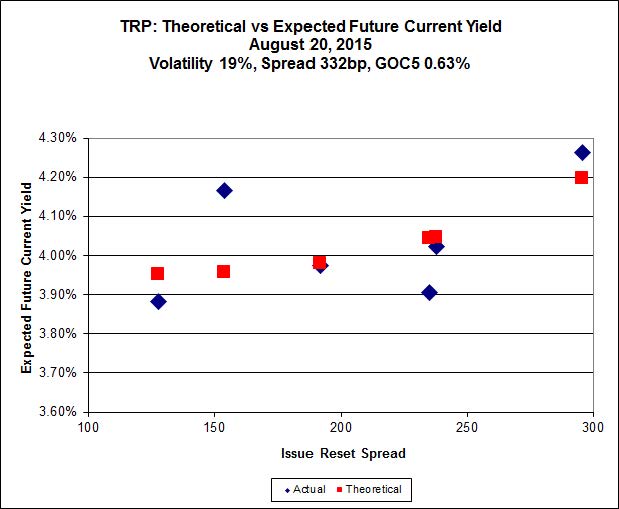
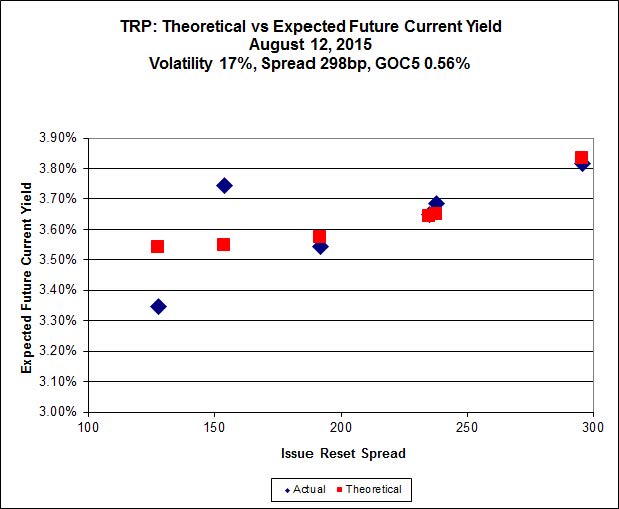
Here’s TRP:

impVol_TRP_141224
Click for Big

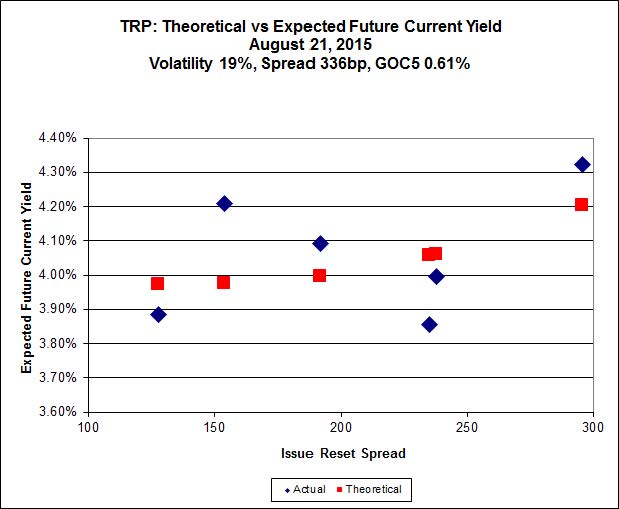
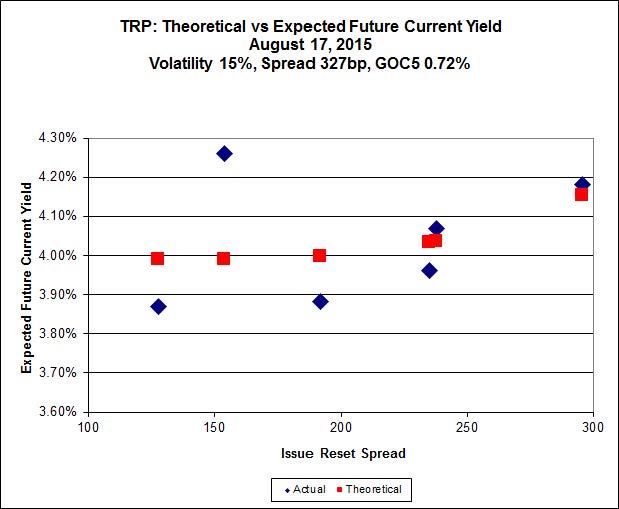
So according to this, TRP.PR.A, bid at 20.12, is $1.59 cheap, but it has already reset (at +192). TRP.PR.D, bid at 25.11 and resetting at +238bp on 2019-4-30 is $0.43 rich and TRP.PR.E, bid at 25.30 and resetting at +235bp on 2019-10-30 (two months prior to the next TRP.PR.A reset), is $0.82 rich.

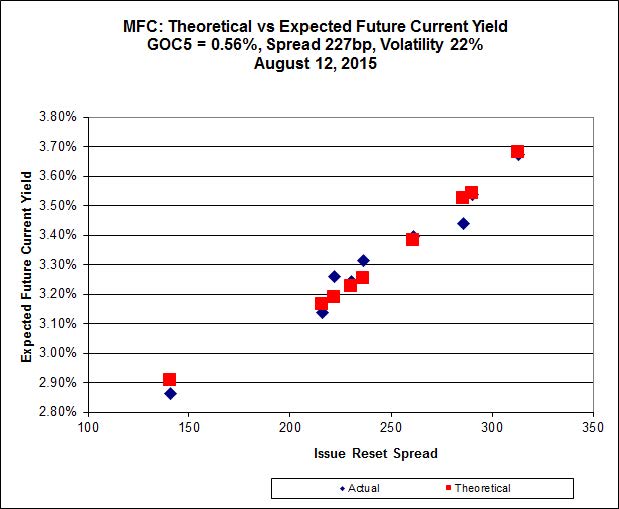
impVol_MFC_141224
Click for Big

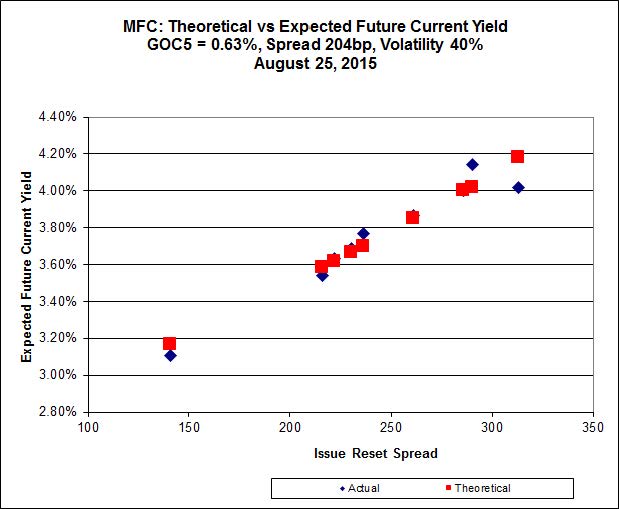
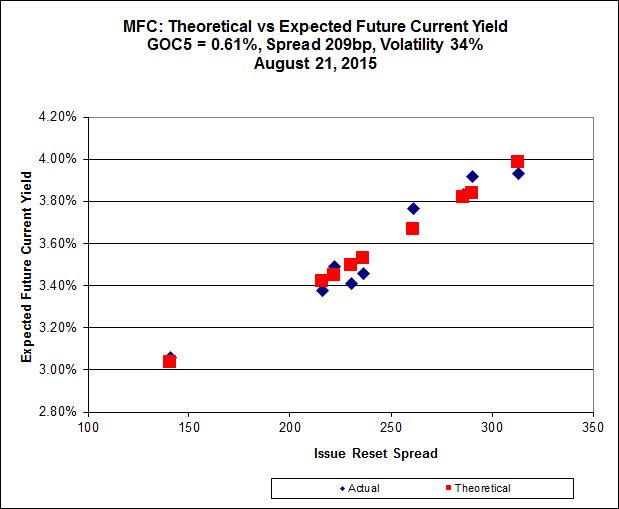
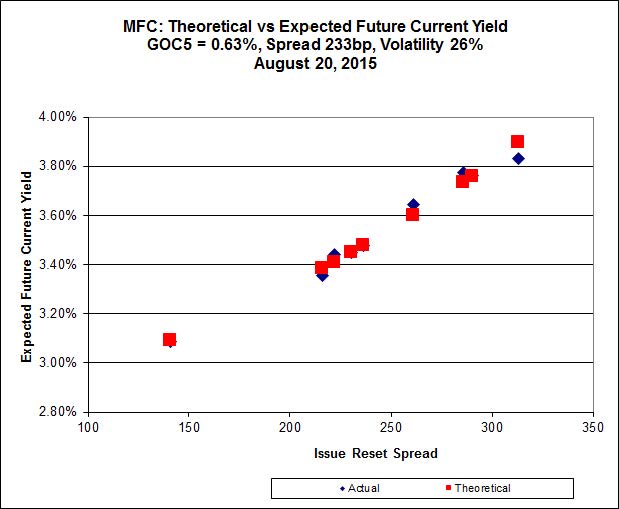
There is an excellent fit to theory for the MFC issues, but Implied Volatility continues to be a conundrum. It is far too high if we consider that NVCC rules will never apply to these issues; it is far too low if we consider them to be NVCC non-compliant issues (and therefore with Deemed Maturities in the call schedule).

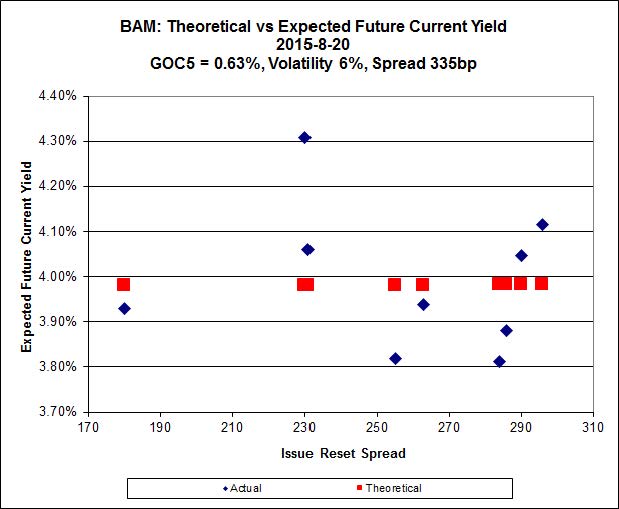
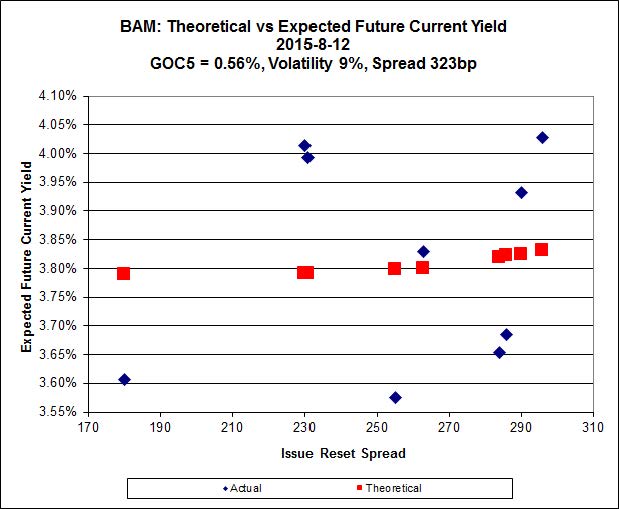
impVol_BAM_141224
Click for Big

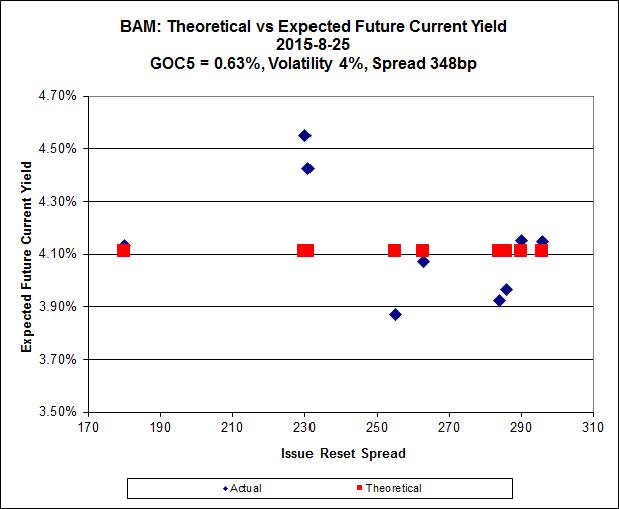
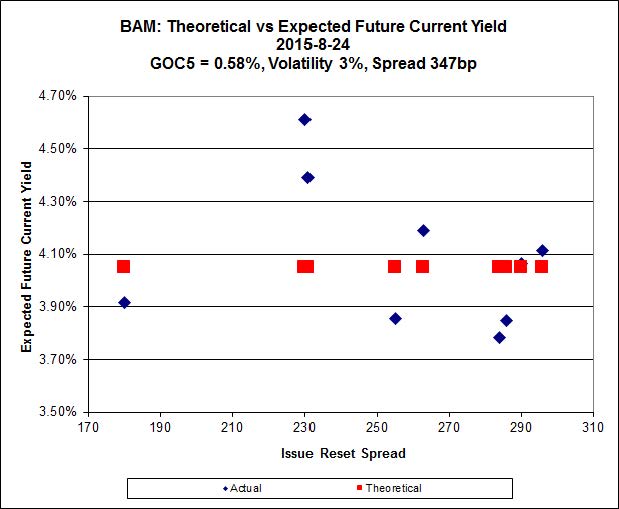
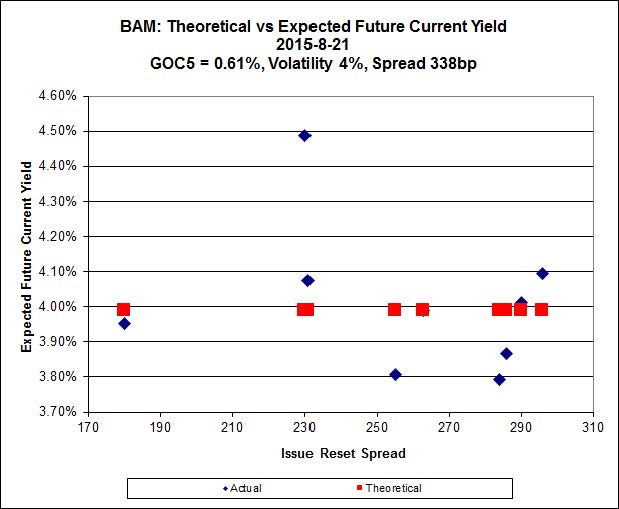
There continues to be cheapness in the lowest-spread issue, BAM.PR.X, resetting at +180bp on 2017-6-30, which is bid at 20.83 after another day of excellent performance and appears to be $0.82 cheap, while BAM.PR.R, resetting at +230bp 2016-6-30 is bid at 25.19 and appears to be $1.24 rich.

It will be noticed that due to price changes in issues other than BAM.PR.X, this issue gained over a point and yet became cheaper to the rest; additionally, it seems clear that the higher-spread issues define a curve with significantly more Implied Volatility than is calculated when the low-spread outlier is included.

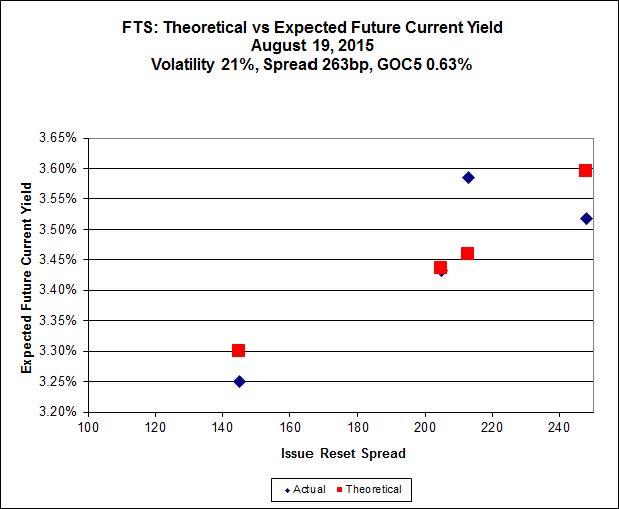
impVol_FTS_141224
Click for Big

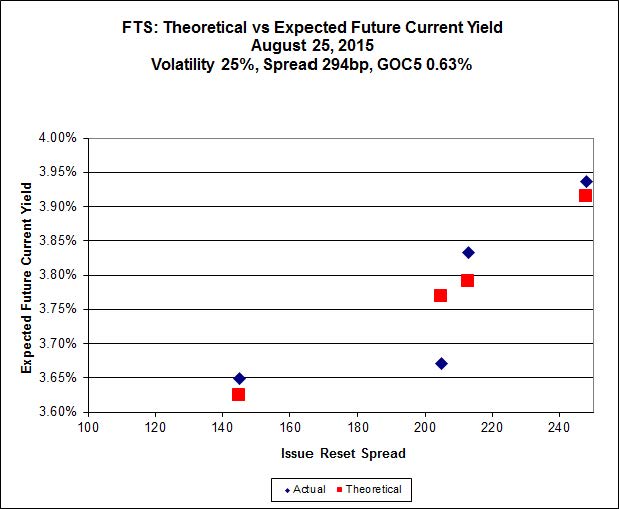
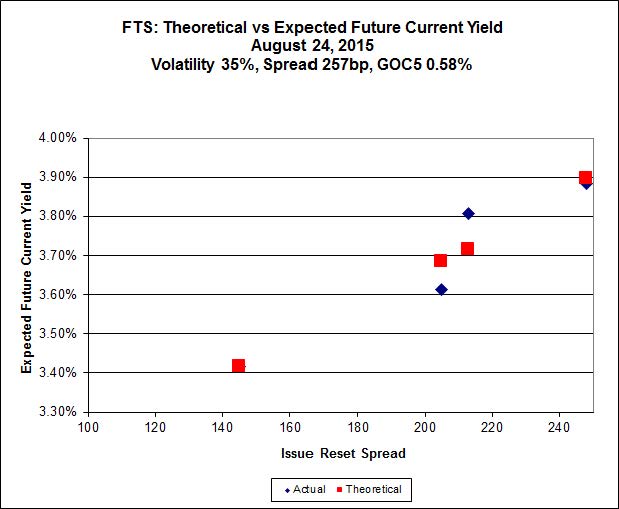
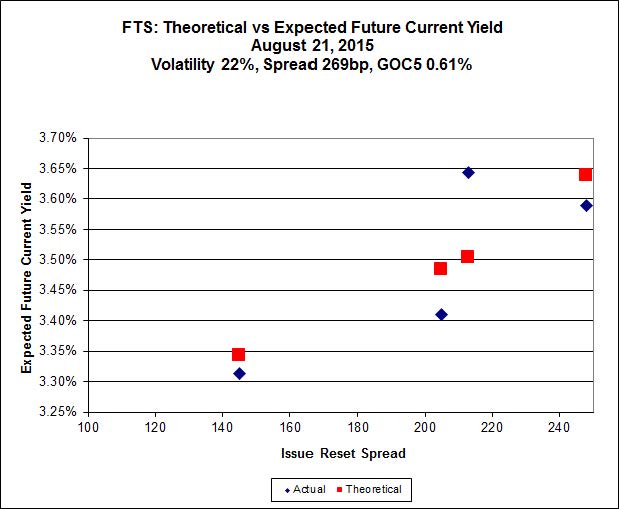
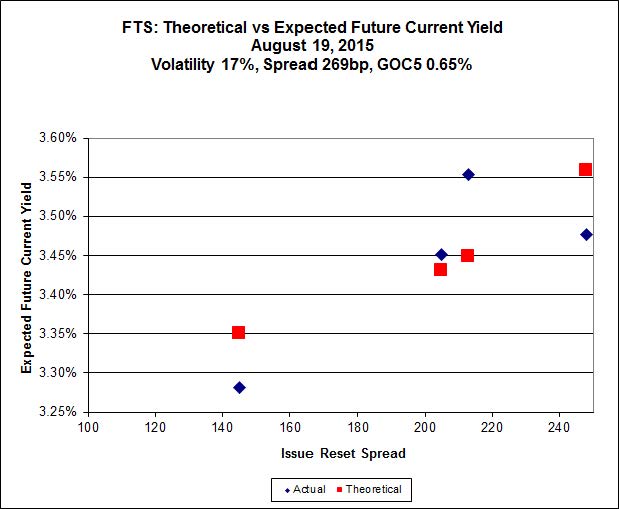
This is just weird because the middle is expensive and the ends are cheap but anyway … FTS.PR.H, with a spread of +145bp, and bid at 18.77, looks $1.24 cheap and resets 2015-6-1. FTS.PR.K, with a spread of +205bp, and bid at 25.15, looks $1.04 expensive and resets 2019-3-1

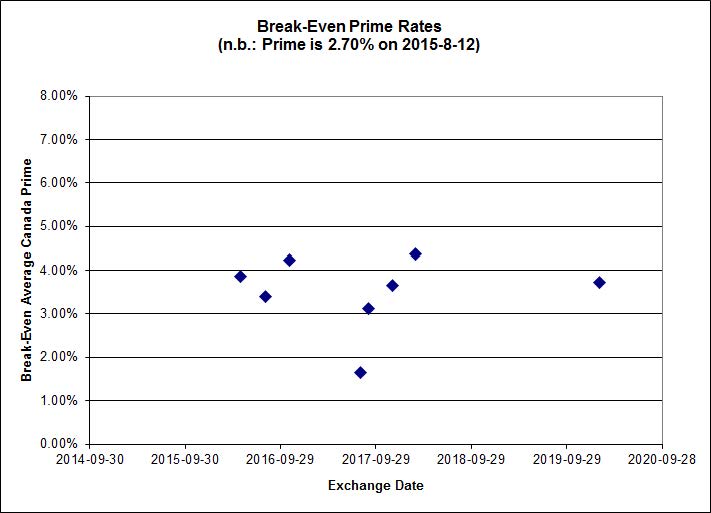
pairsFR_141224
Click for Big
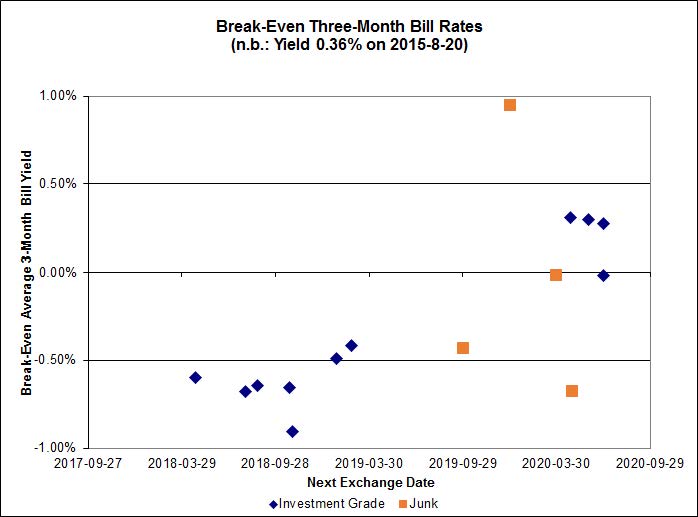
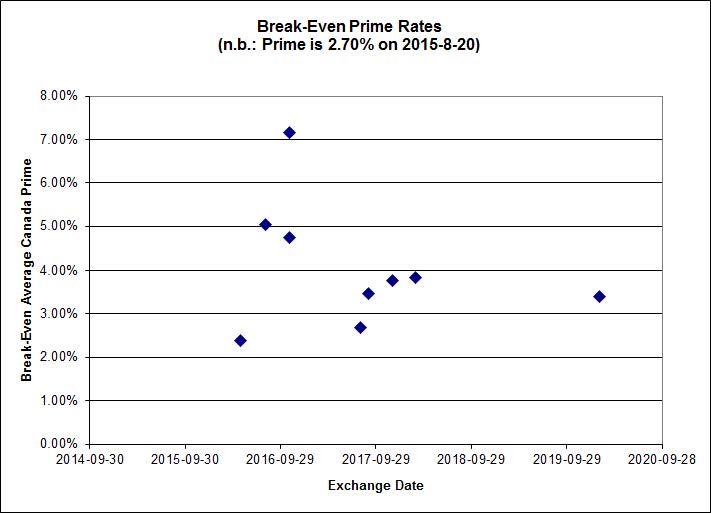
Click for Big

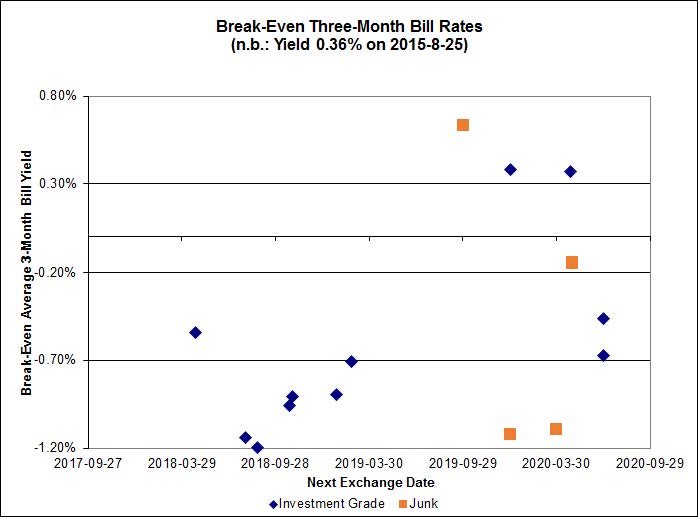
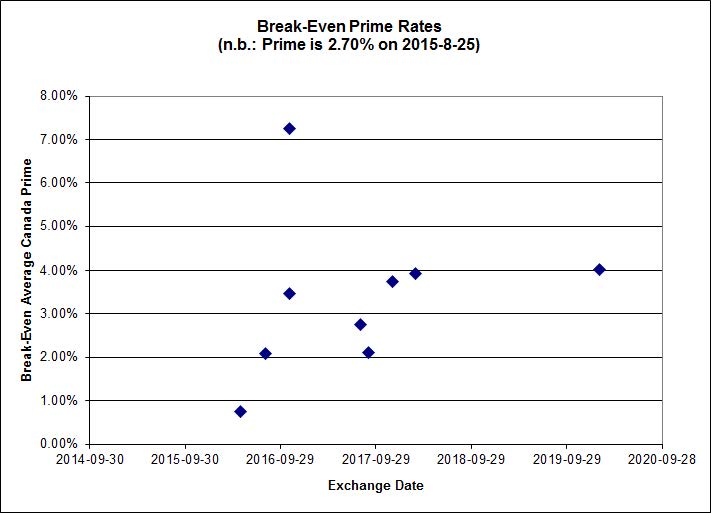
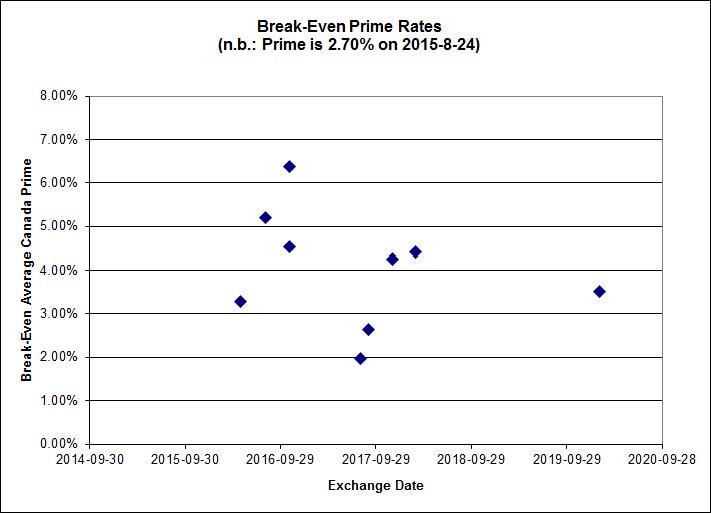
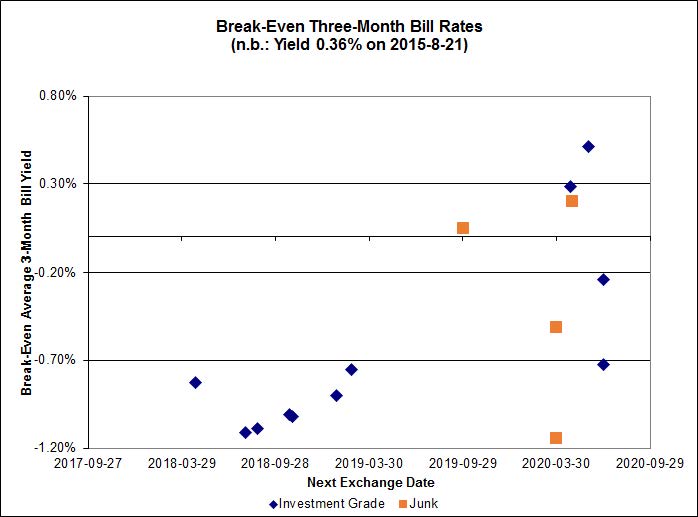
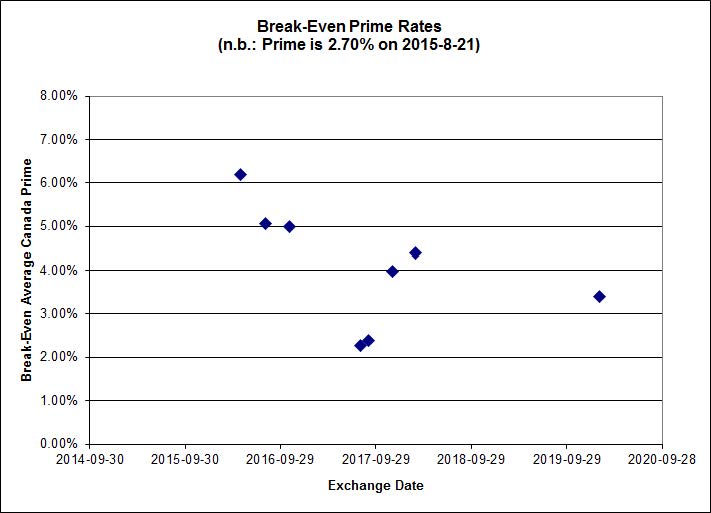
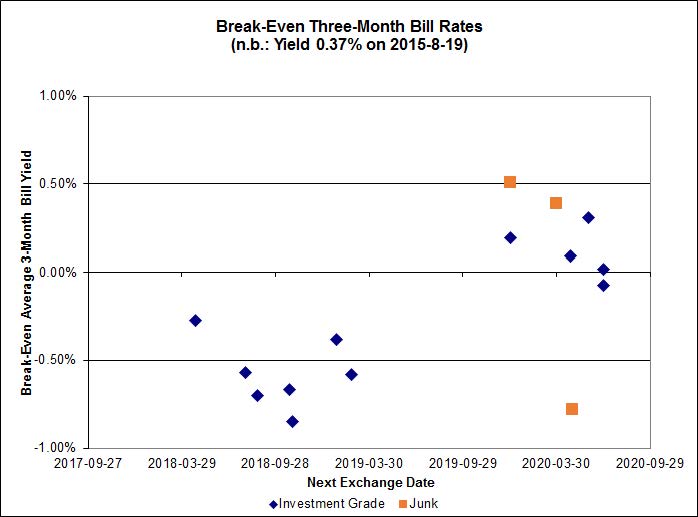
The average break-even rate has declined from 1.80%-2.00% at the time recent conversion decisions were made to a current cluster of (mostly) 1.50%-1.65%. This decline means that the estimated profit on TRP.PR.A conversion has declined from $0.48 to a mere $0.16 (at the lower end of the range, 1.50%).

HIMIPref™ Preferred Indices
These values reflect the December 2008 revision of the HIMIPref™ Indices

Values are provisional and are finalized monthly
Index Mean
Current
Yield
(at bid)
Median
YTW
Median
Average
Trading
Value
Median
Mod Dur
(YTW)
Issues Day’s Perf. Index Value
Ratchet 0.00 % 0.00 % 0 0.00 0 -0.1574 % 2,517.9
FixedFloater 0.00 % 0.00 % 0 0.00 0 -0.1574 % 3,986.3
Floater 3.01 % 3.12 % 65,755 19.42 4 -0.1574 % 2,676.7
OpRet 4.41 % -3.39 % 24,220 0.08 2 -0.0196 % 2,749.9
SplitShare 4.28 % 4.08 % 35,850 3.69 5 0.0713 % 3,199.0
Interest-Bearing 0.00 % 0.00 % 0 0.00 0 -0.0196 % 2,514.5
Perpetual-Premium 5.44 % -3.29 % 71,137 0.08 20 0.1610 % 2,483.7
Perpetual-Discount 5.16 % 5.05 % 109,250 15.38 15 0.6970 % 2,667.3
FixedReset 4.23 % 3.58 % 245,785 8.58 77 0.3659 % 2,539.0
Deemed-Retractible 4.95 % -0.68 % 96,125 0.11 40 0.4981 % 2,629.6
FloatingReset 2.56 % 1.92 % 63,660 3.43 5 0.4177 % 2,547.2
Performance Highlights
Issue Index Change Notes
SLF.PR.G FixedReset -2.02 % YTW SCENARIO
Maturity Type : Hard Maturity
Maturity Date : 2025-01-31
Maturity Price : 25.00
Evaluated at bid price : 21.36
Bid-YTW : 4.67 %
PWF.PR.P FixedReset -1.22 % YTW SCENARIO
Maturity Type : Limit Maturity
Maturity Date : 2044-12-24
Maturity Price : 21.01
Evaluated at bid price : 21.01
Bid-YTW : 3.68 %
BAM.PR.K Floater -1.01 % YTW SCENARIO
Maturity Type : Limit Maturity
Maturity Date : 2044-12-24
Maturity Price : 16.66
Evaluated at bid price : 16.66
Bid-YTW : 3.15 %
IAG.PR.A Deemed-Retractible -1.00 % YTW SCENARIO
Maturity Type : Hard Maturity
Maturity Date : 2025-01-31
Maturity Price : 25.00
Evaluated at bid price : 23.71
Bid-YTW : 5.28 %
BAM.PR.N Perpetual-Discount 1.04 % YTW SCENARIO
Maturity Type : Limit Maturity
Maturity Date : 2044-12-24
Maturity Price : 21.42
Evaluated at bid price : 21.42
Bid-YTW : 5.58 %
ENB.PR.J FixedReset 1.06 % YTW SCENARIO
Maturity Type : Limit Maturity
Maturity Date : 2044-12-24
Maturity Price : 22.72
Evaluated at bid price : 23.75
Bid-YTW : 4.22 %
BAM.PF.F FixedReset 1.07 % YTW SCENARIO
Maturity Type : Call
Maturity Date : 2019-09-30
Maturity Price : 25.00
Evaluated at bid price : 25.60
Bid-YTW : 3.95 %
GWO.PR.L Deemed-Retractible 1.09 % YTW SCENARIO
Maturity Type : Call
Maturity Date : 2015-01-30
Maturity Price : 26.00
Evaluated at bid price : 26.08
Bid-YTW : 1.37 %
BAM.PR.X FixedReset 1.12 % YTW SCENARIO
Maturity Type : Limit Maturity
Maturity Date : 2044-12-24
Maturity Price : 20.83
Evaluated at bid price : 20.83
Bid-YTW : 4.04 %
RY.PR.L FixedReset 1.14 % YTW SCENARIO
Maturity Type : Call
Maturity Date : 2019-02-24
Maturity Price : 25.00
Evaluated at bid price : 26.53
Bid-YTW : 2.80 %
ENB.PF.C FixedReset 1.19 % YTW SCENARIO
Maturity Type : Limit Maturity
Maturity Date : 2044-12-24
Maturity Price : 22.67
Evaluated at bid price : 23.78
Bid-YTW : 4.29 %
BAM.PF.B FixedReset 1.20 % YTW SCENARIO
Maturity Type : Limit Maturity
Maturity Date : 2044-12-24
Maturity Price : 23.32
Evaluated at bid price : 25.30
Bid-YTW : 3.87 %
IAG.PR.G FixedReset 1.22 % YTW SCENARIO
Maturity Type : Call
Maturity Date : 2017-06-30
Maturity Price : 25.00
Evaluated at bid price : 26.52
Bid-YTW : 1.79 %
MFC.PR.B Deemed-Retractible 1.29 % YTW SCENARIO
Maturity Type : Hard Maturity
Maturity Date : 2025-01-31
Maturity Price : 25.00
Evaluated at bid price : 24.35
Bid-YTW : 5.02 %
GWO.PR.P Deemed-Retractible 1.29 % YTW SCENARIO
Maturity Type : Call
Maturity Date : 2020-03-31
Maturity Price : 25.25
Evaluated at bid price : 25.88
Bid-YTW : 4.81 %
SLF.PR.A Deemed-Retractible 1.44 % YTW SCENARIO
Maturity Type : Hard Maturity
Maturity Date : 2025-01-31
Maturity Price : 25.00
Evaluated at bid price : 24.67
Bid-YTW : 4.93 %
PWF.PR.R Perpetual-Premium 1.44 % YTW SCENARIO
Maturity Type : Call
Maturity Date : 2021-04-30
Maturity Price : 25.00
Evaluated at bid price : 26.02
Bid-YTW : 4.92 %
SLF.PR.D Deemed-Retractible 1.64 % YTW SCENARIO
Maturity Type : Hard Maturity
Maturity Date : 2025-01-31
Maturity Price : 25.00
Evaluated at bid price : 23.56
Bid-YTW : 5.21 %
SLF.PR.E Deemed-Retractible 1.68 % YTW SCENARIO
Maturity Type : Hard Maturity
Maturity Date : 2025-01-31
Maturity Price : 25.00
Evaluated at bid price : 23.64
Bid-YTW : 5.22 %
SLF.PR.C Deemed-Retractible 1.72 % YTW SCENARIO
Maturity Type : Hard Maturity
Maturity Date : 2025-01-31
Maturity Price : 25.00
Evaluated at bid price : 23.65
Bid-YTW : 5.16 %
GWO.PR.G Deemed-Retractible 1.72 % YTW SCENARIO
Maturity Type : Call
Maturity Date : 2015-01-23
Maturity Price : 25.00
Evaluated at bid price : 25.38
Bid-YTW : -13.88 %
GWO.PR.R Deemed-Retractible 1.85 % YTW SCENARIO
Maturity Type : Hard Maturity
Maturity Date : 2025-01-31
Maturity Price : 25.00
Evaluated at bid price : 24.72
Bid-YTW : 4.96 %
CU.PR.D Perpetual-Discount 2.02 % YTW SCENARIO
Maturity Type : Limit Maturity
Maturity Date : 2044-12-24
Maturity Price : 24.34
Evaluated at bid price : 24.77
Bid-YTW : 4.97 %
CU.PR.E Perpetual-Discount 2.02 % YTW SCENARIO
Maturity Type : Limit Maturity
Maturity Date : 2044-12-24
Maturity Price : 24.33
Evaluated at bid price : 24.76
Bid-YTW : 4.97 %
BAM.PR.T FixedReset 2.02 % YTW SCENARIO
Maturity Type : Limit Maturity
Maturity Date : 2044-12-24
Maturity Price : 23.40
Evaluated at bid price : 24.69
Bid-YTW : 3.74 %
TRP.PR.C FixedReset 2.04 % YTW SCENARIO
Maturity Type : Limit Maturity
Maturity Date : 2044-12-24
Maturity Price : 20.05
Evaluated at bid price : 20.05
Bid-YTW : 3.78 %
GWO.PR.I Deemed-Retractible 2.06 % YTW SCENARIO
Maturity Type : Hard Maturity
Maturity Date : 2025-01-31
Maturity Price : 25.00
Evaluated at bid price : 23.75
Bid-YTW : 5.16 %
MFC.PR.F FixedReset 2.14 % YTW SCENARIO
Maturity Type : Hard Maturity
Maturity Date : 2025-01-31
Maturity Price : 25.00
Evaluated at bid price : 21.91
Bid-YTW : 4.57 %
HSE.PR.A FixedReset 2.31 % YTW SCENARIO
Maturity Type : Limit Maturity
Maturity Date : 2044-12-24
Maturity Price : 20.41
Evaluated at bid price : 20.41
Bid-YTW : 3.91 %
FTS.PR.J Perpetual-Discount 2.44 % YTW SCENARIO
Maturity Type : Limit Maturity
Maturity Date : 2044-12-24
Maturity Price : 24.32
Evaluated at bid price : 24.74
Bid-YTW : 4.82 %
Volume Highlights
Issue Index Shares
Traded
Notes
TD.PF.C FixedReset 63,650 Recent new issue.
YTW SCENARIO
Maturity Type : Limit Maturity
Maturity Date : 2044-12-24
Maturity Price : 23.13
Evaluated at bid price : 24.92
Bid-YTW : 3.55 %
MFC.PR.A OpRet 52,800 Scotia crossed 50,000 at 25.31.
YTW SCENARIO
Maturity Type : Call
Maturity Date : 2015-06-19
Maturity Price : 25.00
Evaluated at bid price : 25.27
Bid-YTW : 2.01 %
CM.PR.E Perpetual-Premium 28,773 Called for Redemption effective 2015-1-31.
YTW SCENARIO
Maturity Type : Call
Maturity Date : 2015-01-23
Maturity Price : 25.00
Evaluated at bid price : 24.98
Bid-YTW : -0.33 %
TRP.PR.A FixedReset 27,895 Resets to 3.266% effective Dec 31.
YTW SCENARIO
Maturity Type : Limit Maturity
Maturity Date : 2044-12-24
Maturity Price : 20.12
Evaluated at bid price : 20.12
Bid-YTW : 4.11 %
IAG.PR.E Deemed-Retractible 26,000 Called for redemption effective 2014-12-31.
YTW SCENARIO
Maturity Type : Call
Maturity Date : 2015-12-31
Maturity Price : 25.75
Evaluated at bid price : 25.99
Bid-YTW : 4.80 %
CM.PR.P FixedReset 25,588 Recent new issue.
YTW SCENARIO
Maturity Type : Limit Maturity
Maturity Date : 2044-12-24
Maturity Price : 23.12
Evaluated at bid price : 24.90
Bid-YTW : 3.55 %
There were 15 other index-included issues trading in excess of 10,000 shares.
Wide Spread Highlights
Issue Index Quote Data and Yield Notes
BAM.PF.E FixedReset Quote: 25.15 – 26.15
Spot Rate : 1.0000
Average : 0.5936

YTW SCENARIO
Maturity Type : Limit Maturity
Maturity Date : 2044-12-24
Maturity Price : 23.19
Evaluated at bid price : 25.15
Bid-YTW : 3.90 %

POW.PR.B Perpetual-Premium Quote: 25.02 – 25.39
Spot Rate : 0.3700
Average : 0.2475

YTW SCENARIO
Maturity Type : Call
Maturity Date : 2015-01-23
Maturity Price : 25.00
Evaluated at bid price : 25.02
Bid-YTW : 0.45 %

HSE.PR.C FixedReset Quote: 25.36 – 25.69
Spot Rate : 0.3300
Average : 0.2261

YTW SCENARIO
Maturity Type : Call
Maturity Date : 2019-12-31
Maturity Price : 25.00
Evaluated at bid price : 25.36
Bid-YTW : 4.24 %

PVS.PR.D SplitShare Quote: 24.35 – 24.63
Spot Rate : 0.2800
Average : 0.1848

YTW SCENARIO
Maturity Type : Hard Maturity
Maturity Date : 2021-10-08
Maturity Price : 25.00
Evaluated at bid price : 24.35
Bid-YTW : 5.02 %

TRP.PR.A FixedReset Quote: 20.12 – 20.48
Spot Rate : 0.3600
Average : 0.2666

YTW SCENARIO
Maturity Type : Limit Maturity
Maturity Date : 2044-12-24
Maturity Price : 20.12
Evaluated at bid price : 20.12
Bid-YTW : 4.11 %

POW.PR.A Perpetual-Premium Quote: 25.17 – 25.49
Spot Rate : 0.3200
Average : 0.2289

YTW SCENARIO
Maturity Type : Call
Maturity Date : 2015-01-23
Maturity Price : 25.00
Evaluated at bid price : 25.17
Bid-YTW : -6.65 %

Market Action

December 23, 2014

On December 19 my attention was drawn to a parallel between the Suez Crisis in 1956 and the current Ukraine Crisis. The Chinese provide a counter-parallel, assuming that’s a word:

China is stepping up its role as the lender of last resort to some of the world’s most financially strapped countries.

Chinese officials signaled on the weekend they are willing to expand a $24 billion currency swap program to help Russia weather the worst economic crisis since the 1998 default. China has provided $2.3 billion in funds to Argentina since October as part of a currency swap, and last month it lent $4 billion to Venezuela, whose reserves cover just two years of debt payments.

By lending to nations shut out of overseas capital markets, Chinese President Xi Jinping is bolstering the country’s influence in the global economy and cutting into the International Monetary Fund’s status as the go-to financier for governments in financial distress. While the IMF tends to demand reforms aimed at stabilizing a country’s economy in exchange for loans, analysts speculate that China’s terms are more focused on securing its interests in the resource-rich countries.

Today’s PrefBlog Movie Of The Week is:

Ukraine opened a criminal probe after several gold bars at the central bank’s storage in the southern city of Odessa turned to be painted lead.

“The management of the central bank’s branch in Odessa asked us to investigate fraud by their employee,” Volodymyr Shablienko, head of the Odessa police’s press office, said by phone today. “We are conducting a forensic audit now.”

A central bank employee passed lead bars covered with golden paint to the storage unit, registering them as gold, the Vesti newspaper reported today, citing an unidentified person with knowledge of the matter in Odessa’s police department.

Speaking of Russian, how about them banks, eh?:

After arresting a decline in the ruble, Russia is now trying to avert a banking crisis.

Lawmakers rushed legislation through the lower house of parliament today allowing the Deposit Insurance Agency to buy stakes in banks before they face bankruptcy proceedings to keep the system stable. While the ruble strengthened for a third day as the government told state-run exporters to sell foreign currency, it’s still down 30 percent in three months. Standard & Poor’s said today it may cut Russia’s credit rating to junk in part because of concern about the banking system.

The central bank put National Bank Trust, the country’s 15th-biggest based on retail deposits, under the control of the Deposit Insurance Agency yesterday. An investor will soon be selected to carry out the 30 billion-ruble ($550 million) rescue, the Bank of Russia said.

Trust, once part of exiled former oil tycoon Mikhail Khodorkovsky’s business empire, had a capital hole of tens of billions of rubles and lost more than 3 billion rubles in retail deposits last week, central bank Deputy Governor Mikhail Sukhov said yesterday. Bank of Russia’s press service confirmed his comments, earlier reported by the Interfax newswire.

And the Dow Jones Industrial Average is also pretty interesting:

The Dow Jones Industrial Average rose 5.6 percent over the past five days for the biggest rally since 2011, climbing to 18,024.17 yesterday, as the central bank pledged patience in raising interest rates while data showed the economy roared the most in the third quarter since 2003. A measure of expected volatility in the Dow has fallen the most in three years during the recent rally.

The Dow closed at a six-month low on Oct. 16 before rallying more than 1,882 points, or 12 percent, to top 18,000. The Chicago Board Options Exchange Dow Jones Industrial Average (INDU) Volatility Index, a measure of demand for options on the blue-chip stocks gauge, has bounced back after two jumps of more than 70 percent since September.

The industrial average has risen about 175 percent during the bull market that began in March 2009, propelled by better-than-estimated corporate results and three rounds of Fed bond purchases. The Standard & Poor’s 500 Index has more than tripled in that time. It rose 0.2 percent yesterday to finish at an all-time high.

The press might get interested in credit ratings again; e.g., Bloomberg:

One large company and four smaller firms didn’t follow their own methodologies in determining ratings, the SEC said in its report on Nationally Recognized Statistical Rating Organizations, or NRSROs.

After reviewing e-mails of one of the larger raters, the regulator determined that business and market-share conditions influenced the substance of its criteria. Employees on the business side of this rater worked in a concerted effort to change the criteria to appease an industry trade group, the SEC said.

OK, so let’s look at the relevant section in the actual staff report, titled 2014 SUMMARY REPORT OF COMMISSION STAFF’S EXAMINATIONS OF EACH NATIONALLY RECOGNIZED STATISTICAL RATING ORGANIZATION:

The Staff’s review of one larger NRSRO’s revisions to one of its rating criteria, including extensive review of its emails, suggests that this NRSRO’s business and market-share concerns influenced the substance of the criteria. Some of this NRSRO’s business personnel engaged in a concerted effort to address concerns raised by a trade association about this NRSRO’s contemplated revisions to the criteria report, and this criteria report was changed in a manner that addressed the business personnel’s concerns and was advantageous to the trade group. Also, documentation to support this change was lacking. The Staff recommended that this NRSRO enforce its policies and procedures and internal controls to separate the analytical process from commercial influence and ensure that the analytic justification of its criteria is adequately recorded and maintained. The Staff also recommended that this NRSRO’s Board retain an independent auditor, to be approved by OCR, to conduct a review of the development of the criteria and provide a written report summarizing the review to this NRSRO’s Board and compliance group as well as OCR.

It’s very difficult to see anything to be upset about here. First, the external body being dealt with was a trade group, not an individual company, which alleviates at least some of the automatic concerns right away (to a degree that can only be determined once we know how the trade group functions, for starters). Second, SEC Staff are shocked and horrified that the changes sought by the trade group are advantageous to the trade group. Well, yeah. Does anybody really expect anything else? Third, the criteria were changed in a manner that addressed the business personnel’s concerns … OK. Were the business personnel’s concerns grounded or ungrounded? Fourth, the documentation to support this change was lacking. Well, I can let you guys in on a little secret about regulatory paperwork: it’s always lacking. God and all his angels could not maintain records that would survive a determined fault-finding mission by regulators; not while doing any work of substance, anyway.

So the summary sounds bad, and the raw material hints that maybe something could be bad, but there’s nothing of real substance in this finding. However, look for it to be quoted as unequivocal damnation in debates to come.

Fortis Inc., proud issuer of FTS.PR.E, FTS.PR.F, FTS.PR.G, FTS.PR.H, FTS.PR.J, FTS.PR.K and FTS.PR.M, was confirmed at Pfd-2(low) by DBRS and removed from ‘Review-Developing’:

DBRS Limited (DBRS) has today removed the A (low) Issuer Rating, A (low) Unsecured Debentures and Pfd-2 (low) Preferred Shares ratings of Fortis Inc. (Fortis, the Parent or the Company) from Under Review with Developing Implications and has confirmed the ratings as listed above with Stable trends. This action follows the completion of the Company’s acquisition of UNS Energy Corporation (UNS) (the Acquisition) and the conversion of $1.8 billion of convertible debentures into common equity in late October 2014.

In DBRS’s view, the overall business risk profile of Fortis’ investment portfolio should remain in the A (low) range following the completion of the Acquisition.

Fortis’ financing of the USD 2.5 billion Acquisition was consistent with DBRS’s expectation. Fortis issued $1.8 billion in convertible debentures, approximately $600 million in preferred shares and the remaining portion in debt. Most of the convertible debentures were converted into common equity in late October 2014. As a result, the financial risk profile on a non-consolidated basis remains consistent with DBRS’s expectation, with all pro forma non-consolidated credit ratios improving from 2013. Fortis’ non-consolidated debt in the capital structure would remain within DBRS’s 20% guideline for holding company notching while all other key credit metrics would solidly remain within the current rating range.

FTS has been on Review-Developing for over a year.

The Canadian preferred share market was on wheels today, with PerpetualDiscounts up 33bp, FixedResets winning 47bp and DeemedRetractibles gaining 18bp. The Performance Highlights table is suitably enormous, with only one loser; led on the upside by the low-reset insurance issues that had the stuffing kicked out of them in the first week of the month. Volume was above average.

For as long as the FixedReset market is so violently unsettled, I’ll keep publishing updates of the more interesting and meaningful series of FixedResets’ Implied Volatilities. This doesn’t include Enbridge because although Enbridge has a large number of issues outstanding, all of which are quite liquid, the range of Issue Reset Spreads is too small for decent conclusions. The low is 212bp (ENB.PR.H; second-lowest is ENB.PR.D at 237bp) and the high is a mere 268 for ENB.PF.G.

Remember that all rich /cheap assessments are:

  • based on Implied Volatility Theory only
  • are relative only to other FixedResets from the same issuer
  • assume constant GOC-5 yield
  • assume constant Implied Volatility
  • assume constant spread

Here’s TRP:

impVol_TRP_141223
Click for Big

So according to this, TRP.PR.A, bid at 20.30, is $1.41 cheap, but it has already reset (at +192). TRP.PR.D, bid at 25.11 and resetting at +238bp on 2019-4-30 is $0.43 rich and TRP.PR.E, bid at 25.27 and resetting at +235bp on 2019-10-30, is $0.79 rich.

This particular calculation is fascinating because it is apparent that – disregarding the TRP.PR.A outlier – the slope of the line used to calculate implied volatility is negative. I can’t remember seeing one of those since the Credit Crunch!

impVol_MFC_141223
Click for Big

The impressive performance of MFC.PR.F brought it back to consistency with the curve defined by the higher reset issues today, but the Implied Volatility continues to be a conundrum. It is far too high if we consider that NVCC rules will never apply to these issues; it is far too low if we consider them to be NVCC non-compliant issues (and therefore with Deemed Maturities in the call schedule).

impVol_BAM_141223
Click for Big

There continues to be cheapness in the lowest-spread issue, BAM.PR.X, resetting at +180bp on 2017-6-30, which is bid at 20.60 after superb performance today and appears to be $0.76 cheap, while BAM.PR.R, resetting at +230bp 2016-6-30 is bid at 25.08 and appears to be $1.36 rich.

impVol_FTS_141223
Click for Big

This is just weird because the middle is expensive and the ends are cheap but anyway … FTS.PR.H, with a spread of +145bp, and bid at 18.78, looks $1.18 cheap and resets 2015-6-1. FTS.PR.K, with a spread of +205bp, and bid at 24.94, looks $0.96 expensive and resets 2019-3-1

pairsFR_141223
Click for Big

The average break-even rate has declined from 1.80%-2.00% at the time recent conversion decisions were made to a current cluster of (mostly) 1.55%-1.60%. This decline means that the estimated profit on TRP.PR.A conversion has declined from $0.48 to a mere $0.21 (at the lower end of the range, 1.55%).

HIMIPref™ Preferred Indices
These values reflect the December 2008 revision of the HIMIPref™ Indices

Values are provisional and are finalized monthly
Index Mean
Current
Yield
(at bid)
Median
YTW
Median
Average
Trading
Value
Median
Mod Dur
(YTW)
Issues Day’s Perf. Index Value
Ratchet 0.00 % 0.00 % 0 0.00 0 2.5690 % 2,521.9
FixedFloater 0.00 % 0.00 % 0 0.00 0 2.5690 % 3,992.6
Floater 3.01 % 3.11 % 66,751 19.44 4 2.5690 % 2,680.9
OpRet 4.41 % -3.08 % 25,222 0.08 2 0.0588 % 2,750.4
SplitShare 4.28 % 4.08 % 37,327 3.69 5 0.1490 % 3,196.8
Interest-Bearing 0.00 % 0.00 % 0 0.00 0 0.0588 % 2,515.0
Perpetual-Premium 5.45 % -0.21 % 71,880 0.08 20 0.1291 % 2,479.8
Perpetual-Discount 5.20 % 5.08 % 110,410 15.31 15 0.3281 % 2,648.8
FixedReset 4.24 % 3.63 % 247,985 16.45 77 0.4734 % 2,529.7
Deemed-Retractible 4.97 % 1.04 % 96,558 0.27 40 0.1766 % 2,616.6
FloatingReset 2.57 % 2.11 % 63,812 3.50 5 0.0079 % 2,536.6
Performance Highlights
Issue Index Change Notes
FTS.PR.J Perpetual-Discount -1.02 % YTW SCENARIO
Maturity Type : Limit Maturity
Maturity Date : 2044-12-23
Maturity Price : 23.76
Evaluated at bid price : 24.15
Bid-YTW : 4.94 %
BAM.PR.T FixedReset 1.00 % YTW SCENARIO
Maturity Type : Limit Maturity
Maturity Date : 2044-12-23
Maturity Price : 23.19
Evaluated at bid price : 24.20
Bid-YTW : 3.84 %
MFC.PR.B Deemed-Retractible 1.01 % YTW SCENARIO
Maturity Type : Hard Maturity
Maturity Date : 2025-01-31
Maturity Price : 25.00
Evaluated at bid price : 24.04
Bid-YTW : 5.18 %
BAM.PF.B FixedReset 1.01 % YTW SCENARIO
Maturity Type : Limit Maturity
Maturity Date : 2044-12-23
Maturity Price : 23.22
Evaluated at bid price : 25.00
Bid-YTW : 3.93 %
BNS.PR.P FixedReset 1.01 % YTW SCENARIO
Maturity Type : Call
Maturity Date : 2018-04-25
Maturity Price : 25.00
Evaluated at bid price : 25.91
Bid-YTW : 2.37 %
CU.PR.C FixedReset 1.06 % YTW SCENARIO
Maturity Type : Call
Maturity Date : 2017-06-01
Maturity Price : 25.00
Evaluated at bid price : 25.80
Bid-YTW : 2.75 %
MFC.PR.C Deemed-Retractible 1.12 % YTW SCENARIO
Maturity Type : Hard Maturity
Maturity Date : 2025-01-31
Maturity Price : 25.00
Evaluated at bid price : 23.45
Bid-YTW : 5.34 %
TRP.PR.A FixedReset 1.15 % YTW SCENARIO
Maturity Type : Limit Maturity
Maturity Date : 2044-12-23
Maturity Price : 20.30
Evaluated at bid price : 20.30
Bid-YTW : 4.07 %
FTS.PR.F Perpetual-Discount 1.22 % YTW SCENARIO
Maturity Type : Limit Maturity
Maturity Date : 2044-12-23
Maturity Price : 24.53
Evaluated at bid price : 24.80
Bid-YTW : 4.97 %
PWF.PR.P FixedReset 1.29 % YTW SCENARIO
Maturity Type : Limit Maturity
Maturity Date : 2044-12-23
Maturity Price : 21.27
Evaluated at bid price : 21.27
Bid-YTW : 3.63 %
BAM.PR.Z FixedReset 1.38 % YTW SCENARIO
Maturity Type : Call
Maturity Date : 2017-12-31
Maturity Price : 25.00
Evaluated at bid price : 25.65
Bid-YTW : 3.86 %
IAG.PR.A Deemed-Retractible 1.61 % YTW SCENARIO
Maturity Type : Hard Maturity
Maturity Date : 2025-01-31
Maturity Price : 25.00
Evaluated at bid price : 23.95
Bid-YTW : 5.15 %
CU.PR.E Perpetual-Discount 1.76 % YTW SCENARIO
Maturity Type : Limit Maturity
Maturity Date : 2044-12-23
Maturity Price : 23.87
Evaluated at bid price : 24.27
Bid-YTW : 5.08 %
BAM.PR.C Floater 1.76 % YTW SCENARIO
Maturity Type : Limit Maturity
Maturity Date : 2044-12-23
Maturity Price : 16.74
Evaluated at bid price : 16.74
Bid-YTW : 3.13 %
GWO.PR.H Deemed-Retractible 1.77 % YTW SCENARIO
Maturity Type : Hard Maturity
Maturity Date : 2025-01-31
Maturity Price : 25.00
Evaluated at bid price : 24.68
Bid-YTW : 5.03 %
BAM.PR.K Floater 2.50 % YTW SCENARIO
Maturity Type : Limit Maturity
Maturity Date : 2044-12-23
Maturity Price : 16.83
Evaluated at bid price : 16.83
Bid-YTW : 3.11 %
TRP.PR.C FixedReset 2.61 % YTW SCENARIO
Maturity Type : Limit Maturity
Maturity Date : 2044-12-23
Maturity Price : 19.65
Evaluated at bid price : 19.65
Bid-YTW : 3.86 %
BAM.PR.X FixedReset 2.64 % YTW SCENARIO
Maturity Type : Limit Maturity
Maturity Date : 2044-12-23
Maturity Price : 20.60
Evaluated at bid price : 20.60
Bid-YTW : 4.08 %
PWF.PR.A Floater 2.90 % YTW SCENARIO
Maturity Type : Limit Maturity
Maturity Date : 2044-12-23
Maturity Price : 19.50
Evaluated at bid price : 19.50
Bid-YTW : 2.71 %
BAM.PR.B Floater 3.07 % YTW SCENARIO
Maturity Type : Limit Maturity
Maturity Date : 2044-12-23
Maturity Price : 16.80
Evaluated at bid price : 16.80
Bid-YTW : 3.12 %
SLF.PR.G FixedReset 3.07 % YTW SCENARIO
Maturity Type : Hard Maturity
Maturity Date : 2025-01-31
Maturity Price : 25.00
Evaluated at bid price : 21.80
Bid-YTW : 4.43 %
MFC.PR.F FixedReset 4.48 % YTW SCENARIO
Maturity Type : Hard Maturity
Maturity Date : 2025-01-31
Maturity Price : 25.00
Evaluated at bid price : 21.45
Bid-YTW : 4.82 %
GWO.PR.N FixedReset 5.47 % A real move. All trades after 3:18pm were higher than the “last” 20.83 bid; and these amounted to 3300 shares.
YTW SCENARIO
Maturity Type : Hard Maturity
Maturity Date : 2025-01-31
Maturity Price : 25.00
Evaluated at bid price : 20.83
Bid-YTW : 4.89 %
Volume Highlights
Issue Index Shares
Traded
Notes
CM.PR.E Perpetual-Premium 192,259 Called for redemption effective January 31
YTW SCENARIO
Maturity Type : Call
Maturity Date : 2015-01-22
Maturity Price : 25.00
Evaluated at bid price : 24.97
Bid-YTW : -0.03 %
TD.PF.C FixedReset 110,049 Recent new issue.
YTW SCENARIO
Maturity Type : Limit Maturity
Maturity Date : 2044-12-23
Maturity Price : 23.10
Evaluated at bid price : 24.85
Bid-YTW : 3.56 %
CM.PR.P FixedReset 92,894 Recent new issue.
YTW SCENARIO
Maturity Type : Limit Maturity
Maturity Date : 2044-12-23
Maturity Price : 23.11
Evaluated at bid price : 24.86
Bid-YTW : 3.55 %
BMO.PR.W FixedReset 83,585 RBC crossed 64,800 at 25.07.
YTW SCENARIO
Maturity Type : Limit Maturity
Maturity Date : 2044-12-23
Maturity Price : 23.22
Evaluated at bid price : 25.15
Bid-YTW : 3.50 %
RY.PR.H FixedReset 72,465 RBC crossed 62,000 at 25.50.
YTW SCENARIO
Maturity Type : Limit Maturity
Maturity Date : 2044-12-23
Maturity Price : 23.32
Evaluated at bid price : 25.41
Bid-YTW : 3.50 %
RY.PR.Z FixedReset 54,366 RBC crossed 50,000 at 25.55.
YTW SCENARIO
Maturity Type : Limit Maturity
Maturity Date : 2044-12-23
Maturity Price : 23.38
Evaluated at bid price : 25.55
Bid-YTW : 3.46 %
There were 37 other index-included issues trading in excess of 10,000 shares.
Wide Spread Highlights
Issue Index Quote Data and Yield Notes
ENB.PR.Y FixedReset Quote: 21.96 – 22.49
Spot Rate : 0.5300
Average : 0.3295

YTW SCENARIO
Maturity Type : Limit Maturity
Maturity Date : 2044-12-23
Maturity Price : 21.62
Evaluated at bid price : 21.96
Bid-YTW : 4.35 %

ELF.PR.H Perpetual-Premium Quote: 25.44 – 26.00
Spot Rate : 0.5600
Average : 0.3923

YTW SCENARIO
Maturity Type : Limit Maturity
Maturity Date : 2044-12-23
Maturity Price : 24.97
Evaluated at bid price : 25.44
Bid-YTW : 5.48 %

CU.PR.D Perpetual-Discount Quote: 24.28 – 24.75
Spot Rate : 0.4700
Average : 0.3026

YTW SCENARIO
Maturity Type : Limit Maturity
Maturity Date : 2044-12-23
Maturity Price : 23.88
Evaluated at bid price : 24.28
Bid-YTW : 5.07 %

GWO.PR.L Deemed-Retractible Quote: 25.80 – 26.20
Spot Rate : 0.4000
Average : 0.2399

YTW SCENARIO
Maturity Type : Call
Maturity Date : 2018-12-31
Maturity Price : 25.00
Evaluated at bid price : 25.80
Bid-YTW : 4.77 %

FTS.PR.J Perpetual-Discount Quote: 24.15 – 24.75
Spot Rate : 0.6000
Average : 0.4517

YTW SCENARIO
Maturity Type : Limit Maturity
Maturity Date : 2044-12-23
Maturity Price : 23.76
Evaluated at bid price : 24.15
Bid-YTW : 4.94 %

NEW.PR.D SplitShare Quote: 32.41 – 33.41
Spot Rate : 1.0000
Average : 0.8572

YTW SCENARIO
Maturity Type : Call
Maturity Date : 2015-06-26
Maturity Price : 32.07
Evaluated at bid price : 32.41
Bid-YTW : 2.04 %

Market Action

December 22, 2014

Matt Levine of Bloomberg points out the obvious flaws in paying informers:

Anyway $56 million for 14 water damaged houses! That’s a cool $4 million per house. Buys a lot of slab re-pouring. DealBook has more stories of whistle-blowers getting great gobs of money out of the Bank of America settlements — some $170 million to four whistle-blowers, out of Bank of America’s vast $16.65 billion mortgage settlement from August.

It is possible to overdo the talk of incentives in banking compensation, but, I mean, that’s quite an incentive. Appraising some homes properly will get you, let’s say, fired by your crooked bosses. 3 Appraising those homes improperly will get you, let’s say, a nice bonus. But appraising them improperly and then calling the FBI will get you a whopping great $56 million.

There are more signs that US real estate continues to normalize:

There’s an undersupply of single-family houses and apartments to rent for the first time since 2001, according to an analysis by Frank Nothaft, chief economist at mortgage buyer Freddie Mac, based on available inventory and historic vacancy rates. The deficit in the third quarter was about 350,000, the most in records dating back 14 years.

The shortage is giving the upper hand to institutional investors who spent more than $25 billion since 2012 buying single-family homes to rent. While the market for apartments has been in favor of landlords for five years, owners of houses are now able to increase rents and reduce turnover to boost profits.

The U.S. rental-vacancy rate fell to 7.4 percent in the third quarter, according to Census Bureau data. The market is considered balanced, with neither landlords nor tenants having the upper hand when it comes to rents, at a vacancy rate of 8.2 percent, based on the average from 1994 through 2003, according to Freddie Mac (FMCC)’s Nothaft.

The housing surplus peaked at almost 2 million units, including 1.2 million rentals, in the third quarter of 2009, when foreclosures were soaring and years of speculative construction led to a glut of empty houses.

Geoffrey R. Dunbar writes a Working Paper for the BoC titled Demographics and the Demand for Currency:

I use data from the Bank of Canada’s Bank Note Distribution System and exploit a natural experiment offered by the timing of Easter in the Gregorian calendar to analyze the effects of demographic change for currency demand. I find that the main drivers of low-denomination bank note demand are merchants. Merchants and the youngest age group, aged 15-24, are also a significant source of demand for twenty-dollar bank notes and for the total dollar value of withdrawals. In contrast, increases in the demographic age groups 25-54 and 55 plus tend to lower bank note withdrawals. Finally, I find no evidence that employment status is related to bank note demand, but that there is a difference between the bank note demand of men aged 15-24 and women aged 15-24 increases in the share of women aged 15-24 lead to increases in bank note demand.

The last sentence provides great opportunity for salacious speculation! Regrettably:

Although it is interesting to conjecture reasons for the apparent difference in currency demand between young men and young women, the data available do not permit a causal investigation.

The BoC has also published a Working Paper by Sami Alpanda and Sarah Zubairy titled Addressing Household Indebtedness: Monetary, Fiscal or Macroprudential Policy?:

In this paper, we build a dynamic stochastic general-equilibrium model with housing and household debt, and compare the effectiveness of monetary policy, housing-related fiscal policy, and macroprudential regulations in reducing household indebtedness. The model features long-term fixed-rate borrowing and lending across two types of households, and differentiates between the flow and the stock of household debt. We use Bayesian methods to estimate parameters related to model dynamics, while level parameters are calibrated to match key ratios in the U.S. data. We find that monetary tightening is able to reduce the stock of real mortgage debt, but leads to an increase in the household debt-to-income ratio. Among the policy tools we consider, tightening in mortgage interest deduction and regulatory loan-to-value (LTV) are the most effective and least costly in reducing household debt, followed by increasing property taxes and monetary tightening. Although mortgage interest deduction is a broader tool than regulatory LTV, and therefore potentially more costly in terms of output loss, it is effective in reducing overall mortgage debt, since its direct reach also extends to home equity loans.

I don’t like the idea of macroprudential regulation as stated: reducing the maximum LTV is too prescriptive. I would much prefer adding a countercyclical element to the Risk Weighting of mortgages for banks in Canada – e.g., if mortgages on the balance sheet are within – say – 3% of the 10 year average, then everything is normal. But once they’re – say – 10% above the 10 year average, then the Risk Weight changes from 35% to 40%. There are also considerations of public welfare in play – when loans are easy to get, introducing a macroprudential policy that leans against high-LTV mortgages means that the marginal consumer is being told he can’t buy a house, but can buy a car. And what if the wise policy-makers are wrong?

Allison Schrager of Bloomberg reminds us of The Real Risk of Pension Plans: They Give Retirees False Security:

Retirement security is ending the year at an all-time low. The $1.1 trillion last-minute spending bill will allow trustees to cut benefits in multiemployer defined benefit pension plans. And while it affects a relatively small population, 10 million people at most, it opens the door for other employers to make similar cuts. Maybe that’s a long way off; maybe not. But the provision is a rude awakening: We may romanticize guaranteed retirement benefits and lament our 401(k) world, but pensions aren’t safe these days either.

It turns out that pension plan sponsors, and the politicians who oversee them, are just as fallible as workaday employees. We all prefer to spend more today and deal with the future when it comes. Pension plans have done this for years by promising generous benefits without a clear plan to pay for them. When pressed, they may simply raise their performance expectations or choose more risky investments in search of higher returns. Neither is a legitimate solution. In theory, regulators should keep pension plan sponsors in check. In practice, the rules regulators must enforce tend to indulge, or even encourage, risky behavior.

It was a nice day for US Equities:

The Standard & Poor’s 500 Index (SPX) increased 0.4 percent to 2,078.54 at 4 p.m. in New York, above its previous record close of 2,075.37 reached Dec. 5. The Dow Jones Industrial Average climbed 154.64 points, or 0.9 percent, to 17,959.44, also a closing record. The Russell 200 Index added 0.5 percent to the highest since July, while the Nasdaq Composite Index (CCMP) finished 10 points below a more than 14-year high.

The S&P 500 and Dow (INDU) climbed back to record levels after a slide in oil prices and a worsening of the financial crisis in Russia rippled through financial markets earlier this month, wiping more than $1 trillion from U.S. equity values in less than two weeks. The S&P 500 lost 5 percent in seven trading days through Dec. 16.

Today’s gains in the S&P 500 completed the fifth recovery this year from a decline of 4 percent or more, just 17 days after it started. In comparable drops beginning in January, April, July and September, the S&P 500 needed about a month to erase losses, data compiled by Bloomberg show.

This is the 50th time this year the S&P 500 has closed at an all-time high, while the Dow has done it 35 times. The S&P 500 reached records on 45 occasions in 2013, as the index recovered from the financial crisis to top its previous high from October 2007 for the first time

Canadian equities, not so much:

Canadian stocks declined, after posting the best week in five years, as commodity producers tumbled with the price of crude and metals.

The Standard & Poor’s/TSX Composite Index (SPTSX) fell 35.88 points, or 0.3 percent, to 14,432.38 at 4 p.m. in Toronto. Trading in the benchmark gauge’s stocks was 16 percent below the 30-day average. The index has lost 2.1 percent in December, paring its gains for the year to 6 percent.

Veresen Inc., proud issuer of VSN.PR.A and VSN.PR.C, has announced:

the formation of a new entity, Veresen Midstream Limited Partnership (“Veresen Midstream”), which will be owned equally by Veresen and affiliates of Kohlberg Kravis Roberts & Co. L.P. (“KKR”), a global investment firm. Veresen Midstream has entered into definitive agreements to acquire certain natural gas gathering and compression assets supporting Montney development in the Dawson area of northeastern British Columbia from Encana Corporation (“Encana”) and the Cutbank Ridge Partnership (“CRP”). CRP is a partnership between Encana and Cutbank Dawson Gas Resources Ltd., a subsidiary of Mitsubishi Corporation. Veresen Midstream has also agreed to undertake up to $5 billion of new midstream expansion for Encana and CRP in the Montney region under a 30-year fee-for-service arrangement. Veresen Midstream will be Veresen’s primary growth vehicle for its Canadian natural gas and natural gas liquids (“NGL”) midstream business.

Key Highlights

  • Establishes Veresen Midstream as a leading player in the core of the Montney, one of North America’s most prolific and competitive resource plays.
  • Requires no up-front funding from Veresen; Veresen Midstream will be funded initially through committed non-recourse debt and a cash equity contribution from KKR, while Veresen will fund its equity investment by contributing its Hythe/Steeprock assets.
  • Provides Veresen Midstream with a large multi-year capital program to construct contracted midstream infrastructure under favourable economic terms, and a powerful platform to pursue additional third-party growth opportunities.
  • Establishes a long-term, fee-for-service natural gas gathering, compression and processing agreement with Encana and CRP.
  • Cash flow neutral to Veresen in 2015; accretive as Veresen Midstream’s new capital projects are placed in-service.

DBRS comments:

DBRS expects that this agreement will have no material impact on the credit risk profile of Veresen. Based on its preliminary review, DBRS views the agreement as neutral for the business risk profile of the Company. The business risk profile of Veresen Midstream is supported by the Hythe/Steeprock firm’s long-term take-or-pay contract with Encana and the Dawson assets (current and future expansion) which are under long-term contract with CRP. Veresen would also modestly benefit from a more diversified portfolio of assets situated in the rich gas Montney basin, which is one of the most prolific gas plays actively targeted by major producers; however, this benefit could be offset by the significant financing requirements at Veresen Midstream, as DBRS notes that cash distributions will be available to Veresen after debt servicing at Veresen Midstream.

… and as for DBRS itself:

DBRS Ltd., the world’s fourth-largest credit rating company, has agreed to be acquired by the Carlyle Group (CG) and Warburg Pincus for about $500 million, according to people familiar with the sale.

The headquarters of closely held DBRS, which has offices in New York, Chicago and London, will stay in Toronto, and Walter Schroeder, the firm’s founder, will remain an investor, the companies said in a statement today.

“While our Canadian franchise and culture will continue to be at the core of DBRS’s operations, the breadth and depth of both Warburg Pincus and Carlyle’s international presence will be invaluable to DBRS,” Schroeder said in the statement.

Carlyle and Warburg were attracted to DBRS primarily because of its strong position in Canada and niche products like commercial mortgage-backed securities, which will provide steady cash flow as it looks to expand elsewhere in the U.S. and Europe, according to a person familiar with the matter.

It was a mixed day for the Canadian preferred share market, with PerpetualDiscounts down 28bp, FixedResets off 8bp and DeemedRetractibles gaining 7bp. There is yet another lengthy list of performance highlights, with Brookfield issues prominent among the losers. Volume was average.

For as long as the FixedReset market is so violently unsettled, I’ll keep publishing updates of the more interesting and meaningful series of FixedResets’ Implied Volatilities. This doesn’t include Enbridge because although Enbridge has a large number of issues outstanding, all of which are quite liquid, the range of Issue Reset Spreads is too small for decent conclusions. The low is 212bp (ENB.PR.H; second-lowest is ENB.PR.D at 237bp) and the high is a mere 268 for ENB.PF.G.

Remember that all rich /cheap assessments are:

  • based on Implied Volatility Theory only
  • are relative only to other FixedResets from the same issuer
  • assume constant GOC-5 yield
  • assume constant Implied Volatility
  • assume constant spread

Here’s TRP:

impVol_TRP_141222
Click for Big

So according to this, TRP.PR.A, bid at 20.07, is $1.50 cheap, but it has already reset (at +192). TRP.PR.D, bid at 25.10 and resetting at +238bp on 2019-4-30 is $0.09 rich and TRP.PR.E, bid at 25.20 and resetting at +235bp on 2019-10-30, is $0.79 rich.

This particular calculation is fascinating because it is apparent that – disregarding the TRP.PR.A outlier – the slope of the line used to calculate implied volatility is negative. I can’t remember seeing one of those since the Credit Crunch!

impVol_MFC_141222
Click for Big

Here, as has often been the case lately, it is apparent that

  • MFC.PR.F, resetting at 141bp on 2016-06-19 is in another world and distorting results again. It’s the only deep-discount issue, bid at 20.53 – everything else is above or near par
  • the slope determined by the higher-spread issues is unreasonably high if these are to be considered perpetual issues and unreasonably low if they are to be considered NVCC non-compliant issues
impVol_BAM_141222
Click for Big

There continues to be extraordinary cheapness in the lowest-spread issue, BAM.PR.X, resetting at +180bp on 2017-6-30, which is bid at 20.07 and appears to be $0.86 cheap, while BAM.PR.R, resetting at +230bp 2016-6-30 is bid at 24.86 and appears to be $1.43 rich.

impVol_FTS_141222
Click for Big

This is just weird because the middle is expensive and the ends are cheap but anyway … FTS.PR.H, with a spread of +145bp, and bid at 18.70, looks $1.07 cheap and resets 2015-6-1. FTS.PR.K, with a spread of +205bp, and bid at 24.91, looks $1.01 expensive and resets 2019-3-1

pairsFR_141222
Click for Big

The average break-even rate has declined from 1.80%-2.00% at the time recent conversion decisions were made to a current range of (mostly) 1.55%-1.70%. This decline means that the estimated profit on TRP.PR.A conversion has declined from $0.48 to a mere $0.21 (at the lower end of the range, 1.55%).

HIMIPref™ Preferred Indices
These values reflect the December 2008 revision of the HIMIPref™ Indices

Values are provisional and are finalized monthly
Index Mean
Current
Yield
(at bid)
Median
YTW
Median
Average
Trading
Value
Median
Mod Dur
(YTW)
Issues Day’s Perf. Index Value
Ratchet 0.00 % 0.00 % 0 0.00 0 -0.8443 % 2,458.7
FixedFloater 0.00 % 0.00 % 0 0.00 0 -0.8443 % 3,892.6
Floater 3.08 % 3.19 % 66,900 19.27 4 -0.8443 % 2,613.8
OpRet 4.41 % -2.77 % 26,167 0.08 2 0.0000 % 2,748.8
SplitShare 4.29 % 4.09 % 38,865 3.69 5 0.4859 % 3,192.0
Interest-Bearing 0.00 % 0.00 % 0 0.00 0 0.0000 % 2,513.5
Perpetual-Premium 5.45 % -0.26 % 74,524 0.08 20 0.0582 % 2,476.6
Perpetual-Discount 5.22 % 5.10 % 110,488 15.29 15 -0.2774 % 2,640.2
FixedReset 4.26 % 3.60 % 249,810 16.48 77 -0.0786 % 2,517.8
Deemed-Retractible 4.98 % 1.46 % 97,419 0.18 40 0.0745 % 2,612.0
FloatingReset 2.57 % 2.13 % 64,337 3.50 5 0.0394 % 2,536.4
Performance Highlights
Issue Index Change Notes
BAM.PF.D Perpetual-Discount -3.31 % YTW SCENARIO
Maturity Type : Limit Maturity
Maturity Date : 2044-12-22
Maturity Price : 21.01
Evaluated at bid price : 21.01
Bid-YTW : 5.86 %
BAM.PR.M Perpetual-Discount -1.72 % YTW SCENARIO
Maturity Type : Limit Maturity
Maturity Date : 2044-12-22
Maturity Price : 21.16
Evaluated at bid price : 21.16
Bid-YTW : 5.64 %
BAM.PR.T FixedReset -1.64 % YTW SCENARIO
Maturity Type : Limit Maturity
Maturity Date : 2044-12-22
Maturity Price : 23.08
Evaluated at bid price : 23.96
Bid-YTW : 3.88 %
TRP.PR.A FixedReset -1.62 % YTW SCENARIO
Maturity Type : Limit Maturity
Maturity Date : 2044-12-22
Maturity Price : 20.07
Evaluated at bid price : 20.07
Bid-YTW : 4.12 %
BAM.PF.C Perpetual-Discount -1.54 % YTW SCENARIO
Maturity Type : Limit Maturity
Maturity Date : 2044-12-22
Maturity Price : 21.13
Evaluated at bid price : 21.13
Bid-YTW : 5.77 %
BAM.PR.B Floater -1.51 % YTW SCENARIO
Maturity Type : Limit Maturity
Maturity Date : 2044-12-22
Maturity Price : 16.30
Evaluated at bid price : 16.30
Bid-YTW : 3.22 %
ENB.PR.B FixedReset -1.38 % YTW SCENARIO
Maturity Type : Limit Maturity
Maturity Date : 2044-12-22
Maturity Price : 21.95
Evaluated at bid price : 22.20
Bid-YTW : 4.30 %
BAM.PR.R FixedReset -1.35 % YTW SCENARIO
Maturity Type : Limit Maturity
Maturity Date : 2044-12-22
Maturity Price : 23.67
Evaluated at bid price : 24.86
Bid-YTW : 3.74 %
POW.PR.G Perpetual-Premium -1.16 % YTW SCENARIO
Maturity Type : Call
Maturity Date : 2021-04-15
Maturity Price : 25.00
Evaluated at bid price : 25.95
Bid-YTW : 4.86 %
ENB.PR.P FixedReset -1.15 % YTW SCENARIO
Maturity Type : Limit Maturity
Maturity Date : 2044-12-22
Maturity Price : 21.91
Evaluated at bid price : 22.34
Bid-YTW : 4.37 %
GWO.PR.N FixedReset -1.00 % YTW SCENARIO
Maturity Type : Hard Maturity
Maturity Date : 2025-01-31
Maturity Price : 25.00
Evaluated at bid price : 19.75
Bid-YTW : 5.52 %
HSE.PR.A FixedReset 1.07 % YTW SCENARIO
Maturity Type : Limit Maturity
Maturity Date : 2044-12-22
Maturity Price : 19.87
Evaluated at bid price : 19.87
Bid-YTW : 4.02 %
FTS.PR.J Perpetual-Discount 1.62 % YTW SCENARIO
Maturity Type : Limit Maturity
Maturity Date : 2044-12-22
Maturity Price : 24.00
Evaluated at bid price : 24.40
Bid-YTW : 4.89 %
CGI.PR.D SplitShare 1.75 % YTW SCENARIO
Maturity Type : Soft Maturity
Maturity Date : 2023-06-14
Maturity Price : 25.00
Evaluated at bid price : 25.60
Bid-YTW : 3.45 %
SLF.PR.G FixedReset 1.93 % YTW SCENARIO
Maturity Type : Hard Maturity
Maturity Date : 2025-01-31
Maturity Price : 25.00
Evaluated at bid price : 21.15
Bid-YTW : 4.79 %
Volume Highlights
Issue Index Shares
Traded
Notes
TD.PF.C FixedReset 115,130 Recent new issue.
YTW SCENARIO
Maturity Type : Limit Maturity
Maturity Date : 2044-12-22
Maturity Price : 23.11
Evaluated at bid price : 24.88
Bid-YTW : 3.56 %
CM.PR.P FixedReset 80,195 Recent new issue.
YTW SCENARIO
Maturity Type : Limit Maturity
Maturity Date : 2044-12-22
Maturity Price : 23.08
Evaluated at bid price : 24.79
Bid-YTW : 3.57 %
IAG.PR.E Deemed-Retractible 49,640 Called for redemption effective 2014-12-31.
YTW SCENARIO
Maturity Type : Call
Maturity Date : 2015-12-31
Maturity Price : 25.75
Evaluated at bid price : 25.98
Bid-YTW : 4.81 %
MFC.PR.N FixedReset 40,200 Recent new issue.
YTW SCENARIO
Maturity Type : Hard Maturity
Maturity Date : 2025-01-31
Maturity Price : 25.00
Evaluated at bid price : 24.92
Bid-YTW : 3.82 %
SLF.PR.G FixedReset 38,668 Desjardins crossed 13,000 at 20.93.
YTW SCENARIO
Maturity Type : Hard Maturity
Maturity Date : 2025-01-31
Maturity Price : 25.00
Evaluated at bid price : 21.15
Bid-YTW : 4.79 %
TRP.PR.B FixedReset 31,904 YTW SCENARIO
Maturity Type : Limit Maturity
Maturity Date : 2044-12-22
Maturity Price : 17.16
Evaluated at bid price : 17.16
Bid-YTW : 3.91 %
There were 32 other index-included issues trading in excess of 10,000 shares.
Wide Spread Highlights
Issue Index Quote Data and Yield Notes
BAM.PF.D Perpetual-Discount Quote: 21.01 – 21.64
Spot Rate : 0.6300
Average : 0.3861

YTW SCENARIO
Maturity Type : Limit Maturity
Maturity Date : 2044-12-22
Maturity Price : 21.01
Evaluated at bid price : 21.01
Bid-YTW : 5.86 %

BAM.PR.K Floater Quote: 16.42 – 17.14
Spot Rate : 0.7200
Average : 0.5232

YTW SCENARIO
Maturity Type : Limit Maturity
Maturity Date : 2044-12-22
Maturity Price : 16.42
Evaluated at bid price : 16.42
Bid-YTW : 3.19 %

SLF.PR.A Deemed-Retractible Quote: 24.26 – 24.78
Spot Rate : 0.5200
Average : 0.3869

YTW SCENARIO
Maturity Type : Hard Maturity
Maturity Date : 2025-01-31
Maturity Price : 25.00
Evaluated at bid price : 24.26
Bid-YTW : 5.14 %

PVS.PR.B SplitShare Quote: 25.31 – 25.74
Spot Rate : 0.4300
Average : 0.3039

YTW SCENARIO
Maturity Type : Hard Maturity
Maturity Date : 2019-01-10
Maturity Price : 25.00
Evaluated at bid price : 25.31
Bid-YTW : 4.09 %

BAM.PR.M Perpetual-Discount Quote: 21.16 – 21.50
Spot Rate : 0.3400
Average : 0.2162

YTW SCENARIO
Maturity Type : Limit Maturity
Maturity Date : 2044-12-22
Maturity Price : 21.16
Evaluated at bid price : 21.16
Bid-YTW : 5.64 %

HSE.PR.C FixedReset Quote: 25.04 – 25.34
Spot Rate : 0.3000
Average : 0.1805

YTW SCENARIO
Maturity Type : Limit Maturity
Maturity Date : 2044-12-22
Maturity Price : 23.17
Evaluated at bid price : 25.04
Bid-YTW : 4.40 %

Market Action

December 19, 2014

Canadian inflation was tamer than expected:

Canada’s inflation rate slowed more than economists forecast in November, returning to the central bank’s target on a drop in gasoline prices.

The consumer price index rose 2.0 percent from a year ago following the October pace of 2.4 percent, Statistics Canada said today from Ottawa. The core rate, which excludes eight volatile products including fruit, vegetables and gasoline, slowed to 2.1 percent following the October pace of 2.3 percent, which was the fastest in almost three years.

Economists forecast the total rate would rise 2.2 percent and core by 2.4 percent, according to median responses in separate Bloomberg News surveys.

Bank of Canada Governor Stephen Poloz has said inflation will slow to a 1.4 percent pace in the second quarter of next year, ending a period of faster-than-expected gains linked to temporary factors such as a weaker currency and price increases for products such as meat. Policy makers have kept their benchmark overnight lending rate at 1 percent for more than four years and economists surveyed by Bloomberg predict Poloz won’t tighten for about another year.

… which didn’t do the dollar much good:

Canada’s dollar approached a five-year low after a report showed inflation slowed more than forecast in November, adding to speculation slumping crude-oil prices will damp economic growth and keep interest rates low for longer.

The currency fell for a fourth week as crude, the nation’s biggest export, traded at almost the lowest since 2009. Canadian two-year government bonds’ yield advantage over U.S. peers shrank to the least since 2010 as traders priced in a rate increase by the Federal Reserve in the first half of 2015 and began to push chances for Bank of Canada rate action into 2016.

The loonie, as the Canadian dollar is known for the image of the aquatic bird on the C$1 coin, weakened 0.2 percent to C$1.1600 per U.S. dollar at 5 p.m. Toronto time. It touched C$1.1674 on Dec. 15, the weakest level since July 2009. One loonie purchases 86.21 U.S. cents.

Canada’s two-year debt yielded 37 basis points, or 0.37 percentage point, more than comparable-maturity Treasuries, compared with 63 basis points in October. The Canadian yields have been little changed during the period, while U.S. yields rose as investors sold Treasuries. Two-year securities are more sensitive to expectations for changes in central-bank policy than longer-maturity debt, which tends to reflect expectations for inflation.

Canadian retail sales were little changed in October at C$42.8 billion ($36.9 billion), Statistics Canada said in another report. A Bloomberg survey of economists forecast a 0.3 percent decrease.

Ontario, Canada’s most populous province, had its credit rating downgraded to AA- from AA by Fitch Ratings. The company cited the difficult actions needed to meet the province’s goal for a balanced budget by 2017-18.

… but equities seemed pretty happy:

Canadian stocks rose for a fourth day, capping their best week in five years, as energy producers led gains in a rally ignited by the Federal Reserve’s pledge to be patient on boosting borrowing costs.

Energy stocks in the Standard & Poor’s/TSX Composite Index (SPTSX) rose 2.9 percent for a 13 percent gain this week, the most in five years. Trican Well Service Ltd. and TransGlobe Energy Corp. soared more than 8.8 percent. BlackBerry Ltd. dropped 1.2 percent after reporting third-quarter revenue short of analysts’ estimates.

The S&P/TSX index climbed 121.51 points, or 0.9 percent, to 14,468.26 at 4 p.m. in Toronto. The gauge surged 5.6 percent in the past four days as oil prices stabilized and Fed Chair Janet Yellen said the U.S. central bank will probably hold rates near zero at least through the first quarter.

MetLife has been designated a systemically important financial institution – and doesn’t like it:

The Financial Stability Oversight Council voted to designate New York-based MetLife a SIFI, the insurer said today in a statement. The ruling subjects MetLife to stricter Federal Reserve oversight that could include tougher capital, leverage and liquidity requirements. The company can appeal in U.S. district court within 30 days.

“We continue to believe that MetLife is not systemically important,” the insurer said in the statement. “The company will carefully review the designation rationale as it considers its next steps.”

The company has said that it wouldn’t pose a risk to the broader financial system even if it were to fail, and Kandarian has called the insurance industry a source of stability. MetLife, based in New York, didn’t take a bailout during the 2008 financial crisis.

MetLife said today that FSOC should focus on activities that pose systemic risks, rather than on individual companies.

“FSOC has already embraced this activities-based approach for the asset-management industry but has rejected it for the life-insurance industry,” MetLife said in its statement.

U.S. lawmakers voted last week to give the Fed more flexibility in how it sets rules after insurers said they shouldn’t be subject to standards set for banks. Kandarian, in a Dec. 10 statement, praised Congress for passing the legislation, which he said would give the central bank the “opportunity to write rules that will preserve competition.”

Simon Kennedy of Bloomberg draws our attention to an interesting parallel to 1956:

The U.K., with France, followed Israel into Egypt in 1956 after President Gamal Abdel Nasser nationalized the global commercial lifeline and kicked out the consortium that had been running the canal.

Britain was exposed when sterling came under speculative attack. Investors targeted its $2.80 peg to the dollar, forcing the Bank of England to run down its reserves to defend it.

For the U.K., “Suez was also a financial crisis,” according to a 2001 study by IMF historian James M. Boughton.

As they struggled to maintain the $2 billion minimum viewed as necessary to stave off devaluation, British officials began looking for assistance. Knowing the U.S. was unlikely to help directly, they turned to the then decade-old IMF.

No dice. U.S. Treasury Secretary George M. Humphrey told the U.K. he would only back it at the IMF when it was “conforming to, rather than defying, the United Nations.”

On the verge of having to reveal its reserves had breached $2 billion, the British government buckled and announced a troop withdrawal from Egypt. That freed up $1.3 billion of international loans. Sterling was saved.

As noted very briefly above, Fitch downgraded Ontari-ari-ari-owe:

RATING DOWNGRADE: Difficult actions will be necessary to achieve the province’s deficit elimination goal of fiscal 2018 and budget options are likely to prove more limited given the extent of actions taken to date and use of one-time actions to achieve targets, in Fitch’s opinion. While the province is considering other fiscal options for fiscal 2016 should economic conditions restrain future revenue growth, the downgrade to ‘AA-‘ reflects Fitch’s concern that risks remain to achieving its goals and both debt burden and the accumulated deficit will remain significantly elevated, reflected in a rating level more consistent with an ‘AA-‘ rating.

SIGNIFICANT FINANCIAL IMBALANCE: The province had an accumulated deficit equal to 152% of operating revenues in fiscal 2014 (25.4% of gross domestic product [GDP]) due to, slow revenue growth, and increasing expenditures, and sizable capital borrowing. Annual deficits through the forecast period of fiscal 2018 will contribute to growth in the accumulated deficit.

LARGE AND GROWING DEBT BURDEN: The province has a high debt burden (net direct debt to GDP) with net debt to GDP at 38.4% for fiscal 2014, although debt service expense is a manageable 8% of annual expenditures. Fitch expects debt levels to increase through fiscal 2016, and then begin to decrease, given the province’s expectation of an annual deficit through that fiscal year and continued growth in GDP. Pensions are well funded.

RATING SENSITIVITIES

The rating is sensitive to the province’s commitment and success in achieving deficit elimination targets and restoring fiscal balance. Failure to enact budgets that follow a path toward articulated deficit elimination targets would result in negative rating pressure. Reaching deficit elimination targets ahead of forecast, sizable growth in GDP, and steady progress on lowering debt burden and the accumulated deficit would be positive credit factors.

It was a good day for the Canadian preferred share market, with PerpetualDiscounts winning 37bp, FixedResets up 26bp and DeemedRetractibles gaining 13bp. Volatility was high (although low by recent standards!) and dominated by FixedResets – particularly the low-spread and credit-uncertain Enbridge issues which have been hit hard recently. Volume was average.

For as long as the FixedReset market is so violently unsettled, I’ll keep publishing updates of the more interesting and meaningful series of FixedResets’ Implied Volatilities. This doesn’t include Enbridge because although Enbridge has a large number of issues outstanding, all of which are quite liquid, the range of Issue Reset Spreads is too small for decent conclusions. The low is 212bp (ENB.PR.H; second-lowest is ENB.PR.D at 237bp) and the high is a mere 268 for ENB.PF.G.

Remember that all rich /cheap assessments are:

  • based on Implied Volatility Theory only
  • are relative only to other FixedResets from the same issuer
  • assume constant GOC-5 yield
  • assume constant Implied Volatility
  • assume constant spread

Here’s TRP:

impVol_TRP_141219
Click for Big

So according to this, TRP.PR.A, bid at 20.40, is $1.24 cheap, but it has already reset (at +192). TRP.PR.D, bid at 25.11 and resetting at +238bp on 2019-4-30 is $0.44 rich and TRP.PR.E, bid at 25.40 and resetting at +235bp on 2019-10-30, is $0.93 rich.

This particular calculation is fascinating because it is apparent that – disregarding the TRP.PR.A outlier – the slope of the line used to calculate implied volatility is negative. I can’t remember seeing one of those since the Credit Crunch!

impVol_MFC_141219
Click for Big

Here, as has often been the case lately, it is apparent that

  • MFC.PR.F, resetting at 141bp on 2016-06-19 is in another world and distorting results again. It’s the only deep-discount issue, bid at 20.65 – everything else is above or near par.
  • the slope determined by the higher-spread issues is unreasonably high if these are to be considered perpetual issues and unreasonably low if they are to be considered NVCC non-compliant issues
impVol_BAM_141219
Click for Big

There continues to be extraordinary cheapness in the lowest-spread issue, BAM.PR.X, resetting at +180bp on 2017-6-30, which is bid at 20.26 and appears to be $0.95 cheap, while BAM.PR.R, resetting at +230bp 2016-6-30 is bid at 25.20 and appears to be $1.65 rich.

impVol_FTS_141219
Click for Big

This is just weird because the middle is expensive and the ends are cheap but anyway … FTS.PR.H, with a spread of +145bp, and bid at 18.60, looks $1.08 cheap and resets 2015-6-1. FTS.PR.K, with a spread of +205bp, and bid at 24.81, looks $1.02 expensive and resets 2019-3-1

pairs_FR_141219
Click for Big

The average break-even rate has declined from 1.80%-2.00% at the time recent conversion decisions were made to a current range of 1.50%-1.60%. This decline means that the estimated profit on TRP.PR.A conversion has declined from $0.48 to a mere $0.16 (at the lower end of the range).

HIMIPref™ Preferred Indices
These values reflect the December 2008 revision of the HIMIPref™ Indices

Values are provisional and are finalized monthly
Index Mean
Current
Yield
(at bid)
Median
YTW
Median
Average
Trading
Value
Median
Mod Dur
(YTW)
Issues Day’s Perf. Index Value
Ratchet 0.00 % 0.00 % 0 0.00 0 1.1782 % 2,479.6
FixedFloater 0.00 % 0.00 % 0 0.00 0 1.1782 % 3,925.8
Floater 3.06 % 3.16 % 65,591 19.34 4 1.1782 % 2,636.0
OpRet 4.41 % -2.78 % 26,566 0.08 2 0.0000 % 2,748.8
SplitShare 4.31 % 4.04 % 39,459 3.70 5 -0.1804 % 3,176.6
Interest-Bearing 0.00 % 0.00 % 0 0.00 0 0.0000 % 2,513.5
Perpetual-Premium 5.44 % -3.14 % 75,182 0.08 20 -0.0196 % 2,475.1
Perpetual-Discount 5.20 % 5.11 % 110,801 15.26 15 0.3683 % 2,647.5
FixedReset 4.26 % 3.58 % 250,616 16.57 77 0.2554 % 2,519.8
Deemed-Retractible 4.98 % 1.11 % 99,552 0.19 40 0.1252 % 2,610.0
FloatingReset 2.56 % 2.11 % 63,285 3.51 5 -0.1417 % 2,535.4
Performance Highlights
Issue Index Change Notes
ENB.PF.G FixedReset 1.18 % YTW SCENARIO
Maturity Type : Limit Maturity
Maturity Date : 2044-12-19
Maturity Price : 22.74
Evaluated at bid price : 23.99
Bid-YTW : 4.23 %
GWO.PR.H Deemed-Retractible 1.25 % YTW SCENARIO
Maturity Type : Hard Maturity
Maturity Date : 2025-01-31
Maturity Price : 25.00
Evaluated at bid price : 24.28
Bid-YTW : 5.23 %
TRP.PR.E FixedReset 1.36 % YTW SCENARIO
Maturity Type : Limit Maturity
Maturity Date : 2044-12-19
Maturity Price : 23.30
Evaluated at bid price : 25.40
Bid-YTW : 3.63 %
ENB.PF.E FixedReset 1.41 % YTW SCENARIO
Maturity Type : Limit Maturity
Maturity Date : 2044-12-19
Maturity Price : 22.63
Evaluated at bid price : 23.72
Bid-YTW : 4.27 %
PWF.PR.T FixedReset 1.49 % YTW SCENARIO
Maturity Type : Call
Maturity Date : 2019-01-31
Maturity Price : 25.00
Evaluated at bid price : 25.83
Bid-YTW : 3.49 %
ENB.PR.Y FixedReset 1.52 % YTW SCENARIO
Maturity Type : Limit Maturity
Maturity Date : 2044-12-19
Maturity Price : 21.71
Evaluated at bid price : 22.08
Bid-YTW : 4.27 %
GWO.PR.N FixedReset 1.53 % YTW SCENARIO
Maturity Type : Hard Maturity
Maturity Date : 2025-01-31
Maturity Price : 25.00
Evaluated at bid price : 19.95
Bid-YTW : 5.33 %
FTS.PR.H FixedReset 1.58 % YTW SCENARIO
Maturity Type : Limit Maturity
Maturity Date : 2044-12-19
Maturity Price : 18.60
Evaluated at bid price : 18.60
Bid-YTW : 3.77 %
PWF.PR.A Floater 5.56 % Reasonably sort-of real. This reverses yesterday‘s loss, which was reasonably sort of real, but on trivial volume. Volume today was actually respectable, 5,776 shares, with the low for the day being 18.41 at the opening, with all subsequent trades near or above 19.00 – with a high of 19.98 for 500 shares late in the day.
YTW SCENARIO
Maturity Type : Limit Maturity
Maturity Date : 2044-12-19
Maturity Price : 19.00
Evaluated at bid price : 19.00
Bid-YTW : 2.78 %
Volume Highlights
Issue Index Shares
Traded
Notes
TD.PF.C FixedReset 140,825 Recent new issue.
YTW SCENARIO
Maturity Type : Limit Maturity
Maturity Date : 2044-12-19
Maturity Price : 23.07
Evaluated at bid price : 24.76
Bid-YTW : 3.53 %
ENB.PR.Y FixedReset 127,774 Scotia crossed 100,000 at 21.98.
YTW SCENARIO
Maturity Type : Limit Maturity
Maturity Date : 2044-12-19
Maturity Price : 21.71
Evaluated at bid price : 22.08
Bid-YTW : 4.27 %
ENB.PR.T FixedReset 113,374 Scotia crossed 100,000 at 22.40.
YTW SCENARIO
Maturity Type : Limit Maturity
Maturity Date : 2044-12-19
Maturity Price : 21.97
Evaluated at bid price : 22.45
Bid-YTW : 4.29 %
SLF.PR.A Deemed-Retractible 76,340 Desjardins crossed 74,800 at 24.40.
YTW SCENARIO
Maturity Type : Hard Maturity
Maturity Date : 2025-01-31
Maturity Price : 25.00
Evaluated at bid price : 24.20
Bid-YTW : 5.17 %
HSE.PR.A FixedReset 74,639 RBC crossed 46,200 at 19.55.
YTW SCENARIO
Maturity Type : Limit Maturity
Maturity Date : 2044-12-19
Maturity Price : 19.66
Evaluated at bid price : 19.66
Bid-YTW : 3.99 %
BMO.PR.S FixedReset 63,578 RBC crossed 50,000 at 25.53.
YTW SCENARIO
Maturity Type : Limit Maturity
Maturity Date : 2044-12-19
Maturity Price : 23.36
Evaluated at bid price : 25.50
Bid-YTW : 3.51 %
There were 34 other index-included issues trading in excess of 10,000 shares.
Wide Spread Highlights
Issue Index Quote Data and Yield Notes
CGI.PR.D SplitShare Quote: 25.16 – 26.08
Spot Rate : 0.9200
Average : 0.7739

YTW SCENARIO
Maturity Type : Soft Maturity
Maturity Date : 2023-06-14
Maturity Price : 25.00
Evaluated at bid price : 25.16
Bid-YTW : 3.69 %

IAG.PR.A Deemed-Retractible Quote: 23.41 – 23.99
Spot Rate : 0.5800
Average : 0.4533

YTW SCENARIO
Maturity Type : Hard Maturity
Maturity Date : 2025-01-31
Maturity Price : 25.00
Evaluated at bid price : 23.41
Bid-YTW : 5.44 %

RY.PR.L FixedReset Quote: 26.02 – 26.34
Spot Rate : 0.3200
Average : 0.2162

YTW SCENARIO
Maturity Type : Call
Maturity Date : 2019-02-24
Maturity Price : 25.00
Evaluated at bid price : 26.02
Bid-YTW : 3.30 %

FTS.PR.G FixedReset Quote: 24.86 – 25.19
Spot Rate : 0.3300
Average : 0.2354

YTW SCENARIO
Maturity Type : Limit Maturity
Maturity Date : 2044-12-19
Maturity Price : 23.23
Evaluated at bid price : 24.86
Bid-YTW : 3.44 %

BAM.PR.K Floater Quote: 16.55 – 16.95
Spot Rate : 0.4000
Average : 0.3074

YTW SCENARIO
Maturity Type : Limit Maturity
Maturity Date : 2044-12-19
Maturity Price : 16.55
Evaluated at bid price : 16.55
Bid-YTW : 3.17 %

NEW.PR.D SplitShare Quote: 32.17 – 33.09
Spot Rate : 0.9200
Average : 0.8327

YTW SCENARIO
Maturity Type : Call
Maturity Date : 2015-06-26
Maturity Price : 32.07
Evaluated at bid price : 32.17
Bid-YTW : 3.46 %

Market Action

December 18, 2014

US equities were on fire today:

The Dow Jones Industrial Average surged the most since 2011 and the Standard & Poor’s 500 Index capped its best two-day gain in three years as global equities rallied on the Federal Reserve’s pledge to be patient on boosting rates.

The S&P 500 added 2.4 percent to 2,061.23 at 4 p.m. in New York. The index climbed 4.5 percent over two days, the most since November 2011. The Dow gained 421.28 points, or 2.4 percent, to 17,778.15, the biggest one-day jump since December 2011.

Canadian equities too!:

Canadian stocks rose, capping the biggest three-day surge in more than three years, as consumer-staples and health-care companies led gains amid a global rally following the Federal Reserve’s pledge to be patient on boosting rates.

Nine of the 10 main groups in the Standard & Poor’s/TSX Composite Index (SPTSX) advanced. Alimentation Couche-Tard Inc. surged 8.3 percent to pace gains in consumer shares, while raw-materials stocks jumped 2.1 percent.

The S&P/TSX Index increased 132.87 points, or 0.9 percent, to 14,346.75 at 4 p.m. in Toronto. The equity gauge has surged 4.7 percent in the past three days, the most since November 2011. The index is up 5.3 percent for the year.

Junk seems to have hit a bottom:

Demand for junk-rated debt is bouncing back from a selloff triggered by plunging oil prices on optimism that the Federal Reserve will be in no rush to raise interest rates next year.

The risk premium on the Markit CDX North American High Yield Index, a credit-default swaps benchmark tied to the debt of 100 speculative-grade companies, declined 14.7 basis points to 354.3 basis points. That follows yesterday’s drop resulting in the biggest two-day decline for the index since January 2013. The average yield on speculative-grade debt contracted for the first time this month on Dec. 17 dropping to 7.1 percent, according to Bank of America Merrill Lynch index data.

Treasuries, not so much:

Treasuries fell, with 10-year note yields rising the most during two days in 17 months, after Federal Reserve Chair Janet Yellen suggested a “patient” approach to interest rates may translate into an increase by the middle of next year.

The yield on the 30-year bond touched the highest level in a week as Yellen said yesterday at a news conference that a rate increase won’t take place for “at least the next couple of meetings.” The difference between two- and 30-year yields widened for the first time in six days as longer-maturity Treasuries led declines. Stocks rose by the most in two years. The Treasury auctioned $16 billion of five-year inflation-indexed securities at the highest yield since April 2010.

The benchmark 10-year yield rose seven basis points, or 0.07 percentage point, to 2.21 percent at 4:59 p.m. New York time, according to Bloomberg Bond Trader data. The 2.25 percent note maturing in November 2024 fell 20/32, or $6.25 per $1,000 face amount, to 100 3/8. The yield has increased as much as 17 basis points the past two days, the most since July 2013.

Thirty-year bond yields added nine basis points to 2.82 percent, reaching the highest level since Dec. 11. Two-year yields gained one basis point to 0.63 percent.

Crude oil futures fell 2.8 percent to $54.89 a barrel in New York, after reaching $53.60 on Dec. 16, a five-year low.

Pay attention to the slope of the yield curve! While FixedResets are more-or-less immune to changes in five-year rates, the yield they pay has to compete with fixed rate perpetual instruments! It is not impossible that at some point there may be a reprise of what happened to Floaters in the Credit Crunch.

And Credit Crunch capital destruction due to housing prices might even be rivalled by capital destruction due to oil prices:

In a stunning analysis this week, Goldman Sachs found almost $1 trillion in investments in future oil projects at risk. They looked at 400 of the world’s largest new oil and gas fields — excluding U.S. shale — and found projects representing $930 billion of future investment that are no longer profitable with Brent crude at $70. In the U.S., the shale-oil party isn’t over yet, but zombies are beginning to crash it.

Switzerland has a problem that many might like to have:

Switzerland’s franc weakened the most in 18 months versus the euro after the nation’s central bank introduced negative interest rates to defend the currency’s cap.

The shared currency fell for a second day against the dollar as the Swiss National Bank decision boosted speculation the European Central Bank will expand stimulus measures next year.

The franc weakened against all of its 16 major peers as the Zurich-based SNB introduced a negative deposit rate for the first time since the 1970s, saying it was prepared to buy unlimited foreign currency to shield the 1.20-per-euro cap and take further measures if needed.

The Swiss currency appreciated to within 0.07 percent of the cap yesterday, reaching the strongest level since September 2012. Pressure on the cap has bolstered speculation the ECB will start a large-scale sovereign-bond buying program, a measure that may weaken the euro against its peers.

SNB President Thomas Jordan cited turmoil in Russia as a “major contributory factor” to its rate decision.

“If money is moving out of these high-risk geopolitical countries, where do they tend to move this money to? Switzerland,” said FXCM’s Song. The rates move was “a way for the SNB to discourage that.”

Is this what they mean by “captive market“?:

Take [journalist Sarah] Koenig’s 40 hours of taped calls with [prisoner Adnan] Syed, a detail she mentions in the second-to-last episode (the finale makes its debut on Thursday morning). In 2013, the top rate for telephone calls to prisons in the U.S. was 89¢ per minute plus a $3.95 per-call charge, according to data collected by the Federal Communications Commission. At that rate, Koenig and Syed conversations could have easily exceeded $2,500. Representatives for “Serial” and Global Tel-Link declined to comment for this story.

The market for inmate phone services is unusual, to say the least. The prisons generally sign exclusive contracts with specialized phone carriers. Instead of competing by offering the lowest-priced calls or the best sound quality, companies such as Global Tel-Link win contracts largely by offering to pay the prisons a portion of the money from inmates’ phone bills. Some carriers pay the prisons up to 96 percent of their call revenue, according to the FCC.

There was a good bounce in the Canadian preferred share market today, with PerpetualDiscounts gaining 13bp, FixedResets up 17bp and DeemedRetractibles winning 37bp. There is yet another very lengthy Performance Highlights list. Volume was on the high side of average.

For as long as the FixedReset market is so violently unsettled, I’ll keep publishing updates of the more interesting and meaningful series of FixedResets’ Implied Volatilities. This doesn’t include Enbridge because although Enbridge has a large number of issues outstanding, all of which are quite liquid, the range of Issue Reset Spreads is too small for decent conclusions. The low is 212bp (ENB.PR.H; second-lowest is ENB.PR.D at 237bp) and the high is a mere 268 for ENB.PF.G.

Remember that all rich /cheap assessments are:

  • based on Implied Volatility Theory only
  • are relative only to other FixedResets from the same issuer
  • assume constant GOC-5 yield
  • assume constant Implied Volatility
  • assume constant spread

Here’s TRP:

impVol_TRP_141218
Click for Big

So according to this, TRP.PR.A, bid at 20.30, is $1.31 cheap, but it has already reset (at +192). TRP.PR.D, bid at 25.29 and resetting at +238bp on 2019-4-30 is $0.68 rich and TRP.PR.E, bid at 25.06 and resetting at +235bp on 2019-10-30, is $0.65 rich.

impVol_MFC_141218
Click for Big

It looks like MFC.PR.F, resetting at 141bp on 2016-06-19 is in another world and distorting results again. It’s the only deep-discount issue, bid at 20.65 – everything else is above or near par.

impVol_BAM_141218
Click for Big

There continues to be extraordinary cheapness in the lowest-spread issue, BAM.PR.X, resetting at +180bp on 2017-6-30, which is bid at 20.10 and appears to be $0.93 cheap, while BAM.PR.R, resetting at +230bp 2016-6-30 is bid at 25.20 and appears to be $1.73 rich.

impVol_FTS_141218
Click for Big

This is just weird because the middle is expensive and the ends are cheap but anyway … FTS.PR.H, with a spread of +145bp, and bid at 18.31, looks $1.37 cheap and resets 2015-6-1. FTS.PR.K, with a spread of +205bp, and bid at 24.85, looks $1.11 expensive and resets 2019-3-1

FixedResetFloatingPairs_141218
Click for Big

The average break-even rate has declined from 1.80%-2.00% at the time recent conversion decisions were made to a current range of 1.50%-1.70%. This decline means that the estimated profit on TRP.PR.A conversion has declined from $0.48 to a mere $0.16 (at the lower end of the range).

HIMIPref™ Preferred Indices
These values reflect the December 2008 revision of the HIMIPref™ Indices

Values are provisional and are finalized monthly
Index Mean
Current
Yield
(at bid)
Median
YTW
Median
Average
Trading
Value
Median
Mod Dur
(YTW)
Issues Day’s Perf. Index Value
Ratchet 0.00 % 0.00 % 0 0.00 0 -0.7600 % 2,450.8
FixedFloater 0.00 % 0.00 % 0 0.00 0 -0.7600 % 3,880.1
Floater 3.09 % 3.14 % 65,153 19.39 4 -0.7600 % 2,605.3
OpRet 4.41 % -2.93 % 27,667 0.08 2 0.0589 % 2,748.8
SplitShare 4.30 % 4.03 % 41,093 3.71 5 -0.1109 % 3,182.3
Interest-Bearing 0.00 % 0.00 % 0 0.00 0 0.0589 % 2,513.5
Perpetual-Premium 5.44 % 0.13 % 73,767 0.09 20 0.1569 % 2,475.6
Perpetual-Discount 5.22 % 5.13 % 110,103 15.19 15 0.1268 % 2,637.8
FixedReset 4.27 % 3.61 % 249,079 16.56 77 0.1731 % 2,513.4
Deemed-Retractible 4.99 % 2.78 % 99,638 0.28 40 0.3651 % 2,606.8
FloatingReset 2.56 % 2.12 % 64,099 3.44 5 0.2922 % 2,539.0
Performance Highlights
Issue Index Change Notes
PWF.PR.A Floater -5.36 % This is reasonably real, but on very low volume. Total volume was 1,669 shares, which started the day at 19.26, but there was a trade at 3:06pm for 200 shares at 18.27 and an odd-lot at 18.26. The last quote was 18.00-19.00.
YTW SCENARIO
Maturity Type : Limit Maturity
Maturity Date : 2044-12-18
Maturity Price : 18.00
Evaluated at bid price : 18.00
Bid-YTW : 2.93 %
TRP.PR.E FixedReset -1.18 % YTW SCENARIO
Maturity Type : Limit Maturity
Maturity Date : 2044-12-18
Maturity Price : 23.19
Evaluated at bid price : 25.06
Bid-YTW : 3.70 %
ENB.PR.J FixedReset -1.05 % YTW SCENARIO
Maturity Type : Limit Maturity
Maturity Date : 2044-12-18
Maturity Price : 22.60
Evaluated at bid price : 23.50
Bid-YTW : 4.22 %
TRP.PR.D FixedReset 1.16 % YTW SCENARIO
Maturity Type : Limit Maturity
Maturity Date : 2044-12-18
Maturity Price : 23.31
Evaluated at bid price : 25.29
Bid-YTW : 3.61 %
FTS.PR.H FixedReset 1.16 % YTW SCENARIO
Maturity Type : Limit Maturity
Maturity Date : 2044-12-18
Maturity Price : 18.31
Evaluated at bid price : 18.31
Bid-YTW : 3.83 %
BAM.PR.C Floater 1.22 % YTW SCENARIO
Maturity Type : Limit Maturity
Maturity Date : 2044-12-18
Maturity Price : 16.65
Evaluated at bid price : 16.65
Bid-YTW : 3.15 %
SLF.PR.B Deemed-Retractible 1.25 % YTW SCENARIO
Maturity Type : Hard Maturity
Maturity Date : 2025-01-31
Maturity Price : 25.00
Evaluated at bid price : 24.31
Bid-YTW : 5.16 %
TRP.PR.C FixedReset 1.39 % YTW SCENARIO
Maturity Type : Limit Maturity
Maturity Date : 2044-12-18
Maturity Price : 19.01
Evaluated at bid price : 19.01
Bid-YTW : 3.91 %
BAM.PR.K Floater 1.52 % YTW SCENARIO
Maturity Type : Limit Maturity
Maturity Date : 2044-12-18
Maturity Price : 16.70
Evaluated at bid price : 16.70
Bid-YTW : 3.14 %
BAM.PR.T FixedReset 1.58 % YTW SCENARIO
Maturity Type : Limit Maturity
Maturity Date : 2044-12-18
Maturity Price : 23.29
Evaluated at bid price : 24.43
Bid-YTW : 3.73 %
SLF.PR.E Deemed-Retractible 1.62 % YTW SCENARIO
Maturity Type : Hard Maturity
Maturity Date : 2025-01-31
Maturity Price : 25.00
Evaluated at bid price : 23.20
Bid-YTW : 5.44 %
SLF.PR.D Deemed-Retractible 1.63 % YTW SCENARIO
Maturity Type : Hard Maturity
Maturity Date : 2025-01-31
Maturity Price : 25.00
Evaluated at bid price : 23.12
Bid-YTW : 5.43 %
SLF.PR.C Deemed-Retractible 1.63 % YTW SCENARIO
Maturity Type : Hard Maturity
Maturity Date : 2025-01-31
Maturity Price : 25.00
Evaluated at bid price : 23.11
Bid-YTW : 5.44 %
IGM.PR.B Perpetual-Premium 1.71 % YTW SCENARIO
Maturity Type : Call
Maturity Date : 2017-12-31
Maturity Price : 25.25
Evaluated at bid price : 26.16
Bid-YTW : 4.85 %
TRP.PR.A FixedReset 1.75 % YTW SCENARIO
Maturity Type : Limit Maturity
Maturity Date : 2044-12-18
Maturity Price : 20.30
Evaluated at bid price : 20.30
Bid-YTW : 4.00 %
SLF.PR.A Deemed-Retractible 1.77 % YTW SCENARIO
Maturity Type : Hard Maturity
Maturity Date : 2025-01-31
Maturity Price : 25.00
Evaluated at bid price : 24.20
Bid-YTW : 5.17 %
PWF.PR.P FixedReset 1.96 % YTW SCENARIO
Maturity Type : Limit Maturity
Maturity Date : 2044-12-18
Maturity Price : 20.81
Evaluated at bid price : 20.81
Bid-YTW : 3.64 %
MFC.PR.B Deemed-Retractible 2.58 % YTW SCENARIO
Maturity Type : Hard Maturity
Maturity Date : 2025-01-31
Maturity Price : 25.00
Evaluated at bid price : 23.84
Bid-YTW : 5.28 %
Volume Highlights
Issue Index Shares
Traded
Notes
CM.PR.P FixedReset 364,622 Recent new issue.
YTW SCENARIO
Maturity Type : Limit Maturity
Maturity Date : 2044-12-18
Maturity Price : 23.05
Evaluated at bid price : 24.70
Bid-YTW : 3.54 %
BMO.PR.S FixedReset 205,009 Desjardins bought blocks of 10,000 and 28,900 from Scotia at 25.53, then another 20,000 at 25.51. Desjardins then crossed 75,000 at 25.53 and bought 25,300 from RBC at the same price.
YTW SCENARIO
Maturity Type : Limit Maturity
Maturity Date : 2044-12-18
Maturity Price : 23.36
Evaluated at bid price : 25.50
Bid-YTW : 3.51 %
TD.PF.C FixedReset 141,790 Recent new issue.
YTW SCENARIO
Maturity Type : Limit Maturity
Maturity Date : 2044-12-18
Maturity Price : 23.06
Evaluated at bid price : 24.74
Bid-YTW : 3.53 %
MFC.PR.M FixedReset 90,100 Scotia crossed blocks of 50,000 and 29,000, both at 25.15.
YTW SCENARIO
Maturity Type : Call
Maturity Date : 2019-12-19
Maturity Price : 25.00
Evaluated at bid price : 25.27
Bid-YTW : 3.68 %
ENB.PR.F FixedReset 83,698 Nesbitt bought 30,400 from GMP at 22.60, then crossed 25,000 at the same price.
YTW SCENARIO
Maturity Type : Limit Maturity
Maturity Date : 2044-12-18
Maturity Price : 22.20
Evaluated at bid price : 22.70
Bid-YTW : 4.24 %
BMO.PR.Q FixedReset 67,833 Nesbitt bought 55,200 from GMP at 23.90.
YTW SCENARIO
Maturity Type : Hard Maturity
Maturity Date : 2022-01-31
Maturity Price : 25.00
Evaluated at bid price : 24.06
Bid-YTW : 3.46 %
There were 35 other index-included issues trading in excess of 10,000 shares.
Wide Spread Highlights
Issue Index Quote Data and Yield Notes
PWF.PR.A Floater Quote: 18.00 – 19.00
Spot Rate : 1.0000
Average : 0.6943

YTW SCENARIO
Maturity Type : Limit Maturity
Maturity Date : 2044-12-18
Maturity Price : 18.00
Evaluated at bid price : 18.00
Bid-YTW : 2.93 %

ELF.PR.H Perpetual-Premium Quote: 25.39 – 26.00
Spot Rate : 0.6100
Average : 0.4119

YTW SCENARIO
Maturity Type : Limit Maturity
Maturity Date : 2044-12-18
Maturity Price : 24.92
Evaluated at bid price : 25.39
Bid-YTW : 5.49 %

TRP.PR.E FixedReset Quote: 25.06 – 25.50
Spot Rate : 0.4400
Average : 0.3003

YTW SCENARIO
Maturity Type : Limit Maturity
Maturity Date : 2044-12-18
Maturity Price : 23.19
Evaluated at bid price : 25.06
Bid-YTW : 3.70 %

NEW.PR.D SplitShare Quote: 32.14 – 33.00
Spot Rate : 0.8600
Average : 0.7370

YTW SCENARIO
Maturity Type : Call
Maturity Date : 2015-06-26
Maturity Price : 32.07
Evaluated at bid price : 32.14
Bid-YTW : 3.62 %

GWO.PR.P Deemed-Retractible Quote: 25.41 – 25.90
Spot Rate : 0.4900
Average : 0.3782

YTW SCENARIO
Maturity Type : Hard Maturity
Maturity Date : 2025-01-31
Maturity Price : 25.00
Evaluated at bid price : 25.41
Bid-YTW : 5.20 %

FTS.PR.J Perpetual-Discount Quote: 23.78 – 24.50
Spot Rate : 0.7200
Average : 0.6131

YTW SCENARIO
Maturity Type : Limit Maturity
Maturity Date : 2044-12-18
Maturity Price : 23.42
Evaluated at bid price : 23.78
Bid-YTW : 5.02 %

Market Action

December 17, 2014

Today’s big news was the FOMC release:

Information received since the Federal Open Market Committee met in October suggests that economic activity is expanding at a moderate pace. Labor market conditions improved further, with solid job gains and a lower unemployment rate. On balance, a range of labor market indicators suggests that underutilization of labor resources continues to diminish. Household spending is rising moderately and business fixed investment is advancing, while the recovery in the housing sector remains slow. Inflation has continued to run below the Committee’s longer-run objective, partly reflecting declines in energy prices. Market-based measures of inflation compensation have declined somewhat further; survey-based measures of longer-term inflation expectations have remained stable.

To support continued progress toward maximum employment and price stability, the Committee today reaffirmed its view that the current 0 to 1/4 percent target range for the federal funds rate remains appropriate. In determining how long to maintain this target range, the Committee will assess progress–both realized and expected–toward its objectives of maximum employment and 2 percent inflation.

However, if incoming information indicates faster progress toward the Committee’s employment and inflation objectives than the Committee now expects, then increases in the target range for the federal funds rate are likely to occur sooner than currently anticipated. Conversely, if progress proves slower than expected, then increases in the target range are likely to occur later than currently anticipated.

As always, the votes against and rationales thereof are illuminating:

Voting against the action were Richard W. Fisher, who believed that, while the Committee should be patient in beginning to normalize monetary policy, improvement in the U.S. economic performance since October has moved forward, further than the majority of the Committee envisions, the date when it will likely be appropriate to increase the federal funds rate; Narayana Kocherlakota, who believed that the Committee’s decision, in the context of ongoing low inflation and falling market-based measures of longer-term inflation expectations, created undue downside risk to the credibility of the 2 percent inflation target; and Charles I. Plosser, who believed that the statement should not stress the importance of the passage of time as a key element of its forward guidance and, given the improvement in economic conditions, should not emphasize the consistency of the current forward guidance with previous statements.

We don’t get this kind of detail in Canada because none of us are actual adults and might burst into tears if there was any conflict of opinion.

Yellen elaborated:

Yellen told reporters following a two-day meeting that the Fed is likely to hold rates near zero at least through the first quarter. She also laid out the economic parameters that would need to be met for liftoff to begin later in the year and said that rates probably would be raised gradually thereafter. They may not return to more normal levels until 2017, she added.

The dollar and yields on Treasury securities rose in response, as investors in those markets processed the likelihood of rate increases by the Fed. The greenback gained against most currencies, with the Bloomberg Dollar Spot Index increasing to almost a five-year high. The yield on 10-year Treasuries rose eight basis points to 2.14 percent as of 5 p.m. in New York, according to Bloomberg Trader data.

Certainly, US inflation looks tame:

Consumer prices rose 1.3 percent over the past year, the smallest gain since February and down from a 1.7 percent annual advance the prior month, according to the Labor Department.

Energy costs decreased 3.8 percent from a month earlier, led by a 6.6 percent plunge in gasoline that was the biggest drop since December 2008. Food prices rose 0.2 percent.

Excluding volatile food and fuel, the so-called core measure rose 0.1 percent in November, bringing the advance over the past year down to 1.7 percent from 1.8 percent in October. The gain matched the median forecast of economists surveyed by Bloomberg and followed a 0.2 percent increase the prior month.

Rising rents, medical care and airline fares were almost completely offset by the biggest drop in clothing costs in 16 years and the largest fall in prices for used cars and trucks since September 2012.

Speaking of inflation, how about that US two-year break-even inflation rate, eh?:

A Treasury market gauge measuring the outlook for inflation turned negative for the first time in five years as oil costs and consumer prices tumble.

The difference between yields on two-year notes and same-maturity Treasury Inflation Protected Securities, which measures trader expectations for consumer prices over the life of the debt, dropped to minus three basis points yesterday. Treasury long-term yields are falling as inflation slows, while shorter maturities lagged behind as the Federal Reserve prepares to raise interest rates, flattening the so-called yield curve.

Here’s a badge of honour!

What do Highland Capital Management, Fortress Investment Group LLC (FIG) and Cerberus Capital Management have in common? The firms, which manage some $110 billion among them, are on a list that says they can never invest in a $155 million loan that’s trading in U.S. markets.

RBS Holding Co., the owner of direct marketer Quadriga Art, banned the three firms and seven others last year from buying parts of the loan, according to two people with knowledge of the matter who asked not to be named because the decision was private. They were deemed, the people said, to be too demanding in debt restructurings, a fate that executives at RBS — which has no relationship to the Scottish bank — considered as Quadriga’s business faltered.

The practice poses risks to a market whose size has quadrupled from about $200 billion over the last decade as plunging interest rates fueled investor demand for securities that offer extra yield. Blacklisting reduces the number of potential buyers, which in turn makes the loans difficult to trade, and can exclude the savvier investors who are better able to fight for creditor rights in a default.

It took 20 days on average to complete a loan trade in the three months ending in June, according to data compiled by the New York-based Loan Syndications & Trading Association. That’s almost seven times as long as the three-day average in the corporate bond market.

Data gathered by Xtract Research show that 77 percent of all loan deals in the third quarter included provisions giving borrowers the ability to block individual lenders, up from 51 percent at the end of last year.

NexGen Financial Corporation has announced:

that at today’s special meeting its shareholders overwhelmingly approved the previously announced plan of arrangement (the “Arrangement”) between a wholly-owned subsidiary of Natixis Global Asset Management, L.P. and NexGen. The Arrangement was approved by 99.97% of the votes cast by NexGen’s shareholders and 99.96% of the votes cast by NexGen’s shareholders who are not receiving a collateral benefit in connection with the Arrangement. A total of 84.85% of the outstanding common shares of NexGen were voted at the meeting. Now that the requisite shareholder approvals have been obtained, a final order of the Ontario Superior Court of Justice approving the Arrangement will be sought on December 18, 2014. If the final order is obtained, management anticipates that the Arrangement will be completed on or about December 22, 2014, subject to receiving all necessary regulatory approvals.

NexGen was founded in 2005 and has about $885-million under management; Natixis is a conglomerator with over twenty firms in its stable and $894-billion under management.

Sun Life Financial, proud issuer of SLF.PR.A, SLF.PR.B, SLF.PR.C, SLF.PR.D, SLF.PR.E, SLF.PR.G, SLF.PR.H and SLF.PR.I, was confirmed at Pfd-2(high) by DBRS:

Compared to its peers, the Company has a high proportion of BBB and lower-rated bonds to total bonds, at 33.2%. With the Company’s sizable business in the Philippines, it has invested local premium in Philippine government bonds to avoid currency risks.

Return on equity and EBIT fixed-charge coverage ratios are expected to improve with the Company’s efforts to improve profitability toward meeting its 2015 targets. This focus on profitability should have lasting benefits. The five-year historical averages are below the rating level, but improvements are expected.

Financial leverage has declined to near 24% with improved retained earnings and with the Company using the proceeds of the sale of the U.S. business to repay maturing debt. This improved leverage is noted by DBRS, as the Company has had financial leverage ratios above 30%.

Great-West Lifeco, proud issuer of GWO.PR.F, GWO.PR.G, GWO.PR.H, GWO.PR.I, GWO.PR.L, GWO.PR.M, GWO.PR.N, GWO.PR.P, GWO.PR.Q, GWO.PR.R and GWO.PR.S, was confirmed at Pfd-1(low) by DBRS:

With the employed leverage combined with stable profits, the Company has been able to produce an above-peer return on equity in the mid-teens for several years running. As the Company is the largest insurer in Canada, top-line growth will be limited largely to total market growth. Growth by acquisition within Canada is limited, given the dominance of the big three insurers. Achieving a full turnaround with the Putnam investment subsidiary has proven elusive, but recently the funds have achieved high-ranking performance statistics, which should allow a shift toward better results.

Financial leverage at September 30, 2014, is 30.1%, which is better than its prior highs near 34%. As compared with recent leverage reduction achievements of its peers, the Company has been slow in reducing leverage toward its long-term target of 25%. The current leverage ratio is higher than desirable for the rating level.

Industrial Alliance Insurance and Financial Services Inc., proud issuer of IAG.PR.A, IAG.PR.E (soon to be redeemed), IAG.PR.F and IAG.PR.G, was confirmed at Pfd-2(high) by DBRS:

Despite the largely unfavourable market environment, the Company’s return on equity has generally been in the 12% to 13% range for most of the last five years.

The Company has a more aggressive risk appetite compared with other industry players, as demonstrated by its higher tolerance for interest rate and equity market sensitivity and willingness to pursue niche opportunities in the property and casualty space. The Company has rapidly reduced its financial leverage ratio to 25.9% as at September 30, 2014, from a ratio near 36% in 2012 by raising equity and paying down debt. EBIT fixed- charge coverage ratios have been improving and are now in the 5 times coverage range. Both leverage and coverage ratios now sit within or are near the range for an A-rated company.

The minimum continuing capital and surplus requirement at September 30, 2014, is 215%, which is satisfactory for the rating, but considering the sensitivity to interest rates and equities, the Company needs to maintain the ratio in the higher levels.

It was a mixed day for the Canadian preferred share market, with PerpetualDiscounts gaining 1bp, FixedResets down 10bp and DeemedRetractibles off 5bp. There is yet another very lengthy list of performance highlights, with both winners and losers dominated by FixedResets. Volume was average, but the highlights are notable for the presence of two floaters, which usually trade by appointment only and performed poorly – probably due to a dovish interpretation of the FOMC release.

PerpetualDiscounts now yield 5.14%, equivalent to 6.68% interest at the standard equivalency factor of 1.3x. Long corporates now yield about 4.0%, so the pre-tax interest-equivalent spread (in this context, the “Seniority Spread”) is now about 270bp, a significant widening from the 255bp reported December 10.

For as long as the FixedReset market is so violently unsettled, I’ll keep publishing updates of the more interesting and meaningful series of FixedResets’ Implied Volatilities. This doesn’t include Enbridge because although Enbridge has a large number of issues outstanding, all of which are quite liquid, the range of Issue Reset Spreads is too small for decent conclusions. The low is 212bp (ENB.PR.H; second-lowest is ENB.PR.D at 237bp) and the high is a mere 268 for ENB.PF.G.

Remember that all rich /cheap assessments are:

  • based on Implied Volatility Theory only
  • are relative only to other FixedResets from the same issuer
  • assume constant GOC-5 yield
  • assume constant Implied Volatility
  • assume constant spread

Here’s TRP:

impVol_TRP_141217
Click for Big

So according to this, TRP.PR.A, bid at 19.95, is $1.51 cheap, but it has already reset (at +192). TRP.PR.D, bid at 25.00 and resetting at +238bp on 2019-4-30 is $0.52 rich and TRP.PR.E, bid at 25.36 and resetting at +235bp on 2019-10-30, is $1.08 rich.

impVol_MFC_141217
Click for Big

It looks like MFC.PR.F, resetting at 141bp on 2016-06-19 is in another world and distorting results again. It’s the only deep-discount issue, bid at 20.65 – everything else is above or near par.

impVol_BAM_141217
Click for Big

There continues to be extraordinary cheapness in the lowest-spread issue, BAM.PR.X, resetting at +180bp on 2017-6-30, is bid at 20.02 and appears to be $0.91 cheap, while BAM.PR.R, resetting at +230bp 2016-6-30 is bid at 25.00 and appears to be $1.57 rich.

impVol_FTS_141217
Click for Big

This is just weird because the middle is expensive and the ends are cheap but anyway … FTS.PR.H, with a spread of +145bp, and bid at 18.10, looks $1.45 cheap and resets 2015-6-1. FTS.PR.K, with a spread of +205bp, and bid at 24.87, looks $1.21 expensive and resets 2019-3-1

breakEvenBills_141217
Click for Big

Given all today’s speculation on policy rates – and the performance of Floaters – I thought I’d have another look at the break-even bill rates for the FixedReset/FloatingReset Strong Pairs.

The average break-even rate has declined from 1.80%-2.00% at the time recent conversion decisions were made to a current range of 1.50%-1.70%. This decline means that the estimated profit on TRP.PR.A conversion has declined from $0.48 to a mere $0.16 (at the lower end of the range).

HIMIPref™ Preferred Indices
These values reflect the December 2008 revision of the HIMIPref™ Indices

Values are provisional and are finalized monthly
Index Mean
Current
Yield
(at bid)
Median
YTW
Median
Average
Trading
Value
Median
Mod Dur
(YTW)
Issues Day’s Perf. Index Value
Ratchet 0.00 % 0.00 % 0 0.00 0 -1.4405 % 2,469.5
FixedFloater 0.00 % 0.00 % 0 0.00 0 -1.4405 % 3,909.8
Floater 3.07 % 3.17 % 64,422 19.30 4 -1.4405 % 2,625.3
OpRet 4.41 % -2.62 % 27,577 0.08 2 -0.0588 % 2,747.2
SplitShare 4.29 % 4.06 % 41,675 3.71 5 0.4192 % 3,185.8
Interest-Bearing 0.00 % 0.00 % 0 0.00 0 -0.0588 % 2,512.0
Perpetual-Premium 5.45 % 1.35 % 74,676 0.08 20 -0.0843 % 2,471.7
Perpetual-Discount 5.22 % 5.14 % 110,760 15.19 15 0.0144 % 2,634.5
FixedReset 4.28 % 3.63 % 234,962 16.57 77 -0.0978 % 2,509.0
Deemed-Retractible 5.01 % 2.66 % 98,405 0.60 40 -0.0479 % 2,597.3
FloatingReset 2.56 % 2.13 % 63,301 3.51 5 0.0079 % 2,531.6
Performance Highlights
Issue Index Change Notes
IFC.PR.A FixedReset -2.65 % YTW SCENARIO
Maturity Type : Hard Maturity
Maturity Date : 2025-01-31
Maturity Price : 25.00
Evaluated at bid price : 22.01
Bid-YTW : 4.93 %
GWO.PR.N FixedReset -2.20 % YTW SCENARIO
Maturity Type : Hard Maturity
Maturity Date : 2025-01-31
Maturity Price : 25.00
Evaluated at bid price : 19.57
Bid-YTW : 5.55 %
BAM.PR.K Floater -2.08 % YTW SCENARIO
Maturity Type : Limit Maturity
Maturity Date : 2044-12-17
Maturity Price : 16.45
Evaluated at bid price : 16.45
Bid-YTW : 3.18 %
MFC.PR.B Deemed-Retractible -1.94 % YTW SCENARIO
Maturity Type : Hard Maturity
Maturity Date : 2025-01-31
Maturity Price : 25.00
Evaluated at bid price : 23.24
Bid-YTW : 5.60 %
IGM.PR.B Perpetual-Premium -1.76 % YTW SCENARIO
Maturity Type : Call
Maturity Date : 2018-12-31
Maturity Price : 25.00
Evaluated at bid price : 25.72
Bid-YTW : 5.34 %
BAM.PR.C Floater -1.67 % YTW SCENARIO
Maturity Type : Limit Maturity
Maturity Date : 2044-12-17
Maturity Price : 16.45
Evaluated at bid price : 16.45
Bid-YTW : 3.18 %
MFC.PR.F FixedReset -1.67 % YTW SCENARIO
Maturity Type : Hard Maturity
Maturity Date : 2025-01-31
Maturity Price : 25.00
Evaluated at bid price : 20.65
Bid-YTW : 5.21 %
BAM.PF.A FixedReset -1.40 % YTW SCENARIO
Maturity Type : Call
Maturity Date : 2018-09-30
Maturity Price : 25.00
Evaluated at bid price : 25.40
Bid-YTW : 4.02 %
PWF.PR.A Floater -1.19 % YTW SCENARIO
Maturity Type : Limit Maturity
Maturity Date : 2044-12-17
Maturity Price : 19.02
Evaluated at bid price : 19.02
Bid-YTW : 2.78 %
BAM.PR.T FixedReset -1.19 % YTW SCENARIO
Maturity Type : Limit Maturity
Maturity Date : 2044-12-17
Maturity Price : 23.12
Evaluated at bid price : 24.05
Bid-YTW : 3.80 %
PWF.PR.P FixedReset -1.16 % YTW SCENARIO
Maturity Type : Limit Maturity
Maturity Date : 2044-12-17
Maturity Price : 20.41
Evaluated at bid price : 20.41
Bid-YTW : 3.71 %
FTS.PR.H FixedReset -1.09 % YTW SCENARIO
Maturity Type : Limit Maturity
Maturity Date : 2044-12-17
Maturity Price : 18.10
Evaluated at bid price : 18.10
Bid-YTW : 3.87 %
NEW.PR.D SplitShare 1.06 % YTW SCENARIO
Maturity Type : Call
Maturity Date : 2015-06-26
Maturity Price : 32.07
Evaluated at bid price : 32.46
Bid-YTW : 1.67 %
ENB.PR.N FixedReset 1.10 % YTW SCENARIO
Maturity Type : Limit Maturity
Maturity Date : 2044-12-17
Maturity Price : 22.37
Evaluated at bid price : 23.05
Bid-YTW : 4.29 %
TRP.PR.E FixedReset 1.28 % YTW SCENARIO
Maturity Type : Limit Maturity
Maturity Date : 2044-12-17
Maturity Price : 23.29
Evaluated at bid price : 25.36
Bid-YTW : 3.64 %
ENB.PR.H FixedReset 1.62 % YTW SCENARIO
Maturity Type : Limit Maturity
Maturity Date : 2044-12-17
Maturity Price : 20.70
Evaluated at bid price : 20.70
Bid-YTW : 4.31 %
FTS.PR.K FixedReset 2.35 % YTW SCENARIO
Maturity Type : Limit Maturity
Maturity Date : 2044-12-17
Maturity Price : 23.18
Evaluated at bid price : 24.87
Bid-YTW : 3.40 %
TRP.PR.A FixedReset 2.57 % YTW SCENARIO
Maturity Type : Limit Maturity
Maturity Date : 2044-12-17
Maturity Price : 19.95
Evaluated at bid price : 19.95
Bid-YTW : 4.07 %
PWF.PR.T FixedReset 2.88 % YTW SCENARIO
Maturity Type : Limit Maturity
Maturity Date : 2044-12-17
Maturity Price : 23.35
Evaluated at bid price : 25.35
Bid-YTW : 3.63 %
Volume Highlights
Issue Index Shares
Traded
Notes
TD.PF.C FixedReset 140,075 Recent new issue.
YTW SCENARIO
Maturity Type : Limit Maturity
Maturity Date : 2044-12-17
Maturity Price : 23.08
Evaluated at bid price : 24.78
Bid-YTW : 3.53 %
CM.PR.P FixedReset 133,810 Recent new issue.
YTW SCENARIO
Maturity Type : Limit Maturity
Maturity Date : 2044-12-17
Maturity Price : 23.05
Evaluated at bid price : 24.71
Bid-YTW : 3.53 %
BAM.PR.K Floater 93,724 Desjardins crossed 83,400 at 16.37.
YTW SCENARIO
Maturity Type : Limit Maturity
Maturity Date : 2044-12-17
Maturity Price : 16.45
Evaluated at bid price : 16.45
Bid-YTW : 3.18 %
BAM.PR.B Floater 89,653 Desjardins crossed 85,300 at 16.60.
YTW SCENARIO
Maturity Type : Limit Maturity
Maturity Date : 2044-12-17
Maturity Price : 16.50
Evaluated at bid price : 16.50
Bid-YTW : 3.17 %
MFC.PR.N FixedReset 67,100 Recent new issue.
YTW SCENARIO
Maturity Type : Hard Maturity
Maturity Date : 2025-01-31
Maturity Price : 25.00
Evaluated at bid price : 24.91
Bid-YTW : 3.79 %
TRP.PR.C FixedReset 58,489 YTW SCENARIO
Maturity Type : Limit Maturity
Maturity Date : 2044-12-17
Maturity Price : 18.75
Evaluated at bid price : 18.75
Bid-YTW : 3.97 %
There were 29 other index-included issues trading in excess of 10,000 shares.
Wide Spread Highlights
Issue Index Quote Data and Yield Notes
MFC.PR.B Deemed-Retractible Quote: 23.24 – 23.97
Spot Rate : 0.7300
Average : 0.5425

YTW SCENARIO
Maturity Type : Hard Maturity
Maturity Date : 2025-01-31
Maturity Price : 25.00
Evaluated at bid price : 23.24
Bid-YTW : 5.60 %

SLF.PR.E Deemed-Retractible Quote: 22.83 – 23.36
Spot Rate : 0.5300
Average : 0.3429

YTW SCENARIO
Maturity Type : Hard Maturity
Maturity Date : 2025-01-31
Maturity Price : 25.00
Evaluated at bid price : 22.83
Bid-YTW : 5.65 %

ELF.PR.G Perpetual-Discount Quote: 22.90 – 23.48
Spot Rate : 0.5800
Average : 0.4147

YTW SCENARIO
Maturity Type : Limit Maturity
Maturity Date : 2044-12-17
Maturity Price : 22.61
Evaluated at bid price : 22.90
Bid-YTW : 5.26 %

IGM.PR.B Perpetual-Premium Quote: 25.72 – 26.30
Spot Rate : 0.5800
Average : 0.4180

YTW SCENARIO
Maturity Type : Call
Maturity Date : 2018-12-31
Maturity Price : 25.00
Evaluated at bid price : 25.72
Bid-YTW : 5.34 %

CGI.PR.D SplitShare Quote: 25.25 – 25.93
Spot Rate : 0.6800
Average : 0.5192

YTW SCENARIO
Maturity Type : Soft Maturity
Maturity Date : 2023-06-14
Maturity Price : 25.00
Evaluated at bid price : 25.25
Bid-YTW : 3.63 %

ENB.PR.Y FixedReset Quote: 21.70 – 22.15
Spot Rate : 0.4500
Average : 0.2903

YTW SCENARIO
Maturity Type : Limit Maturity
Maturity Date : 2044-12-17
Maturity Price : 21.43
Evaluated at bid price : 21.70
Bid-YTW : 4.35 %

Market Action

December 16, 2014

How ’bout that ruble, eh?

After the single worst day in Russia’s nine-month-old financial crisis, the fallout is spreading across global markets.

Pacific Investment Management Co. (PEBIX) is facing mounting losses on its Russian bond holdings; almost every bullish ruble option contract registered in the U.S. has been made worthless; and foreign-exchange brokers in New York and London told clients they’re no longer taking ruble trades. Sergey Shvetsov, a first deputy central bank governor, expressed astonishment at the scope of the collapse during a business conference in Moscow.

“We couldn’t imagine what’s happening in our worst nightmare even a year ago,” Shvetsov, who oversees financial markets at the central bank, said yesterday. He said the bank’s surprise interest-rate increase in the middle of the night, a 6.5 percentage-point move that failed to stem the run on the ruble yesterday, was a choice between a “very bad” option and and a “very, very bad” option.

The ruble sank beyond 80 per dollar, a record low, as panic swept across Moscow’s financial markets before it rebounded after Economy Minister Alexei Ulyukayev denied speculation the government would impose restrictions to stop Russians from converting cash into dollars. The currency ended the day at 67.9 per dollar, down 5.4 percent on the day, while bonds and stocks also tumbled, sending the RTS equity gauge down the most since 2008.

Russians have long experience of state-run media:

Russians like Vladimir Rudenkov from Voronezh, a city about 500 kilometers (311 miles) from Moscow, were ignoring the government-media assurances and taking action. Rudenkov transfered a portion of his savings into dollars this morning and said he regretted that he didn’t transfer it all.

“The situation is catastrophic,” said Rudenkov, a 35-year-old manager. “I don’t believe that the ruble collapse is happening only due to the falling oil prices. The government is the one to blame as it didn’t defend the national currency.”

The BoC has published a paper by George J. Jiang, Ingrid Lo and Giorgio Valente titled High-Frequency Trading around Macroeconomic News Announcements: Evidence from the U.S. Treasury Market:

This paper investigates high-frequency (HF) market and limit orders in the U.S. Treasury market around major macroeconomic news announcements. BrokerTec introduced i-Cross at the end of 2007 and we use this exogenous event as an instrument to analyze the impact of HF activities on liquidity and price efficiency. Our results show that HF activities have a negative effect on liquidity around economic announcements: they widen spreads during the pre-announcement period and lower depth on the order book during the post-announcement period. The negative impact on liquidity mainly derives from HF trades. Nonetheless, HF trades improve price efficiency during both the preannouncement and post-announcement periods.

Intact Financial Corporation, proud issuer of IFC.PR.A and IFC.PR.C, has been confirmed at Pfd-2(low) by DBRS:

DBRS Limited (DBRS) has today confirmed Intact Financial Corporation’s (Intact or the Company) Issuer Rating at A (low), Senior Unsecured Debt at A (low) and Non-Cumulative Preferred Shares at Pfd-2 (low). The trends are Stable.

The Company’s operating subsidiaries are among the strongest performers in the Canadian property and casualty insurance industry, achieving underwriting profits and obtaining above-industry return on capital results. The Company’s overall underwriting performance hinges on tightening benefits, reducing exposures, scale and analysis, which allows it to identify and price risks by mining its extensive database. Scale also enhances the ability of the Company to keep claims costs lower than those of its peer group and to more efficiently service its multi-channel distribution networks. Recent efforts to increase pricing in firmer commercial markets, to tighten benefits and to reduce earthquake exposures should improve the Company’s performance after three years of elevated catastrophic claims. An efficient capital structure keeps the Company’s overall financial leverage within bounds, and it has seen improving financial leverage ratios since 2011. There is a possibility of acquisition activity increasing the financial leverage if financed with debt.

DBRS calculates Intact’s annualized return on equity for the first nine months of 2014 to be 16.2%, a positive result benefiting from lower catastrophic claims so far this year compared with 2013 and generally improved underwriting results with higher premiums and reduced benefit obligations. The important Ontario auto insurance market, which comprises the largest segment of Intact’s business, is challenging with the provincial government’s desire to lower auto insurance premiums. To achieve the desired premium reductions, the industry is asking for a reduction in benefit costs and greater ability to discourage fraud.

It was (yet another) poor day for the Canadian preferred share market, with PerpetualDiscounts down 9bp, FixedResets losing 22bp and DeemedRetractibles off 8bp. There is (yet another) lengthy list of Performance Highlights, dominated (yet again) by losing FixedResets with (yet more) heavy representation from the credit-dubious Enbridge. Volume was above average, enlivened by the two new issues, CM.PR.P and TD.PF.C.

For as long as the FixedReset market is so violently unsettled, I’ll keep publishing updates of the more interesting and meaningful series of FixedResets’ Implied Volatilities. This doesn’t include Enbridge because although Enbridge has a large number of issues outstanding, all of which are quite liquid, the range of Issue Reset Spreads is too small for decent conclusions. The low is 212bp (ENB.PR.H; second-lowest is ENB.PR.D at 237bp) and the high is a mere 268 for ENB.PF.G.

Remember that all rich /cheap assessments are:

  • based on Implied Volatility Theory only
  • are relative only to other FixedResets from the same issuer
  • assume constant GOC-5 yield
  • assume constant Implied Volatility
  • assume constant spread

Here’s TRP:

impVol_TRP_141216
Click for Big

So according to this, TRP.PR.A, bid at 19.45, is $1.84 cheap, but it has already reset (at +192). TRP.PR.D, bid at 25.00 and resetting at +238bp on 2019-4-30 is $0.66 rich and TRP.PR.E, bid at 25.04 and resetting at +235bp on 2019-10-30, is $0.90 rich. The TRP issues seem to be rationalizing, but there continues to be pressure on TRP.PR.A.

Now, this is really interesting. TRP.PR.A will pay 3.266%, which is to say $0.8165, until its next reset date 2019-12-31. TRP.PR.E will continue to pay its initial dividend of $1.0625 until it resets 2019-10-30 at +235. See that? Two month’s difference in reset. I think we can disregard forecasts of changes in GOC-5 yield that get that precise. That is to say, over the next five years, TRP.PR.E will pay a total of about $1.25 more than TRP.PR.A. Then it will reset at 46bp more, which is to say $0.115 p.a., forever.

And yet the difference in price is $5.59! That seems to me to be a lot to pay for a short term payment of $1.25, leaving $4.34, to earn $0.115, or 2.65%. But some people, it would seem, find this quite reasonable. It will be noted as well that TRP.PR.A is exposed to possible capital gains if the Market Reset Spread narrows; so it could gain up to $5.55 in price while TRP.PR.E got nothing.

impVol_MFC_141216
Click for Big

It looks like MFC.PR.F, resetting at 141bp on 2016-06-19 is in another world and distorting results again.

impVol_BAM_141216
Click for Big

There continues to be extraordinary cheapness in the lowest-spread issue, BAM.PR.X, resetting at +180bp on 2017-6-30, is bid at 20.01 and appears to be $0.96 cheap, while BAM.PR.R, resetting at +230bp 2016-6-30 is bid at 24.90 and appears to be $1.39 rich.

impVol_FTS_141216
Click for Big

This is just weird because the middle is expensive and the ends are cheap but anyway … FTS.PR.H, with a spread of +145bp, and bid at 18.30, looks $1.05 cheap and resets 2015-6-1. FTS.PR.K, with a spread of +205bp, and bid at 24.30, looks $0.77 expensive and resets 2019-3-1

HIMIPref™ Preferred Indices
These values reflect the December 2008 revision of the HIMIPref™ Indices

Values are provisional and are finalized monthly
Index Mean
Current
Yield
(at bid)
Median
YTW
Median
Average
Trading
Value
Median
Mod Dur
(YTW)
Issues Day’s Perf. Index Value
Ratchet 0.00 % 0.00 % 0 0.00 0 -0.1438 % 2,505.6
FixedFloater 0.00 % 0.00 % 0 0.00 0 -0.1438 % 3,966.9
Floater 3.03 % 3.12 % 60,256 19.44 4 -0.1438 % 2,663.7
OpRet 4.41 % -3.71 % 27,354 0.08 2 -0.0196 % 2,748.8
SplitShare 4.31 % 4.02 % 43,390 3.71 5 -0.0294 % 3,172.5
Interest-Bearing 0.00 % 0.00 % 0 0.00 0 -0.0196 % 2,513.5
Perpetual-Premium 5.44 % 1.18 % 74,181 0.09 20 -0.0020 % 2,473.8
Perpetual-Discount 5.22 % 5.14 % 111,245 15.18 15 -0.0864 % 2,634.1
FixedReset 4.28 % 3.60 % 233,669 16.45 77 -0.2249 % 2,511.5
Deemed-Retractible 5.00 % 1.37 % 98,170 0.29 40 -0.0837 % 2,598.5
FloatingReset 2.56 % 2.10 % 64,191 3.51 5 -0.0868 % 2,531.4
Performance Highlights
Issue Index Change Notes
PWF.PR.T FixedReset -4.12 % YTW SCENARIO
Maturity Type : Limit Maturity
Maturity Date : 2044-12-16
Maturity Price : 23.11
Evaluated at bid price : 24.64
Bid-YTW : 3.77 %
IFC.PR.A FixedReset -1.82 % YTW SCENARIO
Maturity Type : Hard Maturity
Maturity Date : 2025-01-31
Maturity Price : 25.00
Evaluated at bid price : 22.61
Bid-YTW : 4.61 %
ENB.PR.B FixedReset -1.53 % YTW SCENARIO
Maturity Type : Limit Maturity
Maturity Date : 2044-12-16
Maturity Price : 22.21
Evaluated at bid price : 22.56
Bid-YTW : 4.16 %
BNS.PR.P FixedReset -1.46 % YTW SCENARIO
Maturity Type : Call
Maturity Date : 2018-04-25
Maturity Price : 25.00
Evaluated at bid price : 25.62
Bid-YTW : 2.71 %
MFC.PR.F FixedReset -1.41 % YTW SCENARIO
Maturity Type : Hard Maturity
Maturity Date : 2025-01-31
Maturity Price : 25.00
Evaluated at bid price : 21.00
Bid-YTW : 5.01 %
GWO.PR.N FixedReset -1.38 % YTW SCENARIO
Maturity Type : Hard Maturity
Maturity Date : 2025-01-31
Maturity Price : 25.00
Evaluated at bid price : 20.01
Bid-YTW : 5.29 %
ENB.PR.N FixedReset -1.26 % YTW SCENARIO
Maturity Type : Limit Maturity
Maturity Date : 2044-12-16
Maturity Price : 22.23
Evaluated at bid price : 22.80
Bid-YTW : 4.34 %
BAM.PF.F FixedReset -1.21 % YTW SCENARIO
Maturity Type : Limit Maturity
Maturity Date : 2044-12-16
Maturity Price : 23.26
Evaluated at bid price : 25.25
Bid-YTW : 4.08 %
ENB.PR.F FixedReset -1.18 % YTW SCENARIO
Maturity Type : Limit Maturity
Maturity Date : 2044-12-16
Maturity Price : 22.20
Evaluated at bid price : 22.70
Bid-YTW : 4.24 %
TRP.PR.A FixedReset 1.30 % YTW SCENARIO
Maturity Type : Limit Maturity
Maturity Date : 2044-12-16
Maturity Price : 19.45
Evaluated at bid price : 19.45
Bid-YTW : 4.17 %
BAM.PF.A FixedReset 1.70 % YTW SCENARIO
Maturity Type : Call
Maturity Date : 2018-09-30
Maturity Price : 25.00
Evaluated at bid price : 25.76
Bid-YTW : 3.60 %
HSE.PR.A FixedReset 2.68 % YTW SCENARIO
Maturity Type : Limit Maturity
Maturity Date : 2044-12-16
Maturity Price : 19.55
Evaluated at bid price : 19.55
Bid-YTW : 4.01 %
Volume Highlights
Issue Index Shares
Traded
Notes
TD.PF.C FixedReset 749,016 New issue settled today.
YTW SCENARIO
Maturity Type : Limit Maturity
Maturity Date : 2044-12-16
Maturity Price : 23.11
Evaluated at bid price : 24.87
Bid-YTW : 3.51 %
CM.PR.P FixedReset 692,550 New issue settled today.
YTW SCENARIO
Maturity Type : Limit Maturity
Maturity Date : 2044-12-16
Maturity Price : 23.07
Evaluated at bid price : 24.75
Bid-YTW : 3.53 %
FTS.PR.M FixedReset 269,800 Desjardins crossed blocks of 197,100 and 60,000 at 25.60.
YTW SCENARIO
Maturity Type : Limit Maturity
Maturity Date : 2044-12-16
Maturity Price : 23.25
Evaluated at bid price : 25.25
Bid-YTW : 3.71 %
TRP.PR.E FixedReset 116,806 RBC crossed 114,600 at 25.30.
YTW SCENARIO
Maturity Type : Limit Maturity
Maturity Date : 2044-12-16
Maturity Price : 23.18
Evaluated at bid price : 25.04
Bid-YTW : 3.70 %
CM.PR.E Perpetual-Premium 66,242 Called for redemption January 31.
YTW SCENARIO
Maturity Type : Call
Maturity Date : 2015-01-15
Maturity Price : 25.00
Evaluated at bid price : 25.30
Bid-YTW : -0.24 %
ENB.PR.A Perpetual-Premium 56,250 RBC crossed 42,700 at 25.10.
YTW SCENARIO
Maturity Type : Limit Maturity
Maturity Date : 2044-12-16
Maturity Price : 24.68
Evaluated at bid price : 24.99
Bid-YTW : 5.54 %
There were 40 other index-included issues trading in excess of 10,000 shares.
Wide Spread Highlights
Issue Index Quote Data and Yield Notes
PWF.PR.T FixedReset Quote: 24.64 – 25.44
Spot Rate : 0.8000
Average : 0.5662

YTW SCENARIO
Maturity Type : Limit Maturity
Maturity Date : 2044-12-16
Maturity Price : 23.11
Evaluated at bid price : 24.64
Bid-YTW : 3.77 %

ENB.PR.A Perpetual-Premium Quote: 24.99 – 25.63
Spot Rate : 0.6400
Average : 0.4751

YTW SCENARIO
Maturity Type : Limit Maturity
Maturity Date : 2044-12-16
Maturity Price : 24.68
Evaluated at bid price : 24.99
Bid-YTW : 5.54 %

NEW.PR.D SplitShare Quote: 32.12 – 33.12
Spot Rate : 1.0000
Average : 0.8457

YTW SCENARIO
Maturity Type : Call
Maturity Date : 2015-06-26
Maturity Price : 32.07
Evaluated at bid price : 32.12
Bid-YTW : 3.71 %

SLF.PR.A Deemed-Retractible Quote: 23.91 – 24.35
Spot Rate : 0.4400
Average : 0.2925

YTW SCENARIO
Maturity Type : Hard Maturity
Maturity Date : 2025-01-31
Maturity Price : 25.00
Evaluated at bid price : 23.91
Bid-YTW : 5.32 %

PWF.PR.A Floater Quote: 19.25 – 20.00
Spot Rate : 0.7500
Average : 0.6105

YTW SCENARIO
Maturity Type : Limit Maturity
Maturity Date : 2044-12-16
Maturity Price : 19.25
Evaluated at bid price : 19.25
Bid-YTW : 2.74 %

FTS.PR.K FixedReset Quote: 24.30 – 24.95
Spot Rate : 0.6500
Average : 0.5176

YTW SCENARIO
Maturity Type : Limit Maturity
Maturity Date : 2044-12-16
Maturity Price : 22.96
Evaluated at bid price : 24.30
Bid-YTW : 3.51 %

Market Action

December 15, 2014

STRIPS are taking off!

An obscure corner of the $12.4 trillion market for U.S. government debt is providing one of the clearest signs yet that bond investors are writing off the threat of inflation for years, if not decades, to come.

Demand for Strips, created when Wall Street banks separate the interest payments from the principal of U.S. debt and sell each at a discount, has boosted the amount outstanding to an average $211 billion this year, the most since 1999, data from the Treasury Department show. The securities, the most vulnerable to inflation of all U.S. government bonds, posted the biggest returns this year by rallying almost 50 percent.

This is particularly impressive given that the yield curve is relatively flat; the STRIPS term curve will always (by inexorable mathematics) be steeper than the bond term curve, on an accelerating basis as the bond curve gets steeper … some of these investors might find themselves bankrupt and bewildered if the curve steepens; which, theoretically, it should do as the market starts pricing in policy rate hikes (cf. 1994).

There is much wailing over drops in the CAD:

The Canadian dollar slumped below the 86-cent mark today as oil prices slipped again.

And don’t expect it to get much better, though there may be some higher points along the way.

The loonie, as Canada’s dollar coin is known, closed at 85.79 cents U.S. today, down more than half a cent.

This came as oil prices, which had stabilized, tumbled yet again, continuing the weeks of turmoil.

But it ain’t got nuthin’ on the ruble:

The ruble tumbled the most since 1998, sliding past 60 for the first time, as traders tested Russia’s willingness to defend the currency amid an oil slump that’s pushing the economy toward recession.

The ruble weakened 9.1 percent to 64.0005 per dollar at 7:57 p.m. in Moscow, the steepest slide on a closing basis since the year Russia defaulted on local-currency debt. The 10-year government bond yield rose 23 basis points to 13.23 percent. Three-month implied volatility for the ruble climbed to a six-year high as the rout triggered the Bank of Russia to sell foreign exchange, according to BCS Financial Group and MDM Bank.

Traders are pressing the central bank to buy more rubles to limit a selloff that has wiped out 22 percent of the currency’s value this month. Oil’s slide toward $60 a barrel in London and sanctions over the conflict in Ukraine are undermining confidence in Russian assets as evidence mounts that the economy is entering a recession. Industrial output fell the most in more than a year in November, data showed today.

Assiduous Reader JP, who continues to send me interesting stuff when youse guys can’t be bothered, sends me a picture, and tells me to note the high and low:

ruble_141215
Click for Big

Faced with this, Russia’s central bank had little choice but to acknowledge Russia’s third world status:

The central bank increased the key rate to 17 percent from 10.5 percent effective today, it said in a statement on its website. Policy makers gathered for an unscheduled meeting after a one-point increase on Dec. 11.

“This decision is aimed at limiting substantially increased ruble depreciation risks and inflation risks,” the bank said in the statement.

Russia’s central bank raised interest rates for the sixth time in 2014 after more than $80 billion spent from its reserves failed to stop a 49 percent selloff of the ruble, the world’s worst-performing currency this year. President Vladimir Putin, whose incursion into Ukraine’s Crimea peninsula in March prompted the U.S. and its allies to strike back with sanctions, this month called for “harsh” measures to deter currency speculators.

The ruble yesterday tumbled past 60 for the first time on record, losing 9.7 percent to 64.4455 a dollar. That extended its plunge this year to 49 percent, which overtook the Ukrainian hryvnia’s drop. Brent, the grade of oil traders look at for pricing Russia’s main export blend, slipped 79 cents, or 1.3 percent, to end the session at $61.06 a barrel on the London-based ICE Futures Europe exchange.

Basically, nobody knows what’s going on:

Canadian stocks fell, extending losses after the worst week in three years, as declines among materials and energy shares offset gains in consumer stocks.

Materials companies lost 3.3 percent as gold and silver fell on speculation the Federal Reserve is moving closer to raising U.S. interest rates amid an improving economy. Energy shares lost 0.9 percent as oil fell to the lowest level in more than five years. Talisman Energy Inc. rallied 18 percent as people familiar with the matter said Canada Pension Plan Investment Board is weighing a bid for the oil-and-gas explorer.

The Standard & Poor’s/TSX Composite Index (SPTSX) lost 25.91 points, or 0.2 percent, to 13,705.14 at 4 p.m. in Toronto, after rising as much as 0.9 percent and then falling 0.7 percent. The equity gauge dropped 5.1 percent last week, its worst weekly decline since September 2011. Trading in S&P/TSX stocks was 31 percent below the 30-day average at closing time.

Canadian equities have pared their gain for the year to 0.6 percent, after rallying as much as 15 percent to a record in September. Oil, bank and raw-material shares, which collectively account for two-thirds of the S&P/TSX, are the worst performers among 10 groups this year, led by a 20 percent slump in energy, according to data compiled by Bloomberg.

Rumours regarding Repsol / Talisman are getting very specific:

Spain’s Repsol SA has submitted an $8.3-billion (U.S.) takeover bid for Talisman Energy Inc. amid falling oil prices and questions about Talisman’s long-term prospects, a source familiar with the situation said on Monday.

Under the offer, Repsol would pay $8 (U.S.) per share of Calgary-base‎d Talisman, the source said.

It was a deceptively mixed day for the Canadian preferred share market, with PerpetualDiscounts up 13bp, FixedResets gaining 4bp and DeemedRetractibles off 1bp, but the modest averages masked a lot of turmoil. There’s yet another very lengthy list of performance highlights, dominated by losing low-spread FixedResets. We may even have entered a period of self-feeding tax-loss selling (many of the losers are also volume highlights), but we won’t know until the season ends! Volume was above average.

For as long as the FixedReset market is so violently unsettled, I’ll keep publishing updates of the more interesting and meaningful series of FixedResets’ Implied Volatilities. This doesn’t include Enbridge because although Enbridge has a large number of issues outstanding, all of which are quite liquid, the range of Issue Reset Spreads is too small for decent conclusions. The low is 212bp (ENB.PR.H; second-lowest is ENB.PR.D at 237bp) and the high is a mere 268 for ENB.PF.G.

Remember that all rich /cheap assessments are:

  • based on Implied Volatility Theory only
  • are relative only to other FixedResets from the same issuer
  • assume constant GOC-5 yield
  • assume constant Implied Volatility
  • assume constant spread

Here’s TRP:

impVol_TRP_141215
Click for Big

So according to this, TRP.PR.A, bid at 19.20, is $2.13 cheap (!), but it has already reset (at +192). TRP.PR.D, bid at 25.15 and resetting at +238bp on 2019-4-30 is $0.81 rich and TRP.PR.E, bid at 25.20 and resetting at +235bp on 2019-10-30, is $1.00 rich. The TRP issues seem to be steadily rationalizing, but there continues to be pressure on TRP.PR.A.

Now, this is really interesting. TRP.PR.A will pay 3.266%, which is to say $0.8165, until its next reset date 2019-12-31. TRP.PR.E will continue to pay its initial dividend of $1.0625 until it resets 2019-10-30 at +235. See that? Two month’s difference in reset. I think we can disregard forecasts of changes in GOC-5 yield that get that precise. That is to say, over the next five years, TRP.PR.E will pay a total of about $1.25 more than TRP.PR.A. Then it will reset at 46bp more, which is to say $0.115 p.a., forever.

And yet the difference in price is … is … SIX DOLLARS! That seems to me to be a lot to pay for a short term payment of $1.25, leaving $4.75, to earn $0.115, or 2.42%. But some people, it would seem, find this quite reasonable.

impVol_MFC_141215
Click for Big

MFC has a very good fit to theory, but the Implied Volatility is very high.

impVol_BAM_141215
Click for Big

There continues to be extraordinary cheapness in the lowest-spread issue, BAM.PR.X, resetting at +180bp on 2017-6-30, is bid at 20.12 and appears to be $0.89 cheap, while BAM.PR.R, resetting at +230bp 2016-6-30 is bid at 25.00 and appears to be $1.49 rich.

impVol_FTS_141215
Click for Big

This is just weird because the middle is expensive and the ends are cheap but anyway … FTS.PR.H, with a spread of +145bp, and bid at 18.40, looks $1.01 cheap and resets 2015-6-1. FTS.PR.K, with a spread of +205bp, and bid at 24.20, looks $0.66 expensive and resets 2019-3-1

HIMIPref™ Preferred Indices
These values reflect the December 2008 revision of the HIMIPref™ Indices

Values are provisional and are finalized monthly
Index Mean
Current
Yield
(at bid)
Median
YTW
Median
Average
Trading
Value
Median
Mod Dur
(YTW)
Issues Day’s Perf. Index Value
Ratchet 0.00 % 0.00 % 0 0.00 0 0.3030 % 2,509.2
FixedFloater 0.00 % 0.00 % 0 0.00 0 0.3030 % 3,972.6
Floater 3.02 % 3.11 % 59,635 19.45 4 0.3030 % 2,667.5
OpRet 4.41 % -3.87 % 27,159 0.08 2 -0.0979 % 2,749.3
SplitShare 4.31 % 4.11 % 45,189 3.71 5 -0.0531 % 3,173.5
Interest-Bearing 0.00 % 0.00 % 0 0.00 0 -0.0979 % 2,514.0
Perpetual-Premium 5.44 % -0.36 % 73,710 0.08 20 -0.0509 % 2,473.9
Perpetual-Discount 5.22 % 5.14 % 109,492 15.21 15 0.1326 % 2,636.3
FixedReset 4.28 % 3.64 % 225,234 16.44 75 0.0382 % 2,517.2
Deemed-Retractible 5.00 % 1.81 % 97,526 0.20 40 -0.0080 % 2,600.7
FloatingReset 2.56 % 2.10 % 64,904 3.52 5 0.0079 % 2,533.6
Performance Highlights
Issue Index Change Notes
TRP.PR.A FixedReset -3.52 % YTW SCENARIO
Maturity Type : Limit Maturity
Maturity Date : 2044-12-15
Maturity Price : 19.20
Evaluated at bid price : 19.20
Bid-YTW : 4.22 %
FTS.PR.H FixedReset -2.65 % YTW SCENARIO
Maturity Type : Limit Maturity
Maturity Date : 2044-12-15
Maturity Price : 18.40
Evaluated at bid price : 18.40
Bid-YTW : 3.81 %
ENB.PR.T FixedReset -2.03 % YTW SCENARIO
Maturity Type : Limit Maturity
Maturity Date : 2044-12-15
Maturity Price : 21.82
Evaluated at bid price : 22.23
Bid-YTW : 4.34 %
HSE.PR.A FixedReset -1.86 % YTW SCENARIO
Maturity Type : Limit Maturity
Maturity Date : 2044-12-15
Maturity Price : 19.04
Evaluated at bid price : 19.04
Bid-YTW : 4.11 %
ENB.PR.A Perpetual-Premium -1.74 % YTW SCENARIO
Maturity Type : Limit Maturity
Maturity Date : 2044-12-15
Maturity Price : 24.56
Evaluated at bid price : 24.81
Bid-YTW : 5.58 %
FTS.PR.K FixedReset -1.71 % YTW SCENARIO
Maturity Type : Limit Maturity
Maturity Date : 2044-12-15
Maturity Price : 22.92
Evaluated at bid price : 24.20
Bid-YTW : 3.53 %
ENB.PR.H FixedReset -1.49 % YTW SCENARIO
Maturity Type : Limit Maturity
Maturity Date : 2044-12-15
Maturity Price : 20.48
Evaluated at bid price : 20.48
Bid-YTW : 4.36 %
ENB.PF.G FixedReset -1.34 % YTW SCENARIO
Maturity Type : Limit Maturity
Maturity Date : 2044-12-15
Maturity Price : 22.55
Evaluated at bid price : 23.59
Bid-YTW : 4.32 %
BMO.PR.Q FixedReset -1.08 % YTW SCENARIO
Maturity Type : Hard Maturity
Maturity Date : 2022-01-31
Maturity Price : 25.00
Evaluated at bid price : 23.74
Bid-YTW : 3.67 %
GWO.PR.G Deemed-Retractible -1.04 % YTW SCENARIO
Maturity Type : Hard Maturity
Maturity Date : 2025-01-31
Maturity Price : 25.00
Evaluated at bid price : 24.65
Bid-YTW : 5.39 %
PWF.PR.S Perpetual-Discount -1.03 % YTW SCENARIO
Maturity Type : Limit Maturity
Maturity Date : 2044-12-15
Maturity Price : 23.58
Evaluated at bid price : 23.95
Bid-YTW : 5.06 %
PWF.PR.T FixedReset 1.02 % YTW SCENARIO
Maturity Type : Limit Maturity
Maturity Date : 2044-12-15
Maturity Price : 23.45
Evaluated at bid price : 25.70
Bid-YTW : 3.56 %
BNS.PR.P FixedReset 1.17 % YTW SCENARIO
Maturity Type : Call
Maturity Date : 2018-04-25
Maturity Price : 25.00
Evaluated at bid price : 26.00
Bid-YTW : 2.24 %
BNS.PR.Y FixedReset 1.51 % YTW SCENARIO
Maturity Type : Hard Maturity
Maturity Date : 2022-01-31
Maturity Price : 25.00
Evaluated at bid price : 24.15
Bid-YTW : 3.00 %
MFC.PR.J FixedReset 1.54 % YTW SCENARIO
Maturity Type : Call
Maturity Date : 2018-03-19
Maturity Price : 25.00
Evaluated at bid price : 25.65
Bid-YTW : 3.16 %
TRP.PR.D FixedReset 2.28 % YTW SCENARIO
Maturity Type : Limit Maturity
Maturity Date : 2044-12-15
Maturity Price : 23.26
Evaluated at bid price : 25.15
Bid-YTW : 3.64 %
Volume Highlights
Issue Index Shares
Traded
Notes
FTS.PR.H FixedReset 214,150 Desjardins crossed 188,300 at 18.00.
YTW SCENARIO
Maturity Type : Limit Maturity
Maturity Date : 2044-12-15
Maturity Price : 18.40
Evaluated at bid price : 18.40
Bid-YTW : 3.81 %
TRP.PR.A FixedReset 120,518 Will reset at 3.266%. Desjardins crossed 20,800 at 19.33. RBC crossed blocks of 28,200 and 24,200 at the same price.
YTW SCENARIO
Maturity Type : Limit Maturity
Maturity Date : 2044-12-15
Maturity Price : 19.20
Evaluated at bid price : 19.20
Bid-YTW : 4.22 %
ENB.PR.Y FixedReset 79,491 Scotia bought 10,700 from National at 21.90.
YTW SCENARIO
Maturity Type : Limit Maturity
Maturity Date : 2044-12-15
Maturity Price : 21.59
Evaluated at bid price : 21.92
Bid-YTW : 4.30 %
CM.PR.E Perpetual-Premium 36,275 Called for redemption 2015-1-31.
YTW SCENARIO
Maturity Type : Call
Maturity Date : 2015-01-14
Maturity Price : 25.00
Evaluated at bid price : 25.30
Bid-YTW : -0.42 %
TRP.PR.C FixedReset 33,937 RBC crossed 13,200 at 18.96.
YTW SCENARIO
Maturity Type : Limit Maturity
Maturity Date : 2044-12-15
Maturity Price : 18.71
Evaluated at bid price : 18.71
Bid-YTW : 3.97 %
BNS.PR.Q FixedReset 29,083 RBC crossed 25,000 at 25.77.
YTW SCENARIO
Maturity Type : Call
Maturity Date : 2018-10-25
Maturity Price : 25.00
Evaluated at bid price : 25.72
Bid-YTW : 2.95 %
There were 36 other index-included issues trading in excess of 10,000 shares.
Wide Spread Highlights
Issue Index Quote Data and Yield Notes
CGI.PR.D SplitShare Quote: 25.05 – 26.14
Spot Rate : 1.0900
Average : 0.6202

YTW SCENARIO
Maturity Type : Soft Maturity
Maturity Date : 2023-06-14
Maturity Price : 25.00
Evaluated at bid price : 25.05
Bid-YTW : 3.74 %

PWF.PR.A Floater Quote: 19.25 – 20.00
Spot Rate : 0.7500
Average : 0.4576

YTW SCENARIO
Maturity Type : Limit Maturity
Maturity Date : 2044-12-15
Maturity Price : 19.25
Evaluated at bid price : 19.25
Bid-YTW : 2.74 %

ENB.PF.G FixedReset Quote: 23.59 – 24.15
Spot Rate : 0.5600
Average : 0.3519

YTW SCENARIO
Maturity Type : Limit Maturity
Maturity Date : 2044-12-15
Maturity Price : 22.55
Evaluated at bid price : 23.59
Bid-YTW : 4.32 %

ENB.PR.A Perpetual-Premium Quote: 24.81 – 25.30
Spot Rate : 0.4900
Average : 0.2943

YTW SCENARIO
Maturity Type : Limit Maturity
Maturity Date : 2044-12-15
Maturity Price : 24.56
Evaluated at bid price : 24.81
Bid-YTW : 5.58 %

BAM.PF.A FixedReset Quote: 25.33 – 25.75
Spot Rate : 0.4200
Average : 0.2618

YTW SCENARIO
Maturity Type : Limit Maturity
Maturity Date : 2044-12-15
Maturity Price : 23.38
Evaluated at bid price : 25.33
Bid-YTW : 4.09 %

MFC.PR.B Deemed-Retractible Quote: 23.62 – 24.07
Spot Rate : 0.4500
Average : 0.3005

YTW SCENARIO
Maturity Type : Hard Maturity
Maturity Date : 2025-01-31
Maturity Price : 25.00
Evaluated at bid price : 23.62
Bid-YTW : 5.39 %

Market Action

December 12, 2014

Well, that was a week and a half!

U.S. stocks sank, with the Dow Jones Industrial Average capping its biggest weekly drop in three years, as oil continued to slide and Chinese industrial data raised concern over a global economic slowdown.

Materials stocks declined the most in the Standard & Poor’s 500 Index, losing 2.9 percent as a group, while energy shares dropped 2.2 percent. International Business Machines Corp., DuPont Co. and Exxon Mobil Corp. sank at least 2.9 percent to lead declines in all 30 Dow stocks.

The S&P 500 lost 1.6 percent to 2,002.33 at 4 p.m. in New York, extending losses in the final hour to cap a weekly drop of 3.5 percent. The Dow sank 315.51 points, or 1.8 percent, to 17,280.83. The Dow slid 3.8 percent for the week, its biggest decline since November 2011.

Canada did worse:

Canadian stocks tumbled with equities around the world, capping the worst week in three years, as the continuing selloff in oil fueled concerns over a global economic slowdown.

Energy stocks dropped with oil prices as RMP Energy Inc. and Pacific Rubiales Energy Corp. slid at least 7.9 percent. Consumer-discretionary stocks sank as Amaya Inc. plunged 18 percent. Talisman Energy Inc. soared 17 percent on speculation of a deal with Repsol SA.

The Standard & Poor’s/TSX Composite Index (SPTSX) fell 173.22 points, or 1.3 percent, to 13,731.9 at 4 p.m. in Toronto. The equity gauge dropped 5.1 percent over five days, its worst weekly decline since September 2011. Trading in S&P/TSX stocks was 12 percent above the 30-day average at this time of day.

But it’s an ill wind…:

Inflation is moribund and bond buyers love it.

As crude oil leads a collapse in commodity prices, a German gauge of the outlook for inflation over the next five years has fallen below zero. With no increases in consumer prices in sight, bondholders’ interest and repayments are worth more, inflaming demand for fixed income. The longest maturities are setting the pace from Europe to the U.S.

The rush for bonds pushed yields in Germany and six other euro-area nations to record lows today, while in the U.S, 30-year yields closed at the lowest level since 2012, according to data compiled by Bloomberg. Adding to the momentum is the prospect that central-bank measures to rekindle inflation would involve efforts to keep down borrowing costs, including so-called quantitative easing from the European Central Bank

and Treasuries…:

Treasuries rallied, with 10-year yields reaching the lowest in eight weeks, as a plunge in crude oil raised concern global inflation is slipping further below central-bank targets before the Federal Reserve meets next week.

The notes posted the biggest weekly decline in yield since June 2012 as crude oil futures fell below $58 a barrel in New York. Fed policy makers will review whether to retain the vow to hold interest rates at virtually zero for a “considerable time.” The biggest U.S. jobs gains in November since January 2012 fueled speculation last week of quicker interest-rate increases, while reports showing slowing factory output in China’s and financial turmoil in Greece represent additional economic headwinds for the U.S.

Treasury 10-year note yields fell eight basis points, or 0.08 percentage point, to 2.08 percent at 5 p.m. in New York, according to Bloomberg Bond Trader prices, after reaching the lowest level since Oct. 16. The 2.25 percent security rose 23/32 or $7.19 per $1,000 face amount, to 101 15/32. The yield has fallen 22 basis points this week, the most since June 2012.

So it seems as if the CSE is introducing market-makers:

Following the successful completion of a pilot project with two symbols, the CSE is now accepting applications for Market Makers for all CSE-listed securities. As outlined in the November 14 notice the CSE is modifying its market making programme to improve execution quality and service for retail investors. Market Makers will have the following responsibilities in their assigned stocks:

  • •Maintain a bid/ask spread goal
  • •Provide a Guaranteed Minimum Fill for eligible orders
  • •Provide automatic odd lot execution, so that all incoming market or better limit odd lot orders will be auto traded at the bid/ask if they cannot be filled by booked odd lot orders;
  • •Ensure a reasonable bid/ask in the context of current market conditions
  • •Undergo periodic performance reviews

If the Toronto Stock Exchange is any guide, then:

  • The bid/ask spread goal will neither be publicized nor enforced
  • The size of the Guaranteed Minimum Fill will be top secret information, available only to those who pay for it
  • Automatic odd lot execution will be fine. Yay!
  • A reasonable bid/ask spread will be good fodder for jokes
  • performance reviews will not be public and nobody will ever lose their assignment

DBRS downgraded Timmy’s:

DBRS Limited (DBRS) has today downgraded the Issuer Rating of Tim Hortons Inc. (THI or the Company) to BB (low) and its Senior Unsecured Debt to B, with a recovery rating of RR6; the trends are Stable. This action follows the Company’s announcement that it has received regulatory approval for and its shareholders have voted in favour of the proposed transaction to create a new global quick-service restaurant leader that would own both THI and Burger King Worldwide, Inc. (Burger King) under a new parent company, Restaurant Brands International (RBI). DBRS has removed the ratings from Under Review with Negative Implications.

Financial Risk Profile
In terms of financial profile, RBI is expected to have balance sheet debt of over $9 billion and preferred shares of $3 billion. Combined with pro forma earnings, DBRS estimates the combined entity will have lease-adjusted debt-to-EBITDAR excluding the preferred shares of approximately 6.23 times (x) and fixed-charge coverage of 1.96x, including the preferred dividend, credit metrics considered at the lower-end of the B range of ratings. That said, the combined entity should nevertheless generate meaningful levels of free cash flow (based on solid operating cash flow and low maintenance capex) beginning in 2016 and could deleverage significantly through a combination of debt repayment and earnings growth.

But, wonder of wonders, the Canadian preferred share market had a very good day, with PerpetualDiscounts up 8bp, FixedResets rocketing up 62bp and DeemedRetractibles gaining 3bp. Not surprisingly, given the averages, the lengthy Performance Highlights table is dominated by FixedReset winners. Volume was high.

For as long as the FixedReset market is so violently unsettled, I’ll keep publishing updates of the more interesting and meaningful series of FixedResets’ Implied Volatilities. This doesn’t include Enbridge because although Enbridge has a large number of issues outstanding, all of which are quite liquid, the range of Issue Reset Spreads is too small for decent conclusions. The low is 212bp (ENB.PR.H; second-lowest is ENB.PR.D at 237bp) and the high is a mere 268 for ENB.PF.G.

Remember that all rich /cheap assessments are:

  • based on Implied Volatility Theory only
  • are relative only to other FixedResets from the same issuer
  • assume constant GOC-5 yield
  • assume constant Implied Volatility
  • assume constant spread

Here’s TRP:

impVol_TRP_141212
Click for Big

So according to this, TRP.PR.A, bid at 19.90, is $1.29 cheap, but it has already reset. TRP.PR.B, bid at 17.20, resetting 2015-6-30 is about 0.21 rich and TRP.PR.C, bid at 18.65, resetting 2016-1-30 is fairly priced. The TRP issues seem to be steadily rationalizing, but there continues to be pressure on TRP.PR.A.

impVol_MFC_141212
Click for Big

It looks like we’re back in the situation in which eight of the nine issues are well-behaved in accordance with theory, but extraordinary pressure on the lowest-spread issue, MFC.PR.F, is distorting the whole calculation. According to the distorted fit, MFC.PR.F, resetting at +141 on 2016-6-19 is about $0.62 cheap, while MFC.PR.L, resetting at +216 on 2019-6-19, is about $0.61 rich.

BAM is a little difficult to figure out:

impVol_BAM_141212
Click for Big

As with MFC, it looks as if extraordinary cheapness in the lowest-spread issue, BAM.PR.X, resetting at +180bp on 2017-6-30, may be throwing off the Implied Volatility calculation; be that as it may, BAM.PR.X is bid at 20.10 and appears to be $0.99 cheap, while BAM.PR.R, resetting at +230bp 2016-6-30 is bid at 25.02 and appears to be $1.43 rich.

impVol_FTS_141212
Click for Big

This is just weird because the middle is expensive and the ends are cheap but anyway … FTS.PR.H, with a spread of +145bp, and bid at 18.90, looks $0.81 cheap and resets 2015-6-1. FTS.PR.K, with a spread of +205bp, and bid at 24.62, looks $0.82 expensive and resets 2019-3-1

And now it’s time for PrefLetter!

HIMIPref™ Preferred Indices
These values reflect the December 2008 revision of the HIMIPref™ Indices

Values are provisional and are finalized monthly
Index Mean
Current
Yield
(at bid)
Median
YTW
Median
Average
Trading
Value
Median
Mod Dur
(YTW)
Issues Day’s Perf. Index Value
Ratchet 0.00 % 0.00 % 0 0.00 0 -0.8015 % 2,501.7
FixedFloater 0.00 % 0.00 % 0 0.00 0 -0.8015 % 3,960.6
Floater 3.03 % 3.13 % 61,910 19.42 4 -0.8015 % 2,659.4
OpRet 4.41 % -5.72 % 28,284 0.08 2 -0.1369 % 2,752.0
SplitShare 4.30 % 4.07 % 44,928 3.72 5 -0.1096 % 3,175.2
Interest-Bearing 0.00 % 0.00 % 0 0.00 0 -0.1369 % 2,516.4
Perpetual-Premium 5.44 % 1.31 % 74,566 0.08 20 0.0137 % 2,475.1
Perpetual-Discount 5.23 % 5.15 % 111,129 15.21 15 0.0750 % 2,632.9
FixedReset 4.28 % 3.64 % 224,047 16.51 75 0.6184 % 2,516.2
Deemed-Retractible 5.00 % 1.32 % 97,795 0.21 40 0.0279 % 2,600.9
FloatingReset 2.56 % 2.12 % 64,801 3.53 5 -0.3147 % 2,533.4
Performance Highlights
Issue Index Change Notes
TRP.PR.A FixedReset -2.45 % YTW SCENARIO
Maturity Type : Limit Maturity
Maturity Date : 2044-12-12
Maturity Price : 19.90
Evaluated at bid price : 19.90
Bid-YTW : 4.07 %
TRP.PR.C FixedReset -2.41 % YTW SCENARIO
Maturity Type : Limit Maturity
Maturity Date : 2044-12-12
Maturity Price : 18.65
Evaluated at bid price : 18.65
Bid-YTW : 3.98 %
BAM.PR.C Floater -1.24 % YTW SCENARIO
Maturity Type : Limit Maturity
Maturity Date : 2044-12-12
Maturity Price : 16.70
Evaluated at bid price : 16.70
Bid-YTW : 3.14 %
BAM.PR.B Floater -1.19 % YTW SCENARIO
Maturity Type : Limit Maturity
Maturity Date : 2044-12-12
Maturity Price : 16.61
Evaluated at bid price : 16.61
Bid-YTW : 3.15 %
FTS.PR.H FixedReset -1.05 % YTW SCENARIO
Maturity Type : Limit Maturity
Maturity Date : 2044-12-12
Maturity Price : 18.90
Evaluated at bid price : 18.90
Bid-YTW : 3.70 %
CU.PR.C FixedReset 1.00 % YTW SCENARIO
Maturity Type : Limit Maturity
Maturity Date : 2044-12-12
Maturity Price : 23.56
Evaluated at bid price : 25.25
Bid-YTW : 3.60 %
BNS.PR.R FixedReset 1.02 % YTW SCENARIO
Maturity Type : Hard Maturity
Maturity Date : 2022-01-31
Maturity Price : 25.00
Evaluated at bid price : 25.65
Bid-YTW : 3.25 %
IFC.PR.C FixedReset 1.10 % YTW SCENARIO
Maturity Type : Call
Maturity Date : 2016-09-30
Maturity Price : 25.00
Evaluated at bid price : 25.80
Bid-YTW : 2.26 %
MFC.PR.C Deemed-Retractible 1.10 % YTW SCENARIO
Maturity Type : Hard Maturity
Maturity Date : 2025-01-31
Maturity Price : 25.00
Evaluated at bid price : 22.90
Bid-YTW : 5.62 %
BAM.PR.R FixedReset 1.21 % YTW SCENARIO
Maturity Type : Limit Maturity
Maturity Date : 2044-12-12
Maturity Price : 23.72
Evaluated at bid price : 25.02
Bid-YTW : 3.64 %
BNS.PR.Q FixedReset 1.26 % YTW SCENARIO
Maturity Type : Call
Maturity Date : 2018-10-25
Maturity Price : 25.00
Evaluated at bid price : 25.70
Bid-YTW : 2.97 %
FTS.PR.K FixedReset 1.28 % YTW SCENARIO
Maturity Type : Limit Maturity
Maturity Date : 2044-12-12
Maturity Price : 23.09
Evaluated at bid price : 24.62
Bid-YTW : 3.44 %
ENB.PR.T FixedReset 1.29 % YTW SCENARIO
Maturity Type : Limit Maturity
Maturity Date : 2044-12-12
Maturity Price : 22.12
Evaluated at bid price : 22.69
Bid-YTW : 4.23 %
BAM.PF.F FixedReset 1.31 % YTW SCENARIO
Maturity Type : Call
Maturity Date : 2019-09-30
Maturity Price : 25.00
Evaluated at bid price : 25.53
Bid-YTW : 3.98 %
NA.PR.S FixedReset 1.39 % YTW SCENARIO
Maturity Type : Limit Maturity
Maturity Date : 2044-12-12
Maturity Price : 23.35
Evaluated at bid price : 25.45
Bid-YTW : 3.60 %
TRP.PR.E FixedReset 1.61 % YTW SCENARIO
Maturity Type : Limit Maturity
Maturity Date : 2044-12-12
Maturity Price : 23.24
Evaluated at bid price : 25.20
Bid-YTW : 3.67 %
IFC.PR.A FixedReset 1.72 % YTW SCENARIO
Maturity Type : Hard Maturity
Maturity Date : 2025-01-31
Maturity Price : 25.00
Evaluated at bid price : 23.00
Bid-YTW : 4.39 %
MFC.PR.L FixedReset 1.87 % YTW SCENARIO
Maturity Type : Hard Maturity
Maturity Date : 2025-01-31
Maturity Price : 25.00
Evaluated at bid price : 25.04
Bid-YTW : 3.66 %
BMO.PR.M FixedReset 1.91 % YTW SCENARIO
Maturity Type : Hard Maturity
Maturity Date : 2022-01-31
Maturity Price : 25.00
Evaluated at bid price : 25.12
Bid-YTW : 3.15 %
MFC.PR.F FixedReset 1.93 % YTW SCENARIO
Maturity Type : Hard Maturity
Maturity Date : 2025-01-31
Maturity Price : 25.00
Evaluated at bid price : 21.15
Bid-YTW : 4.92 %
BAM.PF.A FixedReset 1.96 % YTW SCENARIO
Maturity Type : Call
Maturity Date : 2018-09-30
Maturity Price : 25.00
Evaluated at bid price : 25.51
Bid-YTW : 3.87 %
BNS.PR.P FixedReset 2.15 % YTW SCENARIO
Maturity Type : Call
Maturity Date : 2018-04-25
Maturity Price : 25.00
Evaluated at bid price : 25.70
Bid-YTW : 2.60 %
BAM.PF.B FixedReset 2.39 % YTW SCENARIO
Maturity Type : Limit Maturity
Maturity Date : 2044-12-12
Maturity Price : 23.18
Evaluated at bid price : 24.88
Bid-YTW : 3.90 %
GWO.PR.N FixedReset 2.54 % YTW SCENARIO
Maturity Type : Hard Maturity
Maturity Date : 2025-01-31
Maturity Price : 25.00
Evaluated at bid price : 20.16
Bid-YTW : 5.19 %
MFC.PR.H FixedReset 2.93 % YTW SCENARIO
Maturity Type : Call
Maturity Date : 2017-03-19
Maturity Price : 25.00
Evaluated at bid price : 26.01
Bid-YTW : 2.72 %
PWF.PR.T FixedReset 5.47 % YTW SCENARIO
Maturity Type : Limit Maturity
Maturity Date : 2044-12-12
Maturity Price : 23.37
Evaluated at bid price : 25.44
Bid-YTW : 3.61 %
Volume Highlights
Issue Index Shares
Traded
Notes
IAG.PR.E Deemed-Retractible 148,462 Nesbitt crossed 148,400 at 25.98.
YTW SCENARIO
Maturity Type : Call
Maturity Date : 2015-01-30
Maturity Price : 26.00
Evaluated at bid price : 25.97
Bid-YTW : 4.43 %
ENB.PR.Y FixedReset 122,022 RBC crossed 97,800 at 21.90.
YTW SCENARIO
Maturity Type : Limit Maturity
Maturity Date : 2044-12-12
Maturity Price : 21.58
Evaluated at bid price : 21.91
Bid-YTW : 4.30 %
FTS.PR.M FixedReset 106,445 Scotia crossed blocks of 53,200 and 40,000, both at 25.15.
YTW SCENARIO
Maturity Type : Limit Maturity
Maturity Date : 2044-12-12
Maturity Price : 23.23
Evaluated at bid price : 25.20
Bid-YTW : 3.71 %
MFC.PR.N FixedReset 71,890 Recent new issue.
YTW SCENARIO
Maturity Type : Hard Maturity
Maturity Date : 2025-01-31
Maturity Price : 25.00
Evaluated at bid price : 25.01
Bid-YTW : 3.74 %
TRP.PR.A FixedReset 53,405 Will reset at 3.266%.
YTW SCENARIO
Maturity Type : Limit Maturity
Maturity Date : 2044-12-12
Maturity Price : 19.90
Evaluated at bid price : 19.90
Bid-YTW : 4.07 %
CM.PR.E Perpetual-Premium 48,584 Called for redemption 2015-1-31.
YTW SCENARIO
Maturity Type : Call
Maturity Date : 2015-01-11
Maturity Price : 25.00
Evaluated at bid price : 25.30
Bid-YTW : -0.97 %
There were 45 other index-included issues trading in excess of 10,000 shares.
Wide Spread Highlights
Issue Index Quote Data and Yield Notes
NEW.PR.D SplitShare Quote: 32.47 – 33.35
Spot Rate : 0.8800
Average : 0.6946

YTW SCENARIO
Maturity Type : Call
Maturity Date : 2015-06-26
Maturity Price : 32.07
Evaluated at bid price : 32.47
Bid-YTW : 3.52 %

PWF.PR.P FixedReset Quote: 20.60 – 21.18
Spot Rate : 0.5800
Average : 0.4300

YTW SCENARIO
Maturity Type : Limit Maturity
Maturity Date : 2044-12-12
Maturity Price : 20.60
Evaluated at bid price : 20.60
Bid-YTW : 3.67 %

TRP.PR.D FixedReset Quote: 24.59 – 25.16
Spot Rate : 0.5700
Average : 0.4215

YTW SCENARIO
Maturity Type : Limit Maturity
Maturity Date : 2044-12-12
Maturity Price : 23.06
Evaluated at bid price : 24.59
Bid-YTW : 3.75 %

TRP.PR.C FixedReset Quote: 18.65 – 19.10
Spot Rate : 0.4500
Average : 0.3112

YTW SCENARIO
Maturity Type : Limit Maturity
Maturity Date : 2044-12-12
Maturity Price : 18.65
Evaluated at bid price : 18.65
Bid-YTW : 3.98 %

IGM.PR.B Perpetual-Premium Quote: 26.05 – 26.50
Spot Rate : 0.4500
Average : 0.3421

YTW SCENARIO
Maturity Type : Call
Maturity Date : 2018-12-31
Maturity Price : 25.00
Evaluated at bid price : 26.05
Bid-YTW : 4.96 %

TRP.PR.B FixedReset Quote: 17.20 – 17.49
Spot Rate : 0.2900
Average : 0.1856

YTW SCENARIO
Maturity Type : Limit Maturity
Maturity Date : 2044-12-12
Maturity Price : 17.20
Evaluated at bid price : 17.20
Bid-YTW : 3.81 %

Market Action

December 11, 2014

The war on markets continues:

Citigroup Inc. (C) and Goldman Sachs Group Inc. were among 10 banks fined for failing to shield analysts from pressure to promote stocks a decade after a U.S. crackdown sought to end Wall Street conflicts of interest.

The investment banks promised favorable research to Toys “R” Us Inc. and its private-equity owners in 2010 to win roles in its initial public offering, the Financial Industry Regulatory Authority said today in a statement. The regulator fined the firms a total of $43.5 million, faulting them for “implicitly or explicitly” making promises that their analysts would give positive coverage. Six of the 10 firms didn’t have adequate supervisory procedures to prevent the practice.

Such silliness. Everything needs to be sold and brokerages are sales organizations; pretending otherwise just leads to problems and building an incentive to get around the rules right into the rules. The tension inherent in the current pretense of objectivity is unsustainable; however, as with all other unsustainable financial market tensions, it is impossible to tell just how the situation will eventually resolve.

Rob Carrick of the Globe writes a piece titled Preferred shares will not protect you like bonds will :

Where preferreds do not deliver is in a stock market decline. As the example of the past month shows, you get only a modest buffer against the broader market’s losses. Bonds, by contrast, will often rise in price as stocks sink.

Investors who hold preferred shares have to ask themselves the same question as people who have migrated from bonds to dividend-paying common shares. The question is this: What’s my priority – protecting my portfolio by hedging against stock market risk, or generating an attractive flow of income? If you’re in preferred shares for the income and can live with sliding share prices, then consider them as a bond substitute or companion. If portfolio buoyancy is your goal, then look to bonds and move your preferred shares over the equity side of your portfolio.

Let’s look at part of that again:

Bonds, by contrast, will often rise in price as stocks sink.

What kind of bonds? Long, short, corporate, government? How often will they rise in price as stocks sink? How much? What was the trigger for the decline in stocks? This is all very vague, but ever since Ben Graham made his silly mistake it’s been a very popular fallacy.

As mentioned yesterday, I read through the BoC Financial Stability Report article by Ian Foucher and Kyle Gray titled Exchange-Traded Funds: Evolution of Benefits, Vulnerabilities and Risks:

  • The global market for exchange-traded funds (ETFs) has exhibited strong growth in recent years, reaching US$2.3 trillion by the end of 2013. ETFs have clear advantages for investors, such as low-cost portfolio diversification and the liquidity of an exchange-traded product. However, recent disruptions in certain ETF products have highlighted the need to better understand the vulnerabilities and risks associated with this market.
  • ETFs are generally perceived by investors as having equity-like liquidity, but in times of stress, this liquidity may prove illusory for some funds. Synthetic ETFs also carry additional counterparty and collateral risk. If any of these risks materialized, it could trigger an investor run, which could negatively impact the underlying market as well as other similar funds.
  • The synthetic ETF market in Canada has a high concentration of counterparty risk compared with other jurisdictions. However, given the small size of this market segment, it does not represent a significant vulnerability for the Canadian financial system. Nonetheless, rapid changes in the ETF market imply that authorities need to monitor developments closely.

Well, it’s nice to have Canadian data and Canada-centric discussion, but there’s nothing really new that I can see. See the post Synthetic ETFs a Threat to Financial Stability? for links to a paper on the subject by Srichander Ramaswamy.

And let’s look at another part:

If portfolio buoyancy is your goal, then look to bonds and move your preferred shares over the equity side of your portfolio

Well, for most people that’s a pretty stupid goal, frankly. Ask not what you can do for your portfolio. Ask rather what your portfolio can do for you.

Q: Why did you scrimp and save for forty years?

A: Well, you see, my investment objective is portfolio buoyancy.

If portfolio buoyancy is your goal – for some bizarre reason that almost certainly has nothing to do with your actual life – even CAPM will tell you the right answer: reduce market exposure.

What kind of bonds? Maybe junk energy bonds?

The danger of stimulus-induced bubbles is starting to play out in the market for energy-company debt.

Since early 2010, energy producers have raised $550 billion of new bonds and loans as the Federal Reserve held borrowing costs near zero, according to Deutsche Bank AG. With oil prices plunging, investors are questioning the ability of some issuers to meet their debt obligations. Research firm CreditSights Inc. predicts the default rate for energy junk bonds will double to eight percent next year.

“Anything that becomes a mania — it ends badly,” said Tim Gramatovich, who helps manage more than $800 million as chief investment officer of Santa Barbara, California-based Peritus Asset Management. “And this is a mania.”

But after the series of bad days we’ve been having, insurance sure would be nice!

luckInsurance

Well, according to my figures it was a mixed day on the Canadian preferred share market, but it will be remembered from yesterday that the Toronto Stock Exchange sold me moronic data for FTS.PR.F, making it down 11.87% on a bid/bid basis; today it has bounced back 11.16% and that has screwed up the figures again, which are PerpetualDiscounts up 60bp, FixedResets down 54bp and DeemedRetractibles gaining 4bp. The S&P/TSX indices, which use price/price to calculate returns, are TXPR down 54bp and TXPL down 81bp, so it was a pretty rough day. There is yet another lengthy list of performance highlights which is yet again dominated by losing FixedResets – although it is nice to see SLF.PR.G and MFC.PR.F, recent heavy heavy heavy losers, on the plus side of the ledger for a change. Volume was very high.

For as long as the FixedReset market is so violently unsettled, I’ll keep publishing updates of the more interesting and meaningful series of FixedResets’ Implied Volatilities. This doesn’t include Enbridge because although Enbridge has a large number of issues outstanding, all of which are quite liquid, the range of Issue Reset Spreads is too small for decent conclusions. The low is 212bp (ENB.PR.H; second-lowest is ENB.PR.D at 237bp) and the high is a mere 268 for ENB.PF.G.

Remember that all rich /cheap assessments are:

  • based on Implied Volatility Theory only
  • are relative only to other FixedResets from the same issuer
  • assume constant GOC-5 yield
  • assume constant Implied Volatility
  • assume constant spread

Here’s TRP:

impVol_TRP_141211
Click for Big

So according to this, TRP.PR.A, bid at 20.40, is $1.08 cheap, but it has already reset. TRP.PR.B, bid at 17.25, resetting 2015-6-30 and TRP.PR.C, bid at 19.11, resetting 2016-1-30 are both fairly priced. The TRP issues seem to be steadily rationalizing, but there continues to be pressure on TRP.PR.A.

impVol_MFC_141211
Click for Big

Excellent performance by MFC.PR.F today restored the Implied Volatility calculation to approximately what is was on December 8. Implied Volatility is very high at 38% – which indicates to me that the market accepts a relatively high degree of directionality (towards par) in future prices – MFC.PR.F, resetting at +141 on 2016-6-19 is about $0.85 cheap, while MFC.PR.H, resetting at +313 on 2017-3-19, is about $1.02 cheap.

As shown by the next two charts, the curve-fitting for MFC is much less ambiguous than it has been for the past two days.

impVol_MFC_141211_varSpread
Click for Big
impVol_MFC_141211_varVol
Click for Big
Click for Big

BAM is a little hard to figure out.

impVol_BAM_141211
Click for Big

As with MFC on December 9 and December 10, it looks as if extraordinary cheapness in the lowest-spread issue, BAM.PR.X, resetting at +180bp on 2017-6-30, may be throwing off the Implied Volatility calculation; but that would leave the remaining issues trading at an very high Implied Volatility without any reason – whereas the MFC issues have, at a minimum, a chance of becoming subject to NVCC rules.

As calculated, though, BAM.PR.X, bid at 20.10, seems about $0.84 cheap while BAM.PR.R, resetting at +230 on 2016-6-30 and bid at 24.72, seems $1.40 rich.

impVol_FTS_141211
Click for Big

This is just weird because the middle is expensive and the ends are cheap but anyway … FTS.PR.H, with a spread of +145bp, and bid at 19.10, looks $0.66 cheap and resets 2015-6-1. FTS.PR.K, with a spread of +205bp, and bid at 24.31, looks $0.66 expensive and resets 2019-3-1

HIMIPref™ Preferred Indices
These values reflect the December 2008 revision of the HIMIPref™ Indices

Values are provisional and are finalized monthly
Index Mean
Current
Yield
(at bid)
Median
YTW
Median
Average
Trading
Value
Median
Mod Dur
(YTW)
Issues Day’s Perf. Index Value
Ratchet 0.00 % 0.00 % 0 0.00 0 -0.1226 % 2,521.9
FixedFloater 0.00 % 0.00 % 0 0.00 0 -0.1226 % 3,992.6
Floater 3.01 % 3.10 % 62,468 19.50 4 -0.1226 % 2,680.9
OpRet 4.40 % -9.95 % 27,474 0.08 2 0.1567 % 2,755.8
SplitShare 4.29 % 4.03 % 41,608 3.72 5 0.2125 % 3,178.6
Interest-Bearing 0.00 % 0.00 % 0 0.00 0 0.1567 % 2,519.9
Perpetual-Premium 5.44 % -1.15 % 74,743 0.08 20 0.0118 % 2,474.8
Perpetual-Discount 5.23 % 5.13 % 110,442 15.23 15 0.5967 % 2,630.9
FixedReset 4.31 % 3.79 % 215,621 16.45 75 -0.5437 % 2,500.7
Deemed-Retractible 5.00 % -1.37 % 101,195 0.21 40 0.0430 % 2,600.2
FloatingReset 2.55 % 2.03 % 63,755 3.46 5 -0.1100 % 2,541.4
Performance Highlights
Issue Index Change Notes
IFC.PR.A FixedReset -5.29 % YTW SCENARIO
Maturity Type : Hard Maturity
Maturity Date : 2025-01-31
Maturity Price : 25.00
Evaluated at bid price : 22.61
Bid-YTW : 4.70 %
PWF.PR.T FixedReset -4.66 % YTW SCENARIO
Maturity Type : Limit Maturity
Maturity Date : 2044-12-11
Maturity Price : 22.89
Evaluated at bid price : 24.12
Bid-YTW : 4.00 %
MFC.PR.H FixedReset -2.24 % YTW SCENARIO
Maturity Type : Call
Maturity Date : 2017-03-19
Maturity Price : 25.00
Evaluated at bid price : 25.27
Bid-YTW : 4.07 %
BMO.PR.M FixedReset -2.22 % YTW SCENARIO
Maturity Type : Hard Maturity
Maturity Date : 2022-01-31
Maturity Price : 25.00
Evaluated at bid price : 24.65
Bid-YTW : 3.52 %
TRP.PR.A FixedReset -2.11 % YTW SCENARIO
Maturity Type : Limit Maturity
Maturity Date : 2044-12-11
Maturity Price : 20.40
Evaluated at bid price : 20.40
Bid-YTW : 4.14 %
CU.PR.C FixedReset -1.96 % YTW SCENARIO
Maturity Type : Limit Maturity
Maturity Date : 2044-12-11
Maturity Price : 23.48
Evaluated at bid price : 25.00
Bid-YTW : 3.78 %
BMO.PR.Q FixedReset -1.85 % YTW SCENARIO
Maturity Type : Hard Maturity
Maturity Date : 2022-01-31
Maturity Price : 25.00
Evaluated at bid price : 23.90
Bid-YTW : 3.67 %
BAM.PF.B FixedReset -1.83 % YTW SCENARIO
Maturity Type : Limit Maturity
Maturity Date : 2044-12-11
Maturity Price : 22.96
Evaluated at bid price : 24.30
Bid-YTW : 4.14 %
BAM.PR.Z FixedReset -1.77 % YTW SCENARIO
Maturity Type : Limit Maturity
Maturity Date : 2044-12-11
Maturity Price : 23.44
Evaluated at bid price : 25.20
Bid-YTW : 4.33 %
MFC.PR.L FixedReset -1.68 % YTW SCENARIO
Maturity Type : Hard Maturity
Maturity Date : 2025-01-31
Maturity Price : 25.00
Evaluated at bid price : 24.58
Bid-YTW : 3.96 %
ENB.PR.T FixedReset -1.62 % YTW SCENARIO
Maturity Type : Limit Maturity
Maturity Date : 2044-12-11
Maturity Price : 21.94
Evaluated at bid price : 22.40
Bid-YTW : 4.42 %
BAM.PR.X FixedReset -1.51 % YTW SCENARIO
Maturity Type : Limit Maturity
Maturity Date : 2044-12-11
Maturity Price : 20.10
Evaluated at bid price : 20.10
Bid-YTW : 4.27 %
FTS.PR.M FixedReset -1.50 % YTW SCENARIO
Maturity Type : Limit Maturity
Maturity Date : 2044-12-11
Maturity Price : 23.16
Evaluated at bid price : 25.00
Bid-YTW : 3.87 %
TRP.PR.E FixedReset -1.39 % YTW SCENARIO
Maturity Type : Limit Maturity
Maturity Date : 2044-12-11
Maturity Price : 23.10
Evaluated at bid price : 24.80
Bid-YTW : 3.86 %
BNS.PR.P FixedReset -1.33 % YTW SCENARIO
Maturity Type : Call
Maturity Date : 2018-04-25
Maturity Price : 25.00
Evaluated at bid price : 25.16
Bid-YTW : 3.27 %
BAM.PF.A FixedReset -1.32 % YTW SCENARIO
Maturity Type : Limit Maturity
Maturity Date : 2044-12-11
Maturity Price : 23.28
Evaluated at bid price : 25.02
Bid-YTW : 4.27 %
FTS.PR.K FixedReset -1.26 % YTW SCENARIO
Maturity Type : Limit Maturity
Maturity Date : 2044-12-11
Maturity Price : 22.97
Evaluated at bid price : 24.31
Bid-YTW : 3.62 %
NA.PR.S FixedReset -1.22 % YTW SCENARIO
Maturity Type : Limit Maturity
Maturity Date : 2044-12-11
Maturity Price : 23.24
Evaluated at bid price : 25.10
Bid-YTW : 3.79 %
BNS.PR.Y FixedReset -1.09 % YTW SCENARIO
Maturity Type : Hard Maturity
Maturity Date : 2022-01-31
Maturity Price : 25.00
Evaluated at bid price : 23.60
Bid-YTW : 3.50 %
BNS.PR.Z FixedReset -1.07 % YTW SCENARIO
Maturity Type : Hard Maturity
Maturity Date : 2022-01-31
Maturity Price : 25.00
Evaluated at bid price : 24.11
Bid-YTW : 3.59 %
FTS.PR.J Perpetual-Discount -1.04 % YTW SCENARIO
Maturity Type : Limit Maturity
Maturity Date : 2044-12-11
Maturity Price : 23.39
Evaluated at bid price : 23.75
Bid-YTW : 5.02 %
BNS.PR.R FixedReset -1.01 % YTW SCENARIO
Maturity Type : Hard Maturity
Maturity Date : 2022-01-31
Maturity Price : 25.00
Evaluated at bid price : 25.39
Bid-YTW : 3.47 %
SLF.PR.G FixedReset 2.77 % YTW SCENARIO
Maturity Type : Hard Maturity
Maturity Date : 2025-01-31
Maturity Price : 25.00
Evaluated at bid price : 20.05
Bid-YTW : 5.49 %
MFC.PR.F FixedReset 5.06 % YTW SCENARIO
Maturity Type : Hard Maturity
Maturity Date : 2025-01-31
Maturity Price : 25.00
Evaluated at bid price : 20.75
Bid-YTW : 5.28 %
FTS.PR.F Perpetual-Discount 11.16 % YTW SCENARIO
Maturity Type : Limit Maturity
Maturity Date : 2044-12-11
Maturity Price : 23.70
Evaluated at bid price : 24.01
Bid-YTW : 5.13 %
Volume Highlights
Issue Index Shares
Traded
Notes
TRP.PR.A FixedReset 275,974 Will reset at 3.266% effective December 31. Desjardins crossed 200,000 at 20.30.
YTW SCENARIO
Maturity Type : Limit Maturity
Maturity Date : 2044-12-11
Maturity Price : 20.40
Evaluated at bid price : 20.40
Bid-YTW : 4.14 %
MFC.PR.N FixedReset 189,774 Recent new issue.
YTW SCENARIO
Maturity Type : Hard Maturity
Maturity Date : 2025-01-31
Maturity Price : 25.00
Evaluated at bid price : 25.02
Bid-YTW : 3.79 %
ENB.PR.N FixedReset 63,796 TD crossed 21,800 at 23.30.
YTW SCENARIO
Maturity Type : Limit Maturity
Maturity Date : 2044-12-11
Maturity Price : 22.36
Evaluated at bid price : 23.02
Bid-YTW : 4.42 %
ENB.PR.B FixedReset 58,272 TD crossed 39,700 at 23.10.
YTW SCENARIO
Maturity Type : Limit Maturity
Maturity Date : 2044-12-11
Maturity Price : 22.44
Evaluated at bid price : 22.90
Bid-YTW : 4.22 %
TRP.PR.E FixedReset 56,600 RBC crossed 50,000 at 25.27.
YTW SCENARIO
Maturity Type : Limit Maturity
Maturity Date : 2044-12-11
Maturity Price : 23.10
Evaluated at bid price : 24.80
Bid-YTW : 3.86 %
BAM.PR.Z FixedReset 47,893 YTW SCENARIO
Maturity Type : Limit Maturity
Maturity Date : 2044-12-11
Maturity Price : 23.44
Evaluated at bid price : 25.20
Bid-YTW : 4.33 %
There were 53 other index-included issues trading in excess of 10,000 shares.
Wide Spread Highlights
Issue Index Quote Data and Yield Notes
IFC.PR.A FixedReset Quote: 22.61 – 24.07
Spot Rate : 1.4600
Average : 0.8330

YTW SCENARIO
Maturity Type : Hard Maturity
Maturity Date : 2025-01-31
Maturity Price : 25.00
Evaluated at bid price : 22.61
Bid-YTW : 4.70 %

PWF.PR.T FixedReset Quote: 24.12 – 25.56
Spot Rate : 1.4400
Average : 0.9067

YTW SCENARIO
Maturity Type : Limit Maturity
Maturity Date : 2044-12-11
Maturity Price : 22.89
Evaluated at bid price : 24.12
Bid-YTW : 4.00 %

TD.PR.S FixedReset Quote: 25.23 – 26.35
Spot Rate : 1.1200
Average : 0.6319

YTW SCENARIO
Maturity Type : Hard Maturity
Maturity Date : 2022-01-31
Maturity Price : 25.00
Evaluated at bid price : 25.23
Bid-YTW : 3.15 %

BAM.PF.B FixedReset Quote: 24.30 – 24.92
Spot Rate : 0.6200
Average : 0.3781

YTW SCENARIO
Maturity Type : Limit Maturity
Maturity Date : 2044-12-11
Maturity Price : 22.96
Evaluated at bid price : 24.30
Bid-YTW : 4.14 %

MFC.PR.H FixedReset Quote: 25.27 – 25.94
Spot Rate : 0.6700
Average : 0.4360

YTW SCENARIO
Maturity Type : Call
Maturity Date : 2017-03-19
Maturity Price : 25.00
Evaluated at bid price : 25.27
Bid-YTW : 4.07 %

FTS.PR.K FixedReset Quote: 24.31 – 24.96
Spot Rate : 0.6500
Average : 0.4235

YTW SCENARIO
Maturity Type : Limit Maturity
Maturity Date : 2044-12-11
Maturity Price : 22.97
Evaluated at bid price : 24.31
Bid-YTW : 3.62 %