Issue Comments

S&P Affirms BPO, Credit-Watch Removed

Standard and Poor’s has announced:

  • •Brookfield Property Partners L.P. completed its acquisition of former affiliate and large office landlord Brookfield Office Properties Inc.
  • •Operating fundamentals have improved for office landlords as the U.S. economy has recovered, employment has strengthened, and new office supply additions have been muted.
  • •We are affirming our ‘BBB-‘ corporate credit rating on Brookfield Office and removing all ratings from CreditWatch with developing implications. The outlook is stable.
  • •The stable outlook reflects our view that the company’s competitively positioned office portfolio, with improving occupancy, good quality tenants, and below market rents will support leverage and fixed-charge coverage at current levels.

Standard & Poor’s Ratings Services today affirmed its ‘BBB-‘ corporate credit rating on Brookfield Office Properties Inc. (Brookfield Office), ‘BB+’ rating on the company’s unsecured debt, and ‘BB’ rating on its preferred stock. We removed all ratings on the company from CreditWatch, where we placed them with developing implications on Oct. 4, 2013. These actions affect roughly $1.7 billion of rated corporate debt and preferred securities.

We would lower ratings if leverage rises to 60%, fixed-charge coverage measures deteriorate to the 1.3x level, or the common dividend is not adequately supported by operations, since these measures would be more reflective of an “aggressive” financial risk profile. An increase in speculative development activity would also pressure ratings.

We don’t see potential for upgrade momentum over the next few years despite the company’s “strong” business risk profile until the financial risk profile is more firmly positioned within the “significant” category. Specifically, we would look for fixed-charge coverage measures above 1.7x, debt to EBITDA of less than 10x, and stronger coverage of the common dividend. The prudent pursuit and financing of the company’s expanding development pipeline would also be an important consideration for ratings improvement.

The “Watch – Developing” status was previously reported on PrefBlog.

The ultimate parent, Brookfield Asset Management, has the following preferred shares outstanding:
FixedResets BAM.PF.A, BAM.PF.B, BAM.PF.E, BAM.PF.F, BAM.PR.R, BAM.PR.T, BAM.PR.X, BAM.PR.Z
Floaters BAM.PR.B, BAM.PR.C, BAM.PR.K
RatchetRate BAM.PR.E
FixedFloater BAM.PR.G
OperatingRetractible BAM.PR.J
Straight Perpetual BAM.PR.M, BAM.PR.N, BAM.PF.C, BAM.PF.D

BPO has the following preferred share issues outstanding:
OperatingRetractible BPO.PR.H, BPO.PR.J, BPO.PR.K,
FixedReset BPO.PR.L, BPO.PR.N, BPO.PR.P, BPO.PR.R, BPO.PR.T,
Floaters BPO.PR.W, BPO.PR.X, BPO.PR.Y

In addition, there are the following split shares dependent upon BPO:
BPS.PR.U, BPS.PR.A, BPS.PR.B and BPS.PR.C

Market Action

September 29, 2014

I swear, I’m thinking about changing the name of this thing to RealEstateBlog! Whenever I post about real estate prices I get more responses than with respect to anything else. So, Garth Turner, look out!

Assiduous Reader prefhound sends me a clipping with the following assertions:

I conclude that a house is pretty much similar to a financial investment. Even today’s apparently “elevated” house prices seem reasonably similar to today’s “modest” long term future equity investment potential on an after-tax basis.

For example, at today’s house prices, buying a house for X dollars could generate a long run return of about 3% (tax free). I see this as coming from the sum of 4 components:
1. Cost of Property Tax – about 1% of X per year
2. Cost of Maintenance and Ongoing Renovations – about 3% per year. Some years are much lower and some much higher.
3. Long run Price Appreciation of property – about 3% per year if kept livable and up to standard. 3% = 2% inflation plus the long run salary growth due to 1% productivity gains.
4. Rent Savings of approximately 4% of the house value per year.

Add up these items (4% in costs; 7% in gains and savings) and the result is about 3% long run return.

Further, with a little help from a few educated estimates:

With my previous estimates of rents and competitive investment returns after tax (all smoothed to the same return every year – which is an approximation), I then compared the house owning scenario to a renting scenario where the total cash flows were the same, but any excess/shortfall went into/came from investments.

Remarkably, the renting scenario came out with a current investment asset worth about 96% of the current house value. The renting scenario was roughly financially equivalent to owning.

In the renting scenario we were saving a lot of money for the first 15 years, but then drawing down from savings to pay rent in recent years when maintenance was lower.

… and, provocatively:

Another aspect of this discussion is that houses seem like strip bond investments in an asset mix. This is especially true if there is no mortgage making home equity more volatile.

Perhaps asset mix discussions should consider a paid off house as a bond and a fully mortgaged house as equity, so that the fraction equity = current mortgage / value ratio. This may be sensible while working and continuously saving, but when retirement cash flows require drawing on investments, income generating financial fixed income becomes increasingly important.

So, like Assiduous Reader adrian2, prefhound is holding to the ‘house price proportional to inflation plus productivity’ argument.

While pondering this, and wondering why I didn’t become a real-estate analyst, I came across a paper by Peter Harrison titled MEDIAN WAGES AND PRODUCTIVITY GROWTH IN CANADA AND THE UNITED STATES:

In 2008, Sharpe, Arsenault and Harrison attempted to explain why the median earnings of full-time, full-year workers in Canada rose only $53 dollars, from $41,348 (2005 dollars) in 1980 to $41,401 in 2005, while over the same period, total economy labour productivity gains were 37.4 per cent. They identified four key factors: measurement issues, rising earnings inequality, falling terms of trade of labour (the relationship between the prices workers receive for output and the cost of living), and falling labour share. That study in some sense raised more questions than it answered about the relationship between real wages and labour productivity. This research note expands on Sharpe, Arsenault, and Harrison (2008) in order to shed additional light on the relationship.

The guts of the matter is a very interesting table:

Earnings and Productivity Growth Gap (Compound Annual Growth Rates) Canada
(per cent)
United States (per cent)
Median real hourly wage 0.01 0.33
Labour productivity (Real output per hour) 1.27 1.73
Total Gap 1.26 1.40
Contribution to median real earnings and productivity gap Absolute (points) Relative (per cent) Absolute (points) Relative (per cent)
Inequality from median to average measure 0.35 27.6 0.63 45.1
Labour’s Terms of Trade: from CPI to GDP deflator 0.42 33.3 0.31 22.5
Supplementary Labour Income: from wage to total compensation 0.35 27.3 0.16 11.7
Labour Share of Nominal GDP 0.25 19.8 0.23 16.7
Other measurement issues -0.10 -7.9
Total – All Factors 1.26 100.0 1.34 95.9

This table is applicable to 1980-2005 which is to say from the tail-end of the inflationary period to the middle of the Great Moderation.

Ha! So where’s your productivity gains now, fellas? Admittedly, this analysis refers to the entire labour pool and I suspect that only the upper 60% of the labour pool really counts, but still, that’s a real eye opener. Like I always say, the means of production should controlled by the proletariat, held in trust by me.

It was a mixed day for the Canadian preferred share market, with PerpetualDiscounts up 12bp, FixedResets off 6bp and DeemedRetractibles gaining 2bp. Volatility was minimal. Volume was absurdly low.

HIMIPref™ Preferred Indices
These values reflect the December 2008 revision of the HIMIPref™ Indices

Values are provisional and are finalized monthly
Index Mean
Current
Yield
(at bid)
Median
YTW
Median
Average
Trading
Value
Median
Mod Dur
(YTW)
Issues Day’s Perf. Index Value
Ratchet 0.00 % 0.00 % 0 0.00 0 0.4547 % 2,684.8
FixedFloater 4.20 % 3.46 % 24,686 18.41 1 -0.8772 % 4,127.3
Floater 2.88 % 3.01 % 63,398 19.68 4 0.4547 % 2,776.3
OpRet 4.05 % 2.04 % 95,317 0.08 1 0.0000 % 2,729.2
SplitShare 4.29 % 3.65 % 99,414 3.88 5 0.0875 % 3,155.4
Interest-Bearing 0.00 % 0.00 % 0 0.00 0 0.0000 % 2,495.6
Perpetual-Premium 5.48 % 3.97 % 75,081 0.08 20 0.1900 % 2,445.5
Perpetual-Discount 5.29 % 5.18 % 101,126 15.11 16 0.1169 % 2,589.3
FixedReset 4.25 % 3.75 % 186,603 8.46 75 -0.0612 % 2,553.7
Deemed-Retractible 5.01 % 2.44 % 105,994 0.40 42 0.0200 % 2,561.8
FloatingReset 2.56 % 0.00 % 65,402 0.08 6 -0.1173 % 2,536.6
Performance Highlights
Issue Index Change Notes
TRP.PR.B FixedReset -1.37 % YTW SCENARIO
Maturity Type : Limit Maturity
Maturity Date : 2044-09-29
Maturity Price : 19.50
Evaluated at bid price : 19.50
Bid-YTW : 3.77 %
MFC.PR.F FixedReset -1.34 % YTW SCENARIO
Maturity Type : Hard Maturity
Maturity Date : 2025-01-31
Maturity Price : 25.00
Evaluated at bid price : 22.15
Bid-YTW : 4.67 %
Volume Highlights
Issue Index Shares
Traded
Notes
IFC.PR.C FixedReset 104,293 RBC crossed 100,000 at 25.54.
YTW SCENARIO
Maturity Type : Call
Maturity Date : 2016-09-30
Maturity Price : 25.00
Evaluated at bid price : 25.53
Bid-YTW : 3.11 %
FTS.PR.M FixedReset 98,435 Recent new issue.
YTW SCENARIO
Maturity Type : Call
Maturity Date : 2019-12-01
Maturity Price : 25.00
Evaluated at bid price : 25.28
Bid-YTW : 3.90 %
BMO.PR.W FixedReset 78,793 Scotia crossed 40,000 at 25.10.
YTW SCENARIO
Maturity Type : Limit Maturity
Maturity Date : 2044-09-29
Maturity Price : 23.19
Evaluated at bid price : 25.12
Bid-YTW : 3.72 %
RY.PR.H FixedReset 61,000 TD crossed 49,900 at 25.30.
YTW SCENARIO
Maturity Type : Limit Maturity
Maturity Date : 2044-09-29
Maturity Price : 23.27
Evaluated at bid price : 25.31
Bid-YTW : 3.72 %
ENB.PF.G FixedReset 30,775 Recent new issue.
YTW SCENARIO
Maturity Type : Limit Maturity
Maturity Date : 2044-09-29
Maturity Price : 23.11
Evaluated at bid price : 25.00
Bid-YTW : 4.22 %
TD.PF.B FixedReset 16,467 YTW SCENARIO
Maturity Type : Call
Maturity Date : 2019-07-31
Maturity Price : 25.00
Evaluated at bid price : 25.17
Bid-YTW : 3.59 %
There were 12 other index-included issues trading in excess of 10,000 shares.
Wide Spread Highlights
Issue Index Quote Data and Yield Notes
MFC.PR.L FixedReset Quote: 24.70 – 25.10
Spot Rate : 0.4000
Average : 0.2782

YTW SCENARIO
Maturity Type : Hard Maturity
Maturity Date : 2025-01-31
Maturity Price : 25.00
Evaluated at bid price : 24.70
Bid-YTW : 4.01 %

TRP.PR.B FixedReset Quote: 19.50 – 19.86
Spot Rate : 0.3600
Average : 0.2407

YTW SCENARIO
Maturity Type : Limit Maturity
Maturity Date : 2044-09-29
Maturity Price : 19.50
Evaluated at bid price : 19.50
Bid-YTW : 3.77 %

GWO.PR.I Deemed-Retractible Quote: 22.28 – 22.64
Spot Rate : 0.3600
Average : 0.2663

YTW SCENARIO
Maturity Type : Hard Maturity
Maturity Date : 2025-01-31
Maturity Price : 25.00
Evaluated at bid price : 22.28
Bid-YTW : 5.96 %

ENB.PR.J FixedReset Quote: 25.00 – 25.25
Spot Rate : 0.2500
Average : 0.1633

YTW SCENARIO
Maturity Type : Limit Maturity
Maturity Date : 2044-09-29
Maturity Price : 23.21
Evaluated at bid price : 25.00
Bid-YTW : 4.15 %

PWF.PR.P FixedReset Quote: 22.92 – 23.21
Spot Rate : 0.2900
Average : 0.2057

YTW SCENARIO
Maturity Type : Limit Maturity
Maturity Date : 2044-09-29
Maturity Price : 22.49
Evaluated at bid price : 22.92
Bid-YTW : 3.60 %

FTS.PR.J Perpetual-Discount Quote: 23.51 – 23.79
Spot Rate : 0.2800
Average : 0.2089

YTW SCENARIO
Maturity Type : Limit Maturity
Maturity Date : 2044-09-29
Maturity Price : 23.18
Evaluated at bid price : 23.51
Bid-YTW : 5.09 %

Market Action

September 26, 2014

On September 24, I mentioned bank account promotions in which depositors effectively received a lottery ticket for making a deposit – this is similar to premium bonds in the UK, but not government-backed. My attention has now been drawn to a more savory alternative:

VISIT an outlet of Chilango, a Mexican food chain in London, and you will be invited to “become part of the story”, not just by eating a burrito but by buying a “burrito bond”. These are four-year loans to the firm of at least £500 ($835), paying annual interest of 8%, along with a variable number of free burritos, depending on how much an individual lends. Helped by Crowdcube, a crowdfunding website, Chilango has already raised £1.8m in this way—80% more than its initial goal—from 585 bond-buyers.

In Britain “mini-bonds” are more loans than bonds, in that they are not tradable (elsewhere they are a less regulated version of conventional bonds). They let individuals lend money directly to small, unlisted businesses. They tend to pay well, albeit with lots of risks and quirks.

We’ll never get that here in Canada. Small, unlisted businesses don’t employ ex-regulators and are therefore beyond the Pale.

There may have been a a little progress made in the battle against bank hegemony:

The Canadian Securities Administrators (the CSA) recently announced that the operation of the CSA National Systems (SEDAR, SEDI and NRD) has been transferred as of January 13, 2014 from CDS INC. to CGI Information Systems and Management Consultants Inc. (CGI).

As a result, CDS INC. (through its affiliate CDS Innovations Inc.) is no longer the exclusive provider of SEDAR data feeds. The CSA will now become the direct provider of these data services to subscribers and data resellers. The services consist of the provision of Canadian public company data filed on SEDAR as well as investment fund data filings. The data is delivered in near real-time (i.e., shortly after the time when made publically available in SEDAR), and includes the original PDF formatted filing, a text conversion of the filed document, and a control file indicating changes in the status of filed information.

Customization of information content received (for example, filtering to receive only certain documents) will continue to be available.

Going forward, these SEDAR data services will be offered directly by the Alberta Securities Commission (ASC), in its capacity as the representative securities regulatory authority authorized to grant licenses and enter into agreements with third parties relating to the use of SEDAR data. SEDAR data services can also be obtained from value-added resellers who have been authorized by the ASC to provide the services.

In addition, data feeds of SEDI data or an organization’s NRD data are no longer delivered by CDS INC. or its affiliate CDS Innovations Inc. These services are now offered directly by the ASC, again in its capacity within the CSA as the representative securities regulatory authority authorized to grant licenses and enter into agreements with third parties relating to the use of SEDI data or NRD data.

SEDI data services consist of providing publicly available information on filings, holdings and transactions by insiders of Canadian public companies who are required to report such trades in SEDI. The SEDI system contains information on almost 50,000 insiders and 6,400 issuers, and averages 20,000 insider reports per month.

A registered firm may subscribe to NRD data services to receive a regular feed of its organization’s registered individuals and registration categories.

Should you have interest in or questions about the services noted above, or wish to become a value added reseller, please contact the CSA IT Systems Office at data-distribution-services@csa-acvm.ca

Regrettably, however, this public information is still not public:

Except as otherwise set out in these Terms of Use or unless you have a written agreement in effect with the ASC which states otherwise, you may only provide a hypertext link to this Web Site on another web site, provided that (a) the link is a text-only link clearly marked “SEDAR Home Page”; (b) the user must be linked directly to the URL http://www.sedar.com and not to any other pages within this Web Site; …

Huh. I’ll be writing the ASC and asking for permission to link to the secret public documents. Any bets on my success?

Assiduous Reader MP sends me a link – unlike youse other bums, who never send me NUTHIN’ – to the page for Andrew McCreath’s BNN show, which includes links to two interviews with Nicolas Normandeau, PM of HPR. The first is a competently performed exposition of preferred share basics, the second has a moment of interest when Mr. Normandeau explains his liking for bank-issued DeemedRetractibles. He also doesn’t like FixedResets with low Issue Reset Spreads and claims to have positioned the fund for a modest upwards parallel shift in market yields. Mr. Normandeau works for Fiera, which is controlled by National Bank, as discussed on March 4, 2013.

It was a mixed day for the Canadian preferred share market, with PerpetualDiscounts off 3bp, FixedResets up 7bp and DeemedRetractibles gaining 2bp. Volatility was nonexistent. Volume was very extremely awfully low.

HIMIPref™ Preferred Indices
These values reflect the December 2008 revision of the HIMIPref™ Indices

Values are provisional and are finalized monthly
Index Mean
Current
Yield
(at bid)
Median
YTW
Median
Average
Trading
Value
Median
Mod Dur
(YTW)
Issues Day’s Perf. Index Value
Ratchet 0.00 % 0.00 % 0 0.00 0 -0.3980 % 2,672.7
FixedFloater 4.17 % 3.43 % 24,483 18.49 1 0.7958 % 4,163.9
Floater 2.89 % 3.02 % 64,020 19.67 4 -0.3980 % 2,763.8
OpRet 4.05 % 1.63 % 95,951 0.08 1 0.0395 % 2,729.2
SplitShare 4.29 % 3.83 % 100,607 3.89 5 0.0716 % 3,152.6
Interest-Bearing 0.00 % 0.00 % 0 0.00 0 0.0395 % 2,495.6
Perpetual-Premium 5.49 % 1.81 % 75,065 0.09 20 0.0828 % 2,440.8
Perpetual-Discount 5.28 % 5.19 % 105,033 15.13 16 -0.0271 % 2,586.3
FixedReset 4.25 % 3.80 % 187,613 8.43 75 0.0678 % 2,555.3
Deemed-Retractible 5.01 % 2.43 % 106,290 0.26 42 0.0190 % 2,561.3
FloatingReset 2.58 % -1.43 % 67,870 0.08 6 0.1239 % 2,539.6
Performance Highlights
Issue Index Change Notes
No individual gains or losses exceeding 1%!
Volume Highlights
Issue Index Shares
Traded
Notes
ENB.PF.G FixedReset 197,730 Recent new issue.
YTW SCENARIO
Maturity Type : Limit Maturity
Maturity Date : 2044-09-26
Maturity Price : 23.11
Evaluated at bid price : 25.00
Bid-YTW : 4.27 %
ENB.PR.D FixedReset 84,100 Desjardins crossed 79,000 at 24.10.
YTW SCENARIO
Maturity Type : Limit Maturity
Maturity Date : 2044-09-26
Maturity Price : 22.96
Evaluated at bid price : 24.09
Bid-YTW : 4.15 %
PWF.PR.H Perpetual-Premium 68,309 Nesbitt crossed 65,000 at 25.52.
YTW SCENARIO
Maturity Type : Call
Maturity Date : 2014-10-26
Maturity Price : 25.00
Evaluated at bid price : 25.50
Bid-YTW : -7.41 %
GWO.PR.L Deemed-Retractible 52,500 Desjardins crossed 11,800 at 25.89. RBC crossed 40,000 at the same price.
YTW SCENARIO
Maturity Type : Call
Maturity Date : 2017-12-31
Maturity Price : 25.25
Evaluated at bid price : 25.90
Bid-YTW : 4.75 %
POW.PR.G Perpetual-Premium 46,950 RBC crossed 37,500 at 26.10.
YTW SCENARIO
Maturity Type : Call
Maturity Date : 2021-04-15
Maturity Price : 25.00
Evaluated at bid price : 26.11
Bid-YTW : 4.78 %
BAM.PR.K Floater 44,960 Nesbitt crossed 40,000 at 17.25.
YTW SCENARIO
Maturity Type : Limit Maturity
Maturity Date : 2044-09-26
Maturity Price : 17.26
Evaluated at bid price : 17.26
Bid-YTW : 3.04 %
There were 12 other index-included issues trading in excess of 10,000 shares.
Wide Spread Highlights
Issue Index Quote Data and Yield Notes
CIU.PR.C FixedReset Quote: 20.42 – 21.11
Spot Rate : 0.6900
Average : 0.4710

YTW SCENARIO
Maturity Type : Limit Maturity
Maturity Date : 2044-09-26
Maturity Price : 20.42
Evaluated at bid price : 20.42
Bid-YTW : 3.83 %

GWO.PR.H Deemed-Retractible Quote: 23.71 – 24.06
Spot Rate : 0.3500
Average : 0.2487

YTW SCENARIO
Maturity Type : Hard Maturity
Maturity Date : 2025-01-31
Maturity Price : 25.00
Evaluated at bid price : 23.71
Bid-YTW : 5.54 %

RY.PR.C Deemed-Retractible Quote: 25.56 – 25.84
Spot Rate : 0.2800
Average : 0.1794

YTW SCENARIO
Maturity Type : Call
Maturity Date : 2014-11-24
Maturity Price : 25.25
Evaluated at bid price : 25.56
Bid-YTW : -0.49 %

POW.PR.A Perpetual-Premium Quote: 25.15 – 25.38
Spot Rate : 0.2300
Average : 0.1398

YTW SCENARIO
Maturity Type : Call
Maturity Date : 2014-10-26
Maturity Price : 25.00
Evaluated at bid price : 25.15
Bid-YTW : -5.16 %

MFC.PR.H FixedReset Quote: 26.17 – 26.40
Spot Rate : 0.2300
Average : 0.1447

YTW SCENARIO
Maturity Type : Call
Maturity Date : 2017-03-19
Maturity Price : 25.00
Evaluated at bid price : 26.17
Bid-YTW : 2.69 %

CGI.PR.D SplitShare Quote: 25.25 – 25.49
Spot Rate : 0.2400
Average : 0.1661

YTW SCENARIO
Maturity Type : Soft Maturity
Maturity Date : 2023-06-14
Maturity Price : 25.00
Evaluated at bid price : 25.25
Bid-YTW : 3.65 %

Issue Comments

NA.PR.L To Be Redeemed

National Bank of Canada has announced:

its intention to redeem all of its issued and outstanding Non-Cumulative Fixed Rate First Preferred Shares Series 16 (the “Preferred Shares Series 16”) on November 15, 2014.

Pursuant to the share conditions, on November 15, 2014, the Bank may, at its option, redeem the Preferred Shares Series 16 at a price equal to $25.00 per share together with all declared and unpaid dividends. The declared dividends payable on November 15, 2014 will be paid in the usual manner to shareholders of record on October 10, 2014.

Since November 15, 2014 is a non-business day, any payments due to shareholders on such date will be made on the first business day following such date, being Monday, November 17, 2014.

A formal notice will be issued to shareholders in accordance with the share conditions.

The Bank recommends shareholders consult with their tax advisors to determine the appropriate treatment and impact of the redemptions.

So there goes another bank-issued DeemedRetractible!

Update, 2014-10-1: The coupon on NA.PR.L is 4.85%.

Market Action

September 25, 2014

Michael Lewis – whose book, Flash Boys, is a favourite target for mockery on PrefBlog – had some sharp observations:

Technology entrepreneurship will never have the power to displace big Wall Street banks in the central nervous system of America’s youth, in part because tech entrepreneurship requires the practitioner to have an original idea, or at least to know something about computers, but also because entrepreneurship doesn’t offer the sort of people who wind up at elite universities what a lot of them obviously crave: status certainty.

“I’m going to Goldman,” is still about as close as it gets in the real world to “I’m going to Harvard,” at least for the fiercely ambitious young person who is ambitious to do nothing in particular.

I don’t agree with many of his other assertions in the piece, but I liked that bit!

Eddy Elfenbein of the blog Crossing Wall Street reminds us that a house is just an asset:

Some trader right now is investing in, say, copper. I wish them well. But remember that copper has no independent value. By itself, it’s just an element. Not to get too philosophical, but copper’s entire value is based on what it can do for us. What are the goods and services it can enhance? For that to happen, copper needs to pass though the hands of a business.

This is why long-term studies of what’s been the best investment usually have stocks at the top, followed by bonds and real estate followed by commodities. When you’re investing in a company, you’re really investing in human ingenuity—the way that people can come together and figure out how to make something useful from those assets.

Real estate, for example, is a nice investment. I hope everyone owns their own home. But in the long run, real estate will never, ever, ever, ever outpace stocks. Never. This isn’t just my opinion, it’s reality. It won’t happen because it can’t happen.

A house is simply an asset. No matter how hard it tries, it will never be anything more than an asset. A house does its job by just sitting there. But a stock is different. A stock is part ownership in a corporation. A corporation is people using assets to create wealth. This ain’t just a matter of definitions.

A house’s return cannot exceed inflation over the long term – who would be able to buy it? However, things over the short term can be different, and the short-term can quite possibly exceed one’s lifespan. At present, Canadian house prices are rocketing upwards and have done so for a very long time; part of the recent rise has been interest rates; longer term it has been both a revaluation (in real terms, not just nominal) of the value of having a place to live in the city, whether the city is Toronto, Vancouver or Calgary; and part of it, I think, is due to income inequality. House prices are based not on the average wage of all Canadians, but on the average wage of those Canadians who can afford to buy houses.

My personal view is that a house is just a place to live. But I do know quite a few people who consider them to be investments and buy extra ones for rental purposes. Part of this is risk-aversion; while house prices can and do decline, they rarely decline by as much as equities did during the Credit Crunch. Part of this is wilful blindness; you don’t get a monthly statement from your real-estate broker giving you a solid idea of what you could get for your house if you sold it that day. Part of this is a question of control: renting out houses or speculating on them is something that you can do yourself, without any of the agency problems involved in giving your broker some money to invest on your behalf in companies run by other people, which will be valued by a third set of people. And part of it is … what if I’m wrong?

US public pensions are going to cost a lot:

The 25 largest U.S. public pensions face about $2 trillion in unfunded liabilities, showing that investment returns can’t keep up with ballooning obligations, according to Moody’s Investors Service.

The 25 biggest systems by assets averaged a 7.45 percent return from 2004 to 2013, close to the expected 7.65 percent rate, Moody’s said in a report released today. Yet the New York-based credit rater’s calculation of liabilities tripled in the eight years through 2012, according to the report.

“Despite the robust investment returns since 2004, annual growth in unfunded pension liabilities has outstripped these returns,” Moody’s said. “This growth is due to inadequate pension contributions, stemming from a variety of actuarial and funding practices, as well as the sheer growth of pension liabilities as benefit accruals accelerate with the passage of time, salary increases and additional years of service.”

Here’s a milestone: Government Motors is investment grade:

General Motors Co. (GM), five years after emerging from a government-backed bankruptcy, was returned to investment grade by Standard & Poor’s Ratings Services.

S&P upgraded the biggest U.S. automaker to BBB- from BB+ today, citing progress in Europe, healthy cash flow and limited reputational and market share damage as a result of the company’s record recalls. The ratings outlook is stable.

It was a poor day for the Canadian preferred share market, with PerpetualDiscounts losing 32bp, FixedResets off 8bp and DeemedRetractibles down 10bp. Volatility was low. Volume was low.

HIMIPref™ Preferred Indices
These values reflect the December 2008 revision of the HIMIPref™ Indices

Values are provisional and are finalized monthly
Index Mean
Current
Yield
(at bid)
Median
YTW
Median
Average
Trading
Value
Median
Mod Dur
(YTW)
Issues Day’s Perf. Index Value
Ratchet 0.00 % 0.00 % 0 0.00 0 0.2339 % 2,683.4
FixedFloater 4.20 % 3.46 % 24,517 18.43 1 0.0885 % 4,131.0
Floater 2.88 % 3.01 % 59,274 19.70 4 0.2339 % 2,774.8
OpRet 4.05 % 1.98 % 96,865 0.08 1 -0.0790 % 2,728.2
SplitShare 4.30 % 3.86 % 104,242 3.89 5 -0.1412 % 3,150.4
Interest-Bearing 0.00 % 0.00 % 0 0.00 0 -0.0790 % 2,494.6
Perpetual-Premium 5.49 % 2.33 % 74,457 0.09 20 -0.0989 % 2,438.8
Perpetual-Discount 5.28 % 5.20 % 105,920 15.13 16 -0.3184 % 2,587.0
FixedReset 4.25 % 3.81 % 187,683 8.43 75 -0.0796 % 2,553.6
Deemed-Retractible 5.01 % 2.22 % 105,314 0.41 42 -0.0989 % 2,560.8
FloatingReset 2.58 % -2.37 % 70,136 0.08 6 -0.1498 % 2,536.5
Performance Highlights
Issue Index Change Notes
TRP.PR.C FixedReset -1.45 % YTW SCENARIO
Maturity Type : Limit Maturity
Maturity Date : 2044-09-25
Maturity Price : 21.39
Evaluated at bid price : 21.70
Bid-YTW : 3.83 %
BAM.PF.D Perpetual-Discount -1.33 % YTW SCENARIO
Maturity Type : Limit Maturity
Maturity Date : 2044-09-25
Maturity Price : 21.27
Evaluated at bid price : 21.56
Bid-YTW : 5.70 %
Volume Highlights
Issue Index Shares
Traded
Notes
FTS.PR.M FixedReset 267,530 Recent new issue.
YTW SCENARIO
Maturity Type : Call
Maturity Date : 2019-12-01
Maturity Price : 25.00
Evaluated at bid price : 25.15
Bid-YTW : 4.01 %
ENB.PF.G FixedReset 87,196 Recent new issue.
YTW SCENARIO
Maturity Type : Limit Maturity
Maturity Date : 2044-09-25
Maturity Price : 23.10
Evaluated at bid price : 24.97
Bid-YTW : 4.28 %
POW.PR.C Perpetual-Premium 70,500 Scotia crossed 25,000 at 25.23; TD crossed 19,900 at the same price; Nesbitt crossed 25,000 at the same price again.
YTW SCENARIO
Maturity Type : Call
Maturity Date : 2014-10-25
Maturity Price : 25.00
Evaluated at bid price : 25.20
Bid-YTW : -7.62 %
MFC.PR.C Deemed-Retractible 49,454 TD crossed 40,000 at 22.73.
YTW SCENARIO
Maturity Type : Hard Maturity
Maturity Date : 2025-01-31
Maturity Price : 25.00
Evaluated at bid price : 22.70
Bid-YTW : 5.73 %
HSE.PR.A FixedReset 35,756 Nesbitt crossed 25,000 at 22.92.
YTW SCENARIO
Maturity Type : Limit Maturity
Maturity Date : 2044-09-25
Maturity Price : 22.50
Evaluated at bid price : 22.90
Bid-YTW : 3.80 %
POW.PR.B Perpetual-Premium 34,843 Nesbitt crossed 30,000 at 24.85.
YTW SCENARIO
Maturity Type : Limit Maturity
Maturity Date : 2044-09-25
Maturity Price : 24.57
Evaluated at bid price : 24.83
Bid-YTW : 5.39 %
There were 23 other index-included issues trading in excess of 10,000 shares.
Wide Spread Highlights
Issue Index Quote Data and Yield Notes
HSB.PR.D Deemed-Retractible Quote: 25.34 – 25.91
Spot Rate : 0.5700
Average : 0.4118

YTW SCENARIO
Maturity Type : Call
Maturity Date : 2014-12-31
Maturity Price : 25.00
Evaluated at bid price : 25.34
Bid-YTW : -0.36 %

SLF.PR.G FixedReset Quote: 21.82 – 22.13
Spot Rate : 0.3100
Average : 0.1968

YTW SCENARIO
Maturity Type : Hard Maturity
Maturity Date : 2025-01-31
Maturity Price : 25.00
Evaluated at bid price : 21.82
Bid-YTW : 4.76 %

BAM.PF.E FixedReset Quote: 24.61 – 24.95
Spot Rate : 0.3400
Average : 0.2508

YTW SCENARIO
Maturity Type : Limit Maturity
Maturity Date : 2044-09-25
Maturity Price : 22.99
Evaluated at bid price : 24.61
Bid-YTW : 4.26 %

IAG.PR.A Deemed-Retractible Quote: 22.92 – 23.25
Spot Rate : 0.3300
Average : 0.2410

YTW SCENARIO
Maturity Type : Hard Maturity
Maturity Date : 2025-01-31
Maturity Price : 25.00
Evaluated at bid price : 22.92
Bid-YTW : 5.70 %

W.PR.H Perpetual-Premium Quote: 25.02 – 25.30
Spot Rate : 0.2800
Average : 0.2050

YTW SCENARIO
Maturity Type : Limit Maturity
Maturity Date : 2044-09-25
Maturity Price : 24.80
Evaluated at bid price : 25.02
Bid-YTW : 5.60 %

MFC.PR.G FixedReset Quote: 25.81 – 26.01
Spot Rate : 0.2000
Average : 0.1337

YTW SCENARIO
Maturity Type : Call
Maturity Date : 2016-12-19
Maturity Price : 25.00
Evaluated at bid price : 25.81
Bid-YTW : 2.94 %

Issue Comments

Yes, BCE.PR.Q Is The Ticker For Exchanged BAF.PR.E

There was previously some doubt as to the ticker symbol for the new BCE preferred shares issued in exchange for BAF.PR.E.

However, BCE.PR.Q is, as guessed, the ticker for the new BCE shares which have the same economic terms as BAF.PR.E. The new issue traded 2,200 shares today in a range of 24.60-61 before closing at 25.00-30, 12×6.

The Toronto Stock Exchange has, wonder of wonders, modified its database so that the series denoted by this symbol is indeed “AQ” and that the listing date is now recorded as 2014-9-25.

Regrettably, the dim bulbs at BCE have not yet updated their preferred share information page to reflect the existence of their three new issues.

BCE / BAF Preferred Share Exchange
BCE Ticker Description BAF Ticker
BCE.PR.M FixedReset
4.85%+209
BAF.PR.A
BCE.PR.O FixedReset
4.55%+309
BAF.PR.C
BCE.PR.Q FixedReset
4.25%+264
BAF.PR.E

Each of the new issues, BCE.PR.M, BCE.PR.O and BCE.PR.Q, will be tracked by HIMIPref™. Vital statistics are:

BCE.PR.M FixedReset YTW SCENARIO
Maturity Type : Limit Maturity
Maturity Date : 2044-09-25
Maturity Price : 22.83
Evaluated at bid price : 23.25
Bid-YTW : 4.13 %
BCE.PR.O FixedReset YTW SCENARIO
Maturity Type : Call
Maturity Date : 2017-03-31
Maturity Price : 25.00
Evaluated at bid price : 25.05
Bid-YTW : 4.45 %
BCE.PR.Q FixedReset YTW SCENARIO
Maturity Type : Limit Maturity
Maturity Date : 2044-09-25
Maturity Price : 23.25
Evaluated at bid price : 25.00
Bid-YTW : 4.21 %
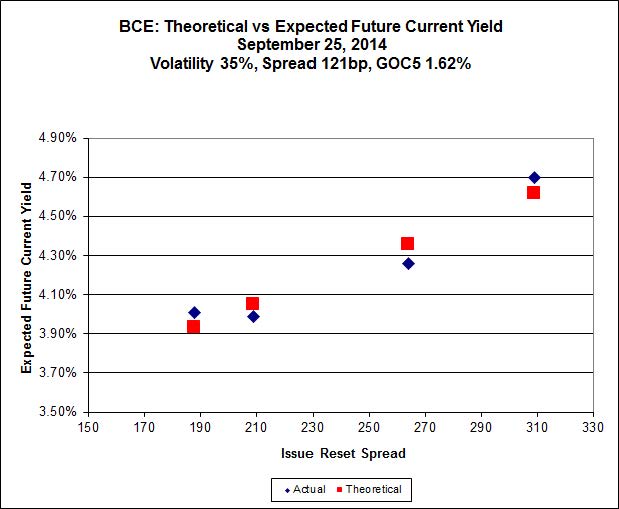
ImpVol_BCE_FR_140925
Click for Big
Market Action

September 24, 2014

PIMCO’s in some kind of trouble with the SEC:

Pacific Investment Management Co. said it’s cooperating with regulators examining how the firm assigned asset prices at Bill Gross’s Pimco Total Return ETF.

“Pimco has been cooperating with the SEC in this non-public matter, and we take our regulatory obligations and responsibilities to our clients very seriously,” Mark Porterfield, a spokesman for Newport Beach, California-based Pimco, said in an e-mailed statement. “We believe our pricing procedures are entirely appropriate and in keeping with industry best-practices.”

“What they’re being accused of is in fact the industry standard accounting process,” Dave Nadig, the chief investment officer at ETF.com, a San Francisco-based ETF research and analysis firm, said in a telephone interview.

By law, fund managers have to come up with a price, either by asking dealers for quotes or by extrapolating from data points such as credit rating, size, structure, and comparable securities, Nadig said.

“Because Pimco is an 800-pound gorilla, they negotiate a really good price,” he said. “If the SEC wants to change how bonds are priced, then they can do that, but that’s going to change everybody.”

The ETF attributed some of its outperformance against its benchmark to “an allocation to non-Agency mortgages which benefited from limited supply and a recovery in the housing sector,” according to the latest quarterly report on its website.

Kirsten Grind, Gregory Zuckerman and Jean Eaglesham of the Wall Street Journal explain:

The investments believed to be in question, such as small amounts of mortgage securities—or "odd lots" in the terminology of the financial markets—tend to receive lower prices because of their small sizes or because they are backed by smaller institutions, among other factors.

After the launch of the ETF, Wall Street traders were encouraged by Pimco to offer these small securities to the Pimco ETF, according to some of the people familiar with the matter. Mortgage bonds with a relatively small $500,000 face amount, for example, might have sold for only $480,000, because few investors wanted them, due to the small size.

But when Pimco, shortly after purchasing the bonds, placed a value on them, it typically used outside pricing companies that often assigned higher valuations because they used a similar, but much larger, pool of mortgage bonds to compare them with, according to people close to the firm. Placing a $500,000 valuation on a bond purchased for $480,000, for example, would have allowed Pimco to claim a quick 4% gain on the $500,000 bond, or $20,000.

If that maneuver happened with enough bonds, early results of the ETF could have been aided, these people say.

Traders say buying discounted bonds, then using an outside ratings company to place a higher valuation on those bonds, is akin to buying a used car on the cheap because it is in poor shape but having a lender rely on the list price when making a loan.

Matt Levine of Bloomberg points out:

The point of a bond ETF is, in large part, to make the illiquid liquid: to make it easy for small investors to buy and sell diversified bond portfolios in small sizes. The point of the ETF structure, on the other hand, is to use the market to prevent mispricing: The market in the underlying acts as a check on the valuation of the fund. And the point of the bond market sometimes seems to be to slice credit into tiny weird units that trade in idiosyncratic ways and reward cleverness. Those three things don’t really go together. It sounds like the SEC’s worry is that Pimco’s ETF made the illiquid liquid, but at the cost of losing the check on its valuation. Which then provided idiosyncratic opportunities to reward cleverness.

It’s a complex story, and not completely apparent that anything wrong is happening. It is quite well known that investors (even retail investors!) can make very good returns simply by asking their salesman to alert them to any strange odd-lots the brokerage might have hanging around. Brokerages will often provide liquidity for transferable GICs, for instance, by offering a really, really crumby price – like 150bp over market yield. They’ll then sell it for 100bp over market yield, recouping their costs while giving the ultimate buyer a great deal on his GIC … provided he doesn’t mind buying some weird dollar value of GIC with a basically random maturity date. But when you do that as part of an ETF … complications ensue.

But I will point out that a large fund (such as anything run by PIMCO!) might quite rationally take a long view … buy enough discounted small lots of the same issue and eventually that discount is no longer applicable.

But perhaps a new way of potentially scoring excess returns is coming!

With interest rates barely above zero, the typical U.S. savings account has all the excitement of, well, waiting in line at the bank. But what if instead of marketing yet another CD or credit card, banks held raffles and gave millions away each month to savers? The local bank might feel less like the villain behind those big overdraft fees and more like a casino on the Vegas strip.

A bank in South Africa tried this in 2005. The First National Bank’s Million-a-Month Account promised savers a chance to win 113 prizes a month, including a grand prize of 1 million South African rand (about U.S.$150,000 at the time). Within 18 months, the bank had more prize-eligible accounts than regular ones. These new customers, many of them poor, saved an extra 1 percent of their incomes, a recent study found, and boosted their overall saving 38 percent.

The only thing preventing a big bank from doing this in the U.S.: It’s completely illegal. A bill in Congress — which passed the U.S. House of Representatives on Sept. 16 — would change the law. If it’s passed by the U.S. Senate in the next few months and signed by President Barack Obama, banks of all sizes could start tempting savers with “savings promotion raffles.”

In the U.S., federal law already lets credit unions offer prizes to savers, as long as states are okay with it. The Save-To-Win game, started in Michigan in 2009, is available at credit unions in four states. In Michigan, every $25 saved increases the chance that a customer could win dozens of monthly prizes worth up to $3,750, or six $10,000 grand prizes each year. So far, more than 50,000 people have saved more than $94 million through the game.

The fun of competing for prizes does get more people saving, the studies of the South African and Save-To-Win experiments suggest. And low-income people especially benefit from this extra cushion of cash. A quarter of Americans tell researcher they’re certain they’d have no way to come up with $2,000 in the next month.

In a paper titled International Transmission Channels of U.S. Quantitative Easing: Evidence from Canada, Tatjana Dahlhaus, Kristina Hess and Abeer Reza claim:

The U.S. Federal Reserve responded to the great recession by reducing policy rates to the effective lower bound. In order to provide further monetary stimulus, they subsequently conducted large-scale asset purchases, quadrupling their balance sheet in the process. We assess the international spillover effects of this quantitative easing program on the Canadian economy in a factor-augmented vector autoregression (FAVAR) framework, by considering a counterfactual scenario in which the Federal Reserve’s long-term asset holdings do not rise in response to the recession. We find that U.S. quantitative easing boosted Canadian output, mainly through the financial channel.

Standard economic theory, however, provides ambiguous implications for the international spillover of monetary easing (Rogoff [2002]). Through the expenditure-switching effect, a monetary expansion in the United States would depreciate the home currency and deteriorate its terms of trade, making home goods cheaper for foreigners. The resulting increase in home country net exports would then detract from the real output of the foreign economy. The income-absorption effect, on the other hand, implies that as long as expansionary monetary policy in the home country drives up domestic income, home demand for imports would rise, boosting the economy of foreign exporters. Finally, in the presence of global financial market integration, any increase in asset prices and reductions in yields in the domestic financial market resulting from QE may be reflected by similar movements in corresponding foreign financial market variables,2 which in turn would boost foreign consumption and investment through the same mechanism as it does in the domestic case. Therefore, whether Canada benefits from the U.S. expansion through QE depends on which of these effects dominate, and is an empirical question that we attempt to answer here.

R Split III Corp., proud issuer of RBS.PR.B was confirmed by DBRS at Pfd-2:

On September 24, 2013, DBRS upgraded the ratings on the Preferred Shares to Pfd-2 from Pfd-2 (low) based on the increased downside protection levels available to holders of the Preferred Shares over the prior year, as well as the increase in distribution coverage ratio. Since the rating was upgraded, the net asset value of the Company has generally been increasing steadily, rising from $43.55 on September 12, 2013, to $54.22 on September 11, 2014. Downside protection available to holders of the Preferred Shares increased to 74.9% as of September 11, 2014, compared to 68.8% on September 12, 2013. In addition, RBC raised its dividends twice this year, on February 26, 2014, and most recently on August 22, 2014, increasing quarterly distributions to 75 cents per share from 67 cents per share. This dividend boost increases the Preferred Share distribution coverage ratio to 2.9 times (up from 2.6 times in September 2013). The confirmation of the rating of the Preferred Shares is based primarily on the current level of downside protection available and the current distribution coverage ratio.

With a market capitalization of less than $10MM, RBS.PR.B is not tracked by HIMIPref™.

It was a mixed day for the Canadian preferred share market, with PerpetualDiscounts rocketing up 34bp (more than half of this was due to strength in three BAM issues), FixedResets off 1bp and DeemedRetractibles down 4bp. Volatility was good, highlighted by winning BAM PerpetualDiscounts. Volume was below average.

HIMIPref™ Preferred Indices
These values reflect the December 2008 revision of the HIMIPref™ Indices

Values are provisional and are finalized monthly
Index Mean
Current
Yield
(at bid)
Median
YTW
Median
Average
Trading
Value
Median
Mod Dur
(YTW)
Issues Day’s Perf. Index Value
Ratchet 0.00 % 0.00 % 0 0.00 0 0.5655 % 2,677.1
FixedFloater 4.20 % 3.46 % 24,694 18.43 1 0.0000 % 4,127.3
Floater 2.88 % 3.00 % 59,989 19.71 4 0.5655 % 2,768.3
OpRet 4.04 % 0.40 % 97,480 0.08 1 0.1185 % 2,730.3
SplitShare 4.29 % 3.76 % 108,617 3.89 5 -0.0873 % 3,154.8
Interest-Bearing 0.00 % 0.00 % 0 0.00 0 0.1185 % 2,496.6
Perpetual-Premium 5.47 % 2.66 % 87,359 0.08 20 0.0531 % 2,441.2
Perpetual-Discount 5.26 % 5.17 % 102,777 15.15 16 0.3439 % 2,595.3
FixedReset 4.25 % 3.80 % 183,208 8.43 75 -0.0098 % 2,555.6
Deemed-Retractible 5.00 % 1.64 % 109,355 0.27 42 -0.0390 % 2,563.3
FloatingReset 2.58 % -2.37 % 70,680 0.08 6 0.0718 % 2,540.3
Performance Highlights
Issue Index Change Notes
TRP.PR.D FixedReset -4.80 % YTW SCENARIO
Maturity Type : Limit Maturity
Maturity Date : 2044-09-24
Maturity Price : 22.61
Evaluated at bid price : 23.58
Bid-YTW : 4.28 %
FTS.PR.G FixedReset -1.05 % YTW SCENARIO
Maturity Type : Limit Maturity
Maturity Date : 2044-09-24
Maturity Price : 23.11
Evaluated at bid price : 24.60
Bid-YTW : 3.81 %
BAM.PR.N Perpetual-Discount 1.09 % YTW SCENARIO
Maturity Type : Limit Maturity
Maturity Date : 2044-09-24
Maturity Price : 21.25
Evaluated at bid price : 21.25
Bid-YTW : 5.62 %
BAM.PF.C Perpetual-Discount 1.22 % YTW SCENARIO
Maturity Type : Limit Maturity
Maturity Date : 2044-09-24
Maturity Price : 21.28
Evaluated at bid price : 21.57
Bid-YTW : 5.64 %
BAM.PR.C Floater 1.51 % YTW SCENARIO
Maturity Type : Limit Maturity
Maturity Date : 2044-09-24
Maturity Price : 17.45
Evaluated at bid price : 17.45
Bid-YTW : 3.00 %
BAM.PF.D Perpetual-Discount 1.77 % YTW SCENARIO
Maturity Type : Limit Maturity
Maturity Date : 2044-09-24
Maturity Price : 21.55
Evaluated at bid price : 21.86
Bid-YTW : 5.62 %
Volume Highlights
Issue Index Shares
Traded
Notes
BMO.PR.T FixedReset 152,616 Nesbitt crossed blocks of 50,000 and 31,900, both at 25.29; RBC crossed 30,000 at the same price.
YTW SCENARIO
Maturity Type : Limit Maturity
Maturity Date : 2044-09-24
Maturity Price : 23.25
Evaluated at bid price : 25.25
Bid-YTW : 3.82 %
ENB.PF.G FixedReset 121,195 Recent new issue.
YTW SCENARIO
Maturity Type : Limit Maturity
Maturity Date : 2044-09-24
Maturity Price : 23.10
Evaluated at bid price : 24.97
Bid-YTW : 4.28 %
IAG.PR.G FixedReset 97,020 RBC crossed blocks of 20,000 and 62,700, both at 26.30.
YTW SCENARIO
Maturity Type : Call
Maturity Date : 2017-06-30
Maturity Price : 25.00
Evaluated at bid price : 26.27
Bid-YTW : 2.38 %
RY.PR.H FixedReset 51,421 TD crossed 25,000 at 25.30.
YTW SCENARIO
Maturity Type : Call
Maturity Date : 2019-08-24
Maturity Price : 25.00
Evaluated at bid price : 25.28
Bid-YTW : 3.74 %
ENB.PR.D FixedReset 50,469 TD crossed 42,600 at 24.16.
YTW SCENARIO
Maturity Type : Limit Maturity
Maturity Date : 2044-09-24
Maturity Price : 22.98
Evaluated at bid price : 24.15
Bid-YTW : 4.14 %
FTS.PR.M FixedReset 41,170 Recent new issue.
YTW SCENARIO
Maturity Type : Call
Maturity Date : 2019-12-01
Maturity Price : 25.00
Evaluated at bid price : 25.15
Bid-YTW : 4.00 %
There were 27 other index-included issues trading in excess of 10,000 shares.
Wide Spread Highlights
Issue Index Quote Data and Yield Notes
TRP.PR.D FixedReset Quote: 23.58 – 25.18
Spot Rate : 1.6000
Average : 0.9276

YTW SCENARIO
Maturity Type : Limit Maturity
Maturity Date : 2044-09-24
Maturity Price : 22.61
Evaluated at bid price : 23.58
Bid-YTW : 4.28 %

HSB.PR.D Deemed-Retractible Quote: 25.30 – 25.92
Spot Rate : 0.6200
Average : 0.3952

YTW SCENARIO
Maturity Type : Call
Maturity Date : 2014-12-31
Maturity Price : 25.00
Evaluated at bid price : 25.30
Bid-YTW : 0.24 %

CGI.PR.D SplitShare Quote: 25.04 – 25.30
Spot Rate : 0.2600
Average : 0.1838

YTW SCENARIO
Maturity Type : Soft Maturity
Maturity Date : 2023-06-14
Maturity Price : 25.00
Evaluated at bid price : 25.04
Bid-YTW : 3.76 %

PWF.PR.O Perpetual-Premium Quote: 26.16 – 26.45
Spot Rate : 0.2900
Average : 0.2300

YTW SCENARIO
Maturity Type : Call
Maturity Date : 2017-10-31
Maturity Price : 25.25
Evaluated at bid price : 26.16
Bid-YTW : 4.81 %

POW.PR.G Perpetual-Premium Quote: 26.11 – 26.31
Spot Rate : 0.2000
Average : 0.1435

YTW SCENARIO
Maturity Type : Call
Maturity Date : 2021-04-15
Maturity Price : 25.00
Evaluated at bid price : 26.11
Bid-YTW : 4.78 %

SLF.PR.D Deemed-Retractible Quote: 22.38 – 22.54
Spot Rate : 0.1600
Average : 0.1045

YTW SCENARIO
Maturity Type : Hard Maturity
Maturity Date : 2025-01-31
Maturity Price : 25.00
Evaluated at bid price : 22.38
Bid-YTW : 5.84 %

Better Communication, Please!

BCE / BAF Preferred Share Symbols Announced, Sort Of, Maybe

Well, pig ignorance and a blithe disregard of the interests of preferred shareholders has struck again, with no announcement on the BCE Inc. preferred share information page regarding the three new series that will result from the BAF conversion.

However, a certain amount of checking permits the identification of at least two tickers:

New Ticker BCE Series Description Old (and continuing) ticker
BCE.PR.M “AM” FixedReset
4.85%+209
BAF.PR.A
BCE.PR.O “AO” FixedReset
4.55%+309
BAF.PR.C
BCE.PR.Q
?????????
“AQ” FixedReset
4.25%+264
BAF.PR.E

For the first two, the correspondence of the first two columns has been established from the name information purchased from the Toronto Stock Exchange. The correspondence of the second column with the third has been established from the security descriptions contained within the Certificate of Amendment to the articles of BCE Inc., which may be found on SEDAR with the search results “BCE Inc. Sep 22 2014 16:50:17 ET Security holders documents – English PDF 847 K”.

I regret, as always, not being able to provide a link to this public document; however, bank-owned SEDAR prohibits direct links and hides them behind a secret API. This is in order to protect their monopoly. This monopoly has been granted to them by the Canadian Securities Administrators, of which the OSC is an important member. The banks are paying the OSC to help them preserve their hegemony over the Canadian financial system. So investors and the general public can stuff it.

Correspondence of the third and fourth columns was determined by looking up the description of the BAF issues in PrefLetter.

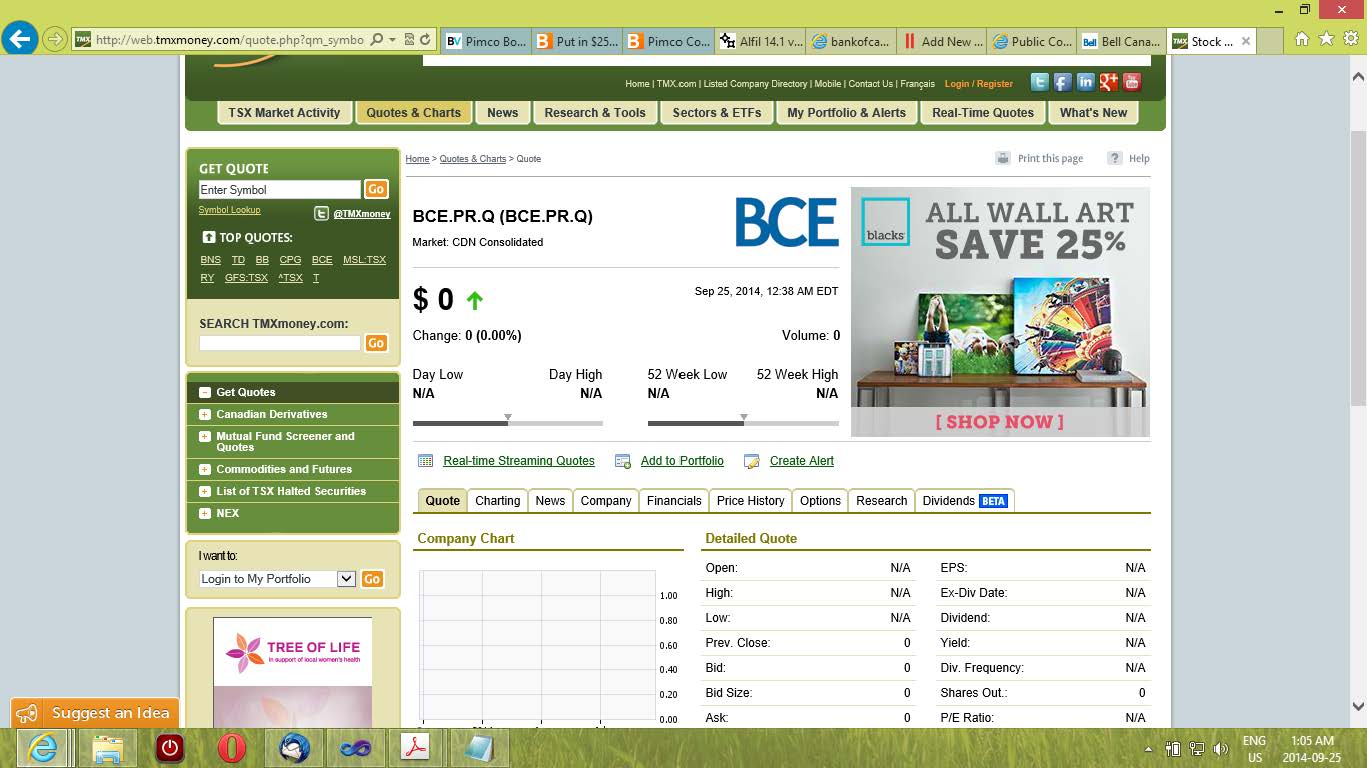
The third issue presents some problems. If we check TMX Money for BCE.PR.Q, we get the result:

TMXMoney_BCEPRQ_140924
Click for Big

This is the standard result for a new ticker the day before it starts trading – I assume it results from the symbol being in the database, but none of the other data that would normally be reported on this page is present. I am unable to obtain such a screen by typing in “BCE.PR.?”, where “?” is any unused letter (other than “M” and “O”, for which satisfactory assignments have been determined), or BCE.PF.A or BCE.PF.Q.

However, the name information file purchased from the Exchange refers to this as Series Q, not as Series AQ. One might at first hope that this is simply a typo, but on the other hand the “Q” series is referenced in both the long name and in the short name.

Further, a quick check of the BCE preferred share information page reveals that there actually is a BCE preferred share Series Q that is not currently trading. It is the RatchetRate counterpart to the FixedFloater BCE.PR.R, and the opportunity to convert into BCE.PR.Q was offered to the R-holders in 2010 but hardly anybody wanted them so everything stayed as R. It will be noted that Series Q was issued in 1995; holders of BCE.PR.R will get another chance to convert in 2015.

It will be noted that other information available from the Exchange – for a price! – indicates the listing date of BCE.PR.Q is 1995/11/21 … so if it weren’t for the fact that I can’t find any other ‘null response’ on TMX Money for a BCE ticker symbol, there would be no reason to suppose that there is any BAF.PR.E / BCE.PR.Q correspondence.

So basically, Series AQ, the former BAF.PR.E, may or may not trade on September 25 as BCE.PR.Q; if it does, then God only knows what Series Q will trade as if it comes into existence next year and God only knows if or when the Exchange will correct their name descriptions. If it doesn’t trade at BCE.PR.Q tomorrow, I don’t know what it will trade as.

This screw up was brought to you courtesy of the bank-owned Toronto Stock Exchange; as we all know, banks in Canada have a near monopoly position over the Canadian financial system, helped along by their special extra monopoly-enhancing payments to the regulators, and employ hundreds of thousands of people, not a single one of whom has any brains at all. Their work in this matter was done on behalf of BCE Inc., which is (surprise!) another near-monopoly which also provides employment exclusively for the brainless.

Market Action

September 24, 2014

RBC issued sub-debt at 3.45%+112:

Royal Bank of Canada (RY on TSX and NYSE) today announced an offering of $1 billion of subordinated debentures (“the Notes”) through its Canadian Medium Term Note Program.

The Notes bear interest at a fixed rate of 3.45 per cent per annum (paid semi-annually) until September 29, 2021, and at the three-month Banker’s Acceptance Rate plus 1.12 per cent thereafter until their maturity on September 29, 2026 (paid quarterly). The expected closing date is September 29, 2014. RBC Capital Markets is acting as lead agent on the issue.

The bank may, at its option, with the prior approval of the Office of the Superintendent of Financial Institutions Canada, redeem the Notes on or after September 29, 2021 at par, in whole at any time or in part from time to time, on not less than 30 days and not more than 60 days notice to registered holders.

Net proceeds from this transaction will be used for general business purposes.

Rumblings about corporate bond liquidity are getting more frequent:

Index fund managers are finding it hard to secure the bonds they need at the prices they want, forcing them to make trade-offs that can hurt investors and leave managers vulnerable in a market downturn.

Bond liquidity has all but dried up for corporate issues after new regulations and capital requirements forced Wall Street banks to slash their inventories of fixed-income products following the financial crisis. That’s especially challenging for index fund managers who must acquire certain bonds to be able to track specific benchmarks.

The lack of liquidity also means funds may have trouble selling bonds in the event interest rates rise and the investors who have sunk about $1.2-trillion (U.S.) in net deposits into long-term bond funds since the end of 2004 head for the exits.

The Financial Stability Board (FSB) is examining whether exchange-traded funds pose a risk to the global financial system for precisely that reason, according to the Bank of Canada’s representative to the committee at the Bank for International Settlements.

“There’s been investments and positions taken that may not have the liquidity there that people expect, especially as interest rates start to normalize,” Carolyn Wilkins, senior deputy governor at Canada’s central bank, told Bloomberg News in an interview. “So the liquidity illusion, if you want to put it that way, is something that we’re worried about.”

I certainly hope she was misquoted in the Bloomberg story regarding that interview:

The efforts of the Basel Committee are helping to restore faith in the financial system, Wilkins said.

“People are going to have the knowledge that the banks not only in Canada, but globally are safer,” she said. “That means that the probability of something going wrong that they’ll be on the hook for later as taxpayers will be lower.”

While additional regulatory requirements may translate into extra transaction costs for the banks and businesses and customers they deal with, “those costs should be worth it because they’re reducing the chances that something goes pear shaped,” she said.

Well, of course there are benefits to increased capital levels, although I don’t have quite the same certainty with respect to some regulatory requirements. And anybody will agree there are costs. The hard part is – and what has been consistently ignored by OSFI, the Bank of Canada, and every apparatchik in the apparatus – is balancing the two. We have a very safe banking system in Canada – and it has come at the expense of innovation and economic growth.