New Issues

New Issue: TA FixedReset 4.60%+203

Transalta Corporation has announced:

that it has agreed to issue to a syndicate of underwriters led by CIBC, RBC Capital Markets and Scotia Capital Inc. for distribution to the public 8,000,000 Cumulative Rate Reset First Preferred Shares, Series A (the “Series A Shares”). The Series A Shares will be issued at a price of $25.00 per Series A Share, for aggregate gross proceeds of $200 million. Holders of the Series A Shares will be entitled to receive a cumulative quarterly fixed dividend yielding 4.60% annually for the initial period ending March 31, 2016. Thereafter, the dividend rate will be reset every five years at a rate equal to the 5-year Government of Canada bond yield plus 2.03%.

Holders of Series A Shares will have the right, at their option, to convert their shares into Cumulative Rate Reset First Preferred Shares, Series B (the “Series B Shares”), subject to certain conditions, on March 31, 2016 and on March 31 every five years thereafter. Holders of the Series B Shares will be entitled to receive cumulative quarterly floating dividends at a rate equal to the three-month Government of Canada Treasury Bill yield plus 2.03%.

TransAlta Corporation has granted the underwriters an option, exercisable in whole or in part prior to closing, to purchase up to an additional 2,000,000 Series A Shares at the same offering price. The Series A Shares will be offered by way of prospectus supplement under the short form base shelf prospectus of TransAlta Corporation dated October 19, 2009. The prospectus supplement will be filed with securities regulatory authorities in all provinces of Canada.

The net proceeds of the offering will be used to partially fund capital projects, for other general corporate purposes and to reduce short term indebtedness of the Company and its affiliates, which short term indebtedness was used to fund the Company’s capital program and for general corporate purposes. The Company may invest funds that it does not immediately require in short term marketable debt securities. The offering is expected to close on or about December 10, 2010.

Update: The market says “Super-Size me!”

TransAlta Corporation (TSX:TA) (NYSE:TAC) has increased its previously announced bought deal financing to $250 million. TransAlta Corporation has agreed to issue to a syndicate of underwriters led by CIBC, RBC Capital Markets and Scotia Capital Inc. for distribution to the public 10,000,000 Cumulative Rate Reset First Preferred Shares, Series A (the “Series A Shares”). The Series A Shares will be issued at a price of $25.00 per Series A Share, for aggregate gross proceeds of $250 million.

TransAlta Corporation has granted the underwriters an option, exercisable in whole or in part prior to closing, to purchase up to an additional 2,000,000 Series A Shares at the same offering price.

Market Action

December 1, 2010

S&P has put Portugal on watch-negative:

What Portugal does to combat downward pressures on growth and under what terms it accepts external support–if it does at all–will influence the government’s creditworthiness. The Eurogroup Ministers recently proposed treaty changes to establish a permanent crisis mechanism to be called the European Stability Mechanism (ESM), which will be based on the European Financial Stability Facility. It is our understanding that the ESM may be designed to rank ahead of private creditors in any future debt restructurings beginning in 2013. As a result, debt that European Monetary Union member states issue might not rank pari passu with debt that the ESM issues. We think that this treaty change would represent a move away from the original design of the European Financial Stability Facility, which was intentionally exempt from preferred creditor status by the 16 members of the Euro Area in an effort to assist European Monetary Union members in financial difficulties.

I’m always looking for new perspectives, so I asked the question:

Why Issue Preferred Shares

Glad you asked…
Perferred shares are issued for a wide variety of reasons. One of the reasons why a preferred share may be issued is because people actually like these kinds of shares compared to other types of shares.

Nicole_Marie8201, Answers Expert

Well, I’m relieved to have finally cleared that one up!

Are politicians taking the US fiscal deficit seriously enough? Is the perfect the enemy of the good? If two deficit panel members are to be believed, the answers are “No” and “Yes”:

A panel vote set for today was delayed until Dec. 3. Bowles said yesterday he didn’t know if members will reach agreement on the proposal, which includes scaling back such popular tax breaks as the home-mortgage interest deduction. Agreement from 14 of the commission’s 18 members is needed to send a plan to Congress for a vote on whether to put it into effect. A failure to get 14 votes would kill the plan.

Representative Paul Ryan, a Wisconsin Republican on the panel, said in an interview he will vote against the plan because it doesn’t do enough to address rising health-care costs. Representative Jeb Hensarling, a Texas Republican, expressed the same concern and said, “I don’t know if you’re going to get my vote.”

Achieving the goal imperfectly and then merely having to tinker with the solution in place is just not sexy enough, I guess.

I had a laugh at the 7% targetted distribution of Quadravest’s Dividend Select 15 on November 26. In the interest of fairness, I think we should all now laugh just as loudly at Mulvihill’s Canadian Utilities & Telecom Income Fund:

The Fund’s investment objectives are (i) to pay holders of its Units (“Unitholders”) monthly distributions in an amount targeted to be 7.0% per annum on the NAV of the Fund; and (ii) to preserve and enhance the Fund’s NAV while reducing portfolio volatility.

The Fund will seek to achieve its investment objectives by investing in a portfolio consisting principally of equity securities of large capitalization (over $1 billion) utility and, to a lesser degree, telecommunications issuers listed on the Toronto Stock Exchange (“TSX”).

The underwriter’s fee is 5.25%. dealers get a trailer of 40bp, and Mulvihill gets 1.1%; the total underlying performance required for a stable NAV is about 8.91% … not entirely unreasonable for equities, provided we ignore sequence-of-returns risk. And, of course, Mulvihill does not provide details of its track record in the prospectus, merely their experience.

PrefBlog salutes Emil Cohen who, despite the best efforts (and a little bullying) of the Toronto District School Board, has the makings of an independent and assertive young man.

In a further abuse of the right to due process, police can now impound cars for failure to make family support payments. Doesn’t this make everybody feel good? After all, the SIU now admits that their investigation of the police assault on Adam Nobody did not include such esoteric investigative techniques as talking to the guy who made the video (although it seems that in the last few days they have listened to a lecture on investigative techniques by Officer Bubbles).

Abuse of police authority? Cover-ups and grossly incompetent pseudo-investigations? A police spokesman claims the officers involved would be outraged at allegations that there’s any kind of cover-up going on, no sir, no way, ain’t never gonna happen, but remains unable to name the officers. Ah, well … here in the true North strong and free, abuse of power is rewarded.

There was continued high volume on the Canadian preferred share market today, with PerpetualDiscounts losing 14bp and FixedResets down marginally.

PerpetualDiscounts now yield 5.37%, equivalent to 7.52% interest at the standard equivalency factor of 1.4x. Long Corporates now yield 5.4%, so the pre-tax interest equivalent spread is now 210bp, an apparrent, but probably meaningless, tightening from the 220bp reported at month-end (i.e., yesterday).

HIMIPref™ Preferred Indices
These values reflect the December 2008 revision of the HIMIPref™ Indices

Values are provisional and are finalized monthly
Index Mean
Current
Yield
(at bid)
Median
YTW
Median
Average
Trading
Value
Median
Mod Dur
(YTW)
Issues Day’s Perf. Index Value
Ratchet 0.00 % 0.00 % 0 0.00 0 0.3762 % 2,269.5
FixedFloater 4.75 % 3.21 % 28,165 19.05 1 1.2826 % 3,542.0
Floater 2.62 % 2.36 % 52,963 21.36 4 0.3762 % 2,450.4
OpRet 4.78 % 3.48 % 61,361 2.39 8 -0.1292 % 2,378.5
SplitShare 5.47 % 1.65 % 122,561 1.02 3 -0.2602 % 2,461.2
Interest-Bearing 0.00 % 0.00 % 0 0.00 0 -0.1292 % 2,174.9
Perpetual-Premium 5.70 % 5.48 % 157,197 5.44 27 -0.0490 % 2,008.3
Perpetual-Discount 5.35 % 5.37 % 283,204 14.83 51 -0.1415 % 2,036.0
FixedReset 5.23 % 3.30 % 356,668 3.15 51 -0.0062 % 2,270.7
Performance Highlights
Issue Index Change Notes
BNS.PR.O Perpetual-Premium -2.17 % YTW SCENARIO
Maturity Type : Limit Maturity
Maturity Date : 2040-12-01
Maturity Price : 24.57
Evaluated at bid price : 24.80
Bid-YTW : 5.71 %
BAM.PR.T FixedReset -1.80 % YTW SCENARIO
Maturity Type : Limit Maturity
Maturity Date : 2040-12-01
Maturity Price : 22.96
Evaluated at bid price : 24.60
Bid-YTW : 4.59 %
RY.PR.B Perpetual-Discount -1.29 % YTW SCENARIO
Maturity Type : Limit Maturity
Maturity Date : 2040-12-01
Maturity Price : 22.81
Evaluated at bid price : 23.00
Bid-YTW : 5.14 %
TD.PR.C FixedReset -1.27 % YTW SCENARIO
Maturity Type : Call
Maturity Date : 2014-03-02
Maturity Price : 25.00
Evaluated at bid price : 26.51
Bid-YTW : 3.74 %
TDS.PR.C SplitShare -1.25 % YTW SCENARIO
Maturity Type : Call
Maturity Date : 2011-12-15
Maturity Price : 10.00
Evaluated at bid price : 10.30
Bid-YTW : 1.65 %
MFC.PR.E FixedReset -1.23 % YTW SCENARIO
Maturity Type : Call
Maturity Date : 2014-10-19
Maturity Price : 25.00
Evaluated at bid price : 26.53
Bid-YTW : 3.83 %
SLF.PR.E Perpetual-Discount -1.11 % YTW SCENARIO
Maturity Type : Limit Maturity
Maturity Date : 2040-12-01
Maturity Price : 20.52
Evaluated at bid price : 20.52
Bid-YTW : 5.49 %
SLF.PR.A Perpetual-Discount -1.05 % YTW SCENARIO
Maturity Type : Limit Maturity
Maturity Date : 2040-12-01
Maturity Price : 21.62
Evaluated at bid price : 21.62
Bid-YTW : 5.50 %
GWO.PR.J FixedReset 1.00 % YTW SCENARIO
Maturity Type : Call
Maturity Date : 2014-01-30
Maturity Price : 25.00
Evaluated at bid price : 27.37
Bid-YTW : 2.66 %
BAM.PR.B Floater 1.14 % YTW SCENARIO
Maturity Type : Limit Maturity
Maturity Date : 2040-12-01
Maturity Price : 17.80
Evaluated at bid price : 17.80
Bid-YTW : 2.98 %
BAM.PR.G FixedFloater 1.28 % YTW SCENARIO
Maturity Type : Limit Maturity
Maturity Date : 2040-12-01
Maturity Price : 22.76
Evaluated at bid price : 22.90
Bid-YTW : 3.21 %
GWO.PR.H Perpetual-Discount 1.48 % YTW SCENARIO
Maturity Type : Limit Maturity
Maturity Date : 2040-12-01
Maturity Price : 23.06
Evaluated at bid price : 23.29
Bid-YTW : 5.20 %
TRP.PR.C FixedReset 1.49 % YTW SCENARIO
Maturity Type : Limit Maturity
Maturity Date : 2040-12-01
Maturity Price : 23.42
Evaluated at bid price : 25.92
Bid-YTW : 3.69 %
Volume Highlights
Issue Index Shares
Traded
Notes
TD.PR.I FixedReset 88,430 RBC crossed three blocks, of 10,000 shares, 49,000 and 25,000, all at 27.90.
YTW SCENARIO
Maturity Type : Call
Maturity Date : 2014-08-30
Maturity Price : 25.00
Evaluated at bid price : 27.88
Bid-YTW : 3.15 %
BNS.PR.P FixedReset 80,493 National crossed 40,000 at 26.22; GMP bought 30,000 from Scotia at 26.25.
YTW SCENARIO
Maturity Type : Call
Maturity Date : 2013-05-25
Maturity Price : 25.00
Evaluated at bid price : 26.00
Bid-YTW : 3.46 %
TRP.PR.A FixedReset 75,399 RBC crossed 48,200 at 26.00.
YTW SCENARIO
Maturity Type : Call
Maturity Date : 2015-01-30
Maturity Price : 25.00
Evaluated at bid price : 25.91
Bid-YTW : 3.55 %
GWO.PR.N FixedReset 75,018 Recent new issue.
YTW SCENARIO
Maturity Type : Limit Maturity
Maturity Date : 2040-12-01
Maturity Price : 24.44
Evaluated at bid price : 24.49
Bid-YTW : 3.70 %
HSB.PR.E FixedReset 68,597 RBC crossed 50,000 at 28.30.
YTW SCENARIO
Maturity Type : Call
Maturity Date : 2014-07-30
Maturity Price : 25.00
Evaluated at bid price : 28.30
Bid-YTW : 3.14 %
TD.PR.C FixedReset 68,029 Desjardins crossed 13,000 at 27.05; RBC crossed 48,400 at 26.86.
YTW SCENARIO
Maturity Type : Call
Maturity Date : 2014-03-02
Maturity Price : 25.00
Evaluated at bid price : 26.51
Bid-YTW : 3.74 %
There were 51 other index-included issues trading in excess of 10,000 shares.
Index Construction / Reporting

HIMIPref™ Index Rebalancing: November 2010

HIMI Index Changes, November 30, 2010
Issue From To Because
TD.PR.P PerpetualPremium PerpetualDiscount Price
CIU.PR.A Scraps PerpetualDiscount Volume
IGM.PR.B PerpetualDiscount PerpetualPremium Price
BMO.PR.H PerpetualDiscount PerpetualPremium Price
GWO.PR.L PerpetualDiscount PerpetualPremium Price
PWF.PR.H PerpetualDiscount PerpetualPremium Price

There were the following intra-month changes:

HIMI Index Changes during November 2010
Issue Action Index Because
CM.PR.R Delete OpRet Redeemed
CM.PR.A Delete OpRet Redeemed
GWL.PR.O Delete PerpetualDiscount Redeemed
SPL.A Delete Scraps Wound up
TDS.PR.B Delete Scraps Redeemed
TDS.PR.C Add SplitShare New Issue
GWO.PR.N Add FixedReset New Issue
Issue Comments

Best & Worst Performers: November 2010

These are total returns, with dividends presumed to have been reinvested at the bid price on the ex-date. The list has been restricted to issues in the HIMIPref™ indices.

November 2010
Issue Index DBRS Rating Monthly Performance Notes (“Now” means “November 30”)
PWF.PR.E Perpetual-Discount Pfd-1(low) -2.65% Now with a pre-tax bid-YTW of 5.68% based on a bid of 24.26 and a limitMaturity.
BAM.PR.I OpRet Pfd-2(low) -2.28% Now with a pre-tax bid-YTW of 3.84% based on a bid of 25.75 an a call 2011-7-30 at 25.25.
BAM.PR.H OpRet Pfd-2(low) -1.74% Now with a pre-tax bid-YTW of 5.13% based on a bid of 25.45 and a softMaturity 2012-3-30 at 25.00.
TD.PR.R Perpetual-Premium Pfd-1(low) -1.64% Now with a pre-tax bid-YTW of 5.58% based on a bid o 25.20 and a call 2017-5-30 at 25.00.
BMO.PR.N FixedReset Pfd-1(low) -1.56% Now with a pre-tax bid-YTW of 2.99% based on a bid of 27.77 and a call 2014-3-27 at 25.00.
MFC.PR.B Perpetual-Discount Pfd-2(high) +4.80% Now with a pre-tax bid-YTW of 5.52% based on a bid of 21.15 and a limitMaturity.
CIU.PR.A Perpetual-Discount Pfd-2(high) +5.09% Now with a pre-tax bid-YTW of 5.25% based on a bid of 22.00 and a limitMaturity.
BAM.PR.G FixFloat Pfd-2(low) +5.65%  
BAM.PR.K Floater Pfd-2(low) +5.94%  
BAM.PR.B Floater Pfd-2(low) +5.96% &nsbp;
Issue Comments

DFN.PR.A To Get Bigger

Dividend 15 Split Corp. has announced:

that it has filed a short form prospectus in each of the provinces of Canada with respect to an additional offering of Preferred Shares and Class A Shares. The offering will be co-led by RBC Capital Markets and CIBC World Markets.

The proceeds from the re-opening of the Company, net of expenses and the Agents’ fee, will be used by the Company to invest in an actively managed portfolio of dividend-yielding common shares which includes each of the 15 Canadian companies listed below. These are currently among the highest dividend-yielding securities in the S&P/TSX 60 Index:

The preliminary prospectus has all the numbers and dates of interest dotted out.

DFN.PR.A was last mentioned on PrefBlog when their secondary offering last spring raised just over $50-million. DFN.PR.A is tracked by HIMIPref™ but is relegated to the Scraps index on credit concerns.

New Issues

New Issue: CPX FixedReset 4.60%+217

Capital Power Corporation has announced:

that it will issue 5,000,000 Cumulative Rate Reset Preference Shares, Series 1 (the “Series 1 Shares”) at a price of $25 per Series 1 Share (the “Offering”) for aggregate gross proceeds of $125 million on a bought deal basis with a syndicate of underwriters, led by TD Securities Inc. and RBC Capital Markets.

The Series 1 Shares will pay fixed cumulative dividends of $1.15 per share per annum, yielding 4.60% per annum, payable on the last day of March, June, September and December of each year, as and when declared by the board of directors of Capital Power, for the initial five-year period ending December 31, 2015. The first quarterly dividend of $0.3308 per share is expected to be paid on March 31, 2011. The dividend rate will be reset on December 31, 2015 and every five years thereafter at a rate equal to the sum of the then five-year Government of Canada bond yield and 2.17%. The Series 1 Shares are redeemable by Capital Power, at its option, on December 31, 2015 and on December 31 of every fifth year thereafter.

Holders of Series 1 Shares will have the right to convert all or any part of their shares into Cumulative Floating Rate Preference Shares, Series 2 (the “Series 2 Shares”), subject to certain conditions, on December 31, 2015 and on December 31 of every fifth year thereafter. Holders of Series 2 Shares will be entitled to receive a cumulative quarterly floating dividend at a rate equal to the sum of the then 90-day Government of Canada Treasury Bill yield plus 2.17%, as and when declared by the board of directors of Capital Power.

The Offering is expected to close on or about December 16, 2010. Net proceeds will be lent to Capital Power L.P. pursuant to a subordinated debt agreement. Capital Power L.P. will use the funds to repay a portion of the outstanding balance under its credit facilities which were used to fund the acquisition of Island Generation and for general corporate purposes.

Standard & Poor’s, a division of the McGraw Hill Companies, Inc. (“S&P”) has assigned a preliminary rating of P-3 (High) for the Series 1 Shares and DBRS Limited (“DBRS”) has assigned a rating of Pfd-3 (low) for the Series 1 Shares.

The Series 1 Shares will be issued pursuant to a short form prospectus that will be filed with securities regulatory authorities in Canada. The Offering is subject to receipt of all necessary regulatory and stock exchange approvals.

Looks expensive to me.

Update: DBRS assigns Pfd-3(low) rating:

Update, 2010-12-2: Note that CPX should be considered the same name as CZP for purposes of issuer concentration calculation, due to the close relationship between the companies:

CPI Income Services Ltd., the general partner of the Partnership (the General Partner), is responsible for management of the Partnership. The General Partner is a wholly-owned subsidiary of CPI Investments Inc. (Investments). EPCOR Utilities Inc. (collectively with its subsidiaries, EPCOR) owns 51 voting, non-participating shares of Investments and Capital Power Corporation (collectively with its subsidiaries, CPC) indirectly owns 49 voting, participating shares of Investments.

During the nine months ended September 30, 2010, the Partnership made cash distributions to CPC in the amount proportionate to its ownership interest. At September 30, 2010, CPC owned 29.8% of the Partnership’s units (30.6% at September 30, 2009).

and more specifically:

The Company’s power generation operations and assets are owned by Capital Power LP (CPLP), a subsidiary of the Company. At September 30, 2010, the Company held approximately 21.75 million general partnership units and one common limited partnership unit of CPLP which represented approximately 27.8% and zero %, respectively, of CPLP, and EPCOR held 56.625 million exchangeable limited partnership units of CPLP (exchangeable for common shares of Capital Power on a one-for-one basis) representing approximately 72.2% of CPLP. The general partner of CPLP is wholly-owned by Capital Power and EPCOR’s representation on the Board of Directors does not represent a controlling vote. Accordingly, Capital Power controls CPLP and the operations of CPLP have been consolidated for financial statement purposes.

The assets used in the operating business of the Company are primarily held through CPLP and its subsidiary entities. The interests held by the Company outside CPLP are not material to the Company’s consolidated operations, assets, liabilities and operating business or the Company’s consolidated financial statements and are primarily a consequence of the Company’s organizational structure.

It should also be noted that:

EPCOR, the power utility owned by the city of Edmonton, Alberta, plans to sell about $200 million (US$200 million) worth of stock in Capital Power Corp, a company it created through the spinoff of its generating assets in May last year.

Capital Power Corp and EPCOR said the offering would see 8,334,000 common shares of Capital Power sold at $24.00 each. The offering was to be handled by a syndicate of underwriters led by RBC Capital Markets and TD Securities Inc.

After the offering, EPCOR will indirectly own 61.6 percent of the common shares of Capital Power.

Underwriters have an option to purchase up to an additional 1,250,000 common shares at the price for further proceeds of about $30 million.

Market Action

November 30, 2010

Markets remain unimpressed by the Irish bail-out:

The difference in yield between Italian 10-year bonds and German bunds widened to 199 basis points after reaching 212 points earlier. The Spanish-German yield spread rose 17 basis points to 284 basis points and the yield premium for Belgian 10- year bonds reached 131 basis points, the most since January 2009.

Credit-default swaps insuring Italian government bonds rose 24 basis points to 270, contracts on Spain increased 16 basis points to 368 and Portugal climbed 12 basis points to 552, all record highs, according to CMA, a data provider.

DBRS has assigned ratings to Loblaw’s shelf prospectus:

DBRS has today assigned a rating of BBB with a Stable trend to Loblaw Companies Limited’s (Loblaw or the Company) new $1 billion Short Form Base Shelf Prospectus, dated November 25, 2010.

This prospectus will enable Loblaw to offer and issue up to $1.0 billion of debentures and second preferred shares during the 25-month period the base shelf prospectus remains valid. Additionally, DBRS has assigned a new rating of Pfd-3 to the Company’s preferred share portion of this prospectus.

Connor Clark & Lunn, best known for the default of their highly structured RPB.PR.A offering (among others) are reinforcing their effort (kicked off with the issue of HBanc Capital Securities Trust, discussed on October 13) to win the covetted PrefBlog “Most Ridiculous Family of Funds” award with the issue of Australian Banc Capital Securites Trust. It should do quite well; the underwriting fee on the Class A units is 5.25%, not that that will have anything to do with the success of the offering, of course.

Coincidentally, a team of analysts has commented on the Aussie Dollar:

Cricket’s oldest international rivalry resumed last week in Australia without a traditional taunt of traveling English fans: “We’re fat, we’re round, three dollars to the pound.”

The dollar chant “won’t be coming out of the songbook this time,” Barmy Army spokeswoman Becky Fairlie-Clarke said in a telephone interview. “It’s more like 1 1/2 now.”

It was a poor day for the Canadian preferred share market, with PerpetualDiscounts down 24bp and FixedResets losing 10bp. Volume was heavy.

PerpetualDiscounts now yield 5.41%, equivalent to 7.57% interest at the standard equivalency factor of 1.4x. Long Corporates continue to yield about 5.4% (maybe a little under) , so the pre-tax interest-equivalent spread is now about 220bp, a significant widening from the 210bp reported on November 24, although it must be noted that the spread has been bouncing between these two levels all month.

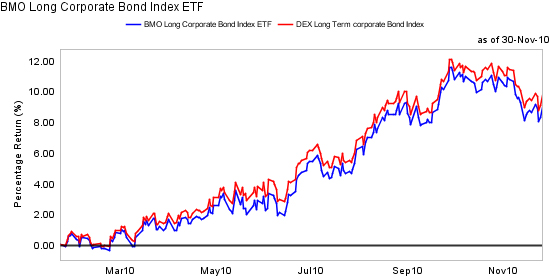
It is instructive to review the performance of the BMO Long Corporate ETF for the month:


Click for big

Long Corporates had a total return of about -1% on the month.

And that’s a wrap for November, 2010!

HIMIPref™ Preferred Indices
These values reflect the December 2008 revision of the HIMIPref™ Indices

Values are provisional and are finalized monthly
Index Mean
Current
Yield
(at bid)
Median
YTW
Median
Average
Trading
Value
Median
Mod Dur
(YTW)
Issues Day’s Perf. Index Value
Ratchet 0.00 % 0.00 % 0 0.00 0 -0.3250 % 2,261.0
FixedFloater 4.81 % 3.46 % 28,565 19.13 1 0.0442 % 3,497.2
Floater 2.63 % 2.36 % 53,681 21.37 4 -0.3250 % 2,441.3
OpRet 4.78 % 3.39 % 62,105 2.40 8 -0.6087 % 2,381.6
SplitShare 5.45 % 0.42 % 123,529 1.02 3 -0.2064 % 2,467.6
Interest-Bearing 0.00 % 0.00 % 0 0.00 0 -0.6087 % 2,177.8
Perpetual-Premium 5.69 % 5.47 % 159,226 5.39 24 -0.2281 % 2,009.3
Perpetual-Discount 5.36 % 5.41 % 273,381 14.81 53 -0.2378 % 2,038.9
FixedReset 5.23 % 3.29 % 341,256 3.15 51 -0.1020 % 2,270.8
Performance Highlights
Issue Index Change Notes
BAM.PR.I OpRet -4.17 % YTW SCENARIO
Maturity Type : Call
Maturity Date : 2011-07-30
Maturity Price : 25.25
Evaluated at bid price : 25.75
Bid-YTW : 3.84 %
BAM.PR.O OpRet -1.22 % YTW SCENARIO
Maturity Type : Option Certainty
Maturity Date : 2013-06-30
Maturity Price : 25.00
Evaluated at bid price : 25.90
Bid-YTW : 3.89 %
RY.PR.C Perpetual-Discount -1.14 % YTW SCENARIO
Maturity Type : Limit Maturity
Maturity Date : 2040-11-30
Maturity Price : 22.35
Evaluated at bid price : 22.50
Bid-YTW : 5.14 %
TD.PR.R Perpetual-Premium -1.02 % YTW SCENARIO
Maturity Type : Call
Maturity Date : 2017-05-30
Maturity Price : 25.00
Evaluated at bid price : 25.20
Bid-YTW : 5.58 %
BNS.PR.Y FixedReset 1.77 % YTW SCENARIO
Maturity Type : Limit Maturity
Maturity Date : 2040-11-30
Maturity Price : 25.19
Evaluated at bid price : 25.24
Bid-YTW : 3.40 %
Volume Highlights
Issue Index Shares
Traded
Notes
GWO.PR.N FixedReset 589,994 Inventory Clearance Sale
YTW SCENARIO
Maturity Type : Limit Maturity
Maturity Date : 2040-11-30
Maturity Price : 24.45
Evaluated at bid price : 24.50
Bid-YTW : 3.70 %
FTS.PR.H FixedReset 194,600 Nesbitt crossed 177,900 at 25.55.
YTW SCENARIO
Maturity Type : Call
Maturity Date : 2020-07-01
Maturity Price : 25.00
Evaluated at bid price : 25.50
Bid-YTW : 3.76 %
GWO.PR.I Perpetual-Discount 62,260 Nesbitt crossed 50,000 at 21.45.
YTW SCENARIO
Maturity Type : Limit Maturity
Maturity Date : 2040-11-30
Maturity Price : 21.40
Evaluated at bid price : 21.40
Bid-YTW : 5.35 %
BNS.PR.K Perpetual-Discount 58,105 TD crossed 50,000 at 23.80.
YTW SCENARIO
Maturity Type : Limit Maturity
Maturity Date : 2040-11-30
Maturity Price : 23.39
Evaluated at bid price : 23.65
Bid-YTW : 5.12 %
RY.PR.I FixedReset 56,650 RBC crossed 20,000 at 26.25 and bought 15,000 from anonymous at the same price.
YTW SCENARIO
Maturity Type : Call
Maturity Date : 2014-03-26
Maturity Price : 25.00
Evaluated at bid price : 26.21
Bid-YTW : 3.43 %
RY.PR.A Perpetual-Discount 51,980 Nesbitt crossed blocks of 20,000 and 16,000, both at 22.43.
YTW SCENARIO
Maturity Type : Limit Maturity
Maturity Date : 2040-11-30
Maturity Price : 22.25
Evaluated at bid price : 22.40
Bid-YTW : 4.99 %
There were 55 other index-included issues trading in excess of 10,000 shares.
Issue Comments

GWO.PR.N: Inventory Clearance Sale at 24.50

GWO.PR.N, a 3.65%+130 FixedReset which met with a lackadaisical reception when it settled on November 23, has apparently proved to be a tough sell – the underwriters are attempting to blow out their inventory at 24.50, with the repriced offering closing on December 3.

Still looks expensive according to me – that’s a pretty skimpy Issue Reset Rate and one must assume that it will never be called – but what do I know? Toronto Stock Exchange volume is about 440,000 shares as of 1pm, traded in a range of 24.48-54.

Market Action

November 29, 2010

The Globe featured the opinions of John Parkins in a squib on Friday:

Here are two words you don’t often see placed next to each other: “corrosive trust.”

That’s a term used by an Alberta professor to describe the clubby atmosphere that tends to emerge when people supposed to represent the public interest are put into a room with industry.

John Parkins of the University of Alberta doesn’t employ the term as a form of flattery. That kind of atmosphere, his research found, is “damaging to democracy” – and that’s an important finding, given that such citizen advisory groups are increasingly being used by industry as sounding boards for public opinion.

But Mr. Parkins found the watchdogs eventually develop a trust in the companies they are supposed to scrutinize, which can mute skepticism. His findings also apply to corporate directors, who are supposed to look after shareholders’ interests.

In other words, it’s another name for regulatory capture.

December 1 is CIBC’s Miracle Day, in which money managers are encouraged to forget all that stupid “best execution” crap and direct their business to a charity case. Anybody doing business with CIBC on December 1 should be subjected to a hostile audit by their clients, but you know something? They won’t be.

Looks like Ireland got its bail-out:

Ireland will receive 67.5 billion euros from the European Union and International Monetary Fund and provide 17.5 billion euros from its own pension reserves, Martti Salmi, a spokesman for the Finnish Finance Ministry, said today after EU finance ministers endorsed the plan in Brussels.

The need for a pact is intensifying as Irish banks’ capital dwindles. Allied Irish Banks Plc and Bank of Ireland Plc bonds fell Nov. 26 on concern the government will abandon a pledge to protect senior bondholders and force them to share the bailout costs. Ireland’s Sunday Business Post and the Sunday Tribune newspapers today reported that the ECB vetoed hurting senior bond holders.

The EU Statement reads:

The financial package of the programme will cover financing needs up to 85 billion euros, including 10 billion euros for immediate recapitalisation measures, 25 billion euros on a contingency basis for banking system supports and 50 billion euros covering budget financing needs. Half of the banking support measures (17.5 billion euros) will be financed by an Irish contribution through the Treasury cash buffer and investments of the National Pension Reserve Fund

If I were to make investment decisions on behalf of a client with anything else in mind other than the client’s best interests, I would be in serious trouble. Politicians are not subject to the same rules. However, it tends to emphasize the general principle that sovereign wealth funds (whether they are explicitly named as such, or are pension funds) should be invested outside the home country. That’s where the Caisse’s mandate gets it wrong.

Bank senior debt escaped an immediate write-down:

Irish banks’ senior bonds rose after the nation’s 85 billion-euro ($113 billion) bailout spared holders of the debt from having to share in lenders’ losses.

Bank of Ireland Plc’s 1.47 billion euros of senior floating-rate notes due September 2011 rose 6.9 cents on the euro to 90.25 cents as of 1:10 p.m. in London, an 8 percent increase, according to composite prices compiled by Bloomberg. The securities fell 7 percent on Nov. 26 on concern senior noteholders were being lined up to take some of the burden of the imminent Irish rescue.

EU ministers also took time to grease the skids for sovereign default:

European finance leaders endorsed a Franco-German compromise on post-2013 sovereign bailouts that waters down calls by German Chancellor Angela Merkel for investors to assume losses and share the costs with taxpayers.

The plan asks investors to take writeoffs on a “case-by- case” basis, according to a statement issued today by euro- area finance ministers after a meeting in Brussels to ratify a bailout for Ireland. The proposal is designed to address “collective action clauses” for debt issued after temporary crisis facilities expire in 2013. Such clauses allow bondholders to change terms of their contracts.

Merkel said Nov. 18 she was “absolutely convinced” creditors had to share bailout costs.

“The proposed clauses for investors are nothing that markets do not know in other currency areas,” said [German government spokesman Steffen] Seibert. “The plan holds no surprises for markets.”

Although the markets may not be surprised, I presume the European banking regulators will be astonished: their stwess tests completely discounted the possibility of sovereign default and looked only at mark-to-market losses in the trading book.

At any rate, it’s been a fizzle so far:

European governments’ 85 billion- euro ($113 billion) bailout package for Ireland failed to quell the market turmoil menacing the euro as stocks, bonds and the currency declined.

Irish 10-year bonds slid after an early advance, European stocks and the euro declined, and the cost of insuring the debt of Spain and Portugal against default soared to record highs.

Merkel’s big ambition is to ensure that politics trumps markets – a foolish notion. The only sensible thing ever said by any politician about financial markets was by then Prime Minister Chretien when the Canadian bond market was teetering back in 1994. I don’t have the reference, or the exact quote (tell me! Somebody please tell me!) but it was something like: “We’re not doing this [budget cuts] because we want to please the bond markets. We’re doing this so we won’t have to care about the bond markets”.

With respect to the Iberian penninsula:

The cost of insuring against default on Portuguese and Spanish government debt soared to record-high levels as an aid package for Ireland failed to reassure investors the region’s debt crisis will be contained.

Credit-default swaps on Portugal jumped 37 basis points to 539, and contracts on Spain climbed 28.75 to 351.5, according to CMA. The Markit iTraxx SovX Western Europe Index of swaps on 15 governments increased 9 basis points to 197, a record based on closing prices.

European stocks fell, extending losses into a fourth week, and bonds dropped as Ireland’s 85 billion-euro ($113 billion) bailout brought focus on the prospect of more aid to indebted nations. The region’s economy may weaken next year as budget cuts to stem the crisis hurt consumer demand and faltering global expansion curbs exports, the European Commission said.

Nouriel Roubini cheerfully opines:

“There is not enough official money to bail out Spain if trouble occurs.”

The CDS business is changing:

Trading in credit-default swaps, Wall Street’s fastest-growing business before the credit crisis, has tumbled 40 to 60 percent from three years ago as banks prepare for new regulation of derivatives.

Barclays Plc analyst Roger Freeman in New York estimates that before and during the credit crisis, Goldman Sachs generated two-thirds of its credit-trading revenue from derivatives. The contracts now likely contribute about a third, with the rest coming from bonds, he said. Michael DuVally, a spokesman at Goldman Sachs in New York, declined to comment.

To reduce opacity that Commodity Futures Trading Commission Chairman Gary Gensler says gives banks an information advantage, trades will have to be done on systems that make dealers compete over pricing and may automate some transactions now done by phone. The deals also will be reported publicly.

The changes may drive down pre-tax profit margins for credit swaps to 22 to 23 percent from about 35 percent, said Sanford C. Bernstein & Co. analyst Brad Hintz, ranked by Institutional Investor as the top analyst covering brokerage firms.

Goldman Sachs Chief Executive Officer Lloyd Blankfein described such a scenario at a Nov. 16 conference sponsored by Bank of America. After changes in equities markets drove commission rates down and volume up for the bank, the firm invested in new computerized stock-trading platforms and was able to slash half the department’s 5,000 trading jobs, he said.

Regulation of the over-the-counter “derivatives market will drive greater transparency and automation,” Blankfein said at the conference. “While transparency can reduce margins, it also introduces new opportunities in the form of greater client participation and product innovation.”

Good thing? Bad thing? Who knows? Who cares? What’s important is that there are now MORE RULES and therefore no financial crisis will ever happen again.

The BOC has released a working paper by Scott Hendry and Alison Madeley titled Text Mining and the Information Content
of Bank of Canada Communications
:

This paper uses Latent Semantic Analysis to extract information from Bank of Canada communication statements and investigates what type of information affects returns and volatility in short-term as well as long-term interest rate markets over the 2002-2008 period. Discussions about geopolitical risk and other external shocks, major domestic shocks (SARS and BSE), the balance of risks to the economic projection, and various forward looking statements are found to significantly affect market returns and volatility, especially for short-term markets. This effect is over and above that from the information contained in any policy interest rate surprise.

HP, among others, is extending term on its borrowings:

Companies are cutting back on commercial paper, short-term borrowings that typically mature in 270 days or less, with the amount outstanding falling for a fourth straight week to $1.065 trillion in the period ended Nov. 24, Federal Reserve data show. HP’s commercial paper outstanding surged to $5.17 billion on July 31 from $294 million in October 2009, according to a regulatory filing.

HP may issue $650 million of five-year notes that yield 73 basis points more than similar-maturity Treasuries, and $1.35 billion of 10-year bonds that pay a spread of 95 basis points, according to a person familiar with the transaction, who declined to be identified because terms aren’t set. Bank of America Corp., BNP Paribas SA, UBS AG and Wells Fargo & Co. are managing the sale, the person said.

DBRS commented on SEC Rule 17g-5 and its exemption today:

The Amended Rule relates to credit rating agencies (CRAs) that are registered with the SEC as NRSROs and hired by issuers, sponsors or arrangers (collectively, the Arrangers) to assign credit ratings to SF instruments. The Amended Rule prohibits an NRSRO from issuing or maintaining ratings on certain SF instruments unless the following requirements are met:

  • Hired NRSROs disclose on a password-protected website to any non-hired NRSRO certain information about the SF instrument(s) they are engaged to rate.
  • Arrangers make available on a password-protected website all information they provide a hired NRSRO to any non-hired NRSRO that wishes to access that information.

This is total craziness. They’re recognizing that you need (or would very much appreciate) material non-public information to do a proper credit analysis, but continue to allow selective disclosure to the rating agencies at the expense of actual investors. I’ve urged the repeal of Regulation FD, but the new rules simply entrench it further.

When will the first arrest of a CRA employee for tipping be made? The more people that have access to this information, the more likely it will squirm its way out into the marketplace. Credit analysis is not, perhaps, quite as sexy or immediate as take-over news and earnings projections, but I’m sure a hedge fund or two would greatly appreciate, say, a list of structured finance vehicles with underlying assets having certain characteristics.

We’re doing a fine job in Afghanistan:

When Afghanistan’s vice president visited the United Arab Emirates last year, local authorities working with the Drug Enforcement Administration discovered that he was carrying $52 million in cash. With wry understatement, a cable from the American Embassy in Kabul called the money “a significant amount” that the official, Ahmed Zia Massoud, “was ultimately allowed to keep without revealing the money’s origin or destination.”

This is an important secret, so Clinton’s trying to whip up a Global War on WikiLeaks.

Closer to home, Chief Blair is all upset because the SIU had to investigate police violence through YouTube. I agree, and I’m upset too. Why hasn’t Blair found out who made the arrests and taken statements, maybe held a press conference? Is it because Snitches Get Stitches? Every time something like this happens, I make a mental note. Perhaps someday the police will want something from me that they can’t demand. I’ll review my notes.

It was a down day on fair volume for the Canadian preferred share market; FixedResets were particularly soft. PerpetualDiscounts were down 8bp and FixedResets lost 17bp, taking the median weighted average yield on the latter index up to 3.27%.

HIMIPref™ Preferred Indices
These values reflect the December 2008 revision of the HIMIPref™ Indices

Values are provisional and are finalized monthly
Index Mean
Current
Yield
(at bid)
Median
YTW
Median
Average
Trading
Value
Median
Mod Dur
(YTW)
Issues Day’s Perf. Index Value
Ratchet 0.00 % 0.00 % 0 0.00 0 0.0750 % 2,268.4
FixedFloater 4.81 % 3.46 % 27,086 19.14 1 -0.4405 % 3,495.6
Floater 2.62 % 2.35 % 51,470 21.37 4 0.0750 % 2,449.2
OpRet 4.75 % 3.11 % 61,284 2.40 8 0.0238 % 2,396.2
SplitShare 5.44 % 0.32 % 118,986 1.03 3 -0.3120 % 2,472.7
Interest-Bearing 0.00 % 0.00 % 0 0.00 0 0.0238 % 2,191.1
Perpetual-Premium 5.67 % 5.32 % 157,722 5.40 24 0.0394 % 2,013.9
Perpetual-Discount 5.35 % 5.37 % 276,608 14.87 53 -0.0808 % 2,043.7
FixedReset 5.22 % 3.27 % 342,008 3.15 51 -0.1702 % 2,273.2
Performance Highlights
Issue Index Change Notes
BNS.PR.Y FixedReset -1.98 % YTW SCENARIO
Maturity Type : Limit Maturity
Maturity Date : 2040-11-29
Maturity Price : 24.75
Evaluated at bid price : 24.80
Bid-YTW : 3.46 %
TRP.PR.A FixedReset -1.14 % YTW SCENARIO
Maturity Type : Call
Maturity Date : 2015-01-30
Maturity Price : 25.00
Evaluated at bid price : 25.95
Bid-YTW : 3.50 %
BMO.PR.M FixedReset -1.09 % YTW SCENARIO
Maturity Type : Call
Maturity Date : 2013-09-24
Maturity Price : 25.00
Evaluated at bid price : 26.36
Bid-YTW : 2.93 %
BNS.PR.M Perpetual-Discount -1.00 % YTW SCENARIO
Maturity Type : Limit Maturity
Maturity Date : 2040-11-29
Maturity Price : 22.52
Evaluated at bid price : 22.67
Bid-YTW : 5.01 %
Volume Highlights
Issue Index Shares
Traded
Notes
BNS.PR.N Perpetual-Discount 126,180 TD crossed 100,000 at 24.85 and bought 16,100 from Nesbitt at the same price.
YTW SCENARIO
Maturity Type : Limit Maturity
Maturity Date : 2040-11-29
Maturity Price : 24.55
Evaluated at bid price : 24.78
Bid-YTW : 5.35 %
TRP.PR.A FixedReset 99,096 RBC crossed two blocks of 25,000 each and one of 30,000, all at 26.15.
YTW SCENARIO
Maturity Type : Call
Maturity Date : 2015-01-30
Maturity Price : 25.00
Evaluated at bid price : 25.95
Bid-YTW : 3.50 %
TD.PR.O Perpetual-Discount 72,479 Desjardins crossed 30,000 at 24.23.
YTW SCENARIO
Maturity Type : Limit Maturity
Maturity Date : 2040-11-29
Maturity Price : 23.95
Evaluated at bid price : 24.21
Bid-YTW : 5.05 %
BNS.PR.P FixedReset 67,182 RBC crossed 25,000 at 26.28; Nesbitt crossed 25,000 at the same price.
YTW SCENARIO
Maturity Type : Call
Maturity Date : 2013-05-25
Maturity Price : 25.00
Evaluated at bid price : 26.15
Bid-YTW : 3.20 %
GWO.PR.N FixedReset 43,525 Recent new issue.
YTW SCENARIO
Maturity Type : Limit Maturity
Maturity Date : 2040-11-29
Maturity Price : 24.55
Evaluated at bid price : 24.60
Bid-YTW : 3.68 %
TDS.PR.C SplitShare 37,985 Recent new issue.
YTW SCENARIO
Maturity Type : Call
Maturity Date : 2011-12-15
Maturity Price : 10.00
Evaluated at bid price : 10.44
Bid-YTW : 0.32 %
There were 40 other index-included issues trading in excess of 10,000 shares.
Market Action

November 26, 2010

Ireland’s causing more trouble:

Senior bonds of Allied Irish Banks Plc and Bank of Ireland Plc slumped today amid concern the government will force holders of such debt to share the cost of bailing out its financial system.

The need for speed in securing a deal for Ireland is growing amid an outflow of funds from its banks and as investors dump the bonds of other European governments on concern they too will be infected by the sovereign debt crisis. As officials from Portugal and Spain rejected speculation that their economies would also need saving, the average yield investors demand to hold 10-year debt from Greece, Ireland, Portugal, Spain and Italy today reached a euro-era record of 7.56 percent.

Aid negotiators from the EU and International Monetary Fund are taking legal advice on how senior bondholders can share the cost of the 85 billion-euro ($113 billion) bailout without triggering lawsuits, the Irish Times reported today, without saying where it got the information.

Allied Irish’s 750 million euros of 5.625 percent senior notes due 2014 plunged 4 cents on the euro to 73 cents, a 5.2 percent decline, according to composite prices on Bloomberg at 1:25 p.m. in London. Bank of Ireland’s 974 million euros of 4.625 percent senior unsecured notes maturing in 2013 fell 4 cents on the euro, or 4.8 percent, to 81 cents.

Two years ago, the Irish government assured senior bondholders that they wouldn’t lose their money if banks failed.

This is what happens when you throw out 300 years of bankruptcy law because it’s inconvenient. I don’t think the Irish banks have any chance at all of rolling that debt when it comes due.

And the PIIGS are getting slaughtered:

The average yield for 10-year debt from Greece, Ireland, Portugal, Spain and Italy reached 7.57 percent today, a euro- era record. The average premium investors demand to hold those securities instead of German bunds widened to as much as 492 basis points, the highest level of 2010. The average cost of insuring against default by the five nations using credit- default swaps reached a record 517 basis points on Nov. 23.

Hungary’s going a step further: confiscation of pension assets:

The government told Hungarians on Nov. 24 to move private- pension fund assets to government control or lose their state pension, an ultimatum designed to shift 3 trillion forint ($14.2 billion) of privately managed pension assets.

While the extra funds will move Hungary’s budget into surplus next year and may drive down government bond yields, the measure will undermine peoples’ ability to manage their savings, said Sandor Vizkeleti, chief executive of Budapest-based Pioneer Alapkezelo, a unit of UniCredit SpA.

Hungary, the first European Union country to obtain an International Monetary Fund-led bailout during the credit crisis in 2008, is following the example of Argentina, which in 2001 seized retirement savings by forcing private pension funds to transfer money to a state bank in exchange for Treasury bills.

The government in Buenos Aires nationalized the $24 billion industry two years ago to compensate for falling tax revenue after a 2005 debt restructuring. In Hungary, private fund members have the option of staying outside the state retirement system at the cost of giving up 70 percent of their contributions and the right to a state pension.

Some interesting developments with US pension funding:

United Parcel Service Inc., the world’s largest package- delivery business, Dow Chemical Co., Northrop Grumman Corp. and PPG Industries Inc. sold at least $5.25 billion of investment- grade U.S. corporate bonds in November to fund their pensions, making it the busiest month since June 2003, according to data compiled by Bloomberg.

The Federal Reserve’s effort to hold down interest rates to stimulate the economy has caused corporate pension obligations, which are pegged to bond yields, to rise by $105.8 billion this year to $1.44 trillion as of October, according to Milliman Inc.

Cyborg Trading was featured in a nice piece in the Globe yesterday:

Cyborg, a startup three years ago that today employs 14 math PhDs in its two Canadian offices, is helping day traders build and run their own trading algorithm. “You still have to come up with your own model, but that’s just one part of the equation,” Mr. Bittrolff says. “After that, it becomes, how do you execute it?”

Cyborg helps customers turn their algorithm into a simple trading strategy, and then incorporate that into their own online trading platform. “Our tool lets the trader manage and monitor his own algo,” Mr. Bittrolff adds. “No one wants these things to run amok.”

This was probably inspired by a piece in Business London Magazine, which I haven’t read because the software used to publish it on-line is such a total piece of shit.

One of their “recent developments” is a rather crude tool to monitor trading depth:

Cyborg Trader™ now offers traders the ability to cancel bids or offers based on the number of shares that are present at the top of book. Cyborg Trader™’s depth threshold technology monitors the size posted on the bid or offer of a price level. If the number of shares posted at a given price reduces by a specified amount (or percentage) the order is cancelled. This gives traders the opportunity to be filled on the bid/offer while they are close to the front of the queue without having stocks trade through their price level.

Yesterday’s Globe had an article titled This 7-per-cent yield comes with questions, about Quadravest’s new Dividend Select 15:

Dividend Select 15 uses an established options strategy called covered call writing to generate the additional five percentage points of return necessary to make those payments of 5.83 cents a month and cover fees.. Covered call writing limits your upside gains on a stock, but it also offers the potential to outperform in a slightly rising, flat or falling market. It works best in volatile markets.

Is it feasible to expect Dividend Select 15 to consistently generate the extra returns needed to make its targeted level of cash payouts? For an answer, [president and CEO of Weigh House Investor Services] Mr. [Warren] MacKenzie consulted an outside money management firm with some expertise in dividend investing.

“They said you can’t do that,” Mr. MacKenzie said. “There’s no way to consistently generate [the extra] 5 per cent.”

This points to a familiar theme in my complaints about regulation: Quadravest has been touting covered call writing in just about every single one of its products. yet in their prospectus they are not compelled to talk about their success in implementing the technique … all they have to disclose is their years of experience.

Assiduous Reader BF points out that Garth Turner continues to promote preferred shares as a panacea. His one-size-fits-all views are discussed on FWF – and probably elsewhere. Mr. Turner does not publish his performance track record. Update: He is a stockbroker with Turner Tomenson & Associates Family Wealth Management of Wellington West Capital Inc.

The Canadian preferred share market eased downwards on average volume today, with PerpetualDiscounts down 6bp and FixedResets losing 5bp.

HIMIPref™ Preferred Indices
These values reflect the December 2008 revision of the HIMIPref™ Indices

Values are provisional and are finalized monthly
Index Mean
Current
Yield
(at bid)
Median
YTW
Median
Average
Trading
Value
Median
Mod Dur
(YTW)
Issues Day’s Perf. Index Value
Ratchet 0.00 % 0.00 % 0 0.00 0 0.4271 % 2,266.7
FixedFloater 4.79 % 3.43 % 27,166 19.18 1 0.8889 % 3,511.1
Floater 2.63 % 2.35 % 53,587 21.38 4 0.4271 % 2,447.4
OpRet 4.75 % 2.83 % 60,030 2.41 8 0.1000 % 2,395.6
SplitShare 5.43 % 0.23 % 115,866 1.03 3 -0.1260 % 2,480.4
Interest-Bearing 0.00 % 0.00 % 0 0.00 0 0.1000 % 2,190.6
Perpetual-Premium 5.67 % 5.37 % 157,524 5.41 24 -0.0706 % 2,013.1
Perpetual-Discount 5.34 % 5.36 % 276,009 14.90 53 -0.0571 % 2,045.4
FixedReset 5.22 % 3.23 % 346,558 3.16 51 -0.0474 % 2,277.0
Performance Highlights
Issue Index Change Notes
PWF.PR.I Perpetual-Premium -1.22 % YTW SCENARIO
Maturity Type : Call
Maturity Date : 2012-05-30
Maturity Price : 25.00
Evaluated at bid price : 25.15
Bid-YTW : 5.92 %
PWF.PR.F Perpetual-Discount -1.13 % YTW SCENARIO
Maturity Type : Limit Maturity
Maturity Date : 2040-11-26
Maturity Price : 23.41
Evaluated at bid price : 23.70
Bid-YTW : 5.59 %
GWO.PR.H Perpetual-Discount -1.02 % YTW SCENARIO
Maturity Type : Limit Maturity
Maturity Date : 2040-11-26
Maturity Price : 23.03
Evaluated at bid price : 23.25
Bid-YTW : 5.29 %
MFC.PR.D FixedReset 1.14 % YTW SCENARIO
Maturity Type : Call
Maturity Date : 2014-07-19
Maturity Price : 25.00
Evaluated at bid price : 27.52
Bid-YTW : 3.55 %
HSB.PR.C Perpetual-Discount 1.43 % YTW SCENARIO
Maturity Type : Limit Maturity
Maturity Date : 2040-11-26
Maturity Price : 23.78
Evaluated at bid price : 24.05
Bid-YTW : 5.38 %
Volume Highlights
Issue Index Shares
Traded
Notes
GWO.PR.I Perpetual-Discount 118,860 Nesbitt crossed 110,800 at 21.45.
YTW SCENARIO
Maturity Type : Limit Maturity
Maturity Date : 2040-11-26
Maturity Price : 21.43
Evaluated at bid price : 21.43
Bid-YTW : 5.34 %
TD.PR.Q Perpetual-Premium 98,100 Nesbitt crossed 80,000 at 25.55.
YTW SCENARIO
Maturity Type : Call
Maturity Date : 2017-03-02
Maturity Price : 25.00
Evaluated at bid price : 25.56
Bid-YTW : 5.28 %
RY.PR.F Perpetual-Discount 56,430 Nesbitt crossed 50,000 at 22.50.
YTW SCENARIO
Maturity Type : Limit Maturity
Maturity Date : 2040-11-26
Maturity Price : 22.34
Evaluated at bid price : 22.48
Bid-YTW : 4.97 %
BMO.PR.L Perpetual-Premium 56,408 Desjardins crossed three blocks, of 25,000 shares, 14,700 and 10,900, all at 26.15.
YTW SCENARIO
Maturity Type : Call
Maturity Date : 2017-06-24
Maturity Price : 25.00
Evaluated at bid price : 26.08
Bid-YTW : 5.06 %
CM.PR.L FixedReset 54,747 RBC crossed 45,600 at 27.98.
YTW SCENARIO
Maturity Type : Call
Maturity Date : 2014-05-30
Maturity Price : 25.00
Evaluated at bid price : 27.98
Bid-YTW : 3.07 %
BNS.PR.N Perpetual-Discount 43,270 RBC crossed 25,000 at 24.85.
YTW SCENARIO
Maturity Type : Limit Maturity
Maturity Date : 2040-11-26
Maturity Price : 24.60
Evaluated at bid price : 24.83
Bid-YTW : 5.34 %
There were 28 other index-included issues trading in excess of 10,000 shares.