Miscellaneous News

Blogroll addition: Jim Hamilton & Securities Regulation

After reading his post regarding the SEC’s short-selling order today, I have added the blog Jim Hamilton’s World of Securities Regulation to the blogroll.

He knows what he’s talking about, a rare and valuable quality in the blogging world. The blog is something of a showpiece for his firm, which gives it additional credibility.

Issue Comments

BMO.PR.I to be Redeemed

BMO has announced:

that on November 25, 2008, it will redeem all of its Non-Cumulative Class B Preferred Shares Series 6. The redemption price, as provided for in the terms of the issue, is $25.00 per share.

Separately from the redemption price, the final quarterly dividend of $0.296875 per share for the Series 6 shares will be paid in the usual manner on November 25, 2008 to shareholders of record on October 31, 2008.

Formal notice will be issued to shareholders in accordance with the share conditions. The redemption of the Series 6 shares is part of the Bank’s ongoing management of its Tier 1 capital.

BMO.PR.I was added to the TXPR index in July 2007. The issue was discussed at length in November 2006. It is tracked by HIMIPref™ and (volume permitting, which is almost certain) will continue to be included in the Operating Retractible index until redemption.

Sub-Prime!

Moody's Updates Sub-Prime Loss Estimate

Moody’s has issued a press release:

According to Moody’s, and as outlined in the Special Report referenced above, lifetime cumulative losses on 2006 vintage subprime first-lien pools are now projected to average 22%, considering pool performance through the July 2008 remittance reports. Projected losses increase progressively with the 2006 quarter of origination, averaging 17% for Q1 2006 and rising to 26% for Q4 2006. This compares to Moody’s previous projections in January, which estimated losses in a range between 14-18%.

This estimate may also be compared with Fitch’s earlier estimate of 21% on 2006 subprime, compared to 10% for 2005 and 26% for 2007 vintage. Fitch’s report has been discussed on PrefBlog.

Market Action

September 18, 2008

The FDIC is working a bit of overtime sorting out the situation with bank holdings of FannieFreddie prefs:

The Federal Deposit Insurance Corporation (FDIC) will work with the limited number of institutions that have significant holdings of common or perpetual preferred shares in Fannie Mae and Freddie Mac to develop Capital Restoration Plans pursuant to federal regulations. These equity investments should be reported as available-for-sale equity securities, if not held for trading purposes, and any net unrealized losses should be deducted from regulatory capital. Attached is the FDIC’s “Statement on Investments in Fannie Mae and Freddie Mac Equity Securities.”

There’s rather a disturbing quote from John McCain:

LAUER: So if we get to the point middle of the week as we heard in that report where AIG might have to file for bankruptcy, they’re on their own?
McCAIN: Well…quote, “on their own”…we have to – we cannot have the taxpayers bail out AIG or anybody else…this is something we’re gonna have to work through — there’s too much corruption, there’s too much access, we can fix it, I believe in America – we can have a 9/11 commission such as we had after 9/11, ’cause this is a huge crisis and we can come up with fixes and we can make sure that every American has a safer future and that is to make them know that their bank deposits are safe and insured.

The disturbing part is “corruption”. “Corruption” implies criminality. There is a huge difference between ‘investments that didn’t work out’ and ‘incompetence and recklessness’ and ‘corruption’. If the next President approaches the issue of regulation of the financial sector with the idea that it was – somewhere, perhaps unprovable, but somewhere – widescale criminality that caused the current crunch, the economy’s in trouble. Sarbanes-Oxley has had a bad enough effect; a reprise will simply accellerate the slow erosion of New York as the world’s premier financial centre.

Reserve Primary Fund broke the buck on September 16; related events and reverberations are wild. State Street & BONY Mellon got hammered:

State Street Corp. fell as much as 55 percent and Federated Investors Inc. and Bank of New York Mellon Corp. declined in New York trading on concerns that money-market funds will be hit by a wave of losses.

The stocks plunged after BNY Mellon said a $22 billion institutional fund suffered losses on debt issued by bankrupt Lehman Brothers Holdings Inc. While not a money-market fund, BNY Mellon’s $22 billion Institutional Cash Reserves was designed to work like one.

.
Dealbreaker is amused.

And Putnam is closing down a huge fund:

Putnam Investments LLC closed its $12.3 billion institutional Putnam Prime Money Market Fund yesterday and plans to return all cash to investors.

The fund, which was valued yesterday at $1 a share, experienced “significant redemption pressure,” the Boston- based company said in a statement. A drop below $1 a share, known as breaking the buck, would have exposed investors to losses.

I discussed this issue – a bit – in my essay A Collateral Proposal, but I’m still having some trouble understanding it. Money market funds invest in commercial paper, not just T-Bills. This is because Commercial Paper pays more. It pays more due to both liquidity concerns and credit concerns. Credit Concerns! Occasionally, there will be a loss. If the Portfolio Manager is doing his job right, these losses will be few and far between; but there will be losses. That’s why you get paid extra!

So a loss of 1-2% on a money market fund is unpleasant, sure, but I’m afraid I just don’t understand why it’s the end of the world.

Another crummy day for prefs, and we can no longer talk about a yield curve. It’s more of a yield smudge, a yield Rorschach (pronounced “Raw-Shock”). Today’s closing average bid-YTW of 6.22% was seen on August 8 (moving down) and July 7 (moving up). The peak, remember, was 6.63%.

Note that these indices are experimental; the absolute and relative daily values are expected to change in the final version. In this version, index values are based at 1,000.0 on 2006-6-30.
The Fixed-Reset index was added effective 2008-9-5 at that day’s closing value of 1,119.4 for the Fixed-Floater index.
Index Mean Current Yield (at bid) Mean YTW Mean Average Trading Value Mean Mod Dur (YTW) Issues Day’s Perf. Index Value
Ratchet N/A N/A N/A N/A 0 N/A N/A
Fixed-Floater 4.75% 4.83% 76,269 15.71 6 -0.4182% 1,076.8
Floater 4.97% 4.97% 49,469 15.57 2 +1.4430% 806.8
Op. Retract 5.00% 4.73% 124,324 3.43 14 -0.1633% 1,045.0
Split-Share 5.60% 7.10% 51,046 4.32 14 -1.4028% 999.1
Interest Bearing 6.66% 7.75% 54,179 5.19 2 -0.3681% 1,069.6
Perpetual-Premium 6.25% 6.21% 57,419 2.19 1 +0.0000% 993.0
Perpetual-Discount 6.14% 6.22% 184,479 13.57 70 -0.4421% 868.8
Fixed-Reset 5.08% 4.94% 1,472,524 14.24 9 -0.1792% 1,115.0
Major Price Changes
Issue Index Change Notes
BNA.PR.C
BNA.PR.B
SplitShare +10.2813%
-6.3590%
Asset coverage of 3.2+:1 as of August 29 according to the company. Now with a pre-tax bid-YTW of 10.28% based on a bid of 18.26 and a hardMaturity 2016-3-25 at 25.00. Compare with BNA.PR.A (7.71% to 2010-9-30) and BNA.PR.C (10.82% to 2019-1-10). Note that, given 2.4 shares of BAM.A per BNA preferred and a price of 28.50 on BAM.A (up 3.60% from yesterday), asset coverage is now 2.7+:1. Today’s volume was 14,200 shares in a range 19.45-75. The last trade was at 2:33pm; the closing quote was 18.26-19.98, 5×5, with the market maker apparently out for coffee.
POW.PR.A PerpetualDiscount -5.5628% Now with a pre-tax bid-YTW of 6.57% based on a bid of 21.73 and a limitMaturity.
POW.PR.C PerpetualDiscount -5.2211% Now with a pre-tax bid-YTW of 6.57% based on a bid of 22.51 and a limitMaturity. Closing quote of 22.51-23.70 … another example of market-making, Toronto-style.
ALB.PR.A SplitShare -4.3243% Asset coverage of 1.7+:1 as of September 11, according to Scotia. Now with a pre-tax bid-YTW of 8.04% based on a bid of 23.01 and a hardMaturity 2011-2-28 at 25.00. Traded 12,923 shares in a range of (sit down) 21.53-24.00. Closing quote was another Toronto Special, 23.01-24.24, 2×1.
SBC.PR.A SplitShare -3.7948% Asset coverage of just under 2.1:1 as of September 11, according to Brompton Group. Now with a pre-tax bid-YTW of 6.43% based on a bid of 9.68 and a hardMaturity 2012-11-30 at 10.00.
GWO.PR.I PerpetualDiscount -3.0922% Now with a pre-tax bid-YTW of 6.45% based on a bid of 17.55 and a limitMaturity.
CM.PR.I PerpetualDiscount -2.4417% Now with a pre-tax bid-YTW of 6.81% based on a bid of 17.58 and a limitMaturity.
FFN.PR.A SplitShare -2.1482% Asset coverage of just under 1.8:1 as of September 15 according to the company. Now with a pre-tax bid-YTW of 7.15% based on a bid of 9.11 and a hardMaturity 2014-12-1 at 10.00.
BCE.PR.Z FixFloat -2.0632%  
SLF.PR.E PerpetualDiscount -2.0408% Now with a pre-tax bid-YTW of 6.20% based on a bid of 18.24 and a limitMaturity.
BCE.PR.G FixFloat -1.8526%  
FBS.PR.B SplitShare -1.7895% Asset coverage of just under 1.6:1 as of September 11, according to TD Securities. Now with a pre-tax bid-YTW of 7.16% based on a bid of 9.33 and a hardMaturity 2011-12-15 at 10.00.
POW.PR.D PerpetualDiscount -1.6859% Now with a pre-tax bid-YTW of 6.25% based on a bid of 21.50 and a limitMaturity.
CM.PR.G PerpetualDiscount -1.5144% Now with a pre-tax bid-YTW of 7.06% based on a bid of 19.51 and a limitMaturity.
HSB.PR.C PerpetualDiscount -1.4918% Now with a pre-tax bid-YTW of 6.47% based on a bid of 19.81 and a limitMaturity.
BSD.PR.A InterestBearing -1.4640% Now with a pre-tax bid-YTW of 8.62% (mostly as interest) based on a bid of 8.75 and a hardMaturity 2015-3-31 at 10.00.
PWF.PR.E PerpetualDiscount -1.3239% Now with a pre-tax bid-YTW of 6.23% based on a bid of 22.36 and a limitMaturity.
PWF.PR.K PerpetualDiscount -1.3158% Now with a pre-tax bid-YTW of 6.22% based on a bid of 20.25 and a limitMaturity.
SLF.PR.D PerpetualDiscount -1.2009% Now with a pre-tax bid-YTW of 6.18% based on a bid of 18.10 and a limitMaturity.
ELF.PR.G PerpetualDiscount -1.1905% Now with a pre-tax bid-YTW of 7.32% based on a bid of 16.60 and a limitMaturity.
RY.PR.D PerpetualDiscount -1.1579% Now with a pre-tax bid-YTW of 6.07% based on a bid of 18.78 and a limitMaturity.
TD.PR.P PerpetualDiscount -1.0725% Now with a pre-tax bid-YTW of 5.78% based on a bid of 23.06 and a limitMaturity.
RY.PR.B PerpetualDiscount -1.0204% Now with a pre-tax bid-YTW of 6.13% based on a bid of 19.40 and a limitMaturity.
GWO.PR.E OpRet -1.0133% Now with a pre-tax bid-YTW of 4.02% based on a bid of 25.40 and a call 2011-4-30 at 25.00.
CM.PR.P PerpetualDiscount +1.2488% Now with a pre-tax bid-YTW of 6.92% based on a bid of 20.27 and a limitMaturity.
BAM.PR.N PerpetualDiscount +1.7024% Now with a pre-tax bid-YTW of 7.41% based on a bid of 16.13 and a limitMaturity.
CM.PR.I PerpetualDiscount -1.4223% Now with a pre-tax bid-YTW of 6.64% based on a bid of 18.02 and a limitMaturity.
BCE.PR.R FixFloat +2.1739%  
BAM.PR.K Floater +2.8221%  
IAG.PR.A PerpetualDiscount +5.5041% Now with a pre-tax bid-YTW of 6.35% based on a bid of 18.21 and a limitMaturity.
Volume Highlights
Issue Index Volume Notes
NTL.PR.F Scraps (Would be ratchet, but there are credit concerns) 260,000 CIBC crossed blocks of 20,000 and 150,000, both at 6.00. Whoosh! Down 14.81%!
TD.PR.M OpRet 251,200 CIBC crossed 250,000 at 26.05. Now with a pre-tax bid-YTW of 4.19% based on a bid of 25.76 and a softMaturity 2013-10-30.
NTL.PR.G Scraps (would be Ratchet, but there are credit concerns) -22.0741% CIBC crossed 150,000 at 5.75. Whoooosh! Down 22.0741%!
MFC.PR.A OpRet 157,970 CIBC crossed 150,000 at 24.90. Now with a pre-tax bid-YTW of 4.05% based on a bid of 25.11 and a softMaturity 2015-12-18 at 25.00.
CM.PR.I PerpetualDiscount 123,000 Nesbitt crossed 100,000 at 17.80. Now with a pre-tax bid-YTW of 6.81% based on a bid of 17.58 and a limitMaturity.
TD.PR.O PerpetualDiscount 109,900 CIBC crossed 100,000 at 21.05. Now with a pre-tax bid-YTW of 5.86% based on a bid of 21.02 and a limitMaturity.
BMO.PR.J PerpetualDiscount 64,460 Nesbitt crossed 50,000 at 18.60. Now with a pre-tax bid-YTW of 6.12% based on a bid of 18.60 and a limitMaturity.

There were twenty-eight other index-included $25-pv-equivalent issues trading over 10,000 shares today.

Issue Comments

WFS.PR.A: Monthly Retraction Attractive?

WFS.PR.A is an interesting issue and the fund was long at the end of August (current position not disclosed). With nearly 12.8-million shares outstanding (par value $10), it’s one of the bigger issues included in the SplitShare index.

It’s currently quoted at 8.55-04, 6×10. Some trades have gone through today at 8.50. The capital units are quoted at 4.62-84, 10×4. It’s hard to get a big position in these things, but patience is a virtue.

As with many split-share corporations, the prospectus for WFS describes a monthly retraction feature:

Regular Retraction: Preferred Shares may be surrendered at any time for retraction by the Company but will be retracted only on a monthly Valuation Date (as defined below). Preferred Shares surrendered for retraction by a holder of Preferred Shares at least five (5) business days prior to the last day of the month (a ‘‘Valuation Date’’) will be retracted on such Valuation Date and such shareholder will receive payment on or before the eighth business day following such Valuation Date. Shareholders whose Preferred Shares are retracted on a Valuation Date will be entitled to receive a retraction price per share equal to 96% of the lesser of (i) the NAV per Unit determined as of the relevant Valuation Date less the cost to the Company of the purchase of a Class A Share in the market for cancellation; and (ii) $10.00. The cost of the purchase of a Class A Share will include the purchase price of the Class A Share, commission and such other costs, if any, related to the liquidation of any portion of the Portfolio required to fund such purchase. See ‘‘Details of the Offering — Certain Provisions of the Preferred Shares — Retraction Privileges.’’

These monthly retractions are, in normal times, of very little interest to preferred shareholders and are neither noted on PrefInfo nor accounted for by HIMIPref™. But these are not normal times.

According to Mulvihill the NAV for WFS as of September 11 was $15.93.

Given the quote on WFS, there’s a pretty good chance (but only a chance!) that a preferred shareholder tendering for monthly retraction would find that the company had purchased the matching capital unit for less than $5.93 and that he would therefore receive (96% of $10.00) less liquidation costs; call it $9.50. There are lots of them trading now for less than $9.00 … this wouldn’t be a bad return at all for two weeks work!

There are risks, of course. There are always risks.

  • The NAV could decline precipituously between the Sep 11 valuation noted and the Valuation Date. I think that the Valuation Date will be September 23, but anybody trying this should check with the company
  • The company might pay more than net-NAV to purchase the matching capital unit (though the last trade was about 24% less than net-NAV).

It should be noted that as of June 30, the fund’s portfolio was 23.1% cash. I do not know whether more recent information is available.

There are risks, to be sure. But some investors might calculate that the risk/reward profile of taking a position below $9.00 and tendering for monthly retraction is worthwhile.

I have not checked the mechanics of such a move. It might be too late to initiate this for the September Valuation Date, given settlement times and delivery times … but, perhaps, an investor with a position in WFS.PR.A that he likes might buy additional shares in the next few days and tender out of his extant holdings. Or, to look at things arsey-versey, if he has an investment in WFS.PR.A that he doesn’t like, there is the potential for tendering rather than selling.

Issue Comments

BSD.PR.A: Globe & Mail Gets the Numbers Wrong

An Assiduous Reader wrote in:

Hi James: I have been tracking your recommendations supplied through Cdn Moneysaver.
I know you had covered this interest bearing preferred and wondered if it is still on your recommended list.
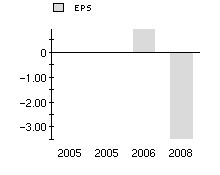
I was especially concerned with the EPS of negative 3.51 on this stock.

Thank you for the Moneysaver articles’ and your educational blog site.

Negative 3.51? That doesn’t tie in with anything I remember! So I asked for the source:

this is the GlobeInvestor site I referenced…

http://www.globeinvestor.com/servlet/Page/document/v5/data/stock?id=BSD.PR.A-T&pi_sponsor=

Thank you.

And hey, looky looky! He’s right! It says right there: EPS -3.51. There’s even a graph:

This is very odd, and not just because I don’t understand how the x-axis of the graph is labelled. I don’t understand this -3.51 business at all … which seems to be tied in (somehow) with a gross loss of 23.96-million, except that I don’t really understand how they labelled their table, either.

When in doubt, go to source documents! On the fund’s report page are annuals and quarterlies to 2Q08. After poking around a while, we open the full annual report for 2007 … and there it is. A loss of 23.96-million. In 2006.

The Globe & Mail – or their data supplier – might wish to update their figures.

Incidentally, looking at the 2Q08 Report, we derive the following table:

BSD.UN P&L
Unaudited
Summarized by James Hymas
[$ thousands]
Gross Income $5,200
Fees & Expenses $805
BSD.PR.A Interest $1,705
Realized & Unrealized
Capital Gains
Net of
cost
$5,226
Capital Units Distribution from capital $1,359
Results of Operations $6,556

Note that in addition to the $1,359 return of capital, the capital unitholders also got $1,505 from net investment income.

The important thing to take from the table, however, is that Income after fees & expenses, but before Preferred Share distributions was $5,200 – $805, or $4,395. Since preferred share distributions are $1,705, income coverage is about 2.6:1, a very good figure. It’s not just a fluke – the figure for 2007 was 2.8:1.

There’s no guarantees this will continue to be the case, especially since the fund has a heavy weighting in resources. But that’s an excellent figure for Income Coverage.

Asset coverage has been bruised over the past year, but remains at just under 1.5:1 as of September 12, according to the company. Besides the layer of capital protection, preferred shares are protected by a covenant that there will be no distributions to Capital Unit Holders if the asset coverage thereby becomes less than 1.4.

Bottom line? Check source documents and make up your own minds (or subscribe to PrefLetter!). At the close last night, BSD.PR.A was bid at 8.88 to yield 8.33% (mostly as interest) until hardMaturity 2015-3-31 at 10.00.

BSD.PR.A is tracked by HIMIPref™ and incorporated in the InterestBearing index.

Regulatory Capital

Goodwill! Bad Reporting!

I don’t have much time to post at the moment, but I would like to get some facts out before the issue takes off … and this looks like an issue that will take off.

In a piece picked up by Naked Capitalism, the New York Times reported:

With little notice, regulators at four agencies that oversee the nation’s banks and savings associations on Monday and Tuesday proposed a significant change in accounting rules to bolster banks and encourage widespread industry consolidation by making them more attractive to prospective purchasers. The regulators and the Bush administration have decided to resort to further loosening of the accounting rules to try to get the industry through problems that some experts have attributed in large part to years of deregulation.

The action by the four banking agencies provides more favorable accounting treatment of so-called good will, an intangible asset that reflects the difference between the market value and selling price of a bank.

“It’s a desperate thing,” said Karen Shaw Petrou, managing partner of Federal Financial Analytics, a consulting company.

“If we’ve learned anything,” she added, “it’s that capital at risk is the way to protect the financial system. Giving any institution a capital incentive to double down the federal backstop would be dangerous.”

Sounds scary, right? Goodwill? Counted as part of Tier 1 Capital? A patent absurdity! Credit Slips has a lot to say, but does not appear to have looked at the source documents.

The Assiduous Readers around here, though, LOVE to look at source documents! Let’s look at the Fed’s press release:

The Federal Reserve Board on Monday requested public comment on an interagency notice of proposed rulemaking (NPR) that would permit a banking organization to reduce the amount of its goodwill deduction from tier 1 capital by any associated deferred tax liability.

Under the proposed rule, the regulatory capital deduction for goodwill would be equal to the maximum capital reduction that could occur as a result of a complete write-off of the goodwill, which is equal to the amount of goodwill reported on the balance sheet under generally accepted accounting principles (GAAP) less any associated deferred tax liability. The proposal is consistent with the treatment of other similar assets.

… and the draft Federal Register Notice:

Under the Agencies’ existing regulatory capital rules, a banking organization1 must deduct certain assets from tier 1 capital.2 A banking organization is permitted to net any associated deferred tax liability against some of those assets prior to deduction from tier 1 capital. Included among those assets are certain intangible assets arising from a nontaxable business combination. Such netting generally is not permitted for goodwill and other intangible assets arising from a taxable business combination. In these cases, the full or gross carrying amount of the asset is deducted.

Statement of Financial Accounting Standards No. 141, Business Combinations (FAS 141), requires that all business combinations be accounted for using the purchase method of accounting for financial reporting purposes under generally accepted accounting principles (GAAP).3 FAS 141 also requires that the acquiring entity assign the cost of the acquired entity to each identifiable asset acquired and liability assumed. The amounts assigned are based generally upon the fair values of such assets and liabilities at the acquisition date. If the cost of the acquired entity exceeds the net of the amounts so assigned, the acquiring entity must recognize the excess amount as goodwill.

Statement of Financial Accounting Standards No. 142, Goodwill and Other Intangible Assets (FAS 142), prohibits the amortization of goodwill for financial reporting purposes under GAAP and requires periodic testing of the carrying amount of goodwill for impairment.

However, a banking organization generally amortizes goodwill for tax purposes. This difference in treatment generally results in the recognition of a deferred tax liability under GAAP. The deferred tax liability increases over time and is reflected in corresponding reductions in earnings for financial reporting purposes until the goodwill has been fully amortized for tax purposes.

The deferred tax liability generally is not reduced or reversed for financial reporting purposes unless the associated goodwill is written down upon a finding of impairment, or is otherwise derecognized.

The Agencies have received requests from several banking organizations to permit the amount of goodwill arising from a taxable business combination that must be deducted from tier 1 capital to be reduced by any associated deferred tax liability. The Agencies believe that this treatment would appropriately reflect a banking organization’s maximum exposure to loss if the goodwill becomes impaired or is derecognized under GAAP.

Accordingly, the Agencies are proposing to amend their respective capital rules to permit a banking organization to reduce the amount of goodwill it must deduct from tier 1 capital by the amount of any deferred tax liability associated with that goodwill. However, a banking organization that reduces the amount of goodwill deducted from tier 1 capital by the amount of the associated deferred tax liability would not be permitted to net this deferred tax liability against deferred tax assets when determining regulatory capital limitations on deferred tax assets.

The proposed change would permit a banking organization to effectively reduce its regulatory capital deduction for goodwill to an amount equal to the maximum regulatory capital reduction that could occur as a result of the goodwill becoming completely impaired or derecognized. This would increase a banking organization’s tier 1 capital, which is used to determine the banking organization’s leverage ratio and risk-based capital ratios.

Quite frankly, this seems eminently reasonable. I look forward to seeing some contrary opinions in the comments on the draft proposal; but at first blush it looks to me simply like a clearing up of a bureaucratic ‘you can’t get there from here’ rule maze.

At the very least, the New York Times is to be castigated for trying to make this into a Dumb Regulator story. We want INFORMATION, guys! I’ll form my own opinions, thank you!

I haven’t checked yet what the rules are in Canada. I’ll look into it … soon.

Update, 2008-9-30: The official FDIC package on this matter has been posted on their website.
Market Action

September 17, 2008

The market shows infinite capacity to surprise! We are told that today’s horror was due to credit concerns, which seems like a reasonable conclusion to draw. Most data seem consistent with this hypothesis.

So why did Fixed-Resets do so well relative to Perpetuals? Regardless of how wonderful – or not – the structure is, it addresses term risk only. Credit risk is not addressed. You have to make an awfully convoluted argument before you conclude that the relative performance of these two preferred share sub-classes is right and proper.

On the other hand, Floaters didn’t do very well. It’s a lousy sample – only two issues and both backed by BAM – but they are not money market instruments. The market always makes sense eventually. Just not right away and not all at the same time.

After today’s carnage, PerpetualDiscounts yield an average 6.18%, back to where it was on August 8 (when yields were falling; three days since the yield-trough of September 12 has undone a month of price-gains) and July 4 (when yields were rising). At the standard 1.4x equivalency factor, this is equal to 8.65% interest. Long corporates now yield 6.3%, so the pre-tax interest-equivalent spread is now about 235bp.

Note that these indices are experimental; the absolute and relative daily values are expected to change in the final version. In this version, index values are based at 1,000.0 on 2006-6-30.
The Fixed-Reset index was added effective 2008-9-5 at that day’s closing value of 1,119.4 for the Fixed-Floater index.
Index Mean Current Yield (at bid) Mean YTW Mean Average Trading Value Mean Mod Dur (YTW) Issues Day’s Perf. Index Value
Ratchet N/A N/A N/A N/A 0 N/A N/A
Fixed-Floater 4.73% 4.79% 73,960 15.74 6 -0.5447% 1,081.3
Floater 5.04% 5.04% 49,315 15.45 2 -5.5873% 795.3
Op. Retract 4.99% 4.61% 123,883 3.30 14 -0.3258% 1,046.7
Split-Share 5.52% 6.68% 49,875 4.33 14 -0.9015% 1,013.3
Interest Bearing 6.63% 7.68% 52,803 5.20 2 +0.2558% 1,073.5
Perpetual-Premium 6.25% 6.20% 57,935 2.19 1 +0.3613% 993.0
Perpetual-Discount 6.11% 6.18% 184,303 13.62 70 -0.9394% 872.7
Fixed-Reset 5.07% 4.92% 1,501,971 14.25 9 -0.1501% 1,117.0
Major Price Changes
Issue Index Change Notes
BAM.PR.K Floater -9.4444% Traded 500 shares in a range of 18.00-19.24 … but the closing quote was 16.30-18.99, 10×3. Way to go on the market making, guys!
BCE.PR.R FixFloat -4.1208% Financing jitters? See main text.
BAM.PR.K Floater -3.7948% Closing quote 18.00-69, 2×3. 1600 shares traded in the range 18.00-01 between 1:40pm and 2:18pm.
ELF.PR.F PerpetualDiscount -6.9251% Now with a pre-tax bid-YTW of 7.53% based on a bid of 18.01 and a limitMaturity.
IAG.PR.A PerpetualDiscount -6.4499% Now with a pre-tax bid-YTW of 6.70% based on a bid of 17.26 and a limitMaturity.
CM.PR.G PerpetualDiscount -4.6221% Now with a pre-tax bid-YTW of 6.95% based on a bid of 19.81 and a limitMaturity.
CM.PR.P PerpetualDiscount -4.5303% Now with a pre-tax bid-YTW of 7.00% based on a bid of 20.02 and a limitMaturity.
HSB.PR.C PerpetualDiscount -4.0553% Now with a pre-tax bid-YTW of 6.37% based on a bid of 20.11 and a limitMaturity.
CM.PR.H PerpetualDiscount -3.1488% Now with a pre-tax bid-YTW of 6.86% based on a bid of 17.84 and a limitMaturity.
DFN.PR.A SplitShare -3.0663% Asset coverage of just under 2.3:1 as of September 15, according to the company. Now with a pre-tax bid-YTW of 5.72% based on a bid of 9.80 and a hardMaturity 2014-12-1 at 10.00.
GWO.PR.I PerpetualDiscount -3.0514% Now with a pre-tax bid-YTW of 6.24% based on a bid of 18.11 and a limitMaturity.
CM.PR.D PerpetualDiscount -2.9783% Now with a pre-tax bid-YTW of 6.82% based on a bid of 21.50 and a limitMaturity.
BAM.PR.N PerpetualDiscount -2.8781% Now with a pre-tax bid-YTW of 7.54% based on a bid of 15.86 and a limitMaturity.
RY.PR.W PerpetualDiscount -2.3775% Now with a pre-tax bid-YTW of 6.17% based on a bid of 20.12 and a limitMaturity.
BAM.PR.O OpRet -2.2989% Now with a pre-tax bid-YTW of 8.94% based on a bid of 21.25 and optionCertainty 2013-6-30 at 25.00. Compare with BAM.PR.H (6.52% to 2012-3-30), BAM.PR.I (5.86% to 2013-12-30) and BAM.PR.J (6.34% to 2018-3-30).
POW.PR.B PerpetualDiscount -2.1442% Now with a pre-tax bid-YTW of 6.37% based on a bid of 21.45 and a limitMaturity.
BCE.PR.R FixFloat -2.1277%  
FFN.PR.A SplitShare -2.1030% Asset coverage of just under 1.8:1 as of September 15, 2008, according to the company. Now with a pre-tax bid-YTW of 6.72% based on a bid of 9.31 and a limitMaturity.
FBS.PR.B SplitShare -2.0619% Asset coverage of just under 1.6:1 as of September 11, according to TD Securities. Now with a pre-tax bid-YTW of 6.54% based on a bid of 9.50 and a hardMaturity 2011-12-15 at 10.00.
CM.PR.E PerpetualDiscount -2.0314% Now with a pre-tax bid-YTW of 6.72% based on a bid of 21.22 and a limitMaturity.
CM.PR.J PerpetualDiscount -1.9031% Now with a pre-tax bid-YTW of 6.74% based on a bid of 17.01 and a limitMaturity.
BAM.PR.B Floater -1.8225%  
MFC.PR.B PerpetualDiscount -1.8040% Now with a pre-tax bid-YTW of 5.81% based on a bid of 20.14 and a limitMaturity.
HSB.PR.D PerpetualDiscount -1.7292% Now with a pre-tax bid-YTW of 6.32% based on a bid of 19.89 and a limitMaturity.
BAM.PR.M PerpetualDiscount -1.6980% Now with a pre-tax bid-YTW of 7.37% based on a bid of 16.21 and a limitMaturity.
ELF.PR.G PerpetualDiscount -1.5240% Now with a pre-tax bid-YTW of 7.23% based on a bid of 16.80 and a limitMaturity.
CM.PR.I PerpetualDiscount -1.4223% Now with a pre-tax bid-YTW of 6.64% based on a bid of 18.02 and a limitMaturity.
MFC.PR.C PerpetualDiscount -1.3761% Now with a pre-tax bid-YTW of 5.85% based on a bid of 19.35 and a limitMaturity.
BNA.PR.B SplitShare -1.2658% Now with a pre-tax bid-YTW of 9.14% based on a bid of 19.50 and a hardMaturity 2016-3-25 at 25.00. See BNA.PR.C, below.
ENB.PR.A PerpetualDiscount -1.2600% Now with a pre-tax bid-YTW of 5.89% based on a bid of 23.51 and a limitMaturity.
RY.PR.A PerpetualDiscount -1.2208% Now with a pre-tax bid-YTW of 6.05% based on a bid of 18.61 and a limitMaturity.
NA.PR.N FixedReset -1.2205%  
BCE.PR.I FixedFloat -1.2097%  
PWF.PR.E PerpetualDiscount -1.1775% Now with a pre-tax bid-YTW of 6.14% based on a bid of 22.66 and a limitMaturity.
BAM.PR.J OpRet -1.1008% Now with a pre-tax bid-YTW of 6.34% based on a bid of 23.36 and a softMaturity 2018-3-30 at 25.00. See BAM.PR.O, above.
PWF.PR.G PerpetualDiscount -1.0604% Now with a pre-tax bid-YTW of 6.17% based on a bid of 24.26 and a limitMaturity.
SLF.PR.C PerpetualDiscount -1.0371% Now with a pre-tax bid-YTW of 6.17% based on a bid of 18.13 and a limitMaturity.
GWO.PR.H PerpetualDiscount +1.0350% Now with a pre-tax bid-YTW of 5.94% based on a bid of 20.50 and a limitMaturity.
TCA.PR.Y PerpetualDiscount +1.6344% Now with a pre-tax bid-YTW of 5.97% based on a bid of 47.26 and a limitMaturity.
BNA.PR.C SplitShare +5.8906% Asset coverage of 3.2+:1 as of August 29 according to the company. Now with a pre-tax bid-YTW of 10.92% based on a bid of 15.10 and a hardMaturity 2019-1-10 at 25.00. Compare with BNA.PR.A (7.26% to 2010-9-30) and BNA.PR.B (9.14% to 2016-3-25). Note that, given 2.4 shares of BAM.A per BNA preferred and a price of 27.51 on BAM.A (down 4.35% from yesterday), asset coverage is now 2.6+:1. Today’s volume was 1,500 shares in a range 15.50-75.
Volume Highlights
Issue Index Volume Notes
RY.PR.I FixedReset 187,370 RBC bought a total of 64,400 shares in six blocks from various dealers in a range of 24.95-97. New issue settled yesterday.
TD.PR.P PerpetualDiscount 169,675 National Bank crossed 100,000 at 23.40, then Nesbitt crossed 65,000 at the same price. Now with a pre-tax bid-YTW of 5.71% based on a bid of 23.31 and a limitMaturity.
BNS.PR.M PerpetualDiscount 127,100 Anonymous bought 10,000 from Nesbitt at 19.75, then National crossed 80,000 at the same price. Now with a pre-tax bid-YTW of 5.83% based on a bid of 19.63 and a limitMaturity.
RY.PR.G PerpetualDiscount 75,050 (Not necessarily the same) anonymous bought five blocks of 10,000 shares each from Scotia (virtually simultaneously), then another 10,000 from Nesbitt at 19.12. Now with a pre-tax bid-YTW of 5.99% based on a bid of 19.01 and a limitMaturity.
CU.PR.B PerpetualDiscount 50,500 Nesbitt crossed 50,000 at 24.90. Now with a pre-tax bid-YTW of 6.05% based on a bid of 25.00 and a limitMaturity.

There were twenty-nine other index-included $25-pv-equivalent issues trading over 10,000 shares today.

Issue Comments

NTL.PR.F / NTL.PR.G : DBRS changes trend to "Stable"

DBRS has announced:

has today changed the trend for the B (low) Issuer Rating and Pfd-5 (low) preferred share ratings of Nortel Networks Limited, Nortel Networks Corporation, and Nortel Networks Capital Corporation (collectively, Nortel or the Company), to Stable from Positive.

The rating action follows Nortel’s announcement today that: (1) a sustained and expanding economic downturn will pressure the Company’s operating and financial performance, (2) the Company will undergo further restructuring and cost reduction initiatives, and (3) the Company intends to explore a divestiture of its Metro Ethernet Networks (MEN) business.

DBRS had placed Nortel on Positive trend in July 2008. At the time, DBRS expected the Company could reasonably grow revenue in the low single-digit range, achieve gross margins comfortably above 40%, and grow and sustain operating margins above 8% (see separate press release dated July 14, 2008). DBRS had expected Nortel’s Enterprise Solutions and MEN businesses to be the primary drivers of expected operating improvement.

In light of Nortel’s revised business outlook, DBRS expects that the time horizon in which the Company can comfortably achieve these operating metrics has extended beyond what may be reasonable for the trend to remain Positive. Despite expected improvements in the gross margins (which are expected to remain above 40% at the end of the year), DBRS now anticipates that revenue growth and operating margin improvements will fall well short of previous expectations.

For the full year of 2008, DBRS now expects Nortel’s revenue to decline by just under 4% on a year-over-year basis, to roughly $10.6 billion, and operating margins are expected to remain well below 8% at the end of the year. DBRS expects Nortel’s liquidity to deteriorate slightly from historic levels, with the Company’s overall cash position declining to roughly $2.7 billion at the end of 2008.

With respect to its MEN business, while the impact of a divestiture on the Company’s consolidated financial and business risk profiles may be moderate, DBRS notes that exiting this business will remove the Company from a higher-growth segment, expected to be a partial driver of the Company’s overall operating improvement.

DBRS expects the long-term trend to remain Stable until DBRS can gain comfort on: (1) the relative mix in terms of the competitive and economic forces affecting the Company’s ability to achieve its long-term financial targets, (2) the impact on the Company’s financial and business risk profiles following any divestiture of the Company’s MEN business, and (3) Nortel’s long-term strategy to achieve meaningful and sustainable operating improvements in an intensely competitive and challenging operating environment.

Nortel prefs got hammered today, but not as badly as the stock:

Nortel, based in Toronto, fell $2.62, or 49 percent, to $2.68 at 4 p.m. in New York Stock Exchange composite trading, the biggest decline since July 1980, according to Bloomberg data.

The stock price has led to suggestions that a takeover is in order:

“The most likely option is that it will be acquired, either before or after a financial crisis,” suggested Duncan Stewart, president of Duncan Stewart Asset Management.

Stewart added that a deal might come before third-quarter earnings are released.

These issues were last mentioned on PrefBlog on March 10 in connection with their price differential:

NTL.PR.F closed today at 11.40-59, 10×7

NTL.PR.G closed today at 10.00-48, 15×10

Today,

  • NTL.PR.F : 6.75-00, 10×5
  • NTL.PR.G : 6.75-00, 3×15