Market Action

February 26, 2018

Hard on the heels of my mention of foreigner bashing in BC and the interesting discussion that followed comes a Bloomberg story about Canadian mortgage fraud:

Evidence of mortgage fraud amid surging home prices and household debt has prompted S&P Global Ratings to lower a key risk metric for Canadian banks.

The credit ratings agency dropped its economic risk assessment by one notch due to evidence of residential-mortgage fraud at smaller Canadian banks, which could compound existing risks from the country’s hot housing market, according to a statement Friday. S&P lowered the Canadian banks’ economic risk level to 3 out of 10, with a higher number representing great risk, revising the trend to stable. That puts Canada in line with the U.S., but lower than the U.K. and Australia.

High housing prices and debt loads increase incentives for fraudulent activity such as overstating a borrower’s income to meet qualifying criteria. Additionally, a growing share of mortgages is being originated by brokers who don’t bear the credit risk for the loans like lenders, according to the statement.

That second paragraph is very poorly written (I think the reporters had problems with “higher” and “lower” as it related to the scale used by S&P), but given the rest of the article I conclude it means they have reassessed “economic risk level” so that it is less desirable than it was before.

The S&P statement also referred to a press release from Equifax Canada about a report that I can’t find on their website (I can’t find the press release there, either!):

Equifax Canada (NYSE:EFX) data suggests high-risk and suspected fraudulent mortgage activity is on the rise noting a 52 per cent increase in suspected fraudulent mortgage applications since 2013.

According to data from Equifax’s enterprise fraud management solution, ‘Falsified Account Statements’ and ‘Falsified Documents’ were the most prominent application tags, as reported by investigators. The other was ‘Conflicting Information’. Of those applications flagged, 67 per cent were from Ontario while the next highest was 12 per cent from B.C.

Little White Lies

With respect to mortgage fraud, the results of the recent Equifax survey showed:
•13 per cent of Canadians indicated they felt it was okay to tell ‘a little white lie’ when applying for a mortgage to get the house they want.
•16 per cent said they believe mortgage fraud is a victimless crime
•8 per cent admitted to misrepresenting the facts on a credit or loan application

The Cost of Buying a Home

When asked about housing prices, the results of the recent Equifax survey showed:
•84 per cent believe that the cost of home ownership is too high for first-home buyers today
•Nearly three-in-ten Canadians cite ‘more demand than supply’ (29 per cent) and ‘foreign buyers’ (27 per cent), as the main factors driving up home prices
•B.C. residents (compared to other provinces) were significantly more likely to cite foreign buyers as the top reason for home prices being driven up (75 per cent versus 42 per cent for all other provinces, respectively

So, we’ll see how it goes when mortgage renewal rates go up to 6%, which they probably will at some point, although not necessarily in my lifetime. I have a great personal interest in this matter, as every now and then a prospective client sneers at the pathetic yield offered by preferred shares and condescendingly informs me that he can get 8%, no problem, from a mortgage investment corporation. I don’t think these guys know about risk … but then, they don’t have to! Every one I’ve ever talked to is smart enough that he’ll get out before problems become apparent to the hoi polloi.

Don’t get me wrong! I’m sure that private mortgages are a decent enough asset class and I’m sure that there are some mortgage grantors who are better at their job than others. It’s just that I don’t think a lot of people enamoured of the sector know the ‘Capital Destruction Partners’ paradigm (where you make great returns for twenty years and get wiped out in the twenty-first); and all the MIC advertising I’ve ever seen plays to that ignorance.

For instance, let’s look at Income Trust One, which touts its 8.32% nine-year historical average return. The fund fact sheet refers to a “Weighted Average LTV” [Loan to Value] of 50.8%, which sounds pretty good, right? So I looked further down and got some more detail:

incometrustone_factsheetextract
Click for Big

This puzzled me. How does an LTV of 50.8% square with historical returns of 8.32% (and over 7% in each of the three quarters to the 2017Q3 publication date)? So I sent them an eMail:

I would like some clarification regarding your calculation of Loan to Value as reported on your Fund Fact Sheet as of September 30, 2017.

How do your calculations account for the Security Position of your mortgages?

For instance, if a property is considered to have a value of $800,000 and has a first mortgage outstanding with another firm for $400,000 and you have a second mortgage on the property for $200,000, what do you consider the LTV for your portion of the mortgage to be?

… and they were kind enough to answer …

Thank you for your email. Good question.

The loan to value (LTV) is calculated as the total amount of loan been borrowed (not just our portion) on a property (1st mortgage+ 2nd mortgage+…) / the appraisal value of the property.

Using your example below, the LTV will be (1st mortgage balance $400,000 + 2nd mortgage $200,000)/property appraised value ($800,000): ($400,000+$200,000)/$800,000 = 75%

So that seems reasonable enough and is actually quite heartening … but it’s not the whole story because it does not account for the subordination of the second mortgage; it treats the first and second mortgages equally for LTV calculation purposes and so is obviously not a metric one would wish to use much for risk evaluation purposes.

For instance, in a first-mortgage-only situation, a LTV of 75% means that if the property loses 25% of its value, then the mortgage debt is exactly covered. This is also the case when the $600,000 loan is split as above. So far, so good.

But say the property loses half its value. In this case, the first mortgage is precisely covered and the second mortgage is wiped out. That is the crucial difference. This is the structured finance conundrum that led to a lot of people getting nasty surprises during the Credit Crunch, as discussed long ago in the post Hull & White on AAA Tranches of Subprime.

Now I don’t want anybody to think that I’m picking on Income Trust One – I looked at them only because I saw their ad in the paper on the weekend when I had a little spare time that I created by neglecting my programming duties. It may be the best investment ever. It might not be. To take an informed view, I would have to do some very detailed work on the component mortgages of the Fund – and this level of detail is not available in the fund’s offering memorandum or the audited financial statements. Then I’d need some kind of covariance model and all that other good stuff we learned about during the Credit Crunch. Also, one notices from the 17Q3 Financial Statements (unaudited) that the fund is levered up: unitholders’ equity of $127-million is boosted with a $43-million loan, so that has to be accounted for. I’m not going to do all that work.

And I don’t think any of the guys who have sneered at the paltry expected yields on Canadian Preferred shares have done all that work either.

A recent survey shows Canadians don’t know the difference between their bank and their mommy:

Among the most common types of advice retail bank customers seek are investment-related advice (47 per cent); quick tips to help improve their financial situation (45 per cent); retirement-related advice (42 per cent); advice to help keep track of spending and household budgets (32 per cent); and in-depth financial review (30 per cent).

In addition, almost 30 per cent of customers younger than 40 years old say they are “very interested” in receiving advice from their bank.

There’s a good drone story from the UK:

A man who crashed his car in freezing night-time temperatures was saved from hypothermia when he was found by a police thermal-imaging drone.

He was discovered in a deep ditch, 500ft (160m) away from his car on the A16 near Ludborough, Lincolnshire.

Sgt [Mike] Templeman said: “We didn’t know if this male had been picked up, [or] if he had carried on walking.

“We did extensive searches in the [police] vehicles, obviously we are very rural and it was very dark so you’re limited in what you can see.”

The OPP has a similar system, but I don’t know how widely deployed it is:

The OPP and Georgian Bay Volunteer Search And Rescue (GBVSAR) have taken over the Wye Marsh in a training session today [November 29, 2017]. Volunteers and officers have set up a command post to search for two “missing” men at the marsh. The scenario details that the men didn’t return to their vehicle early in the morning and the OPP and GBVSAR have been deployed to help look for them.

The OPP are able to bring in a UAS (unmanned aerial system), aka a drone, to help aid in the search. The drone has the ability to go up about 400 ft off the ground and travel up to speeds up 16-20 knots. There’s a thermal imaging camera on board to help the operator on the ground track what they are seeing from the sky. The camera is detailed enough to show the operator when something is an animal or a person in possible need of assistance.

BC has a formal testing programme:

A year into a pilot project to test unmanned aerial vehicles (UAVs) — commonly known as drones — for search and rescue, the province says the jury is still out on the high-tech helpers.

Search teams in Coquitlam and Kamloops got the go ahead from Emergency Management B.C. (EMBC) to test the tools last December [2016].

But EMBC search and rescue specialist Andrew Morrison said the drones haven’t seen enough air time yet to draw any firm conclusions.

“For example, Coquitlam Search and Rescue had zero deployments. Kamloops Search and Rescue had requested a UAV 18 times and deployed nine times,” he said.

HIMIPref™ Preferred Indices
These values reflect the December 2008 revision of the HIMIPref™ Indices

Values are provisional and are finalized monthly
Index Mean
Current
Yield
(at bid)
Median
YTW
Median
Average
Trading
Value
Median
Mod Dur
(YTW)
Issues Day’s Perf. Index Value
Ratchet 0.00 % 0.00 % 0 0.00 0 0.4191 % 3,055.0
FixedFloater 0.00 % 0.00 % 0 0.00 0 0.4191 % 5,605.8
Floater 3.25 % 3.46 % 96,093 18.55 4 0.4191 % 3,230.6
OpRet 0.00 % 0.00 % 0 0.00 0 0.0550 % 3,157.9
SplitShare 4.70 % 4.04 % 62,172 3.33 5 0.0550 % 3,771.3
Interest-Bearing 0.00 % 0.00 % 0 0.00 0 0.0550 % 2,942.5
Perpetual-Premium 5.45 % 4.96 % 72,064 14.38 20 0.0000 % 2,828.9
Perpetual-Discount 5.40 % 5.42 % 87,723 14.73 14 0.3650 % 2,946.0
FixedReset 4.25 % 4.56 % 167,451 5.81 102 0.0780 % 2,519.1
Deemed-Retractible 5.14 % 5.72 % 90,735 5.72 28 0.1746 % 2,910.4
FloatingReset 2.94 % 2.96 % 38,172 3.71 10 0.0825 % 2,769.2
Performance Highlights
Issue Index Change Notes
TD.PF.C FixedReset 1.14 % YTW SCENARIO
Maturity Type : Limit Maturity
Maturity Date : 2048-02-26
Maturity Price : 22.81
Evaluated at bid price : 23.16
Bid-YTW : 4.58 %
BAM.PR.T FixedReset 1.17 % YTW SCENARIO
Maturity Type : Limit Maturity
Maturity Date : 2048-02-26
Maturity Price : 21.30
Evaluated at bid price : 21.58
Bid-YTW : 4.85 %
BAM.PR.N Perpetual-Discount 1.17 % YTW SCENARIO
Maturity Type : Limit Maturity
Maturity Date : 2048-02-26
Maturity Price : 21.27
Evaluated at bid price : 21.54
Bid-YTW : 5.59 %
BAM.PF.B FixedReset 1.27 % YTW SCENARIO
Maturity Type : Limit Maturity
Maturity Date : 2048-02-26
Maturity Price : 23.49
Evaluated at bid price : 24.00
Bid-YTW : 4.87 %
TRP.PR.H FloatingReset 1.35 % YTW SCENARIO
Maturity Type : Limit Maturity
Maturity Date : 2048-02-26
Maturity Price : 17.30
Evaluated at bid price : 17.30
Bid-YTW : 3.46 %
BAM.PF.C Perpetual-Discount 1.38 % YTW SCENARIO
Maturity Type : Limit Maturity
Maturity Date : 2048-02-26
Maturity Price : 21.67
Evaluated at bid price : 21.99
Bid-YTW : 5.59 %
BAM.PF.D Perpetual-Discount 1.42 % YTW SCENARIO
Maturity Type : Limit Maturity
Maturity Date : 2048-02-26
Maturity Price : 21.90
Evaluated at bid price : 22.19
Bid-YTW : 5.60 %
Volume Highlights
Issue Index Shares
Traded
Notes
IGM.PR.B Perpetual-Premium 204,350 YTW SCENARIO
Maturity Type : Call
Maturity Date : 2018-03-28
Maturity Price : 25.25
Evaluated at bid price : 25.41
Bid-YTW : 2.99 %
SLF.PR.B Deemed-Retractible 171,800 YTW SCENARIO
Maturity Type : Hard Maturity
Maturity Date : 2025-01-31
Maturity Price : 25.00
Evaluated at bid price : 23.01
Bid-YTW : 6.41 %
MFC.PR.G FixedReset 138,271 YTW SCENARIO
Maturity Type : Call
Maturity Date : 2021-12-19
Maturity Price : 25.00
Evaluated at bid price : 24.70
Bid-YTW : 4.19 %
PWF.PR.P FixedReset 103,114 YTW SCENARIO
Maturity Type : Limit Maturity
Maturity Date : 2048-02-26
Maturity Price : 19.72
Evaluated at bid price : 19.72
Bid-YTW : 4.38 %
MFC.PR.O FixedReset 73,200 YTW SCENARIO
Maturity Type : Call
Maturity Date : 2021-06-19
Maturity Price : 25.00
Evaluated at bid price : 26.41
Bid-YTW : 3.69 %
MFC.PR.Q FixedReset 53,325 YTW SCENARIO
Maturity Type : Hard Maturity
Maturity Date : 2025-01-31
Maturity Price : 25.00
Evaluated at bid price : 24.90
Bid-YTW : 4.78 %
There were 35 other index-included issues trading in excess of 10,000 shares.
Wide Spread Highlights
Issue Index Quote Data and Yield Notes
TRP.PR.F FloatingReset Quote: 20.85 – 21.20
Spot Rate : 0.3500
Average : 0.2575

YTW SCENARIO
Maturity Type : Limit Maturity
Maturity Date : 2048-02-26
Maturity Price : 20.85
Evaluated at bid price : 20.85
Bid-YTW : 3.65 %

MFC.PR.N FixedReset Quote: 23.59 – 23.89
Spot Rate : 0.3000
Average : 0.2110

YTW SCENARIO
Maturity Type : Hard Maturity
Maturity Date : 2025-01-31
Maturity Price : 25.00
Evaluated at bid price : 23.59
Bid-YTW : 5.13 %

TD.PF.D FixedReset Quote: 24.16 – 24.41
Spot Rate : 0.2500
Average : 0.1680

YTW SCENARIO
Maturity Type : Limit Maturity
Maturity Date : 2048-02-26
Maturity Price : 23.14
Evaluated at bid price : 24.16
Bid-YTW : 4.81 %

CU.PR.I FixedReset Quote: 25.31 – 25.60
Spot Rate : 0.2900
Average : 0.2106

YTW SCENARIO
Maturity Type : Call
Maturity Date : 2020-12-01
Maturity Price : 25.00
Evaluated at bid price : 25.31
Bid-YTW : 4.02 %

HSE.PR.A FixedReset Quote: 17.94 – 18.45
Spot Rate : 0.5100
Average : 0.4378

YTW SCENARIO
Maturity Type : Limit Maturity
Maturity Date : 2048-02-26
Maturity Price : 17.94
Evaluated at bid price : 17.94
Bid-YTW : 4.93 %

MFC.PR.O FixedReset Quote: 26.41 – 26.60
Spot Rate : 0.1900
Average : 0.1235

YTW SCENARIO
Maturity Type : Call
Maturity Date : 2021-06-19
Maturity Price : 25.00
Evaluated at bid price : 26.41
Bid-YTW : 3.69 %

Issue Comments

AX.PR.U Redemption Becomes Official

Artis Real Estate Investment Trust has announced (on 2018-2-22):

that it has delivered formal notice to the holder(s) of its Preferred Units, Series C (the “Series C Units”) that, on March 31, 2018, the Trust will redeem all of the 3,000,000 outstanding Series C Units at a price of US$25.328125 (the “Redemption Price”) for each Series C Unit, being US$25.00 plus US$0.328125 in accrued and unpaid distributions thereon up to but excluding March 31, 2018.

The Redemption Price will be payable upon presentation and surrender of the Series C Units called for redemption at the corporate trust offices of AST Trust Company (Canada) at 1 Toronto Street, Suite 1200, Toronto, Ontario, M5C 2V6, Attention: Corporate Actions.

The intention to redeem, but not a commitment, was announced in January.

AX.PR.U is a FixedReset, 5.25%+446, US Pay, ROC, that commenced trading 2012-9-18 after being announced 2012-9-11. It is callable at par on March 31. The issue has not been tracked by HIMIPref™ as it is US-Pay.

Issue Comments

ABK.PR.C To Mature on Schedule

AllBanc Split Corp. has announced:

The Board of Directors of AllBanc Split Corp. (the “Company”) has today declared dividends of $0.3164 per Preferred Share and $0.5600 per Capital Share, payable on March 9, 2018 to holders of record at the close of business on March 7, 2018.

The Class A Capital Shares (“Capital Shares”) and Class C Preferred Shares, Series 1 (“Preferred Shares”) will be redeemed by the Company in accordance with their terms on March 9, 2018 and the Company will wind up and terminate as soon as practicable after such date. Pursuant to these provisions, the Preferred Shares will be redeemed at a price per share equal to the lesser of $31.64 and the net asset value per unit. The Capital Shares will be redeemed at a price per share equal to the amount by which the net asset value per unit exceeds $31.64.

Holders of Capital Shares who requested to receive their redemption payment in portfolio shares and gave notice to this effect and tendered $31.64 for each Capital Share by February 9, 2018 will receive their pro rata share of the portfolio shares. The redemption of Capital Shares and Preferred Shares will constitute a taxable disposition of the Company’s shares at the time of the redemption whether the payment is received in the form of cash or portfolio shares.

A further press release will be issued by the Company in connection with the redemption prices on March 8, 2018. Payment of the amounts due to holders of Capital Shares and Preferred Shares will be made by the Company on March 9, 2018.

AllBanc Split Corp. is a mutual fund corporation created to hold a portfolio of publicly listed common shares of selected Canadian chartered banks. Class A Capital Shares, and Class C Preferred Shares of AllBanc Split Corp. are listed for trading on The Toronto Stock Exchange under the symbols ABK.A and ABK.PR.C respectively.

ABK.PR.C is a SplitShare paying 4.00% that commenced trading 2013-3-8 after being announced 2013-1-29. It has been tracked by HIMIPref™ but relegated to the Scraps index on volume concerns.

Despite the company’s caution regarding the expected redemption price of the issue, full payment seems assured given the NAVPU of 106.78 on 2018-2-15.

Issue Comments

ALB.PR.C : Partial Call for Redemption

Allbanc Split Corp. II has announced (on 2018-2-15):

that it has called 42,667 Preferred Shares for cash redemption on February 28, 2018 (in accordance with the Company’s Articles of Incorporation, as amended) representing approximately 7.282% of the outstanding Preferred Shares as a result of the special annual retraction of 85,334 Capital Shares by the holders thereof. The Preferred Shares shall be redeemed on a pro rata basis, so that each holder of Preferred Shares of record on February 26, 2018 will have approximately 7.282% of their Preferred Shares redeemed. The redemption price for the Preferred Shares will be $25.67 per share.

Holders of Preferred Shares that are on record for dividends but have been called for redemption will be entitled to receive dividends thereon which have been declared but remain unpaid up to but not including February 28, 2018.

Payment of the amount due to holders of Preferred Shares will be made by the Company on February 28, 2018. From and after February 28, 2018 the holders of Preferred Shares that have been called for redemption will not be entitled to dividends or to exercise any right in respect of such shares except to receive the amount due on redemption.

Allbanc Split Corp. II is a mutual fund corporation created to hold a portfolio of publicly listed common shares of selected Canadian chartered banks. Capital Shares and Preferred Shares of Allbanc Split Corp. II are listed for trading on The Toronto Stock Exchange under the symbols ALB and ALB.PR.C respectively.

ALB.PR.C is a SplitShare “yielding approximately 4.75% annually on the initial issue price”, maturing 2021-2-28, that commenced trading 2016-2-26. It is tracked by HIMIPref™ but relegated to the Scraps index on volume concerns.

Market Action

February 23, 2018

HIMIPref™ Preferred Indices
These values reflect the December 2008 revision of the HIMIPref™ Indices

Values are provisional and are finalized monthly
Index Mean
Current
Yield
(at bid)
Median
YTW
Median
Average
Trading
Value
Median
Mod Dur
(YTW)
Issues Day’s Perf. Index Value
Ratchet 0.00 % 0.00 % 0 0.00 0 0.8454 % 3,042.2
FixedFloater 0.00 % 0.00 % 0 0.00 0 0.8454 % 5,582.4
Floater 3.27 % 3.48 % 95,968 18.50 4 0.8454 % 3,217.1
OpRet 0.00 % 0.00 % 0 0.00 0 0.1969 % 3,156.2
SplitShare 4.71 % 4.03 % 62,921 3.34 5 0.1969 % 3,769.2
Interest-Bearing 0.00 % 0.00 % 0 0.00 0 0.1969 % 2,940.9
Perpetual-Premium 5.45 % 4.95 % 69,736 14.38 20 -0.0539 % 2,828.9
Perpetual-Discount 5.42 % 5.41 % 85,226 14.75 14 0.0063 % 2,935.3
FixedReset 4.25 % 4.63 % 161,658 5.81 102 0.0041 % 2,517.1
Deemed-Retractible 5.15 % 5.71 % 90,127 5.72 28 -0.0962 % 2,905.3
FloatingReset 3.01 % 3.02 % 38,446 3.71 10 -0.0434 % 2,766.9
Performance Highlights
Issue Index Change Notes
TD.PF.C FixedReset -1.12 % YTW SCENARIO
Maturity Type : Limit Maturity
Maturity Date : 2048-02-23
Maturity Price : 22.57
Evaluated at bid price : 22.90
Bid-YTW : 4.68 %
TRP.PR.H FloatingReset -1.04 % YTW SCENARIO
Maturity Type : Limit Maturity
Maturity Date : 2048-02-23
Maturity Price : 17.07
Evaluated at bid price : 17.07
Bid-YTW : 3.59 %
BAM.PF.G FixedReset 1.19 % YTW SCENARIO
Maturity Type : Limit Maturity
Maturity Date : 2048-02-23
Maturity Price : 23.34
Evaluated at bid price : 24.58
Bid-YTW : 4.95 %
SLF.PR.G FixedReset 1.30 % YTW SCENARIO
Maturity Type : Hard Maturity
Maturity Date : 2025-01-31
Maturity Price : 25.00
Evaluated at bid price : 19.55
Bid-YTW : 7.18 %
PWF.PR.A Floater 1.51 % YTW SCENARIO
Maturity Type : Limit Maturity
Maturity Date : 2048-02-23
Maturity Price : 21.47
Evaluated at bid price : 21.47
Bid-YTW : 2.82 %
Volume Highlights
Issue Index Shares
Traded
Notes
TD.PF.D FixedReset 313,733 YTW SCENARIO
Maturity Type : Limit Maturity
Maturity Date : 2048-02-23
Maturity Price : 23.21
Evaluated at bid price : 24.30
Bid-YTW : 4.82 %
GWO.PR.S Deemed-Retractible 180,060 YTW SCENARIO
Maturity Type : Hard Maturity
Maturity Date : 2025-01-31
Maturity Price : 25.00
Evaluated at bid price : 24.69
Bid-YTW : 5.64 %
PWF.PR.P FixedReset 132,700 YTW SCENARIO
Maturity Type : Limit Maturity
Maturity Date : 2048-02-23
Maturity Price : 19.76
Evaluated at bid price : 19.76
Bid-YTW : 4.43 %
BAM.PR.Z FixedReset 102,933 YTW SCENARIO
Maturity Type : Limit Maturity
Maturity Date : 2048-02-23
Maturity Price : 23.03
Evaluated at bid price : 24.61
Bid-YTW : 5.01 %
GWO.PR.M Deemed-Retractible 96,856 YTW SCENARIO
Maturity Type : Call
Maturity Date : 2018-03-31
Maturity Price : 25.25
Evaluated at bid price : 25.60
Bid-YTW : 0.29 %
HSE.PR.C FixedReset 63,788 YTW SCENARIO
Maturity Type : Limit Maturity
Maturity Date : 2048-02-23
Maturity Price : 23.57
Evaluated at bid price : 24.85
Bid-YTW : 5.17 %
There were 36 other index-included issues trading in excess of 10,000 shares.
Wide Spread Highlights
Issue Index Quote Data and Yield Notes
TRP.PR.H FloatingReset Quote: 17.07 – 17.57
Spot Rate : 0.5000
Average : 0.3219

YTW SCENARIO
Maturity Type : Limit Maturity
Maturity Date : 2048-02-23
Maturity Price : 17.07
Evaluated at bid price : 17.07
Bid-YTW : 3.59 %

TD.PF.C FixedReset Quote: 22.90 – 23.25
Spot Rate : 0.3500
Average : 0.1990

YTW SCENARIO
Maturity Type : Limit Maturity
Maturity Date : 2048-02-23
Maturity Price : 22.57
Evaluated at bid price : 22.90
Bid-YTW : 4.68 %

MFC.PR.K FixedReset Quote: 22.96 – 23.30
Spot Rate : 0.3400
Average : 0.2092

YTW SCENARIO
Maturity Type : Hard Maturity
Maturity Date : 2025-01-31
Maturity Price : 25.00
Evaluated at bid price : 22.96
Bid-YTW : 5.69 %

IFC.PR.C FixedReset Quote: 23.68 – 24.10
Spot Rate : 0.4200
Average : 0.3018

YTW SCENARIO
Maturity Type : Hard Maturity
Maturity Date : 2025-01-31
Maturity Price : 25.00
Evaluated at bid price : 23.68
Bid-YTW : 5.00 %

CM.PR.Q FixedReset Quote: 24.20 – 24.49
Spot Rate : 0.2900
Average : 0.1805

YTW SCENARIO
Maturity Type : Limit Maturity
Maturity Date : 2048-02-23
Maturity Price : 23.16
Evaluated at bid price : 24.20
Bid-YTW : 4.82 %

EIT.PR.A SplitShare Quote: 25.35 – 25.82
Spot Rate : 0.4700
Average : 0.3610

YTW SCENARIO
Maturity Type : Soft Maturity
Maturity Date : 2024-03-14
Maturity Price : 25.00
Evaluated at bid price : 25.35
Bid-YTW : 4.51 %

Market Action

February 22, 2018

A Bank of Canada Staff Working Paper by Patricia Palhau Mora titled The “Too Big to Fail” Subsidy in Canada: Some Estimates contains a warning for future changes to Canadian bank credit ratings:

Despite progress on regulation, CRAs [Credit Rating Agencies] continue to generally factor in some (or even the same) expectation of public support, which suggests that challenges to effective resolution are expected to remain. In Canada, revisions to the ratings’ methodologies did not generally result in changes to state-support expectations for the domestic banks. Moody’s still rates Canada as a “supportive jurisdiction” in its government support assessment framework, reflecting an expectation that the government would still need to bail out a large financial institution given the size of Canadian banks relative to the national economy, and the potential for contagion among large interconnected players. Following the release of the 2014 bail-in consultation paper (Department of Finance Canada 2014), CRAs placed the credit ratings of the D-SIBs and Desjardins under negative watch, indicating they would likely be revised down “in the near future.”42 Moody’s kicked off the revisions in July 2014 by changing the outlook of the seven largest Canadian banks’ long-term senior unsecured debt and deposit notes’ ratings to “negative” from “stable.” S&P followed in August 2014, also revising the D-SIBs’ outlook to “negative” from “stable,” factoring in an expectation that extraordinary government support to D-SIBs’ senior bondholders would become less certain.

While bail-in legislation received Royal Assent in summer 2016, CRAs have not yet changed the support assumptions, publicly stating they are still awaiting more detail on the operational aspects of the regime. More recently, in a request for comments published on November 6, 2017, Moody’s proposed designating Canada as an “operational resolution regime,” given the introduction of preliminary bail-in rules, signalling that government support expectations for D-SIBs are likely to decrease soon. This would be consistent with large bank ratings being lowered up to three notches in the US and the EU in response to Dodd–Frank Title II and the EU Bank Recovery and Resolution Directive.

HIMIPref™ Preferred Indices
These values reflect the December 2008 revision of the HIMIPref™ Indices

Values are provisional and are finalized monthly
Index Mean
Current
Yield
(at bid)
Median
YTW
Median
Average
Trading
Value
Median
Mod Dur
(YTW)
Issues Day’s Perf. Index Value
Ratchet 0.00 % 0.00 % 0 0.00 0 -0.6906 % 3,016.7
FixedFloater 0.00 % 0.00 % 0 0.00 0 -0.6906 % 5,535.6
Floater 3.29 % 3.50 % 93,369 18.46 4 -0.6906 % 3,190.2
OpRet 0.00 % 0.00 % 0 0.00 0 -0.2820 % 3,150.0
SplitShare 4.71 % 4.03 % 63,778 3.34 5 -0.2820 % 3,761.8
Interest-Bearing 0.00 % 0.00 % 0 0.00 0 -0.2820 % 2,935.1
Perpetual-Premium 5.44 % 4.95 % 67,144 14.37 20 0.0220 % 2,830.4
Perpetual-Discount 5.42 % 5.40 % 82,695 14.77 14 -0.0412 % 2,935.1
FixedReset 4.25 % 4.62 % 157,407 4.28 102 0.0090 % 2,517.0
Deemed-Retractible 5.14 % 5.76 % 88,768 5.72 28 -0.0391 % 2,908.1
FloatingReset 3.00 % 3.01 % 38,941 3.71 10 0.0478 % 2,768.1
Performance Highlights
Issue Index Change Notes
PWF.PR.A Floater -1.81 % YTW SCENARIO
Maturity Type : Limit Maturity
Maturity Date : 2048-02-22
Maturity Price : 21.15
Evaluated at bid price : 21.15
Bid-YTW : 2.87 %
Volume Highlights
Issue Index Shares
Traded
Notes
TD.PF.C FixedReset 164,000 YTW SCENARIO
Maturity Type : Limit Maturity
Maturity Date : 2048-02-22
Maturity Price : 22.82
Evaluated at bid price : 23.16
Bid-YTW : 4.63 %
BNS.PR.Z FixedReset 118,000 YTW SCENARIO
Maturity Type : Hard Maturity
Maturity Date : 2022-01-31
Maturity Price : 25.00
Evaluated at bid price : 22.98
Bid-YTW : 4.71 %
MFC.PR.J FixedReset 113,000 YTW SCENARIO
Maturity Type : Hard Maturity
Maturity Date : 2025-01-31
Maturity Price : 25.00
Evaluated at bid price : 24.90
Bid-YTW : 4.72 %
IFC.PR.E Deemed-Retractible 102,000 YTW SCENARIO
Maturity Type : Hard Maturity
Maturity Date : 2025-01-31
Maturity Price : 25.00
Evaluated at bid price : 24.56
Bid-YTW : 5.68 %
BNS.PR.Q FixedReset 81,400 YTW SCENARIO
Maturity Type : Hard Maturity
Maturity Date : 2022-01-31
Maturity Price : 25.00
Evaluated at bid price : 24.96
Bid-YTW : 3.89 %
BAM.PF.J FixedReset 76,100 YTW SCENARIO
Maturity Type : Call
Maturity Date : 2022-12-31
Maturity Price : 25.00
Evaluated at bid price : 25.22
Bid-YTW : 4.73 %
There were 29 other index-included issues trading in excess of 10,000 shares.
Wide Spread Highlights
Issue Index Quote Data and Yield Notes
RY.PR.N Perpetual-Premium Quote: 25.03 – 25.50
Spot Rate : 0.4700
Average : 0.2834

YTW SCENARIO
Maturity Type : Call
Maturity Date : 2024-11-24
Maturity Price : 25.00
Evaluated at bid price : 25.03
Bid-YTW : 4.91 %

HSE.PR.A FixedReset Quote: 17.91 – 18.45
Spot Rate : 0.5400
Average : 0.3681

YTW SCENARIO
Maturity Type : Limit Maturity
Maturity Date : 2048-02-22
Maturity Price : 17.91
Evaluated at bid price : 17.91
Bid-YTW : 5.04 %

IFC.PR.C FixedReset Quote: 23.60 – 23.90
Spot Rate : 0.3000
Average : 0.1723

YTW SCENARIO
Maturity Type : Hard Maturity
Maturity Date : 2025-01-31
Maturity Price : 25.00
Evaluated at bid price : 23.60
Bid-YTW : 5.06 %

SLF.PR.G FixedReset Quote: 19.30 – 19.66
Spot Rate : 0.3600
Average : 0.2385

YTW SCENARIO
Maturity Type : Hard Maturity
Maturity Date : 2025-01-31
Maturity Price : 25.00
Evaluated at bid price : 19.30
Bid-YTW : 7.39 %

CU.PR.G Perpetual-Discount Quote: 21.32 – 21.60
Spot Rate : 0.2800
Average : 0.2000

YTW SCENARIO
Maturity Type : Limit Maturity
Maturity Date : 2048-02-22
Maturity Price : 21.32
Evaluated at bid price : 21.32
Bid-YTW : 5.30 %

BAM.PR.B Floater Quote: 17.39 – 17.75
Spot Rate : 0.3600
Average : 0.2817

YTW SCENARIO
Maturity Type : Limit Maturity
Maturity Date : 2048-02-22
Maturity Price : 17.39
Evaluated at bid price : 17.39
Bid-YTW : 3.51 %

Issue Comments

ENB.PR.D : No Conversion to FloatingReset

Enbridge Inc. has announced:

that after having taken into account all conversion notices received from holders of its outstanding Cumulative Redeemable Preference Shares, Series D (Series D Shares) by the February 14, 2018 deadline for the conversion of the Series D Shares into Cumulative Redeemable Preference Shares, Series E of Enbridge (Series E Shares), less than the 1,000,000 Series D Shares required to give effect to conversions into Series E Shares were tendered for conversion. As a result, none of Enbridge’s outstanding Series D Shares will be converted into Series E Shares on March 1, 2018.

ENB.PR.D is now a FixedReset, 4.46%+237, that commenced trading (with a 4.00% coupon) 2011-11-23 after being announced 2011-11-14. It is tracked by HIMIPref™ but relegated to the Scraps subindex on credit concerns.

It will be recalled that ENB.PR.D will reset to 4.46% effective March 1 and I recommended against conversion.

Issue Comments

MFC.PR.J To Reset At 4.731%

Manulife Financial Corporation has announced (emphasis added):

the applicable dividend rates for its Non-cumulative Rate Reset Class 1 Shares Series 11 (the “Series 11 Preferred Shares”) (TSX: MFC.PR.J) and Non-cumulative Floating Rate Class 1 Shares Series 12 (the “Series 12 Preferred Shares”).

With respect to any Series 11 Preferred Shares that remain outstanding after March 19, 2018, holders thereof will be entitled to receive fixed rate non-cumulative preferential cash dividends on a quarterly basis, as and when declared by the Board of Directors of Manulife and subject to the provisions of the Insurance Companies Act (Canada). The dividend rate for the five-year period commencing on March 20, 2018, and ending on March 19, 2023, will be 4.73100% per annum or $0.295688 per share per quarter, being equal to the sum of the five-year Government of Canada bond yield as at February 20, 2018, plus 2.61%, as determined in accordance with the terms of the Series 11 Preferred Shares.

With respect to any Series 11 Preferred Shares that may be issued on March 19, 2018 in connection with the conversion of the Series 11 Preferred Shares into the Series 12 Preferred Shares, holders thereof will be entitled to receive floating rate non-cumulative preferential cash dividends on a quarterly basis, calculated on the basis of actual number of days elapsed in each quarterly floating rate period divided by 365, as and when declared by the Board of Directors of Manulife and subject to the provisions of the Insurance Companies Act (Canada). The dividend rate for the three-month period commencing on March 20, 2018, and ending on June 19, 2018, will be 0.96209% (3.81700% on an annualized basis) or $0.240523 per share, being equal to the sum of the three-month Government of Canada Treasury bill yield as at February 20, 2018, plus 2.61%, as determined in accordance with the terms of the Series 12 Preferred Shares.

Beneficial owners of Series 11 Preferred Shares who wish to exercise their right of conversion should instruct their broker or other nominee to exercise such right before 5:00 p.m. (Toronto time) on March 5, 2018. The news release announcing such conversion right was issued on February 12, 2018 and can be viewed on SEDAR or Manulife’s website. Conversion inquiries should be directed to Manulife’s Registrar and Transfer Agent, AST Trust Company (Canada), at 1‑800-783-9495.

The Toronto Stock Exchange (“TSX”) has conditionally approved the listing of the Series 12 Preferred Shares effective upon conversion. Listing of the Series 12 Preferred Shares is subject to Manulife fulfilling all the listing requirements of the TSX and, upon approval, the Series 12 Preferred Shares will be listed on the TSX under the trading symbol “MFC.PR.S”.

MFC.PR.J is a FixedReset, 4.00%+261, that commenced trading 2012-12-4 after being announced 2012-11-27. It is tracked by HIMIPref™ and is assigned to the FixedReset sub-index.

As this issue is not NVCC compliant and it is an insurance issue, it is analyzed as having a Deemed Retraction, effective 2025-1-31 (this date may change in the future).

The most logical way to analyze the question of whether or not to convert is through the theory of Preferred Pairs, for which a calculator is available. Briefly, a Strong Pair is defined as a pair of securities that can be interconverted in the future (e.g., MFC.PR.J and the FloatingReset MFC.PR.S that will exist if enough holders convert). Since they will be interconvertible on this future date, it may be assumed that they will be priced identically on this date (if they aren’t then holders will simply convert en masse to the higher-priced issue). And since they will be priced identically on a given date in the future, any current difference in price must be offset by expectations of an equal and opposite value of dividends to be received in the interim. And since the dividend rate on one element of the pair is both fixed and known, the implied average rate of the other, floating rate, instrument can be determined. Finally, we say, we may compare these average rates and take a view regarding the actual future course of that rate relative to the implied rate, which will provide us with guidance on which element of the pair is likely to outperform the other until the next interconversion date, at which time the process will be repeated.

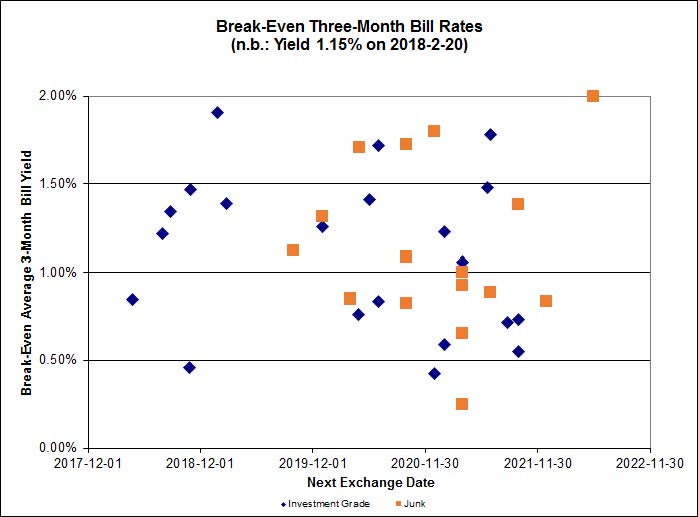
We can show the break-even rates for each FixedReset / FloatingReset Strong Pair graphically by plotting the implied average 3-month bill rate against the next Exchange Date (which is the date to which the average will be calculated).

pairs_fr_180220
Click for Big

The market appears to be relatively uninterested in floating rate product; most of the implied rates until the next interconversion are scattered around the current 3-month bill rate and the averages for investment-grade and junk issues are slightly below current market rates, at +1.23% and +0.93%, respectively – although these break-even rates are much closer to the market rate than has been case for recent resets! Whatever might be the result of the next few Bank of Canada overnight rate decisions, I suggest that it is unlikely that the average rate over the next five years will be lower than current – but if you disagree, of course, you may interpret the data any way you like.

Since credit quality of each element of the pair is equal to the other element, it should not make any difference whether the pair examined is investment-grade or junk, although we might expect greater variation of implied rates between junk issues on grounds of lower liquidity, and this is just what we see.

If we plug in the current bid price of the MFC.PR.J FixedReset, we may construct the following table showing consistent prices for its soon-may-be-issued FloatingReset counterpart, MFC.PR.S, given a variety of Implied Breakeven yields consistent with issues currently trading:

Estimate of FloatingReset MFC.PR.S (received in exchange for MFC.PR.J) Trading Price In Current Conditions
  Assumed FloatingReset
Price if Implied Bill
is equal to
FixedReset Bid Price Spread 1.75% 1.25% 0.75%
MFC.PR.J 24.80 261bp 24.42 23.91 23.40

Based on current market conditions, I suggest that the FloatingResets that will result from conversion are likely to be cheap and trading below the price of their FixedReset counterparts. Therefore, it seems likely that I will recommend that holders of MFC.PR.J continue to hold the issue and not to convert, but I will wait until it’s closer to the March 5, 2018 notification deadline before making a final pronouncement. I will note that once the FloatingResets commence trading (if, in fact, they do) it may be a good trade to swap the FixedReset for the FloatingReset in the market once both elements of each pair are trading and you can – presumably, according to this analysis – do it with a reasonably good take-out in price, rather than doing it through the company on a 1:1 basis. But that, of course, will depend on the prices at that time and your forecast for the path of policy rates over the next five years. There are no guarantees – my recommendation is based on the assumption that current market conditions with respect to the pairs will continue until the FloatingResets commence trading and that the relative pricing of the two new pairs will reflect these conditions.

Administration

Toronto Rock Lacrosse Ticket Giveaway – Update #2

I have five more pairs of Toronto Rock Lacrosse tickets to give away!

The games take place at the Air Canada Centre and the seats are very good. Just tell me which ones you would like. A decision regarding who gets tickets will be made two weeks before each game and I will mail them to the lucky winner; while preference will be given to customers and those who tell me they’ve got a kid who plays lacrosse, anybody can win. If you win and don’t want your name publicized, that’s fine.

The games are:

Toronto Rock Lacrosse Ticket Giveaway
Date Opponent
Saturday
2018-1-27
7pm
New England Black Wolves
Saturday
2018-2-3
7pm
Calgary Roughnecks
Saturday
2018-3-3
7pm
Georgia Swarm
Sunday
2018-3-11
3pm
New England Black Wolves
Friday
2018-3-30
7:30pm
Colorado Mammoth
Friday
2018-4-13
7:30pm
Rochester Knighthawks
???
???
???
Home Playoff Game 1
If there is one!
???
???
???
Coupons Redeemable for available tickets
Expires 2018-4-14

The tickets for the January 27 game were given to a non-client … see, anybody can win! Assiduous Reader fed received the February 3 tickets and Assiduous Reader CC will be going to the March 3 game. There’s not much time left until the game against New England on March 11 … get your eMails in! Or, get an early entry in for a later game!

The games are a lot of fun. One thing that has impressed me is that these guys’ technical skills are so good they can concentrate on strategy … there are a lot fewer loose balls than I remember from my days of box lacrosse at age 10!

The redeemable coupons can be exchanged for tickets for any game, but there are no guarantees regarding just what seats you will get. Still, if you would like to plan an outing for four, rather than just a pair, let me know and … you might get two ‘real’ tickets and the two coupons!

The play-off game? There’s no guarantee that there will be one, but you could always cross your fingers and ask for them.

To try your luck at receiving a pair of tickets, just eMail me or comment on this post.

Issue Comments

INE Off Watch-Positive, Says S&P

Standard & Poor’s has announced:

  • •We are affirming our ratings on Innergex Renewable Energy Inc., including our ‘BBB-‘ long-term corporate credit rating on the company, and removing the ratings from CreditWatch with positive implications.
  • •We believe the acquisition of Alterra Power Corp. increases Innergex’s scale and improves diversity by geography and fuel-type or resource.
  • •We are revising our financial risk profile to significant from
    intermediate after the additional debt used to fund the cash portion of the acquisition.

  • •The stable outlook reflects our expectation that Innergex’s portfolio of power generation facilities will continue to operate under long-term contracts with investment-grade counterparties and generate fairly predictable cash flows to support its holding-company debt obligations.


S&P Global Ratings today affirmed its ‘BBB-‘ long-term corporate credit rating on Longueuil, Que.-based Innergex Renewable Energy Inc. At the same time, S&P Global Ratings affirmed its ‘BB’ global scale rating and ‘P-3’ Canada scale rating on the company’s preferred shares. S&P Global Ratings removed the ratings from CreditWatch with positive implications, where they were placed Nov. 2, 2017. The outlook is stable.

A downgrade could happen if FFO-to-debt ratio consistently falls below 23% over our outlook period. This could result from increased costs at projects under construction resulting in increased capital contributions from Innergex funded through debt, or from a significant reduction in cash flows from its
projects due to operational challenges.

An upgrade could happen if Innergex continues to meet projections while FFO-to-debt moves materially higher than 35%. This could result from increased cash flows from new projects or new acquisitions or deleveraging with paying
down of debt or lower balances outstanding on the credit facility.

Affected issues are INE.PR.A and INE.PR.C.