MAPF

MAPF Performance, December 2012

The fund outperformed in December, boosted by good performance by the MFC and SLF DeemedRetractibles. DeemedRetractibles as a group outperformed FixedResets, +96bp vs. +76bp respectively.

The fund’s Net Asset Value per Unit as of the close December 31, 2012, was 10.8307 after a dividend distribution of 0.129831. There was no capital gains distribution.

2012 was a fine year for the fund, as it returned +12.76% (after expenses, before fees) against +5.50% for its benchmark … leaving me once again to ponder the question: ‘Why am I not running every dollar there is?’

Returns to December 31, 2012
Period MAPF BMO-CM “50” Index TXPR
Total Return
CPD
according to
Blackrock
One Month +1.05% +0.92% +0.95% +0.95%
Three Months +2.72% +1.58% +1.39% +1.19%
One Year +12.76% +5.50% +5.51% +4.90%
Two Years (annualized) +7.13% +6.64% +5.64% N/A
Three Years (annualized) +10.10% +7.79% +6.33% +5.58%
Four Years (annualized) +22.06% +12.83% +11.15% N/A
Five Years (annualized) +16.37% +6.25% +4.88% +4.22%
Six Years (annualized) +13.16% +4.07%    
Seven Years (annualized) +12.24% +4.10%    
Eight Years (annualized) +11.43% +4.07%    
Nine Years (annualized) +11.65% +4.28%    
Ten Years (annualized) +13.67% +4.58%    
Eleven Years (annualized) +12.47% +4.57%    
MAPF returns assume reinvestment of distributions, and are shown after expenses but before fees.
CPD Returns are for the NAV and are after all fees and expenses.
* CPD does not directly report its two- or four-year returns.
Figures for Omega Preferred Equity (which are after all fees and expenses) for 1-, 3- and 12-months are +0.64%, +1.20% and +5.33%, respectively, according to Morningstar after all fees & expenses. Three year performance is +6.60%; five year is +5.20%
Figures for Jov Leon Frazer Preferred Equity Fund Class I Units (which are after all fees and expenses) for 1-, 3- and 12-months are -0.57%, -0.35% and +1.02% respectively, according to Morningstar. Three Year performance is +3.47%
Figures for Manulife Preferred Income Fund (formerly AIC Preferred Income Fund) (which are after all fees and expenses) for 1-, 3- and 12-months are +0.72%, +0.1.29% & +4.75%, respectively. Three Year performance is +4.88%
Figures for Horizons AlphaPro Preferred Share ETF (which are after all fees and expenses) for 1-, 3- and 12-months are +0.77%, +1.33% & +6.37%, respectively.
Figures for Altamira Preferred Equity Fund are +0.66% for one month.
The figure for BMO S&P/TSX Laddered Preferred Share Index ETF is +0.89% for one-month. [calculation by JH]

MAPF returns assume reinvestment of dividends, and are shown after expenses but before fees. Past performance is not a guarantee of future performance. You can lose money investing in Malachite Aggressive Preferred Fund or any other fund. For more information, see the fund’s main page. The fund is available either directly from Hymas Investment Management or through a brokerage account at Odlum Brown Limited.

A problem that has bedevilled the market over the past year has been the OSFI decision not to grandfather Straight Perpetuals as Tier 1 bank capital, and their continued foot-dragging regarding a decision on insurer Straight Perpetuals has segmented the market to the point where trading has become much more difficult. The fund has done well by trading between GWO issues, which have a good range of annual coupons, but is “stuck” in the MFC and SLF issues, which have a much narrower range of coupon, while the IAG DeemedRetractibles are quite illiquid. Until the market became so grossly segmented, this was not so much of a problem – but now banks are not available to swap into (because they are so expensive) and non-regulated companies are likewise deprecated (because they are not DeemedRetractibles; they should not participate in the increase in value that will follow the OSFI decision I anticipate). The fund’s portfolio is, in effect ‘locked in’ to the MFC & SLF issues due to projected gains from a future OSFI decision, to the detriment of trading gains.

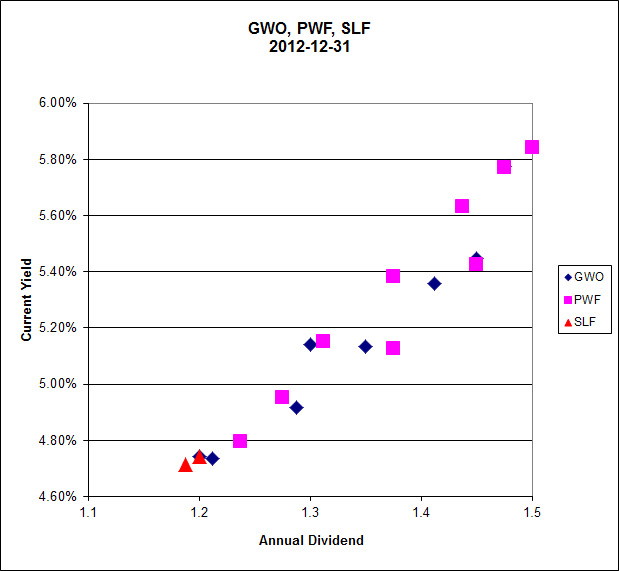
SLF DeemedRetractibles may be compared with PWF and GWO:

Click for Big

It is quite apparent that that the market continues to treat regulated insurance issues (SLF, GWO) no differently from unregulated issues (PWF) – despite the fact that the PWF issues are much more subject to unfavourable calls in the near term and should, logically, be deprecated on those grounds alone without any fancy-pants arguments about imposition of the NVCC rule!

Those of you who have been paying attention will remember that in a “normal” market (which we have not seen in well over a year) the slope of this line is related to the implied volatility of yields in Black-Scholes theory, as discussed in the January, 2010, edition of PrefLetter. The relationship is still far too large to be explained by Implied Volatility – the numbers still indicate an overwhelming degree of directionality in the market’s price expectations.

Sometimes everything works … sometimes it’s 50-50 … sometimes nothing works. The fund seeks to earn incremental return by selling liquidity (that is, taking the other side of trades that other market participants are strongly motivated to execute), which can also be referred to as ‘trading noise’ – although for quite some time, noise trading has taken a distant second place to the sectoral play on insurance DeemedRetractibles. There were a lot of strongly motivated market participants during the Panic of 2007, generating a lot of noise! Unfortunately, the conditions of the Panic may never be repeated in my lifetime … but the fund will simply attempt to make trades when swaps seem profitable, without worrying about the level of monthly turnover.

There’s plenty of room for new money left in the fund. I have shown in recent issues of PrefLetter that market pricing for FixedResets is demonstrably stupid and I have lots of confidence – backed up by my bond portfolio management experience in the markets for Canadas and Treasuries, and equity trading on the NYSE & TSX – that there is enough demand for liquidity in any market to make the effort of providing it worthwhile (although the definition of “worthwhile” in terms of basis points of outperformance changes considerably from market to market!) I will continue to exert utmost efforts to outperform but it should be borne in mind that there will almost inevitably be periods of underperformance in the future.

The yields available on high quality preferred shares remain elevated, which is reflected in the current estimate of sustainable income.

Calculation of MAPF Sustainable Income Per Unit
Month NAVPU Portfolio
Average
YTW
Leverage
Divisor
Securities
Average
YTW
Capital
Gains
Multiplier
Sustainable
Income
per
current
Unit
June, 2007 9.3114 5.16% 1.03 5.01% 1.3240 0.3524
September 9.1489 5.35% 0.98 5.46% 1.3240 0.3773
December, 2007 9.0070 5.53% 0.942 5.87% 1.3240 0.3993
March, 2008 8.8512 6.17% 1.047 5.89% 1.3240 0.3938
June 8.3419 6.034% 0.952 6.338% 1.3240 $0.3993
September 8.1886 7.108% 0.969 7.335% 1.3240 $0.4537
December, 2008 8.0464 9.24% 1.008 9.166% 1.3240 $0.5571
March 2009 $8.8317 8.60% 0.995 8.802% 1.3240 $0.5872
June 10.9846 7.05% 0.999 7.057% 1.3240 $0.5855
September 12.3462 6.03% 0.998 6.042% 1.3240 $0.5634
December 2009 10.5662 5.74% 0.981 5.851% 1.1141 $0.5549
March 2010 10.2497 6.03% 0.992 6.079% 1.1141 $0.5593
June 10.5770 5.96% 0.996 5.984% 1.1141 $0.5681
September 11.3901 5.43% 0.980 5.540% 1.1141 $0.5664
December 2010 10.7659 5.37% 0.993 5.408% 1.0298 $0.5654
March, 2011 11.0560 6.00% 0.994 5.964% 1.0298 $0.6403
June 11.1194 5.87% 1.018 5.976% 1.0298 $0.6453
September 10.2709 6.10%
Note
1.001 6.106% 1.0298 $0.6090
December, 2011 10.0793 5.63%
Note
1.031 5.805% 1.0000 $0.5851
March, 2012 10.3944 5.13%
Note
0.996 5.109% 1.0000 $0.5310
June 10.2151 5.32%
Note
1.012 5.384% 1.0000 $0.5500
September 10.6703 4.61%
Note
0.997 4.624% 1.0000 $0.4934
December, 2012 10.8307 4.24% 0.989 4.287% 1.0000 $0.4643
NAVPU is shown after quarterly distributions of dividend income and annual distribution of capital gains.
Portfolio YTW includes cash (or margin borrowing), with an assumed interest rate of 0.00%
The Leverage Divisor indicates the level of cash in the account: if the portfolio is 1% in cash, the Leverage Divisor will be 0.99
Securities YTW divides “Portfolio YTW” by the “Leverage Divisor” to show the average YTW on the securities held; this assumes that the cash is invested in (or raised from) all securities held, in proportion to their holdings.
The Capital Gains Multiplier adjusts for the effects of Capital Gains Dividends. On 2009-12-31, there was a capital gains distribution of $1.989262 which is assumed for this purpose to have been reinvested at the final price of $10.5662. Thus, a holder of one unit pre-distribution would have held 1.1883 units post-distribution; the CG Multiplier reflects this to make the time-series comparable. Note that Dividend Distributions are not assumed to be reinvested.
Sustainable Income is the resultant estimate of the fund’s dividend income per current unit, before fees and expenses. Note that a “current unit” includes reinvestment of prior capital gains; a unitholder would have had the calculated sustainable income with only, say, 0.9 units in the past which, with reinvestment of capital gains, would become 1.0 current units.
DeemedRetractibles are comprised of all Straight Perpetuals (both PerpetualDiscount and PerpetualPremium) issued by BMO, BNS, CM, ELF, GWO, HSB, IAG, MFC, NA, RY, SLF and TD, which are not exchangable into common at the option of the company (definition refined in May, 2011). These issues are analyzed as if their prospectuses included a requirement to redeem at par on or prior to 2022-1-31, in addition to the call schedule explicitly defined. See OSFI Does Not Grandfather Extant Tier 1 Capital, CM.PR.D, CM.PR.E, CM.PR.G: Seeking NVCC Status and the January, February, March and June, 2011, editions of PrefLetter for the rationale behind this analysis.
Yields for September, 2011, to January, 2012, were calculated by imposing a cap of 10% on the yields of YLO issues held, in order to avoid their extremely high calculated yields distorting the calculation and to reflect the uncertainty in the marketplace that these yields will be realized. From February to September 2012, yields on these issues have been set to zero. All YLO issues held were sold in October 2012.

Significant positions were held in DeemedRetractible and FixedReset issues on December 31; all of these currently have their yields calculated with the presumption that they will be called by the issuers at par prior to 2022-1-31. This presents another complication in the calculation of sustainable yield. The fund also holds a position various SplitShare issues which also have their yields calculated with the expectation of a maturity at par.

I will no longer show calculations that assume the conversion of the entire portfolio into PerpetualDiscounts, as there are currently only four such issues of investment grade, from only two issuer groups. Additionally, the fund has no holdings of these issues.

It should be noted that the concept of this Sustainable Income calculation was developed when the fund’s holdings were overwhelmingly PerpetualDiscounts – see, for instance, the bottom of the market in November 2008. It is easy to understand that for a PerpetualDiscount, the technique of multiplying yield by price will indeed result in the coupon – a PerpetualDiscount paying $1 annually will show a Sustainable Income of $1, regardless of whether the price is $24 or $17.

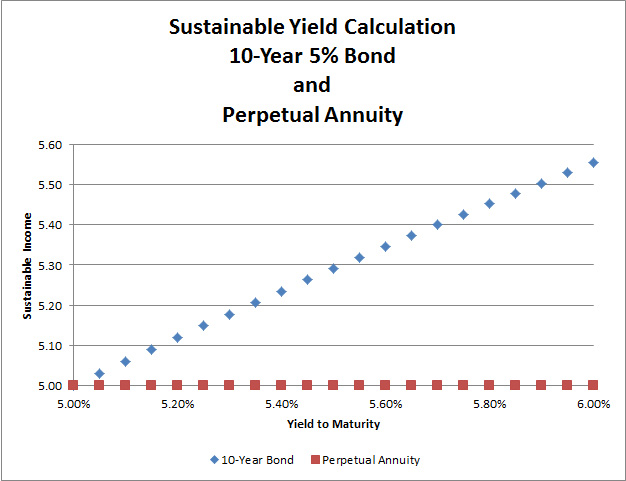
Things are not quite so neat when maturity dates and maturity prices that are different from the current price are thrown into the mix. If we take a notional Straight Perpetual paying $5 annually, the price is $100 when the yield is 5% (all this ignores option effects). As the yield increases to 6%, the price declines to 83.33; and 83.33 x 6% is the same $5. Good enough.

But a ten year bond, priced at 100 when the yield is equal to its coupon of 5%, will decline in price to 92.56; and 92.56 x 6% is 5.55; thus, the calculated Sustainable Income has increased as the price has declined as shown in the graph:

Click for Big

The difference is because the bond’s yield calculation includes the amortization of the discount; therefore, so does the Sustainable Income estimate.

Thus, the decline in the MAPF Sustainable Income from $0.5500 per unit in June to $0.4643 per unit in December should be looked at as a simple consequence of the fund’s holdings; virtually all of which have their yields calculated in a manner closer to bonds than to Perpetual Annuities.

Different assumptions lead to different results from the calculation, but the overall positive trend is apparent. I’m very pleased with the long-term results! It will be noted that if there was no trading in the portfolio, one would expect the sustainable yield to be constant (before fees and expenses). The success of the fund’s trading is showing up in

  • the very good performance against the index
  • the long term increases in sustainable income per unit

As has been noted, the fund has maintained a credit quality equal to or better than the index; outperformance is due to exploitation of trading anomalies.

Again, there are no predictions for the future! The fund will continue to trade between issues in an attempt to exploit market gaps in liquidity, in an effort to outperform the index and keep the sustainable income per unit – however calculated! – growing.

MAPF

MAPF Portfolio Composition: December, 2012

Turnover increased in December, to 10%.

There is extreme segmentation in the marketplace, with OSFI’s NVCC rule changes in February 2011 having had the effect of splitting the formerly relatively homogeneous Straight Perpetual class of preferreds into three parts:

  • Unaffected Straight Perpetuals
  • DeemedRetractibles explicitly subject to the rules (banks)
  • DeemedRetractibles considered by me, but not (yet!) by the market, to be likely to be explicitly subject to the rules in the future (insurers and insurance holding companies)

This segmentation, and the extreme valuation differences between the segments, has cut down markedly on the opportunities for trading. Another trend that hasn’t helped has been the migration of PerpetualDiscounts into PerpetualPremiums (due to price increases) – many of the PerpetualPremiums have negative Yields-to-Worst and those that don’t aren’t particularly thrilling; speaking very generally, PerpetualPremiums are to be avoided, not traded! This effect has caused the first of the three segments noted above to disappear for most practical purposes.

Sectoral distribution of the MAPF portfolio on December 31 was as follows:

MAPF Sectoral Analysis 2012-12-31
HIMI Indices Sector Weighting YTW ModDur
Ratchet 0% N/A N/A
FixFloat 0% N/A N/A
Floater 0% N/A N/A
OpRet 0% N/A N/A
SplitShare 9.6% (-0.2) 4.94% 5.24
Interest Rearing 0% N/A N/A
PerpetualPremium 0.0% (0) N/A N/A
PerpetualDiscount 0.0% (0) N/A N/A
Fixed-Reset 22.0% (+0.1) 2.20% 1.67
Deemed-Retractible 59.4% (+0.4) 4.73% 7.35
Scraps (Various) 7.8% (-0.9) 6.07% 10.71
Cash 1.1% (+0.5) 0.00% 0.00
Total 100% 4.24% 6.08
Totals and changes will not add precisely due to rounding. Bracketted figures represent change from November month-end. Cash is included in totals with duration and yield both equal to zero.
DeemedRetractibles are comprised of all Straight Perpetuals (both PerpetualDiscount and PerpetualPremium) issued by BMO, BNS, CM, ELF, GWO, HSB, IAG, MFC, NA, RY, SLF and TD, which are not exchangable into common at the option of the company. These issues are analyzed as if their prospectuses included a requirement to redeem at par on or prior to 2022-1-31, in addition to the call schedule explicitly defined. See OSFI Does Not Grandfather Extant Tier 1 Capital, CM.PR.D, CM.PR.E, CM.PR.G: NVCC Status Confirmed and the January, February, March and June, 2011, editions of PrefLetter for the rationale behind this analysis. (all recent editions have a short summary of the argument included in the “DeemedRetractible” section)

The “total” reflects the un-leveraged total portfolio (i.e., cash is included in the portfolio calculations and is deemed to have a duration and yield of 0.00.). MAPF will often have relatively large cash balances, both credit and debit, to facilitate trading. Figures presented in the table have been rounded to the indicated precision.

Credit distribution is:

MAPF Credit Analysis 2012-12-31
DBRS Rating Weighting
Pfd-1 0 (0)
Pfd-1(low) 52.9% (+1.9)
Pfd-2(high) 28.6% (+0.6)
Pfd-2 0 (0)
Pfd-2(low) 9.6% (-2.0)
Pfd-3(high) 1.4% (-0.2)
Pfd-3 2.6% (-0.5)
Pfd-3(low) 0.3% (+0.3)
Pfd-4(high) 0.4% (0)
Pfd-4 1.8% (-0.4)
Pfd-4(low) 1.3% (0)
Cash 1.1% (+0.5)
Totals will not add precisely due to rounding. Bracketted figures represent change from November month-end.

Liquidity Distribution is:

MAPF Liquidity Analysis 2012-12-31
Average Daily Trading Weighting
<$50,000 9.3% (-3.3)
$50,000 – $100,000 14.0% (+2.9)
$100,000 – $200,000 37.5% (-3.1)
$200,000 – $300,000 21.6% (+0.9)
>$300,000 16.6% (+2.4)
Cash 1.1% (+0.5)
Totals will not add precisely due to rounding. Bracketted figures represent change from November month-end.

MAPF is, of course, Malachite Aggressive Preferred Fund, a “unit trust” managed by Hymas Investment Management Inc. Further information and links to performance, audited financials and subscription information are available the fund’s web page. The fund may be purchased either directly from Hymas Investment Management or through a brokerage account at Odlum Brown Limited. A “unit trust” is like a regular mutual fund, but is sold by offering memorandum rather than prospectus. This is cheaper, but means subscription is restricted to “accredited investors” (as defined by the Ontario Securities Commission) or those who subscribe for $150,000+. Fund past performances are not a guarantee of future performance. You can lose money investing in MAPF or any other fund.

A similar portfolio composition analysis has been performed on the Claymore Preferred Share ETF (symbol CPD) (and other funds) as of August 31, 2012, and published in the October (mainly methodology), November (most funds), and December (ZPR) 2012, PrefLetter. While direct comparisons are difficult due to the introduction of the DeemedRetractible class of preferred share (see above) it is fair to say:

  • MAPF credit quality is better
  • MAPF liquidity is a lower
  • MAPF Yield is higher
  • Weightings in
    • MAPF is much more exposed to DeemedRetractibles
    • MAPF is much less exposed to Operating Retractibles
    • MAPF is much more exposed to SplitShares
    • MAPF is less exposed to FixFloat / Floater / Ratchet
    • MAPF weighting in FixedResets is much lower
Market Action

January 4, 2013

There was a decent, but by no means stellar, US jobs number:

Employers added workers in December at about the same pace as the prior month, and the unemployment rate matched a four-year low, showing sustained gains in the U.S. labor market even as lawmakers were struggling to reach a budget deal.

Payrolls rose by 155,000 workers last month following a revised 161,000 advance in November that was more than initially estimated, Labor Department figures showed today in Washington. The median estimate of 82 economists surveyed by Bloomberg called for a increase of 152,000. The unemployment rate held at 7.8 percent after the November figure was revised up from a previously reported 7.7 percent.

The S&P 500 reached a milestone of sorts:U.S. stocks rose, sending the Standard & Poor’s 500 Index above the highest closing level since December 2007, after data showed employers added workers in December at about the same pace as the prior month.

Mark Whitehouse of Bloomberg writes an interesting review of an IMF paper by two IMF officials, chief economist Olivier Blanchard and economist Daniel Leigh, titled Growth Forecast Errors and Fiscal Multipliers:

This paper investigates the relation between growth forecast errors and planned fiscalconsolidation during the crisis. We find that, in advanced economies, stronger planned fiscal consolidation has been associated with lower growth than expected, with the relation being particularly strong, both statistically and economically, early in the crisis. A natural interpretation is that fiscal multipliers were substantially higher than implicitly assumed by forecasters. The weaker relation in more recent years may reflect in part learning by forecasters and in part smaller multipliers than in the early years of the crisis.

First, because of the binding zero lower bound on nominal interest rates, central banks could not cut interest rates to offset the negative short-term effects of a fiscal consolidation on economic activity. Christiano, Eichenbaum, and Rebelo (2011) have shown, using a dynamic stochastic general equilibrium (DSGE) model, that under such conditions, fiscal multipliers can exceed 3. Since episodes characterized by a binding zero lower bound (also referred to as “liquidity trap” episodes) have been rare, only a few empirical studies investigate fiscal multipliers under such conditions. Based on data for 27 economies during the 1930s—a period during which interest rates were at or near the zero lower bound—Almunia and others (2010) have concluded that fiscal multipliers were about 1.6.

Second, lower output and lower income, together with a poorly functioning financial system, imply that consumption may have depended more on current than on future income, and that investment may have depended more on current than on future profits, with both effects leading to larger multipliers (Eggertsson and Krugman, 2012).

Third, and consistent with some of the above mechanisms, a number of empirical studies have found that fiscal multipliers are likely to be larger when there is a great deal of slack in the economy. Based on U.S. data, Auerbach and Gorodnichenko (2012b) have found that fiscal multipliers associated with government spending can fluctuate from being near zero in normal times to about 2.5 during recessions.5 If fiscal multipliers were larger than normal and growth projections implicitly assumed multipliers more consistent with normal times, then growth forecast errors should be systematically correlated with fiscal consolidation forecasts.

Perhaps Keynesian economics will make a comeback! I’ve often remarked that I don’t mind large deficits in hard times … as long as there is a credible plan, with accompanying legislation, for paying off the new debt within 20-30 years.

America is a country in which rights are paramount. Unless you’re a bank:

“This dispute does not go to the merits of the matter but it does raise an important issue of principle: Whether we and other banks, large and small alike, have the fundamental right long recognized in this country to communicate freely with and seek confidential guidance from their lawyers,” Zuccarelli said in an interview.

Bryan Hubbard, an OCC spokesman, declined to comment on the agency’s inquiry.

In the letter sent to JPMorgan general counsel Stephen Cutler, the inspector general — the Treasury’s internal watchdog — dismissed JPMorgan’s arguments on attorney-client privilege, saying the OCC “could not do its work” if banks were allowed to withhold information on that basis. The OCC, an independent bureau of Treasury, asked the IG office to review the situation, Thorson said in the letter.

Failure to produce the records “will have to be seen as a continuing purposeful impediment to the authority of the OCC,” Thorson said in the letter, and would require “further action by our office.”

Coming up next: hand over your Facebook password or be charged with obstructing justice.

DBRS has a new methodology for rating life insurers, but there were no major changes and it did not result in any ratings actions. They did not opine on the result of OSFI’s consideration of the definition of capital.

It was a good day for the Canadian preferred share market, with PerpetualPremiums gaining 11bp, FixedResets winning 13bp and DeemedRetractibles up 12bp. Volatility was average, but all on the upside. Volume continued to be very low.

HIMIPref™ Preferred Indices
These values reflect the December 2008 revision of the HIMIPref™ Indices

Values are provisional and are finalized monthly
Index Mean
Current
Yield
(at bid)
Median
YTW
Median
Average
Trading
Value
Median
Mod Dur
(YTW)
Issues Day’s Perf. Index Value
Ratchet 0.00 % 0.00 % 0 0.00 0 0.0266 % 2,487.8
FixedFloater 4.26 % 3.62 % 29,442 18.00 1 0.8137 % 3,777.1
Floater 2.80 % 3.00 % 54,178 19.75 4 0.0266 % 2,686.1
OpRet 4.62 % -5.60 % 50,346 0.41 4 0.0381 % 2,602.2
SplitShare 4.63 % 4.67 % 48,412 4.35 2 0.2015 % 2,879.3
Interest-Bearing 0.00 % 0.00 % 0 0.00 0 0.0381 % 2,379.5
Perpetual-Premium 5.25 % -0.06 % 71,717 0.77 30 0.1098 % 2,338.1
Perpetual-Discount 4.85 % 4.88 % 132,763 15.70 4 0.1628 % 2,646.3
FixedReset 4.92 % 2.90 % 202,436 4.01 78 0.1302 % 2,472.9
Deemed-Retractible 4.87 % -0.08 % 109,907 0.36 46 0.1202 % 2,434.0
Performance Highlights
Issue Index Change Notes
MFC.PR.C Deemed-Retractible 1.15 % YTW SCENARIO
Maturity Type : Hard Maturity
Maturity Date : 2022-01-31
Maturity Price : 25.00
Evaluated at bid price : 24.73
Bid-YTW : 4.70 %
GWO.PR.Q Deemed-Retractible 1.20 % YTW SCENARIO
Maturity Type : Hard Maturity
Maturity Date : 2022-01-31
Maturity Price : 25.00
Evaluated at bid price : 26.21
Bid-YTW : 4.53 %
VNR.PR.A FixedReset 1.26 % YTW SCENARIO
Maturity Type : Call
Maturity Date : 2017-10-15
Maturity Price : 25.00
Evaluated at bid price : 26.49
Bid-YTW : 3.23 %
PWF.PR.P FixedReset 1.49 % YTW SCENARIO
Maturity Type : Limit Maturity
Maturity Date : 2043-01-04
Maturity Price : 23.64
Evaluated at bid price : 25.88
Bid-YTW : 2.90 %
Volume Highlights
Issue Index Shares
Traded
Notes
BNS.PR.Z FixedReset 37,591 TD crossed 19,100 at 24.70.
YTW SCENARIO
Maturity Type : Hard Maturity
Maturity Date : 2022-01-31
Maturity Price : 25.00
Evaluated at bid price : 24.65
Bid-YTW : 3.21 %
BNS.PR.Q FixedReset 24,090 YTW SCENARIO
Maturity Type : Hard Maturity
Maturity Date : 2022-01-31
Maturity Price : 25.00
Evaluated at bid price : 24.97
Bid-YTW : 3.21 %
FTS.PR.G FixedReset 21,669 YTW SCENARIO
Maturity Type : Limit Maturity
Maturity Date : 2043-01-04
Maturity Price : 23.77
Evaluated at bid price : 24.40
Bid-YTW : 3.59 %
IFC.PR.A FixedReset 18,000 YTW SCENARIO
Maturity Type : Hard Maturity
Maturity Date : 2022-01-31
Maturity Price : 25.00
Evaluated at bid price : 25.91
Bid-YTW : 3.26 %
ENB.PR.D FixedReset 17,743 TD crossed 10,500 at 25.55.
YTW SCENARIO
Maturity Type : Limit Maturity
Maturity Date : 2043-01-04
Maturity Price : 23.31
Evaluated at bid price : 25.50
Bid-YTW : 3.58 %
ENB.PR.T FixedReset 15,283 Recent new issue.
YTW SCENARIO
Maturity Type : Limit Maturity
Maturity Date : 2043-01-04
Maturity Price : 23.18
Evaluated at bid price : 25.28
Bid-YTW : 3.73 %
There were 13 other index-included issues trading in excess of 10,000 shares.
Wide Spread Highlights
Issue Index Quote Data and Yield Notes
TRI.PR.B Floater Quote: 22.59 – 24.10
Spot Rate : 1.5100
Average : 0.8370

YTW SCENARIO
Maturity Type : Limit Maturity
Maturity Date : 2043-01-04
Maturity Price : 22.32
Evaluated at bid price : 22.59
Bid-YTW : 2.30 %

ELF.PR.G Perpetual-Discount Quote: 24.30 – 24.80
Spot Rate : 0.5000
Average : 0.4222

YTW SCENARIO
Maturity Type : Limit Maturity
Maturity Date : 2043-01-04
Maturity Price : 23.82
Evaluated at bid price : 24.30
Bid-YTW : 4.88 %

POW.PR.D Perpetual-Premium Quote: 25.08 – 25.25
Spot Rate : 0.1700
Average : 0.1056

YTW SCENARIO
Maturity Type : Call
Maturity Date : 2014-10-31
Maturity Price : 25.00
Evaluated at bid price : 25.08
Bid-YTW : 4.77 %

HSE.PR.A FixedReset Quote: 26.08 – 26.27
Spot Rate : 0.1900
Average : 0.1266

YTW SCENARIO
Maturity Type : Limit Maturity
Maturity Date : 2043-01-04
Maturity Price : 23.67
Evaluated at bid price : 26.08
Bid-YTW : 2.95 %

BAM.PR.T FixedReset Quote: 25.75 – 25.92
Spot Rate : 0.1700
Average : 0.1071

YTW SCENARIO
Maturity Type : Limit Maturity
Maturity Date : 2043-01-04
Maturity Price : 23.45
Evaluated at bid price : 25.75
Bid-YTW : 3.56 %

BNS.PR.K Deemed-Retractible Quote: 25.70 – 25.95
Spot Rate : 0.2500
Average : 0.1886

YTW SCENARIO
Maturity Type : Call
Maturity Date : 2013-02-03
Maturity Price : 25.50
Evaluated at bid price : 25.70
Bid-YTW : -8.99 %

Market Action

January 3, 2013

Suncor has a corporate policy of ineffective supervision:

Last June, Suncor told its workers it would introduce a sweeping random drug-and-alcohol testing policy for all employees in “safety-sensitive” roles, meaning they could be tested at any time.

Workers in safety-sensitive jobs aren’t supervised? What kind of company is this?

It was a mixed day for the Canadian preferred share market, with PerpetualPremiums gaining 6bp, FixedResets down 5bp and DeemedRetractibles up 14bp. Volatility was low. Volume picked up, and is now merely very low.

HIMIPref™ Preferred Indices
These values reflect the December 2008 revision of the HIMIPref™ Indices

Values are provisional and are finalized monthly
Index Mean
Current
Yield
(at bid)
Median
YTW
Median
Average
Trading
Value
Median
Mod Dur
(YTW)
Issues Day’s Perf. Index Value
Ratchet 0.00 % 0.00 % 0 0.00 0 0.3341 % 2,487.1
FixedFloater 4.29 % 3.66 % 29,819 17.94 1 1.1431 % 3,746.6
Floater 2.80 % 3.01 % 54,857 19.74 4 0.3341 % 2,685.4
OpRet 4.62 % -3.44 % 51,130 0.41 4 0.1622 % 2,601.2
SplitShare 4.64 % 4.67 % 50,261 4.35 2 -0.2613 % 2,873.6
Interest-Bearing 0.00 % 0.00 % 0 0.00 0 0.1622 % 2,378.6
Perpetual-Premium 5.25 % 0.31 % 69,152 0.77 30 0.0594 % 2,335.5
Perpetual-Discount 4.86 % 4.85 % 133,209 15.76 4 0.0203 % 2,642.0
FixedReset 4.92 % 2.97 % 203,611 4.03 78 -0.0451 % 2,469.7
Deemed-Retractible 4.87 % 0.11 % 110,894 0.36 46 0.1354 % 2,431.1
Performance Highlights
Issue Index Change Notes
GWO.PR.M Deemed-Retractible 1.06 % YTW SCENARIO
Maturity Type : Call
Maturity Date : 2015-03-31
Maturity Price : 26.00
Evaluated at bid price : 26.60
Bid-YTW : 4.53 %
BAM.PR.G FixedFloater 1.14 % YTW SCENARIO
Maturity Type : Limit Maturity
Maturity Date : 2043-01-03
Maturity Price : 22.62
Evaluated at bid price : 22.12
Bid-YTW : 3.66 %
Volume Highlights
Issue Index Shares
Traded
Notes
RY.PR.A Deemed-Retractible 101,384 Desjardins crossed 96,000 at 25.93.
YTW SCENARIO
Maturity Type : Call
Maturity Date : 2013-05-24
Maturity Price : 25.50
Evaluated at bid price : 25.92
Bid-YTW : 1.30 %
RY.PR.H Deemed-Retractible 84,870 National bought 39,100 from CIBC, then crossed 40,000, both at 26.80.
YTW SCENARIO
Maturity Type : Call
Maturity Date : 2013-05-24
Maturity Price : 26.00
Evaluated at bid price : 26.80
Bid-YTW : -1.00 %
GWO.PR.J FixedReset 55,783 TD crossed 42,600 at 25.95.
YTW SCENARIO
Maturity Type : Call
Maturity Date : 2013-12-31
Maturity Price : 25.00
Evaluated at bid price : 25.94
Bid-YTW : 2.21 %
CM.PR.M FixedReset 41,362 Nesbitt crossed 40,000 at 26.60.
YTW SCENARIO
Maturity Type : Call
Maturity Date : 2014-07-31
Maturity Price : 25.00
Evaluated at bid price : 26.62
Bid-YTW : 2.02 %
BAM.PR.B Floater 28,112 Nesbitt bought 10,000 from anonymous at 17.59.
YTW SCENARIO
Maturity Type : Limit Maturity
Maturity Date : 2043-01-03
Maturity Price : 17.54
Evaluated at bid price : 17.54
Bid-YTW : 3.01 %
SLF.PR.A Deemed-Retractible 23,687 YTW SCENARIO
Maturity Type : Call
Maturity Date : 2014-03-31
Maturity Price : 25.00
Evaluated at bid price : 25.12
Bid-YTW : 4.40 %
There were 14 other index-included issues trading in excess of 10,000 shares.
Wide Spread Highlights
Issue Index Quote Data and Yield Notes
BAM.PR.C Floater Quote: 17.48 – 19.00
Spot Rate : 1.5200
Average : 1.3691

YTW SCENARIO
Maturity Type : Limit Maturity
Maturity Date : 2043-01-03
Maturity Price : 17.48
Evaluated at bid price : 17.48
Bid-YTW : 3.02 %

MFC.PR.C Deemed-Retractible Quote: 24.45 – 24.88
Spot Rate : 0.4300
Average : 0.2852

YTW SCENARIO
Maturity Type : Hard Maturity
Maturity Date : 2022-01-31
Maturity Price : 25.00
Evaluated at bid price : 24.45
Bid-YTW : 4.86 %

MFC.PR.F FixedReset Quote: 24.16 – 24.50
Spot Rate : 0.3400
Average : 0.2249

YTW SCENARIO
Maturity Type : Hard Maturity
Maturity Date : 2022-01-31
Maturity Price : 25.00
Evaluated at bid price : 24.16
Bid-YTW : 3.82 %

TRP.PR.A FixedReset Quote: 25.55 – 25.80
Spot Rate : 0.2500
Average : 0.1525

YTW SCENARIO
Maturity Type : Limit Maturity
Maturity Date : 2043-01-03
Maturity Price : 23.77
Evaluated at bid price : 25.55
Bid-YTW : 3.18 %

MFC.PR.B Deemed-Retractible Quote: 24.77 – 25.09
Spot Rate : 0.3200
Average : 0.2242

YTW SCENARIO
Maturity Type : Hard Maturity
Maturity Date : 2022-01-31
Maturity Price : 25.00
Evaluated at bid price : 24.77
Bid-YTW : 4.83 %

BAM.PR.G FixedFloater Quote: 22.12 – 22.83
Spot Rate : 0.7100
Average : 0.6189

YTW SCENARIO
Maturity Type : Limit Maturity
Maturity Date : 2043-01-03
Maturity Price : 22.62
Evaluated at bid price : 22.12
Bid-YTW : 3.66 %

Market Action

January 2, 2013

Good news on pensions – but not for the sponsors:

The solvency of Canadian defined benefit pension plans improved in 2012, a new Mercer study says.

The consultant said Wednesday that its Pension Health Index stood at 82 per cent on Dec. 31, up two percentage points for the fourth quarter and up six percentage points for the year.

However, the global pension, health and investment consultancy said economic factors were largely a non-factor.

Most of the improvement was due to increased employer contributions to fund deficits.

It was a mixed day for the Canadian preferred share market, with PerpetualPremiums gaining 10bp, FixedResets up 23bp and DeemedRetractibles off 7bp – seemingly unaffected by excitement in the equity market. Volatility was higher than average, comprised of losing DeemedRetractibles and winning FixedResets. However, volume continued its recent stretch of extremely low number, so all this could just be a puff of smoke.

PerpetualDiscounts now yield 4.88%, equivalent to 6.34% interest at the standard equivalency factor of 1.3x. Long corporates now yield about 4.25%, so the pre-tax interest-equivalent spread (in this context, the “Seniority Spread”) is now about 210bp, unchanged from the figure reported December 27.

HIMIPref™ Preferred Indices
These values reflect the December 2008 revision of the HIMIPref™ Indices

Values are provisional and are finalized monthly
Index Mean
Current
Yield
(at bid)
Median
YTW
Median
Average
Trading
Value
Median
Mod Dur
(YTW)
Issues Day’s Perf. Index Value
Ratchet 0.00 % 0.00 % 0 0.00 0 0.0134 % 2,478.8
FixedFloater 4.34 % 3.71 % 30,015 17.85 1 0.0915 % 3,704.3
Floater 2.81 % 3.01 % 53,128 19.74 4 0.0134 % 2,676.5
OpRet 4.63 % 1.99 % 53,231 0.46 4 -0.0763 % 2,597.0
SplitShare 4.62 % 4.64 % 50,717 4.36 2 0.2014 % 2,881.1
Interest-Bearing 0.00 % 0.00 % 0 0.00 0 -0.0763 % 2,374.7
Perpetual-Premium 5.26 % 0.31 % 70,018 0.16 30 0.1002 % 2,334.1
Perpetual-Discount 4.86 % 4.88 % 130,914 15.70 4 0.0611 % 2,641.5
FixedReset 4.91 % 2.94 % 205,918 4.09 78 0.2344 % 2,470.8
Deemed-Retractible 4.88 % 0.81 % 109,506 0.36 46 -0.0731 % 2,427.8
Performance Highlights
Issue Index Change Notes
GWO.PR.M Deemed-Retractible -1.13 % YTW SCENARIO
Maturity Type : Call
Maturity Date : 2015-03-31
Maturity Price : 26.00
Evaluated at bid price : 26.32
Bid-YTW : 5.04 %
GWO.PR.Q Deemed-Retractible -1.03 % YTW SCENARIO
Maturity Type : Hard Maturity
Maturity Date : 2022-01-31
Maturity Price : 25.00
Evaluated at bid price : 25.91
Bid-YTW : 4.69 %
IAG.PR.G FixedReset 1.11 % YTW SCENARIO
Maturity Type : Call
Maturity Date : 2017-06-30
Maturity Price : 25.00
Evaluated at bid price : 26.30
Bid-YTW : 3.07 %
MFC.PR.G FixedReset 1.16 % YTW SCENARIO
Maturity Type : Call
Maturity Date : 2016-12-19
Maturity Price : 25.00
Evaluated at bid price : 26.27
Bid-YTW : 3.09 %
GWO.PR.N FixedReset 1.64 % YTW SCENARIO
Maturity Type : Hard Maturity
Maturity Date : 2022-01-31
Maturity Price : 25.00
Evaluated at bid price : 23.53
Bid-YTW : 3.78 %
MFC.PR.I FixedReset 1.70 % YTW SCENARIO
Maturity Type : Call
Maturity Date : 2017-09-19
Maturity Price : 25.00
Evaluated at bid price : 26.25
Bid-YTW : 3.30 %
Volume Highlights
Issue Index Shares
Traded
Notes
ENB.PR.T FixedReset 28,650 Recent new issue.
YTW SCENARIO
Maturity Type : Limit Maturity
Maturity Date : 2043-01-02
Maturity Price : 23.16
Evaluated at bid price : 25.21
Bid-YTW : 3.74 %
FTS.PR.G FixedReset 21,325 YTW SCENARIO
Maturity Type : Limit Maturity
Maturity Date : 2043-01-02
Maturity Price : 23.71
Evaluated at bid price : 24.34
Bid-YTW : 3.60 %
NA.PR.O FixedReset 16,834 National crossed 11,300 at 26.50.
YTW SCENARIO
Maturity Type : Call
Maturity Date : 2014-02-15
Maturity Price : 25.00
Evaluated at bid price : 26.52
Bid-YTW : 1.89 %
ELF.PR.H Perpetual-Premium 15,149 National crossed 12,100 at 25.90.
YTW SCENARIO
Maturity Type : Call
Maturity Date : 2021-04-17
Maturity Price : 25.00
Evaluated at bid price : 25.95
Bid-YTW : 4.94 %
ENB.PR.P FixedReset 14,287 YTW SCENARIO
Maturity Type : Limit Maturity
Maturity Date : 2043-01-02
Maturity Price : 23.20
Evaluated at bid price : 25.29
Bid-YTW : 3.73 %
GWO.PR.N FixedReset 13,548 YTW SCENARIO
Maturity Type : Hard Maturity
Maturity Date : 2022-01-31
Maturity Price : 25.00
Evaluated at bid price : 23.53
Bid-YTW : 3.78 %
There were 3 other index-included issues trading in excess of 10,000 shares.
Wide Spread Highlights
Issue Index Quote Data and Yield Notes
BAM.PR.C Floater Quote: 17.44 – 19.00
Spot Rate : 1.5600
Average : 1.2036

YTW SCENARIO
Maturity Type : Limit Maturity
Maturity Date : 2043-01-02
Maturity Price : 17.44
Evaluated at bid price : 17.44
Bid-YTW : 3.02 %

GWO.PR.M Deemed-Retractible Quote: 26.32 – 26.84
Spot Rate : 0.5200
Average : 0.3643

YTW SCENARIO
Maturity Type : Call
Maturity Date : 2015-03-31
Maturity Price : 26.00
Evaluated at bid price : 26.32
Bid-YTW : 5.04 %

BAM.PR.G FixedFloater Quote: 21.87 – 22.54
Spot Rate : 0.6700
Average : 0.5190

YTW SCENARIO
Maturity Type : Limit Maturity
Maturity Date : 2043-01-02
Maturity Price : 22.45
Evaluated at bid price : 21.87
Bid-YTW : 3.71 %

TCA.PR.Y Perpetual-Premium Quote: 52.20 – 52.60
Spot Rate : 0.4000
Average : 0.2647

YTW SCENARIO
Maturity Type : Call
Maturity Date : 2014-03-05
Maturity Price : 50.00
Evaluated at bid price : 52.20
Bid-YTW : 1.41 %

GWO.PR.Q Deemed-Retractible Quote: 25.91 – 26.30
Spot Rate : 0.3900
Average : 0.2610

YTW SCENARIO
Maturity Type : Hard Maturity
Maturity Date : 2022-01-31
Maturity Price : 25.00
Evaluated at bid price : 25.91
Bid-YTW : 4.69 %

RY.PR.B Deemed-Retractible Quote: 26.02 – 26.34
Spot Rate : 0.3200
Average : 0.2159

YTW SCENARIO
Maturity Type : Call
Maturity Date : 2013-02-01
Maturity Price : 25.75
Evaluated at bid price : 26.02
Bid-YTW : -2.24 %

Market Action

December 31, 2012

Fiscal madness continues in the US, with proposals to embed milkfare:

Under President Harry S. Truman’s farm policy, the government bought supplies of a product until its price reached “parity” with the cost immediately before World War I. Adjusted for a century of inflation, the Agriculture Department’s milk-support price today would be $39.08 per hundred pounds, more than double the dairy futures price of $18.60 at 8:34 a.m. in New York today.

Under the revised dairy plan, written by [Minnesota Rep. Collin] Peterson [D], the government would manage the milk supply by setting milk- production limits for farmers who enroll in a market- stabilization program. The proposal eliminates programs that pay farmers when prices fall below a certain level, replacing them with initiatives designed to protect profit margins through insurance programs and by limiting output, which would raise prices.

The year ended on a positive note, with PerpetualPremiums and DeemedRetractibles both up 2bp and FixedResets winning 12bp. Volatility was muted. Volume was near non-existent.

And that’s a wrap for 2012! The fund’s done rather well over the year … I’ve earned an extra half spoonful of cinnamon in my coffee tonight!

HIMIPref™ Preferred Indices
These values reflect the December 2008 revision of the HIMIPref™ Indices

Values are provisional and are finalized monthly
Index Mean
Current
Yield
(at bid)
Median
YTW
Median
Average
Trading
Value
Median
Mod Dur
(YTW)
Issues Day’s Perf. Index Value
Ratchet 0.00 % 0.00 % 0 0.00 0 -0.1601 % 2,478.5
FixedFloater 4.35 % 3.71 % 30,473 17.85 1 0.2294 % 3,700.9
Floater 2.81 % 3.00 % 54,001 19.72 4 -0.1601 % 2,676.1
OpRet 4.62 % 1.63 % 53,688 0.46 4 0.1241 % 2,599.0
SplitShare 4.63 % 4.68 % 52,488 4.36 2 0.0000 % 2,875.3
Interest-Bearing 0.00 % 0.00 % 0 0.00 0 0.1241 % 2,376.5
Perpetual-Premium 5.26 % 1.03 % 67,640 0.78 30 0.0194 % 2,331.8
Perpetual-Discount 4.86 % 4.89 % 129,708 15.69 4 -0.0305 % 2,639.9
FixedReset 4.92 % 2.89 % 212,650 4.25 77 0.1249 % 2,465.0
Deemed-Retractible 4.88 % 0.09 % 110,626 0.16 46 0.0193 % 2,429.5
Performance Highlights
Issue Index Change Notes
ELF.PR.G Perpetual-Discount -1.10 % YTW SCENARIO
Maturity Type : Limit Maturity
Maturity Date : 2042-12-31
Maturity Price : 23.75
Evaluated at bid price : 24.23
Bid-YTW : 4.89 %
MFC.PR.B Deemed-Retractible 1.09 % YTW SCENARIO
Maturity Type : Hard Maturity
Maturity Date : 2022-01-31
Maturity Price : 25.00
Evaluated at bid price : 24.96
Bid-YTW : 4.72 %
Volume Highlights
Issue Index Shares
Traded
Notes
ENB.PR.T FixedReset 24,165 Recent new issue.
YTW SCENARIO
Maturity Type : Limit Maturity
Maturity Date : 2042-12-31
Maturity Price : 23.16
Evaluated at bid price : 25.21
Bid-YTW : 3.74 %
BMO.PR.Q FixedReset 18,397 YTW SCENARIO
Maturity Type : Hard Maturity
Maturity Date : 2022-01-31
Maturity Price : 25.00
Evaluated at bid price : 24.92
Bid-YTW : 3.19 %
TD.PR.A FixedReset 15,467 RBC bought 13,300 from CIBC at 25.58.
YTW SCENARIO
Maturity Type : Hard Maturity
Maturity Date : 2022-01-31
Maturity Price : 25.00
Evaluated at bid price : 25.55
Bid-YTW : 3.36 %
MFC.PR.E FixedReset 10,362 YTW SCENARIO
Maturity Type : Call
Maturity Date : 2014-09-19
Maturity Price : 25.00
Evaluated at bid price : 26.20
Bid-YTW : 2.85 %
RY.PR.H Deemed-Retractible 10,100 National crossed 10,000 at 26.75.
YTW SCENARIO
Maturity Type : Call
Maturity Date : 2013-05-24
Maturity Price : 26.00
Evaluated at bid price : 26.74
Bid-YTW : -0.41 %
There were 0 other index-included issues trading in excess of 10,000 shares.
Wide Spread Highlights
Issue Index Quote Data and Yield Notes
BAM.PR.C Floater Quote: 17.47 – 19.00
Spot Rate : 1.5300
Average : 0.8128

YTW SCENARIO
Maturity Type : Limit Maturity
Maturity Date : 2042-12-31
Maturity Price : 17.47
Evaluated at bid price : 17.47
Bid-YTW : 3.00 %

BNS.PR.J Deemed-Retractible Quote: 25.82 – 26.28
Spot Rate : 0.4600
Average : 0.2675

YTW SCENARIO
Maturity Type : Call
Maturity Date : 2013-10-29
Maturity Price : 25.00
Evaluated at bid price : 25.82
Bid-YTW : 0.74 %

ELF.PR.G Perpetual-Discount Quote: 24.23 – 24.70
Spot Rate : 0.4700
Average : 0.2905

YTW SCENARIO
Maturity Type : Limit Maturity
Maturity Date : 2042-12-31
Maturity Price : 23.75
Evaluated at bid price : 24.23
Bid-YTW : 4.89 %

TCA.PR.X Perpetual-Premium Quote: 51.56 – 52.42
Spot Rate : 0.8600
Average : 0.7270

YTW SCENARIO
Maturity Type : Call
Maturity Date : 2013-10-15
Maturity Price : 50.00
Evaluated at bid price : 51.56
Bid-YTW : 1.03 %

BNS.PR.O Deemed-Retractible Quote: 26.26 – 26.55
Spot Rate : 0.2900
Average : 0.1778

YTW SCENARIO
Maturity Type : Call
Maturity Date : 2013-04-26
Maturity Price : 26.00
Evaluated at bid price : 26.26
Bid-YTW : 0.74 %

GWO.PR.N FixedReset Quote: 23.15 – 23.46
Spot Rate : 0.3100
Average : 0.2078

YTW SCENARIO
Maturity Type : Hard Maturity
Maturity Date : 2022-01-31
Maturity Price : 25.00
Evaluated at bid price : 23.15
Bid-YTW : 3.99 %

Market Action

December 28, 2012

I mentioned the report from Deloitte UK yesterday, titled Bridging the Advice Gap: Delivering Investment Products in a Post-RDR World. Under the new UK regime of prohibiting payments by fund sponsors to salesmen, Deloitte suggests that bank advisors will be hardest hit, since they have greatest exposure to “mass market” clientele (up to £10,000 in portfolio value) and are perceived as being too sales-oriented and not as skilled as other advisors.

In preparation for the change:

  • Lloyds will offer face-to-face advice only to those with £100,000+ to invest
  • HSBC will offer face-to-face advice only to those with £100,000 income or £50,000 savings; peasants will get a DIY website
  • Barclays Financial Planning will shut down and the bank will focus on high net worth individuals
  • On the other hand, Santander is hiring frantically to add to its 1,000+ existing staff

What might happen in Canada if similar regulations are enacted? I suggest:

  • No change in MF fees (why bother? Those few people who care moved to other products long ago)
  • Much more tied selling (don’t expect to see a Bank “A” advisor recommending a Bank “B” product)
  • Even stranger PPN products from the banks (Nobody pays anyone! It’s EXACTLY like a GIC, except you can MAKE UP TO 10%!!!!)

Credit Suisse is advocating increased regulation for exchanges:

The botched initial offering of Facebook Inc. (FB) is the catalyst that should lead to U.S. exchanges being stripped of self-regulatory powers and their related benefits, a Credit Suisse Group AG (CS) executive said.

Nasdaq Stock Market’s claim of immunity from liability for $500 million in brokerage losses stemming from technology problems on May 18 exposes a conflict between the historical, quasi-governmental role of exchanges and their status as profit- seeking public companies, Dan Mathisson, head of U.S. equity trading at Credit Suisse, told U.S. senators in Washington last week. Those tensions can’t be managed fairly and should spur a regulatory overhaul of the securities market, he said.

Like the Commonwealth of Virginia and Indian tribes, exchanges have absolute immunity for actions taken as part of their regulatory duties. The doctrine arose when exchanges were not-for-profit organizations owned by their member firms. The shield protects them from lawsuits related to the exercise of powers delegated by the SEC and prevents financial losses that could jeopardize institutions seen as vital to the U.S. economy.

The Globe has an opinion piece titled CMHC must stay in government hands, which argues that … well, you figure it out! The concluding paragraph is:

Governments must be wary of intervention for its own sake, but governments should step in where the market fails to achieve an economically efficient outcome. J.P. Morgan may have been the “lender of last resort” in 1907 , but no one would suggest privatizing the Bank of Canada today. We need a government-owned (if reformed) CHMC to curb excesses in housing. Too often in the financial system, the invisible hand likes to roll the dice, fuelling speculative bubbles and the risk of financial collapse. Like musical chairs, everyone has fun until the music stops.

The problem with this argument is that it makes the implicit assumption of a wise, benevolent government carefully tempering the enthusiasm and despair of childish bankers – a view that has gained many adherents in the past years. Trouble is … in just as many cases, and in the case of Canadian housing in particular, it is the government that is the villain. CMHC has been pumping up Canadian housing prices like no man’s business for the past six years (as alluded to yesterday); in the US, it was Fannie and Freddie that ran amok. In the current instance, CMHC is aided by the Bank of Canada, which has kept the price of money down … for very good reasons, but with the unavoidable side-effect of pumped-up prices for houses.

The author also makes the claim that:

Organizations from the Financial Stability Board to the International Monetary Fund praise CMHC as a lynchpin of Canada’s financial stability (albeit calling for improved governance and risk management by CMHC).

I am unable to detect much “praise”, although the word “lynchpin” is justified by paragraph 40 of the IMF report.

I am advised by Financial Webring Forum that the comments to the CSA fiduciary duty proposals are being published. Those who are fascinated with the issue and have a LOT of time to spare may be interested in the SEC Study on Investment Advisers and Broker-Dealers and the Comments on Study Regarding Obligations of Brokers, Dealers, and Investment Advisers.

It was a day of modest movement for the Canadian preferred share market, with PerpetualPremiums up 6bp and both FixedResets and DeemedRetractibles gaining 1bp. Volatility was low. Volume was extremely low, with a notable presence in the highlights of BNS issues, which went ex-Dividend.

HIMIPref™ Preferred Indices
These values reflect the December 2008 revision of the HIMIPref™ Indices

Values are provisional and are finalized monthly
Index Mean
Current
Yield
(at bid)
Median
YTW
Median
Average
Trading
Value
Median
Mod Dur
(YTW)
Issues Day’s Perf. Index Value
Ratchet 0.00 % 0.00 % 0 0.00 0 0.0267 % 2,482.5
FixedFloater 4.36 % 3.72 % 31,614 17.83 1 1.3011 % 3,692.4
Floater 2.80 % 3.00 % 54,137 19.73 4 0.0267 % 2,680.4
OpRet 4.63 % 2.45 % 30,726 0.47 4 -0.3425 % 2,595.8
SplitShare 4.63 % 4.67 % 54,645 4.37 2 0.1816 % 2,875.3
Interest-Bearing 0.00 % 0.00 % 0 0.00 0 -0.3425 % 2,373.6
Perpetual-Premium 5.26 % 1.17 % 69,953 0.16 30 0.0647 % 2,331.3
Perpetual-Discount 4.86 % 4.87 % 129,641 15.73 4 0.0374 % 2,640.7
FixedReset 4.93 % 2.97 % 216,459 4.26 77 0.0116 % 2,461.9
Deemed-Retractible 4.88 % -0.34 % 113,513 0.33 46 0.0100 % 2,429.1
Performance Highlights
Issue Index Change Notes
TRP.PR.C FixedReset -1.16 % YTW SCENARIO
Maturity Type : Limit Maturity
Maturity Date : 2042-12-28
Maturity Price : 23.55
Evaluated at bid price : 25.55
Bid-YTW : 2.86 %
BAM.PR.G FixedFloater 1.30 % YTW SCENARIO
Maturity Type : Limit Maturity
Maturity Date : 2042-12-28
Maturity Price : 22.41
Evaluated at bid price : 21.80
Bid-YTW : 3.72 %
Volume Highlights
Issue Index Shares
Traded
Notes
BNS.PR.X FixedReset 22,780 YTW SCENARIO
Maturity Type : Call
Maturity Date : 2014-04-25
Maturity Price : 25.00
Evaluated at bid price : 26.45
Bid-YTW : 1.37 %
ENB.PR.T FixedReset 16,125 Recent new issue.
YTW SCENARIO
Maturity Type : Limit Maturity
Maturity Date : 2042-12-28
Maturity Price : 23.17
Evaluated at bid price : 25.23
Bid-YTW : 3.74 %
FTS.PR.G FixedReset 14,760 Desjardins crossed 12,000 at 24.25.
YTW SCENARIO
Maturity Type : Limit Maturity
Maturity Date : 2042-12-28
Maturity Price : 23.55
Evaluated at bid price : 24.20
Bid-YTW : 3.63 %
ENB.PR.N FixedReset 14,100 YTW SCENARIO
Maturity Type : Call
Maturity Date : 2018-12-01
Maturity Price : 25.00
Evaluated at bid price : 25.46
Bid-YTW : 3.73 %
BNS.PR.Q FixedReset 13,580 YTW SCENARIO
Maturity Type : Hard Maturity
Maturity Date : 2022-01-31
Maturity Price : 25.00
Evaluated at bid price : 24.76
Bid-YTW : 3.32 %
BNS.PR.P FixedReset 11,500 YTW SCENARIO
Maturity Type : Call
Maturity Date : 2013-04-25
Maturity Price : 25.00
Evaluated at bid price : 25.02
Bid-YTW : 3.28 %
There were 1 other index-included issues trading in excess of 10,000 shares.
Wide Spread Highlights
Issue Index Quote Data and Yield Notes
TCA.PR.X Perpetual-Premium Quote: 51.50 – 52.42
Spot Rate : 0.9200
Average : 0.5812

YTW SCENARIO
Maturity Type : Call
Maturity Date : 2013-10-15
Maturity Price : 50.00
Evaluated at bid price : 51.50
Bid-YTW : 1.17 %

TRP.PR.C FixedReset Quote: 25.55 – 25.96
Spot Rate : 0.4100
Average : 0.2490

YTW SCENARIO
Maturity Type : Limit Maturity
Maturity Date : 2042-12-28
Maturity Price : 23.55
Evaluated at bid price : 25.55
Bid-YTW : 2.86 %

MFC.PR.E FixedReset Quote: 26.20 – 26.47
Spot Rate : 0.2700
Average : 0.1519

YTW SCENARIO
Maturity Type : Call
Maturity Date : 2014-09-19
Maturity Price : 25.00
Evaluated at bid price : 26.20
Bid-YTW : 2.84 %

IGM.PR.B Perpetual-Premium Quote: 26.38 – 26.70
Spot Rate : 0.3200
Average : 0.2303

YTW SCENARIO
Maturity Type : Call
Maturity Date : 2014-12-31
Maturity Price : 26.00
Evaluated at bid price : 26.38
Bid-YTW : 4.66 %

MFC.PR.A OpRet Quote: 25.65 – 25.94
Spot Rate : 0.2900
Average : 0.2038

YTW SCENARIO
Maturity Type : Call
Maturity Date : 2013-06-19
Maturity Price : 25.50
Evaluated at bid price : 25.65
Bid-YTW : 3.02 %

TRP.PR.A FixedReset Quote: 25.55 – 25.77
Spot Rate : 0.2200
Average : 0.1434

YTW SCENARIO
Maturity Type : Limit Maturity
Maturity Date : 2042-12-28
Maturity Price : 23.77
Evaluated at bid price : 25.55
Bid-YTW : 3.19 %

Market Action

December 27, 2012

Quick! Call the handwringers! There’s been another market distortion!

California, the world’s ninth- largest economy, has Edison International (EIX) to thank for selling all of its carbon permits in the state’s first auction. The company unintentionally bid for twice as many allowances as were for sale.

Edison, owner of the state’s second-biggest power utility, submitted a proposal in the wrong format and offered to buy 21 times more allowances than it wanted on Nov. 14, documents obtained by Bloomberg show.

When the state Air Resources Board said last month that it had received three bids for every available permit, it failed to mention that Edison accounted for nearly 72 percent of the offers. Had the company submitted its proposals in the right format, about 225,000 permits would have gone unsold at auction, Bloomberg calculations based on data from the report show.

There’s a new study on HFT by Matthew Baron, Jonathan Brogaard and Andrei Kirilenko titled The Trading Profits of High Frequency Traders:

We examine the profitability of high frequency traders (HFTs). Using transaction level data with user identifications, we find that high frequency trading (HFT) is highly profitable: HFTs collectively earn over $23 million in trading profits in the E-mini S&P 500 futures contract during the month of August 2010. The profits of HFTs are mainly derived from Opportunistic traders, but also from Fundamental (institutional) traders, Small (retail) traders, and Non-HFT Market Makers. While HFTs bear some risk, they generate unusually high average Sharpe ratios with a median of 4.5 across firms in August 2010. Finally, HFTs profits are persistent, new entrants have a higher propensity to underperform and exit, and the fastest firms (in absolute and in relative terms) earn the highest profits.

We find that the aggressiveness of a given HFT firm is highly persistent not only across days but over a two-year span, and use this finding to classify HFTs into three categories based on liquidity provision: Aggressive HFTs (if >60% of their trades are liquidity taking), Mixed (if between 20% and 60% of their trades are liquidity taking), and Passive (if <20% of their trades are liquidity taking). We show that the level of profits is significantly higher for liquidity-taking HFTs than for liquidity-providing ones: The average Aggressive HFTs earns $45,267 in gross trading profits in August 2010, while Mixed and Passive HFTs earn significantly less: only $19,466 and $2,461 per day, respectively.

Small traders are defined as firms that trade less than a median of 20 contracts a day of all the days that firm is active. This is the majority of traders, with 21,761 participants in August 2010.

Small traders in particular suffer the highest short-term losses to HFTs on a per contract basis: $3.49 per contract to Aggressive HFTs compared to $1.92 for Fundamental traders and $2.49 for Opportunistic traders, for a contract valued at approximately $50,000.

Under the informed trader hypothesis we expect to see HFT profits being small, or even negative, when trading with Fundamental traders. However, a growing literature shows that Fundamental traders may trade in a way that makes their order flow noticeable (Hirschey, 2011). Heston, Korajczyk, and Sadka (2010) show that institutional traders leave a detectable pattern in their trading activity. Under the detectable patterns hypothesis we would expect HFT profits to be higher when trading with Fundamental traders than with others.

For example, Fundamental traders incur a loss of -$1.92 (Column 2, Row 5) when trading with Aggressive HFTs, while Small traders experience a much larger loss of -$3.49 (Column 2, Row 7). Interestingly, Small traders lose similar amounts per contract to non-HFT traders. The empirical results support the first hypothesis that Fundamental (institutional) traders are generally informed traders able to evade leaving a detectable pattern in their trading activity from which HFTs glean information. The results also support the hypothesis that Small (retail) traders are noise traders who incur the largest effective transaction costs per contract.

I often get asked about Business Continuity Plans. Imagine what they look like in Israel!

Tal Keinan, an Israeli fund manager, was ready for the question he’s always asked when he met with investors in New York in October: Why put your money with a manager whose country Iran has threatened to obliterate.

“We tell them ‘if the Iranians attack, the worst thing that can happen is you lose your money manager not your money,’” Keinan, chief executive officer of Tel Aviv-based KCPS & Company, which oversees $1 billion in assets, said in an interview on Oct. 14. “The notion is trade global markets with global assets and clients, but just do it from Israel because of the concentration of talent here.”

The country is becoming a magnet for hedge fund managers as lower operating costs, the world’s highest number of Ph.D.s and hi-tech startups per capita overshadow concern that Israel may be attacked by missiles from Tehran. The number of funds has grown to 60 overseeing about $2 billion from 13 in 2006, according to a survey of the local industry published in July by Tzur Management. Israel may be on track to replicate the growth that propelled Singapore’s industry from fewer than 20 managers in 2001 to 320 overseeing $48 billion in 2009, Yitz Raab, founder and managing partner of the Tel Aviv-based fund administration company, said in an interview on Nov. 11.

Did you have a lot of downgrades in your bond portfolio in 2012? You’re not alone:

Standard & Poor’s and Moody’s Investors Service are cutting corporate debt ratings at the fastest pace since 2009 as a global economic slowdown and record borrowing erode credit quality.

The ratio of ratings downgrades to upgrades worldwide climbed to 1.85 this year from 1.23 in 2011, according to S&P data. PSA Peugeot Citroen (UG), Europe’s second-largest carmaker, was cut three times by Moody’s since March to speculative grade. Fort Worth, Texas-based RadioShack Corp. (RSH) was lowered four steps this year by S&P to seven levels below investment grade. Defaults rose to 80 issuers from 52 in 2011, according to S&P.

Europe’s second recession in four years and slowing global economic growth are helping to push a measure of corporate debt to earnings to a three-year high, Barclays Plc data show. Companies from the neediest to the most creditworthy sold unprecedented amounts of debt at record-low yields in 2012 as the Federal Reserve held interest rates at almost zero for a fourth year in an effort to boost the U.S. economy.

There’s a good article in the Globe titled CMHC: Ottawa’s $800-billion housing problem:

To Mr. Dodge, these were irresponsible moves that would encourage some people to borrow too much or jump into the market before they were ready, creating new risks for the economy. “This is a mistake,” he told CMHC brass bluntly.

Lower mortgage standards were going to cause already-frothy house prices to inflate even more – an “excessive exuberance,” the governor called it – as buyers rushed in, borrowing greater amounts of money and purchasing bigger homes than they could otherwise afford.

“This is absolutely not the appropriate thing to do,” a frustrated Mr. Dodge told the meeting.

Even more about housing in the Globe, in an article titled Frozen out: Behind Canada’s housing ‘affordability crisis’:

The average home in Canada now costs about $350,000, roughly five times the average household income. In the mid-1970s, it was three times average income, says University of British Columbia professor Paul Kershaw, who crunched the numbers for a recent report on generational income gaps.

There are many ways to judge how affordable a house is, but on that most basic measure – how many years of earnings it takes to buy a typical home – houses in Canada are dramatically more expensive than they were four or five decades ago.

Building up enough cash for a down payment can be crippling for many people, Prof. Kershaw says.

“Take an average 25– to 34-year-old in 1976, working full-time and making the average wage. That person had to save for five years to build up a 20-per-cent down payment for an average home,” he said. “Today, take the same 25– to 34-year-old. Now, they have to save for 10 years. And in B.C., it is 15 years.”

The underlying reason for this, Prof. Kershaw points out, is that housing prices have risen dramatically, while household incomes – adjusted for inflation – have barely moved at all since the mid-1970s.

Now, I have no doubt but that those figures are accurate, and I have no doubt but that houses are more expensive than they were forty years ago (whatever that means, however it’s measured). But my question is: how meaningful are these averages? The average Canadian is not the same guy as the average house-buyer, and never has been. What happens if you leave house prices as they are, but restrict the calculation of average income to the upper – say – 60%?

There’s an article in the Globe today titled The great pension shift: Goodbye safe, dull government bonds. Standard market timing chatter I generally don’t pass on, but there was one good snippet:

Low rates have hit pension funds especially hard. As interest rates fall, the amount of money that funds have to put aside to meet their future obligations increases. Even solid investment returns in recent years haven’t been enough to offset the impact of low rates, which have mired many pension funds in deficits, said Jim Leech, president and chief executive of Ontario Teachers’ Pension Plan, consistently one of the country’s top performing pension funds.

The cost of funding a typical pension for a teacher in Ontario has risen to close to $1-million from about $600,000 in the mid 2000s, Mr. Leech said.

Weary readers of the comments to the post of December 24 will be aware that I have been deluged with Mutual Fund links recently – so I’ll highlight a few of them that didn’t get into the comments. Most come with a hat-tip to Ken Kivenko’s “Fund OBSERVER”.

I mentioned the Hargreaves discount brokerage in the UK on December 17, which is trying to determine how to make any money now that the UK has banned fundcos from making payments to brokerages. Deloitte’s has come out with a report titled “Bridging the Advice Gap: Delivering Investment Products in a Post-RDR World, which is summarized by Morningstar as:

estimates that up to 5.5 million disenfranchised customers will choose to stop using financial advisers or be unable to access financial advice.

This shift is being brought about by the Retail Distribution Review (RDR), which is a set of new industry rules that will be put in place in 2013. The rules stipulate that financial advisers must start making upfront payment agreements with clients instead of taking commissions from investment product providers. These rules are being put in place to ensure there is more transparency about fees in the industry, but they could have the unintended consequence of turning investors away from advice because they want to avoid fees.

“Many customers are unlikely to accept adviser charges for the services currently on offer. According to our research, some 33% of UK adults with less than £50,000 in savings, and 32% of those with more than £50,000, indicate they would cease using advisers for all [investment] products if they were charged directly.”

Of those people surveyed who said they would continue to seek out financial advice, many indicated that they would likely cut down on their adviser meetings in an effort to avoid high fees.

Coming up next: regulators to continue the inevitable downward spiral of a command economy, and make advice mandatory, at a set fee, paid to their brothers-in-law.

The report found that most large IFA firms and high street banks have begun channelling resources towards serving customers with at least £50,000 in investable assets.

And along those lines, we learn that (holy smokes, whoever woulda thunk it?) shelf space is valuable and businesses like to increase profit:

It came to our attention recently that earlier this year, RBC’s discount brokerage, RBC Direct Investing, ceased to offer funds sponsored by Leith Wheeler, Mawer and Steadyhand. The move was described by RBC as a “business decision,” and we assume this reflects the fact that the funds offered by these firms do not pay trailers, and thus RBC does not receive any revenue from their sale.

TDW also has enabling language in its Account Agreement:

5. Commissions: We reserve the right to charge fees or commissions which are not noted in the fund company’s prospectus. All such fees will be communicated in writing.

6. Minimum Investment: We reserve the right to set our own minimum purchase or redemption amount, which may differ from what is noted in the fund company’s prospectus.

7. Jurisdictional Purchase Limitations: We will only transact a purchase request for a Client if the applicable fund is fully registered for sale in the jurisdiction in which the Client resides.

8. Rights of Rescission: We will only accept requests to rescind the purchase if it does not exceed the sum of $50,000 and if you give us notice in writing within 48 hours of your receipt of the confirmation for a lump sum purchase. The trade confirmation will be deemed conclusively to have been received in the ordinary mail by you within five (5) days of the date it is mailed.

Yes, shelf space is valuable. I know there are restrictions on the availability of High Interest Savings Accounts; I would imagine that these restrictions, imposed by both manufacturer and brokerage, will increase as time goes on. You can’t get President’s Choice at Dominion!

This one will please all the advisor-bashers out there! John Chalmers and Jonathan Reuter write a paper titled What is the Impact of Financial Advisors on Retirement Portfolio Choices and Outcomes?:

We study choices and outcomes in the Oregon University System’s Optional Retirement Plan (ORP). ORP participants can choose to invest through a firm that uses brokers to provide personal face-to-face financial services, or through three lower-service firms. We find that younger, less highly educated, and less highly paid employees are more likely to invest through a broker, suggesting that demand for broker services is higher among those with lower levels of financial literacy. We also find significant differences in portfolio choice and outcomes. Broker clients allocate their retirement contributions across a larger number of investments, are less likely to remain fully invested in the default investment option, and less likely to change their equity allocation during the recent financial crisis. However, the portfolios of broker clients are significantly riskier, and underperform by as much as 2 percent per year on a risk-adjusted basis. Moreover, we are able to exploit variation in the broker fees paid by different investments to show that retirement contributions are higher when broker fees are higher. This highlights the agency conflict that can arise when unsophisticated investors seek financial advice from intermediaries. Although we cannot conclude that those investing through a broker would have been better off investing on their own, our findings suggest that brokers are a costly and imperfect substitute for financial literacy.

Well, sure. You don’t make any money by telling your clients that they’re wrong. You make money by telling your clients that they’re perfectly right, and it is a good time to get out of X and into Y. It helps if you deluge your client with a blizzard of information, so they’ll latch on to a piece of it and make a provisional decision that you can agree with, so that’s why brokerages have analysts. After all: the customer is always right!

You think that’s cynical? Well, just remember that a cynic is an educated idealist. For instance, Brad M. Barber, Terrance Odean and Lu Zheng wrote a paper titled Out of Sight, Out of Mind: The Effects of Expenses on Mutual Fund Flows:

We argue that the purchase decisions of mutual fund investors are influenced by salient, attention-grabbing information. Investors are more sensitive to salient in-your-face fees, like front-end loads and commissions, than operating expenses; they are likely to buy funds that attract their attention through exceptional performance, marketing, or advertising. Our empirical analysis of mutual fund flows over the last 30 years yields strong support for our contention. We find consistently negative relations between fund flows and front-end load fees. We also document a negative relation between fund flows and commissions charged by brokerage firms. In contrast, we find no relation (or a perverse positive relation) between operating expenses and fund flows. Additional analyses indicate that mutual fund marketing and advertising, the costs of which are often embedded in a fund’s operating expenses, account for this surprising result.

It is something of a relief to find a recent paper by Jesus Sierra titled Consumer Interest Rates and Retail Mutual Fund Flows that at least finds some correlation between equity fund flows and the actual economy:

This paper documents a link between the real and financial sides of the economy. We find that retail equity mutual fund flows in Canada are negatively related to current and past changes in a component of the prime and 5-year mortgage rates that is uncorrelated with government rates. The effect is present when we control for other determinants of fund flows and is more pronounced for big and old funds. The results suggest that consumers’ investments in domestic equity mutual funds take time to respond to changes in interest rates, and that developments in the market for consumer debt may have spillovers into other areas of the financial services industry.

Joseph Groia (famed for incivility to the OSC) and Owais Ahmed write a marvellous piece titled Extending a Fiduciary Duty to All Financial Advisors and Brokers: Will it Make a Difference?:

A fiduciary duty will also not help victims of boiler room fraud, Ponzi schemes, unregistered representatives, and unregistered products. We are amazed at how little real regulatory work is being done to prevent these schems and how ineffective the regulators are in helping injured investors received [sic] compensation for their losses. If there is one area of the marketplace, above all others, in which there should be a renewed effort, it is here.

A statutory fiduciary standard which puts all investment advisors and brokers in the same position does not reflect the realities of the market place, and will not improve the remedies available to investors. There are other areas where more meaningful progress can be made, such as the mechanics of the relationship between investors and financial advisors and brokers.

And, just to wrap up today’s episode of Mutual Fund Argumentation, Assiduous Careful Readers will remember one of the arguments put forth by the Assiduous Reader who sent in all his comments by eMail:

Finally, OSC rules impose a fiduciary duty on fund managers. They must act solely in the Best interests of the fund.Paying trailers to discount brokers who provide no advice or incremental service is robbing fund assets to enhance Fund manufacturer AUM only.

This turned into a huge argument, with my view being that since the trailer fee component of MER is simply part of the fundcos’ gross revenue, they can pay it out to whoever they like. The argument was, essentially, whether the fundco is acting as agent or principal with respect to this portion of MER, a point on which we were unable to agree.

I understand my correspondent has consulted People Who Should Know, and been advised that he is correct (the customer is always right!), since the payments are disclosed in the prospectus and other documents; I understand that the word “may”, as in “may pay dealers a trailer” is a complicating factor in this reasoning.

However, Assiduous Readers and Loyal Fans will be relieved to know that I have a fallback argument:
i) The fundco charges a set MER so that they can pay for advice
ii) By purchasing the fund through a discount brokerage, the investor has indicated that he wants the fund, and doesn’t mind paying full price, but he doesn’t want advice, thank you very much.
iii) Therefore, the fundcos have a little bit of extra money that they don’t need to pay anybody
iv) They elect to pay it to the discount brokerages

I have no doubt but that eventually a few lawyers will get a nice car or two out of this.

It was a mixed day for the Canadian preferred share market, with PerpetualPremiums up 9bp, FixedResets gaining 1bp and DeemedRetractibles down 9bp. Volatility was average-ish, but entirely to the downside. Volume was extremely light.

PerpetualDiscounts now yield 4.88% equivalent to 6.34% interest at the standard equivalency factor of 1.3x. Long corporates now yield 4.25%, so the pre-tax interest-equivalent spread (in this context, the “Seniority Spread”) is now about 210bp, a slight (and perhaps spurious) widening from the 205 bp reported December 19.

HIMIPref™ Preferred Indices
These values reflect the December 2008 revision of the HIMIPref™ Indices

Values are provisional and are finalized monthly
Index Mean
Current
Yield
(at bid)
Median
YTW
Median
Average
Trading
Value
Median
Mod Dur
(YTW)
Issues Day’s Perf. Index Value
Ratchet 0.00 % 0.00 % 0 0.00 0 0.0401 % 2,481.8
FixedFloater 4.41 % 3.78 % 31,419 17.73 1 -1.0575 % 3,645.0
Floater 2.80 % 3.00 % 54,676 19.73 4 0.0401 % 2,679.7
OpRet 4.61 % -2.03 % 54,547 0.43 4 0.2575 % 2,604.7
SplitShare 4.64 % 4.76 % 55,306 4.37 2 -0.3218 % 2,870.1
Interest-Bearing 0.00 % 0.00 % 0 0.00 0 0.2575 % 2,381.7
Perpetual-Premium 5.26 % 1.21 % 70,830 0.78 30 0.0935 % 2,329.8
Perpetual-Discount 4.85 % 4.88 % 131,186 15.58 4 -0.0507 % 2,639.7
FixedReset 4.92 % 2.99 % 219,486 4.10 77 0.0128 % 2,461.7
Deemed-Retractible 4.87 % 0.09 % 118,079 0.33 46 -0.0914 % 2,428.8
Performance Highlights
Issue Index Change Notes
IAG.PR.F Deemed-Retractible -1.30 % YTW SCENARIO
Maturity Type : Call
Maturity Date : 2015-03-31
Maturity Price : 26.00
Evaluated at bid price : 26.65
Bid-YTW : 4.50 %
MFC.PR.G FixedReset -1.07 % YTW SCENARIO
Maturity Type : Call
Maturity Date : 2016-12-19
Maturity Price : 25.00
Evaluated at bid price : 25.96
Bid-YTW : 3.40 %
BAM.PR.G FixedFloater -1.06 % YTW SCENARIO
Maturity Type : Limit Maturity
Maturity Date : 2042-12-27
Maturity Price : 22.22
Evaluated at bid price : 21.52
Bid-YTW : 3.78 %
Volume Highlights
Issue Index Shares
Traded
Notes
CM.PR.M FixedReset 75,000 Nesbitt crossed 75,000 at 26.60.
YTW SCENARIO
Maturity Type : Call
Maturity Date : 2014-07-31
Maturity Price : 25.00
Evaluated at bid price : 26.58
Bid-YTW : 2.09 %
CM.PR.L FixedReset 27,050 Nesbitt crossed 25,000 at 26.35.
YTW SCENARIO
Maturity Type : Call
Maturity Date : 2014-04-30
Maturity Price : 25.00
Evaluated at bid price : 26.30
Bid-YTW : 2.10 %
BNS.PR.Y FixedReset 25,600 Nesbitt sold 10,000 to RBC at 24.14.
YTW SCENARIO
Maturity Type : Hard Maturity
Maturity Date : 2022-01-31
Maturity Price : 25.00
Evaluated at bid price : 24.14
Bid-YTW : 3.30 %
ENB.PR.T FixedReset 15,574 Recent new issue.
YTW SCENARIO
Maturity Type : Limit Maturity
Maturity Date : 2042-12-27
Maturity Price : 23.17
Evaluated at bid price : 25.23
Bid-YTW : 3.74 %
GWO.PR.Q Deemed-Retractible 13,355 YTW SCENARIO
Maturity Type : Hard Maturity
Maturity Date : 2022-01-31
Maturity Price : 25.00
Evaluated at bid price : 26.25
Bid-YTW : 4.50 %
BNS.PR.J Deemed-Retractible 13,325 Desjardins crossed 10,000 at 26.45.
YTW SCENARIO
Maturity Type : Call
Maturity Date : 2013-10-29
Maturity Price : 25.00
Evaluated at bid price : 26.43
Bid-YTW : -0.58 %
There were 6 other index-included issues trading in excess of 10,000 shares.
Wide Spread Highlights
Issue Index Quote Data and Yield Notes
W.PR.H Perpetual-Premium Quote: 25.75 – 26.43
Spot Rate : 0.6800
Average : 0.4172

YTW SCENARIO
Maturity Type : Call
Maturity Date : 2013-02-14
Maturity Price : 25.00
Evaluated at bid price : 25.75
Bid-YTW : -17.83 %

PWF.PR.P FixedReset Quote: 25.30 – 25.74
Spot Rate : 0.4400
Average : 0.2607

YTW SCENARIO
Maturity Type : Limit Maturity
Maturity Date : 2042-12-27
Maturity Price : 23.47
Evaluated at bid price : 25.30
Bid-YTW : 3.01 %

CM.PR.K FixedReset Quote: 25.99 – 26.45
Spot Rate : 0.4600
Average : 0.3053

YTW SCENARIO
Maturity Type : Call
Maturity Date : 2014-07-31
Maturity Price : 25.00
Evaluated at bid price : 25.99
Bid-YTW : 2.50 %

MFC.PR.G FixedReset Quote: 25.96 – 26.25
Spot Rate : 0.2900
Average : 0.1796

YTW SCENARIO
Maturity Type : Call
Maturity Date : 2016-12-19
Maturity Price : 25.00
Evaluated at bid price : 25.96
Bid-YTW : 3.40 %

IAG.PR.A Deemed-Retractible Quote: 24.59 – 24.85
Spot Rate : 0.2600
Average : 0.1585

YTW SCENARIO
Maturity Type : Hard Maturity
Maturity Date : 2022-01-31
Maturity Price : 25.00
Evaluated at bid price : 24.59
Bid-YTW : 4.85 %

GWO.PR.L Deemed-Retractible Quote: 26.32 – 26.59
Spot Rate : 0.2700
Average : 0.1708

YTW SCENARIO
Maturity Type : Call
Maturity Date : 2014-12-31
Maturity Price : 26.00
Evaluated at bid price : 26.32
Bid-YTW : 4.79 %

Market Action

December 24, 2012

It is always interesting to compare Dollar-Weighted returns with Time-Weighted returns as an indicator of how much retail loses by trying to time the market. Bloomberg estimates an enormous figure:

Americans have missed out on almost $200 billion of stock gains as they drained money from the market in the past four years, haunted by the financial crisis.

Assets in equity mutual, exchange-traded and closed-end funds increased about 85 percent to $5.6 trillion since the bull market began in March 2009, trailing the Standard & Poor’s 500 Index’s 94 percent advance, according to data compiled by Bloomberg and Morningstar Inc. The proportion of retirement funds in stocks fell about 0.5 percentage point, compared with an average rise of 8.2 percentage points in rallies since 1990.

The retreat shows that even the biggest gain since 1998 failed to heal investor confidence after the financial collapse that wiped out $11 trillion in U.S. equity value was followed by record price swings in equities, a market breakdown that briefly erased $862 billion in share value and the slowest recovery from a recession since World War II. Individuals are withdrawing money as political leaders struggle to avert budget cuts that threaten to throw the economy into a new slump.

Unintended consequences is a persistent theme on PrefBlog – largely because regulators never think things through:

Policy makers are disappointed that lower yields on mortgage-backed securities haven’t led to more savings on home loans after the Fed expanded its balance sheet to an all-time high of almost $3 trillion through bond purchases. Bernanke this month called the trend “unfortunate,” and the Federal Reserve Bank of New York held a workshop to examine the issue.

The gap between the bond yields and home-loan rates is blunting the economic benefits of the Fed’s record accommodation, New York Fed President William C. Dudley said in a speech in New York this month. Among the reasons for the spread: banks are reluctant to take on the expensive fixed costs of new staff to process the paperwork and tougher capital requirements are making it less attractive to service loans.

It’s also tough to find and train workers, and harder for new mortgage companies to gain approval to enter the business as oversight becomes more stringent in the wake of the financial crisis, said Willie Newman, head of Taylor Capital Group Inc.’s home-loan unit, which originated $1.4 billion of mortgages last quarter

An Assiduous Reader sends me a link to Ken Kivenko comments on Trailer Fees – which, regretably, strays far afield from the subject of trailer fees. The arguments rest on the same fallacious assumption made in most other arguments I have seen: an assumption that the salesman has or should have some kind of duty to serve the best interest of the investor – even though the investor is paying nothing for this service. Life sure would be nice if we could all get something for nothing! Mr. Kivenko goes so far as to assert:

Fund manufacturers pay online brokers a trailer but no service is provided- at a minimum ,this s a breach of portfolio manager fiduciary duty; worst case: an illegal misappropriation of fund assets.

I fail to see how this is a breach of portfolio manager fiductiary duty, much less how the it becomes an “illegal misappropriation of fund assets.

However, I did agree with one part!

Encourage competition by allowing Canadians access to lower cost U.S. Mutual funds

I would go further: encourage competition by allowing Canadians to sponsor lower cost Canadian funds! Let us, for instance look at the Acker Finley Canada Focus Fund 2011 Interim Management Report of Fund Performance and Financial Report, which is available on SEDAR dated August 24, 2011. Specifically, we’ll look at “Statements of Investment Operations Six months ended June 30 (Unaudited)” The fund had slightly under $4.3-million under management at the time of the report.

INVESTMENT INCOME
Dividends 44,870 63,123
Less: Interest expense 63 107
  44,807 63,016
EXPENSES
Management fee (note 7) 30,014 34,681
Security holder reporting costs 38,259 37,921
Custodian fee 8,438 8,061
Independent Review Committee fees 26,776 26,818
Legal and filing fees 16,343 17,575
Audit fee 7,923 7,934
Harmonized Sales Tax or Goods and Services Tax 14,933 6,650
  142,686 139,640
Net investment loss (97,879) (76,624)

Holy smokaramas, look at those expenses! The MER was 5.95%! It may well be that the sponsor was simply paying above the market rate for the various things a public mutual fund might have – it’s not a question I have investigated closely – but when you add the cost for preparing and filing a prospectus (about $100,000, I believe), I suspect most readers will understand why my fund is not a PUBLIC mutual fund but relies on prospectus exemptions.

At any rate, all the various arguments against trailer fees run into the same problem: a salesman is not a fiduciary. Maybe he should be a fiduciary (in which case, who will the salesmen be?), but right now, he ain’t. The trailer fee debate, as it has been framed by the CSA should be abandoned, as it is simply a subset of the fiduciary vs. salesman debate, which is being discussed separately for some reason.

It has also occurred to me to question why new issue commissions have not been included in the trailer fee debate, assuming that we want a trailer fee debate. Salesman can make 3% (before his brokerage gets its cut) for selling a perfectly routine preferred share new issue. All the principles applicable to mutual fund trailer fees are applicable to new issue commissions, as far as I can see.

The motto of Mr. Kivenko’s organization, Kenmar Associates, is “The Voice of the retail Investor”, but it is unclear to me whether this is more than just another marketting slogan. Neither Kenmar nor Kivenko is registered with the OSC – but, of course, some might consider this a good thing!

Mr. Kivenko’s comment letter did lead me (by a circuitous route) to a most illuminating article by Kieth Ambachtsheer and Rob Bauer titled Losing Ground:

The study specifically compares the net excess returns produced by a large sample of Canadian mutual funds with domestic equity mandates against the net excess returns produced by a large sample of the domestic equity components of Canadian pension funds. An important study finding is that, over the nine-year period from 1996 to 2004, the Canadian equity components of Canadian pension funds outperformed their Canadian equity market benchmark by an average +1.2% per annum, net of expenses. Over the same nine-year period, Canadian equity mutual funds with domestic mandates underperformed their Canadian equity market benchmark by an average -2.6% per annum, net of management fees, but before any applicable sales charges. Any such sales charges would reduce mutual fund net returns even further.

This in turn led me to another interesting paper by R. Bauer, R. Frehen, H. Lumb and R. Otten titled Economies of Scale, Lack of Skill or Misalignment of Interest?:

This paper provides empirical evidence on the comparative performance of three important players in the US financial services industry: defined benefit (DB) pension funds, defined contribution (DC) pension funds, and mutual funds. We have access to a pension fund database, which provides fund-specific cost, benchmark and equity return information at the total plan level. This allows us to study both net and gross equity returns in great detail. Our empirical results clearly show that equity investments of DB and DC pension funds perform according to their fund-specific benchmarks, whereas mutual funds on average under-perform by about 150-200 basis points in the same period. We find modest evidence of persistence in mutual fund returns, while there is none in pension fund returns. The performance differential between pension and mutual funds cannot be fully explained either by differences in costs, as a result of economies of scale, or by size, risk and style deviations. We conclude that other factors must play an important role. Agency costs are a usual suspect.

How do we interpret these results? Do pension fund managers have more skill than mutual fund managers in relative terms? Yes, but both are unable to beat the corresponding benchmarks. Moreover, pension funds hire (and fire) institutional asset managers who provide mutual funds to individual investors as well. So, if they are using the same portfolio managers, why do we find different returns? Is the lower cost level of pension funds an explanation? Potentially, but it cannot fully explain the difference in returns. Moreover, the multi-level panel analysis shows that other drivers of the return difference cannot be found.

Based on my own, totally anecdotal observations, I’ll vote for “manager skill” as the big factor, which is exacerbated by cash flows and the fear of cash flows.

It was another good day for the Canadian preferred share market, with PerpetualPremiums gaining 2bp, FixedResets up 8bp and DeemedRetractibles winning 22bp. Volatility was low. Volume, as befits the season and the market hours, was extremely low.

HIMIPref™ Preferred Indices
These values reflect the December 2008 revision of the HIMIPref™ Indices

Values are provisional and are finalized monthly
Index Mean
Current
Yield
(at bid)
Median
YTW
Median
Average
Trading
Value
Median
Mod Dur
(YTW)
Issues Day’s Perf. Index Value
Ratchet 0.00 % 0.00 % 0 0.00 0 -0.1999 % 2,480.8
FixedFloater 4.37 % 3.73 % 32,567 17.83 1 -1.3605 % 3,684.0
Floater 2.80 % 2.99 % 56,915 19.74 4 -0.1999 % 2,678.6
OpRet 4.63 % -0.08 % 55,128 0.44 4 0.1337 % 2,598.0
SplitShare 4.63 % 4.60 % 55,408 4.38 2 0.2419 % 2,879.3
Interest-Bearing 0.00 % 0.00 % 0 0.00 0 0.1337 % 2,375.6
Perpetual-Premium 5.25 % 1.96 % 71,270 0.79 30 0.0241 % 2,327.6
Perpetual-Discount 4.84 % 4.87 % 132,824 15.59 4 0.0508 % 2,641.0
FixedReset 4.92 % 3.01 % 224,220 4.04 77 0.0788 % 2,461.3
Deemed-Retractible 4.87 % 0.07 % 117,239 0.33 46 0.2169 % 2,431.1
Performance Highlights
Issue Index Change Notes
BAM.PR.G FixedFloater -1.36 % YTW SCENARIO
Maturity Type : Limit Maturity
Maturity Date : 2042-12-24
Maturity Price : 22.37
Evaluated at bid price : 21.75
Bid-YTW : 3.73 %
CU.PR.C FixedReset -1.10 % YTW SCENARIO
Maturity Type : Call
Maturity Date : 2017-06-01
Maturity Price : 25.00
Evaluated at bid price : 26.08
Bid-YTW : 3.03 %
Volume Highlights
Issue Index Shares
Traded
Notes
BNS.PR.Z FixedReset 34,177 YTW SCENARIO
Maturity Type : Hard Maturity
Maturity Date : 2022-01-31
Maturity Price : 25.00
Evaluated at bid price : 24.74
Bid-YTW : 3.28 %
BMO.PR.M FixedReset 21,950 YTW SCENARIO
Maturity Type : Hard Maturity
Maturity Date : 2022-01-31
Maturity Price : 25.00
Evaluated at bid price : 25.05
Bid-YTW : 3.18 %
BAM.PR.R FixedReset 14,635 YTW SCENARIO
Maturity Type : Limit Maturity
Maturity Date : 2042-12-24
Maturity Price : 23.69
Evaluated at bid price : 26.35
Bid-YTW : 3.57 %
RY.PR.F Deemed-Retractible 12,949 YTW SCENARIO
Maturity Type : Call
Maturity Date : 2013-01-23
Maturity Price : 26.00
Evaluated at bid price : 26.18
Bid-YTW : 0.13 %
ENB.PR.B FixedReset 11,174 YTW SCENARIO
Maturity Type : Call
Maturity Date : 2017-06-01
Maturity Price : 25.00
Evaluated at bid price : 25.50
Bid-YTW : 3.59 %
TD.PR.Y FixedReset 10,900 YTW SCENARIO
Maturity Type : Hard Maturity
Maturity Date : 2022-01-31
Maturity Price : 25.00
Evaluated at bid price : 25.12
Bid-YTW : 3.28 %
There were 2 other index-included issues trading in excess of 10,000 shares.
Wide Spread Highlights
Issue Index Quote Data and Yield Notes
TD.PR.Q Deemed-Retractible Quote: 26.55 – 26.77
Spot Rate : 0.2200
Average : 0.1316

YTW SCENARIO
Maturity Type : Call
Maturity Date : 2013-01-31
Maturity Price : 26.00
Evaluated at bid price : 26.55
Bid-YTW : -7.05 %

MFC.PR.F FixedReset Quote: 24.03 – 24.32
Spot Rate : 0.2900
Average : 0.2147

YTW SCENARIO
Maturity Type : Hard Maturity
Maturity Date : 2022-01-31
Maturity Price : 25.00
Evaluated at bid price : 24.03
Bid-YTW : 3.88 %

ENB.PR.N FixedReset Quote: 25.44 – 25.64
Spot Rate : 0.2000
Average : 0.1286

YTW SCENARIO
Maturity Type : Call
Maturity Date : 2018-12-01
Maturity Price : 25.00
Evaluated at bid price : 25.44
Bid-YTW : 3.73 %

CU.PR.C FixedReset Quote: 26.08 – 26.29
Spot Rate : 0.2100
Average : 0.1509

YTW SCENARIO
Maturity Type : Call
Maturity Date : 2017-06-01
Maturity Price : 25.00
Evaluated at bid price : 26.08
Bid-YTW : 3.03 %

RY.PR.T FixedReset Quote: 26.80 – 26.97
Spot Rate : 0.1700
Average : 0.1130

YTW SCENARIO
Maturity Type : Call
Maturity Date : 2014-08-24
Maturity Price : 25.00
Evaluated at bid price : 26.80
Bid-YTW : 2.17 %

TRI.PR.B Floater Quote: 22.43 – 22.63
Spot Rate : 0.2000
Average : 0.1433

YTW SCENARIO
Maturity Type : Limit Maturity
Maturity Date : 2042-12-24
Maturity Price : 22.15
Evaluated at bid price : 22.43
Bid-YTW : 2.30 %