Issue Comments

TA.PR.H Closes at Discount on Sub-Par Volume

Transalta Corporation has announced:

it has completed its public offering of 9,000,000 Cumulative Redeemable Rate Reset First Preferred Shares, Series E (the “Series E Shares”) at a price of $25.00 per Series E Share.

The offering, previously announced on August 2, 2012, resulted in gross proceeds to TransAlta of $225 million. The net proceeds of the offering will be used to partially fund capital projects, for other general corporate purposes, and to reduce short term indebtedness of the Corporation and its affiliates.

The Series E Shares were offered to the Canadian public through a syndicate of underwriters led by CIBC, RBC Capital Markets and Scotiabank by way of a prospectus supplement that was filed with securities regulatory authorities in Canada under TransAlta’s short form base shelf prospectus dated November 15, 2011.

Holders of Series E Shares are entitled to receive a cumulative quarterly fixed dividend yielding 5.00% annually for the initial period ending September 30, 2017. Thereafter, the dividend rate will be reset every five years at a rate equal to the 5-year Government of Canada bond yield plus 3.65%. Holders of Series E Shares will have the right, at their option, to convert their shares into Cumulative Redeemable Rate Reset First Preferred Shares, Series F (the “Series F Shares”), subject to certain conditions, on September 30, 2017 and on September 30 every five years thereafter. Holders of Series F Shares will be entitled to receive cumulative quarterly floating dividends at a rate equal to the three-month Government of Canada Treasury Bill yield plus 3.65%. The Series E Shares are listed on the Toronto Stock Exchange under the ticker symbol TA.PR.H.

They announced on August 3:

that further to its bought deal financing (the “Offering”) announced on August 2, 2012, the syndicate of underwriters led by CIBC, RBC Capital Markets and Scotiabank have exercised the underwriters’ option (the “Option”) granted to them. Pursuant to the exercise of the Option, TransAlta Corporation will issue an additional 3,000,000 Cumulative Redeemable Floating Rate Reset First Preferred Shares, Series E (the “Series E Shares”) for aggregate gross proceeds of $75 million, bringing the aggregate gross proceeds of the Offering to $225 million.

TA.PR.H is a FixedReset, 5.00%+365, announced August 2. The issue will be tracked by HIMIPref™ but assigned to the Scraps index on credit concerns.

TA was recently downgraded to P-3 by S&P and placed on Review-Developing by DBRS.

TA.PR.H traded 236,734 shares today in a range of 24.70-85 before closing at 24.70-73, 3×16. Vital statistics are:

TA.PR.H FixedReset YTW SCENARIO
Maturity Type : Limit Maturity
Maturity Date : 2042-08-10
Maturity Price : 23.05
Evaluated at bid price : 24.70
Bid-YTW : 4.99 %
Market Action

August 9, 2012

Nothing happened today.

It was a positive day for the Canadian preferred share market, with PerpetualPremiums up 2bp, FixedResets gaining 7bp and DeemedRetractibles winning 11bp. Volatility was almost non-existant. Volume was very low.

PerpetualDiscounts (all three of them!) now yield 4.96%, equivalent to 6.45% interest at the standard equivalency factor of 1.3x. Long corporates now yield about 4.35%, so the pre-tax interest equivalent spread (in this context, the “Seniority Spread”) is now about 210bp, a decent-enough narrowing from the 220bp reported August 1.

HIMIPref™ Preferred Indices
These values reflect the December 2008 revision of the HIMIPref™ Indices

Values are provisional and are finalized monthly
Index Mean
Current
Yield
(at bid)
Median
YTW
Median
Average
Trading
Value
Median
Mod Dur
(YTW)
Issues Day’s Perf. Index Value
Ratchet 0.00 % 0.00 % 0 0.00 0 0.1601 % 2,312.3
FixedFloater 0.00 % 0.00 % 0 0.00 0 0.1601 % 3,459.0
Floater 3.15 % 3.19 % 67,437 19.24 3 0.1601 % 2,496.7
OpRet 4.76 % 2.32 % 32,094 0.87 5 -0.0459 % 2,537.7
SplitShare 5.47 % 5.04 % 67,014 4.63 3 0.1731 % 2,767.9
Interest-Bearing 0.00 % 0.00 % 0 0.00 0 -0.0459 % 2,320.5
Perpetual-Premium 5.30 % 3.99 % 104,880 1.14 28 0.0230 % 2,272.5
Perpetual-Discount 4.97 % 4.96 % 97,949 15.50 3 0.2518 % 2,515.6
FixedReset 4.99 % 3.09 % 177,576 3.78 71 0.0734 % 2,422.4
Deemed-Retractible 4.95 % 3.18 % 136,455 0.78 46 0.1124 % 2,354.8
Performance Highlights
Issue Index Change Notes
ELF.PR.H Perpetual-Premium -1.20 % YTW SCENARIO
Maturity Type : Call
Maturity Date : 2021-04-17
Maturity Price : 25.00
Evaluated at bid price : 25.54
Bid-YTW : 5.27 %
Volume Highlights
Issue Index Shares
Traded
Notes
TD.PR.G FixedReset 82,125 Nesbitt crossed 75,000 at 26.62.
YTW SCENARIO
Maturity Type : Call
Maturity Date : 2014-04-30
Maturity Price : 25.00
Evaluated at bid price : 26.56
Bid-YTW : 2.61 %
TRP.PR.C FixedReset 73,035 Scotia bought 25,000 from CIBC at 25.80; Desjardins bought 18,500 from Nesbitt at the same price.
YTW SCENARIO
Maturity Type : Limit Maturity
Maturity Date : 2042-08-09
Maturity Price : 23.55
Evaluated at bid price : 25.76
Bid-YTW : 2.91 %
BMO.PR.Q FixedReset 69,101 RBC crossed 49,900 at 25.57.
YTW SCENARIO
Maturity Type : Hard Maturity
Maturity Date : 2022-01-31
Maturity Price : 25.00
Evaluated at bid price : 25.43
Bid-YTW : 2.94 %
BMO.PR.P FixedReset 52,210 RBC crossed 48,500 at 26.75.
YTW SCENARIO
Maturity Type : Call
Maturity Date : 2015-02-25
Maturity Price : 25.00
Evaluated at bid price : 26.76
Bid-YTW : 2.45 %
BNS.PR.P FixedReset 31,417 Nesbitt crossed 30,000 at 25.31.
YTW SCENARIO
Maturity Type : Call
Maturity Date : 2013-04-25
Maturity Price : 25.00
Evaluated at bid price : 25.30
Bid-YTW : 3.43 %
MFC.PR.D FixedReset 23,041 YTW SCENARIO
Maturity Type : Call
Maturity Date : 2014-06-19
Maturity Price : 25.00
Evaluated at bid price : 26.50
Bid-YTW : 3.79 %
There were 14 other index-included issues trading in excess of 10,000 shares.
Wide Spread Highlights
Issue Index Quote Data and Yield Notes
HSB.PR.C Deemed-Retractible Quote: 25.75 – 26.49
Spot Rate : 0.7400
Average : 0.5071

YTW SCENARIO
Maturity Type : Call
Maturity Date : 2012-09-08
Maturity Price : 25.50
Evaluated at bid price : 25.75
Bid-YTW : -0.27 %

ELF.PR.H Perpetual-Premium Quote: 25.54 – 26.00
Spot Rate : 0.4600
Average : 0.3108

YTW SCENARIO
Maturity Type : Call
Maturity Date : 2021-04-17
Maturity Price : 25.00
Evaluated at bid price : 25.54
Bid-YTW : 5.27 %

PWF.PR.F Perpetual-Premium Quote: 25.23 – 25.60
Spot Rate : 0.3700
Average : 0.2675

YTW SCENARIO
Maturity Type : Call
Maturity Date : 2012-09-08
Maturity Price : 25.00
Evaluated at bid price : 25.23
Bid-YTW : -4.30 %

RY.PR.N FixedReset Quote: 26.22 – 26.53
Spot Rate : 0.3100
Average : 0.2137

YTW SCENARIO
Maturity Type : Call
Maturity Date : 2014-02-24
Maturity Price : 25.00
Evaluated at bid price : 26.22
Bid-YTW : 2.84 %

IGM.PR.B Perpetual-Premium Quote: 26.50 – 26.80
Spot Rate : 0.3000
Average : 0.2190

YTW SCENARIO
Maturity Type : Call
Maturity Date : 2016-12-31
Maturity Price : 25.50
Evaluated at bid price : 26.50
Bid-YTW : 4.85 %

BAM.PR.O OpRet Quote: 25.73 – 26.09
Spot Rate : 0.3600
Average : 0.2904

YTW SCENARIO
Maturity Type : Option Certainty
Maturity Date : 2013-06-30
Maturity Price : 25.00
Evaluated at bid price : 25.73
Bid-YTW : 2.32 %

Issue Comments

DBRS Sounds a Warning – But No Formal Change – on CPX.PR.A

DBRS has announced that it:

has today published an updated report on Capital Power Corporation (CPC or the Company). The Company’s Preferred Shares rating is based on the credit quality of its subsidiary, Capital Power L.P. (CPLP; rated BBB by DBRS). The one-notch differential in the ratings of CPC and CPLP reflects structural subordination at CPC, which is largely dependent on its own resources and dividends from CPLP. Dividends from CPLP could be curtailed if the viability of CPLP needs to be safeguarded.

DBRS is increasingly concerned about the continued challenging merchant power market environment that could materially add to the Company’s existing challenges in the medium term. In addition, the Sundance Unit 1 and 2 restarts, which are expected in late 2013, could place more pressure on the merchant power market environment in Alberta. The continued downward pressure on natural gas prices, which make natural gas combined-cycle plants more cost effective in terms of both capital and fuel costs, are expected to pressure CPLP’s merchant power earnings.

CPC has no debt issued at the parent level and is not expected to issue any debt in the foreseeable future. The Company has $122 million of preferred shares outstanding as of June 30, 2012. Preferred shares, as a percentage of common equity, are within the 20% threshold (defined as the percentage of preferred shares outstanding divided by total equity, excluding preferreds). For the six months ended June 30, 2012, CPC distributed $3 million to its preferred shareholders and $37 million to its common shareholders ($6 million and $51 million to preferred and common shareholders, respectively for fiscal 2011).

DBRS confirmed CPX.PR.A at Pfd-3(low) on July 24.

CPX.PR.A is tracked by HIMIPref™ but is relegated to the Scraps index on credit concerns.

Issue Comments

BCE.PR.A To Reset To 3.45%

BCE Inc. has announced:

BCE Inc. will, on September 1, 2012, continue to have Cumulative Redeemable First Preferred Shares, Series AA outstanding if, following the end of the conversion period on August 22, 2012, BCE Inc. determines that at least 2.5 million Series AA Preferred Shares would remain outstanding. In such a case, as of September 1, 2012, the Series AA Preferred Shares will pay, on a quarterly basis, as and when declared by the Board of Directors of BCE Inc., a fixed cash dividend for the following five years that will be based on an annual fixed dividend rate equal to 3.45%.

BCE.PR.A is interconvertible with BCE.PR.B on September 1, and notice of conversion is required to be with BCE by August 22, 2012. Note that brokerages and other custodians will have deadlines slightly in advance of this – so if contemplating conversion, find out your deadline immediately! The Notice of Conversion was discussed on PrefBlog.

I recommend that holders of BCE.PR.A convert to BCE.PR.B. The total dividends paid over the next five years will greater for the latter issue if the average prime rate exceeds 3.45% (provided that this issue continues to pay 100% of prime, which it will do unless the current price of $21 increases to over $25). This condition will be met if prime increases steadily to 4% at the end of five years. This is a reasonably good bet, even with the Fed announcing continued financial repression through the end of 2014. Additionally, I judge the chance of an overshoot of this figure to be much greater than the chance of an extreme undershoot; in other words, I judge the chances of average prime being 5% to be much greater than the chance of average prime being 2%.

Market Action

August 8, 2012

Fisher says that central banks are pushing on a string:

Federal Reserve Bank of Dallas President Richard Fisher said adequate economic stimulus is in place and that global central banks may not have the capacity to undertake additional measures.

“We’re at the risk of overburdening the central banks,” Fisher said in an interview today on “Bloomberg Surveillance” with Tom Keene and Sara Eisen. “We keep applying what I call monetary Ritalin to the system. We all know there’s a risk of over-prescribing.”

Fisher said the largest banks have $1.5 trillion in excess reserves that they would like to put to work and that the private sector now must take the next steps to boost growth. Lawmakers also must act to eliminate uncertainty about government spending and tax rates, Fisher said.

“We have done our job,” Fisher said of the Fed. “We have done enough. Just doing more doesn’t solve the problem. The problem is engaging the transmission. We provided the gas, the gas tank is full.”

Today’s report will be late. Today’s nightmare is a router upgrade at the server farm that hosts HIMIPref™ (and all my websites) – I get an intermittent and randomly timed error caused by the host programme’s being “Unable to connect to the remote server” when performing one of the myriad Web Service accesses in the course of its run.

I am working to make the programme more robust by repeating attempts to contact the server when this error is reported and confidently expect to complete the process at about the same time as the server farm management fixes the routing problem.

Update:

HIMIPref™ Preferred Indices
These values reflect the December 2008 revision of the HIMIPref™ Indices

Values are provisional and are finalized monthly
Index Mean
Current
Yield
(at bid)
Median
YTW
Median
Average
Trading
Value
Median
Mod Dur
(YTW)
Issues Day’s Perf. Index Value
Ratchet 0.00 % 0.00 % 0 0.00 0 0.3414 % 2,308.6
FixedFloater 0.00 % 0.00 % 0 0.00 0 0.3414 % 3,453.5
Floater 3.15 % 3.19 % 67,059 19.22 3 0.3414 % 2,492.7
OpRet 4.75 % 2.31 % 32,420 0.87 5 0.0842 % 2,538.8
SplitShare 5.48 % 5.06 % 67,940 4.64 3 0.1868 % 2,763.1
Interest-Bearing 0.00 % 0.00 % 0 0.00 0 0.0842 % 2,321.5
Perpetual-Premium 5.30 % 3.96 % 108,453 1.14 28 0.0440 % 2,272.0
Perpetual-Discount 4.98 % 4.97 % 99,196 15.48 3 -0.0420 % 2,509.3
FixedReset 4.99 % 3.10 % 179,265 3.93 71 -0.0430 % 2,420.6
Deemed-Retractible 4.95 % 3.54 % 138,585 1.33 46 0.0213 % 2,352.2
Performance Highlights
Issue Index Change Notes
SLF.PR.I FixedReset -1.13 % YTW SCENARIO
Maturity Type : Call
Maturity Date : 2016-12-31
Maturity Price : 25.00
Evaluated at bid price : 25.43
Bid-YTW : 3.95 %
IAG.PR.A Deemed-Retractible 1.02 % YTW SCENARIO
Maturity Type : Hard Maturity
Maturity Date : 2022-01-31
Maturity Price : 25.00
Evaluated at bid price : 23.77
Bid-YTW : 5.37 %
Volume Highlights
Issue Index Shares
Traded
Notes
TD.PR.O Deemed-Retractible 101,700 YTW SCENARIO
Maturity Type : Call
Maturity Date : 2012-09-07
Maturity Price : 25.75
Evaluated at bid price : 25.99
Bid-YTW : -5.27 %
CM.PR.E Perpetual-Premium 90,282 YTW SCENARIO
Maturity Type : Call
Maturity Date : 2012-09-07
Maturity Price : 25.25
Evaluated at bid price : 25.88
Bid-YTW : -21.57 %
CM.PR.L FixedReset 51,821 YTW SCENARIO
Maturity Type : Call
Maturity Date : 2014-04-30
Maturity Price : 25.00
Evaluated at bid price : 26.76
Bid-YTW : 2.41 %
CM.PR.K FixedReset 51,245 YTW SCENARIO
Maturity Type : Call
Maturity Date : 2014-07-31
Maturity Price : 25.00
Evaluated at bid price : 26.25
Bid-YTW : 2.82 %
CM.PR.D Perpetual-Premium 47,200 YTW SCENARIO
Maturity Type : Call
Maturity Date : 2012-09-07
Maturity Price : 25.00
Evaluated at bid price : 26.02
Bid-YTW : -37.26 %
BNS.PR.K Deemed-Retractible 42,300 YTW SCENARIO
Maturity Type : Call
Maturity Date : 2012-09-07
Maturity Price : 25.50
Evaluated at bid price : 25.57
Bid-YTW : 3.10 %
There were 17 other index-included issues trading in excess of 10,000 shares.
Wide Spread Highlights
Issue Index Quote Data and Yield Notes
MFC.PR.F FixedReset Quote: 23.90 – 24.55
Spot Rate : 0.6500
Average : 0.3948

YTW SCENARIO
Maturity Type : Hard Maturity
Maturity Date : 2022-01-31
Maturity Price : 25.00
Evaluated at bid price : 23.90
Bid-YTW : 4.07 %

IAG.PR.E Deemed-Retractible Quote: 26.44 – 26.95
Spot Rate : 0.5100
Average : 0.3721

YTW SCENARIO
Maturity Type : Call
Maturity Date : 2014-12-31
Maturity Price : 26.00
Evaluated at bid price : 26.44
Bid-YTW : 5.32 %

BAM.PR.R FixedReset Quote: 26.42 – 26.82
Spot Rate : 0.4000
Average : 0.2849

YTW SCENARIO
Maturity Type : Limit Maturity
Maturity Date : 2042-08-08
Maturity Price : 23.66
Evaluated at bid price : 26.42
Bid-YTW : 3.66 %

HSB.PR.C Deemed-Retractible Quote: 25.51 – 25.85
Spot Rate : 0.3400
Average : 0.2518

YTW SCENARIO
Maturity Type : Call
Maturity Date : 2014-06-30
Maturity Price : 25.00
Evaluated at bid price : 25.51
Bid-YTW : 4.30 %

BMO.PR.N FixedReset Quote: 26.49 – 26.70
Spot Rate : 0.2100
Average : 0.1262

YTW SCENARIO
Maturity Type : Call
Maturity Date : 2014-02-25
Maturity Price : 25.00
Evaluated at bid price : 26.49
Bid-YTW : 2.37 %

BAM.PR.N Perpetual-Discount Quote: 24.12 – 24.49
Spot Rate : 0.3700
Average : 0.2982

YTW SCENARIO
Maturity Type : Limit Maturity
Maturity Date : 2042-08-08
Maturity Price : 23.83
Evaluated at bid price : 24.12
Bid-YTW : 4.97 %

Issue Comments

New Issue: BIR FixedReset 8.00%+683

On July 17, Birchcliff Energy announced:

it has entered into an agreement with a syndicate of underwriters, which have agreed to purchase, on a bought deal basis, 1.6 million preferred units (“Preferred Units”) at a price of $25.00 per Preferred Unit, for total gross proceeds of $40 million (the “Offering”).

Each Preferred Unit will consist of one Cumulative 5-Year Rate-Reset Preferred Share, Series A (the “Series A Preferred Shares”) and 3 common share purchase warrants issued by Birchcliff (the “Warrants”), with each Warrant providing the right to purchase one (1) common share in the capital of Birchcliff (“Common Shares”) at an exercise price of $8.30 per Common Share for a period of two years. The syndicate of underwriters is co-led by GMP Securities L.P., Cormark Securities Inc. and National Bank Financial Inc., and includes HSBC Securities (Canada) Inc., Raymond James Ltd., Macquarie Group Ltd. and Peters & Co. Limited.

The Series A Preferred Shares will pay cumulative dividends of $2.00 per share per annum, payable quarterly if, as and when declared by Birchcliff’s board of directors (with the first quarterly dividend to be paid on September 30, 2012 (or the next business day)), for the initial five year period ending September 30, 2017. The dividend rate will be reset on September 30, 2017 and every five years thereafter at a rate equal to the five-year Government of Canada bond yield plus 6.83 per cent. The Series A Preferred Shares will be redeemable by the issuer on or after September 30, 2017, in accordance with their terms.

Holders of the Series A Preferred Shares will have the right, at their option, to convert their shares into Cumulative Floating Rate Preferred Shares, Series B (the “Series B Preferred Shares”) subject to certain conditions, on September 30, 2017 and on September 30 every five years thereafter. Holders of the Series B Preferred Shares will be entitled to receive cumulative quarterly floating dividends at a rate equal to the three-month Government of Canada Treasury Bill yield plus 6.83 per cent, if, as and when declared by Birchcliff’s board of directors.

The Preferred Units will be offered for sale to the public in each of the provinces of Canada other than Quebec pursuant to a short form prospectus to be filed with Canadian securities regulatory authorities in such provinces. The Offering is scheduled to close on or about August 8, 2012, subject to certain conditions, including obtaining all necessary regulatory approvals.

The deal was quickly upsized:

Birchcliff Energy Ltd. (“Birchcliff” or the “Corporation”) (TSX: BIR) is pleased to announce that Birchcliff has increased the size of its previously announced bought deal preferred unit offering to $50 million, from $40 million. Birchcliff will issue a total of two (2) million preferred units (“Preferred Units”) at a price of $25.00 per Preferred Unit, for total gross proceeds of $50 million (the “Offering”).

The deal closed today:

Birchcliff Energy Ltd. (“Birchcliff” or the “Corporation”) (TSX: BIR) is pleased to announce that it has closed its previously announced bought deal preferred unit financing of two million preferred units of Birchcliff (“Preferred Units”) at a price of $25.00 per Preferred Unit, for gross proceeds of $50 million (the “Offering”). Each Preferred Unit is comprised of one cumulative redeemable 5-year rate reset preferred share, series A (a “Series A Preferred Share”) of Birchcliff, to yield initially 8.00% per annum; and three common share purchase warrants (each a “Warrant”) of Birchcliff. Each Warrant provides the right to purchase one common share (a “Common Share”) of the Corporation for a period of two years from the closing date of August 8, 2012, at a price of $8.30 per Common Share. Birchcliff now has two million Series A Preferred Shares, six million Warrants and 141,475,311 Common Shares outstanding.

The prospectus is available on SEDAR, dated July 30, 2012. I am not permitted to link to this public document due to soon-to-be-bank-owned CDS’ abusive exploitation of its cosy little contract with the regulators.

The prospectus states:

The Series A Preferred Shares, the Series B Preferred Shares, the Warrants and the Common Shares are not rated by any credit rating agency.

This means the issue will not be tracked by HIMIPref™. The presence of a credit rating serves as a public flashpoint, downgrades in which will often persuade an otherwise complacent Board and management to take decisive action to fix it. If Hymas Investment Management downgrades an issue – so what? If S&P downgrades an issue and it gets into the papers – that’s a little more serious.

BIR.PR.A had good volume but lousy results on its first day of trading, with 102,370 shares changing hands in a range of 22.25-23.25. The closing quote was 23.00-50, 14×1. The warrants did quite well, trading 349,150 in a range of 1.00-25, closing at 1.12-20, 8×1, so purchasers of the $25 units of one preferred and three warrants have done quite well so far!

Market Action

August 7, 2012

The Bloomberg editorial board wants more paperwork:

The Securities and Exchange Commission last month took a half-step by requiring markets to build a $4.1 billion system that can generate audit trails of all transactions. The trouble with this system is that trading data won’t be generated until the next day, a feature the industry insisted on. Day-old data might not help regulators much when they are called upon the instant a market blows up. (It took five months to confirm the cause of the flash crash.) Nor is it clear that the system will be able to pinpoint the identity of every party in a transaction.

The SEC and stock exchanges should also require major trading firms to demonstrate that their software programs are reliable before letting them go live. Now, firms are simply urged to adhere to an industry-recommended set of best practices. Unleashing a flawed program, as Knight seems to have done, is unacceptable.

Market apologists have said Knight’s errant trades caused no harm to anyone other than Knight and its shareholders, who saw the value of their investment shrink by about $600 million in a few hours. Yet who can be so certain the next bug-infested program won’t inflict much more damage? And what might have happened if Knight, which handled about 11 percent of all U.S. stock trading before the errors, had shut down?

Plus, the argument that Knight only hurt itself is bogus: Investors withdrew $127 billion from stock mutual funds in the 12 months ended in June. Repeated computer-trading misfires — not to mention the financial crisis of 2008 — erode confidence in U.S. markets. At some point, regulators and Wall Street have to decide whether the quest for speed is worth the chaos that can result.

$4.1-billion for a trade tracking system. You can put a Mars buggy on Mars for less than that. Has anybody, anywhere, ever seen a cost-benefit analysis for increased regulation? As far as I can tell, the attitude is – this might be worth something, so we should build it no matter what the cost.

As are most calls for increased regulation, Bloomberg’s argument depends upon dizzying leaps of logic and extremely vague fear-mongering:

  • Yet who can be so certain the next bug-infested program won’t inflict much more damage?: Just, what, exactly, are you afraid of?
  • And what might have happened if Knight, which handled about 11 percent of all U.S. stock trading before the errors, had shut down?: Golly, I don’t know. The end of the universe, maybe?
  • Investors withdrew $127 billion from stock mutual funds in the 12 months ended in June. Repeated computer-trading misfires — not to mention the financial crisis of 2008 — erode confidence in U.S. markets.: Just what, if any, connection is there between these two sentences? How is confidence in US markets eroded? What is the effect of this loss of confidence?

Assiduous Reader beluga alleges:

I placed a limit order for YLO.PR.C at 43 cents today at 10am. Got two partial fills with a 100 shares left at the end of the day. I then noticed YLO.PR.C closed at 40 cents and there were trades at 0.425 and 0.40 just before 3pm.

Called to find out what happened. My order was routed to Alpha and after the partial fills didn’t go back to TSX.

This is contrary to my understanding of the National Best-Bid-and-Offer rules. Does anybody have any other ideas?

Interesting staffing kerfuffle at AGF:

AGF Management Ltd. is suing a former star manager and a U.S. investment firm, alleging they engineered the departure of most of AGF’s emerging markets team and cost the Canadian firm millions in lost business.

Patricia Perez-Coutts, who oversaw the top-performing AGF Emerging Markets mutual fund and related institutional accounts, left AGF with four members of her team in May to run money for Dallas-based Westwood Holdings Inc.

Two lessons there:

  • That’s why you’ve got to give your star managers a piece of the action
  • That’s why fundcos don’t promote star managers any more

I liked the Michael Osborne’s op-ed on TMX / Maple:

The approval of the Maple deal bears all the hallmarks of the creation of a “Canadian champion.” Proponents argue that we should accept reduced competition at home, in order to create Canadian champions that have the resources to take on the world. The problem is that monopolies become bloated and inefficient, and unable to compete in world markets. Instead of a Canadian champion, we get an uncompetitive Canadian backwater ripe for foreign takeover.

Ripe for foreign takeover indeed, unless the feds decide it is in the national interest for one group of Canadians to stick it to another group of Canadians. As they have done.

It was a mildly negative day for the Canadian preferred share market, with PerpetualPremiums losing 5bp, FixedResets off 3bp and DeemedRetractibles down 2bp. Volatility was mild. Volume was low.

HIMIPref™ Preferred Indices
These values reflect the December 2008 revision of the HIMIPref™ Indices

Values are provisional and are finalized monthly
Index Mean
Current
Yield
(at bid)
Median
YTW
Median
Average
Trading
Value
Median
Mod Dur
(YTW)
Issues Day’s Perf. Index Value
Ratchet 0.00 % 0.00 % 0 0.00 0 0.4843 % 2,300.8
FixedFloater 0.00 % 0.00 % 0 0.00 0 0.4843 % 3,441.7
Floater 3.16 % 3.20 % 65,234 19.21 3 0.4843 % 2,484.2
OpRet 4.76 % 2.30 % 32,697 0.87 5 0.2456 % 2,536.7
SplitShare 5.49 % 5.00 % 67,493 4.64 3 -0.0533 % 2,757.9
Interest-Bearing 0.00 % 0.00 % 0 0.00 0 0.2456 % 2,319.6
Perpetual-Premium 5.30 % 4.04 % 104,784 1.15 28 -0.0549 % 2,271.0
Perpetual-Discount 4.98 % 4.97 % 99,656 15.49 3 -0.2232 % 2,510.3
FixedReset 4.99 % 3.09 % 181,174 3.79 71 -0.0288 % 2,421.7
Deemed-Retractible 4.96 % 3.54 % 139,111 1.19 46 -0.0170 % 2,351.6
Performance Highlights
Issue Index Change Notes
PWF.PR.O Perpetual-Premium -1.28 % YTW SCENARIO
Maturity Type : Call
Maturity Date : 2018-10-31
Maturity Price : 25.00
Evaluated at bid price : 26.31
Bid-YTW : 4.87 %
BAM.PR.B Floater 1.20 % YTW SCENARIO
Maturity Type : Limit Maturity
Maturity Date : 2042-08-07
Maturity Price : 16.85
Evaluated at bid price : 16.85
Bid-YTW : 3.14 %
Volume Highlights
Issue Index Shares
Traded
Notes
TD.PR.G FixedReset 202,317 Nesbitt crossed blocks of 147,200 and 50,000, both at 26.62.
YTW SCENARIO
Maturity Type : Call
Maturity Date : 2014-04-30
Maturity Price : 25.00
Evaluated at bid price : 26.64
Bid-YTW : 2.42 %
BMO.PR.O FixedReset 62,996 TD crossed 29,800 and 26,900, both at 26.68.
YTW SCENARIO
Maturity Type : Call
Maturity Date : 2014-05-25
Maturity Price : 25.00
Evaluated at bid price : 26.79
Bid-YTW : 2.24 %
FTS.PR.H FixedReset 58,745 National crossed 50,000 at 25.42.
YTW SCENARIO
Maturity Type : Limit Maturity
Maturity Date : 2042-08-07
Maturity Price : 23.59
Evaluated at bid price : 25.55
Bid-YTW : 2.85 %
TD.PR.O Deemed-Retractible 56,230 Desjardins crossed 50,000 at 25.98.
YTW SCENARIO
Maturity Type : Call
Maturity Date : 2012-09-06
Maturity Price : 25.75
Evaluated at bid price : 25.97
Bid-YTW : -4.51 %
ENB.PR.N FixedReset 52,972 Recent new issue.
YTW SCENARIO
Maturity Type : Limit Maturity
Maturity Date : 2042-08-07
Maturity Price : 23.16
Evaluated at bid price : 25.20
Bid-YTW : 3.89 %
MFC.PR.B Deemed-Retractible 52,088 Scotia crossed 33,700 at 23.56.
YTW SCENARIO
Maturity Type : Hard Maturity
Maturity Date : 2022-01-31
Maturity Price : 25.00
Evaluated at bid price : 23.59
Bid-YTW : 5.54 %
There were 18 other index-included issues trading in excess of 10,000 shares.
Wide Spread Highlights
Issue Index Quote Data and Yield Notes
BNA.PR.D SplitShare Quote: 26.43 – 26.80
Spot Rate : 0.3700
Average : 0.2510

YTW SCENARIO
Maturity Type : Call
Maturity Date : 2012-09-06
Maturity Price : 26.00
Evaluated at bid price : 26.43
Bid-YTW : 1.00 %

PWF.PR.O Perpetual-Premium Quote: 26.31 – 26.63
Spot Rate : 0.3200
Average : 0.2024

YTW SCENARIO
Maturity Type : Call
Maturity Date : 2018-10-31
Maturity Price : 25.00
Evaluated at bid price : 26.31
Bid-YTW : 4.87 %

BAM.PR.O OpRet Quote: 25.73 – 25.99
Spot Rate : 0.2600
Average : 0.1529

YTW SCENARIO
Maturity Type : Option Certainty
Maturity Date : 2013-06-30
Maturity Price : 25.00
Evaluated at bid price : 25.73
Bid-YTW : 2.30 %

POW.PR.A Perpetual-Premium Quote: 25.41 – 25.80
Spot Rate : 0.3900
Average : 0.2877

YTW SCENARIO
Maturity Type : Call
Maturity Date : 2012-09-06
Maturity Price : 25.00
Evaluated at bid price : 25.41
Bid-YTW : -9.71 %

HSB.PR.E FixedReset Quote: 26.80 – 27.06
Spot Rate : 0.2600
Average : 0.1664

YTW SCENARIO
Maturity Type : Call
Maturity Date : 2014-06-30
Maturity Price : 25.00
Evaluated at bid price : 26.80
Bid-YTW : 3.07 %

VNR.PR.A FixedReset Quote: 25.86 – 26.10
Spot Rate : 0.2400
Average : 0.1582

YTW SCENARIO
Maturity Type : Call
Maturity Date : 2017-10-15
Maturity Price : 25.00
Evaluated at bid price : 25.86
Bid-YTW : 3.79 %

Issue Comments

YLO Court Battle Looming?

Tim Kiladze of the Globe and Mail reports:

But there have been rumblings of anger from some creditor groups about the way the spoils are being divided, and the company’s bankers and convertible debenture holders – who own bonds that can be converted into common shares – escalated frustrations last week by separately hiring lawyers and going public with their grievances.

On Monday, the banking group, which is made up of the Big Six banks and Caisse Centrale Desjardins, and which is owed $369-million by Yellow Media, will appear in Quebec court to voice its arguments.

Banks and convertible debenture holders both argue they were treated unfairly by Yellow Media because they were not consulted before the restructuring plans were made public. The banks accuse the company of using “a divide and conquer strategy” by negotiating only with a small group of bondholders, and they want the process to start over.

At the moment, it is unclear how receptive the court will be to both groups’ complaints because their legal rights are murky. The debt restructuring has already been deemed to be fair by financial advisers BMO Nesbitt Burns and Canaccord Genuity.

But that hasn’t stopped the groups from putting forth their arguments. In a motion filed in Quebec court, the banking group, represented by McMillan LLP, states that “creditors are the parties with the primary economic interest in an insolvent entity, and they are, and must be, involved in shaping the terms of a plan that will govern any compromise or arrangement of their debt.”

The convertible debenture holders are also upset at “having been excluded completely from the consultative process” said lawyer Avram Fishman at Fishman Flanz Meland Paquin LLP, and they can’t understand why “they were not asked whether they agreed with [the proposed arrangement] or what provisions could be changed to induce them to accept it.”

The proposed reorganization has been reported on PrefBlog. I suspect that I might recommend a negative vote by preferred shareholders – who may well be able to vote separately as a class – on the grounds that the plan assumes forced conversion by preferreds into old common, which is then converted on harsh terms into new common.

In other words, the plan appears (appears! Pending my review of final documentation!) to be a worst-case scenario alread for the preferred shareholders … and why should they vote “Yes” if they’re not being paid to vote “Yes”?

YLO has four series of preferred shares outstanding: YLO.PR.A & YLO.PR.B, which are subject to forcible conversion into old common, and YLO.PR.C & YLO.PR.D, which are not.

MAPF

MAPF Performance: July 2012

The fund strongly outperformed in June July, due largely to stellar performance by insurer-issued DeemedRetractibles and BNA.PR.C. Another major factor was the relative performance of FixedResets, which underperformed DeemedRetractibles by 58bp over the month – relative to the index, the fund is underweight in FixedResets.

All the above factors were also critical elements of last month’s underperformance – but each bounced back with room to spare.

The fund’s Net Asset Value per Unit as of the close July 31, 2012, was 10.4713.

Returns to July, 2012
Period MAPF BMO-CM “50” Index TXPR
Total Return
CPD
according to
Blackrock
One Month +2.51% +0.75% +1.06% +0.91%
Three Months +1.60% +0.65% +1.26% +1.06%
One Year +2.84% +4.47% +4.26% +3.76%
Two Years (annualized) +9.13% +8.70% +7.32% N/A
Three Years (annualized) +11.19% +9.09% +7.53% +6.79%
Four Years (annualized) +21.13% +8.44% +7.11% N/A
Five Years (annualized) +14.87% +5.03% +3.84% +3.21%
Six Years (annualized) +13.27% +4.29%    
Seven Years (annualized) +11.98% +4.12%    
Eight Years (annualized) +11.39% +4.24%    
Nine Years (annualized) +12.23% +4.43%    
Ten Years (annualized) +12.35% +4.62%    
Eleven Years (annualized) +12.25% +4.56%    
MAPF returns assume reinvestment of distributions, and are shown after expenses but before fees.
CPD Returns are for the NAV and are after all fees and expenses.
* CPD does not directly report its two- or four-year returns.
Figures for Omega Preferred Equity (which are after all fees and expenses) for 1-, 3- and 12-months are +0.76%, +0.76% and +3.95%, respectively, according to Morningstar after all fees & expenses. Three year performance is +7.69%.
Figures for Jov Leon Frazer Preferred Equity Fund Class I Units (which are after all fees and expenses) for 1-, 3- and 12-months are +0.54%, +0.36% and +2.12% respectively, according to Morningstar. Three Year performance is +4.97%
Figures for Manulife Preferred Income Fund (formerly AIC Preferred Income Fund) (which are after all fees and expenses) for 1-, 3- and 12-months are +0.98%, +0.97% & +3.79%, respectively. Three Year performance is +5.52%
Figures for Horizons AlphaPro Preferred Share ETF (which are after all fees and expenses) for 1-, 3- and 12-months are +0.70%, +1.05% & +5.26%, respectively.

MAPF returns assume reinvestment of dividends, and are shown after expenses but before fees. Past performance is not a guarantee of future performance. You can lose money investing in Malachite Aggressive Preferred Fund or any other fund. For more information, see the fund’s main page. The fund is available either directly from Hymas Investment Management or through a brokerage account at Odlum Brown Limited.

A problem that has bedevilled the market over the past year has been the OSFI decision not to grandfather Straight Perpetuals as Tier 1 bank capital, and their continued foot-dragging regarding a decision on insurer Straight Perpetuals has segmented the market to the point where trading has become much more difficult. The fund has done well by trading between GWO issues, which have a good range of annual coupons, but is “stuck” in the MFC and SLF issues, which have a much narrower range of coupon, while the IAG DeemedRetractibles are quite illiquid. Until the market became so grossly segmented, this was not so much of a problem – but now banks are not available to swap into (because they are so expensive) and non-regulated companies are likewise unavailable (because they are not DeemedRetractibles; they should not participate in the increase in value that will follow the OSFI decision I anticipate). The fund’s portfolio is, in effect ‘locked in’ to the MFC & SLF issues due to projected gains from a future OSFI decision, to the detriment of trading gains.

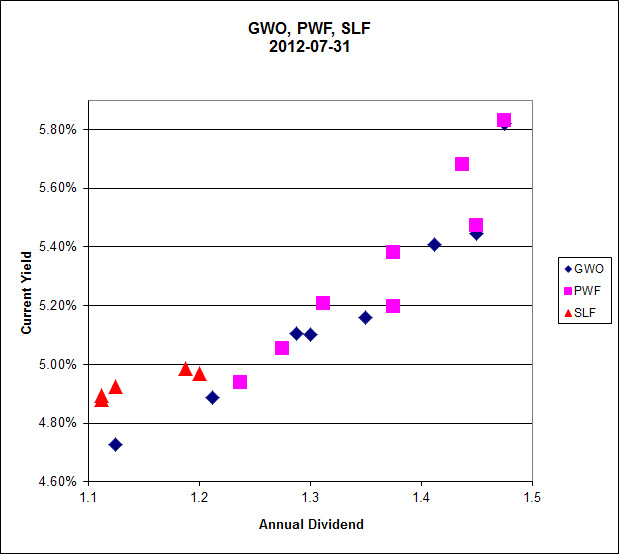
SLF DeemedRetractibles may be compared with PWF and GWO:

Click for Big

It is quite apparent that that the market continues to treat regulated issues (SLF, GWO) no differently from unregulated issues (PWF).

Those of you who have been paying attention will remember that in a “normal” market (which we have not seen in over a year) the slope of this line is related to the implied volatility of yields in Black-Scholes theory, as discussed in the January, 2010, edition of PrefLetter. The relationship is still far too large to be explained by Implied Volatility – the numbers still indicate an overwhelming degree of directionality in the market’s price expectations.

Sometimes everything works … sometimes it’s 50-50 … sometimes nothing works. The fund seeks to earn incremental return by selling liquidity (that is, taking the other side of trades that other market participants are strongly motivated to execute), which can also be referred to as ‘trading noise’. There were a lot of strongly motivated market participants during the Panic of 2007, generating a lot of noise! Unfortunately, the conditions of the Panic may never be repeated in my lifetime … but the fund will simply attempt to make trades when swaps seem profitable, without worrying about the level of monthly turnover.

There’s plenty of room for new money left in the fund. I have shown in recent issues of PrefLetter that market pricing for FixedResets is demonstrably stupid and I have lots of confidence – backed up by my bond portfolio management experience in the markets for Canadas and Treasuries, and equity trading on the NYSE & TSX – that there is enough demand for liquidity in any market to make the effort of providing it worthwhile (although the definition of “worthwhile” in terms of basis points of outperformance changes considerably from market to market!) I will continue to exert utmost efforts to outperform but it should be borne in mind that there will almost inevitably be periods of underperformance in the future.

The yields available on high quality preferred shares remain elevated, which is reflected in the current estimate of sustainable income.

Calculation of MAPF Sustainable Income Per Unit
Month NAVPU Portfolio
Average
YTW
Leverage
Divisor
Securities
Average
YTW
Capital
Gains
Multiplier
Sustainable
Income
per
current
Unit
June, 2007 9.3114 5.16% 1.03 5.01% 1.3240 0.3524
September 9.1489 5.35% 0.98 5.46% 1.3240 0.3773
December, 2007 9.0070 5.53% 0.942 5.87% 1.3240 0.3993
March, 2008 8.8512 6.17% 1.047 5.89% 1.3240 0.3938
June 8.3419 6.034% 0.952 6.338% 1.3240 $0.3993
September 8.1886 7.108% 0.969 7.335% 1.3240 $0.4537
December, 2008 8.0464 9.24% 1.008 9.166% 1.3240 $0.5571
March 2009 $8.8317 8.60% 0.995 8.802% 1.3240 $0.5872
June 10.9846 7.05% 0.999 7.057% 1.3240 $0.5855
September 12.3462 6.03% 0.998 6.042% 1.3240 $0.5634
December 2009 10.5662 5.74% 0.981 5.851% 1.1141 $0.5549
March 2010 10.2497 6.03% 0.992 6.079% 1.1141 $0.5593
June 10.5770 5.96% 0.996 5.984% 1.1141 $0.5681
September 11.3901 5.43% 0.980 5.540% 1.1141 $0.5664
December 2010 10.7659 5.37% 0.993 5.408% 1.0298 $0.5654
March, 2011 11.0560 6.00% 0.994 5.964% 1.0298 $0.6403
June 11.1194 5.87% 1.018 5.976% 1.0298 $0.6453
September 10.2709 6.10%
Note
1.001 6.106% 1.0298 $0.6090
December, 2011 10.0793 5.63%
Note
1.031 5.805% 1.0000 $0.5851
March, 2012 10.3944 5.13%
Note
0.996 5.109% 1.0000 $0.5310
June 10.2151 5.32%
Note
1.012 5.384% 1.0000 $0.5500
July, 2012 10.4713 5.03%
Note
1.00 5.030% 1.0000 $0.5267
NAVPU is shown after quarterly distributions of dividend income and annual distribution of capital gains.
Portfolio YTW includes cash (or margin borrowing), with an assumed interest rate of 0.00%
The Leverage Divisor indicates the level of cash in the account: if the portfolio is 1% in cash, the Leverage Divisor will be 0.99
Securities YTW divides “Portfolio YTW” by the “Leverage Divisor” to show the average YTW on the securities held; this assumes that the cash is invested in (or raised from) all securities held, in proportion to their holdings.
The Capital Gains Multiplier adjusts for the effects of Capital Gains Dividends. On 2009-12-31, there was a capital gains distribution of $1.989262 which is assumed for this purpose to have been reinvested at the final price of $10.5662. Thus, a holder of one unit pre-distribution would have held 1.1883 units post-distribution; the CG Multiplier reflects this to make the time-series comparable. Note that Dividend Distributions are not assumed to be reinvested.
Sustainable Income is the resultant estimate of the fund’s dividend income per current unit, before fees and expenses. Note that a “current unit” includes reinvestment of prior capital gains; a unitholder would have had the calculated sustainable income with only, say, 0.9 units in the past which, with reinvestment of capital gains, would become 1.0 current units.
DeemedRetractibles are comprised of all Straight Perpetuals (both PerpetualDiscount and PerpetualPremium) issued by BMO, BNS, CM, ELF, GWO, HSB, IAG, MFC, NA, RY, SLF and TD, which are not exchangable into common at the option of the company (definition refined in May). These issues are analyzed as if their prospectuses included a requirement to redeem at par on or prior to 2022-1-31, in addition to the call schedule explicitly defined. See OSFI Does Not Grandfather Extant Tier 1 Capital, CM.PR.D, CM.PR.E, CM.PR.G: Seeking NVCC Status and the January, February, March and June, 2011, editions of PrefLetter for the rationale behind this analysis.
Yields for September, 2011, to January, 2012, were calculated by imposing a cap of 10% on the yields of YLO issues held, in order to avoid their extremely high calculated yields distorting the calculation and to reflect the uncertainty in the marketplace that these yields will be realized. Commencing February, 2012, yields on these issues have been set to zero.

Significant positions were held in DeemedRetractible and FixedReset issues on July 31; all of these currently have their yields calculated with the presumption that they will be called by the issuers at par prior to 2022-1-31. This presents another complication in the calculation of sustainable yield. The fund also holds a position various SplitShare issues which also have their yields calculated with the expectation of a maturity at par.

I will no longer show calculations that assume the conversion of the entire portfolio into PerpetualDiscounts, as there are currently only three such issues of investment grade, from only two issuer groups. Additionally, the fund has no holdings of these issues.

It should be noted that the concept of this Sustainable Income calculation was developed when the fund’s holdings were overwhelmingly PerpetualDiscounts – see, for instance, the bottom of the market in November 2008. It is easy to understand that for a PerpetualDiscount, the technique of multiplying yield by price will indeed result in the coupon – a PerpetualDiscount paying $1 annually will show a Sustainable Income of $1, regardless of whether the price is $24 or $17.

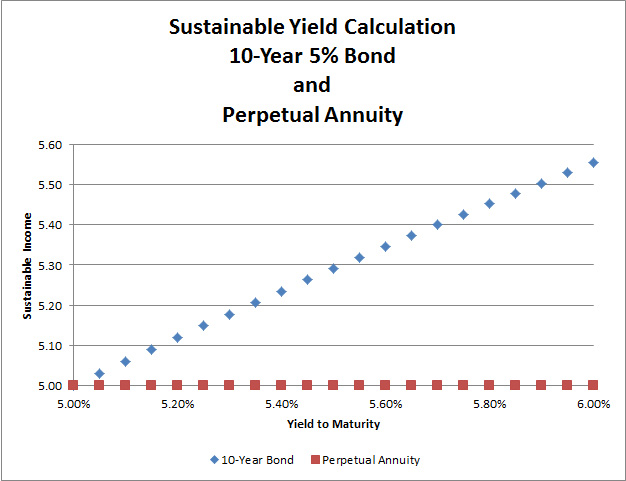
Things are not quite so neat when maturity dates and maturity prices that are different from the current price are thrown into the mix. If we take a notional Straight Perpetual paying $5 annually, the price is $100 when the yield is 5% (all this ignores option effects). As the yield increases to 6%, the price declines to 83.33; and 83.33 x 6% is the same $5. Good enough.

But a ten year bond, priced at 100 when the yield is equal to its coupon of 5%, will decline in price to 92.56; and 92.56 x 6% is 5.55; thus, the calculated Sustainable Income has increased as the price has declined as shown in the graph:

Click for Big

The difference is because the bond’s yield calculation includes the amortization of the discount; therefore, so does the Sustainable Income estimate.

Thus, the decline in the MAPF Sustainable Income from $0.5500 per unit in June to $0.5267 per unit in July should be looked at as a simple consequence of the funds holdings; virtually all of which have their yields calculated in a manner closer to bonds than to Perpetual Annuities.

Different assumptions lead to different results from the calculation, but the overall positive trend is apparent. I’m very pleased with the long-term results! It will be noted that if there was no trading in the portfolio, one would expect the sustainable yield to be constant (before fees and expenses). The success of the fund’s trading is showing up in

  • the very good performance against the index
  • the long term increases in sustainable income per unit

As has been noted, the fund has maintained a credit quality equal to or better than the index; outperformance is due to exploitation of trading anomalies.

Again, there are no predictions for the future! The fund will continue to trade between issues in an attempt to exploit market gaps in liquidity, in an effort to outperform the index and keep the sustainable income per unit – however calculated! – growing.