New Issues

New Issue: MFC FixedReset, 3.90%+236

Manulife Financial Corporation has announced:

a Canadian public offering of Non-cumulative Rate Reset Class 1 Shares Series 17 (“Series 17 Preferred Shares”). Manulife will issue 10 million Series 17 Preferred Shares priced at $25 per share to raise gross proceeds of $250 million. The offering will be underwritten by a syndicate of investment dealers co-led by Scotia Capital Inc., RBC Capital Markets and TD Securities and is anticipated to qualify as Tier 1 capital for Manulife. The expected closing date for the offering is August 15, 2014. Manulife intends to file a prospectus supplement to its June 23, 2014 base shelf prospectus in respect of this issue.

Holders of the Series 17 Preferred Shares will be entitled to receive a non-cumulative quarterly fixed dividend yielding 3.90 per cent annually, as and when declared by the Board of Directors of Manulife, for the initial period ending December 19, 2019. Thereafter, the dividend rate will be reset every five years at a rate equal to the 5-year Government of Canada bond yield plus 2.36 per cent.

Holders of Series 17 Preferred Shares will have the right, at their option, to convert their shares into Non-cumulative Rate Reset Class 1 Shares Series 18 (“Series 18 Preferred Shares”), subject to certain conditions, on December 19, 2019 and on December 19 every five years thereafter. Holders of the Series 18 Preferred Shares will be entitled to receive non-cumulative quarterly floating dividends, as and when declared by the Board of Directors of Manulife, at a rate equal to the three-month Government of Canada Treasury Bill yield plus 2.36 per cent.

Manulife intends to use the net proceeds from the offering to partially fund the redemption of Manulife’s Non-cumulative Rate Reset Class 1 Shares Series 1 (the “Series 1 Preferred Shares”) on September 19, 2014.

Later, they added:

that as a result of strong investor demand for its previously announced Canadian public offering of Non-cumulative Rate Reset Class 1 Shares Series 17 (“Series 17 Preferred Shares”), the size of the offering has been increased to 14 million shares. The gross proceeds of the offering will now be $350 million. The offering will be underwritten by a syndicate of investment dealers co-led by Scotia Capital Inc., RBC Capital Markets and TD Securities and is anticipated to qualify as Tier 1 capital for Manulife. The expected closing date for the offering is August 15, 2014. Manulife intends to file a prospectus supplement to its June 23, 2014 base shelf prospectus in respect of this issue.

Manulife intends to use the net proceeds from the offering to fund the redemption of Manulife’s Non-cumulative Rate Reset Class 1 Shares Series 1 (the “Series 1 Preferred Shares”) on September 19, 2014.

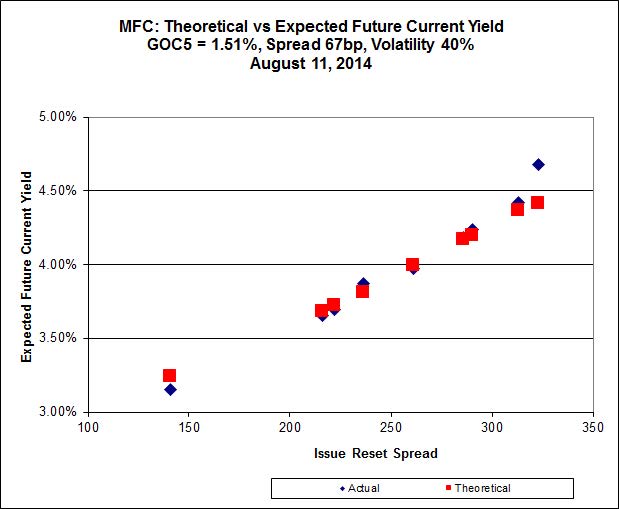
This issue is priced in-line with extant issues, according to Implied Volatility theory:

ImpVol_MFC_FR_140811
Click for Big

I continue to be puzzled about why the Implied Volatility for MFC FixedResets is so high.

Issue Comments

MFC.PR.E To Be Redeemed

Manulife Financial Corp. has announced:

its intention to redeem all of its outstanding 14,000,000 Non-cumulative Rate Reset Class 1 Shares Series 1 (“Series 1 Preferred Shares”) for cash on September 19, 2014. The Series 1 Preferred Shares are redeemable at Manulife’s option on September 19, 2014, at a redemption price per Series 1 Preferred Share equal to C$25.00 for an aggregate total of C$350 million. Formal notice will be delivered to holders of Series 1 Preferred Shares in accordance with the terms outlined in the share provisions for the Series 1 Preferred Shares.

Separately from the redemption price, the final quarterly dividend of C$0.35 per Series 1 Preferred Share will be paid in the usual manner on September 19, 2014 to shareholders of record on August 19, 2014. After the Series 1 Preferred Shares are redeemed, holders of Series 1 Preferred Shares will cease to be entitled to distributions of dividends and will not be entitled to exercise any rights as holders other than to receive the redemption price.

No surprise here – with an Issue Reset Spread of 323bp, this was rather expensive money for them. They have separately announced their intention to issue at +236.

MFC.PR.E commenced trading 2009-6-3 after being announced 2009-5-25.

PrefLetter

August PrefLetter Released!

The August, 2014, edition of PrefLetter has been released and is now available for purchase as the “Previous edition”. Those who subscribe for a full year receive the “Previous edition” as a bonus.

The regular appendices reporting on DeemedRetractibles and FixedResets are included.

PrefLetter may now be purchased by all Canadian residents.

Until further notice, the “Previous Edition” will refer to the August, 2014, issue, while the “Next Edition” will be the September, 2014, issue, scheduled to be prepared as of the close September 12 and eMailed to subscribers prior to market-opening on September 15.

PrefLetter is intended for long term investors seeking issues to buy-and-hold. At least one recommendation from each of the major preferred share sectors is included and discussed.

Note: My verbosity has grown by such leaps and bounds that it is no longer possible to deliver PrefLetter as an eMail attachment – it’s just too big for my software! Instead, I have sent passwords – click on the link in your eMail and your copy will download.

Note: The PrefLetter website has a Subscriber Download Feature. If you have not received your copy, try it!

Note: PrefLetter eMails sometimes runs afoul of spam filters. If you have not received your copy within fifteen minutes of a release notice such as this one, please double check your (company’s) spam filtering policy and your spam repository – there are some hints in the post Sympatico Spam Filters out of Control. If it’s not there, contact me and I’ll get you your copy … somehow!

Note: There have been scattered complaints regarding inability to open PrefLetter in Acrobat Reader, despite my practice of including myself on the subscription list and immediately checking the copy received. I have had the occasional difficulty reading US Government documents, which I was able to resolve by downloading and installing the latest version of Adobe Reader. Also, note that so far, all complaints have been from users of Yahoo Mail. Try saving it to disk first, before attempting to open it.

Note: There have been other scattered complaints that double-clicking on the links in the “PrefLetter Download” email results in a message that the password has already been used. I have been able to reproduce this problem in my own eMail software … the problem is double-clicking. What happens is the first click opens the link and the second click finds that the password has already been used and refuses to work properly. So the moral of the story is: Don’t be a dick! Single Click!

Note: Assiduous Reader DG informs me:

In case you have any other Apple users: you need to install a free App from the apple store called “FileApp”. It comes with it’s own tutorial and allows you to download and save a PDF file.

Issue Comments

LFE.PR.B Semi-Annual Report 2014

Canadian Life Companies Split Corp has released its Semi-Annual Report to May 31, 2014.

Figures of interest are:

MER: 1.43% of the whole unit value, “presented to reflect the normal operating expenses of the Company excluding
any one time secondary offering expenses.”

Average Net Assets: We need this to calculate portfolio yield. The Total Assets of the fund at year end was $190.0-million, compared to $199.9-million on May 31, so call it an average of $195.0-million. Preferred share dividends of $4,229,154 were paid over the half year at 0.625 p.a., implying average units outstanding of 13.53-million, at an average NAVPU of about $14.05, implies $190.2-million. That’s reasonably good agreement! Say the Average Net Assets are $192.6-million.

Underlying Portfolio Yield: Income received of $2,871,701 divided by average net assets of $194.7-million, multiplied by two because it’s semiannual is 2.98%.

Income Coverage: Net investment income of $1,873,801 (after adding back warrant subscription fees) divided by preferred share dividends of $4,229,154 is a rather low 44% – but consistent with the figure for 2013.

Issue Comments

FTN.PR.A Semi-Annual Report 2014

Financial 15 Split Corp has released its Semi-Annual Report to May 31, 2014.

Figures of interest are:

MER: 1.60% of the whole unit value, “presented to reflect the normal operating expenses of the Company excluding any one time secondary offering expenses.”

Average Net Assets: We need this to calculate portfolio yield. The Total Assets of the fund at year end was $185.2-million, compared to $209.3-million on May 31, so call it an average of $197.2-million. Preferred share dividends of $3,219,876 were paid over the half year at 0.525 p.a., implying average units outstanding of 12.27-million, at an average NAVPU of about $15.75, implies $193.2-million. That’s reasonably good agreement! Say the Average Net Assets are $194.7-million.

Underlying Portfolio Yield: Income received of $2,687,593 divided by average net assets of $194.7-million, multiplied by two because it’s semiannual is 2.76%.

Income Coverage: Net investment income of $1,015,649 divided by preferred share dividends of $3,219,876 is a very low 32%.

The Income Coverage is substantially lower than the calculation performed from the 2013 Annual Report. This may be related to their issuance of $34.5-million in units last January.

Issue Comments

DF.PR.A Semi-Annual Report

Dividend 15 Split Corp. II has released its Semi-Annual Report to May 31, 2014.

Figures of interest are:

MER: 1.30% of the whole unit value, “to reflect the normal operating expenses of the Company excluding any one time secondary offering expenses.”.

Average Net Assets: We need this to calculate portfolio yield. The Total Assets of the fund at year end was $115.6-million, compared to $153.2-million on May 31, so call it an average of $134.4-million. Preferred share dividends of $1,997,813 were paid over the half year at 0.525 p.a., implying average units outstanding of 7.61-million, at an average NAVPU of about $16.7, implies $127.1-million. That’s reasonably good agreement! Say the Average Net Assets are $130.8-million.

Underlying Portfolio Yield: Income received of $1,969,925 divided by average net assets of $130.8-million, multiplied by two because it’s semiannual is 3.01%.

Income Coverage: Net investment income of $1,104,941 divided by preferred share dividends of $1,997,813 is 55%.

Note that both the calculated portfolio yield and the income coverage are less than what was calculated according to the 2013 Annual Report; there may have been a delay in investing the proceeds of their issuance. We will have to wait and see what the 2014 Annual Report brings.

Issue Comments

FFN.PR.A Completes Overnight Offering

Quadravest has announced:

Financial 15 Split Corp. II (the “Company”) is pleased to announce it has completed an overnight offering of 1,955,000 Preferred Shares and 1,955,000 Class A Shares. Total gross proceeds of the offering were $35.2 million, bringing the Company’s net assets to approximately $124.5 million. The shares will trade on the Toronto Stock Exchange under the existing symbols of FFN.PR.A (Preferred shares) and FFN (Class A shares).

The Preferred Shares were offered at a price of $10.00 per Preferred Share to yield 5.25% on the issue price, and the Class A Shares were offered at a price of $8.00 per Class A Share targeting to yield 15% annually based on the current distribution policy.

The offering was co-led by National Bank Financial Inc., CIBC, RBC Capital Markets and also included BMO Capital Markets, GMP Securities L.P., Canaccord Genuity Corp. and Raymond James.

The net proceeds of the secondary offering will be used by the Company to invest in a high quality portfolio consisting of 15 financial services companies made up of Canadian and U.S. issuers as follows:

Bank of Montreal National Bank of Canada Bank of America Corp.
The Bank of Nova Scotia Manulife Financial Corporation Citigroup Inc.
Canadian Imperial Bank of Commerce Sun Life Financial Services of Canada Goldman Sachs Group Inc.
Royal Bank of Canada Great-West Lifeco Inc. JP Morgan Chase & Co.
The Toronto-Dominion Bank CI Financial Corp. Wells Fargo & Co.

FFN.PR.A was last mentioned on PrefBlog when shareholders voted for a term extension last May.

Issue Comments

S&P Sets Outlook-Negative on Canadian Banks

Standard & Poor’s has announced:

Standard & Poor’s Ratings Services today said that it revised its outlooks to negative from stable on almost all Canadian banks to which we have ascribed ratings uplift for potential extraordinary government support in a crisis. We base this rating action on our view that the announcement of a proposed bail-in policy regime might lead us to lower ratings on the banks within two years. We are revising our outlooks on Royal Bank of Canada (RBC), Toronto-Dominion Bank (TD Bank), The Bank of Nova Scotia (Scotiabank), Bank of Montreal (BMO), Canadian Imperial Bank of Commerce (CIBC), and National Bank of Canada (NBC).

“The outlook revision reflects our expectation of reduced potential for extraordinary government support arising from implementation of the proposed new elements of the resolution framework for Canadian banks,” said Standard & Poor’s credit analyst Tom Connell.

We incorporate the potential for extraordinary government support in our ratings on the seven largest Canadian financial institutions. We evaluate the potential for extraordinary government support through an assessment of a bank’s systemic importance, in conjunction with our view of the government’s willingness and capacity to support one or more banks during a crisis. We assess seven Canadian financial institutions as having “high” or “moderate” systemic importance. We also assess Canada as being “supportive,” which is the middle of three categories in our framework for evaluating the tendency of a government to bail out a financial institution. The issuer credit ratings on the large Canadian financial institutions include either one notch (RBC, TD Bank, Scotiabank, NBC, and Caisse Centrale Desjardins) or two notches (BMO and CIBC) of uplift due to the potential for extraordinary government support.

This notching reflects our belief that the Canadian government, like other governments around the world, would face strong incentives to support a large institution in a crisis to preserve financial market stability. We base this on the size and interconnectedness of these banks, their importance to the economy, and the potential for the failure of one institution to destabilize the system as a whole. We believe there is a moderately high likelihood that the Canadian government would intervene to preempt a large bank’s failure.

We might reclassify the Canadian government’s tendency to support a bank as “uncertain” from the current “supportive” category. We note that taxpayer protection is a primary goal of the bail-in policy, as the consultation document’s title reflects. We expect the Canadian government will take a pragmatic approach that balances policy goals and makes use of whatever options are available in the event of an impending bank failure. Canada has not prohibited capital injections to a distressed bank, but does include a capital injection from a federal or provincial government as a trigger event for the conversion of nonviability capital instruments and of bail-in debt. For jurisdictions we view as having an uncertain tendency to support banks, we do not apply any ratings uplift from a bank’s stand-alone credit profile, regardless of the bank’s systemic importance.

Alternatively, we could reduce our assessment of the systemic importance of some or all Canadian banks, to “moderate” or “low.” This could arise if we conclude that the array of resolution tools, including the bail-in option, would have the potential to materially reduce the potential for a bank failure to destabilize the financial system. For banks we view as having low systemic importance, we do not apply any uplift for extraordinary government support. For banks that we believe have moderate systemic importance, we would limit uplift of extraordinary support to one notch at most (assuming we view the government as supportive).

This announcement by S&P mirrors a a similar announcement by Moody’s last month.

Affected issues are
BNS.PR.A, BNS.PR.B, BNS.PR.C, BNS.PR.L, BNS.PR.M, BNS.PR.N, BNS.PR.O, BNS.PR.P, BNS.PR.Q, BNS.PR.R, BNS.PR.Y, BNS.PR.Z

BMO.PR.J, BMO.PR.K, BMO.PR.L, BMO.PR.M, BMO.PR.P, BMO.PR.Q, BMO.PR.R, BMO.PR.S, BMO.PR.T, BMO.PR.W

CM.PR.D, CM.PR.E, CM.PR.G, CM.PR.O

NA.PR.L, NA.PR.M, NA.PR.Q, NA.PR.S

RY.PR.A, RY.PR.B, RY.PR.C, RY.PR.D, RY.PR.E, RY.PR.F, RY.PR.G, RY.PR.H, RY.PR.I, RY.PR.K, RY.PR.L, RY.PR.T, RY.PR.W, RY.PR.X, RY.PR.Y, RY.PR.Z

TD.PR.O, TD.PR.P, TD.PR.Q, TD.PR.R, TD.PR.S, TD.PR.T, TD.PR.Y, TD.PR.Z, TD.PF.A, TD.PF.B

Market Action

August 8, 2014

The economy is still in the pits:

Canadian employers created barely any jobs in July, surprising forecasters and reinforcing the Bank of Canada’s decision to keep interest rates low.

Statistics Canada’s monthly tally of hiring and firing produced a net gain of 200 positions last month, as a 60,000 increase in part-time jobs marginally outweighed a 59,700 plunge in full-time positions.

StatsCan estimates there were 17,820,900 people working in July, only 0.7 per cent more than a year ago. The labour participation rate, which measures the percentage of the population either working or seeking work, dropped to 65.9 per cent, the lowest since October 2001. Employment in goods-producing industries has shrunk by 56,000 positions this year, reducing the headcount to its lowest since January 2012, according National Bank Financial.

Canada’s businesses are wary of using their profits to expand, as demand at home and abroad remains lacklustre.

The result is an economy that has plateaued. Construction led the decline in goods-producing industries, as builders cut their payrolls by 42,200 in July from June. Factories added 11,500 workers last month, but there still were 14,200 fewer people working in manufacturing than there were a year earlier. There are now almost two Canadians working in the services industry for every one worker in goods-producing sectors. Employment in health care and social assistance increased by 87,100 positions from July 2013, although health jobs declined by 28,500 last month. Finance and real estate declined by 22,400 in July from a year earlier.

Dan Hallett wrote a piece on the Alterna Bank Market Tracer GIC the other day:

While the issuer – Alterna Bank – doesn’t make an offering document available on its website, it provides a fact sheet and other information with sufficient details to test the product using actual historical data. Using the formulas contained in the fact sheet, I was able to model the S&P/TSX 60 Index to see how often and by how much the GIC would have beaten the pure index investment over both 3 and 5 year terms.

From September 1999 through June 2014 there were 141 rolling 3-year periods based on monthly data. … 77 per cent of the time Market Tracer loses. During the little time during which Market Tracer would have done better, its margin of outperformance would have been much smaller than the margin of underperformance.

From September 1999 through June 2014 there were 123 rolling 5 year periods based on monthly data. … •In other words, the time Market Tracer would have lost during virtually every five year period by a large margin. And in the few instances where it was successful, it just squeaked by the index.

It’s always good to check things with a simulation, but there is an easier way to understand why this product is no good.

According to the linked fact sheet,

AlternaMarketTracer
Click for Big

OK, so the total return to maturity on the instrument is dependent upon the average of the index level at every interim month-end. So the return will be path dependent.

What kind of path is best? Well, given a monotonic return function, it is clear that for any given end-value of the index in excess of the initial level, it is best if the market jumps up to that level instantly and remains there for the full term (if the return function is not monotonic, then we want the index level to go arbitrarily high in the first month and remain there until it dives to the end-value at maturity).

OK … from this preliminary insight, we can generalize that we want the good months to come at the beginning of the term and the bad months to come later. What does that remind us of?

Any Reader who didn’t immediately say “Sequence of Returns Risk with Negative Cash Flows” is not sufficiently Assiduous and should read more of my publications. But this insight helps us to determine how this vehicle could be replicated.

If the term is N months, then divide your initial investment into N equal sub-portfolios and invest each one in the index. At the end of every month, liquidate one of the sub-portfolios and keep the proceeds in cash earning no interest; zip, zero, zilch interest. The big Nada.

Then – ignoring the principal protection of the note and assuming that the “Participation Factor” is 100%, the end-value of this investment strategy will be equal to the end-value of the Alterna GIC.

So basically, then, half your investment is in cash earning zero. Is it any wonder the note underperforms the index? The only surprise is that it outperforms sometimes … but I attribute this to the time period Mr. Hallett chose for his simulations. The period 1999-2014 is notable for times at which having a put option on an equity index was a Good Thing.

My attention was brought to an attempt at flim-flam recently:

Canada’s biggest banks accepted tens of billions in government funds during the recession, according to a report released today by the Canadian Centre for Policy Alternatives.

Canada’s banking system is often lauded for being one of the world’s safest. But an analysis by CCPA senior economist David Macdonald concluded that Canada’s major lenders were in a far worse position during the downturn than previously believed.

Macdonald examined data provided by the Canada Mortgage and Housing Corporation, the Office of the Superintendent of Financial Institutions and the big banks themselves for his report published Monday.

It says support for Canadian banks from various agencies reached $114 billion at its peak. That works out to $3,400 for every man, woman and child in Canada, and also to seven per cent of Canada’s gross domestic product in 2009.

The figure is also 10 times the amount Canadian taxpayers spent on the auto industry in 2009.

“At some point during the crisis, three of Canada’s banks — CIBC, BMO, and Scotiabank — were completely under water, with government support exceeding the market value of the company,” Macdonald said.

The federal government claims it was offering the banks ‘liquidity support,’ but it looks an awful lot like a bailout to me,” says Macdonald.

“It would have been cheaper to buy every single share in these companies,” Macdonald said.

One would hope that somebody commenting on the banking system – any banking system – would understand the difference between solvency and liquidity; but it is apparent from the last three quoted paragraphs that Mr. Macdonald either doesn’t know or doesn’t care. So, the Canadian Centre for Policy Alternatives has merely cemented its reputation for pig-ignorance; but maybe they were able to reinforce the prejudices of their donors sufficiently to stay afloat for a little while longer.

It was a mixed day for the Canadian preferred share market, with PerpetualDiscounts up 29bp, FixedResets off 5bp and DeemedRetractibles gaining 3bp. Volatility was minimal. Volume was very awfully extremely low.

And now it’s time to do PrefLetter. I’ve got my supplies … two boxes of doughnuts, three packages of Nibs (cherry), three large bags of potato chips, eight packages of cookies and a large container of salted roast peanuts. Let’s eat right to keep fit, that’s what I say!

HIMIPref™ Preferred Indices
These values reflect the December 2008 revision of the HIMIPref™ Indices

Values are provisional and are finalized monthly
Index Mean
Current
Yield
(at bid)
Median
YTW
Median
Average
Trading
Value
Median
Mod Dur
(YTW)
Issues Day’s Perf. Index Value
Ratchet 0.00 % 0.00 % 0 0.00 0 -0.4709 % 2,624.3
FixedFloater 4.17 % 3.40 % 28,495 18.60 1 -0.0438 % 4,163.9
Floater 2.92 % 3.05 % 45,549 19.58 4 -0.4709 % 2,713.7
OpRet 4.03 % 0.69 % 73,291 0.08 1 -0.0785 % 2,715.8
SplitShare 4.24 % 3.81 % 56,348 3.97 6 0.2007 % 3,131.4
Interest-Bearing 0.00 % 0.00 % 0 0.00 0 -0.0785 % 2,483.3
Perpetual-Premium 5.49 % -3.04 % 82,538 0.08 19 0.0372 % 2,436.1
Perpetual-Discount 5.23 % 5.18 % 115,394 15.17 17 0.2854 % 2,590.9
FixedReset 4.29 % 3.56 % 195,205 8.68 75 -0.0521 % 2,560.3
Deemed-Retractible 5.00 % 2.07 % 112,411 0.30 42 0.0323 % 2,550.5
FloatingReset 2.65 % 2.06 % 78,034 3.78 6 0.0263 % 2,521.6
Performance Highlights
Issue Index Change Notes
CIU.PR.C FixedReset -1.85 % YTW SCENARIO
Maturity Type : Limit Maturity
Maturity Date : 2044-08-08
Maturity Price : 21.25
Evaluated at bid price : 21.25
Bid-YTW : 3.38 %
FTS.PR.J Perpetual-Discount 1.79 % YTW SCENARIO
Maturity Type : Limit Maturity
Maturity Date : 2044-08-08
Maturity Price : 24.04
Evaluated at bid price : 24.44
Bid-YTW : 4.92 %
Volume Highlights
Issue Index Shares
Traded
Notes
GWO.PR.N FixedReset 138,510 Desjardins crossed 130,700 at 21.15.
YTW SCENARIO
Maturity Type : Hard Maturity
Maturity Date : 2025-01-31
Maturity Price : 25.00
Evaluated at bid price : 21.17
Bid-YTW : 4.83 %
BMO.PR.W FixedReset 95,375 Recent new issue.
YTW SCENARIO
Maturity Type : Limit Maturity
Maturity Date : 2044-08-08
Maturity Price : 23.13
Evaluated at bid price : 24.95
Bid-YTW : 3.58 %
MFC.PR.B Deemed-Retractible 47,332 Scotia crossed 14,900 at 23.30.
YTW SCENARIO
Maturity Type : Hard Maturity
Maturity Date : 2025-01-31
Maturity Price : 25.00
Evaluated at bid price : 23.22
Bid-YTW : 5.67 %
ENB.PF.C FixedReset 44,585 Nesbitt crossed 24,400 at 25.13.
YTW SCENARIO
Maturity Type : Limit Maturity
Maturity Date : 2044-08-08
Maturity Price : 23.16
Evaluated at bid price : 25.11
Bid-YTW : 4.09 %
TD.PF.B FixedReset 43,965 Recent new issue.
YTW SCENARIO
Maturity Type : Limit Maturity
Maturity Date : 2044-08-08
Maturity Price : 23.17
Evaluated at bid price : 25.03
Bid-YTW : 3.60 %
ENB.PF.E FixedReset 40,648 Recent new issue.
YTW SCENARIO
Maturity Type : Limit Maturity
Maturity Date : 2044-08-08
Maturity Price : 23.12
Evaluated at bid price : 25.00
Bid-YTW : 4.09 %
There were 9 other index-included issues trading in excess of 10,000 shares.
Wide Spread Highlights
Issue Index Quote Data and Yield Notes
IAG.PR.F Deemed-Retractible Quote: 25.95 – 26.30
Spot Rate : 0.3500
Average : 0.2294

YTW SCENARIO
Maturity Type : Call
Maturity Date : 2018-03-31
Maturity Price : 25.25
Evaluated at bid price : 25.95
Bid-YTW : 5.23 %

CU.PR.D Perpetual-Discount Quote: 24.33 – 24.75
Spot Rate : 0.4200
Average : 0.3114

YTW SCENARIO
Maturity Type : Limit Maturity
Maturity Date : 2044-08-08
Maturity Price : 23.93
Evaluated at bid price : 24.33
Bid-YTW : 5.02 %

CU.PR.E Perpetual-Discount Quote: 24.36 – 24.73
Spot Rate : 0.3700
Average : 0.2667

YTW SCENARIO
Maturity Type : Limit Maturity
Maturity Date : 2044-08-08
Maturity Price : 23.96
Evaluated at bid price : 24.36
Bid-YTW : 5.02 %

TRP.PR.D FixedReset Quote: 25.25 – 25.47
Spot Rate : 0.2200
Average : 0.1435

YTW SCENARIO
Maturity Type : Limit Maturity
Maturity Date : 2044-08-08
Maturity Price : 23.26
Evaluated at bid price : 25.25
Bid-YTW : 3.69 %

IFC.PR.C FixedReset Quote: 25.65 – 25.90
Spot Rate : 0.2500
Average : 0.1808

YTW SCENARIO
Maturity Type : Call
Maturity Date : 2016-09-30
Maturity Price : 25.00
Evaluated at bid price : 25.65
Bid-YTW : 3.17 %

SLF.PR.A Deemed-Retractible Quote: 23.74 – 24.03
Spot Rate : 0.2900
Average : 0.2219

YTW SCENARIO
Maturity Type : Hard Maturity
Maturity Date : 2025-01-31
Maturity Price : 25.00
Evaluated at bid price : 23.74
Bid-YTW : 5.48 %

Market Action

August 7, 2014

Call the papers! A cabinet minister said something intelligent:

Federal Employment Minister Jason Kenney says he wants to exploit a “dysfunctional” American immigration system to lure high-tech workers to Canada when they can’t get permanent residency in the United States.

The minister said Wednesday the U.S. failure to reform its immigration system is keeping an opportunity open for Canada and there are plans to make it easier for prospects to come to Canada with program changes this January. Mr. Kenney did not provide details of the specific changes.

“If you’ve got a degree in something like computer science from Stanford or the Massachusetts Institute of Technology and the Americans won’t give you a green card, you’re welcome to Canada. We have a functioning immigration system that will become even faster-moving under express entry in January of next year.”

Fortunately for our prejudices, however, they had to admit:

Mr. Kenney noted that Canada previously posted a billboard in Silicon Valley, promoting low taxes and visas for those having trouble with their U.S. visas.

Mr. Kenney’s office was asked about numbers on the program, but a spokesperson said they were not available.

It was a mixed day for the Canadian preferred share market, with PerpetualDiscounts off 8bp, FixedResets up 14bp and DeemedRetractibles gaining 3bp. Volatility was minimal. Volume was extremely low.

HIMIPref™ Preferred Indices
These values reflect the December 2008 revision of the HIMIPref™ Indices

Values are provisional and are finalized monthly
Index Mean
Current
Yield
(at bid)
Median
YTW
Median
Average
Trading
Value
Median
Mod Dur
(YTW)
Issues Day’s Perf. Index Value
Ratchet 0.00 % 0.00 % 0 0.00 0 0.0416 % 2,636.7
FixedFloater 4.16 % 3.40 % 26,564 18.61 1 0.0439 % 4,165.7
Floater 2.91 % 3.04 % 45,462 19.61 4 0.0416 % 2,726.5
OpRet 4.02 % -0.40 % 76,011 0.08 1 -0.0392 % 2,717.9
SplitShare 4.24 % 3.94 % 58,673 3.97 6 0.0508 % 3,125.1
Interest-Bearing 0.00 % 0.00 % 0 0.00 0 -0.0392 % 2,485.2
Perpetual-Premium 5.49 % -3.87 % 85,475 0.09 19 -0.0145 % 2,435.2
Perpetual-Discount 5.25 % 5.20 % 115,886 15.15 17 -0.0818 % 2,583.5
FixedReset 4.29 % 3.58 % 194,584 6.73 75 0.1424 % 2,561.6
Deemed-Retractible 5.00 % 1.44 % 113,140 0.23 42 0.0304 % 2,549.7
FloatingReset 2.68 % 2.10 % 81,133 3.78 6 0.1447 % 2,520.9
Performance Highlights
Issue Index Change Notes
CIU.PR.C FixedReset 1.00 % YTW SCENARIO
Maturity Type : Limit Maturity
Maturity Date : 2044-08-07
Maturity Price : 21.35
Evaluated at bid price : 21.65
Bid-YTW : 3.33 %
PWF.PR.P FixedReset 1.60 % YTW SCENARIO
Maturity Type : Limit Maturity
Maturity Date : 2044-08-07
Maturity Price : 23.13
Evaluated at bid price : 23.56
Bid-YTW : 3.33 %
Volume Highlights
Issue Index Shares
Traded
Notes
TD.PF.B FixedReset 165,375 Recent new issue.
YTW SCENARIO
Maturity Type : Limit Maturity
Maturity Date : 2044-08-07
Maturity Price : 23.18
Evaluated at bid price : 25.04
Bid-YTW : 3.63 %
POW.PR.G Perpetual-Premium 145,673 TD crossed 140,000 at 25.75.
YTW SCENARIO
Maturity Type : Call
Maturity Date : 2021-04-15
Maturity Price : 25.00
Evaluated at bid price : 25.75
Bid-YTW : 5.16 %
TRP.PR.D FixedReset 64,868 Scotia crossed 50,000 at 25.31.
YTW SCENARIO
Maturity Type : Call
Maturity Date : 2019-04-30
Maturity Price : 25.00
Evaluated at bid price : 25.39
Bid-YTW : 3.67 %
BMO.PR.W FixedReset 58,550 Recent new issue.
YTW SCENARIO
Maturity Type : Limit Maturity
Maturity Date : 2044-08-07
Maturity Price : 23.13
Evaluated at bid price : 24.96
Bid-YTW : 3.61 %
PVS.PR.D SplitShare 29,125 YTW SCENARIO
Maturity Type : Hard Maturity
Maturity Date : 2021-10-08
Maturity Price : 25.00
Evaluated at bid price : 24.50
Bid-YTW : 4.92 %
SLF.PR.A Deemed-Retractible 22,683 Scotia crossed 20,000 at 23.74.
YTW SCENARIO
Maturity Type : Hard Maturity
Maturity Date : 2025-01-31
Maturity Price : 25.00
Evaluated at bid price : 23.66
Bid-YTW : 5.52 %
There were 13 other index-included issues trading in excess of 10,000 shares.
Wide Spread Highlights
Issue Index Quote Data and Yield Notes
W.PR.H Perpetual-Premium Quote: 25.20 – 26.20
Spot Rate : 1.0000
Average : 0.5943

YTW SCENARIO
Maturity Type : Call
Maturity Date : 2014-09-06
Maturity Price : 25.00
Evaluated at bid price : 25.20
Bid-YTW : -0.02 %

FTS.PR.J Perpetual-Discount Quote: 24.01 – 24.58
Spot Rate : 0.5700
Average : 0.3990

YTW SCENARIO
Maturity Type : Limit Maturity
Maturity Date : 2044-08-07
Maturity Price : 23.64
Evaluated at bid price : 24.01
Bid-YTW : 5.01 %

ELF.PR.F Perpetual-Discount Quote: 24.10 – 24.38
Spot Rate : 0.2800
Average : 0.1857

YTW SCENARIO
Maturity Type : Limit Maturity
Maturity Date : 2044-08-07
Maturity Price : 23.85
Evaluated at bid price : 24.10
Bid-YTW : 5.54 %

BNS.PR.B FloatingReset Quote: 25.26 – 25.53
Spot Rate : 0.2700
Average : 0.1827

YTW SCENARIO
Maturity Type : Call
Maturity Date : 2018-10-25
Maturity Price : 25.00
Evaluated at bid price : 25.26
Bid-YTW : 2.28 %

CIU.PR.C FixedReset Quote: 21.65 – 22.20
Spot Rate : 0.5500
Average : 0.4657

YTW SCENARIO
Maturity Type : Limit Maturity
Maturity Date : 2044-08-07
Maturity Price : 21.35
Evaluated at bid price : 21.65
Bid-YTW : 3.33 %

IAG.PR.A Deemed-Retractible Quote: 23.10 – 23.65
Spot Rate : 0.5500
Average : 0.4664

YTW SCENARIO
Maturity Type : Hard Maturity
Maturity Date : 2025-01-31
Maturity Price : 25.00
Evaluated at bid price : 23.10
Bid-YTW : 5.66 %