New Issues

New Issue: TRP FixedReset 4.60%+192

TransCanada Corporation has announced:

it will issue 12,000,0000 cumulative redeemable first preferred shares, series 1 (the “Series 1 Preferred Shares”) at a price of $25.00 per share, for aggregate gross proceeds of $300 million on a bought deal basis to a syndicate of underwriters in Canada led by Scotia Capital Inc., and RBC Capital Markets.

The holders of Series 1 Preferred Shares will be entitled to receive fixed cumulative dividends at an annual rate of $1.15 per share, payable quarterly, as and when declared by the board of directors of TransCanada, yielding 4.6% per annum, for the initial five-year period ending December 31, 2014 with the first dividend payment date scheduled for December 31, 2009. The dividend rate will reset on December 31, 2014 and every five years thereafter at a rate equal to the sum of the then five-year Government of Canada bond yield and 1.92%. The Series 1 Preferred Shares are redeemable by TransCanada on or after December 31, 2014.

The holders of Series 1 Preferred Shares will have the right to convert their shares into cumulative redeemable first preferred shares, series 2 (the “Series 2 Preferred Shares”), subject to certain conditions, on December 31, 2014 and on December 31 of every fifth year thereafter. The holders of Series 2 Preferred Shares will be entitled to receive quarterly floating rate cumulative dividends, as and when declared by the board of directors of TransCanada, at a rate equal to the sum of the then 90-day Government of Canada treasury bill rate and 1.92%.

TransCanada has granted to the underwriters an option, exercisable at any time up to 48 hours prior to the closing of the offering, to purchase up to an additional 2,000,000 Series 1 Preferred Shares at a price of $25.00 per share.

The anticipated closing date is September 30, 2009. The net proceeds of the offering will be used to partially fund capital projects, for other general corporate purposes and to re-pay short term indebtedness of TransCanada and its affiliates.

The Series 1 Preferred Shares will be offered to the public in Canada pursuant to a prospectus supplement that will be filed with securities regulatory authorities in Canada under TransCanada’s short form base shelf prospectus dated September 21, 2009. The securities referred to herein have not been and will not be registered under the United States Securities Act of 1933, as amended, and may not be offered or sold in the United States absent registration or an applicable exemption from registration requirements.

The initial dividend will be payable 2009-12-31 for $0.2899, based on a September 30 closing.

The existing TRP straight perpetuals, TRP.PR.X and TRP.PR.Y, closed yesterday very near par to yield about 5.63%; the Break-Even Rate Shock on this issue is therefore 145bp, a fairly high figure. The analytical concept of Break-Even Rate Shock was introduced in the June PrefLetter; the next edition of Canadian Moneysaver will contain a briefer exposition of the technique.

I am advised that this issue has flown off the shelves and the books are closed, which brings with it the prospect of another flurry of new issues. This leads to interesting possibilities for future issuance and analysis … with the bank issues that reset at spreads of 300bp+, one might reasonably (rather aggressively, too aggressively according to me, but reasonably) have made the assumption that a call at the first reset date was a certainty. At +192bp for an issue of this credit quality, the future is somewhat murkier.

Update: “Flew off the shelves” was a bit of an understatement … TRP has announced that the customers wanted to supersize their orders:

TransCanada Corporation (TransCanada) today announced that as a result of strong investor demand for its domestic public offering of cumulative redeemable first preferred shares, series 1 (the “Series 1 Preferred Shares”), the size of the offering has been increased to a total of 22 million shares. The gross proceeds of the offering will now be $550 million.

There will not be an underwriters option, as was previously granted. The syndicate of underwriters is led by Scotia Capital Inc., and RBC Capital Markets. The anticipated closing date is September 30, 2009.

It should be noted that the TCA.PR.X and TCA.PR.Y issues referenced above are issued by the TransCanada Pipelines subsidiary, with all the usual complexities of determining relative credit quality (diversification vs. proximity to the money). The TransCanada 2008 Annual Report notes:

TransCanada’s issuer rating assigned by Moody’s Investors Service (Moody’s) is Baa1 with a stable outlook. TransCanada PipeLines Limited’s (TCPL) senior unsecured debt is rated A with a stable outlook by DBRS, A3 with a stable outlook by Moody’s, and A- with a stable outlook by Standard and Poor’s.
Interesting External Papers

BoE Releases Quarterly Bulletin 2009-Q3

The Bank of England has announced the release of the 2009 Q3 issue of the Bank of England Quarterly Bulletin with the usual top-notch research. This quarter’s articles are:

  • Foreword
  • Markets and operations
  • Global imbalances and the financial crisis
  • Household saving
  • Interpreting recent movements in sterling
  • What can be said about the rise and fall in oil prices?
  • Bank of England Systemic Risk Survey
  • Monetary Policy Roundtable

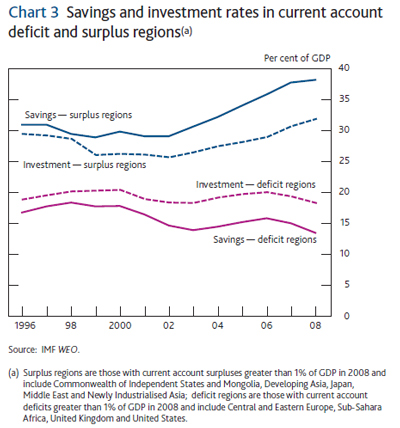
The article on Global imbalances seeks to challenge Taylor’s assertion that there was no global saving glut by focussing on gross, not net numbers:

An important factor was the adoption of managed exchange rate policies by some EAEs [East Asian Economies],(2) whereby a particular level of their currency was targeted, usually against the US dollar. This policy was prompted, in part, by the aim of spurring economic development through exports, thereby addressing extensive rural underemployment.(3)(4) The desire to accumulate foreign exchange reserves as insurance against a repeat of the 1997–98 Asian currency crises was an additional motivation.(5) Another factor may have been the slow pace of financial development in many EAEs which meant that there was a dearth of domestic investment opportunities (see Caballero et al (2008)). This may have necessitated savings being channelled to the deeper and more liquid financial markets in western economies.

Bernanke (2005) has argued that the low and falling savings rates in deficit countries which accompanied the credit boom, were principally the outcome of an endogenous process by which the excess savings of the surplus countries — the ‘global
savings glut’ — were recycled.

Meanwhile, banks were exposing themselves to liquidity risk:

An associated innovation was that banks changed their funding models. In particular, banks sold the new types of securities to
end-investors via the so-called ‘shadow banking system’, encompassing structured investment vehicles (SIVs) and conduits, which provided a framework for lending and borrowing without accepting deposits. This was termed the ‘originate to distribute’ model: aiming to spread the risks associated with securitised assets off their balance sheets, banks sold them to SIVs, which then aimed to sell them on to end-investors.(1) At the same time, banks increasingly relied on wholesale funding markets, including in selling the securitised assets, see the October 2008 Financial Stability Report. The magenta bars in Chart 8 show that the share of funding by UK banks derived from securitisations increased between 2000 and 2008.(2)

The authors repeatedly emphasize this point:

The funding structure of financial institutions, with its reliance on wholesale markets and the use of securitised assets (Chart 8), was a related vulnerability. In particular, this funding model relied on the continued functioning of those markets. This funding often came from foreign investors and this, together with banks’ increased lending overseas and the growth of the shadow banking system, generated the further vulnerability of increased and complex cross-border linkages between both financial institutions and between countries more generally. Such complex international linkages potentially give rise to unappreciated, but potent, interconnections between firms in the global financial system.

The article on oil prices makes a claim of regulatory significance:

The price of oil rose steadily between the middle of 2003 and the end of 2007, rose further and more rapidly until mid-2008 and fell sharply until the end of that year. Commentators agree that a significant part of the increase in the oil price over that period was due to rapid demand growth from emerging markets, but there are substantial differences of view about the relative importance of other factors, and limited work thus far in explaining the large fall in oil prices in the second half of 2008. The purpose of this article is to analyse the main explanations for the rise and fall in oil prices in the five years until the end of 2008. It argues that shocks to oil demand and supply, coupled with the institutional factors of the oil market, are qualitatively consistent with the direction of price movements, although the magnitude of the rise and subsequent fall during 2008 is more difficult to justify. The available empirical evidence suggests that financial flows into oil markets have not been an important factor over the period as a whole. Nonetheless, one cannot rule out the possibility that some part of the sharp rise and fall in the oil price in 2008 might have had some of the characteristics of an asset price bubble.

Market Action

September 21, 2009

Jim Hamilton of Econbrowser points out that increased regulation of bankers’ pay mean increased risk of regulatory capture. While supporting the principle, he recommends:

Openness and transparency. Details of all regulations should always be extremely transparent and public, with high-profile communication of any proposed changes. I was unable to locate a public release of the specifics of the Fed’s proposal, but gather that the WSJ story was based on off-the-record statements from “people familiar with the matter”. I think one of the best disinfectants for preventing regulatory capture is to keep as bright a light as possible shining on all details of the regulatory process.

Simplicity and uniformity. The goal here is to be very clear about the basic principles we’re trying to implement and make sure they’re applied broadly, fairly, and consistently. Although the Fed is used to thinking in terms of preserving its discretion, it’s important that these regulations be implemented in a transparently uniform way.

The first, at least, of these principles is anathema to Canada’s OSFI.

Scott Sumner of Bentley University writes a provocative column on VoxEU, Misdiagnosing the crisis: The real problem was not real, it was nominal arguing that monetary policy was too tight in late 2008, and that this is what caused the awful events of 4Q08:

Woodford (2003) emphasised how expectations of future monetary policy and aggregate demand impact current demand. An explicit price level or nominal GDP trajectory going several years forward would have helped stabilise expectations in late 2008. Because the Fed failed to set an explicit target path (level targeting), expectations became very bearish in late 2008. Contrary to what many economists assumed, tight money was already sharply depressing the economy by August 2008. After the failure of Lehman most economists simply assumed that causation ran from financial crisis to falling demand. This reversed the primary direction of causation – as in the Great Depression, economic weakness worsened bank balance sheets and intensified the financial crisis in late 2008.

A recent Vox column by Carmassi, Gros, and Micossi expressed the widely held view that the roots of this crisis lay in overly accommodative Fed policy during the housing bubble. Policy was a bit too easy during that period, as nominal GDP growth was slightly excessive, but if we are going to take market efficiency seriously then the primary cause of the severe worldwide recession should have occurred when the markets actually crashed. Yes, the tech and housing bubbles showed that markets are not always efficient. But that is no reason to ignore market signals.

The preferred share market advanced today, with PerpetualDiscounts gaining 15bp while FixedResets were up 6bp. Floaters gained strongly, claiming the top three spots on the performance table to take that very volatile, small, BAM dominated index up 159bp, perhaps helped by Jonathan Chevreau’s endorsement of the asset class (hat tip: Assiduous Reader MP):

Floating Rate Preferred Shares pay a dividend based on the prime rate and provide tax-efficient income for non-registered portfolios. Compared to pure interest income, such preferred shares are taxed far less harshly because of the dividend tax credit. If the Bank of Canada boosts the prime rate and banks increase their prime rate in response, the dividend income on these shares will rise, as will its capital value. Palombi’s current favorite is the BCE Preferred Series, which pay 100% of the prime rate.

Volume was good.

HIMIPref™ Preferred Indices
These values reflect the December 2008 revision of the HIMIPref™ Indices

Values are provisional and are finalized monthly
Index Mean
Current
Yield
(at bid)
Median
YTW
Median
Average
Trading
Value
Median
Mod Dur
(YTW)
Issues Day’s Perf. Index Value
Ratchet 0.00 % 0.00 % 0 0.00 0 1.5938 % 1,498.5
FixedFloater 5.72 % 3.98 % 52,690 18.62 1 0.0000 % 2,683.1
Floater 2.45 % 2.08 % 30,576 22.24 4 1.5938 % 1,872.0
OpRet 4.85 % -13.38 % 134,712 0.09 15 -0.1119 % 2,293.3
SplitShare 6.41 % 6.54 % 897,028 4.03 2 0.1106 % 2,063.9
Interest-Bearing 0.00 % 0.00 % 0 0.00 0 -0.1119 % 2,097.0
Perpetual-Premium 5.75 % 5.64 % 152,941 2.53 12 0.0395 % 1,885.5
Perpetual-Discount 5.70 % 5.77 % 207,919 14.20 59 0.1492 % 1,802.3
FixedReset 5.47 % 3.98 % 457,803 4.06 40 0.0635 % 2,116.0
Performance Highlights
Issue Index Change Notes
ENB.PR.A Perpetual-Premium -1.16 % YTW SCENARIO
Maturity Type : Call
Maturity Date : 2009-10-21
Maturity Price : 25.00
Evaluated at bid price : 25.50
Bid-YTW : -14.43 %
CU.PR.B Perpetual-Premium -1.02 % YTW SCENARIO
Maturity Type : Call
Maturity Date : 2012-07-01
Maturity Price : 25.00
Evaluated at bid price : 25.35
Bid-YTW : 5.62 %
CL.PR.B Perpetual-Premium 1.21 % YTW SCENARIO
Maturity Type : Call
Maturity Date : 2009-10-21
Maturity Price : 25.50
Evaluated at bid price : 25.85
Bid-YTW : -11.95 %
TRI.PR.B Floater 1.66 % YTW SCENARIO
Maturity Type : Limit Maturity
Maturity Date : 2039-09-21
Maturity Price : 19.01
Evaluated at bid price : 19.01
Bid-YTW : 2.06 %
BAM.PR.K Floater 2.34 % YTW SCENARIO
Maturity Type : Limit Maturity
Maturity Date : 2039-09-21
Maturity Price : 13.12
Evaluated at bid price : 13.12
Bid-YTW : 2.99 %
BAM.PR.B Floater 3.11 % YTW SCENARIO
Maturity Type : Limit Maturity
Maturity Date : 2039-09-21
Maturity Price : 13.25
Evaluated at bid price : 13.25
Bid-YTW : 2.97 %
Volume Highlights
Issue Index Shares
Traded
Notes
CIU.PR.B FixedReset 115,000 RBC crossed 110,000 at 28.25.
YTW SCENARIO
Maturity Type : Call
Maturity Date : 2014-07-01
Maturity Price : 25.00
Evaluated at bid price : 28.25
Bid-YTW : 3.84 %
BMO.PR.O FixedReset 68,375 Nesbitt crossed 50,000 at 28.00.
YTW SCENARIO
Maturity Type : Call
Maturity Date : 2014-06-24
Maturity Price : 25.00
Evaluated at bid price : 28.00
Bid-YTW : 3.89 %
GWO.PR.H Perpetual-Discount 56,562 Nesbitt crossed 25,000 at 20.83.
YTW SCENARIO
Maturity Type : Limit Maturity
Maturity Date : 2039-09-21
Maturity Price : 20.90
Evaluated at bid price : 20.90
Bid-YTW : 5.83 %
BAM.PR.B Floater 44,874 YTW SCENARIO
Maturity Type : Limit Maturity
Maturity Date : 2039-09-21
Maturity Price : 13.25
Evaluated at bid price : 13.25
Bid-YTW : 2.97 %
MFC.PR.D FixedReset 44,033 Desjardins crossed 25,000 at 27.90.
YTW SCENARIO
Maturity Type : Call
Maturity Date : 2014-07-19
Maturity Price : 25.00
Evaluated at bid price : 27.90
Bid-YTW : 4.00 %
MFC.PR.C Perpetual-Discount 32,000 RBC crossed 21,000 at 19.19.
YTW SCENARIO
Maturity Type : Limit Maturity
Maturity Date : 2039-09-21
Maturity Price : 19.15
Evaluated at bid price : 19.15
Bid-YTW : 5.92 %
There were 40 other index-included issues trading in excess of 10,000 shares.
Issue Comments

GFV.PR.A: Capital Unit Dividend Reinstated

I’m a little late with this news, but that’s life …

Global Forty-Five Split Corp. announced on August 20:

that it has re-instated a distribution of $0.05 per Class A Share for the month ending August 31, 2009. The distribution will be paid on or before September 15, 2009 to unitholders of record on August 31, 2009.

The Manager will assess the ability to pay distributions, and the amount thereof, on a monthly basis. Among other considerations, the Company is not permitted to pay a distribution on the Class A Shares if, after the payment of the distribution by the Company, the Net Asset Value per Unit would be less than $15.00.

The Capital Unit dividend had been suspended in November 2008.

The last mention of GFV.PR.A on PrefBlog occurred when it was upgraded to Pfd-3(high) by DBRS. GFV.PR.A is not tracked by HIMIPref™.

New Issues

New Issue: TCL FixedReset 6.75%+416

Further to their filing of a base prospectus announced last week, Transcontinental Inc. has announced:

that it will be issuing 4,000,000 cumulative rate reset preferred shares, series D (the “Series D Preferred Shares”) for aggregate gross proceeds of $100 million on a bought deal basis to a syndicate of underwriters led by Scotia Capital Inc. and CIBC World Markets Inc., acting as joint book-runners. The Series D Preferred Shares will pay cumulative dividends of $1.6875 per share per annum, yielding 6.75% per annum, payable quarterly, for the initial five year period ending October 15, 2014. The dividend rate will be reset on October 15, 2014 and every five years thereafter at a rate equal to the 5-year Government of Canada bond yield plus 4.16%. The Series D Preferred Shares will be redeemable by Transcontinental on October 15, 2014, and every five years thereafter in accordance with their terms.

Holders of the Series D Preferred Shares will have the right, at their option, to convert their shares into cumulative floating rate preferred shares series E. (the “Series E Preferred Shares”) subject to certain conditions, on October 15, 2014 and on October 15 every five years thereafter. Holders of the Series E Preferred Shares will be entitled to receive cumulative quarterly floating dividends at a rate equal to the three-month Government of Canada Treasury Bill yield plus 4.16%.

Transcontinental has also granted the underwriters the option to purchase up to 600,000 additional Series D Preferred Shares to cover over-allotments, exercisable in whole or in part anytime up to 30 days following closing of the offering.

Net proceeds resulting from the sale of the Series D Preferred Shares of Transcontinental shall be used by the Corporation to repay indebtedness, and for general corporate purposes.

The Series D Preferred Shares will be offered for sale to the public in each of the provinces Canada pursuant to a prospectus supplement and the base shelf prospectus filed on September 17, 2009. The prospectus supplement will be filed with Canadian securities regulatory authorities in all provinces of Canada.

The offering is scheduled to close on or about October 2, 2009, subject to certain conditions, including conditions set forth in the underwriting agreement.

Assiduous, yet bewildered, Readers will note:

Transcontinental provides printing, publishing and marketing services that deliver exceptional value to its clients along with a unique, integrated platform for them to reach and retain their target audiences. Transcontinental is the largest printer in Canada and the sixth largest in North America. It is also Canada’s leading publisher of consumer magazines and French-language educational resources as well as the country’s second-largest community newspaper publisher. Transcontinental’s digital platform delivers unique content through more than 120 websites. Its Marketing Communications Sector provides advertising services and marketing products using new communications platforms supported by database analytics, premedia, email marketing, and custom communications. Transcontinental is a growing corporation with a culture of continuous improvement and financial discipline, whose values, including respect, innovation and integrity, are central to its operation.

I’m certainly glad that their values include respect, innovation and integrity. This is a highly unusual claim for a company to make and has been noted carefully.

The first dividend will be $0.4854, payable 2010-1-15, based on closing 2009-10-2.

The issue is rated Pfd-3(high) by DBRS. This issue continues the recent trend of the market towards lower-quality credits; but it is non-financial and cumulative, which will hold great attraction for many.

The issue will be tracked by HIMIPref™ but be relegated to the “Scraps” index on credit concerns.

Interesting External Papers

Management Reaction to Mandatory Accounting Changes

I recently highlighted a paper by Alistair Murdoch of the University of Manitoba in which he showed that, in terms of the effect on the CAPM Beta of the common stock, preferred shares that were not convertible at a fixed rate into common were perceived by the market as being debt-like.

This paper was used as evidence to support the accounting reclassification of retractible preferred shares as debt for audited balance sheet purposes.

He then wrote a follow-up paper examining the effects of this change, titled Management Reaction to Mandatory Accounting Changes: The Canadian Preferred Shares Case:

The new Canadian accounting standards for financial instruments require that retractable preferred shares be classified as debt, thus negatively affecting the debt/equity ratio. Previous research, most of which has examined the impact of a change in American accounting standards affecting the determination of earnings, indicates that firms with such shares will act to mitigate the negative impact of the accounting change on their financial statements. Specifically, firms are likely to: a) reduce the amount of retractable preferred shares outstanding, and/or b) reduce the amount of other liabilities, and/or c) increase the amount of equity outstanding.

I test these predictions using data on firms required to file information on their preferred shares with Canadian securities commissions. Evidence based on a sample of 34 such firms indicates that they did indeed reduce the amounts of both retractable preferred shares and the amounts of other liabilities and issued additional common shares. Surprisingly, smaller firms did not make greater reductions (as a proportion of total assets) than larger firms.

He makes one statement about market efficiency that I consider worthy of comment:

The economic consequences of the replacement of retractable preferred shares by other sources of financing, primarily common shares, is not clear. If retractable preferred shares became a popular financial instrument during the 1970s and 1980s because they allowed firms to issue debt in the guise of equity, then their disappearance due to the standard change having stripped this disguise from them is desirable because it promotes informational efficiency.

This is of interest because it may be flipped upside down and used as an attack on the Efficient Market Hypothesis. The mandated change in classification is cosmetic only; no information is supplied to the marketplace by an auditor’s opinion as to whether a particular instrument is best placed in the shareholders’ equity section of the balance sheet or not. The prospectus contains all the necessary information for investors to judge the nature of the instrument for themselves and is not changed by this opinion.

Thus, any change in management or market behaviour due to such a change is evidence that the market’s efficiency has changed; and if the market’s efficiency can change, then the EMH does not hold.

In this particular case, I take the view that the change increased the efficiency of the market, by allowing bozos (who equate the term “research” with “looking stuff up in Compustat”) to more closely match the judgement of those who have actually examined the data and thus reduces the rewards for market professionals to think about what they are doing.

This supports the hypothesis that informtion has a value – it ain’t free!

Of interest in the paper was Table 1 “Number of publicly listed Canadian companies with outstanding retractable preferred shares”, which documents a nearly monotonic decline from 1988 (114 companies) to 1997 (32 companies). With the benefit of over a decade’s worth of additional data, we can now see that retractibles from Operating Companies (the HIMIPref™ subindex “OpRet”) has dwindled to virtual insignificance.

Interesting External Papers

Are Preferred Shares Debt or Equity?

This is an old paper (1997) but interesting none-the-less.

Alistair Murdoch of the Deparment of Accounting and Finance, University of Manitoba wrote a paper Are Preferred Shares Debt or Equity?: Some Canadian Evidence with the abstract:

I test the appropriateness of new accounting standards that would treat some types of preferred shares as debt rather than equity. I develop a new model to examine whether capital markets view the (systematic) risk of preferred shares to be more like the risk of debt or more like the risk of common equity. The proposed model is compared to a traditional model tested on 1986 to 1994 data of thirty-nine companies that trade on the Toronto Stock Exchange and issued preferred shares during that period. Debt, retractable preferred shares and p lain vanilla preferred shares appear to be substantially less risky than common shares. Other types of preferred shares are more risky than debt; some appear to be more risky than common shares. These results support the view that some types of preferred shares should be classified as liabilities.

He reasons that:

A firm that increases its debt/(common) equity ratio increases the risk of the (common) equity and may increase the risk of the debt. If preferred shares are viewed as debt, then issuing preferred shares should have the same effect as increasing the debt/(common) equity ratio. If they are viewed as equity, then their issue should have the same effect as decreasing the debt/(common) equity ratio. Finally, if they are some intermediate form of financing, they may have no effect on the risk of the (common) equity.

… I confirm that debt is less risky than common equity. I find that retractable preferred shares and plain vanilla shares are also less risky than common equity and that in most of my tests their level of risk is not statistically significantly different from that of debt. Other kinds of preferred shares are more risky than debt. Convertible preferred shares are as risky as common shares, while preferred shares that are convertible at market or that are both retractible and convertible appear more risky than common shares

Risk is defined as Beta in the Capital Asset Pricing Model. The “Asset Beta” of each company is decomposed into the equity beta and terms representing the contributions of debt and the various flavours of preferred share, where:

A firm’s asset beta is a measure of the relation between the firm’s return on assets and the market return. Beta is usually estimated by regressing the firm’s return on the market return over some period during which beta is assumed to be constant.

After performing the regressions, the author concludes:

This paper has attempted to determine empirically whether during the past decade the Canadian market has viewed preferred shares as being more like debt or more like equity. It reports that retractable preferred shares have been viewed much like debt which supports the recent change in the accounting classification of these securities

An interesting paper in that it attempts to classify preferred shares according to the effect of their issuance on the Beta of the common, rather than considering the market price of the preferred shares themselves.

Issue Comments

EVT.PR.A to Be Redeemed

Economic Investment Trust Limited has announced:

that on November 30, 2009 it will redeem for cash all of its outstanding 5% Cumulative Preferred Shares Series A at a redemption price of $53.125, comprised of $50.00 per share, a premium of $2.50, and accrued dividends in the amount of $0.625 per share.

Even the most Assiduous Readers may be forgiven for asking ‘What?’. The June 09 Financials state:

At June 30, 2009, there are 5,615,535 Common Shares issued and outstanding and each share is entitled to one vote. There are 7,200 (2008 – 7,700) 5% Cumulative Preferred Shares Series A issued and outstanding. During the fi rst quarter, the Company purchased 500 Preferred Shares Series A for cancellation.

So the total market capitalization of the preferreds comes to less than half a million dollars. EVT.PR.A closed today at 51.23 bid for 800, no offer. This is the first mention of EVT.PR.A on PrefBlog. EVT.PR.A is not tracked by HIMIPref™.

Issue Comments

XCM.PR.A: Optional Reorganization Plan Announced

Commerce Split Inc. has announced:

it plans on holding a special meeting of shareholders in December 2009 to vote on a reorganization plan for the Company.

The reorganization proposal will provide both Priority Equity and Class A shareholders with an opportunity to participate in an alternative structure going forward. This proposal is designed to address the impact that the significant decline in price of the Company’s underlying holding of CIBC common stock and the resultant activation of the Priority Equity Protection Plan has had on the ability of the Company to meet some of its original investment objectives.

Many of the characteristics of the proposal will be similar to the previous shareholder proposal that was contained in the December 23, 2008 Management Information Circular. This previous proposal, although not passed, did receive overwhelming support, outside of certain larger shareholders. If this proposal had been implemented at that time, both classes of shareholders would have experienced significant improvement in the value of their investments. As a consequence of the results of this vote and continued interest in seeking a solution that balances the interests of both classes of shareholders, the Company is bringing forward this proposal which will provide shareholders with a choice of remaining in the current Fund with all the existing attributes or the option to transfer into a new Fund that will have a different set of attributes, subject to maintaining an equal number of shares of each Class outstanding in each option.

The Company, subject to all necessary Board and regulatory approvals, expects to send out the full details of this proposal to all shareholders through a Management Information Circular in November, 2009 with a shareholder vote to follow in December, 2009.

The proposal will allow shareholders the option to participate in a new Fund with different attributes. The new Fund would allow the fixed income instruments purchased under the Priority Equity Protection Plan to be liquidated and the proceeds to be re-invested in common shares of CIBC. This would allow the new Fund to begin receiving dividends on a more fully invested position (on up to 100% of Fund assets versus a currently invested position in CIBC common stock of 20%) in CIBC common stock, increase income producing potential under the covered call writing program and increase participation in any capital appreciation of CIBC common stock held. The requirement that an equal number of Priority Equity shareholders and Class A shareholders be outstanding would also be maintained in the New Fund.

Priority Equity shareholders transferring their Priority Equity shares to the new Fund would receive i) one new $5 preferred share to yield 7.5% per annum and ii) one $5 par value equity share that will receive dividends of 7.5% per annum if and when the Company’s net asset value exceeds $12.50.

In addition, each Priority Equity share exchanged would receive i) one half Series I warrant, with one full Series I warrant allowing holders to purchase a full Unit (a Unit consisting of one new preferred share, one new equity share and a Class A share) of the Company at a price of $10 for 1 year and ii) a full Series II warrant to acquire a full Unit of the Company at a price of $12.50 for 2 years. These warrants will effectively provide upside potential on the performance of CIBC shares held in the Fund. The Company believes that the proposed package of securities will provide Priority Equity shareholders with substantial value added compared to their existing investment.

Class A shares will receive dividends when the net asset value reaches $15 per unit in the new Fund with all other attributes to remain the same. The value of the Class A share opportunity in the new Fund is that it will provide more exposure to any increases in CIBC common stock held through the Fund and the Company believes this provides substantial shareholder value relative to Class A shareholders’ existing investment.

Shareholders that do not wish to transfer into the new Fund may maintain their investment in the existing Fund under the existing set of attributes for each class of share.

The Company believes this reorganization plan is in the best interest of all shareholders. The full details of the Plan will be sent to all shareholders in November, 2009.

The immediate thing that strikes me about this press release is the plethora of detail relative to the terse release from XMF.PR.A, its sister in misery. This may be related to its September 15 valuation of $9.24 net of accrued preferred share dividends.

XCM closed today at 1.18-1.24, 50×63, while XCM.PR.A closed at 7.75-86, 100×2 … in contrast to XMF.PR.A, the October retraction is in the money (although not clear whether retractors will get the accrued dividend). Of course, the higher NAV has led to a lower committment to the fixed income portfolio: XCM has 21% exposure to CM as of August 31, which makes arbitrage somewhat riskier.

The fascinating part about this reorganization is the optional nature of the proposed conversions. It remains to be seen whether the proposed exchange will be coercive or not … the final proposal may well have unpleasant language about fees and expenses and so on that would, in practical terms, force conversion if the plan is passed.

XCM.PR.A was last mentioned on PrefBlog when management refused to consider winding up the company. XCM.PR.A is not tracked by HIMIPref™.

Issue Comments

XMF.PR.A to Try Again for Reorganization

M-Split Corp. has announced:

that it plans on holding a special meeting of shareholders in December 2009 to vote on a reorganization proposal for the Company.

The reorganization proposal will allow shareholders to vote on an alternative structure going forward. This proposal is designed to address the impact that the significant decline in price of the Company’s underlying holding of Manulife common stock and the resultant activation of the Priority Equity Protection Plan has had on the ability of the Company to meet some of its original investment objectives.

Many of the characteristics of this new proposal will be similar to the previous shareholder proposal that was contained in the December 23, 2008 Management Information Circular. This previous proposal, although not passed, did receive overwhelming support, outside of certain larger shareholders. If this proposal had been implemented at that time, both classes of shareholders would have experienced significant improvement in the value of their investments.

The Company, subject to all necessary Board and regulatory approvals, expects to send out the full details of this proposal to all shareholders through a Management Information Circular in November, 2009 with a shareholder vote to follow in December, 2009.

The Company believes this reorganization proposal will be in the best interest of all shareholders.

Presumably the company has managed to get support of some of the larger shareholders who scuttled the last attempt; in the last press release reported on PrefBlog, the company claimed to be maintaining a dialogue.

The NAV as of Sept. 15 was $8.51, with less than 1% exposure to MFC as of June 18, 2009.

Of note is the upcoming special retraction:

Shareholders who concurrently retract a Priority Equity share and a Class A share (together, a “unit”) in the month of October in each year will be entitled to receive an amount equal to the transactional net asset value per unit on the last day of October.

Note that the company does not appear to be putting any money into its issuer bid:

On March 2, 2009, the Company announced the acceptance of a Normal Course Issuer bid that could allow the Company to purchase, from time to time, up to 10% of the public float of the shares. The Company plans on utilizing this only in situations where the combined trading prices of the Priority Equity shares and Class A shares are at an excessive discount to net asset value of the Company.

XMF.PR.A closed today at 7.79-90, 198(!)x27, while XMF closed at 0.52-56, 3×12; my guess is that arbitrageurs have moved in, given that the NAV is dependent almost entirely on five-year strips. Note that:

Any accrued or declared and unpaid dividends payable on or before a Retraction Date in respect of Priority Equity Shares tendered for retraction on such Retraction Date will also be paid on the Retraction Payment Date.

The prospectus is not explicit on the disposition of accrued dividends on the exercise of an October retraction.

XMF.PR.A is not tracked by HIMIPref™.