Market Action

May 4, 2011

The Bank of Canada has released a discussion paper by Gordon Wilkinson titled The Behaviour of Consumer Prices Across Provinces:

Measures of core inflation enable a central bank to distinguish price movements that are transitory and generated by non-monetary events from those that are more permanent and related to prior monetary policy decisions. The author uses standard statistical measures to assess the behaviour of consumer prices across provinces and identify price components with more divergent price patterns. The results indicate that energy, shelter and tobacco prices are the most volatile across provinces. Very large price movements restricted to one or a few provinces suggest that the forces or events triggering those movements may be province specific and unrelated to national demand pressures. Such results suggest that constructing a type of core inflation measure called the “trimmed mean” that excludes components with exceptionally large price changes at the provincial level may offer an alternative means of assessing underlying inflationary pressures.

Speaking of inflation, Statscan is changing the shopping basket:

For inflation’s scorekeepers, it’s out with film developing and in with tablet computers and smartphones.

Statistics Canada is revamping its approach to measuring the price of goods to reflect new realities about today’s consumer experience: Spending habits are changing more rapidly, and the lifespan of products is growing ever shorter.

This month, for the first time in four years, the federal agency is updating the basket of goods and services that measures price changes, adding new items like tablet computers, smart phones and dried lentils, and de-emphasizing older ones, such as photography services.

And starting next year, the agency plans to revise the basket every three years or less because consumption patterns are changing more quickly. Statscan has typically updated the basket every four or five years. Similar agencies in other countries, such as Britain or Sweden, update their measures every year or two.

The FRBB has released a Public Policy Discussion Paper by Geoffrey M.B. Tootell titled Do Commodity Price Spikes Cause Long-Term Inflation?:

This public policy brief examines the relationship between trend inflation and commodity price increases and finds that evidence from recent decades supports the notion that commodity price changes do not affect the long-run inflation rate. Evidence from earlier decades suggests that effects on inflation expectations and wages played a key role in whether commodity price movements altered trend inflation. This brief is based on a memo to the president of the Federal Reserve Bank of Boston as background to a meeting of the Federal Open Market Committee.

There’s a new Maple issuer:

The ranks of so-called Maple issues by non-financial borrowers has expanded by one with news Tuesday that Korea Gas Corporation priced and raised a $300-million, five-year offering.

KOGAS set up in 1983, is a public company which has grown to become the world’s largest LNG import company, originally planned to raise $250-million but raised more because of strong institutional demand. The A+ rated notes came with a coupon of 4.58% and a yield of 4.585% – for a spread of 203 basis points or two points tighter than what was presented in the marketing period.

The deal is the first by Kogas in Canada. Indeed the financing is the first Maple by either an Asian or South Korean borrower.

The market, both in its heyday and since its return to life a year back, is dominated by financial institutions. But investors soon get their fill of such issues and clamor for borrowings by industrial companies. Kogas has met those wishes and becomes the third non-financial issuer in the past eight months. Earlier, Molson Coors Brewing Co. ($500-million) and Anheuser-Busch InBev Worldwide Inc. ($600-million) raised capital in this market.

So fat this year $2.25-billion has been raised via the sale of Maple bonds, For the same period last year $1.8-billion. For all of 2010 $4.5-billion was raised. “I expect that demand will stay strong and issuance for the year will exceed last years,” added [John] Tkach [of Scotia Capital].

This issue is being sold on the exempt market, so you can’t buy it, suckers. The regulators have determined that you’re not smart enough.

OSFI’s Julie Dickson has delivered a 2011 Financial Services Invitational Forum, April 27, 2011. There was nothing very new or interesting in the content, but I was pleased to see that at least some attempt was made to support some of the assertions. One reference was to a letter to the Financail Times from Prof. Anat Admati of Stanford and others:

Banks’ high leverage and the resulting fragility and systemic risk contributed to the near collapse of the financial system. Basel III is far from sufficient to protect the system from recurring crises. If a much larger fraction, at least 15 per cent, of banks’ total, non-risk-weighted, assets were funded by equity, the social benefits would be substantial. And the social costs would be minimal, if any.

Debt that converts to equity, so-called “contingent capital”, is complex to design and tricky to implement. Increasing equity requirements is simpler and more effective.

Another reference was to a Bank of England discussion paper by David Miles, Jing Yang and Gilberto Marcheggiano titled Optimal Bank Capital:

This paper reports estimates of the long-run costs and benefits of banks funding more of their assets with loss-absorbing capital, or equity. Measuring those costs requires careful consideration of a wide range of issues about how shifts in funding affect required rates of return and on how costs are influenced by the tax system; it also requires a clear distinction to be drawn between costs to individual institutions (private costs) and overall economic (or social) costs. Without a calculation of the benefits from having banks use more equity no estimate of costs — however accurate — can tell us what the optimal level of bank capital is. We use empirical evidence on UK banks to assess costs; we use data from shocks to incomes from a wide range of countries over a long period to assess risks to banks and how equity funding (or capital) protects against those risks. We find that the amount of equity capital that is likely to be desirable for banks to use is very much larger than banks have used in recent years and also higher than targets agreed under the Basel III framework.

The US housing market is still sick:

U.S. lenders should consider debt-for- equity swaps to help homeowners who face default or owe more than their properties are worth, mortgage pioneer Lewis Ranieri said.

“If his house was $220,000, and now it’s $90,000, give me the keys, I give you a lease for seven years,” Ranieri, chairman of investment company Ranieri Partners LLC, said during a panel discussion at the Milken Institute Global Conference in Beverly Hills, California. “If you behave well, I will give you back the house.”

As many as 11 million troubled mortgages are weighing on the U.S. housing market, said Ranieri, who helped Salomon Brothers become Wall Street’s most profitable firm in the 1980s by packaging home loans into securities. Distressed sales made up 40 percent of transactions in March, the National Association of Realtors said April 20. Home prices fell 3.3 percent in February from a year earlier, according to the S&P/Case-Shiller measure of 20 cities.

I don’t understand how Ranieri’s idea can be described as a debt for equity swap (if you have to give it back, you don’t own it, do you?) but doubtless there’s some explanation.

Of much more interest than all this ephemeral financial stuff is the results of the NASA relativity test:

Gravity Probe B, built by Lockheed Martin Corp. (LMT) and designed by scientists from Stanford University near Palo Alto, California, measured how space and time are warped by gravitational bodies, a phenomenon called the geodetic effect. The probe launched in 2004 also analyzed frame-dragging, the way spinning objects pull space and time around them.

The effects were demonstrated by having Gravity Probe B point at a star, IM Pegasi, while orbiting Earth. If gravity didn’t affect space and time, the gyroscopes aboard the probe would point in the same direction forever during their orbit, as Isaac Newton had theorized. Instead, they showed tiny, measurable changes in the direction of their spin as Earth’s gravity tugged at them, as Einstein had predicted.

The project was one of the longest-running efforts in the U.S. space agency’s history, beginning in 1963, and cost about $750 million, NASA spokesman Trent Perrotto said today in a telephone interview. The findings were the culmination of 49 years of work by [Stanford physicist Francis] Everitt, who came to Stanford in 1962 to help build the most precise gyroscope ever designed and produced, according to NASA.

Forty-nine years! I think we can allow Dr. Everitt a day off now, right? Then he can work on the Higgs boson.

It was a strong day in the Canadian preferred share market, with PerpetualDiscounts roaring ahead 42bp, FixedResets winnning 15bp and DeemedRetractibles gaining 14bp. The Performance Highlights table, while hardly lengthy, was comprised entirely of gainers. Volume was good.

HIMIPref™ Preferred Indices
These values reflect the December 2008 revision of the HIMIPref™ Indices

Values are provisional and are finalized monthly
Index Mean
Current
Yield
(at bid)
Median
YTW
Median
Average
Trading
Value
Median
Mod Dur
(YTW)
Issues Day’s Perf. Index Value
Ratchet 0.00 % 0.00 % 0 0.00 0 -0.0353 % 2,437.0
FixedFloater 0.00 % 0.00 % 0 0.00 0 -0.0353 % 3,665.3
Floater 2.47 % 2.26 % 39,268 21.62 4 -0.0353 % 2,631.4
OpRet 4.86 % 3.57 % 61,053 1.19 9 -0.0513 % 2,419.4
SplitShare 5.20 % -1.79 % 74,968 0.61 6 0.0598 % 2,499.2
Interest-Bearing 0.00 % 0.00 % 0 0.00 0 -0.0513 % 2,212.4
Perpetual-Premium 5.74 % 5.62 % 144,729 2.35 9 0.0000 % 2,055.4
Perpetual-Discount 5.56 % 5.59 % 121,736 14.44 15 0.4245 % 2,133.6
FixedReset 5.16 % 3.39 % 210,354 2.89 57 0.1467 % 2,300.5
Deemed-Retractible 5.22 % 5.01 % 314,348 8.09 53 0.1381 % 2,103.9
Performance Highlights
Issue Index Change Notes
PWF.PR.P FixedReset 1.06 % YTW SCENARIO
Maturity Type : Call
Maturity Date : 2016-03-01
Maturity Price : 25.00
Evaluated at bid price : 25.70
Bid-YTW : 3.79 %
BAM.PR.M Perpetual-Discount 1.08 % YTW SCENARIO
Maturity Type : Limit Maturity
Maturity Date : 2041-05-04
Maturity Price : 21.52
Evaluated at bid price : 21.52
Bid-YTW : 5.59 %
GWO.PR.I Deemed-Retractible 1.09 % YTW SCENARIO
Maturity Type : Hard Maturity
Maturity Date : 2022-01-31
Maturity Price : 25.00
Evaluated at bid price : 21.40
Bid-YTW : 6.47 %
PWF.PR.L Perpetual-Discount 1.35 % YTW SCENARIO
Maturity Type : Limit Maturity
Maturity Date : 2041-05-04
Maturity Price : 23.04
Evaluated at bid price : 23.25
Bid-YTW : 5.51 %
Volume Highlights
Issue Index Shares
Traded
Notes
HSE.PR.A FixedReset 81,133 Nesbitt crossed 50,000 at 25.70.
YTW SCENARIO
Maturity Type : Call
Maturity Date : 2016-04-30
Maturity Price : 25.00
Evaluated at bid price : 25.70
Bid-YTW : 3.98 %
PWF.PR.F Perpetual-Discount 63,912 Nesbitt crossed 60,000 at 23.81.
YTW SCENARIO
Maturity Type : Limit Maturity
Maturity Date : 2041-05-04
Maturity Price : 23.55
Evaluated at bid price : 23.82
Bid-YTW : 5.54 %
MFC.PR.B Deemed-Retractible 59,037 RBC crossed 39,200 at 21.81.
YTW SCENARIO
Maturity Type : Hard Maturity
Maturity Date : 2022-01-31
Maturity Price : 25.00
Evaluated at bid price : 21.67
Bid-YTW : 6.50 %
TRP.PR.B FixedReset 44,790 Desjardins bought 10,700 from anonymous at 25.20 and crossed 17,700 at the same price.
YTW SCENARIO
Maturity Type : Call
Maturity Date : 2020-07-30
Maturity Price : 25.00
Evaluated at bid price : 25.26
Bid-YTW : 3.80 %
RY.PR.A Deemed-Retractible 41,765 YTW SCENARIO
Maturity Type : Hard Maturity
Maturity Date : 2022-01-31
Maturity Price : 25.00
Evaluated at bid price : 23.87
Bid-YTW : 4.99 %
MFC.PR.A OpRet 36,410 RBC crossed 35,000 at 25.75.
YTW SCENARIO
Maturity Type : Soft Maturity
Maturity Date : 2015-12-18
Maturity Price : 25.00
Evaluated at bid price : 25.70
Bid-YTW : 3.57 %
There were 41 other index-included issues trading in excess of 10,000 shares.
Wide Spread Highlights
Issue Index Quote Data and Yield Notes
CIU.PR.B FixedReset Quote: 27.89 – 28.35
Spot Rate : 0.4600
Average : 0.3299

YTW SCENARIO
Maturity Type : Call
Maturity Date : 2014-07-01
Maturity Price : 25.00
Evaluated at bid price : 27.89
Bid-YTW : 3.28 %

TRI.PR.B Floater Quote: 23.05 – 23.75
Spot Rate : 0.7000
Average : 0.5767

YTW SCENARIO
Maturity Type : Limit Maturity
Maturity Date : 2041-05-04
Maturity Price : 22.77
Evaluated at bid price : 23.05
Bid-YTW : 2.26 %

PWF.PR.A Floater Quote: 23.49 – 23.83
Spot Rate : 0.3400
Average : 0.2193

YTW SCENARIO
Maturity Type : Limit Maturity
Maturity Date : 2041-05-04
Maturity Price : 23.19
Evaluated at bid price : 23.49
Bid-YTW : 2.20 %

PWF.PR.M FixedReset Quote: 26.76 – 27.00
Spot Rate : 0.2400
Average : 0.1666

YTW SCENARIO
Maturity Type : Call
Maturity Date : 2014-03-02
Maturity Price : 25.00
Evaluated at bid price : 26.76
Bid-YTW : 3.41 %

BNS.PR.Z FixedReset Quote: 24.50 – 24.70
Spot Rate : 0.2000
Average : 0.1537

YTW SCENARIO
Maturity Type : Hard Maturity
Maturity Date : 2022-01-31
Maturity Price : 25.00
Evaluated at bid price : 24.50
Bid-YTW : 4.02 %

CU.PR.B Perpetual-Premium Quote: 25.37 – 25.64
Spot Rate : 0.2700
Average : 0.2241

YTW SCENARIO
Maturity Type : Call
Maturity Date : 2012-07-01
Maturity Price : 25.00
Evaluated at bid price : 25.37
Bid-YTW : 5.63 %

Issue Comments

RF.PR.A Reorg Meeting – This Is Getting Interesting!

As noted in the post RF.PR.A Special Meeting Adjourned, the special meeting to decide on the reorganization of C.A. BANCORP CANADIAN REALTY FINANCE CORPORATION was adjourned from the original date of April 25, 2011 until tomorrow, May 5, 2011 at 4:00 p.m. EST, due to lack of quorum.

Now, Barry Critchley reports:

Pref shareholders are concerned with the credit risk they are being asked to assume if Green Tree acquires the management contract. In short, despite what C.A. Bancorp says about Green Tree’s “experienced team” and “enhanced infrastructure,” no one knows how successful the new team will be.

Can they run the commercial mortgage business well enough to generate enough income to continue to pay out on the prefs? Currently, pref shareholders receive fixed quarterly distributions of $0.4219 per share or 6.75% per annum. At the end of 2010, the fair value of the prefs was $31.1 million, or $21.18 per share.

But there’s more to it than that! There’s an external party opposed to the reorganization that has been scooping up shares in the present manager, CABancorp:

One investor, New York-based CDJ Global Catalyst, which owns 15.1% of C.A. Bancorp, said last week it disagrees with the realization strategy and indicated in a release it has had discussions and exchanged correspondence with C.A. Bancorp’s directors. CDJ, which also indicated it may “initiate proposals and/or transactions with a view to enhancing and protecting shareholder value,” couldn’t be reached for comment. It has been a steady buyer of C.A. Bancorp shares with its most recent purchase (251,400 shares) being bought at an average price of $2.16 a share. Book value is $2.53.

CDJ has been diligently writing press releases; the most recent, released April 27, is titled CDJ Announces Acquisition of Shares of C.A. Bancorp Inc.:

CDJ Global Catalyst LLC (“CDJ”) announced that from March 10, 2011 until April 26, 2011, CDJ acquired, for one or more of its managed client accounts in respect of which it exercises sole discretion, an aggregate of 251,400 common shares of C.A. Bancorp Inc. (TSX:BKP) (“CAB”) representing approximately 2% of the total issued common shares of CAB. The common shares were purchased for an average price of $2.16.

Combined with the shares held by client accounts in respect of which CDJ exercises sole discretion, CDJ now has control over 1,856,651 common shares, representing approximately 15.1% of the total issued and outstanding common shares of CAB.

CDJ intends from time to time to seek to continue to have discussions with representatives of CAB and its investee, C.A. Bancorp Canadian Realty Finance Corporation, (the “Subsidiary”).

CDJ strongly disagrees with CAB’s proposed Realization Strategy (as such term is defined in CAB’s public record), including the proposed sale of its interest in C.A. Bancorp Canadian Realty Finance Corp.

As a result, CDJ may, either alone or with others, consider and/or initiate proposals and/or transactions with a view to enhancing and protecting shareholder value, including the value of its investment to date. Such alternative proposals and/or transactions may include CDJ, either alone or with others, (i) seeking to influence decisions of CAB’s management and directors including, without limitation, by seeking representation by membership or through observer status on the board of directors or otherwise; (ii) seeking to add nominees designated by the Offeror to CAB’s board of directors, which could include expanding the size of the board of directors and/or removing individuals from CAB’s board of directors; and (iii) acquiring some or all of the outstanding securities of CAB or the Subsidiary. Such alternative proposals and/or transactions may also include CDJ supporting others in an alternative proposal and/or transaction.

CDJ may, from time to time and at any time, acquire additional common shares of CAB and/or its Subsidiary and/or other equity securities of the Company or the Subsidiary (collectively, the “Securities”) in the open market or otherwise and reserves the right to dispose of any and all of its Securities in the open market or otherwise, at any time and from time to time, and to engage in hedging or similar transactions with respect to the Securities.

At the present time, CDJ does not intend to acquire 20% or more of any class of Securities of the Company or the Subsidiary.

I continue to recommend that preferred shareholders vote “No” to the change in manager.

Market Action

May 3, 2011

The FRB Cleveland has released the April, 2011, edition of Economic Trends.

There will be a conference on The Future of Life-Cycle Saving & Investing sponsored by the Boston Fed and others at the end of May.

The Portuguese bail-out has been agreed:

Portugal reached an agreement with officials preparing its European Union-led bailout that will provide as much as 78 billion euros ($116 billion) in aid and allow more time to reduce the country’s budget deficit.

The three-year plan set goals for a budget deficit of 5.9 percent of gross domestic product this year, 4.5 percent in 2012 and 3 percent in 2013, Prime Minister Jose Socrates said in Lisbon today. The government in March targeted a deficit of 4.6 percent this year, 3 percent in 2012 and 2 percent in 2013.

It was another mixed day in the Canadian preferred share market, but this one was much calmer: PerpetualDiscounts lost 10bp, FixedResets gained 6bp and DeemedRetractibles were basically flat. There was only one entry in the Performance Highlights table. Volume was very light.

HIMIPref™ Preferred Indices
These values reflect the December 2008 revision of the HIMIPref™ Indices

Values are provisional and are finalized monthly
Index Mean
Current
Yield
(at bid)
Median
YTW
Median
Average
Trading
Value
Median
Mod Dur
(YTW)
Issues Day’s Perf. Index Value
Ratchet 0.00 % 0.00 % 0 0.00 0 -0.0118 % 2,437.9
FixedFloater 0.00 % 0.00 % 0 0.00 0 -0.0118 % 3,666.6
Floater 2.47 % 2.26 % 38,221 21.62 4 -0.0118 % 2,632.3
OpRet 4.90 % 3.30 % 59,456 2.04 8 0.1780 % 2,420.7
SplitShare 5.21 % -1.94 % 75,011 0.62 6 0.0240 % 2,497.7
Interest-Bearing 0.00 % 0.00 % 0 0.00 0 0.1780 % 2,213.5
Perpetual-Premium 5.78 % 5.60 % 112,712 1.11 8 0.0397 % 2,055.4
Perpetual-Discount 5.57 % 5.59 % 146,657 14.41 16 -0.0983 % 2,124.6
FixedReset 5.17 % 3.39 % 213,398 2.89 57 0.0638 % 2,297.1
Deemed-Retractible 5.22 % 5.04 % 315,682 8.13 53 0.0023 % 2,101.0
Performance Highlights
Issue Index Change Notes
CM.PR.K FixedReset -1.59 % YTW SCENARIO
Maturity Type : Call
Maturity Date : 2014-08-30
Maturity Price : 25.00
Evaluated at bid price : 26.67
Bid-YTW : 3.25 %
Volume Highlights
Issue Index Shares
Traded
Notes
SLF.PR.C Deemed-Retractible 86,838 Scotia crossed 59,400 at 21.25; Desjardins crossed 13,200 at the same price.
YTW SCENARIO
Maturity Type : Hard Maturity
Maturity Date : 2022-01-31
Maturity Price : 25.00
Evaluated at bid price : 21.25
Bid-YTW : 6.50 %
TD.PR.I FixedReset 85,148 RBC crossed two blocks of 40,000 each at 27.31.
YTW SCENARIO
Maturity Type : Call
Maturity Date : 2014-08-30
Maturity Price : 25.00
Evaluated at bid price : 27.33
Bid-YTW : 3.31 %
BNS.PR.Y FixedReset 45,423 RBC bought 37,300 from anonymous at 25.00.
YTW SCENARIO
Maturity Type : Hard Maturity
Maturity Date : 2022-01-31
Maturity Price : 25.00
Evaluated at bid price : 25.02
Bid-YTW : 3.64 %
TRP.PR.A FixedReset 37,992 RBC crossed 25,000 at 25.90.
YTW SCENARIO
Maturity Type : Call
Maturity Date : 2015-01-30
Maturity Price : 25.00
Evaluated at bid price : 25.91
Bid-YTW : 3.67 %
CIU.PR.A Perpetual-Discount 25,800 Desjardins crossed 25,000 at 22.65.
YTW SCENARIO
Maturity Type : Limit Maturity
Maturity Date : 2041-05-03
Maturity Price : 22.49
Evaluated at bid price : 22.65
Bid-YTW : 5.16 %
BNS.PR.K Deemed-Retractible 24,588 YTW SCENARIO
Maturity Type : Hard Maturity
Maturity Date : 2022-01-31
Maturity Price : 25.00
Evaluated at bid price : 24.96
Bid-YTW : 4.85 %
There were 22 other index-included issues trading in excess of 10,000 shares.
Wide Spread Highlights
Issue Index Quote Data and Yield Notes
HSB.PR.E FixedReset Quote: 27.40 – 27.80
Spot Rate : 0.4000
Average : 0.2634

YTW SCENARIO
Maturity Type : Call
Maturity Date : 2014-07-30
Maturity Price : 25.00
Evaluated at bid price : 27.40
Bid-YTW : 3.71 %

CM.PR.K FixedReset Quote: 26.67 – 27.00
Spot Rate : 0.3300
Average : 0.2275

YTW SCENARIO
Maturity Type : Call
Maturity Date : 2014-08-30
Maturity Price : 25.00
Evaluated at bid price : 26.67
Bid-YTW : 3.25 %

PWF.PR.I Perpetual-Premium Quote: 25.17 – 25.40
Spot Rate : 0.2300
Average : 0.1668

YTW SCENARIO
Maturity Type : Call
Maturity Date : 2012-05-30
Maturity Price : 25.00
Evaluated at bid price : 25.17
Bid-YTW : 5.42 %

CM.PR.L FixedReset Quote: 27.68 – 27.95
Spot Rate : 0.2700
Average : 0.2160

YTW SCENARIO
Maturity Type : Call
Maturity Date : 2014-05-30
Maturity Price : 25.00
Evaluated at bid price : 27.68
Bid-YTW : 2.91 %

ELF.PR.G Deemed-Retractible Quote: 20.35 – 20.67
Spot Rate : 0.3200
Average : 0.2673

YTW SCENARIO
Maturity Type : Hard Maturity
Maturity Date : 2022-01-31
Maturity Price : 25.00
Evaluated at bid price : 20.35
Bid-YTW : 7.35 %

TD.PR.E FixedReset Quote: 27.16 – 27.36
Spot Rate : 0.2000
Average : 0.1481

YTW SCENARIO
Maturity Type : Call
Maturity Date : 2014-05-30
Maturity Price : 25.00
Evaluated at bid price : 27.16
Bid-YTW : 3.36 %

Miscellaneous News

BofA Maple Sub-Debt: Pretend-Maturity Will Be Ignored

Boyd Erman of the Globe & Mail reports in a piece titled Bank of America shocks Maple market:

Bank of America (BAC-N12.680.342.76%) has broken an unwritten rule and shocked the Canadian bond market by deciding not to redeem a $500-million bond issue.

But the unwritten, wink-and-nod agreement with the investors who bought them was that the bonds would be called at the end of five years so that investors would never have to face the lower rates.

Bank of America has decided not to call the bonds and will take advantage of the lower rates. For investors in the bonds, it means lower prices and lower interest income, and a tough decision about what to do next.

My suggestion is that they make a note to read the terms of the issue next time, but what do I know?

The bonds were originally sold with a coupon of 4.81 per cent. Now, under the floating structure, they will pay interest rate at a short-term benchmark plus a fraction of a percentage point. At the moment, that works out to about 1.8 per cent.

The bonds are now being quoted at about 96 to 97 cents on the dollar by some desks after being marked at par in the days before this on expectations that they would be called at 100 cents on the dollar, market sources said.

The comments on the Globe site are a hoot.

There’s not much information available on this issue, but it’s mentioned briefly in the RBC-CM Maple Guide of 2H08 – with all the pseudo-analysis based on a certainty of call, of course, as is usual with subordinated debt.

I last reviewed this topic in the post Bank Sub-Debt Redemptions.

Market Action

May 2, 2011

The drive to protect incompetent traders continues:

U.S. prosecutors have joined regulators’ investigation into whether some high-speed traders are manipulating markets by posting and immediately canceling waves of rapid-fire orders, two officials said.

Justice Department investigators are “working closely” with the Securities and Exchange Commission to review practices “that are potentially manipulative, like quote-stuffing,” Marc Berger, chief of the Securities and Commodities Task Force at the U.S. Attorney’s Office for the Southern District of New York, said today at an event in New York.

While regulators previously said they were probing possibly abusive algorithmic trading practices, the attention of criminal authorities ramps up the stakes.

While researching something else, I ran across an opinion piece by Ed Waitzer titled New IIROC plan avoids putting duty on advisors to act in clients’ interest that illustrates the complete inability of professional regulators to analyze the simplest transaction. In talking about the “fiduciary responsibility” issue, he states:

To understand the difference between a “suitability” and “best-interest” standard, think of a student seeking advice at an electronics store about her need for a laptop. The salesperson recommends a highly priced unit with an expensive extended warranty — all designed to generate the highest commission. The laptop is suitable — it will satisfy the student’s needs. It clearly isn’t the best solution and a disclosure obligation isn’t likely to stand in the way of a motivated salesperson. If the salesperson had been bound by a “best-interest” standard, he would recommend a simpler, more reliable and affordable unit.

What utter balderdash. If the salesperson was bound by the “best-interest” standard and was being paid on commission, he would simply ensure that he had a plausible rationale for recommending the more profitable product as being in the student’s best interest. “What if it breaks? You’re on a tight budget! It might break at a bad time! You’re better off buying the extended warranty and fixing your costs. Then you can concentrate on your studies, instead of worrying about malfunctions in your machine.” No purpose would be served by a “best-interest” standard in the presence of commissioned sales except for the – very important, with respect to the employment prospects of some – generation of paperwork and checklists for the electronic consumer goods’ salesmen’s regulator.

I get hate mail whenever I write about the fiduciary responsibility issue – such as January 24 – so all I can suggest is: if you want a fiduciary, hire one. I’m a Portfolio Manager, for instance. I get paid for Assets Under Management, not for transactions. I’m a fiduciary – in fact, I’m legally (OSC) and ethically (CFA) required to be. If you don’t want a fiduciary, don’t hire a Portfolio Manager – hire a stockbroker or mutual fund salesman. It’s really quite simple.

It looks like Berkshire Hathaway has been stung by recent criticism and is now attempting to worm its way back into the good graces of morons by criticisizing investment banks:

Charles Munger, whose Berkshire Hathaway Inc. (BRK/A) holds $5 billion of options on Goldman Sachs Group Inc. (GS) stock, said the role of investment bankers in helping to mask Greece’s financial troubles was “perfectly disgusting.”

“Wall Street to some extent is deliberately trying to profit from sin, and I think it’s a mistake,” Munger told reporters yesterday after Berkshire’s annual press conference in Omaha, Nebraska. “Why should an investment banker go to Greece to teach them how to pretend their finances are different from what they really are? Why isn’t that a perfectly disgusting bit of human behavior?”

Goldman’s conduct with respect to Greece was discussed on PrefBlog when the issue became fashionable (see, for example, March 1, 2010). I eagerly await Munger’s next pronouncement, which may be on the topic of whether lawyers should represent Bad People. Still, I can’t blame him for chanting the slogan of the ‘finance as a cooperative game’ crowd – the Berkshire / Buffett / Munger mystique is worth what? 10%? 20% of their stock price? Who wants to guess?

The US Administration recently announced drastic measures against a Public Enemy. You know who I mean:

Citing an epidemic of childhood obesity, regulators are taking aim at a range of tactics used to market foods high in sugar, fat or salt to children, including the use of cartoon characters like Toucan Sam, the brightly colored Froot Loops pitchman, who appears in television commercials and online games as well as on cereal boxes.

Regulators are asking food makers and restaurant companies to make a choice: make your products healthier or stop advertising them to youngsters.

“Toucan Sam can sell healthy food or junk food,” said Dale Kunkel, a communications professor at the University of Arizona who studies the marketing of children’s food. “This forces Toucan Sam to be associated with healthier products.”

Walk the plank, Cap’n!

It was another mixed day for the Canadian preferred share market, with DeemedRetractibles bouncing back (a little, anyway) from a sub-par month of April: PerpetualDiscounts lost 1bp, FixedResets gained 13bp and DeemedRetractibles won 31bp. The badly beaten up DeemedRetractibles from insurers were prominent on the performance highlights table. Volume was good. And now it’s time to watch the election news…

HIMIPref™ Preferred Indices
These values reflect the December 2008 revision of the HIMIPref™ Indices

Values are provisional and are finalized monthly
Index Mean
Current
Yield
(at bid)
Median
YTW
Median
Average
Trading
Value
Median
Mod Dur
(YTW)
Issues Day’s Perf. Index Value
Ratchet 0.00 % 0.00 % 0 0.00 0 0.5562 % 2,438.2
FixedFloater 0.00 % 0.00 % 0 0.00 0 0.5562 % 3,667.0
Floater 2.47 % 2.26 % 38,192 21.62 4 0.5562 % 2,632.6
OpRet 4.91 % 3.20 % 59,032 2.04 8 0.0626 % 2,416.4
SplitShare 5.21 % -2.23 % 77,671 0.62 6 0.0750 % 2,497.1
Interest-Bearing 0.00 % 0.00 % 0 0.00 0 0.0626 % 2,209.6
Perpetual-Premium 5.78 % 5.65 % 116,502 1.11 8 0.0149 % 2,054.6
Perpetual-Discount 5.57 % 5.58 % 147,548 14.40 16 -0.0119 % 2,126.6
FixedReset 5.17 % 3.44 % 218,609 2.89 57 0.1330 % 2,295.7
Deemed-Retractible 5.22 % 5.04 % 314,948 8.12 53 0.3083 % 2,100.9
Performance Highlights
Issue Index Change Notes
GWO.PR.I Deemed-Retractible 1.00 % YTW SCENARIO
Maturity Type : Hard Maturity
Maturity Date : 2022-01-31
Maturity Price : 25.00
Evaluated at bid price : 21.13
Bid-YTW : 6.62 %
SLF.PR.B Deemed-Retractible 1.06 % YTW SCENARIO
Maturity Type : Hard Maturity
Maturity Date : 2022-01-31
Maturity Price : 25.00
Evaluated at bid price : 22.94
Bid-YTW : 5.93 %
TD.PR.C FixedReset 1.10 % YTW SCENARIO
Maturity Type : Call
Maturity Date : 2014-03-02
Maturity Price : 25.00
Evaluated at bid price : 26.70
Bid-YTW : 3.10 %
SLF.PR.E Deemed-Retractible 1.14 % YTW SCENARIO
Maturity Type : Hard Maturity
Maturity Date : 2022-01-31
Maturity Price : 25.00
Evaluated at bid price : 21.36
Bid-YTW : 6.49 %
SLF.PR.D Deemed-Retractible 1.14 % YTW SCENARIO
Maturity Type : Hard Maturity
Maturity Date : 2022-01-31
Maturity Price : 25.00
Evaluated at bid price : 21.26
Bid-YTW : 6.49 %
BNS.PR.O Deemed-Retractible 1.21 % YTW SCENARIO
Maturity Type : Call
Maturity Date : 2017-05-26
Maturity Price : 25.00
Evaluated at bid price : 26.00
Bid-YTW : 4.88 %
SLF.PR.C Deemed-Retractible 1.24 % YTW SCENARIO
Maturity Type : Hard Maturity
Maturity Date : 2022-01-31
Maturity Price : 25.00
Evaluated at bid price : 21.30
Bid-YTW : 6.47 %
PWF.PR.A Floater 1.25 % YTW SCENARIO
Maturity Type : Limit Maturity
Maturity Date : 2041-05-02
Maturity Price : 23.19
Evaluated at bid price : 23.49
Bid-YTW : 2.20 %
MFC.PR.C Deemed-Retractible 1.28 % YTW SCENARIO
Maturity Type : Hard Maturity
Maturity Date : 2022-01-31
Maturity Price : 25.00
Evaluated at bid price : 21.37
Bid-YTW : 6.50 %
BAM.PR.O OpRet 1.44 % YTW SCENARIO
Maturity Type : Option Certainty
Maturity Date : 2013-06-30
Maturity Price : 25.00
Evaluated at bid price : 26.05
Bid-YTW : 3.20 %
Volume Highlights
Issue Index Shares
Traded
Notes
BNS.PR.O Deemed-Retractible 81,675 Nesbitt crossed 50,000 at 26.01.
YTW SCENARIO
Maturity Type : Call
Maturity Date : 2017-05-26
Maturity Price : 25.00
Evaluated at bid price : 26.00
Bid-YTW : 4.88 %
BMO.PR.L Deemed-Retractible 69,173 Nesbitt crossed 60,000 at 25.85.
YTW SCENARIO
Maturity Type : Call
Maturity Date : 2017-06-24
Maturity Price : 25.00
Evaluated at bid price : 25.76
Bid-YTW : 5.18 %
TRP.PR.C FixedReset 36,135 Scotia crossed 25,000 at 25.54.
YTW SCENARIO
Maturity Type : Call
Maturity Date : 2016-02-29
Maturity Price : 25.00
Evaluated at bid price : 25.55
Bid-YTW : 3.90 %
TD.PR.G FixedReset 35,911 RBC crossed 25,000 at 27.25.
YTW SCENARIO
Maturity Type : Call
Maturity Date : 2014-05-30
Maturity Price : 25.00
Evaluated at bid price : 27.16
Bid-YTW : 3.36 %
HSB.PR.E FixedReset 35,406 RBC crossed 25,000 at 27.35.
YTW SCENARIO
Maturity Type : Call
Maturity Date : 2014-07-30
Maturity Price : 25.00
Evaluated at bid price : 27.35
Bid-YTW : 3.76 %
BMO.PR.Q FixedReset 31,060 YTW SCENARIO
Maturity Type : Hard Maturity
Maturity Date : 2022-01-31
Maturity Price : 25.00
Evaluated at bid price : 25.02
Bid-YTW : 3.85 %
There were 37 other index-included issues trading in excess of 10,000 shares.
Wide Spread Highlights
Issue Index Quote Data and Yield Notes
TRI.PR.B Floater Quote: 23.05 – 23.72
Spot Rate : 0.6700
Average : 0.4321

YTW SCENARIO
Maturity Type : Limit Maturity
Maturity Date : 2041-05-02
Maturity Price : 22.77
Evaluated at bid price : 23.05
Bid-YTW : 2.26 %

FTS.PR.G FixedReset Quote: 26.26 – 26.73
Spot Rate : 0.4700
Average : 0.3457

YTW SCENARIO
Maturity Type : Call
Maturity Date : 2013-10-01
Maturity Price : 25.00
Evaluated at bid price : 26.26
Bid-YTW : 3.39 %

BAM.PR.X FixedReset Quote: 24.63 – 24.96
Spot Rate : 0.3300
Average : 0.2165

YTW SCENARIO
Maturity Type : Limit Maturity
Maturity Date : 2041-05-02
Maturity Price : 22.97
Evaluated at bid price : 24.63
Bid-YTW : 4.38 %

NA.PR.N FixedReset Quote: 26.15 – 26.50
Spot Rate : 0.3500
Average : 0.2617

YTW SCENARIO
Maturity Type : Call
Maturity Date : 2013-09-14
Maturity Price : 25.00
Evaluated at bid price : 26.15
Bid-YTW : 3.19 %

CIU.PR.B FixedReset Quote: 27.68 – 27.94
Spot Rate : 0.2600
Average : 0.1733

YTW SCENARIO
Maturity Type : Call
Maturity Date : 2014-07-01
Maturity Price : 25.00
Evaluated at bid price : 27.68
Bid-YTW : 3.54 %

NA.PR.P FixedReset Quote: 27.75 – 28.05
Spot Rate : 0.3000
Average : 0.2141

YTW SCENARIO
Maturity Type : Call
Maturity Date : 2014-03-17
Maturity Price : 25.00
Evaluated at bid price : 27.75
Bid-YTW : 2.58 %

MAPF

MAPF Performance: April 2011

The fund had a poor month with a return of -1.32%. While comparative index figures are not yet available, the Claymore ETF, CPD, was essentially flat on the month, with its NAV dropping $0.07 after paying a dividend of $0.069.

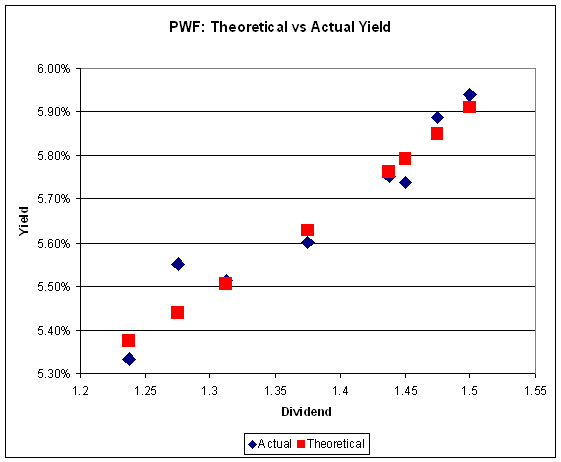
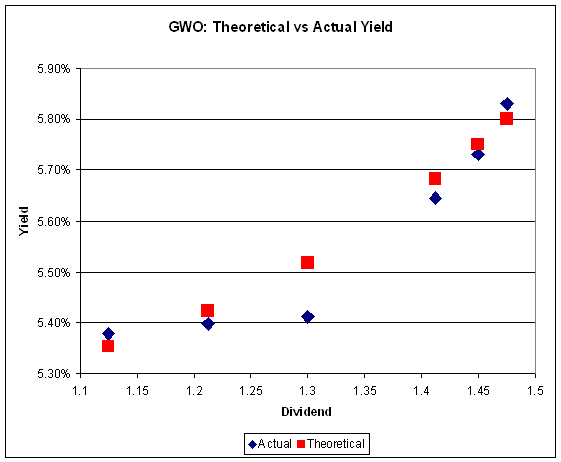
The fund’s poor performance is again attributable to its heavy position in DeemedRetractibles issued by insurers, which did very poorly. To illustrate this, I have uploaded two graphs comparing very similar issues: GWO.PR.I and CM.PR.I:

These two issues are both considered to be DeemedRetractibles; I consider it more prudent to assume they will be redeemed on or before 2022-1-31 than to assume otherwise. However, the market does not presently share my opinion! This is best illustrated by calculating Implied Volatility with the Straight Perpetual Implied Volatility Calculator.


Click for Big


Click for Big

The Implied Volatility for the PWF issues is 26%, while for the GWO issues it is 16%. Note that I consider a reasonable figure for Implied Volatility, in the absence of directional bias, to be in the 15-20% range; a figure outside this range implies some degree of directional bias in the market: lower means that the market believes that eventual redemption is less likely than would be predicted by random chance, a higher figure implies more likely redemption. When the calculation is performed for CM issues, a ludicrously high value is obtained, implying perceived virtual certainty of redemption – which is as it should be.

However, the market is currently pricing the PWF and GWO issues as if it is the former that has some kind of non-economic incentive to redeem, rather than the latter! I do not believe that this conclusion may be justified in any manner whatsoever.

It is in the nature of the preferred share market to behave irrationally from time to time – in the spring of 2010, I noted that the relative prices for these two issues reflected negative Implied Volatility (which cannot actually be calculated because the math blows up). It happens. Sometimes, when the market takes an irrational dislike to a particular issue or set of issues, I am able to exploit the opportunity thus provided; sometimes, as now, I’m already there and have to suffer (another example was June 2008, immortalized in my article The Swoon in June).

I am, of course, disappointed at the second consecutive month of underperformance – but have every reason to believe that this is transient.

The fund’s Net Asset Value per Unit as of the close April 29 was $10.9105.

Returns to April 29, 2011
Period MAPF Index CPD
according to
Claymore
One Month -1.32% +0.36% +0.01%
Three Months -0.57% +1.79% +1.41%
One Year +23.73% +15.78% +12.91%
Two Years (annualized) +25.99% +16.15% N/A
Three Years (annualized) +23.64% +7.28% +4.73%
Four Years (annualized) +17.37% +3.90%  
Five Years (annualized) +15.15% +3.96%  
Six Years (annualized) +13.64% +3.87%  
Seven Years (annualized) +13.08% +4.14%  
Eight Years (annualized) +14.54% +4.41%  
Nine Years (annualized) +13.05% +4.58%  
Ten Years (annualized) +13.36% +4.21%  
The Index is the BMO-CM “50”
MAPF returns assume reinvestment of distributions, and are shown after expenses but before fees.
CPD Returns are for the NAV and are after all fees and expenses.
* CPD does not directly report its two-year returns.
Figures for Omega Preferred Equity (which are after all fees and expenses) for 1-, 3- and 12-months are +0.00%, +1.17% and +13.87%, respectively, according to Morningstar after all fees & expenses. Three year performance is +5.89%.
Figures for Jov Leon Frazer Preferred Equity Fund Class I Units (which are after all fees and expenses) for 1-, 3- and 12-months are -0.15%, +0.56% and +9.26% respectively, according to Morningstar
Figures for Manulife Preferred Income Fund (formerly AIC Preferred Income Fund) (which are after all fees and expenses) for 1-, 3- and 12-months are +0.07%, +0.81% & +9.91%, respectively
Figures for Horizons AlphaPro Preferred Share ETF are not yet available (inception date 2010-11-23)

MAPF returns assume reinvestment of dividends, and are shown after expenses but before fees. Past performance is not a guarantee of future performance. You can lose money investing in Malachite Aggressive Preferred Fund or any other fund. For more information, see the fund’s main page. The fund is available either directly from Hymas Investment Management or through a brokerage account at Odlum Brown Limited.

Sometimes everything works … sometimes the trading works, but sectoral shifts overwhelm the increment … sometimes nothing works. The fund seeks to earn incremental return by selling liquidity (that is, taking the other side of trades that other market participants are strongly motivated to execute), which can also be referred to as ‘trading noise’. There were a lot of strongly motivated market participants during the Panic of 2007, generating a lot of noise! Unfortunately, the conditions of the Panic may never be repeated in my lifetime … but the fund will simply attempt to make trades when swaps seem profitable, without worrying about the level of monthly turnover.

There’s plenty of room for new money left in the fund. I have shown in recent issues of PrefLetter that market pricing for FixedResets is demonstrably stupid and I have lots of confidence – backed up by my bond portfolio management experience in the markets for Canadas and Treasuries, and equity trading on the NYSE & TSX – that there is enough demand for liquidity in any market to make the effort of providing it worthwhile (although the definition of “worthwhile” in terms of basis points of outperformance changes considerably from market to market!) I will continue to exert utmost efforts to outperform but it should be borne in mind that there will almost inevitably be periods of underperformance in the future.

The yields available on high quality preferred shares remain elevated, which is reflected in the current estimate of sustainable income.

Calculation of MAPF Sustainable Income Per Unit
Month NAVPU Portfolio
Average
YTW
Leverage
Divisor
Securities
Average
YTW
Capital
Gains
Multiplier
Sustainable
Income
per
current
Unit
June, 2007 9.3114 5.16% 1.03 5.01% 1.2857 0.3628
September 9.1489 5.35% 0.98 5.46% 1.2857 0.3885
December, 2007 9.0070 5.53% 0.942 5.87% 1.2857 0.4112
March, 2008 8.8512 6.17% 1.047 5.89% 1.2857 0.4672
June 8.3419 6.034% 0.952 6.338% 1.2857 $0.4112
September 8.1886 7.108% 0.969 7.335% 1.2857 $0.4672
December, 2008 8.0464 9.24% 1.008 9.166% 1.2857 $0.5737
March 2009 $8.8317 8.60% 0.995 8.802% 1.2857 $0.6046
June 10.9846 7.05% 0.999 7.057% 1.2857 $0.6029
September 12.3462 6.03% 0.998 6.042% 1.2857 $0.5802
December 2009 10.5662 5.74% 0.981 5.851% 1.0819 $0.5714
March 2010 10.2497 6.03% 0.992 6.079% 1.0819 $0.5759
June 10.5770 5.96% 0.996 5.984% 1.0819 $0.5850
September 11.3901 5.43% 0.980 5.540% 1.0819 $0.5832
December 2010 10.7659 5.37% 0.993 5.408% 1.0000 $0.5822
March, 2011 11.0560 6.00% 0.994 5.964% 1.0000 $0.6594
April, 2011 10.9105 6.20% 1.003 6.219% 1.0000 $0.6785
NAVPU is shown after quarterly distributions of dividend income and annual distribution of capital gains.
Portfolio YTW includes cash (or margin borrowing), with an assumed interest rate of 0.00%
The Leverage Divisor indicates the level of cash in the account: if the portfolio is 1% in cash, the Leverage Divisor will be 0.99
Securities YTW divides “Portfolio YTW” by the “Leverage Divisor” to show the average YTW on the securities held; this assumes that the cash is invested in (or raised from) all securities held, in proportion to their holdings.
The Capital Gains Multiplier adjusts for the effects of Capital Gains Dividends. On 2009-12-31, there was a capital gains distribution of $1.989262 which is assumed for this purpose to have been reinvested at the final price of $10.5662. Thus, a holder of one unit pre-distribution would have held 1.1883 units post-distribution; the CG Multiplier reflects this to make the time-series comparable. Note that Dividend Distributions are not assumed to be reinvested.
Sustainable Income is the resultant estimate of the fund’s dividend income per current unit, before fees and expenses. Note that a “current unit” includes reinvestment of prior capital gains; a unitholder would have had the calculated sustainable income with only, say, 0.9 units in the past which, with reinvestment of capital gains, would become 1.0 current units.
Analysis of yields changed in February 2011 to include the concept of DeemedRetractible issues. DeemedRetractibles are comprised of all Straight Perpetuals (both PerpetualDiscount and PerpetualPremium) issued by BMO, BNS, CM, ELF, GWO, HSB, IAG, MFC, NA, RY, SLF and TD. These issues are analyzed as if their prospectuses included a requirement to redeem at par on or prior to 2022-1-31, in addition to the call schedule explicitly defined. See OSFI Does Not Grandfather Extant Tier 1 Capital and the January & February, 2011, editions of PrefLetter for the rationale behind this analysis. This deemed maturity has a significant effect on calculated yields.

Significant positions were held in DeemedRetractible and FixedReset issues on April 29; all of the former and most of the latter currently have their yields calculated with the presumption that they will be called by the issuers at par prior to 2022-1-31. This presents another complication in the calculation of sustainable yield. The fund also holds a position in a SplitShare (BNA.PR.C) which also has its yield calculated with the expectation of a maturity.

However, if the entire portfolio except for the PerpetualDiscounts were to be sold and reinvested in these issues, the yield of the portfolio would be the 5.54% shown in the MAPF Portfolio Composition: April 2011 analysis (which is slightly below the 5.58% index yield on April 29). Given such reinvestment, the sustainable yield would be $10.9105 * 0.0554 = $0.6044, a slight decline from the $11.0560 * 0.0560 = $0.6191 reported in March.

Different assumptions lead to different results from the calculation, but the overall positive trend is apparent. I’m very pleased with the results! It will be noted that if there was no trading in the portfolio, one would expect the sustainable yield to be constant (before fees and expenses). The success of the fund’s trading is showing up in

  • the very good performance against the index
  • the long term increases in sustainable income per unit

As has been noted, the fund has maintained a credit quality equal to or better than the index; outperformance is due to constant exploitation of trading anomalies.

Again, there are no predictions for the future! The fund will continue to trade between issues in an attempt to exploit market gaps in liquidity, in an effort to outperform the index and keep the sustainable income per unit – however calculated! – growing.

MAPF

MAPF Portfolio Composition: April 2011

Turnover declined dramatically in April, to about 4%. Now that the portfolio has repositioned itself to account for OSFI’s refusal to grandfather extant Tier 1 Capital, we are back to the slow trading of positions based on changes in relative value.

Trades were, as ever, triggered by a desire to exploit transient mispricing in the preferred share market (which may be thought of as “selling liquidity”), rather than any particular view being taken on market direction, sectoral performance or credit anticipation.

MAPF Sectoral Analysis 2011-4-29
HIMI Indices Sector Weighting YTW ModDur
Ratchet 0% N/A N/A
FixFloat 0% N/A N/A
Floater 0% N/A N/A
OpRet 0% N/A N/A
SplitShare 4.8% (+0.6) 6.47% 6.34
Interest Rearing 0% N/A N/A
PerpetualPremium 0.0% (0) N/A N/A
PerpetualDiscount 6.8% (+0.9) 5.54% 14.59
Fixed-Reset 8.1% (-0.3) 3.54% 2.81
Deemed-Retractible 70.0% (-1.9) 6.39% 8.08
Scraps (Various) 10.0% (-0.2) 7.50% 10.23
Cash +0.3% (+0.9) 0.00% 0.00
Total 100% 6.20% 8.20
Totals and changes will not add precisely due to rounding. Bracketted figures represent change from February month-end. Cash is included in totals with duration and yield both equal to zero.
DeemedRetractibles are comprised of all Straight Perpetuals (both PerpetualDiscount and PerpetualPremium) issued by BMO, BNS, CM, ELF, GWO, HSB, IAG, MFC, NA, RY, SLF and TD. These issues are analyzed as if their prospectuses included a requirement to redeem at par on or prior to 2022-1-31, in addition to the call schedule explicitly defined. See OSFI Does Not Grandfather Extant Tier 1 Capital and the January, February and March, 2011, editions of PrefLetter for the rationale behind this analysis.

The “total” reflects the un-leveraged total portfolio (i.e., cash is included in the portfolio calculations and is deemed to have a duration and yield of 0.00.). MAPF will often have relatively large cash balances, both credit and debit, to facilitate trading. Figures presented in the table have been rounded to the indicated precision.

Credit distribution is:

MAPF Credit Analysis 2011-4-29
DBRS Rating Weighting
Pfd-1 0 (0)
Pfd-1(low) 43.2% (+0.1)
Pfd-2(high) 26.8% (-1.2)
Pfd-2 0 (0)
Pfd-2(low) 19.7% (+1.0)
Pfd-3(high) 6.5% (-0.1)
Pfd-3 3.5% (-0.1)
Cash +0.3% (+0.9)
Totals will not add precisely due to rounding. Bracketted figures represent change from March month-end.
A position held in ELF preferreds has been assigned to Pfd-2(low)

Liquidity Distribution is:

MAPF Liquidity Analysis 2011-4-29
Average Daily Trading Weighting
<$50,000 0.0% (0)
$50,000 – $100,000 17.9% (+3.7)
$100,000 – $200,000 35.2% (-4.8)
$200,000 – $300,000 14.8% (+9.0)
>$300,000 31.8% (-8.7)
Cash +0.3% (+0.9)
Totals will not add precisely due to rounding. Bracketted figures represent change from March month-end.

MAPF is, of course, Malachite Aggressive Preferred Fund, a “unit trust” managed by Hymas Investment Management Inc. Further information and links to performance, audited financials and subscription information are available the fund’s web page. The fund may be purchased either directly from Hymas Investment Management or through a brokerage account at Odlum Brown Limited. A “unit trust” is like a regular mutual fund, but is sold by offering memorandum rather than prospectus. This is cheaper, but means subscription is restricted to “accredited investors” (as defined by the Ontario Securities Commission) or those who subscribe for $150,000+. Fund past performances are not a guarantee of future performance. You can lose money investing in MAPF or any other fund.

A similar portfolio composition analysis has been performed on the Claymore Preferred Share ETF (symbol CPD) as of August 31, 2010, and published in the September, 2010, PrefLetter. While direct comparisons are difficult due to the introduction of the DeemedRetractible class of preferred share (see above) it is fair to say:

  • MAPF credit quality is better
  • MAPF liquidity is a higher
  • MAPF Yield is higher
  • Weightings in
    • MAPF is much more exposed to DeemedRetractibles
    • MAPF is much less exposed to Operating Retractibles
    • MAPF is slightly more exposed to SplitShares
    • MAPF is less exposed to FixFloat / Floater / Ratchet
    • MAPF weighting in FixedResets is much lower
Market Action

April 29, 2011

Elections have consequences!

The TMX Group Inc.’ s plan to merge with London Stock Exchange Group Plc wouldn’t get federal government approval if Jack Layton has any say — and polls say that the New Democratic Party leader may have a lot of say after Monday’s federal election.

Speaking Friday as his party surges in popularity, Mr. Layton said he saw too much risk to approve the deal.

“We worry that Canadian business trying to access capital might have greater difficulty. As much as one might want to pretend that nothing will change, we find that hard to believe,” he said, according to Reuters.

But there’s a decent chance the deal will be approved before the new Minister’s office is painted orange:

On Friday TMX Group (X-T40.080.150.38%) and London Stock Exchange Group cast any questions aside by starting the formal application process with federal and provincial authorities regarding their proposed combination.

That means TMX has submitted its application to Investment Canada, which now has 75 days at most to review the proposal. Formal filings with the four provincial regulators who have a say will come in the next few weeks.

It was another mixed and somewhat strange day on the Canadian preferred share market – it appears that the announcement that CM will prioritize preferred share redemptions is having some effect. PerpetualDiscounts gained 20bp, FixedResets were down 4bp and DeemedRetractibles won 44bp. DeemedRetractibles dominated the Performance Highlights table, with a few insurer issues nestled amongst the banks. Volume was good.

And that’s a wrap for another month! Final figures aren’t in yet, but it looks like the overall market was basically flat on the month.

HIMIPref™ Preferred Indices
These values reflect the December 2008 revision of the HIMIPref™ Indices

Values are provisional and are finalized monthly
Index Mean
Current
Yield
(at bid)
Median
YTW
Median
Average
Trading
Value
Median
Mod Dur
(YTW)
Issues Day’s Perf. Index Value
Ratchet 0.00 % 0.00 % 0 0.00 0 0.2135 % 2,424.7
FixedFloater 0.00 % 0.00 % 0 0.00 0 0.2135 % 3,646.7
Floater 2.49 % 2.26 % 35,609 21.62 4 0.2135 % 2,618.0
OpRet 4.91 % 3.62 % 58,150 2.05 8 0.0578 % 2,414.9
SplitShare 5.21 % -2.05 % 80,405 0.63 6 0.0022 % 2,495.2
Interest-Bearing 0.00 % 0.00 % 0 0.00 0 0.0578 % 2,208.2
Perpetual-Premium 5.78 % 5.66 % 123,843 6.12 8 0.0844 % 2,054.3
Perpetual-Discount 5.57 % 5.58 % 144,536 14.41 16 0.2049 % 2,126.9
FixedReset 5.18 % 3.46 % 214,695 2.90 57 -0.0366 % 2,292.6
Deemed-Retractible 5.24 % 5.07 % 317,498 8.13 53 0.4354 % 2,094.5
Performance Highlights
Issue Index Change Notes
POW.PR.B Perpetual-Discount 1.02 % YTW SCENARIO
Maturity Type : Limit Maturity
Maturity Date : 2041-04-29
Maturity Price : 23.41
Evaluated at bid price : 23.70
Bid-YTW : 5.68 %
RY.PR.F Deemed-Retractible 1.20 % YTW SCENARIO
Maturity Type : Hard Maturity
Maturity Date : 2022-01-31
Maturity Price : 25.00
Evaluated at bid price : 23.62
Bid-YTW : 5.11 %
RY.PR.B Deemed-Retractible 1.28 % YTW SCENARIO
Maturity Type : Hard Maturity
Maturity Date : 2022-01-31
Maturity Price : 25.00
Evaluated at bid price : 24.44
Bid-YTW : 4.96 %
BMO.PR.J Deemed-Retractible 1.48 % YTW SCENARIO
Maturity Type : Hard Maturity
Maturity Date : 2022-01-31
Maturity Price : 25.00
Evaluated at bid price : 24.01
Bid-YTW : 4.97 %
IAG.PR.A Deemed-Retractible 1.56 % YTW SCENARIO
Maturity Type : Hard Maturity
Maturity Date : 2022-01-31
Maturity Price : 25.00
Evaluated at bid price : 21.46
Bid-YTW : 6.54 %
GWO.PR.H Deemed-Retractible 1.58 % YTW SCENARIO
Maturity Type : Hard Maturity
Maturity Date : 2022-01-31
Maturity Price : 25.00
Evaluated at bid price : 22.46
Bid-YTW : 6.25 %
BNS.PR.K Deemed-Retractible 1.85 % YTW SCENARIO
Maturity Type : Hard Maturity
Maturity Date : 2022-01-31
Maturity Price : 25.00
Evaluated at bid price : 24.75
Bid-YTW : 4.95 %
Volume Highlights
Issue Index Shares
Traded
Notes
CM.PR.J Deemed-Retractible 72,205 TD crossed 42,400 at 24.05.
YTW SCENARIO
Maturity Type : Hard Maturity
Maturity Date : 2022-01-31
Maturity Price : 25.00
Evaluated at bid price : 24.05
Bid-YTW : 4.99 %
BNS.PR.P FixedReset 43,326 Nesbitt bought 10,000 from anonymous at 26.00; Desjardins crossed 25,000 at 26.02.
YTW SCENARIO
Maturity Type : Call
Maturity Date : 2013-05-25
Maturity Price : 25.00
Evaluated at bid price : 25.95
Bid-YTW : 3.07 %
POW.PR.B Perpetual-Discount 42,719 RBC bought two blocks of 10,000 each from anonymous at 23.50, then crossed 11,000 at 23.60.
YTW SCENARIO
Maturity Type : Limit Maturity
Maturity Date : 2041-04-29
Maturity Price : 23.41
Evaluated at bid price : 23.70
Bid-YTW : 5.68 %
CM.PR.I Deemed-Retractible 33,700 YTW SCENARIO
Maturity Type : Hard Maturity
Maturity Date : 2022-01-31
Maturity Price : 25.00
Evaluated at bid price : 24.50
Bid-YTW : 4.97 %
HSB.PR.E FixedReset 31,305 Desjardins crossed 10,000 at 27.32.
YTW SCENARIO
Maturity Type : Call
Maturity Date : 2014-07-30
Maturity Price : 25.00
Evaluated at bid price : 27.35
Bid-YTW : 3.76 %
PWF.PR.L Perpetual-Discount 29,723 Desjardins crossed 25,000 at 23.00.
YTW SCENARIO
Maturity Type : Limit Maturity
Maturity Date : 2041-04-29
Maturity Price : 22.78
Evaluated at bid price : 22.97
Bid-YTW : 5.58 %
There were 38 other index-included issues trading in excess of 10,000 shares.
Wide Spread Highlights
Issue Index Quote Data and Yield Notes
BAM.PR.R FixedReset Quote: 25.60 – 26.18
Spot Rate : 0.5800
Average : 0.4320

YTW SCENARIO
Maturity Type : Call
Maturity Date : 2021-07-30
Maturity Price : 25.00
Evaluated at bid price : 25.60
Bid-YTW : 4.95 %

TD.PR.C FixedReset Quote: 26.41 – 26.80
Spot Rate : 0.3900
Average : 0.2844

YTW SCENARIO
Maturity Type : Call
Maturity Date : 2014-03-02
Maturity Price : 25.00
Evaluated at bid price : 26.41
Bid-YTW : 3.51 %

POW.PR.D Perpetual-Discount Quote: 22.73 – 23.05
Spot Rate : 0.3200
Average : 0.2157

YTW SCENARIO
Maturity Type : Limit Maturity
Maturity Date : 2041-04-29
Maturity Price : 22.54
Evaluated at bid price : 22.73
Bid-YTW : 5.54 %

IAG.PR.E Deemed-Retractible Quote: 25.60 – 25.86
Spot Rate : 0.2600
Average : 0.1640

YTW SCENARIO
Maturity Type : Call
Maturity Date : 2019-01-30
Maturity Price : 25.00
Evaluated at bid price : 25.60
Bid-YTW : 5.73 %

GWO.PR.N FixedReset Quote: 24.55 – 24.85
Spot Rate : 0.3000
Average : 0.2296

YTW SCENARIO
Maturity Type : Hard Maturity
Maturity Date : 2022-01-31
Maturity Price : 25.00
Evaluated at bid price : 24.55
Bid-YTW : 4.04 %

BAM.PR.K Floater Quote: 19.20 – 19.39
Spot Rate : 0.1900
Average : 0.1263

YTW SCENARIO
Maturity Type : Limit Maturity
Maturity Date : 2041-04-29
Maturity Price : 19.20
Evaluated at bid price : 19.20
Bid-YTW : 2.75 %

Market Action

April 28, 2011

Nothing happened today.

It was a mixed day for the Canadian preferred share market, with PerpetualDiscounts losing 4bp, FixedResets up 10bp and DeemedRetractibles gaining 41bp. The Performance Highlights table was comprised entirely of strongly performing bank DeemedRetractibles, almost certainly due to news that CM will prioritize preferred share redemptions as a use of its excess capital. Volume was strong.

HIMIPref™ Preferred Indices
These values reflect the December 2008 revision of the HIMIPref™ Indices

Values are provisional and are finalized monthly
Index Mean
Current
Yield
(at bid)
Median
YTW
Median
Average
Trading
Value
Median
Mod Dur
(YTW)
Issues Day’s Perf. Index Value
Ratchet 0.00 % 0.00 % 0 0.00 0 -0.0948 % 2,419.5
FixedFloater 0.00 % 0.00 % 0 0.00 0 -0.0948 % 3,639.0
Floater 2.49 % 2.26 % 35,105 21.63 4 -0.0948 % 2,612.5
OpRet 4.91 % 3.40 % 57,138 2.05 8 0.1158 % 2,413.5
SplitShare 5.21 % -1.89 % 81,402 0.63 6 -0.1291 % 2,495.2
Interest-Bearing 0.00 % 0.00 % 0 0.00 0 0.1158 % 2,206.9
Perpetual-Premium 5.79 % 5.62 % 124,326 6.12 8 0.1441 % 2,052.6
Perpetual-Discount 5.58 % 5.58 % 133,843 14.38 16 -0.0412 % 2,122.6
FixedReset 5.18 % 3.46 % 218,011 2.90 57 0.1034 % 2,293.5
Deemed-Retractible 5.26 % 5.13 % 315,125 8.12 53 0.4070 % 2,085.4
Performance Highlights
Issue Index Change Notes
BMO.PR.K Deemed-Retractible 1.02 % YTW SCENARIO
Maturity Type : Call
Maturity Date : 2016-12-25
Maturity Price : 25.00
Evaluated at bid price : 25.27
Bid-YTW : 4.98 %
RY.PR.D Deemed-Retractible 1.32 % YTW SCENARIO
Maturity Type : Hard Maturity
Maturity Date : 2022-01-31
Maturity Price : 25.00
Evaluated at bid price : 23.74
Bid-YTW : 5.10 %
RY.PR.C Deemed-Retractible 1.57 % YTW SCENARIO
Maturity Type : Hard Maturity
Maturity Date : 2022-01-31
Maturity Price : 25.00
Evaluated at bid price : 23.91
Bid-YTW : 5.12 %
CM.PR.J Deemed-Retractible 1.70 % YTW SCENARIO
Maturity Type : Hard Maturity
Maturity Date : 2022-01-31
Maturity Price : 25.00
Evaluated at bid price : 23.92
Bid-YTW : 5.05 %
CM.PR.H Deemed-Retractible 1.81 % YTW SCENARIO
Maturity Type : Hard Maturity
Maturity Date : 2022-01-31
Maturity Price : 25.00
Evaluated at bid price : 24.69
Bid-YTW : 4.98 %
CM.PR.I Deemed-Retractible 1.84 % YTW SCENARIO
Maturity Type : Hard Maturity
Maturity Date : 2022-01-31
Maturity Price : 25.00
Evaluated at bid price : 24.35
Bid-YTW : 5.04 %
Volume Highlights
Issue Index Shares
Traded
Notes
MFC.PR.D FixedReset 121,669 TD crossed blocks of 17,300 and 10,000, RBC crossed 50,000 and 25,000 and TD bought 10,000 from CIBC, all at 27.50. YTW SCENARIO
Maturity Type : Call
Maturity Date : 2014-07-19
Maturity Price : 25.00
Evaluated at bid price : 27.46
Bid-YTW : 3.64 %
TD.PR.R Deemed-Retractible 119,333 RBC crossed two blocks of 50,000 each, both at 25.98.
YTW SCENARIO
Maturity Type : Call
Maturity Date : 2017-05-30
Maturity Price : 25.00
Evaluated at bid price : 25.93
Bid-YTW : 4.91 %
BNS.PR.O Deemed-Retractible 103,700 Nesbitt and TD both crossed 50,000 at 25.60.
YTW SCENARIO
Maturity Type : Call
Maturity Date : 2017-05-26
Maturity Price : 25.00
Evaluated at bid price : 25.65
Bid-YTW : 5.13 %
MFC.PR.C Deemed-Retractible 65,043 RBC crossed 15,000 and TD crossed 24,300, both at 21.02.
YTW SCENARIO
Maturity Type : Hard Maturity
Maturity Date : 2022-01-31
Maturity Price : 25.00
Evaluated at bid price : 20.92
Bid-YTW : 6.76 %
RY.PR.R FixedReset 59,736 Nesbitt crossed 50,000 at 26.90.
YTW SCENARIO
Maturity Type : Call
Maturity Date : 2014-03-26
Maturity Price : 25.00
Evaluated at bid price : 26.91
Bid-YTW : 3.39 %
CM.PR.D Deemed-Retractible 55,206 RBC crossed 48,600 at 25.43.
YTW SCENARIO
Maturity Type : Call
Maturity Date : 2011-05-30
Maturity Price : 25.25
Evaluated at bid price : 25.40
Bid-YTW : -1.43 %
There were 51 other index-included issues trading in excess of 10,000 shares.
Wide Spread Highlights
Issue Index Quote Data and Yield Notes
RY.PR.B Deemed-Retractible Quote: 24.13 – 24.58
Spot Rate : 0.4500
Average : 0.3186

YTW SCENARIO
Maturity Type : Hard Maturity
Maturity Date : 2022-01-31
Maturity Price : 25.00
Evaluated at bid price : 24.13
Bid-YTW : 5.11 %

GWO.PR.F Deemed-Retractible Quote: 25.20 – 25.54
Spot Rate : 0.3400
Average : 0.2399

YTW SCENARIO
Maturity Type : Call
Maturity Date : 2012-10-30
Maturity Price : 25.00
Evaluated at bid price : 25.20
Bid-YTW : 5.68 %

BAM.PR.J OpRet Quote: 26.89 – 27.20
Spot Rate : 0.3100
Average : 0.2183

YTW SCENARIO
Maturity Type : Call
Maturity Date : 2014-04-30
Maturity Price : 26.00
Evaluated at bid price : 26.89
Bid-YTW : 4.13 %

PWF.PR.L Perpetual-Discount Quote: 22.95 – 23.23
Spot Rate : 0.2800
Average : 0.2011

YTW SCENARIO
Maturity Type : Limit Maturity
Maturity Date : 2041-04-28
Maturity Price : 22.76
Evaluated at bid price : 22.95
Bid-YTW : 5.58 %

BMO.PR.M FixedReset Quote: 25.93 – 26.18
Spot Rate : 0.2500
Average : 0.1724

YTW SCENARIO
Maturity Type : Call
Maturity Date : 2013-09-24
Maturity Price : 25.00
Evaluated at bid price : 25.93
Bid-YTW : 3.16 %

BAM.PR.I OpRet Quote: 25.31 – 25.60
Spot Rate : 0.2900
Average : 0.2134

YTW SCENARIO
Maturity Type : Call
Maturity Date : 2012-07-30
Maturity Price : 25.00
Evaluated at bid price : 25.31
Bid-YTW : 4.84 %

Issue Comments

ES.PR.B Upgraded to Pfd-3 by DBRS

Dominion Bond Rating Service has announced that it:

has today updated the ratings of preferred shares issued by three split share companies and trusts (the Issuers): Energy Split Corporation, SNP Split Corp. and Utility Split Trust. The preferred shares of Energy Split Corporation have been upgraded to Pfd-3 from Pfd-3 (low), and the preferred shares/securities of SNP Split Corp. and Utility Split Trust have been confirmed at Pfd-3 (high) and Pfd-2 (low), respectively.

Each of the Issuers has invested in a portfolio of securities funded by the issuance of two classes of shares – dividend-yielding preferred shares (or securities) and capital shares (or units). The main form of credit enhancement available to preferred shares is a buffer of downside protection. Downside protection corresponds to the percentage decline in market value of a portfolio that must be experienced before the preferred shares would be in a loss position. The amount of downside protection available to preferred shares will fluctuate over time based on changes in the market value of the portfolio.

Today’s rating actions reflect generally upward trends in the net asset value (NAV) of the respective portfolios over the past year. In its surveillance of split share funds, DBRS reviews historical trends in downside protection and assigns greater weighting to more recent Issuer NAVs. Each of the Issuers has a scheduled termination date in 2011.

Energy Split Corporation is ES.PR.B, last mentioned on PrefBlog when it was upgraded to Pfd-3(low) by DBRS. ES.PR.B is not tracked by HIMIPref™, but it will be considered for inclusion in the database if they go for a term extension.