Issue Comments

TXT.PR.A: Big Partial Redemption on Term Extension

Top 10 Split Trust has announced:

that the Fund will effect a partial redemption of its preferred securities (“Preferred Securities”) in order to maintain an equal number of Preferred Securities and capital units (“Capital Units”) of the Fund outstanding. The partial redemption of Preferred Securities is being made in connection with the recent approval by holders of the Capital Units and the Preferred Securities (collectively, the “Securityholders”) of a proposal to extend the term of the Fund for an additional five-year term until March 31, 2016 and for automatic successive five-year terms thereafter.

Pursuant to the special retraction right granted to Securityholders in connection with the extension of the Fund, 284,227 Preferred Securities and 741,330 Capital Units were surrendered for retraction. In order to maintain an equal number of Preferred Securities and Capital Units, the Fund will redeem an aggregate of 457,103 Preferred Securities on a pro rata basis from all holders of record of Preferred Securities on March 31, 2011 (the “Repayment Date”), representing approximately 19.8% of the issued and outstanding Preferred Securities. Each Preferred Security that is redeemed pursuant to the partial redemption will be redeemed at a price equal to $12.50, being the principal amount per Preferred Security, plus all accrued and unpaid interest thereon (the “Repayment Price”). The Repayment Price will be paid to holders whose Preferred Securities are redeemed by the Fund within 10 business days following the Repayment Date.

I don’t know how I missed the reorg, but I did!

On February 15, the fund announced:

that the Board of Directors of Mulvihill Capital Management Inc. (“MCM”), the manager of the Fund, has approved a proposal, subject to securityholder approval, to extend the term of the Fund for five years beyond its scheduled termination date of March 31, 2011, and for successive five-year terms after March 31, 2016. If the extension is approved, holders of capital units (“Capital Units”) and preferred securities (“Preferred Securities”) of the Fund (“Securityholders”) will be given a special right to redeem their Capital Units or Preferred Securities at net asset value (“NAV”) per Capital Unit or at the repayment price per Preferred Security on March 31, 2011.

The Fund is also proposing to: (i) provide a special redemption right to enable holders of Capital Units and Preferred Securities to retract their securities on March 31, 2011 on the same terms that would have applied had the Fund retracted or repaid all Capital Units and Preferred Securities in accordance with the existing terms of such securities; (ii) change the monthly retraction prices for the Capital Units such that monthly retraction prices are calculated by reference to market price in addition to NAV and to change the notice period and payment period for the exercise of such rights and the payment of the retraction amount relating thereto; and (iii) consolidate the Capital Units or redeem the Preferred Securities on a pro rata basis, as the case may be, in order to maintain the same number of Capital Units and Preferred Securities outstanding.

The meeting date was then changed to March 21. The reorg was approved:

Top 10 Split Trust (the “Fund”) is pleased to announce that holders of capital units (“Capital Units”) and holders of preferred securities (“Preferred Securities”) of the Fund (collectively, the “Securityholders”) have approved a proposal to extend the term of the Fund for five years beyond its scheduled termination date of March 31, 2011, and for automatic successive five-year terms after March 31, 2016.

Holders of Preferred Securities have the opportunity to benefit from: (i) fixed quarterly cash interest payments equal to 6.25% per annum on the $12.50 principal amount of a Preferred Security and (ii) an attractive five-year term with automatic successive five-year term extensions after March 31, 2016.

NAV is 17.28 as of March 17 giving Asset Coverage of 1.4-:1. TXT.PR.A was last mentioned on PrefBlog when the rating of Pfd-4(high) was withdrawn by DBRS at the company’s request. TXT.PR.A is not tracked by HIMIPref™.

Market Action

March 22, 2011

Looks like an election is in the wind:

Opposition leaders have signalled they will not support the Conservative budget, making a spring election all but inevitable.

The budget’s debt management strategy was interesting:

The government said in the debt management strategy that it released with the federal budget that it’s taking the step to ensure that it always has enough cash to pay one month of bills, which incidentally is the same requirement that will be in place for banks under the new Basel rules. The money will be stashed in interest bearing accounts and foreign exchange reserves and shouldn’t add to the deficit in a “material” way.

Europe had a bad day:

Irish notes slid, leading bonds of Europe’s most indebted nations lower, and the euro fell on concern the region’s leaders are struggling to fix the government-finance crisis. Oil rallied, while U.S. and European stocks retreated following a rebound in Japanese shares.

Irish 2-year note yields surged 62 basis points to 9.87 percent and rose as high as 10.18 percent, the most since Bloomberg began collecting the data in 2003. Yields on similar- maturity Portuguese and Greek debt climbed at least 26 basis points.

UK inflation is on the rise:

U.K. inflation accelerated more than economists forecast in February to the fastest pace in more than two years, adding pressure on the Bank of England to increase its benchmark interest rate.

Consumer prices rose 4.4 percent from a year earlier after a 4 percent increase in January, the Office for National Statistics said today in London. That’s the most since October 2008. The median forecast of 32 economists in a Bloomberg News survey was 4.2 percent. A separate report showed the budget deficit unexpectedly widened as government revenue fell.

But I may have been wrong about the long term effects of Credit Crunch politics on the UK financial sector:

Goldman Sachs Group Inc. (GS) employs almost as many people in London today as it did in 2007, before Lehman Brothers Holdings Inc. (LEHMQ) filed for the biggest bankruptcy in history, sparking a global recession.

Goldman Sachs isn’t alone. Royal Bank of Scotland Group Plc (RBS), recipient of the world’s biggest bank bailout, has more workers in its securities unit than four years ago. Barclays Capital, under Robert Diamond, hired 1,800 in 2010.

Investment banks in Europe’s financial capital are adding jobs, helping to bolster headcounts at law and accounting firms across London, as the rest of Britain struggles to recover from the worst economic contraction since the 1930s. Chancellor of the Exchequer George Osborne, who delivers his budget today, has little alternative except to do all he can to keep companies such as Barclays Plc (BARC) and HSBC Holdings Plc (HSBA) from leaving London.

“We want London to remain a global financial center, and one that will continue to flourish and grow because of the employment it brings,” Treasury minister Mark Hoban said at a conference in the City of London last week. “We want to see more employment in the U.K., not less and I think a blooming financial services sector can help deliver that.”

Nevertheless, DBRS is worried:

  • • Some investors have expressed increasing concern about Euro zone countries suffering from high and rising debt burdens, uncertain bank recapitalization needs, low competitiveness or political instability.
  • • In addition to low investor confidence, deterioration in global economic and political conditions – the Japanese nuclear crisis, popular unrest in Bahrain, energy supply disruptions in Libya – could slow Europe’s economic recovery and thereby delay fiscal adjustment and debt stabilization.
  • • Greater clarity on European policies came on March 11, the first in a series of meetings through March 25, with a set of initiatives that if approved may help restore confidence and provide countries with time to implement fiscal austerity programs and return to growth.
  • • However, DBRS believes that the final announcements may continue to leave doubts about Europe’s policy stance regarding debt restructuring. The unstable macroeconomic environment however increases the need for greater policy clarity.
  • • DBRS would be encouraged by policies that address not only liquidity needs, but also reduce debt servicing costs. Clearer policies would further help to stabilize DBRS’s sovereign ratings in Europe.

One can’t help but wonder what will ultimately happen to Detroit:

The population in Detroit plunged 25 percent during the last decade, falling to the lowest level since 1910, according to 2010 Census figures.

The number of city residents fell to 713,777 last year, compared with 951,270 in 2000, the U.S. Census Bureau said today in Washington.

Detroit’s overall population has fallen steadily since 1950, when it peaked at 1.8 million.

There’s a fascinating development in workplace computer privacy law:

A judgment on Tuesday from the Ontario Court of Appeal broke new ground on an issue that is exploding into the court system – the extent to which Internet information is private and beyond the reach of the law.

The case involved a Northern Ontario high school teacher charged with possessing child pornography. The judges said that police breached his Charter rights by viewing his computer files without a warrant.

Toronto lawyer Scott Hutchison, a privacy expert, said that the court has given a sound answer to a vital question. “This case comes down firmly on the side of privacy and holds that employers cannot give police investigators access to a workplace computer,” he said.

“This case makes it clear that the employer may own the computer, but that doesn’t give them the power to waive the employee’s privacy rights,” Mr. Hutchison added.

Writing on behalf of Chief Justice Warren Winkler and Mr. Justice Robert Sharpe, Madam Justice Andromache Karakatsanis said the board employee did not breach the Charter protection against unreasonable search and seizure because he was mandated to do so.

However, the police search was an entirely different matter.

DBRS has released six methodological updates. Of primary interest are Life Insurance companies and P&C Insurance companies.

The Globe’s John Heinzl had a good piece titled Getting a grip on the dividend gross-up.

It was another strong day in the Canadian preferred share market, with PerpetualDiscounts up 26bp, FixedResets winning 13bp and DeemedRetractibles gaining 9bp. Volume continued to be light.

HIMIPref™ Preferred Indices
These values reflect the December 2008 revision of the HIMIPref™ Indices

Values are provisional and are finalized monthly
Index Mean
Current
Yield
(at bid)
Median
YTW
Median
Average
Trading
Value
Median
Mod Dur
(YTW)
Issues Day’s Perf. Index Value
Ratchet 0.00 % 0.00 % 0 0.00 0 0.3017 % 2,381.4
FixedFloater 0.00 % 0.00 % 0 0.00 0 0.3017 % 3,581.6
Floater 2.53 % 2.34 % 45,607 21.40 4 0.3017 % 2,571.3
OpRet 4.90 % 3.60 % 53,053 1.15 9 0.0302 % 2,395.5
SplitShare 5.10 % 3.21 % 154,141 0.99 5 0.2502 % 2,480.8
Interest-Bearing 0.00 % 0.00 % 0 0.00 0 0.0302 % 2,190.5
Perpetual-Premium 5.74 % 5.64 % 138,608 6.21 10 0.0734 % 2,035.2
Perpetual-Discount 5.50 % 5.54 % 121,417 14.37 14 0.2581 % 2,125.9
FixedReset 5.16 % 3.50 % 241,891 2.95 57 0.1328 % 2,280.5
Deemed-Retractible 5.22 % 5.17 % 342,129 8.27 53 0.0936 % 2,084.3
Performance Highlights
Issue Index Change Notes
GWO.PR.G Deemed-Retractible 1.03 % YTW SCENARIO
Maturity Type : Hard Maturity
Maturity Date : 2022-01-31
Maturity Price : 25.00
Evaluated at bid price : 24.63
Bid-YTW : 5.40 %
BMO.PR.N FixedReset 1.17 % YTW SCENARIO
Maturity Type : Call
Maturity Date : 2014-03-27
Maturity Price : 25.00
Evaluated at bid price : 27.63
Bid-YTW : 2.99 %
BAM.PR.R FixedReset 1.19 % YTW SCENARIO
Maturity Type : Limit Maturity
Maturity Date : 2041-03-22
Maturity Price : 25.40
Evaluated at bid price : 25.45
Bid-YTW : 4.89 %
BNS.PR.O Deemed-Retractible 1.43 % YTW SCENARIO
Maturity Type : Call
Maturity Date : 2017-05-26
Maturity Price : 25.00
Evaluated at bid price : 26.17
Bid-YTW : 4.90 %
Volume Highlights
Issue Index Shares
Traded
Notes
HSE.PR.A FixedReset 201,177 Recent new issue.
YTW SCENARIO
Maturity Type : Limit Maturity
Maturity Date : 2041-03-22
Maturity Price : 24.90
Evaluated at bid price : 24.95
Bid-YTW : 4.31 %
PWF.PR.L Perpetual-Discount 95,794 RBC crossed 93,200 at 23.95.
YTW SCENARIO
Maturity Type : Limit Maturity
Maturity Date : 2041-03-22
Maturity Price : 23.58
Evaluated at bid price : 23.81
Bid-YTW : 5.43 %
SLF.PR.B Deemed-Retractible 82,928 Nesbitt crossed 50,000 at 22.95; Desjardins crossed 25,000 at the same price.
YTW SCENARIO
Maturity Type : Hard Maturity
Maturity Date : 2022-01-31
Maturity Price : 25.00
Evaluated at bid price : 22.91
Bid-YTW : 5.87 %
PWF.PR.I Perpetual-Premium 53,000 Desjardins crossed blocks of 26,300 and 25,000, both at 25.40.
YTW SCENARIO
Maturity Type : Call
Maturity Date : 2012-05-30
Maturity Price : 25.00
Evaluated at bid price : 25.33
Bid-YTW : 5.61 %
NA.PR.P FixedReset 51,320 Issuer bid.
YTW SCENARIO
Maturity Type : Call
Maturity Date : 2014-03-17
Maturity Price : 25.00
Evaluated at bid price : 28.29
Bid-YTW : 2.31 %
PWF.PR.G Perpetual-Premium 50,400 RBC crossed blocks of 36,300 and 13,700, both at 25.20.
YTW SCENARIO
Maturity Type : Limit Maturity
Maturity Date : 2041-03-22
Maturity Price : 24.93
Evaluated at bid price : 25.15
Bid-YTW : 5.96 %
There were 25 other index-included issues trading in excess of 10,000 shares.
Wide Spread Highlights
Issue Index Quote Data and Yield Notes
CU.PR.B Perpetual-Premium Quote: 25.25 – 25.61
Spot Rate : 0.3600
Average : 0.2256

YTW SCENARIO
Maturity Type : Call
Maturity Date : 2012-07-01
Maturity Price : 25.00
Evaluated at bid price : 25.25
Bid-YTW : 5.48 %

CM.PR.G Deemed-Retractible Quote: 25.40 – 25.70
Spot Rate : 0.3000
Average : 0.1893

YTW SCENARIO
Maturity Type : Call
Maturity Date : 2014-05-31
Maturity Price : 25.00
Evaluated at bid price : 25.40
Bid-YTW : 5.15 %

TD.PR.G FixedReset Quote: 27.40 – 27.66
Spot Rate : 0.2600
Average : 0.1608

YTW SCENARIO
Maturity Type : Call
Maturity Date : 2014-05-30
Maturity Price : 25.00
Evaluated at bid price : 27.40
Bid-YTW : 3.42 %

SLF.PR.A Deemed-Retractible Quote: 22.66 – 22.96
Spot Rate : 0.3000
Average : 0.2011

YTW SCENARIO
Maturity Type : Hard Maturity
Maturity Date : 2022-01-31
Maturity Price : 25.00
Evaluated at bid price : 22.66
Bid-YTW : 5.95 %

CIU.PR.B FixedReset Quote: 27.36 – 27.80
Spot Rate : 0.4400
Average : 0.3537

YTW SCENARIO
Maturity Type : Call
Maturity Date : 2014-07-01
Maturity Price : 25.00
Evaluated at bid price : 27.36
Bid-YTW : 3.80 %

RY.PR.P FixedReset Quote: 27.20 – 27.54
Spot Rate : 0.3400
Average : 0.2612

YTW SCENARIO
Maturity Type : Call
Maturity Date : 2014-03-26
Maturity Price : 25.00
Evaluated at bid price : 27.20
Bid-YTW : 3.37 %

Issue Comments

LBS.PR.A Warrants In the Money; Expire Thursday

Brompton Group has announced that the warrants to purchase Whole Units containing LBS.PR.A are in the money, with a NAV of 19.29 as of March 21 (assuming all warrants are exercised) vs. an exercise price of 18.87.

This is an improvement from the March 17 value of 19.06.

Brompton points out that:

Warrants which are not exercised or sold will expire on March 24, 2011. Investors should contact their investment advisor to exercise or sell their warrants.

LBS.PR.A was last mentioned on PrefBlog when the warrant offering was finalized. LBS.PR.A is tracked by HIMIPref™ but is relegated to the Scraps index on credit concerns.

Interesting External Papers

BoE Quarterly Bulletin, 2011Q1

The Bank of England has released its 2011 Quarterly Bulletin, filled with the usual high quality analysis.

In addition to the Markets and Operations review, there are articles on:

  • Understanding the recent weakness in broad money growth
  • Understanding labour force participation in the United Kingdom
  • China’s changing growth pattern
  • Summaries of recent Bank of England working papers
    • Wage rigidities in an estimated DSGE model of the UK labour market
    • The contractual approach to sovereign debt restructuring
    • Are EME indicators of vulnerability to financial crises decoupling from global factors?
    • Low interest rates and housing booms: the role of capital inflows, monetary policy
      and financial innovation

    • Mapping systemic risk in the international banking network
    • A Bayesian approach to optimal monetary policy with parameter and model uncertainty

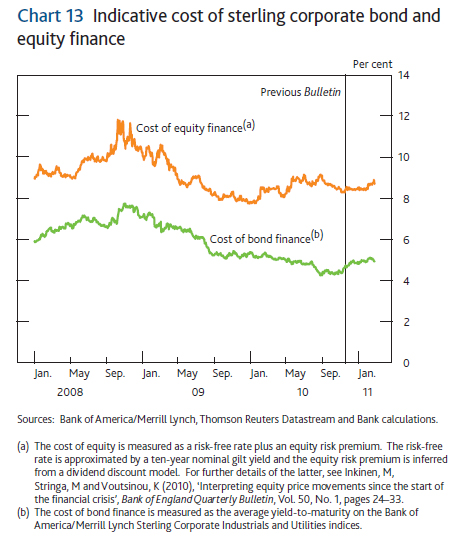
In the United Kingdom, despite the reduction in sterling corporate bond spreads, the cost of corporate bond finance for investment-grade non-financial companies increased slightly, on account of the rise in government bond yields. An indicative measure of the nominal cost of equity finance for UK companies had also risen slightly (Chart 13).


Click for big
Market Action

March 21, 2011

No commentary today – sorry!

It was a strong day on the Canadian preferred share market, with PerpetualDiscounts gaining 16bp, FixedResets up 10bp and DeemedRetractibles winning 20bp. Volume was light – most investors (other than myself, of course) being too busy dancing naked in lascivious spring rites. Why don’t I ever get invited?

To my astonishment, not only did BMO.PR.J not crash heavily to earth after Friday’s fireworks, but it again topped the list of Performance Highlights! It now looks even more expensive and there is the possibility that there is more behind the story than a simple fat-finger or algo-gone-wild. A short squeeze, maybe? Unlikely, I know, but what else is there? A point against the short-squeeze story is that today’s buying – of 13,941 shares – was broadly based, with RBC taking the largest share with 4,005 shares. Friday’s buyer, Desjardins, bought 2,618 shares. It’s all very peculiar, but living in PreferredShareLand is a little like being the White Queen in Through the Looking Glass – one sometimes see six preposterous things before breakfast.

HIMIPref™ Preferred Indices
These values reflect the December 2008 revision of the HIMIPref™ Indices

Values are provisional and are finalized monthly
Index Mean
Current
Yield
(at bid)
Median
YTW
Median
Average
Trading
Value
Median
Mod Dur
(YTW)
Issues Day’s Perf. Index Value
Ratchet 0.00 % 0.00 % 0 0.00 0 0.0845 % 2,374.2
FixedFloater 0.00 % 0.00 % 0 0.00 0 0.0845 % 3,570.8
Floater 2.53 % 2.35 % 47,509 21.38 4 0.0845 % 2,563.5
OpRet 4.90 % 3.70 % 52,876 1.15 9 0.1599 % 2,394.8
SplitShare 5.11 % 3.25 % 155,387 1.00 5 -0.0038 % 2,474.6
Interest-Bearing 0.00 % 0.00 % 0 0.00 0 0.1599 % 2,189.8
Perpetual-Premium 5.74 % 5.60 % 137,236 6.21 10 0.0675 % 2,033.7
Perpetual-Discount 5.51 % 5.55 % 121,638 14.37 14 0.1581 % 2,120.4
FixedReset 5.17 % 3.54 % 245,446 2.95 57 0.1017 % 2,277.5
Deemed-Retractible 5.23 % 5.21 % 344,987 8.28 53 0.1962 % 2,082.3
Performance Highlights
Issue Index Change Notes
BAM.PR.R FixedReset -1.95 % YTW SCENARIO
Maturity Type : Limit Maturity
Maturity Date : 2041-03-21
Maturity Price : 25.10
Evaluated at bid price : 25.15
Bid-YTW : 4.95 %
IAG.PR.A Deemed-Retractible -1.03 % YTW SCENARIO
Maturity Type : Hard Maturity
Maturity Date : 2022-01-31
Maturity Price : 25.00
Evaluated at bid price : 22.10
Bid-YTW : 6.09 %
CM.PR.H Deemed-Retractible 1.06 % YTW SCENARIO
Maturity Type : Hard Maturity
Maturity Date : 2022-01-31
Maturity Price : 25.00
Evaluated at bid price : 24.75
Bid-YTW : 5.03 %
RY.PR.A Deemed-Retractible 1.11 % YTW SCENARIO
Maturity Type : Hard Maturity
Maturity Date : 2022-01-31
Maturity Price : 25.00
Evaluated at bid price : 23.62
Bid-YTW : 5.19 %
BAM.PR.J OpRet 1.20 % YTW SCENARIO
Maturity Type : Soft Maturity
Maturity Date : 2018-03-30
Maturity Price : 25.00
Evaluated at bid price : 26.21
Bid-YTW : 4.59 %
BMO.PR.J Deemed-Retractible 1.45 % YTW SCENARIO
Maturity Type : Hard Maturity
Maturity Date : 2022-01-31
Maturity Price : 25.00
Evaluated at bid price : 24.55
Bid-YTW : 4.78 %
Volume Highlights
Issue Index Shares
Traded
Notes
HSE.PR.A FixedReset 104,718 Recent new issue.
YTW SCENARIO
Maturity Type : Limit Maturity
Maturity Date : 2041-03-21
Maturity Price : 24.80
Evaluated at bid price : 24.85
Bid-YTW : 4.32 %
RY.PR.I FixedReset 80,264 Nesbitt crossed 75,000 at 26.20.
YTW SCENARIO
Maturity Type : Call
Maturity Date : 2014-03-26
Maturity Price : 25.00
Evaluated at bid price : 26.11
Bid-YTW : 3.53 %
BMO.PR.Q FixedReset 63,150 Scotia bought 10,000 from anonymous at 24.73; Nesbitt crossed 12,100 at 24.77.
YTW SCENARIO
Maturity Type : Hard Maturity
Maturity Date : 2022-01-31
Maturity Price : 25.00
Evaluated at bid price : 24.76
Bid-YTW : 3.91 %
TRP.PR.B FixedReset 59,416 Desjardins crossed 45,000 at 25.00.
YTW SCENARIO
Maturity Type : Limit Maturity
Maturity Date : 2041-03-21
Maturity Price : 24.89
Evaluated at bid price : 24.94
Bid-YTW : 3.83 %
TRP.PR.C FixedReset 56,128 Desjardins crossed 45,000 at 25.49.
YTW SCENARIO
Maturity Type : Call
Maturity Date : 2021-03-01
Maturity Price : 25.00
Evaluated at bid price : 25.45
Bid-YTW : 4.09 %
NA.PR.O FixedReset 41,359 Issuer bid.
YTW SCENARIO
Maturity Type : Call
Maturity Date : 2014-03-17
Maturity Price : 25.00
Evaluated at bid price : 28.30
Bid-YTW : 2.28 %
There were 26 other index-included issues trading in excess of 10,000 shares.
Wide Spread Highlights
Issue Index Quote Data and Yield Notes
BAM.PR.R FixedReset Quote: 25.15 – 26.11
Spot Rate : 0.9600
Average : 0.5791

YTW SCENARIO
Maturity Type : Limit Maturity
Maturity Date : 2041-03-21
Maturity Price : 25.10
Evaluated at bid price : 25.15
Bid-YTW : 4.95 %

TRI.PR.B Floater Quote: 22.90 – 23.75
Spot Rate : 0.8500
Average : 0.7032

YTW SCENARIO
Maturity Type : Limit Maturity
Maturity Date : 2041-03-21
Maturity Price : 22.66
Evaluated at bid price : 22.90
Bid-YTW : 2.26 %

GWO.PR.H Deemed-Retractible Quote: 23.20 – 23.48
Spot Rate : 0.2800
Average : 0.1973

YTW SCENARIO
Maturity Type : Hard Maturity
Maturity Date : 2022-01-31
Maturity Price : 25.00
Evaluated at bid price : 23.20
Bid-YTW : 5.77 %

PWF.PR.L Perpetual-Discount Quote: 23.75 – 24.12
Spot Rate : 0.3700
Average : 0.2982

YTW SCENARIO
Maturity Type : Limit Maturity
Maturity Date : 2041-03-21
Maturity Price : 23.52
Evaluated at bid price : 23.75
Bid-YTW : 5.44 %

BNS.PR.Z FixedReset Quote: 24.27 – 24.90
Spot Rate : 0.6300
Average : 0.5684

YTW SCENARIO
Maturity Type : Hard Maturity
Maturity Date : 2022-01-31
Maturity Price : 25.00
Evaluated at bid price : 24.27
Bid-YTW : 4.17 %

HSB.PR.D Deemed-Retractible Quote: 23.91 – 24.17
Spot Rate : 0.2600
Average : 0.2002

YTW SCENARIO
Maturity Type : Hard Maturity
Maturity Date : 2022-01-31
Maturity Price : 25.00
Evaluated at bid price : 23.91
Bid-YTW : 5.55 %

Issue Comments

DFN.PR.A Annual Report 2010

Dividend 15 Split Corp. has released its Annual Report to November 30, 2010.

DFN / DFN.PR.A Performance
Instrument One
Year
Three
Years
Five
Years
Whole Unit +11.32% -2.67% +2.66%
DFN.PR.A +5.38% +5.38% -+5.38%
DFN +18.02% -7.11% +0.87%
S&P TSX 60 Index +11.88% +0.31% +6.51%

I can’t help but think that the S&P TSX 60 is not a particularly good index for the fund (why not the S&P/TSX Canadian Dividend Aristocrats?) but despite reservations:

As a result of the Company being limited to a specific universe of stocks and that a covered call writing program is implemented to generate additional income, the investment profile of the Company is quite unique and any comparisons with any other external market indices may not be appropriate.

… the company made the choice so we’ll go with it … while remembering to check every year that it hasn’t been changed!

Figures of interest are:

MER: 1.19% of the whole unit value, excluding one time initial offering expenses. These boosted the whole-unit MER to 2.08%, but bypassed the income statement, being taken as a direct hit to shareholders’ equity. I suggest that the best way to handle this is to amortize the extra 0.89% over the remaining four years of the fund, and call the “analytical MER” 1.41%.

Average Net Assets: We need this to calculate portfolio yield; unfortunately the number of units changesd, which makes it more approximate. The Total Assets of the fund at year end was $269.4-million, compared to $219.6-million a year prior, so call it an average of $244.5-million. Total Preferred Share Distribution was $6.068-million, at $0.525/share implies an average of 11.56-million units, at an average NAV of ((19.21 + 16.83) / 2 = 18.02, so call it $208-million. That’s a big difference, but:

During March 2010, the Company issued 2,400,000 Class A and Preferred shares at a unit price of $21 for total net proceeds after the payment of agents fees of $48.4 million.

. March is about 1/3 of the way through the fiscal year, so the figure derived by preferred share distributions is probably more accurate, so let’s call the Average Net Assets $220-million.

Underlying Portfolio Yield: Dividends received of $9.08-million divided by average net assets of $220-million is 4.13%.

Income Coverage: Dividends of 9.08-million less expenses before issuance fees of 3.01-million is 6.07-million, to cover preferred dividends of 6.84-million is 89%

Issue Comments

FTU.PR.A Annual Report 2010

U.S. Financial 15 Split Corp. has released its Annual Report to November 30, 2010.

FTU / FTU.PR.A Performance
Instrument One
Year
Three
Years
Five
Years
Whole Unit -5.90% -29.45% -18.67%
FTU.PR.A -5.90% -12.00% -4.89%
FTU N/A -100.00% -100.00%
S&P 500 Financial Index -3.23% -19.88% -14.64%

An unusual feature of this fund is that it missed quite a few dividends on its preferred shares during the crisis – since these dividends are cumulative, they have been recorded as a liability on the company’s books. Hence:

The Company has 3,081,476 Preferred shares outstanding as at November 30, 2010 with a principal repayment target of $10 per Preferred share for a total of $30,814,760 due on the termination date, December 1, 2012. As at November 30, 2010, the Company has Net Assets equivalent to $5.54 per Preferred share for a total of $17,080,883. This represents a deficiency as at November 30, 2010 of $4.46 per Preferred share for a total deficiency of $13,733,927. An amount of $0.5624 per Preferred share in accrued cumulative dividends representing dividends not paid in previous years as at November 30, 2010 is also available to holders of Preferred shares on the termination date.

Thus, when calculating Market and Asset Coverage for the preferred shares, one must add the cumulated dividends to the published NAV – being very careful to check whether the company has made up any of the arrears since their year-end! There was one such payement in April, 2010, but none since.

Additionally, one may expect that the dividend yield of the underlying portfolio will increase significantly in the near future, as the Fed reduced restrictions on banks on March 18.

Figures of interest are:

MER: 1.50% of the whole unit value.

Average Net Assets: We need this to calculate portfolio yield; unfortunately the number of units changesd, which makes it more approximate. Additionally, the presence of the cumulated dividends makes the calculation more difficult. The Total Assets of the fund at year end was $19.0-million, compared to $24.0-million a year prior, so call it an average of $21.5-million. Total Preferred Share Distribution was $1.46-million, at $0.40/unit (four skipped distributions and one make-up distribution) implies an average of 3.65-million units, at an average NAV of ((5.54+0.56) + (6.50 + 0.56 – 0.125)) / 2 = 6.52, so call it $23.8-million. This is good agreement (considering all the adjustments!), call the average NAV $22-million.

Underlying Portfolio Yield: Dividends and interest received of $120,277 net of withholding divided by average net assets of 22-million is 0.55%.

Income Coverage: Dividends of 120,277 less expenses 290,947 is (170,670), to cover preferred dividends 3,081,476 shares at $0.525 dividend entitlement is less than negative 10.5%.

Issue Comments

PIC.PR.A Annual Report

Premium Income Corporation has released its Annual Report to October 31, 2010.

PIC / PIC.PR.A Performance
Instrument One
Year
Three
Years
Five
Years
Ten
Years
Whole Unit +15.07% -0.53% +3.17% +5.56%
PIC.PR.A +5.88% +5.88% +5.90% +5.97%
PIC +48.45% -7.46% +0.30% +5.51%
S&P/TSX Diversified Banks Index +18.52% +3.65% +8.45% +11.27%

Figures of interest are:

MER: 1.10% of the whole unit value, excluding the special resolution expense (incurred when extending term). With this expense, MER for 2010 was 1.44% – for analytical purposes, I suggest it’s best to amortize this and call the MER 1.17%.

Average Net Assets: We need this to calculate portfolio yield; unfortunately the number of units changesd, which makes it more approximate. The Net Asset Value at year end was $292.34-million, compared to $279.70 a year prior, so call it an average of $286.02-million. Total Preferred Share Distribution was $12.31-million, at $0.86/unit implies an average of $14.31-million units, at an average NAV of (20.56 + 19.15) / 2 = 19.86, so call it $284-million. This is good agreement, call the average NAV $285-million.

Underlying Portfolio Yield: Dividends and interest received of $12.4-million divided by average net assets of 285-million is 4.35%.

Income Coverage: Dividends & Interest of $12.4-million less expenses before resolution costs of $3.5-million is $8.9-million, to cover preferred dividends of $12.3-million is 72%.

Market Action

March 18, 2011

Teachers’ supports the TMX / LSE deal:

Specifically, we support the proposed merger for the following reasons:

  • It is important to ensure that Teachers’ and other investors have access to an effective, low cost trading platform to execute both cash and derivative trades. The combined exchange operator should be able to achieve economies of scale, lowering the cost of capital and trading costs.

What? Judging a company by what it does for its customers rather that the quality of jobs it provides its employees and suppliers? Why, that’s … that’s un-Canadian! The More-Subsidies government should revoke their citizenship, immediately and retroactively!

The Fed has relaxed dividend restrictions on large US bank holding companies:

The Federal Reserve on Friday announced it has completed the Comprehensive Capital Analysis and Review (CCAR), its cross-institution study of the capital plans of the 19 largest U.S. bank holding companies.

As a result of the CCAR, some firms are expected to increase or restart dividend payments, buy back shares, or repay government capital. The Federal Reserve on Friday will discuss the reviews and its decisions with firms that requested a capital action. All 19 firms will receive more detailed assessments of their capital planning processes next month.

In February 2009, the Federal Reserve advised bank holding companies that safety and soundness considerations required that dividends be substantially reduced or eliminated. Since that time, the Federal Reserve has indicated that increased capital distributions would generally not be considered prudent in the absence of a well-developed capital plan and a capital position that would remain strong even under adverse conditions.

There was immediate reaction:

JPMorgan Chase & Co. (JPM) and Wells Fargo & Co. (WFC) increased dividends and authorized share buybacks after the Federal Reserve reviewed the ability of the largest U.S. lenders to withstand another economic slump. Bank stocks rallied in New York trading.

Goldman Sachs Group Inc. (GS) said it got permission to buy back $5 billion of preferred stock sold to Warren Buffett’s Berkshire Hathaway Inc. in 2008.

And some took advantage of the market’s reaction:

KeyCorp (KEY), Ohio’s second-biggest bank, raised $625 million selling shares as part of a plan to repay a U.S. bailout after a Federal Reserve review of the company’s capital strength.

KeyCorp, based in Cleveland, sold 70.6 million shares of common stock at $8.85 each, the bank said today in a statement.

The Federal Reserve told KeyCorp it didn’t object to a plan to sell stock and issue debt to help repurchase $2.5 billion of preferred shares sold to the U.S. Treasury in 2008 as part of the Troubled Asset Relief Program, the company said in a statement. KeyCorp paid about $282 million in dividends to Treasury during the investment period.

KeyCorp advanced 7 cents to $8.92 as of 4 p.m. today in New York Stock Exchange composite trading before the announcement.

… and so did SunTrust:

SunTrust Banks Inc. (STI) raised $1.04 billion selling shares as part of a plan to repay $4.85 billion in U.S. bailout funds.

The lender, based in Atlanta, sold 35.3 million shares of common stock for $29.50 each, data compiled by Bloomberg show.

The Federal Reserve, which reviewed the financial strength of the largest U.S. lenders, didn’t object to SunTrust’s capital plan to sell the stock and issue a further $1 billion of debt, the bank said today in a statement. Repayment to the Troubled Asset Relief Program, which will also draw on “other available funds,” is subject to approval by the U.S. Treasury Department, the bank said.

SunTrust advanced $1.34, or 4.7 percent, to $29.59 as of 4 p.m. today in New York Stock Exchange composite trading before the announcement.

Regulators world-wide are seeking to expand their empires:

Michael Oxley, the former congressman who co-wrote the Sarbanes-Oxley Act of 2002, has registered as a lobbyist for the Financial Industry Regulatory Authority to promote self-regulation of investment advisers.

Oxley, a partner at Baker Hostetler LLP in Washington, registered this week as a Finra lobbyist, saying he would work on securities regulation and the “harmonization of regulation of broker-dealers and investment advisers,” according to his registration form. Finra oversees about 4,560 brokerage firms and is interested in expanding to investment advisers.

Salesmen should not have the same regulator as asset managers.

Today’s embarrassing news release is:

GMP Capital Inc. (“GMP”) (TSX: GMP and GMP.PR.B) announced that it has re-filed its audited financial statements and accompanying management’s discussion and analysis for the year ended December 31, 2010 to correct a calculation error relating to earnings per common share for 2009.

The correction relates to amounts recorded in connection with the redemption of GMP’s Series A preferred shares in December 2009. The amounts were charged to retained earnings, as required, but were not deducted in computing net income available to common shareholders. The earnings per common share (“EPS”) for 2009 has accordingly been revised from $0.64 per basic EPS and $0.59 per diluted EPS, as originally reported, to $0.52 per basic EPS and $0.48 per diluted EPS. The correction and re-filing has no effect on EPS for 2010 and does not otherwise affect GMP’s financial statements for the years ended 2010 and 2009.

On the whole, I would say that’s on a par with the Toronto Society of Financial Analysts repeated problems with their financial statements! It was just yesterday that Harris Fricker, CEO of GMP Capital, wrote an incomprehensible essay in the Globe trying to tell the TMX how to manage its business.

It was quite the day for BMO.PR.J!
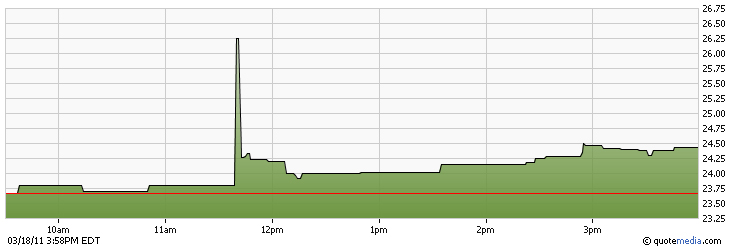

Click for big

BMO.PR.J was the best performing index-included preferred share for the day, trading 89,346 shares in a range of 23.78-26.25 (!) [It’s been a while seen we’ve seen $2+ ranges!] before closing at 24.20-43, 10×18. Thanks to Assiduous Reader GA for bringing this to my attention.

Was it Algos Gone Wild? Fat Finger? One way or another, Desjardins bought 19,500 shares at an average price of 24.60 in 24 pieces from 11:40:36 to 11:40:37 – the first piece executed at 23.81, the last at 26.23. Then two odd-lots traded at 26.25 (presumably the offering price, but I haven’t bought that data), indicating a separate order. The next batch of Desjardins’ buying was another 20,200 shares at an average price of 25.75 in 9 pieces from 11:40:37 to 11:40:48, starting at 24.20 (an algo coming in with a new offer?) and ending at 26.25. This sequence included 16,400 shares at the high for the day of 26.25. Kudos to Goldman Sachs, who – I’m guessing, but it’s a pretty confident kind of guess – has an algorithm trolling the alleyways just looking for this sort of thing and were the seller of the last four lots at 26.25, totalling 9,500 shares.

Or maybe it wasn’t a Goldman algorithm, but an iceberg, placed well off the market price some time every morning? Either way, they made about $20-grand.

Oh, and when I say “Desjardins” and “Goldman”, it might not have been their prop desks acting as principal – this might all have been client orders.

The Canadian preferred share market was strong today, with PerpetualDiscounts up 9bp, FixedResets gaining 14bp and DeemedRetractibles winning 37bp. Volume was light.

HIMIPref™ Preferred Indices
These values reflect the December 2008 revision of the HIMIPref™ Indices

Values are provisional and are finalized monthly
Index Mean
Current
Yield
(at bid)
Median
YTW
Median
Average
Trading
Value
Median
Mod Dur
(YTW)
Issues Day’s Perf. Index Value
Ratchet 0.00 % 0.00 % 0 0.00 0 -0.3250 % 2,372.2
FixedFloater 0.00 % 0.00 % 0 0.00 0 -0.3250 % 3,567.8
Floater 2.54 % 2.35 % 46,650 21.37 4 -0.3250 % 2,561.4
OpRet 4.91 % 3.51 % 54,639 0.36 9 0.0605 % 2,391.0
SplitShare 5.11 % 3.54 % 160,538 1.00 5 -0.1964 % 2,474.7
Interest-Bearing 0.00 % 0.00 % 0 0.00 0 0.0605 % 2,186.3
Perpetual-Premium 5.75 % 5.63 % 129,733 13.90 10 0.0656 % 2,032.4
Perpetual-Discount 5.52 % 5.55 % 121,975 14.40 14 0.0944 % 2,117.1
FixedReset 5.17 % 3.57 % 246,947 2.96 57 0.1367 % 2,275.2
Deemed-Retractible 5.24 % 5.27 % 350,128 8.28 53 0.3727 % 2,078.3
Performance Highlights
Issue Index Change Notes
W.PR.H Perpetual-Discount -1.03 % YTW SCENARIO
Maturity Type : Limit Maturity
Maturity Date : 2041-03-18
Maturity Price : 23.71
Evaluated at bid price : 24.01
Bid-YTW : 5.82 %
CM.PR.I Deemed-Retractible 1.00 % YTW SCENARIO
Maturity Type : Hard Maturity
Maturity Date : 2022-01-31
Maturity Price : 25.00
Evaluated at bid price : 24.15
Bid-YTW : 5.22 %
GWO.PR.G Deemed-Retractible 1.07 % YTW SCENARIO
Maturity Type : Hard Maturity
Maturity Date : 2022-01-31
Maturity Price : 25.00
Evaluated at bid price : 24.51
Bid-YTW : 5.45 %
RY.PR.G Deemed-Retractible 1.08 % YTW SCENARIO
Maturity Type : Hard Maturity
Maturity Date : 2022-01-31
Maturity Price : 25.00
Evaluated at bid price : 23.50
Bid-YTW : 5.30 %
BAM.PR.R FixedReset 1.10 % YTW SCENARIO
Maturity Type : Call
Maturity Date : 2016-07-30
Maturity Price : 25.00
Evaluated at bid price : 25.65
Bid-YTW : 4.81 %
CM.PR.J Deemed-Retractible 1.10 % YTW SCENARIO
Maturity Type : Hard Maturity
Maturity Date : 2022-01-31
Maturity Price : 25.00
Evaluated at bid price : 23.81
Bid-YTW : 5.18 %
RY.PR.B Deemed-Retractible 1.17 % YTW SCENARIO
Maturity Type : Hard Maturity
Maturity Date : 2022-01-31
Maturity Price : 25.00
Evaluated at bid price : 24.14
Bid-YTW : 5.18 %
CIU.PR.C FixedReset 1.63 % YTW SCENARIO
Maturity Type : Limit Maturity
Maturity Date : 2041-03-18
Maturity Price : 24.85
Evaluated at bid price : 24.90
Bid-YTW : 3.92 %
SLF.PR.F FixedReset 1.72 % YTW SCENARIO
Maturity Type : Call
Maturity Date : 2014-07-30
Maturity Price : 25.00
Evaluated at bid price : 27.16
Bid-YTW : 3.25 %
BMO.PR.J Deemed-Retractible 2.28 % YTW SCENARIO
Maturity Type : Hard Maturity
Maturity Date : 2022-01-31
Maturity Price : 25.00
Evaluated at bid price : 24.20
Bid-YTW : 4.94 %
Volume Highlights
Issue Index Shares
Traded
Notes
HSE.PR.A FixedReset 540,247 New issue settled today.
YTW SCENARIO
Maturity Type : Limit Maturity
Maturity Date : 2041-03-18
Maturity Price : 24.80
Evaluated at bid price : 24.85
Bid-YTW : 4.37 %
BMO.PR.J Deemed-Retractible 89,346 Algos gone wild? See main post above for commentary. There were no blocks reported.
YTW SCENARIO
Maturity Type : Hard Maturity
Maturity Date : 2022-01-31
Maturity Price : 25.00
Evaluated at bid price : 24.20
Bid-YTW : 4.94 %
NA.PR.P FixedReset 83,515 Issuer bid.
YTW SCENARIO
Maturity Type : Call
Maturity Date : 2014-03-17
Maturity Price : 25.00
Evaluated at bid price : 28.27
Bid-YTW : 2.33 %
NA.PR.N FixedReset 81,700 Issuer bid.
YTW SCENARIO
Maturity Type : Call
Maturity Date : 2013-09-14
Maturity Price : 25.00
Evaluated at bid price : 26.98
Bid-YTW : 2.23 %
BMO.PR.Q FixedReset 75,020 Nesbitt bought 27,600 from Anonymous at 24.75.
YTW SCENARIO
Maturity Type : Hard Maturity
Maturity Date : 2022-01-31
Maturity Price : 25.00
Evaluated at bid price : 24.71
Bid-YTW : 3.97 %
PWF.PR.I Perpetual-Premium 40,800 Desjardins crossed 28,600 at 25.27.
YTW SCENARIO
Maturity Type : Call
Maturity Date : 2012-05-30
Maturity Price : 25.00
Evaluated at bid price : 25.31
Bid-YTW : 5.63 %
There were 26 other index-included issues trading in excess of 10,000 shares.
Wide Spread Highlights
Issue Index Quote Data and Yield Notes
TRI.PR.B Floater Quote: 22.90 – 23.75
Spot Rate : 0.8500
Average : 0.5422

YTW SCENARIO
Maturity Type : Limit Maturity
Maturity Date : 2041-03-18
Maturity Price : 22.66
Evaluated at bid price : 22.90
Bid-YTW : 2.26 %

W.PR.H Perpetual-Discount Quote: 24.01 – 24.37
Spot Rate : 0.3600
Average : 0.2670

YTW SCENARIO
Maturity Type : Limit Maturity
Maturity Date : 2041-03-18
Maturity Price : 23.71
Evaluated at bid price : 24.01
Bid-YTW : 5.82 %

FTS.PR.H FixedReset Quote: 25.00 – 25.30
Spot Rate : 0.3000
Average : 0.2097

YTW SCENARIO
Maturity Type : Limit Maturity
Maturity Date : 2041-03-18
Maturity Price : 24.95
Evaluated at bid price : 25.00
Bid-YTW : 4.08 %

BNS.PR.Z FixedReset Quote: 24.27 – 24.85
Spot Rate : 0.5800
Average : 0.5009

YTW SCENARIO
Maturity Type : Hard Maturity
Maturity Date : 2022-01-31
Maturity Price : 25.00
Evaluated at bid price : 24.27
Bid-YTW : 4.20 %

BAM.PR.P FixedReset Quote: 27.07 – 27.37
Spot Rate : 0.3000
Average : 0.2214

YTW SCENARIO
Maturity Type : Call
Maturity Date : 2014-10-30
Maturity Price : 25.00
Evaluated at bid price : 27.07
Bid-YTW : 4.45 %

NA.PR.L Deemed-Retractible Quote: 24.55 – 24.85
Spot Rate : 0.3000
Average : 0.2230

YTW SCENARIO
Maturity Type : Hard Maturity
Maturity Date : 2022-01-31
Maturity Price : 25.00
Evaluated at bid price : 24.55
Bid-YTW : 5.15 %

Data Changes

NEW.PR.C Added to HIMIPref™ Database

I have added NEW.PR.C to the HIMIPref™ database, as the soon to expire warrant offering is in the money and can be expected to increase the number of shares – and hence the Average Trading Value – dramatically.

NEW.PR.C commenced trading 2009-6-26 after a prospectus dated 2009-6-16.

Issue price of 13.70, annual dividend of 0.822 paid quarterly, hence coupon of 6%.

Maturity date 2014-6-26; redeemable every June 26 at par.

Rated Pfd-2 by DBRS continuously since inception.

Monthly Retraction with a formula of 95%NAV – C – 1. Oddly, there is no maximum price! There is a Special Annual Concurrent Retraction (including a Capital Share) at NAV.

The dividend policy is:

The Class A Capital Shares provide their holders with a leveraged investment, the value of which is linked to changes in the market price of the Portfolio Shares. Holders of Class A Capital Shares will be entitled on redemption to the benefit of any capital appreciation in the market price of the Portfolio Shares. The fixed distributions on the Series 2 Preferred Shares will be funded from the dividends received on the Portfolio Shares. If necessary, any shortfall in the dividends on the Series 2 Preferred Shares will be funded by proceeds from the sale of Portfolio Shares. In the event that the Portfolio Share dividends exceed the amount of the fixed Series 2 Preferred Share dividends and all expenses of the Company, the excess amount may be paid as dividends on the Class A Capital Shares, as determined by the Board of Directors of the Company, subject to the dividend policy of the Board of Directors.

NEW.PR.C has been assigned initially to the Scraps index, but may migrate shortly to the SplitShares index.

There will be those, I know, who will be pleased to point out that this back-dated addition of an issue adds a little selection bias to the HIMIPref™ database, to which I am forced to respond: “Your mother wears army boots!”. I NEED DATA, and with the recent disappearance of SXT.PR.A and the imminent disappearance of MUH.PR.A, I need it badly. I hope that following the warrant expiry, NEW.PR.C will be liquid enough to trade, at least in small pieces.