Market Action

December 16, 2010

Looks like efforts to determine whodunnit have broken down amidst political jockeying:

Democrats and Republicans on the Financial Crisis Inquiry Commission, struggling for months to find consensus behind the scenes, haven’t even been able to agree on whether to include the phrases “Wall Street” and “shadow banking” in the final report. The report is now scheduled to be published in January and is likely to include dissents, FCIC members said yesterday.

The four Republicans on the 10-member panel made their views public in a nine-page document yesterday, saying they place much of the blame for the 2008 crisis on the government and mortgage firms Fannie Mae and Freddie Mac rather than banks.

The dissent itself commences with something sensible:

Bubbles happen. In retrospect, they always seem easy to identify, but as they are building, experts debate whether they exist—and, if so, why. The recent housing bubble was no different. Despite national home price appreciation well above the historical trend for almost a decade, and local markets with even more pronounced price swings, most homeowners and mortgage investors believed there were sound fundamentals underpinning their investments.

… and to a large extent blame the elephant:

There were three important ways that the government pushed investors toward investing in mortgage debt. First, the regulatory capital requirements associated with mortgage debt were lower than for other investments. Second, the government encouraged the private market to extend credit to previously underserved borrowers through a combination of legislation, regulation, and moral suasion. Third, and most important, during the bubble’s expansion, the largest investors in the mortgage market, the government-sponsored enterprises (GSEs)—Fannie Mae and Freddie Mac—were instruments of U.S. government housing policy.

All this is true. I’m disappointed to see that there is no criticism of structural problems in the US mortgage market: 30-year terms with the homeowner able to redeem at par at any time; no recourse to the borrower in the event of default; tax-deductibility of mortgage payments.

The Republicans address tranche retention:

Super-senior risk: The safest, “super-senior” tranches of mortgage-backed structured products were less attractive to investors because they did not provide a sufficient spread above other, safer securities, like U.S. Treasuries.

This looks like it’s glossing over some stuff, to put it mildly. Why is a brokerage creating products too expensive to sell? I don’t think we can paint the brokers as victims on this one.

As I have urged before, I believe there should be not one, but two regulatory regimes: one for banks, expected to buy-and-hold and surcharging trading activities; one for brokerages, expected to trade, surcharging aged inventory.

The Boston Fed has released a policy brief by Jihye Jeon, Judit Montoriol-Garriga, Robert K. Triest, and J. Christina Wang titled Evidence of a Credit Crunch? Results from the 2010 Survey of First District Community Banks:

This policy brief summarizes the findings of the Survey of Community Banks conducted by the Federal Reserve Bank of Boston in May 2010. This survey seeks to understand how the supply of, and demand for, bank business loans changed in the period following the financial crisis. The survey design focuses on assessing how much community banks were willing and able to lend to local businesses that used to be customers of large banks but lost access to credit in the aftermath of the financial crisis. The survey responses provide some evidence that lending standards for commercial loans have tightened moderately at community banks since late 2008, with the tightening being more severe for new customers than for those that already had a relationship with the respondent bank. The survey also reveals that expansions of several SBA guarantee programs since the crisis have ameliorated possible credit constraints on small businesses.

BIS has released the BIS Quarterly Review, December 2010 with features:

  • The $4 trillion question: what explains FX growth since the 2007 survey?
  • Derivatives in emerging markets
  • Counterparty risk and contract volumes in the credit default swap market
  • A user’s guide to the Triennial Central Bank Survey of foreign exchange
    market activity

Additionally, Basel III rules text and results of the quantitative impact study issued by the Basel Committee.

The Basel Committee issued today the Basel III rules text, which presents the details of global regulatory standards on bank capital adequacy and liquidity agreed by the Governors and Heads of Supervision, and endorsed by the G20 Leaders at their November Seoul summit. The Committee also published the results of its comprehensive quantitative impact study (QIS).

The rules text presents the details of the Basel III Framework, which covers both microprudential and macroprudential elements. The Framework sets out higher and better-quality capital, better risk coverage, the introduction of a leverage ratio as a backstop to the risk-based requirement, measures to promote the build up of capital that can be drawn down in periods of stress, and the introduction of two global liquidity standards.

With respect to the leverage ratio, the Committee will use the transition period to assess whether its proposed design and calibration is appropriate over a full credit cycle and for different types of business models. Based on the results of a parallel run period, any adjustments would be carried out in the first half of 2017 with a view to migrating to a Pillar 1 treatment on 1 January 2018 based on appropriate review and calibration.

OSFI notes:

As stated in the rules text, the BCBS is finalizing additional entry criteria related to non-viability contingent capital (NVCC) for instruments other than common equity. Once finalized, the additional criteria are to be added to the Basel III rules text. We currently expect this to occur early in 2011.
The Basel III rules affect the eligibility of instruments for inclusion in regulatory capital and provide for a transition and phase-out for instruments that do not meet the Basel III requirements. OSFI intends to adopt the Basel III changes in its domestic capital guidance for deposit-taking institutions (DTIs). As the Basel III rules text currently provides that the cap on non-qualifying capital will be applied to Tier 1 and Tier 2 instruments separately and refers to the total amount of non-qualifying capital, the finalization of rules related to NVCC may affect the operation of the cap on Tier 1 and Tier 2 non-qualifying instruments. Once the Basel III rules text governing NVCC requirements has been finalized by the BCBS, OSFI intends to issue guidance clarifying the phase-out of all non-qualifying instruments by DTIs, including OSFI’s expectations with respect to rights of redemption under regulatory event5 clauses.

This letter does not apply to regulated life insurance companies or insurance holding companies. While such insurers should be aware of developments related to DTIs on matters where OSFI has traditionally aligned its regulatory requirements (such as eligible capital instruments), OSFI intends to engage in consultation during 2011 before determining which Basel III rule changes will be applied to the life insurance industry and to thereafter issue guidance to insurers to reflect such changes.

The Feds are proposing Pooled Registered Pension Plans, which have been praised by insurance salemen in all walks of life. Blake’s explains:

The main items discussed in the Backgrounder are as follows:

1. Eligible Administrators of the PRPPs will be regulated financial institutions, including trust and insurance companies and other financial institutions with a trust subsidiary.
2. The Administrator will have a fiduciary duty to plan members.

3. The PRPPs will have a suitable low-cost default investment option for a broad group, and a manageable number of investment options for members to choose from.

4. Administrators will be required to provide all members with prescribed information on a regular, periodic basis.

5. There will be certain tasks that an employer that offers a PRPP must fulfill.

6. Employers may be permitted to enrol their employees into a PRPP at any stage of their employment and there may be rights of an employee to “opt out” shortly after enrolment.

7. The framework also provides that employers will have the ability to increase the employee’s default contribution rate from time to time, potentially subject to a new “opt out” right.

8. Employer contributions will be locked-in with some jurisdictions permitting what appears to be limited unlocking rights.

9. Jurisdictions will make a determination as to whether to require mandatory employer participation.

10. Employers contributing directly to a PRPP and their employees will be permitted to make contributions under the RPP limits, with the pension adjustment reporting. Self-employed persons and other employees will contribute on the basis of their available RRSP limit.”

The Canadian preferred share market had another poor day on high volume, with PerpetualDiscounts bearing the brunt of the losses. PerpetualDiscounts were down 32bp, while FixedResets lost 4bp.

HIMIPref™ Preferred Indices
These values reflect the December 2008 revision of the HIMIPref™ Indices

Values are provisional and are finalized monthly
Index Mean
Current
Yield
(at bid)
Median
YTW
Median
Average
Trading
Value
Median
Mod Dur
(YTW)
Issues Day’s Perf. Index Value
Ratchet 0.00 % 0.00 % 0 0.00 0 -0.0499 % 2,279.6
FixedFloater 4.78 % 3.47 % 28,230 19.06 1 -1.0435 % 3,520.4
Floater 2.62 % 2.40 % 49,500 21.23 4 -0.0499 % 2,461.4
OpRet 4.82 % 3.18 % 71,299 2.39 8 -0.3464 % 2,378.7
SplitShare 5.35 % 1.13 % 1,073,580 0.98 4 0.1111 % 2,443.7
Interest-Bearing 0.00 % 0.00 % 0 0.00 0 -0.3464 % 2,175.1
Perpetual-Premium 5.74 % 5.61 % 154,456 6.42 27 -0.1031 % 1,996.4
Perpetual-Discount 5.49 % 5.49 % 273,631 14.62 51 -0.3224 % 1,986.2
FixedReset 5.27 % 3.70 % 360,286 3.10 52 -0.0370 % 2,244.1
Performance Highlights
Issue Index Change Notes
ELF.PR.F Perpetual-Discount -2.16 % YTW SCENARIO
Maturity Type : Limit Maturity
Maturity Date : 2040-12-16
Maturity Price : 21.88
Evaluated at bid price : 22.16
Bid-YTW : 6.08 %
BAM.PR.I OpRet -1.83 % YTW SCENARIO
Maturity Type : Call
Maturity Date : 2011-01-15
Maturity Price : 25.50
Evaluated at bid price : 25.77
Bid-YTW : -9.88 %
ELF.PR.G Perpetual-Discount -1.72 % YTW SCENARIO
Maturity Type : Limit Maturity
Maturity Date : 2040-12-16
Maturity Price : 19.95
Evaluated at bid price : 19.95
Bid-YTW : 6.07 %
GWO.PR.G Perpetual-Discount -1.33 % YTW SCENARIO
Maturity Type : Limit Maturity
Maturity Date : 2040-12-16
Maturity Price : 22.81
Evaluated at bid price : 23.04
Bid-YTW : 5.65 %
POW.PR.B Perpetual-Discount -1.25 % YTW SCENARIO
Maturity Type : Limit Maturity
Maturity Date : 2040-12-16
Maturity Price : 23.42
Evaluated at bid price : 23.71
Bid-YTW : 5.73 %
RY.PR.B Perpetual-Discount -1.11 % YTW SCENARIO
Maturity Type : Limit Maturity
Maturity Date : 2040-12-16
Maturity Price : 22.20
Evaluated at bid price : 22.34
Bid-YTW : 5.31 %
BAM.PR.G FixedFloater -1.04 % YTW SCENARIO
Maturity Type : Limit Maturity
Maturity Date : 2040-12-16
Maturity Price : 25.00
Evaluated at bid price : 22.76
Bid-YTW : 3.47 %
IAG.PR.F Perpetual-Premium -1.04 % YTW SCENARIO
Maturity Type : Limit Maturity
Maturity Date : 2040-12-16
Maturity Price : 24.54
Evaluated at bid price : 24.76
Bid-YTW : 5.97 %
MFC.PR.C Perpetual-Discount -1.01 % YTW SCENARIO
Maturity Type : Limit Maturity
Maturity Date : 2040-12-16
Maturity Price : 19.64
Evaluated at bid price : 19.64
Bid-YTW : 5.77 %
BNA.PR.E SplitShare 1.03 % YTW SCENARIO
Maturity Type : Hard Maturity
Maturity Date : 2017-12-10
Maturity Price : 25.00
Evaluated at bid price : 24.50
Bid-YTW : 5.22 %
Volume Highlights
Issue Index Shares
Traded
Notes
TD.PR.C FixedReset 86,855 RBC crossed 70,000 at 26.70.
YTW SCENARIO
Maturity Type : Call
Maturity Date : 2014-03-02
Maturity Price : 25.00
Evaluated at bid price : 26.62
Bid-YTW : 3.66 %
RY.PR.B Perpetual-Discount 46,986 RBC crosed 25,000 at 22.34.
YTW SCENARIO
Maturity Type : Limit Maturity
Maturity Date : 2040-12-16
Maturity Price : 22.20
Evaluated at bid price : 22.34
Bid-YTW : 5.31 %
MFC.PR.B Perpetual-Discount 40,778 Desardins crossed 30,000 at 20.50.
YTW SCENARIO
Maturity Type : Limit Maturity
Maturity Date : 2040-12-16
Maturity Price : 20.45
Evaluated at bid price : 20.45
Bid-YTW : 5.72 %
SLF.PR.C Perpetual-Discount 40,290 RBC crossed 25,000 at 19.45.
YTW SCENARIO
Maturity Type : Limit Maturity
Maturity Date : 2040-12-16
Maturity Price : 19.40
Evaluated at bid price : 19.40
Bid-YTW : 5.76 %
CM.PR.H Perpetual-Discount 31,320 RBC crossed 25,000 at 22.15.
YTW SCENARIO
Maturity Type : Limit Maturity
Maturity Date : 2040-12-16
Maturity Price : 21.75
Evaluated at bid price : 22.04
Bid-YTW : 5.51 %
POW.PR.B Perpetual-Discount 30,900 RBC crossed 25,000 at 23.80.
YTW SCENARIO
Maturity Type : Limit Maturity
Maturity Date : 2040-12-16
Maturity Price : 23.42
Evaluated at bid price : 23.71
Bid-YTW : 5.73 %
There were 51 other index-included issues trading in excess of 10,000 shares.
Issue Comments

CPX.PR.A Closes Firm on Good Volume

Capital Power Corporation has announced:

that it has closed its previously announced offering of 5,000,000 Cumulative Rate Reset Preference Shares, Series 1 (the “Series 1 Shares”) at a price of $25 per Series 1 Share (the “Offering”) for aggregate gross proceeds of $125 million on a bought deal basis with a syndicate of underwriters, led by TD Securities Inc. and RBC Capital Markets.

CPX.PR.A is a FixedReset 4.60%+217 announced December 1. The issue traded 262,349 shares in a range of 24.85-95 before closing at 24.88-90, 4×116.

Vital statistics are:

CPX.PR.A FixedReset YTW SCENARIO
Maturity Type : Limit Maturity
Maturity Date : 2040-12-16
Maturity Price : 24.83
Evaluated at bid price : 24.88
Bid-YTW : 4.59 %
Issue Comments

LBS.PR.A: Warrant Offering

Brompton Group has announced:

that it has filed a preliminary prospectus relating to an offering of warrants to Class A shareholders of the Company. Each Class A shareholder will receive one half of a warrant for each Class A share held on a record date which will be set upon filing of the final prospectus.

One warrant will entitle the holder to purchase a Unit (consist ing of one Class A share and one Preferred share of the Company) upon payment of the subscription price, which will be determined as the lesser of:
(i) $18.87 (which is the sum of (a) the most recently calculated NAV per Unit prior to the date hereof and
(b) the estimated per Unit fees and expenses of the offering), and (ii) the most recently calculated NAV per Unit prior to the date of filing the final prospectus plus the estimated per Unit fees and expenses of the offering. The Company has applied to list the warrants and the Class A shares and Preferred shares issuable on the exercise thereof on the TSX.

Successful completion of the warrants offering will provide the Company with additional capital that can be used to take advantage of attractive investment opportunities and it is also expected to increase the trading liquidity of the Class A shares and Preferred shares and reduce the ongoing management expense ratio of the Company.

There is no word yet regarding the exercise date of the warrants, but with the last one the warrants were outstanding for about a month.

LBS.PR.A was last mentioned on PrefBlog at the time of their warrant offering five months ago, which was something of a fizzle. LBS.PR.A is tracked by HIMIPref™ but is relegated to the Scraps index on credit concerns.

Market Action

December 15, 2010

The Financial Post published an interesting factoid on Canadas:

Canadian 10-year yields gained 47 basis points to 3.28% today, from 2.81% on Nov. 4, the day after the Fed unveiled plans to buy US$600-billion in Treasuries through June to spur economic growth. The yields are rising so fast they exceed all 18 of the March 2011 forecasts of economists in a Bloomberg survey. The highest, from Kurt Karl, Swiss Re’s chief U.S. economist, calls for yields at 3.2% by then. The weighted average estimate is 2.95%.

The Boston Fed has released a four-part video lecture on the Great Recession. I must say, I’m pleased and impressed at this sort of outreach programme – I prefer written commentary myself, but I know most people prefer video. We never see anything like this in Canada … pity.

TD CEO Ed Clark announced today that he is an enthusiastic proponent of moral hazard:

If policy makers want Canadians to stop borrowing too much, it’s up to Ottawa, not financial institutions, to force a change in behaviour, says one of Bay Street’s longest-serving senior bankers.

Toronto-Dominion Bank chief executive officer Ed Clark acknowledged Canadians’ alarming debt levels, but said the issue is a matter of public policy and would be best resolved by a tighter government rules on residential mortgages.

In an interview with The Globe and Mail, Mr. Clark said that no bank wants to be the first to impose stricter requirements on borrowers out of fear that it will suffer a major loss of customers to rivals. Personal banking “is a highly competitive industry,” Mr. Clark said. “If we said ‘Look, we’re going to be heroes and save Canada from itself, and we’ll impose a whole new [mortgage] regime on everyone else,’ the other four [large] banks would say ‘Let’s carve them up.’ ”

Listen up, Mr. Clark! Nobody wants or needs you to save Canada from itself. You’re being paid a rather fat salary to save TD Bank from itself. Why are you so eager to make mortgage loans to poor credits? Why are you so worried that the poor credits will stampede to other banks, leaving TD in the miserable position of having a high quality mortgage portfolio?

Mr. Clark proposes government action, citing rules on credit cards as an example of where the banks follow whatever guidelines are provided. The Canadian banking system is run by “adults” who are able to come together and work with the government to guide the process, he said, so there is no trouble sitting everyone down at the same table.

The Canadian banking system is run by weak-kneed oligarchy of idiots, who have the idea that tough management consists of begging Mama to tell them what to do.

Naturally, the Globe and Mail is quick to urge arbitrary measures:

From Gordon Nixon of Royal Bank of Canada, to Ed Clark of Toronto-Dominion Bank, to William Downe of Bank of Montreal, chief executives of big banks are all on the record with some version of the same refrain: Something needs to be done to slow the growth in consumer debt.

So who can do it? The banks, you say? They could just turn down customers seeking loans more often. It’s not going to happen. Saying no would make the banks the bad guys. Plus, the bank executives are wont to point out, probably rightly, that competitive pressures mean that even if one says no, another will probably say yes.

If the government is to do anything, it has two logical measures: tighten up the rules on the risk-weighting of loans (via OSFI) and/or charge more to insure risky mortgages (via the CMHC). Early on in the US housing crunch, I suggested a regime whereby 25% (or so) capital was required on mortgages. If the consumer didn’t put it up as a down payment, then the required amount gets deducted, dollar for dollar, from the bank’s tier 1 capital. That’s the capital part of the loan. Then the rest gets risk-weighted as a normal mortgage.

More and more, I’m seeing a move towards central planning. It always sounds good and it never works.

Good news on the Canadian preferred share market today, as investors lost less than usual on continued elevated volume. PerpetualDiscounts were down 15bp, while FixedResets managed to gain a whopping 3bp.

PerpetualDiscounts now yield 5.48%, equivalent to 7.67% interest at the standard equivalency factor of 1.4x. Long Corporates now yield about 5.6%, so the pre-tax interest-equivalent spread (also called the Seniority Spread) is now about 210bp, a widening from the 200bp reported December 8 as long corporate yields increased but interest-equivalent PerpetualDiscount yields increased more.

HIMIPref™ Preferred Indices
These values reflect the December 2008 revision of the HIMIPref™ Indices

Values are provisional and are finalized monthly
Index Mean
Current
Yield
(at bid)
Median
YTW
Median
Average
Trading
Value
Median
Mod Dur
(YTW)
Issues Day’s Perf. Index Value
Ratchet 0.00 % 0.00 % 0 0.00 0 -0.0130 % 2,280.8
FixedFloater 4.73 % 3.22 % 27,886 18.99 1 0.0000 % 3,557.5
Floater 2.62 % 2.40 % 51,467 21.23 4 -0.0130 % 2,462.6
OpRet 4.80 % 3.20 % 73,752 2.39 8 0.2991 % 2,387.0
SplitShare 5.35 % 1.12 % 1,117,248 0.98 4 0.0303 % 2,441.0
Interest-Bearing 0.00 % 0.00 % 0 0.00 0 0.2991 % 2,182.7
Perpetual-Premium 5.73 % 5.62 % 155,957 6.42 27 0.2459 % 1,998.5
Perpetual-Discount 5.47 % 5.48 % 275,113 14.65 51 -0.1474 % 1,992.7
FixedReset 5.27 % 3.68 % 363,640 3.10 52 0.0268 % 2,244.9
Performance Highlights
Issue Index Change Notes
RY.PR.F Perpetual-Discount -1.58 % YTW SCENARIO
Maturity Type : Limit Maturity
Maturity Date : 2040-12-15
Maturity Price : 21.44
Evaluated at bid price : 21.75
Bid-YTW : 5.15 %
RY.PR.A Perpetual-Discount -1.15 % YTW SCENARIO
Maturity Type : Limit Maturity
Maturity Date : 2040-12-15
Maturity Price : 21.43
Evaluated at bid price : 21.43
Bid-YTW : 5.24 %
GWO.PR.H Perpetual-Discount -1.13 % YTW SCENARIO
Maturity Type : Limit Maturity
Maturity Date : 2040-12-15
Maturity Price : 22.65
Evaluated at bid price : 22.84
Bid-YTW : 5.32 %
TRP.PR.C FixedReset 1.12 % YTW SCENARIO
Maturity Type : Limit Maturity
Maturity Date : 2040-12-15
Maturity Price : 25.25
Evaluated at bid price : 25.30
Bid-YTW : 4.03 %
MFC.PR.C Perpetual-Discount 1.38 % YTW SCENARIO
Maturity Type : Limit Maturity
Maturity Date : 2040-12-15
Maturity Price : 19.84
Evaluated at bid price : 19.84
Bid-YTW : 5.71 %
FTS.PR.G FixedReset 1.87 % YTW SCENARIO
Maturity Type : Call
Maturity Date : 2013-10-01
Maturity Price : 25.00
Evaluated at bid price : 25.67
Bid-YTW : 4.26 %
GWO.PR.L Perpetual-Premium 7.16 % Merely a reversal of yesterday‘s nonsense.
YTW SCENARIO
Maturity Type : Limit Maturity
Maturity Date : 2040-12-15
Maturity Price : 24.19
Evaluated at bid price : 24.40
Bid-YTW : 5.80 %
Volume Highlights
Issue Index Shares
Traded
Notes
MFC.PR.D FixedReset 169,481 Nesbitt crossed 150,000 at 26.75.
YTW SCENARIO
Maturity Type : Call
Maturity Date : 2014-07-19
Maturity Price : 25.00
Evaluated at bid price : 26.75
Bid-YTW : 4.51 %
CIU.PR.C FixedReset 126,400 Recent new issue.
YTW SCENARIO
Maturity Type : Limit Maturity
Maturity Date : 2040-12-15
Maturity Price : 23.11
Evaluated at bid price : 24.95
Bid-YTW : 3.63 %
TRP.PR.A FixedReset 105,906 Nesbitt crossed 100,000 at 25.85.
YTW SCENARIO
Maturity Type : Call
Maturity Date : 2015-01-30
Maturity Price : 25.00
Evaluated at bid price : 25.82
Bid-YTW : 3.68 %
TD.PR.M OpRet 103,553 Nesbitt crossed 100,000 at 25.85.
YTW SCENARIO
Maturity Type : Call
Maturity Date : 2011-05-30
Maturity Price : 25.50
Evaluated at bid price : 25.77
Bid-YTW : 3.55 %
MFC.PR.A OpRet 72,203 Nesbitt crossed 35,000 at 25.65; then bought 17,500 from TD at the same price.
YTW SCENARIO
Maturity Type : Soft Maturity
Maturity Date : 2015-12-18
Maturity Price : 25.00
Evaluated at bid price : 25.64
Bid-YTW : 3.55 %
SLF.PR.E Perpetual-Discount 69,003 Nesbitt crossed 26,000 at 19.66 and 25,000 at 19.69.
YTW SCENARIO
Maturity Type : Limit Maturity
Maturity Date : 2040-12-15
Maturity Price : 19.68
Evaluated at bid price : 19.68
Bid-YTW : 5.74 %
There were 49 other index-included issues trading in excess of 10,000 shares.
Issue Comments

EN.PR.A To Be Redeemed on Schedule, December 16

Energy Split Corp. II has announced:

that the redemption prices for all outstanding Capital Yield Shares and ROC Preferred Shares to be paid on December 16, 2010 are as follows:

Redemption Price per ROC Preferred Share: $13.74

Redemption Price per Capital Yield Share: $9.86

The Capital Yield Shares and ROC Preferred Shares are listed for trading on The Toronto Stock Exchange under the symbols EN and EN.PR.A, respectively. The Capital Yield Shares and ROC Preferred Shares will be de-listed from the Toronto Stock Exchange as at the close of trading on December 16, 2010.

EN.PR.A was last mentioned on PrefBlog last December when there was a tiny partial redemption. EN.PR.A has been tracked by HIMIPref™, but relegated to the Scraps index on volume concerns – there were less than 1-million shares outstanding.

Market Action

December 14, 2010

The FOMC Statement held no surprises:

To promote a stronger pace of economic recovery and to help ensure that inflation, over time, is at levels consistent with its mandate, the Committee decided today to continue expanding its holdings of securities as announced in November. The Committee will maintain its existing policy of reinvesting principal payments from its securities holdings. In addition, the Committee intends to purchase $600 billion of longer-term Treasury securities by the end of the second quarter of 2011, a pace of about $75 billion per month. The Committee will regularly review the pace of its securities purchases and the overall size of the asset-purchase program in light of incoming information and will adjust the program as needed to best foster maximum employment and price stability.

The Committee will maintain the target range for the federal funds rate at 0 to 1/4 percent and continues to anticipate that economic conditions, including low rates of resource utilization, subdued inflation trends, and stable inflation expectations, are likely to warrant exceptionally low levels for the federal funds rate for an extended period.

Voting against the policy was Thomas M. Hoenig. In light of the improving economy, Mr. Hoenig was concerned that a continued high level of monetary accommodation would increase the risks of future economic and financial imbalances and, over time, would cause an increase in long-term inflation expectations that could destabilize the economy.

It occurs to me that Mr. Hoenig is being used – probably with his enthusiastic cooperation – as a straw man. The Fed wants to send an explicit signal that they’ve thought about this, discussed this and reached a concensus to reject this. There’s no shortage of blogs out there claiming hyperinflation is imminent! Given the increased public discussion of economic data, with various levels of competence, one wonders if more public pronouncements by governments and their agencies will set up straw men in their releases and recognize that forecasts are necessarily imprecise.

“The Cabinet today decided that all protesters at G-20 meetings held in Canada will be billy-clubbed. Voting against the motion was the Public Safety Commissioner, who wished to place land-mines in approved protest areas”.

Oh boy, this is just like the old days! The Canadian preferred share market got clobbered today, with PerpetualDiscounts losing 70bp and FixedResets down 12bp. Volume continued at elevated levels.

HIMIPref™ Preferred Indices
These values reflect the December 2008 revision of the HIMIPref™ Indices

Values are provisional and are finalized monthly
Index Mean
Current
Yield
(at bid)
Median
YTW
Median
Average
Trading
Value
Median
Mod Dur
(YTW)
Issues Day’s Perf. Index Value
Ratchet 0.00 % 0.00 % 0 0.00 0 0.0499 % 2,281.1
FixedFloater 4.73 % 3.22 % 27,492 19.00 1 0.0000 % 3,557.5
Floater 2.62 % 2.40 % 52,063 21.23 4 0.0499 % 2,463.0
OpRet 4.82 % 3.40 % 70,159 2.39 8 -0.1060 % 2,379.8
SplitShare 5.35 % 1.12 % 1,162,643 0.98 4 2.4532 % 2,440.3
Interest-Bearing 0.00 % 0.00 % 0 0.00 0 -0.1060 % 2,176.1
Perpetual-Premium 5.75 % 5.62 % 154,216 13.76 27 -0.4668 % 1,993.6
Perpetual-Discount 5.46 % 5.49 % 274,996 14.68 51 -0.7021 % 1,995.6
FixedReset 5.27 % 3.63 % 369,356 3.16 52 -0.1246 % 2,244.3
Performance Highlights
Issue Index Change Notes
GWO.PR.L Perpetual-Premium -8.07 % Just another dumb quote. the issue traded 1,610 shares today in a range of 24.70-91 before being quoted at 22.77-24.71. No rants today. I’m getting closer to solving the puzzle … just need the results of one more inquiry.
YTW SCENARIO
Maturity Type : Limit Maturity
Maturity Date : 2040-12-14
Maturity Price : 22.64
Evaluated at bid price : 22.77
Bid-YTW : 6.22 %
FTS.PR.G FixedReset -2.14 % YTW SCENARIO
Maturity Type : Limit Maturity
Maturity Date : 2040-12-14
Maturity Price : 25.11
Evaluated at bid price : 25.20
Bid-YTW : 4.59 %
TD.PR.O Perpetual-Discount -1.95 % YTW SCENARIO
Maturity Type : Limit Maturity
Maturity Date : 2040-12-14
Maturity Price : 22.88
Evaluated at bid price : 23.09
Bid-YTW : 5.31 %
SLF.PR.D Perpetual-Discount -1.87 % YTW SCENARIO
Maturity Type : Limit Maturity
Maturity Date : 2040-12-14
Maturity Price : 19.43
Evaluated at bid price : 19.43
Bid-YTW : 5.75 %
GWO.PR.I Perpetual-Discount -1.67 % YTW SCENARIO
Maturity Type : Limit Maturity
Maturity Date : 2040-12-14
Maturity Price : 20.55
Evaluated at bid price : 20.55
Bid-YTW : 5.50 %
PWF.PR.K Perpetual-Discount -1.54 % YTW SCENARIO
Maturity Type : Limit Maturity
Maturity Date : 2040-12-14
Maturity Price : 22.29
Evaluated at bid price : 22.45
Bid-YTW : 5.59 %
RY.PR.W Perpetual-Discount -1.45 % YTW SCENARIO
Maturity Type : Limit Maturity
Maturity Date : 2040-12-14
Maturity Price : 22.83
Evaluated at bid price : 23.06
Bid-YTW : 5.35 %
HSB.PR.D Perpetual-Discount -1.45 % YTW SCENARIO
Maturity Type : Limit Maturity
Maturity Date : 2040-12-14
Maturity Price : 22.94
Evaluated at bid price : 23.15
Bid-YTW : 5.41 %
CM.PR.J Perpetual-Discount -1.44 % YTW SCENARIO
Maturity Type : Limit Maturity
Maturity Date : 2040-12-14
Maturity Price : 21.23
Evaluated at bid price : 21.23
Bid-YTW : 5.38 %
RY.PR.C Perpetual-Discount -1.41 % YTW SCENARIO
Maturity Type : Limit Maturity
Maturity Date : 2040-12-14
Maturity Price : 21.62
Evaluated at bid price : 21.62
Bid-YTW : 5.37 %
RY.PR.H Perpetual-Premium -1.36 % YTW SCENARIO
Maturity Type : Call
Maturity Date : 2017-06-23
Maturity Price : 25.00
Evaluated at bid price : 25.40
Bid-YTW : 5.45 %
SLF.PR.C Perpetual-Discount -1.31 % YTW SCENARIO
Maturity Type : Limit Maturity
Maturity Date : 2040-12-14
Maturity Price : 19.54
Evaluated at bid price : 19.54
Bid-YTW : 5.72 %
MFC.PR.C Perpetual-Discount -1.31 % YTW SCENARIO
Maturity Type : Limit Maturity
Maturity Date : 2040-12-14
Maturity Price : 19.57
Evaluated at bid price : 19.57
Bid-YTW : 5.79 %
HSB.PR.C Perpetual-Discount -1.19 % YTW SCENARIO
Maturity Type : Limit Maturity
Maturity Date : 2040-12-14
Maturity Price : 23.04
Evaluated at bid price : 23.27
Bid-YTW : 5.49 %
RY.PR.D Perpetual-Discount -1.16 % YTW SCENARIO
Maturity Type : Limit Maturity
Maturity Date : 2040-12-14
Maturity Price : 21.25
Evaluated at bid price : 21.25
Bid-YTW : 5.35 %
RY.PR.E Perpetual-Discount -1.16 % YTW SCENARIO
Maturity Type : Limit Maturity
Maturity Date : 2040-12-14
Maturity Price : 21.25
Evaluated at bid price : 21.25
Bid-YTW : 5.35 %
RY.PR.G Perpetual-Discount -1.16 % YTW SCENARIO
Maturity Type : Limit Maturity
Maturity Date : 2040-12-14
Maturity Price : 21.30
Evaluated at bid price : 21.30
Bid-YTW : 5.34 %
BAM.PR.J OpRet -1.10 % YTW SCENARIO
Maturity Type : Soft Maturity
Maturity Date : 2018-03-30
Maturity Price : 25.00
Evaluated at bid price : 26.11
Bid-YTW : 4.66 %
RY.PR.A Perpetual-Discount -1.09 % YTW SCENARIO
Maturity Type : Limit Maturity
Maturity Date : 2040-12-14
Maturity Price : 21.68
Evaluated at bid price : 21.68
Bid-YTW : 5.18 %
BMO.PR.L Perpetual-Premium -1.04 % YTW SCENARIO
Maturity Type : Call
Maturity Date : 2017-06-24
Maturity Price : 25.00
Evaluated at bid price : 25.66
Bid-YTW : 5.41 %
SLF.PR.E Perpetual-Discount -1.01 % YTW SCENARIO
Maturity Type : Limit Maturity
Maturity Date : 2040-12-14
Maturity Price : 19.70
Evaluated at bid price : 19.70
Bid-YTW : 5.73 %
SLF.PR.G FixedReset 1.00 % YTW SCENARIO
Maturity Type : Limit Maturity
Maturity Date : 2040-12-14
Maturity Price : 25.20
Evaluated at bid price : 25.25
Bid-YTW : 3.87 %
CM.PR.K FixedReset 1.03 % YTW SCENARIO
Maturity Type : Call
Maturity Date : 2014-08-30
Maturity Price : 25.00
Evaluated at bid price : 26.60
Bid-YTW : 3.65 %
BNA.PR.E SplitShare 10.82 % Just a reversal of yesterday’s nonsense. Even after the price drop from Friday’s issue price of $25.00, it’s still hellishly expensive … BNA.PR.C is now quoted at 22.10-32, for a bid-side YTW of 6.25%.
YTW SCENARIO
Maturity Type : Hard Maturity
Maturity Date : 2017-12-10
Maturity Price : 25.00
Evaluated at bid price : 24.38
Bid-YTW : 5.30 %
Volume Highlights
Issue Index Shares
Traded
Notes
CIU.PR.A Perpetual-Discount 108,550 Nesbitt crossed 75,000 at 21.75.
YTW SCENARIO
Maturity Type : Limit Maturity
Maturity Date : 2040-12-14
Maturity Price : 21.44
Evaluated at bid price : 21.75
Bid-YTW : 5.32 %
POW.PR.D Perpetual-Discount 102,090 Desjardins crossed 73,900 at 22.75.
YTW SCENARIO
Maturity Type : Limit Maturity
Maturity Date : 2040-12-14
Maturity Price : 22.56
Evaluated at bid price : 22.75
Bid-YTW : 5.58 %
MFC.PR.B Perpetual-Discount 91,082 Nesbitt crossed 25,000 at 20.30; T crossed 49,000 at 20.34.
YTW SCENARIO
Maturity Type : Limit Maturity
Maturity Date : 2040-12-14
Maturity Price : 20.25
Evaluated at bid price : 20.25
Bid-YTW : 5.78 %
TD.PR.Q Perpetual-Premium 68,701 Nesbitt crossed 50,000 at 25.45.
YTW SCENARIO
Maturity Type : Call
Maturity Date : 2017-03-02
Maturity Price : 25.00
Evaluated at bid price : 25.40
Bid-YTW : 5.46 %
SLF.PR.A Perpetual-Discount 58,672 Desjardins crossed 38,500 at 20.92.
YTW SCENARIO
Maturity Type : Limit Maturity
Maturity Date : 2040-12-14
Maturity Price : 20.86
Evaluated at bid price : 20.86
Bid-YTW : 5.72 %
BNS.PR.N Perpetual-Discount 58,193 Desjardins crossed blocks of 35,000 and 11,200, both at 24.37.
YTW SCENARIO
Maturity Type : Limit Maturity
Maturity Date : 2040-12-14
Maturity Price : 23.98
Evaluated at bid price : 24.20
Bid-YTW : 5.50 %
There were 51 other index-included issues trading in excess of 10,000 shares.
Interesting External Papers

BoC Releases December 2010 Financial System Review

The Bank of Canada has released the December 2010 Financial System Review which includes reports on:

  • The Countercyclical Bank Capital Buffer: Insights for Canada
  • Strengthening the Infrastructure of Over-the-Counter Derivatives Markets
  • Central Counterparties and Systemic Risk
  • Contingent Capital and Bail-In Debt: Tools for Bank Resolution

The Bank identifies:

Four major interconnected sources of risk emanate from the external macrofinancial environment: (i) sovereign debt concerns in several countries; (ii) financial fragility associated with the weak global economic recovery; (iii) global imbalances; and (iv) the potential for excessive risk-taking behaviour arising from a prolonged period of exceptionally low interest rates in major advanced economies. The main domestic source of risk arises from the increasingly stretched financial position of Canadian households, which leaves them more vulnerable to adverse events

They identify a central contradiction in monetary policy:

While stimulative monetary policy is needed to support the global economic recovery, experience suggests that a long period of very low interest rates may be associated with excessive credit creation and undue risk-taking as investors seek higher returns, leading to the underpricing of risk and unsustainable increases in asset prices.

One wonders if they are sending a signal by picking on the insurers:

Institutional investors with liabilities having a duration exceeding that of their assets, such as life insurance companies and defined benefit pension plans, are particularly affected by a sustained period of low interest rates. In this environment, the combination of upward pressure on the actuarial value of contractual liabilities and reduced yields on assets is likely to put pressure on the balance sheets of these entities, and potentially encourage risk-taking behaviour as these institutions strive to achieve the minimum returns they have guaranteed to policyholders and beneficiaries.

… and then return to the theme:

In Canada, household credit has continued to expand rapidly during the recession and the early stages of the recovery. While this expansion—in contrast with the experience in previous downturns and in other advanced economies—is in part a testament to the resilience of Canada’s financial system, it is also an important source of risk. The proportion of households with stretched financial positions that leave them vulnerable to an adverse shock has grown significantly in recent years, as the growth rate of debt has outpaced that of disposable income. The risk is that a shock to economic conditions could be transmitted to the broader financial system through a deterioration in the credit quality of loans to households. This would prompt a tightening of credit conditions that could trigger a mutually reinforcing deterioration of real activity and financial stability.

So there’s an inherent contradiction here. In bad times, interest rates are lowered so that people will borrow more and spend it. But now they’re worried that the borrowers won’t be able to pay it back, in sufficient numbers to cause problems of its own.

Clearly, monetary policy is too blunt a tool to do much. The bank wants to encourage borrowing and spending, sure, but it wants to encourage productive borrowing and spending – and the Wrong Type of People are exploiting monetary policy and blowing their loan proceeds on houses, beer and prostitutes instead of on productive equipement.

This becomes a political issue. Accellerated Depreciation is being tried in the US:

Tax cuts intended for businesses are a relatively small part of the $858 billion tax bill scheduled for a final vote in the Senate as early as Tuesday.

The Joint Committee on Taxation estimated that about $75 billion of the tax breaks in the plan were aimed at businesses, including $13 billion for a two-year extension of the coveted research and development credit, which helps cover the cost of wages for employees involved in research. The proposal also commits $22 billion for accelerated depreciation, which in 2011 would allow businesses to write off 100 percent of their capital expenditures immediately instead of over several years.

Many economists are skeptical of the tax breaks’ potential to stoke the economy in any meaningful way. Businesses are sitting on more than a trillion in cash, but are reluctant to invest because of lagging demand, a problem that tax incentives are not devised to address.

“The research and development credit is a good thing, with a limited effect, and the accelerated depreciation will get people to move forward with investment that they probably would have done anyway,” said David Wyss, chief economist at Standard & Poor’s. “But when you look at the amount of money involved, you’re not getting a lot of bang for your buck.”

The BoC cheerfully concludes:

The probability of an adverse labour market shock materializing is judged to have edged higher in recent months, owing to the downward revision in the October Monetary Policy Report to the outlook for the global and Canadian economies. The Bank has conducted a partial stress-testing simulation to estimate the impact on household balance sheets of a hypothetical labour market shock that would increase the unemployment rate by 3 percentage points. The results suggest that the associated rise in financial stress among households would double the proportion of loans that are in arrears three months or more. Owing to the declining affordability of housing and the increasingly stretched financial positions of households, the probability of a negative shock to property prices has risen as well.

The Bank judges that, overall, the risk of a system-wide disturbance arising from financial stress in the household sector is elevated and has edged higher since June. This vulnerability is unlikely to decline quickly, given projections of subdued growth in income.

The section on the macro-financial environment has a few interesting things to say:

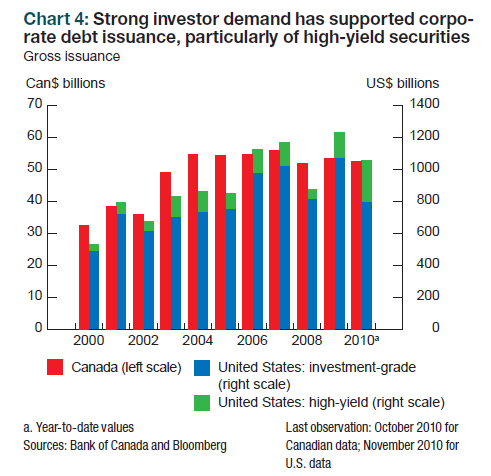
The current environment has supported elevated corporate bond issuance across the credit spectrum (Chart 4). In particular, issuance of U.S.-dollar high-yield debt has reached a historic high. The search for yield has also supported increased issuance of securities with longer maturities, especially in the most recent period.(1) Owing partly to the relative strength of Canada’s banking, corporate and government sectors, demand by foreign investors for Canadian debt securities remains robust.(2) A number of Canadian issuers, including some banks and provincial governments, have taken advantage of this strong international demand for Canadian debt products by accessing markets outside Canada.

1 For instance, 45 per cent of total corporate debt issued in the Canadian market in the third quarter had a maturity of 5 to 10 years, and 9 per cent a maturity of 30 years or more, compared with averages of 32 per cent and 3 per cent, respectively, since 1999.

2 Statistics Canada data show that, in the 12-month period ending in September 2010, nonresident investors purchased $105 billion in bonds in Canadian markets, compared with $43 billion over the same period in 2009.


Click for Big

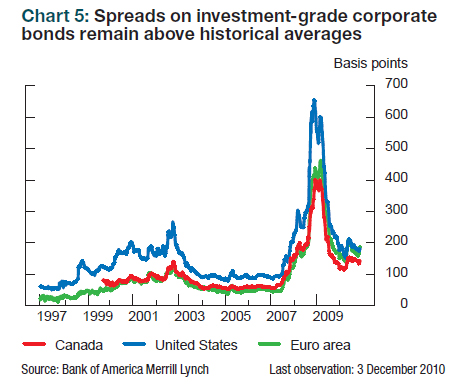
Not surprisingly, given the strength of demand, credit spreads have tightened further in Canada and in other key developed markets, although they generally remain above historical averages (Chart 5).(3) Assuming a 40 per cent recovery rate, the current spreads on North American indexes for corporate credit default swaps (CDS) imply a default rate for the next five years of 1.50 per cent per year for investment-grade issuers and 5.25 per cent per year for high-yield issuers. Based on historical data, these implied default rates, although well below the peaks reached in previous recessions, are higher than the average realized default rates.(4) Overall, this suggests that current pricing in corporate bond markets is consistent with expectations of a modest economic recovery in industrialized economies.

3 While corporate spreads in Canada and the euro area are above their levels from the early 2000s, U.S. spreads are somewhat lower, particularly for high-yield investors.

4 Default rates for high-yield issuers have peaked at about 12 per cent during every recession since 1990, and the average default rate since the 1980s has been 4.5 per cent. Moody’s reports that, for the period from 1989 to 2009, the average cumulative default rate over a five year window was 0.9 per cent for Canadian investment-grade issuers and 1 per cent for U.S. investment-grade issuers.


Click for Big

In contrast to the term extension for corporate issuers:

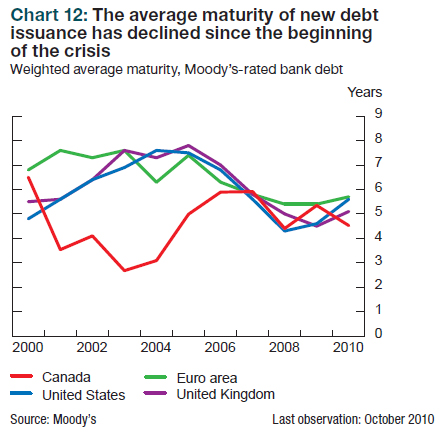
International banks continue to increase liquid assets and search for stable, longer-term funding, but progress has been slow. Many institutions still rely on wholesale funding, and the average maturity of new issuances has declined since the beginning of the crisis (Chart 12). Some small banks that have traditionally relied on retail deposits to finance their operations are facing stronger competition, given that the banking sector as a whole is seeking to improve the stability of its liquidity position by reducing its reliance on wholesale sources of funds.


Click for big

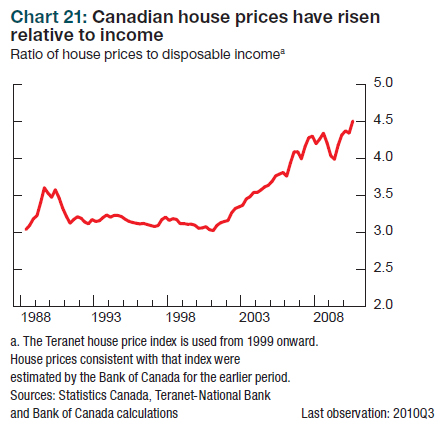
I’m including the next chart just because it’s cool:


Click for Big

Is monetary policy pushing on a string?

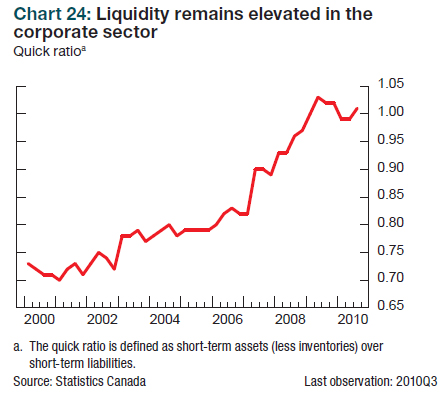
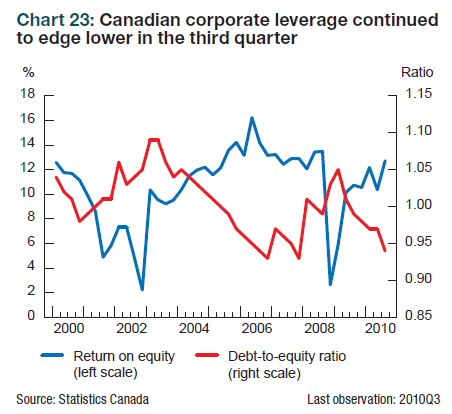
New information received since June indicates that the aggregate financial position of the Canadian non-financial corporate sector remains robust despite the recent slowdown in economic growth. The corporate sector appears well placed to withstand the financial consequences of adverse shocks. Corporate leverage declined in the third quarter of 2010, reaching the lowest ratio observed since the end of the financial crisis (Chart 23). Canadian corporate leverage, measured at market value, remains significantly below that of the United States, the United Kingdom and the euro area. Moreover, liquidity in the Canadian non-financial corporate sector—as measured by the ratio of short-term assets (less inventories) to short-term liabilities—remains elevated (Chart 24).


Click for Big
 
 
Click for Big

The individual reports are important enough that I’ll deal with them separately … some time.

Issue Comments

MFC Prefs Downgraded to P-2 / BBB by S&P

Standard & Poor’s has announced:

  • We believe that the prospective earnings profile of Manulife Financial’s U.S. operations will be weaker than we previously expected given the current economic environment.
  • In addition, we expect the volatility associated with Manulife Financial’s net earnings and capital to remain elevated over the intermediate term, until it makes more progress in reducing and containing its risks more in line with its updated risk tolerances.
  • We have lowered our counterparty credit and financial strength ratings on Manulife Financial’s core and guaranteed insurance operating subsidiaries to ‘AA-‘ from ‘AA’ and our counterparty credit rating on Manulife Financial (the holding company) to ‘A-‘ from ‘A’.
  • The outlook is stable.

This follows their Credit Watch Negative in November and the downgrade to P-2(high) in August.

Manulife has a fair batch of preferreds outstanding: MFC.PR.A, MFC.PR.B, MFC.PR.C, MFC.PR.D and MFC.PR.E.

Market Action

December 13, 2010

CalPERS, the gigantic California pension fund most notable for not doing its own credit analysis, has been told to take a running jump:

Judge Richard Kramer in San Francisco state court said yesterday that the companies’ ratings of three structured investment vehicles that the California Public Employees’ Retirement System lost money on are a form of speech about an issue of public interest that is protected under a state law designed to fend off cases meant to chill public debate.

The companies all gave their highest ratings to Cheyne Finance LLC, Stanfield Victoria Funding LLC and Sigma Finance Inc., prompting Calpers to invest $1.3 billion in them in 2006, the fund said in its complaint.

The Australian covered bond market is attracting attention:

Westpac Banking Corp., Commonwealth Bank of Australia, Australia & New Zealand Banking Group Ltd. and National Australia Bank Ltd. may be able to issue three-year covered bonds priced to yield about 50 basis points more than the bank bill swap rate, less than the 85 basis-point spread on senior debt, according to Royal Bank of Scotland Group Plc. Moody’s Investors Service estimates savings of 20 percent.

Covered bonds are “essential weapons as banks look for cheaper and more diversified sources of funding,” John Manning, a credit analyst at RBS in Sydney, said in a telephone interview. Even when global credit markets seized up, European banks “had good access to covered bond markets and were able to access the funding they required at quite commercially acceptable rates,” he said.

The Australian government will amend the law to let financiers issue the securities for the first time, Treasurer Wayne Swan said Dec. 12 as he announced an overhaul package aimed at spurring competition in the banking industry. Global sales of the securities, including Pfandbriefe, as they are known in Germany, have surged 33 percent to a record 329 billion euros ($435 billion) in 2010, according to data compiled by Bloomberg, as investors seek the relative safety of debt backed by both the issuer and an underlying pool of assets.

Investors in Europe demand 177 basis points of extra yield to hold covered bonds instead of government debt, according to Bank of America Merrill Lynch’s EMU Covered Bonds index. Spreads average 237 basis points, or 2.37 percentage points, on the region’s financial debt, a separate index shows.

Australia’s government will release draft amendments to the Banking Act to allow the sale of covered securities during the first sitting of Parliament next year, according to a federal document detailing the planned changes.

Allowing covered bonds will help “secure the long-term safety and sustainability” of Australia’s banking system, the document states. Treasury may impose a cap on the amount of covered bonds that each bank can sell, “for example five percent of an issuer’s total Australian assets,” it said.

Canadian Imperial Bank of Commerce raised A$750 million in October in the first sale of Australian dollar-denominated covered bonds since the start of the credit crisis in 2007. The Australian laws don’t block overseas banks issuing the notes.

The 5.75 percent notes due December 2013 were priced to yield 91.25 basis points more than similar-maturity government debt, according to a statement at the time. The spread has narrowed to 87 basis points, according to ANZ Bank prices on Bloomberg. A basis point is 0.01 percentage point.

It was clobberin’ time on the Canadian preferred share market, as high volume and losses continued. PerpetualDiscounts got smacked for 42bp, while FixedResets were down 10bp.

The most irritating news of the day was the closing quote on BNA.PR.E, which settled on Friday and has already been forgotten by the underwriters who made a nice little fee for flogging it. It traded 64,885 shares on the day in a range of 24.81-91. So far, so good, right? The closing quote was 22.00-24.80, 20×50. That’s a two dollar and eighty cent spread on issue that closed on the previous trading day. This is a disgrace; the market maker, the exchange and the underwriters should be ashamed of themselves.

One factoid of note is that Scotia was the only broker with any buying interest, responsible for 60,500 of the buy side, leaving only 4,385 for the rest of the street.

Meanwhile, remember GWO.PR.J? It was quoted Friday at 26.40-27.60 after trading 2,457 shares and today traded 5,764 shares in a range of 26.75-95 before closing with a quote of 26.80-60, 1×8.

This is simply not acceptable. Market makers get valuable privileges and if they want to keep them, should be required to earn them.

I have sent the following eMail to the Exchange:

Sirs,

I have not yet received a reply to the eMail below. Can you tell me when I might expect to receive it?

I note additionally that GWO.PR.J had a closing quote 26.40-27.60 on Friday and a quote of 26.80-60. Can you explain why you permit such incompetent market making?

I also note that BNA.PR.E, a new issue which settled on Friday, closed the second trading day of its existence with a quote of 22.00 – 24.80. Why does the Exchange permit such a lackadaisical attitude by those whom it rewards with market making privileges?

I sent the original eMail on December 2.

HIMIPref™ Preferred Indices
These values reflect the December 2008 revision of the HIMIPref™ Indices

Values are provisional and are finalized monthly
Index Mean
Current
Yield
(at bid)
Median
YTW
Median
Average
Trading
Value
Median
Mod Dur
(YTW)
Issues Day’s Perf. Index Value
Ratchet 0.00 % 0.00 % 0 0.00 0 0.2473 % 2,279.9
FixedFloater 4.73 % 3.22 % 27,662 19.00 1 0.0000 % 3,557.5
Floater 2.62 % 2.40 % 51,752 21.24 4 0.2473 % 2,461.7
OpRet 4.81 % 3.46 % 70,954 2.40 8 0.2896 % 2,382.4
SplitShare 5.49 % 0.73 % 118,649 0.99 4 -2.8850 % 2,381.8
Interest-Bearing 0.00 % 0.00 % 0 0.00 0 0.2896 % 2,178.5
Perpetual-Premium 5.72 % 5.61 % 156,596 6.43 27 -0.1549 % 2,002.9
Perpetual-Discount 5.42 % 5.42 % 272,507 14.74 51 -0.4207 % 2,009.7
FixedReset 5.26 % 3.62 % 365,525 3.11 52 -0.1026 % 2,247.1
Performance Highlights
Issue Index Change Notes
BNA.PR.E SplitShare -11.65 % A disgraceful quote that needs to be explained by the Exchange. See discussion in main post.

YTW SCENARIO
Maturity Type : Hard Maturity
Maturity Date : 2017-12-10
Maturity Price : 25.00
Evaluated at bid price : 22.00
Bid-YTW : 7.09 %

CM.PR.G Perpetual-Discount -1.90 % YTW SCENARIO
Maturity Type : Limit Maturity
Maturity Date : 2040-12-13
Maturity Price : 23.98
Evaluated at bid price : 24.26
Bid-YTW : 5.63 %
MFC.PR.E FixedReset -1.89 % YTW SCENARIO
Maturity Type : Call
Maturity Date : 2014-10-19
Maturity Price : 25.00
Evaluated at bid price : 26.00
Bid-YTW : 4.46 %
PWF.PR.E Perpetual-Discount -1.62 % YTW SCENARIO
Maturity Type : Limit Maturity
Maturity Date : 2040-12-13
Maturity Price : 23.24
Evaluated at bid price : 24.27
Bid-YTW : 5.70 %
GWO.PR.G Perpetual-Discount -1.34 % YTW SCENARIO
Maturity Type : Limit Maturity
Maturity Date : 2040-12-13
Maturity Price : 23.24
Evaluated at bid price : 23.50
Bid-YTW : 5.54 %
MFC.PR.D FixedReset -1.29 % YTW SCENARIO
Maturity Type : Call
Maturity Date : 2014-07-19
Maturity Price : 25.00
Evaluated at bid price : 26.76
Bid-YTW : 4.49 %
GWO.PR.M Perpetual-Premium -1.29 % YTW SCENARIO
Maturity Type : Limit Maturity
Maturity Date : 2040-12-13
Maturity Price : 24.31
Evaluated at bid price : 24.52
Bid-YTW : 5.93 %
SLF.PR.A Perpetual-Discount -1.17 % YTW SCENARIO
Maturity Type : Limit Maturity
Maturity Date : 2040-12-13
Maturity Price : 21.05
Evaluated at bid price : 21.05
Bid-YTW : 5.66 %
SLF.PR.C Perpetual-Discount -1.15 % YTW SCENARIO
Maturity Type : Limit Maturity
Maturity Date : 2040-12-13
Maturity Price : 19.80
Evaluated at bid price : 19.80
Bid-YTW : 5.64 %
SLF.PR.E Perpetual-Discount -1.14 % YTW SCENARIO
Maturity Type : Limit Maturity
Maturity Date : 2040-12-13
Maturity Price : 19.90
Evaluated at bid price : 19.90
Bid-YTW : 5.67 %
PWF.PR.F Perpetual-Discount -1.12 % YTW SCENARIO
Maturity Type : Limit Maturity
Maturity Date : 2040-12-13
Maturity Price : 23.53
Evaluated at bid price : 23.80
Bid-YTW : 5.58 %
TD.PR.S FixedReset -1.03 % YTW SCENARIO
Maturity Type : Call
Maturity Date : 2013-08-30
Maturity Price : 25.00
Evaluated at bid price : 25.95
Bid-YTW : 3.67 %
BNS.PR.K Perpetual-Discount 1.39 % YTW SCENARIO
Maturity Type : Limit Maturity
Maturity Date : 2040-12-13
Maturity Price : 23.11
Evaluated at bid price : 23.35
Bid-YTW : 5.20 %
GWO.PR.J FixedReset 1.52 % YTW SCENARIO
Maturity Type : Call
Maturity Date : 2014-01-30
Maturity Price : 25.00
Evaluated at bid price : 26.80
Bid-YTW : 3.43 %
Volume Highlights
Issue Index Shares
Traded
Notes
PWF.PR.E Perpetual-Discount 91,420 Scotia crossed blocks of 45,700 and 41,300, both at 24.70.
YTW SCENARIO
Maturity Type : Limit Maturity
Maturity Date : 2040-12-13
Maturity Price : 23.24
Evaluated at bid price : 24.27
Bid-YTW : 5.70 %
CM.PR.K FixedReset 70,675 TD crossed 11,300 at 26.10; Nesbitt crossed 50,000 at 26.25.
YTW SCENARIO
Maturity Type : Call
Maturity Date : 2014-08-30
Maturity Price : 25.00
Evaluated at bid price : 26.33
Bid-YTW : 3.95 %
MFC.PR.B Perpetual-Discount 64,894 RBC crossed 38,400 at 20.50.
YTW SCENARIO
Maturity Type : Limit Maturity
Maturity Date : 2040-12-13
Maturity Price : 20.41
Evaluated at bid price : 20.41
Bid-YTW : 5.73 %
BNA.PR.E SplitShare 64,885 Recent new issue. See also main post.
YTW SCENARIO
Maturity Type : Hard Maturity
Maturity Date : 2017-12-10
Maturity Price : 25.00
Evaluated at bid price : 22.00
Bid-YTW : 7.09 %
CM.PR.I Perpetual-Discount 54,804 RBC crossed 35,000 at 22.20.
YTW SCENARIO
Maturity Type : Limit Maturity
Maturity Date : 2040-12-13
Maturity Price : 21.96
Evaluated at bid price : 22.08
Bid-YTW : 5.39 %
CIU.PR.C FixedReset 40,364 Recent new issue.
YTW SCENARIO
Maturity Type : Limit Maturity
Maturity Date : 2040-12-13
Maturity Price : 23.13
Evaluated at bid price : 25.00
Bid-YTW : 3.62 %
There were 48 other index-included issues trading in excess of 10,000 shares.
Issue Comments

Moody's Downgrades RY Preferreds to A3

Last February, Moody’s slashed bank preferred ratings by three notches, reflecting a reappraisal of the likelihood of government support, at least as far as preferreds were concerned:

Prior to the global financial crisis, Moody’s had incorporated into its ratings an assumption that support provided by national governments and central banks to shore up a troubled bank would, to some extent, benefit the holders of bank subordinated capital as well as the senior creditors. The systemic support for these instruments has not been forthcoming in many cases. The revised methodology largely removes previous assumptions of systemic support, resulting in today’s rating action. In addition, the revised methodology generally widens the notching on a bank hybrid’s rating that is based on the instrument’s features.

In that action, RY prefs were downgraded three notches, taking them from Aa2 to A2. The three notch downgrade was in line with almost every other bank. Almost.

A little while earlier, Moody’s had taken BMO prefs down four notches, due to concerns over the volatility of its capital market business.

In the RY Annual Report for 2010, they stated their strategic goals:

  • In Canada, our goal is to be the undisputed leader in financial services.
  • Globally, our goal is to be a leading provider of capital markets and wealth management solutions
  • Intargeted markets, our goal is to be a leading provider of select financial services complementary to our core strengths.

Moody’s takes exception to the goal of growing the capital markets business:

Moody’s Investors Service has downgraded the ratings of Royal Bank of Canada, driven principally by the bank’s commitment to its sizeable and growing capital markets business, which potentially exposes bondholders to increased earnings volatility and poses significant risk management challenges .

As part of its universal banking strategy, RBC management is selectively expanding upon its strong domestic investment banking and trading capabilities to build a global investment banking platform. Tactically, RBC has been able to exploit the continuing disarray at many of its investment banking competitors to upgrade and build out its banking, sales and trading capabilities outside Canada.

“Shareholders and bank managers are attracted to the growth potential of capital markets businesses, but these businesses can expose bank bondholders to hidden tail risks,” said Peter Nerby, a Moody’s Senior Vice-President.

Although Moody’s expects RBC’s other businesses will provide a substantial buffer against these risks, the rating agency believes the opacity and the potential volatility associated RBC’s enlarged and expanding capital markets operations are not consistent with its former B+ unsupported bank financial strength rating.

RBC already has a substantial commitment to the capital markets business. At year end 2010, the capital markets segment represented roughly 45% of the bank’s consolidated balance sheet, and management is attributing roughly 25% of the firm’s $33 billion in common equity to the capital markets segment. Over the long run, management has signaled that the contribution from capital markets businesses could be as much as 30% of overall revenue and earnings through the cycle.

..Issuer: Royal Bank of Canada

….Preferred Stock Preferred Stock, Downgraded to A3 from A2

Royal Bank has a host of preferreds outstanding: RY.PR.A, RY.PR.B, RY.PR.C, RY.PR.D, RY.PR.E, RY.PR.F, RY.PR.G, RY.PR.H, RY.PR.I, RY.PR.L, RY.PR.N, RY.PR.P, RY.PR.R, RY.PR.T, RY.PR.W, RY.PR.X and RY.PR.Y.