Interesting External Papers

Why Weren't Irish Banks Resilient?

Paul Krugman writes an op-ed piece in the New York Times today, titled An Irish Mirror:

So what can we learn from the way Ireland had a U.S.-type financial crisis with very different institutions? Mainly, that we have to focus as much on the regulators as on the regulations. By all means, let’s limit both leverage and the use of securitization — which were part of what Canada did right. But such measures won’t matter unless they’re enforced by people who see it as their duty to say no to powerful bankers.

That’s why we need an independent agency protecting financial consumers — again, something Canada did right — rather than leaving the job to agencies that have other priorities. And beyond that, we need a sea change in attitudes, a recognition that letting bankers do what they want is a recipe for disaster. If that doesn’t happen, we will have failed to learn from recent history — and we’ll be doomed to repeat it.

I find his insistence on the need for securitization to be limited somewhat puzzling: the authors of his source material go out of their way to stress that securitization was not a major factor in the Irish debacle.

The source paper is a paper by Gregory Connor, Thomas Flavin and Brian O’Kelly titled The U.S. and Irish Credit Crises: Their Distinctive Differences and Common Features:

Although the US credit crisis precipitated it, the Irish credit crisis is an identifiably separate one, which might have occurred in the absence of the U.S. crash. The distinctive differences between them are notable. Almost all the apparent causal factors of the U.S. crisis are missing in the Irish case; and the same applies vice-versa. At a deeper level, we identify four common features of the two credit crises: capital bonanzas, irrational exuberance, regulatory imprudence, and moral hazard. The particular manifestations of these four “deep” common features are quite different in the two cases.

There is some support for the IMF’s thesis that stability of the funding base is important for overall stability:

In the case of Ireland, the capital bonanza was mediated by the Irish commercial banks. In 1999, Irish banks were funded primarily from domestic sources; see Table 1. By 2008, Irish customer deposits provided just 22% of domestic bank funding. Over 37% of the funding was obtained in the form of deposits and securities from the international capital markets. Directly in response to this capital inflow, the balance sheets of the Irish banks increased more than six-fold in the period 1999 to 2008. Lending to the non-financial private sector had grown to more than 200% of GDP by end of the period, approximately twice the European average (see Figure 5).

It is becoming more and more compelling to believe that the Basel Accords’ insistence that inter-bank loans should be risk-weighted according to the credit rating of their sovereign is a major contributor to financial instability.

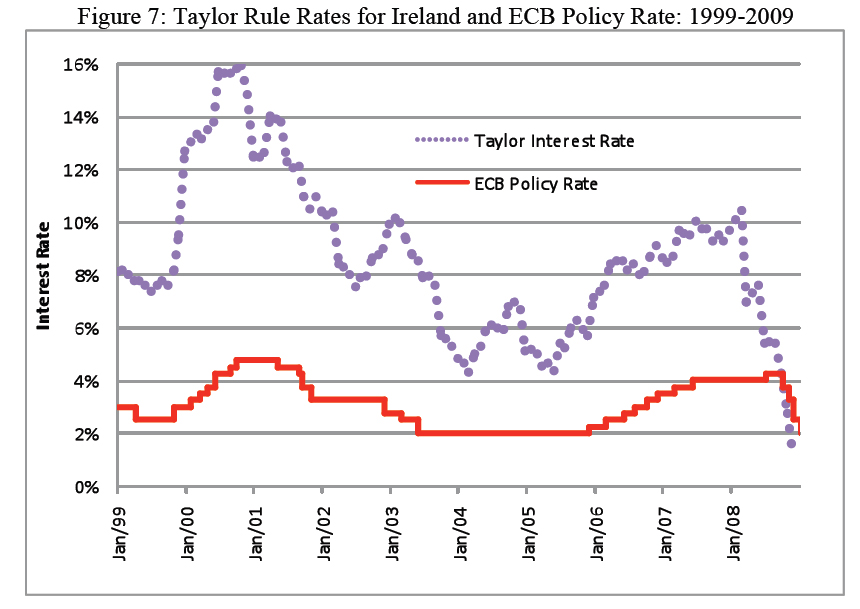
The authors also stress the relative looseness of monetary policy, as measured by the Taylor rule. This is food for Canadian thought, given the perpetual squawking over the Bank of Canada rate, which is by necessity applied nationally, over regions that can be performing very differently from each other.

After Ireland’s entry to the Euro zone, Irish banks funded much of their lending with short-term foreign borrowing. This allowed Irish financial institutions to extend much larger volumes of credit to borrowers at lower cost, as evidenced by Figure 6. As a small member of the Eurozone, Ireland does not have control of its interest rates, but Figure 7 shows an Irish target rate calculated from a standard Taylor rule. We set the target rate equal to 1/2 (GDP growth rate – 3%) + 1/2 (inflation rate – 2%) + 1%. Had Eurozone interest rates been set in accordance with a Taylor rule for Ireland, the interest rate would have been almost 6% higher on average during the period, and up to 12% higher in 2000.

Click for Big

As always, concentration is at the root of the problem:

Woods (2007) reports that, as a proportion of lending to the private sector, property related lending grew from 38% in 2001 to over 62% in 2007. With the enormous growth in property- and construction-related lending, the loan books of the Irish domestic banks were becoming increasingly undiversified.

Dr. Krugman glosses over a major similarity between the pre-crash climates in the US and Ireland. He believes that Fannie & Freddie’s role are overemphasized in the current debate; but they simply represent one way for the government to over-stimulate the housing sector. In Ireland the mechanism was different, but the results the same:

In addition to the enormous credit inflow, the over-heating of the property markets was exacerbated by government legislation that encouraged people to invest in property through a series of tax-incentive schemes. For example, generous tax relief was available to investors in hotels as the government sought to increase the stock of hotel rooms and hence tourism; similar breaks were available to individuals who built houses in seaside towns and in rural areas.

On the retail end, we can see some support for the Canadian regulatory response, when the maximum insurable amortization period was decreased along with the maximum LTV ratio:

A considerable decline in lending standards occurred in the Irish mortgage market; an increasing proportion of lending was done at higher loan-to-value, higher income multiples, longer maturities, and with interest-only periods. The only step the regulator took to stem the sharp decline in lending standards was to increase to 100% the risk-weighting on the portion of a residential mortgage written above an 80% loan-to-value threshold. As Honohan (2009) notes, this was a weak and ineffective response.

The familiar weaknesses of the American securitization process are dutifully trotted out, but the authors point out:

Despite its centrality to the US crisis, this particular moral hazard problem has no relevance to the Irish credit crisis. Throughout the bubble period Irish banks used the originate-and-hold lending system, for both residential mortgage and business lending. Almost all the loans that the Irish banks generated remained on their own balance sheets. This crucial component of the US crisis is virtually absent in the Irish case.

I have often criticized the lack of recourse in US mortgages; there is some skepticism as to the effectiveness of recourse in Ireland:

The property loans issued by Irish banks were obtained by wealthy property developers, arguably well-informed, rational actors with considerable business acumen. It is not clear whether a moral hazard argument can explain their behaviour. Personal guarantees were a standard component of property development loan contracts in Ireland during the bubble period, so most of these developers did not have recourse to the trader put option. Irish property developers are legally liable for the “tail risk” in the net value of these loans, including de jure claims against their personal assets.

This brings us to another potential source of moral hazard: weak law enforcement. This was likely an important source of moral hazard in the Irish case. The legal framework for personal bankruptcy in Ireland is antiquated and rarely activated. Although property developers signed de jure claims against their personal assets as part of their bank loan contracts, many commentators believe that these claims are de facto unenforceable in Ireland. There is also the concern in Ireland that politically powerful agents have the ability to manipulate regulatory and legislative processes to their advantages. Most large property developers in Ireland have been very closely connected to the ruling political party, Fianna Fáil. Kelly (2009) uses the term “too connected to fail” for this feature of the Irish business environment.

Administration

Maverecon Removed from Blogroll

I reported Willem Buiter’s move to Citigroup, but neglected to remove Maverecon from the Blogroll … but now that sad task is done.

Dr. Buiter’s valedictory post is entertaining:

The joys of academic freedom and irresponsibility include the ability to participate in public debate using expressive, forceful language, strong metaphors, analogues and similes, to go over the top from time to time, to overstate the case and over-egg the pudding and not to worry about giving offense to the high and mighty. Because of their sheltered existence, academics can be reckless with impunity in their excursions into the forum of public opinion.

Inevitably, during my years with the MPC and the EBRD, both the form and substance of my public statements were more constrained than during my academic episodes before and after. The same will be true during the years to come with Citi.

Regulation

Pegged Orders: IIROC & CSA to Host Semi-Open Meeting

The Investment Industry Regulatory Organization of Canada has announced:

The Canadian Securities Administrators (CSA) and the Investment Industry Regulatory Organization of Canada (IIROC) invite all interested parties to attend a forum to discuss market structure issues raised in Joint CSA/IIROC Consultation Paper 23-404 Dark Pools, Dark Orders, and Other Developments in Market Structure in Canada (the Consultation Paper). The forum will be held:

Tuesday, March 23rd, 2010 from 8:30 a.m. – 3:30 p.m.
at the Design Exchange, 234 Bay Street in Toronto (Trading Floor, 2nd Floor)


While the forum will allow those that commented on the Consultation Paper to discuss their views, we welcome others that would like to observe the presentations and discussion to attend. If you wish to attend the forum as an observer, please complete the registration form (available on the IIROC website at www.iiroc.ca under the “What’s New” heading) by Friday, March 19th. Space is limited, so registrations will be accepted on a first come, first serve basis.

Pegged Orders were last discussed on PrefBlog when comments on the consultation paper were republished.

Market Action

March 5, 2010

European leaders are continuing their desperate efforts to divert attention from the causes of the Greek crisis:

German Chancellor Angela Merkel said that Greece doesn’t need financial aid, as she turned her focus to restricting the use of derivatives to halt “speculators” from exploiting countries’ budget deficits.

“Credit-default swaps, where you insure your neighbor’s house just to destroy it and make money from it, that’s exactly what we have to curb,” Merkel said at a joint press conference in Berlin today with Greek Prime Minister George Papandreou.

Merkel said that Greece has done its work and that Europe and the U.S. must ensure that financial-market speculators aren’t allowed to inflict further damage on Greece or on other countries.

“We must succeed at putting a stop to the speculators’ game with sovereign states,” Merkel said. “We can’t allow speculators to be the profiteers of Greece’s difficult situation.” While “technically not easy,” derivatives including credit-default swaps “must be curbed,” she said.

The Greek situation has spiralled (almost?) out of control due to European complacency. After years of turning a blind eye to the problem, they now have to face it … and no politician likes problems. Shoot the messenger!

Volume was good today but price action was muted, with PerpetualDiscounts gaining 2bp and FixedResets up 3bp. There were only two entries on the performance highlights tables – from the Floating Rate class, naturally enough!

HIMIPref™ Preferred Indices
These values reflect the December 2008 revision of the HIMIPref™ Indices

Values are provisional and are finalized monthly
Index Mean
Current
Yield
(at bid)
Median
YTW
Median
Average
Trading
Value
Median
Mod Dur
(YTW)
Issues Day’s Perf. Index Value
Ratchet 2.72 % 2.81 % 40,717 20.59 1 -0.0481 % 2,035.1
FixedFloater 5.30 % 3.41 % 41,482 19.69 1 0.4410 % 2,980.3
Floater 1.92 % 1.65 % 48,204 23.50 4 0.9833 % 2,398.2
OpRet 4.88 % 2.28 % 109,170 0.23 13 0.1191 % 2,308.3
SplitShare 6.39 % 6.43 % 127,751 3.72 2 -0.1978 % 2,137.1
Interest-Bearing 0.00 % 0.00 % 0 0.00 0 0.1191 % 2,110.7
Perpetual-Premium 5.90 % 5.84 % 131,946 5.86 7 -0.0625 % 1,887.8
Perpetual-Discount 5.87 % 5.90 % 175,924 14.02 71 0.0161 % 1,798.1
FixedReset 5.40 % 3.55 % 317,315 3.72 42 0.0279 % 2,192.5
Performance Highlights
Issue Index Change Notes
PWF.PR.A Floater 1.73 % YTW SCENARIO
Maturity Type : Limit Maturity
Maturity Date : 2040-03-05
Maturity Price : 23.20
Evaluated at bid price : 23.50
Bid-YTW : 1.65 %
HSB.PR.D Perpetual-Discount 2.00 % YTW SCENARIO
Maturity Type : Limit Maturity
Maturity Date : 2040-03-05
Maturity Price : 22.24
Evaluated at bid price : 22.39
Bid-YTW : 5.68 %
Volume Highlights
Issue Index Shares
Traded
Notes
BNS.PR.L Perpetual-Discount 153,219 TD crossed 25,000 at 20.05. Nesbitt crossed 100,000 at 20.07.
YTW SCENARIO
Maturity Type : Limit Maturity
Maturity Date : 2040-03-05
Maturity Price : 19.96
Evaluated at bid price : 19.96
Bid-YTW : 5.72 %
TD.PR.P Perpetual-Discount 108,820 Nesbitt crossed 100,000 at 23.54.
YTW SCENARIO
Maturity Type : Limit Maturity
Maturity Date : 2040-03-05
Maturity Price : 23.22
Evaluated at bid price : 23.40
Bid-YTW : 5.67 %
TRP.PR.A FixedReset 106,759 Nesbitt crossed 19,900 at 26.10.
YTW SCENARIO
Maturity Type : Call
Maturity Date : 2015-01-30
Maturity Price : 25.00
Evaluated at bid price : 26.11
Bid-YTW : 3.54 %
TD.PR.S FixedReset 106,348 Nesbitt crossed 100,000 at 26.27.
YTW SCENARIO
Maturity Type : Call
Maturity Date : 2013-08-30
Maturity Price : 25.00
Evaluated at bid price : 26.26
Bid-YTW : 3.55 %
RY.PR.C Perpetual-Discount 76,110 TD crossed 73,400 at 20.35.
YTW SCENARIO
Maturity Type : Limit Maturity
Maturity Date : 2040-03-05
Maturity Price : 20.30
Evaluated at bid price : 20.30
Bid-YTW : 5.72 %
SLF.PR.C Perpetual-Discount 75,532 Scotia crossed 62,000 at 18.60.
YTW SCENARIO
Maturity Type : Limit Maturity
Maturity Date : 2040-03-05
Maturity Price : 18.61
Evaluated at bid price : 18.61
Bid-YTW : 5.99 %
There were 37 other index-included issues trading in excess of 10,000 shares.
Market Action

March 4, 2010

The Credit Rating Agencies are now being drawn into the Greece fiasco:

European Union finance ministers are pushing the European Central Bank to develop its own rating system for euro zone countries, German business daily Handelsblatt reported on Wednesday, citing EU finance ministry sources.

The paper quoted one official saying the plan would free the euro zone from its dependency on international rating agencies such as Standard & Poors, Moody’s and Fitch.

Fitch and S&P have downgraded Greece into ‘B’ territory and should Moody’s follow suit, banks would no longer be able to exchange Greek government debt for cash in ECB refinancing operations from January 2011.

On the one hand, this is no big deal. Central Banks have always had, and should always have, the power to determine just what constitutes the good collateral they lend against. On the other hand, this could very easily become simply another method of papering over the cracks in the system, prior to the Big Collapse.

I’m always pointing out that despite the reset mechanism, FixedResets are not five-year instruments, which I’ll point out again in the wake of the new TRP FixedReset 4.00%+128. Why not? Well, here’s one example:

Two years after the auction-rate bond market froze, Hawaii has lost about $250 million in market value on $1 billion in student-loan securities sold by a single Citigroup Inc. broker as a cash substitute that the state has had difficulty unloading.

Hawaii purchased half of the securities for its short-term treasury account from Honolulu broker Pete Thompson, 60, in the eight months before the market collapsed, according to Scott Kami, an administrator at the state finance department.

Auction-rate securities typically have maturities as long as 40 years and yields that are reset in periodic sales held as frequently as every seven days. As the global credit crisis deepened in 2008, banks that underwrote the obligations reversed decades of support for the market when they declined to bid for the debt.

Cash Substitute

The action left purchasers such as Hawaii, which viewed auction-rate debt as a higher-yielding cash substitute, unable to sell without taking losses. Citigroup provided the state with a valuation on Dec. 28 saying securities with a face value of about $1 billion were worth $752 million, according to bank documents.

“It was represented to us that these were liquid investments that we could get out every seven to 10 days,” Kami said in an interview.

Hawaii’s suing. Why these situations are the fault of the salesman and not the moron who bought them in such huge quantities is quite beyond me.

The Federal Budget is a total waste of time and I can’t be bothered with it.

Good volume today, perhaps sparked by the TRP FixedReset 4.00%+128 new issue announcement and the closing of GWO.PR.M, but the market came off, with PerpetualDiscounts down 28bp and FixedResets down 7bp.

HIMIPref™ Preferred Indices
These values reflect the December 2008 revision of the HIMIPref™ Indices

Values are provisional and are finalized monthly
Index Mean
Current
Yield
(at bid)
Median
YTW
Median
Average
Trading
Value
Median
Mod Dur
(YTW)
Issues Day’s Perf. Index Value
Ratchet 2.71 % 2.81 % 41,083 20.59 1 1.9598 % 2,036.1
FixedFloater 5.33 % 3.43 % 41,547 19.66 1 0.2948 % 2,967.3
Floater 1.94 % 1.68 % 48,522 23.41 4 -0.9134 % 2,374.8
OpRet 4.89 % 2.25 % 104,717 0.24 13 -0.2287 % 2,305.5
SplitShare 6.37 % 6.43 % 129,114 3.72 2 0.3308 % 2,141.3
Interest-Bearing 0.00 % 0.00 % 0 0.00 0 -0.2287 % 2,108.2
Perpetual-Premium 5.89 % 5.84 % 132,055 6.90 7 -0.3621 % 1,889.0
Perpetual-Discount 5.87 % 5.90 % 177,232 14.03 71 -0.2827 % 1,797.8
FixedReset 5.41 % 3.59 % 319,392 3.73 42 -0.0697 % 2,191.9
Performance Highlights
Issue Index Change Notes
CU.PR.B Perpetual-Premium -2.49 % YTW SCENARIO
Maturity Type : Call
Maturity Date : 2012-07-01
Maturity Price : 25.00
Evaluated at bid price : 25.06
Bid-YTW : 5.95 %
PWF.PR.A Floater -2.12 % YTW SCENARIO
Maturity Type : Limit Maturity
Maturity Date : 2040-03-04
Maturity Price : 22.82
Evaluated at bid price : 23.10
Bid-YTW : 1.68 %
PWF.PR.L Perpetual-Discount -1.69 % YTW SCENARIO
Maturity Type : Limit Maturity
Maturity Date : 2040-03-04
Maturity Price : 20.91
Evaluated at bid price : 20.91
Bid-YTW : 6.18 %
MFC.PR.A OpRet -1.44 % YTW SCENARIO
Maturity Type : Soft Maturity
Maturity Date : 2015-12-18
Maturity Price : 25.00
Evaluated at bid price : 25.92
Bid-YTW : 3.38 %
BAM.PR.E Ratchet 1.96 % YTW SCENARIO
Maturity Type : Limit Maturity
Maturity Date : 2040-03-04
Maturity Price : 21.67
Evaluated at bid price : 20.81
Bid-YTW : 2.81 %
Volume Highlights
Issue Index Shares
Traded
Notes
TRP.PR.A FixedReset 427,183 Volume was probably boosted a little by the new issue announcement. Nesbitt bought 14,600 from RBC at 25.90 and 10,000 from anonymous at 25.94 and 50,000 from National at 25.95. RBC bought 20,000 from National at 25.97. Nesbitt crossed 40,000 at 26.00, then another 40,000 at 26.03. Nesbitt bought 10,000 from RBC at 26.03.
YTW SCENARIO
Maturity Type : Call
Maturity Date : 2015-01-30
Maturity Price : 25.00
Evaluated at bid price : 26.03
Bid-YTW : 3.60 %
TD.PR.E FixedReset 166,335 TD crossed blocks of 127,100 and 12,000, both at 27.95.
YTW SCENARIO
Maturity Type : Call
Maturity Date : 2014-05-30
Maturity Price : 25.00
Evaluated at bid price : 27.94
Bid-YTW : 3.44 %
GWO.PR.M Perpetual-Discount 160,180 New issue settled today.
YTW SCENARIO
Maturity Type : Limit Maturity
Maturity Date : 2040-03-04
Maturity Price : 24.41
Evaluated at bid price : 24.62
Bid-YTW : 5.92 %
BNS.PR.X FixedReset 62,407 National crossed 25,000 at 28.20, then sold 11,000 to RBC at 28.24.
YTW SCENARIO
Maturity Type : Call
Maturity Date : 2014-05-25
Maturity Price : 25.00
Evaluated at bid price : 28.30
Bid-YTW : 3.11 %
BMO.PR.O FixedReset 60,950 RBC crossed 50,000 at 28.10.
YTW SCENARIO
Maturity Type : Call
Maturity Date : 2014-06-24
Maturity Price : 25.00
Evaluated at bid price : 28.09
Bid-YTW : 3.48 %
TD.PR.I FixedReset 58,136 Nesbitt crossed 40,000 at 28.08.
YTW SCENARIO
Maturity Type : Call
Maturity Date : 2014-08-30
Maturity Price : 25.00
Evaluated at bid price : 28.01
Bid-YTW : 3.51 %
There were 48 other index-included issues trading in excess of 10,000 shares.
Issue Comments

GWO.PR.M Drops on Light First-Day Trading; Still Expensive

Great-West Lifeco has announced:

the closing of its previously announced offering of 6,000,000 Non-Cumulative First Preferred Shares, Series M through a syndicate of underwriters co-led by BMO Capital Markets, RBC Capital Markets and Scotia Capital to raise gross proceeds of $150 million. The shares will be posted for trading on the Toronto Stock Exchange under the symbol “GWO.PR.M”.

The Series M Shares were priced at $25.00 per share and carry a 5.80% annual dividend. The net proceeds will be used by the Company to fund the redemption of the Non-Cumulative First Preferred Shares, Series D on March 31, 2010.

The issue traded 160,180 shares in a range of 24.50-70 before closing at 24.62-65, 50×11. It is 5.80% Straight announced February 23.

Vital statistics are:

GWO.PR.M Perpetual-Discount YTW SCENARIO
Maturity Type : Limit Maturity
Maturity Date : 2040-03-04
Maturity Price : 24.41
Evaluated at bid price : 24.62
Bid-YTW : 5.92 %

Comparables are:

GWO PerpetualDiscount Comparables
Ticker Dividend Quote Bid YTW
GWO.PR.I 1.125 18.76-83 6.01%
GWO.PR.H 1.2125 20.26-44 6.00%
GWO.PR.G 1.30 21.40-45 6.09%
GWO.PR.L 1.4125 23.55-68 6.00%
GWO.PR.M 1.45 24.62-65 5.92%
GWO.PR.F 1.475 24.64-80 5.98%

Lynx-eyed Assiduous Readers will note that prices of comparators has dropped since the announcement, but yields have barely changed. These issues all went ex-Dividend on March 1; the Power Group likes to announce new straight issues shortly prior to the ex-Date so that comparators will be full of dividend and hence have a lower Current Yield.

It is worth noting that not only is GWO.PR.M still expensive when priced as a perpetual annuity, but also that there is basically no allowance for Implied Volatility in the group prices – which makes it more expensive still.

Miscellaneous News

February 2010 Top Publication Downloads

It’s interesting:

1. Preferred Shares and GICs (1)

2. Perpetual and Retractible Preferred Shares (2)

3. Why Invest in Preferred Shares? (3)

4. Corporate Bonds … or Preferred Shares? (5)

5. Trading Preferreds (6)

6. A Brief Introduction to Preferred Shares (4)

7. Interest Bearing Preferreds (7)

8. Modified Duration (8)

9. The Bond Portfolio Jigsaw Puzzle (10)

10. Dividends and Ex-Dates (-)

The bracketted numbers give the positions on the January Top 10 List – there’s not much change!

New Issues

New Issue: TRP FixedReset 4.00%+128

TransCanada Corporation has announced:

that it will issue 12 million cumulative redeemable first preferred shares, series 3 (the “Series 3 Preferred Shares”) at a price of $25.00 per share, for aggregate gross proceeds of $300 million on a bought deal basis to a syndicate of underwriters in Canada led by Scotia Capital Inc., and RBC Capital Markets.

The holders of Series 3 Preferred Shares will be entitled to receive fixed cumulative dividends at an annual rate of $1.00 per share, payable quarterly, as and when declared by the board of directors of TransCanada, yielding 4.00 per cent per annum, for the initial five-year period ending June 30, 2015 with the first dividend payment date scheduled for June 30, 2010. The dividend rate will reset on June 30, 2015 and every five years thereafter at a rate equal to the sum of the then five-year Government of Canada bond yield plus 1.28 per cent. The Series 3 Preferred Shares are redeemable by TransCanada, at its option, on June 30, 2015 and on June 30 of every fifth year thereafter.

The holders of Series 3 Preferred Shares will have the right to convert their shares into cumulative redeemable first preferred shares, series 4 (the “Series 4 Preferred Shares”), subject to certain conditions, on June 30, 2015 and on June 30 of every fifth year thereafter. The holders of Series 4 Preferred Shares will be entitled to receive quarterly floating rate cumulative dividends, as and when declared by the board of directors of TransCanada, at a rate equal to the sum of the then 90-day Government of Canada treasury bill rate plus 1.28 per cent.

TransCanada has granted to the underwriters an option, exercisable at any time up to 48 hours prior to the closing of the offering, to purchase up to an additional two million Series 3 Preferred Shares at a price of $25.00 per share.

The anticipated closing date is March 11, 2010. The net proceeds of the offering will be used to partially fund capital projects, for other general corporate purposes and to reduce short term indebtedness of TransCanada and its affiliates, which short term indebtedness was used to fund TransCanada’s capital program and for general corporate purposes.

There’s a narrow spread for you!

TRP.PR.A, a FixedReset 4.60%+192 closed last night at 26.01-05 to yield 3.62-58% to its first call 2014-12-31.

TCA.PR.X and TCA.PR.Y, both straights with a $50 par value and a dividend of $2.80 issued by TRP’s operating subsidiary, closed last night at 48.80-86 and 48.80-90, respectively, to yield 5.74-73%. The Break-Even Rate Shock on this issue is therefore an astonishing 266bp – and the straights used for this calculation, remember, are of the operating sub and therefore a marginally better credit.

Update: DBRS has announced that it:

has today assigned a rating of Pfd-2 (low) with a Stable trend to the $350 million Cumulative Redeemable First Preferred Shares, Series 3 (First Preferreds) to be issued by TransCanada Corporation (TCC or the Company). The First Preferreds will yield 4.0% per annum for the initial five-year period ending June 30, 2015. The dividend rate will reset on June 30, 2015, and every five years thereafter at a rate equal to the sum of the then five-year Government of Canada bond yield plus 1.28%. The First Preferreds are redeemable by TCC on June 30, 2015, and on June 30 of every fifth year thereafter. The First Preferreds are expected to settle on March 11, 2010.

The First Preferreds will rank equally with existing first preferred shares of the Company and the net proceeds from the offering will be used to partially fund capital projects, for other general corporate purposes and to repay short-term indebtedness of the Company and its affiliates

Market Action

March 3, 2010

Faced with criticism of their conduct and market disdain for their chances going forward, European politicians are taking decisive action – prohibit criticism!

The European Commission said yesterday it will investigate trades in sovereign credit-default swaps in the wake of the Greek crisis, which has pushed the euro lower and prompted officials to warn hedge funds they shouldn’t try to profit from the woes of the region’s nations.

… with further details:

Banks and regulators across Europe were summoned by the European Commission to discuss regulation of the market for sovereign credit-default swaps in the wake of the Greek debt crisis.

The European Union’s executive agency will hold a meeting in Brussels “shortly,” Chantal Hughes, a commission spokeswoman, said in an e-mailed statement today. The talks, which will take place as soon as March 5, will cover CDS pricing and links to the sovereign bond market, according to three people familiar with the discussions.

Remember the little boy who shouted that the Emperor had no clothes? The soldiers slaughtered him, his family, and anybody who heard the treacherous remark. Later, the Emperor’s wardrobe expenses caused taxes to rise so high that a famine resulted and the Empire collapsed. But that’s show-biz.

There’s more jostling in the Brookfield / General Growth deal, with Ackman’s role being criticized:

General Growth Properties Inc’s unsecured creditors and suitor Simon Property Group on Tuesday criticized William Ackman’s role in the mall owner’s restructuring plan, alleging conflicts of interest given his position as a director and largest shareholder.

Ackman has backed a reorganization plan that calls for his Pershing Square Capital Management hedge fund to offer Brookfield Asset Management certain protections in return for the Canadian firm financing General Growth’s stand-alone exit from bankruptcy.

The official committee of General Growth’s unsecured creditors said in a court filing that the agreement between Pershing Square and Brookfield effectively restricts General Growth from considering alternative transactions because it puts the company into “an obvious conflict of interest situation.”

“The Debtors must choose between the best interests of the estates and the economic interests of one of their most active and vocal directors,” it added, referring to Ackman.

Simon, a General Growth creditor, also questioned the arrangement between Brookfield and Ackman’s Pershing Square in a separate filing Tuesday.

RBC CEO Gord Nixon spoke at the annual meeting:

“Political rhetoric is distorting the cause of this recent crisis and potentially distorting the cure,” he told shareholders at the bank’s annual meeting in Toronto Wednesday. “This crisis was not caused by Wall Street, executive compensation, nor proprietary trading, although they all played a part. The root cause of the crisis was the failure of the U.S. residential mortgage market,” he said, adding that “the basic requirement to qualify for a large mortgage in the United States was a pulse.”

I would say ‘triggered’ rather than ’caused’. The recession is bringing to light a lot of bad practices: General Motors, Chrysler, Greece …

“The bulk of the losses during the crisis arguably resulted from lending practices and excessive concentration related, primarily, to U.S. residential real estate and over-extended consumers, not those activities addressed by the proposed reforms,” he said.

Glad to hear someone talking about concentration. Bad investments can hurt you, but over-concentration can kill you … as, for instance, many Canadian ABCP players found out. He says Basel III is fraying ’round the edges:

“While a few months ago it appeared as if there was a high degree of co-operation among the Financial Stability Board countries, we are now experiencing a divide with different countries trying to initiate rules that best suit their jurisdictions,” he said. “The unified response that was necessary and commendable during the darkest days of the crisis now risks being replaced by regulatory and legislative one-upmanship, as various governments pursue local agendas.”

And, while he said he agrees that it’s important for banks to be conservatively capitalized, he said that “the current Basel III proposals, as they’re referred to, are so complex and onerous that we run the risk of no agreement being reached.”

I was quoted in the Advisor.ca budget wish-list:

James Hymas, president, Hymas Investment Management Inc.

• A clear-cut plan for a balanced budget through the cycle.
• I want to see statements of planned spending cuts and tax increases that will not just eliminate the deficit (a childish half-measure), but ensure – insofar as such things can be ensured – that surpluses built up in relatively good times will pay for this recession and put us in a good position to cope with the next one.

Volume dropped to more normal levels on a steady day in the Canadian preferred share market, with PerpetualDiscounts gaining 5bp and FixedResets gaining 9bp … taking the YTW on the latter class down to 3.52%.

PerpetualDiscounts now yield 5.89%, equivalent to 8.25% interest at the standard equivalency factor of 1.4x. Long Corporates are now yielding about 5.8%, so the pre-tax interest-equivalent spread (also called the Seniority Spread) now stands at 245bp, a sharp, bond-driven widening from the 235bp recorded at month-end.

HIMIPref™ Preferred Indices
These values reflect the December 2008 revision of the HIMIPref™ Indices

Values are provisional and are finalized monthly
Index Mean
Current
Yield
(at bid)
Median
YTW
Median
Average
Trading
Value
Median
Mod Dur
(YTW)
Issues Day’s Perf. Index Value
Ratchet 2.77 % 2.92 % 40,679 20.50 1 -0.4876 % 1,997.0
FixedFloater 5.34 % 3.45 % 40,599 19.64 1 -1.2136 % 2,958.5
Floater 1.92 % 1.65 % 49,074 23.45 4 0.6990 % 2,396.7
OpRet 4.88 % 1.59 % 102,078 0.24 13 -0.0089 % 2,310.8
SplitShare 6.39 % 6.53 % 129,500 3.72 2 0.3985 % 2,134.3
Interest-Bearing 0.00 % 0.00 % 0 0.00 0 -0.0089 % 2,113.0
Perpetual-Premium 5.87 % 5.81 % 132,078 6.90 7 -0.0791 % 1,895.9
Perpetual-Discount 5.86 % 5.89 % 180,302 14.05 70 0.0514 % 1,802.9
FixedReset 5.40 % 3.52 % 320,307 3.73 42 0.0898 % 2,193.4
Performance Highlights
Issue Index Change Notes
BAM.PR.G FixedFloater -1.21 % YTW SCENARIO
Maturity Type : Limit Maturity
Maturity Date : 2040-03-03
Maturity Price : 25.00
Evaluated at bid price : 20.35
Bid-YTW : 3.45 %
RY.PR.I FixedReset -1.14 % YTW SCENARIO
Maturity Type : Call
Maturity Date : 2014-03-26
Maturity Price : 25.00
Evaluated at bid price : 26.07
Bid-YTW : 3.86 %
BAM.PR.K Floater 1.10 % YTW SCENARIO
Maturity Type : Limit Maturity
Maturity Date : 2040-03-03
Maturity Price : 17.50
Evaluated at bid price : 17.50
Bid-YTW : 2.27 %
TRI.PR.B Floater 1.29 % YTW SCENARIO
Maturity Type : Limit Maturity
Maturity Date : 2040-03-03
Maturity Price : 23.25
Evaluated at bid price : 23.55
Bid-YTW : 1.65 %
BAM.PR.O OpRet 1.91 % YTW SCENARIO
Maturity Type : Option Certainty
Maturity Date : 2013-06-30
Maturity Price : 25.00
Evaluated at bid price : 26.15
Bid-YTW : 3.81 %
Volume Highlights
Issue Index Shares
Traded
Notes
SLF.PR.A Perpetual-Discount 76,680 Scotia crossed 48,700 at 19.75.
YTW SCENARIO
Maturity Type : Limit Maturity
Maturity Date : 2040-03-03
Maturity Price : 19.80
Evaluated at bid price : 19.80
Bid-YTW : 6.01 %
CM.PR.G Perpetual-Discount 67,265 RBC crossed 53,900 at 23.05.
YTW SCENARIO
Maturity Type : Limit Maturity
Maturity Date : 2040-03-03
Maturity Price : 22.94
Evaluated at bid price : 23.15
Bid-YTW : 5.90 %
BAM.PR.P FixedReset 63,090 Nesbitt crossed 50,000 at 27.20.
YTW SCENARIO
Maturity Type : Call
Maturity Date : 2014-10-30
Maturity Price : 25.00
Evaluated at bid price : 27.19
Bid-YTW : 5.19 %
BMO.PR.P FixedReset 59,828 Desjardins crossed 43,300 at 27.05.
YTW SCENARIO
Maturity Type : Call
Maturity Date : 2015-03-27
Maturity Price : 25.00
Evaluated at bid price : 27.02
Bid-YTW : 3.66 %
CM.PR.I Perpetual-Discount 50,068 YTW SCENARIO
Maturity Type : Limit Maturity
Maturity Date : 2040-03-03
Maturity Price : 20.23
Evaluated at bid price : 20.23
Bid-YTW : 5.89 %
GWO.PR.G Perpetual-Discount 34,133 YTW SCENARIO
Maturity Type : Limit Maturity
Maturity Date : 2040-03-03
Maturity Price : 21.46
Evaluated at bid price : 21.46
Bid-YTW : 6.07 %
There were 31 other index-included issues trading in excess of 10,000 shares.