Market Action

June 12, 2014

It’s a wonderful economic recovery we’re having:

Retail sales rose 0.3 percent in May as American consumers took a respite following a three-month surge in shopping. The gain followed a revised 0.5 percent gain in April that was much larger than previously estimated, Commerce Department figures showed. The median forecast of 83 economists surveyed by Bloomberg called for a 0.6 percent advance.

A separate report indicated applications for unemployment benefits in the U.S. rose to 317,000 last week. The median forecast of 52 economists surveyed by Bloomberg called for 310,000. Claims have averaged around 324,000 so far in 2014.

The Bank of Canada has published the Financial System Review, June 2014. They cite four main risks:

  • A sharp correction in house prices prices, resulting from a large, macroeconomic shock that leads to higher unemployment and a reduced ability of Canadian households to service their debts.
  • A sharp increase in long-term interest rates globally, including in Canada, likely resulting from an overshoot in U.S. long-term interest rates.
  • Stress emanating from China and other EMEs, triggered by a severe financial disruption in China associated with a significant slowdown in Chinese economic growth. There would be widespread repercussions on global economic and financial systems that would feed back to Canada. (The Globe highlighted this one).
  • Serious financial stress from the euro area with global consequences, possibly caused by market concern about the adequacy of bank balance sheet repair or a sudden economic shock related to heightened geopolitical stress in Ukraine and Russia.

In Making Banks Safer: Implementing Basel III, Éric Chouinard and Graydon Paulin sing the usual Rah-Rah-Canada song and make a plea for more cushy foreign based jobs for ex-Bank of Canada personnel:

Early evidence that the Canadian and international banking systems have already made good progress in implementing Basel III—particularly by augmenting the quantity and quality of capital—is excellent news. As this process continues, it is imperative to continuously assess the impact of the reforms on financial stability and their macroeconomic implications more broadly.

Additional analysis and rigorous monitoring are essential, in part to identify any unexpected adverse consequences should they occur. It is also critical that the minimum standards be rigorously respected across all jurisdictions to achieve the full benefits of the reforms and to maintain a level playingfield. This is why the Basel Committee’s enhanced efforts with respect to monitoring are so important. It is essential that, in future impact analyses and consistency assessments, authorities continue to improve prudential standards for the banking sector by supporting greater consistency in risk weights and by addressing the implementation gaps that have been identified.

In Reforming Financial Benchmarks: An International Perspective, Thomas Thorn and Harri Vikstedt emphasize that there must be new employment possibilities for domestic regulators as well:

Public sector authorities around the world are developing and implementing their responses to the allegations of manipulation that have emerged for many financial benchmarks. These efforts seek to ensure that benchmarks are robust without compromising their intended economic role, while also taking into account the complex issues that can arise in transitioning to alternative benchmarks. Canada is no exception: our public sector authorities are working closely with the industry to ensure that our financial benchmarks are robust and meet international standards.

And in Stress Testing the Canadian Banking System: A System-Wide Approach a case is made for more back-room staff:

Stress testing is an important component of the tool kit available to authorities, including the Bank of Canada, to assess risks to the financial system. However, it is important to highlight that, despite recent significant progress in the development of stress-testing models, stress testing remains challenging because it attempts to capture the effects of tail events.

In most stress tests, solvency risk explains a large share of the deterioration in the capital ratios of banks during periods of severe stress. As demonstrated by the recent financial crisis, however, liquidity risk and network spillover effects can generate substantial additional losses for banks. Hence, it is important to take them into account when assessing risks. To this end, the Bank of Canada has developed an innovative stress-testing model, the Macro Financial Risk Assessment Framework (MFRAF), which incorporates various sources of risk for banks—solvency risk, liquidity risk and spillover effects.

Research is ongoing to improve MFRAF in two directions. First, the liquidity module could be enhanced by developing a model to link the evolution of market liquidity conditions with the behaviour of banks under stress (e.g., their decision to sell liquid or illiquid assets to meet their funding needs). Second, MFRAF should incorporate a model of risk-weighted assets to more accurately estimate the effects of solvency risk, liquidity risk and network effects on bank capital levels.

Not mentioned in all of this were the implications of the Ban the Bond movement:

As governments around the world implement “bail-in” provisions to avoid taxpayer-funded bank bailouts, Moody’s Investors Service took action in Canada on Wednesday by changing the outlook to negative from stable on some of the senior debt and uninsured deposits of Canada’s largest seven banks.

The ratings agency, which at the same time affirmed the long-term ratings of the banks, said it took the action on the supported senior debt and uninsured deposit ratings “in the context of previously announced plans by the Canadian government to implement a ‘bail-in’ regime for domestic systemically important banks.”

Moody’s also cited an “accelerating” global trend towards reducing the public cost of future bank “resolutions.”

“The negative outlook reflects Moody’s view that the balance of risk for the Canadian bank’s senior debt holders and uninsured depositors has shifted to the downside.”

Sure. Before, the senior debt holders and uninsured depositors could rely on bankruptcy court. Now they’ve got to hope that an unaccountable bureaucrat or panicking politician will give their interests some weight. Result – I’ll bet there ain’t gonna be no more long term senior bank debt.

But most of the interesting news today comes from Britain where, after twenty-two years of intensive study, they have decided what to do if speculators like George Soros attack the sterling: jail ’em:

British finance minister George Osborne will reject European Union plans to outlaw currency market manipulation on Thursday and instead set out his own proposals to make rigging exchange rates a criminal offence.

EU laws taking effect in 2016 will make it a criminal offence with a four-year jail term to rig key prices in a wide range of financial markets.

Britain has already introduced a maximum seven-year jail term for trying to manipulate the LIBOR interbank interest rate, and plans to introduce similar criminal penalties for rigging benchmarks in currency, commodity and fixed income markets.

“Our own rules will be as strong or stronger than those of the EU, but will preserve flexibility to reflect specific circumstances in the UK’s globally important financial sector,” Britain’s finance ministry said in a statement late on Wednesday.

We know that this flexibility to reflect specific circumstances will never, ever be misused by the government of the day. After all, as discussed on Guy Fawkes Day, 2008, the counter-terrorist rules have never been misused. Well, hardly ever.

The UK government has instructed one of its junior spokesmen to prepare the market for higher policy rates:

Mark Carney said the Bank of England could raise interest rates from a record low earlier than investors expect as he expressed concern that mounting debt related to the housing market could undermine stability.

“There’s already great speculation about the exact timing of the first rate hike and this decision is becoming more balanced,” the BOE governor said in a speech at the Mansion House in London today. “It could happen sooner than markets currently expect.” The pound strengthened after the remarks.

And future recessions will be completely eliminated through the miracle of central planning!

Chancellor of the Exchequer George Osborne promised the Bank of England new powers over mortgage lending to prevent the strengthening housing market derailing the recovery.

While real estate poses no immediate threat, it could do in the future unless action is taken, Osborne said his annual speech at the Mansion House in London tonight. Under the plans, financial-stability officials would be able to cap the size of mortgages as a proportion of income or property value.

“I want to make sure the Bank of England has all the weapons it needs to guard against risks in the housing market,” Osborne said. “I want to protect those who own homes, protect those who aspire to own a home, and protect the millions who suffer when boom turns to bust.”

The new controls will give Carney more power over the mortgage market than his predecessor, Mervyn King, wanted when he was governor. When the Financial Policy Committee was deciding in 2012 on the “powers of direction” it might need, it resisted requesting authority over loan-to-income and loan-to-value ratios as these would require a high level of “public acceptability.”

Such measures are now publicly acceptable due to the Global War on Traders; the public has been properly conditioned into a state of highly advantageous fear and loathing.

Bloomberg reports that Larry Tabb is pushing block-trades:

If you’re a whale in the stock market, maybe it’s time to stop pretending you’re a guppy.

That’s basically the case being made these days by market researcher [Tabb Group LLC head] Larry Tabb, who argues that the time is right to revive the art of block trading for institutional investors.

The status quo among brokers currently is to slice and dice large trades into tiny orders in an effort to quickly access liquidity scattered across multiple exchanges and dark pools. Much of the song and dance performed by computer algorithms is an effort to buy or sell large chunks of stock without throwing off a scent to high-frequency trading computers trying to sniff out big buyers and sellers in the market.

VWAP became a standard for trading execution, in Tabb’s view, amid the proliferation of exchanges and alternative trading venues coupled with paranoia that super-fast computers will exploit “information leakage.”

The youngest traders may be most uncomfortable with the patience needed to trade blocks and the notion that faster is not always better, according to Tabb.

VWAP is a standard due to the general incompetence of portfolio managers exacerbated by separation of duties between PMs and traders. I mean, really! If I want to sell A to buy B and take out $X, who really gives a flying Fibonacci Sequence about what the VWAP was, is or might be? But it is very helpful in providing a lowest common denominator in the de-skilling of the market place.

VWAP is useful only in those situations in which the PM says ‘Hey – I have no idea what the fair values for A & B are, but not only is there a headline in the Wall Street Journal today about how wonderful B is, but my big toe is hurting, which I’ve always found to be an excellent indicator, and I have a client meeting next week and haven’t figured out what to talk about yet. So sell A and buy B, will ya? Price doesn’t matter, I don’t have a clue. Just do the VWAP.’

I haven’t been hanging around the institutional trading desks much in the last decade, but I have in the past and probably will in the future. A good salesman will understand what you’re trying to do and how you’re trying to do it and bring things to your attention when he thinks it might get him some business (“Hey – that 5-10-20 butterfly you were trying yesterday is a dime better now!”). In a lot of cases, the salesman is the only person in the entire process who has a clue about the market, because the putative portfolio manager is just a jumped-up stockbroker whose only interest is in sales; or, on the other hand, he’s just a dork off the street, inventing and implementing some dorky strategy and employed only because the front office needs an actual product to sell; performance is not important.

A good salesman will make a huge amount of money because his calls to investment management firms get returned and a lot of the buy side will trust him unquestioningly when a trade is suggested. That adds up to deal flow and deal flow makes the world go ’round.

However, in some third world countries such as Canada, it doesn’t matter all that much. You don’t like us? You want to know something about something that’s not in my script? So what? Where else are you gonna go? The banks have bought up the dealers and banks make their money by deskilling their personnel and running an ice-cream stand with one flavour. In my intermittent exposures to bond institutional desks over the past decade, I certainly got the impression that the actual salesmen (good, bad and indifferent) of the ’90’s were gradually being replaced by high school students spending Career Day at the bank to write down the orders, get the prices from one of the Smart People, and read them back to the client. They’re much cheaper for the bank to hire. So I suspect Mr. Tabb won’t be drumming up much consulting business in Canada.

GMP Capital, proud issuer of GMP.PR.B, was confirmed at Pfd-3(low) [Trend Negative] by DBRS:

DBRS has today confirmed the Pfd-3 (low) rating on the Cumulative Preferred Shares of GMP Capital Inc. (GMP or the Company). The trend remains Negative. The rating reflects the strength of the Company’s business franchise as a provider of investment banking and capital markets products and services to its targeted market of mid-sized, primarily Canadian companies, many operating in the resource and energy sectors. While DBRS recognizes the Company’s demonstrated resilience through the prolonged challenging market environment, the Negative trend reflects the current adverse commodities and M&A market environment, GMP’s modest earnings and coverage ratios and the uncertain outlook going forward given the uneven global economic recovery and overall subdued client demand. While the Company is more diverse geographically and by business line than in the past, GMP has yet to demonstrate the benefits originally anticipated by its U.S. acquisition.

Versesen, proud issuer of VSN.PR.A and VSN.PR.C, was confirmed at Pfd-3(high) [Stable] by DBRS:

DBRS has today confirmed the Issuer Rating and Senior Unsecured Notes rating of Veresen Inc. (Veresen or the Company) at BBB (high) and the Preferred Shares at Pfd-3 (high), all with Stable trends. The confirmation reflects the Company’s strong business risk profile supported by (1) a diverse portfolio of energy infrastructure assets, and (2) stable cash flows underpinned by firm ship-or-pay contracts in the pipeline business and long-term contracts in the power and midstream operations, with strong counterparties. The Company has the potential to further grow and diversify its business through liquefied natural gas (LNG) exports from Jordan Cove Energy Project (Jordan Cove, or the Project) by 2019, subject to Company securing FERC approval and long-term tolling agreements with customers. Veresen’s financial metrics are consistent with current rating category.

It was a mixed day for the Canadian preferred share market, with PerpetualDiscounts down 18bp, FixedResets gaining 7bp and DeemedRetractibles up 9bp. Volatility was minimal. Volume was average.

HIMIPref™ Preferred Indices
These values reflect the December 2008 revision of the HIMIPref™ Indices

Values are provisional and are finalized monthly
Index Mean
Current
Yield
(at bid)
Median
YTW
Median
Average
Trading
Value
Median
Mod Dur
(YTW)
Issues Day’s Perf. Index Value
Ratchet 0.00 % 0.00 % 0 0.00 0 -1.1085 % 2,491.8
FixedFloater 4.54 % 3.80 % 29,072 17.80 1 0.0000 % 3,781.1
Floater 2.94 % 3.05 % 44,498 19.61 4 -1.1085 % 2,690.4
OpRet 4.38 % -9.80 % 25,422 0.08 2 0.1364 % 2,711.6
SplitShare 4.80 % 4.27 % 57,373 4.13 5 0.1033 % 3,120.4
Interest-Bearing 0.00 % 0.00 % 0 0.00 0 0.1364 % 2,479.5
Perpetual-Premium 5.52 % 1.68 % 82,724 0.08 17 -0.0761 % 2,401.1
Perpetual-Discount 5.27 % 5.28 % 111,309 14.96 20 -0.1800 % 2,544.8
FixedReset 4.50 % 3.73 % 217,429 6.70 79 0.0747 % 2,533.7
Deemed-Retractible 5.00 % -0.37 % 144,086 0.13 43 0.0911 % 2,532.5
FloatingReset 2.67 % 2.45 % 129,956 3.97 6 0.0264 % 2,488.5
Performance Highlights
Issue Index Change Notes
FTS.PR.J Perpetual-Discount -1.39 % YTW SCENARIO
Maturity Type : Limit Maturity
Maturity Date : 2044-06-12
Maturity Price : 23.10
Evaluated at bid price : 23.42
Bid-YTW : 5.09 %
BAM.PR.C Floater -1.38 % YTW SCENARIO
Maturity Type : Limit Maturity
Maturity Date : 2044-06-12
Maturity Price : 17.16
Evaluated at bid price : 17.16
Bid-YTW : 3.05 %
PWF.PR.A Floater -1.23 % YTW SCENARIO
Maturity Type : Limit Maturity
Maturity Date : 2044-06-12
Maturity Price : 20.15
Evaluated at bid price : 20.15
Bid-YTW : 2.62 %
IFC.PR.A FixedReset 1.06 % YTW SCENARIO
Maturity Type : Hard Maturity
Maturity Date : 2025-01-31
Maturity Price : 25.00
Evaluated at bid price : 23.85
Bid-YTW : 4.20 %
Volume Highlights
Issue Index Shares
Traded
Notes
CM.PR.O FixedReset 304,855 Recent new issue.
YTW SCENARIO
Maturity Type : Limit Maturity
Maturity Date : 2044-06-12
Maturity Price : 23.16
Evaluated at bid price : 25.03
Bid-YTW : 3.80 %
BAM.PF.D Perpetual-Discount 130,280 YTW SCENARIO
Maturity Type : Limit Maturity
Maturity Date : 2044-06-12
Maturity Price : 21.79
Evaluated at bid price : 22.10
Bid-YTW : 5.54 %
BNS.PR.P FixedReset 90,805 RBC crossed 90,300 at 25.13.
YTW SCENARIO
Maturity Type : Call
Maturity Date : 2018-04-25
Maturity Price : 25.00
Evaluated at bid price : 25.13
Bid-YTW : 3.33 %
MFC.PR.E FixedReset 64,211 TD crossed 50,000 at 25.20.
YTW SCENARIO
Maturity Type : Call
Maturity Date : 2014-09-19
Maturity Price : 25.00
Evaluated at bid price : 25.16
Bid-YTW : 2.83 %
BMO.PR.T FixedReset 57,001 Recent new issue.
YTW SCENARIO
Maturity Type : Limit Maturity
Maturity Date : 2044-06-12
Maturity Price : 23.15
Evaluated at bid price : 25.02
Bid-YTW : 3.74 %
BAM.PF.F FixedReset 55,094 Recent new issue.
YTW SCENARIO
Maturity Type : Limit Maturity
Maturity Date : 2044-06-12
Maturity Price : 23.18
Evaluated at bid price : 25.12
Bid-YTW : 4.36 %
There were 31 other index-included issues trading in excess of 10,000 shares.
Wide Spread Highlights
Issue Index Quote Data and Yield Notes
FTS.PR.J Perpetual-Discount Quote: 23.42 – 23.80
Spot Rate : 0.3800
Average : 0.2348

YTW SCENARIO
Maturity Type : Limit Maturity
Maturity Date : 2044-06-12
Maturity Price : 23.10
Evaluated at bid price : 23.42
Bid-YTW : 5.09 %

FTS.PR.F Perpetual-Discount Quote: 23.60 – 24.03
Spot Rate : 0.4300
Average : 0.2999

YTW SCENARIO
Maturity Type : Limit Maturity
Maturity Date : 2044-06-12
Maturity Price : 23.14
Evaluated at bid price : 23.60
Bid-YTW : 5.21 %

TRP.PR.A FixedReset Quote: 23.33 – 23.65
Spot Rate : 0.3200
Average : 0.2252

YTW SCENARIO
Maturity Type : Limit Maturity
Maturity Date : 2044-06-12
Maturity Price : 22.43
Evaluated at bid price : 23.33
Bid-YTW : 3.75 %

PWF.PR.A Floater Quote: 20.15 – 20.61
Spot Rate : 0.4600
Average : 0.3672

YTW SCENARIO
Maturity Type : Limit Maturity
Maturity Date : 2044-06-12
Maturity Price : 20.15
Evaluated at bid price : 20.15
Bid-YTW : 2.62 %

ENB.PR.A Perpetual-Premium Quote: 25.26 – 25.55
Spot Rate : 0.2900
Average : 0.2126

YTW SCENARIO
Maturity Type : Call
Maturity Date : 2014-07-12
Maturity Price : 25.00
Evaluated at bid price : 25.26
Bid-YTW : -5.04 %

TD.PR.Y FixedReset Quote: 25.25 – 25.47
Spot Rate : 0.2200
Average : 0.1475

YTW SCENARIO
Maturity Type : Hard Maturity
Maturity Date : 2022-01-31
Maturity Price : 25.00
Evaluated at bid price : 25.25
Bid-YTW : 3.38 %

Market Action

June 11, 2014

The OECD has released its OECD Economic Surveys – CANADA – June 2014 – OVERVIEW.

Housing issues and monetary policy

  • • Tighten mortgage insurance to cover only part of lenders’ losses in case of mortgage default. Continue to increase the private-sector share of the market by gradually reducing the cap on the Canada Mortgage and Housing Corporation’s (CMHC) insured mortgages. The government would also need to carefully consider its ability to achieve its housing-finance and financial-stability objectives in the context of a smaller mortgage insurance-market share for CMHC.


Low borrowing costs and loosening credit restrictions over the mid-2000s made it easier for homeowners to carry larger mortgages, driving household debt to a historical high of 166% of disposable income. Easier credit over this period partly reflected growing mortgage securitisation by the Canada Mortgage and Housing Corporation (CMHC), which is wholly owned by the federal government.

The extent of federal government involvement in mortgage markets via mortgage insurance and CMHC securitisation operations is unusual by international standards. Some 65% of mortgages in Canada are insured, three-quarters of them by CMHC and the rest by private-sector insurers. The government fully backs all CMHC-insured mortgages and, in the event that a private insurer becomes insolvent, 90% of the value of the mortgages it insures (i.e. the government would honour lender claims for privately insured mortgages under insolvency, less 10% of the original principal amount of the mortgage and any applicable liquidation proceeds). Furthermore, mortgage insurance covers 100% of the loan balance (less the 10% in the event of private insurer insolvency), compared with losses of only up to 10-30% of outstanding balances in most other countries (BIS, 2013).

This extensive role exposes the taxpayer to potentially large risks, although the track record has been good so far.

CMHC’s currently dominant role could be reduced by progressively lowering the amount of insurance it can write (currently capped at CAD 600 billion) and raising that of the private providers (currently CAD 300 billion). Over the longer run the insurance activities of CMHC could be privatised, shifting the government’s role to one of guaranteeing only against catastrophic losses.

Oddly, these recommendations regarding the CMHC were not highlighted by either G&M story, which focussed on inequality and labour mobility barriers.

It was another good day for the Canadian preferred share market, with PerpetualDiscounts up 14bp, FixedResets winning 16bp and DeemedRetractibles gaining 10bp. There was a fair bit of volatility, but not with any clear trends. Volume was very low.

PerpetualDiscounts now yield 5.30%, equivalent to 6.89% at the standard equivalency factor of 1.3x. Long corporates now yield a hair under 4.4%, so the pre-tax interest-equivalent spread (in this context, the “Seniority Spread”) is now about 250bp, a slight (and perhaps spurious) tightening from the 255bp reported June 4.

HIMIPref™ Preferred Indices
These values reflect the December 2008 revision of the HIMIPref™ Indices

Values are provisional and are finalized monthly
Index Mean
Current
Yield
(at bid)
Median
YTW
Median
Average
Trading
Value
Median
Mod Dur
(YTW)
Issues Day’s Perf. Index Value
Ratchet 0.00 % 0.00 % 0 0.00 0 -0.2423 % 2,519.7
FixedFloater 4.54 % 3.80 % 28,774 17.80 1 0.3357 % 3,781.1
Floater 2.91 % 3.01 % 45,019 19.72 4 -0.2423 % 2,720.6
OpRet 4.39 % -9.95 % 26,471 0.08 2 -0.0779 % 2,707.9
SplitShare 4.81 % 4.29 % 59,724 4.13 5 -0.0397 % 3,117.2
Interest-Bearing 0.00 % 0.00 % 0 0.00 0 -0.0779 % 2,476.1
Perpetual-Premium 5.51 % -1.87 % 83,352 0.08 17 0.1247 % 2,403.0
Perpetual-Discount 5.27 % 5.30 % 115,236 14.92 20 0.1441 % 2,549.4
FixedReset 4.50 % 3.75 % 218,422 6.78 79 0.1554 % 2,531.8
Deemed-Retractible 5.00 % 1.47 % 145,119 0.20 43 0.1043 % 2,530.2
FloatingReset 2.67 % 2.43 % 131,051 3.97 6 0.1656 % 2,487.8
Performance Highlights
Issue Index Change Notes
FTS.PR.H FixedReset -1.31 % YTW SCENARIO
Maturity Type : Limit Maturity
Maturity Date : 2044-06-11
Maturity Price : 21.07
Evaluated at bid price : 21.07
Bid-YTW : 3.71 %
TRP.PR.A FixedReset -1.06 % YTW SCENARIO
Maturity Type : Limit Maturity
Maturity Date : 2044-06-11
Maturity Price : 22.39
Evaluated at bid price : 23.25
Bid-YTW : 3.77 %
CIU.PR.C FixedReset 1.05 % YTW SCENARIO
Maturity Type : Limit Maturity
Maturity Date : 2044-06-11
Maturity Price : 21.15
Evaluated at bid price : 21.15
Bid-YTW : 3.62 %
FTS.PR.J Perpetual-Discount 1.06 % YTW SCENARIO
Maturity Type : Limit Maturity
Maturity Date : 2044-06-11
Maturity Price : 23.40
Evaluated at bid price : 23.75
Bid-YTW : 5.02 %
BAM.PF.A FixedReset 1.14 % YTW SCENARIO
Maturity Type : Call
Maturity Date : 2018-09-30
Maturity Price : 25.00
Evaluated at bid price : 25.55
Bid-YTW : 3.90 %
ENB.PR.D FixedReset 1.41 % YTW SCENARIO
Maturity Type : Limit Maturity
Maturity Date : 2044-06-11
Maturity Price : 23.06
Evaluated at bid price : 24.40
Bid-YTW : 4.01 %
BAM.PF.E FixedReset 1.48 % YTW SCENARIO
Maturity Type : Limit Maturity
Maturity Date : 2044-06-11
Maturity Price : 23.08
Evaluated at bid price : 24.90
Bid-YTW : 4.13 %
Volume Highlights
Issue Index Shares
Traded
Notes
CM.PR.O FixedReset 1,524,069 New issue settled today.
YTW SCENARIO
Maturity Type : Limit Maturity
Maturity Date : 2044-06-11
Maturity Price : 23.16
Evaluated at bid price : 25.01
Bid-YTW : 3.81 %
TRP.PR.B FixedReset 135,089 RBC crossed 130,000 at 20.30.
YTW SCENARIO
Maturity Type : Limit Maturity
Maturity Date : 2044-06-11
Maturity Price : 20.26
Evaluated at bid price : 20.26
Bid-YTW : 3.63 %
BAM.PF.F FixedReset 93,320 Recent new issue.
YTW SCENARIO
Maturity Type : Limit Maturity
Maturity Date : 2044-06-11
Maturity Price : 23.17
Evaluated at bid price : 25.09
Bid-YTW : 4.37 %
RY.PR.H FixedReset 84,930 Recent new issue.
YTW SCENARIO
Maturity Type : Limit Maturity
Maturity Date : 2044-06-11
Maturity Price : 23.16
Evaluated at bid price : 25.05
Bid-YTW : 3.76 %
BMO.PR.T FixedReset 53,980 Recent new issue.
YTW SCENARIO
Maturity Type : Limit Maturity
Maturity Date : 2044-06-11
Maturity Price : 23.15
Evaluated at bid price : 25.01
Bid-YTW : 3.75 %
MFC.PR.D FixedReset 51,181 Called for redemption.
YTW SCENARIO
Maturity Type : Call
Maturity Date : 2014-07-19
Maturity Price : 25.00
Evaluated at bid price : 24.99
Bid-YTW : 5.66 %
There were 19 other index-included issues trading in excess of 10,000 shares.
Wide Spread Highlights
Issue Index Quote Data and Yield Notes
TD.PR.P Deemed-Retractible Quote: 26.05 – 26.50
Spot Rate : 0.4500
Average : 0.3400

YTW SCENARIO
Maturity Type : Call
Maturity Date : 2014-07-11
Maturity Price : 25.75
Evaluated at bid price : 26.05
Bid-YTW : -1.92 %

IFC.PR.A FixedReset Quote: 23.86 – 24.20
Spot Rate : 0.3400
Average : 0.2327

YTW SCENARIO
Maturity Type : Hard Maturity
Maturity Date : 2025-01-31
Maturity Price : 25.00
Evaluated at bid price : 23.86
Bid-YTW : 4.33 %

HSE.PR.A FixedReset Quote: 22.71 – 22.99
Spot Rate : 0.2800
Average : 0.1845

YTW SCENARIO
Maturity Type : Limit Maturity
Maturity Date : 2044-06-11
Maturity Price : 22.37
Evaluated at bid price : 22.71
Bid-YTW : 3.78 %

FTS.PR.K FixedReset Quote: 24.75 – 24.99
Spot Rate : 0.2400
Average : 0.1517

YTW SCENARIO
Maturity Type : Limit Maturity
Maturity Date : 2044-06-11
Maturity Price : 23.09
Evaluated at bid price : 24.75
Bid-YTW : 3.67 %

SLF.PR.G FixedReset Quote: 22.12 – 22.40
Spot Rate : 0.2800
Average : 0.1981

YTW SCENARIO
Maturity Type : Hard Maturity
Maturity Date : 2025-01-31
Maturity Price : 25.00
Evaluated at bid price : 22.12
Bid-YTW : 4.52 %

RY.PR.Z FixedReset Quote: 25.12 – 25.39
Spot Rate : 0.2700
Average : 0.1892

YTW SCENARIO
Maturity Type : Limit Maturity
Maturity Date : 2044-06-11
Maturity Price : 23.20
Evaluated at bid price : 25.12
Bid-YTW : 3.73 %

Issue Comments

CM.PR.O Firm On Immense Volume

The Canadian Imperial Bank of Commerce has announced:

that it has completed the offering of 16 million non-cumulative Rate Reset Class A Preferred Shares Series 39 (the “Series 39 Shares”) priced at $25.00 per share to raise gross proceeds of $400 million.

The offering was made through a syndicate of underwriters led by CIBC World Markets Inc. The Series 39 Shares commence trading on the Toronto Stock Exchange today under the ticker symbol CM.PR.O.

The Series 39 Shares were issued under a prospectus supplement dated June 2, 2014, to CIBC’s short form base shelf prospectus dated March 11, 2014.

CM.PR.O is a FixedReset, 3.90%+232, announced June 2. The issue will be tracked by HIMIPref™ and is assigned to the FixedReset subindex.

The issue has had its DBRS rating confirmed at Pfd-2 [Stable].

CM.PR.O traded 1,912,169 shares today (consolidated exchanges) in a range of 24.95-02 before closing at 25.01-02, 128×258. Vital statistics are:

CM.PR.O FixedReset YTW SCENARIO
Maturity Type : Limit Maturity
Maturity Date : 2044-06-11
Maturity Price : 23.16
Evaluated at bid price : 25.01
Bid-YTW : 3.81 %
Market Action

June 10, 2014

OK, so it looks like this series on power storage has turned into a three-day rant; particularly disconcerting because it has nothing whatsoever to do with Canadian preferred shares or even financial markets in general. Sorry, guys, but in the first place it’s interesting and in the second place Assiduous Reader JP keeps sending me interesting links, unlike youse other bums, who never send me NUTHIN’.

One thing I found myself was the 2011 Ontario Auditor General’s Report on Renewable Energy:

Since the prevalence of SBG events could threaten the reliability of the electricity system, the IESO has been taking action to ease the power surplus. However, there are technical difficulties and cost implications of these actions. Among them:

  • • Storing surplus power is difficult because of the seasonal nature of renewable energy and the need for unrealistically large storage capacity.


However, intermittent renewable energy sources such as wind and solar require fast-responding backup power and/or storage capacity to keep the supply of electricity steady when the skies are cloudy or the wind dies down. The OPA informed us that because viable large-scale energy storage is not available in Ontario, wind and solar power must be backed up by other forms of generation.

Despite these concerns, the cost and environmental impacts of such backup generation capacity were not formally analyzed to ensure that this information would be available to policy decision-makers. We noted that:

  • • Prior to the passage of the Green Energy and Green Economy Act in 2009, the Ministry did not quantify how much backup power would be required. It was not until February 2011 that the Minister issued a new supply-mix directive that asked the OPA to consider backup options, such as converting coal-fired plants to gas-fired operation, importing power from other jurisdictions, and developing storage systems. The OPA has not yet made any recommendations to the Ministry.
  • • The only analysis on backup power that the Ministry cited was a study done by a third party engaged by the OPA as part of its 2007 IPSP development. The study noted that 10,000 MW of wind would require an extra 47% of non-wind sources to handle extreme drops in wind. We noted that the third party who carried out this study also operated an Ontario wind farm, raising questions about the study’s objectivity. In spite of this, the OPA and the Ministry did not confirm or update
    this study’s projections and did not determine how much backup power would be required.

The only question left in my mind is: Is Ontario energy policy determined by morons, or is it determined by dolts? Never mind. Don’t answer. I don’t want to know.

Assiduous Reader JP sends me a link to a US Department of Energy report: Grid Energy Storage:

At present, the U.S. has about 24.6GW (approx. 2.3% of total electric production capacity) of grid storage, 95% of which is pumped storage hydro. Europe and Japan have notably higher fractions of grid storage. Pursuit of a clean energy future is motivating significantly increased storage development efforts in Europe and Asia, as well as the U.S.

In the past few years, the urgency of energy storage requirements has become a greater, more pressing issue that is expected to continue growing over the next decade:

  • California enacted a law in October 2010 requiring the California Public Utilities Commission (CPUC) to establish appropriate 2015 and 2020 energy storage procurement targets for California load serving entities, if cost effective and commercially viable by October 2013 (AB 2514). In February 2013, the CPUC determined that Southern California Edison must procure 50 MW of energy storage capacity by 2021 in Los Angeles area. Additionally, in June 2013, the CPUC proposed storage procurement targets and mechanisms totaling 1,325 MW of storage. Other States are looking to the example that California is setting, and Congress has introduced two bills that establish incentives for storage deployment.

    New capabilities of pumped hydro, through the use of variable speed pumping, is opening up the potential for the provision of additional services that may be used to assist in the integration of variable generation sources. Projects may be practically sized up to 4,000 MW and operate at about 76%–85% efficiency, depending on design. Pumped hydro plants have long lives, on the order of 50-60 years. As a general rule, a reservoir one kilometer in diameter, 25 meters deep, and having an average head of 200 meters would hold enough water to generate 10,000 MWh.

Japan is an emerging storage powerhouse:

Japan is emerging as a hot-spot for energy storage projects, as utilities and technology companies look to battery-based solutions in response to the surge in solar PV installations.

Two new battery storage projects have been announced in the past week, with Toshiba to install a 20MWh/40MW lithium-ion battery project in Tohuku, and the island of Okinawa announcing a 2MW battery storage project on Tuesday.

Japan is expected to be the largest market for solar PV installations in 2013, with around 9GW to be installed following the introduction of feed in tariffs last year in response to the Fukushima nuclear disaster.

… and Israel’s getting in on the action:

Alstom has signed two contracts totaling around €120 million1 with PSP Investment Ltd for the supply of two 150 MW pump-turbines with the associated balance of plant equipment and Alstom’s Distributed Control System (DCS) for the 300 MW Gilboa pumped storage power plant in Israel.

Alstom also signed an eighteen-year operation & maintenance (O&M) agreement, covering day-to-day operation and maintenance of the power plant. The project represents Alstom’s first entry into the Israeli hydro market and will be the country’s first pumped storage power station, Alstom already has a proven track record in the Israeli power generation market with respect to existing steam plants and gas plants.

The power plant, located 60 km east of Haifa, will be commissioned in 2018, and will increase the country’s installed power generation capacity by 2.5%. It will contribute to increasing the reliability of electricity supply and will provide an important tool to control the demand and distribution of electricity.

During off-peak hours, pumped storage uses the energy from other power stations to transfer water to a high storage reservoir. The stored water will later be reused to generate electricity to cover temporary peaks. This helps lower the overall operation cost of power production and levels the fluctuating output of intermittent power sources.

And what are we doing here in Ontari-ari-ari-owe, barely years after the Auditor-General’s report? Flywheels!

There’s nothing like a 4,000-kilogram spinning steel cylinder to smooth out the ups and downs of the power system.

At least, that’s what Temporal Power is betting on.

The fledgling firm showed off its technology to Ontario energy minister Bob Chiarelli on Wednesday.

Temporal is betting on flywheels as a solution to an increasing problem on Ontario’s power system: With an increasing amount of wind and solar power flowing onto the grid, you need systems that can counterbalance the natural ebbs and flows of renewables.

Temporal has an agreement with Ontario Power Generation and NRStore — a firm headed by Annette Verschuren —– for a flywheel facility to counter-balance the minute-by-minute voltage variations on the power grid.

As far as I can tell – from the DoE report – flywheels are good for conditioning power. For load-shifting … not so much.

But fear not! Time-of-Use Billing with our billion dollar smart meter programme will save us! Right? Right?

The most significant result of those presented below is that both the conventional impact analysis and the elasticity analysis report the same result for the estimated residential summer weekday On-Peak reduction, 3.3%.

The following is not a figure, it’s a table, but never mind.

Figure ES- 12: Approximate Impact on Average Residential Commodity Costs
Season On-Peak Mid-Peak Off-Peak Weekdays Weekend Total Within Season
Summer -$2 -$2 $0 $2 -$2
Summer Shoulder -$2 -$1 $0 $1 -$2
Winter -$2 -$2 $0 $0 -$3
Winter Shoulder $0 $0 $1 $0 $0
Total Across Seasons -$6 -$5 $2 $3 -$6

Turning back to finance, just as a change of pace, it seems that while Canadian household income coverage is still lousy, asset coverage is much better:

In a new report from Merrill Lynch, economist Emanuella Enenajor says Canadian consumers have been undergoing a “stealth deleveraging” – a significant reduction in debt accumulation that has largely flown under the radar because of the focus on the market’s favoured measure of household debt loads, the debt-to-disposable-income ratio. This sat at a record 164 per cent at the end of 2013 – widely seen as evidence that Canadians simply can’t break their reckless and unsustainable debt habit.

Statistics Canada data show that household debt growth in the fourth quarter was just 4.5 per cent year over year, the slowest since 2001. Non-mortgage debt (credit plus loans) grew just 0.1 per cent last year.

The problem is, the other half of the equation has slowed as well. Disposable income has grown 4.3 per cent annually, on average, since 2010, compared with 5.1 per cent annually in the decade before the financial crisis.

Canadian households’ debt-to-net-worth ratio – which takes into account the value of the assets acquired with much of that debt, such as real estate, and thus may be a more complete measure of the household debt burden – has been generally declining since the recession, and ended 2013 at its lowest level since the middle of 2008. Ms. Enenajor said that while rising asset values (namely, the continued strength in the residential real estate market) have helped, the key has been the slowdown in household debt growth. People are also saving more as their borrowing has slowed.

Bloomberg has a story about how the ECB’s negative interest rates are bringing back the carry trade, but I was more interested in the gorgeous collection of trite slogans and thought-substitutes embodied in a single quote:

“The ECB has signaled risk is on again,” Eric Busay, a Sacramento-based money manager at the California Public Employees’ Retirement System, the largest U.S. public pension fund with $294 billion in assets, said in a June 6 phone interview. “People are concerned when to exit the trade and they understand the rush to exit could be crowded. But at the same time, you have to be in it to win it.”

I love it! Say it with a straight face, win a CFA charter!

It was another positive day for the Canadian preferred share market, with PerpetualDiscounts winning 14bp, FixedResets up 8bp and DeemedRetractibles gaining 5bp. Volatility was virtually nonexistent. Volume was a little above average.

HIMIPref™ Preferred Indices
These values reflect the December 2008 revision of the HIMIPref™ Indices

Values are provisional and are finalized monthly
Index Mean
Current
Yield
(at bid)
Median
YTW
Median
Average
Trading
Value
Median
Mod Dur
(YTW)
Issues Day’s Perf. Index Value
Ratchet 0.00 % 0.00 % 0 0.00 0 0.4974 % 2,525.8
FixedFloater 4.56 % 3.81 % 29,955 17.78 1 0.0000 % 3,768.4
Floater 2.89 % 3.02 % 45,131 19.60 4 0.4974 % 2,727.2
OpRet 4.38 % -10.11 % 26,719 0.08 2 -0.1167 % 2,710.0
SplitShare 4.81 % 4.24 % 62,170 4.14 5 0.1273 % 3,118.4
Interest-Bearing 0.00 % 0.00 % 0 0.00 0 -0.1167 % 2,478.0
Perpetual-Premium 5.52 % 1.43 % 82,308 0.08 17 0.0532 % 2,400.0
Perpetual-Discount 5.26 % 5.29 % 115,809 14.95 20 0.1393 % 2,545.8
FixedReset 4.51 % 3.74 % 220,218 6.78 78 0.0765 % 2,527.9
Deemed-Retractible 5.00 % 1.03 % 147,343 0.14 43 0.0521 % 2,527.6
FloatingReset 2.67 % 2.51 % 132,919 3.97 6 0.1525 % 2,483.7
Performance Highlights
Issue Index Change Notes
PWF.PR.A Floater 1.24 % YTW SCENARIO
Maturity Type : Limit Maturity
Maturity Date : 2044-06-10
Maturity Price : 20.40
Evaluated at bid price : 20.40
Bid-YTW : 2.59 %
MFC.PR.K FixedReset 1.77 % YTW SCENARIO
Maturity Type : Hard Maturity
Maturity Date : 2025-01-31
Maturity Price : 25.00
Evaluated at bid price : 24.75
Bid-YTW : 3.94 %
Volume Highlights
Issue Index Shares
Traded
Notes
BMO.PR.T FixedReset 125,224 Recent new issue.
YTW SCENARIO
Maturity Type : Limit Maturity
Maturity Date : 2044-06-10
Maturity Price : 23.15
Evaluated at bid price : 25.01
Bid-YTW : 3.75 %
RY.PR.H FixedReset 120,030 Recent new issue.
YTW SCENARIO
Maturity Type : Limit Maturity
Maturity Date : 2044-06-10
Maturity Price : 23.16
Evaluated at bid price : 25.04
Bid-YTW : 3.76 %
TD.PF.A FixedReset 110,150 Recent new issue.
YTW SCENARIO
Maturity Type : Limit Maturity
Maturity Date : 2044-06-10
Maturity Price : 23.15
Evaluated at bid price : 25.04
Bid-YTW : 3.74 %
RY.PR.I FixedReset 82,215 RBC crossed 73,200 at 25.20.
YTW SCENARIO
Maturity Type : Call
Maturity Date : 2019-02-24
Maturity Price : 25.00
Evaluated at bid price : 25.17
Bid-YTW : 3.41 %
ENB.PR.T FixedReset 78,136 Scotia crossed blocks of 35,000 and 25,000, both at 24.35.
YTW SCENARIO
Maturity Type : Limit Maturity
Maturity Date : 2044-06-10
Maturity Price : 22.91
Evaluated at bid price : 24.30
Bid-YTW : 4.13 %
SLF.PR.A Deemed-Retractible 72,189 RBC crossed 60,000 at 23.84.
YTW SCENARIO
Maturity Type : Hard Maturity
Maturity Date : 2025-01-31
Maturity Price : 25.00
Evaluated at bid price : 23.88
Bid-YTW : 5.30 %
There were 37 other index-included issues trading in excess of 10,000 shares.
Wide Spread Highlights
Issue Index Quote Data and Yield Notes
CIU.PR.C FixedReset Quote: 20.93 – 21.69
Spot Rate : 0.7600
Average : 0.5882

YTW SCENARIO
Maturity Type : Limit Maturity
Maturity Date : 2044-06-10
Maturity Price : 20.93
Evaluated at bid price : 20.93
Bid-YTW : 3.66 %

GCS.PR.A SplitShare Quote: 24.90 – 25.24
Spot Rate : 0.3400
Average : 0.2200

YTW SCENARIO
Maturity Type : Hard Maturity
Maturity Date : 2019-07-31
Maturity Price : 25.00
Evaluated at bid price : 24.90
Bid-YTW : 4.24 %

IAG.PR.A Deemed-Retractible Quote: 22.66 – 22.95
Spot Rate : 0.2900
Average : 0.2018

YTW SCENARIO
Maturity Type : Hard Maturity
Maturity Date : 2025-01-31
Maturity Price : 25.00
Evaluated at bid price : 22.66
Bid-YTW : 5.79 %

PWF.PR.K Perpetual-Discount Quote: 23.66 – 23.88
Spot Rate : 0.2200
Average : 0.1478

YTW SCENARIO
Maturity Type : Limit Maturity
Maturity Date : 2044-06-10
Maturity Price : 23.38
Evaluated at bid price : 23.66
Bid-YTW : 5.29 %

CU.PR.F Perpetual-Discount Quote: 22.25 – 22.45
Spot Rate : 0.2000
Average : 0.1302

YTW SCENARIO
Maturity Type : Limit Maturity
Maturity Date : 2044-06-10
Maturity Price : 21.91
Evaluated at bid price : 22.25
Bid-YTW : 5.07 %

PWF.PR.E Perpetual-Premium Quote: 25.10 – 25.34
Spot Rate : 0.2400
Average : 0.1848

YTW SCENARIO
Maturity Type : Limit Maturity
Maturity Date : 2044-06-10
Maturity Price : 24.88
Evaluated at bid price : 25.10
Bid-YTW : 5.55 %

Market Action

June 9, 2014

Assiduous Reader JP brings the following to my attention, in response to the bit about renewables’ effect on utilities:

Europe’s drive toward a power system based on renewable energy has gone so far that output will probably need to be cut within months because of oversupply.

Network operators are likely to curb solar and wind generation at times of low demand to prevent overloading the region’s 188,000 miles (302,557 kilometers) of power lines, Entso-e, the grid association in Brussels, said last month. Renewable output is poised to almost double to 18 percent by 2020, according to Energy Brainpool GmbH & Co. KG, a consulting firm in Berlin.

Europe’s fivefold surge in green energy in the past decade pushed prices to a nine-year low and wiped out $400 billion in market value of utilities from Germany’s RWE AG to GDF Suez SA in Paris.

European governments handed out $57 billion in 2012 for green energy projects, more than half of the global $101 billion, according to the International Energy Agency in Paris.

Investment in new European projects slowed to $43 billion last year from as much as $80.2 billion in 2012, according to Bloomberg New Energy Finance in London.

The spending came even as EU’s power demand peaked in 2008 and is poised to slide 0.3 percent this year, according to IHS Inc., a consulting firm based in Englewood, Colorado.

At some point, grid operators and power suppliers are going to have to come up with some way to store electricity, de facto if not de jure. My guess is that the best way to do this is to increase surge capacity in hydroelectric plants, so you just turn off the generators and let the water build up a little bit more behind the dam, until you need the power and can let things run flat out. This happens every day at Niagara Falls; surely the method could be extended to cover intermittent wind and solar supply with minimal tinkering.

Anybody with more insights into this … eMail me! I have posted a question on the Straight Dope Message Board, which is always a good resource.

What with it being close to election day and all, I thought I’d pass along Assiduous Reader JP’s note about promises, promises:

In what appears to be a first, the Lisgar GO station in Mississauga is going green.

As of about April 1 [2009], if plans stay on track, about 80 per cent of the busy train station’s electrical needs will be powered by the wind, courtesy of a brand new turbine that will generate roughly 56,000 kilowatts a day.

GO Transit spokeswoman Jessica Kosmack suggests the turbine’s $620,000 price tag will prove a bargain and perhaps become a prototype for other eco-oriented initiatives across the 8,000-kilometre GO network, which comprises 59 rail stations and numerous bus routes.

reality, reality:

A wind turbine pilot project at a GO station in Mississauga, built for $620,000, is producing 91 per cent less electricity than originally projected.

The turbine, unveiled at Lisgar GO station in April 2009, was expected to produce 98,550 kilowatt hours (kWh) per year — enough to power 80 per cent of the station’s electricity needs.

More than four years later, it is only producing around 9,000 kWh per year, or about 9 per cent of projections.

That’s enough electricity to power a single typical household in Toronto for nine months.

Metrolinx blamed “inconsistent localized wind levels” and new development in the area for the turbine’s underperformance. A spokeswoman still called it a “marginal success.”

Other marginal successes include Enron, Chrysler, Bre-X and Nortel.

It was a good day for the Canadian preferred share market, with PerpetualDiscounts winning 14bp, FixedResets up 12bp and DeemedRetractibles gaining 8bp. Volatility was average and the Performance Highlights table is comprised entirely of FixedResets, which continue to adjust after the recent carnage and partial recovery. Volume was very low.

HIMIPref™ Preferred Indices
These values reflect the December 2008 revision of the HIMIPref™ Indices

Values are provisional and are finalized monthly
Index Mean
Current
Yield
(at bid)
Median
YTW
Median
Average
Trading
Value
Median
Mod Dur
(YTW)
Issues Day’s Perf. Index Value
Ratchet 0.00 % 0.00 % 0 0.00 0 -0.2618 % 2,513.3
FixedFloater 4.56 % 3.81 % 30,237 17.78 1 0.0000 % 3,768.4
Floater 2.90 % 3.03 % 45,595 19.58 4 -0.2618 % 2,713.7
OpRet 4.38 % -12.47 % 27,822 0.08 2 -0.1748 % 2,713.2
SplitShare 4.81 % 4.30 % 64,716 4.14 5 0.1753 % 3,114.4
Interest-Bearing 0.00 % 0.00 % 0 0.00 0 -0.1748 % 2,480.9
Perpetual-Premium 5.52 % 2.65 % 82,715 0.08 17 -0.0139 % 2,398.7
Perpetual-Discount 5.27 % 5.28 % 107,160 14.97 20 0.1374 % 2,542.2
FixedReset 4.51 % 3.74 % 220,259 6.78 78 0.1214 % 2,525.9
Deemed-Retractible 5.01 % 1.44 % 148,691 0.21 43 0.0773 % 2,526.2
FloatingReset 2.68 % 2.52 % 134,814 3.97 6 -0.0199 % 2,479.9
Performance Highlights
Issue Index Change Notes
MFC.PR.K FixedReset -2.21 % YTW SCENARIO
Maturity Type : Hard Maturity
Maturity Date : 2025-01-31
Maturity Price : 25.00
Evaluated at bid price : 24.32
Bid-YTW : 4.14 %
CU.PR.C FixedReset -1.13 % YTW SCENARIO
Maturity Type : Call
Maturity Date : 2017-06-01
Maturity Price : 25.00
Evaluated at bid price : 25.31
Bid-YTW : 3.61 %
MFC.PR.J FixedReset -1.10 % YTW SCENARIO
Maturity Type : Call
Maturity Date : 2018-03-19
Maturity Price : 25.00
Evaluated at bid price : 25.28
Bid-YTW : 3.66 %
BAM.PR.T FixedReset 1.10 % YTW SCENARIO
Maturity Type : Limit Maturity
Maturity Date : 2044-06-09
Maturity Price : 23.34
Evaluated at bid price : 24.79
Bid-YTW : 4.01 %
Volume Highlights
Issue Index Shares
Traded
Notes
BMO.PR.T FixedReset 239,548 Recent new issue.
YTW SCENARIO
Maturity Type : Limit Maturity
Maturity Date : 2044-06-09
Maturity Price : 23.15
Evaluated at bid price : 25.00
Bid-YTW : 3.75 %
IFC.PR.A FixedReset 215,207 RBC crossed blocks of 133,700 and 64,800, both at 23.75.
YTW SCENARIO
Maturity Type : Hard Maturity
Maturity Date : 2025-01-31
Maturity Price : 25.00
Evaluated at bid price : 23.75
Bid-YTW : 4.38 %
BAM.PF.F FixedReset 135,410 Recent new issue.
YTW SCENARIO
Maturity Type : Limit Maturity
Maturity Date : 2044-06-09
Maturity Price : 23.14
Evaluated at bid price : 24.98
Bid-YTW : 4.39 %
RY.PR.H FixedReset 113,905 Recent new issue.
YTW SCENARIO
Maturity Type : Limit Maturity
Maturity Date : 2044-06-09
Maturity Price : 23.15
Evaluated at bid price : 25.01
Bid-YTW : 3.76 %
BAM.PF.C Perpetual-Discount 110,571 Scotia crossed blocks of 58,200 and 30,000, both at 22.10.
YTW SCENARIO
Maturity Type : Limit Maturity
Maturity Date : 2044-06-09
Maturity Price : 21.82
Evaluated at bid price : 22.12
Bid-YTW : 5.57 %
TD.PF.A FixedReset 106,020 Recent new issue.
YTW SCENARIO
Maturity Type : Limit Maturity
Maturity Date : 2044-06-09
Maturity Price : 23.15
Evaluated at bid price : 25.04
Bid-YTW : 3.74 %
There were 18 other index-included issues trading in excess of 10,000 shares.
Wide Spread Highlights
Issue Index Quote Data and Yield Notes
MFC.PR.K FixedReset Quote: 24.32 – 24.95
Spot Rate : 0.6300
Average : 0.4507

YTW SCENARIO
Maturity Type : Hard Maturity
Maturity Date : 2025-01-31
Maturity Price : 25.00
Evaluated at bid price : 24.32
Bid-YTW : 4.14 %

HSB.PR.C Deemed-Retractible Quote: 25.46 – 25.70
Spot Rate : 0.2400
Average : 0.1604

YTW SCENARIO
Maturity Type : Call
Maturity Date : 2014-07-30
Maturity Price : 25.00
Evaluated at bid price : 25.46
Bid-YTW : -1.03 %

ELF.PR.H Perpetual-Discount Quote: 24.75 – 25.03
Spot Rate : 0.2800
Average : 0.2075

YTW SCENARIO
Maturity Type : Limit Maturity
Maturity Date : 2044-06-09
Maturity Price : 24.33
Evaluated at bid price : 24.75
Bid-YTW : 5.63 %

RY.PR.I FixedReset Quote: 25.12 – 25.33
Spot Rate : 0.2100
Average : 0.1390

YTW SCENARIO
Maturity Type : Call
Maturity Date : 2019-02-24
Maturity Price : 25.00
Evaluated at bid price : 25.12
Bid-YTW : 3.46 %

VNR.PR.A FixedReset Quote: 25.65 – 26.00
Spot Rate : 0.3500
Average : 0.2827

YTW SCENARIO
Maturity Type : Call
Maturity Date : 2017-10-15
Maturity Price : 25.00
Evaluated at bid price : 25.65
Bid-YTW : 3.75 %

ENB.PF.A FixedReset Quote: 25.10 – 25.33
Spot Rate : 0.2300
Average : 0.1648

YTW SCENARIO
Maturity Type : Limit Maturity
Maturity Date : 2044-06-09
Maturity Price : 23.17
Evaluated at bid price : 25.10
Bid-YTW : 4.19 %

Issue Comments

EMA.PR.F A Little Soft But Volume Good

Emera Incorporated has announced:

that it has completed its public offering of eight million Cumulative Rate Reset First Preferred Shares, Series F for aggregate gross proceeds of $200 million. The offering was first announced on May 29, 2014 when Emera entered into an agreement with a syndicate of underwriters in Canada led by Scotiabank. The net proceeds of the offering will be used for general corporate purposes, including repayment of indebtedness under Emera’s credit facilities.

EMA.PR.F is a FixedReset, 4.25%+263, announced May 29. It will be tracked by HIMIPref™ but relegated to the Scraps index on credit concerns.

The issue traded 375,950 shares today in a tight range of 24.85-90 before closing at 24.85-88, 4×9. Vital statistics are:

EMA.PR.F FixedReset YTW SCENARIO
Maturity Type : Limit Maturity
Maturity Date : 2044-06-09
Maturity Price : 23.07
Evaluated at bid price : 24.85
Bid-YTW : 4.17 %
Market Action

June 6, 2014

So the big news of the day was the US jobs number:

Payrolls pushed past their U.S. pre-recession peak for the first time in May, a milestone that’s been five years in the making.

The 217,000 advance in hiring followed a 282,000 gain in April, figures from the Labor Department showed today in Washington. It marked the fourth consecutive month employment increased by more than 200,000, the first time that’s happened since early 2000. The jobless rate unexpectedly held at an almost six-year low of 6.3 percent.

The report also showed incomes climbed, the ranks of the long-term unemployed decreased and businesses took on more full-time help, evidence of the type of economic progress that will keep the Federal Reserve paring record monetary stimulus.

The so-called participation rate, which indicates the share of working-age people in the labor force, held at 62.8 percent, matching the lowest since March 1978.

Drew DeSilver of Pew Research points out:

But while the country may have climbed out of the deepest jobs hole since the Depression, that hardly means everything is peachy. There are about 15 million more working-age people now than there were in January 2008, but essentially the same number of jobs. Only 58.9% of the adult population is employed, four percentage points below the level in January 2008.

As the above chart from the Economic Policy Institute (prepared before today’s jobs report) shows, the economy is still some 7 million jobs short of what it would need for the employment-to-population ratio to reach its pre-recession level. EPI economist Heidi Shierholz commented, “We are far, far from healthy labor market conditions.”

The morally pure among us will be thrilled that Christian Bittar has been fined megabucks for a back-dated crime:

Britain’s markets regulator is seeking to fine former Deutsche Bank AG (DBK) trader Christian Bittar about 10 million pounds ($17 million) for trying to rig benchmark interest rates, its largest ever penalty against an individual, said a person with knowledge of the situation.

The penalty would dwarf the $9.6 million imposed on Rameshkumar Goenka, a Dubai-based investor, for manipulating stocks in London, the regulator’s biggest to date. The FCA has said it’s preparing to fine at least seven other traders it didn’t identify for their roles in trying to rig the London interbank offered rate or similar benchmarks. At least two may be fined more than one million pounds each, according to people with knowledge of the talks.

Well, Zero Hedge will be happy, anyway:

So to summarize:

1.Deutsche tells an internal prop trader to invest billions in the Libor market,but tells him: “do everything legally and by the book or else.”
2.Bittar colludes with virtually everyone else under the sun (for a full roster of names all of which point to one place: Switzerland, and secondly Singapore, see here), to generate billions in profits;
3.Bittar makes tens if not hundreds of millions of bonuses for himself;
4.Finally, DB no longer can hide the deception and claws back a portion of Bittar’s bonuses, while washing its hands of the full affair;
5.Scapegoat punished, life goes on.
And then what happened to Bittar?

He now works for Bluecrest Capital Management LLP, Europe’s third- biggest hedge fund with $30 billion under management.

I.e., nothing changes.

It was a mixed day for the Canadian preferred share market, with PerpetualDiscounts off 4bp, FixedResets up 15bp and DeemedRetractibles gaining 5bp. Volatility was minimal. Volume was extremely low.

HIMIPref™ Preferred Indices
These values reflect the December 2008 revision of the HIMIPref™ Indices

Values are provisional and are finalized monthly
Index Mean
Current
Yield
(at bid)
Median
YTW
Median
Average
Trading
Value
Median
Mod Dur
(YTW)
Issues Day’s Perf. Index Value
Ratchet 0.00 % 0.00 % 0 0.00 0 0.1380 % 2,519.9
FixedFloater 4.56 % 3.81 % 30,598 17.79 1 0.0000 % 3,768.4
Floater 2.89 % 3.02 % 46,130 19.61 4 0.1380 % 2,720.8
OpRet 4.37 % -13.36 % 28,178 0.08 2 0.2336 % 2,717.9
SplitShare 4.82 % 4.31 % 65,310 4.15 5 -0.1750 % 3,109.0
Interest-Bearing 0.00 % 0.00 % 0 0.00 0 0.2336 % 2,485.3
Perpetual-Premium 5.52 % 3.63 % 83,738 0.09 17 -0.0785 % 2,399.0
Perpetual-Discount 5.27 % 5.27 % 104,443 14.99 20 -0.0408 % 2,538.7
FixedReset 4.52 % 3.70 % 221,981 8.57 78 0.1465 % 2,522.9
Deemed-Retractible 5.01 % 1.38 % 149,083 0.15 43 0.0466 % 2,524.3
FloatingReset 2.68 % 2.53 % 136,565 3.98 6 0.0332 % 2,480.4
Performance Highlights
Issue Index Change Notes
MFC.PR.K FixedReset 1.10 % YTW SCENARIO
Maturity Type : Hard Maturity
Maturity Date : 2025-01-31
Maturity Price : 25.00
Evaluated at bid price : 24.87
Bid-YTW : 3.85 %
MFC.PR.J FixedReset 1.27 % YTW SCENARIO
Maturity Type : Call
Maturity Date : 2018-03-19
Maturity Price : 25.00
Evaluated at bid price : 25.56
Bid-YTW : 3.34 %
Volume Highlights
Issue Index Shares
Traded
Notes
BMO.PR.T FixedReset 1,105,469 New issue settled today.
YTW SCENARIO
Maturity Type : Limit Maturity
Maturity Date : 2044-06-06
Maturity Price : 23.14
Evaluated at bid price : 24.97
Bid-YTW : 3.71 %
TD.PF.A FixedReset 167,080 Recent new issue.
YTW SCENARIO
Maturity Type : Limit Maturity
Maturity Date : 2044-06-06
Maturity Price : 23.14
Evaluated at bid price : 25.02
Bid-YTW : 3.70 %
RY.PR.H FixedReset 107,539 Recent new issue.
YTW SCENARIO
Maturity Type : Limit Maturity
Maturity Date : 2044-06-06
Maturity Price : 23.14
Evaluated at bid price : 24.98
Bid-YTW : 3.73 %
BAM.PF.F FixedReset 83,105 Recent new issue
YTW SCENARIO
Maturity Type : Limit Maturity
Maturity Date : 2044-06-06
Maturity Price : 23.13
Evaluated at bid price : 24.97
Bid-YTW : 4.35 %
BAM.PR.T FixedReset 77,881 TD crossed 67,700 at 24.50.
YTW SCENARIO
Maturity Type : Limit Maturity
Maturity Date : 2044-06-06
Maturity Price : 23.23
Evaluated at bid price : 24.52
Bid-YTW : 4.02 %
BNS.PR.Z FixedReset 29,540 YTW SCENARIO
Maturity Type : Hard Maturity
Maturity Date : 2022-01-31
Maturity Price : 25.00
Evaluated at bid price : 24.03
Bid-YTW : 3.75 %
There were 16 other index-included issues trading in excess of 10,000 shares.
Wide Spread Highlights
Issue Index Quote Data and Yield Notes
FTS.PR.H FixedReset Quote: 21.13 – 22.25
Spot Rate : 1.1200
Average : 0.6481

YTW SCENARIO
Maturity Type : Limit Maturity
Maturity Date : 2044-06-06
Maturity Price : 21.13
Evaluated at bid price : 21.13
Bid-YTW : 3.64 %

GWO.PR.I Deemed-Retractible Quote: 22.35 – 23.10
Spot Rate : 0.7500
Average : 0.4865

YTW SCENARIO
Maturity Type : Hard Maturity
Maturity Date : 2025-01-31
Maturity Price : 25.00
Evaluated at bid price : 22.35
Bid-YTW : 5.84 %

FTS.PR.F Perpetual-Discount Quote: 23.85 – 24.47
Spot Rate : 0.6200
Average : 0.3938

YTW SCENARIO
Maturity Type : Limit Maturity
Maturity Date : 2044-06-06
Maturity Price : 23.57
Evaluated at bid price : 23.85
Bid-YTW : 5.16 %

CIU.PR.C FixedReset Quote: 20.93 – 21.70
Spot Rate : 0.7700
Average : 0.5972

YTW SCENARIO
Maturity Type : Limit Maturity
Maturity Date : 2044-06-06
Maturity Price : 20.93
Evaluated at bid price : 20.93
Bid-YTW : 3.60 %

TRP.PR.E FixedReset Quote: 25.06 – 25.44
Spot Rate : 0.3800
Average : 0.2243

YTW SCENARIO
Maturity Type : Limit Maturity
Maturity Date : 2044-06-06
Maturity Price : 23.16
Evaluated at bid price : 25.06
Bid-YTW : 3.90 %

ELF.PR.F Perpetual-Discount Quote: 24.01 – 24.43
Spot Rate : 0.4200
Average : 0.3036

YTW SCENARIO
Maturity Type : Limit Maturity
Maturity Date : 2044-06-06
Maturity Price : 23.70
Evaluated at bid price : 24.01
Bid-YTW : 5.59 %

Issue Comments

BMO.PR.T Firm on Excellent Volume

Bank of Montreal has announced:

it has closed its domestic public offering of Non-Cumulative 5-Year Rate Reset Class B Preferred Shares Series 29 (the “Preferred Shares Series 29”). The offering was underwritten on a bought deal basis by a syndicate led by BMO Capital Markets. Bank of Montreal issued 16 million Preferred Shares Series 29 at a price of $25 per share to raise gross proceeds of $400 million.

The Preferred Shares Series 29 were issued under a prospectus supplement dated May 30, 2014, to the Bank’s short form base shelf prospectus dated March 13, 2014. Such shares will commence trading on the Toronto Stock Exchange today under the ticker symbol BMO.PR.T.

BMO.PR.T is a FixedReset, 3.90%+224, NVCC-compliant issue announced May 28. It will be tracked by HIMIPref™ and has been assigned to the FixedReset subindex.

The issue traded 1,434,969 (on all exchanges combined) shares today in a range of 24.90-99 before closing at 24.97-00, 44×150. Vital statistics are:

BMO.PR.T FixedReset YTW SCENARIO
Maturity Type : Limit Maturity
Maturity Date : 2044-06-06
Maturity Price : 23.14
Evaluated at bid price : 24.97
Bid-YTW : 3.71 %

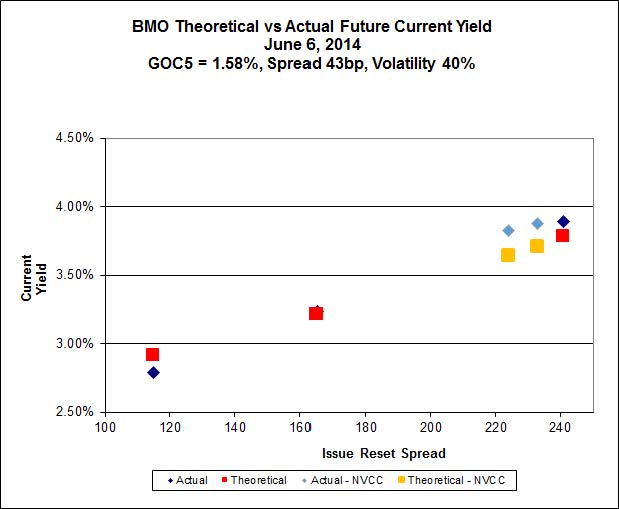
As shown in the follow chart displaying the result of the calculation, Implied Volatility for the BMO series of FixedResets remains very high, above its maximum reasonable value of 40%, implying that the market continues to ascribe a high degree of directionality (i.e., towards $25) for these issues. However, it also appears that the NVCC-compliant issues are trading at a premium yield to the non-compliant issues, so at least there’s some degree of reasonability to relative market prices!

ImpVol_BMOFR_140606
Click for Big
Issue Comments

M.PR.A To Get Bigger

Mosaic Capital Corporation has announced:

that it has filed and received a receipt for a preliminary short form prospectus in connection with a C$25,000,000 marketed public offering (the Offering”) of units (“Units”) of Mosaic. The Offering will be conducted on a reasonable best efforts basis through a syndicate of agents co-led by Clarus Securities Inc. and Canaccord Genuity Corp. and including Raymond James Ltd., National Bank Financial Inc. and Mackie Research Capital Corporation (the “Agents”). Mosaic has agreed to grant to the Agents an over-allotment option to purchase that number of additional Units equal to 15% of the Units sold pursuant to the Offering at the Offering Price for a period ending 30 days following the closing of the Offering.

Each Unit is comprised of one preferred security in the capital of Mosaic and one quarter (0.25) of one common share purchase warrant (a “Warrant”). Each full Warrant will entitle the holder to purchase one common share (a “Common Share”) in the capital of Mosaic for an exercise price of C$15.50 for 18 months following completion of the Offering. In the event that the 20-day volume weighted average price of the Common Shares listed on the TSX Venture Exchange is equal to or above C$18.00, the expiry date of the Warrants shall be accelerated to a date that is 30 days after notice is given by Mosaic.

The Units will be offered in British Columbia, Alberta, Saskatchewan, Manitoba, Ontario, New Brunswick, Nova Scotia, Prince Edward Island and Newfoundland by short form prospectus.

The net proceeds from the Offering will be used to fund Mosaic’s future acquisitions that fit Mosaic’s acquisition criteria and for general corporate purposes.

The Offering is expected to close on or about June 18th, 2014, subject to customary conditions and all regulatory approvals including the approval of the TSX Venture Exchange and of applicable securities regulatory authorities.

According to the Preliminary Prospectus available on SEDAR dated 2014-6-3:

The terms and conditions of the Preferred Securities to be issued pursuant to the Offering will be governed by the indenture dated April 29, 2011 (the “Preferred Securities Indenture”) and will bear the same terms as the issued and outstanding Preferred Securities of Mosaic which are traded on the TSX Venture Exchange (the “Exchange”) under the symbol “M.PR.A”. On June 2, 2014, the last trading day prior to the date of this short form prospectus, the closing price of the Preferred Securities on the Exchange was $11.35. See “Trading Price and Volume”.

The Preferred Securities are undated, perpetual securities having no fixed maturity date or redemption date. Each Preferred Security carries an entitlement to a monthly distribution in the amount of $0.0833 ($1.00 per annum) which is payable monthly in arrears on or about the 15th day of the succeeding month. The first monthly distribution on the Preferred Securities to be issued in connection with the Offering will be paid on or about the 15th day of the month following their issuance. Monthly distributions are cumulative but may be indefinitely deferred by Mosaic. For Canadian income tax purposes, the monthly distribution in respect of the Preferred Securities is considered interest income in the hands of the recipient. The Preferred Securities are unsecured and subordinated obligations of Mosaic ranking pari passu among themselves but subordinated and postponed to all of Mosaic’s senior indebtedness. The Preferred Securities do not carry any voting rights and may be redeemed or purchased for cancellation at any time by Mosaic. See “Details of the Offering – Preferred Securities” and “Certain Canadian Federal Income Tax Considerations” for particulars pertaining to the Preferred Securities.

Principal Amount
Each Preferred Security represents $10 in principal amount.

The Preferred Securities are undated, perpetual securities having no fixed maturity date or redemption date. The Preferred Securities are not redeemable by the holder at any time or in any circumstances. Notwithstanding any default of Mosaic under the terms of the Preferred Securities Indenture (including any default in the payment of interest), the principal amount under any or all of the Preferred Securities will only become due and payable upon a liquidation, dissolution or bankruptcy of Mosaic.

The Preferred Securities are unsecured and subordinated obligations of Mosaic ranking pari passu among themselves but subordinated and postponed to all indebtedness, liabilities and obligations of Mosaic which, by the terms of the instrument creating or evidencing such indebtedness, liabilities or obligations, is not expressed to rank in right of payment in subordination to or pari passu with the indebtedness evidenced by the Preferred Securities or any of them. The obligations under the Preferred Securities rank senior to the Common Shares.

The Preferred Securities are redeemable by Mosaic at any time at Mosaic’s option, in whole or in part (in which case they will be redeemed on a pro-rata basis), upon payment in respect of each Preferred Security of the “Redemption Price” which means, in respect of each Preferred Security, the greater of: (i) the amount of $10 dollars, being the principal amount thereof; and (ii) the market price (as defined in the Preferred Securities Indenture) of such Preferred Security; and, in each case, shall also include all accrued and unpaid interest on such Preferred Security (including any unpaid deferred interest, if any) up to but excluding the date of redemption. Mosaic will satisfy the Redemption Price by way of cash payment to the holders of Preferred Securities being redeemed.

Each Preferred Security bears simple interest at a rate of 10% per annum from the date of issuance upon the $10 principal amount thereof which, therefore, gives rise to an entitlement to a monthly distribution in the amount of $0.0833 ($1.00 per annum) which is payable monthly in arrears on or about the 15th day of the succeeding month. Interest payable on the Preferred Securities is cumulative and non-compounding. Each period from and including the first day of a month to and including the last day of the month is herein referred to as an “Interest Period”. The current Interest Period is one month. Subject to the terms of the Preferred Securities Indenture, Mosaic may change the Interest Period in its discretion provided that it shall be no greater than six months in duration. Holders of Preferred Securities of record on June 30, 2014 will be entitled to receive distributions for the June Interest Period.

Thanks to Assiduous Reader AP for alerting me to this. The TSX Venture Exchange is something I don’t pay a lot of attention to, but since I had the information in my lap, I thought I’d pass it on.

M.PR.A is not tracked by HIMIPref™ as it does not have a credit rating. This is not because I can’t come to my own views regarding credit quality, or because I worship the Credit Rating Agencies, but because I feel the threat of an imminent downgrade from a major agency does an excellent job of focussing the minds of the directors and management that they have a problem that really should be addressed. A ‘Review-Negative’ by Hymas Investment Management does not have quite the same effect.