MAPF

MAPF Portfolio Composition: June 2010

Turnover picked up substantially in June to about 53%. It’s about time we saw some useful volatility!

Trades were, as ever, triggered by a desire to exploit transient mispricing in the preferred share market (which may the thought of as “selling liquidity”), rather than any particular view being taken on market direction, sectoral performance or credit anticipation.

MAPF Sectoral Analysis 2010-6-30
HIMI Indices Sector Weighting YTW ModDur
Ratchet 0% N/A N/A
FixFloat 0% N/A N/A
Floater 0% N/A N/A
OpRet 0% N/A N/A
SplitShare 2.9% (-1.1) 7.97% 6.79
Interest Rearing 0% N/A N/A
PerpetualPremium 0.0% (0) N/A N/A
PerpetualDiscount 82.4% (+1.1) 6.11% 13.77
Fixed-Reset 9.8% (+0.6) 3.86% 3.44
Scraps (FixedReset) 4.4% (-0.5) 7.01% 12.53
Cash 0.4% (-0.1) 0.00% 0.00
Total 100% 5.96% 12.45
Totals and changes will not add precisely due to rounding. Bracketted figures represent change from May month-end. Cash is included in totals with duration and yield both equal to zero.

The “total” reflects the un-leveraged total portfolio (i.e., cash is included in the portfolio calculations and is deemed to have a duration and yield of 0.00.). MAPF will often have relatively large cash balances, both credit and debit, to facilitate trading. Figures presented in the table have been rounded to the indicated precision.

I recently received a question from a potential investor:

I just had a look at MAPF’s portfolio composition and noticed that it is very heavily in perpetual preferreds at a discount. I’m a bit surprised. I would think the general expectation is that interest rates will rise, which would reduce prices for perpetuals. What is the transient mispricing in the market for perpetuals that you are seeing now? Thanks very much in advance and best wishes,

I replied:

HIMIPref assigns a valuation to each issue which may be approximated as

V = Y + D

where Y is yield and D is Disparity.

Since PerpetualDiscounts yield so much more than FixedResets, there is somthing of a hurdle the latter class must get over before they are valued sufficiently highly to be included in a portfolio, but this effect is relatively small (see http://www.prefshares.com/overview/valuation.php)

Disparity is calclated according to the individual issue’s distance from the self-consistent yield curve. Fitting the yield curve provides several normalization factors, so that, for instance, the average disparity of all FixedResets will be zero, of all PerpetualDiscounts to be zero, of all issues rated Pfd-1(low) to be zero, etc. Note, however that the yield curve fitting is done with squared error, so that this will not be precisely true.

PerpetualDiscounts are far more widely dispersed about their mean than FixedResets; for instance, there is very obvious evidence of Credit Stratification (see http://www.prefblog.com/?p=2340) in this class, whereas the market appears to treat all FixedResets of like credit identically (see last two issues of PrefLetter).

Thus, the issues with the highest Valuation will tend to be PerpetualDiscounts.

When you write “the general expectation is that interest rates will rise”, I have to ask: which interest rates? Long, short, corporate, government? Long Corporates have been on wheels lately, fuelled by increasing speculation regarding deflation.

I guess I didn’t really answer one part of his question in detail: What is the transient mispricing in the market for perpetuals that you are seeing now? However, I show a sequence of trades below in which the fund was able to improve credit quality at what may be considered to be a low cost.

Credit distribution is:

MAPF Credit Analysis 2010-6-30
DBRS Rating Weighting
Pfd-1 0 (0)
Pfd-1(low) 69.2% (+8.2)
Pfd-2(high) 11.8% (-5.5)
Pfd-2 0 (0)
Pfd-2(low) 14.1% (-2.2)
Pfd-3(high) 4.4% (-0.5)
Cash 0.4% (-0.1)
Totals will not add precisely due to rounding. Bracketted figures represent change from Junel month-end.

The increase in credit quality was due in part to swaps from POW.PR.D (Pfd-2(high)) to GWO.PR.I (Pfd-1(low)):

MAPF Trades, POW.PR.D to GWO.PR.I
Date POW.PR.D GWO.PR.I
5/31 19.77
bid
6.43%
Yield
17.64
bid
6.39%
Yield
6/18 Sold
21.01
Bought
18.70
6/23 Sold
20.78
Bought
18.74
6/25 Sold
20.87
Bought
18.85
6/30 20.69
bid
6.07%
Yield
18.81
bid
6.02%
Yield
Dividends Ex 6/21
0.3125
 
Only major trades are shown. Not all trades affecting credit quality are reported. Details are incomplete and approximate. All trades wil be published at the time the Semi-annual report is released.

Liquidity Distribution is:

MAPF Liquidity Analysis 2010-6-30
Average Daily Trading Weighting
<$50,000 0.0% (0)
$50,000 – $100,000 2.9% (+2.9)
$100,000 – $200,000 40.8% (+13.4)
$200,000 – $300,000 32.0% (-18.5)
>$300,000 24.0% (+0.4)
Cash 0.4% (-0.1)
Totals will not add precisely due to rounding. Bracketted figures represent change from May month-end.

MAPF is, of course, Malachite Aggressive Preferred Fund, a “unit trust” managed by Hymas Investment Management Inc. Further information and links to performance, audited financials and subscription information are available the fund’s web page. A “unit trust” is like a regular mutual fund, but is sold by offering memorandum rather than prospectus. This is cheaper, but means subscription is restricted to “accredited investors” (as defined by the Ontario Securities Commission) and those who subscribe for $150,000+. Fund past performances are not a guarantee of future performance. You can lose money investing in MAPF or any other fund.

A similar portfolio composition analysis has been performed on the Claymore Preferred Share ETF (symbol CPD) as of August 17, 2009, and published in the September, 2009, PrefLetter. When comparing CPD and MAPF:

  • MAPF credit quality is better
  • MAPF liquidity is a little lower
  • MAPF Yield is higher
  • Weightings in
    • MAPF is much more exposed to PerpetualDiscounts
    • MAPF is much less exposed to Operating Retractibles
    • MAPF is more exposed to SplitShares
    • MAPF is less exposed to FixFloat / Floater / Ratchet
    • MAPF weighting in FixedResets is much lower
Market Action

July 2, 2010

The US jobs number was poor:

Employment at companies rose 83,000, less than the 110,000 gain forecast by economists in a Bloomberg News survey. Including government, payrolls fell for the first time this year because of a drop in federal census workers. The jobless rate dropped to 9.5 percent from 9.7 percent as the labor force shrank, the Labor Department reported today in Washington.

OSFI has published a presentation by Michel Montambeault, Director, to the Canada Institute of Actuaries (CIA) Annual Meeting, on the topic of “Canadian Mortality Experience”, 29 June 2010, Vancouver, British Columbia. In related news, a cluster of longevity genes has been identified:

U.S. scientists say they have discovered the genetic signature of an exceptionally long life, and with nothing more than a DNA sample they can predict – with 77 per cent accuracy – those biologically built to live beyond a century.

They also predict that such a test, based on a set of 150 genetic markers, will be available to the curious by summer’s end.

“It’s really quite revolutionary,” said Thomas Perls, associate professor of medicine at Boston University and senior author of a research paper published online Thursday by the journal Science. “With the accuracy we’ve demonstrated, companies are going to pick this up. We’ll see it on the market in a month.”

Adverse selection just became a bigger risk for the insurance companies!

I sent an eMail to the Toronto Stock Exchange:

On June 30, MFC.PR.B traded 5,792 shares on the TSX in a range of 19.63-80 and closed at 19.01-66, 10×12. The last trade was at 3:58pm, 300 shares at 19.66.

I have a number of questions:
i) Who is the market maker for this issue?
ii) Which firm employs the market maker?
iii) What committments were made regarding spreads by the market maker?
iv) How have these committments been kept over the past year?
v) How have other committments made by this market maker been kept over the past year?
vi) How have other committments made by the market maker’s firm been kept over the past year?

We’ll see what happens with that! (Fearless prediction: Nothing).

On an extremely quiet day in the Canadian preferred share market, PerpetualDiscounts lost 4bp while FixedResets gained 14bp.

HIMIPref™ Preferred Indices
These values reflect the December 2008 revision of the HIMIPref™ Indices

Values are provisional and are finalized monthly
Index Mean
Current
Yield
(at bid)
Median
YTW
Median
Average
Trading
Value
Median
Mod Dur
(YTW)
Issues Day’s Perf. Index Value
Ratchet 2.82 % 2.92 % 26,768 20.33 1 0.0000 % 2,048.5
FixedFloater 0.00 % 0.00 % 0 0.00 0 -1.0732 % 3,107.8
Floater 2.32 % 1.97 % 46,034 22.46 4 -1.0732 % 2,215.1
OpRet 4.87 % 3.59 % 79,627 0.88 11 -0.0671 % 2,334.3
SplitShare 6.38 % 6.36 % 87,888 3.46 2 -0.2195 % 2,173.9
Interest-Bearing 0.00 % 0.00 % 0 0.00 0 -0.0671 % 2,134.5
Perpetual-Premium 5.98 % 5.88 % 121,604 1.86 4 -0.2973 % 1,910.6
Perpetual-Discount 5.94 % 6.01 % 188,996 13.90 73 -0.0418 % 1,813.2
FixedReset 5.37 % 3.90 % 325,073 3.49 47 0.1434 % 2,192.4
Performance Highlights
Issue Index Change Notes
BAM.PR.B Floater -2.03 % YTW SCENARIO
Maturity Type : Limit Maturity
Maturity Date : 2040-07-02
Maturity Price : 14.99
Evaluated at bid price : 14.99
Bid-YTW : 2.93 %
BAM.PR.K Floater -1.70 % YTW SCENARIO
Maturity Type : Limit Maturity
Maturity Date : 2040-07-02
Maturity Price : 15.00
Evaluated at bid price : 15.00
Bid-YTW : 2.93 %
BAM.PR.H OpRet -1.23 % YTW SCENARIO
Maturity Type : Call
Maturity Date : 2010-08-01
Maturity Price : 25.50
Evaluated at bid price : 25.60
Bid-YTW : 1.24 %
PWF.PR.A Floater -1.12 % YTW SCENARIO
Maturity Type : Limit Maturity
Maturity Date : 2040-07-02
Maturity Price : 21.75
Evaluated at bid price : 22.00
Bid-YTW : 1.97 %
PWF.PR.O Perpetual-Discount -1.00 % YTW SCENARIO
Maturity Type : Limit Maturity
Maturity Date : 2040-07-02
Maturity Price : 23.58
Evaluated at bid price : 23.76
Bid-YTW : 6.22 %
BAM.PR.R FixedReset 1.15 % YTW SCENARIO
Maturity Type : Limit Maturity
Maturity Date : 2040-07-02
Maturity Price : 23.26
Evaluated at bid price : 25.50
Bid-YTW : 4.77 %
BNS.PR.Q FixedReset 1.28 % YTW SCENARIO
Maturity Type : Call
Maturity Date : 2013-11-24
Maturity Price : 25.00
Evaluated at bid price : 25.99
Bid-YTW : 3.60 %
NA.PR.O FixedReset 1.56 % YTW SCENARIO
Maturity Type : Call
Maturity Date : 2014-03-17
Maturity Price : 25.00
Evaluated at bid price : 27.94
Bid-YTW : 3.49 %
MFC.PR.B Perpetual-Discount 2.84 % YTW SCENARIO
Maturity Type : Limit Maturity
Maturity Date : 2040-07-02
Maturity Price : 19.55
Evaluated at bid price : 19.55
Bid-YTW : 6.01 %
Volume Highlights
Issue Index Shares
Traded
Notes
RY.PR.R FixedReset 31,130 Desjardins crossed 27,400 at 27.37.
YTW SCENARIO
Maturity Type : Call
Maturity Date : 2014-03-26
Maturity Price : 25.00
Evaluated at bid price : 27.50
Bid-YTW : 3.62 %
RY.PR.A Perpetual-Discount 25,703 YTW SCENARIO
Maturity Type : Limit Maturity
Maturity Date : 2040-07-02
Maturity Price : 19.56
Evaluated at bid price : 19.56
Bid-YTW : 5.77 %
MFC.PR.D FixedReset 19,477 YTW SCENARIO
Maturity Type : Call
Maturity Date : 2014-07-19
Maturity Price : 25.00
Evaluated at bid price : 27.50
Bid-YTW : 4.02 %
TRP.PR.C FixedReset 14,275 Recent new issue.
YTW SCENARIO
Maturity Type : Limit Maturity
Maturity Date : 2040-07-02
Maturity Price : 23.11
Evaluated at bid price : 24.96
Bid-YTW : 4.02 %
BNS.PR.N Perpetual-Discount 13,990 YTW SCENARIO
Maturity Type : Limit Maturity
Maturity Date : 2040-07-02
Maturity Price : 22.42
Evaluated at bid price : 22.55
Bid-YTW : 5.83 %
CM.PR.L FixedReset 13,735 YTW SCENARIO
Maturity Type : Call
Maturity Date : 2014-05-30
Maturity Price : 25.00
Evaluated at bid price : 27.78
Bid-YTW : 3.35 %
There were 5 other index-included issues trading in excess of 10,000 shares.
Index Construction / Reporting

Index Performance: June 2010

Performance of the HIMIPref™ Indices for June, 2010, was:

Total Return
Index Performance
June 2010
Three Months
to
June 30, 2010
Ratchet -1.41% -5.25%
FixFloat +1.88% -2.05%
Floater -0.44% -8.10%
OpRet +1.41% +1.09%
SplitShare +1.33% +1.90%
Interest +1.41%**** +1.09%****
PerpetualPremium +5.32%* +3.08%*
PerpetualDiscount +5.32% +4.14%
FixedReset +1.59% -0.34%
* The last member of the PerpetualPremium index was transferred to PerpetualDiscount at the May, 2010, rebalancing; subsequent performance figures are set equal to the PerpetualPremium index
**** The last member of the InterestBearing index was transferred to Scraps at the June, 2009, rebalancing; subsequent performance figures are set equal to the OperatingRetractible index
Passive Funds (see below for calculations)
CPD +2.58% +1.33%
DPS.UN +3.42% +1.09%
Index
BMO-CM 50 +2.87% +1.17%
TXPR Total Return +2.64% +1.40%

The pre-tax interest equivalent spread of PerpetualDiscounts over Long Corporates (which I also refer to as the Seniority Spread) ended the month at 290bp a significant decline from the +315bp recorded on May 31. The big story was the decline in long corporate yields, from 5.65% to 5.45%, as increased chatter about deflation has the market timers all excited.

I would be happier with long corporates in the 6.00-6.25% range, but what do I know? The market has never shown any particular interest in my happiness.

Charts related to the Seniority Spread and the Bozo Spread (PerpetualDiscount Current Yield less FixedReset Current Yield) are published in PrefLetter.

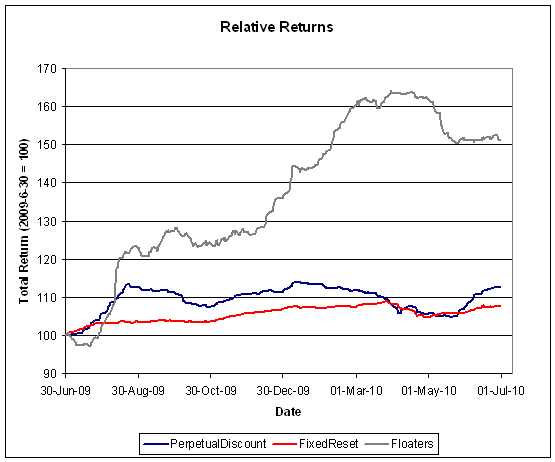
The trailing year returns are starting to look a bit more normal.


Click for big

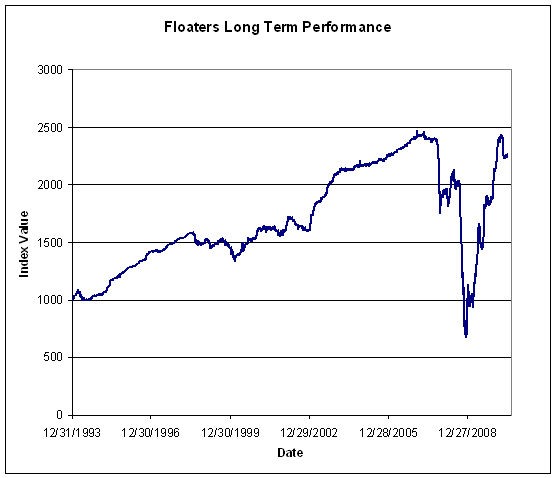
Floaters have had a wild ride


Click for big

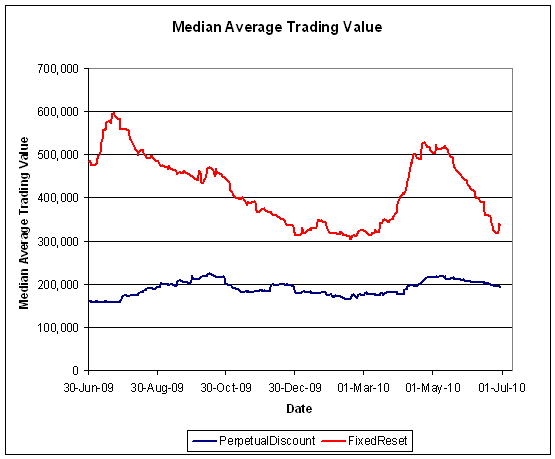
FixedReset volume declined during the month after their burst of activity in April when they performed poorly. Volume may be under-reported due to the influence of Alternative Trading Systems (as discussed in the November PrefLetter), but I am biding my time before incorporating ATS volumes into the calculations, to see if the effect is transient or not.


Click for big

Compositions of the passive funds were discussed in the September, 2009, edition of PrefLetter.

Claymore has published NAV and distribution data (problems with the page in IE8 can be kludged by using compatibility view) for its exchange traded fund (CPD) and I have derived the following table:

CPD Return, 1- & 3-month, to June, 2010
Date NAV Distribution Return for Sub-Period Monthly Return
March 31, 2010 16.46 0.00    
April 30 16.11     -2.13%
May 31 16.26     +0.93%
June 25 16.47 0.21 +2.58% +2.58%
June 30, 2010 16.47 0.00 0.00%
Quarterly Return +1.33%

Claymore currently holds $444,847,391 (advisor & common combined) in CPD assets, up about $13-million from the $431,929,434 reported last month and up about $71-million from the $373,729,364 reported at year-end. The monthly increase in AUM of about 2.99% is larger than the total return of +2.58%, implying that the ETF experienced small net subscriptions in May.

The DPS.UN NAV for June 30 has been published so we may calculate the approximate May returns.

DPS.UN NAV Return, June-ish 2010
Date NAV Distribution Return for sub-period Return for period
Estimated May Ending Stub -0.74% **
May 26, 2010 19.34      
June 28 19.85 * 0.30   +4.19%
June 30, 2010 19.85     0.00%
Estimated June Return +3.42% ***
*CPD had a NAVPU of 16.47 on June 28 and 16.47 on June 30, hence the total return for the period for CPD was +0.00%. The return for DPS.UN in this period is presumed to be equal, hence the estimated NAV for DPS.UN on June 28 is presumed to be equal to the June 30 value.
**CPD had a NAVPU of 16.14 on May 26 and 16.26 on May 31, hence the total return for the period for CPD was +0.74%. The return for DPS.UN in this period is presumed to be equal.
*** The estimated June return for DPS.UN’s NAV is therefore the product of three period returns, -0.74%, +4.19% and 0.00% to arrive at an estimate for the calendar month of +3.42%

Now, to see the DPS.UN quarterly NAV approximate return, we refer to the calculations for April and May:

DPS.UN NAV Returns, three-month-ish to end-June-ish, 2010
April-ish -2.47%
May-ish +0.22%
June-ish +3.42%
Three-months-ish +1.09%
Index Construction / Reporting

HIMIPref™ Index Rebalancing: June, 2010

HIMI Index Changes, June 30, 2010
Issue From To Because
BAM.PR.G FixFloat Scraps Volume
PWF.PR.A Scraps Floater Volume
CL.PR.B PerpetualDiscount PerpetualPremium Price
NA.PR.M PerpetualDiscount PerpetualPremium Price
CU.PR.B PerpetualDiscount PerpetualPremium Price
BMO.PR.L PerpetualDiscount PerpetualPremium Price

The strong performance of Straight Perpetuals over the past month means that the PerpetualPremium index has been repopulated, albeit lightly and weakly. Unfortunately, however, low volumes on BAM.PR.G have resulted in its relegation to the Scraps index, leaving FixedFloaters as an empty set.

There were the following intra-month changes:

HIMI Index Changes during June 2010
Issue Action Index Because
EMA.PR.A Add Scraps New Issue
TRP.PR.C Add FixedReset New Issue
PWF.PR.P Add FixedReset New Issue
Issue Comments

Best & Worst Performers: June 2010

These are total returns, with dividends presumed to have been reinvested at the bid price on the ex-date. The list has been restricted to issues in the HIMIPref™ indices.

June 2010
Issue Index DBRS Rating Monthly Performance Notes (“Now” means “June 30”)
BAM.PR.K Floater Pfd-2(low) -3.41% Also the worst performer in May.
BAM.PR.B Floater Pfd-2(low) -2.56% Also the second-worst performer in May.
GWO.PR.J FixedReset Pfd-1(low) -2.37% It’s presence here is largely due to a disappearing bid on June 30: the closing quote was 25.92-62, after trading 3,400 shares in a range of 26.62-85. Now with a (bid) yield of 4.90% based on a bid of 25.92 an a call 2014-1-30 at 25.00.
BAM.PR.E Ratchet Pfd-2(low) -1.41% Strong Pair with BAM.PR.G. Also the fourth-worst performer in May.
BNA.PR.D SplitShare Pfd-2(low) -0.19% Now with a pre-tax bid-YTW of 6.35% based on a bid of 25.95 and a hardMaturity 2014-7-9 at 25.00.
W.PR.J Perpetual-Discount Pfd-2(low) +8.01% Now with a pre-tax bid-TTW of 6.10% based on a bid of 23.00 and a limitMaturity.
W.PR.H Perpetual-Discount Pfd-2(low) +8.05% Now with a pre-tax bid-TTW of 6.11% based on a bid of 22.53 and a limitMaturity.
BAM.PR.M Perpetual-Discount Pfd-2(low) +8.26% Now with a pre-tax bid-TTW of 6.59% based on a bid of 18.16 and a limitMaturity.
IAG.PR.A Perpetual-Discount Pfd-2(high) +8.72% The fifth-worst performer in May, so a lot of this return is merely bounce-back. Now with a pre-tax bid-TTW of 6.03% based on a bid of 19.20 and a limitMaturity.
ELF.PR.G Perpetual-Discount Pfd-2(low) +9.10% Now with a pre-tax bid-YTW of 6.62% based on a bid of 18.03 and a limitMaturity.
Market Action

June 30, 2010

Corporations are well placed to weather the next crisis:

Companies from the U.S. to Europe and Asia are selling the fewest bonds since 2004, as rising cash levels allow borrowers to weather a slowing economy.

Debt offerings fell to $1.17 trillion in the first half of the year, 39 percent less than the same period in 2009, according to data compiled by Bloomberg. The decline was led by financial companies, which issued 35 percent less debt.

Issuance is declining as borrowers with 15 percent more cash than a year earlier avoid tapping credit markets amid concern that Europe’s sovereign-debt crisis may slow the global economic recovery. Corporate bonds have returned 4.9 percent in the first half of the year, beating the MSCI World Index of stocks, which is down 8.9 percent, by the most in nine years.

Cash at investment-grade companies rose to $668 billion at the end of the first quarter from $580 billion a year earlier, while debt fell 2 percent to $2.3 trillion, JPMorgan Chase & Co. analysts led by Eric Beinstein in New York wrote last week.

In the midst of the sovereign debt crisis, the EU is taking firm action:

Bankers in Europe will not be allowed to take home more than a third of their bonuses in cash from the start of next year under planned new rules, a British lawmaker said Tuesday.

Under the negotiated agreement, cash could only constitute 30 percent of a regular bonus and one-fifth a large bonus. A new watchdog for European banks will define what constitutes a large bonus. There will also be an opportunity for a “clawback” of bonuses if deals made to reach profit targets later fell apart.

In addition, banks that have received government bailouts will have to limit bonuses paid to their managers, while directors will not be eligible to receive any bonus unless it is justified to supervisors. Banks must also set limits on bonuses in relation to salaries to avoid any windfall payouts.

What will happen, I think, is that talent will migrate to hedge funds, which will take over a significant part of the market-making function. Maybe this is a good thing. But I doubt that anybody’s thought about it.

Ms Gertrude Tumpel-Gugerell, Member of the Executive Board of the European Central Bank, spoke at the US Financial Services Roundtable, Brussels, 28 June 2010, stringing together non-sequiters to reach a politically desirable conclusion (emphasis added):

The first priority relates to the development of financial infrastructures in those markets where they are not yet sufficiently used or available, notably in OTC derivatives markets. The crisis has shown that markets with adequate infrastructures and hence proper risk management and risk provisions have proven to be more resilient than markets without such infrastructures, such as the OTC derivatives markets. Therefore, expanding the use of central counterparties (CCPs) in these increasingly systemically relevant markets is a key measure to reduce counterparty and operational risk. Another important step is the mandatory reporting of all trades to centralised trade registries, so-called trade repositories, in order to enhance market transparency. In my view, if CCPs and trade repositories for credit default swaps had been available before the Lehman default, Lehman’s CDS exposures could have been managed in a much more transparent and resilient way and could have mitigated the negative chain reaction on CDS markets that followed the demise of Lehman.

CCPs and trade repositories for OTC derivatives are ultimately beneficial for all stakeholders. Still, there are the well-known challenges of effective collective action in the context of the provision of public goods. Hence, private sector efforts alone may not suffice to foster sufficient progress towards the use of CCPs and trade repositories for OTC derivatives. It is therefore important to adopt and implement the regulatory requirements for the mandatory central clearing of all eligible products and the reporting of trades to trade repositories in a timely manner. Given, however, the global nature of OTC derivatives markets, it is clear that such regulatory tools will only be successful if they are applied in a coordinated manner around the globe. I strongly support the recently launched work of the Financial Stability Board to develop common approaches to fostering the central clearing of eligible OTC derivatives as well as to expand the range of potentially clearable products through enhanced standardisation.

Quite frankly, I don’t understand her use of the word “therefore”!

The OSC has published a new edition of Perspectives. Articles feature:

  • CSA publishes proposed amendments to mutual fund regulations
  • CSA publishes frequently asked questions about order protection and locked and crossed markets
  • OSC updates registrant section of its website

There’s some more reaction to mandatory margining proposals, this time from ISDA:

A change in the wording of the financial reform bill now being finalized in the US Congress could cost US companies as much as $1 trillion in capital and liquidity requirements, according to research by the International Swaps and Derivatives Association, Inc. (ISDA). About $400 billion would be needed as collateral that corporations could be required to post with their dealer counterparties to cover the current exposure of their OTC derivatives transactions. ISDA estimates that $370 billion represents the additional credit capacity that companies could need to maintain to cover potential future exposure of those transactions. If markets return to levels prevailing at the end of 2008, additional collateral needs would bring the total to $1 trillion.

That will be a nice little profit centre for the banks – setting up credit lines dedicated to collateralization! Now, is this a good thing, or a bad thing? Nobody knows. It hasn’t been discussed.

Naturally, some companies will be affected more than others:

Berkshire [Hathaway Inc.] owns derivatives with a notional value of about $62 billion and has “negligible” collateral requirements, Barclays analyst Jay Gelb said today in a report. [Warren] Buffett’s firm, based in Omaha, Nebraska, may need to post $6 billion to $8 billion in collateral under rules being debated by the U.S. Congress, he said.

The SEC has announced new rules to discourage political corruption in the investment advisory business. Sadly, there are no rules disallowing the hiring of former SEC employees.

CM has issued CHF 500-million in 5-year covered bonds at 1.75%. Bonds OnLine is reporting 5-year Swiss governments at a rather alarming -0.26% (that’s right, negative twenty-six beeps); the only data I can find for 5-years on the Swiss National Bank site is dated May 31. DBRS rates them AAA:

The ratings are based on several factors. First, the Covered Bonds are senior unsecured direct obligations of CIBC, which is the fifth largest bank in Canada and rated AA and R-1 (high) with a Stable trend by DBRS. Second, in addition to a general recourse to CIBC’s assets, the Covered Bonds are supported by a diversified collateral pool of first-lien prime residential mortgages insured by Canada Mortgage and Housing Corporation (CMHC) (the Cover Pool). CMHC is an agent of Her Majesty in right of Canada and is rated AAA by DBRS.

MFC.PR.B traded 5,792 shares on the TSX today in a range of 19.63-80 and closed at 19.01-66, 10×12. The last trade was at 3:58pm, 300 shares at 19.66. I can only suppose the market maker decided to get an early start on his weekend.

Much the same thing happened with GWO.PR.J: traded 3,400 shares in a range of 26.62-85 before closing at 25.92-62, 20×7.

BAM.PR.G traded 145 shares, all at 21.40, and closed at 20.91-40, 15×10. I can only imagine that the market maker was overwhelmed by the volume.

These are particularly annoying incidents, because it’s not just month-end, it’s quarter-end.

PerpetualDiscounts squeaked out a win today, gaining 4bp, while FixedResets gained 7bp on light volume and, as we have seen, a surprising and probably spurious amount of volatility.

PerpetualDiscounts now yield 5.97%, equivalent to 8.36% interest at the standard conversion factor of 1.4x. Long corporates now yield an astonishing (to me) 5.45%, so the pre-tax interest-equivalent spread (also called the Seniority Spread) now stands at about 290bp, the same level reported on June 23, but a narrowing of 25bp from the 315bp spread reported on May 31.

And that’s a wrap for June, 2010!

HIMIPref™ Preferred Indices
These values reflect the December 2008 revision of the HIMIPref™ Indices

Values are provisional and are finalized monthly
Index Mean
Current
Yield
(at bid)
Median
YTW
Median
Average
Trading
Value
Median
Mod Dur
(YTW)
Issues Day’s Perf. Index Value
Ratchet 2.81 % 2.92 % 27,881 20.35 1 0.0000 % 2,048.0
FixedFloater 5.20 % 3.37 % 21,210 19.70 1 -2.2897 % 3,077.5
Floater 2.42 % 2.85 % 76,191 20.08 3 -0.2578 % 2,239.0
OpRet 4.87 % 3.57 % 82,897 0.89 11 -0.0423 % 2,335.9
SplitShare 6.37 % 6.35 % 91,524 3.47 2 -0.0439 % 2,178.7
Interest-Bearing 0.00 % 0.00 % 0 0.00 0 -0.0423 % 2,136.0
Perpetual-Premium 0.00 % 0.00 % 0 0.00 0 0.0431 % 1,916.3
Perpetual-Discount 5.94 % 5.97 % 192,482 13.90 77 0.0431 % 1,814.0
FixedReset 5.37 % 3.90 % 335,785 3.46 47 0.0686 % 2,189.3
Performance Highlights
Issue Index Change Notes
MFC.PR.B Perpetual-Discount -2.96 % YTW SCENARIO
Maturity Type : Limit Maturity
Maturity Date : 2040-06-30
Maturity Price : 19.01
Evaluated at bid price : 19.01
Bid-YTW : 6.17 %
GWO.PR.J FixedReset -2.63 % YTW SCENARIO
Maturity Type : Call
Maturity Date : 2014-01-30
Maturity Price : 25.00
Evaluated at bid price : 25.92
Bid-YTW : 4.90 %
BAM.PR.G FixedFloater -2.29 % YTW SCENARIO
Maturity Type : Limit Maturity
Maturity Date : 2040-06-30
Maturity Price : 25.00
Evaluated at bid price : 20.91
Bid-YTW : 3.37 %
BAM.PR.B Floater -1.80 % YTW SCENARIO
Maturity Type : Limit Maturity
Maturity Date : 2040-06-30
Maturity Price : 15.30
Evaluated at bid price : 15.30
Bid-YTW : 2.85 %
PWF.PR.F Perpetual-Discount -1.27 % YTW SCENARIO
Maturity Type : Limit Maturity
Maturity Date : 2040-06-30
Maturity Price : 21.50
Evaluated at bid price : 21.77
Bid-YTW : 6.13 %
TD.PR.N OpRet -1.26 % YTW SCENARIO
Maturity Type : Soft Maturity
Maturity Date : 2014-01-30
Maturity Price : 25.00
Evaluated at bid price : 25.77
Bid-YTW : 3.92 %
BAM.PR.K Floater -1.04 % YTW SCENARIO
Maturity Type : Limit Maturity
Maturity Date : 2040-06-30
Maturity Price : 15.26
Evaluated at bid price : 15.26
Bid-YTW : 2.86 %
TD.PR.G FixedReset 1.13 % YTW SCENARIO
Maturity Type : Call
Maturity Date : 2014-05-30
Maturity Price : 25.00
Evaluated at bid price : 27.75
Bid-YTW : 3.56 %
BAM.PR.H OpRet 1.21 % YTW SCENARIO
Maturity Type : Call
Maturity Date : 2010-07-30
Maturity Price : 25.50
Evaluated at bid price : 25.92
Bid-YTW : -13.77 %
TRI.PR.B Floater 1.29 % YTW SCENARIO
Maturity Type : Limit Maturity
Maturity Date : 2040-06-30
Maturity Price : 23.32
Evaluated at bid price : 23.60
Bid-YTW : 1.82 %
Volume Highlights
Issue Index Shares
Traded
Notes
TRP.PR.C FixedReset 376,889 Recent new issue.
YTW SCENARIO
Maturity Type : Limit Maturity
Maturity Date : 2040-06-30
Maturity Price : 23.10
Evaluated at bid price : 24.93
Bid-YTW : 4.03 %
PWF.PR.P FixedReset 159,850 Recent new issue.
YTW SCENARIO
Maturity Type : Limit Maturity
Maturity Date : 2040-06-30
Maturity Price : 23.16
Evaluated at bid price : 25.11
Bid-YTW : 4.04 %
PWF.PR.J OpRet 121,223 Called for redemption.
YTW SCENARIO
Maturity Type : Call
Maturity Date : 2011-05-30
Maturity Price : 25.25
Evaluated at bid price : 25.71
Bid-YTW : 3.51 %
PWF.PR.I Perpetual-Discount 82,900 RBC crossed blocks of 10,000 and 57,300, both at 24.90.
YTW SCENARIO
Maturity Type : Limit Maturity
Maturity Date : 2040-06-30
Maturity Price : 24.42
Evaluated at bid price : 24.80
Bid-YTW : 6.15 %
TRP.PR.B FixedReset 78,929 Nesbitt crossed 50,000 at 24.56.
YTW SCENARIO
Maturity Type : Limit Maturity
Maturity Date : 2040-06-30
Maturity Price : 24.55
Evaluated at bid price : 24.60
Bid-YTW : 3.90 %
BNS.PR.M Perpetual-Discount 27,091 YTW SCENARIO
Maturity Type : Limit Maturity
Maturity Date : 2040-06-30
Maturity Price : 19.80
Evaluated at bid price : 19.80
Bid-YTW : 5.79 %
There were 22 other index-included issues trading in excess of 10,000 shares.
Market Action

June 29, 2010

The Bank for International Settlements released its annual report with chapters on:

  • Beyond the rescue: exiting intensive care and finishing the reforms
  • From the emergency room to intensive care: the year in retrospect
  • Low interest rates: do the risks outweigh the rewards?
  • Post-crisis policy challenges in emerging market economies
  • Fiscal sustainability in the industrial countries: risks and challenges
  • The future of the financial sector
  • Macroprudential policy and addressing procyclicality
  • The BIS: mission, activities, governance and financial results

Naturally enough, the sections that dealt with regulation are in complete alignment with the G-20 communique. What a coincidence that is!

There’s a hiccup on the way to the US Bank Bill:

U.S. Representative Barney Frank may reconvene the House-Senate financial-overhaul conference today to address Republican protests over a $19 billion bank fee in the bill, according to a scheduling announcement sent to lawmakers.

One plan under consideration would instead cover the shortfall in the bill with an increase in the fund that the Federal Deposit Insurance Corp. maintains to repay customers their deposits when a bank fails. Another would save money by closing the Troubled Asset Relief Program two months early, according to the announcement.

Changing the bank fee could end an impasse that threatened to delay the final Senate vote on the bill after the death of Senator Robert Byrd, a West Virginia Democrat. Byrd’s absence left Democrats in need of all four Republicans who previously backed the measure. One of those Republicans, Senator Scott Brown of Massachusetts, withdrew his support earlier today, citing the fee.

PrefBlog has added to its list of interesting things to do while drunk:

Mr Perkins, who worked for City brokers PVM Oil, had gone on a golfing weekend organised by the company.

Then he took the Monday off work and continued to binge drink from midday onwards.

By the evening, Mr Perkins had made his first batch of unauthorised trades.

In his stupor, he casually notched up thousands of trades worth a total of $520million (£345million).

He drunkenly bought a net 7.13million barrels of oil during the typically quiet overnight period, and at times was personally responsible for 69 per cent of the overall volume of Brent crude being traded globally.

His actions sent prices surging by more than $1.50 to $73.50 for a barrel of Brent crude oil – the highest it had been for eight months.

The deals ended up costing his company £6million and potentially cost companies worldwide more than £100million.

Westcoast did a 10-year bond issue:

Westcoast Energy Inc. raised C$250 million from an issue of 10-year bonds maturing July 2020, pricing the offering at 138.5 basis points over the relevant benchmark for a yield of 4.571%, according to a person familiar with the matter.

The bonds carry a coupon of 4.57%.

Westcoast is owned by Spectra Energy Corp. (SE).

There’s an odd lawsuit against the Greater Toronto Hockey League claiming not that try-outs were rigged, or anything like that, but that everybody should get a chance to play (70-odd players tried out for 17 positions):

“Their direct actions have caused irreparable psychological damage to Daniel Longo’s self esteem as an impressionable teenager and demoralized Daniel as an athlete and team hockey player with his peers,” the Longo statement of claim reads. “The conduct by all defendants destroyed the dignity of my son, whom in good conscience gave his team nothing but his best efforts.”

Valela’s statement of claim states: “When Christopher was advised of his termination by my wife and I, he vowed never to play the game he loved since childhood. And, morevoer, his misguided group of defendants demoralized my wife and I, whom had gone well beyond the call of duty as parents in support of the Toronto Avalanche hockey team for two seasons.”

I know a teenager who quit an activity after finding out he wasn’t good enough. Has it always been this way, or is all the fashionable self-esteem crap raising a nation of quitters?

Tragedy struck the Canadian preferred share market today, as PerpetualDiscounts suffered their first loss since May 20. The PerpetualDiscount index gained on twenty-six consecutive trading days, for a total return of +7.43% as median weighted average yield declined from 6.39% to 6.01%. Over the same period, FixedResets had a total return of +1.68%.

I had been hoping to close the quarter with a full month’s run of gains … but you can’t win them all!

PerpetualDiscounts lost 4bp while FixedResets gained 11bp today. Volume picked up to above-average levels, perhaps related to portfolio shuffling with respect to PWF.PR.P and TRP.PR.C, which both closed today.

HIMIPref™ Preferred Indices
These values reflect the December 2008 revision of the HIMIPref™ Indices

Values are provisional and are finalized monthly
Index Mean
Current
Yield
(at bid)
Median
YTW
Median
Average
Trading
Value
Median
Mod Dur
(YTW)
Issues Day’s Perf. Index Value
Ratchet 2.81 % 2.91 % 29,040 20.36 1 0.0000 % 2,048.0
FixedFloater 5.08 % 3.25 % 21,966 19.86 1 -0.0467 % 3,149.6
Floater 2.42 % 2.80 % 75,818 20.22 3 -0.6041 % 2,244.8
OpRet 4.87 % 3.31 % 86,299 0.41 11 0.1166 % 2,336.9
SplitShare 6.36 % 6.27 % 87,069 3.47 2 -0.5455 % 2,179.7
Interest-Bearing 0.00 % 0.00 % 0 0.00 0 0.1166 % 2,136.9
Perpetual-Premium 0.00 % 0.00 % 0 0.00 0 -0.0402 % 1,915.5
Perpetual-Discount 5.94 % 6.00 % 194,603 13.91 77 -0.0402 % 1,813.2
FixedReset 5.37 % 3.93 % 340,948 3.52 47 0.1140 % 2,187.8
Performance Highlights
Issue Index Change Notes
NA.PR.L Perpetual-Discount -1.49 % YTW SCENARIO
Maturity Type : Limit Maturity
Maturity Date : 2040-06-29
Maturity Price : 20.55
Evaluated at bid price : 20.55
Bid-YTW : 6.00 %
CM.PR.J Perpetual-Discount -1.16 % YTW SCENARIO
Maturity Type : Limit Maturity
Maturity Date : 2040-06-29
Maturity Price : 18.79
Evaluated at bid price : 18.79
Bid-YTW : 5.99 %
BNA.PR.C SplitShare -1.06 % YTW SCENARIO
Maturity Type : Hard Maturity
Maturity Date : 2019-01-10
Maturity Price : 25.00
Evaluated at bid price : 19.56
Bid-YTW : 8.00 %
PWF.PR.G Perpetual-Discount 1.11 % YTW SCENARIO
Maturity Type : Limit Maturity
Maturity Date : 2040-06-29
Maturity Price : 24.32
Evaluated at bid price : 24.60
Bid-YTW : 6.10 %
PWF.PR.F Perpetual-Discount 1.38 % YTW SCENARIO
Maturity Type : Limit Maturity
Maturity Date : 2040-06-29
Maturity Price : 21.79
Evaluated at bid price : 22.05
Bid-YTW : 6.05 %
BAM.PR.O OpRet 1.84 % YTW SCENARIO
Maturity Type : Option Certainty
Maturity Date : 2013-06-30
Maturity Price : 25.00
Evaluated at bid price : 25.97
Bid-YTW : 3.64 %
Volume Highlights
Issue Index Shares
Traded
Notes
TRP.PR.C FixedReset 567,818 New issue settled today.
YTW SCENARIO
Maturity Type : Limit Maturity
Maturity Date : 2040-06-29
Maturity Price : 23.07
Evaluated at bid price : 24.83
Bid-YTW : 4.05 %
PWF.PR.P FixedReset 563,942 New issue settled today.
YTW SCENARIO
Maturity Type : Limit Maturity
Maturity Date : 2040-06-29
Maturity Price : 23.12
Evaluated at bid price : 25.00
Bid-YTW : 4.06 %
BNS.PR.N Perpetual-Discount 411,715 Nesbitt crossed 400,000 at 22.85.
YTW SCENARIO
Maturity Type : Limit Maturity
Maturity Date : 2040-06-29
Maturity Price : 22.72
Evaluated at bid price : 22.87
Bid-YTW : 5.84 %
TD.PR.C FixedReset 160,065 Scotia crossed 77,000 at 26.70; TD crossed blocks of 20,000 and 25,000 at the same price.
YTW SCENARIO
Maturity Type : Call
Maturity Date : 2014-03-02
Maturity Price : 25.00
Evaluated at bid price : 26.69
Bid-YTW : 3.90 %
TD.PR.G FixedReset 70,200 TD crossed blocks of 25,000 and 10,000 at 27.40; National sold 10,000 to anonymous at the same price.
YTW SCENARIO
Maturity Type : Call
Maturity Date : 2014-05-30
Maturity Price : 25.00
Evaluated at bid price : 27.44
Bid-YTW : 3.89 %
PWF.PR.J OpRet 60,633 Called for redemption.
YTW SCENARIO
Maturity Type : Call
Maturity Date : 2010-07-29
Maturity Price : 25.50
Evaluated at bid price : 25.72
Bid-YTW : 3.31 %
There were 43 other index-included issues trading in excess of 10,000 shares.
Issue Comments

PWF.PR.P Closes Firm on Heavy Volume

Power Financial Corp. has announced:

the successful completion and closing of an offering of 11,200,000 4.40% Non-Cumulative 5-Year Rate Reset First Preferred Shares, Series P (the “Series P Shares”) priced at $25.00 per share to raise gross proceeds of $280 million.

The issue was bought by an underwriting group co-led by BMO Capital Markets, RBC Capital Markets and Scotia Capital Inc. Following the successful sale of the initially announced 8,000,000 Series P Shares, the underwriters exercised an option to purchase an additional 3,200,000 Series P Shares.

The Series P Shares will be listed and posted for trading on the Toronto Stock Exchange under the symbol “PWF.PR.P”. Proceeds from the issue will be used to supplement Power Financial’s financial resources and for general corporate purposes.

PWF.PR.P is a FixedReset, 4.40%+160, announced June 17. It traded 563,942 shares today in a range of 24.85-02 before closing at 25.00-14.

The greenshoe was for 4-million shares, so 80% was exercised.

Given the Power Group’s reputation for extremely tight pricing of their new preferred issues, I can bet the CFO has already received a sternly worded memo about leaving too much money on the table!

Vital statistics are:

PWF.PR.P FixedReset YTW SCENARIO
Maturity Type : Limit Maturity
Maturity Date : 2040-06-29
Maturity Price : 23.12
Evaluated at bid price : 25.00
Bid-YTW : 4.06 %

PWF.PR.P is tracked by HIMIPref™ and has been assigned to the FixedReset index.

Issue Comments

TRP.PR.C Closes Below Par on Heavy Volume

TransCanada Corp. has announced:

that it has completed its public offering of cumulative redeemable first preferred shares, series 5 (the “Series 5 Preferred Shares”). As the underwriters fully exercised their option to acquire an additional two million Series 5 Preferred Shares, the size of the offering increased to a total of 14 million shares resulting in gross proceeds of $350 million.

The offering was first announced on June 17, 2010 when TransCanada entered into an agreement with a syndicate of underwriters in Canada led by Scotia Capital Inc., RBC Capital Markets, and BMO Capital Markets.

The net proceeds of the offering will be used to partially fund capital projects, for general corporate purposes and to reduce short term indebtedness of TransCanada and its affiliates, which short term indebtedness was used to fund TransCanada’s capital program and for general corporate purposes.

TRP.PR.C traded 567,818 shares today in a range of 24.75-90 before closing at 24.83-88. This issue is a FixedReset, 4.40%+154, announced June 17.

Vital statistics are:

TRP.PR.C FixedReset YTW SCENARIO
Maturity Type : Limit Maturity
Maturity Date : 2040-06-29
Maturity Price : 23.07
Evaluated at bid price : 24.83
Bid-YTW : 4.05 %

TRP.PR.C is tracked by HIMIPref™ and has been added to the FixedReset index.

Market Action

June 28, 2010

The Federal Reserve Bank of Boston has released a Public Policy Brief by Jeffrey C. Fuhrer and Giovanni P. Olivei titled The Role of Expectations and Output in the Inflation Process: An Empirical Assessment:

This brief examines two issues of current interest concerning inflation: (1) whether “well-anchored” expectations will help to restrain inflation’s decline and whether an “un-anchoring” of expectations could lead to undesirably high inflation and (2) to what extent output (or utilization) gaps are useful components of empirical models of inflation and, if they are useful, to what extent current gaps might counterbalance the effect of expectations on inflation. The goals of conducting this examination are to articulate a reasonably coherent framework for the discussion, highlight the key areas of uncertainty, and provide new empirical evidence that sheds some light on these areas.

Nothing much happened in the credit markets, so I’ll discuss Toronto politics. Why not?

I am pleased to see that Queers Against Israeli Apartheid is being readmitted to the Pride Parade:

Pride Toronto has announced that its recent resolution to restrict the use of certain language during the 2010 Parade has been replaced by the requirement that each participating group read, sign and agree to abide by the City of Toronto’s Declaration of a Non-Discrimination Policy, and that all groups that uphold this policy are welcome to participate in the 2010 Pride Parade.

The requirement to “read, sign and agree to abide by the City of Toronto’s Declaration of a Non-Discrimination Policy” is more than just a little bit precious, but if Pride wants to jump through those hoops, that’s their business. To me, it just shows there’s not much point in getting involved with any sponsored civic activity.

Two mayoral hopefuls seem to think this is an issue in which the city should be involved:

“I want to express my disappointment and disgust with Pride Toronto’s decision to allow this hateful group to march,” said mayoral hopeful Rob Ford.

Giorgio Mammoliti, who is also running for mayor, will introduce a motion at council demanding that Pride return all city funding, about $250,000.

Pride’s done a lot more to bring money into the city than either of those two clowns ever have! I think they should concentrate a little more on how to get a souvlaki cart licensed in less than three years.

PerpetualDiscounts gained 14bp today to keep the streak alive – two more days and they will have gone the entire month of June without a loss. FixedResets were flat; volume was moderate; volatility was almost non-existent.

HIMIPref™ Preferred Indices
These values reflect the December 2008 revision of the HIMIPref™ Indices

Values are provisional and are finalized monthly
Index Mean
Current
Yield
(at bid)
Median
YTW
Median
Average
Trading
Value
Median
Mod Dur
(YTW)
Issues Day’s Perf. Index Value
Ratchet 2.80 % 2.91 % 30,248 20.37 1 -2.3621 % 2,048.0
FixedFloater 5.08 % 3.25 % 21,722 19.87 1 0.5164 % 3,151.1
Floater 2.40 % 2.80 % 77,029 20.22 3 -0.0914 % 2,258.4
OpRet 4.87 % 3.49 % 86,042 0.42 11 -0.2502 % 2,334.2
SplitShare 6.33 % 6.22 % 88,425 3.47 2 -0.2829 % 2,191.6
Interest-Bearing 0.00 % 0.00 % 0 0.00 0 -0.2502 % 2,134.4
Perpetual-Premium 0.00 % 0.00 % 0 0.00 0 0.1369 % 1,916.3
Perpetual-Discount 5.93 % 6.01 % 194,811 13.93 77 0.1369 % 1,813.9
FixedReset 5.42 % 3.97 % 318,296 3.46 45 -0.0050 % 2,185.3
Performance Highlights
Issue Index Change Notes
BAM.PR.E Ratchet -2.36 % YTW SCENARIO
Maturity Type : Limit Maturity
Maturity Date : 2040-06-28
Maturity Price : 21.67
Evaluated at bid price : 20.75
Bid-YTW : 2.91 %
BAM.PR.O OpRet -2.30 % YTW SCENARIO
Maturity Type : Option Certainty
Maturity Date : 2013-06-30
Maturity Price : 25.00
Evaluated at bid price : 25.50
Bid-YTW : 4.30 %
GWO.PR.J FixedReset -1.22 % YTW SCENARIO
Maturity Type : Call
Maturity Date : 2014-01-30
Maturity Price : 25.00
Evaluated at bid price : 26.62
Bid-YTW : 4.06 %
Volume Highlights
Issue Index Shares
Traded
Notes
TD.PR.O Perpetual-Discount 44,405 Nesbitt crossed blocks of 10,500 and 16,500, both at 21.30.
YTW SCENARIO
Maturity Type : Limit Maturity
Maturity Date : 2040-06-28
Maturity Price : 21.24
Evaluated at bid price : 21.24
Bid-YTW : 5.82 %
TD.PR.K FixedReset 31,754 RBC crossed 24,800 at 27.50.
YTW SCENARIO
Maturity Type : Call
Maturity Date : 2014-08-30
Maturity Price : 25.00
Evaluated at bid price : 27.45
Bid-YTW : 3.98 %
RY.PR.A Perpetual-Discount 29,747 RBC crossed 15,000 at 19.68.
YTW SCENARIO
Maturity Type : Limit Maturity
Maturity Date : 2040-06-28
Maturity Price : 19.68
Evaluated at bid price : 19.68
Bid-YTW : 5.73 %
POW.PR.A Perpetual-Discount 28,800 RBC crossed 28,800 (yes, every share that traded) at 23.15.
YTW SCENARIO
Maturity Type : Limit Maturity
Maturity Date : 2040-06-28
Maturity Price : 22.69
Evaluated at bid price : 22.93
Bid-YTW : 6.12 %
TD.PR.M OpRet 26,336 RBC crossed 20,000 at 26.31.
YTW SCENARIO
Maturity Type : Call
Maturity Date : 2010-07-28
Maturity Price : 25.75
Evaluated at bid price : 25.99
Bid-YTW : 2.18 %
RY.PR.X FixedReset 21,760 YTW SCENARIO
Maturity Type : Call
Maturity Date : 2014-09-23
Maturity Price : 25.00
Evaluated at bid price : 27.35
Bid-YTW : 4.03 %
There were 25 other index-included issues trading in excess of 10,000 shares.