Market Action

December 13, 2012

Yesterday we learned that IIROC is very concerned about “layering”, a term which they did not define.

Fortunately, a real regulator commissioned a study, High frequency trading, information, and profits, by Jonathan A. Brogaard, which addresses this question:

Layering
Layering is an illegitimate strategy by which a malevolent trader places hidden orders on one side of the market, and then puts in displayed orders on the other side so as to deceive other traders into thinking that the price is moving in a given direction. Once the hidden orders have been crossed and a trade occurs, the malevolent trader withdraws his displayed orders. This is illegal and at least one firm, Trillium Trading, has been caught engaging in it (FINRA, 2010).

For example, if a trader wants to buy a stock at 10.01, but its current bid is 10.02 and its ask is 10.03, it may put in a limit order to buy (a bid) at 10.01 that is hidden (or displayed). It will then place several limit orders to sell (offers) at a slightly higher price, say 10.05. Others will see that there is strong selling pressure and will subsequently adjust their bids and offers lower. Once the offer price hits 10.01 there will be a trade. The trader will have bought the stock for 10.01 and will withdraw his offer quotes.

The FINRA settlement with Trillium is in picture format, so I won’t quote from it.

Felix Salmon points out:

What Trillium did is market manipulation, to be sure, and it deserves a fine. But it’s a bit of a stretch to paint this as the first battle in the war against high-frequency traders — not least because there isn’t actually anything particularly high-frequency about what Trillium was doing.

Yes, Finra does say that Trillium’s layering was an “improper high frequency trading strategy”. But fundamentally it was about misdirection, rather than speed.

But the victims are the people (or algorithms) who thought there was a naive trader posting public buy orders, and wanted to trade against that order. It’s hard to feel a lot of sympathy for them.

Frankly, I don’t feel any sympathy for them and, equally frankly, I don’t understand why layering is considered illegal. It’s misdirection, sure. So what? The layerers are putting up actionable trades that can get executed. The only people who get hurt are those who are (a) too clever by half and (b) not trading on fundamentals.

It all gets back to my insistence that anything that doesn’t necessarily hurt a fundamental trader should almost always be perfectly legal. Let us say, for instance, that I want to buy 10,000 shares of ABC.PR.A at 25.05 but the market’s really thin: 25.00-10, with not much size on the 25.10 offer and not much behind it.

Some might say I should put in a bid for 10,000 at 25.05, since that’s what I want to do, but we can disregard that advice. I’m not going to write a put option for 10,00 shares mid-market for free! No, I might bid 1,000 at 25.01. Maybe 25.00. Who knows, maybe even only 24.95, outside the market, if there isn’t much of a bid. I mean, hell, if I’m the only one willing to supply liquidity, why shouldn’t I get paid for it?

So along comes the the horrible, horrible layering guy. He wants to buy at 25.00. So he puts in an offer for 10,000 shares at 25.05 to drive the price down. So I lift his offer (maybe with a pounce algorithm, if I happen to be using such a a facility) – thank you very much! I’ve got my trade done and, to the extent that I am an “informed trader”, I’m probably going to make some money and he’s probably going to lose some.

Why does IIROC have such a prejudice against informed traders? Why is IIROC so eager to protect speculative cowboys at the expense of fundamental traders?

To be fair, there are opposing views:

Say a stock is trading at $25/share. Looking at the Level II ladder, on the buy side you can see many shares at $25, $24.99, $24.98, $24.97, $24.96, waiting to execute. As a daytrader, you make an offer to buy at say $25.97, believing that there really are buyers at these levels and that the market is currently heavily traded. Your trade is filled but just as that happens, you see the offers to buy literally evaporate. These were phony to begin with, and in truth, the security was really thinly traded, not heavily traded at all. Now you have difficulty exiting your trade and you end up taking a loss.

But look at that … “in truth, the security was really thinly traded”. Well, if you don’t know anything about the stock you’re trading other than a one-time snapshot of the market, I suggest you should get burnt. Note the author’s profession:

Barbara Cohen CIO, Shadowtraders, and professional day trader, specializes in teaching students how they can be trading futures with their own trading system and trading strategies.

It would seem that at least a partial explanation for her opposition is that the HFT guys are simply better at the job than are her students.

And look what passes for brilliant innovation among the old-money crowd! As mentioned on 2012-2-8, RBC received a good dose of breathless adoration for it’s THOR execution product. And what does THOR do, one might ask? According to the product sheet:

Latency normalization is an important factor in securing liquidity and obtaining best execution.
• THOR’s synchronization logic compensates for timing differentials across North America, minimizing cancellation windows for high-frequency trading algorithms; this significantly reduces information leakage, leading to higher fill rates.

So the programme staggers the sending times to minimize the difference in the exchange’s receiving times, thereby minimizing the window in which the Evil HFT Layerer can cancel his misdirecting order. May I be excused for thinking that this idea is a teensy-weeny little bit obvious? As well as resulting from a simple reverse-engineering investigation, rather than breaking new ground?

The LIBOR hand-wringing is heating up again:

The conspiracy wasn’t confined to low-level employees. Senior managers at RBS, Britain’s largest publicly owned lender, knew banks were systematically rigging Libor as early as August 2007, transcripts of phone conversations obtained by Bloomberg show. Some traders colluded with counterparts at other banks to boost profits from interest-rate futures by aligning their submissions. Members of the close-knit group knew each other from working at the same firms or going on trips organized by interdealer brokers such as ICAP Plc (IAP) to Chamonix, a French ski resort, or the Monaco Grand Prix.

Regulators have known since at least August 2007 that banks were using artificially low Libor submissions to appear healthier than they were. That month, a Barclays employee in London e-mailed the Federal Reserve Bank of New York, questioning the numbers that other banks were inputting, according to transcripts published by the New York Fed.

Nine months later, Tim Bond, then head of asset allocation at Barclays’s investment bank, publicly described the Libor figures as “divorced from reality,” saying in a Bloomberg Television interview that firms were routinely misstating their borrowing costs to avoid the perception they were facing stress.

The New York Fed and the Bank of England say they didn’t act because they had no responsibility for oversight of Libor. That fell to the British Bankers’ Association, the industry lobbying group that created the rate and largely ignored recommendations from central bankers after 2008 to change the way the benchmark is computed. Regulators also were preoccupied with the biggest financial crisis since the Great Depression, and forcing banks to be honest about their Libor submissions might have revealed they were paying penalty rates to borrow.

Here’s deposit insurance with a vengeance:

The European Commission plans to propose the bank resolution mechanism in 2013, EU leaders said in a statement after the meeting.

The resolution mechanism “will be based on contributions by the financial sector” and will contain backstops that will “be fiscally neutral over the medium term, by ensuring that public assistance is recouped by means of ex-post levies on the financial industry,” the leaders said in the statement.

Penalizing good banks for the sins of bad banks and their lackadaisical regulators? How can this possibly be justified? And why isn’t 500 years of bankruptcy law good enough? I’m still waiting for an answer to that last one.

As part of the continuing effort to ensure that the experience and wisdom of Canadian regulators is properly venerated and applied to the questions of the day, the CSA has released DISCUSSION PAPER AND REQUEST FOR COMMENT 81-407: MUTUAL FUND FEES. I was most interested in Figure 11.
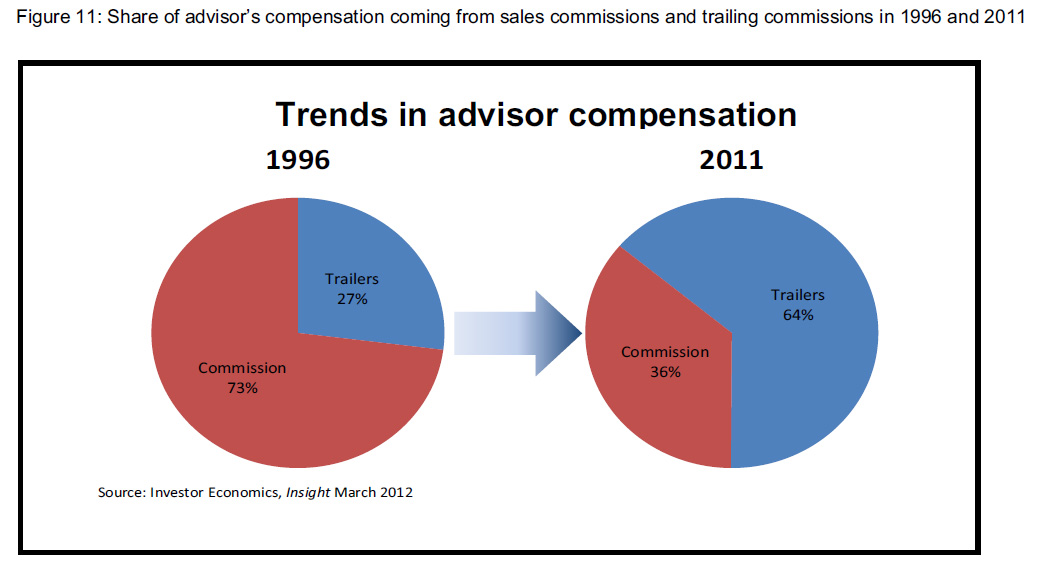

Click for Big

At present, mutual fund manufacturers may fund increased trailing commissions to advisors by simply allocating a greater portion of the management fees they earn to the payment of these commissions. While overall fund costs do not increase in this scenario, investors have no say in the extent to which their mutual fund assets are used to pay for advisor compensation.

Oh, the horror! Imagine that! Mutual Funds are just like every single other product sold to retail, including vegetables and beer!

Using fund assets to pay for trailing commissions could encourage additional sales of the fund. This could increase the fund’s assets under management, which would increase the management fees payable. This creates an actual or a perceived conflict of interest between the mutual fund manufacturer and the fund’s investors.83 This practice could put the mutual fund manufacturer at odds with its statutory duty to act in the best interest of the mutual fund84 to the extent the mutual fund manufacturer, rather than the fund and its investors, is the primary beneficiary of the fund’s asset growth. The mutual fund manufacturer must be able to demonstrate that it is acting in the best interests of the mutual fund and its investors, and not itself, when engaging in this practice.85

I find this rather breathtaking; not just in the bland assertion that charging for services rendered “could” be a conflict of interest, but in the implication of the last sentence, in which the manufacturers are obliged to prove they are not crooks.

So now we get to the grand finale:

Some possible changes include:
i. Advisor services to be specified and provided in exchange for trailing commissions
ii. A standard class for DIY investors with no or reduced trailing commission
Every mutual fund could have a low-cost ‘execution-only’ series or class of securities available for direct purchase by investors. The lower management fees of this series or class would reflect that no or nominal trailing commissions are paid to advisors, in light of the lack of advice sought by DIY investors who purchase and hold securities of this series or class. This low-cost series or class of securities could be made available to investors through a discount brokerage, or alternatively, be distributed directly by the mutual fund manufacturer, in which case the mutual fund manufacturer would need to be registered as a mutual fund dealer.
iii. Trailing commission component of management fees to be unbundled and charged/disclosed as a separate assetbased fee
iv. A separate series or class of funds for each purchase option
v. Cap commissions There could be a maximum limit set on the portion of mutual fund assets that could be used to pay trailing commissions to advisors as a way to mitigate the perceived conflicts of interests and the lack of alignment of advisor compensation and services described in Part V. This could be achieved by imposing a cap on the separate asset-based fee discussed in option iii above. Trailing commissions could further be plainly labelled or described as “ongoing sales commissions” in mutual fund disclosure documents, thus providing greater transparency for investors of their main purpose.

In addition or as an alternative to a cap on trailing commissions at the mutual fund level, there could be a cap imposed on the aggregate sales charge, that is, the sum of any initial sales charge and “ongoing sales commission” that could be paid by an individual investor at the account level over the length of a mutual fund investment. Once the cap is reached, the investor’s holdings could be automatically converted to a series or class of securities of the mutual fund not bearing an ongoing assetbased sales charge. This would bring certainty to an investor as to the maximum sales commission payable.

The U.S. imposes caps on commissions paid by mutual fund investors. These caps are imposed through a prohibition on advisors who are members of FINRA from offering or selling shares of any investment company if the sales charges described in the prospectus are excessive. “Excessive” is determined by reference to specific sales charge limits prescribed under FINRA’s business conduct rules.157 Those same rules similarly impose limits on trailing commission rates for both load158 and no-load investment companies.159

vi. Implement additional standards or duties for advisors

vii. Discontinue the practice of advisor compensation being set by mutual fund manufacturers

With respect to (ii), it’s not clear how the discount brokerages will get paid. Earth to CSA: no pay, no work. It’s also not clear just what the manufacturor’s responsibilities will be in the event they are registered to sell securities direct. I suspect it means lots and lots of jobs for ex-regulators.

With respect to (v), it’s just plain none of the regulators’ damn business.

I think all the specified regulatory make-work projects are completely nuts myself, but I am well aware that others will differ. Those others may wish to know:

VIII. COMMENT PROCESS
We welcome feedback on the issues raised and the potential regulatory options discussed in this paper. We invite all interested parties to make written submissions. Submissions received by April 12, 2013 will be considered.

DBRS confirmed BAM Split at Pfd-2(low) (proud issuer of BNA.PR.B, BNA.PR.C, BNA.PR.D and BNA.PR.E):

The Pfd-2 (low) ratings of the Class AA Preferred Shares are primarily based on the downside protection and dividend coverage available to the Class AA Preferred Shares.

The main constraints to the ratings are the following:

(1) The downside protection available to holders of the Class AA Preferred Shares depends solely on the market value of the BAM Shares held in the Portfolio, which will fluctuate over time.

(2) There is a lack of diversification as the Portfolio is entirely made up of BAM Shares.

(3) Changes in the dividend policy of BAM may result in reductions in Class AA Preferred Shares dividend coverage.

(4) As the BAM Shares pay dividends in U.S. dollars, the Company is exposed to foreign currency risk relating to the Canadian-U.S. exchange rate, specifically the appreciation of the Canadian dollar vs. the U.S. dollar. This may have a negative impact on the dividend coverage ratio of the Class AA Preferred Shares as these dividends are paid in Canadian dollars.

(5) Downside protection available to the Class AA Preferred Shares may be negatively affected by the retraction of the Junior Preferred Shares.

Oddly, there was no mention of the credit quality of BAM itself in the DBRS press release. According to the DBRS SplitShare methodology:

The importance of credit quality in a portfolio increases as the diversifi cation of the portfolio decreases. To be included as a single name in a split share portfolio, a company should be diversified in its business operations by product and by geography. The rating on preferred shares with exposure to single-name portfolios will generally not exceed the rating on the preferred shares of the underlying company since the downside protection is dependent entirely on the value of the common shares of that company.

S&P dropped a bomb on bank preferreds:

  • •We believe that the Canadian banking sector is encountering incremental pressure from headwinds facing the Canadian economy, which is heightening economic risk in the banking system. We also believe that industry risk for the Canadian banking sector is increasing. We expect that intensifying competition for loans and deposits will lead to pressure on profitability growth, especially in banks’ retail businesses.
  • •We are therefore lowering our issuer credit ratings by one notch on The Bank of Nova Scotia, Central 1 Credit Union, Caisse centrale Desjardins, Home Capital Group Inc., Laurentian Bank of Canada, and National Bank of Canada. The outlook is stable.
  • •We are affirming our issuer credit ratings and stable outlooks on Bank of Montreal (and BMO Financial), Canadian Imperial Bank of Commerce, and Manulife Bank of Canada. We have lowered the related stand-alone credit profiles (SACPs) for these institutions by one notch, however.
  • •We are also affirming our issuer credit ratings on Royal Bank of Canada and The Toronto-Dominion Bank, and revising the respective outlooks to stable from negative.
  • •We are also affirming our issuer credit rating with a negative outlook on HSBC Bank Canada, which reflect those on its parent.

It was a strikingly mixed day for the Canadian preferred share market, with PerpetualPremiums up 10bp, FixedResets off 5bp and DeemedRetractibles gaining 15bp. Volatility was low. Volume was high and the highlights are exclusively FixedResets.

HIMIPref™ Preferred Indices
These values reflect the December 2008 revision of the HIMIPref™ Indices

Values are provisional and are finalized monthly
Index Mean
Current
Yield
(at bid)
Median
YTW
Median
Average
Trading
Value
Median
Mod Dur
(YTW)
Issues Day’s Perf. Index Value
Ratchet 0.00 % 0.00 % 0 0.00 0 -0.1837 % 2,473.5
FixedFloater 4.12 % 3.48 % 30,010 18.32 1 -0.3459 % 3,904.1
Floater 2.81 % 3.00 % 61,994 19.73 4 -0.1837 % 2,670.7
OpRet 4.64 % 2.00 % 51,684 0.51 4 -0.3336 % 2,591.1
SplitShare 4.65 % 4.72 % 61,904 4.41 2 0.0809 % 2,866.6
Interest-Bearing 0.00 % 0.00 % 0 0.00 0 -0.3336 % 2,369.3
Perpetual-Premium 5.25 % 1.70 % 72,110 0.20 30 0.0994 % 2,322.5
Perpetual-Discount 4.86 % 4.86 % 133,287 15.63 4 0.1222 % 2,634.6
FixedReset 4.94 % 3.02 % 233,276 4.33 77 -0.0460 % 2,448.8
Deemed-Retractible 4.91 % 2.25 % 115,789 0.44 46 0.1550 % 2,410.9
Performance Highlights
Issue Index Change Notes
TD.PR.E FixedReset -4.17 % Not real – the market maker just fell asleep, that’s all. The issue traded 5,850 shares in a range of 26.45-60, so this is just another example of inexcusable sloppiness.
YTW SCENARIO
Maturity Type : Call
Maturity Date : 2014-04-30
Maturity Price : 25.00
Evaluated at bid price : 25.51
Bid-YTW : 5.28 %
Volume Highlights
Issue Index Shares
Traded
Notes
SLF.PR.F FixedReset 158,700 Desjardins crossed 150,000 at 26.45.
YTW SCENARIO
Maturity Type : Call
Maturity Date : 2014-06-30
Maturity Price : 25.00
Evaluated at bid price : 26.36
Bid-YTW : 2.22 %
HSB.PR.E FixedReset 152,025 RBC crossed 145,000 at 26.50.
YTW SCENARIO
Maturity Type : Call
Maturity Date : 2014-06-30
Maturity Price : 25.00
Evaluated at bid price : 26.55
Bid-YTW : 2.30 %
ENB.PR.T FixedReset 118,825 Recent new issue.
YTW SCENARIO
Maturity Type : Limit Maturity
Maturity Date : 2042-12-13
Maturity Price : 23.10
Evaluated at bid price : 25.02
Bid-YTW : 3.70 %
BAM.PR.P FixedReset 94,176 Nesbitt crossed 50,000 at 26.80; TD crossed 24,200 at the same price; Desjardins crossed 12,000 at the same price again.
YTW SCENARIO
Maturity Type : Call
Maturity Date : 2014-09-30
Maturity Price : 25.00
Evaluated at bid price : 26.70
Bid-YTW : 2.92 %
BNS.PR.Q FixedReset 75,131 Nesbitt crossed 48,300 at 24.80.
YTW SCENARIO
Maturity Type : Hard Maturity
Maturity Date : 2022-01-31
Maturity Price : 25.00
Evaluated at bid price : 24.86
Bid-YTW : 3.32 %
CIU.PR.C FixedReset 73,800 Nesbit sold 15,000 to Desjardins at 24.81, crossed 36,400 at 24.84, and sold 10,000 to RBC at 24.84.
YTW SCENARIO
Maturity Type : Limit Maturity
Maturity Date : 2042-12-13
Maturity Price : 23.24
Evaluated at bid price : 24.80
Bid-YTW : 2.69 %
There were 40 other index-included issues trading in excess of 10,000 shares.
Wide Spread Highlights
Issue Index Quote Data and Yield Notes
TD.PR.E FixedReset Quote: 25.51 – 26.55
Spot Rate : 1.0400
Average : 0.5817

YTW SCENARIO
Maturity Type : Call
Maturity Date : 2014-04-30
Maturity Price : 25.00
Evaluated at bid price : 25.51
Bid-YTW : 5.28 %

BAM.PR.C Floater Quote: 17.44 – 17.99
Spot Rate : 0.5500
Average : 0.3545

YTW SCENARIO
Maturity Type : Limit Maturity
Maturity Date : 2042-12-13
Maturity Price : 17.44
Evaluated at bid price : 17.44
Bid-YTW : 3.00 %

MFC.PR.A OpRet Quote: 25.75 – 26.23
Spot Rate : 0.4800
Average : 0.2970

YTW SCENARIO
Maturity Type : Call
Maturity Date : 2013-06-19
Maturity Price : 25.50
Evaluated at bid price : 25.75
Bid-YTW : 2.00 %

BAM.PR.P FixedReset Quote: 26.70 – 27.10
Spot Rate : 0.4000
Average : 0.2652

YTW SCENARIO
Maturity Type : Call
Maturity Date : 2014-09-30
Maturity Price : 25.00
Evaluated at bid price : 26.70
Bid-YTW : 2.92 %

IGM.PR.B Perpetual-Premium Quote: 26.38 – 26.69
Spot Rate : 0.3100
Average : 0.1946

YTW SCENARIO
Maturity Type : Call
Maturity Date : 2018-12-31
Maturity Price : 25.00
Evaluated at bid price : 26.38
Bid-YTW : 5.00 %

TD.PR.G FixedReset Quote: 26.41 – 26.64
Spot Rate : 0.2300
Average : 0.1300

YTW SCENARIO
Maturity Type : Call
Maturity Date : 2014-04-30
Maturity Price : 25.00
Evaluated at bid price : 26.41
Bid-YTW : 2.60 %

Issue Comments

TD Affirmed by S&P; Outlook Revised to Stable

Standard & Poor’s has announced:

  • •We believe that the Canadian banking sector is encountering incremental pressure from headwinds facing the Canadian economy, which is heightening economic risk in the banking system.
  • •We also believe that industry risk for the Canadian banking sector is increasing. We expect that intensifying competition for loans and deposits will lead to pressure on profitability growth, especially in banks’ retail businesses.
  • •We are affirming our ‘AA-/A-1+’ long- and short-term issuer credit ratings on Toronto-Dominion Bank (TD Bank), and revising the outlook to stable from negative.
  • •The stable outlook reflects our expectation that TD Bank will maintain its current credit profile in the next 24 months.


The ratings are also based on our assessment of TD Bank’s funding as “average” (revised from “above average”) and of its liquidity position as “adequate”. The revision of our assessment of TD Bank’s funding profile recognizes its favorable deposit position, particularly in the U.S., counterbalanced by notable reliance on wholesale funding, as is the case with other large Canadian banks. The resulting SACP of ‘a+’ is adjusted upward one notch in arriving at the ‘AA-‘ issuer credit rating, reflecting our expectation for potential extraordinary government support in a stress scenario.

The stable outlook reflects Standard & Poor’s view that TD Bank’s core retail-oriented franchise spanning both Canadian and U.S. markets incorporates sufficient resilience to weather a range of economic environments, even recognizing the potential for more drawn-out recoveries in both markets.

S&P’s prior negative outlook was reported on PrefBlog.

TD has the following preferred share issues outstanding: TD.PR.A (Series AA); TD.PR.C (Series AC); TD.PR.E (Series AE); TD.PR.G (Series AG); TD.PR.I (Series AI); TD.PR.K (Series AK); TD.PR.O (Series O); TD.PR.P (Series P); TD.PR.Q (Series Q); TD.PR.R (Series R); TD.PR.S (Series S) and TD.PR.Y (Series Y).

Issue Comments

S&P Affirms RY, Revises Outlook to Stable

Standard & Poor’s has announced:

  • •We believe that the Canadian banking sector is encountering incremental pressure from headwinds facing the Canadian economy, which is heightening economic risk in the banking system.
  • •We also believe that industry risk for the Canadian banking sector is increasing. We expect that intensifying competition for loans and deposits will lead to pressure on profitability growth, especially in banks’ retail businesses.
  • •We are affirming our ‘AA-‘ long-term and ‘A-1+’ short-term issuer credit ratings on Royal Bank of Canada as well as the ‘AA-‘ issue ratings on the bank’s senior unsecured debt. We are revising the outlook to stable from negative. We have affirmed the stand-alone credit profile on Royal Bank of Canada as the bank’s stronger Standard & Poor’s projected risk-adjusted capital ratio led to a reassessment of the capital and earnings score to “adequate” from “moderate”.
  • •The stable outlook reflects our expectation that Royal Bank of Canada’s credit fundamentals will remain consistent with its current ratings over the next 24 months.


RBC’s funding and liquidity positions are viewed as “average” and “adequate”, respectively, and reflect the bank’s stable domestic retail deposit franchise and its strengthening funding and liquidity positions to meet final Basel III liquidity and funding requirements while recognizing a material wholesale funding component.

It is our view that RBC is a systemically important bank and that it would likely benefit from extraordinary government support in times of stress.

The stable outlook reflects our expectations that RBC will continue to manage its balance sheet prudently, maintain peer-leading asset quality, and generate consistent though slower earnings growth through its premier business franchises in Canada and diversified revenue sources to support its RAC ratio, and for the funding and liquidity profile to strengthen further due to more stringent regulatory liquidity measures.

S&P’s prior negative outlook was reported on PrefBlog.

RY has the following preferred share issues outstanding: RY.PR.A (series AA); RY.PR.B (Series AB); RY.PR.C (Series AC); RY.PR.D (Series AD); RY.PR.E (Series AE); RY.PR.F (Series AF); RY.PR.G (Series AG); RY.PR.H (Series AH); RY.PR.I (Series AJ); RY.PR.L (Series AL); RY.PR.N (Series AN); RY.PR.P (Series AP); RY.PR.R (Series AR); RY.PR.T (Series AT); RY.PR.W (Series W); RY.PR.X (Series AV) and RY.PR.Y (Series AX).

Note that S&P does not discriminate between RY.PR.W and the other issues, even though RY.PR.W has a potential NVCC clause.

Issue Comments

BMO Preferreds Downgraded by S&P to P-2

Standard & Poor’s has announced:

  • •We believe that the Canadian banking sector is encountering incremental pressure from headwinds facing the Canadian economy, which is heightening economic risk in the banking system.
  • •We also believe that industry risk for the Canadian banking sector is increasing. We expect that intensifying competition for loans and deposits will lead to pressure on profitability growth, especially in banks’ retail businesses.
  • •We are affirming our ‘A+/A-1’ long- and short-term issuer credit ratings on BMO and BMO Financial Corp., as well as the ‘A+’ issue rating on BMO’s senior unsecured debt. We are lowering our issue rating on BMO’s and BMO Financial’s subsidiaries’ nondeferrable subordinated debt to ‘BBB+’ from ‘A-‘, and our rating on its preferred shares and hybrid securities to ‘BBB’ from ‘BBB+’.
  • •The stable outlook reflects our expectation that the bank’s credit fundamentals will remain consistent with its current ratings over the next 24 months.


The resulting SACP of ‘a-‘ is adjusted upward two notches in arriving at the ‘A+’ issuer credit rating, reflecting our expectation for potential extraordinary government support in a stress scenario.

We could revise the outlook to negative or lower the ratings if the Marshall & Ilsley acquisition pressures BMO’s operating performance through weakening asset quality and additional credit marks, making net charge-offs consistently and materially exceed those of its domestic peers. We could also revise the outlook to negative or lower the rating if the projected Standard & Poor’s RAC ratio falls below 7% for several consecutive quarters. We could revise the outlook to positive or raise the rating if BMO garners a stronger retail and commercial market position in Canada, becoming more closely aligned with the top performers (TD Bank and Royal Bank of Canada, in our view), or if its RAC ratio is consistently above 10%. We see this as unlikely at this time.

BMO has the following series of preferreds outstanding: BMO.PR.H (Series 5); BMO.PR.J (Series 13); BMO.PR.K (Series 14); BMO.PR.L (Series 15); BMO.PR.M (Series 16); BMO.PR.N (Series 18); BMO.PR.O (Series 21); BMO.PR.P (Series 23) and BMO.PR.Q (Series 25). All have been downgraded to P-2 from P-2(high).

Issue Comments

BNS Preferreds Downgraded by S&P to P-2(high); Outlook Now Stable

Standard & Poor’s has announced:

  • •We believe that the Canadian banking sector is encountering incremental pressure from headwinds facing the Canadian economy, which is heightening economic risk in the banking system.
  • •We also believe industry risk for the Canadian banking sector is increasing. We expect that intensifying competition for loans and deposits will lead to pressure on profitability growth, especially in banks’ retail businesses.
  • •We are lowering our long- and short-term issuer credit ratings on Bank of Nova Scotia to ‘A+/A-1’ from ‘AA-/A-1+’, following our revision of the stand-alone credit profile on the bank to ‘a’ from ‘a+’, and assigning a stable outlook.
  • •The stable outlook reflects our expectation that Bank of Nova Scotia’s credit fundamentals will remain consistent with current ratings over the next 24 months.


Consequently, we lowered our anchor SACP, which is the starting point for our ratings on financial institutions operating primarily in Canada, to ‘a-‘ from ‘a’ But the anchor for BNS was lowered to ‘bbb+’ from ‘a-‘, reflecting its operating footprint in countries that are weaker than Canada, in our view. This is reflected in our revision of Banking Industry Country Risk Assessment (BICRA) for Canada to group ‘2’ from ‘1’ and revised our industry risk score, a component of the BICRA, to ‘2’ from ‘1’ (see “Various Rating Actions Taken On Canadian Financial Institutions Due To Rising Industry and Economic Risks,” published Dec. 13, 2012, on RatingsDirect on the Global Credit Portal).

The resulting SACP of ‘a’ is adjusted upward one notch in arriving at the ‘A+’ issuer credit rating to reflect our expectation for extraordinary government support in a crisis.

Hands up whoever feels good about sovereign support of BNS expansion into countries with weaker economies!

The prior negative outlook on BNS was reported on PrefBlog.

BNS has the following preferred shares outstanding: BNS.PR.J (Series 12); BNS.PR.K (Series 13); BNS.PR.L (Series 14); BNS.PR.M (Series 15); BNS.PR.N (Series 16); BNS.PR.O (Series 17); BNS.PR.P (Series 18); BNS.PR.Q (Series 20); BNS.PR.R (Series 22); BNS.PR.T (Series 26); BNS.PR.X (Series 28); BNS.PR.Y (Series 30) and BNS.PR.Z (Series 32). All have been downgraded from P-1(low) to P-2(high).

Issue Comments

LB Preferreds Downgraded by S&P; Outlook Now Stable

Standard & Poor’s has announced:

  • •We believe that the Canadian banking sector is encountering incremental pressure from headwinds facing the Canadian economy, which is heightening economic risk in the banking system.
  • •We also believe industry risk for the Canadian banking sector is increasing. We expect that intensifying competition for loans and deposits will lead to pressure on profitability growth, especially in banks’ retail businesses.
  • •We are lowering our long- and short-term issuer credit ratings on Laurentian Bank to ‘BBB/A-2’ from ‘BBB+/A-2’, and assigning a stable outlook, following our revision of Laurentian Bank’s stand-alone credit profile to ‘bbb’ from ‘bbb+’. In conjunction with these actions, we are also lowering our issue ratings on Laurentian Bank’s senior unsecured debt to ‘BBB’ from ‘BBB+’ and its nondeferrable subordinated debt to ‘BBB-‘ from ‘BBB’, and its preferred shares and hybrids to ‘BB+’ from ‘BBB-‘.
  • •The stable outlook reflects our expectation that Laurentian will maintain its current credit profile across a range of future scenarios.


Our “weak” business position assessment of Laurentian recognizes the bank’s limited diversity of business lines and somewhat concentrated regional focus. Recent acquisitions to expand Laurentian’s B2B franchise may over time contribute to the resilience of Laurentian’s business position, although integration costs and risks offset the potential benefits in the near term.

We view Laurentian Bank’s funding as “above average” and liquidity as “adequate”, given the bank’s relatively low reliance on more expensive and less reliable wholesale funds; competition for retail deposits will likely continue to impose margin pressure on Laurentian, however.

In distinction to their views on CM but similarly to NA, there is no allusion to LB being systemically important and no expectation of government support in times of stress.

S&P’s prior outlook of Negative on LB was reported on PrefBlog.

LB has three issues of preferreds outstanding: LB.PR.D (Series 9); LB.PR.E (Series 10); and LB.PR.F (Series 11). All have been downgraded from P-2(low) to P-3(high).

Issue Comments

NA Preferreds Downgraded by S&P; Outlook Now Stable

Standard & Poor’s has announced:

  • •We believe that the Canadian banking sector is encountering incremental pressure from headwinds facing the Canadian economy, which is heightening economic risk in the banking system.
  • •We also believe industry risk for the Canadian banking sector is increasing. We expect that intensifying competition for loans and deposits will lead to pressure on profitability growth, especially in banks’ retail businesses.
  • •We are lowering our long- and short-term issuer credit ratings on National Bank of Canada to ‘A-/A-2’ from ‘A/A-1’, following our revision of the stand-alone credit profile on the bank to ‘a-‘ from ‘a’. The outlook is stable.
  • •The stable outlook reflects our expectation that National Bank of Canada’s credit fundamentals will remain consistent with current ratings over the next 24 months.

In distinction to S&P’s views regarding CM, there is no allusion to NA being systemically important and no expectation of government support in times of stress.

S&P’s prior Negative Outlook on NA was reported on PrefBlog.

NA has the following preferred share issues outstanding: NA.PR.K (Series 15, called for redemption); NA.PR.L (Series 16); NA.PR.M (Series 20); NA.PR.N (Series 21); NA.PR.O (Series 24); NA.PR.P (Series 26); NA.PR.Q (Series 28). All have been downgraded to P-2 from P-2(high).

Issue Comments

CM Preferreds Downgraded by S&P

Standard and Poor’s has announced:

  • •We believe that the Canadian banking sector is encountering incremental pressure from headwinds facing the Canadian economy, which is heightening
    economic risk in the banking system.

  • •We also believe that industry risk for the Canadian banking sector is
    increasing. We expect that intensifying competition for loans and deposits will lead to pressure on profitability growth, especially in banks’ retail businesses.

  • •We are affirming our ‘A+/A-1’ long- and short-term issuer credit ratings
    on CIBC, as well as the ‘A+’ issue rating on CIBC’s senior unsecured debt. We are lowering our issue rating on CIBC’s nondeferrable subordinated debt to ‘BBB+’ from ‘A-‘, and our rating on its preferred shares and hybrids to ‘BBB’ from ‘BBB+’.

  • •The stable outlook reflects our expectation that the bank’s credit fundamentals will remain consistent with its current ratings over the next 24 months.


It is our view that CIBC is a “systemically important” bank and that it would likely benefit from extraordinary government support in times of stress.

This results in the CM PerpetualPremiums, CM.PR.D (Series 26) and CM.PR.E (Series 27) being downgraded from P-2 to P-2(low). CM.PR.G (Series 29) can be taken as equivalent although it is not rated by S&P, oddly enough. These are the issues which have been recognized by OSFI has having a good enough NVCC clause.

CM’s other three issues outstanding are CM.PR.K (Series 33), CM.PR.L (Series 35) and CM.PR.M (Series 37), have been downgraged to P-2 from P-2(high)

Market Action

December 12, 2012

IIROC has published a study of HFT titled The HOT Study: Phases I and II of IIROC’s Study of High Frequency Trading Activity on Canadian Equity Marketplaces:

Despite the absence of a clear definition, HFT is of concern to many stakeholders in the Canadian equity marketplace:
• Retail investors complain that their bids and offers are often continuously bettered by the minimum tick size, forcing them to cross the spread by entering market orders to execute a trade;

So retail investors attempting to get paid for supplying liquidity to the marketplace find out that somebody else can supply it cheaper. BooHooHoo.

• Institutional investors, and inventory traders providing liquidity to them, are concerned that algorithms with a technological advantage prey on their large orders, negatively impacting their transaction prices and trading costs;

So market participants with brains manage to out-trade salesmen with big smiles. BooHooHoo.

• Traditional market makers complain they are unable to compete with high frequency electronic liquidity providers (“ELP”);

So the buggy-whip boys can’t compete with nerdy little geeks who didn’t even go to the right schools. BooHooHoo.

• Regulators are concerned with the heightened possibility of spoofing, layering, quote stuffing and other potentially manipulative activity; and

Finally! A point that might, possibly, in some alternate universe, be of concern. You can’t spoof or manipulate somebody who trades on fundamentals – in fact, any attempt to do so is just as likely to provide a fundamental trader with an opportunity as otherwise. Why are the regulators so concerned about protecting idiots who don’t trade on fundamentals? Why are the regulators so upset that sometimes the gamers get outgamed?

• Participants are impacted by increased messaging rates incurring costs for processing and storing data.

Well, that’s the participants’ problem, isn’t it? Just part of that nasty little thing called “competition”, that the regulators are determined to stamp out so the financial marketplace can become a cooperative game where we all help each other, just like in kiddy-school. At any rate, if the exchanges consider it to be a problem (or a potential source of competitive advantage) they can always start charging for each order placed, regardless of whether or not it’s filled.

IIROC, eh? They’re good at awarding single-source contracts to insiders … at thinking things through, not so much.

The Press Release highlights the findings:

Key Findings of Phases I and II — Trading by the Study Group

  • • HOT traders:
    • o represent 11% of User IDs
    • o account for 22% of trading volume, 32% of dollar value, 42% of trades and 94% of all order messages sent
    • o trade 36% of all Canadian share volume traded in US inter-listed securities
    • o trade 60% of all Canadian trading in ETFs and ETNs
  • • HOT users trade:
    • o a larger percentage of total dark activity than displayed market activity
    • o anonymously more often than other market participants
    • o passively approximately 66% of the time
    • o over 90% of their activity through seven IIROC Dealer Members
    • o 23% of their volume within the same broker1 – generally more than retail users and less than other users (excluding retail)
    • o predominantly liquid TSX-listed securities priced over $1.00
    • o more in TSX 60 Index securities than in other TSX-listed securities
    • o primarily outside of the Opening or Market on Close trading sessions
  • • HOT Users earned $250,000 more per day in rebates than they paid in fees. All other participants earned more rebates than HOT Users; however these other participants paid $462,000 more per day in fees than they earned in rebates.
  • • 40% of HOT Users were identified as DMA (as opposed to non-DMA).
  • • HOT DMA Users:
    • o were responsible for the majority of trading by all HOT Users
    • o that were categorized as “Fast” (44% of HOT DMA Users) were responsible for 91% of HOT DMA Users’ share volume
    • o have lower order-to-trade ratios when compared with non-DMA HOT Users
  • • Average order-to-trade ratio is higher in ETF trading for all HOT Users, but particularly for the non-DMA groups.
  • • By all measures, HOT clients (DMA and non-DMA) are more active in common shares and HOT non-DMA (inventory and other) are more active in ETFs/ETNs.

The FOMC statement was interesting:

To support continued progress toward maximum employment and price stability, the Committee expects that a highly accommodative stance of monetary policy will remain appropriate for a considerable time after the asset purchase program ends and the economic recovery strengthens. In particular, the Committee decided to keep the target range for the federal funds rate at 0 to 1/4 percent and currently anticipates that this exceptionally low range for the federal funds rate will be appropriate at least as long as the unemployment rate remains above 6-1/2 percent, inflation between one and two years ahead is projected to be no more than a half percentage point above the Committee’s 2 percent longer-run goal, and longer-term inflation expectations continue to be well anchored. The Committee views these thresholds as consistent with its earlier date-based guidance. In determining how long to maintain a highly accommodative stance of monetary policy, the Committee will also consider other information, including additional measures of labor market conditions, indicators of inflation pressures and inflation expectations, and readings on financial developments. When the Committee decides to begin to remove policy accommodation, it will take a balanced approach consistent with its longer-run goals of maximum employment and inflation of 2 percent.

The Canadian preferred share market drifted slightly upwards today, with PerpetualPremiums and DeemedRetractibles gaining 2bp and FixedResets winning 6bp. Volatility was minimal. Volume was average, but made notable by significant trading in the BAM floaters.

PerpetualDiscounts now yield 4.87%, equivalent to 6.33% interest at the standard equivalency factor of 1.3x. Long corporates now yield about 4.25%, so the pre-tax interest-equivalent spread (in this context, the “Seniority Spread”) is now about 210bp, a slight (and perhaps spurious) decline from the 215bp reported December 5.

HIMIPref™ Preferred Indices
These values reflect the December 2008 revision of the HIMIPref™ Indices

Values are provisional and are finalized monthly
Index Mean
Current
Yield
(at bid)
Median
YTW
Median
Average
Trading
Value
Median
Mod Dur
(YTW)
Issues Day’s Perf. Index Value
Ratchet 0.00 % 0.00 % 0 0.00 0 -0.0083 % 2,478.1
FixedFloater 4.11 % 3.46 % 29,202 18.35 1 0.6090 % 3,917.7
Floater 2.80 % 2.99 % 57,383 19.76 4 -0.0083 % 2,675.7
OpRet 4.62 % 1.81 % 35,823 0.51 4 0.0569 % 2,599.7
SplitShare 4.65 % 4.71 % 62,597 4.41 2 0.0405 % 2,864.3
Interest-Bearing 0.00 % 0.00 % 0 0.00 0 0.0569 % 2,377.2
Perpetual-Premium 5.25 % 2.14 % 73,055 0.38 30 0.0187 % 2,320.2
Perpetual-Discount 4.86 % 4.87 % 134,646 15.61 4 0.0139 % 2,631.4
FixedReset 4.94 % 2.95 % 230,818 4.34 77 0.0640 % 2,449.9
Deemed-Retractible 4.91 % 3.17 % 115,934 0.68 46 0.0230 % 2,407.2
Performance Highlights
Issue Index Change Notes
GWO.PR.N FixedReset -1.90 % YTW SCENARIO
Maturity Type : Hard Maturity
Maturity Date : 2022-01-31
Maturity Price : 25.00
Evaluated at bid price : 23.22
Bid-YTW : 3.86 %
Volume Highlights
Issue Index Shares
Traded
Notes
MFC.PR.J FixedReset 281,692 Recent new issue.
YTW SCENARIO
Maturity Type : Call
Maturity Date : 2018-03-19
Maturity Price : 25.00
Evaluated at bid price : 25.25
Bid-YTW : 3.82 %
BAM.PR.K Floater 172,050 Nesbitt crossed 150,000 at 17.50.
YTW SCENARIO
Maturity Type : Limit Maturity
Maturity Date : 2042-12-12
Maturity Price : 17.36
Evaluated at bid price : 17.36
Bid-YTW : 3.02 %
BAM.PR.B Floater 160,822 Nesbitt crossed 150,000 at 17.50.
YTW SCENARIO
Maturity Type : Limit Maturity
Maturity Date : 2042-12-12
Maturity Price : 17.50
Evaluated at bid price : 17.50
Bid-YTW : 2.99 %
RY.PR.T FixedReset 136,250 RBC crossed 119,800 at 26.75.
YTW SCENARIO
Maturity Type : Call
Maturity Date : 2014-08-24
Maturity Price : 25.00
Evaluated at bid price : 26.76
Bid-YTW : 2.22 %
SLF.PR.G FixedReset 103,828 Desjardins crossed 95,800 at 24.30.
YTW SCENARIO
Maturity Type : Hard Maturity
Maturity Date : 2022-01-31
Maturity Price : 25.00
Evaluated at bid price : 24.27
Bid-YTW : 3.51 %
BMO.PR.M FixedReset 96,184 National crossed 70,000 at 24.76.
YTW SCENARIO
Maturity Type : Hard Maturity
Maturity Date : 2022-01-31
Maturity Price : 25.00
Evaluated at bid price : 24.81
Bid-YTW : 3.19 %
There were 29 other index-included issues trading in excess of 10,000 shares.
Wide Spread Highlights
Issue Index Quote Data and Yield Notes
BAM.PR.K Floater Quote: 17.36 – 18.10
Spot Rate : 0.7400
Average : 0.5562

YTW SCENARIO
Maturity Type : Limit Maturity
Maturity Date : 2042-12-12
Maturity Price : 17.36
Evaluated at bid price : 17.36
Bid-YTW : 3.02 %

FTS.PR.E OpRet Quote: 27.12 – 27.50
Spot Rate : 0.3800
Average : 0.2807

YTW SCENARIO
Maturity Type : Call
Maturity Date : 2013-06-01
Maturity Price : 25.75
Evaluated at bid price : 27.12
Bid-YTW : -5.98 %

GWO.PR.N FixedReset Quote: 23.22 – 23.45
Spot Rate : 0.2300
Average : 0.1307

YTW SCENARIO
Maturity Type : Hard Maturity
Maturity Date : 2022-01-31
Maturity Price : 25.00
Evaluated at bid price : 23.22
Bid-YTW : 3.86 %

CIU.PR.B FixedReset Quote: 26.64 – 26.90
Spot Rate : 0.2600
Average : 0.1626

YTW SCENARIO
Maturity Type : Call
Maturity Date : 2014-06-01
Maturity Price : 25.00
Evaluated at bid price : 26.64
Bid-YTW : 2.31 %

HSE.PR.A FixedReset Quote: 25.78 – 26.03
Spot Rate : 0.2500
Average : 0.1529

YTW SCENARIO
Maturity Type : Limit Maturity
Maturity Date : 2042-12-12
Maturity Price : 23.58
Evaluated at bid price : 25.78
Bid-YTW : 2.92 %

HSB.PR.D Deemed-Retractible Quote: 25.82 – 26.10
Spot Rate : 0.2800
Average : 0.1838

YTW SCENARIO
Maturity Type : Call
Maturity Date : 2013-01-30
Maturity Price : 25.50
Evaluated at bid price : 25.82
Bid-YTW : -6.20 %

Market Action

December 11, 2012

What’s going on with Northern Securities, IIROC and Penson?:

9. NSI advised IIROC Staff that it was considering the following three options to address the pending wind down of Penson:
i. Retain a new carrying broker;
ii. Enter into an omnibus arrangement with an existing carrying broker or self-clearing firm and administer certain back office functions itself;
iii. Enter into a business amalgamation or a sale.

10. On November 23, 2012, IIROC Staff advised NSI that NSI’s failure to enter into a new introducing-carrying arrangement or to demonstrate progress toward an alternative arrangement would soon result in such financial and operating difficulty for NSI that NSI cannot be permitted to continue to operate without risk of imminent harm to NSI’s clients.

11. IIROC Staff also advised NSI that if it did not enter into a binding agreement for either a new introducing-carrying arrangement or a business combination with a self-clearing Dealer Member by December 7, 2012, then IIROC Staff would proceed to an expedited hearing to seek appropriate remedies from an IIROC Hearing Panel.

It was a mixed day for the Canadian preferred share market, with PerpetualPremiums gaining 6bp, FixedResets down 3bp and DeemedRetractibles off 2bp. Volatility was low. Volume was heavy.

HIMIPref™ Preferred Indices
These values reflect the December 2008 revision of the HIMIPref™ Indices

Values are provisional and are finalized monthly
Index Mean
Current
Yield
(at bid)
Median
YTW
Median
Average
Trading
Value
Median
Mod Dur
(YTW)
Issues Day’s Perf. Index Value
Ratchet 0.00 % 0.00 % 0 0.00 0 0.0133 % 2,478.3
FixedFloater 4.13 % 3.48 % 28,122 18.30 1 -0.4762 % 3,894.0
Floater 2.79 % 3.01 % 56,494 19.63 4 0.0133 % 2,675.9
OpRet 4.60 % 1.03 % 35,270 0.48 4 0.0569 % 2,598.3
SplitShare 4.65 % 4.72 % 64,652 4.41 2 0.3247 % 2,863.1
Interest-Bearing 0.00 % 0.00 % 0 0.00 0 0.0569 % 2,375.9
Perpetual-Premium 5.25 % 1.83 % 74,102 0.38 30 0.0601 % 2,319.8
Perpetual-Discount 4.83 % 4.87 % 132,848 15.61 4 0.0304 % 2,631.0
FixedReset 4.94 % 2.95 % 219,461 4.34 77 -0.0298 % 2,448.4
Deemed-Retractible 4.91 % 2.52 % 119,262 0.45 46 -0.0152 % 2,406.6
Performance Highlights
Issue Index Change Notes
TRP.PR.C FixedReset -1.04 % YTW SCENARIO
Maturity Type : Limit Maturity
Maturity Date : 2042-12-11
Maturity Price : 23.57
Evaluated at bid price : 25.67
Bid-YTW : 2.79 %
Volume Highlights
Issue Index Shares
Traded
Notes
ENB.PR.T FixedReset 249,620 Recent new issue.
YTW SCENARIO
Maturity Type : Limit Maturity
Maturity Date : 2042-12-11
Maturity Price : 23.10
Evaluated at bid price : 25.02
Bid-YTW : 3.70 %
MFC.PR.J FixedReset 140,025 Recent new issue.
YTW SCENARIO
Maturity Type : Hard Maturity
Maturity Date : 2022-01-31
Maturity Price : 25.00
Evaluated at bid price : 25.11
Bid-YTW : 3.91 %
TD.PR.O Deemed-Retractible 106,124 Nesbitt crossed 100,000 at 25.85.
YTW SCENARIO
Maturity Type : Call
Maturity Date : 2013-01-10
Maturity Price : 25.50
Evaluated at bid price : 25.83
Bid-YTW : -4.40 %
ENB.PR.B FixedReset 103,159 TD crossed 73,600 at 25.24; Nesbitt bought 10,000 from National at 25.25.
YTW SCENARIO
Maturity Type : Limit Maturity
Maturity Date : 2042-12-11
Maturity Price : 23.28
Evaluated at bid price : 25.24
Bid-YTW : 3.57 %
POW.PR.G Perpetual-Premium 101,380 Nesbitt crossed 100,000 at 27.15.
YTW SCENARIO
Maturity Type : Call
Maturity Date : 2020-04-15
Maturity Price : 25.25
Evaluated at bid price : 27.02
Bid-YTW : 4.58 %
TD.PR.I FixedReset 78,652 RBC crossed 67,600 at 26.85.
YTW SCENARIO
Maturity Type : Call
Maturity Date : 2014-07-31
Maturity Price : 25.00
Evaluated at bid price : 26.84
Bid-YTW : 2.11 %
There were 43 other index-included issues trading in excess of 10,000 shares.
Wide Spread Highlights
Issue Index Quote Data and Yield Notes
BAM.PR.K Floater Quote: 17.50 – 18.10
Spot Rate : 0.6000
Average : 0.3548

YTW SCENARIO
Maturity Type : Limit Maturity
Maturity Date : 2042-12-11
Maturity Price : 17.50
Evaluated at bid price : 17.50
Bid-YTW : 3.03 %

TRP.PR.C FixedReset Quote: 25.67 – 25.99
Spot Rate : 0.3200
Average : 0.1784

YTW SCENARIO
Maturity Type : Limit Maturity
Maturity Date : 2042-12-11
Maturity Price : 23.57
Evaluated at bid price : 25.67
Bid-YTW : 2.79 %

PWF.PR.M FixedReset Quote: 26.03 – 26.36
Spot Rate : 0.3300
Average : 0.2250

YTW SCENARIO
Maturity Type : Call
Maturity Date : 2014-01-31
Maturity Price : 25.00
Evaluated at bid price : 26.03
Bid-YTW : 2.91 %

PWF.PR.P FixedReset Quote: 25.12 – 25.35
Spot Rate : 0.2300
Average : 0.1665

YTW SCENARIO
Maturity Type : Limit Maturity
Maturity Date : 2042-12-11
Maturity Price : 23.40
Evaluated at bid price : 25.12
Bid-YTW : 2.95 %

BMO.PR.K Deemed-Retractible Quote: 26.16 – 26.27
Spot Rate : 0.1100
Average : 0.0707

YTW SCENARIO
Maturity Type : Call
Maturity Date : 2013-01-10
Maturity Price : 26.00
Evaluated at bid price : 26.16
Bid-YTW : 0.25 %

POW.PR.C Perpetual-Premium Quote: 25.51 – 25.65
Spot Rate : 0.1400
Average : 0.1052

YTW SCENARIO
Maturity Type : Call
Maturity Date : 2013-01-10
Maturity Price : 25.00
Evaluated at bid price : 25.51
Bid-YTW : -7.73 %