New Issues

New Issue: BNA Split-Share, 7-Year, 4.85%

BAM Split Corp has announced:

that it has entered into an agreement to sell $110,000,000 principal amount of Class AA Preferred Shares, Series 5 (the “Series 5 Preferred Shares”), with an underwriters’ option to purchase an additional $15,000,000 principal amount of Series 5 Preferred Shares, to a syndicate of underwriters co-led by Scotia Capital Inc., CIBC World Markets Inc., RBC Capital Markets, and TD Securities Inc. on a bought deal basis. Closing of the offering is expected to occur on or about December 10, 2010. The Series 5 Preferred Shares will carry a fixed coupon of 4.85% and will have a final maturity of December 10, 2017. The Series 5 Preferred Shares have a provisional rating of Pfd-2 (low) from DBRS. The net proceeds of the offering will be used to pay a special cash dividend to holders of the Company’s Capital Shares.

BAM Split Corp. owns a portfolio consisting of 53,160,644 Class A Limited Voting Shares of Brookfield Asset Management Inc. (the “Brookfield Shares”) which is expected to yield quarterly dividends that are sufficient to fund quarterly fixed cumulative preferential dividends for the holders of the company’s Preferred Shares and to enable the holders of the company’s Capital Shares to participate in any capital appreciation of the Brookfield Shares.

As of the March 2010 Semi-annual report there were 14.713-million units outstanding, so the addition of 4.4-million new preferreds (which will presumably be accompanied by a split of the capital units) will dilute the NAV to about 77% of its October 31 value of $109.53, or $84.

Another way to state this is that there used to be 3.61 shares of BAM.A held per unit; now there will be 2.78.

So credit quality has declined, but is still very high.

The funny thing about this is that BNA.PR.C has not budged on the news. It closed Friday at 22.56-69 for a yield-to-worst of 5.87-79% to its scheduled maturity 2019-1-10. So, compared with the new issue, an investor can pick up more than a point of yield for a one-year term extension, which sounds pretty good to me! I will also point out that the tax on the capital gain component of BNA.PR.C’s yield is, of course, deferred …. and, should the company exercise its call right in the event of a takeover of BAM, there’s a lot more upside than in the new issue.

But, you see, the other funny thing about this is that BNA.PR.C pays a dividend of 1.0875 p.a., which means that the Current Yield (which, of course, ignores the capital gain on maturity) is 4.82%. I don’t think the coupon rate of 4.85% on the new issue is coincidental … I love this market!

Issue Comments

BNS to Acquire DW: DW.PR.A Skyrockets

Scotiabank has announced:

that Scotiabank has agreed to make an offer for all of the common shares of DundeeWealth that the Bank does not own. Scotiabank currently owns 18 per cent of DundeeWealth.

The value of the offer to DundeeWealth shareholders is $21.00 per common share representing an enterprise value for DundeeWealth of approximately $3.2 billion. Scotiabank will offer 0.2497 of a Scotiabank common share and, at the election of each shareholder, either $5.00 in cash or 0.2 of a $25.00, 3.70% five year rate reset Scotiabank preferred share for each DundeeWealth common share (including common shares issuable on conversion of other shares).

Dundee Corporation owns 48 per cent of DundeeWealth. As a result of Dundee Corporation’s commitment to tender, on completion of the offer Scotiabank will own at least 67 per cent of DundeeWealth. After the completion of the offer, Scotiabank also expects to proceed with the acquisition of the balance of the common shares of DundeeWealth.

This will improve the credit quality of DW.PR.A quite considerably, and the cash might have an effect on the credit ratings of DC as well. DW.PR.A closed on Friday at 24.95-30, for a yield-to-worst of 4.94-68%, but is now quoted at 26.01-25. The Modified Duration on Friday was 5.38,

It’s interesting that Scotia is offering partial payment in FixedReset preferreds with an initial coupon of 3.70% – that would make the Issue Reset Spread about 150bp, so this issue will be treated as “more perpetual than otherwise”.

Update: DBRS comments:

The transaction is consistent with BNS’s strategy of growing its wealth management businesses, which the Bank believes offers attractive opportunities. DBRS views BNS’s wealth management businesses as a key component of the Bank’s domestic growth strategy.

BNS will gain significant market share to 7.8% and become the fifth largest mutual fund provider in Canada and the third largest among the Canadian banks with over $55 billion in assets under management, up from tenth position. The Bank is currently under-represented in retail mutual funds.

The transaction provides BNS with added capabilities in the advisor channel, which is the primary distribution channel for DWI. Over the last three years, BNS has been investing to strengthen its distribution capabilities in wealth management, including both the direct and advisor channels. Both mutual fund brands, ScotiaFunds and Dynamic, will be maintained.

Market Action

November 19, 2010

Allied Irish is on central bank life-support:

Allied Irish Banks Plc, Ireland’s second-biggest bank, has tripled its reliance on funding from central banks since the end of June as companies and customers pulled money amid the country’s debt crisis.

The bank’s dependence on “monetary authorities” rose to 27 billion euros ($37 billion) from a “high single-digit” billion-euro amount on June 30, Alan Kelly, general manager of group corporate services at Allied Irish, said in a telephone interview today. Funding conditions were “increasingly challenging,” the Dublin-based lender said in a statement.

Irish lenders have become more reliant on European Central Bank funding after being frozen out of wholesale markets. The amount of ECB loans to the country’s banks rose 7.3 percent to 130 billion euros in October from the previous month, Ireland’s Central Bank said on Nov. 1. The data include both international and domestic banks operating in Ireland.

Deposits dropped by about 13 billion euros since the start of the year, Allied Irish said in the statement. That equates to about a 17 percent decline, Kelly said. Allied Irish said it will increase the amount it’s seeking to raise in a share sale by the end of the year to 6.6 billion euros from 5.4 billion euros.

More specifically, their interim management statement says:

Customer accounts have been affected by current adverse international sentiment towards the Irish sovereign and banking sector and are down by c.€13bn from the beginning of 2010 to the close of business on 16 November. This reduction was primarily due to lower institutional and corporate balances.

General funding market conditions in recent months have become increasingly challenging. This has had a negative impact on AIB’s funding position which has seen a reduction on maturity of debt securities in issue and customer accounts. This reduction has been offset by an increase in secured deposits by banks, in particular by monetary authorities. While AIB had issued term funding of €6.7bn during 2010 in anticipation of term funding maturing in September 2010, current market conditions are limiting funding access to shorter durations, mainly on a secured basis.

Geithner’s upset about the Fed’s politicization:

U.S. Treasury Secretary Timothy F. Geithner warned Republicans against politicizing the Federal Reserve and said the Obama administration would oppose any effort to strip the central bank of its mandate to pursue full employment.

“It is very important to keep politics out of monetary policy,” Geithner said in an interview airing on Bloomberg Television’s “Political Capital with Al Hunt” this weekend. “You want to be very careful not to take steps that hurt our credibility.”

The Republican congressional leadership, including John Boehner, nominated as the next House speaker, has criticized the Fed’s plan to buy $600 billion in assets, saying it would fuel inflation and asset bubbles. Senator Bob Corker, a Tennessee Republican who serves on the Banking Committee, said he favors confining the Fed’s mandate to promoting price stability.

“It is very important that we respect and honor what the Congress did when it set up our independent central bank with a mandate to keep prices low and stable over time and to make sure” it promotes “sustainable economic growth,” said Geithner, who was president of the Federal Reserve Bank of New York before taking over as Treasury secretary last year.

FortisBC has issued 40-year MTNs at 5%.

The Canadian preferred share market continued to recover from the damage done earlier in the week on continued heavy volume, with PerpetualDiscounts up 23bp, while FixedResets lost 2bp.

HIMIPref™ Preferred Indices
These values reflect the December 2008 revision of the HIMIPref™ Indices

Values are provisional and are finalized monthly
Index Mean
Current
Yield
(at bid)
Median
YTW
Median
Average
Trading
Value
Median
Mod Dur
(YTW)
Issues Day’s Perf. Index Value
Ratchet 0.00 % 0.00 % 0 0.00 0 0.0885 % 2,245.1
FixedFloater 4.94 % 3.58 % 27,440 19.04 1 -1.3004 % 3,404.4
Floater 2.65 % 2.34 % 61,559 21.39 4 0.0885 % 2,424.1
OpRet 4.76 % 2.95 % 60,911 2.43 8 -0.1094 % 2,392.5
SplitShare 5.41 % -0.32 % 121,081 1.05 3 -0.4281 % 2,489.3
Interest-Bearing 0.00 % 0.00 % 0 0.00 0 -0.1094 % 2,187.8
Perpetual-Premium 5.65 % 5.23 % 166,167 5.27 24 0.0786 % 2,018.9
Perpetual-Discount 5.34 % 5.38 % 262,856 14.78 53 0.2339 % 2,044.2
FixedReset 5.22 % 3.01 % 344,910 3.18 50 -0.0207 % 2,283.1
Performance Highlights
Issue Index Change Notes
BAM.PR.R FixedReset -1.42 % YTW SCENARIO
Maturity Type : Call
Maturity Date : 2016-07-30
Maturity Price : 25.00
Evaluated at bid price : 26.46
Bid-YTW : 4.37 %
FTS.PR.F Perpetual-Discount -1.35 % YTW SCENARIO
Maturity Type : Limit Maturity
Maturity Date : 2040-11-19
Maturity Price : 23.13
Evaluated at bid price : 23.33
Bid-YTW : 5.26 %
BAM.PR.G FixedFloater -1.30 % YTW SCENARIO
Maturity Type : Limit Maturity
Maturity Date : 2040-11-19
Maturity Price : 25.00
Evaluated at bid price : 22.01
Bid-YTW : 3.58 %
POW.PR.B Perpetual-Discount 1.05 % YTW SCENARIO
Maturity Type : Limit Maturity
Maturity Date : 2040-11-19
Maturity Price : 23.81
Evaluated at bid price : 24.08
Bid-YTW : 5.61 %
PWF.PR.F Perpetual-Discount 1.14 % YTW SCENARIO
Maturity Type : Limit Maturity
Maturity Date : 2040-11-19
Maturity Price : 23.63
Evaluated at bid price : 23.90
Bid-YTW : 5.53 %
Volume Highlights
Issue Index Shares
Traded
Notes
RY.PR.E Perpetual-Discount 74,083 National crossed 25,000 at 22.33.
YTW SCENARIO
Maturity Type : Limit Maturity
Maturity Date : 2040-11-19
Maturity Price : 22.14
Evaluated at bid price : 22.27
Bid-YTW : 5.07 %
RY.PR.A Perpetual-Discount 70,410 RBC crossed 50,000 at 22.45.
YTW SCENARIO
Maturity Type : Limit Maturity
Maturity Date : 2040-11-19
Maturity Price : 22.22
Evaluated at bid price : 22.37
Bid-YTW : 4.99 %
BNS.PR.Q FixedReset 69,155 TD crossed 50,000 at 26.45.
YTW SCENARIO
Maturity Type : Call
Maturity Date : 2013-11-24
Maturity Price : 25.00
Evaluated at bid price : 26.38
Bid-YTW : 3.10 %
RY.PR.L FixedReset 65,225 RBC crossed 61,900 at 27.00.
YTW SCENARIO
Maturity Type : Call
Maturity Date : 2014-03-26
Maturity Price : 25.00
Evaluated at bid price : 27.01
Bid-YTW : 2.99 %
TD.PR.M OpRet 60,345 RBC crossed 20,000 at 25.86; Scotia bought 20,000 from anonymous at the same price. Desjardins crossed 15,000 at the same price again.
YTW SCENARIO
Maturity Type : Call
Maturity Date : 2011-05-30
Maturity Price : 25.50
Evaluated at bid price : 25.85
Bid-YTW : 2.45 %
RY.PR.T FixedReset 50,300 TD crossed 40,000 at 27.90.
YTW SCENARIO
Maturity Type : Call
Maturity Date : 2014-09-23
Maturity Price : 25.00
Evaluated at bid price : 27.84
Bid-YTW : 3.09 %
There were 51 other index-included issues trading in excess of 10,000 shares.
Interesting External Papers

Mapping capital and liquidity requirements to bank lending spreads

The Bank for International Settlements has released a working paper by Michael R King titled Mapping capital and liquidity requirements to bank lending spreads:

This study outlines a methodology for mapping the increases in capital and liquidity requirements proposed under Basel III to bank lending spreads. The higher cost associated with a one percentage point increase in the capital ratio can be recovered by increasing lending spreads by 15 basis points for a representative bank. This calculation assumes the return on equity (ROE) and the cost of debt are unchanged, with no change in other sources of income and no reduction in operating expenses. If ROE and the cost of debt are assumed to decline, the impact on lending spreads is reduced. To recover the additional cost of meeting the December 2009 proposal for the Net Stable Funding Ratio (NSFR), a representative bank would need to increase lending spreads by 24 basis points. Taking into account the fall in risk-weighted assets from holding more government bonds reduces this cost to 12 basis points or less.

The Bank of Canada estimate was 14bp.

Market Action

November 18, 2010

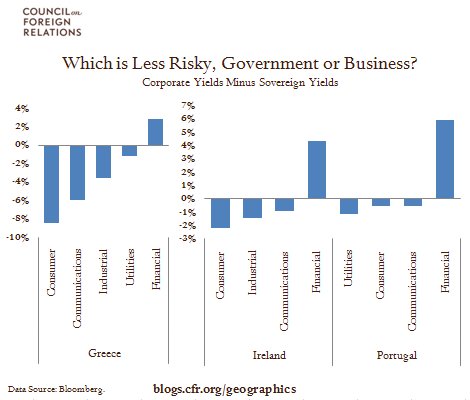
I may have mentioned this before, but there are negative credit spreads in Europe:

The spread does, nevertheless, tell a story about relative risk. In Greece, Ireland, and Portugal, a number of sectors have negative corporate spreads, suggesting that firms are either less likely to default than their governments or will have higher recovery rates if they do default. The sector that stands apart as being much riskier than the government is financials. If these governments partially default, the guarantees they have made to the banking system are no longer credible, and the credit losses may be severe.


Click for Big

There’s some commentary from Felix Salmon and Bloomberg:

An index of credit-default swaps on 15 European governments now exceeds a gauge of investment-grade credit risk by about 50 basis points, according to data from CMA and JPMorgan Chase & Co. Corporate swaps are historically more expensive than sovereign contracts.

The gap between the indexes “highlights the difference between how fundamentally strong non-financial corporate credit is versus how weak governments are,” said Aziz Sunderji, a credit strategist at Barclays Capital in London. “Corporate balance sheets look strong, cash liquidity buffers are large, and earnings have surprised to the upside. Most of the problems are originating from the sovereign side.”

Berkshire Hathaway was touted last spring as having traded through Treasuries, but the data are suspect.

For those who are interested, the relevant CDS indices are the Markit iTraxx SovX Western Europe index and the Markit iTraxx Europe index. Today’s marks are 165bp and 102bp, respectively.

Ireland is going to the well:

Ireland said it may ask for an international bailout as European Central Bank President Jean- Claude Trichet signaled debt-laden nations can’t rely on him to keep their financial systems afloat forever.

Finance Minister Brian Lenihan said in Dublin he would welcome the creation of “substantial contingency capital funding” for Irish banks. In Frankfurt, Trichet said in a speech that policies first used to fight the global credit crisis can’t “evolve into a dependency as conditions normalize.”

The ECB is concerned that banks in Ireland and Greece are becoming too reliant on its unlimited money market operations and is pushing Ireland to accept a rescued funded by European Union governments and the International Monetary Fund. Irish central bank Governor Patrick Honohan said today that an agreement may amount to “tens of billions” of euros.

I’m not sure what exactly is meant by “contingency capital funding”.

Enbridge Gas Distribution, a wholly owned subsidiary of Enbridge Inc., has issued 40-year MTNs at 4.95%.

The Canadian preferred share market bounced back today on continued high volume, with PerpetualDiscounts up 18bp and FixedResets gaining 4bp.

HIMIPref™ Preferred Indices
These values reflect the December 2008 revision of the HIMIPref™ Indices

Values are provisional and are finalized monthly
Index Mean
Current
Yield
(at bid)
Median
YTW
Median
Average
Trading
Value
Median
Mod Dur
(YTW)
Issues Day’s Perf. Index Value
Ratchet 0.00 % 0.00 % 0 0.00 0 0.3297 % 2,243.1
FixedFloater 4.88 % 3.50 % 26,918 19.13 1 0.0000 % 3,449.2
Floater 2.65 % 2.34 % 62,480 21.39 4 0.3297 % 2,422.0
OpRet 4.75 % 2.92 % 60,850 2.44 8 -0.0333 % 2,395.2
SplitShare 5.38 % -1.12 % 121,012 1.06 3 0.1896 % 2,500.0
Interest-Bearing 0.00 % 0.00 % 0 0.00 0 -0.0333 % 2,190.2
Perpetual-Premium 5.66 % 5.28 % 167,997 4.00 24 0.1459 % 2,017.3
Perpetual-Discount 5.35 % 5.42 % 257,999 14.76 53 0.1761 % 2,039.5
FixedReset 5.22 % 3.02 % 344,363 3.18 50 0.0376 % 2,283.6
Performance Highlights
Issue Index Change Notes
POW.PR.B Perpetual-Discount -1.33 % YTW SCENARIO
Maturity Type : Limit Maturity
Maturity Date : 2040-11-18
Maturity Price : 23.56
Evaluated at bid price : 23.83
Bid-YTW : 5.67 %
FTS.PR.G FixedReset 1.04 % YTW SCENARIO
Maturity Type : Call
Maturity Date : 2013-10-01
Maturity Price : 25.00
Evaluated at bid price : 26.27
Bid-YTW : 3.25 %
BAM.PR.B Floater 1.11 % YTW SCENARIO
Maturity Type : Limit Maturity
Maturity Date : 2040-11-18
Maturity Price : 17.30
Evaluated at bid price : 17.30
Bid-YTW : 3.06 %
SLF.PR.A Perpetual-Discount 1.32 % YTW SCENARIO
Maturity Type : Limit Maturity
Maturity Date : 2040-11-18
Maturity Price : 21.87
Evaluated at bid price : 22.21
Bid-YTW : 5.41 %
RY.PR.H Perpetual-Premium 1.74 % YTW SCENARIO
Maturity Type : Call
Maturity Date : 2017-06-23
Maturity Price : 25.00
Evaluated at bid price : 25.69
Bid-YTW : 5.17 %
FTS.PR.F Perpetual-Discount 2.38 % YTW SCENARIO
Maturity Type : Limit Maturity
Maturity Date : 2040-11-18
Maturity Price : 23.43
Evaluated at bid price : 23.65
Bid-YTW : 5.19 %
Volume Highlights
Issue Index Shares
Traded
Notes
TD.PR.M OpRet 203,000 Nesbitt bought 12,100 from anonymous as 25.86. RBC crossed three blocks, of 10,000 shares, 79,400 and 80,000, all at 25.86.
YTW SCENARIO
Maturity Type : Call
Maturity Date : 2011-05-30
Maturity Price : 25.50
Evaluated at bid price : 25.85
Bid-YTW : 2.44 %
RY.PR.F Perpetual-Discount 56,647 Nesbitt crossed 50,000 at 22.15.
YTW SCENARIO
Maturity Type : Limit Maturity
Maturity Date : 2040-11-18
Maturity Price : 22.13
Evaluated at bid price : 22.26
Bid-YTW : 5.01 %
BNS.PR.M Perpetual-Discount 47,998 Nesbitt crossed 29,000 at 22.41.
YTW SCENARIO
Maturity Type : Limit Maturity
Maturity Date : 2040-11-18
Maturity Price : 22.23
Evaluated at bid price : 22.36
Bid-YTW : 5.07 %
PWF.PR.P FixedReset 43,525 RBC crossed 30,000 at 26.00.
YTW SCENARIO
Maturity Type : Call
Maturity Date : 2016-03-01
Maturity Price : 25.00
Evaluated at bid price : 26.07
Bid-YTW : 3.54 %
BNS.PR.N Perpetual-Discount 38,090 Nesbitt crossed 30,000 at 24.93.
YTW SCENARIO
Maturity Type : Limit Maturity
Maturity Date : 2040-11-18
Maturity Price : 24.59
Evaluated at bid price : 24.82
Bid-YTW : 5.33 %
BNS.PR.L Perpetual-Discount 36,478 Desjardins crossed 25,000 at 22.41.
YTW SCENARIO
Maturity Type : Limit Maturity
Maturity Date : 2040-11-18
Maturity Price : 22.22
Evaluated at bid price : 22.36
Bid-YTW : 5.07 %
There were 50 other index-included issues trading in excess of 10,000 shares.
Issue Comments

BCE.PR.R FixedFloater – None Converted to Ratchet

BCE Inc. has announced:

that none of its Cumulative Redeemable First Preferred Shares, Series R (Series R Preferred Shares) will be converted into Cumulative Redeemable First Preferred Shares, Series Q (Series Q Preferred Shares).

On October 12, 2010, BCE notified holders of Series R Preferred Shares that they could elect to convert their shares into Series Q Preferred Shares subject to the terms and conditions attached to those shares. Only 71,965 of BCE’s 8,000,000 Series R Preferred Shares were surrendered for conversion into Series Q Preferred Shares. As this would result in there being less than one million Series Q Preferred Shares outstanding, no Series R Preferred Shares will, as per the terms and conditions attached to those shares, be converted on December 1, 2010 into Series Q Preferred Shares. Shareholders who had elected to convert their Series R Preferred Shares will be receiving, by December 1, 2010, share certificates representing the number of shares surrendered for conversion.

The Series R Preferred Shares will continue to be listed on The Toronto Stock Exchange under the symbol BCE.PR.R. The Series R Preferred Shares will pay on a quarterly basis, for the five-year period beginning on December 1, 2010, as and when declared by the Board of Directors of BCE, a fixed dividend based on an annual dividend rate of 4.490%.

BCE.PR.R was last mentioned on PrefBlog when the dividend reset to 4.49% was announced. BCE.PR.R is tracked by HIMIPref™ but is relegated to the Scraps index on credit concerns.

Issue Comments

BoC Releases Autumn 2010 Review

The Bank of Canada has released the Autumn 2010 Review with articles

  • Has Exchange Rate Pass-Through Really Declined? Some
    Recent Insights from the Literature

  • Financial Stress, Monetary Policy, and Economic Activity
  • Trends in Issuance: Underlying Factors and Implications

The last article, by Jonathan Witmer, attracted my eye, but was something of a disappointment … typical B-School Look-Mummy-I-Got-A-Spreadsheet broker research stuff.

Update: Not everyone agrees with my assessment of the Witmer paper.

Market Action

November 17, 2010

Econbrowser‘s Menzie Chinn brings to my attention a very nice interactive from the NYT on the US budget deficit.

It looks as if the Europeans are thinking about rejecting bank leverage caps:

Banks in Europe may escape global rules designed to limit their debt, as several countries push the European Union to drop a so-called leverage ratio, two people close to the discussions said.

A majority of nations in the 27-country EU oppose introducing a binding leverage ratio that was adopted last week by the Group of 20 countries, according to the people, who declined to be identified because the discussions are private. The countries, including Sweden and France, say the ratio might encourage banks to pursue risky activities, the people said.

Opponents of a leverage ratio say that by putting a limit on the scale of banks’ activities, institutions may be tempted to maximize returns by curtailing traditional lending in favor of riskier activities.

Almost all EU states have said they oppose implementing legislation that includes a binding leverage ratio, according to the people. The countries are seeking a separate decision on the issue in several years, following further analysis of the financial effect.

“The leverage ratio is unsuitable as a regulatory instrument”, declared Chris De Noose, managing director of the European Savings Banks Group, “due to its lack of sensitivity to the specificities of the business models of the various financial institutions and their riskiness and exposure to market volatility.”

A binding leverage ratio probably leads to banks being given the “wrong incentives,” Lars Hofer, a spokesman for the Association of German Banks, said. Banks could take “higher risks in order to generate higher profits on a given number of risk-weighted assets,” he said.

Well, all I can say is that that doesn’t fit my memories of the Panic of 2007! However, a lack of leverage cap will allow the European banks to load up on nice, save, solid sovereign debt.

Efforts to politicize the Fed continue:

The four top Republicans in Congress wrote to Federal Reserve Chairman Ben S. Bernanke today expressing “deep concerns” over the central bank’s second- round of Treasury bond purchases.

“While intended to improve the short-term growth of the U.S. economy and help maintain a stable price level, such a measure introduces significant uncertainty regarding the future strength of the dollar,” the letter said. The purchases could “result both in hard-to-control, long-term inflation and potentially generate artificial asset bubbles.”

The letter, dated today, was signed by House Republican leader John Boehner of Ohio, House Republican Whip Eric Cantor of Virginia, Senate Republican leader Mitch McConnell of Kentucky, and Senate Republican Whip Jon Kyl of Arizona.

Straight Perpetuals continued to slide today, with PerpetualDiscounts losing 18bp, but FixedReset were able to hold, gaining 1bp. Volume continued to be heavy.

PerpetualDiscounts now yield 5.43%, equivalent to 7.60% interest at the standard equivalency factor of 1.4x. Long Corporates now yield about 5.4%, so the pre-tax interest-equivalent spread (also called the Seniority Spread) is now 220bp, an increase from the 210bp reported on November 10.

HIMIPref™ Preferred Indices
These values reflect the December 2008 revision of the HIMIPref™ Indices

Values are provisional and are finalized monthly
Index Mean
Current
Yield
(at bid)
Median
YTW
Median
Average
Trading
Value
Median
Mod Dur
(YTW)
Issues Day’s Perf. Index Value
Ratchet 0.00 % 0.00 % 0 0.00 0 -0.1140 % 2,235.7
FixedFloater 4.88 % 3.50 % 27,177 19.14 1 0.2247 % 3,449.2
Floater 2.66 % 2.34 % 63,062 21.39 4 -0.1140 % 2,414.0
OpRet 4.75 % 2.83 % 61,560 2.44 8 -0.1282 % 2,396.0
SplitShare 5.34 % -1.12 % 122,645 1.06 3 0.3608 % 2,495.3
Interest-Bearing 0.00 % 0.00 % 0 0.00 0 -0.1282 % 2,190.9
Perpetual-Premium 5.66 % 5.30 % 161,043 4.75 24 -0.2917 % 2,014.4
Perpetual-Discount 5.36 % 5.43 % 258,566 14.74 53 -0.1766 % 2,035.9
FixedReset 5.22 % 3.00 % 335,983 3.19 50 0.0140 % 2,282.8
Performance Highlights
Issue Index Change Notes
FTS.PR.F Perpetual-Discount -2.04 % YTW SCENARIO
Maturity Type : Limit Maturity
Maturity Date : 2040-11-17
Maturity Price : 22.91
Evaluated at bid price : 23.10
Bid-YTW : 5.31 %
SLF.PR.A Perpetual-Discount -1.31 % YTW SCENARIO
Maturity Type : Limit Maturity
Maturity Date : 2040-11-17
Maturity Price : 21.66
Evaluated at bid price : 21.92
Bid-YTW : 5.49 %
BAM.PR.O OpRet -1.13 % YTW SCENARIO
Maturity Type : Option Certainty
Maturity Date : 2013-06-30
Maturity Price : 25.00
Evaluated at bid price : 26.20
Bid-YTW : 3.36 %
BMO.PR.L Perpetual-Premium -1.11 % YTW SCENARIO
Maturity Type : Call
Maturity Date : 2017-06-24
Maturity Price : 25.00
Evaluated at bid price : 25.86
Bid-YTW : 5.19 %
BAM.PR.M Perpetual-Discount -1.07 % YTW SCENARIO
Maturity Type : Limit Maturity
Maturity Date : 2040-11-17
Maturity Price : 21.22
Evaluated at bid price : 21.22
Bid-YTW : 5.69 %
SLF.PR.C Perpetual-Discount -1.05 % YTW SCENARIO
Maturity Type : Limit Maturity
Maturity Date : 2040-11-17
Maturity Price : 20.80
Evaluated at bid price : 20.80
Bid-YTW : 5.43 %
MFC.PR.E FixedReset 1.13 % YTW SCENARIO
Maturity Type : Call
Maturity Date : 2014-10-19
Maturity Price : 25.00
Evaluated at bid price : 26.77
Bid-YTW : 3.52 %
POW.PR.B Perpetual-Discount 1.22 % YTW SCENARIO
Maturity Type : Limit Maturity
Maturity Date : 2040-11-17
Maturity Price : 23.88
Evaluated at bid price : 24.15
Bid-YTW : 5.60 %
Volume Highlights
Issue Index Shares
Traded
Notes
SLF.PR.F FixedReset 102,775 TD crossed 73,400 at 27.70; National crossed 17,000 at 27.79.
YTW SCENARIO
Maturity Type : Call
Maturity Date : 2014-07-30
Maturity Price : 25.00
Evaluated at bid price : 27.70
Bid-YTW : 3.13 %
GWO.PR.F Perpetual-Premium 89,910 RBC crossed 88,900 at 25.45.
YTW SCENARIO
Maturity Type : Call
Maturity Date : 2012-10-30
Maturity Price : 25.00
Evaluated at bid price : 25.44
Bid-YTW : 5.40 %
TD.PR.M OpRet 83,640 RBC crossed 80,000 at 25.86.
YTW SCENARIO
Maturity Type : Call
Maturity Date : 2010-12-17
Maturity Price : 25.75
Evaluated at bid price : 25.85
Bid-YTW : 2.42 %
TDS.PR.C SplitShare 76,467 Recent new issue.
YTW SCENARIO
Maturity Type : Call
Maturity Date : 2011-12-15
Maturity Price : 10.00
Evaluated at bid price : 10.60
Bid-YTW : -1.12 %
TD.PR.S FixedReset 75,765 National crossed two blocks of 25,000 each and one of 10,000, all at 26.65.
YTW SCENARIO
Maturity Type : Call
Maturity Date : 2013-08-30
Maturity Price : 25.00
Evaluated at bid price : 26.51
Bid-YTW : 2.72 %
TD.PR.Y FixedReset 73,620 Nesbitt crossed 60,000 at 26.51.
YTW SCENARIO
Maturity Type : Call
Maturity Date : 2013-11-30
Maturity Price : 25.00
Evaluated at bid price : 26.52
Bid-YTW : 2.98 %
There were 59 other index-included issues trading in excess of 10,000 shares.
Issue Comments

DBRS Withdraws Ratings on PIC.PR.A, WFS.PR.A & TXT.PR.A

DBRS has announced that it:

has today discontinued the ratings of the Preferred Shares/Securities issued by Mulvihill Premium Canadian Bank, Top 10 Split Trust, and World Financial Split Corp. The ratings are being withdrawn at the request of Mulvihill Capital Management Inc., the manager of the three funds.

PIC.PR.A was last mentioned on PrefBlog when the Capital Units were consolidated. It is tracked by HIMIPref™ but is relegated to the Scraps index on credit concerns.

WFS.PR.A was last mentioned on PrefBlog when it was downgraded to Pfd-4(low) by DBRS. It is tracked by HIMIPref™ but is relegated to the Scraps index on credit concerns.

TXT.PR.A was last mentioned on PrefBlog when it was upgraded to Pfd-4(high) by DBRS. It is not tracked by HIMIPref™.

Market Action

November 16, 2010

Torys securities lawyer Joel Wiesenfeld says Securities officials should defend deals:

A principal rationale by a financial institution for settlement in the first place is to limit the reputational harm caused by long-term media exposure, such as is common if there is a contested hearing, no matter which party wins the hearing.

It is far more difficult to understand why securities regulators do not mount spirited defences of the settlements they enter into, including the purpose of the investigation, the decision to settle, and the terms of the settlement. Inasmuch as that analysis will likely not be forthcoming from the media, it is imperative that securities regulators learn that their job is not complete following the approval of a settlement, for it is in the public interest for the regulator to explain how and why its regulatory imperative in investigating and settling has been achieved. Until that begins to occur, all we will be left with is the usual rant.

I’ve got a better idea: no deals. If they’re guilty, nail ’em to the wall. If they’re not guilty, eschew extortion.

Meanwhile the SEC’s war on competition continues:

The SEC, the top U.S. securities regulator, must address the use of algorithms, the computer codes that power high-frequency trading and disrupt the marketplace, SEC Chairman Mary Schapiro told the Securities Industry and Financial Markets Association annual conference on Monday.

“We hope this will lead to a more stable marketplace,” she said.

“Some high-frequency traders are not registered or regulated at all,” Schapiro told reporters on the sidelines of the conference. “There’s an issue about the use of disruptive algorithms in the marketplace, that contribute dramatically to volatility and instability.”

The SEC is considering “certain throttles” that would govern the way algorithms impact the marketplace, possibly slowing them down, she said.

Other SEC steps since the crash included adding circuit breakers that pause trading when stocks plunge or soar. Schapiro on Monday said one algorithm recently triggered a breaker when it “tried to sell 10 percent of the daily volume of a stock in two seconds.

“That’s a huge volume disruption,” she said.

Golly! Can you imagine? Somebody trading stocks without being regulated! It’s a scandal!

It strikes me that the new circuit breakers are very prone to moral hazard … even if they’re not already written and in place, I bet a lot of programmers and developers are having a good think about how automatic circuit breakers and automatic trade busts can be used to their advantage. Moral hazard is profitable!

Allied Irish Bank was able to sell senior bonds earlier this year by making them retractible. Guess what’s happening?:

Ireland’s second-largest lender, which has a market capitalization of 418 million euros ($569 million), was able to raise debt this year by giving buyers the right to sell the notes back at face value at set dates prior to final maturity, according to data compiled by Bloomberg. Today the bank said an investor requested repayment of 120 million euros of its floating-rate bonds due in February at the Nov. 30 put date.

And the Europeans are bickering:

Greek 10-year bond yields surged 20 basis points to 11.62 percent amid concern that the nation, which received a 110 billion-euro bailout in May, won’t be able to cut its budget deficit fast enough. Austria is threatening to block its next transfer of funds to Greece unless the government gets back on track a deficit-cutting plan agreed just six months ago with the European Union and International Monetary Fund.

“We are getting indications that the Greeks can’t stick to their plan in a sufficient manner, in particular on the revenue side,” Finance Minister Josef Proell said according to a government e-mail that confirmed remarks made after a cabinet meeting today. “The data we have at the moment doesn’t give any reason to approve the December tranche from the Austrian point of view.”

Greece led a surge in the cost of insuring European government debt. Credit-default swaps on Greece soared 86 basis points to 944, the highest since June 29, according to data provider CMA. Contracts on Ireland rose 22 basis points to 515, Portugal climbed 13 to 426, Italy increased 7 to 188 and Spain was up 8 at 259.

The competitive position of European hedge funds vs. the banks is getting better:

Funds may have the option to explain to the Financial Services Authority why they are unable to comply with rules that require half of bonuses to be paid in shares, said the people, some of whom declined to be identified because negotiations are private. The regulator is reviewing whether the largest hedge funds must fully comply with the rules, according to the people.

The FSA in July proposed expanding the companies covered by its bonus rules from 27 banks to 2,500 firms, including building societies and hedge funds, to comply with European Union legislation on bank capital. The regulator proposed the possibility of giving firms a “comply or explain” exception and the Committee of European Banking Supervisors supported that position last month, said Darren Fox, a partner at Simmons & Simmons, who represents hedge funds.

This may be a good thing. It may be bad. I don’t think anybody’s really thought about it.

The Cleveland Fed has published the November, 2010 edition of Economic Trends:

This, in effect, is like the CPI asking the question, “What does it cost to maintain this fixed basket of goods and services?” while the PCE asks, “What does it cost to maintain this given level of satisfaction?” Because the CPI updates the expenditure weightings only every few years, it doesn’t allow for substitution effects. For example, if the price of coffee suddenly doubles, people may start to drink more tea. Thus, the CPI may tend to overstate the aggregate price level during periods of volatile relative price swings.

The last diff erence between the two series is called the “weight” effect. Due to the differences in the scope of the measures and in the source data for some items, the PCE and CPI have different weights on similar items. The largest difference comes from the shelter (housing) components, which in the CPI carry a relative importance value of roughly 32 percent, while in the PCE it is a little less than half of that. Such a huge difference in weights means that housing prices exert much more of an influence over the trajectory of the CPI than that of the PCE, leading to differences in their growth rates over time.

It was clobberin’ time on the Canadian preferred share market today, with PerpetualDiscounts losing 80bp and FixedResets down 43bp – taking the median weighted average yield on the latter index back above 3%. Volume continued at very high levels. This is great, just like the old days of two years ago! Still, on the theory that misery loves company, have a look at …
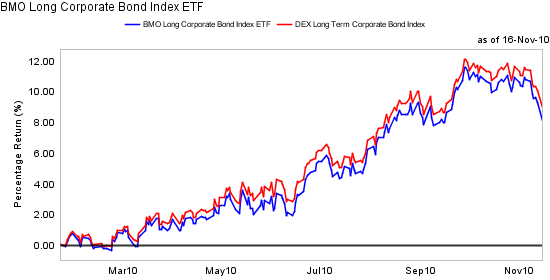

Click for Big
HIMIPref™ Preferred Indices
These values reflect the December 2008 revision of the HIMIPref™ Indices

Values are provisional and are finalized monthly
Index Mean
Current
Yield
(at bid)
Median
YTW
Median
Average
Trading
Value
Median
Mod Dur
(YTW)
Issues Day’s Perf. Index Value
Ratchet 0.00 % 0.00 % 0 0.00 0 -0.1012 % 2,238.3
FixedFloater 4.89 % 3.51 % 27,266 19.14 1 -0.2242 % 3,441.5
Floater 2.66 % 2.33 % 62,126 21.40 4 -0.1012 % 2,416.8
OpRet 4.74 % 2.92 % 61,076 2.44 8 -0.3125 % 2,399.0
SplitShare 5.36 % -0.67 % 122,599 1.06 3 0.0328 % 2,486.3
Interest-Bearing 0.00 % 0.00 % 0 0.00 0 -0.3125 % 2,193.7
Perpetual-Premium 5.65 % 5.23 % 160,159 3.06 24 -0.3396 % 2,020.3
Perpetual-Discount 5.35 % 5.41 % 259,589 14.73 53 -0.8007 % 2,039.5
FixedReset 5.23 % 3.02 % 335,198 3.19 50 -0.4277 % 2,282.4
Performance Highlights
Issue Index Change Notes
CM.PR.J Perpetual-Discount -2.45 % YTW SCENARIO
Maturity Type : Limit Maturity
Maturity Date : 2040-11-16
Maturity Price : 21.52
Evaluated at bid price : 21.86
Bid-YTW : 5.17 %
MFC.PR.B Perpetual-Discount -2.24 % YTW SCENARIO
Maturity Type : Limit Maturity
Maturity Date : 2040-11-16
Maturity Price : 20.95
Evaluated at bid price : 20.95
Bid-YTW : 5.55 %
RY.PR.W Perpetual-Discount -2.09 % YTW SCENARIO
Maturity Type : Limit Maturity
Maturity Date : 2040-11-16
Maturity Price : 23.67
Evaluated at bid price : 23.95
Bid-YTW : 5.12 %
CM.PR.H Perpetual-Discount -1.92 % YTW SCENARIO
Maturity Type : Limit Maturity
Maturity Date : 2040-11-16
Maturity Price : 22.79
Evaluated at bid price : 23.00
Bid-YTW : 5.25 %
CM.PR.I Perpetual-Discount -1.91 % YTW SCENARIO
Maturity Type : Limit Maturity
Maturity Date : 2040-11-16
Maturity Price : 22.45
Evaluated at bid price : 22.61
Bid-YTW : 5.24 %
NA.PR.N FixedReset -1.83 % YTW SCENARIO
Maturity Type : Call
Maturity Date : 2013-09-14
Maturity Price : 25.00
Evaluated at bid price : 26.31
Bid-YTW : 3.34 %
POW.PR.B Perpetual-Discount -1.81 % YTW SCENARIO
Maturity Type : Limit Maturity
Maturity Date : 2040-11-16
Maturity Price : 23.59
Evaluated at bid price : 23.86
Bid-YTW : 5.66 %
RY.PR.C Perpetual-Discount -1.78 % YTW SCENARIO
Maturity Type : Limit Maturity
Maturity Date : 2040-11-16
Maturity Price : 22.45
Evaluated at bid price : 22.61
Bid-YTW : 5.10 %
TRP.PR.C FixedReset -1.77 % YTW SCENARIO
Maturity Type : Limit Maturity
Maturity Date : 2040-11-16
Maturity Price : 25.50
Evaluated at bid price : 25.55
Bid-YTW : 3.77 %
SLF.PR.D Perpetual-Discount -1.74 % YTW SCENARIO
Maturity Type : Limit Maturity
Maturity Date : 2040-11-16
Maturity Price : 20.87
Evaluated at bid price : 20.87
Bid-YTW : 5.41 %
SLF.PR.G FixedReset -1.72 % YTW SCENARIO
Maturity Type : Limit Maturity
Maturity Date : 2040-11-16
Maturity Price : 25.65
Evaluated at bid price : 25.70
Bid-YTW : 3.64 %
IAG.PR.E Perpetual-Premium -1.68 % YTW SCENARIO
Maturity Type : Call
Maturity Date : 2019-01-30
Maturity Price : 25.00
Evaluated at bid price : 25.80
Bid-YTW : 5.67 %
RY.PR.G Perpetual-Discount -1.63 % YTW SCENARIO
Maturity Type : Limit Maturity
Maturity Date : 2040-11-16
Maturity Price : 22.13
Evaluated at bid price : 22.26
Bid-YTW : 5.07 %
BNS.PR.K Perpetual-Discount -1.55 % YTW SCENARIO
Maturity Type : Limit Maturity
Maturity Date : 2040-11-16
Maturity Price : 23.29
Evaluated at bid price : 23.54
Bid-YTW : 5.13 %
RY.PR.D Perpetual-Discount -1.55 % YTW SCENARIO
Maturity Type : Limit Maturity
Maturity Date : 2040-11-16
Maturity Price : 22.17
Evaluated at bid price : 22.30
Bid-YTW : 5.06 %
BNS.PR.L Perpetual-Discount -1.55 % YTW SCENARIO
Maturity Type : Limit Maturity
Maturity Date : 2040-11-16
Maturity Price : 22.17
Evaluated at bid price : 22.30
Bid-YTW : 5.08 %
SLF.PR.E Perpetual-Discount -1.50 % YTW SCENARIO
Maturity Type : Limit Maturity
Maturity Date : 2040-11-16
Maturity Price : 20.96
Evaluated at bid price : 20.96
Bid-YTW : 5.45 %
CIU.PR.B FixedReset -1.41 % YTW SCENARIO
Maturity Type : Call
Maturity Date : 2014-07-01
Maturity Price : 25.00
Evaluated at bid price : 27.90
Bid-YTW : 3.24 %
RY.PR.E Perpetual-Discount -1.29 % YTW SCENARIO
Maturity Type : Limit Maturity
Maturity Date : 2040-11-16
Maturity Price : 22.04
Evaluated at bid price : 22.17
Bid-YTW : 5.09 %
BAM.PR.H OpRet -1.28 % YTW SCENARIO
Maturity Type : Call
Maturity Date : 2010-12-16
Maturity Price : 25.25
Evaluated at bid price : 25.52
Bid-YTW : 1.58 %
TD.PR.O Perpetual-Discount -1.23 % YTW SCENARIO
Maturity Type : Limit Maturity
Maturity Date : 2040-11-16
Maturity Price : 23.92
Evaluated at bid price : 24.18
Bid-YTW : 5.04 %
MFC.PR.E FixedReset -1.19 % YTW SCENARIO
Maturity Type : Call
Maturity Date : 2014-10-19
Maturity Price : 25.00
Evaluated at bid price : 26.47
Bid-YTW : 3.84 %
RY.PR.A Perpetual-Discount -1.19 % YTW SCENARIO
Maturity Type : Limit Maturity
Maturity Date : 2040-11-16
Maturity Price : 22.26
Evaluated at bid price : 22.41
Bid-YTW : 4.98 %
SLF.PR.A Perpetual-Discount -1.16 % YTW SCENARIO
Maturity Type : Limit Maturity
Maturity Date : 2040-11-16
Maturity Price : 21.87
Evaluated at bid price : 22.21
Bid-YTW : 5.41 %
BNS.PR.M Perpetual-Discount -1.11 % YTW SCENARIO
Maturity Type : Limit Maturity
Maturity Date : 2040-11-16
Maturity Price : 22.24
Evaluated at bid price : 22.37
Bid-YTW : 5.07 %
RY.PR.B Perpetual-Discount -1.07 % YTW SCENARIO
Maturity Type : Limit Maturity
Maturity Date : 2040-11-16
Maturity Price : 23.01
Evaluated at bid price : 23.21
Bid-YTW : 5.07 %
PWF.PR.F Perpetual-Discount -1.04 % YTW SCENARIO
Maturity Type : Limit Maturity
Maturity Date : 2040-11-16
Maturity Price : 23.52
Evaluated at bid price : 23.80
Bid-YTW : 5.55 %
RY.PR.Y FixedReset -1.04 % YTW SCENARIO
Maturity Type : Call
Maturity Date : 2014-12-24
Maturity Price : 25.00
Evaluated at bid price : 27.71
Bid-YTW : 3.25 %
IAG.PR.C FixedReset -1.03 % YTW SCENARIO
Maturity Type : Call
Maturity Date : 2014-01-30
Maturity Price : 25.00
Evaluated at bid price : 27.01
Bid-YTW : 3.81 %
ELF.PR.G Perpetual-Discount 2.17 % YTW SCENARIO
Maturity Type : Limit Maturity
Maturity Date : 2040-11-16
Maturity Price : 20.69
Evaluated at bid price : 20.69
Bid-YTW : 5.81 %
Volume Highlights
Issue Index Shares
Traded
Notes
GWO.PR.F Perpetual-Premium 302,334 RBC crossed 300,000 at 25.45.
YTW SCENARIO
Maturity Type : Call
Maturity Date : 2012-10-30
Maturity Price : 25.00
Evaluated at bid price : 25.44
Bid-YTW : 5.39 %
CM.PR.E Perpetual-Premium 250,941 RBC crossed three blocks, of 210,000 shares, 18,700 and 15,000, all at 25.35.
YTW SCENARIO
Maturity Type : Call
Maturity Date : 2012-11-30
Maturity Price : 25.00
Evaluated at bid price : 25.25
Bid-YTW : 5.23 %
TD.PR.M OpRet 168,800 RBC crossed blocks of 99,000 and 67,700, both at 25.86.
YTW SCENARIO
Maturity Type : Call
Maturity Date : 2010-12-16
Maturity Price : 25.75
Evaluated at bid price : 25.86
Bid-YTW : 1.79 %
IAG.PR.F Perpetual-Premium 155,060 Desjardins crossed 150,000 at 25.65.
YTW SCENARIO
Maturity Type : Call
Maturity Date : 2019-04-30
Maturity Price : 25.00
Evaluated at bid price : 25.55
Bid-YTW : 5.73 %
PWF.PR.M FixedReset 150,900 Nesbitt bought two blocks from National, 25,000 and 18,400 shares, both at 27.65, then crossed 100,000 at the same price.
YTW SCENARIO
Maturity Type : Call
Maturity Date : 2014-03-02
Maturity Price : 25.00
Evaluated at bid price : 27.60
Bid-YTW : 2.72 %
BMO.PR.P FixedReset 83,530 Scotia crossed 74,700 at 27.40.
YTW SCENARIO
Maturity Type : Call
Maturity Date : 2015-03-27
Maturity Price : 25.00
Evaluated at bid price : 27.32
Bid-YTW : 3.05 %
There were 53 other index-included issues trading in excess of 10,000 shares.