Regulatory Capital

RY Capitalization: 4Q08

RY has released its Fourth Quarter 2008 Earnings and Supplementary Package, so it’s time to recalculate how much room they have to issue new preferred shares – assuming they want to!

Step One is to analyze their Tier 1 Capital, reproducing the prior format:

RY Capital Structure
October, 2007
& October, 2008
  4Q07 4Q08
Total Tier 1 Capital 23,383 25,173
Common Shareholders’ Equity 95.2% 115.0%
Preferred Shares 10.0% 10.6%
Innovative Tier 1 Capital Instruments 14.9% 15.4%
Non-Controlling Interests in Subsidiaries 0.1% 1.4%
Goodwill -20.3% -39.6%
Miscellaneous NA -2.7%
‘Miscellaneous’ includes ‘Substantial Investments’, ‘Securitization-related deductions’, ‘Expected loss in excess of allowance’ and ‘Other’

Next, the issuance capacity (from Part 3 of the introductory series):

RY
Tier 1 Issuance Capacity
October 2007
& October 2008
  4Q07 4Q08
Equity Capital (A) 17,545 18,637
Non-Equity Tier 1 Limit (B=A/3), 4Q07
(B=0.666*A), 4Q08
5,848 12,425
Innovative Tier 1 Capital (C) 3,494 3,879
Preferred Limit (D=B-C) 2,354 8,546
Preferred Actual (E) 2,344 2,657
New Issuance Capacity (F=D-E) 10 5,889
Items A, C & E are taken from the table
“Regulatory Capital”
of the supplementary information;
Note that Item A includes everything except preferred shares and innovative capital instruments


Item B is as per OSFI Guidelines; the limit was recently increased.
Items D & F are my calculations

and the all important Risk-Weighted Asset Ratios!

RY
Risk-Weighted Asset Ratios
October 2007
& October 2008
  Note 2007 4Q08
Equity Capital A 17,545 18,637
Risk-Weighted Assets B 247,635 278,579
Equity/RWA C=A/B 7.09% 6.69%
Tier 1 Ratio D 9.4% 9.0%
Capital Ratio E 11.5% 11.1%
Assets to Capital Multiple F 19.8x 20.1x
A is taken from the table “Issuance Capacity”, above
B, D, E & F are taken from RY’s Supplementary Report
C is my calculation.

RY’s Assets-to-Capital multiple has again edged up over the normal limit (though not as high as it was in the first quarter). If we follow international practice and retain the EL/ALLL deductions, the ratio is higher:

RY Adjusted Assets-to-Capital Multiple
Item Value
Total Regulatory Capital 30,830
EL/ALLL Deductions 630
Adjusted Capital 31,460
Reported ACM 20.1x
Implied Assets 632,346
Unadjusted ACM 20.5x

We see from the supplementary data that the average credit risk weight of their assets has declined from 25% in 3Q08 to 24% in 4Q08, but their total exposure has risen dramatically, from $838-billion to $956-billion. This is largely due to a dramatic $72-billion increase in “Other Risk-Adjusted Assets”, from $115-billion in 3Q08 (at a 28% risk-weight) to $187-billion in 4Q08 (at a 19% risk-weight). A footnote gives a partial answer:

For credit risk, portfolios using the Standardized and AIRB Approach represents 27% and 58%, respectively, of RAA. The remaining 15% represents Balance Sheet assets not included in Standardized or AIRB Approaches.

The Balance sheet provides a clue. Assets classed as “Derivatives” are $136-billion in 4Q08, up from a mere $69-billion in 3Q08; the offsetting liability has increased to $129-billion from $67-billion. The $136-billion Derivatives asset may be compared to the disclosure of $86-billion in OTC derivatives disclosed in the calculation of Risk Weighted Assets. It seems likely that the “other” category includes Exchange Traded Derivatives.

Additionally, Total Lending has risen $43-billion; from $437-billion to $480-billion.

The Earnings Release comments:

The Tier 1 capital ratio was down 50 basis points from last quarter primarily due to the impact of a sharply weaker Canadian dollar at quarter-end on the translated value of foreign currency denominated assets, which resulted in higher risk-adjusted assets and a higher goodwill capital deduction. The Total capital ratio was down 60bps from last quarter largely due to factors noted above for Tier 1 capital.

Additionally:

At the end of the fourth quarter, the U.S./Canadian dollar exchange rate was $0.830 as compared to $0.977 at the end of the third quarter, reflecting a depreciation of 15% in the Canadian dollar. Total assets as of October 31, 2008 were up 14%, from the end of the third quarter, of which approximately one-third of the increase was due to the impact of the weaker Canadian dollar on the translation of mainly U.S. dollar-denominated assets. Risk-adjusted assets increased 10% from the end of the third quarter, of which approximately two-thirds was due to the impact of the weaker Canadian dollar on the translation of mainly U.S. dollar-denominated assets.

Royal Bank needs to do some delevering – an equity issue is indicated, since the Equity / RWA ratio is below that of its peers.

Market Action

December 4, 2008

Assiduous Readers will know that I am not averse to a little bit of stimulus in this lousy economy. Deficits are fine, provided they’re backed up with credible research showing a good healthy surplus through a business cycle – many of our current problems are the result of What-Debt? and Spend-Every-Penny goosing an already over-stimulated economy with not just tax cuts, but moronic tax cuts – like cutting the GST.

Infrastructure would be a marvellous place to start. It has a very high economic multiplier and is the type of thing that has a very logical end-point, making it possible to turn off the tap without too much controversy – once you’ve built your subway or repaired your bridge … it’s built! There is only so much you can do (take it too far, for instance, and we end up with 1000% over-capacity in the cement industry and a lot of really shoddy construction that has to be torn down), but in Canada and the Western world generally, there is a huge list of neglected infrastructure that would be a Very Good Thing to chip away at.

However, from Japan comes a cautionary tale about idiotic infrastructure spending:

Japan’s $268 million Ibaraki Airport is on schedule to open for business in March 2010. The hard part will be persuading an airline to fly there.

The government and Ibaraki prefecture, home to 3 million people, are paying for the airport north of Tokyo, which won’t have train services and is a half-hour drive from Ibaraki’s capital, Mito. Japan Airlines Corp. and All Nippon Airways Co., which operate 90 percent of flights in the country, don’t plan to use it.

We don’t have to worry about such boondoggles in Canada, though! What-Debt? has reacted forcefully and decisively to the global economic crisis by forcefully and decisively running away from Parliament for eight weeks. See ya!

The Amazing Takeover Bid That Will Never End continued its gyrations today, with Bloomberg reporting:

The private-equity firms that agreed to buy BCE Inc. for C$52 billion ($42 billion) may instead seek to acquire a minority stake in the Canadian phone company, according to two people with knowledge of the plan.

The alternative proposal involves the buyers investing C$8 billion to C$10 billion in preferred securities for about 20 percent of BCE. It also calls for a cash dividend of C$8 to C$10 a share to paid to BCE shareholders.

Citigroup Inc., based in New York, and Frankfurt-based Deutsche Bank AG are leading a group of lenders that also includes Toronto-Dominion Bank and Royal Bank of Scotland Group Plc. The banks would need to approve the new transaction. The debt required to finance the minority stake would be around C$7 billion or C$8 billion, compared with the C$34 billion the banks would fund if the buyout went ahead.

Bloomberg also has a piece on Municipal credit rating upgrades, implying skullduggery by S&P. All the data is cherry-picked, of course, so whether there’s an actual trend or not remains to be see. But I bring this up because of the most interesting quote:

Recent default studies suggesting municipalities’ enhanced creditworthiness don’t account for what happened to issuers during the Great Depression, according to Richard Ciccarone, chief research officer of McDonnell Investment Management LLC. The Oak Brook, Illinois-based firm has $12 billion under management, including municipal bonds.

In 1929, more than 98 percent of the largest U.S. cities were rated Aa or better, according to Ciccarone’s research, which cites a study of municipal bonds showing that 3,252 issues went into default at the peak of the economic contraction in 1935. Almost half the bonds in default were rated Aaa in 1929.

“We may be facing the same conditions today that we did in the 1930s, but they could be worse because of pension and other liabilities,” Ciccarone said. “We have some huge liabilities at the same time that real estate values are falling.”

Yo! Ciccarone! Get with the programme! There’s some political theatre that needs to be played out! What do you think you are, some kind of investment expert or something?

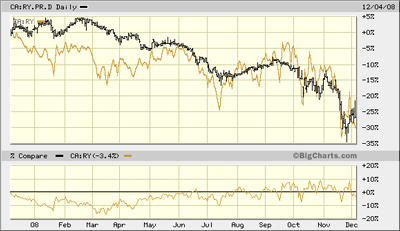
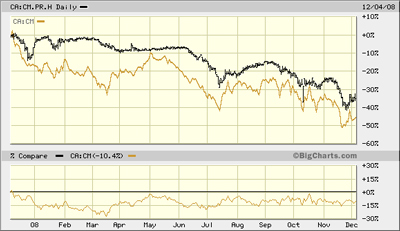
I got a little curious today about relative performances;

RY.PR.D vs. common:

CM.PR.H vs common:

Make of it what you will.

Volume continued heavy today; volume and price advances in split shares were again particularly noteworthy.

Note that these indices are experimental; the absolute and relative daily values are expected to change in the final version. In this version, index values are based at 1,000.0 on 2006-6-30.
The Fixed-Reset index was added effective 2008-9-5 at that day’s closing value of 1,119.4 for the Fixed-Floater index.
Index Mean Current Yield (at bid) Mean YTW Mean Average Trading Value Mean Mod Dur (YTW) Issues Day’s Perf. Index Value
Ratchet N/A N/A N/A N/A 0 N/A N/A
Fixed-Floater 7.06% 7.40% 78,618 13.22 6 -0.3933% 748.0
Floater 9.20% 9.47% 64,655 9.75 2 +5.5443% 384.9
Op. Retract 5.50% 6.97% 142,959 4.19 15 +0.4110% 981.0
Split-Share 7.25% 14.45% 67,284 3.93 14 +0.8939% 845.9
Interest Bearing 9.64% 21.26% 58,029 2.86 3 -1.6837% 759.4
Perpetual-Premium N/A N/A N/A N/A N/A N/A N/A
Perpetual-Discount 7.89% 8.01% 199,387 11.41 71 +0.3262% 700.2
Fixed-Reset 6.13% 5.59% 1,046,273 14.20 15 -0.0511% 974.2
Major Price Changes
Issue Index Change Notes
BSD.PR.A InterestBearing -8.0717% Asset coverage of 0.9-:1 as of November 28, according to Brookfield Funds. Still rated Pfd-2(low) by Dumb Bunnies “R” Us. Now with a pre-tax bid-YTW of 25.34% based on a bid of 4.10 and a hardMaturity 2015-3-31 at 10.00. Closing quote of 4.10-38, 55×1. Day’s range of 4.11-46.
SLF.PR.C PerpetualDiscount -6.1224% Now with a pre-tax bid-YTW of 8.09% based on a bid of 13.80 and a limitMaturity. Closing quote 13.80-10, 3X3. Day’s range of 13.70-14.72.
BCE.PR.Z FixFloat -5.9377%  
RY.PR.G PerpetualDiscount -4.7205% Now with a pre-tax bid-YTW of 7.42% based on a bid of 15.34 and a limitMaturity. Closing quote 15.34-64, 3×15. Day’s range of 15.30-99.
FBS.PR.B SplitShare -4.0541% Asset coverage of 1.1+:1 as of November 27, according to TD Securities. Now with a pre-tax bid-YTW of 17.55% based on a bid of 7.10 and a hardMaturity 2011-12-15 at 10.00. Closing quote of 7.10-39, 58×10. Day’s range of 7.10-50.
W.PR.H PerpetualDiscount -3.0109% Now with a pre-tax bid-YTW of 9.31% based on a bid of 15.14 and a limitMaturity. Closing quote 15.55-74, 3×2. Day’s range of 15.50-75.
W.PR.J PerpetualDiscount -2.9468% Now with a pre-tax bid-YTW of 9.47% based on a bid of 15.15 and a limitMaturity. Closing quote 15.14-49, 2×2. Day’s range of 15.02-60.
TCA.PR.Y PerpetualDiscount -2.6277% Now with a pre-tax bid-YTW of 7.11% based on a bid of 15.30 and a limitMaturity. Closing quote 40.02-00, 7X5. Day’s range of 40.50-48.
LBS.PR.A SplitShare -2.5714% Asset coverage of 1.4+:1 as of November 27, according to Brompton Group. Now with a pre-tax bid-YTW of 14.12% based on a bid of 6.82 and a hardMaturity 2013-11-29 at 10.00. Closing quote of 6.82-10, 10×5. Day’s range of 6.82-00.
BNS.PR.K PerpetualDiscount -2.3214% Now with a pre-tax bid-YTW of 7.44% based on a bid of 16.41 and a limitMaturity. Closing quote 16.41-60, 5X3. Day’s range of 16.40-25.
WFS.PR.A SplitShare -2.2360% Asset coverage of 1.3-:1 as of November 30 according to Mulvihill. Now with a pre-tax bid-YTW of 16.30% based on a bid of 7.87 and a hardMaturity 2011-6-30 at 10.00. Closing quote of 7.87-04, 10×35. Day’s range of 7.77-93.
BCE.PR.Y FixFloat -2.1407%  
CM.PR.D PerpetualDiscount -2.0443% Now with a pre-tax bid-YTW of 8.50% based on a bid of 17.25 and a limitMaturity. Closing quote 17.25-39, 5×8. Day’s range of 17.00-98.
RY.PR.W PerpetualDiscount +2.0286% Now with a pre-tax bid-YTW of 7.24% based on a bid of 17.10 and a limitMaturity. Closing quote 17.10-15, 8×83. Day’s range of 16.75-64.
CM.PR.J PerpetualDiscount +2.1180% Now with a pre-tax bid-YTW of 8.50% based on a bid of 13.50 and a limitMaturity. Closing quote 13.50-55, 8×1. Day’s range of 13.38-73.
SBC.PR.A SplitShare +2.2727% Asset coverage of 1.5-:1 as of November 27 according to Brompton Group. Now with a pre-tax bid-YTW of 13.36% based on a bid of 7.65 and a hardMaturity 2012-11-30 at 10.00. Closing quote of 7.65-99, 36×9. Day’s range of 7.75-00.
BMO.PR.K PerpetualDiscount +2.4209% Now with a pre-tax bid-YTW of 8.05% based on a bid of 16.50 and a limitMaturity. Closing quote 16.50-68, 1×15. Day’s range of 16.00-69.
PWF.PR.G PerpetualDiscount +2.5641% Now with a pre-tax bid-YTW of 8.35% based on a bid of 18.00 and a limitMaturity. Closing quote 18.00-75, 3×2. Day’s range of 17.55-19.08.
BAM.PR.K Floater +2.8767%  
BAM.PR.N PerpetualDiscount +3.3266% Now with a pre-tax bid-YTW of 12.01% based on a bid of 10.25 and a limitMaturity. Closing quote 10.25-34, 13×1. Day’s range of 10.00-44.
BMO.PR.H PerpetualDiscount +3.9251% Now with a pre-tax bid-YTW of 7.79% based on a bid of 17.21 and a limitMaturity. Closing quote 17.20-54, 4×11. Day’s range of 16.65-17.80.
DFN.PR.A SplitShare +4.1162% Asset coverage of 1.9-:1 as of November 14 according to the company. Now with a pre-tax bid-YTW of 8.34% based on a bid of 8.60 and a hardMaturity 2014-12-1 at 10.00. Closing quote of 8.60-77, 5×2. Day’s range of 8.37-97.
FTN.PR.A SplitShare +4.5089% Asset coverage of 1.6-:1 as of November 28, according to the company. Now with a pre-tax bid-YTW of 13.22% based on a bid of 6.49 and a hardMaturity 2015-12-1 at 10.00. Closing quote of 6.49-63, 2×10. Day’s range of 6.47-89.
CL.PR.B PerpetualDiscount +5.0000% Now with a pre-tax bid-YTW of 7.86% based on a bid of 19.95 and a limitMaturity. Closing quote 19.95-24, 6×4. Day’s range of 18.10-20.25 (!)
PWF.PR.I PerpetualDiscount +5.6338% Now with a pre-tax bid-YTW of 8.15% based on a bid of 18.75 and a limitMaturity. Closing quote 18.51-00, 5×3. Day’s range of 17.75-18.75.
BCE.PR.G FixFloat +6.8302%  
FFN.PR.A SplitShare +6.8966% Asset coverage of 1.4+:1 as of November 14 according to the company. Now with a pre-tax bid-YTW of 15.31% based on a bid of 6.20 and a hardMaturity 2014-12-1 at 10.00. Closing quote of 6.20-83, 32×1. Day’s range of 6.01-20.
BNA.PR.B SplitShare +7.0664% Asset coverage of 1.6+:1 as of December 4 based on BAM.A at 16.72 and 2.4 BAM.A per unit. Now with a pre-tax bid-YTW of 13.93% based on a bid of 15.00 and a hardMaturity 2016-3-25 at 25.00. Closing quote of 15.00-58, 14×4. Day’s range of 14.11-15.34.
BAM.PR.J OpRet +7.5862% Now with a pre-tax bid-YTW of 12.65% based on a bid of 15.60 and a softMaturity 2018-3-30 at 25.00. Closing quote of 15.60-16.70, 3×1. Day’s range of 13.95-16.50.
BAM.PR.B Floater +8.1461%  
Volume Highlights
Issue Index Volume Notes
PIC.PR.A Scraps (Would be SplitShare but there are credit concerns) 222,957 RBC crossed 201,800 at 11.80. Asset coverage of 1.2-:1 as of November 30 according to Mulvihill. Now with a pre-tax bid-YTW of 21.27% based on a bid of 11.61 and a hardMaturity 2010-11-1 at 15.00.
WN.PR.E Scraps (would be PerpetualDiscount but there are credit concerns) 114,677 Desjardins crossed 100,000 at 14.42. Now with a pre-tax bid-YTW of 8.59% based on a bid of 14.20 and a limitMaturity.
BNA.PR.B SplitShare 105,365 Desjardins crossed 100,000 at 14.50. Asset coverage of 1.6+:1 as of December 4 based on BAM.A at 16.72 and 2.4 BAM.A per unit. Now with a pre-tax bid-YTW of 13.93% based on a bid of 15.00 and a hardMaturity 2016-3-25 at 25.00. Closing quote of 15.00-58, 14×4. Day’s range of 14.11-15.34.
WN.PR.D Scraps (would be PerpetualDiscount but there are credit concerns) 103,819 Desjardins crossed 100,000 at 16.50. Now with a pre-tax bid-YTW of 8.13% based on a bid of 16.40 and a limitMaturity.
TD.PR.M OpRet 101,850 CIBC crossed 100,000 at 25.35. Now with a pre-tax bid-YTW of 4.59% based on a bid of 25.26 and a softMaturity 2013-10-30 at 25.00.
BAM.PR.I OpRet 91,965 TD crossed 85,000 at 17.75. Now with a pre-tax bid-YTW of 13.99% based on a bid of 17.80 and a softMaturity 2013-12-30 at 25.00.
CM.PR.H PerpetualDiscount 68,349 Now with a pre-tax bid-YTW of 8.47% based on a bid of 14.44 and a limitMaturity.
BNS.PR.N PerpetualDiscount 64,566 National crossed 40,000 at 17.82. Now with a pre-tax bid-YTW of 7.52% based on a bid of 17.74 and a limitMaturity.

There were sixty-one index-included $25-pv-equivalent issues trading over 10,000 shares today
Regulatory Capital

NA Capitalization: 4Q08

NA has released its Fourth Quarter 2008 Report and Supplementary Package, so it’s time to recalculate how much room they have to issue new preferred shares – assuming they want to!

Step One is to analyze their Tier 1 Capital, reproducing the prior format:

NA Capital Structure
October, 2007
& October, 2008
  4Q07 4Q08
Total Tier 1 Capital 4,442 5,480
Common Shareholders’ Equity 95.0% 86.2%
Preferred Shares 9.0% 14.1%
Innovative Tier 1 Capital Instruments 11.4% 15.1%
Non-Controlling Interests in Subsidiaries 0.4% 0.3%
Goodwill -15.8% -13.5%
Miscellaneous NA -2.3%
Shareholders’ equity includes ‘Foreign Currency Translation Adjustment’
‘Miscellaneous’ includes ‘unrealized gain of available for sale equity securities’ and ‘securitization related deductions’

Next, the issuance capacity (from Part 3 of the introductory series):

NA
Tier 1 Issuance Capacity
October 2007
& October 2008
  4Q07 4Q08
Equity Capital (A) 3,534 3,878
Non-Equity Tier 1 Limit (B=A/3), 4Q07
(B=0.666*A), 4Q08
1,178 2,585
Innovative Tier 1 Capital (C) 508 828
Preferred Limit (D=B-C) 670 1,757
Preferred Actual (E) 400 774
New Issuance Capacity (F=D-E) 270 983
Items A, C & E are taken from the table
“Risk Adjusted Capital Ratiosl”
of the supplementary information;
Note that Item A includes everything except preferred shares and innovative capital instruments


Item B is as per OSFI Guidelines; the limit was recently increased.
Items D & F are my calculations

and the all important Risk-Weighted Asset Ratios!

NA
Risk-Weighted Asset Ratios
October 2007
& October 2008
  Note 2007 4Q08
Equity Capital A 3,534 3,878
Risk-Weighted Assets B 49,336 58,069
Equity/RWA C=A/B 7.16% 6.67%
Tier 1 Ratio D 9.0% 9.4%
Capital Ratio E 12.4% 13.2%
Assets to Capital Multiple F 18.6x 16.7x
A is taken from the table “Issuance Capacity”, above
B, D & E are taken from RY’s Supplementary Report
C is my calculation
F is taken from the OSFI site for 4Q07. The 4Q08 figure is approximated by subtracting goodwill of 740 from total assets of 129,332 to obtain adjusted assets of 128,592 and dividing by 7,679 total capital.

National Bank does not disclose its Assets-to-Capital Multiple. Their Report to Shareholders simply states (Note 4):

In addition to regulatory capital ratios, banks are expected to meet an assets-to-capital multiple test. The assets-to-capital multiple is calculated by dividing a bank’s total assets, including specified off-balance sheet items, by its total capital. Under this test, total assets should not be greater than 23 times the total capital. The Bank met the assets-to-capital multiple test in the third quarter of 2008.

They’re reducing their leverage a little, but not by enough. Equity/RWA is now less than 7% (they report 6.43% on page 3 of the supplementary data; it’s not clear how that is calculated) … if they want to eliminated the (low) discount on their Pfd-1(low) preferred shares, they have to issue some equity. Which is not to say that their prefs are unduly risky, of course … but it does mean they have greater credit risk than their better capitalized competitors.

Regulatory Capital

TD Capitalization: 4Q08

TD has released its Fourth Quarter 2008 Report and Supplementary Package, so it’s time to recalculate how much room they have to issue new preferred shares – assuming they want to!

Step One is to analyze their Tier 1 Capital, reproducing the prior format:

TD Capital Structure
October, 2007
& October, 2008
  4Q07 4Q08
Total Tier 1 Capital 15,645 20,679
Common Shareholders’ Equity 131.5% 144.2%
Preferred Shares 6.2% 11.7%
Innovative Tier 1 Capital Instruments 11.1% 13.4%
Non-Controlling Interests in Subsidiaries 0.1% 0.1%
Goodwill -49.0% -73.3%
Miscellaneous NA +3.9%
‘Common Shareholders Equity’ includes ‘Common Shares’, ‘Contributed Surplus’, ‘Retained Earnings’ and ‘FX net of Hedging’
‘Miscellaneous’ includes ‘Securitization Allowance’, ‘ALLL/EL shortfall’ and ‘Other’.

Next, the issuance capacity (from Part 3 of the introductory series):

TD
Tier 1 Issuance Capacity
October 2007
& October 2008
  4Q07 4Q08
Equity Capital (A) 12,931 15,489
Non-Equity Tier 1 Limit (B=A/3), 4Q07
(B=0.666*A), 4Q08
4,310 10,326
Innovative Tier 1 Capital (C) 1,740 2,765
Preferred Limit (D=B-C) 2,570 7,561
Preferred Actual (E) 974 2,425
New Issuance Capacity (F=D-E) 1,346 5,136
Items A, C & E are taken from the table
“Regulatory Capital”
of the supplementary information;
Note that Item A includes everything except preferred shares and innovative instruments


Item B is as per OSFI Guidelines; the limit was recently increased.
Items D & F are my calculations

and the all important Risk-Weighted Asset Ratios!

TD
Risk-Weighted Asset Ratios
October 2007
& October 2008
  Note 2007 4Q08
Equity Capital A 12,931 15,489
Risk-Weighted Assets B 152,519 211,750
Equity/RWA C=A/B 8.48% 7.31%
Tier 1 Ratio D 10.3% 9.8%
Capital Ratio E 13.0% 12.0%
Assets to Capital Multiple F 19.7x 21.6x
A is taken from the table “Issuance Capacity”, above
B, D & E are taken from TD’s Supplementary Report
C is my calculation.
F is from OSFI (4Q07) and my calculation (4Q08) Total Capital ($25,348-million), Total Assets ($563,214-million) less Goodwill ($14,842-million)

The Assets-to-capital multiple has skyrocketted over the quarter:

Assets-to-Capital
Rough Calculation
Item 3Q08 4Q08
Total Assets 508,839 563,214
Goodwill 14,317 14,842
Net Assets 494,522 548,372
Total Capital 24,702 25,348
Assets-to-Capital 20.02x 21.63x

It should be noted that my rough calculation above is not strictly accurate: as TD noted in their 3Q08 Shareholder Report:

The assets-to-capital multiple is calculated as total assets plus off-balance sheet credit instruments, such as certain letters of credit and guarantees less investments in associated corporations, goodwill and net intangibles, divided by Total adjusted capital.

… and they arrived at a figure of 17.9x for 4Q08. OSFI does not require the Assets-to-Capital multiple to be disclosed, let alone reconciled to other data.

Whatever the level, it is apparent that the multiple has increased, with assets up approximately $55-billion. “Securities” is pretty much a wash, with a $20-billion decline in “Trading” balanced largely by an increase in “Available for Sale” of $15-billion. “Loans” is a similar wash, with a $10-billion decline in “Residential Mortgages” offset by a $8-billion increase in “Business & Government”. The big balloon is a $42-billion increase in “Derivatives”, financed by a similar $35-billion “Derivatives” on the liability side.

This is probably due to the huge market move of the Canadian Dollar in the third quarter, as individual contracts in a matched book ballooned in value. BMO was also affected by this behaviour. However, TD does not address this asset/liability gross-up, nor does it provide a table showing counterparty strength.

Regulatory Capital

CM Capitalization: 4Q08

CIBC (Stock symbol CM … I can never quite decide how to present it!) has released its 4Q08 Supplementary Package, so it’s time to recalculate how much room they have to issue new preferred shares – assuming they want to!

Step One is to analyze their Tier 1 Capital, reproducing the prior format:

CM Capital Structure
October, 2007
& October, 2008
  4Q07 4Q08
Total Tier 1 Capital 12,379 12,365
Common Shareholders’ Equity 90.1% 91.2%
Preferred Shares 23.7% 26.1%
Innovative Tier 1 Capital Instruments 0% 0%
Non-Controlling Interests in Subsidiaries 1.1% 1.4%
Goodwill -14.9% -17.0%
Misc. NA -1.8%
Shareholders’ Equity includes “Common Shares”, “Contributed Surplus”, “Retained Earnings”, “Net after tax fair value losses arising from changes in institution’s own credit risk”, “Foreign Currency translation adjustments”, and “Net after tax undrealized holding loss on AFS equity securities in OCI”

‘Misc.’ is comprised of Basel II adjustments to Tier 1 Equity

Next, the issuance capacity (from Part 3 of the introductory series):

CM
Tier 1 Issuance Capacity
October 2007
& October 2008
  4Q07 4Q08
Equity Capital (A) 9,448 9,134
Non-Equity Tier 1 Limit (B=A/3), 4Q07
(B=0.666*A), 4Q08
3,149 6,089
Innovative Tier 1 Capital (C) 0 0
Preferred Limit (D=B-C) 3,149 6,089
Preferred Actual (E) 2,931 3,231
New Issuance Capacity (F=D-E) 218 2,858
Items A, C & E are taken from the table
“Regulatory Capital”
of the supplementary information;
Note that Item A is defined as total Tier 1 Capital, less preferred shares.


Item B is as per OSFI Guidelines; the limit was recently increased.
Items D & F are my calculations

and the all important Risk-Weighted Asset Ratios!

CM
Risk-Weighted Asset Ratios
October 2007
& October 2008
  Note 4Q07 4Q08
Equity Capital A 9,448 9,134
Risk-Weighted Assets B 127,424 117,900
Equity/RWA C=A/B 7.41% 7.75%
Tier 1 Ratio D 9.7% 10.5%
Capital Ratio E 13.9% 15.4%
Assets to Capital Multiple F 19.0x 18.9x
A is taken from the table “Issuance Capacity”, above
B, D & E are taken from CM’s Supplementary Report
C is my calculation.
F is taken from OSFI (4Q07) and reported total capital ($18,129-million) over Average assets ($342,621-million)
Note that CM reports “Common Equity to risk-weighted assets” of 9.5%. They do not include “non-controlling interests”, “goodwill” and the Basel II adjustments in the numerator; I do.

Again, the 4Q07 figures are not directly comparable with the 4Q08 figures due to the change from Basel I to Basel II.

On a Basel I basis, the Tier I and Total Capital ratios got a big boost in the first quarter with the capital raise, but have since declined; the Tier 1 ratio is now the lowest it has been in the last two years, but held steady in the fourth quarter. The total capital ratio declined over the quarter as issuance of sub-debt did not keep pace with the increase in RWA.

Further, on a Basel I basis, Total Risk Weighted Assets have increased somewhat since 4Q07, due to increases in the risk-weight of “Other Loans” and “Other Assets”. From the breakdown of loans on page 22 of the supplementary data, it looks like a fairly even increase in business across the board, led by personal loans and Commercial real-estate/construction.

New Issues

New Issue (Maybe): BNS Fixed-Reset 6.25%+???

This is not the usual reporting of a new issue!

Back in October, Scotia announced:

Scotiabank has agreed to purchase 104,609,895 trust units of CI from Sun Life for approximately $2.3 billion in cash representing all of Sun Life’s 37 per cent ownership stake in CI.

Today, Scotia has announced:

that the Bank plans to close its 37 per cent strategic investment in CI Financial Income Fund (“CI”; TSX: CIX.UN) next week, pending receipt of executed agreements, regulatory approvals and acceptance by the Toronto Stock Exchange.

Scotiabank is purchasing Sun Life Financial’s (“Sun Life” TSX/NYSE:SLF) stake of 104,609,895 CI trust units for $1.55 billion in cash, $500 million in common shares at $34.60 per share and $250 million in 6.25 per cent rate reset preferred shares.

That’s it. That’s all I know. None of the extant BNS Fixed-Resets have a 6.25% initial coupon, so this would be a new issue rather than a re-opening.

The Globe & Mail reports:

National Bank Financial analyst Robert Sedran said Scotiabank’s Tier 1 capital ratio, the key measure that regulator’s watch, had been expected to dip to 8.8 per cent if the deal for the stake in CI had been all-cash. With the changes, Scotiabank’s Tier 1 ratio will now be about 9.1 per cent, he said. Regulators require the ratio, which is a measure of a bank’s capital against its assets weighted by the risk they pose, to stay above 7 per cent.

Scotiabank said it will issue $500-million in common shares to Sun Life at $34.60 per share, and $250-million in 6.25 per cent rate reset preferred shares.

The $34.60 equity price is almost 7 per cent higher to yesterday’s closing price, Mr. Aiken noted.

So what is this? Will Sunlife sell the shares in a secondary offering? Will there be a primary offering by Scotia of this issue? Will the shares come with a prospectus, or is it to be a restricted private placement forever?

Stay tuned!

Market Action

December 3, 2008

Econbrowser‘s James Hamilton reviews 5-Year TIPS, which have been showing some rather unusual behaviour recently:

on Monday, the TIPS yield fell 214 basis points, while the nominal yield was down only 22 basis points, leaving the TIPS yield only slightly above the nominal.

Dr. Hamilton quotes extensively from Greg Mankiw who points out:

Starting 12/01/2008, the TIPS yield curve will use on-the-run TIPS as knot points rather than all securities under 20 years

There are two kinds of TIPS – on-the-run (recent issue) and off-the-run (old issue). The older issues will have a lot of prior inflation embedded in their price; the new issues will have none. Since the minimum redemption value of a TIPS is par, this means that a deflationary environment will erode the principal of off-the-run TIPS while leaving the on-the-run issues unscathed; hence, there is now not simply a liquidity premium contributing to the difference in yields, but an embedded put as well.

Assiduous Readers will remember that continued five-year TIPS issuance is dubious. They will also be aware that the Cleveland Fed has given up trying to figure out what TIPS yields really mean!

Entirely reasonable performance today on continued high volume. Of particular interest is the spike in volume and prices of splitShare corporations.

Note that these indices are experimental; the absolute and relative daily values are expected to change in the final version. In this version, index values are based at 1,000.0 on 2006-6-30.
The Fixed-Reset index was added effective 2008-9-5 at that day’s closing value of 1,119.4 for the Fixed-Floater index.
Index Mean Current Yield (at bid) Mean YTW Mean Average Trading Value Mean Mod Dur (YTW) Issues Day’s Perf. Index Value
Ratchet N/A N/A N/A N/A 0 N/A N/A
Fixed-Floater 7.02% 7.36% 78,664 13.26 6 -1.7358% 751.0
Floater 9.71% 10.00% 61,180 9.31 2 +2.1503% 364.7
Op. Retract 5.53% 7.01% 142,588 4.18 15 -0.0515% 977.0
Split-Share 7.31% 14.49% 66,886 3.89 14 +1.6050% 838.4
Interest Bearing 9.46% 20.51% 58,779 2.89 3 -0.9721% 772.4
Perpetual-Premium N/A N/A N/A N/A N/A N/A N/A
Perpetual-Discount 7.92% 8.04% 197,377 11.40 71 +0.2976% 697.9
Fixed-Reset 6.13% 5.59% 1,076,057 14.21 15 +0.2764% 974.7
Major Price Changes
Issue Index Change Notes
BNA.PR.B SplitShare -12.4375% Now with a pre-tax bid-YTW of 15.20% based on a bid of 14.01 and a hardMaturity 2016-3-25 at 25.00. Closing quote of 14.01-15.49, 10×1. Day’s range of 14.00-76.
BCE.PR.G FixFloat -7.4279%  
RY.PR.F PerpetualDiscount -5.5556% Now with a pre-tax bid-YTW of 7.35% based on a bid of 15.30 and a limitMaturity. Closing quote 15.45-57, 9×3. Day’s range of 15.00-16.50.
CM.PR.E PerpetualDiscount -3.1579% Now with a pre-tax bid-YTW of 8.62% based on a bid of 16.56 and a limitMaturity. Closing quote 16.56-75, 5×10. Day’s range of 16.56-25.
NA.PR.L PerpetualDiscount -3.1455% Now with a pre-tax bid-YTW of 8.32% based on a bid of 14.78 and a limitMaturity. Closing quote 14.78-27, 3×16. Day’s range of 14.49-15.55.
MFC.PR.C PerpetualDiscount -3.1271% Now with a pre-tax bid-YTW of 7.77% based on a bid of 14.56 and a limitMaturity. Closing quote 14.55-68, 26×2. Day’s range of 14.51-30.
BCE.PR.A FixFloat -2.9412%  
CM.PR.G PerpetualDiscount -2.5563% Now with a pre-tax bid-YTW of 8.60% based on a bid of 16.01 and a limitMaturity. Closing quote 16.01-27, 5×1. Day’s range of 15.52-16.62.
CM.PR.K FixedReset -2.4096%  
FTN.PR.A SplitShare -2.3585% Asset coverage of 1.6-:1 as of November 28, according to the company. Now with a pre-tax bid-YTW of 14.07% based on a bid of 6.21 and a hardMaturity 2015-12-1 at 10.00. Closing quote of 6.21-40, 7×1. Day’s range of 6.13-51.
SBN.PR.A SplitShare -2.0732% Asset coverage of 1.8+:1 as of November 30 according to Mulvihill. Now with a pre-tax bid-YTW of 9.78% based on a bid of 8.03 and a hardMaturity 2014-12-1 at 10.00. Closing quote of 8.03-45, 30×10. Day’s range of 7.91-15.
BAM.PR.N PerpetualDiscount -2.0730% Now with a pre-tax bid-YTW of 12.42% based on a bid of 9.92 and a limitMaturity. Closing quote 9.92-10.09, 1×4. Day’s range of 9.90-16.
NA.PR.M PerpetualDiscount -2.0619% Now with a pre-tax bid-YTW of 8.01% based on a bid of 19.00 and a limitMaturity. Closing quote 19.00-50, 15×2. Day’s range of 19.10-80.
BAM.PR.J OpRet -2.0270% Now with a pre-tax bid-YTW of 13.82% based on a bid of 14.50 and a softMaturity 2018-3-30 at 25.00. Closing quote of 14.50-69, 8×1. Day’s range of 14.00-00.
BMO.PR.J PerpetualDiscount +2.0906% Now with a pre-tax bid-YTW of 7.77% based on a bid of 14.65 and a limitMaturity. Closing quote 14.65-90, 20×12. Day’s range of 14.00-15.00.
BMO.PR.K PerpetualDiscount +2.0913% Now with a pre-tax bid-YTW of 8.25% based on a bid of 16.11 and a limitMaturity. Closing quote 16.11-35, 10×1. Day’s range of 15.90-60.
LBS.PR.A SplitShare +2.1898% Asset coverage of 1.4+:1 as of October 17, according to Brompton Group. Now with a pre-tax bid-YTW of 14.12% based on a bid of 7.00 and a hardMaturity 2013-11-29 at 10.00. Closing quote of 7.00-14, 30×1. Day’s range of 6.90-19.
TD.PR.S FixedReset +2.2005%  
ENB.PR.A PerpetualDiscount +2.3000% Now with a pre-tax bid-YTW of 6.78% based on a bid of 20.46 and a limitMaturity. Closing quote 20.46-21.92 (!). Day’s range of 19.99-46.
ELF.PR.G PerpetualDiscount +2.3622% Now with a pre-tax bid-YTW of 9.36% based on a bid of 13.00 and a limitMaturity. Closing quote 13.00-88, 11X2. Day’s range of 12.70-00.
TD.PR.Y FixedReset +2.4691%  
BNS.PR.O PerpetualDiscount +2.6761% Now with a pre-tax bid-YTW of 7.58% based on a bid of 18.80 and a limitMaturity. Closing quote 18.80-03, 20×8. Day’s range of 18.50-00.
POW.PR.A PerpetualDiscount +2.6786% Now with a pre-tax bid-YTW of 8.30% based on a bid of 17.25 and a limitMaturity. Closing quote 17.25-50, 2×24. Day’s range of 16.80-50.
FBS.PR.B SplitShare +2.7778% Asset coverage of 1.1+:1 as of November 27 according to TD Securities. Now with a pre-tax bid-YTW of 15.93% based on a bid of 7.40 and a hardMaturity 2011-12-15 at 10.00. Closing quote of 7.40-48, 20×10. Day’s range of 7.30-49.
SLF.PR.C PerpetualDiscount +3.0133% Now with a pre-tax bid-YTW of 7.59% based on a bid of 14.70 and a limitMaturity. Closing quote 14.70-71, 158×1. Day’s range of 14.00-15.01.
SLF.PR.B PerpetualDiscount +3.0239% Now with a pre-tax bid-YTW of 8.22% based on a bid of 14.65 and a limitMaturity. Closing quote 14.65-70, 20×2. Day’s range of 14.25-70.
DF.PR.A SplitShare +3.2389% Asset coverage of 1.4+:1 as of November 28 according to the company. Now with a pre-tax bid-YTW of 10.77% based on a bid of 7.65 and a hardMaturity 2014-12-1 at 10.00. Closing quote of 7.65-87, 100×1. Day’s range of 7.49-50.
LFE.PR.A SplitShare +3.5616% Asset coverage of 1.6-:1 as of November 14 according to the company. Now with a pre-tax bid-YTW of 13.45% based on a bid of 7.56 and a hardMaturity 2012-12-1 at 10.00. Closing quote of 7.56-95, 50×14. Day’s range of 7.23-95.
MFC.PR.B PerpetualDiscount +3.6482% Now with a pre-tax bid-YTW of 7.35% based on a bid of 15.91 and a limitMaturity. Closing quote 15.91-10, 3×20. Day’s range of 15.40-16.40.
BAM.PR.B Floater +3.7901%  
PWF.PR.E PerpetualDiscount +4.1905% Now with a pre-tax bid-YTW of 8.54% based on a bid of 16.41 and a limitMaturity. Closing quote 16.41-51, 1×2. Day’s range of 15.90-80.
FFN.PR.A SplitShare +4.3165% Asset coverage of 1.4+:1 as of November 14 according to the company. Now with a pre-tax bid-YTW of 16.78% based on a bid of 5.80 and a hardMaturity 2014-12-1 at 10.00. Closing quote of 5.80-6.83, 4×2. Day’s range of 5.60-00.
DFN.PR.A SplitShare +7.8329% Asset coverage of 1.9-:1 as of November 14 according to the company. Now with a pre-tax bid-YTW of 9.16% based on a bid of 8.26 and a hardMaturity 2014-12-1 at 10.00. Closing quote of 8.26-49, 50×1. Day’s range of 7.79-39.
WFS.PR.A SplitShare +8.1989% Asset coverage of 1.3-:1 as of November 30 according to Mulvihill. Now with a pre-tax bid-YTW of 15.25% based on a bid of 8.05 and a hardMaturity 2011-6-30 at 10.00. Closing quote of 8.05-15, 14×10. Day’s range of 7.09-8.15.
Volume Highlights
Issue Index Volume Notes
TD.PR.O PerpetualDiscount 235,205 TD crossed 200,000 at 16.40. Now with a pre-tax bid-YTW of 7.45% based on a bid of 16.55 and a limitMaturity.
BPO.PR.I Scraps (Would be OpRet but there are credit concerns) 202,555 TD crossed 100,000 at 17.60, then another 100,000 at the same price. Now with a pre-tax bid-YTW of 27.11% based on a bid of 17.01 and OptionCertainty 2010-12-31 at 25.00.
WFS.PR.A SplitShare 238,665 RBC crossed 191,000 at 8.15. Asset coverage of 1.3-:1 as of November 30 according to Mulvihill. Now with a pre-tax bid-YTW of 15.25% based on a bid of 8.05 and a hardMaturity 2011-6-30 at 10.00. Closing quote of 8.05-15, 14×10. Day’s range of 7.09-8.15.
BMO.PR.K PerpetualDiscount 79,315 Desjardins crossed 27,200 at 16.60. Now with a pre-tax bid-YTW of 8.25% based on a bid of 16.11 and a limitMaturity.
SLF.PR.A PerpetualDiscount 71,220 National Bank crossed 40,000 at 14.09. Now with a pre-tax bid-YTW of 8.39% based on a bid of 14.20 and a limitMaturity.
BMO.PR.J PerpetualDiscount 69,000 Now with a pre-tax bid-YTW of 7.77% based on a bid of 14.65 and a limitMaturity.

There were sixty-seven index-included $25-pv-equivalent issues trading over 10,000 shares today
Issue Comments

XCM.PR.A Proposes Reorganization

Commerce Split Corp. has announced:

Commerce Split Corp. (“the Company”) was required to sell the majority of its holdings in CIBC. The proceeds of these sales have been used to purchase fixed income securities under the Priority Equity Protection Plan as per the prospectus.

The Company, subject to all necessary Board and regulatory approvals, expects to send out the full details of this proposal to all shareholders through a Management Information Circular sometime in January, 2009 with a shareholder vote to follow in February, 2009. The key aspects of the proposal are discussed below.

The Plan will recommend the fixed income instruments purchased under the Priority Equity Protection Plan be liquidated and the proceeds be re-invested in common shares of CIBC.

The Plan will propose that each Priority Equity share be exchanged for the following three securities: i) one new $5 preferred share to yield 7.5% per annum; ii) one $5 par value equity share that will receive dividends of 7.5% per annum if and when the Company’s net asset value exceeds $12.50; and also iii) one half warrant to purchase a full unit (consisting of one new preferred share, one new equity share and a Class A share) of the Company at a price of $10 at specified times during the first two years subsequent to the approval date. The warrant will effectively provide upside potential on the performance of CIBC shares. The Company believes that the proposed package of securities will provide Priority Equity shareholders with substantial value added compared to their existing investment.

The Class A shares will remain the same except that the threshold for reinstatement of dividends on the Class A shares will only occur if the net asset value per unit reaches $15.00 per unit (current threshold is $12.50 net asset value per unit.) Increases in the net asset value per unit above $10 (current net asset value per unit was $9.15 as at November 28, 2008) will continue to accrue to the Class A shareholder. The value of this opportunity is that it is similar to an option on CIBC and the Company believes this provides substantial shareholder value relative to Class A shareholders’ existing investment.

At first blush, this sounds like a pretty lousy option for the preferred shareholders. Right now their dividends are impaired – or soon will be impaired – but they have full ownership of a portfolio of fixed income securities worth $9.15. If they proceed with this exchange, they will be getting 3.75% (approx) on their money as a dividend because the new class of shares will only pay dividends if there is significant price appreciation.

The new class of share will be fully exposed to declines in the value of the underlying CM shares, but will participate in future capital gains only to the extent of the $0.85 current price difference. The new class won’t even get dividends until there’s been a 25%+ increase in capital value.

I am open to arguments based on the value of the option they are being granted – feel free to write in and analyze! – but it looks to me like they should probably VOTE NO!

XCM.PR.A was last mentioned on PrefBlog when the company announced it was mulling over a reorganization plan. XCM.PR.A is not tracked by HIMIPref™.

Update: After further thought, I have decided that I am not open to arguments based on the value of the option. The preferred shareholders – currently holding a perfectly good fixed-income portfolio – are being asked to provide all the funding for the new company, taking all the downside risk of the portfolio holdings and giving away, free, gratis and for nothing an option on a big chunk of the upside. VOTE NO!

Issue Comments

XMF.PR.A Proposes Reorganization

M-Split Corp. has announced:

due to the dramatic and volatile drop in the price of Manulife common shares, M Split Corp. (“the Company”) was required to sell the majority of its holdings in Manulife. The proceeds of these sales have been used to purchase fixed income securities under the Priority Equity Protection Plan as per the prospectus.

the Company is recommending to shareholders that the Company be reorganized. The Company, subject to all necessary Board and regulatory approvals, expects to send out the full details of this proposal to all shareholders through a Management Information Circular sometime in January, 2009 with a shareholder vote to follow in February, 2009. The key aspects of the proposal are discussed below.

The Plan will recommend the fixed income instruments purchased under the Priority Equity Protection Plan be liquidated and the proceeds be re-invested in common shares of Manulife.

The Plan will propose that each Priority Equity share be exchanged for the following three securities: i) one new $5 preferred share to yield 7.5% per annum; ii) one $5 par value equity share that will receive dividends of 7.5% per annum if and when the Company’s net asset value exceeds $12.50; and also iii) one half warrant to purchase a full unit (consisting of one new preferred share, one new equity share and a Class A share) of the Company at a price of $10 at specified times during the first two years subsequent to the approval date. The warrant will effectively provide upside potential on the performance of Manulife shares. The Company believes that the proposed package of securities will provide Priority Equity shareholders with substantial value added compared to their existing investment.

The Class A shares will remain the same except that the threshold for reinstatement of dividends on the Class A shares will only occur if the net asset value per unit reaches $15.00 per unit (current threshold is $12.50 net asset value per unit.) Increases in the net asset value per unit above $10 (current net asset value per unit was $9.63 as at November 28, 2008) will continue to accrue to the Class A shareholder. The value of this opportunity is that it is similar to an option on Manulife and the Company believes this provides substantial shareholder value relative to Class A shareholders’ existing investment.

At first blush, this sounds like a pretty lousy option for the preferred shareholders. Right now their dividends are impaired – or soon will be impaired – but they have full ownership of a portfolio of fixed income securities worth $9.63. If they proceed with this exchange, they will be getting 3.75% (approx) on their money as a dividend because the new class of shares will only pay dividends if there is significant price appreciation.

The new class of share will be fully exposed to declines in the value of the underlying Manulife shares, but will participate in future capital gains only to the extent of the $0.37 current price difference. The new class won’t even get dividends until there’s been a 25%+ increase in capital value.

I am open to arguments based on the value of the option they are being granted – feel free to write in and analyze! – but it looks to me like they should probably VOTE NO!

XMF.PR.A was last mentioned on PrefBlog when the company announced it was mulling over plans to reorganize. XMF.PR.A is not tracked by HIMIPref™.

Update: After further thought, I have decided that I am not open to arguments based on the value of the option. The preferred shareholders – currently holding a perfectly good fixed-income portfolio – are being asked to provide all the funding for the new company, taking all the downside risk of the portfolio holdings and giving away, free, gratis and for nothing an option on a big chunk of the upside. VOTE NO!

Market Action

December 2, 2008

Bloomberg reports:

The U.S. Securities and Exchange Commission may act to curb conflicts of interest at credit-rating companies while delaying a mortgage-bond ranking proposal faulted by underwriters, two people familiar with the matter said.

SEC commissioners plan to bar employees who assess debt from discussing compensation with the bankers selling the bonds, said the people, who declined to be identified before a vote in Washington tomorrow. Commissioners also may limit gifts from underwriters and restrict debt analysts from offering advice on structuring securities to win top grades.

Well, it sure sounds tough doesn’t it? The whole point is to ensure that there are enough rules to ensure that everybody is guilty of something. Then when things go wrong, you have your choice of scapegoat … that’s what regulation’s all about. However, some good might come out of the process:

The SEC sought to encourage unsolicited rankings by proposing another rule in June that would have forced credit- rating companies to publish the data that goes into their assessments. As a result, competitors could have graded bonds even if they weren’t paid by debt underwriters.

New York-based Moody’s in a July 28 letter to the SEC said the proposal would trigger lawsuits and encourage banks to take their business to the credit-rating company that asked for “the least amount of information.”

SEC commissioners will seek a second round of public comment on the proposal instead of adopting it at tomorrow’s 10 a.m. Washington time meeting, the people said.

The ratings agencies’ exemption from Regulation FD must be repealed. It’s the only way … I’ve written an essay on the topic. Unfortunately, however, addressing this issue would involve the authorities admitting that the current system works pretty well and the agencies do a pretty good job … subject to all the caveats that apply in assessment of any forecasting ability.

Since the regulators’ myth-du-jour is that the credit crunch was caused by Evil Credit Agency exploitation of Innocent Portfolio Managers (rarely, if ever, criticized; presumably because they already have regulations coming out their ying-yang) it will be inconvenient to acknowledge reality. Fortunately, this bothers neither regulators nor politicians.

A good solid day for PerpetualDiscounts, up nearly 1% in a sloppy market. Another two weeks of good returns like this and we’ll make up for November!

Note that these indices are experimental; the absolute and relative daily values are expected to change in the final version. In this version, index values are based at 1,000.0 on 2006-6-30.
The Fixed-Reset index was added effective 2008-9-5 at that day’s closing value of 1,119.4 for the Fixed-Floater index.
Index Mean Current Yield (at bid) Mean YTW Mean Average Trading Value Mean Mod Dur (YTW) Issues Day’s Perf. Index Value
Ratchet N/A N/A N/A N/A 0 N/A N/A
Fixed-Floater 6.89% 7.23% 78,980 13.40 6 -1.5584% 764.2
Floater 9.92% 10.22% 57,925 9.02 2 +0.9081% 357.0
Op. Retract 5.52% 7.00% 137,155 4.18 15 +0.1794% 977.5
Split-Share 7.41% 15.05% 64,770 3.92 14 +1.0165% 825.1
Interest Bearing 9.37% 19.71% 58,012 2.89 3 +0.0790% 780.0
Perpetual-Premium N/A N/A N/A N/A N/A N/A N/A
Perpetual-Discount 7.94% 8.06% 193,760 11.38 71 +0.9365% 695.8
Fixed-Reset 6.15% 5.60% 1,102,580 14.18 15 -0.1895% 972.0
Major Price Changes
Issue Index Change Notes
BAM.PR.H OpRet -7.3171% Now with a pre-tax bid-YTW of 15.82% based on a bid of 19.00 and a softMaturity 2012-3-30 at 25.00. Closing quote of 19.00-25, 19×18. Day’s range of 18.50-20.50 (!).
ENB.PR.A PerpetualDiscount -4.7619% Now with a pre-tax bid-YTW of 6.94% based on a bid of 20.00 and a limitMaturity. Closing quote 20.00-30, 8×5. Day’s range of 19.86-30.
BCE.PR.G FixFloat -4.1765%  
FBS.PR.B SplitShare -4.1278% Asset coverage of 1.1+:1 as of November 27 according to TD Securities. Now with a pre-tax bid-YTW of 16.97% based on a bid of 7.20 and a hardMaturity 2011-12-15 at 10.00. Closing quote of 7.20-48, 1×1. Day’s range of 7.10-75.
BMO.PR.K PerpetualDiscount -3.7805% Now with a pre-tax bid-YTW of 8.42% based on a bid of 15.78 and a limitMaturity. Closing quote 15.78-25, 6×10. Day’s range of 15.77-17.00.
BMO.PR.M FixedReset -3.7559%  
FFN.PR.A SplitShare -3.4722% Asset coverage of 1.4+:1 as of November 14 according to the company. Now with a pre-tax bid-YTW of 17.73% based on a bid of 5.56 and a hardMaturity 2014-12-1 at 10.00. Closing quote of 5.56-75, 3×8. Day’s range of 5.49-77.
BMO.PR.H PerpetualDiscount -3.2825% Now with a pre-tax bid-YTW of 8.12% based on a bid of 16.50 and a limitMaturity. Closing quote 16.50-97, 11×3. Day’s range of 16.50-18.17.
POW.PR.A PerpetualDiscount +3.0675% Now with a pre-tax bid-YTW of 8.52% based on a bid of 16.80 and a limitMaturity. Closing quote 16.80-99, 2×1. Day’s range of 16.69-01.
GWO.PR.G PerpetualDiscount +3.1250% Now with a pre-tax bid-YTW of 8.41% based on a bid of 15.51 and a limitMaturity. Closing quote 15.51-87, 3×1. Day’s range of 15.36-11.
NA.PR.M PerpetualDiscount +3.1915% Now with a pre-tax bid-YTW of 7.84% based on a bid of 19.40 and a limitMaturity. Closing quote 19.40-95, 23×5. Day’s range of 19.00-40.
PWF.PR.L PerpetualDiscount +3.3333% Now with a pre-tax bid-YTW of 8.38% based on a bid of 15.50 and a limitMaturity. Closing quote 15.50-94, 10X10. Day’s range of 15.10-94.
HSB.PR.D PerpetualDiscount +3.5897% Now with a pre-tax bid-YTW of 7.93% based on a bid of 16.16 and a limitMaturity. Closing quote 16.16-50, 7×3. Day’s range of 16.00-47.
LBS.PR.A SplitShare +3.6309% Asset coverage of 1.4+:1 as of October 17, according to Brompton Group. Now with a pre-tax bid-YTW of 14.66% based on a bid of 6.85 and a hardMaturity 2013-11-29 at 10.00. Closing quote of 6.85-22, 35×1. Day’s range of 6.61-99.
IAG.PR.A PerpetualDiscount +3.7064% Now with a pre-tax bid-YTW of 8.09% based on a bid of 14.27 and a limitMaturity. Closing quote 14.27-98, 1×2. Day’s range of 14.00-93.
BAM.PR.K Floater +3.7143%  
CM.PR.K FixedReset +3.7500%  
SLF.PR.C PerpetualDiscount +4.1606% Now with a pre-tax bid-YTW of 7.82% based on a bid of 14.27 and a limitMaturity. Closing quote 14.27-08, 12×2. Day’s range of 14.00-15.50.
RY.PR.G PerpetualDiscount +4.1801% Now with a pre-tax bid-YTW of 7.02% based on a bid of 16.20 and a limitMaturity. Closing quote 16.20-44, 1×5. Day’s range of 15.50-40.
DFN.PR.A SplitShare +4.7880% Asset coverage of 1.9-:1 as of November 14 according to the company. Now with a pre-tax bid-YTW of 10.73% based on a bid of 7.66 and a hardMaturity 2014-12-1 at 10.00. Closing quote of 7.66-89, 5×2. Day’s range of 7.16-00.
MFC.PR.C PerpetualDiscount +5.4737% Now with a pre-tax bid-YTW of 7.53% based on a bid of 15.03 and a limitMaturity. Closing quote 15.03-44, 3X9. Day’s range of 14.30-10.
GWO.PR.H PerpetualDiscount +5.7082% Now with a pre-tax bid-YTW of 8.11% based on a bid of 15.00 and a limitMaturity. Closing quote 15.00-16.25 (!), 4X7. Day’s range of 14.19-15.45.
LFE.PR.A SplitShare +6.2591% Asset coverage of 1.6-:1 as of November 14 according to the company. Now with a pre-tax bid-YTW of 14.50% based on a bid of 7.30 and a hardMaturity 2012-12-1 at 10.00. Closing quote of 7.30-69, 113×3. Day’s range of 7.30-50.
ELF.PR.F PerpetualDiscount +6.7887% Now with a pre-tax bid-YTW of 9.70% based on a bid of 14.00 and a limitMaturity. Closing quote 14.00-45, 3×3. Day’s range of 13.55-00.
BAM.PR.J OpRet +9.6296% Now with a pre-tax bid-YTW of 13.49% based on a bid of 14.80 and a softMaturity 2018-3-30 at 25.00. Closing quote of 14.80-99, 5×6. Day’s range of 13.90-14.99.
Volume Highlights
Issue Index Volume Notes
BMO.PR.J PerpetualDiscount 637,525 RBC bougth 54,300 from Nesbitt at 14.26; then Nesbitt crossed 527,900 at 14.25. Now with a pre-tax bid-YTW of 7.93% based on a bid of 14.35 and a limitMaturity.
CM.PR.J PerpetualDiscount 627,500 TD crossed 577,700 at 12.75 … and they had to take the bid down half a buck to do it! Now with a pre-tax bid-YTW of 8.67% based on a bid of 13.23 and a limitMaturity.
PWF.PR.K PerpetualDiscount 76,075 RBC crossed 50,000 at 14.70. Now with a pre-tax bid-YTW of 8.63% based on a bid of 14.60 and a limitMaturity.
GWO.PR.H PerpetualDiscount 75.519 Nesbitt crossed 50,000 at 14.60. Now with a pre-tax bid-YTW of 8.11% based on a bid of 15.00 and a limitMaturity.
PWF.PR.M FixedReset 71,210 Desjardins crossed 38,700 at 23.80; Scotia bought 25,800 from Anonymous at 24.00. Recent new issue.

There were fifty-seven index-included $25-pv-equivalent issues trading over 10,000 shares today