MAPF

MAPF Performance, October 2013

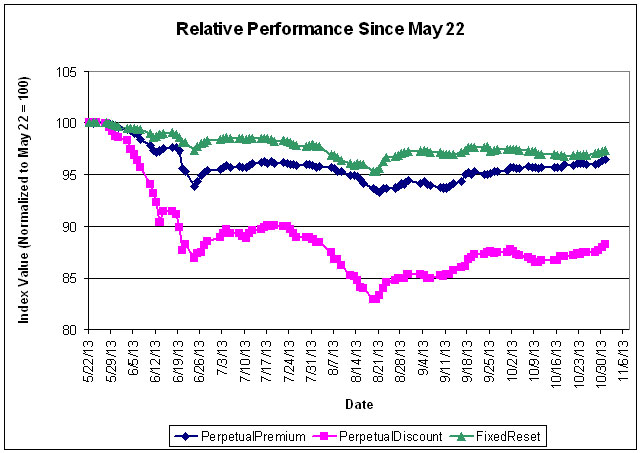
The fund outperformed in October, due to its low weighting in junk FixedResets, which underperformed (as indicated by the performance difference between TXPR (-0.07%) and TXPL (-0.78%)). The fund’s returns were also helped along by superior performance from its holdings of insurance-issued DeemedRetractibles.

Click for Big

Click for Big

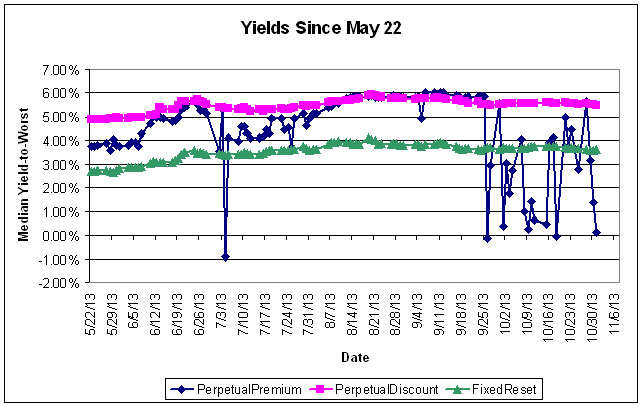
To a certain extent, the (modest, so far) recovery may reflect an acceptance of my belief that the decline in the preferred share market has been overdone; the following table shows the increase in yields since May 22 of some fixed income sectors:

Yield Changes
May 22, 2013
to
October 31, 2013
Sector Yield
May 22
Yield
October 31
Change
Five-Year Canadas 1.38% 1.71% +33bp
Long Canadas 2.57% 3.01% +44bp
Long Corporates 4.15% 4.7% +55bp
FixedResets
Investment Grade
(Interest Equivalent)
3.51% 4.74% +123bp
Perpetual-Discounts
Investment Grade
(Interest Equivalent)
6.34% 7.14% +80bp
The change in yield of PerpetualDiscounts is understated due a massive influx of issues from the PerpetualPremium sub-index over the period, which improved credit quality. When the four issues that comprised the PerpetualDiscount sub-index as of May 22 are evaluated as of October 31, the interest-equivalent yield is 7.64% and thus the change is +130bp.

ZPR, is a relatively new ETF comprised of FixedResets and Floating Rate issues, with a very high proportion of junk issues, which returned -0.75% for the month, and -1.74% over the past three months (according to my calculations from the fund’s NAV data and distribution data; our regulators are hard at work protecting you from performance data since the fund has been extant for less than a year), versus returns for the TXPL index of -0.78% and -1.67%, respectively. The fund has been able to attract assets of about $837.8-million in the eleven and a half months since inception; a gain of $11.9-million in October despite losing approximately $6.2-million due to performance. This indicates that an inflow of funds occurred in October – perhaps implying a (very modest!) return of confidence among retail investors. I feel that the flows into and out of this fund are very important in determining the performance of its constituents.

TXPR had returns over one- and three-months of +0.48% and -1.57%, respectively

Returns for the HIMIPref™ investment grade sub-indices for October were as follows:

HIMIPref™ Indices
Performance to October 31, 2013
Sub-Index 1-Month 3-month
Ratchet N/A N/A
FixFloat +4.30% -0.97%
Floater -2.70% -6.31%
OpRet +0.26% +0.31%
SplitShare +0.51% -0.03%
Interest N/A N/A
PerpetualPremium +1.16% 0.65%
PerpetualDiscount +0.95% -0.50%
FixedReset -0.10% -0.55%
DeemedRetractible +1.40% +1.88%
FloatingReset N/A N/A

Malachite Aggressive Preferred Fund’s Net Asset Value per Unit as of the close October 31, 2013, was 10.1070.

Returns to October 31, 2013
Period MAPF BMO-CM “50” Index TXPR
Total Return
CPD – according to Blackrock
One Month +0.77% +0.19% -0.07% -0.12%
Three Months +0.77% -0.15% -0.67% -0.75%
One Year -1.22% +0.32% -1.28% -1.66%
Two Years (annualized) +4.80% +3.23% +2.28% N/A
Three Years (annualized) +3.98% +4.29% +2.99% +2.49%
Four Years (annualized) +8.05% +6.70% +5.19% N/A
Five Years (annualized) +17.98% +8.82% +7.28% +6.60%
Six Years (annualized) +13.66% +5.00% +3.64%  
Seven Years (annualized) +11.11% +3.52%    
Eight Years (annualized) +10.50% +3.71%    
Nine Years (annualized) +10.04% +3.75%    
Ten Years (annualized) +10.57% +3.93%    
Eleven Years (annualized) +11.92% +4.24%    
Twelve Years (annualized) +10.77% +4.18%    
MAPF returns assume reinvestment of distributions, and are shown after expenses but before fees.
CPD Returns are for the NAV and are after all fees and expenses.
* CPD does not directly report its two- or four-year returns.
Figures for Omega Preferred Equity (which are after all fees and expenses) for 1-, 3- and 12-months are +0.29%, -0.04% and -0.06%, respectively, according to Morningstar after all fees & expenses. Three year performance is +3.49%; five year is +7.60%
Figures for Jov Leon Frazer Preferred Equity Fund Class I Units (which are after all fees and expenses) for 1-, 3- and 12-months are -0.21%, -1.60% and -2.24% respectively, according to Morningstar. Three Year performance is +0.82%
Figures for Manulife Preferred Income Fund (formerly AIC Preferred Income Fund) (which are after all fees and expenses) for 1-, 3- and 12-months are -0.70%, -2.59% & -4.74%, respectively. Three Year performance is +1.20%
Figures for Horizons AlphaPro Preferred Share ETF (which are after all fees and expenses) for 1-, 3- and 12-months are +0.77%, -0.53% & +0.43%, respectively.
Figures for Altamira Preferred Equity Fund are -0.21%, -1.09% and -2.47% for one-, three- and twelve months, respectively.
The figure for BMO S&P/TSX Laddered Preferred Share Index ETF is -0.75% and -1.74% for one- and three-months. [calculation by JH; I am happy that next month the fund will have been around for over a year and the regulators will stop protecting me from the evils of fund performance calculations]

MAPF returns assume reinvestment of dividends, and are shown after expenses but before fees. Past performance is not a guarantee of future performance. You can lose money investing in Malachite Aggressive Preferred Fund or any other fund. For more information, see the fund’s main page. The fund is available either directly from Hymas Investment Management or through a brokerage account at Odlum Brown Limited.

A problem that has bedevilled the market over the past two years has been the OSFI decision not to grandfather Straight Perpetuals as Tier 1 bank capital, and their continued foot-dragging regarding a decision on insurer Straight Perpetuals has segmented the market to the point where trading has become much more difficult. The fund occasionally finds an attractive opportunity to trade between GWO issues, which have a good range of annual coupons (but in which trading is now hampered by the fact that the low-coupon issues are trading near par and are callable at par in the near term), but is “stuck” in the MFC and SLF issues, which have a much narrower range of coupon, while the IAG DeemedRetractibles are quite illiquid. Until the market became so grossly segmented, this was not so much of a problem – but now banks are not available to swap into (because they are so expensive) and non-regulated companies are likewise deprecated (because they are not DeemedRetractibles; they should not participate in the increase in value that will follow the OSFI decision I anticipate and, in addition, are analyzed as perpetuals). The fund’s portfolio is, in effect ‘locked in’ to the MFC & SLF issues due to projected gains from a future OSFI decision, to the detriment of trading gains particularly in May, 2013, when the three lowest-coupon SLF DeemedRetractibles (SLF.PR.C, SLF.PR.D and SLF.PR.E) were the worst performing DeemedRetractibles in the sub-index, and in June, 2013, when the insurance-issued DeemedRetractibles behaved like PerpetualDiscounts in a sharply negative market.

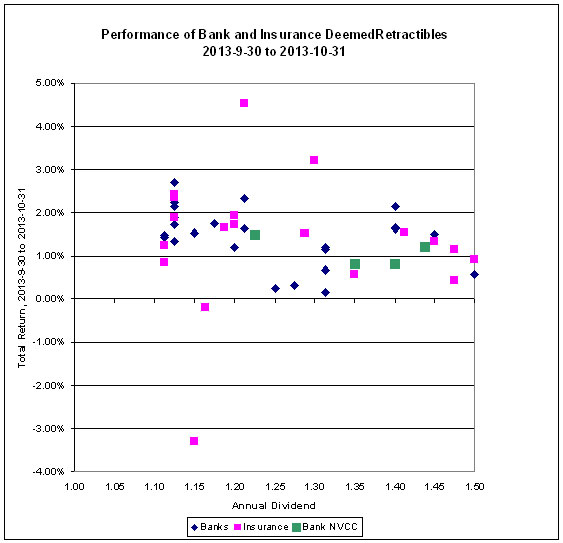
DeemedRetractibles had relatively uncorrelated performances in October:

Click for Big

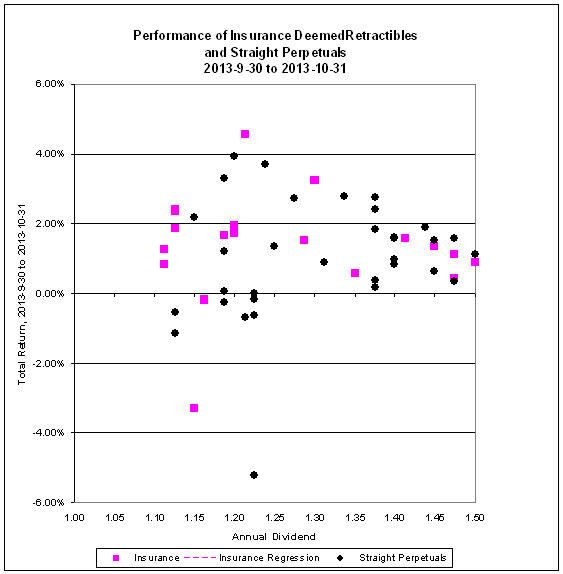
And Straight Perpetuals were indistinguishable from DeemedRetractibles:

Click for Big

A side effect of the downdraft has been the return of measurable Implied Volatility (all Implied Volatility calculations use bids from November 1):
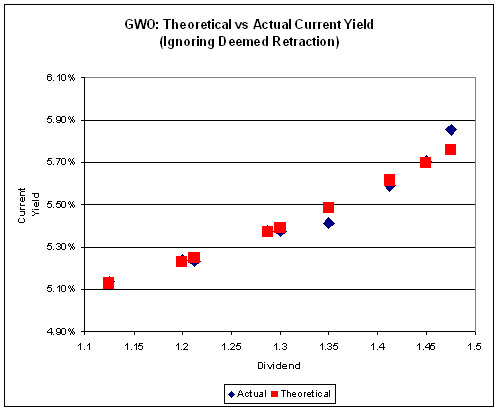

Click for Big
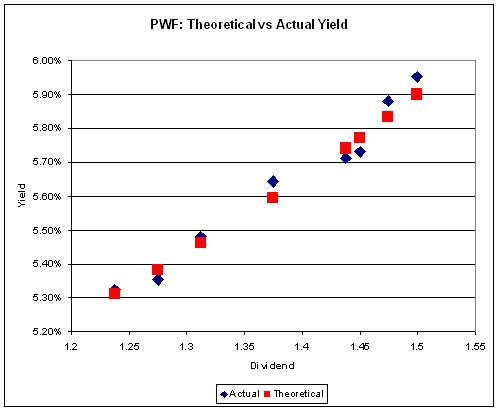

Click for Big
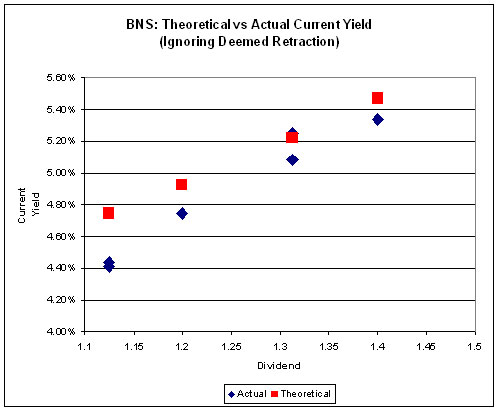

Click for Big

Implied Volatility of
Three Series of Straight Perpetuals
September, 2013
Issuer Pure Yield Implied Volatility
GWO 4.50% (+0.38) 21% (-6)
PWF 3.60% (-1.18) 30% (+10)
BNS 0.01% (0) 40% (0)
Bracketted figures are changes since September month-end

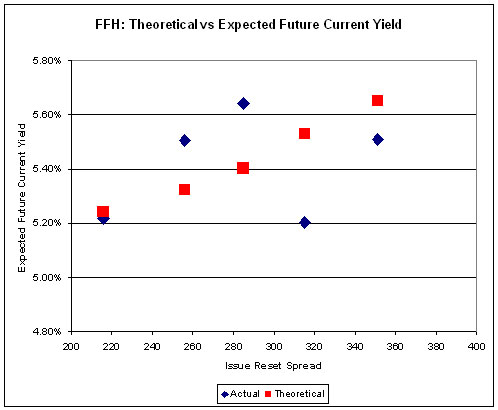
In the September, 2013, edition of PrefLetter, I extended the theory of Implied Volatility to FixedResets – relating the option feature of the Issue Reset Spreads to a theoretical non-callable Market Spread.
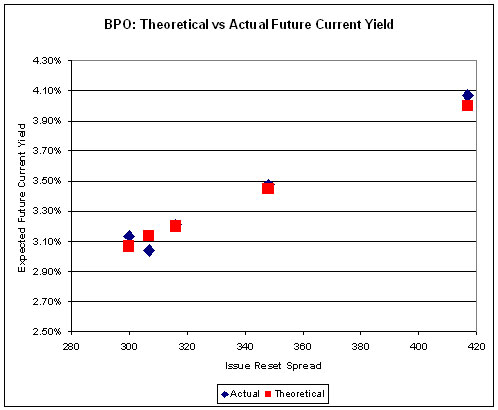

Click for Big

Click for Big

Implied Volatility of
Two Series of FixedResets
September, 2013
Issuer Market Reset Spread
(Non-Callable)
Implied Volatility
BPO 84bp (-104) 40% (-22)
FFH 330bp (+35) 16%
Bracketted figures are changes since September month-end

These are very interesting results: the BPO issues were, on average, flat over the month although the average concealed a lot of variance: BPO.PR.P (Issue Reset Spread = 300bp) was down 2.44% while BPO.PR.N (IRS = 307bp) gained 1.04% and BPO.PR.T (IRS = 316) was up 1.43%. The higher-IRS issues BPO.PR.L (IRS = 417; Return +0.04%) and BPO.PR.R (IRS = 348bp, Return +0.36%) merely held their own. In all, though, it appears that the BPO issues are trading as if redemption is more likely that one would think from fundamentals.

As for FFH, the two higher-IRS issues (FFH.PR.C, IRS=315bp, and FFH.PRK, IRS=351bp) are extremely expensive relative to their peers, to the point where the Implied Volatility calculation doesn’t mean much.

Those of you who have been paying attention will remember that in a “normal” market (which we have not seen in well over a year) the slope of this line is related to the implied volatility of yields in Black-Scholes theory, as discussed in the January, 2010, edition of PrefLetter. As has been previously noted, very high levels of Implied Volatility (in the 40% range) imply a very strong expectation of directionality in future prices – i.e, an expectation that all issues will be redeemed at par.

It is significant that the preferred share market knows no moderation. I suggest that a good baseline estimate for Volatility over a three year period is 15% but the observed figure is generally higher in a rising market and lower in a declining one … with, of course, a period of adjustment in between, which I suspect we are currently experiencing.

Sometimes everything works … sometimes it’s 50-50 … sometimes nothing works. The fund seeks to earn incremental return by selling liquidity (that is, taking the other side of trades that other market participants are strongly motivated to execute), which can also be referred to as ‘trading noise’ – although for quite some time, noise trading has taken a distant second place to the sectoral play on insurance DeemedRetractibles. There were a lot of strongly motivated market participants during the Panic of 2007, generating a lot of noise! Unfortunately, the conditions of the Panic may never be repeated in my lifetime … but the fund will simply attempt to make trades when swaps seem profitable, without worrying about the level of monthly turnover.

There’s plenty of room for new money left in the fund. I have shown in PrefLetter that market pricing for FixedResets is very often irrational and I have lots of confidence – backed up by my bond portfolio management experience in the markets for Canadas and Treasuries, and equity trading on the NYSE & TSX – that there is enough demand for liquidity in any market to make the effort of providing it worthwhile (although the definition of “worthwhile” in terms of basis points of outperformance changes considerably from market to market!) I will continue to exert utmost efforts to outperform but it should be borne in mind that there will almost inevitably be periods of underperformance in the future.

The yields available on high quality preferred shares remain elevated, which is reflected in the current estimate of sustainable income.

Calculation of MAPF Sustainable Income Per Unit
Month NAVPU Portfolio
Average
YTW
Leverage
Divisor
Securities
Average
YTW
Capital
Gains
Multiplier
Sustainable
Income
per
current
Unit
June, 2007 9.3114 5.16% 1.03 5.01% 1.3240 0.3524
September 9.1489 5.35% 0.98 5.46% 1.3240 0.3773
December, 2007 9.0070 5.53% 0.942 5.87% 1.3240 0.3993
March, 2008 8.8512 6.17% 1.047 5.89% 1.3240 0.3938
June 8.3419 6.034% 0.952 6.338% 1.3240 $0.3993
September 8.1886 7.108% 0.969 7.335% 1.3240 $0.4537
December, 2008 8.0464 9.24% 1.008 9.166% 1.3240 $0.5571
March 2009 $8.8317 8.60% 0.995 8.802% 1.3240 $0.5872
June 10.9846 7.05% 0.999 7.057% 1.3240 $0.5855
September 12.3462 6.03% 0.998 6.042% 1.3240 $0.5634
December 2009 10.5662 5.74% 0.981 5.851% 1.1141 $0.5549
March 2010 10.2497 6.03% 0.992 6.079% 1.1141 $0.5593
June 10.5770 5.96% 0.996 5.984% 1.1141 $0.5681
September 11.3901 5.43% 0.980 5.540% 1.1141 $0.5664
December 2010 10.7659 5.37% 0.993 5.408% 1.0298 $0.5654
March, 2011 11.0560 6.00% 0.994 5.964% 1.0298 $0.6403
June 11.1194 5.87% 1.018 5.976% 1.0298 $0.6453
September 10.2709 6.10%
Note
1.001 6.106% 1.0298 $0.6090
December, 2011 10.0793 5.63%
Note
1.031 5.805% 1.0000 $0.5851
March, 2012 10.3944 5.13%
Note
0.996 5.109% 1.0000 $0.5310
June 10.2151 5.32%
Note
1.012 5.384% 1.0000 $0.5500
September 10.6703 4.61%
Note
0.997 4.624% 1.0000 $0.4934
December, 2012 10.8307 4.24% 0.989 4.287% 1.0000 $0.4643
March, 2013 10.9033 3.87% 0.996 3.886% 1.0000 $0.4237
June 10.3261 4.81% 0.998 4.80% 1.0000 $0.4957
September 10.0296 5.62% 0.996 5.643% 1.0000 $0.5660
October, 2013 10.1070 5.62% 0.997 5.637% 1.0000 $0.5697
NAVPU is shown after quarterly distributions of dividend income and annual distribution of capital gains.
Portfolio YTW includes cash (or margin borrowing), with an assumed interest rate of 0.00%
The Leverage Divisor indicates the level of cash in the account: if the portfolio is 1% in cash, the Leverage Divisor will be 0.99
Securities YTW divides “Portfolio YTW” by the “Leverage Divisor” to show the average YTW on the securities held; this assumes that the cash is invested in (or raised from) all securities held, in proportion to their holdings.
The Capital Gains Multiplier adjusts for the effects of Capital Gains Dividends. On 2009-12-31, there was a capital gains distribution of $1.989262 which is assumed for this purpose to have been reinvested at the final price of $10.5662. Thus, a holder of one unit pre-distribution would have held 1.1883 units post-distribution; the CG Multiplier reflects this to make the time-series comparable. Note that Dividend Distributions are not assumed to be reinvested.
Sustainable Income is the resultant estimate of the fund’s dividend income per current unit, before fees and expenses. Note that a “current unit” includes reinvestment of prior capital gains; a unitholder would have had the calculated sustainable income with only, say, 0.9 units in the past which, with reinvestment of capital gains, would become 1.0 current units.
DeemedRetractibles are comprised of all Straight Perpetuals (both PerpetualDiscount and PerpetualPremium) issued by BMO, BNS, CM, ELF, GWO, HSB, IAG, MFC, NA, RY, SLF and TD, which are not exchangable into common at the option of the company (definition refined in May, 2011). These issues are analyzed as if their prospectuses included a requirement to redeem at par on or prior to 2022-1-31 (banks) or 2025-1-31 (insurers and insurance holding companies), in addition to the call schedule explicitly defined. See OSFI Does Not Grandfather Extant Tier 1 Capital, CM.PR.D, CM.PR.E, CM.PR.G: Seeking NVCC Status and the January, February, March and June, 2011, editions of PrefLetter for the rationale behind this analysis.
Yields for September, 2011, to January, 2012, were calculated by imposing a cap of 10% on the yields of YLO issues held, in order to avoid their extremely high calculated yields distorting the calculation and to reflect the uncertainty in the marketplace that these yields will be realized. From February to September 2012, yields on these issues have been set to zero. All YLO issues held were sold in October 2012.

Significant positions were held in DeemedRetractible, SplitShare and FixedReset issues on July 31; all of these currently have their yields calculated with the presumption that they will be called by the issuers at par prior to 2022-1-31 (banks) or 2025-1-31 (insurers and insurance holding companies). This presents another complication in the calculation of sustainable yield. The fund also holds positions in various SplitShare issues which also have their yields calculated with the expectation of a maturity at par.

I no longer show calculations that assume the conversion of the entire portfolio into PerpetualDiscounts, as the fund has only a very small position in these issues.

I will also note that the sustainable yield calculated above is not directly comparable with any yield calculation currently reported by any other preferred share fund as far as I am aware. The Sustainable Yield depends on:
i) Calculating Yield-to-Worst for each instrument and using this yield for reporting purposes;
ii) Using the contemporary value of Five-Year Canadas (set at 1.72% for the October 31 calculation) to estimate dividends after reset for FixedResets.

Most funds report Current Yield. For instance, ZPR reports a “Portfolio Yield” of 5.03% as of October 25, 2013 and notes:

Portfolio yield is calculated as the most recent income received by the ETF in the form of dividends interest and other income annualized based on the payment frequently divided by the current market value of ETFs investments.

In other words – it’s the Current Yield, a meaningless number. The Current Yield of MAPF is 5.08% as of September 30, but I will neither report that with any degree of prominence nor take any great pleasure in the fact that it’s a little higher than the ZPR number. It’s meaningless; to accord it any prominence in portfolio reporting is misleading.

It should be noted that the concept of this Sustainable Income calculation was developed when the fund’s holdings were overwhelmingly PerpetualDiscounts – see, for instance, the bottom of the market in November 2008. It is easy to understand that for a PerpetualDiscount, the technique of multiplying yield by price will indeed result in the coupon – a PerpetualDiscount paying $1 annually will show a Sustainable Income of $1, regardless of whether the price is $24 or $17.

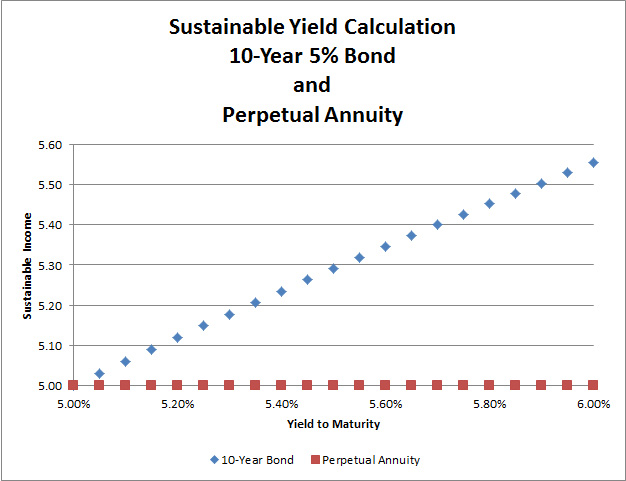
Things are not quite so neat when maturity dates and maturity prices that are different from the current price are thrown into the mix. If we take a notional Straight Perpetual paying $5 annually, the price is $100 when the yield is 5% (all this ignores option effects). As the yield increases to 6%, the price declines to 83.33; and 83.33 x 6% is the same $5. Good enough.

But a ten year bond, priced at 100 when the yield is equal to its coupon of 5%, will decline in price to 92.56; and 92.56 x 6% is 5.55; thus, the calculated Sustainable Income has increased as the price has declined as shown in the graph:

Click for Big

The difference is because the bond’s yield calculation includes the amortization of the discount; therefore, so does the Sustainable Income estimate.

Different assumptions lead to different results from the calculation, but the overall positive trend is apparent. I’m very pleased with the long-term results! It will be noted that if there was no trading in the portfolio, one would expect the sustainable yield to be constant (before fees and expenses). The success of the fund’s trading is showing up in

  • the very good performance against the index
  • the long term increases in sustainable income per unit

As has been noted, the fund has maintained a credit quality equal to or better than the index; outperformance is due to exploitation of trading anomalies.

Again, there are no predictions for the future! The fund will continue to trade between issues in an attempt to exploit market gaps in liquidity, in an effort to outperform the index and keep the sustainable income per unit – however calculated! – growing.
MAPF

MAPF Portfolio Composition: October 2013

Turnover remained reasonable in October, at about 10%.

There is extreme segmentation in the marketplace, with OSFI’s NVCC rule changes in February 2011 having had the effect of splitting the formerly relatively homogeneous Straight Perpetual class of preferreds into three parts:

  • Unaffected Straight Perpetuals
  • DeemedRetractibles explicitly subject to the rules (banks)
  • DeemedRetractibles considered by me, but not (yet!) by the market, to be likely to be explicitly subject to the rules in the future (insurers and insurance holding companies)

This segmentation, and the extreme valuation differences between the segments, has cut down markedly on the opportunities for trading. Another trend that hasn’t helped was the migration of PerpetualDiscounts into PerpetualPremiums (due to price increases) earlier in the year – many of the PerpetualPremiums had negative Yields-to-Worst and those that don’t aren’t particularly thrilling; speaking very generally, PerpetualPremiums are to be avoided, not traded! This effect has caused the first of the three segments noted above to be untradeable for most practical purposes. The summer’s downdraft reversed the trend and resulted in a large pool of PerpetualDiscounts, but due to their long term they are still, as a class, inferior to DeemedRetractibles. In October there was a small migration back into PerpetualPremiums.

To make this more clear, it used to be that there were 70-odd Straight Perpetuals and I was more or less indifferent as to which ones I owned (subject, of course, to issuer concentration concerns and other risk management factors). Thus, if any one of these 70 were to go down in price by – say – $0.25, I would quite often have something in inventory that I’d be willing to swap for it. The segmentation means that I am no longer indifferent; in addition to checking the valuation of a potential buy to its peers, I also have to check its peer group. This cuts down on the potential for trading.

There is no real hope that this situation will be corrected in the near-term. OSFI has indicated that the long-promised “Draft Definition of Capital” for insurers will not be issued “for public consultation in late 2012 or early 2013”, as they fear that it might encourage speculation in the marketplace. It is not clear why OSFI is so afraid of informed speculation, since the constant speculation in the marketplace is currently less informed than it would be with a little bit of regulatory clarity.

As a result of this delay, I have extended the Deemed Maturity date for insurers and insurance holding companies by three years (to 2025-1-31), in the expectation that when OSFI finally does provide clarity, they will allow the same degree of lead-in time for these companies as they did for banks. This has obviously had a major effect on the durations of preferred shares subject to the change but, fortunately, not much on their calculated yields as most of these issues are either trading near par or were trading at sufficient premium that a par call was expected on economic grounds. However, with the declines in the market over the past two months, the expected capital gain on redemption of the insurance-issued DeemedRetractibles has become an important component of the calculated yield.

Sectoral distribution of the MAPF portfolio on October 31 was as follows:

MAPF Sectoral Analysis 2013-10-31
HIMI Indices Sector Weighting YTW ModDur
Ratchet 0% N/A N/A
FixFloat 0% N/A N/A
Floater 0% N/A N/A
OpRet 0% N/A N/A
SplitShare 18.4% (0) 4.87% 6.13
Interest Rearing 0% N/A N/A
PerpetualPremium 0.0% (0) N/A N/A
PerpetualDiscount 10.1% (+0.5) 5.38% 14.81
Fixed-Reset 7.5% (-0.6) 3.99% 7.19
Deemed-Retractible 54.3% (+0.2) 6.04% 8.48
Scraps (Various) 9.4% (+0.1) 6.40% 12.76
Cash +0.3% (-0.1) 0.00% 0.00
Total 100% 5.62% 8.97
Totals and changes will not add precisely due to rounding. Bracketted figures represent change from September month-end. Cash is included in totals with duration and yield both equal to zero.
DeemedRetractibles are comprised of all Straight Perpetuals (both PerpetualDiscount and PerpetualPremium) issued by BMO, BNS, CM, ELF, GWO, HSB, IAG, MFC, NA, RY, SLF and TD, which are not exchangable into common at the option of the company. These issues are analyzed as if their prospectuses included a requirement to redeem at par on or prior to 2022-1-31 (banks) or 2025-1-3 (insurers and insurance holding companies), in addition to the call schedule explicitly defined. See OSFI Does Not Grandfather Extant Tier 1 Capital, CM.PR.D, CM.PR.E, CM.PR.G: NVCC Status Confirmed and the January, February, March and June, 2011, editions of PrefLetter for the rationale behind this analysis. (all recent editions have a short summary of the argument included in the “DeemedRetractible” section)

Note that the estimate for the time this will become effective for insurers and insurance holding companies was extended by three years in April 2013, due to the delays in OSFI’s providing clarity on the issue.

The “total” reflects the un-leveraged total portfolio (i.e., cash is included in the portfolio calculations and is deemed to have a duration and yield of 0.00.). MAPF will often have relatively large cash balances, both credit and debit, to facilitate trading. Figures presented in the table have been rounded to the indicated precision.

Credit distribution is:

MAPF Credit Analysis 2013-10-31
DBRS Rating Weighting
Pfd-1 0 (0)
Pfd-1(low) 37.5% (+1.5)
Pfd-2(high) 43.0% (+0.8)
Pfd-2 0% (-2.2)
Pfd-2(low) 9.9% (0)
Pfd-3(high) 1.0% (0)
Pfd-3 4.6% (-0.1)
Pfd-3(low) 1.6% (0)
Pfd-4(high) 0% (0)
Pfd-4 0% (0)
Pfd-4(low) 0.8% (0)
Pfd-5(high) 1.3% (+0.1)
Cash 0..3% (-0.1)
Totals will not add precisely due to rounding. Bracketted figures represent change from August month-end.
A position held in NPI.PR.A is not rated by DBRS, but has been included as “Pfd-3” in the above table on the basis of its S&P rating of P-3.

Changes in credit quality were driven largely by the swap of the position held in HSB.PR.E (FixedReset, Pfd-2) to purchase BNS.PR.Y, BNS.PR.Z (FixedReset, Pfd-1(low)) and CU.PR.G (PerpetualDiscount, Pfd-2(high)).

Liquidity Distribution is:

MAPF Liquidity Analysis 2013-10-31
Average Daily Trading Weighting
<$50,000 0.0% (-0.6)
$50,000 – $100,000 17.3% (+0.6)
$100,000 – $200,000 18.4% (-10.0)
$200,000 – $300,000 40.5% (-2.2)
>$300,000 23.4% (+12.3)
Cash 0.3% (-0.1)
Totals will not add precisely due to rounding. Bracketted figures represent change from September month-end.

MAPF is, of course, Malachite Aggressive Preferred Fund, a “unit trust” managed by Hymas Investment Management Inc. Further information and links to performance, audited financials and subscription information are available the fund’s web page. The fund may be purchased either directly from Hymas Investment Management or through a brokerage account at Odlum Brown Limited. A “unit trust” is like a regular mutual fund, but is sold by offering memorandum rather than prospectus. This is cheaper, but means subscription is restricted to “accredited investors” (as defined by the Ontario Securities Commission) or those who subscribe for $150,000+. Fund past performances are not a guarantee of future performance. You can lose money investing in MAPF or any other fund.

A similar portfolio composition analysis has been performed on the Claymore Preferred Share ETF (symbol CPD) (and other funds) as of August 31, 2012, and published in the October (mainly methodology), November (most funds), and December (ZPR) 2012, PrefLetter. While direct comparisons are difficult due to the introduction of the DeemedRetractible class of preferred share (see above) it is fair to say:

  • MAPF credit quality is better
  • MAPF liquidity is a lower
  • MAPF Yield is higher
  • Weightings in
    • MAPF is much more exposed to DeemedRetractibles
    • MAPF is much less exposed to Operating Retractibles
    • MAPF is much more exposed to SplitShares
    • MAPF is less exposed to FixFloat / Floater / Ratchet
    • MAPF weighting in FixedResets is much lower
Market Action

November 1, 2013

There was a little pop in bond yields today:

Treasury 10-year note yields (USGG10YR) rose to the highest levels in two weeks after a gauge of U.S. manufacturing expanded at a faster pace than forecast, weakening the case for the Federal Reserve to maintain stimulus.

The benchmark securities extended the first five-day drop in three weeks as Fed Bank of St. Louis President James Bullard said labor market gains in the past year could warrant a cut in the bond buying. Fed policy makers said Oct. 30 that the economy showed signs of “underlying strength” even as they maintained their $85 billion of monthly asset purchases.

Want a raise? Go west, young man!

Data released yesterday by Statistics Canada showed the difference in average hourly wages in Alberta and the rest of the country, but for Saskatchewan, widened again in August.

“Note that hourly wages are now nearly $6 less in Atlantic Canada than in Alberta, the widest gap on record, a factor that has contributed to pushing more than 11,000 migrants out of the region in the past year – a major headache for housing markets, government finances, etc.,” said senior economist Robert Kavcic of BMO Nesbitt Burns.

“Even B.C. is seeing the wage gap approach $4/hour versus Alberta, and not coincidentally is also seeing a decade-high net outflow of workers.”

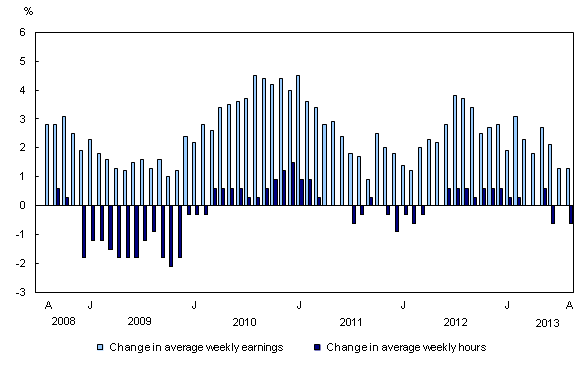
The StatsCan report indicates that a decent economy is still comfortably far away:


Click for Big

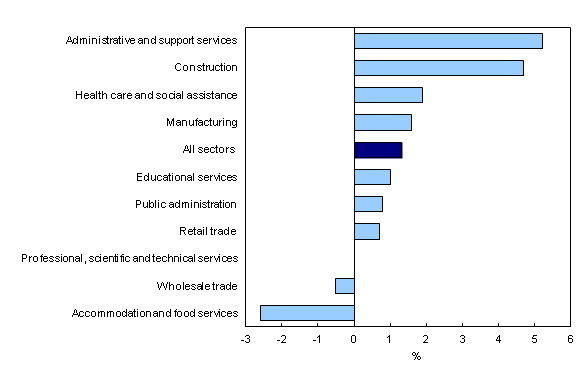
… with an implication that those who decided to earn a living filing paperwork for construction companies are getting vindicated …


Click for Big

DBRS confirmed Enbridge at Pfd-2(low):

DBRS has today confirmed the Issuer Rating of Enbridge Inc. (ENB or the Company) at A (low) and ratings on ENB’s Medium-Term Notes & Unsecured Debentures, Commercial Paper and Cumulative Redeemable Preferred Shares ratings at A (low), R-1 (low) and Pfd-2 (low), respectively, all with Stable trends. The ratings reflect (1) a relatively strong business risk profile, (2) pressure on ENB’s near-to-medium-term credit metrics and (3) results under the ten-year Competitive Tolling Settlement (CTS), effective July 1, 2011.

Enbridge is the proud issuer of ENB.PR.A, ENB.PR.B, ENB.PR.D, ENB.PR.F, ENB.PR.H, ENB.PR.N, ENB.PR.P, ENB.PR.T and ENB.PR.Y, as well as some US-Pay stuff that I don’t track.

It was a negative day for the Canadian preferred share market, with PerpetualDiscounts down 11bp, FixedResets off 3bp and DeemedRetractibles losing 18bp. The Performance Highlights table is longer than one might expect given the modest overall moves, with a preponderance of Straight losers. Volume was on the low side of average.

HIMIPref™ Preferred Indices
These values reflect the December 2008 revision of the HIMIPref™ Indices

Values are provisional and are finalized monthly
Index Mean
Current
Yield
(at bid)
Median
YTW
Median
Average
Trading
Value
Median
Mod Dur
(YTW)
Issues Day’s Perf. Index Value
Ratchet 0.00 % 0.00 % 0 0.00 0 0.2682 % 2,465.9
FixedFloater 4.18 % 3.46 % 27,003 18.46 1 0.1323 % 4,012.5
Floater 3.01 % 3.03 % 62,859 19.64 3 0.2682 % 2,662.5
OpRet 4.63 % 3.38 % 67,802 0.57 3 -0.1541 % 2,636.1
SplitShare 4.74 % 4.90 % 63,167 3.68 6 0.0202 % 2,957.4
Interest-Bearing 0.00 % 0.00 % 0 0.00 0 -0.1541 % 2,410.4
Perpetual-Premium 5.59 % 3.68 % 126,485 0.31 11 -0.0613 % 2,298.0
Perpetual-Discount 5.53 % 5.52 % 183,016 14.55 27 -0.1093 % 2,372.7
FixedReset 5.01 % 3.59 % 227,630 3.37 82 -0.0277 % 2,454.1
Deemed-Retractible 5.08 % 4.20 % 195,601 1.50 42 -0.1802 % 2,409.5
FloatingReset 2.62 % 2.37 % 310,113 4.53 5 -0.0317 % 2,454.0
Performance Highlights
Issue Index Change Notes
BAM.PF.B FixedReset -2.08 % YTW SCENARIO
Maturity Type : Limit Maturity
Maturity Date : 2043-11-01
Maturity Price : 22.55
Evaluated at bid price : 23.55
Bid-YTW : 4.55 %
GWO.PR.N FixedReset -1.99 % YTW SCENARIO
Maturity Type : Hard Maturity
Maturity Date : 2025-01-31
Maturity Price : 25.00
Evaluated at bid price : 21.71
Bid-YTW : 4.75 %
MFC.PR.C Deemed-Retractible -1.66 % YTW SCENARIO
Maturity Type : Hard Maturity
Maturity Date : 2025-01-31
Maturity Price : 25.00
Evaluated at bid price : 21.30
Bid-YTW : 6.48 %
VNR.PR.A FixedReset -1.38 % YTW SCENARIO
Maturity Type : Call
Maturity Date : 2017-10-15
Maturity Price : 25.00
Evaluated at bid price : 25.05
Bid-YTW : 4.38 %
ELF.PR.F Perpetual-Discount -1.26 % YTW SCENARIO
Maturity Type : Limit Maturity
Maturity Date : 2043-11-01
Maturity Price : 23.22
Evaluated at bid price : 23.52
Bid-YTW : 5.67 %
BAM.PF.C Perpetual-Discount -1.04 % YTW SCENARIO
Maturity Type : Limit Maturity
Maturity Date : 2043-11-01
Maturity Price : 20.01
Evaluated at bid price : 20.01
Bid-YTW : 6.14 %
SLF.PR.C Deemed-Retractible -1.01 % YTW SCENARIO
Maturity Type : Hard Maturity
Maturity Date : 2025-01-31
Maturity Price : 25.00
Evaluated at bid price : 21.53
Bid-YTW : 6.27 %
BAM.PR.T FixedReset 1.13 % YTW SCENARIO
Maturity Type : Limit Maturity
Maturity Date : 2043-11-01
Maturity Price : 22.57
Evaluated at bid price : 23.31
Bid-YTW : 4.42 %
TRP.PR.C FixedReset 1.25 % YTW SCENARIO
Maturity Type : Limit Maturity
Maturity Date : 2043-11-01
Maturity Price : 22.28
Evaluated at bid price : 22.61
Bid-YTW : 3.73 %
PWF.PR.L Perpetual-Discount 1.49 % YTW SCENARIO
Maturity Type : Limit Maturity
Maturity Date : 2043-11-01
Maturity Price : 23.51
Evaluated at bid price : 23.81
Bid-YTW : 5.37 %
CIU.PR.C FixedReset 2.33 % YTW SCENARIO
Maturity Type : Limit Maturity
Maturity Date : 2043-11-01
Maturity Price : 21.09
Evaluated at bid price : 21.09
Bid-YTW : 3.82 %
Volume Highlights
Issue Index Shares
Traded
Notes
FTS.PR.J Perpetual-Discount 53,435 RBC crossed two blocks of 25,000 each, both at 23.26.
YTW SCENARIO
Maturity Type : Limit Maturity
Maturity Date : 2043-11-01
Maturity Price : 22.76
Evaluated at bid price : 23.16
Bid-YTW : 5.19 %
CM.PR.G Perpetual-Premium 32,900 Desjardins crossed 21,000 at 25.03.
YTW SCENARIO
Maturity Type : Call
Maturity Date : 2014-05-01
Maturity Price : 25.00
Evaluated at bid price : 25.02
Bid-YTW : 5.35 %
CU.PR.C FixedReset 29,800 Scotia crossed 24,700 at 25.25.
YTW SCENARIO
Maturity Type : Call
Maturity Date : 2017-06-01
Maturity Price : 25.00
Evaluated at bid price : 25.25
Bid-YTW : 3.92 %
MFC.PR.C Deemed-Retractible 21,353 YTW SCENARIO
Maturity Type : Hard Maturity
Maturity Date : 2025-01-31
Maturity Price : 25.00
Evaluated at bid price : 21.30
Bid-YTW : 6.48 %
CM.PR.E Perpetual-Premium 18,616 YTW SCENARIO
Maturity Type : Call
Maturity Date : 2013-12-01
Maturity Price : 25.00
Evaluated at bid price : 25.13
Bid-YTW : -0.36 %
CM.PR.K FixedReset 18,360 YTW SCENARIO
Maturity Type : Call
Maturity Date : 2014-07-31
Maturity Price : 25.00
Evaluated at bid price : 25.50
Bid-YTW : 2.70 %
There were 28 other index-included issues trading in excess of 10,000 shares.
Wide Spread Highlights
Issue Index Quote Data and Yield Notes
CIU.PR.C FixedReset Quote: 21.09 – 21.75
Spot Rate : 0.6600
Average : 0.5245

YTW SCENARIO
Maturity Type : Limit Maturity
Maturity Date : 2043-11-01
Maturity Price : 21.09
Evaluated at bid price : 21.09
Bid-YTW : 3.82 %

BNS.PR.O Deemed-Retractible Quote: 26.24 – 26.61
Spot Rate : 0.3700
Average : 0.2458

YTW SCENARIO
Maturity Type : Call
Maturity Date : 2013-12-01
Maturity Price : 26.00
Evaluated at bid price : 26.24
Bid-YTW : -5.56 %

IAG.PR.G FixedReset Quote: 25.56 – 25.83
Spot Rate : 0.2700
Average : 0.1857

YTW SCENARIO
Maturity Type : Call
Maturity Date : 2017-06-30
Maturity Price : 25.00
Evaluated at bid price : 25.56
Bid-YTW : 3.77 %

PWF.PR.I Perpetual-Premium Quote: 25.20 – 25.50
Spot Rate : 0.3000
Average : 0.2286

YTW SCENARIO
Maturity Type : Call
Maturity Date : 2013-12-01
Maturity Price : 25.00
Evaluated at bid price : 25.20
Bid-YTW : -3.49 %

SLF.PR.G FixedReset Quote: 22.48 – 22.67
Spot Rate : 0.1900
Average : 0.1225

YTW SCENARIO
Maturity Type : Hard Maturity
Maturity Date : 2025-01-31
Maturity Price : 25.00
Evaluated at bid price : 22.48
Bid-YTW : 4.54 %

GWO.PR.M Deemed-Retractible Quote: 25.41 – 25.58
Spot Rate : 0.1700
Average : 0.1047

YTW SCENARIO
Maturity Type : Hard Maturity
Maturity Date : 2025-01-31
Maturity Price : 25.00
Evaluated at bid price : 25.41
Bid-YTW : 5.70 %

Market Action

October 31, 2013

Nothing happened today.

It was a mixed day for the Canadian preferred share market, with PerpetualDiscounts up 37bp, FixedResets gaining 11bp and DeemedRetractibles off 3bp. The Performance Highlights table is notable on the downside for domination by BAM Floating Rate issues, while the upside has a surprisingly large population of FixedResets. Volume was high.

PerpetualDiscounts now yield 5.49%, equivalent to 7.14% interest at the standard equivalency factor of 1.3x. Long corporates now yield about 4.7%, so the pre-tax interest-equivalent spread (in this context, the “Seniority Spread”) is now about 245bp, unchanged from October 23.

And that’s it for another month!

HIMIPref™ Preferred Indices
These values reflect the December 2008 revision of the HIMIPref™ Indices

Values are provisional and are finalized monthly
Index Mean
Current
Yield
(at bid)
Median
YTW
Median
Average
Trading
Value
Median
Mod Dur
(YTW)
Issues Day’s Perf. Index Value
Ratchet 0.00 % 0.00 % 0 0.00 0 -0.9452 % 2,459.3
FixedFloater 4.19 % 3.47 % 28,099 18.46 1 2.0702 % 4,007.2
Floater 2.75 % 3.03 % 63,356 19.65 5 -0.9452 % 2,655.4
OpRet 4.62 % 3.16 % 68,248 0.57 3 0.0900 % 2,640.2
SplitShare 4.75 % 4.90 % 63,647 3.68 6 0.1314 % 2,956.8
Interest-Bearing 0.00 % 0.00 % 0 0.00 0 0.0900 % 2,414.2
Perpetual-Premium 5.78 % 0.13 % 105,812 0.08 7 0.1586 % 2,299.4
Perpetual-Discount 5.49 % 5.49 % 186,112 14.46 30 0.3678 % 2,375.3
FixedReset 5.01 % 3.65 % 227,423 3.37 82 0.1110 % 2,454.8
Deemed-Retractible 5.08 % 4.15 % 195,475 1.51 43 -0.0330 % 2,413.8
FloatingReset 0.00 % 0.00 % 0 0.00 5 0.1110 % 2,454.8
Performance Highlights
Issue Index Change Notes
MFC.PR.B Deemed-Retractible -2.43 % YTW SCENARIO
Maturity Type : Hard Maturity
Maturity Date : 2025-01-31
Maturity Price : 25.00
Evaluated at bid price : 21.71
Bid-YTW : 6.41 %
BAM.PR.C Floater -1.69 % YTW SCENARIO
Maturity Type : Limit Maturity
Maturity Date : 2043-10-31
Maturity Price : 17.40
Evaluated at bid price : 17.40
Bid-YTW : 3.04 %
BAM.PR.K Floater -1.64 % YTW SCENARIO
Maturity Type : Limit Maturity
Maturity Date : 2043-10-31
Maturity Price : 17.34
Evaluated at bid price : 17.34
Bid-YTW : 3.05 %
BAM.PR.B Floater -1.52 % YTW SCENARIO
Maturity Type : Limit Maturity
Maturity Date : 2043-10-31
Maturity Price : 17.46
Evaluated at bid price : 17.46
Bid-YTW : 3.03 %
BAM.PR.R FixedReset -1.30 % YTW SCENARIO
Maturity Type : Limit Maturity
Maturity Date : 2043-10-31
Maturity Price : 23.46
Evaluated at bid price : 25.07
Bid-YTW : 4.13 %
TRP.PR.A FixedReset -1.23 % YTW SCENARIO
Maturity Type : Limit Maturity
Maturity Date : 2043-10-31
Maturity Price : 23.63
Evaluated at bid price : 24.11
Bid-YTW : 3.84 %
PWF.PR.S Perpetual-Discount 1.06 % YTW SCENARIO
Maturity Type : Limit Maturity
Maturity Date : 2043-10-31
Maturity Price : 22.60
Evaluated at bid price : 22.96
Bid-YTW : 5.24 %
GWO.PR.H Deemed-Retractible 1.09 % YTW SCENARIO
Maturity Type : Hard Maturity
Maturity Date : 2025-01-31
Maturity Price : 25.00
Evaluated at bid price : 23.27
Bid-YTW : 5.78 %
PWF.PR.F Perpetual-Discount 1.10 % YTW SCENARIO
Maturity Type : Limit Maturity
Maturity Date : 2043-10-31
Maturity Price : 23.70
Evaluated at bid price : 23.97
Bid-YTW : 5.50 %
VNR.PR.A FixedReset 1.20 % YTW SCENARIO
Maturity Type : Call
Maturity Date : 2017-10-15
Maturity Price : 25.00
Evaluated at bid price : 25.40
Bid-YTW : 3.98 %
POW.PR.D Perpetual-Discount 1.36 % YTW SCENARIO
Maturity Type : Limit Maturity
Maturity Date : 2043-10-31
Maturity Price : 22.87
Evaluated at bid price : 23.16
Bid-YTW : 5.43 %
CIU.PR.C FixedReset 1.38 % YTW SCENARIO
Maturity Type : Limit Maturity
Maturity Date : 2043-10-31
Maturity Price : 20.61
Evaluated at bid price : 20.61
Bid-YTW : 3.91 %
BAM.PR.X FixedReset 1.41 % YTW SCENARIO
Maturity Type : Limit Maturity
Maturity Date : 2043-10-31
Maturity Price : 21.96
Evaluated at bid price : 22.36
Bid-YTW : 4.18 %
ENB.PR.D FixedReset 1.43 % YTW SCENARIO
Maturity Type : Limit Maturity
Maturity Date : 2043-10-31
Maturity Price : 22.89
Evaluated at bid price : 24.14
Bid-YTW : 4.19 %
FTS.PR.H FixedReset 1.48 % YTW SCENARIO
Maturity Type : Limit Maturity
Maturity Date : 2043-10-31
Maturity Price : 21.60
Evaluated at bid price : 22.00
Bid-YTW : 3.72 %
ENB.PR.Y FixedReset 1.52 % YTW SCENARIO
Maturity Type : Limit Maturity
Maturity Date : 2043-10-31
Maturity Price : 22.45
Evaluated at bid price : 23.40
Bid-YTW : 4.35 %
FTS.PR.J Perpetual-Discount 1.76 % YTW SCENARIO
Maturity Type : Limit Maturity
Maturity Date : 2043-10-31
Maturity Price : 22.75
Evaluated at bid price : 23.15
Bid-YTW : 5.19 %
ENB.PR.H FixedReset 1.83 % YTW SCENARIO
Maturity Type : Limit Maturity
Maturity Date : 2043-10-31
Maturity Price : 22.46
Evaluated at bid price : 23.32
Bid-YTW : 4.16 %
BAM.PR.G FixedFloater 2.07 % YTW SCENARIO
Maturity Type : Limit Maturity
Maturity Date : 2043-10-31
Maturity Price : 22.89
Evaluated at bid price : 22.68
Bid-YTW : 3.47 %
POW.PR.B Perpetual-Discount 2.08 % YTW SCENARIO
Maturity Type : Limit Maturity
Maturity Date : 2043-10-31
Maturity Price : 23.69
Evaluated at bid price : 24.00
Bid-YTW : 5.61 %
PWF.PR.K Perpetual-Discount 2.15 % YTW SCENARIO
Maturity Type : Limit Maturity
Maturity Date : 2043-10-31
Maturity Price : 23.04
Evaluated at bid price : 23.33
Bid-YTW : 5.32 %
TD.PR.Y FixedReset Not Calc! YTW SCENARIO
Maturity Type : Hard Maturity
Maturity Date : 2022-01-31
Maturity Price : 25.00
Evaluated at bid price : 24.86
Bid-YTW : 3.60 %
Volume Highlights
Issue Index Shares
Traded
Notes
SLF.PR.A Deemed-Retractible 99,266 RBC crossed 80,200 at 22.75.
YTW SCENARIO
Maturity Type : Hard Maturity
Maturity Date : 2025-01-31
Maturity Price : 25.00
Evaluated at bid price : 22.71
Bid-YTW : 5.96 %
SLF.PR.E Deemed-Retractible 97,747 RBC crossed 82,000 at 22.36.
YTW SCENARIO
Maturity Type : Hard Maturity
Maturity Date : 2025-01-31
Maturity Price : 25.00
Evaluated at bid price : 22.13
Bid-YTW : 6.00 %
CU.PR.G Perpetual-Discount 53,571 RBC crossed 24,900 at 21.39.
YTW SCENARIO
Maturity Type : Limit Maturity
Maturity Date : 2043-10-31
Maturity Price : 21.30
Evaluated at bid price : 21.30
Bid-YTW : 5.38 %
GWO.PR.H Deemed-Retractible 49,176 TD crossed 30,000 at 23.38.
YTW SCENARIO
Maturity Type : Hard Maturity
Maturity Date : 2025-01-31
Maturity Price : 25.00
Evaluated at bid price : 23.27
Bid-YTW : 5.78 %
CU.PR.F Perpetual-Discount 34,460 RBC crossed 25,000 at 21.39.
YTW SCENARIO
Maturity Type : Limit Maturity
Maturity Date : 2043-10-31
Maturity Price : 21.30
Evaluated at bid price : 21.30
Bid-YTW : 5.38 %
BAM.PR.M Perpetual-Discount 31,638 YTW SCENARIO
Maturity Type : Limit Maturity
Maturity Date : 2043-10-31
Maturity Price : 20.15
Evaluated at bid price : 20.15
Bid-YTW : 5.97 %
There were 51 other index-included issues trading in excess of 10,000 shares.
Wide Spread Highlights
Issue Index Quote Data and Yield Notes
MFC.PR.B Deemed-Retractible Quote: 21.71 – 22.20
Spot Rate : 0.4900
Average : 0.3070

YTW SCENARIO
Maturity Type : Hard Maturity
Maturity Date : 2025-01-31
Maturity Price : 25.00
Evaluated at bid price : 21.71
Bid-YTW : 6.41 %

PWF.PR.L Perpetual-Discount Quote: 23.46 – 23.90
Spot Rate : 0.4400
Average : 0.3165

YTW SCENARIO
Maturity Type : Limit Maturity
Maturity Date : 2043-10-31
Maturity Price : 23.17
Evaluated at bid price : 23.46
Bid-YTW : 5.45 %

CGI.PR.D SplitShare Quote: 23.81 – 24.26
Spot Rate : 0.4500
Average : 0.3354

YTW SCENARIO
Maturity Type : Soft Maturity
Maturity Date : 2023-06-14
Maturity Price : 25.00
Evaluated at bid price : 23.81
Bid-YTW : 4.45 %

FTS.PR.F Perpetual-Discount Quote: 23.50 – 23.89
Spot Rate : 0.3900
Average : 0.2887

YTW SCENARIO
Maturity Type : Limit Maturity
Maturity Date : 2043-10-31
Maturity Price : 23.21
Evaluated at bid price : 23.50
Bid-YTW : 5.29 %

GWO.PR.P Deemed-Retractible Quote: 24.90 – 25.24
Spot Rate : 0.3400
Average : 0.2476

YTW SCENARIO
Maturity Type : Hard Maturity
Maturity Date : 2025-01-31
Maturity Price : 25.00
Evaluated at bid price : 24.90
Bid-YTW : 5.54 %

BAM.PR.K Floater Quote: 17.34 – 17.75
Spot Rate : 0.4100
Average : 0.3222

YTW SCENARIO
Maturity Type : Limit Maturity
Maturity Date : 2043-10-31
Maturity Price : 17.34
Evaluated at bid price : 17.34
Bid-YTW : 3.05 %

Issue Comments

TD.PR.Z: Tiny Premium on Commencement

TD.PR.Z, a FloatingReset +168 just converted from TD.PR.Y, reached only a very small premium over TD.PR.Y on its debut today.

The issue traded 8,500 shares in a range of 25.00-09 before settling at 25.00-08, 15×5.

TD.PR.Z will be tracked by HIMIPref™ and is assigned to the brand-new FloatingReset subindex.

We can examine the comparables with the help of the Pairs Equivalency Calculator:

FixedReset / FloatingReset Strong Pairs
FixedReset FloatingReset Next
Exchange
Date
Implied
3-Month
Bill Rate
BNS.PR.P BNS.PR.A 2018-4-26 2.54%
TD.PR.S TD.PR.T 2018-7-31 2.29%
BMO.PR.M BMO.PR.R 2018-8-25 2.13%
BNS.PR.Q BNS.PR.B 2018-10-25 2.03%
TD.PR.Y TD.PR.Z 2018-10-31 2.01%

So TD.PR.Y has the smallest premium of the lot, eclipsed even by the previous low of BNS.PR.Q/BNS.PR.B Is the bloom is off the rose as far as FloatingResets are concerned?

Vital Statistics are:

TD.PR.Z FloatingReset YTW SCENARIO
Maturity Type : Hard Maturity
Maturity Date : 2022-01-31
Maturity Price : 25.00
Evaluated at bid price : 25.00
Bid-YTW : 2.52 %
Market Action

October 30, 2013

Today’s FOMC release was ‘Steady as she goes’:

Taking into account the extent of federal fiscal retrenchment over the past year, the Committee sees the improvement in economic activity and labor market conditions since it began its asset purchase program as consistent with growing underlying strength in the broader economy. However, the Committee decided to await more evidence that progress will be sustained before adjusting the pace of its purchases. Accordingly, the Committee decided to continue purchasing additional agency mortgage-backed securities at a pace of $40 billion per month and longer-term Treasury securities at a pace of $45 billion per month. The Committee is maintaining its existing policy of reinvesting principal payments from its holdings of agency debt and agency mortgage-backed securities in agency mortgage-backed securities and of rolling over maturing Treasury securities at auction. Taken together, these actions should maintain downward pressure on longer-term interest rates, support mortgage markets, and help to make broader financial conditions more accommodative, which in turn should promote a stronger economic recovery and help to ensure that inflation, over time, is at the rate most consistent with the Committee’s dual mandate.

Joshua Zumbrun & Jeff Kearns of Bloomberg comment:

The consumer price index increased 0.2 percent after rising 0.1 percent the prior month, a Labor Department report showed today. The Fed’s preferred gauge of inflation, the personal consumption expenditures index, rose 1.2 percent in August and hasn’t breached 2 percent since March 2012.

The Fed removed a sentence from the previous statement that had said tighter financial conditions could slow the improvement in the economy.

Kansas City Fed President Esther George dissented for the seventh meeting in a row, citing the risk the Fed’s stimulus could create financial imbalances and cause long-term inflation expectations to rise.

Richard Vedder of Bloomberg rages against the cost of US universities’ hubris:

I have written before on how the expansion of federal student-loan programs has encouraged colleges to simply raise their costs. Students are left to pile up more debt while colleges indulge in their Edifice Complex — building luxury dorms and gyms and stadiums (all “sustainable,” of course) at the expense of poorer students. There is another, related government subsidy that also has perverse effects and needs reform: the tax-exempt debt binge by universities.

Schools are exuberantly borrowing, in some cases issuing 100-year (century) bonds. Some bond offerings are justified, even wise, as schools are taking advantage of low interest rates to reduce future debt-service obligations. But a lot of this activity is financing construction of high-end student housing, faddish “centers” and stadiums.

These perquisites appeal to the most affluent. For many students, however, the costs of college are rising relative to the perceived benefits, pushing them to consider lower-cost substitutes (online education, nondegree certificate programs).

Many bonds are tax-exempt. The more money borrowed, the more generous the exemption, creating in effect a taxpayer subsidy for rich universities. Should there be no cap on the tax exemptions private colleges can claim on their bond debt, and is it appropriate for the government to subsidize all types of projects at these schools?

And the argument regarding the cost of Too-Big-to-Fail rages on as well:

McCloskey’s confusion about the nature of the too-big-to-fail subsidy leads directly to another misconception: that regulatory compliance costs could somehow offset the subsidy. Compliance may or may not put a greater burden on larger banks (I suspect executives at small banks would disagree). In any case, the costs do nothing to reduce the taxpayer subsidy or the incentive to preserve it by becoming as big and systemically threatening as possible.

In other words, U.S. taxpayers are paying big banks to put the economy in danger, which is crazy. The best solution is to make banks less likely to fail by requiring that they finance themselves with more equity capital, which absorbs losses in bad times.

Regulators have taken a small step in that direction by proposing that bank holding companies have at least $5 in capital for every $100 in assets — a 5 percent leverage ratio that is a bit more than the global minimum of 3 percent. The proposal, to which banks are adamantly opposed, falls far short of the 20 percent that economists have argued would be best for the economy, but at least it’s a start. Let’s hope they stick to it.

Matt Levine writes a more sensible than usual piece about the so-call FX manipulation scandal, which I never-the-less disagree with:

There are two problems with this. One, while the bank is guaranteeing the client the WM/Reuters fix price, nobody’s guaranteeing the bank anything. The bank has to actually go trade and try to hit that price. The way the fix works is that it’s set by sampling trades over a 60-second window, so you have to have a certain amount of skill and luck to trade at (or better than) the official price. It’s risky.

Two — and this is important, too — banks are in the business of making money, and the trade they want is not “buy at WM/Reuters fix and sell at WM/Reuters fix” but rather “buy at less than WM/Reuters fix and sell at WM/Reuters fix.”
If your client tells you at 3:30 that they want to buy francs at the 4 p.m. price, there are fairly straightforward ways to try to ensure a profit. Like: If they’re buying a lot of francs, then you’d expect that to push the market for francs up. So what you could do is start buying francs at 3:30 when they’re trading at $1.1150 or whatever,**** and keep buying steadily until 4 p.m. when they’re trading at $1.1200, for an average price of like $1.1175, and then sell to the client at the 4 p.m. fix of $1.1200. You buy francs for $1.1175, you sell them for $1.1200, you make $0.0025 per franc, you do it a lot, boom, good business.

Also some things are right out:

In June, Bloomberg News reported that dealers pooled information about their positions through instant messages, executed their own trades before client orders and sought to manipulate the benchmark WM/Reuters rates by pushing through trades around the 60-second windows when the benchmarks are set.

The sharing client data among dealers seems self-evidently bad. The “executed their own trades before client orders and sought to manipulate the benchmark” is either bad, or just legit hedging that looks bad, or something in between, or some combination thereof, it is hard to know.

This shows a fundamental misconception of the order.

The bank has not agreed to act as agent, with fiduciary responsibility, for the client. What the bank has done is sold a very short-term (intra-day) forward contract to the client. When the dealers talk to each other, they’re not sharing information about client orders, they’re sharing information about their own orders, which they will be placing as principal in order to cover their position.

The big problem with the market is that there are too many fools and charlatans in charge of too much client money. Dealers are not your friends. Dealers are counterparties, just like Loblaws is my counterparty when I buy groceries. Loblaws and I get on well and have a mutually beneficial relationship – but they’re always trying to make it a little more beneficial for them and I’m always trying to make it a little more beneficial for me. Sadly, this fundamental truth escapes the Boo-hoo-hoo brigade.

The industry is staffed with MBAs, which stands for Minimal Brain Activity. There is nothing the dealers do that a large client – large enough to matter, large enough to be asked their intentions – cannot do himself. Trades can be sampled over a given period, whether it’s the period of the fix, or the run-up to it, or the aftermath … but, unfortunately, that involves actual work, which MBAs are fundamentally incapable of doing, or even understanding. Why, one might have to write, or commission, an algorithmic programme to buy your USD 100-million in million dollar chunks! Computer programmes? Those are for geeks! Daddy didn’t pay for a good school so I could write computer programmes! It might take more than one ‘phone call to execute the trade! More than one call? How are you going to discuss the analysis of Warren Buffet’s pronouncement on Yellen’s approach to the Fed if you have to make more than one call. Can’t be done. Call a dealer, just like Daddy calls his stockbroker.

It may be ugly and awful, but US sequestration might be working anyway:

Senator Jeff Sessions of Alabama, the top Republican on the Budget Committee, said today in an interview such an accord could be a way to replace for a year or two the automatic spending cuts, known as sequestration, that both parties decry.

“A great number of entitlement programs, mandatory programs, are not Social Security and Medicare,” Sessions said. “There are a whole bunch of programs that are mandatory in nature and have never been looked at” and weren’t in the law setting up the automatic cuts, he said, citing farm subsidies and food stamps.

Asked if such a deal is a fallback to a broader deal, he said. “I would hope so.”

BAM closed a big deal:

If you have a railroad or a port for sale, there’s a big new buyer as Brookfield Asset Management just closed a massive $7-billion (U.S.) infrastructure fund that will invest in such things as transportation and energy assets. The new money has the potential to bump up Brookfield’s fee income markedly.

Brookfield blew right through the $5-billion target. There are more than 60 investors, including sovereign wealth funds, insurers, and public and private pension plans. Brookfield is putting in $2.8-billion of its own money (through its Brookfield Infrastructure Partners and Brookfield Renewable Energy Partners LP subsidiaries), meaning $4.2-billion is coming from outside investors. Brookfield said half the investors are rookies at putting money into Brookfield funds.

The new fund will surely significantly boost Brookfield’s fee income.

At a 1.5 per cent management fee, which is in the ballpark for funds of that size, the new outside assets would represent about $63-million a year in additional income for Brookfield. That would be before any performance fees.

It’s very encouraging to see business trying to take back control of the Republican party:

The U.S. Chamber of Commerce fired an opening salvo yesterday in the battle for control of the Republican Party, endorsing a self-described “pro-business” candidate in a special U.S. House race whose opponent is backed by Tea Party groups and is vowing to “be like Ted Cruz.”

The endorsement in the Alabama contest is the chamber’s first political move since the 16-day partial U.S. government shutdown and debt-ceiling battle, which exposed a rift between the Republican establishment wing and the smaller-government movement. Cruz, a Republican senator from Texas, was the chief proponent of the ill-fated plan to link defunding Obamacare to lifting the debt ceiling and passing a government spending bill.

In reaction to the shutdown, which Standard & Poor’s estimated cost the U.S. economy $24 billion, the chamber and other business groups said they will engage in elections — including Republican primaries — to help candidates aligned with their economic goals.

It would be nice to see that in Canada, too.

It was a strong day for the Canadian preferred share market, with PerpetualDiscounts up 34bp, FixedResets gaining 10bp and DeemedRetractibles winning 59bp. The Floating Rate sector got whacked, perhaps in response to the FOMC release and those issues figured prominently on the wrong side of the Performance Highlights table. BAM issues were notable on the winning side. Volume was very high.

HIMIPref™ Preferred Indices
These values reflect the December 2008 revision of the HIMIPref™ Indices

Values are provisional and are finalized monthly
Index Mean
Current
Yield
(at bid)
Median
YTW
Median
Average
Trading
Value
Median
Mod Dur
(YTW)
Issues Day’s Perf. Index Value
Ratchet 0.00 % 0.00 % 0 0.00 0 -0.6193 % 2,482.8
FixedFloater 4.28 % 3.55 % 27,931 18.30 1 -2.1145 % 3,926.0
Floater 2.73 % 2.98 % 63,138 19.77 5 -0.6193 % 2,680.7
OpRet 4.63 % 3.21 % 68,522 0.57 3 -0.0385 % 2,637.8
SplitShare 4.75 % 5.04 % 63,148 3.96 6 0.0894 % 2,952.9
Interest-Bearing 0.00 % 0.00 % 0 0.00 0 -0.0385 % 2,412.0
Perpetual-Premium 5.79 % 1.39 % 105,518 0.08 7 0.2954 % 2,295.8
Perpetual-Discount 5.51 % 5.52 % 181,895 14.36 30 0.3445 % 2,366.6
FixedReset 4.92 % 3.62 % 232,654 3.55 86 0.0995 % 2,452.1
Deemed-Retractible 5.08 % 4.23 % 196,136 1.67 43 0.5898 % 2,414.6
Performance Highlights
Issue Index Change Notes
BAM.PR.G FixedFloater -2.11 % YTW SCENARIO
Maturity Type : Limit Maturity
Maturity Date : 2043-10-30
Maturity Price : 22.56
Evaluated at bid price : 22.22
Bid-YTW : 3.55 %
PWF.PR.P FixedReset -1.79 % YTW SCENARIO
Maturity Type : Limit Maturity
Maturity Date : 2043-10-30
Maturity Price : 22.91
Evaluated at bid price : 23.62
Bid-YTW : 3.60 %
BAM.PR.K Floater -1.73 % YTW SCENARIO
Maturity Type : Limit Maturity
Maturity Date : 2043-10-30
Maturity Price : 17.63
Evaluated at bid price : 17.63
Bid-YTW : 3.00 %
BAM.PR.B Floater -1.66 % YTW SCENARIO
Maturity Type : Limit Maturity
Maturity Date : 2043-10-30
Maturity Price : 17.73
Evaluated at bid price : 17.73
Bid-YTW : 2.98 %
BAM.PR.C Floater -1.06 % YTW SCENARIO
Maturity Type : Limit Maturity
Maturity Date : 2043-10-30
Maturity Price : 17.70
Evaluated at bid price : 17.70
Bid-YTW : 2.98 %
BNS.PR.Z FixedReset 1.06 % YTW SCENARIO
Maturity Type : Hard Maturity
Maturity Date : 2022-01-31
Maturity Price : 25.00
Evaluated at bid price : 23.80
Bid-YTW : 3.95 %
MFC.PR.C Deemed-Retractible 1.12 % YTW SCENARIO
Maturity Type : Hard Maturity
Maturity Date : 2025-01-31
Maturity Price : 25.00
Evaluated at bid price : 21.75
Bid-YTW : 6.22 %
FTS.PR.F Perpetual-Discount 1.13 % YTW SCENARIO
Maturity Type : Limit Maturity
Maturity Date : 2043-10-30
Maturity Price : 23.06
Evaluated at bid price : 23.35
Bid-YTW : 5.32 %
GWO.PR.I Deemed-Retractible 1.14 % YTW SCENARIO
Maturity Type : Hard Maturity
Maturity Date : 2025-01-31
Maturity Price : 25.00
Evaluated at bid price : 22.15
Bid-YTW : 5.99 %
PWF.PR.L Perpetual-Discount 1.17 % YTW SCENARIO
Maturity Type : Limit Maturity
Maturity Date : 2043-10-30
Maturity Price : 23.13
Evaluated at bid price : 23.42
Bid-YTW : 5.46 %
BAM.PF.B FixedReset 1.22 % YTW SCENARIO
Maturity Type : Limit Maturity
Maturity Date : 2043-10-30
Maturity Price : 22.82
Evaluated at bid price : 24.15
Bid-YTW : 4.41 %
GWO.PR.R Deemed-Retractible 1.24 % YTW SCENARIO
Maturity Type : Hard Maturity
Maturity Date : 2025-01-31
Maturity Price : 25.00
Evaluated at bid price : 22.88
Bid-YTW : 5.93 %
TRP.PR.C FixedReset 1.26 % YTW SCENARIO
Maturity Type : Limit Maturity
Maturity Date : 2043-10-30
Maturity Price : 22.23
Evaluated at bid price : 22.54
Bid-YTW : 3.75 %
GWO.PR.H Deemed-Retractible 1.28 % YTW SCENARIO
Maturity Type : Hard Maturity
Maturity Date : 2025-01-31
Maturity Price : 25.00
Evaluated at bid price : 23.02
Bid-YTW : 5.91 %
MFC.PR.B Deemed-Retractible 1.32 % YTW SCENARIO
Maturity Type : Hard Maturity
Maturity Date : 2025-01-31
Maturity Price : 25.00
Evaluated at bid price : 22.25
Bid-YTW : 6.12 %
BAM.PR.N Perpetual-Discount 1.45 % YTW SCENARIO
Maturity Type : Limit Maturity
Maturity Date : 2043-10-30
Maturity Price : 20.35
Evaluated at bid price : 20.35
Bid-YTW : 5.91 %
BAM.PF.C Perpetual-Discount 1.45 % YTW SCENARIO
Maturity Type : Limit Maturity
Maturity Date : 2043-10-30
Maturity Price : 20.33
Evaluated at bid price : 20.33
Bid-YTW : 6.04 %
FTS.PR.H FixedReset 1.55 % YTW SCENARIO
Maturity Type : Limit Maturity
Maturity Date : 2043-10-30
Maturity Price : 21.37
Evaluated at bid price : 21.68
Bid-YTW : 3.79 %
SLF.PR.B Deemed-Retractible 1.58 % YTW SCENARIO
Maturity Type : Hard Maturity
Maturity Date : 2025-01-31
Maturity Price : 25.00
Evaluated at bid price : 23.16
Bid-YTW : 5.78 %
PWF.PR.A Floater 1.60 % YTW SCENARIO
Maturity Type : Limit Maturity
Maturity Date : 2043-10-30
Maturity Price : 23.20
Evaluated at bid price : 23.50
Bid-YTW : 2.19 %
SLF.PR.A Deemed-Retractible 1.61 % YTW SCENARIO
Maturity Type : Hard Maturity
Maturity Date : 2025-01-31
Maturity Price : 25.00
Evaluated at bid price : 22.71
Bid-YTW : 5.96 %
GWO.PR.G Deemed-Retractible 1.67 % YTW SCENARIO
Maturity Type : Hard Maturity
Maturity Date : 2025-01-31
Maturity Price : 25.00
Evaluated at bid price : 24.40
Bid-YTW : 5.58 %
TD.PR.O Deemed-Retractible 1.90 % YTW SCENARIO
Maturity Type : Call
Maturity Date : 2013-11-30
Maturity Price : 25.25
Evaluated at bid price : 25.73
Bid-YTW : -16.80 %
BAM.PR.X FixedReset 2.18 % YTW SCENARIO
Maturity Type : Limit Maturity
Maturity Date : 2043-10-30
Maturity Price : 21.74
Evaluated at bid price : 22.05
Bid-YTW : 4.25 %
Volume Highlights
Issue Index Shares
Traded
Notes
TD.PR.P Deemed-Retractible 54,300 RBC crossed 49,800 at 26.00.
YTW SCENARIO
Maturity Type : Call
Maturity Date : 2013-12-01
Maturity Price : 25.75
Evaluated at bid price : 25.91
Bid-YTW : -2.13 %
CM.PR.M FixedReset 52,190 TD crossed 50,000 at 25.77.
YTW SCENARIO
Maturity Type : Call
Maturity Date : 2014-07-31
Maturity Price : 25.00
Evaluated at bid price : 25.76
Bid-YTW : 2.43 %
PWF.PR.S Perpetual-Discount 36,833 YTW SCENARIO
Maturity Type : Limit Maturity
Maturity Date : 2043-10-30
Maturity Price : 22.40
Evaluated at bid price : 22.72
Bid-YTW : 5.30 %
GWO.PR.H Deemed-Retractible 34,814 YTW SCENARIO
Maturity Type : Hard Maturity
Maturity Date : 2025-01-31
Maturity Price : 25.00
Evaluated at bid price : 23.02
Bid-YTW : 5.91 %
POW.PR.D Perpetual-Discount 32,009 TD bought 10,000 from Scotia at 22.80.
YTW SCENARIO
Maturity Type : Limit Maturity
Maturity Date : 2043-10-30
Maturity Price : 22.42
Evaluated at bid price : 22.85
Bid-YTW : 5.50 %
CU.PR.G Perpetual-Discount 31,565 YTW SCENARIO
Maturity Type : Limit Maturity
Maturity Date : 2043-10-30
Maturity Price : 21.24
Evaluated at bid price : 21.24
Bid-YTW : 5.39 %
There were 65 other index-included issues trading in excess of 10,000 shares.
Wide Spread Highlights
Issue Index Quote Data and Yield Notes
BAM.PR.G FixedFloater Quote: 22.22 – 22.82
Spot Rate : 0.6000
Average : 0.4348

YTW SCENARIO
Maturity Type : Limit Maturity
Maturity Date : 2043-10-30
Maturity Price : 22.56
Evaluated at bid price : 22.22
Bid-YTW : 3.55 %

BAM.PR.K Floater Quote: 17.63 – 18.00
Spot Rate : 0.3700
Average : 0.2258

YTW SCENARIO
Maturity Type : Limit Maturity
Maturity Date : 2043-10-30
Maturity Price : 17.63
Evaluated at bid price : 17.63
Bid-YTW : 3.00 %

BNS.PR.J Deemed-Retractible Quote: 24.99 – 25.29
Spot Rate : 0.3000
Average : 0.1642

YTW SCENARIO
Maturity Type : Hard Maturity
Maturity Date : 2022-01-31
Maturity Price : 25.00
Evaluated at bid price : 24.99
Bid-YTW : 5.29 %

FTS.PR.K FixedReset Quote: 24.41 – 24.74
Spot Rate : 0.3300
Average : 0.2168

YTW SCENARIO
Maturity Type : Limit Maturity
Maturity Date : 2043-10-30
Maturity Price : 22.93
Evaluated at bid price : 24.41
Bid-YTW : 3.87 %

BAM.PR.T FixedReset Quote: 23.10 – 23.39
Spot Rate : 0.2900
Average : 0.1834

YTW SCENARIO
Maturity Type : Limit Maturity
Maturity Date : 2043-10-30
Maturity Price : 22.45
Evaluated at bid price : 23.10
Bid-YTW : 4.46 %

PWF.PR.L Perpetual-Discount Quote: 23.42 – 23.70
Spot Rate : 0.2800
Average : 0.1811

YTW SCENARIO
Maturity Type : Limit Maturity
Maturity Date : 2043-10-30
Maturity Price : 23.13
Evaluated at bid price : 23.42
Bid-YTW : 5.46 %

Issue Comments

FTN.PR.A To Get Bigger In Overnight Offering

Quadravest has announced:

Financial 15 Split Corp. (the “Company”) is pleased to announce that it has filed a short form prospectus in each of the provinces of Canada with respect to an additional offering of preferred shares (“Preferred Shares”) and class A shares (“Class A Shares”) of the Company. The offering will be co-led by National Bank Financial Inc., CIBC World Markets Inc. and RBC Capital Markets.

The Preferred Shares will be offered at a price of $10.00 per Preferred Share to yield 5.25% and the Class A Shares will be offered at a price of $8.50 per Class A Share to yield 17.7%. The closing price of each of the Preferred Shares and the Class A Shares on October 29, 2013 on the TSX was $9.38 and $10.13, respectively.

The proceeds of the secondary offering, net of expenses and the Agents’ fee, will be used by the Company to invest in a high quality portfolio consisting of 15 financial services companies made up of Canadian and U.S. issuers as follows:

Bank of Montreal National Bank of Canada Bank of America Corp.
The Bank of Nova Scotia Manulife Financial Corporation Citigroup Inc.
Canadian Imperial Bank of Commerce Sun Life Financial Services of Canada Inc. Goldman Sachs Group Inc.
Royal Bank of Canada Great-West Lifeco Inc. JP Morgan Chase & Co.
The Toronto-Dominion Bank CI Financial Corp. Wells Fargo & Co.

The Company’s investment objectives are:

Preferred Shares:
i. to provide holders of the Preferred Shares with fixed, cumulative preferential monthly cash dividends in the amount of $0.04375 per Preferred Share to yield 5.25% per annum on the original issue price; and
ii. on or about the termination date, currently December 1, 2015 (the “Termination Date”), to pay the holders of the Preferred Shares $10.00 per Preferred Share, which was the original issue price of the Preferred Shares.

Class A Shares:
i. to provide holders of the Class A Shares with regular monthly cash dividends initially targeted to be $0.10 per Class A Share to yield 8.0% per annum on the original issue price of the Class A Shares, and currently targeted to be $0.1257 per Class A Share;
ii. on or about Termination Date, to pay the holders of Class A Shares $15.00 per Class A Share, which was the original issue price of the Class A Shares.

The Company is currently scheduled to terminate on December 1, 2015. The Company intends to seek shareholder approval to extend the Termination Date initially to December 1, 2020, and thereafter for additional terms of five years each at the discretion of Quadravest Capital Management Inc., as the manager of the Company. In conjunction with such extension, if approved, shareholders would be offered a special retraction right which would allow them to exit their investment in the Company on the same basis as if the Company were to terminate on its otherwise scheduled Termination Date. Further information regarding the term extension will be provided at the time meetings of shareholders are called to consider and, if deemed acceptable, approve the extension.

The sales period of this overnight offering will end at 8:30 a.m. EST on October 31, 2013.

A copy of the preliminary short form prospectus is available from National Bank Financial Inc., CIBC World Markets Inc. and RBC Capital Markets.

FTN.PR.A was last mentioned on PrefBlog in connection with its Semi-Annual Report 13H1.

FTN.PR.A is tracked by HIMIPref™ but is relegated to the Scraps index on credit concerns.

Issue Comments

TRI.PR.B Downgraded to Pfd-3(high) by DBRS; S&P Affirms

DBRS has announced that it:

has today downgraded Thomson Reuters Corporation’s (Thomson Reuters or the Company) Issuer Rating, Unsecured Debentures and Unsecured Medium-Term Notes ratings to BBB (high) from A (low), Commercial Paper rating to R-2 (high) from R-1 (low) and Preferred Shares rating to Pfd-3 (high) from Pfd-2 (low). The trends are all Stable. This action follows the Company’s change in financial management guidelines. As part of a broader plan to improve its business mix and cost structure while returning value to shareholders, the Company now intends to target a net debt-to-EBITDA ratio of up to 2.5 times (x) from 2.0x prior.

The downgrade reflects DBRS’s view that the Company’s target net debt-to-EBITDA ratio of up to 2.5x results in a credit risk profile that is no longer consistent with the A (low) rating category. Going forward, DBRS will continue to monitor the progress of Thomson Reuters’ strategic initiatives related to product simplification, cost cutting, non-core asset dispositions and the effective rollout of the Company’s financial data provision platforms. Thomson Reuters’ revised ratings with Stable trends reflect the Company’s entrenched market position, the diverse nature of its customer base and its predominantly subscription-based revenue model. The ratings also reflect the need for constant innovation, exposure to changing technology, intensifying competition in key segments and the risks associated with the Company’s acquisition and divestiture program.

TRI.PR.B was last mentioned on PrefBlog when S&P put it on Trend-Negative in May 2012.

Standard & Poor’s also downgraded the company but preferreds were not affected:

  • We are lowering our corporate credit rating on New York-based Thomson Reuters Corp. to ‘BBB+’ from ‘A-‘ given the company’s shift in financial policy, which will result in higher debt leverage.
  • In addition, we are assigning our ‘A-2′ global scale short-term rating to Thomson Reuters’ commercial paper program.
  • We expect Thomson Reuters’ adjusted debt leverage will remain above our 2.5x maximum threshold for the ‘A-‘ corporate credit rating in the medium term.
  • We also expect the company to use all of its discretionary cash flow and additional debt to repurchase up to US$1 billion in shares next year, as well as pay dividends, make acquisitions, and fund a US$350 million one-time charge.
  • The stable outlook reflects our belief that Thomson Reuters’ operating
    performance will improve in the next year; that the company will successfully complete its Financial & Risk division transformation in
    2014, resulting in healthy and sustainable revenue and EBITDA growth; and that credit ratios will remain in line with our expectations in the medium term, including adjusted debt to EBITDA below 3x on a sustainable basis.


“The downgrade reflects the company’s shift in its financial policy to allow for a higher level of debt leverage, namely a maximum of 2.5x net debt to EBITDA from the prior target of 2.0x,” said Standard & Poor’s credit analyst Lori Harris. Adding our adjustments, we believe Thomson Reuters’ debt leverage will remain above our maximum 2.5x threshold for the company at the ‘A-‘ rating level. We expect Thomson Reuters to use all of its discretionary cash flow and additional debt this year and next for share repurchases, one-time charges, material pension plan contributions, dividends, and acquisitions. Specifically, management has announced plans for a US$350 million one-time charge mostly for its F&R division and a US$500 million contribution to its defined benefit pension plans this year, as well as up to US$1 billion in share repurchases next year.

TRI.PR.B is tracked by HIMIPref™ and is currently included in the Floaters subindex. It will be moved to Scraps at the regular monthly rebalancing on October 31, on credit concerns.

Market Action

October 29, 2013

Nothing happened today.

It was a good strong day for the Canadian preferred share market, with PerpetualDiscounts up 17bp, FixedResets gaining 10bp and DeemedRetractibles winning 39bp. The Performance Highlights table is dominated by winning insurance-sector DeemedRetractibles. Volume was very high.

HIMIPref™ Preferred Indices
These values reflect the December 2008 revision of the HIMIPref™ Indices

Values are provisional and are finalized monthly
Index Mean
Current
Yield
(at bid)
Median
YTW
Median
Average
Trading
Value
Median
Mod Dur
(YTW)
Issues Day’s Perf. Index Value
Ratchet 0.00 % 0.00 % 0 0.00 0 0.1344 % 2,498.3
FixedFloater 4.19 % 3.46 % 26,336 18.47 1 0.3981 % 4,010.8
Floater 2.71 % 2.93 % 63,693 19.90 5 0.1344 % 2,697.4
OpRet 4.63 % 3.19 % 69,595 0.58 3 0.1673 % 2,638.8
SplitShare 4.76 % 5.07 % 65,679 3.96 6 0.1013 % 2,950.3
Interest-Bearing 0.00 % 0.00 % 0 0.00 0 0.1673 % 2,412.9
Perpetual-Premium 5.81 % 3.16 % 107,015 0.08 7 0.1422 % 2,289.0
Perpetual-Discount 5.52 % 5.55 % 178,054 14.46 30 0.1675 % 2,358.4
FixedReset 4.92 % 3.59 % 233,753 3.75 86 0.1017 % 2,449.7
Deemed-Retractible 5.10 % 4.31 % 195,076 2.81 43 0.3892 % 2,400.5
Performance Highlights
Issue Index Change Notes
TRP.PR.C FixedReset -1.72 % YTW SCENARIO
Maturity Type : Limit Maturity
Maturity Date : 2043-10-29
Maturity Price : 22.02
Evaluated at bid price : 22.26
Bid-YTW : 3.80 %
TRI.PR.B Floater -1.04 % YTW SCENARIO
Maturity Type : Limit Maturity
Maturity Date : 2043-10-29
Maturity Price : 19.89
Evaluated at bid price : 19.89
Bid-YTW : 2.65 %
FTS.PR.G FixedReset -1.04 % YTW SCENARIO
Maturity Type : Limit Maturity
Maturity Date : 2043-10-29
Maturity Price : 22.70
Evaluated at bid price : 23.80
Bid-YTW : 4.03 %
BNS.PR.Y FixedReset -1.01 % YTW SCENARIO
Maturity Type : Hard Maturity
Maturity Date : 2022-01-31
Maturity Price : 25.00
Evaluated at bid price : 23.53
Bid-YTW : 3.79 %
SLF.PR.E Deemed-Retractible 1.06 % YTW SCENARIO
Maturity Type : Hard Maturity
Maturity Date : 2025-01-31
Maturity Price : 25.00
Evaluated at bid price : 21.98
Bid-YTW : 6.08 %
ENB.PR.Y FixedReset 1.06 % YTW SCENARIO
Maturity Type : Limit Maturity
Maturity Date : 2043-10-29
Maturity Price : 22.20
Evaluated at bid price : 22.92
Bid-YTW : 4.46 %
PWF.PR.K Perpetual-Discount 1.07 % YTW SCENARIO
Maturity Type : Limit Maturity
Maturity Date : 2043-10-29
Maturity Price : 22.25
Evaluated at bid price : 22.65
Bid-YTW : 5.47 %
PWF.PR.L Perpetual-Discount 1.09 % YTW SCENARIO
Maturity Type : Limit Maturity
Maturity Date : 2043-10-29
Maturity Price : 22.86
Evaluated at bid price : 23.15
Bid-YTW : 5.53 %
TRP.PR.B FixedReset 1.09 % YTW SCENARIO
Maturity Type : Limit Maturity
Maturity Date : 2043-10-29
Maturity Price : 20.33
Evaluated at bid price : 20.33
Bid-YTW : 3.83 %
MFC.PR.C Deemed-Retractible 1.46 % YTW SCENARIO
Maturity Type : Hard Maturity
Maturity Date : 2025-01-31
Maturity Price : 25.00
Evaluated at bid price : 21.51
Bid-YTW : 6.35 %
SLF.PR.B Deemed-Retractible 1.56 % YTW SCENARIO
Maturity Type : Hard Maturity
Maturity Date : 2025-01-31
Maturity Price : 25.00
Evaluated at bid price : 22.80
Bid-YTW : 5.97 %
SLF.PR.D Deemed-Retractible 1.78 % YTW SCENARIO
Maturity Type : Hard Maturity
Maturity Date : 2025-01-31
Maturity Price : 25.00
Evaluated at bid price : 21.68
Bid-YTW : 6.18 %
GWO.PR.H Deemed-Retractible 1.93 % YTW SCENARIO
Maturity Type : Hard Maturity
Maturity Date : 2025-01-31
Maturity Price : 25.00
Evaluated at bid price : 22.73
Bid-YTW : 6.06 %
MFC.PR.B Deemed-Retractible 2.14 % YTW SCENARIO
Maturity Type : Hard Maturity
Maturity Date : 2025-01-31
Maturity Price : 25.00
Evaluated at bid price : 21.96
Bid-YTW : 6.27 %
FTS.PR.H FixedReset 2.15 % YTW SCENARIO
Maturity Type : Limit Maturity
Maturity Date : 2043-10-29
Maturity Price : 21.35
Evaluated at bid price : 21.35
Bid-YTW : 3.87 %
GWO.PR.I Deemed-Retractible 2.77 % YTW SCENARIO
Maturity Type : Hard Maturity
Maturity Date : 2025-01-31
Maturity Price : 25.00
Evaluated at bid price : 21.90
Bid-YTW : 6.12 %
Volume Highlights
Issue Index Shares
Traded
Notes
ENB.PR.N FixedReset 110,636 Scotia crossed 100,000 at 24.25.
YTW SCENARIO
Maturity Type : Limit Maturity
Maturity Date : 2043-10-29
Maturity Price : 22.91
Evaluated at bid price : 24.33
Bid-YTW : 4.36 %
FTS.PR.E OpRet 102,500 RBC crossed 100,000 at 26.00.
YTW SCENARIO
Maturity Type : Call
Maturity Date : 2014-06-01
Maturity Price : 25.50
Evaluated at bid price : 25.92
Bid-YTW : 3.33 %
BNS.PR.X FixedReset 76,621 Nesbitt crossed 75,000 at 25.45.
YTW SCENARIO
Maturity Type : Call
Maturity Date : 2014-04-25
Maturity Price : 25.00
Evaluated at bid price : 25.45
Bid-YTW : 2.40 %
SLF.PR.E Deemed-Retractible 63,683 TD crossed 50,000 at 21.88.
YTW SCENARIO
Maturity Type : Hard Maturity
Maturity Date : 2025-01-31
Maturity Price : 25.00
Evaluated at bid price : 21.98
Bid-YTW : 6.08 %
SLF.PR.F FixedReset 58,913 TD crossed 50,000 at 25.70.
YTW SCENARIO
Maturity Type : Call
Maturity Date : 2014-06-30
Maturity Price : 25.00
Evaluated at bid price : 25.66
Bid-YTW : 2.77 %
MFC.PR.B Deemed-Retractible 56,854 Nesbitt crossed 46,400 at 21.65.
YTW SCENARIO
Maturity Type : Hard Maturity
Maturity Date : 2025-01-31
Maturity Price : 25.00
Evaluated at bid price : 21.96
Bid-YTW : 6.27 %
There were 62 other index-included issues trading in excess of 10,000 shares.
Wide Spread Highlights
Issue Index Quote Data and Yield Notes
TRP.PR.C FixedReset Quote: 22.26 – 22.78
Spot Rate : 0.5200
Average : 0.3910

YTW SCENARIO
Maturity Type : Limit Maturity
Maturity Date : 2043-10-29
Maturity Price : 22.02
Evaluated at bid price : 22.26
Bid-YTW : 3.80 %

SLF.PR.A Deemed-Retractible Quote: 22.35 – 22.69
Spot Rate : 0.3400
Average : 0.2340

YTW SCENARIO
Maturity Type : Hard Maturity
Maturity Date : 2025-01-31
Maturity Price : 25.00
Evaluated at bid price : 22.35
Bid-YTW : 6.15 %

BAM.PF.C Perpetual-Discount Quote: 20.04 – 20.27
Spot Rate : 0.2300
Average : 0.1414

YTW SCENARIO
Maturity Type : Limit Maturity
Maturity Date : 2043-10-29
Maturity Price : 20.04
Evaluated at bid price : 20.04
Bid-YTW : 6.13 %

TD.PR.O Deemed-Retractible Quote: 25.25 – 25.50
Spot Rate : 0.2500
Average : 0.1679

YTW SCENARIO
Maturity Type : Call
Maturity Date : 2014-10-31
Maturity Price : 25.00
Evaluated at bid price : 25.25
Bid-YTW : 3.82 %

CU.PR.F Perpetual-Discount Quote: 21.29 – 21.56
Spot Rate : 0.2700
Average : 0.1905

YTW SCENARIO
Maturity Type : Limit Maturity
Maturity Date : 2043-10-29
Maturity Price : 21.29
Evaluated at bid price : 21.29
Bid-YTW : 5.38 %

BNS.PR.Y FixedReset Quote: 23.53 – 23.79
Spot Rate : 0.2600
Average : 0.1868

YTW SCENARIO
Maturity Type : Hard Maturity
Maturity Date : 2022-01-31
Maturity Price : 25.00
Evaluated at bid price : 23.53
Bid-YTW : 3.79 %

Market Action

October 28, 2013

Singapore is is seeking to encourage HFT:

Singapore Exchange Ltd. (SGX), Southeast Asia’s biggest bourse operator, wants to lure more high-speed traders onto its stock market as it grapples with lower volume.

Computerized trading firms, which execute transactions in fractions of a second, account for a negligible share of volume on Singapore Exchange’s cash equities market, according to bourse spokeswoman Loh Wei Ling, while they contribute 30 percent of revenue from derivatives. Singapore Exchange will seek to change that once it introduces safeguards, Chief Executive Officer Magnus Bocker said at a briefing this month.

“We will pursue high-frequency trading once we have circuit breakers and other policies in place,” he said. “That will enhance the liquidity and quality of the Singapore market.”

It’s nice to know that they’re not beholden to the Old Boys Club.

I understand that the SplitShare new issue, Prime US Banking Sector Split Corp. discussed on October 2, has been withdrawn. However, there is no confirmation of this as yet on the Quadravest website, the fund’s website or SEDAR. It’s a shame – new issues of this nature that get so far can cost the sponsor a great deal of money.

A gushing article about Raymond James brokerage makes a good point about the effects of bank regulation in Canada:

For instance, Raymond is looking to expand its corporate lending arm after acquiring the Canadian assets of Allied Irish Banks in 2011, and lending spreads are much more attractive here because there is less competition for loans. South of the border, everyone from banks to shadow banks to hedge funds are willing to lend money, and that hurts loan margins and covenant quality.

The Bank of Canada is very frightened of shadow banking, as are other regulators who want to work for banks eventually.

Seth Carpenter, Jane Ihrig, Elizabeth Klee, Daniel Quinn, and Alexander Boote of the Federal Reserve have written a paper titled The Federal Reserve’s Balance Sheet and Earnings: A primer and projections:

Over the past few years, the Federal Reserve’s use of unconventional monetary policy tools has received a vast amount of public attention, from discussing how these asset purchases have put downward pressure on longer-term interest rates and thus supported economic activity to evaluating the implications for Federal Reserve remittances to the Treasury and the effect on monetary and fiscal policy. As the economic recovery has gained some momentum of late, the focus has turned to issues associated with the normalization of monetary policy. In this paper, we consider a variety of scenarios consistent with statements by Federal Reserve officials about how the FOMC will normalize policy, including whether to sell mortgage-backed securities and the timing of lifting the federal funds rate off from the zero lower bound. In addition, we analyze the potential costs associated with using reserve-draining tools, which could become an important expense during the years of normalization. In each of these scenarios, we discuss the implications of these normalization policies on the size and composition of Federal Reserve asset holdings, which provides some indicate the length of time unconventional monetary policy will be in place, and on remittances of earnings to the Treasury, which capture the interest rate risk of these normalization policies.

What I find of interest is that Treasury remittances are affected only by realized capital losses on the sales – unrealized capital losses are a mere bagatelle, as higlighted by Joshua Zumbrun of Bloomberg. Mark-to-market is for suckers, losers and the private sector regulated by the Fed.

James Hamilton of Econbrowser comments:

The hot debate among Fed watchers– when will the Fed announce a “tapering” of its large-scale purchases– concerns a change in the stock of Treasuries and mortgage-backed securities that the Fed ends up holding that comes to only a fraction of that $600 B reference point. For example, I noted earlier that if the Fed had (as some market observers once anticipated) announced at its September FOMC meeting that it would begin to reduce its net purchases of Treasury securities by $2.5 B per month beginning in October, the result as of the end of 2014 would be that the Fed would be holding about $100 B less in Treasury securities by the end of 2014 than if it waits to begin tapering until January. Using the above table as a guide, that suggests a difference of perhaps 2.5-5 basis points (that is, less than 0.05 percentage points difference in the annual yield) on a 10-year Treasury. Even if you double or triple that by adding in the consequences of MBS purchases, it’s hard to see this as the #1 news event with which financial markets should be gripped.

Matthew Klein of Bloomberg has some interesting commentary on cat bonds:

While we shouldn’t cry for the reinsurers just yet, some pension funds may end up buying these high-yielding assets before they fully understand how to model their risks, just as some loaded up on subprime mortgage securities during the mid-2000s. (On the bright side, investors won’t have to worry about fraud when calculating the probability of another Hurricane Sandy.)

Initially, this would depress the cost of disaster insurance, which might lead to overbuilding in risky areas and laxer enforcement of building safety codes. It could also push the insurers and reinsurers to underwrite new risks they are less familiar with in an effort to prop up margins, a danger that was highlighted by the UK’s Prudential Regulation Authority last month. The Bank for International Settlements, based in Basel, Switzerland, has also been looking into the impact of the reinsurance business on financial stability.

In the event of disaster, outside investors who didn’t appreciate what they had been buying might get so spooked by losses that they would cut their allocation to the entire sector. Small shifts from the perspective of pensions could have big effects on insurers’ ability to protect against future catastrophes. The result would be much greater volatility in the cost of insurance, to say nothing of the impact on pension beneficiaries. Plan sponsors and regulators should be careful.

It was a positive day for the Canadian preferred share market, with PerpetualDiscounts gaining 2bp, FixedResets winning 16bp and DeemedRetractibles up 10bp. A surprisingly lengthy Performance Highlights table is dominated by winners. Volume was above average.

HIMIPref™ Preferred Indices
These values reflect the December 2008 revision of the HIMIPref™ Indices

Values are provisional and are finalized monthly
Index Mean
Current
Yield
(at bid)
Median
YTW
Median
Average
Trading
Value
Median
Mod Dur
(YTW)
Issues Day’s Perf. Index Value
Ratchet 0.00 % 0.00 % 0 0.00 0 0.5195 % 2,494.9
FixedFloater 4.20 % 3.48 % 26,588 18.44 1 1.8010 % 3,994.9
Floater 2.71 % 2.95 % 63,934 19.85 5 0.5195 % 2,693.8
OpRet 4.63 % 3.45 % 72,249 0.58 3 -0.1157 % 2,634.4
SplitShare 4.76 % 5.23 % 68,408 3.96 6 0.0352 % 2,947.3
Interest-Bearing 0.00 % 0.00 % 0 0.00 0 -0.1157 % 2,408.9
Perpetual-Premium 5.82 % 5.65 % 108,388 4.33 7 -0.0341 % 2,285.8
Perpetual-Discount 5.53 % 5.58 % 177,333 14.46 30 0.0231 % 2,354.5
FixedReset 4.93 % 3.62 % 236,046 3.99 86 0.1572 % 2,447.2
Deemed-Retractible 5.12 % 4.34 % 193,949 2.81 43 0.0972 % 2,391.2
Performance Highlights
Issue Index Change Notes
GWO.PR.N FixedReset -1.57 % YTW SCENARIO
Maturity Type : Hard Maturity
Maturity Date : 2025-01-31
Maturity Price : 25.00
Evaluated at bid price : 21.91
Bid-YTW : 4.64 %
CIU.PR.A Perpetual-Discount -1.04 % YTW SCENARIO
Maturity Type : Limit Maturity
Maturity Date : 2043-10-28
Maturity Price : 21.02
Evaluated at bid price : 21.02
Bid-YTW : 5.57 %
BAM.PF.B FixedReset 1.05 % YTW SCENARIO
Maturity Type : Limit Maturity
Maturity Date : 2043-10-28
Maturity Price : 22.73
Evaluated at bid price : 23.95
Bid-YTW : 4.46 %
TD.PR.Q Deemed-Retractible 1.12 % YTW SCENARIO
Maturity Type : Call
Maturity Date : 2013-11-27
Maturity Price : 26.00
Evaluated at bid price : 26.20
Bid-YTW : -4.44 %
TRP.PR.A FixedReset 1.46 % YTW SCENARIO
Maturity Type : Limit Maturity
Maturity Date : 2043-10-28
Maturity Price : 23.90
Evaluated at bid price : 24.35
Bid-YTW : 3.81 %
BNS.PR.Y FixedReset 1.54 % YTW SCENARIO
Maturity Type : Hard Maturity
Maturity Date : 2022-01-31
Maturity Price : 25.00
Evaluated at bid price : 23.77
Bid-YTW : 3.65 %
BAM.PR.G FixedFloater 1.80 % YTW SCENARIO
Maturity Type : Limit Maturity
Maturity Date : 2043-10-28
Maturity Price : 22.84
Evaluated at bid price : 22.61
Bid-YTW : 3.48 %
TRI.PR.B Floater 2.03 % YTW SCENARIO
Maturity Type : Limit Maturity
Maturity Date : 2043-10-28
Maturity Price : 20.10
Evaluated at bid price : 20.10
Bid-YTW : 2.63 %
TRP.PR.C FixedReset 2.91 % YTW SCENARIO
Maturity Type : Limit Maturity
Maturity Date : 2043-10-28
Maturity Price : 22.30
Evaluated at bid price : 22.65
Bid-YTW : 3.73 %
Volume Highlights
Issue Index Shares
Traded
Notes
BNS.PR.Y FixedReset 66,455 Scotia crossed 56,400 at 23.60.
YTW SCENARIO
Maturity Type : Hard Maturity
Maturity Date : 2022-01-31
Maturity Price : 25.00
Evaluated at bid price : 23.77
Bid-YTW : 3.65 %
RY.PR.X FixedReset 59,983 TD crossed 50,000 at 25.60.
YTW SCENARIO
Maturity Type : Call
Maturity Date : 2014-08-24
Maturity Price : 25.00
Evaluated at bid price : 25.61
Bid-YTW : 2.71 %
ENB.PR.T FixedReset 57,092 RBC crossed 50,000 at 23.40.
YTW SCENARIO
Maturity Type : Limit Maturity
Maturity Date : 2043-10-28
Maturity Price : 22.47
Evaluated at bid price : 23.41
Bid-YTW : 4.44 %
CIU.PR.A Perpetual-Discount 51,500 Scotia crossed 47,300 at 21.20.
YTW SCENARIO
Maturity Type : Limit Maturity
Maturity Date : 2043-10-28
Maturity Price : 21.02
Evaluated at bid price : 21.02
Bid-YTW : 5.57 %
CM.PR.M FixedReset 51,416 RBC crossed 50,000 at 25.80.
YTW SCENARIO
Maturity Type : Call
Maturity Date : 2014-07-31
Maturity Price : 25.00
Evaluated at bid price : 25.76
Bid-YTW : 2.41 %
CM.PR.E Perpetual-Discount 36,802 RBC crossed 28,500 at 25.12.
YTW SCENARIO
Maturity Type : Call
Maturity Date : 2013-11-27
Maturity Price : 25.00
Evaluated at bid price : 25.09
Bid-YTW : 0.84 %
There were 40 other index-included issues trading in excess of 10,000 shares.
Wide Spread Highlights
Issue Index Quote Data and Yield Notes
CIU.PR.A Perpetual-Discount Quote: 21.02 – 21.65
Spot Rate : 0.6300
Average : 0.4446

YTW SCENARIO
Maturity Type : Limit Maturity
Maturity Date : 2043-10-28
Maturity Price : 21.02
Evaluated at bid price : 21.02
Bid-YTW : 5.57 %

BAM.PR.R FixedReset Quote: 25.14 – 25.64
Spot Rate : 0.5000
Average : 0.3349

YTW SCENARIO
Maturity Type : Limit Maturity
Maturity Date : 2043-10-28
Maturity Price : 23.49
Evaluated at bid price : 25.14
Bid-YTW : 4.11 %

FTS.PR.J Perpetual-Discount Quote: 22.61 – 22.98
Spot Rate : 0.3700
Average : 0.2510

YTW SCENARIO
Maturity Type : Limit Maturity
Maturity Date : 2043-10-28
Maturity Price : 22.29
Evaluated at bid price : 22.61
Bid-YTW : 5.32 %

GWO.PR.N FixedReset Quote: 21.91 – 22.30
Spot Rate : 0.3900
Average : 0.2867

YTW SCENARIO
Maturity Type : Hard Maturity
Maturity Date : 2025-01-31
Maturity Price : 25.00
Evaluated at bid price : 21.91
Bid-YTW : 4.64 %

MFC.PR.K FixedReset Quote: 23.51 – 23.87
Spot Rate : 0.3600
Average : 0.2624

YTW SCENARIO
Maturity Type : Hard Maturity
Maturity Date : 2025-01-31
Maturity Price : 25.00
Evaluated at bid price : 23.51
Bid-YTW : 4.63 %

ENB.PR.B FixedReset Quote: 23.78 – 24.14
Spot Rate : 0.3600
Average : 0.2722

YTW SCENARIO
Maturity Type : Limit Maturity
Maturity Date : 2043-10-28
Maturity Price : 22.79
Evaluated at bid price : 23.78
Bid-YTW : 4.30 %