Interesting External Papers

Excess Reserves at Fed

The Federal Reserve Bank of New York has released a paper by Todd Keister and James J. McAndrews titled Why Are Banks Holding So Many Excess Reserves?:

The buildup of reserves in the U.S. banking system during the financial crisis has fueled concerns that the Federal Reserve’s policies may have failed to stimulate the flow of credit in the economy: banks, it appears, are amassing funds rather than lending them out. However, a careful examination of the balance sheet effects of central bank actions shows that the high level of reserves is simply a by-product of the Fed’s new lending facilities and asset purchase programs. The total quantity of reserves in the banking system reflects the scale of the Fed’s policy initiatives, but conveys no information about the initiatives’ effects on bank lending or on the economy more broadly.
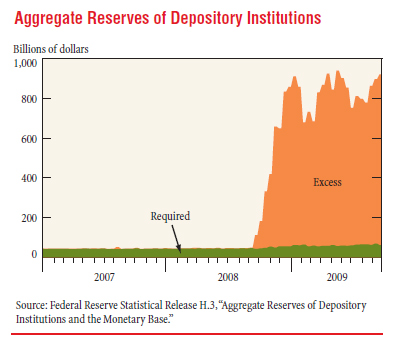
They quote a lot of commentary decrying the build-up of reserves, but state:

In this edition of Current Issues, we argue that the concerns about high levels of reserves are largely unwarranted. Using a series of simple examples, we show how central bank liquidity facilities and other credit programs create—essentially as a by-product—a large quantity of reserves. While the level of required reserves may change modestly with changes in bank lending behavior, the vast majority of the newly created reserves will end up being held as excess reserves regardless of how banks react to the new programs. In other words, the substantial buildup of reserves depicted in the chart reflects the large scale of the Federal Reserve’s policy initiatives, but says little or nothing about the programs’ effects on bank lending or on the economy more broadly.

One casual comment of interest is:

Note the important economic role of interbank lending in this example: it allows funds to flow to their most productive uses, regardless of which bank received the initial deposits.

This, presumably, is a justification for encouraging interbank lending in the BIS Capital Ratios (which allow one bank’s holdings of another bank’s paper to be risk-weighted according to the credit rating of the borrowing bank’s sovereign authority. I would dearly love to see this issue thoroughly discussed; to me, it seems to have had the effect of increasing contagion.

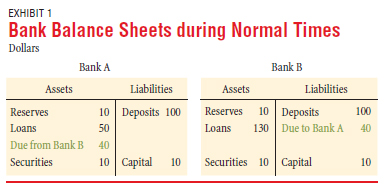
Anyway: in normal times, Bank A has lent to Bank B:
But in stressed times, the inter-bank market fails and the Fed lends to Bank B (via a credit to their reserve account), which repays Bank A by transfer of reserves:
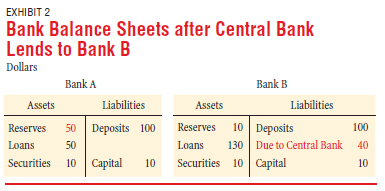
The authors explain:

This simple example illustrates how a central bank’s extension of credit to banks during a financial crisis creates, as a by-product, a large quantity of excess reserves. Merely looking at the aggregate data on bank reserves might lead one to conclude that the central bank’s policy did nothing to promote bank lending, since all of the $40 lent by the central bank ended up being held as excess reserves. The example shows that this conclusion would be unwarranted. In fact, the central bank’s action was highly effective: it prevented Bank B from having to reduce its lending to firms and households by $40.

There are, as always, knock-on effects:

Actions by a central bank that change the quantity of reserves in the banking system also tend to change the level of interest rates. Traditionally, bank reserves did not earn any interest. If Bank A earns no interest on the reserves it is holding in Exhibit 2, it will have an incentive to lend out its excess reserves or to use them to buy other short-term assets. These activities will, in turn, decrease short-term market interest rates and hence may lead to an increase in inflationary pressures.

The Central Bank may therefore choose to sterilize its market action by selling interest-bearing bonds from its holdings to Bank A – or it can achieve a similar policy objective by paying interest on excess reserves.

The authors conclude:

We began this article by asking, Why are banks holding so many excess reserves? We then used a series of simple examples to answer this question in two steps. First, we showed that the liquidity facilities and other credit programs introduced by the Federal Reserve in response to the crisis have created, as a by-product, a large quantity of reserves in the banking system. Second, we showed that while the lending decisions and other activities of banks may result in small changes in the level of required reserves, the vast majority of the newly created reserves will end up being held as excess reserves. The dramatic buildup of excess reserves reflects the large scale of the Federal Reserve’s policy initiatives; it conveys no information about the effects of these initiatives on bank lending or on the level of economic activity.

We also discussed the importance of paying interest on reserves when the level of excess reserves is unusually high, as the Federal Reserve began to do in October 2008. Paying interest on reserves allows a central bank to maintain its influence over market interest rates irrespective of the quantity of reserves in the banking system. The central bank can then scale its policy initiatives according to conditions in the financial sector, while setting its target for the short-term interest rate in response to macroeconomic conditions. This ability to separate short-term interest rates from the quantity of reserves is particularly important during the recovery from a financial crisis. If inflationary pressures begin to appear while the crisis-related programs are still in place, the central bank can use its interest-on-reserves policy to raise interest rates without necessarily removing all of the newly created reserves.

Market Action

December 23, 2009

Volume held up today, as PerpetualDiscounts slipped 14bp but FixedResets continued to defy gravity, gaining 3bp to take yields down to 3.66%.

HIMIPref™ Preferred Indices
These values reflect the December 2008 revision of the HIMIPref™ Indices

Values are provisional and are finalized monthly
Index Mean
Current
Yield
(at bid)
Median
YTW
Median
Average
Trading
Value
Median
Mod Dur
(YTW)
Issues Day’s Perf. Index Value
Ratchet 0.00 % 0.00 % 0 0.00 0 1.4325 % 1,599.1
FixedFloater 5.85 % 3.99 % 40,798 18.79 1 -0.2148 % 2,661.9
Floater 2.45 % 2.83 % 117,020 20.17 3 1.4325 % 1,997.8
OpRet 4.86 % -6.31 % 127,956 0.09 15 0.0435 % 2,320.2
SplitShare 6.43 % -6.01 % 219,731 0.08 2 0.1776 % 2,090.3
Interest-Bearing 0.00 % 0.00 % 0 0.00 0 0.0435 % 2,121.6
Perpetual-Premium 5.86 % 5.87 % 79,094 2.32 7 0.1191 % 1,883.5
Perpetual-Discount 5.82 % 5.86 % 198,300 14.09 68 -0.1351 % 1,793.0
FixedReset 5.40 % 3.66 % 337,300 3.86 41 0.0299 % 2,169.6
Performance Highlights
Issue Index Change Notes
POW.PR.D Perpetual-Discount -1.79 % YTW SCENARIO
Maturity Type : Limit Maturity
Maturity Date : 2039-12-23
Maturity Price : 20.26
Evaluated at bid price : 20.26
Bid-YTW : 6.19 %
BAM.PR.P FixedReset -1.24 % YTW SCENARIO
Maturity Type : Call
Maturity Date : 2014-10-30
Maturity Price : 25.00
Evaluated at bid price : 27.01
Bid-YTW : 5.11 %
POW.PR.B Perpetual-Discount -1.14 % YTW SCENARIO
Maturity Type : Limit Maturity
Maturity Date : 2039-12-23
Maturity Price : 21.44
Evaluated at bid price : 21.75
Bid-YTW : 6.15 %
CM.PR.E Perpetual-Discount -1.11 % YTW SCENARIO
Maturity Type : Limit Maturity
Maturity Date : 2039-12-23
Maturity Price : 23.54
Evaluated at bid price : 23.83
Bid-YTW : 5.86 %
POW.PR.A Perpetual-Discount -1.08 % YTW SCENARIO
Maturity Type : Limit Maturity
Maturity Date : 2039-12-23
Maturity Price : 22.71
Evaluated at bid price : 23.00
Bid-YTW : 6.09 %
TRI.PR.B Floater 1.22 % YTW SCENARIO
Maturity Type : Limit Maturity
Maturity Date : 2039-12-23
Maturity Price : 20.75
Evaluated at bid price : 20.75
Bid-YTW : 1.89 %
CIU.PR.A Perpetual-Discount 1.32 % YTW SCENARIO
Maturity Type : Limit Maturity
Maturity Date : 2039-12-23
Maturity Price : 19.96
Evaluated at bid price : 19.96
Bid-YTW : 5.83 %
BMO.PR.M FixedReset 1.71 % YTW SCENARIO
Maturity Type : Call
Maturity Date : 2013-09-24
Maturity Price : 25.00
Evaluated at bid price : 26.75
Bid-YTW : 3.09 %
BAM.PR.B Floater 2.43 % YTW SCENARIO
Maturity Type : Limit Maturity
Maturity Date : 2039-12-23
Maturity Price : 13.90
Evaluated at bid price : 13.90
Bid-YTW : 2.83 %
Volume Highlights
Issue Index Shares
Traded
Notes
MFC.PR.E FixedReset 58,865 RBC crossed 49,900 at 27.05.
YTW SCENARIO
Maturity Type : Call
Maturity Date : 2014-10-19
Maturity Price : 25.00
Evaluated at bid price : 27.05
Bid-YTW : 3.77 %
IGM.PR.B Perpetual-Discount 45,825 Inventory Blow-Out Sale
YTW SCENARIO
Maturity Type : Limit Maturity
Maturity Date : 2039-12-23
Maturity Price : 24.11
Evaluated at bid price : 24.30
Bid-YTW : 6.12 %
SLF.PR.F FixedReset 38,974 RBC crossed 35,000 at 27.50.
YTW SCENARIO
Maturity Type : Call
Maturity Date : 2014-07-30
Maturity Price : 25.00
Evaluated at bid price : 27.50
Bid-YTW : 3.63 %
CM.PR.I Perpetual-Discount 38,080 YTW SCENARIO
Maturity Type : Limit Maturity
Maturity Date : 2039-12-23
Maturity Price : 20.18
Evaluated at bid price : 20.18
Bid-YTW : 5.82 %
TRP.PR.A FixedReset 33,146 YTW SCENARIO
Maturity Type : Call
Maturity Date : 2015-01-30
Maturity Price : 25.00
Evaluated at bid price : 25.90
Bid-YTW : 3.81 %
RY.PR.X FixedReset 31,978 YTW SCENARIO
Maturity Type : Call
Maturity Date : 2014-09-23
Maturity Price : 25.00
Evaluated at bid price : 27.95
Bid-YTW : 3.70 %
There were 38 other index-included issues trading in excess of 10,000 shares.
Interesting External Papers

BoC Discusses Bank Leverage Ratio Management

The Bank of Canada has released a discussion paper by Etienne Bordeleau, Allan Crawford, and Christopher Graham titled Regulatory Constraints on Bank Leverage: Issues and Lessons from the Canadian Experience:

The Basel capital framework plays an important role in risk management by linking a bank’s minimum capital requirements to the riskiness of its assets. Nevertheless, the risk estimates underlying these calculations may be imperfect, and it appears that a cyclical bias in measures of risk-adjusted capital contributed to procyclical increases in global leverage prior to the recent financial crisis. As such, international policy discussions are considering an unweighted leverage ratio as a supplement to existing risk-weighted capital requirements. Canadian banks offer a useful case study in this respect, having been subject to a regulatory ceiling on an unweighted leverage ratio since the early 1980s. The authors review lessons from the Canadian experience with leverage constraints, and provide some empirical analysis on how such constraints affect banks’ leverage management. In contrast to a number of countries without regulatory constraints, leverage at major Canadian banks was relatively stable leading up to the crisis, reducing pressure for deleveraging during the economic downturn. Empirical results suggest that major Canadian banks follow different strategies for managing their leverage. Some banks tend to raise their precautionary buffer quickly, through sharp reductions in asset growth and faster capital growth, when a shock pushes leverage too close to its authorized limit. For other banks, shocks have more persistent effects on leverage, possibly because these banks tend to have higher buffers on average. Overall, the authors’ results suggest that a leverage ceiling would be a useful tool to complement risk-weighted measures and mitigate procyclical tendencies in the financial system.

The authors conclude:

Empirical analysis provides evidence that banks follow different strategies for managing their leverage buffers. Some banks tend to raise their buffers very quickly when a shock pushes leverage too close to its authorized limit (as might occur during a cyclical upturn). These adjustments are achieved through sharp reductions in asset growth and faster growth in capital. At other banks, shocks have more persistent effects on leverage, which could be explained by the fact that these banks tend to have higher buffers on average.

There’s not a lot of meat in the paper, but it’s a start. Lord knows, we’re nevery going to see any honest analysis out of OSFI!

Interesting External Papers

Effective Fed Funds and Interest on Excess Reserves

The Federal Reserve Bank of New York has released a staff report by Morten L. Bech and Elizabeth Klee titled The Mechanics of a Graceful Exit: Interest on Reserves and Segmentation in the Federal Funds Market:

To combat the financial crisis that intensified in the fall of 2008, the Federal Reserve injected a substantial amount of liquidity into the banking system. The resulting increase in reserve balances exerted downward price pressure in the federal funds market, and the effective federal funds rate began to deviate from the target rate set by the Federal Open Market Committee. In response, the Federal Reserve revised its operational framework for implementing monetary policy and began to pay interest on reserve balances in an attempt to provide a floor for the federal funds rate. Nevertheless, following the policy change, the effective federal funds rate remained below not only the target but also the rate paid on reserve balances. We develop a model to explain this phenomenon and use data from the federal funds market to evaluate it empirically. In turn, we show how successful the Federal Reserve may be in raising the federal funds rate even in an environment with substantial reserve balances.

This issue has been discussed on PrefBlog before, two posts being Effective Fed Funds Rate Continues to Confuse and Effective Fed Funds Rate: A Technical Explanation?.

The authors state the problem succinctly:

Between the October and December 2008 FOMC meetings the average effective federal funds rate was 32 basis points, while the target was 1 percent; the interest rate paid on reserves was 65 basis points or higher for the entire period. This deviation from the theoretical prediction was surprising for even the most astute observers of the federal funds market (Hamilton, 2008, for example). Why did interest on reserves provide an imperfect floor for the federal funds rate, even after the policy was changed so that the interest rate paid on reserves was set equal to the target rate?2 Why would any financial institution lend out funds below the rate paid by the central bank? And even if that were the case, arbitrageurs would surely relish the opportunity of making a pure profit by borrowing cheaply in the market and placing the proceeds with the central bank, and by doing so, move the market rate toward the floor.

… and propose:

The explanation for the puzzling outcome is at least threefold. First, not all participants in the federal funds market are eligible to receive interest on their reserve balances. Government-sponsored enterprises (GSEs) in particular, which are significant sellers of funds on a daily basis, are not legally eligible to receive interest on balances held with Reserve Banks. This heterogeneity across participants created a segmented market with different rate dynamics. Second, banks’ apparent general unwillingness or inability to engage in arbitrage has produced a market structure in which those banks that are willing and able to buy funds from the GSEs have been able to exercise bargaining power and pay the GSEs rates below the interest rate paid on reserves. The lack of arbitrage possibly has been driven in part by banks seeking to control the size of their balance sheet more closely in part to avoid stressing regulatory capital and leverage ratios, as mentioned in Bernanke (2009a). Third, a combination of financial consolidation, credit losses, and changes to risk management practices has led at least some GSEs to limit their number of counterparties in the money market and to tighten credit lines. This trimming of potential trading partners has likely decreased bargaining power with the remaining counterparties. In addition, the GSEs have become a larger share of the federal funds market in recent history and hence have pulled down the weighted average federal funds rate.

The paper is organized as:

First, we briefly discuss the institutional details of the federal funds market. Second, we turn to the history and implementation of the interest-on-reserves regime. Third, we present our model of a bifurcated federal funds market with banks and GSEs. We also sketch out how the model can be extended to describe a trifurcated market in which some banks are slow to adopt the new policy regime. Fourth, we calibrate our model to federal funds market data and back out the relative bargaining power of the different market participants. Fifth, we explore the factors that affect our computed bargaining parameters. We show that the level and distribution of reserve balances, rates in other overnight funding markets, and the riskiness of the buyers all have significant predictive power in explaining the bargaining power of the different types of sellers. With this information, in our sixth section, we forecast the effective federal funds rate under a variety of exit scenarios from the current accommodative stance of monetary policy. The seventh section concludes and offers directions for further research.

Issue Comments

YPG.PR.D Plummets on Opening Day

YPG.PR.D, the 6.90%+426 FixedReset announced December 7, commenced trading today with a dull thud.

It traded 157,195 shares in a range of 23.75-25 before closing at 23.86-90.

Vital statistics are:

YPG.PR.D FixedReset Not Calc! YTW SCENARIO
Maturity Type : Limit Maturity
Maturity Date : 2039-12-22
Maturity Price : 22.68
Evaluated at bid price : 23.86
Bid-YTW : 7.14 %

Looking at relative yields is amusing:

YPG issues on December 22
Ticker Quote Bid Yield Bid YTW Scenario
YPG.PR.A 24.00-10 5.72% SoftMaturity 2012-12-30 at 25.00
YPG.PR.B 18.52-68 10.05% SoftMaturity 2017-6-29 at 25.00
YPG.PR.C 24.00-15 7.02% LimitMaturity
YPG.PR.D 23.86-90 7.14% LimitMaturity
Market Action

December 22, 2009

So much for the Christmas lull! Trading was heavy today and PerpetualDiscounts were down 14bp, while FixedResets were up 13bp as investors realized that a lot of the product available was not the YPG.PR.D new issue.

HIMIPref™ Preferred Indices
These values reflect the December 2008 revision of the HIMIPref™ Indices

Values are provisional and are finalized monthly
Index Mean
Current
Yield
(at bid)
Median
YTW
Median
Average
Trading
Value
Median
Mod Dur
(YTW)
Issues Day’s Perf. Index Value
Ratchet 0.00 % 0.00 % 0 0.00 0 0.1266 % 1,576.6
FixedFloater 5.84 % 3.97 % 41,119 18.81 1 -1.4293 % 2,667.6
Floater 2.49 % 2.90 % 111,326 19.99 3 0.1266 % 1,969.6
OpRet 4.86 % -4.45 % 129,703 0.09 15 0.0306 % 2,319.2
SplitShare 6.44 % -4.43 % 227,943 0.08 2 -0.0887 % 2,086.6
Interest-Bearing 0.00 % 0.00 % 0 0.00 0 0.0306 % 2,120.7
Perpetual-Premium 5.86 % 5.80 % 81,734 2.32 7 -0.0397 % 1,881.3
Perpetual-Discount 5.80 % 5.86 % 197,765 14.03 68 -0.1436 % 1,795.4
FixedReset 5.39 % 3.63 % 343,652 3.86 41 0.1317 % 2,168.9
Performance Highlights
Issue Index Change Notes
HSB.PR.D Perpetual-Discount -2.07 % YTW SCENARIO
Maturity Type : Limit Maturity
Maturity Date : 2039-12-22
Maturity Price : 21.30
Evaluated at bid price : 21.30
Bid-YTW : 5.90 %
RY.PR.C Perpetual-Discount -1.66 % YTW SCENARIO
Maturity Type : Limit Maturity
Maturity Date : 2039-12-22
Maturity Price : 20.75
Evaluated at bid price : 20.75
Bid-YTW : 5.61 %
POW.PR.D Perpetual-Discount -1.57 % YTW SCENARIO
Maturity Type : Limit Maturity
Maturity Date : 2039-12-22
Maturity Price : 20.63
Evaluated at bid price : 20.63
Bid-YTW : 6.08 %
BAM.PR.J OpRet -1.52 % YTW SCENARIO
Maturity Type : Soft Maturity
Maturity Date : 2018-03-30
Maturity Price : 25.00
Evaluated at bid price : 26.00
Bid-YTW : 4.82 %
BAM.PR.G FixedFloater -1.43 % YTW SCENARIO
Maturity Type : Limit Maturity
Maturity Date : 2039-12-22
Maturity Price : 25.00
Evaluated at bid price : 18.62
Bid-YTW : 3.97 %
BNS.PR.Q FixedReset -1.09 % YTW SCENARIO
Maturity Type : Call
Maturity Date : 2013-11-24
Maturity Price : 25.00
Evaluated at bid price : 26.36
Bid-YTW : 3.68 %
PWF.PR.K Perpetual-Discount -1.04 % YTW SCENARIO
Maturity Type : Limit Maturity
Maturity Date : 2039-12-22
Maturity Price : 20.93
Evaluated at bid price : 20.93
Bid-YTW : 6.02 %
BAM.PR.K Floater 1.06 % YTW SCENARIO
Maturity Type : Limit Maturity
Maturity Date : 2039-12-22
Maturity Price : 13.40
Evaluated at bid price : 13.40
Bid-YTW : 2.93 %
CM.PR.K FixedReset 1.26 % YTW SCENARIO
Maturity Type : Call
Maturity Date : 2014-08-30
Maturity Price : 25.00
Evaluated at bid price : 27.25
Bid-YTW : 3.42 %
RY.PR.Y FixedReset 1.30 % YTW SCENARIO
Maturity Type : Call
Maturity Date : 2014-12-24
Maturity Price : 25.00
Evaluated at bid price : 28.00
Bid-YTW : 3.61 %
CM.PR.A OpRet 1.32 % YTW SCENARIO
Maturity Type : Call
Maturity Date : 2010-01-21
Maturity Price : 25.25
Evaluated at bid price : 26.85
Bid-YTW : -52.24 %
NA.PR.L Perpetual-Discount 1.49 % YTW SCENARIO
Maturity Type : Limit Maturity
Maturity Date : 2039-12-22
Maturity Price : 21.48
Evaluated at bid price : 21.75
Bid-YTW : 5.64 %
HSB.PR.C Perpetual-Discount 1.67 % YTW SCENARIO
Maturity Type : Limit Maturity
Maturity Date : 2039-12-22
Maturity Price : 21.58
Evaluated at bid price : 21.90
Bid-YTW : 5.84 %
Volume Highlights
Issue Index Shares
Traded
Notes
CM.PR.L FixedReset 268,035 RBC crossed 26,700 at 28.15; then bought 19,900 from CIBC at the same price. CIBC then sold 19,000 to TD and 17,900 more to RBC at 28.15; TD bought 13,500 from HSBC at 28.15; RBC crossed 40,400 at 28.15. TD crossed a block of 30,900 at 28.16 (finally, a different price) and crossed two blocks, of 37,000 and 15,400 shares, both at the same old 28.15.
YTW SCENARIO
Maturity Type : Call
Maturity Date : 2014-05-30
Maturity Price : 25.00
Evaluated at bid price : 28.14
Bid-YTW : 3.69 %
ACO.PR.A OpRet 194,888 RBC crossed 194,800 at 25.90.
YTW SCENARIO
Maturity Type : Call
Maturity Date : 2010-01-21
Maturity Price : 25.50
Evaluated at bid price : 25.99
Bid-YTW : -13.17 %
GWO.PR.J FixedReset 53,065 RBC crossed 50,000 at 27.16.
YTW SCENARIO
Maturity Type : Call
Maturity Date : 2014-01-30
Maturity Price : 25.00
Evaluated at bid price : 27.16
Bid-YTW : 3.67 %
TD.PR.N OpRet 51,880 TD crossed blocks of 31,000 and 15,000 at 26.33.
YTW SCENARIO
Maturity Type : Call
Maturity Date : 2010-01-21
Maturity Price : 26.00
Evaluated at bid price : 26.40
Bid-YTW : -6.45 %
BNS.PR.T FixedReset 38,555 RBC crossed 18,800 at 28.00.
YTW SCENARIO
Maturity Type : Call
Maturity Date : 2014-05-25
Maturity Price : 25.00
Evaluated at bid price : 28.00
Bid-YTW : 3.57 %
BNS.PR.J Perpetual-Discount 36,620 RBC crossed 18,000 at 23.92.
YTW SCENARIO
Maturity Type : Limit Maturity
Maturity Date : 2039-12-22
Maturity Price : 22.74
Evaluated at bid price : 23.74
Bid-YTW : 5.57 %
There were 64 other index-included issues trading in excess of 10,000 shares.
Indices and ETFs

GWO.PR.X, IGM.PR.A to be Removed from TXPR

Standard & Poor’s has announced:

  • • The Series E First Preferred Shares of Great-West Lifeco Inc. (TSX:GWO.PR.X) have been called for redemption on Thursday, December 31, 2009, at $26.00 per share. The shares will be removed from the S&P/TSX Preferred Share Index after the close of Wednesday, December 30, 2009.
  • •The 5.75% First Preferred Shares, Series A, of IGM Financial Inc. (TSX:IGM.PR.A) have been called for redemption on Thursday, December 31, 2009, at $26.00 per share. The shares will be removed from the S&P/TSX Preferred Share Index after the close of Wednesday, December 30, 2009.

The GWO.PR.X redemption and the IGM.PR.A redemption have been reported on PrefBlog.

Issue Comments

DBRS Mass Review of SplitShares

DBRS has announced that it:

has today taken rating action on structured preferred shares issued by 18 split share companies and trusts (the Issuers).

Each of the Issuers has invested in a portfolio of securities (the Portfolio) funded by issuing two classes of shares – dividend-yielding preferred shares or securities (the Preferred Shares) and capital shares or units (the Capital Shares). The main form of credit enhancement available to these Preferred Shares is a buffer of downside protection. Downside protection corresponds to the percentage decline in market value of the Portfolio that must be experienced before the Preferred Shares would be in a loss position. The amount of downside protection available to Preferred Shares will fluctuate over time based on changes in the market value of the Portfolio.

Of the 18 structured Preferred Share ratings updated today by DBRS, 16 have been upgraded and two have been downgraded. The upgraded ratings reflect an increase in net asset value (NAV) of the respective portfolios over the past four months and a greater stability in equity prices over this period. Two Preferred Share ratings were downgraded mainly because their Issuers have 100% exposure to Canadian life insurance companies, whose equity prices declined in value over the past four months.

They claim The upgraded ratings reflect an increase in net asset value (NAV) of the respective portfolios over the past four months and a greater stability in equity prices over this period …. while the latter part of this assertion is indubitably correct, some NAVs have actually declined over the period – at least, according the NAVs given in my August report of their review and the current NAVs. Of course, reporting-time is not the same thing as rating-time, so it could well be that the NAVs of all upgraded companies did, in fact, increase when measured from rating-time to rating time. Maybe!

I note, for instance, that the NAV of FTN / FTN.PR.A was 18.44 on August 31 and 17.42 on November 30 (the July 31 NAV was 17.89, while Dec 15 was 17.30).

DBRS Review Announced 2009-8-27
Ticker Old
Rating
Asset
Coverage
Last
PrefBlog
Post
HIMIPref™
Index
New
Rating
ABK.PR.B Pfd-3(high) 2.1+:1
12/17
Upgraded None Pfd-2(low)
ALB.PR.A Pfd-3 1.8+:1
12/17
Upgraded Scraps Pfd-3(high)
BSC.PR.A Pfd-3(high) 2.3+:1
12/17
Partial Call for Redemption None Pfd-2(low)
BSD.PR.A Pfd-5 1.2:1
12/18
Semi-Annual Financials Scraps Pfd-5(high)
LCS.PR.A Pfd-3(low) 1.4+:1
12/17
Upgraded None Pfd-4(high)
ES.PR.B Pfd-4(low) 1.4-:1
12/17
Small Call for Redemption None Pfd-4(high)
EN.PR.A Pfd-3 2.0+:1
12/17
Tiny Partial Redemption None Pfd-3(high)
FCS.PR.A Pfd-3(low) 1.5+:1
12/21
Upgraded None Pfd-3
FTN.PR.A Pfd-3(low) 1.7+:1
12/15
Upgraded Scraps Pfd-3
FFN.PR.A Pfd-4(high) 1.5+:1
12/15
Resumes Capital Unit Dividend Scraps Pfd-3(low)
FIG.PR.A Pfd-4 1.4+:1 (?)
Capital Units Rights Offering Scraps Pfd-4(high)
PIC.PR.A Pfd-4 1.4-:1
12/17
Upgraded Scraps Pfd-4(high)
SXT.PR.A Pfd-2(low) 2.3+:1
12/17
Small Partial Redemption Scraps Pfd-2
SLS.PR.A Pfd-4 1.1+:1
12/17
Upgraded None Pfd-4(low)
SNP.PR.V Pfd-3(low) 1.6-:1
12/17
Upgraded None Pfd-3
SOT.PR.A Pfd-3(high) 2.2-:1
12/21
Downgraded None Pfd-2(low)
TDS.PR.B Pfd-3(high) 2.3-:1
12/17
Partial Redemption Scraps Pfd-2(low)
WFS.PR.A Pfd-4 1.3-:1
12/17
Warrants Prospectus Filed Scraps Pfd-4(high)
PrefLetter

PrefLetter Reference to Essay Regarding Implied Volatility

In the December edition of PrefLetter, I suggested that an article regarding the calculation of Implied Volatility as it related to PerpetualDiscounts “should be published in the next edition of Canadian Moneysaver”.

As it turns out, the article has not been published.

The article will be published in expanded form in the January edition of PrefLetter; in the interim, interested PrefLetter subscribers may contact me to receive a copy of the article I had anticipated would be published in CMS.

Regulation

Canadian ABCP

The ABCP settlements have been released:

In the Scotia agreement, the “Contraventions” section is one paragraph long:

71. The Respondent admits to the following contraventions of IIROC Rules, Guidance, IDA By-Laws, Regulations or Policies:

Between July 25 and August 10, 2007, the Respondent failed to adequately respond to emerging issues in the Coventree ABCP market insofar as it continued to sell Coventree ABCP without engaging Compliance and other appropriate processes for the assessment of such emerging issues, contrary to IDA By-law 29.1 (ii) (now Dealer Member Rule 29.1(ii)).

If we have a look at Rule 29.1:

29.1. Dealer Members and each partner, Director, Officer, Supervisor, Registered Representative, Investment Representative and employee of a Dealer Member (i) shall observe high standards of ethics and conduct in the transaction of their business, (ii) shall not engage in any business conduct or practice which is unbecoming or detrimental to the public interest, and (iii) shall be of such character and business repute and have such experience and training as is consistent with the standards described in clauses (i) and (ii) or as may be prescribed by the Board.

For the purposes of disciplinary proceedings pursuant to the Rules, each Dealer Member shall be responsible for all acts and omissions of each partner, Director, Officer, Supervisor, Registered Representative, Investment Representative and employee of a Dealer Member; and each of the foregoing individuals shall comply with all Rules required to be complied with by the Dealer Member.

The agreed statement of facts for Scotia’s “Response to Emerging Issues” is:

60. Notwithstanding the events described above, the Respondent failed to fully assess the information in the July 24th e-mail in a meaningful way. The Respondent did not notify its Compliance Department (“Compliance”) of the July 24th email or its contents until after August 13, 2007.

61. Notwithstanding its concerns about emerging market issues for Coventree ABCP, the Respondent failed to engage an adequate process to fully assess the impact of those concerns. The Respondent did not notify Compliance of its concerns.

62. Notwithstanding the emerging issues relating to the Coventree ABCP market as described above, the Respondent continued to sell Coventree ABCP to institutional clients, primarily by way of newly issued paper.

63. From July 25 to August 3, 2007, the Respondent sold Comet E from inventory, as noted in paragraph 56, and newly issued Planet A ABCP in the amount of $35,400,000, to institutional clients who the Respondent was not aware had knowledge of the US subprime exposure.

64. On August 3 the Respondent sold $28 million and from August 7 to 10 the Respondent sold $235 million in newly issued Aurora A, SAT A, and SIT III A to institutional clients (excluding sales of ABCP that matured prior to August 13, 2007 and sales to the CDPQ and other certain professional counterparties).

Update: The AMF Press Release provides more detail:

Five of the institutions involved are alleged to have failed to adequately respond to issues in the third party ABCP market, as they continued to buy and/or sell without engaging compliance and other appropriate processes for assessing such issues. Particularly, they did not disclose to all their clients the July 24th e-mail from Coventree providing the subprime exposure of each Coventree ABCP conduit.