Category: Interesting External Papers

Interesting External Papers

Bank of Canada Review, Summer 2008

The Summer 2008 edition of the BoC Review has been released. The table of contents is:

  • The Canadian Debt-Strategy Model
  • China’s Integration into the Global Financial System
  • House Prices and Consumer Spending
  • A Tool for Assessing Financial Vulnerabilities in the Household Sector
  • A Money and Credit Real-Time Database for Canada

I very quickly reviewed the articles, but must confess I didn’t find any of them particularly fascinating. The first article, on Canadian debt strategy (how should the feds split up their issuance in order to minimize both cost and risk? How do you define risk, anyway?) was a little disappointing; I felt that there should have been more discussion of the crowding-out effects of short term government debt (I don’t much like the government’s policy of issuing short term bonds. Leave that area for the private sector!) and a greater emphasis on apocalyptic scenarios exacerbated by fiscal boneheadism (I was on the ‘phone with my main man back in 1994, and he was telling me there were serious concerns that the Bank of Canada 10-year auction could fail. I don’t EVER want to hear that again).

Interesting External Papers

The Evolution of Bankers' Acceptances in Canada

One of my source documents for my research on the seniority of Bankers’ Acceptances was an article from the BoC Review of October 1981, by Daryl Merrett.

This article is not available on the Bank of Canada website, so the staff first very kindly faxed me a copy and now has authorized me to make my electronic version of the fax available here.

These are TIF files of not particularly wonderful quality; but those who are interested in the topic will pay more attention to the content than to the form.

Interesting External Papers

Canadian Debt Market Statistics, 1Q08

The Investment Industry Association of Canada has announced:

Widening credit spreads and unsettled markets, coupled with rising inflation and falling real yields, created difficult borrowing conditions in the latest quarter. For the first three months this year, total debt issuance declined 18% quarter-over-quarter. The fall was broad-based, with a notable pullback in provincial and municipal financings. Although issuance fell short of last year’s Q1 level, encouragingly, debt trading activity remained steady with $1.7 billion worth of bonds exchanging hands in the quarter. The Investment Industry Association of Canada (IIAC) today released its periodical An Issue of Debt: Inside Canada’s Debt Markets that includes analysis and results for the first quarter of 2008.

I don’t think much of the articles, but the statistics fall into the “Impressive-sounding statistics to Quote” category.

Interesting External Papers

Target Capitalization of Big US Banks

How Do Large Banking Organizations Manage Their Capital Ratios?, a research paper from the Kansas City Fed.

The authors “find strong evidence that target capital ratios decrease with BHC [Bank Holding Company] size and increase with the volatility of BHC earnings (risk). The relationships between capital targets and BHC market value, growth strategy, and business mix are less systematic and statistically weaker.”

I note that by comparing Table 3, Panel A (regressions on leverage ratio) with Table 3, Panel B (regressions on Tier 1 Ratio) it appears that an asset size of greater than $50-billion (comprising 5.4% of the sample) had a statistically significant influence on the calculation of the targetted Tier 1 ratio, but was insignificant when calculating the targetted Leverage Ratio.

Note a 2003 Comment Letter from the State of New York Banking Department stated:

Capital ratios as well as business plans tend to be different at LCBOs [Large Complex Banking Organizations] and smaller banks. Compared to community and regional banks, LCBOs tend to have capital ratios that are closer to the well-capitalized minimums (see Table 1). All five of the New York State banks with assets over $45 billion have leverage ratios between 5.4% and 6.2%, while the range for all banks is from 5.3% to 52%.[1] (The leverage ratio is more constraining than the risk-based capital ratios.) Thus, bifurcation seems to address the concern of LCBOs to manage their capital ratios, while acknowledging that most community and regional banks are comfortable with much higher than required capital ratios.

However, the situation for large regional banks may be somewhat different: the12 New York banks with assets between $5 billion and $45 billion tend to have higher capital ratios than the largest banks, but may be feeling market pressure to manage these ratios. For these institutions, opting in to the A-IRB approach could make it possible to maintain the same risk-based capital ratios while lowering their leverage ratio close to 5%. As IRB systems and software become more developed, opting in may make more sense for these banks, especially since sophisticated credit risk modeling systems also allow more risk-sensitive pricing.

Interesting External Papers

Credit Ratings: Is Competition Good?

Beatriz Mariano has written a VoxEU column regarding her development of a model for Credit Rating Agency behaviour. The paper is titled Do Reputational Concerns Lead to Reliable Ratings? and, somewhat surprisingly, the answer is ‘Not really’.

This paper studies the behavior of rating agencies, in particular it looks at their incentives to issue a rating that is not justified by the private information collected about the project they are rating in a framework in which they value reputation. The model finds that reputational concerns are not enough to prevent deviations from the private signal, in fact these concerns might end up being the driving force behind these deviations. A rating agency whose private signal is perfect issues this private signal as a rating but a rating agency can make mistakes may end up ignoring the private signal and issuing the rating that minimizes reputational costs. Despite its simplicity, the model can motivate several patterns of behavior. In the monopolistic setting, a rating agency is conservative in the sense that it issues too many bad ratings ignoring private and even public information that indicates that the project is good. Competition forces rating agencies to be more aggressive to make sure that they continue being hired and are not replaced by the competitor. Hence, reputational concerns combined with competition originate boldness as rating agencies issue too many good rating ignoring private and even public information that indicates that the project is bad.

The model clearly illustrates how reputation and informational issues can distort ratings. Competition might not solve the incentive problems faced by rating agencies unless it is combined with better models of risk assessment, which would improve the quality of rating agencies assessments, more transparency in that rating’s procedures, and measures to improve monitoring and accountability in the ratings industry.

Her argument is good, but there are no data to test her hypotheses. As with every other attempt to dissect this problem, we have the basic problem that it is impossible to regulate accurate predictions of the future.

I may as well say it again: special access by the agencies to material non-public information must be revoked.

Interesting External Papers

Deposit Insurance in Chile

My route to this paper is, perhaps, best described at another time. But Deposit Insurance: Handle with Care is a good background paper with excellent references.

The abstract:

Explicit deposit insurance has been spreading rapidly in the past decades, most recently to countries with low levels of financial and institutional development. This paper documents the extent of crosscountry differences in deposit-insurance design and reviews empirical evidence on how particular design features affect private market discipline, banking stability, financial development, and the effectiveness of crisis resolution. This evidence challenges the wisdom of encouraging countries to adopt explicit deposit insurance without first stopping to assess and remedy weaknesses in their informational and supervisory environments. The paper also includes recommendations for reforming the Chilean deposit insurance system based on the results of the research reviewed here.

… and a few observations …

On investigating individual design features, Demirgüç-Kunt and Detragiache also show that deposit insurance causes the most trouble in countries where coverage is extensive, where authorities amass a large fund of explicit reserves and earmark it for insolvency resolution, and where the scheme is administered by government officials rather than the private sector.

It is common practice to issue blanket guarantees to arrest a banking crisis. Countries that have adopted this strategy include Sweden (1992), Japan (1996), Thailand (1997), Korea (1997), Malaysia (1998), and Indonesia (1998). More recently, Turkey tried to halt its financial panic by guaranteeing not just bank depositors, but all domestic and foreign nondeposit creditors of Turkish banks. Advocates of using blanket guarantees to halt a systemic crisis argue that sweeping guarantees can be helpful, even essential, in halting depositors’ flight to quality. However, because blanket guarantees create an expectation of their future use in similar circumstances, they undermine market discipline and may prove greatly destabilizing over longer periods. Although some countries have managed to scale back formal insurance coverage once a crisis has receded, it is very difficult to scale back informal coverage in a credible manner.

Concentrated banking systems experience fewer systemic banking crises (Beck, Demirgüç-Kunt, and Levine, 2003) and almost always generate a high level of implicit insurance coverage, partly because of “too big to fail” pressures. Not surprisingly, empirical evidence confirms that incremental exposure to moral hazard from introducing an explicit insurance system is limited in highly concentrated environments.

By the way …

Deposit insurance was established in Chile in 1986. The system does not have a permanent fund in place. The Chilean Central Bank guarantees 100 percent of demand deposits in full, and 90 percent of household savings and time deposits up to UF 120 per person (approximately US$ 2,800). To limit the Central Bank’s exposure, banks with demand deposits in excess of 2.5 times the capital reserves are required to maintain 100 percent reserves at the Central Bank in short-term central bank or government securities. Foreign exchange deposits are covered, but coverage excludes interbank deposits. Membership is compulsory for all banks, and the scheme is publicly administered.

Interesting External Papers

Central Banks and the Eligibility Premium

For reasons that will become clear to Assiduous Readers in the near future, I’m doing a little reading on the “Eligibility Premium”.

This was defined, in ECB Occasional Paper #49, BindSeil & Papadia, August 2006 as:

the interest rate differential between eligible [as collateral for central bank loans] and ineligible assets, dubbed the “eligibility premium”.

… with the conclusion …

The three estimates above consistently indicate that the eligibility premium deriving from being eligible as collateral for Eurosystem operations is, as a maximum, in the order of magnitude of a few basis points only. However, again, the following caveats to these estimates should be highlighted: In times of financial tensions, the eligibility premium will be much higher. One may view ample collateral availability as an insurance against the consequences of financial instability.

  • In times of financial tensions, the eligibility premium will be much higher. One may view ample collateral availability as an insurance against the consequences of financial instability.
  • For lower-rated banks (e.g. banks with a BBB rating), the value of the eligibility feature is likely to be systematically higher.
  • The low eligibility premium in the euro area is also the result of the ample availability of collateral. If availability were to decrease or demand increase, the premium would increase as well.

As remarked by Michael Reuther of Commerzbank in June 2008:

In a liquidity stress situation only central bank eligible collateral can be seen as really liquid.

It was to capture a suddenly much larger eligibility premium that Congress pressured the Fed to add Student Loans to the eligibility list – and the Fed responded on May 2. It’s hard to say how much the eligibility premium was in this case, but 35bp is a possibility:

The Lincoln, Nebraska-based student-loan provider issued three-year bonds rated AAA that priced to yield 70 basis points more than the three-month London interbank offered rate, said a person familiar with today’s sale, who declined to be identified because the terms aren’t public. That’s a narrower spread than the 105 basis points Nelnet was charged last month, and the 100 basis points the company offered on March 31.

I seem to remember – but cannot find – a Bloomberg story specifically mentioning that spreads between eligible and non-eligible assets had skyrocketted at the height of the crisis.

All this is related to the matter of the Real Bills Doctrine.

Interesting External Papers

BIS Releases Report on Credit Rating Agencies

The Bank for International Settlements has announced the release of a report, Ratings in structured finance: what went wrong and what can be done to address shortcomings?, from a study group chaired by Nigel Jenkinson Executive Director, Financial Stability of the Bank of England.

In sharp contrast to the IOSCO Report on CRAs, this report actually contains and addresses industry criticism of the report’s recommendations.

The recommendations are:

  • Investment fund trustees and managers should review their internal procedures and guidelines concerning how ratings information on SF products is used in their investment mandates and decisions.
  • Rating reports should be presented in a way that facilitates comparisons of risk within and across classes of different SF products.
  • Rating agencies should provide clearer information on the frequency of rating updates.
  • More user-friendly access to CRA SF models and their documentation should be provided. Rating models made available by CRAs should facilitate the conducting of “what if?” analysis or stress tests by users on key model parameters.
  • CRAs should document the sensitivity of SF tranche ratings to changes in their central assumptions regarding default rates, recovery rates and correlations.
  • CRAs should clearly and regularly disclose to investors their economic assumptions underlying the rating of SF products.
  • Limited historical data on underlying asset pools should be clearly disclosed as adding to model risk, as should any adjustment made to mitigate this risk.
  • CRAs should monitor more intensively the performance of the various agents involved in the securitisation process,
  • CRAs should periodically consider the wider systemic implications of a rapid growth of similar instruments or vehicles, or of new business undertaken by existing vehicles, for the continued robustness of their original ratings criteria
  • CRAs should consider how to incorporate additional information on the risk properties of SF products into the rating framework.

Everybody liked the first recommendation. It’s motherhood, after all … and the organizations that have ignored it in the past will ignore it in the future.

It is felt that providing information on what events would spark a review would be useful; but providing a schedule of future reviews would just lead to information overload.

The CRAs objected to disclosure of limited historical data, apparently fearing that this would lead to a box-ticking exercise amongst investors – such investors would ignore the possibility of structural breaks compromising the utility of historical data when it did exist.

The more intensive monitoring of agents in the securitization process was thought to be rather ambitious. That’s the regulators’ job!

Systemic implications are rather problematic – CRAs fear that it will become their responsibility to prick asset bubbles.

A separate rating scale was felt to be costly and cosmetic. A separate volatility indicator was thought to be genuinely useful.

Interesting External Papers

Credit Spreads: Structural Model Deluxe

It has long been a criticism of the structural Merton models of default that they calculate credit spreads that are much lower than those observed in the market. The Bank of England and the Bank of Canada take what I feel is a sensible course and ascribe the excess spread to liquidity concerns.

Liquidity, however, is a kind of touchy-feely concept and there is a yearning to quantify credit spreads such that, ideally, every single beep could be assigned to some kind of rational formula, base largely on default probability. In the Bank of Canada paper referenced above, the authors note:

Recent research that expands structural models by including them in a broader macroeconomic setting has shown that credit-risk premiums may, in fact, account for a larger portion of the overall spread than indicated by the “traditional” structural model (Chen 2008). This suggests that the results of “traditional” structural models such as that used in this study should be interpreted with caution, and should focus on the direction in which risk factors evolve, rather than on the specific values of the relative contributions of the factors.

The Chen paper is available on-line: Macroeconomic Conditions and the Puzzles of Credit Spreads and Capital Structure:

This paper addresses two puzzles about corporate debt: the “credit spread puzzle” – why yield spreads between corporate bonds and treasuries are high and volatile – and the “under-leverage puzzle” – why firms use debt conservatively despite seemingly large tax benefits and low costs of financial distress. I propose a unified explanation for both puzzles: investors demand high risk premia for holding defaultable claims, including corporate bonds and levered firms, because (i) defaults tend to concentrate in bad times when marginal utility is high; (ii) default losses are also higher during such times. I study these comovements in a structural model, which endogenizes firms’ financing and default decisions in an economy with business-cycle variation in expected growth rates and economic uncertainty. These dynamics coupled with recursive preferences generate countercyclical variation in risk prices, default probabilities, and default losses. The credit risk premia in my calibrated model are large enough to account for most of the high spreads and low leverage ratios. Relative to a standard structural model without business-cycle variation, the average spread between Baa and Aaa-rated bonds rises from 48 bp to around 100 bp, while the average optimal leverage ratio of a Baa-rated firm drops from 67% to 42%, both close to the U.S. data.

He points out:

One can not resolve the puzzles simply by raising the risk aversion. While a higher risk aversion does push up the credit spreads, it increases the equity premium dramatically. Moreover, a higher risk aversion actually increases the leverage ratio. It does increase the expected costs of financial distress, which leads to lower optimal coupon rate lower and higher interest coverage. However, a drop in debt value comes with a bigger drop in equity value, resulting in a higher leverage ratio.

The guts of the argument is:

First, marginal utilities are high in recessions, which means that the default losses that occur during such times will affect investors more. Second, recessions are also times when cash flows are expected to grow slower and become more volatile. These factors, combined with higher risk prices at such times, imply lower continuation values for equity-holders, which make firms more likely to default in recessions. Third, since many firms are experiencing problems in recessions, asset liquidation can be particularly costly, which will result in higher default losses for bond and equity-holders. Taken together, the countercyclical variation in risk prices, default probabilities, and default losses raises the present value of expected default losses for bond and equity-holders, which leads to high credit spreads and low leverage ratios.

Frankly, I don’t consider the paper very satisfying. While the argument appears sound, the actual model is too highly parameterized to allow for high confidence in the outputs; in other words, I fear that a variation of data mining has come into play. Additionally, I am highly suspicious of arguments that assume the market is rational and that an objective evaluation of default risk is (essentially) the only factor determining credit spreads. That’s not what I see in the market.

What I see is a lot of segmentation (some investors will not buy corporates. Some investors will buy corporates, but will dump and run at the first whiff of difficulties) and a high liquidity premium – these are two factors not considered in the model.
Interesting External Papers

BoC Financial System Review, June 2008: Credit Spreads

The Bank of Canada released the June 2008 Financial System Review on June 12. One of the three “Highlighted Issues” was Canadian Corporate Investment Grade Spreads.

The authors first define their terms, making a basic point that surprisingly few investors understand:

In general, two important components drive variations in corporate yield spreads. One is the expected loss from default, the other relates to risk premiums. This latter component can be further decomposed into two types: a credit-risk premium and an illiquidity premium. The expected loss from default generally reflects the fundamentals of the firm, such as the degree of leverage and its ability to generate a stable stream of profits. The credit-risk premium is related to the variability of, or uncertainty about, potential loss from default. Both the credit-risk premium and the expected loss from default are affected by changes in macroeconomic activity. When combined, these two components comprise the part of the yield spread attributed to default-related credit risks.

The illiquidity premium, a non-credit-risk factor, relates to a lack of general market liquidity. Moreover, the credit-risk and illiquidity premiums, like other risk premiums, can vary with any change in the risk appetite of investors and are therefore likely to be positively correlated over time.

They decompose the components of the corporate spread vs. governments using a structure “Merton” model, very similar to the BoE research previously reported on PrefBlog – the BoE is thanked for supplying code in note 16. For investment-grade firms issuing Canadian Corporate Bonds (they do not define their universe more precisely than this) they conclude:

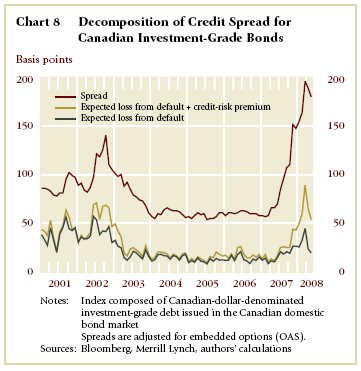
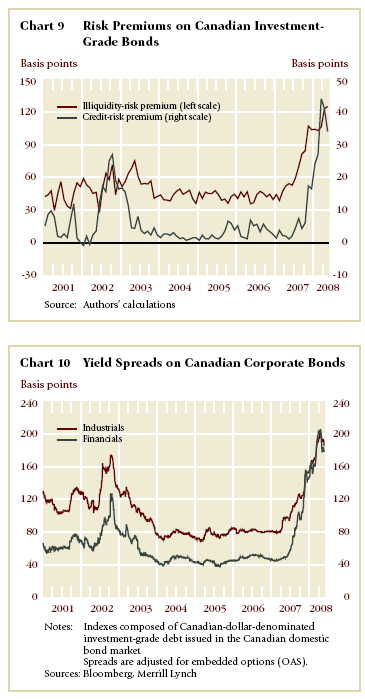
As of 21 May 2008, while the actual spread was 179 basis points, the expected loss, credit-risk premium, and illiquidity premium were 20, 34, and 125 basis points, respectively. Comparable figures for end-July 2007 were 85, 21, 5, and 59 basis points, respectively. The increase in the investment-grade credit spread can thus be attributed to an increase in the credit-risk and illiquidity premiums above their recent historical norms.

… while noting:

The credit-risk component reached its peak level of 89 basis points in March 2008, and the illiquidity premium reached its peak level of 125 basis points in May 2008.

Much of the increase is due to the “high proportion of financial firms (approximately 55% of the index in 2007).”

There are some very illuminating graphs:

I will note that, as of June 25 according to Canadian Bond Indices and the HIMIPref™ Indices:

  • 30-Year Canadas yielded 4.06%
  • Long Corporates yielded ~6.05%
  • PerpetualDiscounts yielded 6.01% as a dividend
  • PerpetualDiscounts yielded 8.41% interest equivalent (at 1.4x)

See Party Like It’s 1999! for further discussion of the PerpetualDiscount Interest-Equivalent / Long Corporate spread.