Category: Issue Comments

Issue Comments

TD.PF.I Firm On Decent Volume

TD.PF.I, a FixedReset, 4.50%+301, NVCC-compliant issue announced 2017-07-05 closed today. It will be tracked by HIMIPref™ and has been assigned to the FixedResets subindex.

The issue traded 775,498 shares today in a tight range of 24.97-02 before closing at 25.00-01. Vital statistics are:

TD.PF.I FixedReset YTW SCENARIO
Maturity Type : Limit Maturity
Maturity Date : 2047-07-14
Maturity Price : 23.14
Evaluated at bid price : 25.00
Bid-YTW : 4.41 %

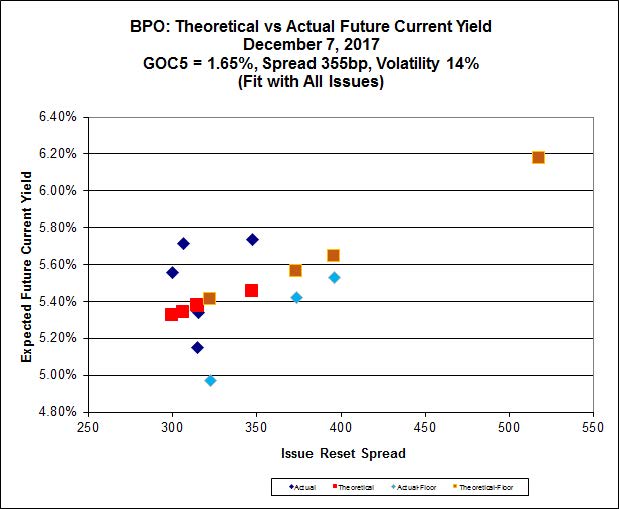
Implied Volatility for FixedResets analysis shows:

impvol_td_170714
Click for Big

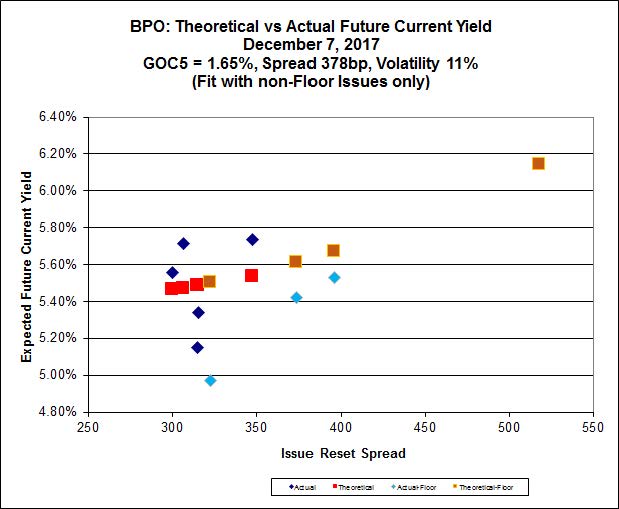
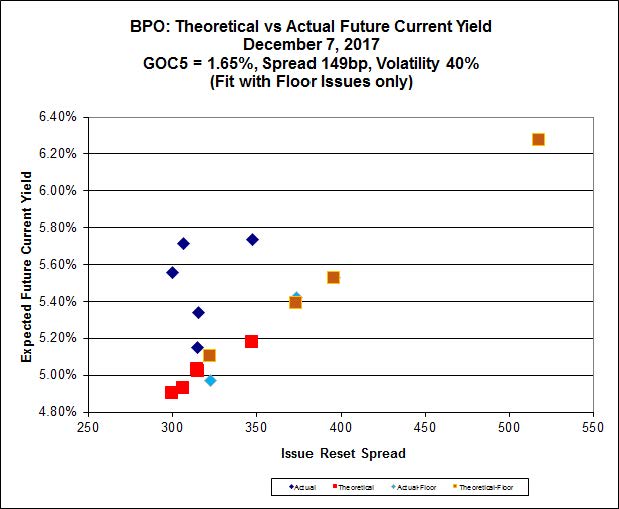
The numbers show a large change from the parameters determined on issue date, which were GOC5=1.43%; Spread=204bp and Implied Volatility=26%. Plugging in the new values for the last two parameters demonstrates a clear steepening during the interval.

impvol_td_170714adj
Click for Big

The new fit is significantly better, with a sum of squared errors of 1.40 compared to 1.86 when today’s data is imposed on the prior parameters.

One thing that hasn’t change is the apparent richness of TD.PF.I – the theoretical price is now 24.28 compared to 24.30 on announcement day.

Issue Comments

BBD.PR.B / BBD.PR.D : Convert or Hold?

On June 16, Bombardier announced (emphasis added):

In connection with the conversion privilege for holders of its Series 2 and Series 3 Preferred Shares, Bombardier Inc. (TSX: BBD.B) (TSX: BBD.A) (TSX: BBD.PR.B) (TSX:BBD.PR.D) today announced the basis for resetting the dividend rate on its Series 3 Preferred Shares in accordance with the terms applicable to those shares.

Holders of Bombardier Inc. Series 2 Preferred Shares have the right to convert all or part of their shares, effective on August 1, 2017, on a one for one basis into Series 3 Preferred Shares. Holders of Bombardier Inc. Series 3 Preferred Shares have the right to convert all or part of their shares, effective on August 1, 2017, on a one for one basis into Series 2 Preferred Shares. Holders who do not convert their shares will retain their Series 2 Preferred Shares or Series 3 Preferred Shares, as the case may be, unless automatically converted in accordance with the terms of the Series 2 or Series 3 Preferred Shares, as described below.

In the case of the Series 2 Preferred Shares, starting as of August 1, 2017, holders will continue to receive a monthly floating adjustable cash dividend, as and when declared by the Board of Directors of Bombardier Inc., based on a dividend rate equal to a percentage of the prime rate, subject to certain adjustments in accordance with the terms of such shares.

In the case of the Series 3 Preferred Shares, starting as of August 1, 2017, holders will receive a quarterly fixed cash dividend for the following five years, as and when declared by the Board of Directors of Bombardier Inc., based on a fixed rate equal to 265% of the yield on five-year non-callable Government of Canada bonds determined as at July 11, 2017, in accordance with the terms of such shares. The annual dividend rate applicable to the Series 3 Preferred Shares will be published on July 12, 2017 in select newspapers.

Any registered shareholder who wishes to convert his or her Series 2 and/ or Series 3 Preferred Shares must complete and sign the conversion panel contained on the back of the Series 2 or Series 3 Preferred Share certificate as the case may be, and deliver it, at the latest by 5:00 p.m. (Montréal time) on July 18, 2017, to Computershare Investor Services Inc.

Shareholders who are beneficial owners and who wish to exercise their right of conversion should communicate as soon as possible with their broker or other nominee and follow their instructions. In that case, it is important that they follow such instructions and act in the timeframe advised so as to provide enough time to their broker or other nominee to meet the July 18, 2017 deadline.

If, after July 18, 2017, Bombardier Inc. determines that there would be less than one million Series 2 Preferred Shares outstanding after the conversion date (being August 1, 2017), then all remaining Series 2 Preferred Shares will automatically be converted into Series 3 Preferred Shares on a one-for-one basis. However, if, after July 18, 2017, Bombardier Inc. determines that there would be less than one million Series 3 Preferred Shares outstanding after the conversion date (being August 1, 2017), then all remaining Series 3 Preferred Shares will automatically be converted into Series 2 Preferred Shares on a one-for-one basis. In either case, Bombardier Inc. shall give a written notice to that effect to holders of such remaining shares no later than July 25, 2017.

Subject to the conditions mentioned in the previous paragraph, on August 1, 2017, and every five years thereafter, holders of Series 2 Preferred Shares and holders of Series 3 Preferred Shares will have again the right to convert their shares into shares of the other series.

The Series 2 and Series 3 Preferred Shares are listed on the Toronto Stock Exchange under the ticker symbol BBD.PR.B and BBD.PR.D, respectively.

In my terminology, BBD.PR.B is a Ratchet Rate preferred, currently paying 100% of Prime, reset quarterly. BBD.PR.D is a FixedFloater currently paying $0.7835 p.a., or 3.134% of its $25 par value. The latter rate resets every Exchange Date; the next exchange date is imminent – 2017-8-1. Both issues have been relegated to the Scraps subindex since inception on credit concerns.

The company has further announced (emphasis added):

that as of August 1, 2017, its Series 3 Preferred Shares will pay, on a quarterly basis, as and when declared by the Board of Directors of Bombardier Inc., cash dividends for the following five years that will be based on a fixed rate equal to the product of (a) the average of the yield to maturity, designated on July 11, 2017 by National Bank Financial Inc. and Scotia Capital Inc., that would be carried by a Government of Canada bond with a five-year maturity, namely 1.503%, multiplied by (b) 265%, which multiplier was previously announced on June 16, 2017.

Accordingly, the annual dividend rate applicable to the Series 3 Preferred Shares for the period of five years beginning on August 1, 2017 will be 3.983%.

As a reminder, any registered shareholder who wishes to convert his or her Series 2 and/ or Series 3 Preferred Shares must complete and sign the conversion panel contained on the back of the Series 2 or Series 3 Preferred Share certificate as the case may be, and deliver it, at the latest by 5:00 p.m. (Montréal time) on July 18, 2017, to Computershare Investor Services Inc. Likewise, shareholders who are beneficial owners and who wish to exercise their right of conversion should communicate as soon as possible with their broker or other nominee and follow their instructions. In that case, it is important that they follow such instructions and act in the timeframe advised so as to provide enough time to their broker or other nominee to meet the July 18, 2017 deadline.

The most logical way to analyze the question of whether or not to convert is through the theory of Preferred Pairs, for which a calculator is available. Briefly, a Strong Pair is defined as a pair of securities that can be interconverted in the future (e.g., BBD.PR.D and BBD.PR.B). Since they will be interconvertible on this future date, it may be assumed that they will be priced identically on this date (if they aren’t then holders will simply convert en masse to the higher-priced issue). And since they will be priced identically on a given date in the future, any current difference in price must be offset by expectations of an equal and opposite value of dividends to be received in the interim. And since the dividend rate on one element of the pair is both fixed and known, the implied average rate of the other, floating rate, instrument can be determined. Finally, we say, we may compare these average rates and take a view regarding the actual future course of that rate relative to the implied rate, which will provide us with guidance on which element of the pair is likely to outperform the other until the next interconversion date, at which time the process will be repeated.

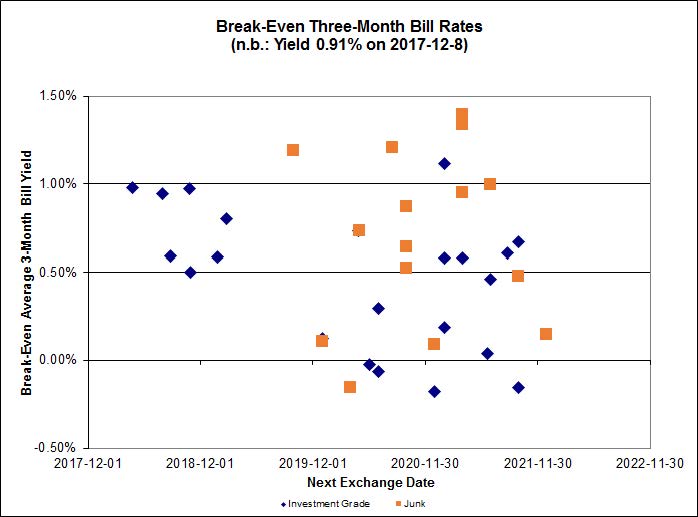
We can show the break-even rates for each FixedFloater / RatchetRate Strong Pair graphically by plotting the implied average Prime rate against the next Exchange Date (which is the date to which the average will be calculated).

pairs_ff_170712
Click for Big

Recent tumult in the market resulting from the Bank of Canada’s hawkish signals (commencing on June 12, reinforced June 13 and piled on with a shovel on June 28) and the execution of a 25bp policy hike today has resulted in fine performance of RatchetRate preferreds, to the point where the average break-even Prime rate is now roughly 4.00% for issues with Exchange Dates in 2020 and afterwards.

Predictions are difficult, particularly when they are about the future! It will be remembered that Prime is currently at 2.95%; therefore, if we assume that future hikes are evenly sized and spaced, an average of 4.00% implies an end-value in five years of about 5.00%. I’m inclined to believe that it will turn out to be less than that, but if you disagree I won’t put up much of an argument!

Since credit quality of each element of the pair is equal to the other element, it should not make any difference whether the pair examined is investment-grade or junk, although we might expect greater variation of implied rates between junk issues on grounds of lower liquidity, and this is just what we see.

If we plug in the current bid price of the BBD.PR.D FixedFloater, we may construct the following table showing consistent prices for its soon-to-be-issued FloatingReset counterpart given a variety of Implied Breakeven yields consistent with issues currently trading:

Estimate of BBD.PR.B (received in exchange for BBD.PR.D) Trading Price In Current Conditions
  Assumed RatchetRate
Price if Implied Prime
is equal to
FixedFloater Bid Price Fixed Rate +3.50% 4.00% 4.50%
BBD.PR.D 9.88 3.983% 9.47 9.89 10.31

Based on current market conditions, I suggest that the BBD.PR.B will likely commence trading at close to the price of BBD.PR.D, its FixedFloater counterpart. Therefore, I make no recommendation regarding conversion into either one or the other. Those with strong convictions regarding future movements in Prime will, of course, have an equally strong preference for one of the two issues; other investors may wish to select which of the pair they wish to hold for the next five years based on their personal circumstances (e.g., if you’re hedging a prime-linked mortgage with this issue [not a wise move], you will want to hold BBD.PR.B).

I will note that the credit quality of these issues is lousy: S&P downgraded them to P-5(low) in 2016 and DBRS downgraded to Pfd-4(low) and discontinued coverage in 2013. With these issues, you’re making such a large bet on the future credit quality of the company that details regarding the next five years of dividends are a mere bagatelle.

Better Communication, Please!

IAG.PR.G : No Conversion to FloatingReset

Industrial Alliance Insurance and Financial Services Inc. has disclosed in an eMail response to my nine (count ’em, nine) inquiries:

Per our May 31 press release, since there were less than 1,000,000 shares to be converted into Series H, no Series H shares will be issued and all shares will remain in Series G, returning a 3.777% dividend rate.

We decided not to issue a press release. We informed CDS last week and the result should have been communicated through CDS. We certainly take note of your comment regarding peers issuing press release in that situation.

Please let me know if you have any questions.

Best regards,

This is pretty second-rate shareholder communication, although I have no doubt that it is legal. CDS? The company is relying on CDS, a bank-owned monopoly with basically no mandate or incentive to communicate with shareholders and entrusting it with the responsibility to promulgate corporate information? The idea is ridiculous.

We can look, for instance, at the SEC’s 2013 announcement regarding disclosures via Twitter (emphasis added):

The Securities and Exchange Commission today issued a report that makes clear that companies can use social media outlets like Facebook and Twitter to announce key information in compliance with Regulation Fair Disclosure (Regulation FD) so long as investors have been alerted about which social media will be used to disseminate such information.

The SEC’s report of investigation confirms that Regulation FD applies to social media and other emerging means of communication used by public companies the same way it applies to company websites. The SEC issued guidance in 2008 clarifying that websites can serve as an effective means for disseminating information to investors if they’ve been made aware that’s where to look for it. Today’s report clarifies that company communications made through social media channels could constitute selective disclosures and, therefore, require careful Regulation FD analysis.

“One set of shareholders should not be able to get a jump on other shareholders just because the company is selectively disclosing important information,” said George Canellos, Acting Director of the SEC’s Division of Enforcement. “Most social media are perfectly suitable methods for communicating with investors, but not if the access is restricted or if investors don’t know that’s where they need to turn to get the latest news.”

The fact that material disclosures of this nature can be made selectively to broker-members of CDS is a disgrace and is particularly obnoxious in that CDS’s immediate controller, the bank-owned Toronto Stock Exchange, has not publicized this information on their website listing for IAG.PR.G or, indeed, for IAG common. However, given that this selective disclosure favours the Big Banks, I’m not holding my breath while waiting for regulatory action.

Assiduous Readers will recall that IAG.PR.G will reset at 3.777% and should now be referred to as a FixedReset, 3.777%+285. I recommended against conversion.

IAG.PR.G commenced trading 2012-6-1 (and was, unusually, re-opened on 2012-6-19) after being announced 2012-5-24. It has been a member of the FixedReset subindex since inception.

As this issue is not NVCC compliant, it is analyzed as having a Deemed Retraction.

Update, 2017-6-30 : The eMail quoted above was from the company and received 2017-06-28. The following was received from the always efficient Computershare on 2017-06-30 (they got the same inquiries I sent to the company itself):

Thank you for your inquiry.

We confirm that Industrial Alliance announced on June 1st, 2017 the conversion of the Class A preferred shares series G (CUSIP 455871806) for preferred series H shares (CUSIP 455871889). However, since less than 1,000,000 series G shares were deposited no shares will be converted. Shareholders will continue to hold their series G shares. Industrial Alliance gave written notice to this effect to holders of series G shares on or around June 22nd, 2017.

If you have any questions, please do not hesitate to contact our National Customer Contact Centre at 888-838-1405 (outside North America at 514-982-7555) between 8:30am and 8:00pm EST from Monday to Friday and one of our agents will be pleased to assist you with your inquiry.

Note that the phrase “gave written notice to this effect to holders” is a very, very clever phrase that some people consider ethical: since IAG.PR.G is book-based, there is (in a very, very clever, lawyerly sense) exactly one holder – CDS. So hats off to the very, very clever people at Computershare!

Yours Sincerely,

Issue Comments

BMO.PR.D Firm On Good Volume

Bank of Montreal has announced:

it has closed its domestic public offering of Non-Cumulative 5-Year Rate Reset Class B Preferred Shares Series 42 (Non-Viability Contingent Capital (NVCC)) (the “Preferred Shares Series 42”). The offering was underwritten on a bought-deal basis by a syndicate of underwriters led by BMO Capital Markets. Bank of Montreal issued 16 million Preferred Shares Series 42 at a price of $25 per share to raise gross proceeds of $400 million.

The Preferred Shares Series 42 were issued under a prospectus supplement dated June 22, 2017, to the Bank’s short form base shelf prospectus dated April 13, 2016. Such shares will commence trading on the Toronto Stock Exchange today under the ticker symbol BMO.PR.D.

BMO.PR.D is a FixedReset, 4.40%+317, NVCC, announced 2017-6-20. It will be tracked by HIMIPref™ and has been assigned to the FixedResets subindex.

The issue traded 1,276,967 shares today in a range of 24.80-97 before closing at 24.94-95. Vital statistics are:

BMO.PR.D FixedReset YTW SCENARIO
Maturity Type : Limit Maturity
Maturity Date : 2047-06-29
Maturity Price : 23.13
Evaluated at bid price : 24.94
Bid-YTW : 4.41 %

Implied Volatility for FixedResets analysis shows very little change in relative valuation since the issue was announced:

impvol_bmo_170629
Click for Big

Only nine days ago, the GOC-5 rate was 1.13%, with the analysis showing a spread of 255bp and Implied Volatility of 18%. The theoretical price is now 24.81, compared to the issue-day calculation of 24.84.

Issue Comments

CSE.PR.A Now Unrated

Standard & Poor’s has announced:

S&P Global Ratings today said it affirmed its ‘BB+’ long-term corporate credit rating on Capstone Infrastructure Corp. (CIC). At the same time, S&P Global Ratings affirmed its ‘B+’ preferred stock rating and ‘P-4(High)’ Canada national scale preferred share rating on the company’s preferred shares. The outlook is stable.

Subsequently, S&P Global Ratings withdrew its ratings on CIC at the company’s request.

The ratings on CIC before the withdrawal primarily reflected our view of a fair business risk profile, underpinned by a high proportion of cash flows from long-term term contracts with investment-grade counterparties, which provides stability to cash flows. The company had no corporate-level debt and in our debt calculations we used imputed debt from the 50% of the preferred shares. We expect the available cash flows will be used to finance general and administrative expenses and preferred share dividends at the corporate level. We also expected Capstone to maintain credit metrics commensurate with the intermediate financial risk profile.

The company is wholly owned by Irving Infrastructure Corp., a subsidiary of iCON Infrastructure Partners III, L.P., a fund advised by London, UK-based iCON Infrastructure LLP.

CSE.PR.A is a FixedReset, 3.271%+271. It is tracked by HIMIPref™ but has been relegated to the Scraps index since issue on credit concerns.

Issue Comments

BAM.PR.X : No Conversion to FloatingReset

Brookfield Asset Management Inc. has announced:

that after having taken into account all election notices received by the June 15, 2017 deadline for the conversion of the Cumulative Class A Preference Shares, Series 28 (the “Series 28 Shares”) (TSX: BAM.PR.X) into Cumulative Class A Preference Shares, Series 29 (the “Series 29 Shares”), the holders of Series 28 Shares are not entitled to convert their Series 28 Shares into Series 29 Shares. There were 398,894 Series 28 Shares tendered for conversion, which is less than the one million shares required to give effect to conversions into Series 29 Shares.

Assiduous Readers will recall that BAM.PR.X will reset at 2.727% and should now be referred to as a FixedReset, 2.727%+180. I recommended against conversion.

The issue commenced trading 2011-2-8 after being announced 2011-1-19. It has been a member of the FixedReset subindex since inception.

Issue Comments

TA.PR.F : No Conversion to FloatingReset

TransAlta Corporation has announced:

that after having taken into account all election notices received by the June 15, 2017 deadline for the conversion of the Cumulative Redeemable Rate Reset Preferred Shares, Series C (the “Series C Shares”) into Cumulative Redeemable Floating Rate Preferred Shares, Series D (the “Series D Shares”), there were 827,628 Series C Shares tendered for conversion, which is less than the one million shares required to give effect to conversions into Series D Shares. As a result, none of the Series C Shares will be converted into Series D Shares on June 30, 2017.

Assiduous Readers will recall that TA.PR.F will reset at 4.027% and should now be referred to as a FixedReset, 4.027%+310. I recommended against conversion.

The issue commenced trading 2011-11-30 after being announced 2011-11-22. It has been relegated to the Scraps subindex since inception on credit concerns.

Issue Comments

CF.PR.C : No Conversion to FloatingReset

Canaccord Genuity Group Inc. has announced:

that after having taken into account all election notices received by the June 15, 2017 conversion deadline in respect of the Cumulative 5-Year Rate Reset First Preferred Shares, Series C (the “Series C Preferred Shares”) tendered for conversion into Cumulative Floating Rate First Preferred Shares, Series D (the “Series D Preferred Shares”), the holders of the Series C Preferred Shares are not entitled to convert their shares. There were 136,467 Series C Preferred Shares tendered for conversion, which is less than the 1,000,000 shares required for the ability to proceed with the conversion into Series D Preferred Shares, in accordance with the terms of the Series C Preferred Shares.

As outlined in a press release on June 1, 2017, holders of Series C Preferred Shares will be entitled to receive quarterly fixed, cumulative, preferential cash dividends, if, as and when declared by the Board of Directors of the Company, subject to the provisions of the Business Corporations Act (British Columbia). The dividend rate for the five-year period commencing on July 1, 2017 and ending on and including June 30, 2022 will be 4.993% per annum, being equal to the sum of the five year Government of Canada bond yield determined as of June 1, plus 4.03%, in accordance with the terms of the Series C Preferred Shares. This new dividend rate is expected to deliver approximately $750,000 in annual savings for common shareholders.

There are currently 4,000,000 Series C Preferred Shares listed on the Toronto Stock Exchange under the symbol CF.PR.C.

Assiduous Readers will recall that CF.PR.C will reset at 4.993% and should now be referred to as a FixedReset, 4.993%+403. I recommended against conversion.

The issue commenced trading 2012-4-10 after being announced 2012-3-22. It has been relegated to the Scraps subindex since inception on credit concerns.

Issue Comments

Aimia Suspends Preferred Dividends

Aimia Inc. has announced:

that its Board of Directors has suspended payment of all dividends on both its outstanding common shares and its Series 1, Series 2 and Series 3 Cumulative Rate Reset Preferred Shares (collectively, the “Preferred Shares”) effective immediately. This includes the previously declared dividends originally scheduled to have been paid on June 30, 2017, to shareholders of record as of June 16, 2017.

Under paragraph 42 of the Canada Business Corporations Act (“CBCA”), the Company’s governing corporate statute, there are two legal tests that must be met before any dividend can be paid. The Company has concluded that it satisfies the solvency test set forth at paragraph 42(a) of the CBCA.

However, due to a number of factors, the Company believes that the capital impairment test set forth in paragraph 42(b) of the CBCA would not be satisfied on June 30, 2017. These factors include the recent significant decline in the Company’s market capitalization following the May 11, 2017, non-renewal announcement by Air Canada and the high amount of the stated capital account (currently about $1.5 billion for common shares and Preferred shares on a combined basis), primarily resulting from past common share issuances at significantly higher prices than the current market.

In the event the Company is able to pay the previously declared dividends referred to above at a future date, the record date for shareholders entitled to such payment remains June 16, 2017. Dividends on the outstanding Preferred Shares are cumulative and will continue to accrue in accordance with the rights, privileges, restrictions and conditions attaching to each series of Preferred Shares.

“The Company currently has the requisite liquidity to pay these dividends, however the statutory capital impairment test legally prohibits us from doing so. Our business continues to perform well and generate strong free cash flow. We reported $331.7 million of cash and cash equivalents, restricted cash and short-term investments and $225.5 million of long-term investments in corporate and government bonds as at March 31, 2017,” said Robert E. Brown, Executive Chairman, Aimia.

“The Company has been in active discussions with various parties with a view to securing new long-term commercial and strategic relationships post-2020. We believe we have a unique set of assets that are highly valuable and compelling,” said David Johnston, Aimia’s Group Chief Executive. “At the same time, the Company is also making progress on its plan to remove a further $70 million of costs from the Company through its business review and we will provide further updates as developments warrant.”

They also announced:

the resignation of three directors. Joanne Ferstman has resigned as a director of the Company. In addition, as part of the Board of Directors’ ongoing process of renewal, the Board of Directors has also accepted the resignations of Alan Rossy and Beth Horowitz.

Over the past few years, the Company has been on a path to simplify and focus the business, reduce operating costs and dispose of certain non-core assets. Reflecting the changing profile of the Company, the Board of Directors has been reviewing its size and composition against the Company’s current needs. The current Board is now reduced to nine members.

Ferstman joined the Board in 2005, Rossy joined the Board in 2007, and Horowitz joined the Board in 2012.

It’s pretty hard to swallow the idea that this is part of a scheduled review, considering that less than a month ago they announced:

that the nominees listed in the management information circular dated March 13, 2017, as amended, were elected as directors of Aimia. The detailed results of the vote for the election of directors held at its Annual Meeting on May 11, 2017 in Toronto are set out below.

Each of the following 12 nominees proposed by management was elected as a director of Aimia:

On top of the Annual Report comments:

This was also an important year for Board renewal as we added to the retailing, capital markets and financial reporting expertise represented.

Following an extensive search led by the Governance and Nominating Committee, we announced the appointment of Thomas (Tom) D. Gardner and William (Bill) McEwan to our Board of Directors in December 2016 and the nomination of Robert (Chris) Kreidler to our Board for election at our AGM in May 2017.

I mean, either this is a lie or the company has been grossly incompetent in scheduling its review vis a vis the Annual Meeting. I’ll need a lot of convincing before I believe there’s a third option.

All this follows hard on the heels of last Thursday’s announcement:

that Chief Financial Officer Tor Lønnum will be leaving the company in September. Family reasons spurred his decision to seek out a new role that allowed him to return to Copenhagen.

Aimia Group Chief Executive David Johnston, together with the Board of Directors, has appointed Aimia director Roman Doroniuk to act as Interim Chief Financial Officer, effective September 5, while a successor is sought. Lønnum will lead the reporting of the company’s second quarter results on August 9, and then work with Doroniuk until September for a smooth transition.

As far as the stated reason for suspending dividends is concerned, well, having $2-billion goodwill on the balance sheet vs. $115-million of shareholders’ equity doesn’t help matters much, and neither does a Retained Earnings (Deficit) balance of $2.7-billion. I’ll need a little convincing before I believe that “past common share issuances at significantly higher prices than the current market” has anything to do with. Looks more like the company has simply pissed away its capital.

Affected issues are AIM.PR.A, AIM.PR.B and AIM.PR.C.

Issue Comments

NA.PR.C Soft-ish On Excellent Volume

National Bank of Canada has announced:

that it has closed its domestic public offering of non-cumulative 5-year rate reset first preferred shares series 38 (non-viability contingent capital (NVCC)) (the “Series 38 Preferred Shares”). National Bank issued 16 million Series 38 Preferred Shares at a price of $25.00 per share to raise gross proceeds of $400 million.

The offering was underwritten by a syndicate led by National Bank Financial Inc.

The Series 38 Preferred Shares will commence trading on the Toronto Stock Exchange today under the ticker symbol NA.PR.C.

The Series 38 Preferred Shares were issued under a prospectus supplement dated June 5, 2017 to National Bank’s short form base shelf prospectus dated November 21, 2016.

NA.PR.C is a FixedReset, 4.45%+343, NVCC-compliant announced 2017-6-1. It will be tracked by HIMIPref™ and has been assigned to the FixedResets subindex.

The issue traded 1,359,922 shares today in a range of 24.78-92 before closing at 24.90-93. Vital statistics are:

NA.PR.C FixedReset YTW SCENARIO
Maturity Type : Limit Maturity
Maturity Date : 2047-06-13
Maturity Price : 23.10
Evaluated at bid price : 24.90
Bid-YTW : 4.33 %

Implied Volatility analysis for FixedResets suggests that this issue continues to be expensive:

impvol_na_170613
Click for Big

The theoretical price of the new issue according to this model is now 24.58, up from 24.25 on announcement day.