Category: Issue Comments

Issue Comments

MFC.PR.I : Convert or Hold?

It will be recalled that MFC.PR.I will reset to 4.351% (paid on par) effective September 19.

Holders of MFC.PR.I have the option to convert to FloatingResets, which will pay 3-month bills plus 286bp on the par value of $25.00, reset quarterly. The deadline for notifying the company of the intent to convert is 5:00 p.m. (Toronto time) on September 5, 2017; but note that this is a company deadline and that brokers will generally set their deadlines a day or two in advance, so there’s not much time to lose if you’re planning to convert! However, if you miss the brokerage deadline they’ll probably do it on a ‘best efforts’ basis if you grovel in a sufficiently entertaining fashion. The ticker for the new FloatingReset, if it is issued, will be MFC.PR.T.

MFC.PR.I is a FixedReset, 4.40%+286, that commenced trading 2012-5-24 after being announced 2012-5-16. It is tracked by HIMIPref™ and is included in the FixedReset subindex. The extension of this issue was announced 2017-7-27.

As this issue (and the possibly forthcoming MFC.PR.T) is not NVCC compliant, it is analyzed as having a Deemed Retraction.

The most logical way to analyze the question of whether or not to convert is through the theory of Preferred Pairs, for which a calculator is available. Briefly, a Strong Pair is defined as a pair of securities that can be interconverted in the future (e.g., MFC.PR.I and the FloatingReset MFC.PR.T that will exist if enough holders convert). Since they will be interconvertible on this future date, it may be assumed that they will be priced identically on this date (if they aren’t then holders will simply convert en masse to the higher-priced issue). And since they will be priced identically on a given date in the future, any current difference in price must be offset by expectations of an equal and opposite value of dividends to be received in the interim. And since the dividend rate on one element of the pair is both fixed and known, the implied average rate of the other, floating rate, instrument can be determined. Finally, we say, we may compare these average rates and take a view regarding the actual future course of that rate relative to the implied rate, which will provide us with guidance on which element of the pair is likely to outperform the other until the next interconversion date, at which time the process will be repeated.

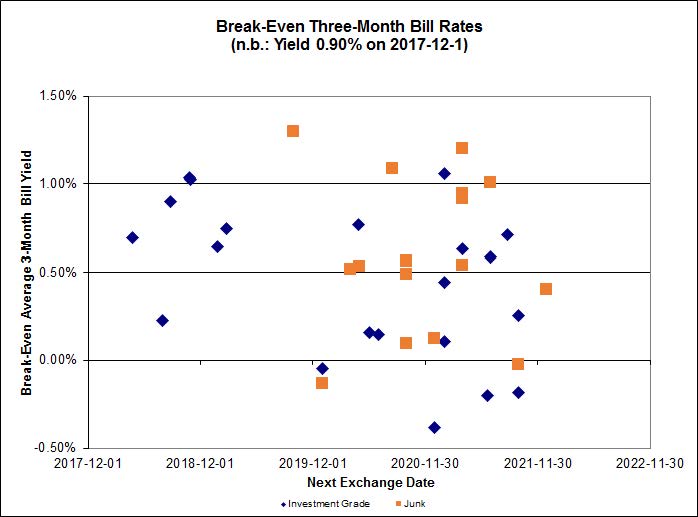
We can show the break-even rates for each FixedReset / FloatingReset Strong Pair graphically by plotting the implied average 3-month bill rate against the next Exchange Date (which is the date to which the average will be calculated).
pairs_fr_170830
Click for Big

The market appears to have a distaste at the moment for floating rate product; most of the implied rates until the next interconversion are lower than the current 3-month bill rate and the averages for investment-grade and junk issues are both well below current market rates, at +0.29% and +0.28%, respectively! Whatever might be the result of the next few Bank of Canada overnight rate decisions, I suggest that it is unlikely that the average rate over the next five years will be lower than current – but if you disagree, of course, you may interpret the data any way you like.

Since credit quality of each element of the pair is equal to the other element, it should not make any difference whether the pair examined is investment-grade or junk, although we might expect greater variation of implied rates between junk issues on grounds of lower liquidity, and this is just what we see.

If we plug in the current bid price of the MFC.PR.I FixedReset, we may construct the following table showing consistent prices for its soon-to-be-issued FloatingReset counterpart given a variety of Implied Breakeven yields consistent with issues currently trading:

Estimate of FloatingReset MFC.PR.T (received in exchange for MFC.PR.I) Trading Price In Current Conditions
  Assumed FloatingReset
Price if Implied Bill
is equal to
FixedReset Bid Price Spread +1.00% +0.50% 0.00%
MFC.PR.I 23.64 286bp 23.14 22.62 22.11

Based on current market conditions, I suggest that the FloatingResets that will result from conversion are likely to be cheap and trading below the price of their FixedReset counterparts. Therefore, I recommend that holders of MFC.PR.I continue to hold the issue and not to convert. I will note that, given the apparent cheapness of the FloatingResets, it may be a good trade to swap the FixedReset for the FloatingReset in the market once both elements of each pair are trading and you can – presumably, according to this analysis – do it with a reasonably good take-out in price, rather than doing it through the company on a 1:1 basis. But that, of course, will depend on the prices at that time and your forecast for the path of policy rates over the next five years. There are no guarantees – my recommendation is based on the assumption that current market conditions with respect to the pairs will continue until the FloatingResets commence trading and that the relative pricing of the new pair will reflect these conditions.

Issue Comments

IGM.PR.B Downgraded to P-2(High) by S&P

Standard & Poor’s has announced:

  • •On Aug. 31, 2017, IGM announced the closing of a minority stake acquisition in China Asset Management Co. Ltd.
  • •We revised the financial risk profile assessment to “modest” from “minimal” because of the increase in debt to fund the transaction combined with lower coverage metrics.
  • •We are lowering our long-term issuer credit rating and unsecured debt ratings on IGM to ‘A’ from ‘A+’ and lowering our preferred stock ratings to ‘BBB+/P-2(high)’ from ‘A-/P-1(low)’. We are also removing these ratings from CreditWatch, where they were placed with negative implications on Dec. 29, 2016.
  • •The stable outlook on IGM reflects our expectation that the company will operate with leverage levels slightly below 1.5x and interest coverage metrics between 9x and 10x during the next 18 to 24 months. It also incorporates our view that investment performance will remain solid and assets under management will grow organically at a modest pace.


The downgrade of IGM reflects the completion of the China Asset Management Co. Ltd. (CAMC) transaction, which was initially announced in December 2016. Through Mackenzie Investments, a subsidiary of IGM, the company acquired a 13.9% stake in CAMC for a purchase price of approximately C$633 million. The acquisition was funded primarily through the issuance of C$600 million in unsecured notes (split in a C$400 million 10-year tranche and a C$200 million 30-year tranche) in January 2017.

The stable outlook reflects S&P Global Ratings’ expectation that IGM will operate with leverage metrics slightly below 1.5x and interest coverage metrics between 9x and 10x during the next 18 to 24 months. The stable outlook also incorporates our expectation that IGM will continue to exhibit positive organic inflows, solid investment performance and sizeable on-balance-sheet investments.

S&P’s Credit Watch Negative was reported on PrefBlog.

IGM.PR.B is a 5.90% Straight Perpetual that commenced trading 2009-12-8 after being announced 2009-11-30. The issue was poorly received and underwriters had to blow out their inventory shortly after opening day.

The issue is tracked by HIMIPref™ and is included in the PerpetualPremium subindex.

Issue Comments

ALA.PR.U To Reset At 5.29%

AltaGas Ltd. has announced:

that it does not intend to exercise its right to redeem its currently outstanding Cumulative Redeemable Five-Year Rate Reset Preferred Shares, Series C (the “Series C Shares”) (TSX:ALA.PR.U) on September 30, 2017. As a result, subject to certain conditions, the holders of the Series C Shares have the right to convert all or part of their Series C Shares on a one-for-one basis into Cumulative Redeemable Floating Rate Preferred Shares, Series D of AltaGas (the “Series D Shares”) on September 30, 2017. Holders who do not exercise their right to convert their Series C Shares into Series D Shares will retain their Series C Shares.

The foregoing conversion right is subject to the conditions that: (i) if AltaGas determines that there would be less than 1,000,000 Series C Shares outstanding after September 30, 2017, then all remaining Series C Shares will automatically be converted into Series D Shares on a one-for-one basis on September 30, 2017; and (ii) alternatively, if AltaGas determines that there would be less than 1,000,000 Series D Shares outstanding after September 30, 2017, no Series C Shares will be converted into Series D Shares. There are currently 8,000,000 Series C Shares outstanding.

With respect to any Series C Shares that remain outstanding after September 30, 2017, holders shall be entitled to receive, as and when declared by the Board of Directors of AltaGas, fixed cumulative preferential cash dividends, payable quarterly. The new annual dividend rate applicable to the Series C Shares for the five-year period commencing on September 30, 2017 to, but excluding, September 30, 2022 will be 5.29 percent, being equal to the five-year United States Government bond yield of 1.71 percent determined as of today plus 3.58 percent.

With respect to any Series D Shares that may be issued on September 30, 2017, holders shall be entitled to receive, as and when declared by the Board of Directors of AltaGas, quarterly floating rate cumulative preferential cash dividends. The dividend rate applicable to the Series D Shares for the three-month floating rate period commencing on September 30, 2017 to, but excluding, December 31, 2017 will be 4.62 percent, based on the annual rate on three-month United States Government treasury bills for the most recent treasury bills auction of 1.04 percent plus 3.58 percent (the “Floating Quarterly Dividend Rate”). The Floating Quarterly Dividend Rate will be reset every quarter.

Beneficial holders of Series C Shares who wish to exercise their right of conversion during the conversion period, which runs from August 31, 2017 until 5:00 p.m. (Toronto time) on September 15, 2017, should communicate as soon as possible with their broker or other intermediary for more information. It is recommended that this be done well in advance of the deadline in order to provide the broker or other intermediary with time to complete the necessary steps. Any notices received after this deadline will not be valid.

Subject to the terms and conditions of the Series C Shares and Series D Shares and AltaGas’ right to redeem such shares, holders of the Series C Shares and the Series D Shares will have the opportunity to convert their shares again on September 30, 2022, and every five years thereafter as long as the Series C and Series D Shares remain outstanding.

ALA.PR.U was issued FixedReset, US-Pay, 4.40%+358, that commenced trading 2012-6-6 after being announced 2012-5-29.

As this is a USD-denominated issue it is not tracked by HIMIPref™ and there will be no recommendation regarding converting or holding.

Thanks to Assiduous Reader CanSiamCyp for bringing this to my attention!

Issue Comments

TA.PR.H to Reset at 5.194%

TransAlta Corporation has announced:

that it does not intend to exercise its right to redeem all or any part of the currently outstanding Cumulative Redeemable Rate Reset First Preferred Shares, Series E (“Series E Shares”) (TSX: TA.PR.H) on September 30, 2017 (the “Conversion Date”).

As a result, and subject to certain conditions set out in the prospectus supplement dated August 3, 2012 relating to the issuance of the Series E Shares, the holders of the Series E Shares will have the right to elect to convert all or any of their Series E Shares into Cumulative Redeemable Floating Rate First Preferred Shares, Series F of the Company (“Series F Shares”) on the basis of one Series F Share for each Series E Share on the Conversion Date.

With respect to any Series E Shares that remain outstanding after September 30, 2017, holders thereof will be entitled to receive quarterly fixed cumulative preferential cash dividends, if, as and when declared by the Board of Directors of TransAlta. The annual dividend rate for the Series E Shares for the five-year period from and including September 30, 2017 to but excluding September 30, 2022, will be 5.194%, being equal to the five-year Government of Canada bond yield of 1.544% determined as of today plus 3.65%, in accordance with the terms of the Series E Shares.

With respect to any Series F Shares that may be issued on September 30, 2017, holders thereof will be entitled to receive quarterly floating rate cumulative preferential cash dividends, if, as and when declared by the Board of Directors of TransAlta. The annual dividend rate for the 3-month floating rate period from and including September 30, 2017 to but excluding December 31, 2017 will be 4.392%, being equal to the annual rate for the most recent auction of 90-day Government of Canada Treasury Bills of 0.742% plus 3.65%, in accordance with the terms of the Series F Shares (the “Floating Quarterly Dividend Rate”). The Floating Quarterly Dividend Rate will be reset every quarter.

As provided in the share conditions of the Series E Shares: (i) if TransAlta determines that there would remain outstanding immediately following the conversion, less than 1,000,000 Series E Shares, all remaining Series E Shares shall be converted automatically into Series F Shares on a one-for one basis effective September 30, 2017; or (ii) if TransAlta determines that there would remain outstanding immediately after the conversion, less than 1,000,000 Series F Shares, holders of Series E Shares shall not be entitled to convert their shares into Series F Shares on the Conversion Date. There are currently 9,000,000 Series E Shares outstanding.

The Series E Shares are issued in “book entry only” form and must be purchased or transferred through a participant in the CDS depository service (“CDS Participant”). All rights of holders of Series E Shares must be exercised through CDS or the CDS Participant through which the Series E Shares are held. The deadline for the registered shareholder to provide notice of exercise of the right to convert Series E Shares into Series F Shares is 3:00 p.m. (MST) / 5:00 p.m. (EST) on September 15, 2017. Any notices received after this deadline will not be valid. As such, holders of Series E Shares who wish to exercise their right to convert their shares should contact their broker or other intermediary for more information and it is recommended that this be done well in advance of the deadline in order to provide the broker or other intermediary with time to complete the necessary steps.

If TransAlta does not receive an election notice from a holder of Series E Shares during the time fixed therefor, then the Series E Shares shall be deemed not to have been converted (except in the case of an automatic conversion). Holders of the Series E Shares and the Series F Shares will have the opportunity to convert their shares again on September 30, 2022, and every five years thereafter as long as the shares remain outstanding.

The Toronto Stock Exchange (TSX) has conditionally approved the listing of the Series F Shares effective upon conversion. Listing of the Series F Shares is subject to TransAlta fulfilling all the listing requirements of the TSX.

TA.PR.H is a FixedReset, 5.00%+365, that commenced trading 2012-8-10 after being announced 2012-8-2. The issue is tracked by HIMIPref™ but has been assigned to the Scraps index on credit concerns.

The most logical way to analyze the question of whether or not to convert is through the theory of Preferred Pairs, for which a calculator is available. Briefly, a Strong Pair is defined as a pair of securities that can be interconverted in the future (e.g., TA.PR.H and the FloatingReset that will exist if enough holders convert). Since they will be interconvertible on this future date, it may be assumed that they will be priced identically on this date (if they aren’t then holders will simply convert en masse to the higher-priced issue). And since they will be priced identically on a given date in the future, any current difference in price must be offset by expectations of an equal and opposite value of dividends to be received in the interim. And since the dividend rate on one element of the pair is both fixed and known, the implied average rate of the other, floating rate, instrument can be determined. Finally, we say, we may compare these average rates and take a view regarding the actual future course of that rate relative to the implied rate, which will provide us with guidance on which element of the pair is likely to outperform the other until the next interconversion date, at which time the process will be repeated.

We can show the break-even rates for each FixedReset / FloatingReset Strong Pair graphically by plotting the implied average 3-month bill rate against the next Exchange Date (which is the date to which the average will be calculated).

pairs_fr_170831
Click for Big

The market appears to have a distaste at the moment for floating rate product; most of the implied rates until the next interconversion are lower than the current 3-month bill rate and the averages for investment-grade and junk issues are both below current market rates, at +0.32% and +0.42%, respectively! Whatever might be the result of the next few Bank of Canada overnight rate decisions, I suggest that it is unlikely that the average rate over the next five years will be lower than current – but if you disagree, of course, you may interpret the data any way you like.

Since credit quality of each element of the pair is equal to the other element, it should not make any difference whether the pair examined is investment-grade or junk, although we might expect greater variation of implied rates between junk issues on grounds of lower liquidity, and this is just what we see.

If we plug in the current bid price of the TA.PR.H FixedReset, we may construct the following table showing consistent prices for its soon-may-be-issued FloatingReset counterpart given a variety of Implied Breakeven yields consistent with issues currently trading:

Estimate of FloatingReset (received in exchange for TA.PR.H) Trading Price In Current Conditions
  Assumed FloatingReset
Price if Implied Bill
is equal to
FixedReset Bid Price Spread 1.00% 0.50% 0.00%
TA.PR.H 21.07 365bp 20.54 20.06 19.58

Based on current market conditions, I suggest that the FloatingResets that will result from conversion are likely to be cheap and trading below the price of their FixedReset counterparts. Therefore, it seems likely that I will recommend that holders of TA.PR.H continue to hold the issue and not to convert, but I will wait until it’s closer to the September 15 notification deadline before making a final pronouncement. I will note that, given the apparent cheapness of the FloatingResets, it may be a good trade to swap the FixedReset for the FloatingReset in the market once both elements of each pair are trading and you can – presumably, according to this analysis – do it with a reasonably good take-out in price, rather than doing it through the company on a 1:1 basis. But that, of course, will depend on the prices at that time and your forecast for the path of policy rates over the next five years. There are no guarantees – my recommendation is based on the assumption that current market conditions with respect to the pairs will continue until the FloatingResets commence trading and that the relative pricing of the two new pairs will reflect these conditions

Issue Comments

BCE.PR.A / BCE.PR.B : 6% Net Conversion To FixedFloater

BCE Inc. has announced:

that 965,769 of its 10,144,302 fixed-rate Cumulative Redeemable First Preferred Shares, Series AA (“Series AA Preferred Shares”) have been tendered for conversion on September 1, 2017, on a one-for-one basis, into floating-rate Cumulative Redeemable First Preferred Shares, Series AB (“Series AB Preferred Shares”). In addition, 2,219,863 of its 9,855,698 Series AB Preferred Shares have been tendered for conversion on September 1, 2017, on a one-for-one basis, into Series AA Preferred Shares. Consequently, on September 1, 2017, BCE will have 11,398,396 Series AA Preferred Shares and 8,601,604 Series AB Preferred Shares issued and outstanding. The Series AA Preferred Shares and the Series AB Preferred Shares will continue to be listed on the Toronto Stock Exchange under the symbols BCE.PR.A and BCE.PR.B, respectively.

The Series AA Preferred Shares will pay on a quarterly basis, for the 5-year period beginning on September 1, 2017, as and when declared by the Board of Directors of BCE, a fixed cash dividend based on an annual fixed dividend rate of 3.61%.

The Series AB Preferred Shares will continue to pay a monthly floating adjustable cash dividend for the 5-year period beginning on September 1, 2017, as and when declared by the Board of Directors of BCE. The monthly floating adjustable dividend for any particular month will continue to be calculated based on the prime rate for such month and using the Designated Percentage for such month representing the sum of an adjustment factor (based on the market price of the Series AB Preferred Shares in the preceding month) and the Designated Percentage for the preceding month.

It will be recalled that after the sending of the conversion notice, the company announced that BCE.PR.A will pay 3.61% of par for the next five years, while BCE.PR.B will continue to pay 100% of Canadian Prime [currently 2.95%], reset quarterly, based on par.

The most logical way to analyze relative pricing of these issues is through the theory of Preferred Pairs, for which a calculator is available. Briefly, a Strong Pair is defined as a pair of securities that can be interconverted in the future (e.g., BCE.PR.A and BCE.PR.B). Since they will be interconvertible on this future date, it may be assumed that they will be priced identically on this date (if they aren’t then holders will simply convert en masse to the higher-priced issue). And since they will be priced identically on a given date in the future, any current difference in price must be offset by expectations of an equal and opposite value of dividends to be received in the interim. And since the dividend rate on one element of the pair is both fixed and known, the implied average rate of the other, floating rate, instrument can be determined. Finally, we say, we may compare these average rates and take a view regarding the actual future course of that rate relative to the implied rate, which will provide us with guidance on which element of the pair is likely to outperform the other until the next interconversion date, at which time the process will be repeated.

We can show the break-even rates for each FixedFloater / RatchetRate Strong Pair graphically by plotting the implied average Prime rate against the next Exchange Date (which is the date to which the average will be calculated).

pairs_ff_170823
Click for Big

To my surprise, the BCE.PR.A / BCE.PR.B pair is not currently showing a significant price differential, resulting in a break-even average prime rate of 3.69% for the period to 2022-9-1. We’ll see how long that lasts!

Issue Comments

RY.PR.B To Be Redeemed

Royal Bank of Canada has announced:

its intention, subject to the approval of the Office of the Superintendent of Financial Institutions (OSFI), to redeem all of its issued and outstanding Non-Cumulative First Preferred Shares Series AB (the “Series AB shares”) on September 27, 2017, for cash at a redemption price of CDN $25.00 per share, together with all declared and unpaid dividends. Royal Bank of Canada also announced its intention, subject to the approval of OSFI, to redeem all of its issued and outstanding Non-Cumulative Perpetual First Preferred Shares Series C-1 (the “Series C-1 shares”) on November 13, 2017, for cash at a redemption price of U.S. $1,000 per share (equivalent to U.S. $25.00 per related depositary share), together with all declared and unpaid dividends. The NYSE-listed Series C-1 depositary shares, each of which represents a 1/40th interest in a Series C-1 share will be redeemed concurrently with the redemption of the Series C-1 shares.

In addition, the Bank has also declared a 34-day dividend of CDN $0.109452 per Series AB share covering the period from August 24, 2017 (the date of the last dividend payment), up to but excluding the redemption date of September 27, 2017. This results in a total amount of CDN $25.109452 per Series AB share to be paid upon surrender of the Series AB shares.

The final quarterly dividend of U.S. $13.75 per share for the Series C-1 shares (equivalent to U.S. $0.34375 per related depositary share) will be paid in the usual manner on November 13, 2017 to shareholders of record on November 3, 2017.

There are 12,000,000 Series AB shares and 82,050 Series C-1 shares outstanding. The redemption of the Series AB and C-1 shares will be financed out of the general corporate funds of Royal Bank of Canada.

Please visit http://www.rbc.com/investorrelations/share-information.html to view tax Questions & Answers relating to the redemption of the Series C-1 shares.

RY.PR.B is a 4.7% Straight Perpetual that was issued shortly after I started this blog; it commenced trading 2006-7-20.

The Series C-1 shares were issued in exchange for City National Corporation’s preferred shares as part of the takeover consideration in November 2015.

The decision to redeem RY.PR.B has attracted some comment on PrefBlog with respect to the timing. Assiduous Reader Brian noted:

In the past, when a bank had several prefs in this group, they always seemed to redeem the issue with the lowest dividend first (eg. Bank of Nova Scotia redeemed BNS.pr.M [4.5%] and BNS.pr.N [5.25%] before finally redeeming BNS.pr.O [5.6%]). That made no sense and I’m hoping that someone can explain this backward thinking to me!

We can resolve this with a little help from PrefInfo. BNS.PR.O was redeemed 2017-4-26, which was the first day of its par call. BNS.PR.N was redeemed 2017-1-27, the first day of its par call. And BNS.PR.M was redeemed 2016-7-27, the first day of its par call.

The explanation is rather neat and not immediately obvious. In fact, long ago I had a contest about this explanation which was won by Assiduous Reader adrian2. Straight Preferreds will, as a rule, have a redemption price which declines from $26 during the sixth year after issue to $25 (the par value) after it has been in existence for nine years. The decline is at a rate of $0.25 p.a. Therefore, if you are an issuer deciding which of several issues to redeem, you should account for the fact that waiting a while will reduce the price – and $0.25 p.a. is fairly substantial compared with the differences in dividend between two issues!

So if we consider BNS’ position in mid-2016, it had a choice of three issues to call:

  • BNS.PR.M, paying $1.125 p.a.
  • BNS.PR.N, paying 1.3125, or
  • BNS.PR.O, paying 1.40

So, as Brian comments, one would normally expect that BNS.PR.O would be redeemed first. However, by waiting until 2017-4-26, they saved $0.25 on the redemption price, so the net cost to them of waiting was only three dividends (October, January, April) totalling $1.05, less the $0.25 reduction in premium, net $0.80. The reduction in premium was not applicable to BNS.PR.M, so it would have cost them the full amount of three dividends, or $0.84375, to have left it outstanding until April. I’m sure that as well there are operational considerations, like making people all confused about their taxes and angry at the redemption as well, but doing the redemptions in reverse order was cheaper, albeit not by much.

So full marks to Assiduous Reader LD for his explanation.

However, what makes this very interesting is the fact that RY.PR.W has not been redeemed, although it is currently callable at par (and has been since 2014-2-24) and pays more ($1.225 p.a.) than RY.PR.B ($1.175). As was noted a long time ago RY.PR.W is convertible into common at the option of the issuer, a feature which has been used to give NVCC status to preferred shares without the necessity of holding a shareholder vote on a change of terms. All that is necessary is an assignment of the conversion trigger right to OSFI. So, the redemption of RY.PR.B instead of the higher-paying RY.PR.W can be taken as an indication – not a guarantee, but an indication – that Royal Bank will be seeking NVCC status for RY.PR.W in the future … or at least wants to keep its options open for a little longer!

Issue Comments

MFC.PR.I To Reset At 4.35100%

Manulife Financial Corporation has announced (although not yet on their website):

the applicable dividend rates for its Non-cumulative Rate Reset Class 1 Shares Series 9 (the “Series 9 Preferred Shares”) (TSX: MFC.PR.I) and Non-cumulative Floating Rate Class 1 Shares Series 10 (the “Series 10 Preferred Shares”).

With respect to any Series 9 Preferred Shares that remain outstanding after September 19, 2017, holders thereof will be entitled to receive fixed rate non-cumulative preferential cash dividends on a quarterly basis, as and when declared by the Board of Directors of Manulife and subject to the provisions of the Insurance Companies Act (Canada). The dividend rate for the five-year period commencing on September 20, 2017, and ending on September 19, 2022, will be 4.35100% per annum or $0.271938 per share per quarter, being equal to the sum of the five-year Government of Canada bond yield as at August 21, 2017, plus 2.86%, as determined in accordance with the terms of the Series 9 Preferred Shares.

With respect to any Series 10 Preferred Shares that may be issued on September 19, 2017 in connection with the conversion of the Series 9 Preferred Shares into the Series 10 Preferred Shares, holders thereof will be entitled to receive floating rate non-cumulative preferential cash dividends on a quarterly basis, calculated on the basis of actual number of days elapsed in each quarterly floating rate period divided by 365, as and when declared by the Board of Directors of Manulife and subject to the provisions of the Insurance Companies Act (Canada). The dividend rate for the three-month period commencing on September 20, 2017, and ending on December 19, 2017, will be 0.89753% (3.60000% on an annualized basis) or $0.224383 per share, being equal to the sum of the three-month Government of Canada Treasury bill yield as at August 21, 2017, plus 2.86%, as determined in accordance with the terms of the Series 10 Preferred Shares.

Beneficial owners of Series 9 Preferred Shares who wish to exercise their right of conversion should instruct their broker or other nominee to exercise such right before 5:00 p.m. (Toronto time) on September 5, 2017. The news release announcing such conversion right was issued on July 27, 2017 and can be viewed on SEDAR or Manulife’s website. Conversion inquiries should be directed to Manulife’s Registrar and Transfer Agent, CST Trust Company, at 1‑800-387-0825.

The Toronto Stock Exchange (“TSX”) has conditionally approved the listing of the Series 10 Preferred Shares effective upon conversion. Listing of the Series 10 Preferred Shares is subject to Manulife fulfilling all the listing requirements of the TSX and, upon approval, the Series 10 Preferred Shares will be listed on the TSX under the trading symbol “MFC.PR.T”.

The notice of extension was previously reported on PrefBlog.

MFC.PR.I is a FixedReset, 4.40%+286, that commenced trading 2012-5-24 after being announced 2012-5-16.

As this issue (and the possibly forthcoming MFC.PR.T) is not NVCC compliant, it is be analyzed as having a Deemed Retraction.

The most logical way to analyze the question of whether or not to convert is through the theory of Preferred Pairs, for which a calculator is available. Briefly, a Strong Pair is defined as a pair of securities that can be interconverted in the future (e.g., MFC.PR.I and the FloatingReset MFC.PR.T that will exist if enough holders convert). Since they will be interconvertible on this future date, it may be assumed that they will be priced identically on this date (if they aren’t then holders will simply convert en masse to the higher-priced issue). And since they will be priced identically on a given date in the future, any current difference in price must be offset by expectations of an equal and opposite value of dividends to be received in the interim. And since the dividend rate on one element of the pair is both fixed and known, the implied average rate of the other, floating rate, instrument can be determined. Finally, we say, we may compare these average rates and take a view regarding the actual future course of that rate relative to the implied rate, which will provide us with guidance on which element of the pair is likely to outperform the other until the next interconversion date, at which time the process will be repeated.

We can show the break-even rates for each FixedReset / FloatingReset Strong Pair graphically by plotting the implied average 3-month bill rate against the next Exchange Date (which is the date to which the average will be calculated).

pairs_fr_170821
Click for Big

The market appears to have a distaste at the moment for floating rate product; most of the implied rates until the next interconversion are lower than the current 3-month bill rate and the averages for investment-grade and junk issues are both well below current market rates, at +0.51% and +0.32%, respectively! Whatever might be the result of the next few Bank of Canada overnight rate decisions, I suggest that it is unlikely that the average rate over the next five years will be lower than current – but if you disagree, of course, you may interpret the data any way you like.

Since credit quality of each element of the pair is equal to the other element, it should not make any difference whether the pair examined is investment-grade or junk, although we might expect greater variation of implied rates between junk issues on grounds of lower liquidity, and this is just what we see.

If we plug in the current bid price of the MFC.PR.I FixedReset, we may construct the following table showing consistent prices for its soon-may-be-issued FloatingReset counterpart given a variety of Implied Breakeven yields consistent with issues currently trading:

Estimate of FloatingReset MFC.PR.T (received in exchange for MFC.PR.I) Trading Price In Current Conditions
  Assumed FloatingReset
Price if Implied Bill
is equal to
FixedReset Bid Price Spread 1.00% 0.50% 0.00%
MFC.PR.I 23.69 286bp 23.18 22.67 22.15

Based on current market conditions, I suggest that the FloatingResets that will result from conversion are likely to be cheap and trading below the price of their FixedReset counterparts. Therefore, it seems likely that I will recommend that holders of MFC.PR.I continue to hold the issue and not to convert, but I will wait until it’s closer to the September 5 notification deadline before making a final pronouncement. I will note that, given the apparent cheapness of the FloatingResets, it may be a good trade to swap the FixedReset for the FloatingReset in the market once both elements of each pair are trading and you can – presumably, according to this analysis – do it with a reasonably good take-out in price, rather than doing it through the company on a 1:1 basis. But that, of course, will depend on the prices at that time and your forecast for the path of policy rates over the next five years. There are no guarantees – my recommendation is based on the assumption that current market conditions with respect to the pairs will continue until the FloatingResets commence trading and that the relative pricing of the two new pairs will reflect these conditions

Issue Comments

IFC.PR.F Soft on Muted Volume

Intact Financial Corporation has announced:

that it has closed its previously announced bought deal offering of 6,000,000 Class A Series 6 Preferred Shares (the “Series 6 Shares”) (the “Offering”) underwritten by a syndicate of underwriters (the “Underwriters”) led by CIBC Capital Markets together with BMO Capital Markets, National Bank Financial and TD Securities Inc., resulting in gross proceeds to IFC of $150 million.

The net proceeds from the Offering are intended to be used by IFC to fund a portion of the purchase price for its previously announced acquisition (the “Acquisition”) of all of the issued and outstanding shares of OneBeacon Insurance Group, Ltd. (“OneBeacon”). The closing of the Acquisition is expected to occur in the third quarter or early fourth quarter of 2017 and is subject to receipt of required regulatory approvals. If the Acquisition is not completed, the net proceeds of this Offering will be used for general corporate purposes.

Each Series 6 Share entitles the holder thereof to receive quarterly non-cumulative preferential cash dividends, if, as and when declared by the Board of Directors, on the last day of March, June, September and December in each year at a rate equal to $0.33125 per share. The initial dividend, if declared, will be paid on December 29, 2017 and will be $0.49007 per share.

The Series 6 Shares will commence trading today on the Toronto Stock Exchange under the symbol IFC.PR.F.

IFC.PR.F is a Straight Perpetual, 5.30%, announced 2017-08-09. It will be tracked by HIMIPref™ and assigned to the DeemedRetractibles sub-index.

As this issue is not NVCC compliant, it will be analyzed as a DeemedRetractible. Note, however, that this carries more uncertainty than it does with most other insurers because Intact is a P&C insurer, not a life company.

The issue traded 259,384 shares on its opening day of 2017-8-18 in a range of 24.75-94 before closing at 24.82-83. Vital Statistics are:

IFC.PR.F Deemed-Retractible YTW SCENARIO
Maturity Type : Hard Maturity
Maturity Date : 2025-01-31
Maturity Price : 25.00
Evaluated at bid price : 24.82
Bid-YTW : 5.46 %
Issue Comments

ENB.PF.U To Reset at 4.959% (USD)

Enbridge Inc. has announced:

that it does not intend to exercise its right to redeem its currently outstanding Cumulative Redeemable Preference Shares, Series L (Series L Shares) (TSX: ENB.PF.U) on September 1, 2017. As a result, subject to certain conditions, the holders of the Series L Shares have the right to convert all or part of their Series L Shares on a one-for-one basis into Cumulative Redeemable Preference Shares, Series M of Enbridge (Series M Shares) on September 1, 2017. Holders who do not to exercise their right to convert their Series L Shares into Series M Shares will retain their Series L Shares.

The foregoing conversion right is subject to the conditions that: (i) if Enbridge determines that there would be less than 1,000,000 Series L Shares outstanding after September 1, 2017, then all remaining Series L Shares will automatically be converted into Series M Shares on a one-for-one basis on September 1, 2017; and (ii) alternatively, if Enbridge determines that there would be less than 1,000,000 Series M Shares outstanding after September 1, 2017, no Series L Shares will be converted into Series M Shares. There are currently 16,000,000 Series L Shares outstanding.

With respect to any Series L Shares that remain outstanding after September 1, 2017, holders thereof will be entitled to receive quarterly fixed cumulative preferential cash dividends, as and when declared by the Board of Directors of Enbridge. The new annual dividend rate applicable to the Series L Shares for the five-year period commencing on September 1, 2017 to, but excluding, September 1, 2022 will be 4.959 percent, being equal to the five-year United States Government treasury bond yield of 1.809 percent determined as of today plus 3.15 percent in accordance with the terms of the Series L Shares.

With respect to any Series M Shares that may be issued on September 1, 2017, holders thereof will be entitled to receive quarterly floating rate cumulative preferential cash dividends, as and when declared by the Board of Directors of Enbridge. The dividend rate applicable to the Series M Shares for the three-month floating rate period commencing on September 1, 2017 to, but excluding, December 1, 2017 will be 1.055 percent, based on the annual rate on three-month United States Government treasury bills for the most recent treasury bills auction of 1.08 percent plus 3.15 percent in accordance with the terms of the Series M Shares (the Floating Quarterly Dividend Rate). The Floating Quarterly Dividend Rate will be reset every quarter.

Beneficial holders of Series L Shares who wish to exercise their right of conversion during the conversion period, which runs from August 2, 2017 until 5:00 p.m. (EST) on August 17, 2017, should communicate as soon as possible with their broker or other intermediary for more information. It is recommended that this be done well in advance of the deadline in order to provide the broker or other intermediary with time to complete the necessary steps. Any notices received after this deadline will not be valid.

The four ENB USD-denominated issues have a very narrow range of spreads, limiting the utility of Implied Volatility Analysis for FixedResets, but for what it’s worth:

impvol_enb_usd_170803
Click for Big

As I do not track USD issues, there will be no recommendation regarding whether holders should convert or hold their ENB.PR.U shares.

Issue Comments

DBRS Improves TD Senior Debt Trend to Stable

DBRS has announced that it:

has today confirmed the ratings of The Toronto-Dominion Bank (TD or the Bank) and its related entities, including TD’s Long-Term Issuer Rating at AA and Short-Term Issuer Rating at R-1 (high). TD’s Long-Term Issuer Rating is composed of an Intrinsic Assessment (IA) of AA (low) and a Support Assessment (SA) of SA2, reflecting the expectation of timely, systemic support from the Government of Canada (rated AAA with a Stable trend by DBRS). The SA2 designation results in a one-notch uplift to the Long-Term Issuer Rating. The trends on TD’s short-term ratings, as well as the Long-Term Issuer Rating, Long-Term Senior Debt, Long-Term Deposits and older-style subordinated debt, have been revised to Stable from Negative, while other capital instruments whose ratings are notched down from the Bank’s IA remain Stable.

The revision of the trends to Stable reflects DBRS’s view that TD’s long-tenured track record of improving fundamentals points to an improving IA, which may offset the anticipated regulatory reform support-related downward pressure on the rating. Therefore, the expectation of a ratings downgrade following the removal of support is less likely.

DBRS continues to view that changes in Canadian banking legislation and regulation point to a declining potential for timely support for Canada’s systemically important banks. Eventually, this decline is expected to result in a change in DBRS’s SA to SA3 from SA2. Currently, for these banks, the SA2 results in an uplift of one notch above their IAs. This regime primarily affects the six big Canadian banks that have been designated as domestic systemically important banks (D-SIBs). While this bail-in regime is expected to come into force in H1 2018, the proposed new bail-inable debt will only begin to be issued by D-SIBs at that time and no existing debt will be subject to bail-in retroactively. Thus, DBRS considers that there would not be sufficient bail-inable debt initially to reduce the likelihood of systemic support from its current level in Canada. DBRS expects to maintain the current notch of support until the D-SIBs build up sufficient new bail-inable senior debt such that the likelihood of systemic support has declined to a level at which this uplift is no longer warranted. The timing of such action depends on the finalization of the bail-in regime and the extent to which the D-SIBs build up their bail-inable senior debt. Two factors pressuring the D-SIBs to issue new bail-inable senior debt are the maturing of their existing senior debt and their need to meet the newly established requirements for total loss absorbing capacity (TLAC) by November 1, 2021. DBRS continues to evaluate the impact of the proposed regulations and will comment further as the proposals are finalized. For more detail, please see “DBRS Comments on Proposed Implementation of Bail-in Regime in Canada; Bank Negative Trends Unchanged” published July 11, 2017, on dbrs.com.

The paper DBRS Comments on Proposed Implementation of Bail-in Regime in Canada; Bank Negative Trends Unchanged states in part:

Under the CDIC Act, if a bank is determined to have ceased or is about to cease to be viable, the CDIC would be authorized to take temporary control or ownership to the bank and conduct the bail-in process. Existing CDIC resolution tools include liquidation, forced sale and creation of a bridge bank. Adding to these powers, the proposed Bail-in Regime permits the conversion of bail-inable liabilities into common shares to recapitalize the distressed bank. CDIC would establish the terms and conditions of the bail-in with the intent under this Act to recapitalize the bank, while respecting the relative hierarchy of the bank’s obligations. Under this approach, more senior obligations are treated better than more junior obligations, as compared to an absolute hierarchy whereby more junior obligations would be written off completely. Thus, senior bail-inable debt would receive more common shares than NVCC securities and all securities in the same class would receive the same treatment.

In its TLAC guideline, OSFI specified its proposed minimum requirements for TLAC for D-SIBs. Initially, there will be a minimum of at least 21.5% for the Risk-based TLAC ratio (TLAC Measure / Risk Weighted Assets). Focusing on the risks faced by a bank, this ratio is considered the primary basis for assessing a D-SIB’s TLAC. There is also a minimum of 6.75% for the TLAC Leverage ratio (TLAC Measure / Exposure Measure), with the framework for determining this exposure being provided in OSFI’s Leverage Requirements guideline. This ratio is considered an overall measure of a D-SIB’s TLAC. Subject to certain adjustments and exclusions, TLAC comprises common equity Tier 1, additional Tier 1 capital, Tier 2 capital, and other TLAC instruments, principally bail-inable senior unsecured debt. OSFI considers that these minimums are consistent with the Financial Stability Board’s (FSB) requirements for G-SIBs, thereby ensuring that Canada’s six D-SIBs are in a comparable position to G-SIBs globally and prepared if there is a change in the designation of one or more of these banks. The intent of the TLAC requirements is to require D-SIBs to have enough resources to be restored to viability after experiencing significant losses in a very stressed environment. D-SIBs will be expected to maintain buffers over the minimum requirements.

The original trend change was reported on PrefBlog in 2015 in the post DBRS: Bank Senior Debt On Trend-Negative Due to Government Support Uncertainty

Preferred shares were not affected by the trend opinion, but I considered the information to be material.

TD’s currently outstanding preferreds are: TD.PF.A, TD.PF.B, TD.PF.C, TD.PF.D, TD.PF.E, TD.PF.F, TD.PF.G, TD.PF.H, TD.PF.I, TD.PR.S, TD.PR.T, TD.PR.Y, TD.PR.Z.