Category: Issue Comments

Issue Comments

New Issue: BMO FixedReset, 4.50%+333

The Bank of Montreal has announced:

a domestic public offering of $500 million of Non-Cumulative 5-Year Rate Reset Class B Preferred Shares Series 40 (Non-Viability Contingent Capital (NVCC)) (the “Preferred Shares Series 40”). The offering will be underwritten on a bought-deal basis by a syndicate of underwriters led by BMO Capital Markets.

The Preferred Shares Series 40 will be issued to the public at a price of $25.00 per share. Holders will be entitled to receive non-cumulative preferential fixed quarterly dividends for the initial period ending May 25, 2022, as and when declared by the Board of Directors of the Bank, payable in the amount of $0.28125 per share, to yield 4.50 per cent annually.

Subject to regulatory approval, on or after May 25, 2022, the Bank may redeem the Preferred Shares Series 40 in whole or in part at par. On May 25, 2022, the dividend rate will reset and will reset thereafter every five years to be equal to the 5-Year Government of Canada Bond Yield plus 3.33 per cent. Subject to certain conditions, holders may elect to convert any or all of their Preferred Shares Series 40 into an equal number of Non-Cumulative Floating Rate Class B Preferred Shares Series 41 (Non-Viability Contingent Capital (NVCC)) (“Preferred Shares Series 41”) on May 25, 2022, and on May 25 of every fifth year thereafter. Holders of the Preferred Shares Series 41 will be entitled to receive non-cumulative preferential floating rate quarterly dividends, as and when declared by the Board of Directors of the Bank, equal to the then 3-month Government of Canada Treasury Bill Yield plus 3.33 per cent. Subject to certain conditions, holders may elect to convert any or all of their Preferred Shares Series 41 into an equal number of Preferred Shares Series 40 on May 25, 2027, and on May 25 of every fifth year thereafter.

The anticipated closing date is March 9, 2017. The net proceeds from the offering will be used by the Bank for general banking purposes.

Implied Volatility analysis indicates that (subject to the usual caveats) this issue is well priced relative to the other BMO NVCC FixedResets:

impvol_bmo_170228
Click for Big

Mind you, though, the Implied Volatility of this set of issues is enormous – 33%! Such a high figure (I suggest that a more rational number is in the 5%-10% range) is suggestive of the idea that an expectation of market directionality is influencing the relative pricing of the different issues; specifically, I suggest that there is an influential view in the market that since these shares are issued by a bank, everything will be OK and they’ll all trade around par forever. We have seen that this assumption can sometimes lead to bad result – boy, have we ever!

I suggest that the level of Implied Volatility implies that a flattening of the indicated curve is more likely than a future steepening – regardless of whether this involves yields of the high-spread issues declining or of low-spread yields increasing, or any other combination of movements – and that therefore the higher-spread issues may be expected to outperform … provided Black-Scholes holds in this particular case! It is entirely possible that Assiduous Readers will have their own views on market direction – a change in spreads, a change in the GOC-5 yield, whatever – and that these views might influence their choice.

Issue Comments

MFC.PR.H: Convert or Hold?

It will be recalled that MFC.PR.H will reset to 4.312% effective March 19.

Holders of MFC.PR.H have the option to convert to FloatingResets, which will pay 3-month bills plus 313bp on the par value of $25.00, reset quarterly. The deadline for notifying the company of the intent to convert is 5:00 p.m. (Toronto time) on March 6, 2017; but note that this is a company deadline and that brokers will generally set their deadlines a day or two in advance, so there’s not much time to lose if you’re planning to convert! However, if you miss the brokerage deadline they’ll probably do it on a ‘best efforts’ basis if you grovel in a sufficiently entertaining fashion. The ticker for the new FloatingReset, if it is issued, will be MFC.PR.S.

The most logical way to analyze the question of whether or not to convert is through the theory of Preferred Pairs, for which a calculator is available. Briefly, a Strong Pair is defined as a pair of securities that can be interconverted in the future (e.g., the FixedReset MFC.PR.H and the FloatingReset, MFC.PR.S, that will exist if enough holders convert). Since they will be interconvertible on this future date, it may be assumed that they will be priced identically on this date (if they aren’t then holders will simply convert en masse to the higher-priced issue). And since they will be priced identically on a given date in the future, any current difference in price must be offset by expectations of an equal and opposite value of dividends to be received in the interim. And since the dividend rate on one element of the pair is both fixed and known, the implied average rate of the other, floating rate, instrument can be determined. Finally, we say, we may compare these average rates and take a view regarding the actual future course of that rate relative to the implied rate, which will provide us with guidance on which element of the pair is likely to outperform the other until the next interconversion date, at which time the process will be repeated.

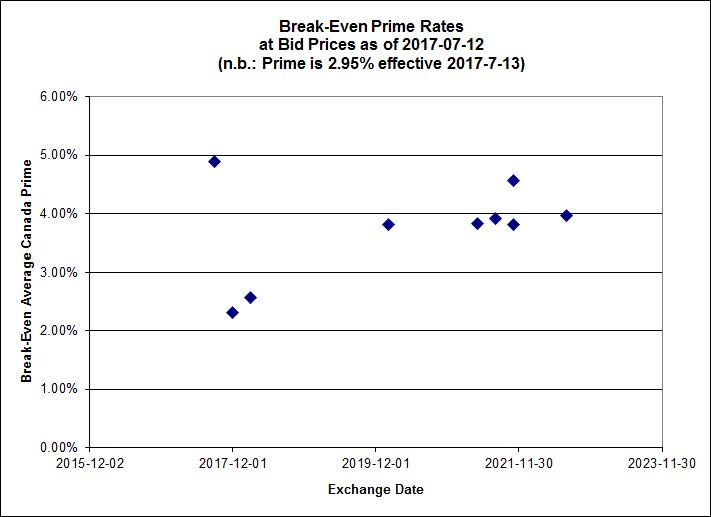
We can show the break-even rates for each FixedReset / FloatingReset Strong Pair graphically by plotting the implied average 3-month bill rate against the next Exchange Date (which is the date to which the average will be calculated).

pairs_fr_170228
Click for Big

The market appears to have a distaste at the moment for floating rate product; most of the implied rates until the next interconversion are lower than the current 3-month bill rate and the averages for investment-grade and junk issues are both well below current market rates, at +0.02% and -0.51%, respectively! Whatever might be the result of the next few Bank of Canada overnight rate decisions, I suggest that it is unlikely that the average rate over the next five years will be lower than current – but if you disagree, of course, you may interpret the data any way you like.

Since credit quality of each element of the pair is equal to the other element, it should not make any difference whether the pair examined is investment-grade or junk, although we might expect greater variation of implied rates between junk issues on grounds of lower liquidity, and this is just what we see.

If we plug in the current bid price of the MFC.PR.H FixedReset, we may construct the following table showing consistent prices for its soon-to-be-issued FloatingReset counterpart given a variety of Implied Breakeven yields consistent with issues currently trading:

Estimate of FloatingReset MFC.PR.S (received in exchange for MFC.PR.H) Trading Price In Current Conditions
  Assumed FloatingReset
Price if Implied Bill
is equal to
FixedReset Bid Price Spread +0.50% 0.00% -0.50%
MFC.PR.H 23.62 313bp 22.92 22.41 21.89

Based on current market conditions, I suggest that the FloatingResets that will result from conversion are likely to be cheap and trading below the price of their FixedReset counterparts. Therefore, I recommend that holders of MFC.PR.H continue to hold the issue and not to convert. I will note that, given the apparent cheapness of the FloatingResets, it may be a good trade to swap the FixedReset for the FloatingReset in the market once both elements of each pair are trading and you can – presumably, according to this analysis – do it with a reasonably good take-out in price, rather than doing it through the company on a 1:1 basis. But that, of course, will depend on the prices at that time and your forecast for the path of policy rates over the next five years. There are no guarantees – my recommendation is based on the assumption that current market conditions with respect to the pairs will continue until the FloatingResets commence trading and that the relative pricing of the two new pairs will reflect these conditions.

Note as well that conversion rights are dependent upon at least one million shares of each series being outstanding after giving effect to holders’ instructions; e.g., if only 100,000 shares of MFC.PR.H are tendered for conversion, then no conversions will be allowed; but if only 100,000 shares of MFC.PR.H will remain after the rest are all tendered, then conversion will be mandatory. However, this is relatively rare: all Strong Pairs have some version of this condition; there are 49 Strong Pairs outstanding; and only ten issues which did not create the potential Strong Pair.

Better Communication, Please!

BPO Has A Website!

I have complained a few times recently (for instance, here and here) about the lack of internet presence of Brookfield Office Properties Inc., a subsidiary of Brookfield Property Partners L.P.; today, I actually did something about it and contacted Matthew Cherry, their Vice President, Investor Relations and Communications, asking about the location of their press releases.

He was kind enough to refer me to the proper page on http://www.bpoinvestor.com.

Great! So now we can look up press releases for BPO, as long as we remember the name of their website! The next step is to convince Brookfield to put links to this site on Brookfield.com in some kind of logical manner and then we’ll be cooking with gas!

BPO has the following preferred share issues outstanding: BPO.PR.A, BPO.PR.C, BPO.PR.E, BPO.PR.J, BPO.PR.K, BPO.PR.N, BPO.PR.P, BPO.PR.R, BPO.PR.S, BPO.PR.T, BPO.PR.W, BPO.PR.X and BPO.PR.Y.

Issue Comments

BPO.PR.K To Be Redeemed

Brookfield Office Properties Inc., a subsidiary of Brookfield Property Partners L.P., has announced:

that it intends to: … Redeem all 5,909,250 of its outstanding Class AAA Preference Shares, Series K (TSX: BPO.PR.K) (the “Series K Shares”), all of which are beneficially held by CDS & Co., as nominee of CDS Clearing and Depositary Services Inc., for cash on March 31, 2017. The redemption price for each such share will be C$25.00 plus accrued and unpaid dividends thereon (which as of March 31, 2017 will be C$0), representing a total redemption price of C$25.00.

Notices of Redemption for both series have been sent to CDS & Co. Payment of the redemption price will be made on or after March 31, 2017 through the facilities of CDS & Co. to … all beneficial holders of the Series K Shares.

BPO.PR.K is a 5.20% Retractible, issued 2004-10-22. It became retractible for shares on 2016-12-31. There was a partial exchange of BPO.PR.K for BPS.PR.C in 2014; BPS is Brookfield Property Split Corp.

So anyway, now we know what the company meant in its press release announcing the issue currently trading as BPO.PR.E. Good catch by Assiduous Reader mbarbon in highlighting their sentence:

The net proceeds of the issue will be used by Brookfield Office Properties for general corporate purposes which may include the redemption of existing preferred shares.

Issue Comments

BPO.PR.J: Partial Call for Redemption

Brookfield Office Properties Inc., a subsidiary of Brookfield Property Partners L.P., has announced:

that it intends to:

  • •Redeem 4,760,750 of its outstanding Class AAA Preference Shares, Series J (TSX: BPO.PR.J) (the “Called Series J Shares”), all of which are beneficially held by CDS & Co., as nominee of CDS Clearing and Depositary Services Inc., for cash on March 31, 2017. The redemption price for each such share will be C$25.00 plus accrued and unpaid dividends thereon (which as of March 31, 2017 will be C$0), representing a total redemption price of C$25.00. The Called Series J Shares will be redeemed on a “pro rata” basis, so that each holder of Class AAA Preference Shares, Series J will have 62.9267290063042% of their Class AAA Preference Shares, Series J redeemed. The pro rata call will be based upon participants’ holdings at the close of business on March 29, 2017.


Notices of Redemption for both series have been sent to CDS & Co. Payment of the redemption price will be made on or after March 31, 2017 through the facilities of CDS & Co. to all beneficial holders of the Called Series J Shares …

Gotta love the 15 significant figures quoted as the proportion to be redeemed!

BPO.PR.J is a 5.00% Retractible, issued 2004-4-30. It became retractible for shares on 2014-12-31. There was a partial exchange of BPO.PR.J for BPS.PR.B in 2014; BPS is Brookfield Property Split Corp.

So anyway, now we know what the company meant in its press release announcing the issue currently trading as BPO.PR.E. Good catch by Assiduous Reader mbarbon in highlighting their sentence:

The net proceeds of the issue will be used by Brookfield Office Properties for general corporate purposes which may include the redemption of existing preferred shares.

Issue Comments

W Upgraded to P-2(low) by S&P Following Parent Merger; DBRS Stands Pat

Enbridge Inc. has announced:

the completion today of the previously announced stock-for-stock merger transaction (the Transaction) to acquire all of the outstanding common stock of Spectra Energy Corp (NYSE:SE) (Spectra Energy).

This led Standard & Poor’s to announce:

  • •On Feb. 27, 2017, Enbridge Inc. announced the completion of its merger with Spectra Energy Corp. in a share-exchange transaction.
  • •With the merger’s completion, Spectra subsidiary Westcoast Energy Inc. will become a wholly owned subsidiary of Enbridge Inc.
  • •We view Westcoast as a core subsidiary of Enbridge, so we are raising our ratings on Westcoast, including our long-term corporate credit rating to ‘BBB+’ from ‘BBB’.
  • •We removed the ratings from CreditWatch, where they were placed with positive implications Sept. 6, 2016.
  • •The stable outlook on Westcoast reflects the outlook on ultimate parent Enbridge.


S&P Global Ratings today said it raised its ratings on Westcoast Energy Inc., including its long-term corporate credit and senior unsecured debt ratings on the company to ‘BBB+’ from ‘BBB’. S&P Global Ratings removed the ratings from CreditWatch, where they were placed with positive implications Sept. 6, 2016. The outlook is stable.

Enbridge Inc. has announced its merger with Spectra Energy Corp., under which Spectra and all its subsidiaries, including Westcoast, will merge with Enbridge at the closing of this share-exchange transaction.

The stable outlook on Westcoast reflects the outlook on parent Enbridge,
because we view Westcoast to be a core subsidiary under our criteria, so have
linked the ratings and outlooks on the two.

The stable outlook on Enbridge reflects our view that the transaction with Spectra will not result in material asset dispositions that do not repay debt, or changes in proposed financing for the combined capital program that increase the proportion of debt. In addition, we expect that the planned capital program will occur on time and budget, and that the financing plans will maintain adjusted funds from operations (AFFO)-to-debt at the low end of the significant financial risk profile category at about 14%.

The new S&P rating for the Westcoast preferreds, W.PR.H, W.PR.J, W.PR.K and W.PR.M, is now P-2(low), up a notch (but an important notch!) from P-3(high).

DBRS commented on the merger:

DBRS continues to believe that the merger does not have any impact on the credit quality of Spectra and its DBRS-rated subsidiaries as no changes are currently contemplated to Spectra, its subsidiaries and counterparties, as a result of the Transaction. As a result, the stand-alone credit profiles of Spectra and its DBRS-rated subsidiaries remain unchanged.

With respect to Enbridge, DBRS confirmed all ratings:

DBRS Limited (DBRS) has today confirmed the following ratings of Enbridge Inc. (ENB) and removed them from Under Review with Developing Implications where they were placed on September 6, 2016. The trends are Stable:

— ENB, Issuer Rating of BBB (high)
— ENB, Medium-Term Notes & Unsecured Debentures rated BBB (high)
— ENB, Cumulative Redeemable Preferred Shares rated Pfd-3 (high)
— ENB, Commercial Paper rated R-2 (high)

With respect to financial risk profile, DBRS expects ENB to meet its key target metrics of 15% funds from operations (FFO) to debt and five times debt-to-EBITDA, likely in late 2018 or early 2019. DBRS notes the combined entity’s substantial medium-term capex program and consequently expects near-term pressure on ENB’s credit metrics to continue. DBRS expects the recovery in key credit metrics (on both consolidated and non-consolidated bases) at the combined entity to be faster than previously expected from ENB on a stand-alone basis. This expectation is consistent with a number of key DBRS assumptions, including the migration of the combined entity’s common dividend payout ratio toward the low end of the 50% to 60% range over the medium term, the achievement of expected run-rate synergies and estimated tax savings, and that there is no increase in structural subordination at the ENB level from currently contemplated levels.

The Stable trends incorporate DBRS’s expectation that any incremental investments in new projects will be consistent with maintaining a strong overall business risk profile and medium-term improvement in key credit metrics. Changes to any of these and other key assumptions would cause DBRS to revisit the current ratings and/or trends.

Issue Comments

ALA.PR.K Firm On Excellent Volume

AltaGas Ltd. has announced:

that it has closed its previously announced public offering of 12,000,000 Cumulative 5-Year Minimum Rate Reset Redeemable Preferred Shares, Series K (the “Series K Preferred Shares”), at a price of $25.00 per Series K Preferred Share (the “Offering”) for aggregate gross proceeds of $300 million.

The Offering was first announced on February 13, 2017 when AltaGas entered into an agreement with a syndicate of underwriters co-led by CIBC Capital Markets, BMO Capital Markets, National Bank Financial Inc. and Scotiabank.

Net proceeds will be used to reduce existing indebtedness and for general corporate purposes.

The Series K Preferred Shares will commence trading today on the Toronto Stock Exchange (“TSX”) under the symbol ALA.PR.K.

ALA.PR.K is a FixedReset, 5.00%+380M500, announced 2017-2-13. It will be tracked by HIMIPref™ but relegated to the Scraps subindex on credit concerns.

The issue traded 1,402,187 shares today in a range of 25.01-10 before closing at 25.09-11, 6×10. Vital statistics are:

ALA.PR.K FixedReset YTW SCENARIO
Maturity Type : Limit Maturity
Maturity Date : 2047-02-22
Maturity Price : 23.18
Evaluated at bid price : 25.09
Bid-YTW : 4.90 %

Implied Volatility analysis indicates that while the new issue is reasonably a little cheap, a cheaper alternative for this name is available with ALA.PR.A:

impvol_ala_170222
Click for Big
Issue Comments

MFC.PR.H To Reset At 4.312%

Manulife Financial Corporation has announced:

the applicable dividend rates for its Non-cumulative Rate Reset Class 1 Shares Series 7 (the “Series 7 Preferred Shares”) (TSX: MFC.PR.H) and Non-cumulative Floating Rate Class 1 Shares Series 8 (the “Series 8 Preferred Shares”).

With respect to any Series 7 Preferred Shares that remain outstanding after March 19, 2017, holders thereof will be entitled to receive fixed rate non-cumulative preferential cash dividends on a quarterly basis, as and when declared by the Board of Directors of Manulife and subject to the provisions of the Insurance Companies Act (Canada). The dividend rate for the five-year period commencing on March 20, 2017, and ending on March 19, 2022, will be 4.31200% per annum or $0.269500 per share per quarter, being equal to the sum of the five-year Government of Canada bond yield as at February 21, 2017, plus 3.13%, as determined in accordance with the terms of the Series 7 Preferred Shares.

With respect to any Series 8 Preferred Shares that may be issued on March 19, 2017 in connection with the conversion of the Series 7 Preferred Shares into the Series 8 Preferred Shares, holders thereof will be entitled to receive floating rate non-cumulative preferential cash dividends on a quarterly basis, calculated on the basis of actual number of days elapsed in each quarterly floating rate period divided by 365, as and when declared by the Board of Directors of Manulife and subject to the provisions of the Insurance Companies Act (Canada). The dividend rate for the three-month period commencing on March 20, 2017, and ending on June 19, 2017, will be 0.90639% (3.59600% on an annualized basis) or $0.226598 per share, being equal to the sum of the three-month Government of Canada Treasury bill yield as at February 21, 2017, plus 3.13%, as determined in accordance with the terms of the Series 8 Preferred Shares.

Beneficial owners of Series 7 Preferred Shares who wish to exercise their right of conversion should instruct their broker or other nominee to exercise such right before 5:00 p.m. (Toronto time) on March 6, 2017. The news release announcing such conversion right was issued on February 10, 2017 and can be viewed on SEDAR or Manulife’s website. Conversion inquiries should be directed to Manulife’s Registrar and Transfer Agent, CST Trust Company, at 1‑800-387-0825.

The Toronto Stock Exchange (“TSX”) has conditionally approved the listing of the Series 8 Preferred Shares effective upon conversion. Listing of the Series 8 Preferred Shares is subject to Manulife fulfilling all the listing requirements of the TSX and, upon approval, the Series 8 Preferred Shares will be listed on the TSX under the trading symbol “MFC.PR.S”.

MFC.PR.H is a FixedReset, 4.60%+313, that commenced trading 2012-2-22 after being announced 2012-2-14. The notice of extension was previously reported.

The most logical way to analyze the question of whether or not to convert is through the theory of Preferred Pairs, for which a calculator is available. Briefly, a Strong Pair is defined as a pair of securities that can be interconverted in the future (e.g., MFC.PR.H and the FloatingReset MFC.PR.S that will exist if enough holders convert). Since they will be interconvertible on this future date, it may be assumed that they will be priced identically on this date (if they aren’t then holders will simply convert en masse to the higher-priced issue). And since they will be priced identically on a given date in the future, any current difference in price must be offset by expectations of an equal and opposite value of dividends to be received in the interim. And since the dividend rate on one element of the pair is both fixed and known, the implied average rate of the other, floating rate, instrument can be determined. Finally, we say, we may compare these average rates and take a view regarding the actual future course of that rate relative to the implied rate, which will provide us with guidance on which element of the pair is likely to outperform the other until the next interconversion date, at which time the process will be repeated.

We can show the break-even rates for each FixedReset / FloatingReset Strong Pair graphically by plotting the implied average 3-month bill rate against the next Exchange Date (which is the date to which the average will be calculated).

pairs_fr_170223
Click for Big

The market appears to have a distaste at the moment for floating rate product; most of the implied rates until the next interconversion are lower than the current 3-month bill rate and the averages for investment-grade and junk issues are both well below current market rates, at -0.51% and -0.64%, respectively! Whatever might be the result of the next few Bank of Canada overnight rate decisions, I suggest that it is unlikely that the average rate over the next five years will be lower than current – but if you disagree, of course, you may interpret the data any way you like.

Since credit quality of each element of the pair is equal to the other element, it should not make any difference whether the pair examined is investment-grade or junk, although we might expect greater variation of implied rates between junk issues on grounds of lower liquidity, and this is just what we see.

If we plug in the current bid price of the MFC.PR.H FixedReset, we may construct the following table showing consistent prices for its soon-to-be-issued FloatingReset counterpart given a variety of Implied Breakeven yields consistent with issues currently trading:

Estimate of FloatingReset (received in exchange for MFC.PR.H) Trading Price In Current Conditions
  Assumed FloatingReset
Price if Implied Bill
is equal to
FixedReset Bid Price Spread 0.00% -0.50% -1.00%
MFC.PR.H 23.98 313bp 22.76 22.24 21.73

Based on current market conditions, I suggest that the FloatingResets that will result from conversion are likely to be cheap and trading below the price of their FixedReset counterparts. Therefore, it seems likely that I will recommend that holders of MFC.PR.H continue to hold the issue and not to convert, but I will wait until it’s closer to the March 6 notification deadline before making a final pronouncement. I will note that, given the apparent cheapness of the FloatingResets, it may be a good trade to swap the FixedReset for the FloatingReset in the market once both elements of each pair are trading and you can – presumably, according to this analysis – do it with a reasonably good take-out in price, rather than doing it through the company on a 1:1 basis. But that, of course, will depend on the prices at that time and your forecast for the path of policy rates over the next five years. There are no guarantees – my recommendation is based on the assumption that current market conditions with respect to the pairs will continue until the FloatingResets commence trading and that the relative pricing of the two new pairs will reflect these conditions.

Insofar as the relative valuation of MFC.PR.H is concerned, Implied Volatility analysis indicates it’s fairly priced relative to other MFC issues:

impvol_mfc_170223
Click for Big

In fact, the entire series is well-behaved, with the exception of MFC.PR.F, which looks about $1.40 cheap (according to this analysis!).

Issue Comments

ALB.PR.C Upgraded to Pfd-2 by DBRS

DBRS has announced that it:

has today upgraded the rating on the Class B Preferred Shares, Series 2 (the Series 2 Preferred Shares) issued by Allbanc Split Corp. II (the Company) to Pfd-2 from Pfd-2 (low). In February 2016, the Company offered 687,567 Series 2 Preferred Shares at $25.67 each as part of a share reorganization. The Series 2 Preferred Shares were issued to maintain the leveraged split share structure of the Company so that the number of issued and outstanding Class A Capital Shares is twice the number of issued and outstanding Series 2 Preferred Shares. The maturity date for the Series 2 Preferred Shares is February 28, 2021.

The current yield on the Portfolio shares fully covers the Series 2 Preferred Share dividends, providing dividend coverage of approximately 1.5 times (x). The Class A Capital Shares are expected to receive all excess dividend income after the Series 2 Preferred Share distributions and other expenses of the Company have been paid.

In the past year, the downside protection available to the Series 2 Preferred Shares, although being volatile, has been gradually increasing, reaching approximately 67.7% as of February 16, 2017.

ALB.PR.C is tracked by HIMIPref™ but relegated to the Scraps index on credit concerns.

Issue Comments

VSN / CPX Deal: Not Great for VSN, says DBRS

Veresen Inc. has announced:

it has entered into a suite of separate agreements to sell its power generation business for $1.18 billion.

Veresen has maximized the value of its power business by selling the assets in three separate packages.

Each of the agreements is subject to closing adjustments and conditions customary in transactions of this nature. Closing is expected to occur during the second quarter of 2017 subject to the receipt of all necessary approvals. Veresen anticipates the minimal amount of cash taxes arising from the sale of the power business will be recovered in the following year. The company expects to update its 2017 guidance for the divestiture of the power business upon the closing of the sale process. TD Securities Inc. acted as the company’s sole financial advisor on this divestiture.

… and Capital Power Corporation has announced:

that it has entered into an agreement to acquire the thermal power business of Veresen Inc., consisting of two gas-fired generation facilities and two waste heat assets.

Under the terms of the agreement, Capital Power will acquire 284 megawatts (MW, net) of generation from two natural gas-fired power assets in Ontario consisting of the 84 MW East Windsor Cogeneration Centre (East Windsor) and a 50% interest in the 400 MW York Energy Centre (York Energy), and will operate both facilities. Both East Windsor and York Energy are under long-term power purchase agreements (PPAs) with the Ontario Independent Electricity System Operator (IESO, A rated) with original terms expiring in 2029 and 2032, respectively. Both assets earn revenue through fixed capacity payments partly indexed to inflation and are compensated for operations and maintenance, and fuel (commodity and transportation) as well as start-up costs. Additionally, East Windsor is under a long-term steam supply agreement with Ford Motor Company (BBB rated).

The purchase price for the acquisition is $225 million in total cash consideration, subject to working capital adjustments and other closing adjustments, and the assumption of $275 million of project level debt (proportionate basis). Capital Power expects to finance the transaction through existing cash and its credit facilities. The transaction is expected to close in the second quarter of 2017, subject to regulatory approvals and satisfaction of closing conditions.

The acquisition is expected to increase adjusted funds from operations (AFFO) by an estimated $24 million in the first full year of operations, which will be accretive by 25 cents per share reflecting a 7% increase. The acquisition is expected to be accretive to earnings by 11 cents per share during its first full year of operations. The projected annual EBITDA generated by the assets is estimated to be $55 million per year.

With respect to VSN, DBRS comments:

DBRS had placed Veresen’s ratings Under Review with Negative Implications on August 4, 2016, following the Company’s announcement that it would sell its power generation business, suspend its Premium Dividend and Dividend Reinvestment Plan (DRIP) and maintain its current dividend payout. Proceeds from the sale of the power business will be invested to develop Veresen’s midstream projects in the core natural gas and natural gas liquids infrastructure business. DBRS believes that this announcement negatively affects Veresen’s business risk profile. Please refer to the DBRS press releases “DBRS Places Veresen Inc.’s Ratings Under Review with Negative Implications,” dated August 4, 2016, and “DBRS Maintains Veresen Inc.’s Ratings Under Review with Negative Implications Status,” dated November 18, 2016. DBRS notes that today’s announcement by the Company is consistent with its announcement on August 4, 2016. Consequently, DBRS is maintaining the Under Review with Negative Implications status on Veresen’s ratings. DBRS will further review the details relating to the sale transactions as they become available and aims to resolve the Under Review with Negative Implications status after the sale transactions have closed in Q2 2017.

With respect to CPX, DBRS comments:

DBRS views the Acquisition as having a modestly positive impact on CPC’s Business Risk Assessment factors as (1) the Acquisition assets are supported by long-term PPAs with highly rated counterparties; (2) cash flow from the Acquisition assets is expected to be stable reflecting the nature of capacity contract payments, which account for approximately 80% of the revenues of the Acquisition assets; and (3) the assets being located outside of Alberta also provides CPC with additional geographic diversification, away from the heightened political risk in the province. However, DBRS views the impact of the Acquisition to be modestly negative on CPC’s credit ratios as a result of additional debt from the Acquisition. Overall, DBRS does not view the Acquisition as having either a material positive or negative impact on CPC’s rating.

DBRS notes that CPC’s rating remains BBB with a Negative trend due to Alberta’s challenging wholesale power market environment and heightened political risk for the power market in Alberta. DBRS expects the Negative trend to be resolved upon the completion of its annual review of the Company, which is anticipated to occur in March 2017.

DBRS’ Review Negative of VSN was reported on PrefBlog here and here. The Negative Trend noted by DBRS with respect to CPX does not affect the preferred shares.

Affected VSN issues are VSN.PR.A, VSN.PR.C and VSN.PR.E.

Affected CPX issues are CPX.PR.A, CPX.PR.C, CPX.PR.E and CPX.PR.E.