Category: Issue Comments

Issue Comments

RON.PR.A, RON.PR.B Upgraded to P-2 by S&P

Standard & Poor’s has announced:

  • •Boucherville, Que.-based RONA Inc. recently announced that Lowe’s Cos. Inc. (A-/Stable/A-2) has provided guarantees of the obligations under RONA’s preferred shares and debentures outstanding.
  • •As a result, we are raising our issue-level rating on RONA’s senior unsecured notes to ‘A-‘ from ‘BBB+’ and our global scale rating on the company’s preferred shares to ‘BBB’ from ‘BBB-‘.
  • •At the same time, we are affirming our ‘BBB+’ long-term corporate credit rating on RONA.
  • •The stable outlook on RONA reflects our stable outlook on Lowe’s and our expectation that over our two-year outlook horizon, RONA’s stand-alone business and financial risk profiles should be unchanged.


RONA recently announced that Lowe’s Cos. Inc. (A-/Stable/A-2) has guaranteed RONA’s preferred shares outstanding as well as the company’s 5.4% debentures due Oct. 20, 2016.

“We base the upgrade on Lowe’s guarantee of RONA’s preferred shares and debentures outstanding,” said S&P Global Ratings credit analyst Alessio Di Francesco.

In our opinion, this guarantee has enhanced the credit profile of these issues resulting in a one-notch upgrade. Our rating on RONA’s senior unsecured debentures is now equalized with our ‘A-‘ issue-level rating on Lowe’s senior unsecured notes. Our ‘BBB’ global scale rating on RONA’s preferred shares is two notches below our long-term corporate credit rating on Lowe’s (guarantor). The notching incorporates our view that the preferred shares have an optional deferral feature and are subordinated to Lowe’s debt outstanding.

The guarantee by Lowe’s has been previously reported on PrefBlog. DBRS has discontinued its rating of RONA, so the S&P rating is the only one available. S&P previously rated the issues P-2(low) following the closing of the takeover via Plan of Arrangement on May 20. RONA’s preferred shareholders turned down a $20 cash offer that was part of the plan. Since March 31, the TXPR total return index has returned +5.42%, while RON.PR.A is up 3.75% from the $20 offer.

Issue Comments

CSE.PR.A: No Conversion

Capstone Infrastructure Corporation has announced:

that none of its Cumulative 5-Year Rate Reset Preferred Shares, Series A (the “Series A shares”) will be converted into Cumulative Floating Rate Preferred Shares, Series B (the “Series B shares”).

On June 10, 2016, Capstone notified holders of Series A shares that they could elect to convert their Series A shares into Series B shares, subject to the terms and conditions of those shares. One such condition is that, following conversion, there be at least 1,000,000 Series B shares outstanding or else no Series A shares will be converted.

As of 5:00 p.m. (EST) on July 18, 2016, the end of the period during which holders of Series A shares could elect to convert their Series A shares into Series B shares, elections for conversion into Series B shares were received in respect of only 429,367 of the 3,000,000 outstanding Series A shares. As a result, the above condition is not satisfied and no Series A shares will be converted into Series B shares. All holders of Series A shares will continue to hold Series A shares.

As previously announced, for the five year period from and including July 31, 2016 to but excluding July 31, 2021, the fixed annual dividend rate for the Series A shares has been set at 3.271% per share, payable in equal quarterly amounts on the last day of each of the months of January, April, July and October if, as and when dividends are declared by the Board of Directors of Corporation.

I have previously reported on the extension of CSE.PR.A, the reset to 3.271% and recommended against conversion.

Issue Comments

BCE.PR.I / BCE.PR.J : Convert Or Hold?

It will be recalled that BCE.PR.I will reset to 2.75% effective August 1.

Holders of BCE.PR.I have the option to convert to the RatchetRate issue, BCE.PR.J, which pays a percentage of Canada Prime on the par value of $25.00. The percentage is currently 100% and will not decline unless the trading price of BCE.PR.J rises above $25, which seems rather unlikely in the current environment. The deadline for notifying the company of the intent to convert is July 22, 2016; but note that this is a company deadline and that brokers will generally set their deadlines a day or two in advance, so there’s not much time to lose if you’re planning to convert! However, if you miss the brokerage deadline they’ll probably do it on a ‘best efforts’ basis if you grovel in a sufficiently entertaining fashion.

It will also be noted that holders of BCE.PR.J have the option of converting to BCE.PR.I. After the dust settled following the last Exchange Date five years ago, about 25% of the total was BCE.PR.J.

The most logical way to analyze the question of whether or not to convert is through the theory of Preferred Pairs, for which a calculator is available. Briefly, a Strong Pair is defined as a pair of securities that can be interconverted in the future (e.g., BCE.PR.I and BCE.PR.J, which will have another Exchange Date in five years). Since they will be interconvertible on this future date, it may be assumed that they will be priced identically on this date (if they aren’t then holders will simply convert en masse to the higher-priced issue). And since they will be priced identically on a given date in the future, any current difference in price must be offset by expectations of an equal and opposite value of dividends to be received in the interim. And since the dividend rate on one element of the pair is both fixed and known, the implied average rate of the other, floating rate, instrument can be determined. Finally, we say, we may compare these average rates and take a view regarding the actual future course of that rate relative to the implied rate, which will provide us with guidance on which element of the pair is likely to outperform the other until the next interconversion date, at which time the process will be repeated.

We can show the break-even rates for each FixedFloater / RatchetRate Strong Pair graphically by plotting the implied average Canada Prime rate against the next Exchange Date (which is the date to which the average will be calculated).

pairs_FF_160719
Click for Big

There’s a fair bit of scatter, but most pairs are within shouting distance of a 2.70% breakeven rate – that is, most pairs are priced such that the total return of the component issues will be equal if Canada Prime remains at 2.70% until the relevant Exchange Date.

Since credit quality of each element of the pair is equal to the other element, it should not make any difference whether the pair examined is investment-grade or junk, although we might expect greater variation of implied rates between junk issues on grounds of lower liquidity, and this is just what we see.

And, of course, since BCE.PR.I will reset to 2.75%, this is equivalent to saying the prices currently and the prices expected to be effective following the Exchange Date are roughly equal. I do not believe that any gains can be expected to be made, or losses expected to be avoided, by holding either issue.

However, on a looking forward basis, I find it more believable that the average Canada Prime over the next five years will exceed 2.70% than I find it to believe that the rate will average lower than current.

Therefore, I recommend that holders of BCE.PR.I convert to BCE.PR.J and that holders of BCE.PR.J continue to hold their shares.

Note that conversion rights are dependent upon at least one million shares of each series being outstanding after giving effect to holders’ instructions; e.g., if only 100,000 shares of BCE.PR.I will remain after all instructions are executed, then all BCE.PR.I will be converted and no BCE.PR.J will convert to BCE.PR.I. And the other way ’round, of course, if practically everybody wants to hold BCE.PR.I. However, this is relatively rare: all 51 Strong Pairs currently extant have some version of this condition and all but six have both series outstanding.

Issue Comments

RON.PR.A, RON.PR.B Guaranteed By Lowes, Reducing Reporting Requirements

Lowe’s Companies, Inc. has announced (although not yet on their website):

RONA inc. (TSX:RON.PR.A)(TSX:RON.PR.B) (“RONA”) today announced that Lowe’s Companies, Inc. (“Lowe’s”) has provided guarantees of the obligations of RONA under RONA’s outstanding Cumulative 5-Year Rate Reset Series 6 Class A Preferred Shares and Cumulative Floating Rate Series 7 Class A Preferred Shares as well as RONA’s 5.40% debentures due October 20, 2016.

The full text of the guarantees have been filed with the Canadian securities regulators and are available on RONA’s profile at www.sedar.com. As a result and in accordance with applicable securities laws and exemptions therefrom, RONA will satisfy its continuous disclosure requirements and other related reporting requirements going forward by filing copies of all disclosure and financial reporting documents Lowe’s is required to file with the Securities and Exchange Commission under the Securities Exchange Act of 1934, as well as certain prescribed summary financial information for RONA, on RONA’s profile at www.sedar.com, and it will no longer be required to file full quarterly and audited annual financial statements in respect of RONA.

Recently, DBRS has discontinued rating these issues while S&P rated them P-2(low) after the takeover closed in May following the decision by preferred shareholders to scorn the $20 offer.

The preferred shareholders figured that keeping RONA as a reporting issuer would be so expensive for Lowe’s that they would gladly pay the full $25 redemption price to get rid of the obligation – I’m not sure if they counted on this maneuver!

Issue Comments

CSE.PR.A: Convert Or Hold?

It will be recalled that CSE.PR.A will reset to 3.271% effective July 31.

Holders of CSE.PR.A have the option to convert to FloatingResets, which will pay 3-month bills plus 271bp on the par value of $25.00, reset quarterly. The deadline for notifying the company of the intent to convert is 5:00 p.m. (EST) on July 18, 2016; but note that this is a company deadline and that brokers will generally set their deadlines a day or two in advance, so there’s not much time to lose if you’re planning to convert! However, if you miss the brokerage deadline they’ll probably do it on a ‘best efforts’ basis if you grovel in a sufficiently entertaining fashion. The ticker for the new FloatingReset, if it is created, has not yet been confirmed.

The most logical way to analyze the question of whether or not to convert is through the theory of Preferred Pairs, for which a calculator is available. Briefly, a Strong Pair is defined as a pair of securities that can be interconverted in the future (e.g., BAM.PR.R and the FloatingReset that will exist if enough holders convert). Since they will be interconvertible on this future date, it may be assumed that they will be priced identically on this date (if they aren’t then holders will simply convert en masse to the higher-priced issue). And since they will be priced identically on a given date in the future, any current difference in price must be offset by expectations of an equal and opposite value of dividends to be received in the interim. And since the dividend rate on one element of the pair is both fixed and known, the implied average rate of the other, floating rate, instrument can be determined. Finally, we say, we may compare these average rates and take a view regarding the actual future course of that rate relative to the implied rate, which will provide us with guidance on which element of the pair is likely to outperform the other until the next interconversion date, at which time the process will be repeated.

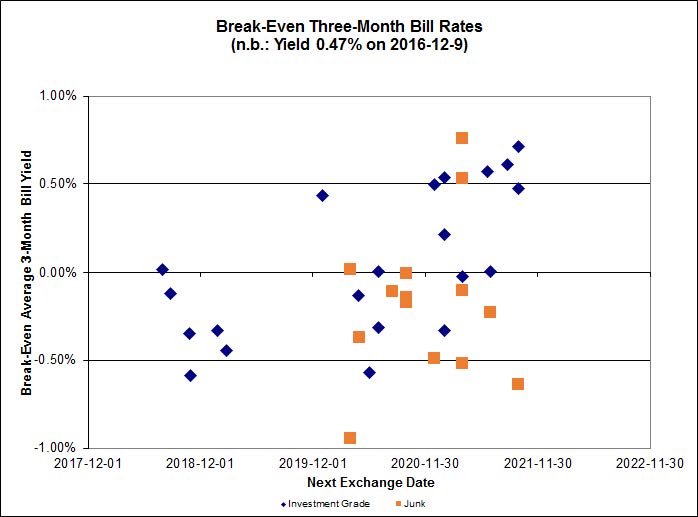
We can show the break-even rates for each FixedReset / FloatingReset Strong Pair graphically by plotting the implied average 3-month bill rate against the next Exchange Date (which is the date to which the average will be calculated).

pairs_FR_160712
Click for Big

The market appears to have a distaste at the moment for floating rate product; most of the implied rates until the next interconversion are lower than the current 3-month bill rate and the averages for investment-grade and junk issues are both below zero, at -0.90% and -0.27%, respectively! Whatever might be the result of the next few Bank of Canada overnight rate decisions, I suggest that it is unlikely that the average rate over the next five years will be lower than current – but if you disagree, of course, you may interpret the data any way you like.

Since credit quality of each element of the pair is equal to the other element, it should not make any difference whether the pair examined is investment-grade or junk, although we might expect greater variation of implied rates between junk issues on grounds of lower liquidity, and this is just what we see.

If we plug in the current bid price of the CSE.PR.A FixedReset, we may construct the following table showing consistent prices for its soon-to-be-issued FloatingReset counterpart given a variety of Implied Breakeven yields consistent with issues currently trading:

Estimate of FloatingReset (received in exchange for CSE.PR.A) Trading Price In Current Conditions
  Assumed FloatingReset
Price if Implied Bill
is equal to
FixedReset Bid Price Spread 0.00% -0.50% -1.00%
CSE.PR.A 11.35 271bp 10.88 10.41 9.95

Based on current market conditions, I suggest that the FloatingResets that will result from conversion are likely to be cheap and trading below the price of their FixedReset counterparts. Therefore, I recommend that holders of CSE.PR.A continue to hold the issue and not to convert. I will note that, given the apparent cheapness of the FloatingResets, it may be a good trade to swap the FixedReset for the FloatingReset in the market once both elements of each pair are trading and you can – presumably, according to this analysis – do it with a reasonably good take-out in price, rather than doing it through the company on a 1:1 basis. But that, of course, will depend on the prices at that time and your forecast for the path of policy rates over the next five years. There are no guarantees – my recommendation is based on the assumption that current market conditions with respect to the pairs will continue until the FloatingResets commence trading and that the relative pricing of the two new pairs will reflect these conditions.

Note as well that conversion rights are dependent upon at least one million shares of each series being outstanding after giving effect to holders’ instructions; e.g., if only 100,000 shares of CSE.PR.A are tendered for conversion, then no conversions will be allowed; but if only 100,000 shares of CSE.PR.A will remain after the rest are all tendered, then conversion will be mandatory. However, this is relatively rare: all 51 Strong Pairs currently extant have some version of this condition and all but six have both series outstanding.

Issue Comments

BCE.PR.I To Reset To 2.75%

BCE Inc. has announced that:

BCE Inc. will, on August 1, 2016, continue to have Cumulative Redeemable First Preferred Shares, Series AI (“Series AI Preferred Shares”) outstanding if, following the end of the conversion period on July 22, 2016, BCE Inc. determines that at least 2 million Series AI Preferred Shares would remain outstanding. In such a case, as of August 1, 2016, the Series AI Preferred Shares will pay, on a quarterly basis, as and when declared by the Board of Directors of BCE Inc., a fixed cash dividend for the following five years that will be based on an annual fixed dividend rate equal to 2.75%.

The pending Exchange Date has been previously reported. As noted there, this FixedFloater issue is interconvertible with the Ratchet Rate preferred, BCE.PR.J:

In order to convert your shares, you must exercise your right of conversion during the conversion period, which runs from June 17, 2016 to July 22, 2016, inclusively.

I will make a recommendation regarding conversion on July 18, but at this point I’m leaning towards the RatchetRate issue, BCE.PR.J, on the grounds that Canada Prime is 2.70% and I find it much easier to believe in an increase over the next five years than a decrease, the current breakeven rate (given bids of 13.48 for BCE.PR.I and 13.59 for BCE.PR.J) of 2.86% is in line with other issues, and the prices are – given current conditions – likely to be so close together after the exchange that there’s not much point trying to make a trading profit based on the conversion.

pairs_FF_160712
Click for Big
Issue Comments

FCS.PR.C: Partial Redemption

Faircourt Asset Management Inc. has announced (although not yet on their website):

that $1,000,000.00 in aggregate principal amount of the Trust’s 6.00% outstanding Preferred Securities (the “Preferred Securities”) will be redeemed on July 27, 2016 (the “Redemption Payment Date”). The record date of the Preferred Securities partial redemption is July 25, 2016.

Proceeds from the Preferred Securities redemption will amount to $10.0450 for each $10.00 principal amount of Securities, being equal to the aggregate of (i) $10.00 (the “Redemption Price”), and (ii) all accrued and unpaid interest hereon to but excluding the Redemption Payment Date (collectively, the “Total Redemption Price”).

The interest upon the principal amount of Preferred Securities called for redemption shall cease to be payable from and after the Redemption Date, unless payment of the Total Redemption Price shall not be made on presentation for surrender of such Securities on or after the Redemption Date or prior to the setting aside of the Total Redemption Price pursuant to the Indenture.

Securities will be redeemed pro rata from each beneficial holder of Securities pursuant to the procedures of CDS Clearing and Depository Services Inc. Beneficial holders of Preferred Securities should contact their broker with any questions regarding the redemption.

FCS.PR.C is a SplitShare paying 6% p.a. (interest) on a par value of $10, maturing 2019-6-30, that commenced trading 2014-12-30. It is tracked by HIMIPref™ but is relegated to the Scraps index on credit concerns.

Issue Comments

HSB: S&P States "Outlook Negative"

Standard & Poor’s has announced:

  • •In our view, the “leave” result in the U.K.’s June 2016 referendum on EU membership (“Brexit”) has increased the risks of adverse economic developments in the U.K. As a result, we now see a negative trend for U.K. banking industry economic risk.
  • •We also believe that the U.K. economy has now entered into a correction phase, driven by our revised expectation that imbalances will worsen as credit growth slows and real house prices contract. However, we consider that banks’ underwriting standards, low interest rates, and low unemployment should mitigate the extent of losses in the banking sector.
  • •We are therefore revising to negative from stable our outlook on the majority of U.K. domestic banks, as described below, while affirming their ratings.


In our opinion, the outcome of the Brexit vote is a seminal event, and will lead to a less predictable, stable, and effective economic policy framework in the U.K. The Brexit result could lead to a deterioration of the U.K.’s economic performance, including its large financial services sector, which is a major contributor to employment and public receipts. As such, we recognize that there is a high degree of uncertainty in the near term. In particular, it is not clear if the U.K. will retain access to the EU single market–the destination of 44% of its exports–on existing terms. Future arrangements regarding the export of services, including by the U.K.’s important financial services industry, are equally uncertain, in our view.

HSBC HOLDINGS PLC

We revised the outlook on group NOHC HSBC Holdings PLC, and certain European and North American subsidiaries, to negative from stable. These subsidiaries include HSBC Bank PLC, HSBC France, HSBC USA Inc., HSBC Bank USA N.A., and HSBC Bank Canada (see Ratings List for full details). The stable outlook on The Hongkong and Shanghai Banking Corp. Ltd. (HBAP) and the outlooks on its subsidiaries across Asia-Pacific remain unchanged. This is because potential extraordinary support from the Hong Kong government would maintain the long-term rating on HBAP at ‘AA-‘ if we were to downgrade HSBC Holdings by one
notch.

The negative outlook reflects potential pressures over our two-year rating horizon arising from the U.K.’s vote to leave the EU and China’s economic slowdown. Although HSBC’s highly diversified business profile and strengthening capitalization are significant mitigants, we nevertheless identify risks to asset quality and revenues that may challenge the current ratings. In particular, we expect uncertainty over whether the U.K.’s future relationship with the EU will hinder the U.K. economy. China’s economic slowdown appears to have had little impact to date on HSBC’s risk profile, but we remain alert to signs of credit deterioration in its material exposure across the Asia-Pacific region. Increased market uncertainty could also prevent HSBC from achieving its strategic priorities. The negative outlook also takes account of other factors–the prolonged period of low global interest rates, HSBC’s ongoing U.S. deferred prosecution agreement, and its outstanding litigation cases.

Affected issues are HSB.PR.C and HSB.PR.D , both of which are DeemedRetractibles trading slightly below par.

Issue Comments

DBRS Discontinues Rating of RON.PR.A, RON.PR.B

DBRS quietly announced on June 29 that it:

has today discontinued the Issuer Rating, Senior Unsecured Debt and Preferred Shares ratings of RONA inc. (RONA or the Company). The ratings are being discontinued at the request of the Company, prior to resolving the Under Review with Positive Implications status, as DBRS did not have sufficient information at this time regarding Lowe’s Companies, Inc.’s (Lowe’s; rated A (low), Stable by DBRS) financial management intentions as it relates to RONA.

On February 3, 2016, DBRS placed RONA’s ratings Under Review with Positive Implications after the Company’s announcement that it had entered into a definitive under which RONA would be acquired by Lowe’s for a total transaction value of $3.2 billion. On May 20, 2016, Lowe’s announced that it had completed its acquisition of RONA.

Thus, S&P’s rating of P-2(low) is the only agency opinion on these issues, following the closing of the Plan of Arrangement earlier this year.

Issue Comments

SJR.PR.B Listed With Some Trading

SJR.PR.B, the new FloatingReset that has come into existence via partial exchange from SJR.PR.A, is now trading.

The 17% conversion rate has been reported previously; Assiduous Readers will remember that I recommended against conversion. SJR.PR.A now pays 2.791% (on par) until 2021-6-30, while SJR.PR.B will pay 3-month bills +200bp, reset quarterly.

SJR.PR.B closed July 4 with a quote of 12.01-50, 7×3. Surprisingly, 1,687 shares traded in a range of 12.30-00.

Vital statistics are:

SJR.PR.A FloatingReset YTW SCENARIO
Maturity Type : Limit Maturity
Maturity Date : 2046-07-04
Maturity Price : 13.26
Evaluated at bid price : 13.26
Bid-YTW : 4.98 %
SJR.PR.B FloatingReset YTW SCENARIO
Maturity Type : Limit Maturity
Maturity Date : 2046-07-04
Maturity Price : 12.01
Evaluated at bid price : 12.01
Bid-YTW : 5.23 %

The $1.25 price difference between the two elements of the Strong Pair (I told you not to convert!) implies a break-even three-month bill rate of -1.03% – at the low end of the range defined by the other junk Strong Pairs.

pairs_FR_160704
Click for Big