Category: Issue Comments

Issue Comments

SJR.PR.A / SJR.PR.B: 17% Conversion To FloatingReset

Shaw Communications Inc. has announced:

that 1,987,607 of its 12,000,000 Cumulative Redeemable Rate Reset Class 2 Preferred Shares, Series A (the “Series A Shares”) were tendered for conversion, on a one-for-one basis, into Cumulative Redeemable Floating Rate Class 2 Preferred Shares, Series B (the “Series B Shares”) after having taken into account all election notices following the June 15, 2016 conversion deadline. As a result of the conversion, Shaw will have 10,012,393 Series A Shares and 1,987,607 Series B Shares issued and outstanding. The Series A Shares will continue to be listed on the Toronto Stock Exchange (“TSX”) under the symbol SJR.PR.A. The Series B Shares will begin trading on the TSX on June 30, 2016 under the symbol SJR.PR.B, subject to Shaw fulfilling all the listing requirements of the TSX.

The Annual Fixed Dividend Rate for the Series A Shares, payable quarterly, was set for the five year period from and including June 30, 2016 to but excluding June 30, 2021, if, as and when declared by the Board of Directors of Shaw, based on an annual fixed dividend rate of 2.791%.

Effective June 30, 2016, the Floating Quarterly Dividend Rate for the Series B Shares was set for the first Quarterly Floating Rate Period, being the period from and including June 30, 2016 to but excluding September 30, 2016, at an annual dividend rate of 2.539%. The Floating Quarterly Dividend Rate will be reset quarterly.

For more information on the terms of, and risks associated with, an investment in, the Series A Shares and the Series B Shares, see Shaw’s prospectus supplement dated May 20, 2011 which is available on sedar.com.

Assiduous Readers will remember that I recommended against conversion after reporting that SJR.PR.A will reset to 2.791% (a drop of 38%).

Issue Comments

BPO.PR.N: No Conversion To FloatingReset

Brookfield Office Properties Inc., a subsidiary of Brookfield Property Partners L.P. has announced:

that after having taken into account all election notices received by the June 15, 2016 deadline for the conversion of its Class AAA Preference Shares, Series N (the “Series N Shares”) (TSX: BPO.PR.N) into Class AAA Preference Shares, Series O (the “Series O Shares”), the holders of Series N Shares are not entitled to convert their Series N Shares into Series O Shares. There were 972,331 Series N Shares tendered for conversion, which is less than the one million shares required to give effect to conversions into Series O Shares.

The Series N Shares will pay on a quarterly basis, for the five-year period beginning on July 1, 2016, as and when declared by the board of directors of Brookfield, a fixed dividend based on an annual dividend rate of 3.782% ($0.236375 per share per quarter).

Assiduous Readers will remember that I recommended against conversion after reporting that BPO.PR.N will reset to 3.782% (a drop of 39%).

Issue Comments

BMO.PR.Q To Be Extended

Bank of Montreal has announced:

that it does not intend to exercise its right to redeem the currently outstanding Non-Cumulative 5-Year Rate Reset Class B Preferred Shares, Series 25 of the Bank (the “Preferred Shares Series 25”) on August 25, 2016, and as a result, subject to certain conditions, the holders of Preferred Shares Series 25 have the right, at their option, to convert all or part of their Preferred Shares Series 25 on a one-for-one basis into Non-Cumulative Floating Rate Class B Preferred Shares, Series 26 of the Bank (the “Preferred Shares Series 26”) on August 25, 2016. Holders who do not exercise their right to convert their Preferred Shares Series 25 into Preferred Shares Series 26 on such date will retain their Preferred Shares Series 25, unless automatically converted in accordance with the conditions below.

The foregoing conversions are subject to the conditions that: (i) if, after August 10, 2016, the Bank determines that there would be less than 1,000,000 Preferred Shares Series 25 outstanding on August 25, 2016, then all remaining Preferred Shares Series 25 will automatically be converted into an equal number of Preferred Shares Series 26 on August 25, 2016; and (ii) alternatively, if the Bank determines that there would be less than 1,000,000 Preferred Shares Series 26 outstanding on August 25, 2016, no Preferred Shares Series 25 will be converted into Preferred Shares Series 26. In either case, the Bank will give written notice to that effect to any registered holders of Preferred Shares Series 25 affected by the preceding minimums on or before August 18, 2016.

The dividend rate applicable to the Preferred Shares Series 25 for the 5-year period commencing on August 25, 2016, and ending on August 24, 2021, and the dividend rate applicable to the Preferred Shares Series 26 for the 3-month period commencing on August 25, 2016, and ending on November 24, 2016, will be determined and announced by way of a news release on July 26, 2016. The Bank will also give written notice of these dividend rates to the registered holders of Preferred Shares Series 25.

Beneficial owners of Preferred Shares Series 25 who, on or after July 26, 2016, wish to exercise their right of conversion should instruct their broker or other nominee to exercise such right before 5:00 p.m. (EDT) on August 10, 2016.

BMO.PR.Q is a FixedReset, 3.90%+115, which commenced trading 2011-3-11 after being announced 2011-3-2. It will be noted that the prospectus does not mention the NVCC rules except as follows:

The Basel Committee on Banking Supervision has announced new international bank capital adequacy rules (commonly called Basel III) which will amend the existing Basel II capital management framework. The Office of the Superintendent of Financial Institutions of Canada (‘‘OSFI’’) has announced that it plans to adopt the new Basel III rules for purposes of Canadian bank capital guidelines. Under the new Basel III rules, effective January 1, 2013, all non-common Tier 1 and Tier 2 capital instruments issued by a bank must have, either in their contractual terms and conditions or by way of statute in the issuer’s home country, a clause requiring a full and permanent conversion into common shares of such bank upon certain trigger events at the point where such bank is determined to be no longer viable. The Preferred Shares Series 25 and, if and when issued, the Preferred Shares Series 26 as a result may not fully qualify as non-common Tier 1 capital under the new capital rules as no such conversion mechanism exists. For purposes of being included in the Bank’s regulatory capital under the new capital rules, the Preferred Shares Series 25 and the Preferred Shares Series 26 would be phased out beginning January 31, 2013 (their recognition will be capped at 90% of total Tier 1 capital from January 1, 2013, with the cap reducing by 10% in each subsequent year). As a result, the Bank may, with the prior approval of the Superintendent, redeem the Preferred Shares Series 25 and the Preferred Shares Series 26, if any, in accordance with their respective terms.

Accordingly, I treat these shares as having a DeemedRetraction for analytical purposes.

I will relay information regarding the reset rate when it is announced July 26 and make a recommendation regarding conversion shortly before the conversion deadline of August 10, 2016.

Issue Comments

BNS.PR.M To Be Redeemed

The Bank of Nova Scotia has announced:

Scotiabank (TSX: BNS) (NYSE: BNS) today announced that it intends to exercise its right to redeem all outstanding Non-cumulative Preferred Shares Series 15 of Scotiabank (the “Series 15 Shares”) on July 27, 2016, at a price equal to $25.00 per share, together with all declared and unpaid dividends. Formal notice will be issued to shareholders in accordance with the share conditions.

The redemption has been approved by the Office of the Superintendent of Financial Institutions and will be financed out of the general funds of Scotiabank.

On May 31, 2016, the Board of Directors of Scotiabank announced a quarterly dividend of $0.28125 per Series 15 Share. This will be the final dividend on the Series 15 Shares and will be paid in the usual manner on July 27, 2016, to shareholders of record at the close of business on July 5, 2016, as previously announced. After July 27, 2016, the Series 15 Shares will cease to be entitled to dividends.

BNS.PR.M is a StraightPerpetual, 4.50%, that commenced trading 2007-4-5 after being announced 2007-3-21. The greenshoe was exercised in its entirety, resulting in 13.8-million shares ($345-million) trading. The issue had no NVCC clause, so since February 2011 it has been considered a DeemedRetractible.

Issue Comments

DBRS Confirms BRF After Review

DBRS has announced that it:

has today removed Brookfield Renewable Partners L.P. (BRP or the Company; formerly Brookfield Renewable Energy Partners L.P.) from Under Review with Developing Implications and confirmed the ratings as follows:

— Issuer Rating of BRP at BBB (high), Stable trend
— Class A Preferred Limited Partnership Units of BRP at Pfd-3 (high), Stable trend
— Class A Preference Shares of Brookfield Renewable Power Preferred Equity Inc. (guaranteed by BRP) at Pfd-3 (high), Stable trend
— Senior Unsecured Debentures and Notes of BRP Finance ULC (guaranteed by BRP) at BBB (high), Stable trend

On January 13, 2016, DBRS placed all the ratings as listed above Under Review with Developing Implications. The rating actions followed the announcement that the Company, with its institutional partners (together, the Consortium), committed to acquire a 57.6% controlling interest in ISAGEN S.A. E.S.P. (ISAGEN) for a total consideration of approximately $2.2 billion (the Acquisition).

DBRS has reviewed the Company’s final financing plan of the Acquisition and is of the view that the Company’s final financing plan is consistent with DBRS’s expectations. In support of the Acquisition, in May 2016, the Company closed CAD 200 million preferred unit offering (Class A Limited Partnership Units) and in June 2016, the Company completed CAD 860 million equity offering. The preferred shares were treated as equity since the outstanding amount still falls within DBRS’s 20% threshold of common equity. Based on DBRS’s review and pro forma calculations, the Company’s consolidated and deconsolidated metrics would remain supportive of the current rating as follows: (1) its pro forma consolidated debt-to-capital ratio would not materially change from 2015, remaining in the 45% to 47% range in 2016; (2) its pro forma deconsolidated debt-to-capital ratio is expected to remain around 20% at the end of 2016; (3) the Company’s pro forma deconsolidated credit metrics, such as cash flow-to-debt and cash flow-to-interest coverage ratios, would slightly improve from 2015 (the cash flow-to-debt ratio was 26.3% in 2015 and the cash flow-to-interest coverage was, including preferred dividends, 4.88 times in 2015) due mainly to stronger cash flow from hydro projects in North America in the first quarter of 2016. In addition, given the Company’s contractual profile (approximately 90% of generation output is contracted for 2016 and 2017) and with the expected incremental cash flow from the Acquisition, DBRS expects that the Company’s deconsolidated cash flow-related metrics will remain stable and will be consistent with the current ratings over the medium term.

The declaration of a Review was reported on PrefBlog in January. BRF was recently highlighted on PrefBlog for actually executing – in a small way – part of its NCIB for preferred shares.

Affected issues are BRF.PR.A, BRF.PR.B, BRF.PR.C, BRF.PR.E and BRF.PR.F.

Issue Comments

MFC.PR.P: Little Trading After Conversion From MFC.PR.F

MFC.PR.P, the new FloatingReset that has come into existence via partial exchange from MFC.PR.F, is now trading.

The 21% conversion rate has been reported previously; Assiduous Readers will remember that I recommended against conversion. MFC.PR.F now pays 2.178% (on par) until 2021-6-19, while MFC.PR.P will pay 3-month bills +141bp, reset quarterly.

MFC.PR.P closed June 20 with a quote of 12.90-20

Vital statistics are:

MFC.PR.P FloatingReset YTW SCENARIO
Maturity Type : Hard Maturity
Maturity Date : 2025-01-31
Maturity Price : 25.00
Evaluated at bid price : 11.50
Bid-YTW : 12.25 %

The $2.05 price difference between the two elements of the Strong Pair (I told you not to convert!) implies a break-even three-month bill rate of -1.20% – at the low end of the range defined by other investment-grade Strong Pairs.

pairs_FR_160622
Click for Big
Issue Comments

BRF NCIB Renewed But Virtually Unutilized Lately

Brookfield Renewable Partners L.P. has announced:

that the Toronto Stock Exchange (the “TSX”) accepted a notice filed by Brookfield Renewable Power Preferred Equity Inc. (“BRP Equity”) of its intention to renew its normal course issuer bid for its outstanding Class A Preference Shares (“Preferred Shares”). BRP Equity is a wholly-owned subsidiary of Brookfield Renewable. Brookfield Renewable believes that in the event that the Preferred Shares trade in a price range that does not fully reflect their value, the acquisition of Preferred Shares may represent an attractive use of available funds. There are currently five series of Preferred Shares outstanding.

Under its current normal course issuer bid that commenced on June 26, 2015 and expires on June 25, 2016, BRP Equity purchased 32,036 Series 1 Preferred Shares, 7,900 Series 2 Preferred Shares, and 38,601 Series 3 Preferred Shares at weighted average prices of $17.87, $16.29 and $20.47 per Preferred Share, respectively. No Series 5 or Series 6 Preferred Shares were purchased by BRP Equity under the normal course issuer bid.

I consider this noteworthy because Normal Course Issuer Bids for preferred shares are often announced but seldom implemented – so the fact that any preferred shares at all were purchased under the expiring plan is noteworthy.

On the other hand, I will note that I reported the purchase of about 75,000 that happened last summer – so the number of shares purchased since last summer’s operation is trivial, if in fact there were any.

That being said, affected issues are BRF.PR.A, BRF.PR.B, BRF.PR.C, BRF.PR.E and BRF.PR.F.

Issue Comments

NA.PR.A Achieves High Premium on Excellent Volume

National Bank of Canada has announced:

that it has closed its domestic public offering of non-cumulative 5-year rate reset first preferred shares series 36 (non-viability contingent capital (NVCC)) (the “Series 36 Preferred Shares”). National Bank issued 16 million Series 36 Preferred Shares at a price of $25.00 per share to raise gross proceeds of $400 million.

The offering was underwritten by a syndicate led by National Bank Financial Inc.

The Series 36 Preferred Shares will commence trading on the Toronto Stock Exchange today under the ticker symbol NA.PR.A.

The Series 36 Preferred Shares were issued under a prospectus supplement dated June 6, 2016 to National Bank’s short form base shelf prospectus dated December 1, 2014.

NA.PR.A is a FixedReset, 5.40%+466, NVCC issue announced 2016-6-2.

This issue will be tracked by HIMIPref™ and has been assigned to the FixedReset subindex. Vital statistics are:

NA.PR.A FixedReset YTW SCENARIO
Maturity Type : Call
Maturity Date : 2021-08-15
Maturity Price : 25.00
Evaluated at bid price : 25.61
Bid-YTW : 4.90 %

As has so often been the case recently, using Implied Volatility analysis to determine whether the pricing of this issue is rich or cheap yields ambiguous results:

impVol_NA_160613
Click for Big

The new issue fits in very well with the line determined by the three extant NVCC-compliant issues, but the Implied Volatility is very high. Thus, if one believes that spreads are very high and will eventually regress to more usual levels, one will buy the low-spread low-price issues in order to capture the expected capital gain. However, if one believes that current conditions represent the new normal (with low GOC-5 yields and spreads that are high relative to historical norms) then one will buy the high-spread high-price issues in order to avoid the capital loss that one expects on the low-spread issues as Implied Volatility declines and the curve flattens.

Issue Comments

MFC.PR.F / MFC.PR.P: 21% Conversion to FloatingReset

Manulife Financial Corporation has announced:

that 1,664,169 of its currently outstanding 8,000,000 Non-cumulative Rate Reset Class 1 Shares Series 3 (the “Series 3 Preferred Shares”) have been elected for conversion on June 20, 2016, on a one-for-one basis, into Non-cumulative Floating Rate Class 1 Shares Series 4 of Manulife (the “Series 4 Preferred Shares”). As a result, on June 20, 2016, Manulife will have 6,335,831 Series 3 Preferred Shares and 1,664,169 Series 4 Preferred Shares issued and outstanding. The Series 3 Preferred Shares and the Series 4 Preferred Shares will be listed on the Toronto Stock Exchange under the symbols MFC.PR.F and MFC.PR.P, respectively.

Subject to certain conditions described in the prospectus supplement dated March 7, 2011 relating to the issuance of the Series 3 Preferred Shares, Manulife may redeem the Series 3 Preferred Shares, in whole or in part, on June 19, 2021 and on June 19 every five years thereafter and may redeem the Series 4 Preferred Shares, in whole or in part, after June 20, 2016.

Assiduous Readers will remember that MFC.PR.F will reset to 2.178%, while the FloatingReset issue, MFC.PR.P, will pay 3-Month T-Bills + 141bp, reset quarterly. I recommended against conversion.

Issue Comments

SJR.PR.A: Convert Or Hold?

It will be recalled that SJR.PR.A will reset to 2.791% effective June 30.

Holders of SJR.PR.A have the option to convert to FloatingResets, which will pay 3-month bills plus 200bp on the par value of $25.00, reset quarterly. The deadline for notifying the company of the intent to convert is 5:00 p.m. (EDT) on June 15, 2016; but note that this is a company deadline and that brokers will generally set their deadlines a day or two in advance, so there’s not much time to lose if you’re planning to convert! However, if you miss the brokerage deadline they’ll probably do it on a ‘best efforts’ basis if you grovel in a sufficiently entertaining fashion. The ticker for the new FloatingReset, if it is created, will be SJR.PR.B.

The most logical way to analyze the question of whether or not to convert is through the theory of Preferred Pairs, for which a calculator is available. Briefly, a Strong Pair is defined as a pair of securities that can be interconverted in the future (e.g., BAM.PR.R and the FloatingReset that will exist if enough holders convert). Since they will be interconvertible on this future date, it may be assumed that they will be priced identically on this date (if they aren’t then holders will simply convert en masse to the higher-priced issue). And since they will be priced identically on a given date in the future, any current difference in price must be offset by expectations of an equal and opposite value of dividends to be received in the interim. And since the dividend rate on one element of the pair is both fixed and known, the implied average rate of the other, floating rate, instrument can be determined. Finally, we say, we may compare these average rates and take a view regarding the actual future course of that rate relative to the implied rate, which will provide us with guidance on which element of the pair is likely to outperform the other until the next interconversion date, at which time the process will be repeated.

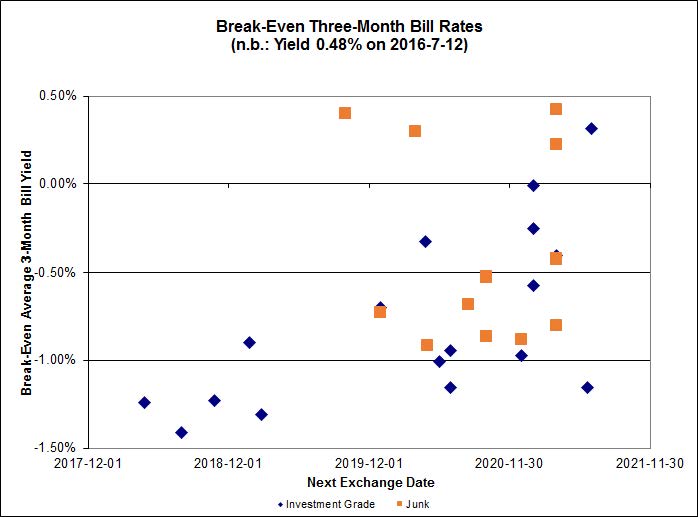
We can show the break-even rates for each FixedReset / FloatingReset Strong Pair graphically by plotting the implied average 3-month bill rate against the next Exchange Date (which is the date to which the average will be calculated).

pairs_FR_160610
Click for Big

The market appears to have a distaste at the moment for floating rate product; most of the implied rates until the next interconversion are lower than the current 3-month bill rate and the averages for investment-grade and junk issues are both below zero, at -0.66% and -0.07%, respectively! Whatever might be the result of the next few Bank of Canada overnight rate decisions, I suggest that it is unlikely that the average rate over the next five years will be lower than current – but if you disagree, of course, you may interpret the data any way you like.

Since credit quality of each element of the pair is equal to the other element, it should not make any difference whether the pair examined is investment-grade or junk, although we might expect greater variation of implied rates between junk issues on grounds of lower liquidity, and this is just what we see.

If we plug in the current bid price of the SJR.PR.A FixedReset, we may construct the following table showing consistent prices for its soon-to-be-issued FloatingReset counterpart given a variety of Implied Breakeven yields consistent with issues currently trading:

Estimate of FloatingReset (received in exchange for SJR.PR.A) Trading Price In Current Conditions
  Assumed FloatingReset
Price if Implied Bill
is equal to
FixedReset Bid Price Spread 0.00% -0.50% -1.00%
SJR.PR.A 12.95 200bp 12.16 11.66 11.16

Based on current market conditions, I suggest that the FloatingResets that will result from conversion are likely to be cheap and trading below the price of their FixedReset counterparts. Therefore, I recommend that holders of SJR.PR.A continue to hold the issue and not to convert. I will note that, given the apparent cheapness of the FloatingResets, it may be a good trade to swap the FixedReset for the FloatingReset in the market once both elements of each pair are trading and you can – presumably, according to this analysis – do it with a reasonably good take-out in price, rather than doing it through the company on a 1:1 basis. But that, of course, will depend on the prices at that time and your forecast for the path of policy rates over the next five years. There are no guarantees – my recommendation is based on the assumption that current market conditions with respect to the pairs will continue until the FloatingResets commence trading and that the relative pricing of the two new pairs will reflect these conditions.

Note as well that conversion rights are dependent upon at least one million shares of each series being outstanding after giving effect to holders’ instructions; e.g., if only 100,000 shares of SJR.PR.A are tendered for conversion, then no conversions will be allowed; but if only 100,000 shares of SJR.PR.A will remain after the rest are all tendered, then conversion will be mandatory. However, this is relatively rare: all 39 Strong Pairs currently extant have some version of this condition and all but five have both series outstanding.