Category: Issue Comments

Issue Comments

GMP.PR.B: Convert or Hold?

It will be recalled that GMP.PR.B will reset to 3.611% effective March 31.

Holders of GMP.PR.B have the option to convert to FloatingResets, which will pay 3-month bills plus 289bp on the par value of $25.00. The deadline for notifying the company of the intent to convert is 5:00 p.m. (EST) on March 16, 2016; but note that this is a company deadline and that brokers will generally set their deadlines a day or two in advance, so there’s not much time to lose if you’re planning to convert! However, if you miss the brokerage deadline they’ll probably do it on a ‘best efforts’ basis if you grovel in a sufficiently entertaining fashion. The ticker for the new FloatingReset is not yet known.

The most logical way to analyze the question of whether or not to convert is through the theory of Preferred Pairs, for which a calculator is available. Briefly, a Strong Pair is defined as a pair of securities that can be interconverted in the future (e.g., PWF.PR.P and the FloatingReset that will exist if enough holders convert). Since they will be interconvertible on this future date, it may be assumed that they will be priced identically on this date (if they aren’t then holders will simply convert en masse to the higher-priced issue). And since they will be priced identically on a given date in the future, any current difference in price must be offset by expectations of an equal and opposite value of dividends to be received in the interim. And since the dividend rate on one element of the pair is both fixed and known, the implied average rate of the other, floating rate, instrument can be determined. Finally, we say, we may compare these average rates and take a view regarding the actual future course of that rate relative to the implied rate, which will provide us with guidance on which element of the pair is likely to outperform the other until the next interconversion date, at which time the process will be repeated.

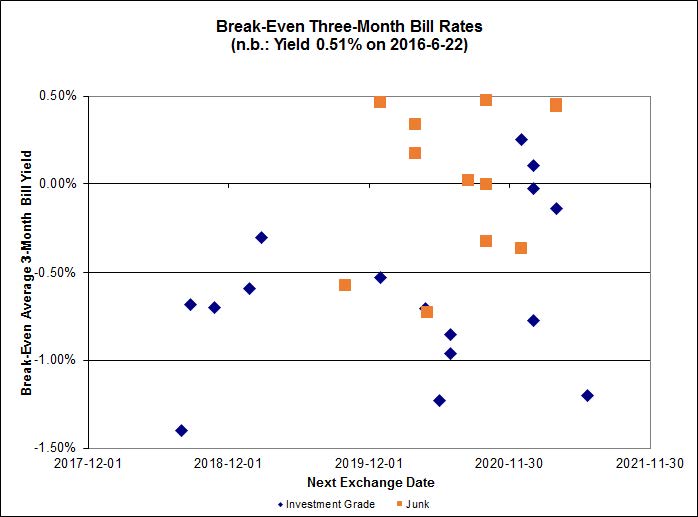
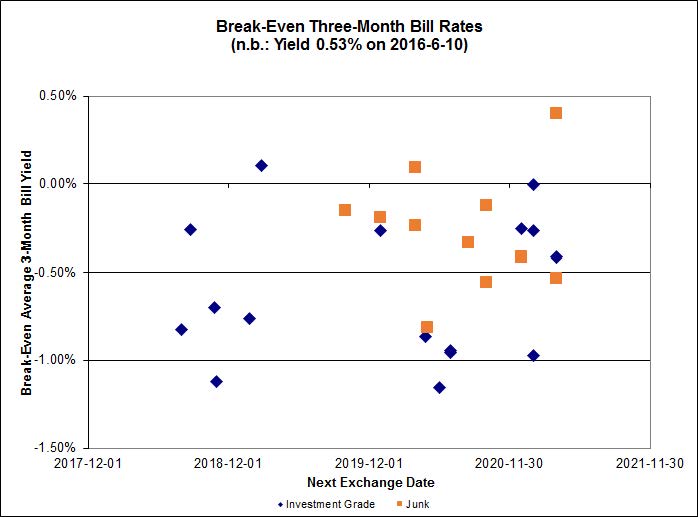
We can show the break-even rates for each FixedReset / FloatingReset Strong Pair graphically by plotting the implied average 3-month bill rate against the next Exchange Date (which is the date to which the average will be calculated).

pairs_FR_160311
Click for Big

The market appears to have a distaste at the moment for floating rate product; almost all of the implied rates until the next interconversion are lower than the current 3-month bill rate and the averages for investment-grade and junk issues are both well below zero, at -0.79% and -0.73%, respectively! Whatever might be the result of the next few Bank of Canada overnight rate decisions, I suggest that it is unlikely that the average rate over the next five years will be lower than current – but if you disagree, of course, you may interpret the data any way you like.

Since credit quality of each element of the pair is equal to the other element, it should not make any difference whether the pair examined is investment-grade or junk, although we might expect greater variation of implied rates between junk issues on grounds of lower liquidity, and this is just what we see.

If we plug in the current bid price of the GMP.PR.B FixedReset, we may construct the following table showing consistent prices for its soon-to-be-issued FloatingReset counterpart given a variety of Implied Breakeven yields consistent with issues currently trading:

Estimate of FloatingReset (received in exchange for GMP.PR.B) Trading Price In Current Conditions
  Assumed FloatingReset
Price if Implied Bill
is equal to
FixedReset Bid Price Spread 0.00% -1.00% -2.00%
GMP.PR.B 9.32 289bp 8.71 7.86 7.01

Based on current market conditions, I suggest that the FloatingResets that will result from conversion are likely to be cheap and trading below the price of their FixedReset counterparts. Therefore, I recommend that holders of GMP.PR.B continue to hold the issue and not to convert. I will note that, given the apparent cheapness of the FloatingResets, it may be a good trade to swap the FixedReset for the FloatingReset in the market once both elements of each pair are trading and you can – presumably, according to this analysis – do it with a reasonably good take-out in price, rather than doing it through the company on a 1:1 basis. But that, of course, will depend on the prices at that time and your forecast for the future path of policy rates. There are no guarantees – my recommendation is based on the assumption that current market conditions with respect to the pairs will continue until the FloatingResets commence trading and that the relative pricing of the two new pairs will reflect these conditions.

Note as well that conversion rights are dependent upon at least one million shares of each series being outstanding after giving effect to holders’ instructions; e.g., if only 100,000 shares of GMP.PR.B are tendered for conversion, then no conversions will be allowed; but if only 100,000 shares of GMP.PR.B will remain after the rest are all tendered, then conversion will be mandatory. However, this is relatively rare: all 39 Strong Pairs currently extant have some version of this condition and all but four have both series outstanding.

Issue Comments

HSE.PR.A: Convert or Hold?

It will be recalled that HSE.PR.A will reset to 2.404% effective March 31.

Holders of HSE.PR.A have the option to convert to FloatingResets, which will pay 3-month bills plus 173bp on the par value of $25.00. The deadline for notifying the company of the intent to convert is 5:00 p.m. (EST) on March 16, 2016; but note that this is a company deadline and that brokers will generally set their deadlines a day or two in advance, so there’s not much time to lose if you’re planning to convert! However, if you miss the brokerage deadline they’ll probably do it on a ‘best efforts’ basis if you grovel in a sufficiently entertaining fashion. The ticker for the new FloatingReset is not yet known.

The most logical way to analyze the question of whether or not to convert is through the theory of Preferred Pairs, for which a calculator is available. Briefly, a Strong Pair is defined as a pair of securities that can be interconverted in the future (e.g., PWF.PR.P and the FloatingReset that will exist if enough holders convert). Since they will be interconvertible on this future date, it may be assumed that they will be priced identically on this date (if they aren’t then holders will simply convert en masse to the higher-priced issue). And since they will be priced identically on a given date in the future, any current difference in price must be offset by expectations of an equal and opposite value of dividends to be received in the interim. And since the dividend rate on one element of the pair is both fixed and known, the implied average rate of the other, floating rate, instrument can be determined. Finally, we say, we may compare these average rates and take a view regarding the actual future course of that rate relative to the implied rate, which will provide us with guidance on which element of the pair is likely to outperform the other until the next interconversion date, at which time the process will be repeated.

We can show the break-even rates for each FixedReset / FloatingReset Strong Pair graphically by plotting the implied average 3-month bill rate against the next Exchange Date (which is the date to which the average will be calculated).

pairs_FR_160311
Click for Big

The market appears to have a distaste at the moment for floating rate product; almost all of the implied rates until the next interconversion are lower than the current 3-month bill rate and the averages for investment-grade and junk issues are both well below zero, at -0.79% and -0.73%, respectively! Whatever might be the result of the next few Bank of Canada overnight rate decisions, I suggest that it is unlikely that the average rate over the next five years will be lower than current – but if you disagree, of course, you may interpret the data any way you like.

Since credit quality of each element of the pair is equal to the other element, it should not make any difference whether the pair examined is investment-grade or junk, although we might expect greater variation of implied rates between junk issues on grounds of lower liquidity, and this is just what we see.

If we plug in the current bid price of the HSE.PR.A FixedReset, we may construct the following table showing consistent prices for its soon-to-be-issued FloatingReset counterpart given a variety of Implied Breakeven yields consistent with issues currently trading:

Estimate of FloatingReset (received in exchange for HSE.PR.A) Trading Price In Current Conditions
  Assumed FloatingReset
Price if Implied Bill
is equal to
FixedReset Bid Price Spread 0.00% -1.00% -2.00%
HSE.PR.A 9.23 160bp 8.59 7.64 6.69

Based on current market conditions, I suggest that the FloatingResets that will result from conversion are likely to be cheap and trading below the price of their FixedReset counterparts. Therefore, I recommend that holders of HSE.PR.A continue to hold the issue and not to convert. I will note that, given the apparent cheapness of the FloatingResets, it may be a good trade to swap the FixedReset for the FloatingReset in the market once both elements of each pair are trading and you can – presumably, according to this analysis – do it with a reasonably good take-out in price, rather than doing it through the company on a 1:1 basis. But that, of course, will depend on the prices at that time and your forecast for the future path of policy rates. There are no guarantees – my recommendation is based on the assumption that current market conditions with respect to the pairs will continue until the FloatingResets commence trading and that the relative pricing of the two new pairs will reflect these conditions.

Note as well that conversion rights are dependent upon at least one million shares of each series being outstanding after giving effect to holders’ instructions; e.g., if only 100,000 shares of HSE.PR.A are tendered for conversion, then no conversions will be allowed; but if only 100,000 shares of HSE.PR.A will remain after the rest are all tendered, then conversion will be mandatory. However, this is relatively rare: all 39 Strong Pairs currently extant have some version of this condition and all but four have both series outstanding.

Issue Comments

L.PR.B Trend Positive, Says DBRS

DBRS has announced that it:

has today confirmed the Issuer Rating, Medium-Term Notes and Debentures ratings of Loblaw Companies Limited (Loblaw or the Company) and the Senior Unsecured Debt rating of Shoppers Drug Mart Corporation (Shoppers) at BBB as well as Loblaw’s Short-Term Issuer Rating at R-2 (middle) and its Second Preferred Shares rating at Pfd-3. DBRS has changed the trends to Positive from Stable.

The trend change reflects the Company’s deleveraging efforts and successful integration subsequent to the acquisition of Shoppers as well as its solid operating performance in both food retail and pharmacy through the end of F2015. The ratings continue to be supported by Loblaw’s business profile which is considered very strong for the current BBB rating, featuring industry-leading size, scale and market positions in retail and pharmacy across Canada. The ratings also incorporate the intense competition in food retail in Canada and the risks associated with drug pricing and pharmacy reforms.

Loblaw’s financial profile should continue to improve over the medium term, benefiting from growth in earnings and cash flows as balance-sheet debt should remain relatively stable. Cash flow from operations should continue to track operating income while capital expenditures (capex) attributable to the retail operations is expected to decline moderately to approximately $1.0 billion. Retail capex will focus on improving existing stores as well as new food and drug store openings as larger supply chain and IT initiatives have been completed. DBRS believes that dividends on a per-share basis will continue to grow at a steady pace, but the cash outlay for dividends should remain near the $400 million level (as share repurchases are completed). As such, DBRS believes that free cash flow before changes in working capital should increase toward the $900 million to $1.0 billion range. Free cash flow is expected to be used to complete share repurchases. As a result, DBRS believes that balance-sheet debt should remain relatively stable and credit metrics should continue to improve as earnings grow.

If DBRS becomes confident in the next six to 12 months that Loblaw’s operating performance will remain sound and balance-sheet debt will remain fairly stable resulting in continued improvement in credit metrics, a ratings upgrade to the BBB (high) level would likely result.

L.PR.B is a 5.30% Straight Perpetual that commenced trading 2016-3-11 after being announced 2015-6-2. It is tracked by HIMIPref™ but relegated to the Scraps index on credit concerns.

Issue Comments

SJR.PR.A Downgraded To Pfd-3(low) By DBRS

DBRS has announced that it:

has today downgraded Shaw Communications Inc.’s (Shaw or the Company) Issuer Rating and Senior Notes rating to BBB (low) from BBB and its Preferred Shares rating to Pfd-3 (low) from Pfd-3. The trends are Stable. This action follows the closing of the Company’s acquisition of WIND Mobile Corp. (WIND) and the announcement to sell its broadcasting subsidiary, Shaw Media Inc. (Shaw Media) to Corus Entertainment Inc. (Corus). The rating action is caused by a gradual erosion in the core cable business owing to persistent subscriber weakness and the expectation that the recent transactions will result in a material weakening of Shaw’s free cash flow profile over the near to medium term.

DBRS notes that Shaw’s earnings profile has been under pressure for some time, owing to continued technological substitution of phone and cable services, increased competition from TELUS Corporation’s (TELUS) Internet protocol television (IPTV) offering and, more recently, economic softness in Alberta, regulatory-driven headwinds. Subscriber erosion accelerated in F2015, with a 3.2% decline recorded in total revenue generating units following a 0.8% decline in F2014. As such, Shaw has had to rely more heavily on price increases to drive earnings growth within its wireline business amid an increasingly competitive telecommunications market. Organic growth was weak in F2015, with much of the revenue and EBITDA increases (4.7% and 5.2%, respectively) attributable to the full-year inclusion of ViaWest. DBRS believes that, independent of the recent transactions, because of mounting pressures on subscribers and expectations of less predictable and potentially more strained organic earnings going forward, Shaw is more appropriately placed in the BBB (low) rating category.

In terms of financial profile, DBRS expects leverage to be reasonable for the revised rating category. As proceeds from the sale of the media assets will be used to pay for the WIND transaction, Shaw will not be required to raise additional debt financing. Pro forma total debt is expected rise to $5.9 billion by year-end F2016 from $5.7 billion in F2015, but this is because of a recent debt-financed tuck-in acquisition by ViaWest. EBITDA, however, is expected to decline with the divestiture of Shaw Media’s operating income and the modest contribution of WIND. As such, pro forma gross debt to EBITDA is expected to peak at roughly 2.8 times (x) by year-end F2017 from 2.4x in the last 12 months Q1 F2016. DBRS notes that the Company has reiterated its long-term target of net debt-to-EBITDA of between 2.0x and 2.5x.

This follows the December, 2015, expressions of nervousness regarding Shaw and the assessment of a negative outlook by S&P in January 2016.

Issue Comments

TA: Trend Changed To Negative By DBRS

DBRS has announced that it:

has today changed the trends of all long-term debt ratings of Capital Power Corporation, Capital Power L.P. and TransAlta Corporation (collectively, the IPPs) to Negative from Stable. DBRS has also changed the trend of TransAlta Corporation’s preferred share rating to Negative from Stable. The rating actions reflect DBRS’s concern that the continued challenging wholesale power market environment and heightened political risk in Alberta may lead the IPPs’ credit risk profile to deteriorate to a level that is no longer consistent with their respective rating categories. The rating actions at this time are limited to trend changes with no immediate rating downgrades, as the negative factors that could lead to downward rating pressure are over the medium to long term. DBRS does not anticipate any material weakness in the IPPs’ financial profile in 2016 from 2015, largely because of strong hedging support and manageable capital spending, despite lower power prices in Alberta.

DBRS believes the continued weak operating environment and the effect of Alberta Climate Leadership Plan (ACLP) combined will gradually weaken several primary business risk profile factors for the IPPs, including (a) hedging profile, particularly post-2020, as all long-term Alberta power purchase arrangements (PPAs) expire by 2020; (b) market position; and (c) market structure and environment. A weakening business risk profile will likely result in a one-notch downgrade to BBB (low) from BBB for the IPPs. A multi-notch downgrade below investment grade is unlikely in the foreseeable future, unless the implementation of the ACLP would materially affect the IPPs’ financial flexibility and profitability.

While TransAlta is less affected by the Alberta climate change strategy than Capital Power, the phase-out of all coal plants by 2030 and rising carbon compliance costs also have potential negative rating implications for TransAlta. Furthermore, TransAlta’s key credit metrics have remained relatively constrained for the current rating, which provides TransAlta with very limited financial flexibility. DBRS acknowledges that TransAlta has responded to the weak power pricing environment by cutting dividends and implementing cost-saving measures.

There are four issues affected by this trend change: TA.PR.D, TA.PR.F, TA.PR.H and TA.PR.J. The first of these, TA.PR.D, will reset at 2.709% on March 31.

I don’t often publish Implied Volatility Analysis for this series – so here it is:

impVol_TA_160310
Click for Big
Issue Comments

RON.PR.A Grumblers Get An Ally

The Stirling Funds has issued an Open Letter to Lowes (LOW: NYSE) and to Rona (RON: TSX) – Lowes Bid Undervalues Rona Preferred Shares (RON.PR.A: TSX):

Lowes, a FORTUNE 50 US based multinational company with sales of over $56 billion, has come to Canada to TAKEOVER, TAKE PRIVATE, CHANGE CONTROL of Rona Inc. Why are these descriptions important? Because they mean that certain things happen: common shareholders get a “Take-Over” premium for their shares and directors and officers get paid handsomely (> $40 million) by accelerating payments that would otherwise take many years for them to receive, if at all.

Let’s consider fundamental principles of Canadian and Quebec corporate law. If Rona’s common shares are collectively worth $2.6 billion, than any higher ranking financial instrument is worth at minimum its face or par value. But that is not how the transaction has been structured and as a result retail preferred shareholders will be FORCED to accept $5 per share less than its face or par value of $25. This is OPPRESSIVE.

Moreover, the Rona Board of Directors owe a fiduciary duty of care to all stakeholders. They have addressed the common shareholders’ interests with a > 100% premium, debenture holders which stand to gain better ratings for their interests, and employees by undertaking to maintain employment, but they have failed in their fiduciary duty to preferred shareholders.

In a similar situation in Canada, RioCan REIT preferred shares with almost identical terms as the Rona preferred shares and also with a March 31, 2016 maturity are being redeemed at their par value of $25.

The Caisse de dépôt et placement du Québec, one of Canada’s pre-eminent pension fund managers, supports the deal seemingly knowing that the preferred shares are held principally by Quebec retail investors and Quebec pensioners, the very people the Caisse represents.

Recently, a Quebec-based retail investor who owns Rona preferred shares wrote to the company:

“I feel the Rona board in unanimously recommending the Lowes take-over has failed to act fairly and equitably in the interests of all stake holders and has only acted in the interest of common shareholders”… “Do not short change the small retail investor”.

As background, the Stirling Funds owns Rona preferred shares. We also own Lowes common shares and are supportive of Lowes’ strategic entry into Canada, and its takeover offer of Rona. We believe Lowes has 1) a strong, focused and highly competent management team; 2) are well positioned in their market segments; and 3) will prosper significantly as the economy continues to recover and the housing and renovation cycle normalises. We are not hostile to Lowes (in fact the opposite). Our issue lies in the deal structure. It would seem bad business for Lowes to “short-change” the very group of investors it hopes to win as customers to save a rounding error on a $2.7 billion purchase.

NEXT STEPS

To further support our efforts to seek fair remedies for the Rona preferred shareholders, the Stirling Funds has retained European-based ÖstVäst Advisory, a specialist advisor to global institutions in complex financial and security law matters.

“It is unclear why Lowes would uniquely diminish the value of the Rona preferred shareholders, while handsomely rewarding everyone else” stated Fredrik Skoglund, Partner & Head of Research of ÖstVäst Advisors. “I would assume the Quebec Securities Commission would not wish to establish precedents like this”.

PROFILES:

The Stirling Funds are value-focused investment funds based in London, England that hold a portfolio of diversified global securities principally in asset-rich companies trading at a discount to their underlying intrinsic value.

ÖstVäst Advisory, based in Stockholm Sweden is an independent, specialist global advisory firm providing client tailored financial, investment and corporate services.

SOURCE The Stirling Funds

For further information: ÖstVäst Advisory AB, Stockholm, Sweden, Fredrik Skoglund, Partner / Head of Research, +46 70 410 5165, info@ostvast.com; The Stirling Funds, London, England, Gordon Flatt, Chief Investment Officer, +44 3239 9932, info@stirling-funds.co.uk

I have not been able to find any information on the so-called Stirling Funds. Their website has been set up simply for use as a mail-drop. They’re not entirely a joke because last October they issued an Early Warning Report:

Yesterday Stirling purchased sufficient shares of Kicking Horse Energy Inc. (KCK: TSX-V) in the market on the Venture Exchange to increase its ownership to hold 7,630,000 Common Shares representing 12% issued equity.

Kicking Horse was promptly taken over at 4.75 per share, so – assuming Stirling Funds has other investments – there is some heft to the management company.

Gordon Flatt, CIO of Stirling, has made the news before in connection with Inco’s preferred shares:

A $40-million (U.S.) investment in Inco Ltd. has intensified speculation that the Canadian nickel producer is a potential takeover target.

The purchase makes Winnipeg’s Coastal Investment Inc. – run by Gordon Flatt, brother of Brascan’s Bruce Flatt – the single-biggest owner of Inco’s series E preferred shares, the market’s largest preferred issue. Coastal now owns 1.12 million shares, or 12 per cent.

In turn, we can find reference to Coastal Value Fund with respect to their redemption of CVF.PR.A in 2007 and DIV.PR.A later in that year. Bloomberg has a note:

As of February 21, 2007, Coastal Value Fund Inc has gone out of business. Coastal Value Fund Inc. is an equity mutual fund launched and managed by Coastal Corp. The fund invests in the public equity markets of Canada. It invests in the stocks of companies operating across diversified sectors. The fund primarily invests in value stocks of large cap companies. Coastal Value Fund Inc was formed on September 27, 2002 and is domiciled in Canada.

And this eventually leads to a Bloomberg data dump regarding Gordon Flatt – he’s got his thumbs in a lot of pies, although it is not immediately apparent how substantial any of them are.

I have sent an eMail to the indicated address:

Dear Mr. Flatt,

I read your press release with interest and will be reporting on it at http://www.prefblog.com later today.

Please tell me a little more about yourself and your firm. Does Stirling Funds have a functional website? What are the AUM and where may I find your historical performance numbers? Ar e you the same Gordon Flatt who has been involved with Copacabana Capital Ltd. and Coastal Value Fund Inc.?

Sincerely,

No answer yet, but it’s still early.

Anyway, Assiduous Readers will remember that my post regarding the proposed RON.PR.A arrangement sparked a fair amount of comment – by PrefBlog standards – with several commenters expressing horror at the idea of a preferred share being taken out below par and heaping me with opprobrium for suggesting it was a pretty good deal for holders.

I based that opinion on a comparison with similar issues, so I’ll take the opportunity to update prices for that list:

Ticker Issue
Reset
Spread
Bid
2016-2-3
Bid
2016-3-8
MFC.PR.J +261 17.89 17.00
RY.PR.M 262 18.45 17.70
TD.PF.D 279 19.00 18.85
SLF.PR.I 273 17.45 17.10
BAM.PF.B 263 16.46 16.88
BMO.PR.Y 271 19.35 18.56

So, given that Lowe’s is offering $20.00 for RON.PR.A with its spread of +265, it would appear that so far a good deal has simply gotten better since the announcement date. But it’s still too early to make a decision … the meeting is not until March 31 and if the preferred share market should happen to go up 10% between now and the last minute to vote … well, then, circumstances alter cases, don’t they?

Update, 2016-3-9: Barry Critchley has taken up the story:

The battle for the support of Rona’s preferred shareholders — who in the takeover by Lowe’s are being offered $20 per share, a $5 discount to the original purchase price — is set to get a little more interesting three weeks before all parties gather in Montreal to approve the transaction.

This week, and possibly as early as Thursday, more information is expected to be released about the extent of the opposition to the terms offered to the pref shareholders. “We have had lots of emails and calls from retail investors about the situation and we will be responding,” said an adviser with knowledge of what’s being planned.

Maybe the circumstances are different but there is a precedent that doesn’t look too good for Lowe’s. In early 1987, Australia’s Fosters Brewing acquired Carling O’Keefe. For some reason, it decided not to acquire the preferred shares that had been issued by Carling. Led by a brewery analyst Mike Palmer and with heavy lifting from Sheila Block of Torys, an action was brought based on improper treatment of Carling’s preferred-shareholders. In time the courts in Ontario found the conduct of the directors of the amalgamated corporation to be “oppressive” to the preference shareholders. After that ruling the pref shareholders got their proper reward.

I’ve looked it up and, while ready to be corrected, suggest that the Carling-Fosters case is irrelevant:

In Palmer v. Carling O’Keefe, Carling O’Keefe amalgamated with a company established by Elders to acquire Carling O’Keefe. The Court was asked to consider the impact of the amalgamation on the holders of the preference shares of Carling O’Keefe. The object of amalgamating the two companies was to move the debt incurred to make the acquisition into Carling O’Keefe. In order to protect the interests of the preference shareholders, sufficient funds to redeem the preference shares were set aside in a separate trust account. The Court decided that the transaction had no business purpose for Carling O’Keefe. It concluded that the transaction served the interests of the controlling shareholder and was unfairly prejudicial to, and unfairly disregarded the interests of, the preference shareholders and that the directors of Carling O’Keefe had breached their duty to act for the benefit of the corporation as a whole. The oppression remedy is discussed in greater detail in Section 7 of this part of the chapter.

In Palmer v. Carling O’Keefe, discussed above, the Court found that there was no bad faith involved in the decision to amalgamate the two companies, and that the board, composed of experienced business people acting upon independent advice, had exercised its best business judgment with respect to the transaction. The Court concluded that the impugned conduct nevertheless constituted oppression because it was unfairly prejudicial to the interests of the holders of preference shares and because it only served the interests of the controlling shareholder and not the interests of the corporation.

It seems to me that this precedent explains why the BCE preferred shares were to be redeemed in the BCE-Teachers’ deal, since in that case BCE was to be loaded up with LBO debt (see Responding to an Amalgamation Squeeze-out under the OBCA); but it doesn’t seem applicable here.

Issue Comments

PVS.PR.A To Be Redeemed

Partners Value Split Corp. has announced:

its intention to redeem all of its outstanding Class AA Preferred Shares, Series 1 (the “Series 1 Preferred Shares”) (TSX: PVS.PR.A) for cash on March 28, 2016 (the “Redemption Date”). The redemption price per Series 1 Preferred Share will be equal to C$25.00 plus accrued and unpaid dividends of C$0.091541 thereon to March 28, 2016, representing a total redemption price of C$25.091541 per Series 1 Preferred Share (the “Redemption Price”). Formal notice will be delivered to holders of Series 1 Preferred Shares in accordance with the terms of the Series 1 Preferred Shares.

From and after the Redemption Date the Series 1 Preferred Shares will cease to be entitled to dividends or any other participation in any distribution of the assets of the Company and the holders thereof shall not be entitled to exercise any of their other rights as shareholders in respect thereof except to receive the Redemption Price (less any tax required to be deducted and withheld by the Company). After the redemption of the Series 1 Preferred Shares, the Company will consolidate the existing capital shares held by Partners Value Investments Inc. so that there are an equal number of preferred shares and capital shares outstanding.

It will be recalled that this redemption was funded well in advance by the issue of PVS.PR.E – part funds from this issuance were used to pay a dividend to the capital unitholder.

Issue Comments

RY.PR.R Not As Good As Expected On Good Volume

Royal Bank of Canada has announced:

it has closed its domestic public offering of Non-Cumulative, 5-Year Rate Reset Preferred Shares Series BM. Royal Bank of Canada issued 30 million Preferred Shares Series BM at a price of $25 per share to raise gross proceeds of $750 million.

The offering was underwritten by a syndicate led by RBC Capital Markets. The Preferred Shares Series BM will commence trading on the Toronto Stock Exchange today under the ticker symbol RY.PR.R.

The Preferred Shares Series BM were issued under a prospectus supplement dated February 29, 2016 to the bank’s short form base shelf prospectus dated January 21, 2016.

RY.PR.R is a FixedReset, 5.50%+480, announced 2016-2-25. The issue will be tracked by HIMIPref™ and assigned to the FixedReset subindex.

The issue traded 1,482,632 shares today (consolidated exchanges) in a range of 25.15-27 before closing at 25.23-25, 25×70. The TXPL total return index has increased by 830bp since the announcement date, so buyers on new-issue day could have done better elsewhere!

Vital statistics are:

RY.PR.R FixedReset YTW SCENARIO
Maturity Type : Call
Maturity Date : 2021-08-24
Maturity Price : 25.00
Evaluated at bid price : 25.23
Bid-YTW : 5.34 %

Implied volatility analysis indicates the issue is expensive at its current level:

impVol_RY_160307
Click for Big

Interpretation of this chart using the standard assumptions that everything will remain the same forever leads us to believe that the new issue is a little cheap – fair value is $25.48 according to the best fit of the NVCC-compliant issues, compared to an actual bid of 25.23. Note that RY.PR.Q is indicated to be quite expensive: it resets at 453bp (less than RY.PR.R) on 2021-5-24, and is 0.71 rich at its bid of 25.52 (higher than RY.PR.R).

However, the standard assumptions are even more shaky than they usually are. Some will say that the derived value of Implied Volatility, at 24%, is far too high and may be expected to decline in the future. This will cause the theoretical curve to flatten, which implies that the higher-spread issues will outperform the lower spread issues. Some will say, however, that the fundamental assumption of non-directionality in the Black-Scholes theory is wrong; that spreads in general are far too high, will narrow, and therefore the lower-spread issues will outperform the higher-spread issues. Some, like myself, will say that both criticisms are correct but that on balance the lower-spread issues are preferable. If, for instance, you plug in a 250bp spread and 10% Implied Volatility – numbers I would consider more reflective of a normal market – you find that the four lower spread issues increase in price by over 40%, compared to the higher-spread issues, which may well go substantially above the $25 call price, but not 40% worth. Mind you, the critical part of the above analysis is “normal” … i.e., with five year Canadas yielding more than inflation and that’s just for starters! There will be some who believe that current conditions represent the new normal; these players will probably prefer the higher-spread issues.

Issue Comments

FN.PR.A To Reset At 2.79%

First National Financial Corporation has announced (although not yet on their website):

the applicable dividend rates for its cumulative 5-year rate reset Class A Preference Shares, Series 1 (“Series 1 Preference Shares”) and cumulative floating rate Class A Preference Shares, Series 2 (“Series 2 Preference Shares”).

With respect to any Series 1 Preference Shares that remain outstanding on March 31, 2016, commencing as of such date, holders thereof will be entitled to receive cumulative preferential cash dividends on a quarterly basis, as and when declared by the Board of Directors of First National. The dividend rate for the five-year period commencing on April 1, 2016, and ending on March 31, 2021 will be 2.79%, being equal to the 5-Year Government of Canada bond yield determined as at 10 am (Toronto time) March 2, 2016 plus 2.07%, as determined in accordance with the terms of the Series 1 Preference Shares.

With respect to any Series 2 Preference Shares that may be issued on March 31, 2016, holders thereof will be entitled to receive floating rate cumulative preferential cash dividends on a quarterly basis, as and when declared by the Board of Directors of First National, based on a dividend rate equal to the 90-day Canadian Treasury Bill plus 2.07% on an actual/365 day count basis, subject to certain adjustments in accordance with the terms of the Series 2 Preference Shares. The dividend rate for the period commencing on April 1, 2016 and ending on June 30, 2016 will be equal to 2.532%, as determined in accordance with the terms of the Series 2 Preference Shares.

Beneficial owners of Series 1 Preference Shares who wish to exercise their right of conversion should communicate as soon as possible with their broker or other nominee and ensure that they follow their instructions in order to ensure that they meet the deadline to exercise such right, which is 5:00 p.m. (Toronto time) on March 16, 2016.

FN.PR.A is a FixedReset 4.65%+207, which commenced trading 2011-1-25 after being announced 2011-1-17. The notice of extension was previously reported on PrefBlog. It is tracked by HIMIPref™ but is relegated to the Scraps index on credit concerns.

The new rate represents a cut of 40% in the dividend rate. Ouch!

As noted in the press release, the deadline for notification of intent to convert to the FloatingReset is March 16. I will post a recommendation on March 11.

Issue Comments

GMP.PR.B To Reset At 3.611%

GMP Capital Inc. has announced:

the applicable dividend rates for its Cumulative 5-Year Rate Reset Preferred Shares, Series B (the Series B Shares) and its Cumulative Floating Rate Preferred Shares, Series C (the Series C Shares), further to its press release dated February 23, 2016, announcing that it does not intend to exercise its right to redeem all or any part of the currently outstanding Series B Shares and, as a result of which, subject to certain conditions, the holders of the Series B Shares have the right to convert all or any part of their Series B Shares into Series C Shares on a one-for-one basis.

With respect to any Series B Shares that remain outstanding after March 31, 2016, holders thereof will be entitled to receive quarterly fixed, cumulative, preferential cash dividends, if, as and when declared by the Board of Directors of the Corporation, subject to the provisions of the Business Corporations Act (Ontario). The dividend rate for the five-year period commencing on April 1, 2016 and ending on and including March 31, 2021 will be 3.611% per annum or $0.22569 per share per quarter, being equal to the sum of the Government of Canada bond yield determined as of today, plus 2.89%, in accordance with the terms of the Series B Shares.

With respect to any Series C Shares that may be issued on March 31, 2016, holders thereof will be entitled to receive quarterly floating rate, cumulative, preferential cash dividends, if, as and when declared by the Board of Directors of the Corporation, subject to the provisions of the Business Corporations Act (Ontario). The dividend rate for the three-month period commencing on April 1, 2016 and ending on and including June 30, 2016 will be 3.352% per annum or $0.20893 per share for the quarter, being equal to the sum of the three-month Government of Canada Treasury Bill yield determined as of today, plus 2.89% (calculated on the basis of the actual number of days elapsed during such quarterly period divided by 365), in accordance with the terms of the Series C Shares. The quarterly floating dividend rate will be reset every quarter.

Beneficial owners of Series B Shares who wish to exercise their conversion right should communicate as soon as possible with their broker or other nominee to ensure their instructions are followed for exercising such right on or prior to the deadline for exercise, which is 5:00 p.m. (Toronto time) on March 16, 2016.

GMP.PR.B is a FixedReset 5.50%+289, which commenced trading 2011-2-22 after being announced 2011-2-1. The notice of extension was previously reported on PrefBlog. It is tracked by HIMIPref™ but is relegated to the Scraps index on credit concerns. It is rated Pfd-3(low) by DBRS; this rating is now on Review-Negative.

The new rate represents a cut of 34% in the dividend rate.

As noted in the press release, the deadline for notification of intent to convert to the FloatingReset is March 16. I will post a recommendation on March 11.

Update, 2016-3-11: Interesting bit in the 15Q4 Report:

Bond forward: On March 2, 2016, we announced that the dividend rate on the Series B Preferred Shares will reset to 3.611% per annum, being the rate equal to the sum of the then current five-year Government of Canada (GOC) bond yield plus 2.89%, for the five-year period commencing on April 1, 2016 and ending on and including March 31, 2021. In order to partially hedge against a potential rise in GOC bond yields, GMP had entered into bond forward agreements with a Schedule I Canadian chartered bank in fourth quarter 2014 and first quarter 2015. In 2015, we recorded $3.6 million in pre-tax unrealized losses in connection with the bond forward (2014 – $0.4 million). For more information refer to “Financial Instruments – Derivative Financial Instruments”.