Category: Issue Comments

Issue Comments

ALA.PR.I Firm on Good Volume

AltaGas Ltd. has announced:

that it has closed its previously announced public offering of 8,000,000 Cumulative Redeemable 5-Year Minimum Rate Reset Preferred Shares, Series I (the “Series I Preferred Shares”), at a price of $25.00 per Series I Preferred Share (“the Offering”) for aggregate gross proceeds of $200 million.

The Offering was first announced on November 12, 2015 when AltaGas entered into an agreement with a syndicate of underwriters co-led by RBC Capital Markets, BMO Capital Markets and Scotiabank.

Net proceeds will be used to reduce outstanding indebtedness and for general corporate purposes.

The Series I Preferred Shares will commence trading today on the Toronto Stock Exchange (“TSX”) under the symbol ALA.PR.I.

ALA.PR.I is a FixedReset, 5.25%+419M525, announced November 12. The issue will be tracked by HIMIPref™ but relegated to the Scraps index on credit concerns.

The issue traded 844,179 shares today (consolidated exchanges) in a range of 24.97-20 before closing at 25.05-07, 10×40. Vital statistics are:

ALA.PR.I FixedReset YTW SCENARIO
Maturity Type : Limit Maturity
Maturity Date : 2045-11-23
Maturity Price : 23.17
Evaluated at bid price : 25.05
Bid-YTW : 5.17 %

The Implied Volatility fit isn’t very good …

impVol_ALA_151123
Click for Big
Issue Comments

FTN.PR.A To Get Bigger

Quadravest has announced:

Financial 15 Split Corp. (the “Company”) is pleased to announce it has filed a preliminary short form prospectus in each of the provinces of Canada with respect to an offering of Preferred Shares and Class A Shares of the Company. The offering will be co-led by National Bank Financial Inc., CIBC, RBC Capital Markets, Scotia Capital Inc., and will also include BMO Capital Markets, GMP Securities L.P., Canaccord Genuity Corp., Dundee Securities, Raymond James, Desjardins Securities Inc., Mackie Research Capital Corporation and Manulife Securities Incorporated.

The Preferred Shares will be offered at a price of $10.00 per Preferred Share to yield 5.25% and the Class A Shares will be offered at a price of $9.90 per Class A Share to yield 15.24%. The closing price on the TSX of each of the Preferred Shares and the Class A Shares on November 18, 2015 was $10.07 and $10.38, respectively.

Since inception of the Company, the aggregate dividends paid on the Preferred Shares have been $6.28 per share and the aggregate dividends paid on the Class A Shares have been $14.12 per share, for a combined total of $20.40. All distributions to date have been made in tax advantage eligible Canadian dividends or capital gains dividends. The net proceeds of the offering will be used by the Company to invest in an actively managed, high quality portfolio consisting of 15 financial services companies made up of Canadian and U.S. issuers as follows:

Bank of Montreal National Bank of Canada Bank of America Corp.
The Bank of Nova Scotia Manulife Financial Corporation Citigroup Inc.
Canadian Imperial Bank of Commerce Sun Life Financial Services of Canada Inc. Goldman Sachs Group Inc.
Royal Bank of Canada Great-West Lifeco Inc. JP Morgan Chase & Co.
The Toronto-Dominion Bank CI Financial Corp. Wells Fargo & Co.

The Company’s investment objectives are:
Preferred Shares:
i. to provide holders of the Preferred Shares with fixed, cumulative preferential monthly cash dividends currently in the amount of 5.25% annually, to be set by the Board of Directors annually subject to a minimum of 5.25% until 2020; and
ii. on or about the termination date, currently December 1, 2020 (subject to further 5 year extensions thereafter), to pay the holders of the Preferred Shares $10.00 per Preferred Share.

Class A Shares:
i. to provide holders of the Class A Shares with regular monthly cash dividends in an amount to be determined by the Board of the Directors; and
ii. to permit holders to participate in all growth in the net asset value of the Company above $10 per Unit, by paying holders on or about the termination date of December 1, 2020 (subject to further 5 year extensions thereafter) such amounts as remain in the Company after paying $10 per Preferred Share.

The sales period of this overnight offering will end at 9:00 a.m. EST on November 20, 2015.

The Net Asset Value Per Unit on November 18 is $17.05 and the new units are being offered at 19.90. Geez, the SplitShare business is nice when it works!

The last time FTN.PR.A got bigger was December 1, 2014, and there are currently slightly over 16.5-million units outstanding. Daily volume is better than most operating issues:

FTNPRA_151119_vol_spot
Click for Big
FTNPRA_151119_vol_avg
Click for Big

Update, 2015-11-20 : A very successful offering!

Financial 15 Split Corp. (the “Company”) is pleased to announce it has completed the overnight marketing of up to 3,335,474 Preferred Shares and up to 2,502,700 Class A Shares of the Company. Total proceeds of the offering are expected to be approximately $58.1 million.

Update, 2015-12-4: It closed:

Financial 15 Split Corp. (the “Company”) is pleased to announce it has completed the overnight offering of 3,335,474 Preferred Shares and 2,502,700 Class A Shares of the Company. Total proceeds of the offering were $58.1 million, bringing the Company’s net assets to approximately $334.7 million. The shares will trade on the Toronto Stock Exchange under the existing symbols of FTN.PR.A (Preferred Shares) and FTN (Class A shares).

Issue Comments

BCE.PR.R To Reset To 4.13%: Convert to BCE.PF.Q or Hold?

BCE Inc. has announced:

BCE Inc. will, on December 1, 2015, continue to have Cumulative Redeemable First Preferred Shares, Series R (“Series R Preferred Shares”) outstanding if, following the end of the conversion period on November 17, 2015, BCE Inc. determines that at least one million Series R Preferred Shares would remain outstanding. In such a case, as of December 1, 2015, the Series R Preferred Shares will pay, on a quarterly basis, as and when declared by the Board of Directors of BCE Inc., a fixed cash dividend for the following five years that will be based on a fixed rate equal to the product of: (a) the average of the yields to maturity compounded semiannually, determined on November 10, 2015 by two investment dealers selected by BCE Inc., that would be carried by non-callable Government of Canada bonds with a 5-year maturity (the “Government of Canada Yield”), multiplied by (b) a percentage rate determined by BCE Inc. (the “Selected Percentage Rate”) for such period. The “Selected Percentage Rate” determined by BCE Inc. for such period is 390%. The “Government of Canada Yield” is 1.059%. Accordingly, the annual dividend rate applicable to the Series R Preferred Shares for the period of five years beginning on December 1, 2015 will be 4.130%.

Five years ago the rate was reset to 4.49% and there was no conversion into the RatchetRate.

According to the conversion notice issued by BCE (emphasis added):

This letter and the attached Notice of Conversion Privilege have been sent to the holders of BCE Inc. Cumulative Redeemable First Preferred Shares, Series R (the “Series R Preferred Shares”).

Beginning on October 16, 2015 and ending on November 17, 2015, holders of Series R Preferred Shares will have the right to choose one of the following options with regards to their shares:
1. To retain any or all of their Series R Preferred Shares and continue to receive a fixed quarterly dividend; or
2. To convert, on a one-for-one basis, any or all of their Series R Preferred Shares into BCE Inc. Cumulative Redeemable First Preferred Shares, Series Q (the “Series Q Preferred Shares”) and receive a floating monthly dividend.

Effective December 1, 2015, the fixed dividend rate for the Series R Preferred Shares will be set for a five-year period as explained in more detail in paragraph 5 of the attached Notice of Conversion Privilege. Should you wish to continue receiving a fixed quarterly dividend for the five-year period beginning December 1, 2015, you do not need to take any action with respect to this notice. However, should you wish to receive a floating monthly dividend, you must elect to convert your Series R Preferred Shares into Series Q Preferred Shares as explained in more detail in the attached Notice of Conversion Privilege.

In order to convert your shares, you must exercise your right of conversion during the conversion period, which runs from October 16, 2015 to November 17, 2015, inclusively. We would like to draw your attention to the fact that should Series Q Preferred Shares be issued following the conversion on December 1, 2015 of Series R Preferred Shares, the Series Q Preferred Shares so issued will begin trading under the symbol BCE.PF.Q. This is not to be confused with BCE Inc.’s Cumulative Redeemable First Preferred Shares, Series AQ which currently trade under the symbol BCE.PR.Q. Should any Series R Preferred Shares remain outstanding after December 1, 2015, they will continue to trade under the symbol BCE.PR.R.

Holders of both the Series R Preferred Shares and the Series Q Preferred Shares will have the opportunity to convert their shares again on December 1, 2020, and every five years thereafter as long as the shares remain outstanding.

Should you require advice as to whether to exercise your conversion privilege, please contact your investment advisor.

If you cannot locate your share certificate or have any questions about the steps to be followed, please contact CST Trust Company at 1-800-561-0934, the transfer agent and registrar for BCE Inc.’s preferred shares.

Please see the attached Notice of Conversion Privilege for further details.

So, there are two things to note very carefully: first, the deadline for notifying the company of an intent to convert is November 17, Tuesday, and not only that, but brokers will generally have earlier internal deadlines so you’ll have to act quickly if you want to convert! Second, the symbol will be BCE.PF.Q – rather confusing, really, but the company made a mistake when converting the BAF.PR.E issue into a BCE issue in September 2014 and it’s too late to fix it.

The conversion notice itself explains the mechanics of how RatchetRate preferreds work, but includes the following important point:

The Designated Percentage for the month of December 2015 will be 80% so that the annual floating dividend rate for the month of December 2015 will be equal to 80% of Prime.

All other RatchetRate preferreds are paying 100% of prime (since they’ve been priced so far below par for so long), and at the maximum rate of change (which is expected to be effective), it will be five months before the new issue’s dividend finally adjusts. This means that the price of 15.60, which is the logical expected trading price for the new issue, will probably not actually be attained until late Spring – until then, a price lower than 15.60 for the RatchetRate should be expected.

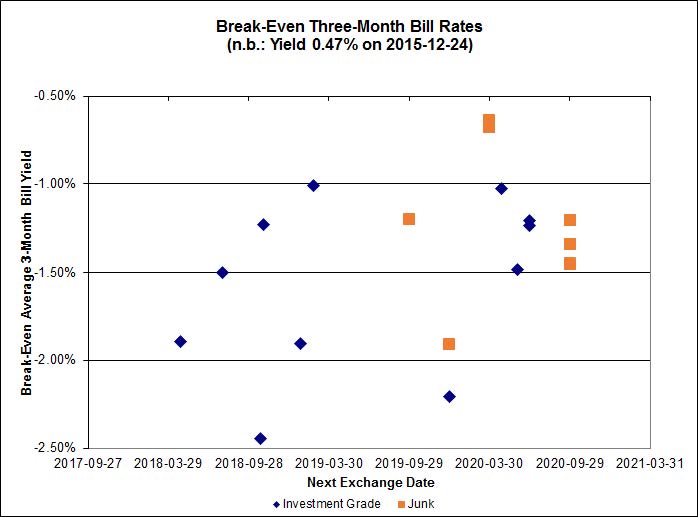
If we look at the implied break-even prime rates for the various FixedFloater / Ratchet strong pairs while assuming that the new RatchetRate will, if issued, eventually trade at 15.60 (the approximate level where other RatchetRates are trading), we can draw the following relationships:

pairs_FF_151112
Click for Big

Clearly, the implied rate of 2.99% for this pair is lower than the other pairs and is more likely to increase than decrease. It is unreasonable to assume that the price of the RatchetRate will change, because there are lots of these trading from the same issuer at about the level assigned, of 15.60. Therefore, it is more reasonable to assume a decrease in the price of BCE.PR.R, from its current bid of 16.70 to a target bid of 16.07, which will result in an implied break-even prime rate of 3.64%, which is the average of the other pairs. It will be noted, however, that this is still a higher bid than is expected for the Ratchet Rate! Therefore, I recommend retaining BCE.PR.R for those who insist on holding one element of the pair.

If you disagree with me and want to convert, remember you’ve got to act fast! The company deadline for receipt of notifications is November 17, and brokers’ internal deadlines will be earlier.

Issue Comments

BRF.PR.E: Coercive Exchange Offer

Brookfield Renewable Energy Partners L.P. has announced:

the commencement of an offer to exchange (the “Exchange Offer”) each issued and outstanding Class A Preference Share, Series 5 of Brookfield Renewable Power Preferred Equity Inc. (TSX:BRF.PR.E) (“BRP Equity”) with an annual dividend rate of 5.00% (collectively, the “Series 5 Preferred Shares”) for one newly issued Class A Preferred Limited Partnership Unit, Series 5 of Brookfield Renewable with an annual distribution rate of 5.59% (collectively, the “Series 5 Preferred Units”). The annual distribution rate on each Series 5 Preferred Unit will be C$1.3976, compared to the annual dividend rate of C$1.25 on each Series 5 Preferred Share.

Holders of Series 5 Preferred Shares (“Series 5 Preferred Shareholders”) will be entitled to receive one Series 5 Preferred Unit for each Series 5 Preferred Share tendered under the Exchange Offer. Each of the guarantors of the Series 5 Preferred Shares will also be a guarantor of the Series 5 Preferred Units, other than the issuer, Brookfield Renewable. The Series 5 Preferred Units have been assigned a provisional rating of “Pfd-3 (high)” by DBRS Limited (“DBRS”) and a preliminary rating of “P-3 (high)” by Standard & Poor’s Rating Services, a division of The McGraw-Hill Companies Inc. (“S&P”), which are the same ratings currently assigned by DBRS and S&P to the Series 5 Preferred Shares.

The Exchange Offer will be open for acceptance until 5:00 p.m. (Toronto Time) on December 18, 2015, unless extended or withdrawn by Brookfield Renewable. The Exchange Offer is conditional upon, among other things, at least 50% of the Series 5 Preferred Shares having been validly deposited or tendered under the Exchange Offer and not withdrawn, which condition may be waived by Brookfield Renewable.

The Exchange Offer is being made pursuant to a supplement to Brookfield Renewable’s short form base shelf prospectus dated May 12, 2015 (the “Prospectus Supplement”) that will be filed today with securities regulatory authorities in each of the provinces and territories of Canada.

Series 5 Preferred Shareholders should consider the following factors, among others, in making a decision whether to accept the Exchange Offer:
•Increased distributions: The annual distribution rate on the Series 5 Preferred Units is 5.59% (C$1.3976), compared to the annual dividend rate of 5.00% (C$1.25) for the Series 5 Preferred Shares.

•Substantially similar other terms and conditions: The other terms and conditions of the Series 5 Preferred Units will be substantially similar to those of the Series 5 Preferred Shares, other than certain technical amendments noted in the Prospectus Supplement.

•Unanimous Board Recommendation: The board of directors of the general partner of Brookfield Renewable and the board of directors of BRP Equity, after reviewing the Fairness Opinion (as defined below) have unanimously recommended that Series 5 Preferred Shareholders accept the Exchange Offer and deposit their Series 5 Preferred Shares pursuant to the Exchange Offer.

•Fairness Opinion: The Partnership and BRP Equity engaged PricewaterhouseCoopers LLP to provide an opinion to the effect that, subject to the assumptions, limitations and qualifications contained therein, the consideration to be received under the Exchange Offer is fair, from a financial point of view, to the holders of Series 5 Preferred Shares (the “Fairness Opinion”).

Full details of the Exchange Offer are contained in the Prospectus Supplement and other related documents that will be mailed today to the registered holder of all Series 5 Preferred Shares as required under applicable Canadian securities laws. Copies of the Prospectus Supplement and other relevant documents will be available on SEDAR at www.sedar.com and on Brookfield Renewable’s website at www.brookfieldrenewable.com. Brookfield Renewable has also commenced the process of mailing to beneficial holders of Series 5 Preferred Shares. Series 5 Preferred Shareholders are urged to evaluate carefully all information in the Exchange Offer, including risk factors, and to consult their own investment, tax and legal advisors.

Computershare Investor Services Inc. is the Depositary for the Exchange Offer and D.F. King Canada, a division of CST Investor Services Inc., is the Information Agent. Any questions or requests for assistance concerning the Exchange Offer or further information about tendering to the Exchange Offer should be directed to the Depositary at 1-800-564-6253 (toll free in North America) or 1-514-982-7555, or by e-mail at corporateactions@computershare.com; or to the Information Agent at 1-800-332-4904 (toll free in North America) or 1-201-806-7301, or by e-mail at inquiries@dfking.com.

Copies of the Prospectus Supplement and any other documents relating to the Exchange Offer as referred to above may be obtained free of charge upon request to the Depositary or the Information Agent. Series 5 Preferred Shareholders whose Series 5 Preferred Shares are registered in the name of a broker, investment dealer, bank, trust company or other nominee should contact such nominee for assistance in depositing their Series 5 Preferred Shares to the Exchange Offer.

BRF.PR.E is a Straight Perpetual, 5.00%, which commenced trading 2013-1-29 after being announced 2013-1-21. It is tracked by HIMIPref™ but relegated to the Scraps index on credit concerns.

I consider this offer coercive because, according to the prospectus supplement:

Following the completion of the Exchange Offer and any Subsequent Acquisition or Compulsory Acquisition Transaction relating thereto, the Partnership intends to cause BRP Equity to apply to the TSX to delist the Series 5 Preferred Shares from trading. See “The Exchange Offer – Effect of the Exchange Offer on the Market for Series 5 Preferred Shares, Listing and Public Disclosure by BRP Equity”.

The more detailed explanation is:

Effect of the Exchange Offer on the Market for Series 5 Preferred Shares, Listing and Public Disclosure by BRP Equity

If, after taking up Series 5 Preferred Shares under the Exchange Offer, the Partnership holds a sufficient number of Series 5 Preferred Shares, the Partnership intends to effect a Subsequent Acquisition Transaction or, if a sufficient number of Series 5 Preferred Shares are tendered, a Compulsory Acquisition. In such event, if permitted by applicable Law, the Partnership will apply to delist the Series 5 Preferred Shares from the TSX and there will no longer be a trading market for the Series 5 Preferred Shares.

Even if the Subsequent Acquisition Transaction or Compulsory Acquisition cannot be completed as quickly as intended, the purchase of Series 5 Preferred Shares by the Partnership pursuant to the Exchange Offer will reduce the number of Series 5 Preferred Shares that might otherwise trade publicly, as well as the number of Series 5 Preferred Shareholders and would likely adversely affect the liquidity and market value of the remaining Series 5 Preferred Shares held by the public.

A decline in liquidity is all part of the game, but it will be noted that company is not making any commitment to maintain the listing in any scenarios that are not specified in the above. Note that:

Resident Holders are cautioned that, if the Series 5 Preferred Shares are no longer listed on a “designated stock exchange” (which currently includes the TSX) and BRP Equity ceases to be a “public corporation” for purposes of the Tax Act, the Series 5 Preferred Shares will not be qualified investments for trusts governed by RRSPs, RRIFs, registered education savings plans, registered disability savings plans, deferred profit sharing plans or TFSAs. Resident Holders are urged to consult their own tax advisors with respect to the potential income tax consequences to them in this regard.

So that’s the stick. The carrot is:

Increased distributions: The annual distribution rate on the Series 5 Preferred Units is 5.59%, compared to the annual dividend rate of 5.00% for the Series 5 Preferred Shares.

But the difficult part is the tax considerations. First off, this is not a tax-free rollover:

A Holder of Series 5 Preferred Shares who for purposes of the Tax Act (as defined herein) and at all relevant times, is or is deemed to be resident in Canada (a “Resident Holder”) who exchanges Series 5 Preferred Shares for Series 5 Preferred Units pursuant to the Exchange Offer will be considered to have disposed of such Series 5 Preferred Shares for proceeds of disposition equal to the fair market value, as at the time of acquisition, of the Series 5 Preferred Units acquired by such Resident Holder on the exchange. As a result, the Resident Holder generally will realize a capital gain (or capital loss) to the extent that such proceeds of disposition exceed (or are less than) the aggregate of the adjusted cost base to the purchaser of the Series 5 Preferred Shares so exchanged and any reasonable costs of disposition.

However, this is of relatively small concern, since the year-end 2014 bid was 21.40 compared to today’s closing bid of 21.05 (after a healthy pop in price today, +3.64%. It looks like some players like the offer!), so I suspect that most – although not all! – holders will crystallize a capital loss.

Of greater pith and moment is the nature of the dividends to be paid on the new Preferred Units:

For Canadian federal income tax purposes, holders of Series 5 Preferred Units will be allocated a portion of the taxable income of the Partnership based on their proportionate share of distributions received on their units. The allocation of taxable income to such holders may be less than the distributions received. This difference is commonly referred to as a tax deferred return of capital (i.e., returns that are initially non-taxable but which reduce the adjusted cost base of the holder’s units). See “Certain Canadian Federal Income Tax Considerations” in this Prospectus Supplement for further details. As shown in the table below, the historical 3 year average per unit Canadian dividends, ordinary income and return of capital (i.e., excess of distributions over allocated taxable income) expressed as a percentage of the annual distributions in respect of units of the Partnership for the period 2012 through 2014 were approximately 56%, 26%, and 18% respectively. Management anticipates the 5 year average per unit Canadian dividend, ordinary income and return of capital will be 50%, 25%, and 25%, respectively, for the period between 2015 and 2020; however, no assurance can be provided this will occur.

So let’s take them at their word and estimate the after tax return on BRF.PR.E compared to the new units (which pay a total of 5.59%). According to Ernst & Young, marginal tax rates for an Ontario resident with taxable income of $150,000 p.a. were 46.41% on income, 23.20% on capital gains and 29.52% on eligible dividends. Since the Return of Capital on the new units will eventually be taxed as a capital gain but only when the gain or loss is crystallized, let’s apply a 25% discount to the capital gain marginal rate to reflect the time value of the money; hence, we will assume that the Return of Capital is subject to tax at a rate of 23.20% * 75% = 17.4%:

Taxation comparison of distributions
  BRF.PR.E New Security
Distribution
Type
Pre Tax Amount Tax Net Pre Tax Amount Tax Net
Eligible
Dividend
1.25 0.369 0.881 0.69875 0.20627 0.49248
Ordinary
Income
0.00 0.00 0.00 0.349375 0.162145 0.187230
Return
of
Capital
0.00 0.00 0.00 0.349375 0.060791 0.288584
Total 1.25 0.369 0.881 1.3975 0.4292 0.9683

So on the surface it seems like a genuine improvement – the after-tax income per share will increase from 0.881 to 0.9683, a 9.9% hike. However, note that there are no guarantees offered by the company! If it should come to pass that 100% of the distributions are ordinary income, then tax at 46.41% will come to 0.6486 and the net after-tax amount will be 0.7489, a 15.0% decline. So there’s a certain amount of tax-risk here, depending on the nature of the company’s distributions.

DBRS has assigned a provisional rating of Pfd-3(high) to the issue:

DBRS Limited (DBRS) has today assigned a provisional rating of Pfd-3 (high) with a Stable trend to Brookfield Renewable Energy Partners L.P.’s (BREP; rated BBB (high), Stable trend) proposed new issuance of Class A Preferred Limited Partnership Units, Series 5 (Preferred LP Units).

I will not make a recommendation regarding tendering holdings of BRF.PR.E at this time, and I might not make a recommendation at all. But feel free to comment!

Issue Comments

Moody's: BNS On Review-Negative

Moody’s Investors Service has announced that it:

has placed the long term ratings, Counterparty Risk Assessment and Baseline Credit Assessment of Bank of Nova Scotia (BNS, Aa2/Aa2 negative, a1) and its subsidiaries on review for downgrade, and affirmed BNS’s Prime-1 short-term deposit rating, short-term Counterparty Risk Assessment and other short term ratings.

Moody’s said the review was prompted by BNS having taken significant measures to increase its profitability that signal a fundamental shift away from the bank’s traditionally low risk appetite. These strategic actions are intended to enhance current profitability (BNS reports the lowest domestic net interest margin of the six largest Canadian banks), but in Moody’s view increase the prospect of future incremental credit losses when the credit cycle turns.

Over the last two years, BNS has accelerated the growth in its credit card and auto finance portfolios, in accordance with its strategic initiatives to expand these portfolios, both of which are particularly prone to rapid deterioration during an economic shock and exhibit higher defaults and loss severities than mortgage portfolios. Personal and credit cards loans grew at a CAGR of 8% over the past two years, the highest among the six large Canadian peer banks. In addition, BNS has made a series of acquisitions away from its strong domestic franchise towards higher-growth but less stable international markets.

During the review period, Moody’s will review the likelihood that BNS’s increased risk tolerance and strategic imperative to increase profitability by shifting the asset mix towards higher yielding categories of consumer credit, both domestically and in international operations, will persist. Moody’s will also undertake further analysis of the operating environments of the regions outside of Canada where BNS operates, and the bank’s strategy and performance in these regions. Moody’s will also assess the implications of the shift in risk tolerance, balanced against the strategic plan to enhance profitability and shareholder returns.

Given the direction of the review, upward pressure on the rating is unlikely. Downward pressure will depend upon our assessment of the items noted above as the focus of our review.

Doug Alexander of Bloomberg observes:

Debtholders already weighed in on the Toronto-based bank: Scotiabank’s Canadian dollar bonds are the worst performing among Canada’s six largest lenders this year.

Scotiabank is rated Aa2 by Moody’s, surpassed only by Toronto-Dominion Bank’s Aa1 grade. Royal Bank of Canada, Bank of Montreal, Canadian Imperial Bank of Commerce and National Bank of Canada carry Aa3 ratings. Moody’s last downgraded Scotiabank in January 2013.

Canadian consumers, already saddled with record household debt, have pushed the ratio of debt to disposable income to almost double that of the nation’s last severe recession in 1992, when unemployment hit 11.7 percent. Canadian card losses typically average around 3 percent of overall balances and soar to 7.5 percent in troubled times, whereas losses from mortgages are about 0.02 percent and have reached 0.1 percent in recessions, Moody’s said.

Scotiabank’s Canadian dollar bonds had a year-to-date total return of 1.5 percent as of Nov. 6, trailing the returns of Canada’s other so-called Big 6 lenders.

Scotia has a raft of preferred shares currently extant which could potentially be downgraded: BNS.PR.A, BNS.PR.B, BNS.PR.C, BNS.PR.D, BNS.PR.L, BNS.PR.M, BNS.PR.N, BNS.PR.O, BNS.PR.P, BNS.PR.Q, BNS.PR.R, BNS.PR.Y and BNS.PR.Z.

Issue Comments

GWO.PR.N To Be Extended

Great-West Lifeco Inc. has announced:

that it does not intend to exercise its right to redeem its outstanding Non-Cumulative 5-Year Rate Reset First Preferred Shares, Series N (the “Series N Shares”) on December 31, 2015. As a result, subject to certain conditions, the holders of the Series N Shares have the right to convert all or any of their Series N Shares into Non-Cumulative Floating Rate First Preferred Shares, Series O (the “Series O Shares”) on a one-for-one basis on December 31, 2015. A formal notice of the right to convert Series N Shares into Series O Shares will be sent to the registered holder of the Series N Shares in accordance with the rights, privileges, restrictions and conditions attached to the Series N Shares. Holders of Series N Shares who do not exercise their right to convert their Series N Shares into Series O Shares on such date will retain their Series N Shares.

The foregoing conversion right is subject to the conditions that: (i) if Lifeco determines that if, following such conversions, there would be less than one million Series O Shares outstanding on December 31, 2015, no Series N Shares may be converted into Series O Shares, and (ii) alternatively, if Lifeco determines that if, following such conversions, there would be less than one million Series N Shares outstanding on December 31, 2015, then all remaining Series N Shares will automatically be converted into Series O Shares on a one-for-one basis on December 31, 2015. In either case, Lifeco will give written notice to that effect to any registered holder affected by the preceding conditions on or before Thursday, December 24, 2015.

The dividend rate applicable to the Series N Shares for the five-year period commencing on December 31, 2015 and ending on December 30, 2020, and the dividend rate applicable to the Series O Shares for the three-month period commencing on December 31, 2015 and ending on March 30, 2016, will be determined on Tuesday, December 1, 2015 and written notice thereof will be given to the registered holder of the Series N Shares on that day.

Beneficial owners of Series N Shares who wish to have their Series N Shares converted into Series O Shares should communicate as soon as possible with their broker or other nominee to ensure their instructions are followed so that the registered holder of the Series N Shares can meet the deadline to exercise such conversion right, which is 5:00 p.m. (ET) on Wednesday, December 16, 2015.

Lifeco may redeem the Series N Shares, in whole or in part, on December 31, 2020 and on December 31 every five years thereafter for $25.00 per share plus declared and unpaid dividends and may redeem the Series O Shares, in whole or in part, after December 31, 2015 for $25.50 per share plus declared and unpaid dividends, unless such Series O Shares are redeemed on December 31, 2020 or on December 31 every five years thereafter, in which case the redemption price will be $25.00 per share plus declared and unpaid dividends.

No surprises here, since GWO.PR.N is a FixedReset, 3.65%+130, which commenced trading 2010-11-23 after being announced 2010-11-15. The issue was met with disfavour and there was an inventory clearance sale closing 2010-12-3.

Note that since the issue is issued by an insurance holding company and is not convertible into common at the option of the issuer, I consider it to have a “Deemed Maturity” 2025-1-31 (this date may change in the future). This is due to my belief that OSFI will eventually extend the Non-Viability Contingent Capital (NVCC) rules to insurers and insurance holding companies. There is a brief explanation of this on the PrefLetter website (under the heading “DeemedRetractibles”) and with more detailed argument and progress reports on international negotiations in every edition of PrefLetter.

I will note that the market does not share my views regarding future application of the NVCC rules insurers and insurance issues trade very similarly to perpetuals.

Issue Comments

Low-Spread FixedResets: October 2015

As noted in MAPF Portfolio Composition: October 2015, the fund now has a large allocation to FixedResets, mostly of relatively low spread.

Many of these were largely purchased with proceeds of sales of DeemedRetractibles from the same issuer; it is interesting to look at the price trend of some of the Straight/FixedReset pairs. We’ll start with GWO.PR.N / GWO.PR.I; the fund sold the latter to buy the former at a takeout of about $1.00 in mid-June, 2014; relative prices over the past year are plotted as:

GWOPRN_GWOPRI_151030_bidDiff
Click for Big

Given that the October month-end take-out was $7.49, this is clearly a trade that has not worked out very well.

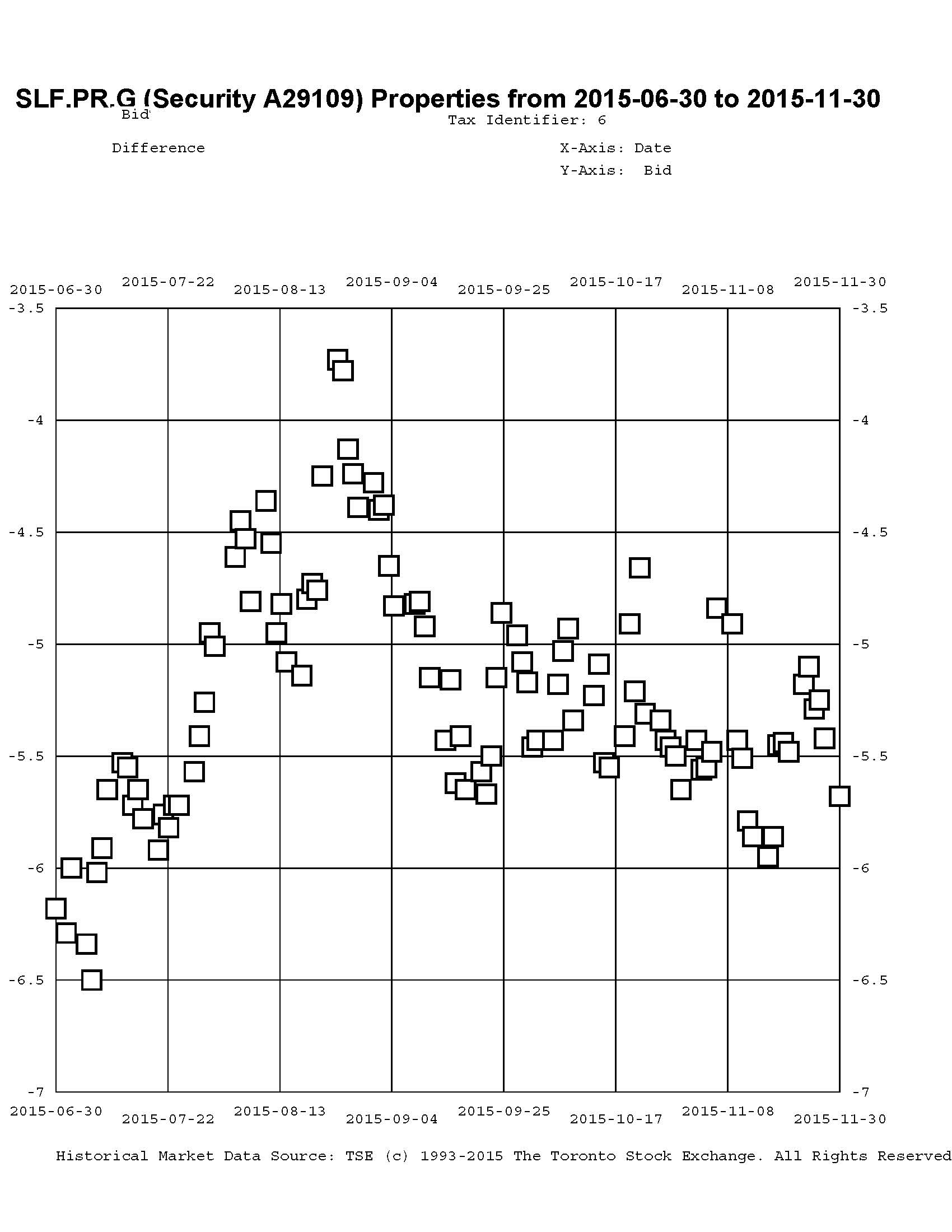
In July, 2014, I reported sales of SLF.PR.D to purchase SLF.PR.G at a take-out of about $0.15:

SLFPRG_SLFPRD_151030_bidDiff
Click for Big

There were similar trades in August, 2014 (from SLF.PR.C) at a take-out of $0.35. The October month-end take-out (bid price SLF.PR.D less bid price SLF.PR.G) was $5.65, so that hasn’t worked very well either.

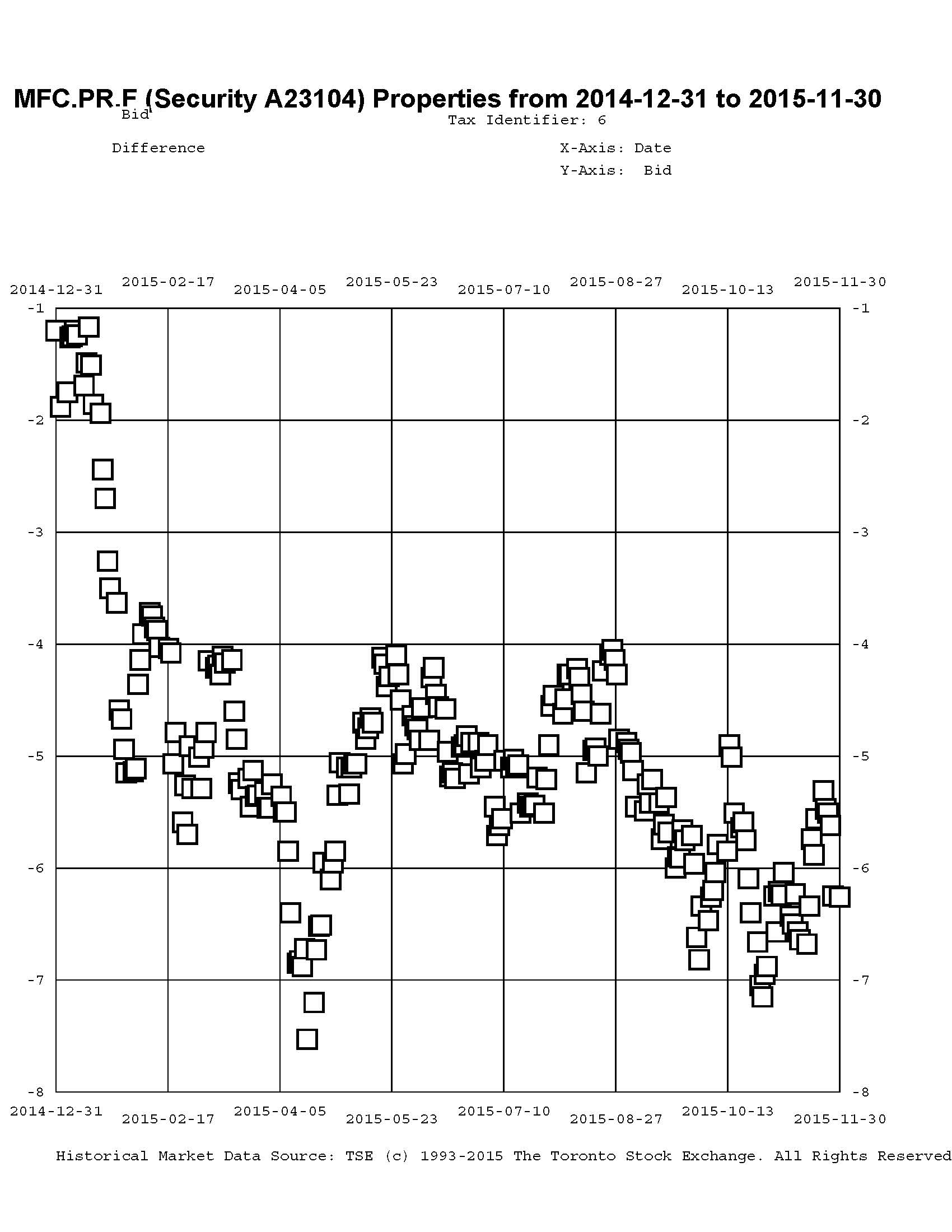
November saw the third insurer-based sector swap, as the fund sold MFC.PR.C to buy the FixedReset MFC.PR.F at a post-dividend-adjusted take-out of about $0.85 … given a October month-end take-out of $6.62, that’s another regrettable trade, although another piece executed in December at a take-out of $1.57 has less badly.

SLFPRG_SLFPRD_151030_bidDiff
Click for Big

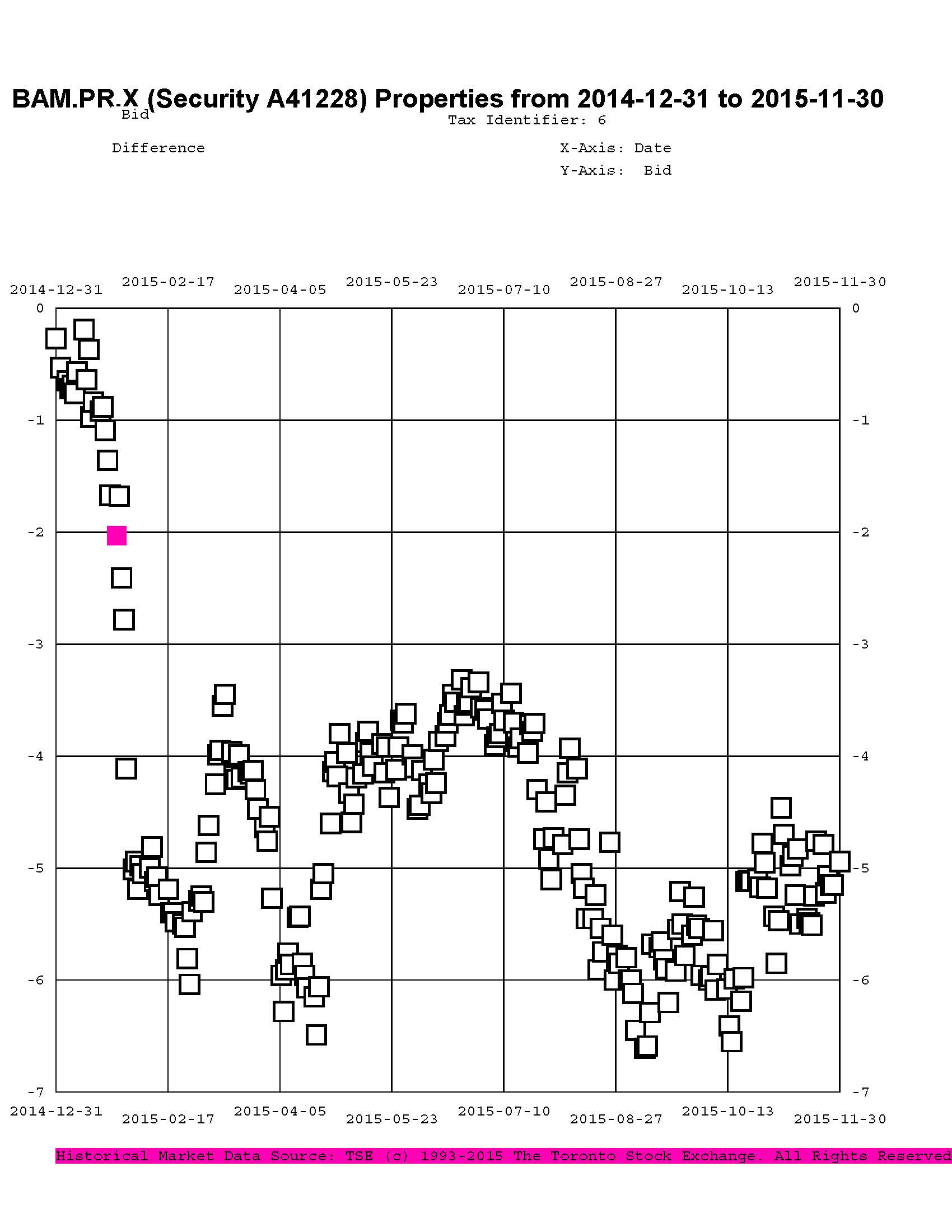
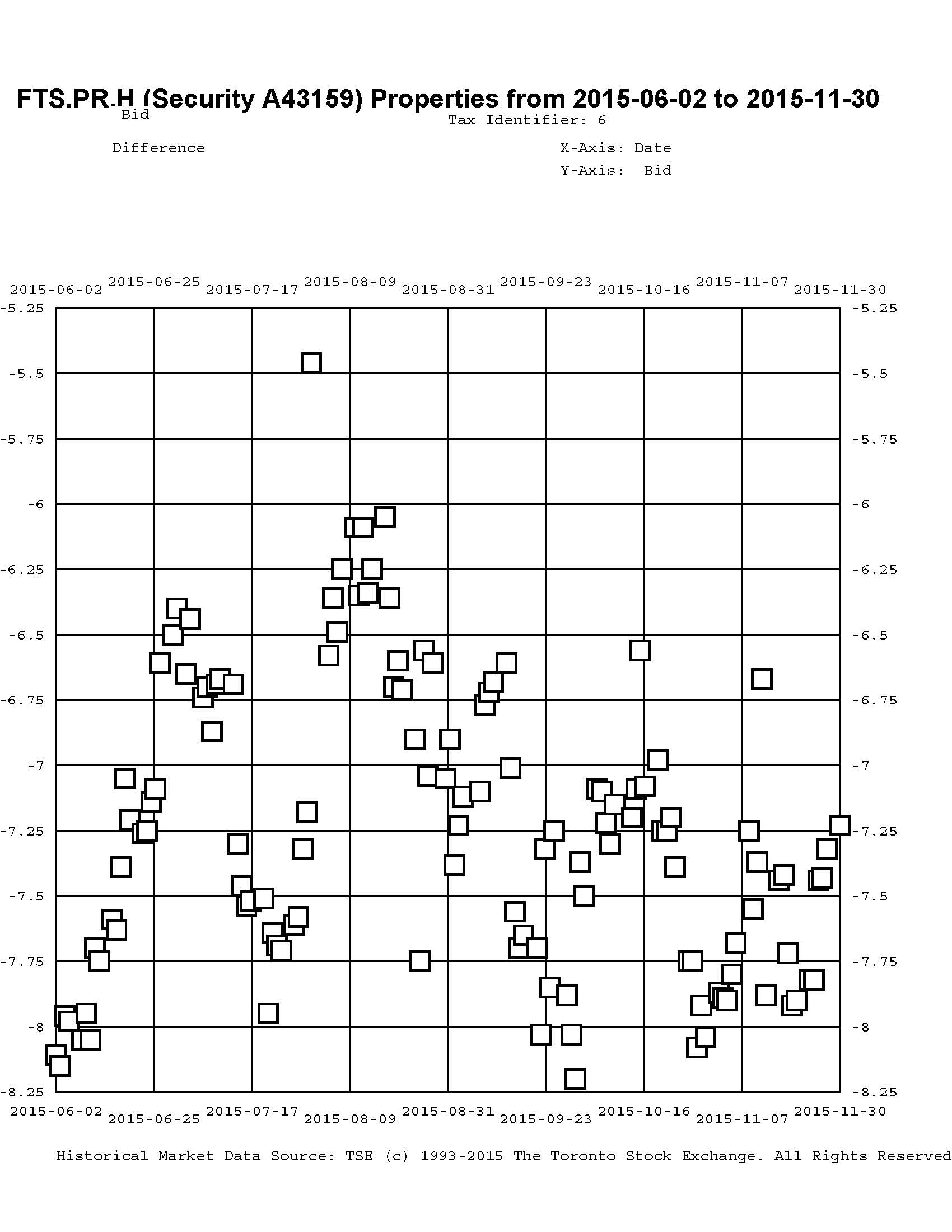
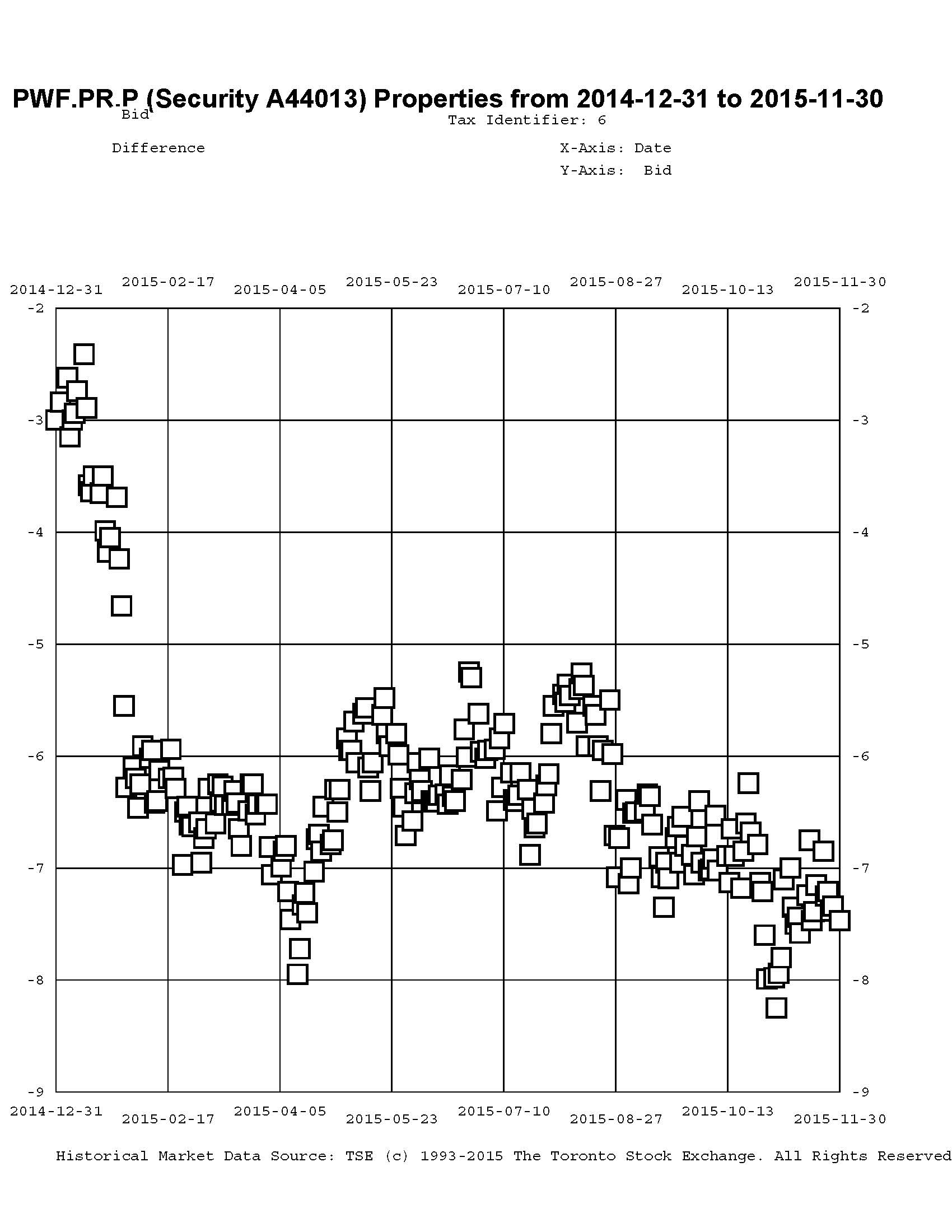
This trend is not restricted to the insurance sector, which I expect will become subject to NVCC rules in the relatively near future and are thus subject to the same redemption assumptions I make for DeemedRetractibles. Other pairs of interest are BAM.PR.X / BAM.PR.N:

BAMPRX_BAMPRN_151030_bidDiff
Click for Big

… and FTS.PR.H / FTS.PR.J:

FTSPRH_FTSPRJ_151030_bidDiff
Click for Big

… and PWF.PR.P / PWF.PR.S:

PWFPRP_PWFPRS_151030_bidDiff
Click for Big

I will agree that the fund’s trades highlighted in this post may be decried as cases of monumental bad timing, but I should point out that in May, 2014, the fund was 63.9% Straight / 9.5% FixedReset while in May 2015 the fund was 12% Straight / 86% FixedReset, FloatingReset and FixedFloater (The latter figures include allocations from those usually grouped as ‘Scraps’). Given that the indices are roughly 30% Straight / 60% FixedReset & FloatingReset, it is apparent that the fund was extremely overweighted in Straights / underweighted in FixedResets in May 2014 but this situation has now reversed. HIMIPref™ analytics have been heavily favouring low-spread issues and the fund’s holdings are overwhelmingly of this type.

Summarizing the charts above in tabular form, we see:

FixedReset Straight Take-out
December 2013
Take-out
MAPF Trade
Take-out
December 2014
September 2015 October 2015
GWO.PR.N
3.65%+130
GWO.PR.I
4.5%
($0.04) $1.00 $2.95 7.21 7.49
SLF.PR.G
4.35%+141
SLF.PR.D
4.45%
($1.29) $0.25 $2.16 5.17 5.65
MFC.PR.F
4.20%+141
MFC.PR.C
4.50%
($1.29) $0.86 $1.20 6.62 6.88
BAM.PR.X
4.60%+180
BAM.PR.N
4.75%
($2.06)   $0.17 5.51 5.18
FTS.PR.H
4.25%+145
FTS.PR.J
4.75%
$0.60   $5.68 8.20 8.04
PWF.PR.P
4.40%+160
PWF.PR.S
4.80%
($0.67)   $3.00 6.72 7.99
The ‘Take-Out’ is the bid price of the Straight less the bid price of the FixedReset; approximate execution prices are used for the “MAPF Trade” column. Bracketted figures in the ‘Take-Out’ columns indicate a ‘Pay-Up’

In January, a slow decline due to fears of deflation got worse with Canada yields plummeting after the Bank of Canada rate cut with speculation rife about future cuts although this slowly died away.

And in late March / early April it got worse again, with one commenter attributing at least some of the blame to the John Heinzl piece in which I pointed out the expected reduction in dividend payouts! In May, a rise in the markets in the first half of the month was promptly followed by a slow decline in the latter half; perhaps due to increased fears that a lousy Canadian economy will delay a Canadian tightening. Changes in June varied as the markets were in an overall decline.

In August we saw increased fear of global deflation emanating from China, although the ‘China Effect’ is disputed.

In September the market just collapsed for no apparent reason; in October the market reversed the September collapse for no apparent reason.

All in all, I take the view that we’ve seen this show before: during the Credit Crunch, Floaters got hit extremely badly (to the point at which their fifteen year total return was negative) because (as far as I can make out) their dividend rate was dropping (as it was linked to Prime) while the yields on other perpetual preferred instruments were skyrocketing (due to credit concerns). Thus, at least some investors insisted on getting long term corporate yields from rates based (indirectly and with a lag, in the case of FixedResets) on short-term government policy rates. And it’s happening again!

There is further discussion of the extremely poor performance in the seven months to July 31 of FixedResets in the post eMail to a Client. Things haven’t really changed since that was written; they’ve just gotten ever so much more so.

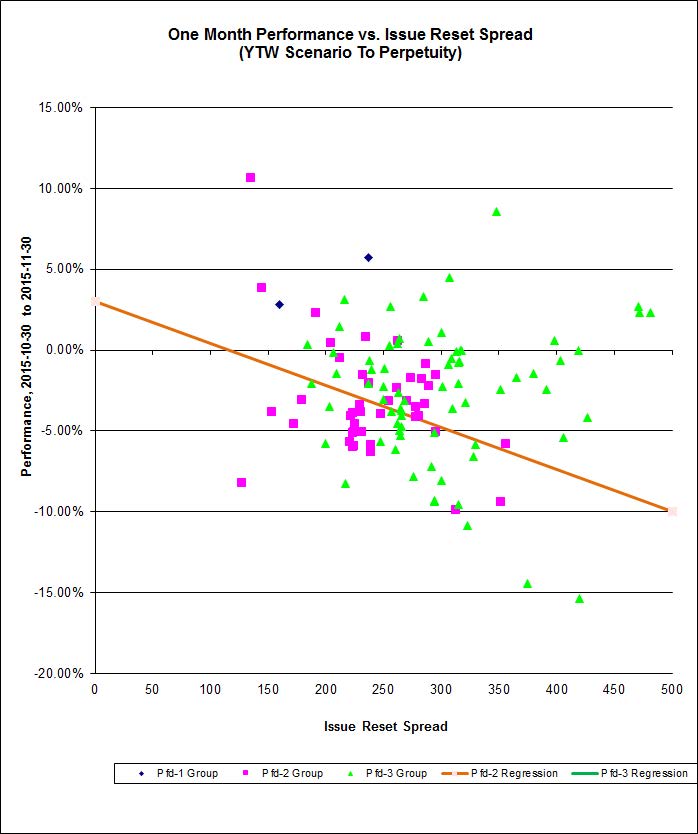
Here’s the October performance for FixedResets that had a YTW Scenario of ‘To Perpetuity’ at mid-month.:

FRPerf_151030_1Mo
Click for Big

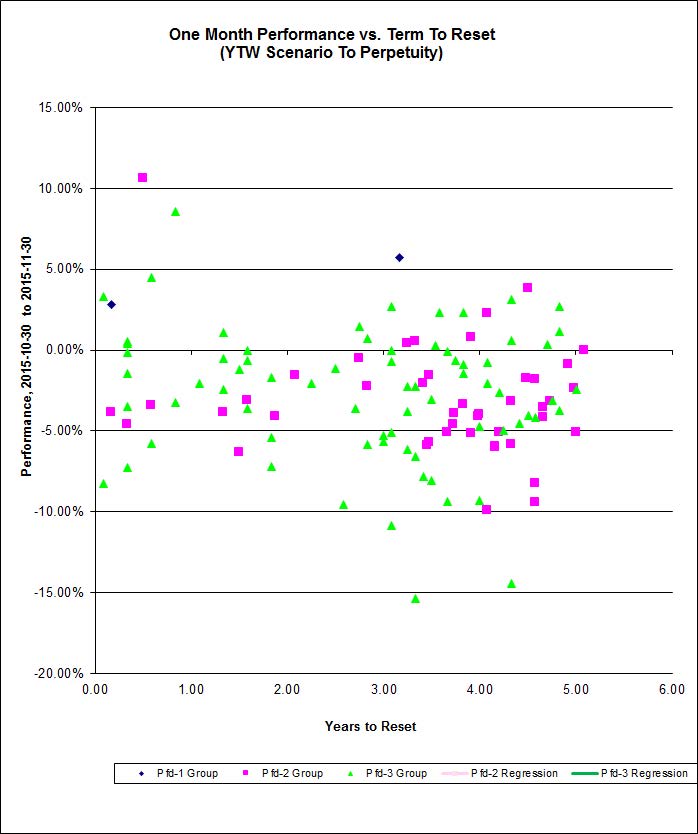
The market was very disorderly in October and correlations of performance are negligible, whether against spread or term-to-reset. However, I have added the regression line for the Pfd-3 group to the above chart, not because the correlation is so great (at only 8%, it isn’t) but because it shows that to the extent that there is a correlation between spreads and returns, the slope is negative.

FRPerf_151030_1Mo_Term
Click for Big

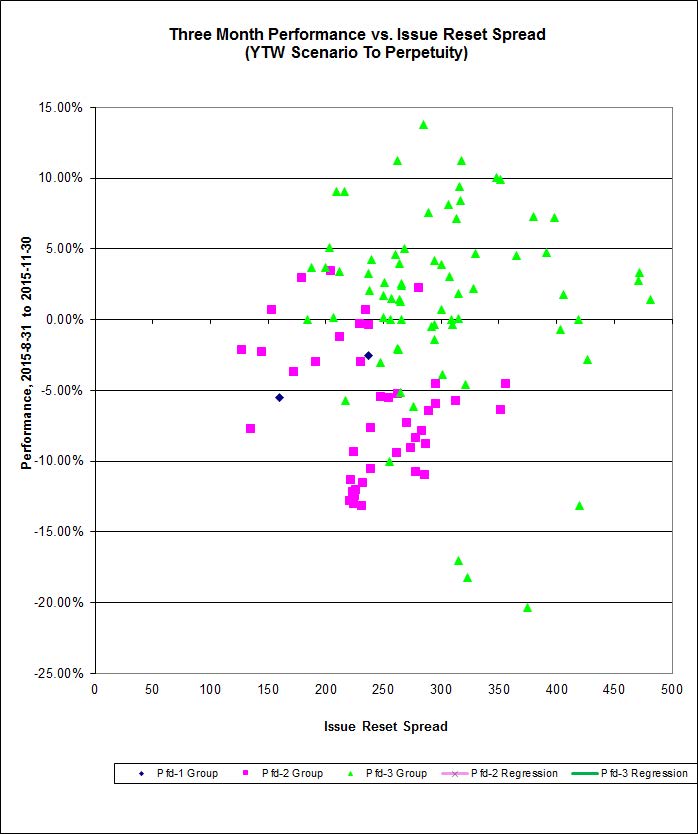
Interestingly, though, three month performance is well correlated for the Pfd-2 group (40%), although no significant relationship is found for the Pfd-3 group:

FRPerf_151030_3Mo
Click for Big
Issue Comments

PVS.PR.E Sinks on Lousy Volume

Partners Value Split Inc. has announced:

the completion of its previously announced issue of 4,000,000 Class AA Preferred Shares, Series 7 (the “Series 7 Preferred Shares”) at an offering price of $25.00 per Series 7 Preferred Share, raising gross proceeds of $100,000,000. The Series 7 Preferred Shares carry quarterly fixed cumulative preferential dividends representing a 5.50% annualized yield on the offering price and have a final maturity of October 31, 2022. The Series 7 Preferred Shares have been listed and posted for trading on the Toronto Stock Exchange under the symbol PVS.PR.E. The net proceeds of the offering will be used to redeem the Company’s outstanding Class AA Preferred Shares, Series 1 no later than March 25, 2016, in accordance with the terms of the Series 1 Preferred Shares, and to pay a special dividend to holders of the Company’s capital shares.

Prior to the closing of the offering, the Company subdivided the existing capital shares held by Partners Value Investments Inc. so that there are an equal number of preferred shares and capital shares outstanding.

The Company owns a portfolio consisting of 79,740,966 Class A Limited Voting Shares of Brookfield Asset Management Inc. (the “Brookfield Shares”) which is expected to yield quarterly dividends that are sufficient to fund quarterly fixed cumulative preferential dividends for the holders of the Company’s preferred shares and to enable the holders of the Company’s capital shares to participate in any capital appreciation of the Brookfield Shares.

DBRS has rated the issue Pfd-2(low):

DBRS Limited (DBRS) has today finalized the provisional rating of Pfd-2 (low) on the Class AA Preferred Shares, Series 7 (the Series 7 Preferred Shares) issued by Partners Value Split Corp. (the Company) and has confirmed the ratings of the previously issued Class AA Preferred Shares, Series 1; Class AA Preferred Shares, Series 3; Class AA Preferred Shares, Series 5; and Class AA Preferred Shares, Series 6 (collectively, with the Series 7 Preferred Shares, the Class AA Preferred Shares) at Pfd-2 (low).

Following the redemption of the Series 1 Preferred Shares, the downside protection available to the Class AA Preferred Shares is expected to be approximately 83% (based on the closing price of BAM shares as of October 22, 2015) and the dividend coverage ratio is expected to be above 1.7 times (based on the Canadian dollar and U.S. dollar exchange rate as of October 22, 2015). BAM declares its dividend in U.S. dollars, so there is the risk that an appreciating Canadian dollar will cause the dividend coverage ratio to fall below 1.0 times. In the event of a shortfall, the Company may sell some of the BAM Shares, engage in security lending or write covered call options to generate sufficient income to satisfy its obligations to pay the Class AA Preferred Shares dividends. If the Company chooses to lend its holdings, the Portfolio would be exposed to the potential losses in the event that the borrower defaults on its obligations to return the borrowed securities.

The rating is based on the same rating rationale and rating considerations as all other series of Class AA Preferred Shares.

PVS.PR.E is a seven-year 5.50% SplitShare announced October 20. It will be tracked by HIMIPref™ and has been assigned to the SplitShares subindex.

The issue traded a miserable 23,300 shares today in a range of 24.50-80 before settling at 24.52-55, 4×57. Vital statistics are:

PVS.PR.E SplitShare YTW SCENARIO
Maturity Type : Hard Maturity
Maturity Date : 2022-10-31
Maturity Price : 25.00
Evaluated at bid price : 24.52
Bid-YTW : 5.86 %
Issue Comments

Low-Spread FixedResets: September 2015

As noted in MAPF Portfolio Composition: September 2015, the fund now has a large allocation to FixedResets, mostly of relatively low spread.

Many of these were largely purchased with proceeds of sales of DeemedRetractibles from the same issuer; it is interesting to look at the price trend of some of the Straight/FixedReset pairs. We’ll start with GWO.PR.N / GWO.PR.I; the fund sold the latter to buy the former at a takeout of about $1.00 in mid-June, 2014; relative prices over the past year are plotted as:

GWOPRN_GWOPRI_150930_bidDiff
Click for Big

Given that the September month-end take-out was $7.21, this is clearly a trade that has not worked out very well.

In July, 2014, I reported sales of SLF.PR.D to purchase SLF.PR.G at a take-out of about $0.15:

SLFPRG_SLFPRD_150930_bidDiff
Click for Big

There were similar trades in August, 2014 (from SLF.PR.C) at a take-out of $0.35. The September month-end take-out (bid price SLF.PR.D less bid price SLF.PR.G) was $5.17, so that hasn’t worked very well either.

November saw the third insurer-based sector swap, as the fund sold MFC.PR.C to buy the FixedReset MFC.PR.F at a post-dividend-adjusted take-out of about $0.85 … given a September month-end take-out of $6.62, that’s another regrettable trade, although another piece executed in December at a take-out of $1.57 has less badly.

MFCPRF_MFCPRC_150930_bidDiff
Click for Big

This trend is not restricted to the insurance sector, which I expect will become subject to NVCC rules in the relatively near future and are thus subject to the same redemption assumptions I make for DeemedRetractibles. Other pairs of interest are BAM.PR.X / BAM.PR.N:

BAMPRX_BAMPRN_150930_bidDiff
Click for Big

… and FTS.PR.H / FTS.PR.J:

FTSPRH_FTSPRJ_150930_bidDiff
Click for Big

… and PWF.PR.P / PWF.PR.S:

PWFPRP_PWFPRS_150930_bidDiff
Click for Big

I will agree that the fund’s trades highlighted in this post may be decried as cases of monumental bad timing, but I should point out that in May, 2014, the fund was 63.9% Straight / 9.5% FixedReset while in May 2015 the fund was 12% Straight / 86% FixedReset, FloatingReset and FixedFloater (The latter figures include allocations from those usually grouped as ‘Scraps’). Given that the indices are roughly 30% Straight / 60% FixedReset & FloatingReset, it is apparent that the fund was extremely overweighted in Straights / underweighted in FixedResets in May 2014 but this situation has now reversed. HIMIPref™ analytics have been heavily favouring low-spread issues and the fund’s holdings are overwhelmingly of this type.

Summarizing the charts above in tabular form, we see:

FixedReset Straight Take-out
December 2013
Take-out
MAPF Trade
Take-out
December 2014
August 2015 September 2015
GWO.PR.N
3.65%+130
GWO.PR.I
4.5%
($0.04) $1.00 $2.95 6.85 7.21
SLF.PR.G
4.35%+141
SLF.PR.D
4.45%
($1.29) $0.25 $2.16 4.28 5.17
MFC.PR.F
4.20%+141
MFC.PR.C
4.50%
($1.29) $0.86 $1.20 4.88 6.62
BAM.PR.X
4.60%+180
BAM.PR.N
4.75%
($2.06)   $0.17 5.80 5.51
FTS.PR.H
4.25%+145
FTS.PR.J
4.75%
$0.60   $5.68 7.05 8.20
PWF.PR.P
4.40%+160
PWF.PR.S
4.80%
($0.67)   $3.00 6.39 6.72
The ‘Take-Out’ is the bid price of the Straight less the bid price of the FixedReset; approximate execution prices are used for the “MAPF Trade” column. Bracketted figures in the ‘Take-Out’ columns indicate a ‘Pay-Up’

In January, a slow decline due to fears of deflation got worse with Canada yields plummeting after the Bank of Canada rate cut with speculation rife about future cuts although this slowly died away.

And in late March / early April it got worse again, with one commenter attributing at least some of the blame to the John Heinzl piece in which I pointed out the expected reduction in dividend payouts! In May, a rise in the markets in the first half of the month was promptly followed by a slow decline in the latter half; perhaps due to increased fears that a lousy Canadian economy will delay a Canadian tightening. Changes in June varied as the markets were in an overall decline.

In August we saw increased fear of global deflation emanating from China, although the ‘China Effect’ is disputed.

In September the market just collapsed for no apparent reason.

All in all, I take the view that we’ve seen this show before: during the Credit Crunch, Floaters got hit extremely badly (to the point at which their fifteen year total return was negative) because (as far as I can make out) their dividend rate was dropping (as it was linked to Prime) while the yields on other perpetual preferred instruments were skyrocketing (due to credit concerns). Thus, at least some investors insisted on getting long term corporate yields from rates based (indirectly and with a lag, in the case of FixedResets) on short-term government policy rates. And it’s happening again!

There is further discussion of the extremely poor performance in the seven months to July 31 of FixedResets in the post eMail to a Client. Things haven’t really changed over the past two months; they’ve just gotten ever so much more so.

Here’s the September performance for FixedResets that had a YTW Scenario of ‘To Perpetuity’ at mid-month.:

LowSpreadFR_Perf_1Mo_150930
Click for Big

The market was very disorderly in September and correlations of performance are negligible, whether against spread or term-to-reset.

LowSpreadFR_PerfTerm_1Mo_150930
Click for Big
Issue Comments

RY.PR.P Smacked On Tiny Volume

Royal Bank of Canada has announced:

it has closed its domestic public offering of Non-Cumulative, Preferred Shares Series BJ. Royal Bank of Canada issued 6 million Preferred Shares Series BJ at a price of $25 per share to raise gross proceeds of $150 million.

The offering was underwritten by a syndicate led by RBC Capital Markets. The Preferred Shares Series BJ will commence trading on the Toronto Stock Exchange today under the ticker symbol RY.PR.P.

The Preferred Shares Series BJ were issued under a prospectus supplement dated September 28, 2015 to the bank’s short form base shelf prospectus dated December 20, 2013.

RY.PR.P is a PerpetualDiscount, 5.25%, announced September 24. The issue will be tracked by HIMIPref™ and has been assigned to the PerpetualDiscount subindex.

The issue traded a miserable 73,494 shares today (consolidated exchanges) in a range of 24.40-80 before closing at 24.40-44, 15×29. Vital statistics are:

RY.PR.P Perpetual-Discount YTW SCENARIO
Maturity Type : Limit Maturity
Maturity Date : 2045-10-02
Maturity Price : 24.04
Evaluated at bid price : 24.40
Bid-YTW : 5.39 %

When only the NVCC-compliant issues are used for fitting the Implied Volatility curve, it appears that Implied Volatility is very low (which suggests that the relationship will steepen somewhat in the future) implying that higher-coupon issues are relatively expensive. However, there are only four data points to support this conclusion and the variety of coupon rates is minimal, so don’t mortgage the farm!

impVol_RY_151002
Click for Big

On the other hand, the lower-coupon, explicitly NVCC-compliant issues (RY.PR.N and RY.PR.O) are trading at the same Current Yield at the new issue, which is crazy; they should be trading to yield a little less (with the 9% Implied Volatility shown, which is calculated including the NVCC-compliance-eligible RY.PR.W), the difference in Current Yield should be about 6bp.