Category: Issue Comments

Issue Comments

LBS.PR.A Closes Treasury Offering

Brompton Group has announced:

Life & Banc Split Corp. (the “Company”) is pleased to announce that it has completed a treasury offering of 1,300,000 class A shares and 1,300,000 preferred shares for aggregate gross proceeds of approximately $25.5 million. The class A shares and preferred shares will continue to trade on the Toronto Stock Exchange under the existing symbols LBS (class A shares) and LBS.PR.A (preferred shares).
The Company invests in a portfolio of common shares of the six largest Canadian banks (“Banks”) and the four major publicly traded Canadian life insurance companies (“Lifecos”). Currently, the portfolio consists of common shares of the following Banks and Lifecos:

The Bank of Nova Scotia Royal Bank of Canada
National Bank of Canada Industrial Alliance Insurance and Financial Services Inc.
The Toronto-Dominion Bank Great-West Lifeco Inc.
Canadian Imperial Bank of Commerce Manulife Financial Corporation
Bank of Montreal Sun Life Financial Inc.

The class A shares were offered at a price of $9.55 and the preferred shares were offered at a price of $10.05. The final class A and preferred share offering prices were determined so as to be non-dilutive to the net asset value per unit of the Company on March 26, 2015, as adjusted for dividends accrued prior to or upon settlement of the offering.

The syndicate of agents for the offering was led by RBC Capital Markets, CIBC, Scotiabank, and TD Securities Inc., and includes BMO Capital Markets, National Bank Financial Inc., GMP Securities L.P., Raymond James Ltd., Canaccord Genuity Corp., Desjardins Securities Inc., Dundee Securities Ltd., Haywood Securities Inc., Industrial Alliance Securities Inc. and Mackie Research Capital Corporation.

Not bad, considering that the April 2 NAVPU was $18.59! I previously reported on the offering.

LBS.PR.A is tracked by HIMIPref™ but is relegated to the Scraps index on credit concerns.

Update, 2015-04-23: Small over-allotment:

Life & Banc Split Corp. (the “Company”) is pleased to announce that it has completed the issuance of 22,000 class A shares and 22,000 preferred shares for aggregate gross proceeds of approximately $0.4 million. The issuance was pursuant to the exercise of the over-allotment option granted to the agents in connection with the Company’s recently completed treasury offering. Following the exercise of the over-allotment option, total gross proceeds raised pursuant to this offering are approximately $25.9 million.

Issue Comments

Low Spread FixedResets: March, 2015

As noted in MAPF Portfolio Composition: March 2015, the fund now has a fairly large allocation to FixedResets, mostly of relatively low spread.

Many of these were largely purchased with proceeds of sales of DeemedRetractibles from the same issuer, it is interesting to look at the price trend of some of the Straight/FixedReset pairs. We’ll start with GWO.PR.N / GWO.PR.I; the fund sold the latter to buy the former at a takeout of about $1.00 in mid-June, 2014; relative prices over the past year are plotted as:

GWOPRN_GWOPRI_150331
Click for Big

Given that the March month-end take-out was $5.74, this is clearly a trade that has not worked out very well.

In July, 2014, I reported sales of SLF.PR.D to purchase SLF.PR.G at a take-out of about $0.15:

SLFPRG_SLFPRD_150331
Click for Big

There were similar trades in August, 2014 (from SLF.PR.C) at a take-out of $0.35. The February month-end take-out (bid price SLF.PR.D less bid price SLF.PR.G) was $6.16, so that hasn’t worked very well either.

November saw the third insurer-based sector swap, as the fund sold MFC.PR.C to buy the FixedReset MFC.PR.F at a post-dividend-adjusted take-out of about $0.85 … given a February month-end take-out of about $5.29, that’s another regrettable trade, although another piece executed in December at a take-out of $1.57 has less badly.

MFCPRF_MFCPRC_bidDiff_150331
Click for Big

This trend is not restricted to the insurance sector, which I expect will become subject to NVCC rules in the relatively near future and are thus subject to the same redemption assumptions I make for DeemedRetractibles. Other pairs of interest are BAM.PR.X / BAM.PR.N:

BAMPRX_BAMPRN_bidDiff_150331
Click for Big

… and FTS.PR.H / FTS.PR.J:

FTSPRH_FTSPRJ_bidDiff_150331
Click for Big

… and PWF.PR.P / PWF.PR.S:

PWFPRP_PWFPRS_bidDiff_150331
Click for Big

I will agree that the fund’s trades highlighted in this post may be decried as cases of monumental bad timing, but I should point out that in May, 2014, the fund was 63.9% Straight / 9.5% FixedReset
while in February 2015 the fund was 22% Straight / 64% FixedReset & FloatingReset (The latter figures include allocations from those usually grouped as ‘Scraps’). Given that the indices are roughly 30% Straight / 60% FixedReset & FloatingReset, it is apparent that the fund was extremely overweighted in Straights / underweighted in FixedResets in May 2014 but is now approximately index-weighted in FixedResets and underweighted in Straights (the balance being mostly SplitShares in the fund). HIMIPref™ analytics have been heavily favouring low-spread issues and the fund’s holdings are overwhelmingly of this type.

Summarizing the charts above in tabular form, we see:

FixedReset Straight Take-out
December 2013
Take-out
MAPF Trade
Take-out
December 2014
Take-out
February 2015
Take-out March 2015
GWO.PR.N
3.65%+130
GWO.PR.I
4.5%
($0.04) $1.00 $2.95 $6.25 $5.74
SLF.PR.G
4.35%+141
SLF.PR.D
4.45%
($1.29) $0.25 $2.16 $6.45 $6.16
MFC.PR.F
4.20%+141
MFC.PR.C
4.50%
($1.29) $0.86 $1.20 $5.29 $5.46
BAM.PR.X
4.60%+180
BAM.PR.N
4.75%
($2.06)   $0.17 $5.39 $4.76
FTS.PR.H
4.25%+145
FTS.PR.J
4.75%
$0.60   $5.68 $8.47 $8.86
PWF.PR.P
4.40%+160
PWF.PR.S
4.80%
($0.67)   $3.00 $6.63 $6.43
The ‘Take-Out’ is the bid price of the Straight less the bid price of the FixedReset; approximate execution prices are used for the “MAPF Trade” column. Bracketted figures in the ‘Take-Out’ columns indicate a ‘Pay-Up’

So why is all this happening? One should take care in explaining market movements, but it is my belief that in the latter half of 2013 we were dealing with the ‘taper tantrum’ – the market’s fears that Fed tapering and subsequent tapering would lead to massive spikes in yields; this led to a great preference for FixedResets over Straights. Now, with the economic news getting less inflationary with every news story and Europe and Japan desperately trying to reflate their sluggish economies, the market seems to think that these rate increases are still a long way off … leading to a great preference for Straights over FixedResets.

In addition, the graphs show a sharp spike in early December, during which the low-spread FixedResets were very badly hurt; I believe this to be due to a combination of tax-loss selling and a panicky response to the 29% reduction in the TRP.PR.A dividend.

And in January it just got worse with Canada yields plummeting after the Bank of Canada rate cut with speculation rife about future cuts although this has recently become less emphatic.

There was some good discussion about what is going on in the comments to the January 29 market action report. I take the view that we’ve seen this show before: during the Credit Crunch, Floaters got hit extremely badly (to the point at which their fifteen year total return was negative) because (as far as I can make out) their dividend rate was dropping (as it was linked to Prime) while the yields on other perpetual preferred instruments were skyrocketing (due to credit concerns). Thus, at least some investors insisted on getting long term corporate yields from rates based (indirectly and with a lag, in the case of FixedResets) on short-term government policy rates. And it’s happening again!

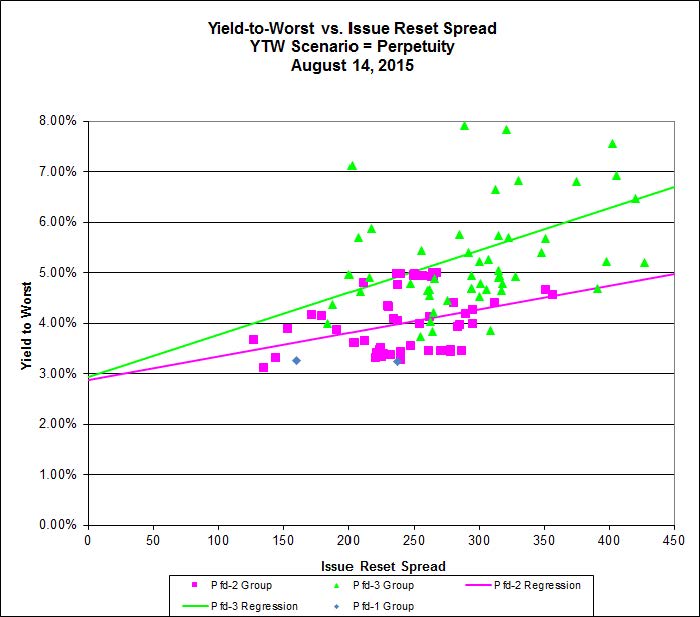
Here’s the March performance for FixedResets that had a YTW Scenario of ‘To Perptuity’ at mid-month. The correlations for both the Pfd-2 Group and the Pfd-3 Group improved this month: 12% and 25%, respectively:

FR_1MoPerf_150331A_IRS
Click for Big
Issue Comments

BBO.PR.A Downgraded to Pfd-3(high) by DBRS

DBRS has announced that it:

has today downgraded the rating of the Class A, Preferred Shares (the Preferred Shares) issued by Big Bank Big Oil Split Corp. (the Company) and removed its Under Review with Negative Implications status. In June 2006, the Company issued 2.72 million Preferred Shares at $10 each and an equal number of Capital Shares (the Capital Shares) at $15 each. The final redemption date for the Preferred Shares is December 30, 2016.

The net proceeds from the offering were used to purchase a portfolio of common shares of the six largest banks and several of the largest oil and gas companies in Canada (collectively, the Portfolio). The Portfolio was initially equally weighted and is rebalanced annually. Dividends received on the Portfolio are used to pay a fixed cumulative quarterly distribution to holders of the Preferred Shares, yielding 5.25% annually on the initial issue price. Holders of the Capital Shares are currently receiving monthly distributions of $0.05 per Capital Share.

On February 6, 2015, due to the drop in downside protection caused by the plunge in oil prices at the end of 2014 and the continued price volatility in early 2015, DBRS placed the rating of the Preferred Shares Under Review with Negative Implications. Downside protection available to holders of the Preferred Shares was 42.1% as of March 30, 2015. As a result of the downside protection remaining below acceptable levels for a prolonged period, the rating of the Preferred Shares have been downgraded to Pfd-3 (high) from Pfd-2 (low), and DBRS removed the Preferred Shares from Under Review with Negative Implications.

The notice of the Review-Negative was previously reported on PrefBlog.

BBO.PR.A is not tracked by HIMIPref™.

Issue Comments

BK.PR.A To Get Bigger

Quadravest has announced:

Canadian Banc Corp. (the “Company’) is pleased to announce it has filed a preliminary short form prospectus in each of the provinces of Canada with respect to an offering of Preferred Shares and Class A Shares of the Company. The offering will be co-led by National Bank Financial Inc., CIBC, RBC Capital Markets and will also include Scotia Capital Inc., TD Securities Inc., BMO Capital Markets, GMP Securities L.P., Canaccord Genuity Corp., Dundee Securities, Raymond James, Desjardins Securities Inc., Mackie Research Capital Corporation and Manulife Securities Incorporated.

The Preferred Shares will be offered at a price of $10.00 per Preferred Share to yield 5% and the Class A Shares will be offered at a price of $13.25 per Class A Share to yield 10%. The closing price on the TSX of each of the Preferred Shares and the Class A Shares on March 31, 2015 was $10.30 and $13.75, respectively.

Since inception of the Company, the aggregate dividends paid on the Preferred Shares have been $5.27 per share and the aggregate dividends paid on the Class A Shares have been $8.89 per share, for a combined total of $14.16 per unit (inclusive of the March 31, 2015 distribution payable on April 10, 2015). All distributions to date have been made in tax advantage eligible Canadian dividends or capital gains dividends.

The net proceeds of the offering will be used by the Company to invest in a portfolio of six publicly traded Canadian Banks as follows: [images of corporate logos for BMO, BNS, CM, NA, RY and TD]

The Company’s investment objectives are to:

  • Preferred Shares:
    • i. provide holders with cumulative preferential floating rate monthly cash dividends at a rate per annum equal to the prevailing Canadian prime rate plus 0.75%(minimum annual rate of 5.0% and maximum annual rate of 7%) based on original issue price; and
    • ii. On or about December 1, 2018 or such other date as the Company may determine (the “termination date”) to pay holders the original $10 issue price of those shares.
  • Class A Shares:
    • i. provide holders with regular monthly cash distributions currently targeted to be at the annualized rate of 10% based upon the volume-weighted average trading price of the Class A Shares on the TSX for the last three trading days of the preceding month; and
    • ii. On the termination date to pay holders the original $15 issue price of those shares.

The sales period of this overnight offering will end at 9:00 a.m. EST on April 2, 2015.

Given that the NAVPU on March 31, 2015 was 21.47, the unit price of $23.25 for the offering is pretty good! It’s nice when you can simultaneously increase your assets under management and improve returns .. when the SplitShare business works, it works really well!

BK.PR.A was last mentioned on PrefBlog when there was a rights offering in September 2014. BK.PR.A is tracked by HIMIPref™ but relegated to the Scraps index on both credit and volume concerns.

Issue Comments

VSN.PR.E Better Than Expected On Decent Volume

Veresen Inc. has announced:

that it has closed its previously announced bought deal offering of 8,000,000 Cumulative Redeemable Preferred Shares, Series E (the “Series E Preferred Shares”) at a price of $25.00 per share representing aggregate gross proceeds of $200,000,000 (the “Offering”). The Offering was made through a syndicate of underwriters co-led by Scotiabank, TD Securities Inc. and RBC Capital Markets.

The net proceeds from the Offering will be used to repay amounts outstanding under the credit facility that Veresen entered into for purposes of financing its acquisition of a 50% convertible preferred interest in Ruby Pipeline Holding Company, L.L.C., the entity which indirectly owns the Ruby pipeline system.

The Series E Preferred Shares will begin trading on the Toronto Stock Exchange today under the symbol “VSN.PR.E”.

VSN.PR.E is a FixedReset, 5.00%+427, announced 2015-03-23. The issue will be tracked by HIMIPref™ but relegated to the Scraps index on credit concerns.

The issue has been rated Pfd-3 [Stable] by DBRS.

VSN.PR.E traded 616,055 shares today (consolidated exchanges) in a range of 24.75-92 before closing at 24.75-79. Vital statistics are:

VSN.PR.E FixedReset YTW SCENARIO
Maturity Type : Limit Maturity
Maturity Date : 2045-04-01
Maturity Price : 23.06
Evaluated at bid price : 24.75
Bid-YTW : 5.02 %

While the issue closed its first day at a discount, its opening day turned out better than might be expected! The NAV of BMO S&P/TSX Laddered Preferred Share Index ETF (ZPR) was 12.86 at the close on March 23 (the announcement day) and was 12.50 today. After doing a rough adjustment for the $0.048 distribution that went ex on March 26, we calculate a total return for the FixedReset ETF over the period of -2.4%, which suggests that a closing price of about 24.39 could have been expected.

Issue Comments

BRF.PR.A To Reset At 3.355%

Brookfield Renewable Energy Partners L.P. has announced:

that it has determined the fixed dividend rate on Brookfield Renewable Power Preferred Equity Inc.’s Class A Preference Shares, Series 1 (“Series 1 Shares”) (TSX: BRF.PR.A) for the five years commencing May 1, 2015 and ending April 30, 2020. If declared, the fixed quarterly dividends on the Series 1 Shares during that period will be paid at an annual rate of 3.355% ($0.2096875 per share per quarter).

Holders of Series 1 Shares have the right, at their option, exercisable not later than 5:00 p.m. (Toronto time) on April 15, 2015, to convert all or part of their Series 1 Shares, on a one-for-one basis, into Class A Preference Shares, Series 2 (the “Series 2 Shares”), effective April 30, 2015.

The quarterly floating rate dividends on the Series 2 Shares will be paid at an annual rate, calculated for each quarter, of 2.62% over the annual yield on three-month Government of Canada treasury bills. The actual quarterly dividend rate in respect of the May 1, 2015 to July 31, 2015 dividend period for the Series 2 Shares will be 0.793468% (3.148% on an annualized basis) and the dividend, if declared, for such dividend period will be $0.198367 per share, payable on July 31, 2015.

Holders of Series 1 Shares are not required to elect to convert all or any part of their Series 1 Shares into Series 2 Shares.

As provided in the share conditions of the Series 1 Shares, (i) if Brookfield Renewable determines that there would be fewer than 1,000,000 Series 1 Shares outstanding after April 30, 2015, all remaining Series 1 Shares will be automatically converted into Series 2 Shares on a one-for-one basis effective April 30, 2015; and (ii) if Brookfield Renewable determines that there would be fewer than 1,000,000 Series 2 Shares outstanding after April 30, 2015, no Series 1 Shares will be permitted to be converted into Series 2 Shares. There are currently 10,000,000 Series 1 Shares outstanding.

The Toronto Stock Exchange (“TSX”) has conditionally approved the listing of the Series 2 Shares effective upon conversion. Listing of the Series 2 Shares is subject to Brookfield Renewable fulfilling all the listing requirements of the TSX and, upon approval, the Series 2 Shares will be listed on the TSX under the trading symbol “BRF.PR.B”.

BRF.PR.A was issued as a FixedReset, 5.25%+262, closing 2010-3-10 after being announced 2010-2-18. The new rate of 3.355% is thus a horrific 36% cut in the dividend.

As stated, the deadline for notification of the company of intent to convert is 5:00 p.m. (Toronto time) on April 15, 2015, but brokers will have earlier internal deadlines. I intend to post on April 10 regarding my recommendation on conversion.

BRF.PR.A is tracked by HIMIPref™ but is relegated to the Scraps index on credit concerns. BRF.PR.B, if it comes into existence as a FloatingReset, will also be tracked.

Issue Comments

AIM.PR.A / AIM.PR.B: 43% Conversion To FloatingReset

AIM.PR.A recently extended with a dividend cut of 31% and I recommended that holders retain their shares in preference to conversion to the FloatingReset issues. More recently, I opined that AIM.PR.A looks cheap relative to AIM.PR.C.

Aimia did not issue a press release with respect to either the conversion percentage or the first day of listing of the FloatingReset AIM.PR.B on the Toronto Stock Exchange, but TMXMoney reports that there are now 3,953,365 shares of AIM.PR.A outstanding relative to 2,946,635 shares of AIM.PR.B, so we may calculate a conversion rate of 43%.

There was no volume in AIM.PR.B reported.

Despite this lack of volume – or, who knows, maybe because of it – the AIM.PR.A / AIM.PR.B Strong Pair ended its first day on the market with an implied average three-month bill rate over the next five years of +0.24%, well within the boundaries set by other pairs.

pairs_FR_150331
Click for Big

Vital statistics are:

AIM.PR.A FixedReset YTW SCENARIO
Maturity Type : Limit Maturity
Maturity Date : 2045-03-31
Maturity Price : 19.50
Evaluated at bid price : 19.50
Bid-YTW : 5.84 %
AIM.PR.B FloatingReset YTW SCENARIO
Maturity Type : Limit Maturity
Maturity Date : 2045-03-31
Maturity Price : 19.00
Evaluated at bid price : 19.00
Bid-YTW : 5.66 %
Issue Comments

FFH.PR.E / FFH.PR.F: 31% Conversion to FloatingReset

FFH.PR.E recently extended with a dividend cut of 39% and I recommended that holders retain their shares in preference to conversion to the FloatingReset issues.

Fairfax did not issue a press release with respect to either the conversion percentage or the first day of listing of the FloatingReset FFH.PR.F on the Toronto Stock Exchange, but TMXMoney reports that there are now 7,915,539 shares of FFH.PR.E outstanding relative to 3,572,044 shares of the FloatingReset FFH.PR.F, so we may calculate a conversion rate of 31%.

Volume of 8,118 shares of FFH.PR.F was reported in a range of 15.65-75.

This was a fairly good result for FFH.PR.F; the FFH.PR.E / FFH.PR.F Strong Pair ended its first day on the market with an implied average three-month bill rate over the next five years of +0.72%, which may seem low, but is the highest rate implied by all other pairs.

pairs_FR_150331
Click for Big

Vital statistics are:

FFH.PR.E FixedReset YTW SCENARIO
Maturity Type : Limit Maturity
Maturity Date : 2045-03-31
Maturity Price : 15.68
Evaluated at bid price : 15.68
Bid-YTW : 4.70 %
FFH.PR.F FloatingReset YTW SCENARIO
Maturity Type : Limit Maturity
Maturity Date : 2045-03-31
Maturity Price : 15.65
Evaluated at bid price : 15.65
Bid-YTW : 4.30 %
Issue Comments

BNS.PR.Y To Reset At 1.82%

The Bank of Nova Scotia has announced:

the applicable dividend rates for its Non-cumulative 5-Year Rate Reset Preferred Shares Series 30 of Scotiabank (the “Preferred Shares Series 30”) and Non-cumulative Floating Rate Preferred Shares Series 31 of Scotiabank (the “Preferred Shares Series 31”).

With respect to any Preferred Shares Series 30 that remain outstanding after April 26, 2015, commencing as of such date, holders thereof will be entitled to receive non-cumulative preferential cash dividends on a quarterly basis, as and when declared by the Board of Directors of Scotiabank and subject to the Bank Act (Canada). The dividend rate for the five-year period commencing on April 26, 2015 and ending on April 25, 2020 will be 1.82%, being equal to the 5-Year Government of Canada bond yield determined as at March 27, 2015 plus 1.00%, as determined in accordance with the terms of the Preferred Shares Series 30.

With respect to any Preferred Shares Series 31 that may be issued on April 26, 2015, holders thereof will be entitled to receive floating rate non-cumulative preferential cash dividends on a quarterly basis, as and when declared by the Board of Directors of Scotiabank and subject to the Bank Act (Canada), based on a dividend rate equal to the 90-day Canadian Treasury Bill yield plus 1.00%, on an actual/365 day count basis, subject to certain adjustments in accordance with the terms of the Preferred Shares Series 31. The dividend rate for the period commencing on April 26, 2015 and ending on July 25, 2015 will be equal to 1.528%, as determined in accordance with the terms of the Preferred Shares Series 31.

Beneficial owners of Preferred Shares Series 30 who wish to exercise their right of conversion should communicate as soon as possible with their broker or other nominee and ensure that they follow their instructions in order to meet the deadline to exercise such right, which is 5:00 p.m. (EDT) on April 13, 2015.

Note that the deadline for notifying the company of a holder’s intent to exchange for the new FloatingReset issue is April 13, but that brokers will have earlier internal deadlines. I intend to recommend whether or not to convert on April 8.

Issue Comments

Market Inefficiency: AIM.PR.A vs. AIM.PR.C

I was challenged on Financial Wisdom Forum to opine on preferred share market inefficiency:

I do wonder if this market is as inefficient as you suggest. It seems to me when inefficiencies exist (that is to say easy money to be made) in capital markets such inefficiencies don’t last long as smart money rushes in to scoop up the cash and thus eliminating the inefficiency . Perhaps Mr Hymas would care to offer an expert opinion on the preferred share market with respect to its inefficiencies or lack there of.

Fortunately enough, there’s an example of inefficient pricing noted just above:

Take AIM.PR.A (which is one of my holdings and is definitely not investment grade). It was yielding 7.3% (current) when I started buying in February. I knew it was resetting end of March at around 4.5% of the redemption price (for a current yield of 5.1% at my ACB), but thought: ‘It must be safe to buy because the market must have priced in whatever.s going to happen’. Well, in early March they announced the details of the reset and then it sunk like a stone! So a week or so after the announcement, I thought: ‘Now the market must really have priced in everything, so now I can buy some more at a bargain’. Which I did. But it kept sinking and sinking and still is sinking!

Let’s look at the yield of AIM.PR.A using the new and improved yield calculator for FixedResets. Assumptions are always necessary when making yield calculations so assume

  • The bid in thirty years will be the same as the close on Friday, 19.31
  • Constant 5-year Canada yield of Friday’s close of 0.79%

and combine that with what we know about the issue

  • Resets 2020-3-31
  • Reset yield is GOC-5 +375bp
  • Paydates are quarterly from June 30

We calculate the yield as 5.85%.

Now look at AIM.PR.C, which closed on Friday at 24.91, currently pays $1.5625 p.a. and resets at five year intervals commencing 2019-3-31 at GOC-5 + 420bp. Make the same assumption of a constant price. The yield is 5.33%.

This relative valuation makes no sense. AIM.PR.C should yield more than AIM.PR.A, since it has greater call risk.

Some people may tell you that the differential makes sense, because when AIM.PR.C resets in four years it is GUARANTEED!!! to reset at a higher level since GOC-5 will DEFINITELY!!! be higher at that time … to which we may retort that in that case, AIM.PR.A will also reset higher since it will reset again one year later.

In order for AIM.PR.C to achieve the 5.85% yield offered by AIM.PR.A, we must assume a constant GOC-5 yield of 1.49%. If we assume that GOC-5 will reach 1.49% and stay there forever, then AIM.PR.A will then yield 6.45% (n.b. a greater increase since the lower price of AIM.PR.A means it is more levered to the GOC-5 rate). So for the realized yields to be equal, we must assume that GOC-5 will increase to 1.49% by the time AIM.PR.C resets in four years, but return to 0.79% when AIM.PR.A resets a year later (there will be infinite equivalent paths for equality of yield, but they will all look more or less like that) and that this zig-zag will continue forever. This seems like a rather complex path to be betting on.

And the above ignores call risk, i.e., assumes that the Volatility of the Market Reset Spread for AIM is zero and that neither issue will be called with 100% certainty. This is another rather aggressive assumption.

If we turn the question around a little, we can determine that, in order for the yield on AIM.PR.A to be equal to the yield on AIM.PR.C (again, with zero allowance made for call risk), then we may say that the constant price of AIM.PR.A should be $21.20, given a constant GOC-5 yield of 0.79 (for both issues!). Thus, we may conclude to a first approximation that AIM.PR.A is about 9% undervalued relative to AIM.PR.C at current prices.

It is not at all unusual to conclude that cheaper issues are unduly cheap relative to their more expensive siblings. I believe that this is due to some feeling among preferred share investors as a group that:

  • Anything priced at around par will always be priced near par, because, dammit, they’re PREFERRED SHARES
  • Anything priced significantly below par is a speculative piece of shit

Regrettably, this hypothesis would be very difficult to prove. And, as the regrettable timing of MAPF’s move into low-spread FixedResets demonstrates, just because something is probably mostly true most of the time doesn’t mean it’s always true all of the time. But … if the odds are with you on all your decisions and you take care that an unlucky streak won’t wipe you out … you’ll do fine.