Category: Issue Comments

Issue Comments

AIM.PR.A, AIM.PR.B & AIM.PR.C Downgraded To Pfd-3(low) By DBRS

DBRS has announced that it:

has today downgraded Aimia Inc.’s (Aimia or the Company) Issuer Rating and Senior Secured Debt rating to BBB (low) and its Preferred Shares rating to Pfd-3 (low). The trends are all Stable. The rating action reflects a deterioration in Aimia’s earnings profile, caused by a number of developments which DBRS believes will lead to a decline in operating income over the near to medium term.

In its press release on September 2, 2014, DBRS stated that it believed adjusted EBITDA (excluding non-recurring items and distributions from Premier Loyalty & Marketing’s Club Premier loyalty program) would decrease to approximately $300 million in 2014 because of the Aeroplan program transformation and financial cards agreement with TD Bank Group (TD; rated AA with a Stable trend by DBRS) and Canadian Imperial Bank of Commerce (CIBC; rated AA with a Stable trend by DBRS). Going forward, DBRS expected that operating performance would benefit from increased customer engagement resulting from the enhancements to the Aeroplan program as well as higher pricing from more favourable contract terms.

While DBRS recognizes elements of progress made to date following the program transformation, a number of factors have caused management’s guidance for adjusted EBITDA to fall to approximately $235 million in 2015. These factors include margin pressure in the Aeroplan business (as a result of lower yield, reduced card spending and increased costs of rewards), the non-renewal of Groupe Auchan at Nectar Italia (its largest partner in Italy), the loss of a major client in its proprietary loyalty services business in Canada and the yet-to-be-determined impact, if any, from credit card interchange fee reform.

As such, DBRS forecasts that credit metrics will weaken to a level that is no longer appropriate for the previous rating category (i.e., gross debt-to-adjusted EBITDA before distributions of approximately 1.75 times (x) to 2.25x and adjusted EBITDA interest coverage of around 7.0x). DBRS now expects gross debt-to-EBITDA to increase to approximately 2.8x at the end of 2015 and adjusted EBITDA interest coverage to decrease to 6.2x, levels more appropriate with the BBB (low) and Pfd-3 (low) rating categories.

The Stable trends reflect DBRS’s view that Aimia will begin to grow its earnings off the new baseline based on the strength of its brands and relationships with key commercial partners. Gross billings should benefit from its strong market positions in Canada and the United Kingdom and its steadily improving geographic and sponsor/partner diversification, as the Company continues to grow its data analytics business and expand globally. The trends also acknowledge Aimia’s exposure to consumer spending and redemption patterns, the significant but moderating degree of revenue concentration and increasing loyalty program offerings from competitors.

In terms of financial profile, DBRS believes Aimia will continue to be a substantial free cash flow generating company. DBRS expects that in 2015, free cash flow after dividends will be approximately $80 million. Free cash flow along with cash on hand is expected to be applied toward share repurchases and small tuck-in acquisitions rather than to repay debt. DBRS believes that Aimia has adequate capacity in the new rating category to execute its business strategy and capital allocation plans over the near to medium term. DBRS forecasts that key credit metrics should remain appropriate for the new rating category (i.e., gross debt-to-adjusted EBITDA before distributions of approximately 2.25x to 3.0x and adjusted EBITDA coverage near 6.0x).

The recent 43% conversion of AIM.PR.A to AIM.PR.B was reported on PrefBlog. The September 2 DBRS ratings confirmation was also reported on PrefBlog.

AIM.PR.A, AIM.PR.B and AIM.PR.C are all tracked by HIMIPref™; all are relegated to the Scraps index on credit concerns.

Issue Comments

BK.PR.A Gets Bigger

Quadravest has announced:

Canadian Banc Corp. (the “Company’) is pleased to announce it has completed the overnight marketing of up to 1,320,000 Preferred Shares and up to 1,320,000 Class A Shares of the Company. Total proceeds of the offering are expected to be approximately $30.7 million.

The offering is being co-led by National Bank Financial Inc., CIBC, RBC Capital Markets and also includes Scotia Capital Inc., TD Securities Inc., BMO Capital Markets, GMP Securities L.P., Canaccord Genuity Corp., Dundee Securities, Raymond James, Desjardins Securities Inc., Mackie Research Capital Corporation and Manulife Securities Incorporated.

The sales period of the overnight offering has now ended.

The Preferred Shares will be offered at a price of $10.00 per Preferred Share to yield 5% and the Class A Shares will be offered at a price of $13.25 per Class A Share to yield 10%. The closing price on the TSX of each of the Preferred Shares and the Class A Shares on April 1, 2015 was $10.30 and $13.75, respectively.

The net proceeds of the offering will be used by the Company to invest in a portfolio of six publicly traded Canadian Banks as follows: [Logos of Big 6 Banks]

The Company’s investment objectives are to:
Preferred Shares:
i. provide holders with cumulative preferential floating rate monthly cash dividends at a rate per annum equal to the prevailing Canadian prime rate plus 0.75% (minimum annual rate of 5.0% and maximum annual rate of 7%) based on original issue price; and
ii. On or about December 1, 2018 or such other date as the Company may determine (the “termination date”) to pay holders the
original $10 issue price of those shares.
Class A Shares:
i. provide holders with regular monthly cash distributions currently targeted to be at the annualized rate of 10% based upon the volume-weighted average trading price of the Class A Shares on the TSX for the last three trading days of the preceding month; and
ii. On the termination date to pay holders the original $15 issue price of those shares.

The intent to issue was previously reported on PrefBlog.

Issue Comments

SBN.PR.A: Annual Report 2014

S Split Corp. has released its Annual Report to December 31, 2014.

SBN / SBN.PR.A Performance
Instrument One
Year
Three
Years
Five
Years
Whole Unit +0.04% +7.59% +5.01%
SBN.PR.A +5.38% +5.38% +5.38%
SBN -5.41% +10.30 +4.53%
Bank of Nova Scotia +3.66% +13.68% +10.35%
S&P/TSX Financial Index +13.80% +18.27% +12.17%

Not much of an advertisement for a call-option writing strategy, is it? They’ve underperformed their underlying issue by over 5% annualized over the past five years. Not only that, the Capital Units have underperformed the common DURING A BULL MARKET! It would be interesting to perform a detailed reconciliation of the performance difference, to determine the amounts attributable to MER, option writing and Sequence of Return Risk adjustments.

Figures of interest are:

MER: 1,426,153 expenses before fund extension costs and special resolution expense divided by 53.8-million average assets (see below) is 2.65%. Ouch!

Average Net Assets: We need this to calculate portfolio yield; and it’s tricky because there were massive redemptions during the year. Preferred Share distributions of 1,509,073 @ 0.525 / share implies 2.874-million shares out on average. Average Unit Value (beginning & end of year) = (18.78 + 19.86) / 2 = 19.32. Therefore 2.874-million @ 19.32 = 55.5-million average net assets. Assets dropped substantially during the year, from 62.072-million to 22.058-million, largely due to a redemption of units on December 1, 2014, in connection with the term extension. So give the lower figure a 1/4 weighting and the higher one 3/4 (assume they were fairly liquid during the fourth quarter) and get (0.75 * 62.072 + 0.25 * 22.058) = 52.1-million average net assets. Good agreement between these two methods! Call it $53.8-million average fund assets.

Underlying Portfolio Yield: Dividends and interest income received of 2.323-million divided by average net assets of 53.8-million is 4.32%

Income Coverage: Net Investment Income (before capital gains & losses and issuance costs and resolution costs ) of $896,671 divided by Preferred Share Distributions of 1,883,142 is 59%.

Issue Comments

LCS.PR.A: Annual Report 2014

Brompton Lifeco Split Corp. has released its Annual Report to December 31, 2014.

LCS / LCS.PR.A Performance
Instrument One
Year
Three
Years
Five
Years
Whole Unit +5.1% +26.6% +8.2%
LCS.PR.A +5.6% +5.9% +5.4%
LCS +4.6% N/A +11.5%
S&P/TSX Financial Index +12.6% +18.7% +11.8%
S&P/TSX Composite Index +10.6% +10.2% +7.5%

Note that the benchmarking isn’t ideal, since the Financial index will include banks, while the fund has a mandate only for insurers.

Figures of interest are:

MER: 1.27% of the whole unit value, excluding Preferred share distributions and issuance costs and agents’ fees in connection with the Fund’s treasury offerings of Preferred shares,.

Average Net Assets: We need this to calculate portfolio yield; and it’s tricky because there was massive issuance during the year. MER of 1.27% on Total Expenses excluding Preferred share distributions and issuance costs and agents’ fees of $773,319 implies $60.89-million net assets. Preferred Share distributions of 1,883,142 @ 0.525 / share implies 3.587-million shares out on average. Average Unit Value (beginning & end of year) = (16.36 + 17.00) / 2 = 16.68. Therefore 3.587-million @ 16.68 = 59.8-million average net assets. Good agreement between these two methods! Call it $60.4-million average fund assets.

Underlying Portfolio Yield: Dividends, interest and lending income received of 1.659-million divided by average net assets of 60.4-million is 2.77%

Income Coverage: Net Investment Income (before capital gains & losses and issuance costs and agents’ fees ) of $886,012 divided by Preferred Share Distributions of 1,883,142 is 47%.

Issue Comments

PVS Annual Report 2014

Partners Value Split Corp. has released its Annual Report to December 31, 2014.

The company has the following issues outstanding: PVS.PR.A, PVS.PR.B, PVS.PR.C and PVS.PR.D. Note that there was a ticker change (from BNA) in July 2014.

Figures of interest are:

MER: I suggest it is best to include the amortization of share issue costs in MER – after all, this is a charge against the stated value of the company. Therefore, expenses were $382,000 (regular expenses) + $1,443,000 (amortization) = $1,825,000 on assets of $2.65-billion (see below) or 7bp.

Average Net Assets: We need this to calculate portfolio yield and MER. The average of the beginning and end of year assets (including preferred shares) so: [(3,108-million + 2,191-million)]/2 = $2.65-billion. It may be noted with admiration that this was done without significant financing – the increase came from appreciation of the underlying BAM.A shares, which increased in price from $41.22 on 2013-12-31 to $58.22 on 2014-12-31.

Underlying Portfolio Yield: Total Income of $40.1-million divided by average net assets of $2,650-million is 1.5%.

Income Coverage: Net income of $39.760-million less amortization of $1.443-million is $38.32-million to cover senior preferred dividends and debenture interest of $26.097-million is 147%. However, I consider it prudent to include the $10-million stated entitlement of the Junior preferreds, even though none of this was actually paid in 2014 because the Juniors can be retracted at any time, which could prove embarrassing in times of extreme stress. So I’d say income coverage is 103%.

Issue Comments

BNS.PR.Y and BRF.PR.A: Convert Or Hold?

It will be recalled that BNS.PR.Y will reset to 1.82% effective April 26 and that BRF.PR.A will reset to 3.355% effective April 30.

Holders of both securities have the option to convert to FloatingResets, which will pay 3-month bills plus 100bp and plus 262bp, respectively. Deadlines for notifying the company of the intent to convert are April 13 and April 15, respectively; note that these are company deadlines and that brokers will generally set their deadlines a day or two in advance, so there’s not much time to lose if you’re planning to convert! Also, I realize that Monday will be the last day to notify BNS of intent to convert and that brokerage deadlines will have passed; but the brokerage deadline is just the date they want to know their answers. They’ll probably do it on a ‘best efforts’ basis when notified on the last day, if you grovel in a sufficiently entertaining fashion.

The most logical way to analyze the question of whether or not to convert is through the theory of Preferred Pairs, for which a calculator is available. Briefly, a Strong Pair is defined as a pair of securities that can be interconverted in the future (e.g., BNS.PR.Y and the FloatingReset that will exist if enough holders convert). Since they will be interconvertible on this future date, it may be assumed that they will be priced identically on this date (if they aren’t then holders will simply convert en masse to the higher-priced issue). And since they will be priced identically on a given date in the future, any current difference in price must be offset by expectations of an equal and opposite value of dividends to be received in the interim. And since the dividend rate on one element of the pair is both fixed and known, the implied average rate of the other, floating rate, instrument can be determined. Finally, we say, we may compare these average rates and take a view regarding the actual future course of that rate relative to the implied rate, which will provide us with guidance on which element of the pair is likely to outperform the other until the next interconversion date, at which time the process will be repeated.

To this end, we may construct a table showing similar pairs currently trading:

Fixed Reset Fixed Rate Floating Reset Spread over Bills Bid Price
Fixed Reset
Bid Price
Floating Reset
Break-Even 3-Month Bill Rate
Investment Grade
BNS.PR.P 3.35% BNS.PR.A 205 25.12 25.35 0.19%
TD.PR.S 3.371% TD.PR.T 160 25.07 23.96 0.28%
BMO.PR.M 3.39% BMO.PR.R 165 25.17 24.12 0.36%
BNS.PR.Q 3.61% BNS.PR.B 170 25.25 23.91 0.21%
TD.PR.Y 3.5595% TD.PR.Z 168 25.30 23.95 0.17%
BNS.PR.R 3.83% BNS.PR.C 188 25.37 24.05 0.36
RY.PR.I 3.52% RY.PR.K 193 25.41 24.25 0.23%
TRP.PR.A 3.266% TRP.PR.F 192 18.90 19.01 1.46%
Junk
DC.PR.B 5.688% DC.PR.D 410 23.71 20.50 -2.05%
AZP.PR.B 5.57% AZP.PR.C 418 13.70 13.26 0.84%
FFH.PR.C 4.578% FFH.PR.D 315 21.13 20.02 0.25%
AIM.PR.A 4.50% AIM.PR.B 375 19.41 19.55 0.89%
FFH.PR.E 2.91% FFH.PR.F 216 15.32 14.70 0.13%

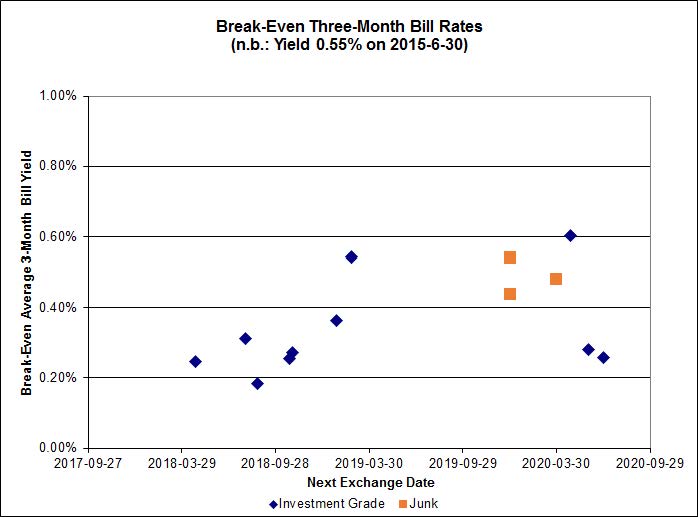
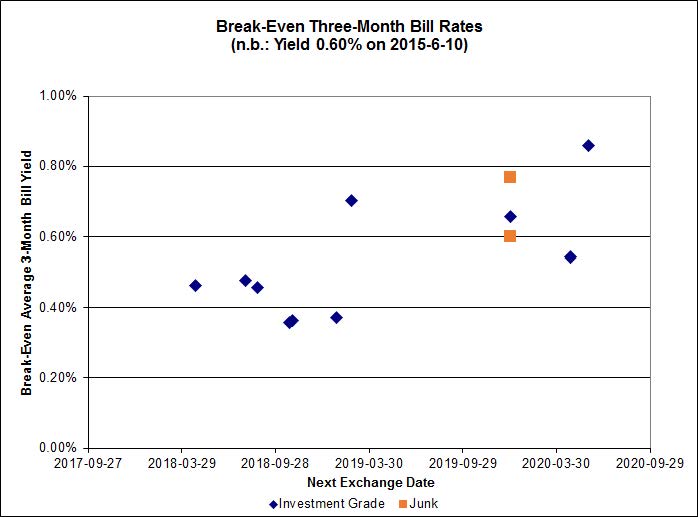
We can show this graphically by plotting the implied average 3-month bill rate against the next Exchange Date (which is the date to which the average will be calculated).

pairs_FR_150410
Click for Big

The market appears to have a distaste at the moment for floating rate product; the implied rates until the next interconversion are all (except one!) lower than the current 3-month bill rate and one is significantly negative! Whatever might be the result of the next few Bank of Canada overnight rate decisions, I suggest that it is unlikely that the average rate over the next five years will be lower than current – but if you disagree, of course, you may interpret the data any way you like.

Since credit quality of each element of the pair is equal to the other element, it should not make any difference whether the pair examined is investment-grade or junk, although we might expect greater variation of implied rates between junk issues on grounds of lower liquidity. The average in the table above for the junk issues (except DC.PR.B / DC.PR.D) is about +0.53%; for the investment grade issues (except TRP.PR.A / TRP.PR.F) it is about 0.26%. There will be more on these exceptions later, but if we plug in these implied yields and the current bid prices of the FixedResets, we may construct the following table showing consistent prices for the two pairs under consideration:

Estimate of FloatingReset Trading Price In Current Conditionss
  Assumed FloatingReset
Price if Implied Bill
is equal to
FixedReset Bid Price Spread +0.26% +0.53%
BNS.PR.Y 21.70 100bp 21.06 21.37
BRF.PR.A 18.01 262bp 17.52 17.80

Based on current market conditions, I suggest that the FloatingResets that may result from conversion of BNS.PR.Y and BRF.PR.A will be cheap and trading a little below the price of the continuing FixedResets. Therefore, I recommend that holders of BNS.PR.Y and BRF.PR.A continue to hold these issues and not to convert. I will note that, given the apparent cheapness of the FloatingResets, it may be a good trade to swap the FixedReset for the FloatingReset in the market once both elements of each pair are trading. But that, of course, will depend on the prices at that time.

Now, about those two exceptions.

The first exception, TRP.PR.A / TRP.PR.F, is problematical. It is notable that the break-even rate has moved dramatically upwards in the course of the last week – on April 2, this pair was an outlier to the downside; which is equivalent to saying that the FloatingReset, TRP.PR.F, has significantly outperformed the FixedReset, TRP.PR.A, during this week’s downdraft. It is tempting to write off the difference as a mere fluctuation, but on the other hand this pair is unique in another way: it is the only investment-grade pair that is not an NVCC non-compliant issue from a bank; which is to say that it is the only investment-grade pair not subject to a DeemedMaturity; which is to say it is the only investment-grade pair for which it is (deemed!) possible to exist to perpetuity, which is in fact the YTW scenario for each pair.

It is possible that the market is trading these issues such that the bank FixedResets with DeemedMaturities have these DeemedMaturities recognized and therefore, quite rightly, have outperformed their FixedResets considered likely to be extant in perpetuity during the week’s downdraft. And it is possible that this DeemedMaturity is being ignored for the FloatingResets. And that the market is ignoring the “Strong Pair” relationship between the pairs for banks, but paying attention to it for the TRP issues (or vice versa!).

This doesn’t make any sense; the Strong Pair theory demands only that the prices be equal on the next exchange date; whatever happens afterwards is irrelevant. But this is the preferred share market, which often doesn’t make sense.

It might be that the TRP pair is predicting the actual implied bill rate better than the bank pairs as far as discounted investment grade pairs are concerned, but fortunately BNS.PR.Y is, like the other bank issues, subject to a DeemedMaturity, so it is reasonable to assume that it and its future pair (if issued) will trade like the other banks.

The other exception is DC.PR.B / DC.PR.C. I don’t understand why there is such an enormous price difference. Sorry!

Issue Comments

PPL.PR.I Closes: Relatively Unscathed on Good Volume

Pembina Pipeline Corporation has announced:

that it has closed its previously announced public offering of cumulative redeemable rate reset class A preferred shares, Series 9 (the “Series 9 Preferred Shares”) for aggregate gross proceeds of $225 million (the “Offering”).

The Offering was announced on March 31, 2015 when Pembina entered into an agreement with a syndicate of underwriters co-led by Scotiabank and RBC Capital Markets. A total of 9,000,000 Series 9 Preferred Shares, which includes 1,000,000 Series 9 Preferred Shares issued pursuant to the partial exercise of the underwriters’ option, were sold under the Offering.

Proceeds from the Offering will be used to reduce indebtedness under the Company’s credit facilities, which indebtedness was incurred in connection with Pembina’s 2015 capital expenditure program.

The Series 9 Preferred Shares will begin trading on the Toronto Stock Exchange today under the symbol PPL.PR.I.

Dividends on the Series 9 Preferred Shares are expected to be $0.2969 quarterly, or $1.1875 per share on an annualized basis, payable on the 1st day of March, June, September and December, as and when declared by the Board of Directors of Pembina, for the initial fixed rate period to but excluding December 1, 2020. The first dividend, if declared, will be payable September 1, 2015, in the amount of $0.4685 per share.

All of Pembina’s dividends are designated “eligible dividends” for Canadian income tax purposes.

PPL.PR.I is a FixedReset, 4.75%+391, announced March 31. It will be tracked by HIMIPref™ but relegated to the Scraps index on credit concerns.

The issue traded 654,760 shares today (consolidated exchanges) in a range of 24.40-68 before closing at 24.45-50. Vital statistics are:

PPL.PR.I FixedReset YTW SCENARIO
Maturity Type : Limit Maturity
Maturity Date : 2045-04-10
Maturity Price : 22.93
Evaluated at bid price : 24.45
Bid-YTW : 4.75 %

The price drop of roughly 2% from the issue price as of March 31 isn’t really all that bad – on the month-to-date price-index, TXPR is down 2.41% and TXPL is down 3.46%. Price indices are pretty silly, but they’re available for free and the difference (from total return indices) in April to date is not particularly large.

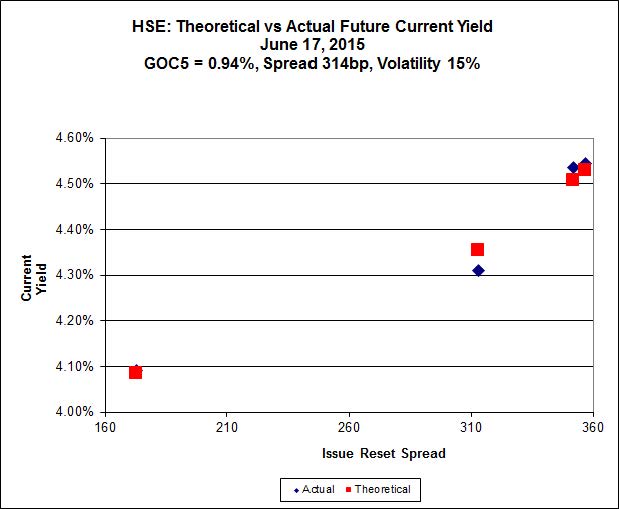
The calculated level of Implied Volatility has dropped substantially from the 33% calculated at announcement time to a more reasonable but still extremely high 24%. This implies that we should expect Implied Volatility to drop, which implies the calculated curve will flatten, which implies we should expect high-reset issues to outperform low-reset issues over the period.

impVol_PPL_150410
Click for Big
Issue Comments

LBS.PR.A Closes Treasury Offering

Brompton Group has announced:

Life & Banc Split Corp. (the “Company”) is pleased to announce that it has completed a treasury offering of 1,300,000 class A shares and 1,300,000 preferred shares for aggregate gross proceeds of approximately $25.5 million. The class A shares and preferred shares will continue to trade on the Toronto Stock Exchange under the existing symbols LBS (class A shares) and LBS.PR.A (preferred shares).
The Company invests in a portfolio of common shares of the six largest Canadian banks (“Banks”) and the four major publicly traded Canadian life insurance companies (“Lifecos”). Currently, the portfolio consists of common shares of the following Banks and Lifecos:

The Bank of Nova Scotia Royal Bank of Canada
National Bank of Canada Industrial Alliance Insurance and Financial Services Inc.
The Toronto-Dominion Bank Great-West Lifeco Inc.
Canadian Imperial Bank of Commerce Manulife Financial Corporation
Bank of Montreal Sun Life Financial Inc.

The class A shares were offered at a price of $9.55 and the preferred shares were offered at a price of $10.05. The final class A and preferred share offering prices were determined so as to be non-dilutive to the net asset value per unit of the Company on March 26, 2015, as adjusted for dividends accrued prior to or upon settlement of the offering.

The syndicate of agents for the offering was led by RBC Capital Markets, CIBC, Scotiabank, and TD Securities Inc., and includes BMO Capital Markets, National Bank Financial Inc., GMP Securities L.P., Raymond James Ltd., Canaccord Genuity Corp., Desjardins Securities Inc., Dundee Securities Ltd., Haywood Securities Inc., Industrial Alliance Securities Inc. and Mackie Research Capital Corporation.

Not bad, considering that the April 2 NAVPU was $18.59! I previously reported on the offering.

LBS.PR.A is tracked by HIMIPref™ but is relegated to the Scraps index on credit concerns.

Update, 2015-04-23: Small over-allotment:

Life & Banc Split Corp. (the “Company”) is pleased to announce that it has completed the issuance of 22,000 class A shares and 22,000 preferred shares for aggregate gross proceeds of approximately $0.4 million. The issuance was pursuant to the exercise of the over-allotment option granted to the agents in connection with the Company’s recently completed treasury offering. Following the exercise of the over-allotment option, total gross proceeds raised pursuant to this offering are approximately $25.9 million.

Issue Comments

Low Spread FixedResets: March, 2015

As noted in MAPF Portfolio Composition: March 2015, the fund now has a fairly large allocation to FixedResets, mostly of relatively low spread.

Many of these were largely purchased with proceeds of sales of DeemedRetractibles from the same issuer, it is interesting to look at the price trend of some of the Straight/FixedReset pairs. We’ll start with GWO.PR.N / GWO.PR.I; the fund sold the latter to buy the former at a takeout of about $1.00 in mid-June, 2014; relative prices over the past year are plotted as:

GWOPRN_GWOPRI_150331
Click for Big

Given that the March month-end take-out was $5.74, this is clearly a trade that has not worked out very well.

In July, 2014, I reported sales of SLF.PR.D to purchase SLF.PR.G at a take-out of about $0.15:

SLFPRG_SLFPRD_150331
Click for Big

There were similar trades in August, 2014 (from SLF.PR.C) at a take-out of $0.35. The February month-end take-out (bid price SLF.PR.D less bid price SLF.PR.G) was $6.16, so that hasn’t worked very well either.

November saw the third insurer-based sector swap, as the fund sold MFC.PR.C to buy the FixedReset MFC.PR.F at a post-dividend-adjusted take-out of about $0.85 … given a February month-end take-out of about $5.29, that’s another regrettable trade, although another piece executed in December at a take-out of $1.57 has less badly.

MFCPRF_MFCPRC_bidDiff_150331
Click for Big

This trend is not restricted to the insurance sector, which I expect will become subject to NVCC rules in the relatively near future and are thus subject to the same redemption assumptions I make for DeemedRetractibles. Other pairs of interest are BAM.PR.X / BAM.PR.N:

BAMPRX_BAMPRN_bidDiff_150331
Click for Big

… and FTS.PR.H / FTS.PR.J:

FTSPRH_FTSPRJ_bidDiff_150331
Click for Big

… and PWF.PR.P / PWF.PR.S:

PWFPRP_PWFPRS_bidDiff_150331
Click for Big

I will agree that the fund’s trades highlighted in this post may be decried as cases of monumental bad timing, but I should point out that in May, 2014, the fund was 63.9% Straight / 9.5% FixedReset
while in February 2015 the fund was 22% Straight / 64% FixedReset & FloatingReset (The latter figures include allocations from those usually grouped as ‘Scraps’). Given that the indices are roughly 30% Straight / 60% FixedReset & FloatingReset, it is apparent that the fund was extremely overweighted in Straights / underweighted in FixedResets in May 2014 but is now approximately index-weighted in FixedResets and underweighted in Straights (the balance being mostly SplitShares in the fund). HIMIPref™ analytics have been heavily favouring low-spread issues and the fund’s holdings are overwhelmingly of this type.

Summarizing the charts above in tabular form, we see:

FixedReset Straight Take-out
December 2013
Take-out
MAPF Trade
Take-out
December 2014
Take-out
February 2015
Take-out March 2015
GWO.PR.N
3.65%+130
GWO.PR.I
4.5%
($0.04) $1.00 $2.95 $6.25 $5.74
SLF.PR.G
4.35%+141
SLF.PR.D
4.45%
($1.29) $0.25 $2.16 $6.45 $6.16
MFC.PR.F
4.20%+141
MFC.PR.C
4.50%
($1.29) $0.86 $1.20 $5.29 $5.46
BAM.PR.X
4.60%+180
BAM.PR.N
4.75%
($2.06)   $0.17 $5.39 $4.76
FTS.PR.H
4.25%+145
FTS.PR.J
4.75%
$0.60   $5.68 $8.47 $8.86
PWF.PR.P
4.40%+160
PWF.PR.S
4.80%
($0.67)   $3.00 $6.63 $6.43
The ‘Take-Out’ is the bid price of the Straight less the bid price of the FixedReset; approximate execution prices are used for the “MAPF Trade” column. Bracketted figures in the ‘Take-Out’ columns indicate a ‘Pay-Up’

So why is all this happening? One should take care in explaining market movements, but it is my belief that in the latter half of 2013 we were dealing with the ‘taper tantrum’ – the market’s fears that Fed tapering and subsequent tapering would lead to massive spikes in yields; this led to a great preference for FixedResets over Straights. Now, with the economic news getting less inflationary with every news story and Europe and Japan desperately trying to reflate their sluggish economies, the market seems to think that these rate increases are still a long way off … leading to a great preference for Straights over FixedResets.

In addition, the graphs show a sharp spike in early December, during which the low-spread FixedResets were very badly hurt; I believe this to be due to a combination of tax-loss selling and a panicky response to the 29% reduction in the TRP.PR.A dividend.

And in January it just got worse with Canada yields plummeting after the Bank of Canada rate cut with speculation rife about future cuts although this has recently become less emphatic.

There was some good discussion about what is going on in the comments to the January 29 market action report. I take the view that we’ve seen this show before: during the Credit Crunch, Floaters got hit extremely badly (to the point at which their fifteen year total return was negative) because (as far as I can make out) their dividend rate was dropping (as it was linked to Prime) while the yields on other perpetual preferred instruments were skyrocketing (due to credit concerns). Thus, at least some investors insisted on getting long term corporate yields from rates based (indirectly and with a lag, in the case of FixedResets) on short-term government policy rates. And it’s happening again!

Here’s the March performance for FixedResets that had a YTW Scenario of ‘To Perptuity’ at mid-month. The correlations for both the Pfd-2 Group and the Pfd-3 Group improved this month: 12% and 25%, respectively:

FR_1MoPerf_150331A_IRS
Click for Big
Issue Comments

BBO.PR.A Downgraded to Pfd-3(high) by DBRS

DBRS has announced that it:

has today downgraded the rating of the Class A, Preferred Shares (the Preferred Shares) issued by Big Bank Big Oil Split Corp. (the Company) and removed its Under Review with Negative Implications status. In June 2006, the Company issued 2.72 million Preferred Shares at $10 each and an equal number of Capital Shares (the Capital Shares) at $15 each. The final redemption date for the Preferred Shares is December 30, 2016.

The net proceeds from the offering were used to purchase a portfolio of common shares of the six largest banks and several of the largest oil and gas companies in Canada (collectively, the Portfolio). The Portfolio was initially equally weighted and is rebalanced annually. Dividends received on the Portfolio are used to pay a fixed cumulative quarterly distribution to holders of the Preferred Shares, yielding 5.25% annually on the initial issue price. Holders of the Capital Shares are currently receiving monthly distributions of $0.05 per Capital Share.

On February 6, 2015, due to the drop in downside protection caused by the plunge in oil prices at the end of 2014 and the continued price volatility in early 2015, DBRS placed the rating of the Preferred Shares Under Review with Negative Implications. Downside protection available to holders of the Preferred Shares was 42.1% as of March 30, 2015. As a result of the downside protection remaining below acceptable levels for a prolonged period, the rating of the Preferred Shares have been downgraded to Pfd-3 (high) from Pfd-2 (low), and DBRS removed the Preferred Shares from Under Review with Negative Implications.

The notice of the Review-Negative was previously reported on PrefBlog.

BBO.PR.A is not tracked by HIMIPref™.