Category: Issue Comments

Issue Comments

FFH: S&P Says Outlook Negative

On February 16 Fairfax Financial Holdings announced:

that it has reached an agreement with Brit PLC (“Brit” or the “company”) to acquire all of the outstanding shares of Brit (the “Brit Shares”). Brit is a market-leading global Lloyd’s of London specialty insurer and reinsurer. The full announcement (the “Announcement”) is available for viewing on Fairfax’s website at www.fairfax.ca/britoffer.

The aggregate purchase price payable by Fairfax for the Offer is approximately US$1.88 billion. On February 12, 2015, Fairfax announced 2014 earnings of approximately US$1.6 billion. Excluding the final dividend expected to be declared by the board of directors of Brit for the year ended December 31, 2014 in an amount of 25 pence per Brit Share , Fairfax’s purchase price of 280 pence per Brit Share is less than ten times the company’s earnings based on the company’s annualized net earnings for the six months ended June 30, 2014. The acquisition is accretive to Fairfax on several metrics including gross revenue per share and investments per share.

I love the bit about how the acquisition is accretive to Fairfax on several metrics including gross revenue per share and investments per share. The Public Relations team must have been scratching their heads for a while before coming up with that one! I can’t even tell you just exactly what “investments per share” means, since the phrase was not mentioned in FFH’s last quarterly statements or MD&A. The assertion was repeated by Prem Watsa in the conference call, but was left unchallenged – there were only softball questions from equity salesmen hoping to line up a financing deal for their firms.

In response to all this Standard & Poor’s has announced:

  • •Fairfax Financial Holdings Ltd. announced on Feb. 16 that it had reached an agreement to acquire Brit PLC for about $1.88 billion.
  • •We are affirming the issuer credit rating on Fairfax Financial Holdings Ltd. at ‘BBB-‘ and the issuer credit and financial strength ratings of its core insurance affiliates at ‘A-‘.
  • •We are revising the outlook to negative from stable, considering the potentially significant reduction in the group’s capital adequacy, as measured by our proprietary capital model.


The company has several options for restoring capital adequacy to a level that Standard & Poor’s views as more supportive of the existing ratings. However, the company is still finalizing the capital enhancement strategy, and there is execution risk with regard to any capital management plan that it adopts.

The negative outlook on Fairfax reflects the significant potential decline in the group’s capital adequacy following the completion of the Brit PLC acquisition. The time horizon for our outlook is six to 12 months.

Fairfax has several preferred share issues outstanding, FFH.PR.C, FFH.PR.D, FFH.PR.E, FFH.PR.G, FFH.PR.I and FFH.PR.K; FFH.PR.D is a FloatingReset paired with FFH.PR.C;, all the others are FixedResets.

Update, 2015-02-23: DBRS has confirmed Fairfax with a Stable Trend:

DBRS Limited (DBRS) has today confirmed the Issuer Rating and Senior Unsecured Debt of Fairfax Financial Holdings Limited (Fairfax) at BBB and the Company’s Preferred Shares at Pfd-3. The trends on all ratings remain Stable. The Senior Unsecured Notes of Fairfax (US) Inc. are guaranteed by Fairfax Financial Holdings Limited. This rating action follows the announcement that Fairfax has agreed to purchase Brit PLC (Brit) for $1.88 billion, a premium of 11.2% per share. Fairfax has obtained a sales agreement with approximately 73% of the voting shares of Brit. The transaction is expected to close in Q2 2015, subject to customary conditions, including regulatory approvals. As a Lloyd’s of London (Lloyd’s) insurer, Brit focuses on global specialty insurance and reinsurance and is the eighth-largest Lloyd’s insurer with a written premium capacity of GBP 1.0 billion as of July 2014.

The rating action reflects DBRS’s view that the purchase is consistent with Fairfax’s strategy of extending its franchise globally through opportunistic investments whereby it acquires businesses with demonstrated underwriting discipline that add to its existing franchise. Fairfax engages in property and casualty insurance, reinsurance and investment management. Brit focuses on property casualty (62% of premium) combined with complex specialty insurance lines such as marine, energy and terrorism risks. DBRS anticipates that the acquisition will help both Fairfax and Brit to expand globally. Fairfax is expected to benefit from the significant expansion in the specialty insurance markets, an enhanced distribution network and Brit’s underwriting skills in specialty insurance. Brit is expected to benefit from the greater scale of the combined companies in the Lloyd’s market, Fairfax’s franchise network presence and Fairfax’s resources, including Fairfax’s strong investment record. Pro forma, the purchase would result in Fairfax strengthening its position in the Lloyd’s market as it is expected to become the fifth-largest insurer with a premium capacity exceeding GBP 1.3 billion as of 2015, which is likely to enhance Fairfax’s ability to manage pricing and to facilitate greater lead opportunities in arranging deal terms.

Issue Comments

DBRS Downgrades Bombardier

DBRS has announced that it:

has today downgraded the Issuer Rating of Bombardier Inc. (Bombardier or the Company) to B (high) and the Trend has been changed to Negative. DBRS’s downgrade incorporates the Company’s progressively weaker financial profile due to debt and liquidity burdens, as well as the erosion of its business profile. The Company’s substantial negative net free cash flow and sizeable financing needs to support its aircraft developments programs have led to increasing indebtedness and weakening of all credit metrics in 2014. Substantial cost pressures have led to the erosion of margins at the aerospace and transportation businesses due to competitive and operational reasons. DBRS could take further negative rating action should the Company announce additional operating challenges, encounter difficulties in executing its ambitious financing, incur material indebtedness or see additional deterioration in profitability.

DBRS’s rating action reflects the Company’s rapidly weakening financial and business risk profiles at its aerospace and transportation businesses. The Negative Trend reflects uncertainty surrounding the financial and business profiles of the Company, noting that both are subject to deterioration and potential rating action in the near-mid-term.

In November, 2013, DBRS announced that it:

downgraded the Issuer Rating and Senior Unsecured Debentures of Bombardier Inc. (BBD or the Company) to BB (low) and the Preferred Shares were downgraded to Pfd-4 (low). The trend on the Issuer Rating is Stable and DBRS has removed all ratings from Under Review with Negative Implications. Additionally, DBRS has discontinued the Company’s Senior Unsecured Debentures and Preferred Shares ratings effective immediately.

Earlier this year, PrefBlog reported that BBD.PR.B, BBD.PR.C & BBD.PR.D Downgraded to P-5(high) by S&P.

BBD.PR.B, BBD.PR.C and BBD.PR.D are all tracked by HIMIPref™ but are relegated to the Scraps index on credit concerns.

Issue Comments

ALB.PR.B: Partial Call For Redemption

Scotia Managed Companies has announced:

Allbanc Split Corp. II (the “Company”) announced today that it has called 110,799 Preferred Shares for cash redemption on February 27, 2015 (in accordance with the Company’s Articles) representing approximately 12.045% of the outstanding Preferred Shares as a result of the special annual retraction of 221,598 Capital Shares by the holders thereof. The Preferred Shares shall be redeemed on a pro rata basis, so that each holder of Preferred Shares of record on February 25, 2015 will have approximately 12.045% of their Preferred Shares redeemed. The redemption price for the Preferred Shares will be $21.80 per share.

Holders of Preferred Shares that are on record for dividends but have been called for redemption will be entitled to receive dividends thereon which have been declared but remain unpaid up to but not including February 27, 2015.

Payment of the amount due to holders of Preferred Shares will be made by the Company on February 27, 2015. From and after February 27, 2015 the holders of Preferred Shares that have been called for redemption will not be entitled to dividends or to exercise any right in respect of such shares except to receive the amount due on redemption.

Allbanc Split Corp. II is a mutual fund corporation created to hold a portfolio of publicly listed common shares of selected Canadian chartered banks. Capital Shares and Preferred Shares of Allbanc Split Corp. II are listed for trading on The Toronto Stock Exchange under the symbols ALB and ALB.PR.B respectively.

ALB.PR.B was last mentioned on PrefBlog when it was upgraded to Pfd-2 by DBRS. ALB.PR.B is tracked by HIMIPref™, but relegated to the Scraps index on volume concerns.

Issue Comments

OSP.PR.A Expected To Commence Trading February 24

Brompton Group has announced:

Brompton Oil Split Corp. (the “Company”) has determined the exchange ratios for the exchange option (the “Exchange Option”) with respect to its initial public offering. Under the Exchange Option, prospective purchasers could purchase Class A shares of the Company or Units (consisting of one Class A and one Preferred share) by an exchange of freely tradable equity securities (“Exchange Securities”) of the issuers listed below (the “Exchange Eligible Issuers”). The Exchange Option expired at 5:00 pm on January 23, 2015.

The following table indicates the adjusted volume weighted average trading price and exchange ratio for the Exchange Securities of each Exchange Eligible Issuer as calculated in the manner described in the Company’s prospectus dated January 29, 2015. The adjusted volume weighted average trading price and exchange ratios are rounded to four decimal places. Fractional Class A shares/Units will not be issued.


The Toronto Stock Exchange has conditionally approved the listing of the Class A and Preferred shares, subject to the Company fulfilling all customary requirements. Trading under the symbols OSP and OSP.PR.A is expected to commence on the closing date, February 24, 2015.

The Company will invest in a portfolio (the “Portfolio”) of equity securities of at least 15 large capitalization North American oil and gas issuers selected by Brompton Funds Limited (the “Manager”) from the S&P 500 Index and the S&P/TSX Composite Index, giving consideration to, among other metrics, attractive valuation, growth prospects, profitability, liquidity, sustainability of dividends and a strong balance sheet. The Portfolio will be focused primarily on oil and gas issuers that have significant exposure to oil.

The investment objectives for the Class A shares are to provide holders with regular monthly non-cumulative cash distributions targeted to be 8.0% per annum on the $15.00 issue price, and the opportunity for growth in net asset value. The investment objectives for the Preferred shares are to provide holders with fixed cumulative preferential quarterly cash distributions in the amount of 5.0% per annum on the $10.00 issue price, and to return the original issue price on the maturity date, March 31, 2020.

The Manager will also be the portfolio manager of the Company. The Manager currently manages 4 split-share funds with assets under management over $900 million. The portfolio management team will be led by Laura Lau, an award winning portfolio manager with over 20 years of experience in financial services, who has a proven track record in managing flow-through funds and resource assets. The team also includes Michael Clare, an experienced energy and flow-through portfolio manager who specializes in the analysis of crude oil and natural gas markets.

The syndicate of agents for the offering is being led by Scotiabank, CIBC and RBC Capital Markets and includes TD Securities Inc., BMO Capital Markets, National Bank Financial Inc., GMP Securities L.P., Raymond James Ltd., Canaccord Genuity Corp., Desjardins Securities Inc., Dundee Securities Ltd., Industrial Alliance Securities Inc. and Mackie Research Capital Corporation.

This new issue was reported on PrefBlog in early January … but now we have a ticker symbol!

Issue Comments

BBO.PR.A Placed On Review-Negative By DBRS

DBRS has announced that it:

has today placed the rating of the Class A, Preferred Shares (the Preferred Shares) issued by Big Bank Big Oil Split Corp. (the Company) Under Review with Negative Implications. In June 2006, the Company issued 2.72 million Preferred Shares at $10 each and an equal number of Capal Shares (the Capital Shares) at $15 each. The final redemption date for the Preferred Shares is December 30, 2016.

DBRS last confirmed the rating of the Preferred Shares on April 4, 2014. The plunge in oil prices in recent months has caused downside protection to fall to 42% as of January 29, 2015. As a result, the Preferred Shares have been placed Under Review with Negative Implications.

BBO.PR.A was last mentioned on PrefBlog when it was confirmed at Pfd-2(low) by DBRS on April 5, 2013.

Blackrock’s useless and hard to find website does not explicitly publish the NAVPU for the fund, but I’m sure we can all applaud management of the company for doing so well despite being mentally deficient. Fiddling with Chart and getting the historical NAVs eventually leads to the information that the NAV is $8.04; note that this is PER CAPITAL UNIT, not per whole unit, which is not made explicit on the charts due to Blackrock management’s unfortunate handicap. As noted on April 5, 2013, this method of reporting valuation was only made clear on the fact sheet, but now clicking “Fact Sheet” on the fund’s page results in the notification that No search results found for keywords: ‘CA0888941006’. Other useful information on the site includes the fact that the page is “Missing portfolio manager content”.

I strongly urge that readers who might meet a Blackrock executive in the course of their day to please remember to be kind. There, but for the grace of God, go we.

BBO.PR.A is not tracked by HIMIPref™.

Issue Comments

HSB.PR.C, HSB.PR.D On Watch-Negative by S&P

Standard & Poor’s has announced:

  • •We have taken various rating actions on the operating and nonoperating holding companies (NOHCs) of certain systemically important U.K., German, and Austrian banking groups.
  • •We have lowered the issuer credit ratings on the U.K. and Swiss NOHCs to reflect our view that the prospect of extraordinary government support to the benefit of their senior creditors is now unlikely.
  • •For most of the U.K., German, and Austrian operating companies, we have placed their long-term, and in some cases also their short-term, ratings on CreditWatch with negative implications.
  • •This reflects these countries’ recent full implementation of the EU Bank Recovery and Resolution Directive, our view that extraordinary government support will likely become less predictable in the near term, but also that we continue to see unresolved questions about how the legislation may operate in practice.
  • •We expect to resolve all these CreditWatch placements by early May 2015.


As a result of our review, we took the following rating actions:

  • •We lowered our long-term ratings on the following bank NOHCs by one or two notches: Barclays PLC, Credit Suisse Group AG, HSBC Holdings PLC, HSBC USA Inc., and Lloyds Banking Group PLC. Where relevant, we affirmed the short-term ratings. The outlooks on these companies are now stable, with the exception of Lloyds, which is positive. We affirmed our ratings on the hybrid capital instruments issued by, or guaranteed by, these NOHCs.
Issue Comments

Effect of Varying GOC-5 Rate On Implied Volatility Rich/Cheap Analysis

Assiduous Reader Prefhound can always be relied upon for detailed analysis and he has not disappointed in his comment on the February 2 Market Report:

For the Jan 23 FTS series, the lowest reset spread was said to be “cheap”, but its return would only be higher than a higher reset spread if long run GOC-5 rose to an equilibrium around 3%. Current price and reset spreads made sense if the long run equilibrium GOC-5 yield were in the 1-1.5% range (vs 0.85% at the time). Only if the long run equilibrium GOC-5 Yield were 0-0.50% would the original rich/cheap analysis produce substantially different long run returns. This suggested to me that rich/cheap was fairly sensitive to long run GOC-5, so arbitrage returns would depend on changes in (and perception of) that benchmark. As you often note, perception can differ enormously from reality, so fixed reset arbitrage appears to have a substantial element of added GOC-5 risk.

It will be recalled that in my original essay on Implied Volatility for FixedResets I made the point that both the “Pure” price (that is, the price of a non-callable annuity) with any given spread would approach par as GOC-5 increased, while the option value would approach zero; thus, we may conclude that an increase in GOC-5 will cause all issues to move closer to their par value (and contrariwise!) regardless of whether they are at a premium or a discount.

As Prefhound has focussed on the January 23 analysis of the FTS FixedResets, I will show their data for that day to make it easier for Assiduous Readers to replicate and extend the analysis. My findings are at variance with Prefhound‘s conclusions, but I’m sure a bit more methodological detail will sort out a difference in assumptions:

FTS FixedResets: Characteristics
Ticker Current
Dividend
Issue
Reset
Spread
Next
Exchange
Date
Bid
Price
2015-1-23
FTS.PR.G 0.9708 +213 2018-9-1 24.70
FTS.PR.H 1.0625 +145 2015-6-1 18.28
FTS.PR.K 1.00 +205 2019-3-1 25.15
FTS.PR.M 1.025 +248 2019-12-1 25.58

So first we will perform a series of computations using the January 23 bids, but varying GOC-5; we come up with the following table:

  Rich / (Cheap)
GOC5 ImpVol Spread FTS.PR.H FTS.PR.G FTS.PR.K FTS.PR.M
5% 1% 247 -3.31 0.84 1.56 0.55
4% 1% 241 -2.98 0.79 1.55 0.3
3% 3% 234 -2.55 0.68 1.51 -0.02
2% 4% 227 -1.92 0.57 1.46 -0.31
1% 5% 217 -1.04 0.24 1.22 -0.7
0% 11% 196 -0.17 -0.17 0.8 -0.7

… which may be graphed as:

impVol_FTS_150123_varyGOC
Click for Big

Further, we can use the Yield Calculator for Resets, which was given a thorough explanation in early December to determine the 25-year yield expected for each of the GOC-5 levels – note that no prior call is assumed in any of these calculations and that the end-price is set equal to current price. We derive the following table (nb: incorrect figures from the original post have been struck out and replaced with corrected figures 2015-2-4).

GOC5 FTS.PR.H FTS.PR.G FTS.PR.K FTS.PR.M
5% 8.80% 6.41% 6.19% 5.62% 6.26%
4% 7.47% 5.69% 5.50% 4.97% 5.64%
3% 6.14% 4.94% 4.79% 4.29% 4.99%
2% 4.80% 4.16% 4.05% 3.58% 4.31%
1% 3.45% 3.35% 3.28% 2.83% 3.60%
0% 2.09% 2.51% 2.47% 2.06% 2.86%

… and plotted as:

yields_FTS_150123_varyGOC_CORRECTED
Click for Big
Corrected 2015-2-4

What makes this chart particularly fascinating is that the minimal difference between the four calculated yields is found at a value for GOC-5 that is very close to the actual GOC-5 rate of 0.78% at the close of that day:

yields_FTS_150123_varyGOC_detail_CORRECTED
Click for Big
Corrected 2015-2-4

This bears investigating … one might almost wonder if there isn’t some market making going on that has the effect of grouping these yields together …

Update, 2015-02-04: Prefhound wants to see the prices for the Implied Volatility fitting adjusted to reflect the period until the next Exchange Date. OK, here goes!

  FTS.PR.H FTS.PR.G FTS.PR.K FTS.PR.M
  Spread 145 213 205 248
  Exchange
Date
2015-6-1 2018-9-1 2019-3-1 2019-12-1
  Dividends
Until
Exchange
Date
2 15 17 20
  Current
Dividend
1.0625 0.9708 1.00 1.025
Future Dividends
GOC5 5% 1.6125 1.7825 1.7625 1.87
4% 1.3625 1.5325 1.5125 1.62
3% 1.1125 1.2825 1.2625 1.37
2% 0.8625 1.0325 1.0125 1.12
1% 0.6125 0.7825 0.7625 0.87
0% 0.3625 0.5325 0.5125 0.62
Price Adjustment
GOC5 5% -0.35 -1.64 -2.07 -2.03
4% 0.15 2.11 2.18 2.98
3% 0.03 1.17 1.12 1.73
2% -0.10 0.23 0.05 0.48%
1% -0.23 -0.71 -1.01 -0.78
0% -0.35 -1.64 -2.07 -2.03
Effective Price
GOC5 5% 18.56 27.74 28.39 29.81
4% 18.43 26.81 27.33 28.56
3% 18.31 25.87 26.27 27.31
2% 18.18 24.93 25.20 26.06
1% 18.06 23.99 24.14 24.81
0% 17.93 23.06 23.08 23.56

And now we will perform a series of computations using the January 23 bids as adjusted in the above table, using the appropriate GOC-5:

  Rich / (Cheap)
GOC5 ImpVol Spread FTS.PR.H FTS.PR.G FTS.PR.K FTS.PR.M
5% 1% 193 -4.71 1.65 2.58 3.25
4% 1% 194 -4.51 0.50 1.52 2.27
3% 1% 216 -3.25 1.02 1.80 0.75
2% 3% 225 -2.11 0.65 1.38 -0.12
1% 7% 226 -0.73 0.29 0.95 -0.74
0% 26% 184 -0.23 0.23 0.67 -0.79

This allows the following chart to be drawn:

impVol_FTS_150123_varyGOC_adjPx
Click for Big

The price adjustments, of course, are very large, but it doesn’t make any difference to the fitting, which uses only prices. The Expected Future Current Yields are calculated only for display purposes. At any rate, while there are significant differences, the qualitative conclusions are the same – this chart looks pretty much the same as the one with unadjusted prices, although there’s a curious jog in the ‘Adjusted Price’ one.

Issue Comments

Low Spread FixedResets: January 2015

As noted in MAPF Portfolio Composition: January 2015, the fund now has a fairly large allocation to FixedResets, although this segment remains below index weight.

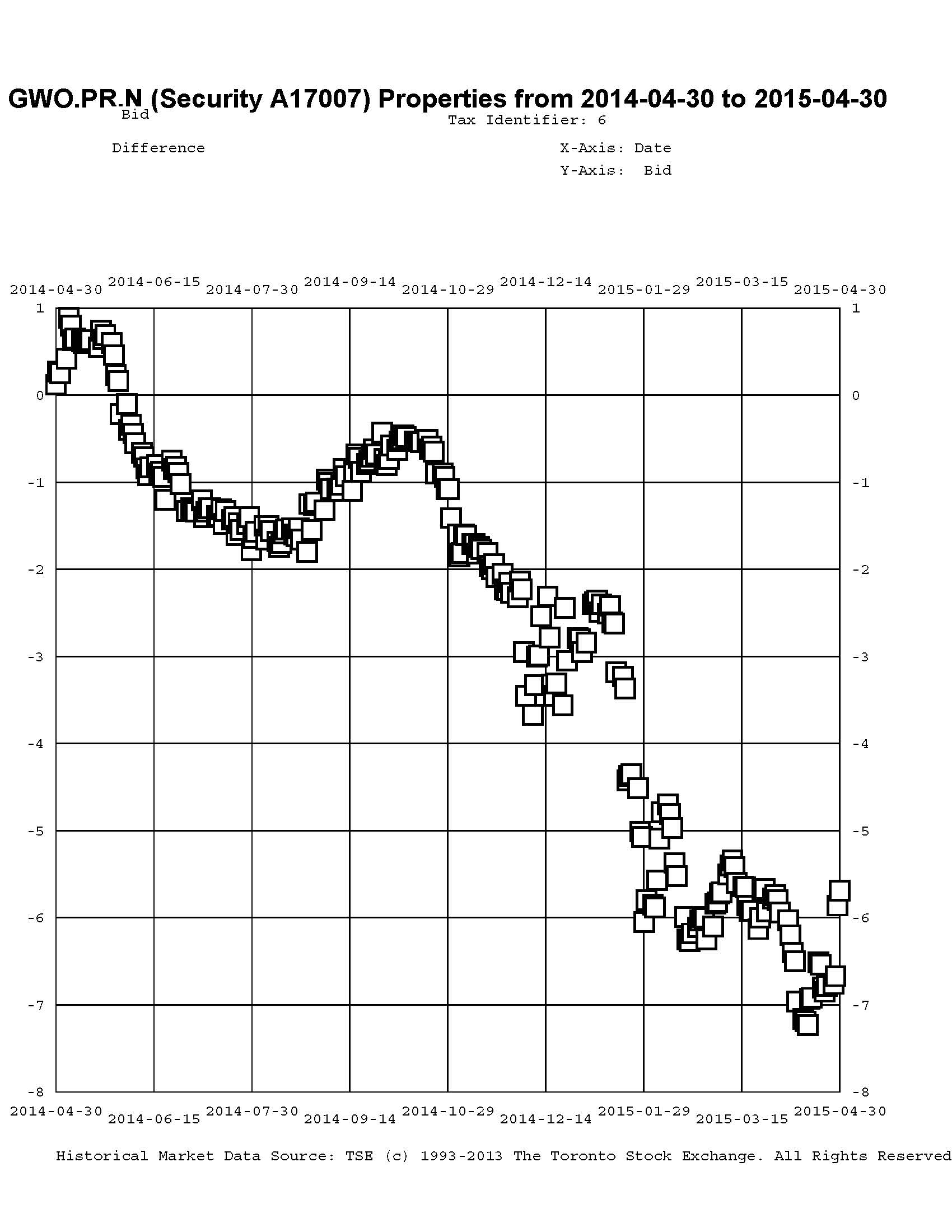
As these were largely purchased with proceeds of sales of DeemedRetractibles from the same issuer, it is interesting to look at the price trend of some of the Straight/FixedReset pairs. We’ll start with GWO.PR.N / GWO.PR.I; the fund sold the latter to buy the former at a takeout of about $1.00 in mid-June, 2014; relative prices over the past year are plotted as:

GWOPRN_GWOPRI_bidDiff_150130
Click for Big

Given that the January month-end take-out was $5.80, this is clearly a trade that has not worked out very well.

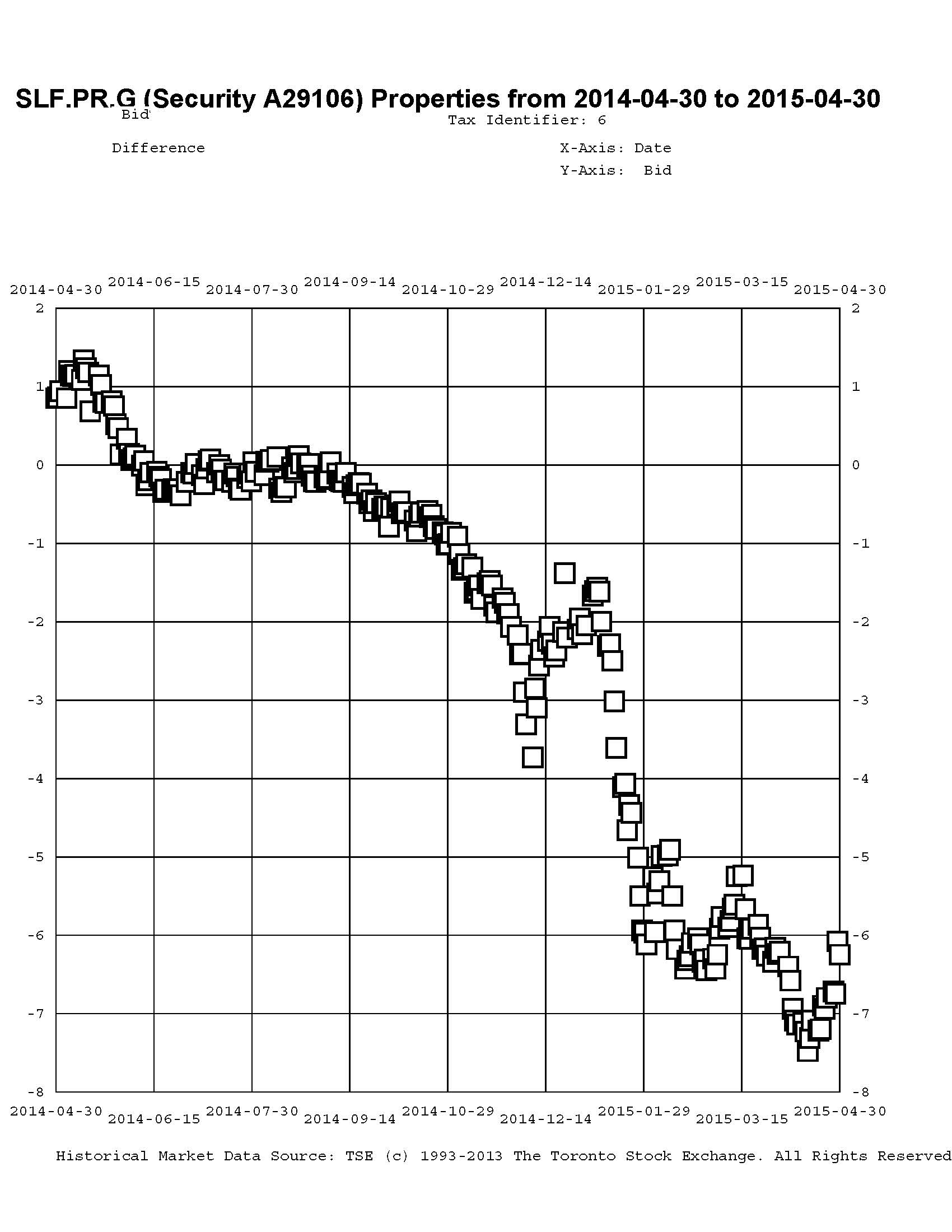
In July, 2014, I reported sales of SLF.PR.D to purchase SLF.PR.G at a take-out of about $0.15:

SLFPRG_SLFPRD_bidDiff_150130
Click for Big

There were similar trades in August, 2014 (from SLF.PR.C) at a take-out of $0.35. The January month-end take-out (bid price SLF.PR.D less bid price SLF.PR.G) was $6.12, so that hasn’t worked very well either.

The trend paused in September, 2014 and, indeed, can be said to have reversed, with the fund selling SplitShares (PVS.PR.B at 25.25-30) to purchase PerpetualDiscounts (BAM.PR.M / BAM.PR.N at about 21.25), a trade which worked out favourably and has been sort-of reversed (into PVS.PR.D) in November 2014.

In October 2014 there was another bit of counterflow, as the fund sold more SplitShares (CGI.PR.D at about 25.25) to purchase more PerpetualDiscounts (CU.PR.F and CU.PR.G, at about 21.25) which again worked out well and was reversed in November, selling the CU issues at about 22.45 to purchase low-spread FixedResets (TRP.PR.A and TRP.PR.B) at about 21.50 and 18.75 (post dividend equivalent), which was basically down by transaction costs at November month-end, but a significant loser by December month-end.

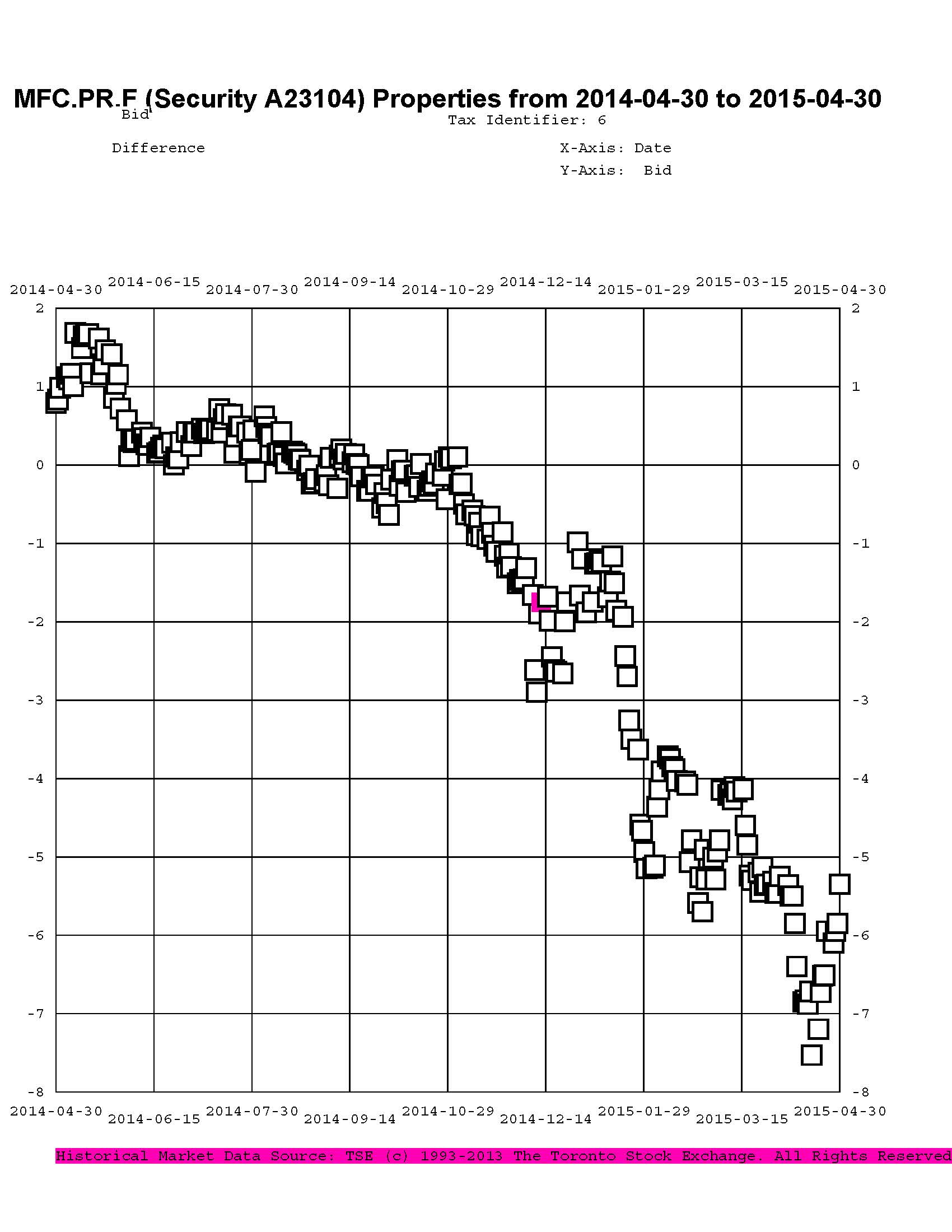
And November saw the third insurer-based sector swap, as the fund sold MFC.PR.C to buy the FixedReset MFC.PR.F at a post-dividend-adjusted take-out of about $0.85 … given a month-end take-out of about $1.30, that’s another regrettable trade, although another piece executed in December at a take-out of $1.57 has done better.

MFCPRF_MFCPRC_bidDiff_150130
Click for Big

This trend is not restricted to the insurance sector. Other pairs of interest are BAM.PR.X / BAM.PR.N:

BAMPRX_BAMPRN_bidDiff_150130
Click for Big

… and FTS.PR.H / FTS.PR.J:

FTSPRH_FTSPRJ_bidDiff_150130
Click for Big

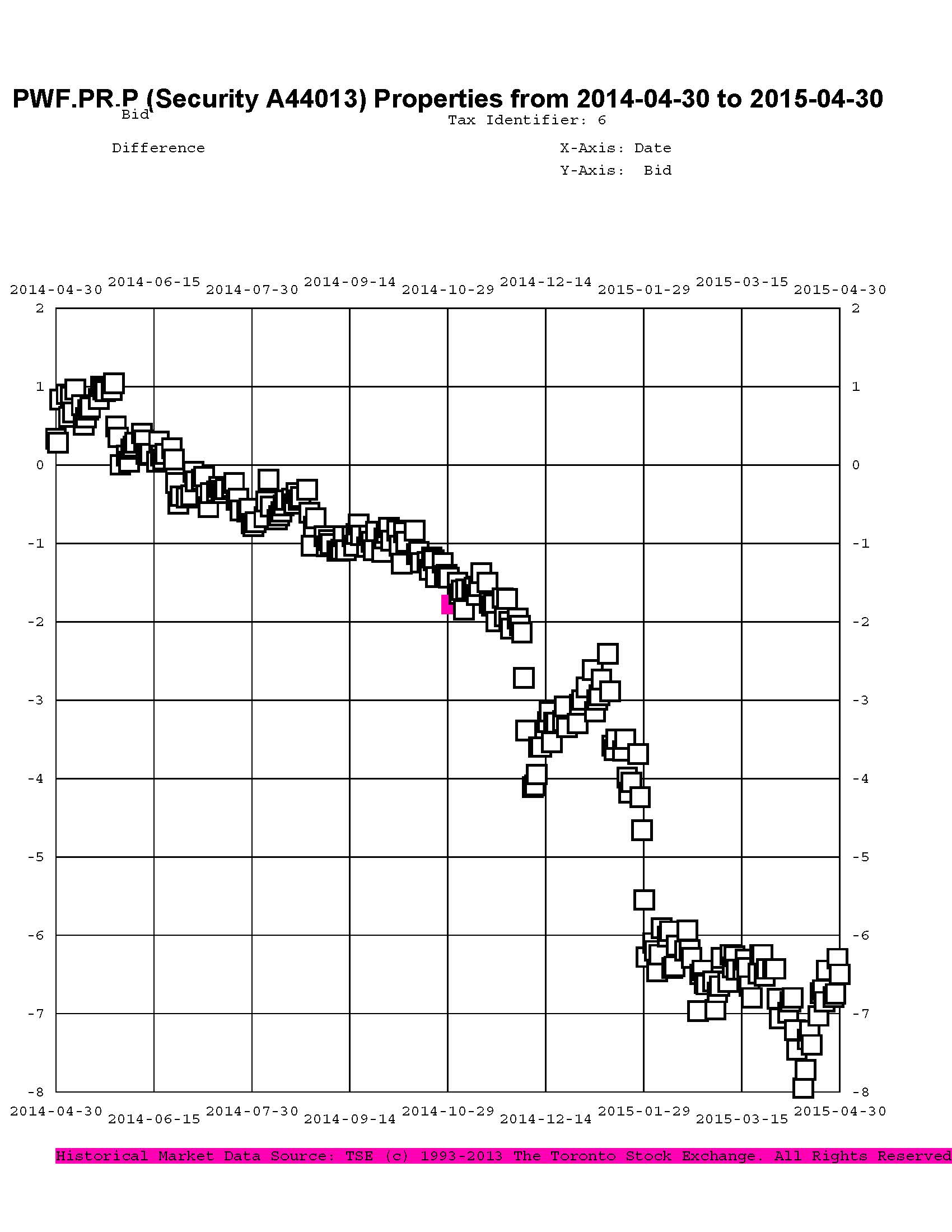
… and PWF.PR.P / PWF.PR.S:

PWFPRP_PWFPRS_bidDiff_150130
Click for Big

I will agree that the fund’s trades highlighted in this post may be decried as cases of monumental bad timing, but I should point out that in May, 2014, the fund was 63.9% Straight / 9.5% FixedReset
while in January 2015 the fund was 35% Straight / 51% FixedReset & FloatingReset (The latter figures include allocations from those usually grouped as ‘Scraps’). Given that the indices are roughly 30% Straight / 60% FixedReset & FloatingReset, it is apparent that the fund was extremely overweighted in Straights / underweighted in FixedResets in May 2014 and that this qualitative tilt remains, but is no longer extreme.

Summarizing the charts above in tabular form, we see:

FixedReset Straight Take-out
December 2013
Take-out
MAPF Trade
Take-out
December 2014
Take-out
January 2014
GWO.PR.N
3.65%+130
GWO.PR.I
4.5%
($0.04) $1.00 $2.95 $5.80
SLF.PR.G
4.35%+141
SLF.PR.D
4.45%
($1.29) $0.25 $2.16 $6.12
MFC.PR.F
4.20%+141
MFC.PR.C
4.50%
($1.29) $0.86 $1.20 $5.15
BAM.PR.X
4.60%+180
BAM.PR.N
4.75%
($2.06)   $0.17 $4.11
FTS.PR.H
4.25%+145
FTS.PR.J
4.75%
$0.60   $5.68 $7.36
PWF.PR.P
4.40%+160
PWF.PR.S
4.80%
($0.67)   $3.00 $6.28
The ‘Take-Out’ is the bid price of the Straight less the bid price of the FixedReset; approximate execution prices are used for the “MAPF Trade” column. Bracketted figures in the ‘Take-Out’ columns indicate a ‘Pay-Up’

So why is all this happening? One should take care in explaining market movements, but it is my belief that in the latter half of 2013 we were dealing with the ‘taper tantrum’ – the market’s fears that Fed tapering and subsequent tapering would lead to massive spikes in yields; this led to a great preference for FixedResets over Straights. Now, with the economic news getting less inflationary with every news story and Europe and Japan desperately trying to reflate their sluggish economies, the market seems to think that these rate increases are still a long way off … leading to a great preference for Straights over FixedResets.

In addition, the graphs show a sharp spike in early December, during which the low-spread FixedResets were very badly hurt; I believe this to be due to a combination of tax-loss selling and a panicky response to the 29% reduction in the TRP.PR.A dividend.

And in January it just got worse with Canada yields plummeting after the Bank of Canada rate cut with speculation rife about future cuts.

There was some good discussion about what is going on in the comments to the January 29 market action report. I take the view that we’ve seen this show before: during the Credit Crunch, Floaters got hit extremely badly (to the point at which their fifteen year total return was negative) because (as far as I can make out) their dividend rate was dropping (as it was linked to Prime) while the yields on other perpetual preferred instruments were skyrocketing (due to credit concerns). Thus, at least some investors insisted on getting long term corporate yields from rates based on short-term government policy rates. And it’s happening again!

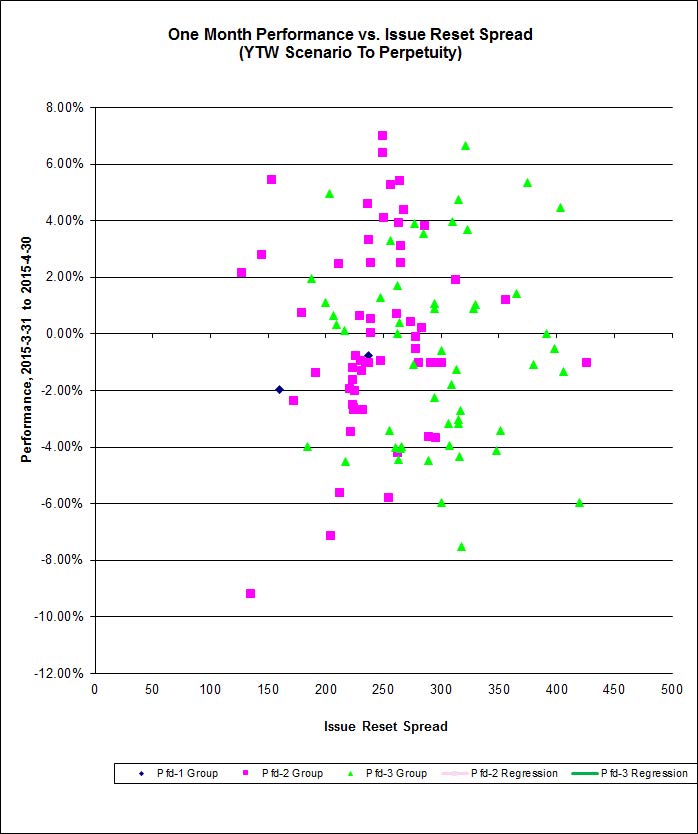
And finally – here’s the January performance for FixedResets that had a YTW Scenario of ‘To Perptuity’ at mid-month. Unusually, the Pfd-3 Group had a better correlation than the Pfd-2 group (20% vs. 11%), but it is striking that the slopes are so similar.:

FR_1MoPerf_150130
Click for Big
Issue Comments

RY.PR.J Firm On Excellent Volume

Royal Bank of Canada has announced:

it has closed its domestic public offering of Non-Cumulative, 5-Year Rate Reset Preferred Shares Series BD. Royal Bank of Canada issued 24 million Preferred Shares Series BD at a price of $25 per share to raise gross proceeds of $600 million.

The offering was underwritten by a syndicate led by RBC Capital Markets. The Preferred Shares Series BD will commence trading on the Toronto Stock Exchange today under the ticker symbol RY.PR.J.

The Preferred Shares Series BD were issued under a prospectus supplement dated January 27, 2015 to the bank’s short form base shelf prospectus dated December 20, 2013.

RY.PR.J is a FixedReset, 3.60%+274, NVCC-compliant, announced January 26. The issue will be tracked by HIMIPref™ and has been assigned to the FixedReset subindex.

Note that since this issue is NVCC-compliant, there is no Deemed Maturity entry in the call schedule analyzed by HIMIPref™. It is, and is analyzed by HIMIPref™ as, a true perpetual … at least until the morons at OSFI change the rules again, since the ‘legitimate expectations of investors’ now include early redemption.

The issue traded 1,383,496 shares today (consolidated exchanges) in a range of 24.82-98 before closing at 24.95-96. Vital statistics are:

RY.PR.J FixedReset YTW SCENARIO
Maturity Type : Limit Maturity
Maturity Date : 2045-01-30
Maturity Price : 23.12
Evaluated at bid price : 24.95
Bid-YTW : 3.42 %

Implied Volatility theory shows the issue should be considered cheap against its peers – not only is the issue’s Expected Future Current Yield well over the ‘best fit’ theoretical estimates (in which implied volatility is capped at 40%) but the fit of 40% should decline as the market realizes that RY issues are no more immune from the laws of economics than any other series, which will result in underperformance of lower-spread issues.

impVol_RY_150129
Click for Big
Issue Comments

Brompton Oil Split Corp. To Close February 24

Brompton Group has announced:

Brompton Funds Limited (the “Manager”) is pleased to announce that Brompton Oil Split Corp. (the “Company”) has filed a final prospectus in respect of its initial public offering up to a maximum of 6,000,000 Class A shares and 6,000,000 Preferred shares at a price of $10.00 per Preferred share and $15.00 per Class A share, for a maximum offering size of $150,000,000. This offering is expected to close on or about February 24, 2015.

The Company will invest in a portfolio (the “Portfolio”) of equity securities of at least 15 large capitalization North American oil and gas issuers selected by the Manager from the S&P 500 Index and the S&P/TSX Composite Index, giving consideration to, among other metrics, attractive valuation, growth prospects, profitability, liquidity, sustainability of dividends and a strong balance sheet. The Portfolio will be focused primarily on oil and gas issuers that have significant exposure to oil, and will initially include equities of the following oil and gas issuers:

ARC Resources Ltd. Chevron Corporation Occidental Petroleum Corporation
Canadian Natural Resources Limited Encana Corporation PrairieSky Royalty Ltd.
ConocoPhillips EOG Resources Inc. Suncor Energy Inc.
Crescent Point Energy Corp. Husky Energy Inc. Vermilion Energy Inc.
Cenovus Energy Inc. Imperial Oil Limited Exxon Mobil Corporation

The investment objectives for the Class A shares are to provide holders with regular monthly non-cumulative cash distributions targeted to be 8.0% per annum on the $15.00 issue price, and the opportunity for growth in net asset value. The investment objectives for the Preferred shares are to provide holders with fixed cumulative preferential quarterly cash distributions in the amount of 5.0% per annum on the $10.00 issue price, and to return the original issue price on the maturity date, March 31, 2020.

Brompton Funds Limited will be the manager and portfolio manager of the Company. The Manager currently manages 4 split-share funds with assets under management over $900 million. The portfolio management team will be led by Laura Lau, an award winning portfolio manager with over 20 years of experience in financial services, who has a proven track record in managing flow-through funds and resource assets. The team also includes Michael Clare, an experienced energy and flow-through portfolio manager who specializes in the analysis of crude oil and natural gas markets.

The syndicate of agents for the offering is being led by Scotiabank, CIBC and RBC Capital Markets and includes TD Securities Inc., BMO Capital Markets, National Bank Financial Inc., GMP Securities L.P., Raymond James Ltd., Canaccord Genuity Corp., Desjardins Securities Inc., Dundee Securities Ltd., Industrial Alliance Securities Inc. and Mackie Research Capital Corporation.

The issuance of the preliminary prospectus was reported on PrefBlog.