Category: Issue Comments

Issue Comments

Effect of Varying GOC-5 Rate On Implied Volatility Rich/Cheap Analysis

Assiduous Reader Prefhound can always be relied upon for detailed analysis and he has not disappointed in his comment on the February 2 Market Report:

For the Jan 23 FTS series, the lowest reset spread was said to be “cheap”, but its return would only be higher than a higher reset spread if long run GOC-5 rose to an equilibrium around 3%. Current price and reset spreads made sense if the long run equilibrium GOC-5 yield were in the 1-1.5% range (vs 0.85% at the time). Only if the long run equilibrium GOC-5 Yield were 0-0.50% would the original rich/cheap analysis produce substantially different long run returns. This suggested to me that rich/cheap was fairly sensitive to long run GOC-5, so arbitrage returns would depend on changes in (and perception of) that benchmark. As you often note, perception can differ enormously from reality, so fixed reset arbitrage appears to have a substantial element of added GOC-5 risk.

It will be recalled that in my original essay on Implied Volatility for FixedResets I made the point that both the “Pure” price (that is, the price of a non-callable annuity) with any given spread would approach par as GOC-5 increased, while the option value would approach zero; thus, we may conclude that an increase in GOC-5 will cause all issues to move closer to their par value (and contrariwise!) regardless of whether they are at a premium or a discount.

As Prefhound has focussed on the January 23 analysis of the FTS FixedResets, I will show their data for that day to make it easier for Assiduous Readers to replicate and extend the analysis. My findings are at variance with Prefhound‘s conclusions, but I’m sure a bit more methodological detail will sort out a difference in assumptions:

FTS FixedResets: Characteristics
Ticker Current
Dividend
Issue
Reset
Spread
Next
Exchange
Date
Bid
Price
2015-1-23
FTS.PR.G 0.9708 +213 2018-9-1 24.70
FTS.PR.H 1.0625 +145 2015-6-1 18.28
FTS.PR.K 1.00 +205 2019-3-1 25.15
FTS.PR.M 1.025 +248 2019-12-1 25.58

So first we will perform a series of computations using the January 23 bids, but varying GOC-5; we come up with the following table:

  Rich / (Cheap)
GOC5 ImpVol Spread FTS.PR.H FTS.PR.G FTS.PR.K FTS.PR.M
5% 1% 247 -3.31 0.84 1.56 0.55
4% 1% 241 -2.98 0.79 1.55 0.3
3% 3% 234 -2.55 0.68 1.51 -0.02
2% 4% 227 -1.92 0.57 1.46 -0.31
1% 5% 217 -1.04 0.24 1.22 -0.7
0% 11% 196 -0.17 -0.17 0.8 -0.7

… which may be graphed as:

impVol_FTS_150123_varyGOC
Click for Big

Further, we can use the Yield Calculator for Resets, which was given a thorough explanation in early December to determine the 25-year yield expected for each of the GOC-5 levels – note that no prior call is assumed in any of these calculations and that the end-price is set equal to current price. We derive the following table (nb: incorrect figures from the original post have been struck out and replaced with corrected figures 2015-2-4).

GOC5 FTS.PR.H FTS.PR.G FTS.PR.K FTS.PR.M
5% 8.80% 6.41% 6.19% 5.62% 6.26%
4% 7.47% 5.69% 5.50% 4.97% 5.64%
3% 6.14% 4.94% 4.79% 4.29% 4.99%
2% 4.80% 4.16% 4.05% 3.58% 4.31%
1% 3.45% 3.35% 3.28% 2.83% 3.60%
0% 2.09% 2.51% 2.47% 2.06% 2.86%

… and plotted as:

yields_FTS_150123_varyGOC_CORRECTED
Click for Big
Corrected 2015-2-4

What makes this chart particularly fascinating is that the minimal difference between the four calculated yields is found at a value for GOC-5 that is very close to the actual GOC-5 rate of 0.78% at the close of that day:

yields_FTS_150123_varyGOC_detail_CORRECTED
Click for Big
Corrected 2015-2-4

This bears investigating … one might almost wonder if there isn’t some market making going on that has the effect of grouping these yields together …

Update, 2015-02-04: Prefhound wants to see the prices for the Implied Volatility fitting adjusted to reflect the period until the next Exchange Date. OK, here goes!

  FTS.PR.H FTS.PR.G FTS.PR.K FTS.PR.M
  Spread 145 213 205 248
  Exchange
Date
2015-6-1 2018-9-1 2019-3-1 2019-12-1
  Dividends
Until
Exchange
Date
2 15 17 20
  Current
Dividend
1.0625 0.9708 1.00 1.025
Future Dividends
GOC5 5% 1.6125 1.7825 1.7625 1.87
4% 1.3625 1.5325 1.5125 1.62
3% 1.1125 1.2825 1.2625 1.37
2% 0.8625 1.0325 1.0125 1.12
1% 0.6125 0.7825 0.7625 0.87
0% 0.3625 0.5325 0.5125 0.62
Price Adjustment
GOC5 5% -0.35 -1.64 -2.07 -2.03
4% 0.15 2.11 2.18 2.98
3% 0.03 1.17 1.12 1.73
2% -0.10 0.23 0.05 0.48%
1% -0.23 -0.71 -1.01 -0.78
0% -0.35 -1.64 -2.07 -2.03
Effective Price
GOC5 5% 18.56 27.74 28.39 29.81
4% 18.43 26.81 27.33 28.56
3% 18.31 25.87 26.27 27.31
2% 18.18 24.93 25.20 26.06
1% 18.06 23.99 24.14 24.81
0% 17.93 23.06 23.08 23.56

And now we will perform a series of computations using the January 23 bids as adjusted in the above table, using the appropriate GOC-5:

  Rich / (Cheap)
GOC5 ImpVol Spread FTS.PR.H FTS.PR.G FTS.PR.K FTS.PR.M
5% 1% 193 -4.71 1.65 2.58 3.25
4% 1% 194 -4.51 0.50 1.52 2.27
3% 1% 216 -3.25 1.02 1.80 0.75
2% 3% 225 -2.11 0.65 1.38 -0.12
1% 7% 226 -0.73 0.29 0.95 -0.74
0% 26% 184 -0.23 0.23 0.67 -0.79

This allows the following chart to be drawn:

impVol_FTS_150123_varyGOC_adjPx
Click for Big

The price adjustments, of course, are very large, but it doesn’t make any difference to the fitting, which uses only prices. The Expected Future Current Yields are calculated only for display purposes. At any rate, while there are significant differences, the qualitative conclusions are the same – this chart looks pretty much the same as the one with unadjusted prices, although there’s a curious jog in the ‘Adjusted Price’ one.

Issue Comments

Low Spread FixedResets: January 2015

As noted in MAPF Portfolio Composition: January 2015, the fund now has a fairly large allocation to FixedResets, although this segment remains below index weight.

As these were largely purchased with proceeds of sales of DeemedRetractibles from the same issuer, it is interesting to look at the price trend of some of the Straight/FixedReset pairs. We’ll start with GWO.PR.N / GWO.PR.I; the fund sold the latter to buy the former at a takeout of about $1.00 in mid-June, 2014; relative prices over the past year are plotted as:

GWOPRN_GWOPRI_bidDiff_150130
Click for Big

Given that the January month-end take-out was $5.80, this is clearly a trade that has not worked out very well.

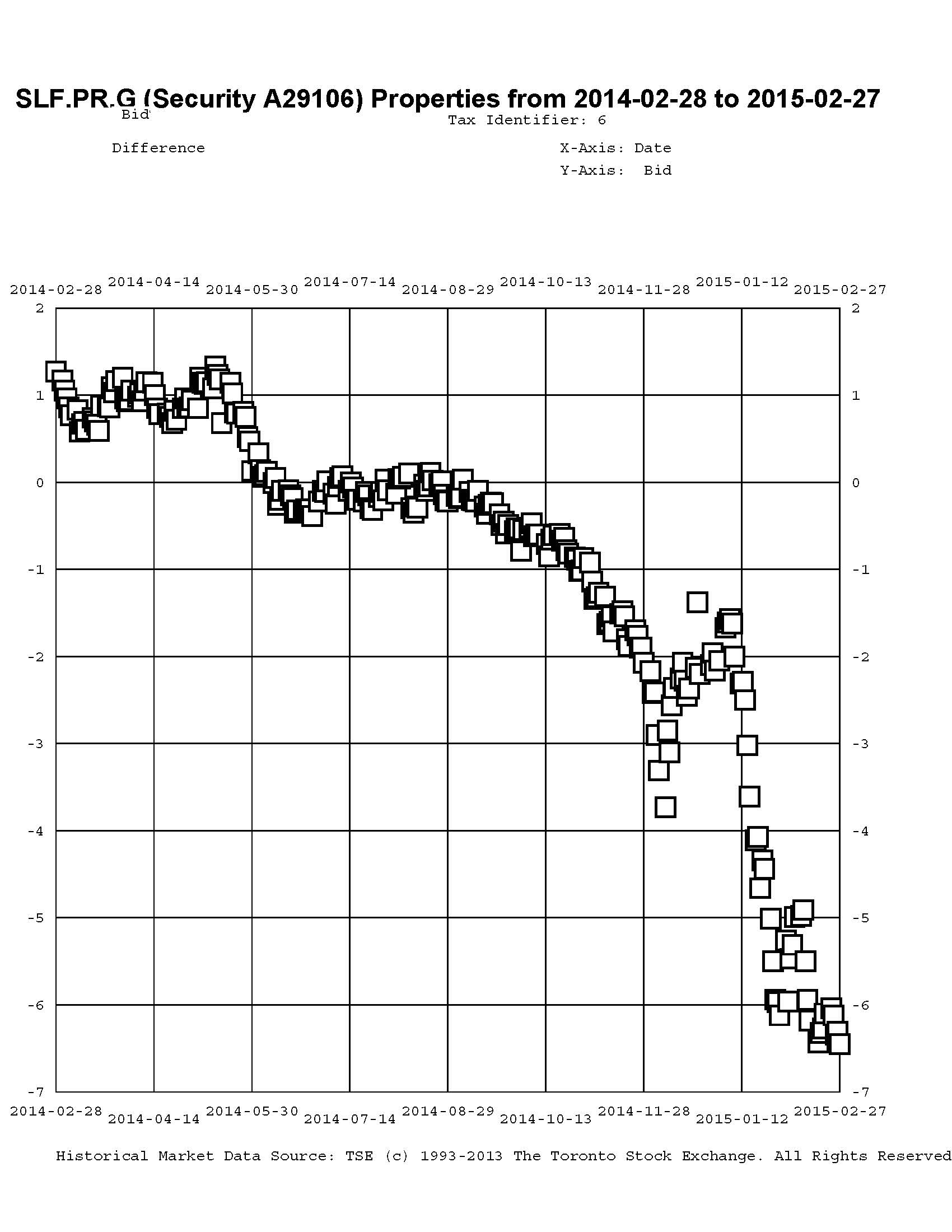
In July, 2014, I reported sales of SLF.PR.D to purchase SLF.PR.G at a take-out of about $0.15:

SLFPRG_SLFPRD_bidDiff_150130
Click for Big

There were similar trades in August, 2014 (from SLF.PR.C) at a take-out of $0.35. The January month-end take-out (bid price SLF.PR.D less bid price SLF.PR.G) was $6.12, so that hasn’t worked very well either.

The trend paused in September, 2014 and, indeed, can be said to have reversed, with the fund selling SplitShares (PVS.PR.B at 25.25-30) to purchase PerpetualDiscounts (BAM.PR.M / BAM.PR.N at about 21.25), a trade which worked out favourably and has been sort-of reversed (into PVS.PR.D) in November 2014.

In October 2014 there was another bit of counterflow, as the fund sold more SplitShares (CGI.PR.D at about 25.25) to purchase more PerpetualDiscounts (CU.PR.F and CU.PR.G, at about 21.25) which again worked out well and was reversed in November, selling the CU issues at about 22.45 to purchase low-spread FixedResets (TRP.PR.A and TRP.PR.B) at about 21.50 and 18.75 (post dividend equivalent), which was basically down by transaction costs at November month-end, but a significant loser by December month-end.

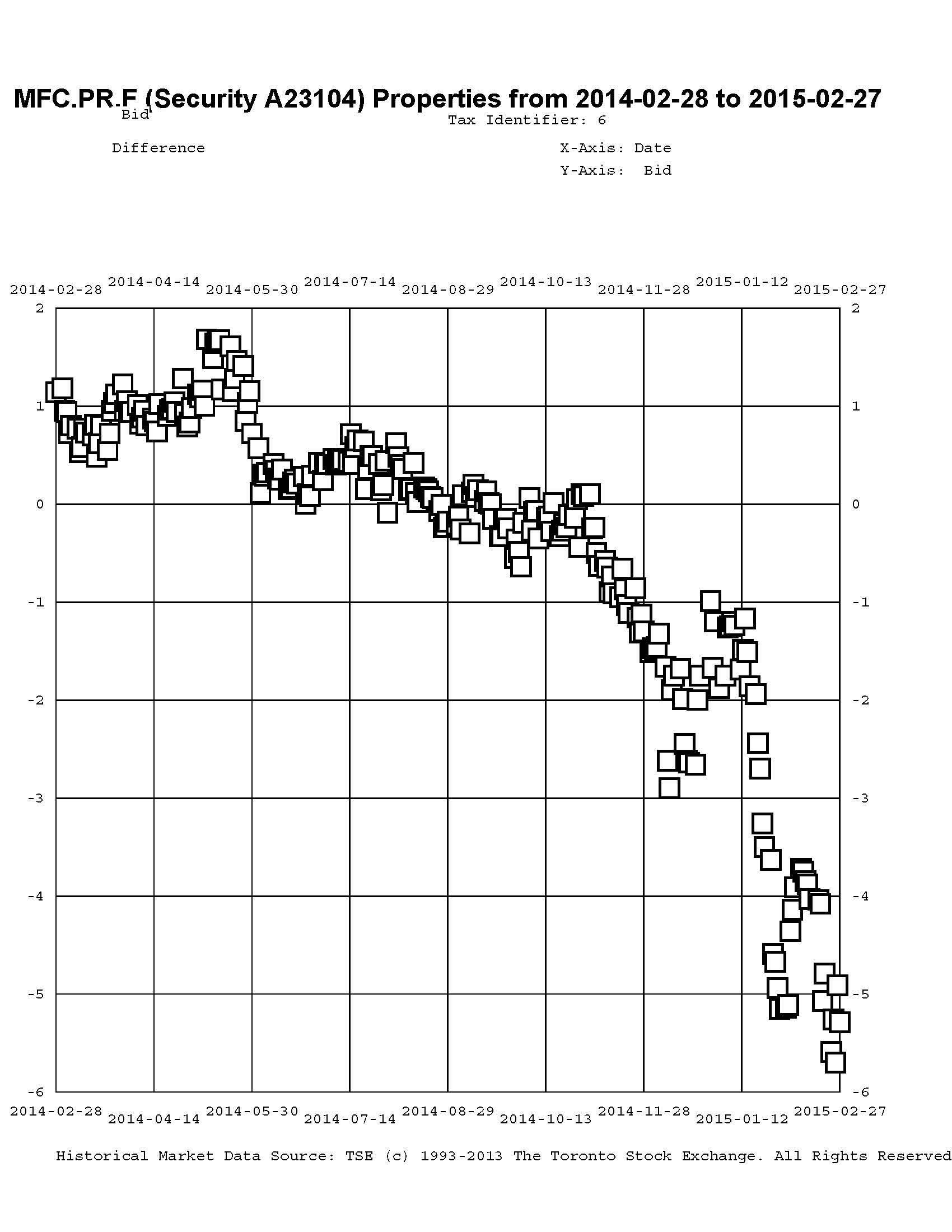
And November saw the third insurer-based sector swap, as the fund sold MFC.PR.C to buy the FixedReset MFC.PR.F at a post-dividend-adjusted take-out of about $0.85 … given a month-end take-out of about $1.30, that’s another regrettable trade, although another piece executed in December at a take-out of $1.57 has done better.

MFCPRF_MFCPRC_bidDiff_150130
Click for Big

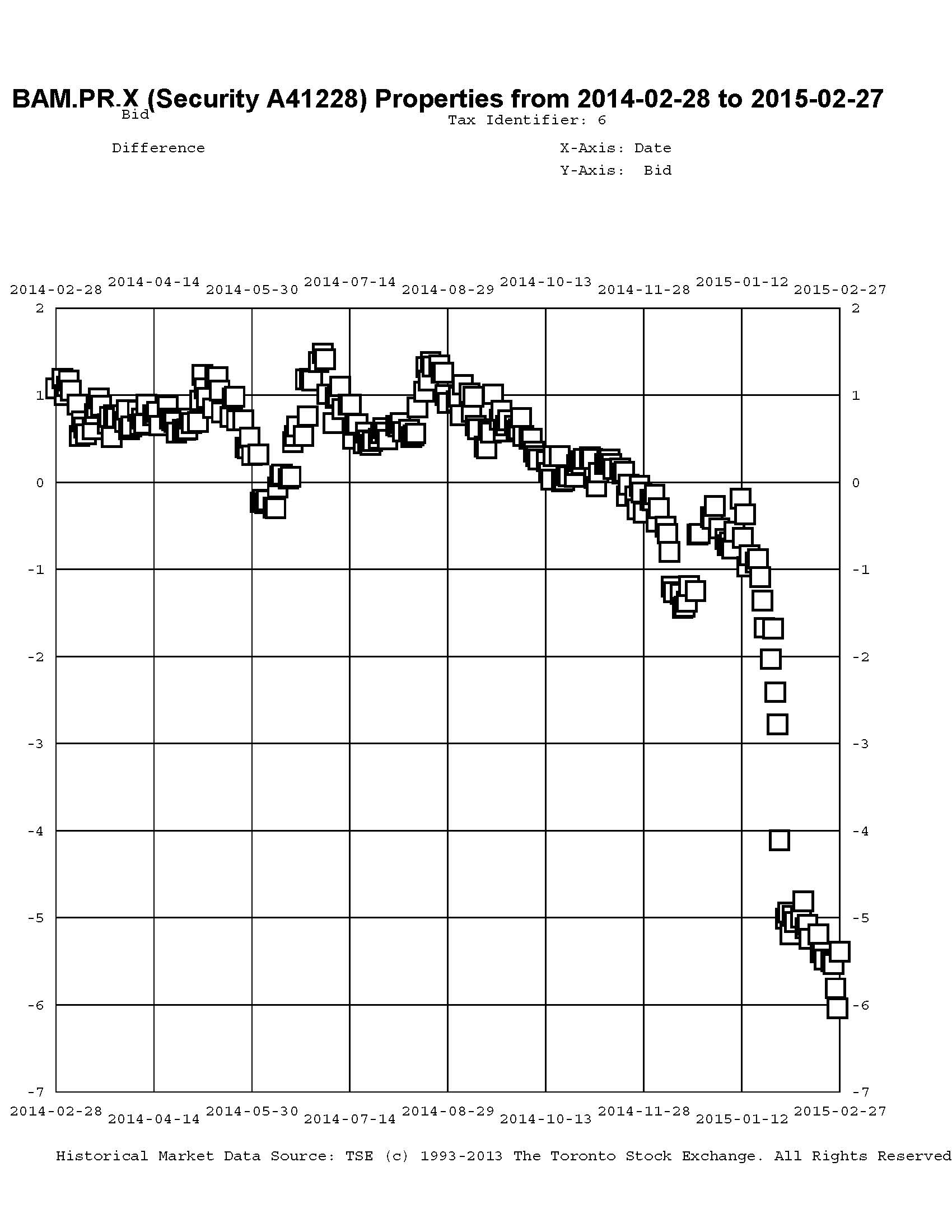
This trend is not restricted to the insurance sector. Other pairs of interest are BAM.PR.X / BAM.PR.N:

BAMPRX_BAMPRN_bidDiff_150130
Click for Big

… and FTS.PR.H / FTS.PR.J:

FTSPRH_FTSPRJ_bidDiff_150130
Click for Big

… and PWF.PR.P / PWF.PR.S:

PWFPRP_PWFPRS_bidDiff_150130
Click for Big

I will agree that the fund’s trades highlighted in this post may be decried as cases of monumental bad timing, but I should point out that in May, 2014, the fund was 63.9% Straight / 9.5% FixedReset
while in January 2015 the fund was 35% Straight / 51% FixedReset & FloatingReset (The latter figures include allocations from those usually grouped as ‘Scraps’). Given that the indices are roughly 30% Straight / 60% FixedReset & FloatingReset, it is apparent that the fund was extremely overweighted in Straights / underweighted in FixedResets in May 2014 and that this qualitative tilt remains, but is no longer extreme.

Summarizing the charts above in tabular form, we see:

FixedReset Straight Take-out
December 2013
Take-out
MAPF Trade
Take-out
December 2014
Take-out
January 2014
GWO.PR.N
3.65%+130
GWO.PR.I
4.5%
($0.04) $1.00 $2.95 $5.80
SLF.PR.G
4.35%+141
SLF.PR.D
4.45%
($1.29) $0.25 $2.16 $6.12
MFC.PR.F
4.20%+141
MFC.PR.C
4.50%
($1.29) $0.86 $1.20 $5.15
BAM.PR.X
4.60%+180
BAM.PR.N
4.75%
($2.06)   $0.17 $4.11
FTS.PR.H
4.25%+145
FTS.PR.J
4.75%
$0.60   $5.68 $7.36
PWF.PR.P
4.40%+160
PWF.PR.S
4.80%
($0.67)   $3.00 $6.28
The ‘Take-Out’ is the bid price of the Straight less the bid price of the FixedReset; approximate execution prices are used for the “MAPF Trade” column. Bracketted figures in the ‘Take-Out’ columns indicate a ‘Pay-Up’

So why is all this happening? One should take care in explaining market movements, but it is my belief that in the latter half of 2013 we were dealing with the ‘taper tantrum’ – the market’s fears that Fed tapering and subsequent tapering would lead to massive spikes in yields; this led to a great preference for FixedResets over Straights. Now, with the economic news getting less inflationary with every news story and Europe and Japan desperately trying to reflate their sluggish economies, the market seems to think that these rate increases are still a long way off … leading to a great preference for Straights over FixedResets.

In addition, the graphs show a sharp spike in early December, during which the low-spread FixedResets were very badly hurt; I believe this to be due to a combination of tax-loss selling and a panicky response to the 29% reduction in the TRP.PR.A dividend.

And in January it just got worse with Canada yields plummeting after the Bank of Canada rate cut with speculation rife about future cuts.

There was some good discussion about what is going on in the comments to the January 29 market action report. I take the view that we’ve seen this show before: during the Credit Crunch, Floaters got hit extremely badly (to the point at which their fifteen year total return was negative) because (as far as I can make out) their dividend rate was dropping (as it was linked to Prime) while the yields on other perpetual preferred instruments were skyrocketing (due to credit concerns). Thus, at least some investors insisted on getting long term corporate yields from rates based on short-term government policy rates. And it’s happening again!

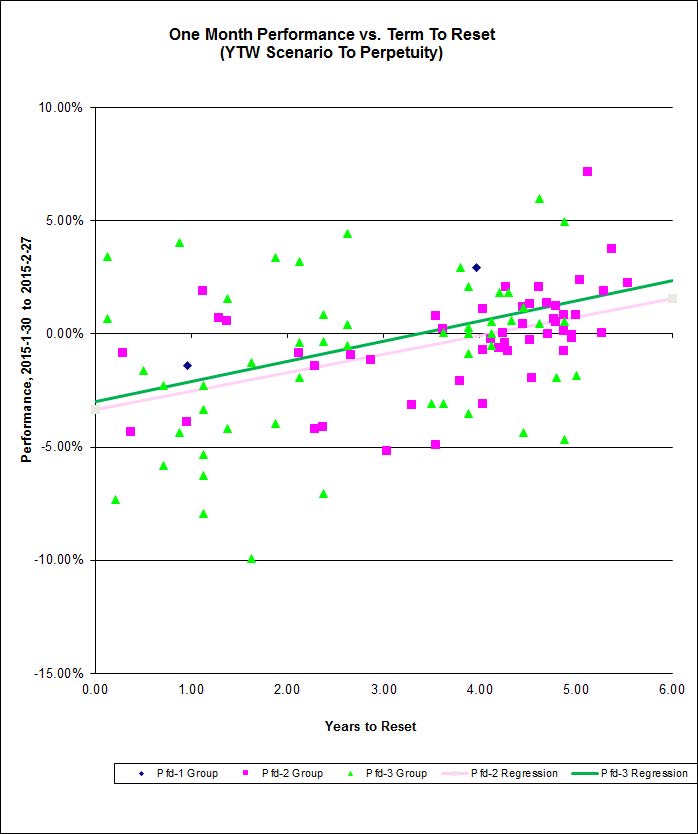
And finally – here’s the January performance for FixedResets that had a YTW Scenario of ‘To Perptuity’ at mid-month. Unusually, the Pfd-3 Group had a better correlation than the Pfd-2 group (20% vs. 11%), but it is striking that the slopes are so similar.:

FR_1MoPerf_150130
Click for Big
Issue Comments

RY.PR.J Firm On Excellent Volume

Royal Bank of Canada has announced:

it has closed its domestic public offering of Non-Cumulative, 5-Year Rate Reset Preferred Shares Series BD. Royal Bank of Canada issued 24 million Preferred Shares Series BD at a price of $25 per share to raise gross proceeds of $600 million.

The offering was underwritten by a syndicate led by RBC Capital Markets. The Preferred Shares Series BD will commence trading on the Toronto Stock Exchange today under the ticker symbol RY.PR.J.

The Preferred Shares Series BD were issued under a prospectus supplement dated January 27, 2015 to the bank’s short form base shelf prospectus dated December 20, 2013.

RY.PR.J is a FixedReset, 3.60%+274, NVCC-compliant, announced January 26. The issue will be tracked by HIMIPref™ and has been assigned to the FixedReset subindex.

Note that since this issue is NVCC-compliant, there is no Deemed Maturity entry in the call schedule analyzed by HIMIPref™. It is, and is analyzed by HIMIPref™ as, a true perpetual … at least until the morons at OSFI change the rules again, since the ‘legitimate expectations of investors’ now include early redemption.

The issue traded 1,383,496 shares today (consolidated exchanges) in a range of 24.82-98 before closing at 24.95-96. Vital statistics are:

RY.PR.J FixedReset YTW SCENARIO
Maturity Type : Limit Maturity
Maturity Date : 2045-01-30
Maturity Price : 23.12
Evaluated at bid price : 24.95
Bid-YTW : 3.42 %

Implied Volatility theory shows the issue should be considered cheap against its peers – not only is the issue’s Expected Future Current Yield well over the ‘best fit’ theoretical estimates (in which implied volatility is capped at 40%) but the fit of 40% should decline as the market realizes that RY issues are no more immune from the laws of economics than any other series, which will result in underperformance of lower-spread issues.

impVol_RY_150129
Click for Big
Issue Comments

Brompton Oil Split Corp. To Close February 24

Brompton Group has announced:

Brompton Funds Limited (the “Manager”) is pleased to announce that Brompton Oil Split Corp. (the “Company”) has filed a final prospectus in respect of its initial public offering up to a maximum of 6,000,000 Class A shares and 6,000,000 Preferred shares at a price of $10.00 per Preferred share and $15.00 per Class A share, for a maximum offering size of $150,000,000. This offering is expected to close on or about February 24, 2015.

The Company will invest in a portfolio (the “Portfolio”) of equity securities of at least 15 large capitalization North American oil and gas issuers selected by the Manager from the S&P 500 Index and the S&P/TSX Composite Index, giving consideration to, among other metrics, attractive valuation, growth prospects, profitability, liquidity, sustainability of dividends and a strong balance sheet. The Portfolio will be focused primarily on oil and gas issuers that have significant exposure to oil, and will initially include equities of the following oil and gas issuers:

ARC Resources Ltd. Chevron Corporation Occidental Petroleum Corporation
Canadian Natural Resources Limited Encana Corporation PrairieSky Royalty Ltd.
ConocoPhillips EOG Resources Inc. Suncor Energy Inc.
Crescent Point Energy Corp. Husky Energy Inc. Vermilion Energy Inc.
Cenovus Energy Inc. Imperial Oil Limited Exxon Mobil Corporation

The investment objectives for the Class A shares are to provide holders with regular monthly non-cumulative cash distributions targeted to be 8.0% per annum on the $15.00 issue price, and the opportunity for growth in net asset value. The investment objectives for the Preferred shares are to provide holders with fixed cumulative preferential quarterly cash distributions in the amount of 5.0% per annum on the $10.00 issue price, and to return the original issue price on the maturity date, March 31, 2020.

Brompton Funds Limited will be the manager and portfolio manager of the Company. The Manager currently manages 4 split-share funds with assets under management over $900 million. The portfolio management team will be led by Laura Lau, an award winning portfolio manager with over 20 years of experience in financial services, who has a proven track record in managing flow-through funds and resource assets. The team also includes Michael Clare, an experienced energy and flow-through portfolio manager who specializes in the analysis of crude oil and natural gas markets.

The syndicate of agents for the offering is being led by Scotiabank, CIBC and RBC Capital Markets and includes TD Securities Inc., BMO Capital Markets, National Bank Financial Inc., GMP Securities L.P., Raymond James Ltd., Canaccord Genuity Corp., Desjardins Securities Inc., Dundee Securities Ltd., Industrial Alliance Securities Inc. and Mackie Research Capital Corporation.

The issuance of the preliminary prospectus was reported on PrefBlog.

Issue Comments

TD.PR.P & TD.PR.Q To Be Redeemed

The Toronto-Dominion Bank has announced:

that it will exercise its right to redeem all of its 10 million outstanding Non-cumulative Redeemable Class A First Preferred Shares, Series P (the “Series P Shares”) on March 2, 2015 at the cash redemption price of $25.607877 per Series P Share, for total redemption proceeds of approximately $256 million.

TD also announced it will exercise its right to redeem all of its 8 million outstanding Non-cumulative Redeemable Class A First Preferred Shares, Series Q (the “Series Q Shares”) on March 2, 2015 at the cash redemption price of $25.615068 per Series Q Share, for total redemption proceeds of approximately $205 million.

The cash redemption price in each case represents the sum of the redemption amount of $25.50 per share, plus an amount equal to the applicable quarterly cash dividend pro rated for the period from and including January 31, 2015 to but excluding March 2, 2015. Regular quarterly dividends of $0.328125 per Series P Share and $0.35 per Series Q Share will be paid in the usual manner on January 31, 2015 to shareholders of record on January 8, 2015, as previously announced.

From and after March 2, 2015, the Series P Shares and Series Q Shares will cease to be entitled to dividends and the only remaining rights of holders of such shares will be to receive payment of the applicable cash redemption price.

Beneficial holders who are not directly the registered holder of Series P Shares or Series Q Shares should contact the financial institution, broker or other intermediary through which they hold these shares to confirm how they will receive their redemption proceeds. Instructions with respect to receipt of the redemption amount will be set out in the Letter of Transmittal to be mailed to registered holders of the Series P Shares and Series Q Shares shortly. Inquiries should be directed to our Registrar and Transfer Agent, CST Trust Company, at 1-800-387-0825 (or in Toronto 416-682-3860).

TD.PR.P is a Straight Perpetual, 5.25%, that commenced trading 2007-11-1 after being announced 2007-10-9. The issue was poorly received – there was an inventory blow-out sale 2007-11-14

TD.PR.Q is a Straight Perpetual, 5.60%, that commenced trading 2008-1-31 after being announced 2008-1-22.

Both issues are NVCC non-compliant and so currently reside in the DeemedRetractibles index.

There are special tax implications with respect to these redemptions! Both redemptions are priced above par ($25.50 in both cases, plus accrued dividends) and the $0.50 premium will be taxable to those who receive it as a Deemed Dividend, which is to say, a Dividend. Many, if not most, if not almost all taxable investors will be better off selling their shares – even at a few pennies discount from the redemption value – and taking the difference as a capital gain (or reduced capital loss). Please consult your personal tax advisor.

Issue Comments

BMO.PR.P To Be Redeemed

The Bank of Montreal has announced:

its intention to redeem all of its $400,000,000 Non-Cumulative 5-Year Rate Reset Class B Preferred Shares Series 23 (“Preferred Shares Series 23”) on February 25, 2015.

The Preferred Shares Series 23 are redeemable at Bank of Montreal’s option on February 25, 2015, at a redemption price of $25.00 per share. Payment of the redemption price will be made by Bank of Montreal on or after February 25, 2015, upon surrender of the Preferred Shares Series 23.

Separately from the payment of the redemption price, the final quarterly dividend of $0.3375 per share for the Preferred Shares Series 23 will be paid in the usual manner on February 25, 2015, to shareholders of record on February 2, 2015.

Notice will be delivered to holders of the Preferred Shares Series 23 in accordance with the terms outlined in the Preferred Shares Series 23 prospectus supplement.

BMO.PR.P is a FixedReset, 5.40%+241, that commenced trading 2009-6-19 after being announced 2009-6-10. The issue has been tracked by HIMIPref™ and is assigned to the FixedReset subindex. The issue is not NVCC compliant and therefore redemption on or before 2021-1-31 has been assumed in the analysis ever since the rules were announced without a grandfather clause and recognized by HIMIPref™.

Redemption of this issue has been widely expected, but I must admit that I thought it could go either way. Five Year Canadas closed at 0.84% bid today, implying the bank could have got another five-years’ worth of Tier 1 Capital for only 3.27%. I guess they don’t figure on needing it!

Issue Comments

LCS.PR.A: Capital Units Suspend Distribution

Brompton Funds has announced:

In accordance with its articles of incorporation and the Class A Share Provisions, the regular, non-cumulative, monthly distribution for the month of January will not be paid on the class A shares of Brompton Lifeco Split Corp. The net asset value per unit as at January 15, 2015 was $14.95. Under the articles of incorporation, no cash distribution may be paid on the class A shares, if after payment of the distribution by the Fund, the net asset value per unit (consisting of one class A share and one preferred share) would be less than $15.00. The Fund will re-evaluate the payment of class A share distributions in each subsequent month with the expectation that normal monthly distributions will resume and a press release will be issued if the net asset value per unit meets this requirement.

In accordance with the Preferred Share Provisions, regular quarterly preferred share dividends will continue to be paid.

This follows a rather sharp drop from $16.45 on December 31, a decline of 9.1% in unit value – rather a steep drop, but the insurance industry, with all its reinvestment risk, hasn’t had a particularly pleasant time of it during the recent plunge in yields:

Ticker Price
2014-12-31
Price
2015-1-20
Change
GWO 33.59 31.45 -6.4%
MFC 22.18 19.93 -10.1%
SLF 41.92 37.50 -10.5%
IAG 44.43 40.26 -9.4%

The Capital Units paid five monthly dividends of $0.075 in 2013 commencing in August as NAV improved throughout the year, and all twelve in 2014.

LCS.PR.A was added to the HIMIPref™ database in October 2014, following its term extension and treasury offering earlier in the year. The issue is relegated to the Scraps index on credit concerns.

Issue Comments

BCE.PR.E / BCE.PR.F : Results of Conversion

BCE Inc. has announced:

that 7,904,105 of its 14,577,100 fixed-rate Cumulative Redeemable First Preferred Shares, Series AF (“Series AF Preferred Shares”) have been tendered for conversion on February 1, 2015, on a one-for-one basis, into floating-rate Cumulative Redeemable First Preferred Shares, Series AE (“Series AE Preferred Shares”). In addition, 34,872 of its 1,422,900 Series AE Preferred Shares have been tendered for conversion on February 1, 2015, on a one-for-one basis, into Series AF Preferred Shares. Consequently, on February 1, 2015, BCE will have 6,707,867 Series AF Preferred Shares and 9,292,133 Series AE Preferred Shares issued and outstanding. The Series AF Preferred Shares and the Series AE Preferred Shares will continue to be listed on the Toronto Stock Exchange under the symbols BCE.PR.F and BCE.PR.E, respectively.

The Series AF Preferred Shares will pay on a quarterly basis, for the five-year period beginning on February 1, 2015, as and when declared by the Board of Directors of BCE, a fixed cash dividend based on an annual dividend rate of 3.110%.

The Series AE Preferred Shares will continue to pay a monthly floating adjustable cash dividend for the five-year period beginning on February 1, 2015, as and when declared by the Board of Directors of BCE. The monthly floating adjustable dividend for any particular month will continue to be calculated based on the prime rate for such month and using the Designated Percentage for such month representing the sum of an adjustment factor (based on the market price of the Series AE Preferred Shares in the preceding month) and the Designated Percentage for the preceding month.

BCE.PR.E closed at 20.50-65 today, while BCE.PR.F closed at 19.64-71, which means that those who took my advice and converted F to E have made a very profitable switch! According to the Pairs Equivalency Calculator, the breakeven Prime Rate for the next five years at these prices is 3.93%, which is more or less in line with the breakeven rates for other FixedFloater / Ratchet Rate Strong Pairs.

pairs_FF_140120
Click For Big
Issue Comments

BBD.PR.B, BBD.PR.C & BBD.PR.D Downgraded to P-5(high) by S&P

Bombardier announced a ‘pause’ today and the market paused its bids:

Bombardier Inc. (BBD/B) tumbled the most in at least 26 years after moving to cut about 1,000 jobs and book $1.4 billion in pretax fourth-quarter costs as it halts work on the Learjet 85 business aircraft.

The dismissals will take place in Kansas and Mexico, and result in severance expense of $25 million this quarter, said Bombardier, which didn’t predict when the Learjet 85 program will resume. Profit in the aerospace and trainmaking units for 2014 will fall short of previously announced targets.

Bombardier’s pullback on the Learjet 85, which was described as a “pause” in the face of weak demand, underscored the company’s struggle in developing new planes. The Learjet 85 is already more than a year behind schedule, and Montreal-based Bombardier eliminated about 3,500 aerospace jobs last year as it postponed the CSeries airliner for the fourth time.

“It’s really not clear to me what ‘pause’ means,” said Cam Doerksen, an analyst at National Bank of Canada Financial in Montreal who rates Bombardier as sector perform. “This is a pretty sizable charge, and this suggests to me this may be longer than a typical delay. This appears to be an indefinite pause.”

The cost to protect Bombardier’s debt from default within 5 years jumped 125 basis points to 481 basis points at 4:17 p.m., according to data provider CMA, which is owned by McGraw Hill Financial and compiles prices quoted by dealers in the privately negotiated market. The contracts are at the highest level since January 2012.

and S&P cut their credit rating by a notch:

  • •Montreal-based Bombardier Inc. announced it would pause its Learjet 85 program due to weak demand and has revised its business aircraft market forecast downward.
  • •In addition, the company revised its 2014 guidance, including reduced earnings before interest and taxes margins at both the aerospace and
    transportation divisions.

  • •Because of Bombardier’s reduced profitability, pricing pressures on new aircraft, and revised escalation assumptions in the transportation division on some contracts that affected estimated future revenues, we
    have reassessed our comparable rating modifier on the company and revised it to “neutral” from “positive”.

  • •As a result, we are lowering our ratings on Bombardier, including our long-term corporate credit rating to ‘B+’ from ‘BB-‘
  • •The negative outlook reflects our view that Bombardier’s 2015 performance could remain challenged due to market conditions and the company’s continued large capital spend program, leading to weaker credit protection measures than previously forecast.


The ratings on Bombardier reflect what we view as the company’s “satisfactory” business risk profile and “highly leveraged” financial risk profile. Our ratings take into consideration the company’s leading market positions in the transportation and business aircraft segments, as well as its product range and diversity. These positive factors are partially offset, in our opinion, by the continued execution risk associated with the entry into service of the CSeries jet, high leverage, and reported profitability that has been weak in both the aerospace and transportation divisions.

The negative outlook reflects our view that Bombardier’s 2015 performance could remain challenged due to market conditions and the company’s continued large capital spend program, leading to weaker credit protection measures than we previously forecast. Furthermore, the outlook incorporates our opinion that, given Bombardier’s current leverage and debt-to-cash flow metrics, there remains very limited room for delays on project execution or margin
deterioration.

We could lower the rating on Bombardier should its new aircraft program experience further delays or order levels do not allow for profitable production, resulting in a reassessment of the company’s business risk profile. In addition, we could take a negative rating action should Bombardier face liquidity pressures, which could result from either deteriorating headroom under its covenants or an inability to refinance upcoming maturities.

These issues have previously been downgraded to P-4(low) by S&P in February 2014 and to Pfd-4(low) by DBRS. All are tracked by HIMIPref™ and all are relegated to the Scraps index on credit concerns.

Update, 2015-1-26: Moody’s has placed Bombardier under Review-Negative:

Moody’s Investors Service placed Bombardier Inc.’s Ba3 Corporate Family rating (CFR), Ba3-PD probability of default rating and Ba3 senior unsecured ratings under review for possible downgrade. Moody’s also lowered the company’s speculative grade liquidity rating to SGL-3 from SGL-2.

The rating’s review follows Bombardier’s announcement yesterday that it has materially lowered its earnings and cash flow expectations for 2014. Consequently, Moody’s believes Bombardier will need to raise additional debt to fund the cash shortfall and address its weakened liquidity position, which would further pressure the company’s adjusted leverage from an already high level of approximately 7x currently. As well, given ongoing execution challenges in its Transportation division, relatively weak order flow for certain of its aircraft, and the potential for further cost escalation related to its CSeries aircraft program, Moody’s believes the company will continue to consume cash through at least 2015. Bombardier’s $2.4 billion of cash and $1.4 billion of available revolvers provides adequate liquidity, however continued covenant compliance through the next year is a concern in Moody’s opinion.

Moody’s review will focus on Bombardier’s plans to strengthen its liquidity position, as well as the company’s prospects for improving its earnings and reducing its cash consumptiveness through 2016.

Bombardier’s unsecured notes, which do not benefit from upstream guarantees, could be lowered by more than the CFR, particularly if the company obtains secured debt with any funding initiatives.

Issue Comments

BCE.PR.F To Reset At 3.110%

BCE Inc. has announced (emphasis from original) that it:

will, on February 1, 2015, continue to have Cumulative Redeemable First Preferred Shares, Series AF (“Series AF Preferred Shares”) outstanding if, following the end of the conversion period on January 19, 2015, BCE Inc. determines that at least one million Series AF Preferred Shares would remain outstanding. In such a case, as of February 1, 2015, the Series AF Preferred Shares will pay, on a quarterly basis, as and when declared by the Board of Directors of BCE Inc., a fixed cash dividend for the following five years that will be based on a fixed rate equal to the product of: (a) the average of the yields to maturity compounded semi-annually, determined on January 12, 2015 by two investment dealers selected by BCE Inc., that would be carried by non-callable Government of Canada bonds with a 5-year maturity (the “Government of Canada Yield”), multiplied by (b) a percentage rate determined by BCE Inc. (the “Selected Percentage Rate”) for such period. The “Selected Percentage Rate” determined by BCE Inc. for such period is 259.4%. The “Government of Canada Yield” is 1.199% . Accordingly, the annual dividend rate applicable to the Series AF Preferred Shares for the period of five years beginning on February 1, 2015 will be 3.110%.

The rate was reset in 2010 to 4.541%, so this is a 32% cut to the dividend, which will no doubt cause much wailing and gnashing of teeth.

This is not much of a premium over the 3.00% (100% of Prime) paid by the RatchetRate issue, BCE.PR.E, and as it turns out the breakeven prime rate as determined by the pairs equivalency calculator is only 3.55% given today’s closing bids of 20.04 for BCE.PR.F and 20.50 for BCE.PR.E.

That is to say that IF BCE.PR.E continues to trade below par and therefore continues to pay 100% of prime, and if the average prime rate from now until the next interconversion date in 2020 exceeds 3.55%, THEN BCE.PR.E will have been the better choice.

As one can see, this is a fairly modest hurdle, compared to that implied by other FixedFloater/RatchetRate Strong Pairs:

pairs_FF_140114
Click for Big

Given that there is a presumed immediate gain of $0.46 available by converting BCE.PR.F to BCE.PR.E and that the risk of this being reduced during the period between the decision date and the date that converters receive their replacement shares is small (since, all else being equal, a reduction in the price of BCE.PR.E implies a reduction in the Break-Even Prime Rate, which is already on the low side), I recommend that holders of BCE.PR.F convert to BCE.PR.E. Holders of BCE.PR.E should retain their shares.

Note that while the company requires notification of conversion prior to 5:00 p.m. (Eastern time) on January 19, 2015, brokerage houses will have deadlines a day or two in advance of the company deadline – so there’s not much time to waste!