Category: Issue Comments

Issue Comments

TA.PR.J Soft On Low Volume

TransAlta Corporation has announced:

it has completed its public offering (the “Offering”) of 6,600,000 Cumulative Redeemable Rate Reset First Preferred Shares, Series G (the “Series G Shares”) at a price of $25.00 per Series G Share.

The Offering, previously announced on August 6, 2014, includes the partial exercise of the underwriters’ option of an additional 600,000 Series G Shares for proceeds of an additional $15 million bringing the aggregate gross proceeds of the Offering to $165 million. The net proceeds of the Offering will be used for general corporate purposes in support of our business, to reduce short term indebtedness and to fund capital investments of the Corporation and its affiliates.

The Series G Shares were offered to the Canadian public through a syndicate of underwriters led by RBC Capital Markets, CIBC and Scotiabank by way of a prospectus supplement that was filed on August 8, 2014 with securities regulatory authorities in Canada under TransAlta’s short form base shelf prospectus dated December 9, 2013.

Holders of Series G Shares are entitled to receive a cumulative quarterly fixed dividend yielding 5.30% annually for the initial period ending September 30, 2019. Thereafter, the dividend rate will be reset every five years at a rate equal to the 5-year Government of Canada bond yield plus 3.80%. Holders of Series G Shares will have the right, at their option, to convert their Series G shares into Cumulative Redeemable Floating Rate First Preferred Shares, Series H (the “Series H Shares”), subject to certain conditions, on September 30, 2019 and on September 30 every five years thereafter. Holders of Series H Shares will be entitled to receive cumulative quarterly floating dividends at a rate equal to the three-month Government of Canada Treasury Bill yield plus 3.80%. The Series G Shares are listed on the Toronto Stock Exchange under the ticker symbol TA.PR.J.

TA.PR.J is a FixedReset, 5.30%+380, announced August 6. It will be tracked by HIMIPref™ and has been assigned to the Scraps index on credit concerns.

The issue traded 307,925 shares today (consolidated exchanges) in a range of 24.65-84 before closing at 24.72-75, 204×92. Vital statistics are:

TA.PR.J FixedReset YTW SCENARIO
Maturity Type : Limit Maturity
Maturity Date : 2044-08-15
Maturity Price : 23.06
Evaluated at bid price : 24.72
Bid-YTW : 5.25 %

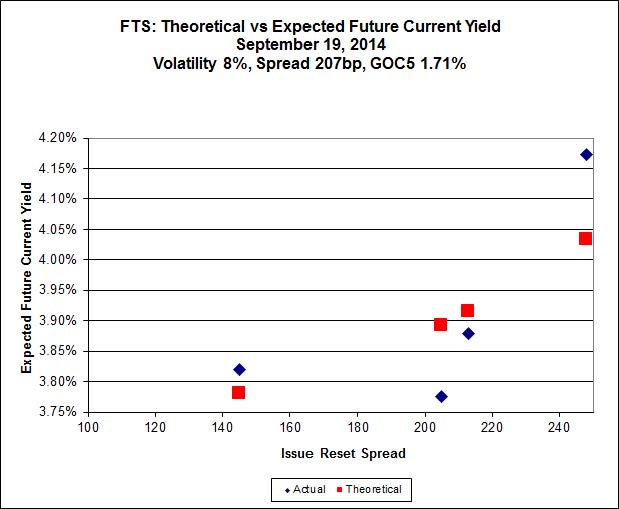
Implied Volatility theory suggests that this issue is about $0.50 expensive, being fairly priced at 24.22 compared to its closing bid of 24.72. TA.PR.F, on the other hand, is about $0.66 cheap, fairly priced at 22.36 compared to its closing bid of 21.70.

ImpVol_TA_140815
Click for Big
Issue Comments

MFC.PR.E To Be Redeemed

Manulife Financial Corp. has announced:

its intention to redeem all of its outstanding 14,000,000 Non-cumulative Rate Reset Class 1 Shares Series 1 (“Series 1 Preferred Shares”) for cash on September 19, 2014. The Series 1 Preferred Shares are redeemable at Manulife’s option on September 19, 2014, at a redemption price per Series 1 Preferred Share equal to C$25.00 for an aggregate total of C$350 million. Formal notice will be delivered to holders of Series 1 Preferred Shares in accordance with the terms outlined in the share provisions for the Series 1 Preferred Shares.

Separately from the redemption price, the final quarterly dividend of C$0.35 per Series 1 Preferred Share will be paid in the usual manner on September 19, 2014 to shareholders of record on August 19, 2014. After the Series 1 Preferred Shares are redeemed, holders of Series 1 Preferred Shares will cease to be entitled to distributions of dividends and will not be entitled to exercise any rights as holders other than to receive the redemption price.

No surprise here – with an Issue Reset Spread of 323bp, this was rather expensive money for them. They have separately announced their intention to issue at +236.

MFC.PR.E commenced trading 2009-6-3 after being announced 2009-5-25.

Issue Comments

LFE.PR.B Semi-Annual Report 2014

Canadian Life Companies Split Corp has released its Semi-Annual Report to May 31, 2014.

Figures of interest are:

MER: 1.43% of the whole unit value, “presented to reflect the normal operating expenses of the Company excluding
any one time secondary offering expenses.”

Average Net Assets: We need this to calculate portfolio yield. The Total Assets of the fund at year end was $190.0-million, compared to $199.9-million on May 31, so call it an average of $195.0-million. Preferred share dividends of $4,229,154 were paid over the half year at 0.625 p.a., implying average units outstanding of 13.53-million, at an average NAVPU of about $14.05, implies $190.2-million. That’s reasonably good agreement! Say the Average Net Assets are $192.6-million.

Underlying Portfolio Yield: Income received of $2,871,701 divided by average net assets of $194.7-million, multiplied by two because it’s semiannual is 2.98%.

Income Coverage: Net investment income of $1,873,801 (after adding back warrant subscription fees) divided by preferred share dividends of $4,229,154 is a rather low 44% – but consistent with the figure for 2013.

Issue Comments

FTN.PR.A Semi-Annual Report 2014

Financial 15 Split Corp has released its Semi-Annual Report to May 31, 2014.

Figures of interest are:

MER: 1.60% of the whole unit value, “presented to reflect the normal operating expenses of the Company excluding any one time secondary offering expenses.”

Average Net Assets: We need this to calculate portfolio yield. The Total Assets of the fund at year end was $185.2-million, compared to $209.3-million on May 31, so call it an average of $197.2-million. Preferred share dividends of $3,219,876 were paid over the half year at 0.525 p.a., implying average units outstanding of 12.27-million, at an average NAVPU of about $15.75, implies $193.2-million. That’s reasonably good agreement! Say the Average Net Assets are $194.7-million.

Underlying Portfolio Yield: Income received of $2,687,593 divided by average net assets of $194.7-million, multiplied by two because it’s semiannual is 2.76%.

Income Coverage: Net investment income of $1,015,649 divided by preferred share dividends of $3,219,876 is a very low 32%.

The Income Coverage is substantially lower than the calculation performed from the 2013 Annual Report. This may be related to their issuance of $34.5-million in units last January.

Issue Comments

DF.PR.A Semi-Annual Report

Dividend 15 Split Corp. II has released its Semi-Annual Report to May 31, 2014.

Figures of interest are:

MER: 1.30% of the whole unit value, “to reflect the normal operating expenses of the Company excluding any one time secondary offering expenses.”.

Average Net Assets: We need this to calculate portfolio yield. The Total Assets of the fund at year end was $115.6-million, compared to $153.2-million on May 31, so call it an average of $134.4-million. Preferred share dividends of $1,997,813 were paid over the half year at 0.525 p.a., implying average units outstanding of 7.61-million, at an average NAVPU of about $16.7, implies $127.1-million. That’s reasonably good agreement! Say the Average Net Assets are $130.8-million.

Underlying Portfolio Yield: Income received of $1,969,925 divided by average net assets of $130.8-million, multiplied by two because it’s semiannual is 3.01%.

Income Coverage: Net investment income of $1,104,941 divided by preferred share dividends of $1,997,813 is 55%.

Note that both the calculated portfolio yield and the income coverage are less than what was calculated according to the 2013 Annual Report; there may have been a delay in investing the proceeds of their issuance. We will have to wait and see what the 2014 Annual Report brings.

Issue Comments

FFN.PR.A Completes Overnight Offering

Quadravest has announced:

Financial 15 Split Corp. II (the “Company”) is pleased to announce it has completed an overnight offering of 1,955,000 Preferred Shares and 1,955,000 Class A Shares. Total gross proceeds of the offering were $35.2 million, bringing the Company’s net assets to approximately $124.5 million. The shares will trade on the Toronto Stock Exchange under the existing symbols of FFN.PR.A (Preferred shares) and FFN (Class A shares).

The Preferred Shares were offered at a price of $10.00 per Preferred Share to yield 5.25% on the issue price, and the Class A Shares were offered at a price of $8.00 per Class A Share targeting to yield 15% annually based on the current distribution policy.

The offering was co-led by National Bank Financial Inc., CIBC, RBC Capital Markets and also included BMO Capital Markets, GMP Securities L.P., Canaccord Genuity Corp. and Raymond James.

The net proceeds of the secondary offering will be used by the Company to invest in a high quality portfolio consisting of 15 financial services companies made up of Canadian and U.S. issuers as follows:

Bank of Montreal National Bank of Canada Bank of America Corp.
The Bank of Nova Scotia Manulife Financial Corporation Citigroup Inc.
Canadian Imperial Bank of Commerce Sun Life Financial Services of Canada Goldman Sachs Group Inc.
Royal Bank of Canada Great-West Lifeco Inc. JP Morgan Chase & Co.
The Toronto-Dominion Bank CI Financial Corp. Wells Fargo & Co.

FFN.PR.A was last mentioned on PrefBlog when shareholders voted for a term extension last May.

Issue Comments

S&P Sets Outlook-Negative on Canadian Banks

Standard & Poor’s has announced:

Standard & Poor’s Ratings Services today said that it revised its outlooks to negative from stable on almost all Canadian banks to which we have ascribed ratings uplift for potential extraordinary government support in a crisis. We base this rating action on our view that the announcement of a proposed bail-in policy regime might lead us to lower ratings on the banks within two years. We are revising our outlooks on Royal Bank of Canada (RBC), Toronto-Dominion Bank (TD Bank), The Bank of Nova Scotia (Scotiabank), Bank of Montreal (BMO), Canadian Imperial Bank of Commerce (CIBC), and National Bank of Canada (NBC).

“The outlook revision reflects our expectation of reduced potential for extraordinary government support arising from implementation of the proposed new elements of the resolution framework for Canadian banks,” said Standard & Poor’s credit analyst Tom Connell.

We incorporate the potential for extraordinary government support in our ratings on the seven largest Canadian financial institutions. We evaluate the potential for extraordinary government support through an assessment of a bank’s systemic importance, in conjunction with our view of the government’s willingness and capacity to support one or more banks during a crisis. We assess seven Canadian financial institutions as having “high” or “moderate” systemic importance. We also assess Canada as being “supportive,” which is the middle of three categories in our framework for evaluating the tendency of a government to bail out a financial institution. The issuer credit ratings on the large Canadian financial institutions include either one notch (RBC, TD Bank, Scotiabank, NBC, and Caisse Centrale Desjardins) or two notches (BMO and CIBC) of uplift due to the potential for extraordinary government support.

This notching reflects our belief that the Canadian government, like other governments around the world, would face strong incentives to support a large institution in a crisis to preserve financial market stability. We base this on the size and interconnectedness of these banks, their importance to the economy, and the potential for the failure of one institution to destabilize the system as a whole. We believe there is a moderately high likelihood that the Canadian government would intervene to preempt a large bank’s failure.

We might reclassify the Canadian government’s tendency to support a bank as “uncertain” from the current “supportive” category. We note that taxpayer protection is a primary goal of the bail-in policy, as the consultation document’s title reflects. We expect the Canadian government will take a pragmatic approach that balances policy goals and makes use of whatever options are available in the event of an impending bank failure. Canada has not prohibited capital injections to a distressed bank, but does include a capital injection from a federal or provincial government as a trigger event for the conversion of nonviability capital instruments and of bail-in debt. For jurisdictions we view as having an uncertain tendency to support banks, we do not apply any ratings uplift from a bank’s stand-alone credit profile, regardless of the bank’s systemic importance.

Alternatively, we could reduce our assessment of the systemic importance of some or all Canadian banks, to “moderate” or “low.” This could arise if we conclude that the array of resolution tools, including the bail-in option, would have the potential to materially reduce the potential for a bank failure to destabilize the financial system. For banks we view as having low systemic importance, we do not apply any uplift for extraordinary government support. For banks that we believe have moderate systemic importance, we would limit uplift of extraordinary support to one notch at most (assuming we view the government as supportive).

This announcement by S&P mirrors a a similar announcement by Moody’s last month.

Affected issues are
BNS.PR.A, BNS.PR.B, BNS.PR.C, BNS.PR.L, BNS.PR.M, BNS.PR.N, BNS.PR.O, BNS.PR.P, BNS.PR.Q, BNS.PR.R, BNS.PR.Y, BNS.PR.Z

BMO.PR.J, BMO.PR.K, BMO.PR.L, BMO.PR.M, BMO.PR.P, BMO.PR.Q, BMO.PR.R, BMO.PR.S, BMO.PR.T, BMO.PR.W

CM.PR.D, CM.PR.E, CM.PR.G, CM.PR.O

NA.PR.L, NA.PR.M, NA.PR.Q, NA.PR.S

RY.PR.A, RY.PR.B, RY.PR.C, RY.PR.D, RY.PR.E, RY.PR.F, RY.PR.G, RY.PR.H, RY.PR.I, RY.PR.K, RY.PR.L, RY.PR.T, RY.PR.W, RY.PR.X, RY.PR.Y, RY.PR.Z

TD.PR.O, TD.PR.P, TD.PR.Q, TD.PR.R, TD.PR.S, TD.PR.T, TD.PR.Y, TD.PR.Z, TD.PF.A, TD.PF.B

Issue Comments

TD.PF.B Firm On Excellent Volume

TD.PF.B, a FixedReset 3.80%+227, NVCC-compliant, announced July 22 settled today. It will be tracked by HIMIPref™ and has been assigned to the FixedReset subindex.

The issue traded 1,287,892 shares today (consolidated tape) in a range of 24.99-08 before closing at 25.07-08, 118×17.

Vital statistics are:

TD.PF.B FixedReset YTW SCENARIO
Maturity Type : Limit Maturity
Maturity Date : 2044-07-31
Maturity Price : 23.18
Evaluated at bid price : 25.07
Bid-YTW : 3.63 %

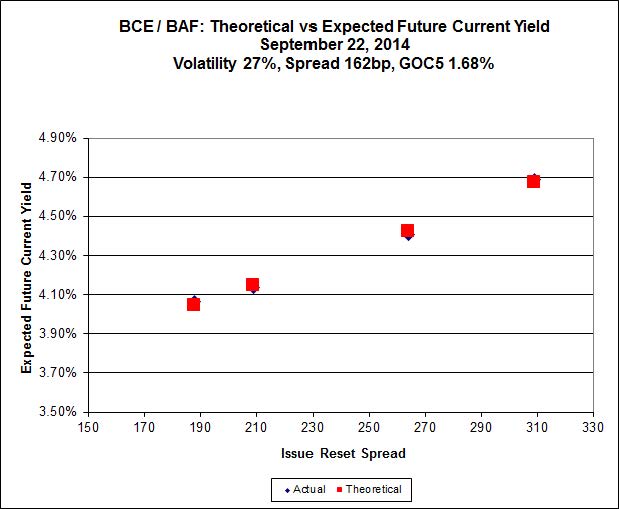
Implied Volatility indicates, as with BMO.PR.W, yesterday, the NVCC-compliant issues appear to be trading in-line with the non-compliant issues, at a very high Implied Volatility. Note that the two issues with the highest Issue Reset Spreads, TD.PR.I and TD.PR.K, were redeemed after the close.

ImpliedVolatility_TD_FR_140731

Click for Big
Issue Comments

BMO.PR.W Firm On Excellent Volume

Bank of Montreal has announced:

it has closed its domestic public offering of Non-Cumulative 5-Year Rate Reset Class B Preferred Shares Series 31 (the “Preferred Shares Series 31”). The offering was underwritten on a bought deal basis by a syndicate of underwriters led by BMO Capital Markets. Bank of Montreal issued 12 million Preferred Shares Series 31 at a price of $25 per share to raise gross proceeds of $300 million.

The Preferred Shares Series 31 were issued under a prospectus supplement dated July 23, 2014, to the Bank’s short form base shelf prospectus dated March 13, 2014. Such shares will commence trading on the Toronto Stock Exchange today under the ticker symbol BMO.PR.W.

BMO.PR.W is a FixedReset, 3.80%+222, announced July 22. It will be tracked by HIMIPref™ and has been assigned to the FixedReset subindex.

The issue traded 1,727,555 shares today (consolidated exchanges) in a range of 24.89-99 before closing at 24.96-98, 30×131. Vital statistics are:

BMO.PR.W FixedReset YTW SCENARIO
Maturity Type : Limit Maturity
Maturity Date : 2044-07-30
Maturity Price : 23.13
Evaluated at bid price : 24.96
Bid-YTW : 3.61 %

The Implied Volatility chart is:

ImpliedVolatility_BMOFR_140730
Click for Big

So, overall, it would appear that Implied Volatility continues to be 40%+ (which I interpret as being due to a high level of expected directionality in prices, i.e., towards $25) and the NVCC-compliant issues continue to trade in line with the non-compliant issues. Regrettably, there isn’t much of a range in the Issue Reset Spreads of the compliant issues.

Better Communication, Please!

Massive Liquidity Premium in BPO vs. BPS Preferred Shares

Assiduous Reader JQ writes in and says:

Hi, James,

I am your long time loyal reader and have learned a lot from you. Thank you very much.

Would you please to answer the following questions about BPO and BPS preferred shares:
BPO.PR._ and BPS.PR._ are both listed, are they same? Why the price difference is so big? Will BPO.PR._ be delisted?

Thank you.

Well, JQ, flattery will get you everywhere! I checked out the last bids for Friday:

BPO vs. BPS Retractible Preferred Shares
BPO Ticker Shares
Outstanding
Quote
2014-7-25
BPS Ticker Shares
Outstanding
Quote
2014-7-25
BPO.PR.H 7.0-million 25.40-57 BPS.PR.A 1.0-million 25.11-25
BPO.PR.J 7.0-million 25.26-35 BPS.PR.B 1.0-million 24.75-76
BPO.PR.K 5.0-milllion 25.70-94 BPS.PR.C 1.0-million 24.63-90
BPO.PR.U
[US Pay]
3.4-million 25.33-47 BPS.PR.U
[US Pay]
1.0-million 24.95-00

Assiduous Readers will recall that BPS preferred shares commenced trading on June 11. Readers will also recall that after reviewing the terms of the organization I concluded that I was more or less indifferent to the choice between the old BPO preferred and the equivalent BPS preferred share:

I make no recommendation. The decision will depend on each holders desire for a (miniscule) extra amount of credit protection (with the early retraction privilege) vs. what could potentially be a very severe loss of liquidity.

However, the difference in price between the equivalent issues is currently fairly large; I urge holders of the BPO preferred shares to review very carefully their need for liquidity and determine whether or not a swap is indicated in their particular situation.

Regrettably, Brookfield Properties Split Corp. still does not have a website, from which we may deduce that the directors (see SEDAR, Brookfield Property Split Corp. Jun 27 2014 14:34:52 ET Security holders documents – English; direct links are not permitted, since the (indirectly) bank-owned SEDAR has a monopoly granted by the securities regulators which they grossly abuse; the competition bureau has given the banks huge exemptions from competition laws in exchange for large regular payments to the regulators):

  • Saul Shulman
  • Bryan Kenneth Davis
  • Robert Stelzl, and
  • Denis Andre Turcotte

are morons. Fortunately, not much brainpower is required to operate a Split Share Corporation with a single issue portfolio.