Category: Issue Comments

Issue Comments

S&P Downgrades YLO Debt; Preferreds Downgraded to "D"

Standard & Poor’s has announced:

  • The prospect of near-term debt restructuring at Montreal-based Yellow Media Inc. has increased, in our opinion.
  • As a result, we are lowering our long-term corporate rating on Yellow Media to ‘CCC’ from ‘B-‘.
  • We are also lowering our issue-level rating on the company’s senior debt to ‘CCC’ from ‘B-‘ and lowering our rating on the subordinated debt to ‘CC’ from ‘CCC’; the recovery ratings on these debt obligations are unchanged.
  • Finally, we are keeping all the ratings on Yellow Media on CreditWatch, where they had been placed with negative implications Dec. 5, 2011.
  • The CreditWatch listing reflects our concern about the increased likelihood of near-term debt restructure, which is aimed at aligning the company’s capital structure to deteriorating operations as well as addressing the refinancing of sizable debt maturities in 2013 and beyond.

At the same time, Standard & Poor’s lowered its issue-level rating on the company’s senior unsecured debt to ‘CCC’ (the same as the corporate credit rating on Yellow Media) from ‘B-‘. The recovery rating on the debt is unchanged at ‘4’, indicating our expectation of average (30%-50%) recovery in the event of a default. Standard & Poor’s also lowered its issue-level rating on Yellow Media’s subordinated debt to ‘CC’ (two notches below the corporate credit rating on the company) from ‘CCC’. The recovery rating on this debt is unchanged at ‘6’, indicating our expectation of negligible (0%-10%) recovery in a default situation.

In addition, we lowered the ratings on the company’s preferred shares outstanding to ‘D’ (default) from ‘C’, owing to the nonpayment of dividends on these securities when due.

“The downgrade primarily reflects Yellow Media’s heightened risk of a near-term debt restructure given the significant refinancing risk for its debt maturities in 2013 and beyond,” said Standard & Poor’s credit analyst Madhav Hari. “The downgrade also reflects our view that the company’s current capital structure is unsustainable against the backdrop of deteriorating revenue and cash flow trends,” Mr. Hari added.

YLO has four series of preferred shares outstanding: YLO.PR.A, YLO.PR.B, YLO.PR.C and YLO.PR.D.

Issue Comments

BCE.PR.F Secondary Offering

I am advised by multiple authoritative sources that there is a secondary offering under way (or is it “under weigh”? You can find much furious discussion of this on the web) for 2-million shares of BCE.PR.F, offered at 23.75.

The issue closed today at 23.95-98, 12×177. This is a wonderful issue for analysis, because there are so many ways of looking at comparators, but the easiest is its Strong Pair BCE.PR.E, a RatchetRate preferred. The two issues are interconvertible on 2015-2-15 and every five years thereafter. Until then BCE.PR.F pays a fixed 4.541% of par. while BCE.PR.E pays 100% of Canadian Prime, although this may be reduced if the price goes above 25.00.

BCE.PR.E closed today at 22.40-50 on less than a board lot traded; we can use this price for comparison purposes since it is close to the other BCE RatchetRates. The Pairs Equivalency Calculator (quick method) tells us that given a price of 22.40 on BCE.PR.E and 23.75 on BCE.PR.F, Canada Prime should average 2.32% until the February, 2015, Exchange Date for the total return on the two issues to be equal.

Seeing as Canada Prime is now 3.00% and is forecast to rise, if anything, over the next three years, BCE.PR.F looks grossly expensive at 23.75. I suspect that it is trading on the basis of its Current Yield of 4.78% and that the market is, as usual, ignoring conversion and dividend reset probabilities.

BCE.PR.F was last mentioned on PrefBlog when there was a secondary offering three-odd months ago. BCE.PR.F is tracked by HIMIPref™ but is relegated to the Scraps index on credit concerns.

Issue Comments

LFE.PR.A Reorganization Details Announced

Canadian Life Companies Split Corp. has announced the details of its reorganization, as promised when the proposal was approved and in accordance with announced terms.

The critical part of today’s announcement is:

Shareholders who do not wish to remain invested in the Company under its reorganized share structure will have until the close of business on May 17, 2012 to provide the Company with notice through their CDS participant that they wish to have their Preferred Shares or Class A Shares redeemed pursuant to the 2012 Special Retraction Right, and to surrender their Shares for retraction. On such a special retraction, each holder of a Preferred Share will receive the lesser of (i) $10.00 and (ii) the net asset value per Unit calculated on May 31, 2012; while holder of a Class A Share will receive the net asset value per Unit calculated on May 31, 2012, less $10.00. Shareholders interested in exercising such retraction right should contact the CDS Participant through which they hold the Shares for further information and instructions as to how to exercise this right. Shareholders should note that the requirements of any particular CDS Participant may vary, and that Shareholders may need to inform their CDS Participant of any intention to exercise this retraction right in advance of the May 17 deadline. Payment for the Class A Shares or Preferred Shares so tendered for retraction pursuant to the 2012 Special Retraction Right will be made no later than June 19, 2012.

Each broker will have a different deadline for notification of desired exercise of the Special Retraction Right, so make sure you know the date applicable to you! It should also be noted that there will be no maturity or retraction available on the previously scheduled wind-up date of 2012-12-1. That’s been wiped out.

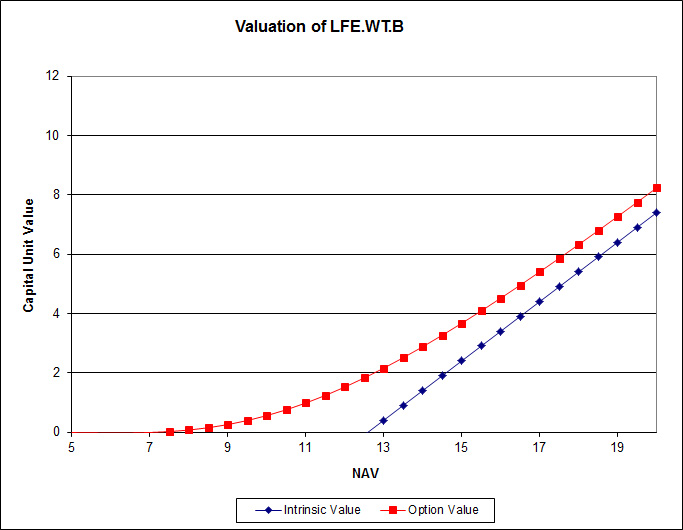
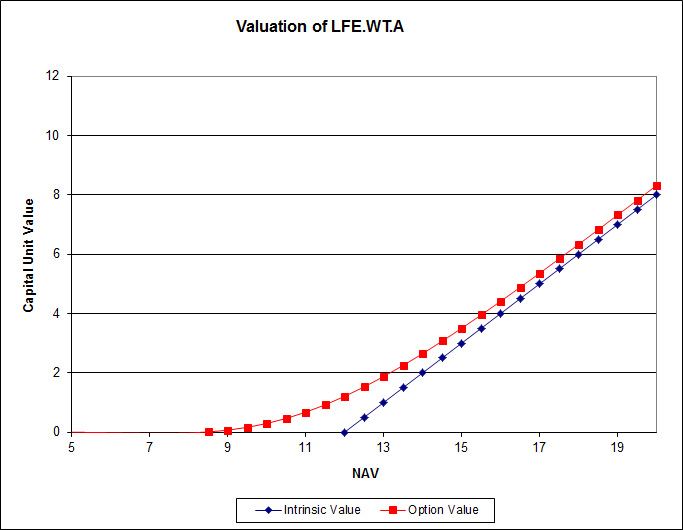
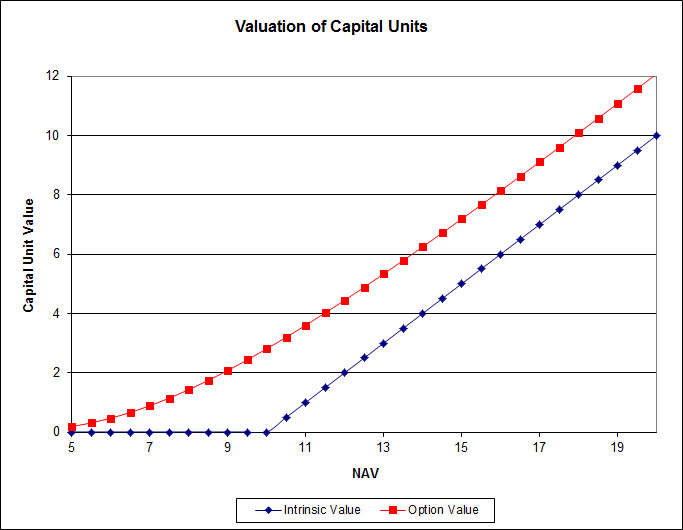
The question is whether or not to retract. The NAV as of 2012-4-13 is $12.64. I believe that due to the increased coupon paid on the shares (it will be 6.25%) and the presence of warrants, it is now more appropriate to consider the preferred shares to be common shares in a closed-end fund trading at a discount rather than “preferred” in the normal sense.

Credit Quality Analysis
LFE.PR.A
Template Start 2002-12-8
End 2010-12-8
Symbol xfn.to
Expected
Return
7.00%
Underlying
Dividend
Yield
4.50%
Issue
Data
Initial NAV
2012-4-13
12.64
Pfd
Redemption
Value
10.00
Pfd
Coupon
0.625
MER 1.04%
(10bp reduction)
Cap Unit Div
Above Test
1.20
Cap Unit Div
Below Test
0.00
NAV Test 15.00
Whole Unit Par Value 25.00
Months to Redemption 80
 
Analysis Probability of Default 28.60%
Loss Given Default 22.42%
Expected Loss 6.40%
 
Yields
Calculation
(from 4/13)
Current Price 10.00
Maturity Date 2018-12-1
Yield to Maturity 6.29%
Expected Price 9.36
Yield to Expectations 5.48%

It will be noted that the yield calculations presented above have been performed from April 13 and hence reflect receipt of the April monthly dividend. Valuation of the options is complex; if the preferreds are considered best analyzed as common shares in a discounted closed-end-fund, there must be some allowance made for the fact that extant capital unitholders will receive some fraction (possibly 100%; possibly as little as 33%) of any final NAV in excess of $10.00.

It will also be noted that there will be many who consider the expected total return of the underlying portfolio, estimated above as 7%, to be overly generous, considering all the current, expected and potential capital rule changes that will be imposed on the insurance industry over the next six years. Others will look at the fat coupon on the new preferreds and reason that this will, essentially, allow them to suck out the excess NAV over the next six years even if the industry doesn’t do very much (it will be noted that in the analytics above, the 50-percentile for the expected final NAV is 12.41 – thus, even given a 7% expected total return of the underlying portfolio, the extant capital unitholders should not expect to make a dime until maturity – no dividends, no capital gain!).

So, some will be attracted to this as an equity investment. But I don’t think these things should be considered “preferred shares” any more. For those who wish to hold preferred shares and accrue the benefits of holding the asset class, I recommend that the Special Retraction Right be exercised or that the shares be sold on the market if they should trade at a premium.

Issue Comments

DBRS: BAM is Not-Quite-Trend-Negative

DBRS has announced that it:

has today confirmed the ratings of Brookfield Asset Management Inc. (BAM or the Company) at A (low), R-1 (low) and Pfd-2 (low). The ratings pertain to BAM at the corporate level. The ratings remain on a Stable trend, notwithstanding weaker corporate-level financial metrics in 2011 because of increased corporate-level debt to finance the growing invested capital. DBRS recognizes that the financial metrics are now weak for the ratings and believes that there is currently minimal room for further deterioration without pressuring the ratings. If one of the following scenarios were to materialize, DBRS will review and base our rating decision on an assessment of the contributing causes, the Company’s remedial plan and other relevant circumstances. These scenarios are: (1) Material increase in the proportion of BAM’s invested capital in less-stable opportunistic investments and private equity, leading to debt increases. (2) Material deterioration or rating downgrade in one or more of the core businesses. (3) Inability to improve cash flow coverage metrics (which could include funds from operations (FFO)-to-debt and FFO fixed charge coverage) to their 2010 levels by the end of 2012.

BAM’s corporate-level debt and issuance of preferred shares have increased in the past two years to partly finance its investments. In the meantime, operating cash flows from its investments recorded only modest growth. As a result, BAM’s corporate-level cash flow coverage metrics have weakened during the period, with FFO coverage-to-debt of 23% in 2011 (from 30% in 2010), FFO-to-interest of 4.5 times (x) (from 5.1x) and FFO-to-fixed charges (interests and preferred share dividend) of 3.1x (from 3.7x). We consider these 2011 levels weak for the ratings and expect improvement during 2012.

BAM’s corporate-level liquidity is strong, supported by corporate-level cash and available credit facilities of $2.4 billion as at December 31, 2011, and annual FFO after corporate expenses of about US$1.0 billion. Currently, there is no material debt repayment scheduled until 2014, when US$518 million comes due. The Company’s financial flexibility is further supported by its ability to access its external investor base and capital markets and to monetize part of its investments in listed vehicles, estimated to have a market value of US$17.9 billion (covering 3.8x the corporate-level debt of US$4.7 billion). While BAM’s liquidity should comfortably cover its corporate-level needs, DBRS notes that the Company remains largely dependent on external investors’ capital and equity issuances to support its growth.

This follows a similar, but more emphatic judgement by S&P.

BAM is the proud issuer of a great many preferred share issues: BAM.PF.A, BAM.PR.B, BAM.PR.C, BAM.PR.E, BAM.PR.G, BAM.PR.I, BAM.PR.J, BAM.PR.K, BAM.PR.M, BAM.PR.N, BAM.PR.O, BAM.PR.P, BAM.PR.R, BAM.PR.T, BAM.PR.X and BAM.PR.Z.

Issue Comments

TCL.PR.D: Confirmed at Pfd-3(high), Trend Now Negative, says DBRS

DBRS has announced that it:

has today confirmed its long-term and preferred share ratings on Transcontinental Inc. (Transcontinental or the Company) at BBB (high) and Pfd-3 (high), respectively. The trends have been changed to Negative. While the Company’s business risk profile and financial profile continue to support a rating above the BB (high) business risk rating for the printing industry, DBRS expects the structural factors that Transcontinental is facing (such as declining demand for print and pricing pressure), along with increased competitive forces (both factors contributed to lower revenue and EBITDA for the two most recent quarters), to persist and potentially accelerate further for Transcontinental over the medium term. As such, these challenges could reduce the Company’s rating differential relative to the printing industry.

The Negative trend reflects DBRS’s expectation that structural forces in both Transcontinental’s Printing and Media segments will persist and could accelerate with excess capacity in the printing industry and a structural shift to digital forms of media affecting both segments. In fact, DBRS notes that, from an industry perspective, digital advertising in the United States surpassed newspaper print advertising for the first time in 2011 (likely just below this level in Canada at the end of 2011), with digital advertising in the United States expected to surpass combined newspaper and magazine print advertising spending in 2012.

From a financial risk perspective, Transcontinental has demonstrated healthy free cash flow conversion, leverage and credit metrics that are above the industry average. This includes EBITDA interest coverage of over 9.0 times, cash flow-to-debt of 0.40 times and gross debt-to-EBITDA of 1.76 times. However, with organic revenue and EBITDA growth under pressure, DBRS believes free cash flow will be directed to small-to-medium acquisitions and increasingly toward shareholder-friendly initiatives. In fact, DBRS notes that inorganic growth must be undertaken by Transcontinental in order to support the dividend growth model that the Company strives to maintain.

DBRS believes Transcontinental’s business risk profile continues to weaken due to a structural shift from traditional forms of media to new forms of media. Competitive forces in the traditional printing industry should continue to intensify with ongoing excess capacity, while the new forms of media are also highly competitive with lower barriers to entry and a less-proven profit model.

TCL.PR.D was added to TXPR in the January, 2012, rebalancing after having been removed in July, 2011. It was upgraded to P-3(high) by S&P in December, 2010.

TCL.PR.D is tracked by HIMIPref™, but is relegated to the Scraps index on credit concerns.

Issue Comments

ENB.PR.U Closes at Significant Premium on Heavy Volume

Enbridge Inc. has announced:

it has closed its previously announced public offering of cumulative redeemable preferred shares, Series J (the “Series J Preferred Shares”) by a syndicate of underwriters led by Scotiabank. Enbridge issued 8 million Series J Preferred Shares for gross proceeds of US$200 million. The Series J Preferred Shares will begin trading on the TSX today under the symbol ENB.PR.U. The proceeds will be used for capital expenditures, to repay indebtedness and for other general corporate purposes.

ENB.PR.U is a FixedReset, 4.00%+305, US-Pay, announced April 10.

The issue traded 1,054,194 shares today in a range of 25.35-50 before closing at 25.35-40, 53×244.

ENB.PR.U will not be tracked by HIMIPref™ as it is US-Pay and there are not enough US-Pay issues to form an analytical universe.

Issue Comments

LFE.PR.A Reorg Proposal Approved

Canadian Life Companies Split Corp. has announced:

A special meeting of the shareholders of Canadian Life Companies Split Corp. (the “Company”) was held earlier today.

The primary purpose of the meeting was to consider and, if thought advisable, to approve a special resolution to reorganize the Company, including a capital reorganization of the Preferred Shares of the Company and an extension of the termination date of the Company, as described in the Management Information Circular dated March 14, 2012 and the March 21, 2012 press release. Class A Shareholders voted 95.0% in favour of the resolution and Preferred Shareholders voted 82.6% in favour of the resolution, and therefore the resolution was approved.

The Company will issue shortly a further press release including all key dates related to the capital reorganization and special retraction.

The proposal was unveiled in late March.

More to follow …

Issue Comments

RBS.PR.A To Be Redeemed on Capital Unit Term Extension

R Split III Corp. has announced:

that the final condition required to extend the term of the Company for an additional five years to May 31, 2017, has been met. Holders of Capital Shares previously approved the extension of the term of the Company subject to the condition that a minimum of 1,405,000 Capital Shares remain outstanding after giving effect to the special retraction right (the “Special Retraction Right”).

Under the Special Retraction Right, 340,074 Capital Shares have been tendered to the Company for retraction on May 31, 2012. Holders of these shares will receive a retraction price equal to the amount, if any, by which the Unit Value exceeds $29.22. Holders of the remaining 2,469,924 Capital Shares will continue to enjoy the benefits of a leveraged participation in the capital appreciation of the Company’s portfolio of common shares (the ‘‘Royal Bank Shares’’) of Royal Bank of Canada (‘‘Royal Bank’’).

The Preferred Shares will be redeemed by the Company on May 31, 2012 in accordance with their terms at a price per share equal to the lesser of $29.22 and Unit Value. In order to maintain the leveraged “split share” structure of the Company, the Company will offer a new series of Class B Preferred Shares to be called the Class B Preferred Shares which are expected to be issued following this redemption.

R Split III Corp. is a mutual fund corporation created to hold a portfolio of common shares of the Royal Bank of Canada. Capital Shares and Preferred Shares of R Split III Corp. are listed for trading on The Toronto Stock Exchange under the symbols RBS and RBS.PR.A respectively.

RBS.PR.A was last mentioned on PrefBlog when Capital Unitholders voted in favour of the plan. RBS.PR.A is not tracked by HIMIPref™.

Issue Comments

CF.PR.C Closing a Disaster for Underwriters

Canaccord Financial has announced:

the completion of its previously announced offering of 4,000,000 Cumulative 5-Year Rate Reset First Preferred Shares, Series C ( the “Series C Preferred Shares”) at a purchase price of CAD$25.00 per Series C Preferred Share, for aggregate gross proceeds of CAD$100 million. The Series C Preferred Shares are expected to commence trading on the Toronto Stock Exchange on April 10, 2012 under the trading symbol “CF.PR.C”.

The offering was underwritten on a bought deal basis by a syndicate of underwriters led by CIBC, Canaccord Genuity Corp. and RBC Capital Markets, and included BMO Nesbitt Burns Inc., National Bank Financial Inc., Scotia Capital Inc., GMP Securities L.P., Macquarie Capital Markets Canada Ltd., Raymond James Ltd., Cormark Securities Inc., Desjardins Securities Inc., Dundee Securities Ltd., Mackie Research Capital Corporation and Manulife Securities Incorporated.

Canaccord has granted the underwriters an over-allotment option, exercisable, in whole or in part, for a period of 30 days following today’s closing, to purchase up to an additional 600,000 Series C Preferred Shares which, if exercised in full, would increase the gross proceeds of the offering to CAD$115 million.
The net proceeds of the offering will be used to reduce outstanding borrowings under the CAD$150 million senior secured credit facility (the “Acquisition Credit Facility”) entered into by the Company, as borrower, and provided by Canadian Imperial Bank of Commerce, as lender.

The Acquisition Credit Facility was entered in order to fund a portion of the cash consideration for the Company’s previously announced acquisition of Collins Stewart Hawkpoint plc, which closed on March 21, 2012.

CF.PR.C is a FixedReset, 5.75%+403, announced March 22. The issue will be tracked by HIMIPref™ but relegated to the Scraps index on credit concerns.

CF.PR.C traded a derisory 33,890 shares in a range of 23.50-48, before closing at 23.40-55, 2×4. Vital statistics are:

CF.PR.C FixedReset YTW SCENARIO
Maturity Type : Limit Maturity
Maturity Date : 2042-04-10
Maturity Price : 22.48
Evaluated at bid price : 23.40
Bid-YTW : 6.04 %
Issue Comments

CSE.PR.A Downgraded to P-4(high) by S&P

Standard & Poor’s has announced:

  • We are lowering our long-term corporate credit rating on Capstone Infrastructure Corp. to ‘BB+’ from ‘BBB-‘.
  • We are also lowering our global scale preferred stock rating on Capstone to ‘B+’ from ‘BB’, and our Canada scale preferred stock rating to ‘P-4(High)’ from ‘P-3’.
  • In addition, we are placing the ratings on the company on CreditWatch with developing implications.
  • The downgrade reflects our view that Capstone’s liquidity is ‘less-than-adequate’; as per our criteria, a company with ‘less-than-adequate’ liquidity cannot have a corporate credit rating higher than ‘BB+’.
  • We believe the CreditWatch resolution could result in a return to investment-grade status for Capstone.
  • Although we consider it unlikely, if the company is unable to either pay down or extend its C$119 million bank revolver maturing in June, a multinotch downgrade could occur.


Standard & Poor’s views the company’s revenues and cash flow from long-term power purchase agreements with provincial government agencies and investment-grade off-takers as stable. In addition, we believe there is a track record of sustained high availability and operating performance of Capstone’s generation assets. We believe that offsetting these strengths are modest asset and geographic diversity, recontracting risks for two of its material generating facilities, and our expectation that the company would increase debt in executing its growth strategy. Evidence of this includes the acquisition of Bristol Water Holdings UK Ltd. While we believe that this acquisition will help to stabilize revenue in the long term, its financing has challenged liquidity.

The company has outlined several initiatives to address its liquidity position. These include refinancing some of the hydro projects under MPT Hydro L.P. and using the net proceeds to reduce debt outstanding under the CPC facility; recapitalizing Varmevarden AB (a company, which Capstone purchased in March 2011, that owns and operates a portfolio of 11 district heating businesses in Sweden) and using proceeds to reduce the amount outstanding on the senior credit facility; and other options, including a new corporate credit facility. To date, the company has completed the Varmevarden refinancing and realized proceeds of approximately C$50 million, which it used to pay down a portion of the senior credit facility.

We believe the CreditWatch resolution, which we expect to come within the next 90 days, could result in a return to investment-grade status for Capstone. Although we consider it unlikely, if the company is unable to either pay down or extend its C$119 million bank revolver maturing in June, a multinotch downgrade could occur.

Capstone is not rated by DBRS. CSE.PR.A was last mentioned on PrefBlog when it dived following a common dividend warning. CSE.PR.A is tracked by HIMIPref™ but is relegated to the Scraps index on credit concerns.

Update, 2016-2-24: S&P later affirmed the company and revised the outlook to Stable from Positive:

    •We are also affirming our ratings on the company, including our ‘BB+’ long-term corporate credit rating.

  • •The outlook revision reflects our assessment of Capstone’s stable cash flow.
  • •In addition, Capstone has taken on some additional parent-level debt in conjunction with its purchase of Renewable Energy Developers Inc., which has negatively affected parent-level credit metrics.


The outlook revision reflects our view of Capstone’s stable, albeit reduced cash flow resulting from the new contract for its power plant at Cardinal, and the company’s continued cash flow that is commensurate with the ‘BB+’ rating.

“In addition, Capstone has taken on some additional parent-level debt in conjunction with its purchase of Renewable Energy Developers Inc., which has negatively affected parent-level credit metrics,” said Standard & Poor’s credit analyst Stephen Goltz.