Category: Issue Comments

Issue Comments

BPO.PR.N Settles Flat on Good Volume

Brookfield Properties announced a FixedReset 6.15%+307 issue on January 11.

It will not have escaped notice that the initial fixed-rate period on this issue is six and a half years, just as was the slightly earlier BAM.PR.R new issue. In distinction to other commenters, I feel that the longer term has a lot more to do with the reset rate than the initial rate lock-in period … by extending term the reset can be set against the longer term Canadas rather than the five-year (or five-and-a-half year, as most of the banks did).

This is becoming a much more important consideration now that the chances that this and future issues will indeed be perpetual are increasing.

There’s no necessity for this: the banks have to calculate their reset in such a way or else OSFI will determine that a step-up exists and possibly disallow the issue as Tier 1 Capital. OSFI’s rules do not apply to BPO or BAM – they could set the reset to negative 20bp if they felt like it and thought it would sell – but presumably the dealers are trying to maintain the integrity of the FixedReset structure.

One way or the other, BPO.PR.N traded 333,903 shares on the TMX in a range of 24.90-09 before closing at 24.95-01, 25×30. Vital Statistics are:

BPO.PR.N FixedReset YTW SCENARIO
Maturity Type : Limit Maturity
Maturity Date : 2040-01-20
Maturity Price : 23.09
Evaluated at bid price : 24.98
Bid-YTW : 5.70 %

BPO.PR.N is tracked by HIMIPref™ but is relegated to the Scraps subindex on credit concerns.

Issue Comments

POW.PR.C Goes Haywire

Assiduous Reader prefhound asks:

Any idea what is going on with POW.PR.C? It has gone up about $1 in the past two days. Is there some possibility of a call at $25.50?

If POW.PR.C, what about PWF.PR.I (currently callable at $25.75; $25.50 in April)? Is there a holding company vs sub difference here?

Both of these are nicely under the call price (unlike GWO.PR.X recently called while above the call price).

This is very strange. If we look at the POW PerpetualDiscount issues outstanding:

POW PerpetualDiscount Issues
Close, 2010-1-19
Ticker Dividend Quote Bid YTW Current Call Price
POW.PR.A 1.40 23.59-75 5.97% 25.00
POW.PR.B 1.3375 22.62-72 5.94% 25.25
POW.PR.C 1.45 25.16-50 5.54% 25.50
POW.PR.D 1.25 21.92-08 5.73% 26.00
Commencing
2010-10-31

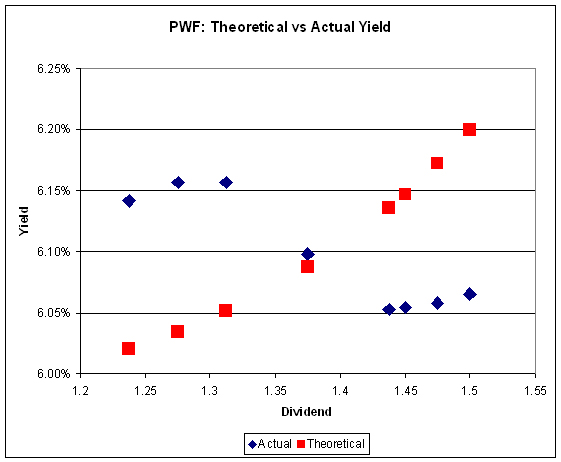
The yields don’t show a pattern – there should normally be an increase in yields with proximity to par to counterbalance negative convexity. POW.PR.A is somewhat less liquid than the others, but not by so much as to warrant more than a beep or two in yield.

Today’s trading is kind of interesting. Between 12:29 and and 13:09 there were ten trades on the TSX with total volume of 7,500 shares, starting with the low price of 25.38 and ending with the high price of 25.45, all with RBC as the buyer.

Then Nesbitt went nuts. Nesbitt was on the buy side for thirty-eight of the last forty trades of the day, taking the price up to 25.53 before it closed with a quote of 25.16-50. All of these trades were retail size – the biggest single transaction was 400 shares and Nesbitt bought a total of 11,600 shares on the day at an average price of $25.446 (data from PC Quote Canada Inc.).

Trading on Pure was relatively inoccuous, trading 5,100 shares with an afternoon high of 25.53 (100 shares, bought by Nesbitt) before closing at the aren’t-you-glad-there-are-market-makers-on-the-TSX quote of 25.30-27.99, 5×20.

To me, it looks like some retail broker has had a brilliant idea and executed it. But you’ll have to ask him what the idea was!

Update, 2010-1-20: New commenter to_be_frank reminds me that POW.PR.C was recently added to TXPR and suggests:

For the same reason, W.PR.J and ENB.PR.A have recently declined by a substantial amount, because those issues were removed from the index. These positions take time to unwind in a relatively illiquid market.

I have examined this hypothesis in the post TXPR Rebalaning Effect on Market.

Issue Comments

BCE.PR.E / BCE.PR.F Conversion Results

BCE Inc. has announced:

that 592,772 of its 14,085,782 Cumulative Redeemable First Preferred Shares, Series AF (series AF preferred shares) have been tendered for conversion, on a one-for-one basis, into Cumulative Redeemable First Preferred Shares, Series AE (series AE preferred shares). In addition, 1,084,090 of its 1,914,218 series AE preferred shares have been tendered for conversion, on a one-for-one basis, into series AF preferred shares. Consequently, on February 1, 2010, BCE will have 1,422,900 series AE preferred shares and 14,577,100 series AF preferred shares issued and outstanding. The series AE preferred shares and the series AF preferred shares will continue to be listed on the Toronto Stock Exchange under the symbols BCE.PR.E and BCE.PR.F respectively.

The series AE preferred shares will continue to pay a monthly floating adjustable cash dividend for the five-year period beginning on February 1, 2010, as and when declared by the Board of Directors of BCE. The monthly floating adjustable dividend for any particular month will continue to be calculated using the Designated Percentage for such month representing the sum of an adjustment factor (based on the market price of the series AE preferred shares in the preceding month) and the Designated Percentage for the preceding month. The series AF preferred shares will pay on a quarterly basis, for the five-year period beginning on February 1, 2010, as and when declared by the Board of Directors of BCE, a fixed dividend based on an annual dividend rate of 4.541%.

This is a logical result (I recommended BCE.PR.F as the better of the pair), but is nevertheless unfortunate. The decline in BCE.PR.E outstanding will reduce its liquidity from already low levels and make swaps between them even harder to execute.

BCE.PR.F is tracked by HIMIPref™ but is relegated to the Scraps index on credit concerns. BCE.PR.E is not tracked by HIMIPref™.

Issue Comments

BAM.PR.R Achieves Solid Premium on Heavy Volume

BAM.PR.R, the new FixedReset 5.40%+230 announced January 5 closed today and was able to close well above par on heavy volume. The issue traded 614,165 shares in a range of 24.95-30 before closing at 25.26-30, 8×61.

Vital statistics are:

BAM.PR.R FixedReset YTW SCENARIO
Maturity Type : Limit Maturity
Maturity Date : 2040-01-14
Maturity Price : 23.17
Evaluated at bid price : 25.26
Bid-YTW : 4.89 %

BAM.PR.R is tracked by HIMIPref™. It has been added to the FixedResets subindex.

Issue Comments

BCE.PR.F to Reset to 4.541%

BCE Inc. has announced (in an ad in the Globe and Mail, which I can’t find on either the Globe‘s website or BCE’s) that:

The “Selected Percentage Rate” determined by BCE Inc. is 168%. The “Government of Canada Yield” is 2.703%. Accordingly, the annual dividend rate applicable to the Series AF Preferred Shares for the five-year period beginning on February 1, 2010 will be 4.541%

This implies that the annual dividend will change to $1.13525, a slight increase from the current $1.10.

BCE.PR.F is convertible to and from BCE.PR.E for a short time every five years – and the window is about to close. Those who wish to convert should contact their brokers immediately.

I recommend holding the fixed rate issue, BCE.PR.F. While I will agree with most that prime will rise in the near future, I am not so convinced that the average over the next five years will exceed 4.541%. One way of achieving such an average, for instance would be a steady rise in prime to about 6.75% over a five year period, an increase of 450bp, or nearly 25bp each and every quarter. That sounds a little extreme, but then, what do I know?

BCE.PR.F was last discussed on PrefBlog when the conversion notice was published.

BCE.PR.F is tracked by HIMIPref™ but is relegated to the Scraps index on credit concerns. BCE.PR.E is not tracked by HIMIPref™ (there are less than 2-million outstanding) but I may add it to the list if there’s a rush to convert.

Update, 2010-1-13: Finally! BCE Notice from website.

Issue Comments

UNG.PR.C and UNG.PR.D

My heart sank as I began tracking down these guys in response to a query. Union Gas Limited is owned by Spectra Energy, which I am sure is a very nice company, run by people who are kind to small fluffy animals, but is completely useless at communicating with preferred shareholders of its subsidiaries.

Union Gas still publishes audited financials on SEDAR and the 2008 Annual Report discloses:
12. Mandatorily Redeemable Preference Shares

    Outstanding  
Authorized Series 2008 2007 2008 2007
(shares)   (shares) ($millions)
Class A – 112,072 Series A, 5.5% 47,672 47,672 3 3
  Series C, 5.0% 49,500 49,500 2 2

The Class A Preference Shares, Series A and C are cumulative and redeemable at $50.50 per share. The Company is obligated to offer to purchase $170,000 of Series A and $140,000 of Series C shares annually at the lowest price obtainable, but not exceeding $50 per share.

Any further information will have to come from Spectra!

Issue Comments

PNG.PR.A

Here’s an odd one! I was asked about this issue today – but it’s such a small issue it’s not in my database. So, I’m putting a short description here, just to make sure I have the information handy in the future.

The company is Pacific Northern Gas, soon to become famous as the corporation with the world’s slowest website.

According to the prospectus for common shares dated 2005-4-6 (available on SEDAR):

6 3/4% Cumulative Redeemable Preferred Shares

The Preferred Shares are entitled to the payment of Ñxed cumulative preferential cash dividends at the rate of 63/4% per annum on the amounts from time to time paid up thereon as when declared by the board of directors of the Company, have priority in the event of the liquidation, dissolution or winding up of the Company over the Common Shares, are non-voting and are redeemable at the option of the Company at $26 per share plus any accrued and unpaid dividends at the date of redemption. The Company may not create shares ranking prior to the Preferred Shares but may create and issue other shares ranking on parity with those shares.

Annual dividends are $1.6875; the par value is $25.00. There are only 200,000 of these shares outstanding.

One wonders why such a small issue remains outstanding. Hey! Any investment bankers out there? I know that in the States, many of their 8,000 banks issue preferred shares not to the public, but to CDO packagers and resellers. There must be quite a few Canadian corporations that would love to issue $5-million or so in prefs, but can’t because the cost is ridiculous. Why don’t we have CDO packagers and resellers in Canada?

Or – even better – an ETF! Start it off with a $100-million IPO (the insurers could supply suitable product for the initial holdings out of their back pocket) and then make it grow with share exchanges: you give me a $5-million private placement, I’ll give you 200,000 shares, which you can then sell.

Issue Comments

XCM.PR.A Unveils Reorganization Plan

Commerce Split Corp. has announced:

that it has filed and mailed the Management Information Circular to all holders of Priority Equity shares and Class A shares of record on December 14, 2009 in connection with a special meeting of shareholders to be held on Wednesday, February 3, 2010.

As previously reported, the purpose of the meeting is to consider and vote upon a proposal which would essentially offer all Priority Equity and Class A shareholders an alternative investment option from their current holdings in the Fund. The special resolution, if passed, would provide shareholders with the ability to elect to 1) maintain the current investment characteristics of their existing shares (a status quo option), through the Original Commerce Split Fund, or 2) choose to have their existing Priority Equity and/or Class A shares reorganized into a new series of shares (the New Commerce Split Fund) that would potentially provide greater distribution and capital growth potential, especially if the common shares of CIBC increase over the remaining 5 year term of the Company.

Management and the Board of Directors of the Company believes the reorganization proposal is in the best interest of all shareholders in light of the current status of the Company and accordingly recommends that shareholders vote for the special resolution.

The reorganization is hopelessly complex. If it proceeds, shareholders can convert into the “New” or “Status Quo” structures; the status quo retains the rights and – presumably – claim on underlying assets of the existing structure.

So let us assume that every Preferred Shareholder converts to “Status Quo” and every Capital Unitholder converts to “New”, which seems to me to be the most rational option. What happens then? The Information Circular explains (contingency 8):

All Priority Equity Shares tendered for conversion into the Original Commerce Split Fund will be so converted. Class A Shareholders electing to convert into the New Commerce Split will only be allowed to so convert their Class A Shares, and Class A Shareholders failing to file an election form will only have their Class A Shares converted, on a pro rata basis, such that, at the end of the conversion, there are at least 500,000 Class A Shares converted into Class A Shares of the Original Commerce Split Fund. Additional Class A Shares will be converted into Class A Shares of the Original Commerce Split Fund on a pro rata basis, such that an equal number of Class A Shares and Priority Equity Shares are converted into Class A Shares and Priority Equity Shares of the Original Commerce Split Fund.

That part is at least half-way reasonable, but it’s a lot more reasonable to vote against the reorganization and pound it into the Capital Unitholders’ heads that their shares are basically worthless. Then buy ’em up and tender for the October retraction. If you want exposure to CM, allocate your current holdings of XCM.PR.A to your short-term bond portfolio and buy CM directly for your stock portfolio.

Vote No!

XCM.PR.A was last discussed on PrefBlog when the meeting date was announced. XCM.PR.A is not tracked by HIMIPref™.

Issue Comments

XMF.PR.A Unveils Reorganization Plan

M-Split Corporation has announced:

that it has filed and mailed the Management Information Circular to all holders of Priority Equity shares and Class A shares of record on December 14, 2009 in connection with a special meeting of shareholders to be held on Wednesday, February 3, 2010.
As previously reported, the purpose of the meeting is to consider and vote upon a proposal to reorganize the share capital of the Fund. The special resolution, if passed, would provide shareholders with the ability to have their existing Priority Equity and/or Class A shares reorganized into a new series of shares that would potentially provide greater distribution and capital growth potential, especially if the common shares of Manulife increase over the remaining 5 year term of the Company.
Management and the Board of Directors of the Company believes the reorganization proposal is in the best interest of all shareholders in light of the current status of the Company and accordingly recommends that shareholders vote for the special resolution.

The cover letter explains:

In summary, holders of the existing Priority Equity Shares would receive the following securities for each Priority Equity share held:

One $5 Class I Preferred share: paying fixed cumulative preferential monthly dividends to yield 7.5% per
annum and having a repayment objective on the Termination Date of $5

One $5 Class II Preferred share: paying distributions to yield 7.5% per annum on the $5 notional issue
price if and when the net asset value per Unit of the New M Split Fund exceeds $12.50 and having a repayment objective on the Termination date of $5.00

One 2011 Warrant: each Warrant can be used to purchase one Unit (consisting of one Class I Preferred share, one Class II Preferred share and one Capital share) for an exercise price of $10.00 at specified times until February 28, 2011

One 2012 Warrant: each Warrant can be used to purchase one Unit (consisting of one Class I Preferred share, one Class II Preferred share and one Capital share) for an exercise price of $12.50 at specified times until February 28, 2012

Holders of the existing Class A Shares would receive a Capital share for each Class A share held:

One Capital Share: Capital shares would continue to participate in any net asset value growth over $10.00 per Unit and dividends would only be reinstated if and when the net asset value per Unit exceeds $15.00. The increased exposure to the Manulife common shares would offer much greater capital appreciation potential, especially if the value of such common shares were to increase over the remaining life of the Fund.

The package offered to the Preferred shareholders is a nightmare to price, which may well be the whole point. Multiple options – which really just allow for the dilution of the capital unitholders, they’re not really priceable as options in the usual manner – differential dividend policies …. I would be much more inclined to look at a Monte Carlo simulation to price this muck rather than attempting a closed form solution.

Ultimately, though, preferred shareholders are offering capital unitholders a package with some value, as opposed to the value they have now, which is zero. If you want exposure to MFC, it’s a whole lot easier to consider the current preferreds as a short-term fixed income investment and simply buy MFC directly.

Vote No!

It’s much easier to buy up the extant capital units (quoted today at 0.36-38, 1×10, no volume) and tender for the annual October retraction.

XMF.PR.A was last discussed on PrefBlog when the meeting date for this proposal was announced. XMF.PR.A is not tracked by HIMIPref™.

Issue Comments

BIG.PR.C Greenshoe Taken Up a Bit

Big 8 Split Corp has announced (though not yet on their website):

that, pursuant to an over-allotment option, it has completed an additional issuance of 23,500 Class C Preferred Shares, Series 1 (the “Class C Preferred Shares”) and 23,500 Class A Capital Shares (the “Capital Shares”) raising $752,000. As a result, the company has raised gross proceeds totalling approximately $25.2 million under its recent offering. The Class C Preferred Shares and Capital Shares were offered to the public by a syndicate of agents led by TD Securities Inc and Scotia Capital Inc., and including BMO Capital Markets, National Bank Financial Inc., Canaccord Capital Corporation, GMP Securities L.P., HSBC Securities (Canada) Inc., Raymond James Ltd., Blackmont Capital Inc., Desjardins Securities Inc., Dundee Securities Corporation, Manulife Securities Incorporated and Wellington West Capital Markets Inc.

Big 8 Split Inc. was established to generate dividend income for the preferred shares while providing holders of the Capital Shares with a leveraged opportunity to participate in capital appreciation from a portfolio of common shares of Bank of Montreal, The Bank of Nova Scotia, Canadian Imperial Bank of Commerce, Royal Bank of Canada, The Toronto-Dominion Bank, Great-West Lifeco Inc., Manulife Financial Corporation, and Sun Life Financial Inc. Information concerning Big 8 Split Inc. is available on our website at www.tdsponsoredcompanies.com