Category: Issue Comments

Issue Comments

ACO.PR.A: Negative Yield-to-Worst; Positive Yield-to-Issuer-Best

I recently had a contest about ACO.PR.A which has been won by Assiduous Reader adrian2.

The question was:

So: here’s the question … how might a rational investor reason that paying $27.00 for this issue has enough chance of at least a half-way decent return to make it worth while? This investor knows that the yield to worst is negative and that he’s taking a chance … why might he buy it anyway?

ACO.PR.A closed at 26.62-75 on Friday, so the situation isn’t quite as dramatic as it was when the bid was $27.00. However, the portfolio of possibilities for this issue on Friday, according to HIMIPref™ was:

Call 2008-12-31 YTM: -1.78 % [Restricted: -0.54 %] (Prob: 40.10 %)
Call 2009-12-31 YTM: 2.35 % [Restricted: 2.35 %] (Prob: 1.01 %)
Soft Maturity 2011-11-30 YTM: 3.68 % [Restricted: 3.68 %] (Prob: 58.89 %)

So the YTW was -1.78%.

Why would an investor pay such a rich price for the issue? Well, there was a hint of the answer buried in my article about retractible preferreds and bonds:

One may sometimes make a reasonable argument that YTW is not the most appropriate method of calculating yields. Say, for instance, that a company has the ability to issue preferreds that pay $1.25 p.a. and has an issue outstanding that pays $1.40 and is currently callable at $26.00, with this price declining by $0.25 annually for the next four years. If the issue is trading above $26.00, the YTW scenario will almost certainly be an immediate call. However, since the company can save $0.25 by delaying redemption, the net cost to the company of leaving the shares outstanding for another year is the dividend less the saving, or $1.15 (during the declining call-price period). Since this is less than the rate it would pay on a new issue, the company may well prefer to wait.

The question of what to believe is a complex question—complex enough, in fact, that I am currently devoting a great deal of time to researching the matter. Most investors will be well advised to rely on YTW.

In other words, Atco (the issuer of ACO.PR.A) may look at the issue on 2008-12-1 and say – ‘well, this issue pays $1.4375 annually, or 5.75% of par (as dividends, which costs more than interest) … we’d better redeem.’

But according to the redemption schedule, they can save $0.50 off the redemption price every year by waiting! If we were going to analyze this precisely, we would look at the situation from their point of view as a loan of $26.00 which amortizes down to a $25.00 balloon payment on 2010-12-1 (the first date they can redeem at $25.00) via quarterly blended payments that include principal. But from a back-of-an-envelope, conceptual perspective, we can say that it’s a loan of $25.50 with an cost of $1.4375 dividend LESS the decrease of $0.50 in redemption price, for an all-in cost of $0.9375 … which comes to about 3.67%, a financing cost calculated to bring smiles to the most hardened CFO, even if it as expensive dividends.

These calculations will be incorporated into the next release of HIMIPref™ – yes, I am working on it, albeit slowly – as “Yield to Issuer Best”. To select YTIB from the table of possibilities, I will be determining the disparity of each redemption option from the yield curve – that is, cash flows for the instrument will be discounted by the self-consistent yield curve to arrive at a net present value for each option. The lowest NPV will determine the YTIB. I do not know, at this point, how influential in the valuation YTIB will be relative to YTW … but hey, it’s worth looking at!

Incidentally, ACO.PR.A was added to the TXPR index in the last rebalancing, despite what might be considered to be relatively low average trading value (HIMIPref™ indicates $18,374 worth of shares daily, TMXMoney calculated 1,600 shares (the difference doesn’t bother me; HIMIPref™ is an adjusted exponential moving average; I believe that TMXMoney is an unadjusted rolling average, virtually guaranteed to show a higher result). A large part of ACO.PR.A’s current price may well be buying from indexers.

The following graphs regarding ACO.PR.A have been prepared and uploaded:

Issue Comments

TD.PR.A Settles: Above Par on High Volume

TD Bank has announced:

that a group of underwriters led by TD Securities Inc. has exercised the option to purchase an additional 2 million non-cumulative 5-Year Reset Preferred Shares, Series AA (the “Series AA Shares”) carrying a face value of $25.00 per share. This brings the total issue announced on September 2, 2008, and expected to close September 12, 2008, to 10 million shares and gross proceeds raised under the offering to $250 million. TDBFG has filed in Canada a prospectus supplement to its January 11, 2007 short form base shelf
prospectus in respect of this issue.

Details of this issue were reported when the issue was announced on September 2.

So – another greenshoe fully exercised for a fixed-reset issue! They’re clearly easy to sell, despite various reservations.

TD.PR.A traded 908,645 shares today in a range of 25.00-15, closing at 25.10-12, 10×6. It has been added to the HIMIPref™ database and Fixed-Reset Index.

Issue Comments

RF.PR.A: 2.7-million Warrants Sold

C. A. Bancorp has announced:

the Corporation has closed a public offering today (the “Offering”). The Corporation offered units (the “Units”) at a price of $10.00 per Unit. Each Unit consists of one Class A Share and one warrant (a “Warrant”) to purchase a Series 1, Preferred Share (a “Preferred Share”).

At the closing, the Corporation issued 2,700,000 Units for aggregate gross proceeds of $27,000,000. The gross proceeds consisted of $23,181,260 in cash and $3,818,740 in publicly listed Canadian common shares and investment grade securities received under the exchange option of the Offering.

The agents for the Offering have been granted an over-allotment option to purchase up to 405,500 Units at any time during the next 30 days.

The securities forming a Unit will trade together on the Toronto Stock Exchange (“TSX”) under the symbol RF.UN as a Unit and cannot be transferred except as part of a Unit and the Warrants may not be exercised for the first 30 days after the date hereof. Thereafter, the Class A Shares and the Warrants will trade separately on the TSX under the symbols RF.A and RF.WT, respectively.

Each Warrant will entitle the holder to purchase one Preferred Share at a subscription price of $23.75 at any time on or before 4:00 p.m. (Toronto time) on September 30, 2011.

The Manager uses the maturity value of the aggregate number of Preferred Shares issued and outstanding and compares that value to the tangible net book value of the aggregate number of Class A Shares issued and outstanding as a measure of the debt (the Preferred Shares) to equity (the Class A Shares) ratio of the Corporation (the “Leverage Ratio”). As at June 30, 2008, the Leverage Ratio was 8.8 to 1.

The Offering caused the debt to equity ratio or the Leverage Ratio of the Corporation to decrease. As at the date hereof, the Leverage Ratio is approximately 1.2 to 1.

As previously reported on PrefBlog, there was a 2-million unit minimum on the offering.

RF.PR.A is not tracked by HIMIPref™

Issue Comments

PFD.PR.A to Vote on Various Proposals

The nice thing about holding Charterhouse Preferred Share Index Corporation is that you get invited to a lot of meetings.

JovFunds Management has announced:

Charterhouse Preferred Share Index Corporation (“Charterhouse”), Fairway Diversified Income and Growth Trust (“Fairway Diversified”), Deans Knight Income and Growth Fund (“Deans Knight”) and Long Reserve Life Resource Fund (“Long Reserve”)(collectively, the “Funds”) announce that they will hold special meetings of the shareholders of Charterhouse and unitholders of Fairway Diversified, Deans Knight and Long Reserve (collectively, the “Securityholders”) on October 20, 2008. JovFunds Management Inc. (“JovFunds”) is the manager of each of these products.

At the meetings, Securityholders will be asked to consider and vote on various proposals relating to the Funds in order to be consistent across the Funds and with market practices, and to improve administrative and operational efficiencies that will be fully described in the management information circulars to be provided to Securityholders in advance of the meetings. Securityholders of record on September 19, 2008, will be entitled to receive notice of and vote at the meetings.

I have seen more informative press releases! The result of the August meeting has been discussed on PrefBlog.

PFD.PR.A is not tracked by HIMIPref™.

Issue Comments

FTN.PR.A Asset Coverage to Improve Following Capital Share Consolidation

Following the shareholder approval of the term extension and during the DBRS Credit Review-Developing, Financial 15 Split Corp. has announced:

a Class A share consolidation for all Class A shareholders of record on September 12, 2008.

The purpose of the share consolidation is to maintain an equal number of Class A shares and Preferred shares outstanding.

As a result of the successful vote to extend the termination date of Financial 15 to December 1, 2015 at the recent Special Meeting of Shareholders held on July 23, 2008, both Class A shareholders and Preferred shareholders were given a special retraction right. This special retraction right allowed both classes of shareholders to tender one or both classes of shares and receive a retraction price based on the August 29 net asset value per unit. In aggregate, there were more Preferred shares tendered for retraction than Class A shares. Since Financial 15 is required to maintain an equal number of shares outstanding for each Class as per the prospectus, the Company must reduce the Class A shares proportionate to the reduction in the Preferred shares.

Immediately after the special retraction payment on September 12, 2008, there would be 7,788,104 Preferred shares and 9,791,021 Class A shares outstanding. In order to restore an equal amount of shares outstanding for each Class, Class A shareholders will have each Class A share consolidated into 0.795432879 Class A shares. In addition the monthly Class A share dividend will be increased from 10 cents per share ($1.20 per annum) to 12.57 cents per share ($1.5084 per annum) in order to maintain the same pre consolidation dividend rate.

The consolidation of the Class A shares has no impact on the intrinsic value of the Class A shares since the net asset value per unit attributable to the Class A shares would increase proportionate to the reduction in the number of Class A shares.

The impact of the share consolidation will be reflected in the next reported net asset value per unit as at September 15, 2008.

This implies that the August 29 asset coverage of about 2.0:1 will increase to about 2.5:1.

Issue Comments

CM.PR.K Settles

The Canadian Imperial Bank of Commerce has announced:

it completed the offering of 12 million non-cumulative Rate Reset Class A Preferred Shares Series 33 (the “Series 33 Shares”) priced at $25.00 per share to raise gross proceeds of $300 million.

The offering was made through a syndicate of underwriters led by CIBC World Markets Inc. Following the successful sale of the initially announced 9 million Series 33 Shares, the underwriters exercised an option to purchase an additional 3 million shares. The Series 33 Shares commence trading on the Toronto Stock Exchange today under the ticket symbol CM.PR.K.

This issue was announced on August 27.

I must say, it looks like these things are easy to sell, despite the various doubts (which include my own!), given that the $75-million greenshoe was fully exercised.

The issue traded 390,289 shares today in a range of 24.80-00, closing at 24.95-97, 30×8.

CM.PR.K has been added to the HIMIPref™ Fixed-Reset Index.

Issue Comments

BNS.PR.R Settles in on Big Volume

Scotiabank has announced:

that it has completed the domestic offering of 12 million, non-cumulative 5-year rate reset preferred shares Series 22 (the “Preferred Shares Series 22”) at a price of $25.00 per share. The gross proceeds of the offering were $300 million.

The offering was made through a syndicate of investment dealers led by Scotia Capital Inc. The Preferred Shares Series 22 commence trading on the Toronto Stock Exchange today under the symbol BNS.PR.R.

I was somewhat surprised to see that the issue size was $300-million, since the original announcement was for $200-million with a $50-million greenshoe, but SEDAR reveals (“Bank of Nova Scotia, The”, “August 27, 2008”, “Underwriting or Agency Agreement”):

The Bank now wishes to offer to the Underwriters, and the Underwriters now wish to purchase from the Bank, an additional 4,000,000 Preferred Shares Series 22 at a price of $25.00 per Preferred Share Series 22.

So it would appear they had no trouble at all getting it off the shelf!

The issue traded 782,940 shares today in a range of 24.86-00, closing at 24.97-99, 100×400.

BNS.PR.R has been added to the HIMIPref™ Fixed-Reset Index.

Issue Comments

BSC.PR.A: Partial Call for Redemption

BNS Split Corp. II has announced:

that it has called 293,090 Preferred Shares for cash redemption on September 22, 2008 (in accordance with the Company’s Articles) as a result of the special annual retraction of 1,033,050 Capital Shares by the holders thereof. The Preferred Shares shall be redeemed on a pro rata basis, so that each holder of Preferred Shares of record on September 19, 2008 will have approximately 12.294% of their Preferred Shares redeemed. The redemption price for the Preferred Shares will be $20.83 per share.

Holders of Preferred Shares that are on record for dividends but have been called for redemption will be entitled to receive dividends thereon which have been declared but remain unpaid up to but not including September 22, 2008.

Payment of the amount due to holders of Preferred Shares will be made by the Company on September 22, 2008. From and after September 22, 2008 the holders of Preferred Shares that have been called for redemption will not be entitled to dividends or to exercise any right in respect of such shares except to receive the amount due on redemption.

There was a similar partial call last September.

BSC.PR.A is not tracked by HIMIPref™.

Issue Comments

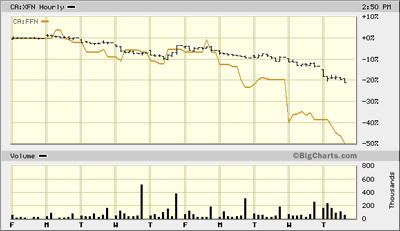
RPA.PR.A / RPB.PR.A / RPQ.PR.A Hit by FannieFreddieFiasco

The companies, which share a common manager/sponsor have announced:

On Sunday the US federal government announced its intention to place government sponsored entities (“GSEs”) Fannie Mae and Freddie Mac (both rated AAA by Standard & Poor’s) under conservatorship. The government’s actions, taken through the Federal Housing Finance Agency, the US Department of the Treasury and the Federal Reserve, are intended to reduce risk in the mortgage financing market.

The use of a conservatorship as the vehicle by which to carry out the changes, however, has potential consequences for ROC Pref II Corp.(“ROC II”), ROC Pref III Corp. (“ROC III”), and Connor, Clark & Lunn ROC Pref Corp. (“ROC IV” and collectively “the ROCs”) which have exposure to both Fannie Mae and Freddie Mac in their respective Reference Portfolios. As discussed in greater detail below, based on current information, we believe the impact on ROC II and ROC IV will be minimal. The impact on ROC III, however, could be more significant.

In the credit default swap (“CDS”) market, contracts are written using standardized language as set out by the International Swaps and Derivatives Association (ISDA). The ROCs apply this standard set of terms. Under ISDA terms, conservatorship is included as part of the definition of a credit event and therefore the government’s actions could be construed as a credit event that would impact the ROCs. Most large investment banks who are ISDA members have disclosed to ISDA that they interpret the conservatorship to be a credit event under the ISDA definitions. ISDA has announced that, after consultation with industry participants, it will launch a protocol to facilitate settlement of credit derivative trades involving Fannie Mae and Freddie Mac. ISDA will publish further details in due course.

The net economic impact of the government’s actions was to decrease the risk of default on the senior debt of the GSEs and there are some differences between this circumstance and the actions of a typical conservatorship, therefore we believe that there will be substantial on-going discussions regarding the impact of these actions on the CDS market in general and the fixed recovery rate swaps in particular. As of the time of this release the ROCs have not received a credit event notice.

If the dealers who issued the credit linked notes pertaining to the ROCs interpret this event as a credit event, ROC II and ROC IV would likely experience minimal impact given the recovery rate is expected to be in the 95% to 100% range. ROC III [RPB.PR.A] however, has a fixed recovery rate feature which, in the case of a typical credit event, would limit the recovery rate to the fixed level of 40%. Fixed recovery rates were a feature that was commonly used in the CDS marketplace at the time that ROC III shares were issued. The rating agencies preferred the additional level of certainty that fixed recovery rate swaps provided investors by taking away the risk of very low recovery levels.

CDS Recovery Locks have been discussed on PrefBlog.

RPA.PR.A was last discussed on PrefBlog when it sustained a credit event from Quebecor World.

RPB.PR.A was placed on Credit-Watch Negative in June. In a development not reported by PrefBlog, it was taken off credit watch and affirmed at P-2(low) in August.

RPQ.PR.A was downgraded in May.

None of these issues are tracked by HIMIPref™.

Issue Comments

Best & Worst Performers: August, 2008

These are total returns, with dividends presumed to have been reinvested at the bid price on the ex-date. The list has been restricted to issues in the HIMIPref™ indices.

August, 2008
Issue Index DBRS Rating Monthly Performance Notes (“Now” means “August 29”)
BNA.PR.C SplitShare Pfd-2(low) -2.55% Asset coverage of 3.3+:1 as of July 31 according to the company. Now with a pre-tax bid-YTW of 9.34% based on a bid of 16.88 and a hardMaturity 2019-1-10 at 25.00. Compare with BNA.PR.A (6.17% to call 2009-10-31) and BNA.PR.B (8.88% to 2016-3-25). See also a comparison with BAM perps.
BNA.PR.B SplitShare Pfd-2(low) -1.1520% Now with a pre-tax bid-YTW of 8.88% based on a bid of 19.71 and a hardMaturity 2016-3-25 at 25.00. See above for comparators.
FTN.PR.A SplitShare Pfd-2 -0.8721% Asset coverage of just under 2.0:1 as of August 15 according to the company. Now with a pre-tax bid-YTW of 5.68% based on a bid of 9.77 and a hardMaturity 2015-12-1 at 10.00.
FFN.PR.A SplitShare Pfd-2(low) -0.7751% Asset coverage of 1.8+:1 as of August 15 according to the company. Now with a pre-tax bid-YTW of 5.78% based on a bid of 9.74 and a hardMaturity 2014-12-1 at 10.00.
BAM.PR.O OpRet Pfd-2(low) -0.2183% Now with a pre-tax bid-YTW of 7.42% based on a bid of 22.85 and optionCertainty 2013-6-30. Compare with BAM.PR.H (5.90% to 2012-3-30), BAM.PR.I (5.44% to 2013-12-30) and BAM.PR.J (6.27% to 2018-3-30).
CM.PR.H PerpetualDiscount Pfd-1 [Trend Negative] +7.3690% Now with a pre-tax bid-YTW of 6.53% based on a bid of 18.65 and a limitMaturity.
NA.PR.L PerpetualDiscount Pfd-1(low) +7.6471% Now with a pre-tax bid-YTW of 6.08% based on a bid of 20.13 and a limitMaturity.
PWF.PR.E PerpetualDiscount Pfd-1(low) +7.7452% Now with a pre-tax bid-YTW of 5.87% based on a bid of 23.51 and a limitMaturity.
CM.PR.I PerpetualDiscount Pfd-1 [Trend Negative] +8.3236% Now with a pre-tax bid-YTW of 6.40% based on a bid of 18.61 and a limitMaturity.
POW.PR.D PerpetualDiscount Pfd-2(high) +8.5523% Now with a pre-tax bid-YTW of 6.03% based on a bid of 21.07 and a limitMaturity.