Category: Issue Comments

Issue Comments

GMP.PR.B & GMP.PR.C Put on Review-Developing by DBRS

GMP Capital will soon experience great change:

GMP Capital Inc. has announced plans to exit the capital markets business, selling its investment banking arm to U.S. brokerage house Stifel Financial Corp. for approximately $70-million in a dramatic shift for what was once one of Canada’s most successful independent investment dealers.

In the latest sign of consolidation in financial services, GMP Capital’s bankers and traders will join St. Louis-based Stifel, which has built a national U.S. platform by making more than two dozen acquisitions during chief executive officer Ronald Kruszewski’s 22 years at the helm.

GMP Capital, founded in 1995 by veteran deal makers, made its name raising money for entrepreneurial businesses such as Research in Motion – now BlackBerry Ltd. – and cannabis, mining, and oil and gas companies in recent years. But, like BlackBerry, the Toronto-based investment bank that once boasted a market value of $2-billion is undergoing a transformation. Its core business will now revolve around its 33-per-cent stake in wealth manager Richardson GMP, which has approximately $30-billion in assets and 170 teams of financial advisers.

Once the Stifel transaction closes, GMP Capital plans to buy the remaining 67 per cent of Richardson GMP from its employees and Winnipeg’s Richardson family in a stock swap that will make the Richardson clan the company’s largest shareholder. GMP Capital will hold approximately $198-million in cash. That capital is earmarked for expanding the wealth management platform by recruiting financial advisers and potentially adding new services such as robo-advisers, specialized lending and asset management.

… and DBRS is watching with great interest:

DBRS, Inc. (DBRS) placed GMP Capital Inc.’s (GMP or the Company) Cumulative Preferred Shares rating of Pfd-4 (high) Under Review with Developing Implications. The rating action follows the announcement that GMP has agreed to sell substantially all of its capital markets business to Stifel Financial Corp. (Stifel).

KEY RATING CONSIDERATIONS
The Under Review with Developing Implications status reflects uncertainty surrounding the transaction, including shareholder and regulatory approval that are still required for the transaction to close as well as other strategic initiatives that are occurring in tandem. While certain assets and liabilities will transfer to Stifel with the capital markets business divestiture, the Cumulative Preferred Shares rated by DBRS will remain with GMP.

DBRS will assess GMP’s pro-forma structure at the close of the transaction, including the remaining assets and liabilities as well as the Company’s future strategic direction and management’s ability to execute on this plan. DBRS notes that Harris Fricker, Chief Executive Officer of GMP, and other key personnel have agreed to join Stifel.

The rating could be upgraded if GMP’s pro-forma financials post-transaction are deemed to be stronger as a result of shedding the capital markets business, which has been highly volatile and loss-making. The rating could be downgraded if GMP’s credit fundamentals post-transaction are deemed to be weaker or if GMP is not able to acquire majority control of Richardson GMP, limiting its wealth management growth strategy.

Affected issues are GMP.PR.B and GMP.PR.C

Issue Comments

RY Upgraded to Pfd-1(low), Pfd-2(high) by DBRS

DBRS has announced that it:

upgraded the long-term ratings of the Royal Bank of Canada (RBC or the Bank) and its related entities, including RBC’s Long-Term Issuer Rating, to AA (high) from AA. DBRS also changed the trend on all long-term ratings to Stable from Positive. The Bank’s Short-Term Issuer Rating was confirmed at R-1 (high) with a Stable trend. RBC’s Long-Term Issuer Rating is composed of an Intrinsic Assessment (IA) of AA and Support Assessment of SA2, which reflect the expectation of timely systemic support from the Government of Canada (rated AAA with a Stable trend by DBRS). The SA2 designation results in a one-notch uplift to the Long-Term Issuer Rating. Under the new Canadian Bank Recapitalization Regime (the Bail-In Regime), DBRS expects to eventually remove the uplift from systemic support, once the Bank has issued a sufficient level of bail-inable senior debt, which would thereby provide an adequate buffer for non-bail-inable obligations and is then expected to offset the removal of systemic support.

DBRS remains concerned over the combination of Canadian household indebtedness and elevated housing prices, particularly in and around Vancouver and Toronto, and the potential impact of a housing downturn on the Canadian economy as well as to other consumer-related loan portfolios. Nonetheless, RBC’s residential-secured portfolio, like all the large Canadian banks, appears conservatively underwritten, with 37% of RBC’s Canadian residential mortgage loans insured. The average loan-to-value ratio of the uninsured portfolio is a conservative 57%, providing a substantial buffer for a decline in housing prices.

RBC’s Q2 2019 Common Equity Tier 1 ratio increased 90 basis points YoY to 11.8%, primarily due to strong earnings generation. While overall capital levels remain well above regulatory minimums, they are at the low end of some global peers. However, DBRS views capital levels as strong given the Bank’s asset mix and ability to generate capital. The Bank has begun issuing Bail-inable Senior Debt as part of the Bail-In Regime. It is expected that the Bank will exceed the total loss absorbing capacity requirements issued by the Office of the Superintendent of Financial Institutions as it replaces maturing legacy senior debt.

18-Jun-19 NVCC Preferred Shares Upgraded Pfd-2 (high) Stb
18-Jun-19 Non-Cumulative Preferred Shares (Excluding Series W) Upgraded Pfd-1 (low) Stb
18-Jun-19 Preferred Shares, Series C-1 Upgraded A Stb
18-Jun-19 Preferred Shares, Series C-2 Upgraded A Stb

Affected issues are:
NVCC-compliant : (Straights) RY.PR.N, RY.PR.O, RY.PR.P
(FixedReset) RY.PR.H, RY.PR.J, RY.PR.M, RY.PR.Q, RY.PR.R, RY.PR.S, RY.PR.Z

NVCC-non-compliant: (Straight) RY.PR.A, RY.PR.C, RY.PR.E, RY.PR.F, RY.PR.G

Specifically Excluded from being rated: RY.PR.W

It’s a bit odd that the Series C-1 shares were upgraded – they have been redeemed as I reported in August 2017; this was confirmed in the 2017 Annual Report:

On November 13, 2017, we redeemed all 82,050 issued and outstanding Non-cumulative Perpetual First Preferred Shares, Series C-1, for cash at a redemption price of US$1,000 per share.

The C-series preferreds were issued in connection with the takeover of City National in 2015.

Issue Comments

LCS.PR.A : Annual Report, 2018

Brompton Lifeco Split Corp. has released its Annual Report to December 31, 2018.

LCS / LCS.PR.A Performance
Instrument One
Year
Three
Years
Five
Years
Ten
Years
Since
Inception
Whole Unit -18.1% +1.1% +2.2% +6.7% +1.5%
LCS.PR.A +5.9% +5.9% +5.9% +5.6% +5.6%
LCS -55.2% -12.1% -7.2% +6.2% -6.2%
S&P/TSX Capped Financial Index -9.2% +8.5% +6.9% +12.2% +5.7%
S&P/TSX Composite Index -8.9% +6.4% +4.1% +7.9% +3.4%

Note that the benchmarking isn’t ideal, since the Financial index will include banks, while the fund has a mandate only for insurers.

Figures of interest are:

MER: The MER per unit of the Fund, excluding Preferred share distributions (which were largely covered by the Fund’s dividend income), was 0.98% in 2018, down from 1.05% in 2017 as a result of better fixed-cost absorption.

Average Net Assets: We need this to calculate portfolio yield; and it’s tricky because “The Fund completed a treasury offering of Class A shares and Preferred shares for aggregate gross proceeds of approximately $38.6 million on February 6, 2018.”. Preferred Share distributions of 4,055,809 @ 0.575 / share implies 7.054-million shares out on average. Average Unit Value (beginning & end of year) = (16.82 + 12.71) / 2 = 14.76. Therefore 7.054-million @ 14.76 = 104.1-million average net assets.

Underlying Portfolio Yield: Dividends, interest and lending income received of 4.249-million divided by average net assets of 104.1-million is 4.08%

Income Coverage: Gross Investment Income (before capital gains & losses) of $4.250-million less expenses of 1.818-million is net investment income of $2.432-million divided by Preferred Share Distributions of 4.056-million is 60%.

Issue Comments

CM.PR.Y Relatively Strong on Excellent Volume

Canadian Imperial Bank of Commerce has announced:

that it has completed the offering of 10 million Non-cumulative Rate Reset Class A Preferred Shares Series 51 (Non-Viability Contingent Capital (NVCC)) (the “Series 51 Shares”) priced at $25.00 per share to raise gross proceeds of $250 million.

The offering was made through a syndicate of underwriters led by CIBC Capital Markets. The Series 51 Shares commence trading on the Toronto Stock Exchange today under the ticker symbol CM.PR.Y.

The Series 51 Shares were issued under a prospectus supplement dated May 27, 2019, to CIBC’s short form base shelf prospectus dated July 11, 2018.

CIBC has designated the Series 51 Shares as eligible to participate in the CIBC Shareholder Investment Plan along with Series 41, 43, 45, 47 and 49. Holders of eligible shares may elect to have dividends on those preferred shares reinvested in common shares if they reside in Canada, or may elect stock dividends if they reside in the U.S. See “CIBC Shareholder Investment Plan” at www.cibc.com for more information.

CM.PR.Y is a FixedReset, 5.15%+362, NVCC, announced May 24. It will be tracked by HIMIPref™ and has been assigned to the FixedReset (Discount) subindex.

The issue traded 1,022,019 shares today in a range of 24.35-65 before closing at 24.37-40. Vital statistics are:

CM.PR.Y FixedReset Disc YTW SCENARIO
Maturity Type : Limit Maturity
Maturity Date : 2049-06-04
Maturity Price : 22.92
Evaluated at bid price : 24.37
Bid-YTW : 5.10 %

Given that the PerpetualDiscount index is down 5.64% from its pre-announcement close on May 23, this was actually a pretty good day for the issue!

The new issue is somewhat expensive according to Implied Volatility Analysis:

impvol_cm_190604
Click for Big

According to this analysis, the fair price of the new issue is 23.71, down from the announcement day fair-value of 24.85, but alert Assiduous Readers will have noticed that the Implied Volatility plot is very peculiar, having three expensive issues and four cheap ones, with nothing in between.

The other two rich issues are:

  • CM.PR.S, a FixedReset, 4.50%+245, NVCC-compliant issue that commenced trading 2018-1-18 after being announced 2018-1-10. It is 0.89 rich, being bid at 19.01 compared to a fair value of 18.12.
  • CM.PR.T, a FixedReset, 5.20%+331, NVCC-compliant issue that commenced trading 2019-1-22 after being announced 2019-1-14. It is 2.17 rich, being bid at 24.40 compared to a fair value of 22.23. Alert readers will note that is is bid higher than CM.PR.Y despite having an Issue Reset Spread 31bp lower. Sometimes I despair of this market.

The extremely perplexing issue is CM.PR.R, a FixedReset, 4.40%+338, NVCC Compliant issue that commenced trading 2017-6-2 after being announced 2017-5-25. It is bid at 21.30 compared to a fair value of 22.56. Alert readers will note that it is bid much lower than CM.PR.T despite having an Issue Reset Spread 7bp higher.

I confess I don’t know quite what to make of this. It is common – normal, even – for a new issue to remain rich for quite some time, but I am at a loss to explain why CM.PR.S should remain rich after being on the market for sixteen months. CM.PR.R is just silly … but note that its current coupon is low relative to the new issue and it won’t reset until 2022-7-31 … three years, roughly, thirteen coupon payments, but that’s only a total of about $0.60 and doesn’t explain the differential with CM.PR.S anyway.

Fortunately, I don’t have to explain it! All I have to do is avoid buying the new issue and favour other, cheaper, choices for any allocation to CM that I care to make.

Issue Comments

TD.PF.M Outperforms Market on Modest Volume

The Toronto Dominion Bank’s new issue closed today without an announcement on their website.

TD.PF.M is a FixedReset 5.10%+356, NVCC, announced 2019-5-24. It will be tracked by HIMIPref™ and has been assigned to the FixedReset (Discount) subindex.

The issue traded 680,093 shares today in a range of 24.60-78 before closing at 24.70-71. Vital statistics are:

TD.PF.M FixedReset Disc YTW SCENARIO
Maturity Type : Limit Maturity
Maturity Date : 2049-06-04
Maturity Price : 23.05
Evaluated at bid price : 24.70
Bid-YTW : 4.96 %

Given that the PerpetualDiscount index is down 5.64% from its pre-announcement close on May 23, this was actually a pretty good day for the issue!

The new issue remains expensive according to Implied Volatility Analysis:

impvol_td_190604
Click for Big

According to this analysis, the fair price of the new issue is 23.58, down 0.69 from the announcement day fair value of 24.27.

It is most interesting to compare this issue with TD.PF.L, a FixedReset, 5.20%+327, that commenced trading 2019-1-28 after being announced 2019-01-17. Alert Assiduous Readers will have noticed that although the initial dividends of the two issues are similar, the spreads are 29bp different, which is significant. The fair price of TD.PF.L according to the analysis above is only 22.39 (down 0.84 from the TD.PF.M announcement day value of 23.23), yet the issue closed today at 24.63-68, not much below TD.PF.M’s 24.70-71. I am reminded of the BCE.PR.K Ridiculous Rip-off Wrinkle, in which BCE was able to reopen the issue since – presumably – the initial coupon rate was in-line with the market even though the spread to the Canada 5-year for the re-opened portion was 87bp lower than it should have been.

Issue Comments

TA Downgraded to P-4(high) by S&P

On March 26, S&P placed TA on Creditwatch-Negative:

  • Calgary, Alta.-based TransAlta Corp. has announced that it entered into an agreement with Brookfield Renewable Partners L.P. with respect to the partial sale of TransAlta’s Alberta hydro assets.
  • As part of this transaction, TransAlta will issue C$350 million in debentures to Brookfield over the coming weeks, mainly to fund future shareholder returns and subsequently issue C$400 million in preferred stock in October 2020 to repay debt maturing in November 2020. Brookfield will also increase its equity investment in TransAlta to 9%. The debentures and preferred shares are expected to convert to a partial interest in TransAlta’s hydro assets in 2025.
  • S&P Global Ratings placed its ‘BBB-‘ issuer credit rating on TransAlta and its issue-level ratings on the company’s debt on CreditWatch with negative implications.
  • TransAlta’s leverage remains elevated for the rating, and the CreditWatch placement reflects a greater than 1-in-2 chance of a downgrade if we are not convinced that the company can improve its funds from operations (FFO) to debt to about 22% or debt to EBITDA would not decrease below 3.5x by 2020.
  • We expect to resolve the CreditWatch over the next 90 days after meeting with company management to evaluate its plans to reduce leverage over the next two years and to manage execution risk while increasing its natural gas and renewables generation portfolio.

They have now downgraded Transalta:

  • Calgary, Alberta-based TransAlta Corp.’s leverage is expected to remain elevated over the next two years following its agreement with Brookfield to borrow $350 million in subordinated debentures and planned $400 million preferred stock issuance (which we view as debt) to fund share repurchases, refinance debt, and accelerate coal-to-gas power plant conversion.
  • We expect the company’s funds from operations (FFO) to debt to remain below 22% and debt to EBITDA above 3.5x (our downgrade thresholds for the rating) for a prolonged period. Consequently, we are lowering our issuer credit rating and senior unsecured issue-level ratings on TransAlta to ‘BB+’ from ‘BBB-‘. We are also lowering our preferred stock rating to ‘B+’ from ‘BB’ and our Canadian preferred stock rating to ‘P-4’ (high) from ‘P-3’.
  • We are assigning our ‘3’ recovery rating to the company’s senior unsecured debt, reflecting our expectation of meaningful recovery in a default scenario.
  • We are removing the ratings from CreditWatch, where we placed them March 26, 2019, with negative implications following the announcement of the Brookfield transaction. The outlook is stable.
  • The stable outlook reflects our expectation of relatively stable operating performance under transitionary industry conditions toward cleaner burning fuels. We expect FFO to debt to remain 16%-17% through 2020 and leverage reduction in the longer term to be driven by improved realizations for its hydroelectric plants following the expiration of under-market-price power purchase agreements (PPAs) in 2020 and the placement of a capacity market in Alberta in November 2021.


We could lower our ratings if we expect FFO to debt to fall below 14% or debt to EBITDA to increase above 4.75x for a prolonged period. This could likely result from significant declines in capacity and power prices in Alberta or significant operating challenges resulting from the coal-to-gas conversion. While less likely, we could lower ratings because of aggressive financial policy changes characterized by meaningful increases in dividends or share repurchases, or a weaker business profile characterized by the sale of contracted assets such that less than 50% of EBITDA is generated by contracted assets.

While unlikely over the next 24 months, we could consider an upgrade if TransAlta successfully pursues coal-to-gas conversions, exhibits good profitability from the converted plants, and materially improves financial performance. More specifically, an upgrade would require sustained FFO to debt above 22% and debt to EBITDA below 3.5x.

Affected issues are TA.PR.D, TA.PR.E, TA.PR.F, TA.PR.H and TA.PR.J.

Issue Comments

PIC.PR.A To Get Bigger

Strathbridge Asset Management Inc. has announced:

Premium Income Corporation (the “Fund”) is pleased to announce that it is undertaking an overnight treasury offering of Preferred Shares and Class A Shares.

The sales period for the overnight offering will end at 9:00 am EST tomorrow, June 4, 2019. The offering is expected to close on or about June 11, 2019 and is subject to certain conditions including approval by the Toronto Stock Exchange (“TSX”). The Preferred Shares will be offered at a price of $14.75 per Preferred Share to yield 5.94% and the Class A Shares will be offered at an indicative price of $6.45 per Class A Share to yield 12.6%. The trading price on the TSX for each of the Preferred Shares and Class A Shares as at 2:30pm EST on June 3, 2019 was $14.78 and $6.63, respectively.

Since the inception of the Fund, the aggregate dividends declared on the Preferred Shares have been $19.62 per share and the aggregate dividends declared on the Class A Shares have been $25.01 per share, for a combined total of $44.63 per unit.

The Fund invests in a portfolio consisting principally of common shares of Bank of Montreal, The Bank of Nova Scotia, Canadian Imperial Bank of Commerce, National Bank of Canada, Royal Bank of Canada and The Toronto-Dominion Bank (the “Banks”). To generate additional returns above the dividend income earned on the Fund’s portfolio, the Fund will selectively write covered call and put options in respect of some or all of the common shares in the Fund’s portfolio. The manager and investment manager of the Fund is Strathbridge Asset Management Inc.

The Preferred Shares pay fixed cumulative preferential quarterly cash distributions in the amount of $0.215625 ($0.8625 per annum) per preferred share representing a yield of 5.75% on the original issue price of $15.00. The Class A Shares currently pay quarterly distributions in the amount $0.20319 ($0.81276 per annum) per Class A Share.

The syndicate of agents for the offering is being co-led by RBC Capital Markets, CIBC Capital Markets, National Bank Financial Inc. and Scotiabank and also includes BMO Capital Markets, TD Securities Inc., Raymond James Ltd., Canaccord Genuity Corp., Desjardins Securities Inc., Echelon Wealth Partners Inc., GMP Securities L.P. and Industrial Alliance Securities Inc.

For further information, please contact Investor Relations at 416.681.3966, toll free at 1.800.725.7172, email at info@strathbridge.com or visit www.strathbridge.com

So the total offering price is 21.20 per Whole Unit and the May 31 NAVPU was 20.28 for a premium of 4.5%. Not as high as the really hot ones, but still … what a business!

Update, 2019-06-16: They raised approximately $13.25-million.

Issue Comments

EFN.PR.C To Reset at 6.210%

Element Fleet Management Corp. has announced (although not yet on their website):

the applicable dividend rates for its Cumulative 5-Year Rate Reset Preferred Shares, Series C (the “Series C shares”) and Cumulative Floating Rate Preferred Shares, Series D (the “Series D shares”).

With respect to any Series C shares that remain outstanding after June 30, 2019, holders thereof shall be entitled to receive, and the Corporation shall pay thereon, if, as and when declared by the directors of the Corporation, fixed, cumulative, preferential cash dividends payable quarterly. The dividend rate applicable to the Series C shares for the period from and including June 30, 2019 up to, but excluding, June 30, 2024, will be 6.210% per annum, being equal to the sum of the 5-year Government of Canada bond yield determined as of today plus 4.81%, in accordance with the terms of the Series C shares.

With respect to any Series D shares that may be issued on June 30, 2019, holders thereof shall be entitled to receive, and the Corporation shall pay thereon, if, as and when declared by the directors of the Corporation, floating rate, cumulative, preferential cash dividends payable quarterly. The dividend rate applicable to the Series D shares for the period from and including June 30, 2019 up to, but excluding, September 30, 2019, will be 6.476% per annum, being equal to the sum of the 3-month Government of Canada Treasury Bill yield determined as of today plus 4.81%, calculated on the basis of the actual number of days in such quarterly period divided by 365, in accordance with the terms of the Series D shares.

Beneficial owners of Series C shares who wish to exercise their Conversion Privilege should communicate with their broker or other nominee to ensure their instructions are followed so that the registered holder of the Series C shares can meet the deadline to exercise the Conversion Privilege. Such deadline is 5:00 p.m. (Toronto time) on June 17, 2019, as further described in the Corporation’s news release dated May 22, 2019 and in the rights, privileges, restrictions and conditions attaching to the Series C shares, as provided in Article 6 of the Corporation’s restated articles of incorporation dated October 4, 2016.

EFN.PR.C was announced 2014-2-26 as a FixedReset, 6.50%+481, but was not added to HIMIPref™ at that time as the company did not have a credit rating. The company received an initial rating from DBRS on 2015-9-24 and HIMIPref™ commenced tracking its four issues then outstanding shortly thereafter. The extension of the issue was announced 2019-5-22. The issue continues to be tracked by HIMIPref™ but is relegated to the Scraps – FixedReset (Discount) subindex on credit concerns.

The most logical way to analyze the question of whether or not to convert is through the theory of Preferred Pairs, for which a calculator is available. Briefly, a Strong Pair is defined as a pair of securities that can be interconverted in the future (e.g., EFN.PR.C and the FloatingReset that will exist if enough holders convert). Since they will be interconvertible on this future date, it may be assumed that they will be priced identically on this date (if they aren’t then holders will simply convert en masse to the higher-priced issue). And since they will be priced identically on a given date in the future, any current difference in price must be offset by expectations of an equal and opposite value of dividends to be received in the interim. And since the dividend rate on one element of the pair is both fixed and known, the implied average rate of the other, floating rate, instrument can be determined. Finally, we say, we may compare these average rates and take a view regarding the actual future course of that rate relative to the implied rate, which will provide us with guidance on which element of the pair is likely to outperform the other until the next interconversion date, at which time the process will be repeated.

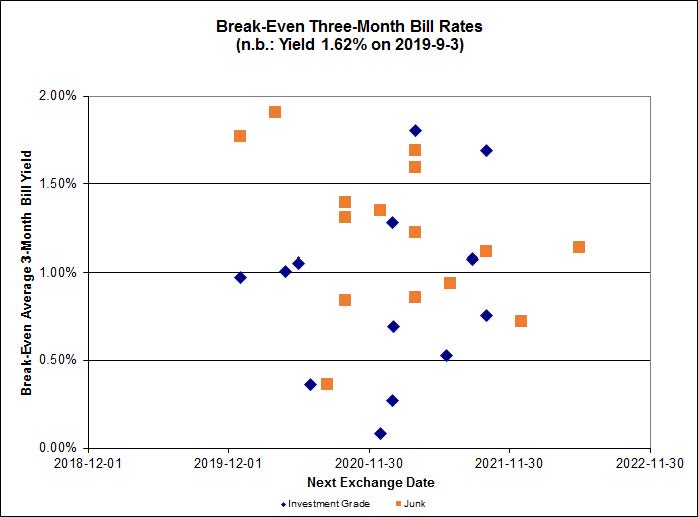
We can show the break-even rates for each FixedReset / FloatingReset Strong Pair graphically by plotting the implied average 3-month bill rate against the next Exchange Date (which is the date to which the average will be calculated).

pairs_fr_190531
Click for Big

The market has regained a little enthusiasm for floating rate product; the implied rates until the next interconversion are below the current 3-month bill rate as the averages for investment-grade and junk issues are at +1.32% and +1.72%, respectively. Whatever might be the result of the next few Bank of Canada overnight rate decisions, I suggest that it is unlikely that the average rate over the next five years will be lower than current – but if you disagree, of course, you may interpret the data any way you like.

Since credit quality of each element of the pair is equal to the other element, it should not make any difference whether the pair examined is investment-grade or junk, although we might expect greater variation of implied rates between junk issues on grounds of lower liquidity, and this is just what we see.

If we plug in the current bid price of the EFN.PR.C FixedReset, we may construct the following table showing consistent prices for its soon-may-be-issued FloatingReset counterpart given a variety of Implied Breakeven yields consistent with issues currently trading:

Estimate of FloatingReset (received in exchange for EFN.PR.C) Trading Price In Current Conditions
  Assumed FloatingReset
Price if Implied Bill
is equal to
FixedReset Bid Price Spread 2.00% 1.50% 1.00%
EFN.PR.C 21.31 481bp 21.87 21.40 20.94

Based on current market conditions, I suggest that the FloatingResets that will result from conversion are likely to trade close to the price of their FixedReset counterparts, EFN.PR.C. Therefore, it seems likely that I will recommend that holders of EFN.PR.C determine whether or not to convert based on their own portfolio considerations and forecast for policy rates, but I will wait until it’s closer to the June 17 notification deadline before making a final pronouncement. I will note that once the FloatingResets commence trading (if, in fact, they do) it may be a good trade to swap one issue for the other in the market once both elements of each pair are trading and you can – hopefully – do it with a reasonably good take-out in price, rather than doing it through the company on a 1:1 basis. But that, of course, will depend on the prices at that time and your forecast for the path of policy rates over the next five years. There are no guarantees – my recommendation is based on the assumption that current market conditions with respect to the pairs will continue until the FloatingResets commence trading and that the relative pricing of the two new pairs will reflect these conditions.
Issue Comments

GRP.PR.A To Be Redeemed

Global Resource Champions Split Corp. has announced:

its intention to redeem all of its outstanding Class A Preferred Shares, Series 1 (the “Series 1 Preferred Shares”) (TSX: GRP.PR.A) for cash on June 14, 2019 (the “Redemption Date”) in accordance with the terms of the Series 1 Preferred Shares.

The redemption price per Series 1 Preferred Share will be equal to C$25.00 plus accrued and unpaid dividends as of the Redemption Date of C$0.321181 per share, representing a total redemption price of C$25.321181 per Series 1 Preferred Share (the “Redemption Price”).

Notice will be delivered to holders of Series 1 Preferred Shares in accordance with the terms of the Series 1 Preferred Shares.

From and after the Redemption Date the Series 1 Preferred Shares will cease to be entitled to dividends or any other participation in any distribution of the assets of the Company and the holders thereof shall not be entitled to exercise any of their other rights as shareholders in respect thereof except to receive the Redemption Price (less any tax required to be deducted and withheld by the Company).

GRP.PR.A is a SplitShare, 6.25%, 7-year issue scheduled to mature 2023-5-25, that commenced trading 2016-5-6 after marketting commenced 2016-4-5. It is tracked by HIMIPref™ but is currently relegated to the Scraps – SplitShare subindex on volume concerns.

Issue Comments

TD Upgraded to Pfd-2(high) by DBRS

DBRS has announced that it:

upgraded the long-term ratings of The Toronto-Dominion Bank (TD or the Bank) and its related entities, including TD’s Long-Term Issuer Rating to AA (high) from AA. The Bank’s Short-Term Issuer Rating is confirmed at R-1 (high). The trend on all ratings is now Stable. TD’s Long-Term Issuer Rating is composed of an Intrinsic Assessment (IA) of AA and a Support Assessment (SA) of SA2, which reflects the expectation of timely systemic support from the Government of Canada (rated AAA with a Stable trend by DBRS). The SA2 designation results in a one-notch uplift to the Long-Term Issuer Rating. Under the new Canadian Bank Recapitalization Regime, DBRS expects to eventually remove the uplift from systemic support once the Bank has issued a sufficient level of bail-inable senior debt, which would thereby provide an adequate buffer for non-bail-inable obligations and is then expected to offset the removal of systemic support.

KEY RATING CONSIDERATIONS
The upgrade of TD’s long-term ratings recognizes the Bank’s improving fundamentals and franchise, including a growing level of earnings in the United States and ongoing strong performance in Canada, as the Bank continues to execute on its lower-risk strategy. DBRS views TD as consistently outperforming most global banks, and the Bank’s upgraded IA is now in line with a few highly regarded U.S. peers. The U.S. retail bank now represents over one-third of the Group’s earnings, which contributes to TD’s geographic diversity. Indeed, the Canadian and U.S. retail operations generate more than 80% of TD’s adjusted net income, providing considerable earnings stability, which is a key factor underpinning the ratings. DBRS notes that the performance of the U.S. franchise has vastly improved as the Bank has built its asset generation capabilities, and it has realized the benefit from margin expansion and lower corporate taxes following U.S. tax reform. However, while historically a source of lower credit risk, TD’s focus on retail lending in Canada, where the consumer is highly levered, makes it somewhat more exposed to a potential downturn in Canada. At present, TD is less exposed (as a percentage of earnings) to capital markets businesses compared with the other large Canadian banks. However, TD is investing to build out its capital markets capabilities, particularly in the United States, which could potentially expose the Bank to greater earnings volatility.

The affected issues are all NVCC-compliant: TD.PF.A, TD.PF.B, TD.PF.C, TD.PF.D, TD.PR.E, TD.PF.F, TD.PF.G, TD.PF.H, TD.PF.I, TD.PF.J, TD.PF.K, TD.PF.L and the new issue.

Update, 2019-5-31: DBRS corrected an error regarding TD’s subordinated debt.