Category: Issue Comments

Issue Comments

DF.PR.A To Be Extended

Quadravest has announced:

Dividend 15 Split Corp. II (the “Company”) is pleased to announce it will extend the termination date of the Company a further five year period from December 1, 2019 to December 1, 2024.

The term extension allows holders of DF Class A Shares (“Class A Shares”) to continue to receive ongoing leveraged exposure to a portfolio consisting of high-quality Canadian dividend yielding stocks as well as receiving targeted monthly distributions. Since inception of the Company Class A shareholders have received monthly distributions totaling $12.50 per share.

Holders of the DF.PR.A Preferred Shares (“Preferred Shares”) are expected to continue to benefit from cumulative preferential monthly distributions. The Preferred shareholders have received a total of $6.41 per share since inception.

The extension of the term of the Company is not expected to be a taxable event and should enable shareholders to defer potential capital gains tax liability that would have otherwise been realized on the redemption of the Class A Shares or Preferred Shares at the end of the term, until such time as such shares are disposed of by shareholders.

In connection with the extension, the Company will have the right to amend the rate of cumulative preferential monthly dividends to be paid to the Preferred Shares for the five year renewal period, commencing December 1, 2019. Any change to the Preferred Share dividend rate for the extended term will be based on market yields for preferred shares with similar terms at such time and will be announced no later than September 30, 2019.

The Company invests in a high quality portfolio of leading Canadian dividend-yielding stocks as follows: Bank of Montreal, Bank of Nova Scotia, Canadian Imperial Bank of Commerce, Royal Bank of Canada, Toronto-Dominion Bank, National Bank of Canada, CI Financial Corp., BCE Inc., Manulife Financial, Enbridge, Sun Life Financial, TELUS Corporation, Thomson Reuters Corporation, TransAlta Corporation, TransCanada Corporation.

DF.PR.A was added to the HIMIPref™ universe in May 2008, as a 5.25% Split Share maturing 2014-12-1. It was hammered in the Credit Crunch, but survived and a five year term extension with unchanged dividend was proposed in May 2013 which was approved in June 2013.

Issue Comments

DFN.PR.A To Be Extended

Quadravest has announced:

Dividend 15 Split Corp. (the “Company”) is pleased to announce it will extend the termination date of the Company a further five year period from December 1, 2019 to December 1, 2024.

The term extension allows holders of DFN Class A Shares (“Class A Shares”) to continue to receive ongoing leveraged exposure to a portfolio consisting of high-quality Canadian dividend yielding stocks as well as receiving targeted monthly distributions. Since inception of the Company Class A shareholders have received 178 consecutive monthly distributions totaling $21.30 per share (including five special distributions of $0.25 per share, one special distribution of $0.50 per share and one special stock dividend of $1.75 per share).

Holders of the DFN.PR.A Preferred Shares (“Preferred Shares”) are expected to continue to benefit from cumulative preferential monthly distributions. The Preferred shareholders have received a total of $7.81 per share since inception.

The extension of the term of the Company is not expected to be a taxable event and should enable shareholders to defer potential capital gains tax liability that would have otherwise been realized on the redemption of the Class A Shares or Preferred Shares at the end of the term, until such time as such shares are disposed of by shareholders.

In connection with the extension, the Company will have the right to amend the rate of cumulative preferential monthly dividends to be paid to the Preferred Shares for the five year renewal period, commencing December 1, 2019. Any change to the Preferred Share dividend rate for the extended term will be based on market yields for preferred shares with similar terms at such time and will be announced no later than September 30, 2019.

The Company invests in a high quality portfolio of leading Canadian dividend-yielding stocks as follows: Bank of Montreal, Bank of Nova Scotia, Canadian Imperial Bank of Commerce, Royal Bank of Canada, Toronto-Dominion Bank, National Bank of Canada, CI Financial Corp., BCE Inc., Manulife Financial, Enbridge, Sun Life Financial, TELUS Corporation, Thomson Reuters Corporation, TransAlta Corporation, TransCanada Corporation.

DFN.PR.A was first traded 2004-3-16 as a 5.25% Split Share scheduled to mature 2009-12-1. A Special Resolution was proposed in April 2007 to extend term to 2014-12-1 with an unchanged dividend. The proposal was approved and shareholders had a wild ride during the Credit Crunch. There was another term extension approved in June 2013 with the dividend remaining unchanged. The fund then swallowed up CGQ & CGQ.E as well as STQ / STQ.E.

Better Communication, Please!

FTS.PR.K Reset Rate to Remain Secret

I sent three eMails of inquiry (on 1/31, 2/1 and 2/4) to Fortis Investor Relations regarding the reset rate for FTS.PR.K:

Will the captioned security be redeemed? Or will the dividend rate be reset, with a conversion option? Will there be a press release, similar to the press releases of your competitors for capital, Enbridge and Pembina Pipelines, with respect to their issues resetting on the same date?

I finally got a reply today well after the close of business:

Good Evening Mr. Hymas,

Thank you for contacting Fortis Inc. Fortis does not intend to exercise its right to redeem all or any part of the currently outstanding Cumulative Redeemable Fixed Rate Reset First Preference Shares, Series K of the Corporation (the “Series K Shares”) on March 1, 2019.

Subject to certain conditions set out in the prospectus supplement of the Corporation dated July 9, 2013 to the base shelf prospectus of the Corporation dated May 10, 2012 relating to the issuance of the Series K Shares, the holders of the Series K Shares have the right to convert all or part of their Series K Shares, on a one-for-one basis, into Cumulative Redeemable Floating Rate First Preference Shares, Series L of the Corporation (the “Series L Shares”) on March 1, 2019 (the “Conversion Date”). This prospectus is on the Fortis website.

You should check CDS Advisory Bulletins for ongoing corporate actions relating to the conversion and/or redemption of Series K first preference shares. Furthermore, Fortis will be announcing the new dividend rate for the Series K upon the board of directors approval and declaration, which should occur around mid-February.

If you have any further questions please let me know.

There is a lot to complain about here.

First is the question of timing:

Fortis will be announcing the new dividend rate for the Series K upon the board of directors approval and declaration, which should occur around mid-February.

I note from the prospectus:

The holders of Series K First Preference Shares will have the right, at their option, to convert any or all of their Series K First Preference Shares into an equal number of Cumulative Redeemable Floating Rate First Preference Shares, Series L of the Corporation (the “Series L First Preference Shares”), subject to certain conditions, on March 1, 2019, and on March 1 every fifth year thereafter (each, a “Series K Conversion Date”).

The conversion of the Series K First Preference Shares may be effected by delivery to the Corporation of written notice thereof not earlier than the 30th day prior to, but not later than 5:00 p.m. (Toronto time) on the 15th day preceding, a Series K Conversion Date.

So March 1, 2019, is a Series K Conversion Date and the deadline for notification of conversion is the 15th day preceding this date, which is February 14, which is “around mid-February”. So the deadline for notification of conversion and the public announcement of the new rate will occur more or less simultaneously.

However, we may also note, from the prospectus, that:

“Fixed Rate Calculation Date” means, for any Subsequent Fixed Rate Period, the 30th day prior to the first day of such Subsequent Fixed Rate Period.

“Subsequent Fixed Rate Period” means, for the initial Subsequent Fixed Rate Period, the period commencing on March 1, 2019 to, but excluding, March 1, 2024 and, for each succeeding Subsequent Fixed Rate Period, the period commencing on the first day of March immediately following the end of the immediately preceding Subsequent Fixed Rate Period to, but excluding, March 1 in the fifth year thereafter.

The Corporation will, on the Fixed Rate Calculation Date, give written notice of the Annual Fixed Dividend Rate for the ensuing Subsequent Fixed Rate Period to the registered holders of the then outstanding Series K First Preference Shares.

So we may assume that Fortis has followed the letter of the prospectus and has already notified the “registered holders” of FTS.PR.K of the reset rate.

One thing sometimes forgotten when discussing “registered holders” nowadays is that there is usually exactly one registered holder: the depositary, which maintains accounts for each of its participants (brokerages) which in turn maintain accounts for each of their customers. This is called a “book based” system and is described in the prospectus, from which the following is extracted:

Except as otherwise provided below, the Series K First Preference Shares and the Series L First Preference Shares will be issued in a “book entry only” form and must be purchased or transferred through participants (“Participants”) in the depository service of CDS Clearing and Depository Services Inc. (“CDS”) or its nominee which include securities brokers and dealers, banks and trust companies. On the Closing Date, the Corporation will cause a global certificate representing the Series K First Preference Shares to be delivered to, and registered in the name of, CDS or its nominee. Except as otherwise provided below, no purchaser of Series K First Preference Shares or Series L First Preference Shares will be entitled to a certificate or other instrument from the Corporation or CDS evidencing that purchaser’s ownership, and no purchaser will be shown on the records maintained by CDS except through a book entry account of a Participant acting on behalf of the purchaser. Each purchaser of Series K First Preference Shares or Series L First Preference Shares will receive a customer confirmation of purchase from the registered dealer from which the Series K First Preference Shares or Series L First Preference Shares are purchased in accordance with the practices and procedures of the dealer. The practices of registered dealers may vary, but generally customer confirmations are issued promptly after execution of a customer order.

So what this means is that CDS has been notified, at which point Fortis has taken no further action to disseminate the information; refusing even to answer direct questions to their Investor Relations Department.

This is ridiculous. This is selective disclosure – perhaps not in law, but for all practical purposes this means that CDS (an entity controlled by the Toronto Stock Exchange) and the brokerages (who are “participants” in CDS) are getting notification of the news and are then advising clients at some later time when they damn well choose.

As far as interested investors and advisors are concerned, I’ve looked up how to get access to the CDS Advisory Bulletins:

The Advisory Bulletins service provides issuers an additional facility to communicate extraordinary details related to pending, ongoing or completed entitlements and corporate actions.

Delivery: Web, MT564/MT568 (ISO 15022)

Depending upon the nature of the message, the details of the bulletin will also be delivered via MT564 – Entitlements Notification and MT568 – Entitlements Narrative message.

Pricing: $1,125

Access the product sheet.

Contact us for pricing and other information

Non – CDS Participant Inquiries for CDS Innovation /TMX Datalinx
Email: datasales@tmx.com

CDS Participant & Issuer Inquiries
Client Relationship Managers cdscdccrelationshipmgmt@tmx.com

I have written to the Exchange:

What is the cost to subscribe to the captioned service? May these bulletins be purchased individually?

There is nothing filed regarding this matter on SEDAR, that bastion of brokerage privilege. Fortis seems very eager to pad the profits of TMX Group Limited!

I’m sure Fortis is operating within the letter of the laws and regulations and I’m sure they’ve got large legal bills to prove it. But I consider the lack of immediate public disclosure – which is standard for its competitors, I can’t think of a single other exception to this practice off the top of my head – to be contrary to the spirit of the regulations.

Given the obsession of Fortis management with keeping this information strictly under wraps, to the extent of refusing to answer a direct question regarding the reset rate when selective disclosure has already been made, I am unable to publish a formal recommendation regarding whether FTS.PR.K security holders should convert or hold their shares.

Issue Comments

PPL.PR.C To Reset At 4.478%

Pembina Pipeline Corporation has announced:

that it does not intend to exercise its right to redeem the currently outstanding Cumulative Redeemable Rate Reset Class A Preferred Shares, Series 3 (“Series 3 Shares”) (TSX: PPL.PR.A) [sic] on March 1, 2019 (the “Conversion Date”).

As a result, and subject to certain terms of the Series 3 Shares, as described in the prospectus supplement dated September 25, 2013 relating to the issuance of the Series 3 Shares, the holders of the Series 3 Shares will have the right to elect to convert all or any of their Series 3 Shares into Cumulative Redeemable Floating Rate Class A Preferred Shares, Series 4 of Pembina (“Series 4 Shares”) on the basis of one Series 4 Share for each Series 3 Share on the Conversion Date.

With respect to any Series 3 Shares that remain outstanding after March 1, 2019, holders thereof will be entitled to receive quarterly fixed cumulative preferential cash dividends, if, as and when declared by the Board of Directors of Pembina. The annual dividend rate for the Series 3 Shares for the five-year period from and including March 1, 2019 to, but excluding, March 1, 2024 will be 4.478%, being equal to the five-year Government of Canada bond yield of 1.878% determined as of today plus 2.60%, in accordance with the terms of the Series 3 Shares.

With respect to any Series 4 Shares that may be issued on March 1, 2019, holders thereof will be entitled to receive quarterly floating rate cumulative preferential cash dividends, if, as and when declared by the Board of Directors of Pembina. The annual dividend rate for the 3-month floating rate period from and including March 1, 2019 to, but excluding, June 1, 2019 will be 4.227%, being equal to the annual rate of interest for the most recent auction of 90-day Government of Canada treasury bills of 1.627% plus 2.60%, in accordance with the terms of the Series 4 Shares (the “Floating Quarterly Dividend Rate”). The Floating Quarterly Dividend Rate will be reset every quarter.

As provided in the terms of the Series 3 Shares: (i) if Pembina determines that there would remain outstanding immediately following the conversion less than 1,000,000 Series 3 Shares, all remaining Series 3 Shares will be converted automatically into Series 4 Shares on a one-for-one basis effective March 1, 2019; or (ii) if Pembina determines that there would remain outstanding immediately following the conversion, less than 1,000,000 Series 4 Shares, holders of Series 3 Shares will not be entitled to convert their Series 3 Shares into Series 4 Shares on the Conversion Date. There are currently 6,000,000 Series 3 Shares outstanding.

The Series 3 Shares are issued in “book entry only” form and, as such, the sole registered holder of the Series 3 Shares is the Canadian Depositary for Securities Limited (“CDS”). All rights of holders of Series 3 Shares must be exercised through CDS or the CDS participant through which the Series 3 Shares are held. The deadline for the registered shareholder (CDS) to provide notice of exercise of the right to convert Series 3 Shares into Series 4 Shares is 3:00 p.m. (MST) / 5:00 p.m. (EST) on February 14, 2019. Any notices received after this deadline will not be valid. As such, holders of Series 3 Shares who wish to exercise their right to convert their Series 3 Shares into Series 4 Shares should contact their broker or other intermediary for more information and it is recommended that this be done well in advance of the deadline in order to provide the broker or other intermediary with the time to complete the necessary steps.

If Pembina does not receive an election notice from CDS during the time fixed therefor, then the Series 3 Shares shall be deemed not to have been converted (except in the case of an automatic conversion). Holders of Series 3 Shares and Series 4 Shares will have an opportunity to convert their shares again on March 1, 2024, and every five years thereafter as long as the shares remain outstanding.

As previously announced, the dividend payable on March 1, 2019 to holders of the Series 3 Shares of record on February 1, 2019 will be $0.293750 per Series 3 Share, consistent with the dividend rate in effect since issuance of the Series 3 Shares on October 2, 2013.

For more information on the terms of, and risks associated with an investment in, the Series 3 Shares and the Series 4 Shares, please see Pembina’s prospectus supplement dated September 25, 2013, which can be found at www.sedar.com.

They later corrected themselves (and changed the text on their linked press release):

In the news release, “Pembina Pipeline Corporation Provides Notice of Series 3 Preferred Share Conversion Right and Announces Reset Dividend Rates,” issued earlier today by Pembina Pipeline Corporation over Cision, we are advised by the company that the opening paragraph referred to a ticker symbol, which should read “TSX: PPL.PR.C” rather than “TSX: PPL.PR.A” as originally issued inadvertently. The complete, corrected release follows:

PPL.PR.C was issued as a FixedReset, 4.70%+260, that commenced trading 2013-10-2 after being announced 2013-9-23. It is tracked by HIMIPref™ but is relegated to the Scraps – FixedReset (Discount) subindex on credit concerns.

The most logical way to analyze the question of whether or not to convert is through the theory of Preferred Pairs, for which a calculator is available. Briefly, a Strong Pair is defined as a pair of securities that can be interconverted in the future (e.g., PPL.PR.C and the FloatingReset that will exist if enough holders convert). Since they will be interconvertible on this future date, it may be assumed that they will be priced identically on this date (if they aren’t then holders will simply convert en masse to the higher-priced issue). And since they will be priced identically on a given date in the future, any current difference in price must be offset by expectations of an equal and opposite value of dividends to be received in the interim. And since the dividend rate on one element of the pair is both fixed and known, the implied average rate of the other, floating rate, instrument can be determined. Finally, we say, we may compare these average rates and take a view regarding the actual future course of that rate relative to the implied rate, which will provide us with guidance on which element of the pair is likely to outperform the other until the next interconversion date, at which time the process will be repeated.

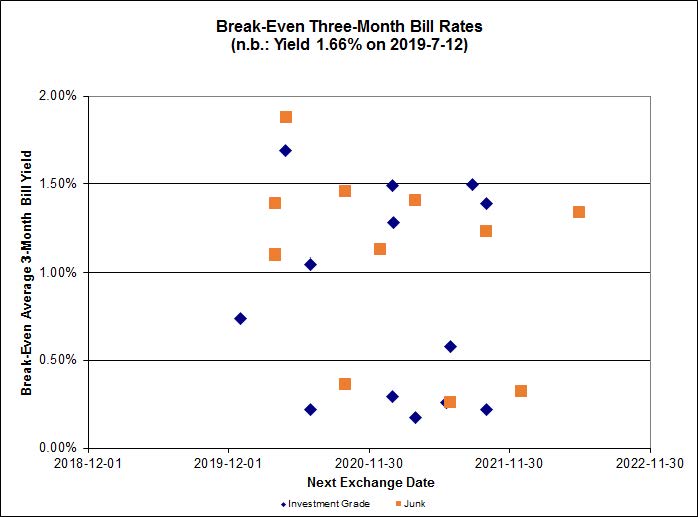
We can show the break-even rates for each FixedReset / FloatingReset Strong Pair graphically by plotting the implied average 3-month bill rate against the next Exchange Date (which is the date to which the average will be calculated).

pairs_fr_190130
Click for Big

The market has lost its fleeting enthusiasm for floating rate product; the implied rates until the next interconversion are below the current 3-month bill rate as the averages for investment-grade and junk issues are at +1.41% and +1.22%, respectively. Whatever might be the result of the next few Bank of Canada overnight rate decisions, I suggest that it is unlikely that the average rate over the next five years will be lower than current – but if you disagree, of course, you may interpret the data any way you like.

Since credit quality of each element of the pair is equal to the other element, it should not make any difference whether the pair examined is investment-grade or junk, although we might expect greater variation of implied rates between junk issues on grounds of lower liquidity, and this is just what we see.

If we plug in the current bid price of the PPL.PR.C FixedReset, we may construct the following table showing consistent prices for its soon-may-be-issued FloatingReset counterpart given a variety of Implied Breakeven yields consistent with issues currently trading:

Estimate of FloatingReset (received in exchange for PPL.PR.C) Trading Price In Current Conditions
  Assumed FloatingReset
Price if Implied Bill
is equal to
FixedReset Bid Price Spread 2.00% 1.50% 1.00%
PPL.PR.C 17.65 260bp 17.77 17.29 16.81

Based on current market conditions, I suggest that the FloatingResets that will result from conversion are likely to trade below the price of their FixedReset counterparts, PPL.PR.C. Therefore, it seems likely that I will recommend that holders of PPL.PR.C continue to hold the issue and not to convert, but I will wait until it’s closer to the February 14 notification deadline before making a final pronouncement. I will note that once the FloatingResets commence trading (if, in fact, they do) it may be a good trade to swap the FixedReset for the FloatingReset in the market once both elements of each pair are trading and you can – presumably, according to this analysis – do it with a reasonably good take-out in price, rather than doing it through the company on a 1:1 basis. But that, of course, will depend on the prices at that time and your forecast for the path of policy rates over the next five years. There are no guarantees – my recommendation is based on the assumption that current market conditions with respect to the pairs will continue until the FloatingResets commence trading and that the relative pricing of the two new pairs will reflect these conditions.

Issue Comments

ENB.PR.P To Reset To 4.379%

Enbridge Inc. has announced:

that it does not intend to exercise its right to redeem its currently outstanding Cumulative Redeemable Preference Shares, Series P (Series P Shares) (TSX: ENB.PR.P) on March 1, 2019. As a result, subject to certain conditions, the holders of the Series P Shares have the right to convert all or part of their Series P Shares on a one-for-one basis into Cumulative Redeemable Preference Shares, Series Q of Enbridge (Series Q Shares) on March 1, 2019. Holders who do not exercise their right to convert their Series P Shares into Series Q Shares will retain their Series P Shares.

The foregoing conversion right is subject to the conditions that: (i) if Enbridge determines that there would be less than 1,000,000 Series P Shares outstanding after March 1, 2019, then all remaining Series P Shares will automatically be converted into Series Q Shares on a one-for-one basis on March 1, 2019; and (ii) alternatively, if Enbridge determines that there would be less than 1,000,000 Series Q Shares outstanding after March 1, 2019, no Series P Shares will be converted into Series Q Shares. There are currently 16,000,000 Series P Shares outstanding.

With respect to any Series P Shares that remain outstanding after March 1, 2019, holders thereof will be entitled to receive quarterly fixed cumulative preferential cash dividends, as and when declared by the Board of Directors of Enbridge. The new annual dividend rate applicable to the Series P Shares for the five-year period commencing on March 1, 2019 to, but excluding, March 1, 2024 will be 4.379 percent, being equal to the five-year Government of Canada bond yield of 1.879 percent determined as of today plus 2.50 percent in accordance with the terms of the Series P Shares.

With respect to any Series Q Shares that may be issued on March 1, 2019, holders thereof will be entitled to receive quarterly floating rate cumulative preferential cash dividends, as and when declared by the Board of Directors of Enbridge. The dividend rate applicable to the Series Q Shares for the three-month floating rate period commencing on March 1, 2019 to, but excluding, June 1, 2019 will be 1.04099 percent, based on the annual rate on three month Government of Canada treasury bills for the most recent treasury bills auction of 1.63 percent plus 2.50 percent in accordance with the terms of the Series Q Shares (the Floating Quarterly Dividend Rate). The Floating Quarterly Dividend Rate will be reset every quarter.

Beneficial holders of Series P Shares who wish to exercise their right of conversion during the conversion period, which runs from January 30, 2019 until 5:00 p.m. (EST) on February 14, 2019, should communicate as soon as possible with their broker or other intermediary for more information. It is recommended that this be done well in advance of the deadline in order to provide the broker or other intermediary time to complete the necessary steps. Any notices received after this deadline will not be valid.

ENB.PR.P is a FixedReset, 4.00%+250, that commenced trading 2012-9-14 after being announced 2012-9-4. It is tracked by HIMIPref™ but is relegated to the Scraps FixedReset Discount index on credit concerns.

The most logical way to analyze the question of whether or not to convert is through the theory of Preferred Pairs, for which a calculator is available. Briefly, a Strong Pair is defined as a pair of securities that can be interconverted in the future (e.g., ENB.PR.P and the FloatingReset that will exist if enough holders convert). Since they will be interconvertible on this future date, it may be assumed that they will be priced identically on this date (if they aren’t then holders will simply convert en masse to the higher-priced issue). And since they will be priced identically on a given date in the future, any current difference in price must be offset by expectations of an equal and opposite value of dividends to be received in the interim. And since the dividend rate on one element of the pair is both fixed and known, the implied average rate of the other, floating rate, instrument can be determined. Finally, we say, we may compare these average rates and take a view regarding the actual future course of that rate relative to the implied rate, which will provide us with guidance on which element of the pair is likely to outperform the other until the next interconversion date, at which time the process will be repeated.

We can show the break-even rates for each FixedReset / FloatingReset Strong Pair graphically by plotting the implied average 3-month bill rate against the next Exchange Date (which is the date to which the average will be calculated).

pairs_fr_190130
Click for Big

The market has lost its fleeting enthusiasm for floating rate product; the implied rates until the next interconversion are below the current 3-month bill rate as the averages for investment-grade and junk issues are at +1.41% and +1.22%, respectively. Whatever might be the result of the next few Bank of Canada overnight rate decisions, I suggest that it is unlikely that the average rate over the next five years will be lower than current – but if you disagree, of course, you may interpret the data any way you like.

Since credit quality of each element of the pair is equal to the other element, it should not make any difference whether the pair examined is investment-grade or junk, although we might expect greater variation of implied rates between junk issues on grounds of lower liquidity, and this is just what we see.

If we plug in the current bid price of the ENB.PR.P FixedReset, we may construct the following table showing consistent prices for its soon-may-be-issued FloatingReset counterpart given a variety of Implied Breakeven yields consistent with issues currently trading:

Estimate of FloatingReset (received in exchange for ENB.PR.P) Trading Price In Current Conditions
  Assumed FloatingReset
Price if Implied Bill
is equal to
FixedReset Bid Price Spread 2.00% 1.50% 1.00%
ENB.PR.P 16.70 250bp 16.82 16.34 15.86

Based on current market conditions, I suggest that the FloatingResets that will result from conversion are likely to trade below the price of their FixedReset counterparts, ENB.PR.P. Therefore, it seems likely that I will recommend that holders of ENB.PR.P continue to hold the issue and not to convert, but I will wait until it’s closer to the February 14 notification deadline before making a final pronouncement. I will note that once the FloatingResets commence trading (if, in fact, they do) it may be a good trade to swap the FixedReset for the FloatingReset in the market once both elements of each pair are trading and you can – presumably, according to this analysis – do it with a reasonably good take-out in price, rather than doing it through the company on a 1:1 basis. But that, of course, will depend on the prices at that time and your forecast for the path of policy rates over the next five years. There are no guarantees – my recommendation is based on the assumption that current market conditions with respect to the pairs will continue until the FloatingResets commence trading and that the relative pricing of the two new pairs will reflect these conditions.
Issue Comments

ENB.PR.J To Reset To 4.449%

Enbridge Inc. has announced:

that it does not intend to exercise its right to redeem its currently outstanding Cumulative Redeemable Preference Shares, Series 7 (Series 7 Shares) (TSX: ENB.PR.J) on March 1, 2019. As a result, subject to certain conditions, the holders of the Series 7 Shares have the right to convert all or part of their Series 7 Shares on a one-for-one basis into Cumulative Redeemable Preference Shares, Series 8 of Enbridge (Series 8 Shares) on March 1, 2019. Holders who do not exercise their right to convert their Series 7 Shares into Series 8 Shares will retain their Series 7 Shares.

The foregoing conversion right is subject to the conditions that: (i) if Enbridge determines that there would be less than 1,000,000 Series 7 Shares outstanding after March 1, 2019, then all remaining Series 7 Shares will automatically be converted into Series 8 Shares on a one-for-one basis on March 1, 2019; and (ii) alternatively, if Enbridge determines that there would be less than 1,000,000 Series 8 Shares outstanding after March 1, 2019, no Series 7 Shares will be converted into Series 8 Shares. There are currently 10,000,000 Series 7 Shares outstanding.

With respect to any Series 7 Shares that remain outstanding after March 1, 2019, holders thereof will be entitled to receive quarterly fixed cumulative preferential cash dividends, as and when declared by the Board of Directors of Enbridge. The new annual dividend rate applicable to the Series 7 Shares for the five-year period commencing on March 1, 2019 to, but excluding, March 1, 2024 will be 4.449 percent, being equal to the five-year Government of Canada bond yield of 1.879 percent determined as of today plus 2.57 percent in accordance with the terms of the Series 7 Shares.

With respect to any Series 8 Shares that may be issued on March 1, 2019, holders thereof will be entitled to receive quarterly floating rate cumulative preferential cash dividends, as and when declared by the Board of Directors of Enbridge. The dividend rate applicable to the Series 8 Shares for the three-month floating rate period commencing on March 1, 2019 to, but excluding, June 1, 2019 will be 1.05863 percent, based on the annual rate on three month Government of Canada treasury bills for the most recent treasury bills auction of 1.63 percent plus 2.57 percent in accordance with the terms of the Series 8 Shares (the Floating Quarterly Dividend Rate). The Floating Quarterly Dividend Rate will be reset every quarter.

Beneficial holders of Series 7 Shares who wish to exercise their right of conversion during the conversion period, which runs from January 30, 2019 until 5:00 p.m. (EST) on February 14, 2019, should communicate as soon as possible with their broker or other intermediary for more information. It is recommended that this be done well in advance of the deadline in order to provide the broker or other intermediary time to complete the necessary steps. Any notices received after this deadline will not be valid.

ENB.PR.J is a FixedReset, 4.40%+257, that commenced trading 2013-12-12 after being announced 2013-12-3. The issue is tracked by HIMIPref™ but relegated to the Scraps – FixedResets (Discount) subindex on credit concerns.

The most logical way to analyze the question of whether or not to convert is through the theory of Preferred Pairs, for which a calculator is available. Briefly, a Strong Pair is defined as a pair of securities that can be interconverted in the future (e.g., ENB.PR.J and the FloatingReset that will exist if enough holders convert). Since they will be interconvertible on this future date, it may be assumed that they will be priced identically on this date (if they aren’t then holders will simply convert en masse to the higher-priced issue). And since they will be priced identically on a given date in the future, any current difference in price must be offset by expectations of an equal and opposite value of dividends to be received in the interim. And since the dividend rate on one element of the pair is both fixed and known, the implied average rate of the other, floating rate, instrument can be determined. Finally, we say, we may compare these average rates and take a view regarding the actual future course of that rate relative to the implied rate, which will provide us with guidance on which element of the pair is likely to outperform the other until the next interconversion date, at which time the process will be repeated.

We can show the break-even rates for each FixedReset / FloatingReset Strong Pair graphically by plotting the implied average 3-month bill rate against the next Exchange Date (which is the date to which the average will be calculated).

pairs_fr_190130
Click for Big

The market has lost its fleeting enthusiasm for floating rate product; the implied rates until the next interconversion are below the current 3-month bill rate as the averages for investment-grade and junk issues are at +1.41% and +1.22%, respectively. Whatever might be the result of the next few Bank of Canada overnight rate decisions, I suggest that it is unlikely that the average rate over the next five years will be lower than current – but if you disagree, of course, you may interpret the data any way you like.

Since credit quality of each element of the pair is equal to the other element, it should not make any difference whether the pair examined is investment-grade or junk, although we might expect greater variation of implied rates between junk issues on grounds of lower liquidity, and this is just what we see.

If we plug in the current bid price of the ENB.PR.J FixedReset, we may construct the following table showing consistent prices for its soon-may-be-issued FloatingReset counterpart given a variety of Implied Breakeven yields consistent with issues currently trading:

Estimate of FloatingReset (received in exchange for ENB.PR.J) Trading Price In Current Conditions
  Assumed FloatingReset
Price if Implied Bill
is equal to
FixedReset Bid Price Spread 2.00% 1.50% 1.00%
ENB.PR.J 17.09 257bp 17.21 16.73 16.25

Based on current market conditions, I suggest that the FloatingResets that will result from conversion are likely to trade below the price of their FixedReset counterparts, ENB.PR.J. Therefore, it seems likely that I will recommend that holders of ENB.PR.J continue to hold the issue and not to convert, but I will wait until it’s closer to the February 14 notification deadline before making a final pronouncement. I will note that once the FloatingResets commence trading (if, in fact, they do) it may be a good trade to swap the FixedReset for the FloatingReset in the market once both elements of each pair are trading and you can – presumably, according to this analysis – do it with a reasonably good take-out in price, rather than doing it through the company on a 1:1 basis. But that, of course, will depend on the prices at that time and your forecast for the path of policy rates over the next five years. There are no guarantees – my recommendation is based on the assumption that current market conditions with respect to the pairs will continue until the FloatingResets commence trading and that the relative pricing of the two new pairs will reflect these conditions.

Issue Comments

ENB.PF.V To Reset To 5.3753%

Enbridge Inc. has announced:

that it does not intend to exercise its right to redeem its currently outstanding Cumulative Redeemable Preference Shares, Series 5 (Series 5 Shares) (TSX: ENB.PF.V) on March 1, 2019. As a result, subject to certain conditions, the holders of the Series 5 Shares have the right to convert all or part of their Series 5 Shares on a one-for-one basis into Cumulative Redeemable Preference Shares, Series 6 of Enbridge (Series 6 Shares) on March 1, 2019. Holders who do not exercise their right to convert their Series 5 Shares into Series 6 Shares will retain their Series 5 Shares.

The foregoing conversion right is subject to the conditions that: (i) if Enbridge determines that there would be less than 1,000,000 Series 5 Shares outstanding after March 1, 2019, then all remaining Series 5 Shares will automatically be converted into Series 6 Shares on a one-for-one basis on March 1, 2019; and (ii) alternatively, if Enbridge determines that there would be less than 1,000,000 Series 6 Shares outstanding after March 1, 2019, no Series 5 Shares will be converted into Series 6 Shares. There are currently 8,000,000 Series 5 Shares outstanding.

With respect to any Series 5 Shares that remain outstanding after March 1, 2019, holders thereof will be entitled to receive quarterly fixed cumulative preferential cash dividends, as and when declared by the Board of Directors of Enbridge. The new annual dividend rate applicable to the Series 5 Shares for the five-year period commencing on March 1, 2019 to, but excluding, March 1, 2024 will be 5.3753 percent, being equal to the five-year United States Treasury bond yield of 2.5553 percent determined as of today plus 2.82 percent in accordance with the terms of the Series 5 Shares.

With respect to any Series 6 Shares that may be issued on March 1, 2019, holders thereof will be entitled to receive quarterly floating rate cumulative preferential cash dividends, as and when declared by the Board of Directors of Enbridge. The dividend rate applicable to the Series 6 Shares for the three-month floating rate period commencing on March 1, 2019 to, but excluding, June 1, 2019 will be 1.34597 percent, based on the annual rate on three month United States Government treasury bills for the most recent treasury bills auction of 2.52 percent plus 2.82 percent in accordance with the terms of the Series 6 Shares (the Floating Quarterly Dividend Rate). The Floating Quarterly Dividend Rate will be reset every quarter.

Beneficial holders of Series 5 Shares who wish to exercise their right of conversion during the conversion period, which runs from January 30, 2019 until 5:00 p.m. (EST) on February 14, 2019, should communicate as soon as possible with their broker or other intermediary for more information. It is recommended that this be done well in advance of the deadline in order to provide the broker or other intermediary time to complete the necessary steps. Any notices received after this deadline will not be valid.

ENB.PF.V is a US-Pay FixedReset, 4.40%+282, that commenced trading 2013-9-27 after being announced 2013-9-19. It is not tracked by HIMIPref™.

Issue Comments

CWB.PR.D Reprices Extant Issues on Decent Volume

Canadian Western Bank has announced:

that it has closed its domestic public offering of non-cumulative 5-year rate reset First Preferred Shares Series 9 (Non-Viability Contingent Capital (NVCC)) (the “Series 9 Preferred Shares”). CWB issued 5,000,000 Series 9 Preferred Shares at a price of $25 per share to raise gross proceeds of $125 million. The offering was underwritten on a bought deal basis by a syndicate led by National Bank Financial Inc. and BMO Capital Markets. Net proceeds from the offering will be added to CWB’s general funds and utilized for general banking purposes.

The Series 9 Preferred Shares will commence trading on the Toronto Stock Exchange today under the ticker symbol CWB.PR.D. The Series 9 Preferred Shares were issued under a prospectus supplement dated January 22, 2019 to CWB’s short form base shelf prospectus dated January 4, 2019.

CWB.PR.D is a FixedReset, 6.00%+404, NVCC-Compliant, announced 2019-01-21. It will be tracked by HIMIPref™ but is relegated to the Scraps FixedReset-Discount subindex on credit concerns.

CWB.PR.D traded 301,959 shares today in a range of 24.61-89 before settling at 24.83-85. Vital statistics are:

CWB.PR.D FixedReset Disc YTW SCENARIO
Maturity Type : Limit Maturity
Maturity Date : 2049-01-29
Maturity Price : 23.09
Evaluated at bid price : 24.83
Bid-YTW : 5.95 %

There are only three CWB issues, including the new issue, so we can’t do a meaningful Implied Volatility analysis, but we can look at the comparators:

Ticker Quote Issue
Reset
Spread
Yield-to-Worst (YTW) YTW Scenario
CWB.PR.B 19.83-54 276 5.90% Limit Maturity at 19.83
CWB.PR.D 24.83-85 404 5.95% Limit Maturity at 23.09
CWB.PR.C 25.31-44 547 5.75% Call 2021-7-31 at 25.00

The new issue has caused a dramatic re-pricing of the two pre-existing issues, with CWB.PR.C down 1.29% since January 18, the last close prior to the announcement, and CWB.PR.B down a horrific 9.52%.

Issue Comments

TD.PF.L Holds Its Own on Muted Volume

The Toronto-Dominion Bank new issue closed today without a formal announcement from the company.

TD.PF.L is a FixedReset, 5.20%+327, announced 2019-01-17. It has been assigned to the FixedReset-Discount subindex.

TD.PF.L traded 688,942 shares today in a range of 24.75-92 before settling at 24.85-88. Vital statistics are:

TD.PF.L FixedReset Disc YTW SCENARIO
Maturity Type : Limit Maturity
Maturity Date : 2049-01-28
Maturity Price : 23.09
Evaluated at bid price : 24.85
Bid-YTW : 5.13 %

The new issue is ridiculously expensive according to Implied Volatility Analysis:

impvol_td_190128
Click for Big

According to this analysis, the fair value of the new issue on January 28 is 22.93, down from 23.32 on January 19. Note that TD.PF.K, a FixedReset, 4.75%+259, NVCC Compliant issue that commenced trading 2018-9-13 after being announced 2018-9-4, was quoted today at 20.80-21, compared to 22.50-65 on January 19. The fair value of TD.PF.K is 20.68 on January 28, according to the analysis, compared to 21.24 on January 19; it is now merely 0.12 rich, compared to 1.26 rich on the TD.PF.L announcement date.

It’s interesting to note that the theoretical spread (on a notional non-callable perpetual resettable annuity) is just a bit more than the actual issue spread for TD.PF.L – which means that TD is basically not just getting the call options on the issue for free, they’re actually being paid to take them!

Issue Comments

AQN Upgraded to Pfd-3 by DBRS

DBRS has announced that it:

upgraded the Issuer Rating and Preferred Shares rating of Algonquin Power & Utilities Corp. (APUC or the Company) to BBB and Pdf-3 from BBB (low) and Pfd-3 (low), respectively. Both trends are Stable. The ratings reflect a significant improvement of APUC’s business risk profile following the acquisition of the Empire District Electric Company (Empire) and a successful integration of Empire into the Company’s regulated utility operations. The ratings also reflect stable and strong cash flow from its two principal subsidiaries (1) Liberty Utilities Co. (LUCo) – the guarantor of the debt issued by Liberty Utilities Finance GP1 (rated BBB (high) with Stable trends, recently confirmed by DBRS; and (2) Algonquin Power Co. (APCo; operating as Liberty Power Co., recently upgraded to BBB with Stable trends, from BBB (low) by DBRS).

APUC is a holding company with a sizable and well-diversified portfolio of low risk, regulated assets (owned by LUCo) and long-term contracted, non-regulated assets (largely owned by APCo). Regulated assets account for approximately 70% of APUC’s 2018 cash flow (pro forma) while the remaining contribution of APUC’s cash flow is from non-regulated generation assets with an average remaining contract life of approximately 14 years. APUC also has an approximate 41.5% equity investment interest in Atlantica Yield plc, which owns and operates a globally diverse, long-term contracted portfolio clean generating assets. Based on the Company’s current business strategy, DBRS expects the Company’s cash flow from regulated utilities to be in the 65% to 70% range going forward. Should the portion of the regulated cash flow decrease significantly from the current mix, it could negatively affect the current ratings.

The ratings incorporate structural subordination in that any debt issued by APUC is structurally subordinated by the debt issued by LUCo and APCo. The ratings also incorporate the regulatory risk at its regulated subsidiaries and volume and re-contracting risk at its non-regulated assets. Any adverse changes at either the regulated subsidiaries or non-regulated generation assets that may weaken the credit profile of these two main subsidiaries could have a negative impact on the ratings of APUC.

Currently, APUC does not issue long-term debt and has minimal debt at the corporate level. DBRS expects the Company to maintain its non-consolidated credit metrics at a reasonable level on a sustainable basis. Any material increases in non-consolidated leverage or a significant weakening of APUC’s cash flow-to-non-consolidated debt ratio could result in a negative rating action.

Affected issues are AQN.PR.A and AQN.PR.D