Category: Issue Comments

Issue Comments

PVS.PR.B to Mature on Schedule

Partners Value Split Corp. has announced (although not yet on their website):

its intention to redeem all 7,631,100 of its Class AA Preferred Shares, Series 3 (“Preferred Shares, Series 3”) for cash on January 10, 2019 (the “Redemption Date”) in accordance with the terms of the Preferred Shares, Series 3.

The redemption price per Preferred Shares, Series 3 will be equal to C$25.00 plus accrued and unpaid dividends of C$0.1222 per share to January 9, 2019, representing a total redemption price of C$25.1222 per share (the “Redemption Price”).

Notice will be delivered to holders of the Preferred Shares, Series 3 in accordance with the terms of the Preferred Shares, Series 3.

From and after the Redemption Date, the Preferred Shares, Series 3 will cease to be entitled to dividends or any other participation in any distribution of the assets of the Company and the holders thereof shall not be entitled to exercise any of their other rights as shareholders in respect thereof except to receive the Redemption Price (less any tax required to be deducted and withheld by the Company). After the redemption of the Preferred Shares, Series 3, the Company will consolidate the existing capital shares held by Partners Value Investments Inc. so that there are an equal number of preferred shares and capital shares outstanding.

PVS.PR.B commenced trading as a ticker change from BNA.PR.C. BNA.PR.C commenced trading 2007-1-10 as a SplitShare, 12-Year, 4.35% after being announced 2006-12-20. It is famous for the immense confusion surrounding its first dividend and for having been recommended in the December 2008 PrefLetter with a quote of 8.15-39 and a yield of 20.59%. Asset Coverage even in those dark days was “just under 1.7:1 as of December 12, based on 2.4 shares of BAM.A per unit.” It was recommended at other times too, of course, but that one sticks in my mind because the yield was so awesome.

Farewell, PVS.PR.B! You were a very useful issue for a very long time!

Issue Comments

CPX.PR.C : No Conversion to FloatingReset

Capital Power Corporation has announced:

that after having taken into account all Election Notices following the December 17, 2018 conversion deadline, in respect of the Cumulative Rate Reset Preference Shares, Series 3 (Series 3 Shares) tendered for conversion into Cumulative Floating Rate Preference Shares, Series 4 (Series 4 Shares), the holders of Series 3 Shares were not entitled to convert their shares. There were approximately 47,270 Series 3 Shares tendered for conversion, which was less than the required one million shares required for conversion into Series 4 Shares.

There are six million Series 3 Shares listed on the Toronto Stock Exchange (TSX) under the symbol CPX.PR.C. Effective December 31, 2018, the Annual Fixed Dividend Rate for the next five-year period has been reset to 5.45300%.

For more information on the terms of, and risks associated with an investment in the Series 3 Shares, please see Capital Power’s prospectus supplement dated December 10, 2012 which is available on sedar.com or on Capital Power’s website at capitalpower.com.

It will be recalled that CPX.PR.C will reset at 5.453% effective December 31, 2018.

CPX.PR.C is a FixedReset, 4.60%+323, that commenced trading 2012-12-18 after being announced 2012-12-6. It is tracked by HIMIPref™ but relegated to the Scraps – FixedReset Discount index on credit concerns.

The issue will reset at 5.453% effective December 31, 2018. I recommended against conversion.

Issue Comments

BPO.PR.T to Reset at 5.383%

Brookfield Office Properties has announced (emphasis added):

the reset dividend rate on its Class AAA Preference Shares, Series T (“Series T Shares”) (TSX: BPO.PR.T) …

Series T Shares

If declared, the fixed quarterly dividends on the Series T Shares for the five years commencing January 1, 2019 and ending December 31, 2023 will be paid at an annual rate of 5.383% ($0.336438 per share per quarter).

Holders of Series T Shares have the right, at their option, exercisable not later than 5:00 p.m. (Toronto time) on December 17, 2018, to convert all or part of their Series T Shares, on a one-for-one basis, into Class AAA Preference Shares, Series U (the “Series U Shares”), effective December 31, 2018.

The quarterly floating rate dividends on the Series U Shares have an annual rate, calculated for each quarter, of 3.16% over the annual yield on three-month Government of Canada treasury bills. The actual quarterly dividend rate for the January 1, 2019 to March 31, 2019 dividend period for the Series U Shares will be 1.200820% (4.87% on an annualized basis) and the dividend, if declared, for such dividend period will be $0.300205 per share, payable on March 29, 2019.

Holders of Series T Shares are not required to elect to convert all or any part of their Series T Shares into Series U Shares.

As provided in the share conditions of the Series T Shares, (i) if Brookfield determines that there would be fewer than 1,000,000 Series T Shares outstanding after December 31, 2018, all remaining Series T Shares will be automatically converted into Series U Shares on a one-for-one basis effective December 31, 2018; and (ii) if Brookfield determines that there would be fewer than 1,000,000 Series U Shares outstanding after December 31, 2018, no Series T Shares will be permitted to be converted into Series U Shares. There are currently 10,000,000 Series T Shares outstanding.

The Toronto Stock Exchange (“TSX”) has conditionally approved the listing of the Series U Shares effective upon conversion. Listing of the Series U Shares is subject to Brookfield fulfilling all the listing requirements of the TSX and, upon approval, the Series U Shares will be listed on the TSX under the trading symbol “BPO.PR.L”.

BPO.PR.T is a FixedReset, 4.60%+316, that commenced trading 2012-9-13 after being announced 2012-9-5. It is tracked by HIMIPref™, but relegated to the Scraps – FixedReset Discount index on credit concerns.

The most logical way to analyze the question of whether or not to convert is through the theory of Preferred Pairs, for which a calculator is available. Briefly, a Strong Pair is defined as a pair of securities that can be interconverted in the future (e.g., BPO.PR.T and the FloatingReset, BPO.PR.L, that will exist if enough holders convert). Since they will be interconvertible on this future date, it may be assumed that they will be priced identically on this date (if they aren’t then holders will simply convert en masse to the higher-priced issue). And since they will be priced identically on a given date in the future, any current difference in price must be offset by expectations of an equal and opposite value of dividends to be received in the interim. And since the dividend rate on one element of the pair is both fixed and known, the implied average rate of the other, floating rate, instrument can be determined. Finally, we say, we may compare these average rates and take a view regarding the actual future course of that rate relative to the implied rate, which will provide us with guidance on which element of the pair is likely to outperform the other until the next interconversion date, at which time the process will be repeated.

We can show the break-even rates for each FixedReset / FloatingReset Strong Pair graphically by plotting the implied average 3-month bill rate against the next Exchange Date (which is the date to which the average will be calculated).

pairs_fr_181203
Click for Big

The market appears to be becoming relatively more interested in floating rate product; the implied rates until the next interconversion are above the current 3-month bill rate as the averages for investment-grade and junk issues are at +2.03% and +2.18%, respectively. Whatever might be the result of the next few Bank of Canada overnight rate decisions, I suggest that it is unlikely that the average rate over the next five years will be lower than current – but if you disagree, of course, you may interpret the data any way you like.

Since credit quality of each element of the pair is equal to the other element, it should not make any difference whether the pair examined is investment-grade or junk, although we might expect greater variation of implied rates between junk issues on grounds of lower liquidity, and this is just what we see.

If we plug in the current bid price of the BPO.PR.T FixedReset, we may construct the following table showing consistent prices for its soon-may-be-issued FloatingReset counterpart given a variety of Implied Breakeven yields consistent with issues currently trading:

Estimate of FloatingReset BPO.PR.L (received in exchange for BPO.PR.T) Trading Price In Current Conditions
  Assumed FloatingReset
Price if Implied Bill
is equal to
FixedReset Bid Price Spread 2.50% 2.00% 1.50%
BPO.PR.T 20.35 316bp 20.61 20.14 19.66

Based on current market conditions, I suggest that the FloatingResets, BPO.PR.L, that will result from conversion are likely to trade below the price of their FixedReset counterparts, BPO.PR.T. Therefore, it seems likely that I will recommend that holders of BPO.PR.T continue to hold the issue and not to convert, but I will wait until it’s closer to the December 17 notification deadline before making a final pronouncement. I will note that once the FloatingResets commence trading (if, in fact, they do) it may be a good trade to swap the FixedReset for the FloatingReset in the market once both elements of each pair are trading and you can – presumably, according to this analysis – do it with a reasonably good take-out in price, rather than doing it through the company on a 1:1 basis. But that, of course, will depend on the prices at that time and your forecast for the path of policy rates over the next five years. There are no guarantees – my recommendation is based on the assumption that current market conditions with respect to the pairs will continue until the FloatingResets commence trading and that the relative pricing of the two new pairs will reflect these conditions.
Issue Comments

ALA.PR.E To Be Extended

AltaGas Ltd. has announced (on November 28):

that it does not intend to exercise its right to redeem any or all of its currently outstanding Cumulative Redeemable Five-Year Rate Reset Preferred Shares, Series E (the “Series E Shares”) (TSX: ALA.PR.E) on December 31, 2018 (the “Conversion Date”).

As a result, subject to certain conditions, the holders of the Series E Shares have the right to convert all or part of their Series E Shares on a one-for-one basis into Cumulative Redeemable Floating Rate Preferred Shares, Series F (the “Series F Shares”) on the Conversion Date. Holders who do not exercise their right to convert their Series E Shares into Series F Shares will, subject to automatic conversion in the circumstances described below, retain their Series E Shares.

The foregoing conversion right is subject to the conditions that: (i) if AltaGas determines that after giving effect to all conversions there would be less than 1,000,000 Series E Shares outstanding after the Conversion Date, then all remaining Series E Shares will automatically be converted into Series F Shares on a one-for-one basis on the Conversion Date; and (ii) if AltaGas determines that after giving effect to all conversions there would be less than 1,000,000 Series F Shares outstanding after the Conversion Date, no Series E Shares will be converted into Series F Shares. There are currently 8,000,000 Series E Shares outstanding.

With respect to any Series E Shares that remain outstanding after the Conversion Date, holders shall be entitled to receive, as and when declared by the Board of Directors of AltaGas, fixed cumulative preferential cash dividends, payable quarterly. The new annual dividend rate applicable to the Series E Shares for the five-year period commencing on and including December 31, 2018 to, but excluding, December 31, 2023 will be set and announced on December 3, 2018, being equal to the sum of the five-year Government of Canada bond yield as of such date plus 3.17 percent.

With respect to any Series F Shares that may be issued on the Conversion Date, holders shall be entitled to receive, as and when declared by the Board of Directors of AltaGas, quarterly floating rate cumulative preferential cash dividends. The dividend rate applicable to the Series F Shares for the three-month floating rate period commencing on and including December 31, 2018 to, but excluding, March 31, 2019 will be set and announced on December 3, 2018, being equal to the sum of the annual rate of interest for the most recent auction of 90 day Government of Canada treasury bills plus 3.17 percent (the “Floating Quarterly Dividend Rate”). The Floating Quarterly Dividend Rate will be reset every quarter.

Beneficial holders of Series E Shares who wish to exercise their right of conversion should instruct their broker or other nominee to exercise such right during the conversion period, which runs from December 1, 2018 until 5:00 p.m. (Toronto time) on December 17, 2018. It is recommended that this be done well in advance of the deadline in order to provide the broker or other intermediary with time to complete the necessary steps. Any notices received after this deadline will not be valid.

Subject to the terms and conditions of the Series E Shares and Series F Shares and AltaGas’ right to redeem such shares, holders of the Series E Shares and the Series F Shares will have the opportunity to convert their shares again on December 31, 2023, and every five years thereafter as long as the Series E Shares and Series F Shares remain outstanding.

ALA.PR.E is a FixedReset, 5.00%+317, that commenced trading 2013-12-13 after being announced 2013-12-4. It is tracked by HIMIPref™ but is relegated to the Scraps – FixedReset Discount subindex due to credit concerns.

Issue Comments

AQN.PR.A To Be Extended

Algonquin Power & Utilities Corp. has announced (on November 28):

that it does not intend to exercise its right to redeem all or part of the currently outstanding 4,800,000 Cumulative 5-Year Rate Reset Preferred Shares, Series A (the “Series A Preferred Shares”) on December 31, 2018. As a result, subject to certain conditions, the holders of the Series A Preferred Shares have the right to convert all or part of their Series A Preferred Shares, on a one-for-one basis, into Cumulative Floating Rate Preferred Shares, Series B (the “Series B Preferred Shares”) on December 31, 2018 (the “Conversion Date”) in accordance with the terms and conditions of the Series A Preferred Shares described in the short form prospectus of the Company dated November 2, 2012.

Holders of Series A Preferred Shares who do not exercise their right to convert their Series A Preferred Shares into Series B Preferred Shares on the Conversion Date will retain their Series A Preferred Shares.

The dividend rate applicable to the Series A Preferred Shares for the 5-year period from December 31, 2018 to but excluding December 31, 2023, and the dividend rate applicable to the Series B Preferred Shares for the 3-month period from December 31, 2018 to but excluding March 31, 2019, will be determined and announced by the Company by way of a news release on December 3, 2018.

Beneficial owners of Series A Preferred Shares who wish to exercise their conversion right during the conversion period, which runs from December 3, 2018 until December 17, 2018 at 5:00 p.m. (EST), should communicate as soon as possible with their broker or other nominee for more information. It is recommended that this be done well in advance of the deadline in order to provide the broker or other nominee time to complete the necessary steps. Any notices received after this deadline will not be valid.

The foregoing conversion rights are subject to the conditions that: (i) if APUC determines that there would remain outstanding on the Conversion Date fewer than 1,000,000 Series B Preferred Shares, after having taken into account all Series A Preferred Shares tendered for conversion into Series B Preferred Shares, then holders of Series A Preferred Shares will not be entitled to convert their Series A Preferred Shares into Series B Preferred Shares, and (ii) alternatively, if APUC determines that there would remain outstanding on the Conversion Date fewer than 1,000,000 Series A Preferred Shares, after having taken into account all Series A Preferred Shares tendered for conversion into Series B Preferred Shares, then all remaining Series A Preferred Shares will automatically be converted into Series B Preferred Shares without the consent of the holders of Series A Preferred Shares, on a one-for-one basis, on the Conversion Date.

In either case, APUC will give written notice to that effect to the registered holder of Series A Preferred Shares no later than December 24, 2018.

AQN.PR.A is a FixedReset, 4.50%+294, that commenced trading 2012-11-9 after being announced 2012-10-25. The issue is tracked by HIMIPref™, but relegated to the Scraps – FixedReset Discount index on credit concerns.

Issue Comments

EFN.PR.A To Be Extended

Element Fleet Management Corp. has announced (on November 20):

that, pursuant to the rights, privileges, restrictions and conditions attaching to the Cumulative 5-Year Rate Reset Preferred Shares, Series A of the Corporation (the “Series A shares”), as provided in the Corporation’s restated articles of incorporation dated October 4, 2016, the holders of Series A shares have the right, at their option, on December 31, 2018 (the “Conversion Date”) to convert all, or any part, of the then outstanding Series A shares into Cumulative Floating Rate Preferred Shares, Series B of the Corporation (the “Series B shares”) on the basis of one Series B share for each Series A share converted (the “Conversion Privilege”).

The dividend rate applicable to the Series A shares for the period from and including December 31, 2018 up to, but excluding, December 31, 2023, and the dividend rate applicable to the Series B shares for the period from and including December 31, 2018 up to, but excluding, March 31, 2019, will be determined by the Corporation and announced by way of a news release on December 3, 2018.

Beneficial owners of Series A shares who wish to exercise their Conversion Privilege should communicate with their broker or other nominee to obtain instructions for exercising such Conversion Privilege during the notice period, which will run from December 3, 2018 until December 17, 2018 at 5:00 p.m. (EST).

The foregoing Conversion Privilege is subject to the following: (i) holders of Series A shares shall not be entitled to convert their Series A shares into Series B shares on the Conversion Date if the Corporation determines that there would remain outstanding on the Conversion Date less than 500,000 Series B shares, after taking into account all Series A shares tendered for conversion into Series B shares, and (ii) alternatively, if the Corporation determines that there would remain outstanding on the Conversion Date less than 500,000 Series A shares after taking into account all Series A shares tendered for conversion into Series B shares, then all, but not part, of the remaining Series A shares shall automatically be converted into Series B shares on the basis of one Series B share for each Series A share on the Conversion Date. In either case, the Corporation will give written notice to that effect to the sole registered holder of the Series A shares at least seven days prior to the Conversion Date.

EFN.PR.A is a FixedReset, 6.60%+471, that was announced 2013-12-9; HIMIPref™ commenced tracking the issue in September 2015 after it received a DBRS rating. It is relegated to the Scraps – FixedReset Discount subindex on credit concerns.

Issue Comments

PVS.PR.G In-Line with Market on Low Volume

Partners Value Split Corp. has announced (although not yet on their website):

the completion of its previously announced issue of 6,000,000 Class AA Preferred Shares, Series 9 (the “Series 9 Preferred Shares”) at an offering price of $25.00 per Series 9 Preferred Share, raising gross proceeds of $150,000,000. The Series 9 Preferred Shares carry quarterly fixed cumulative preferential dividends representing a 4.90% annualized yield on the offering price and have a final maturity of February 28, 2026. The Series 9 Preferred Shares have been listed and posted for trading on the Toronto Stock Exchange under the symbol PVS.PR.G. The net proceeds of the offering will be used to redeem the Company’s outstanding Class AA Preferred Shares, Series 3 (the “Series 3 Preferred Shares”) on January 10, 2019 in accordance with the terms of the Series 3 Preferred Shares.

Prior to the closing of the offering, the Company subdivided the existing capital shares held by Partners Value Investments Inc. so that there are an equal number of preferred shares and capital shares outstanding.

The Company owns a portfolio consisting of 79,740,966 Class A Limited Voting Shares of Brookfield Asset Management Inc. (the “Brookfield Shares”) which is expected to yield quarterly dividends that are sufficient to fund quarterly fixed cumulative preferential dividends for the holders of the Company’s preferred shares and to enable the holders of the Company’s capital shares to participate in any capital appreciation of the Brookfield Shares.

PVS.PR.G is a Split Share, 7-year, 4.90% issue announced November 15. It will be tracked by HIMIPref™ and has been assigned to the SplitShare subindex.

DBRS rates the issue Pfd-2(low):

DBRS Limited (DBRS) finalized the provisional rating of Pfd-2 (low) on the Class AA Preferred Shares, Series 9 (the Series 9 Preferred Shares) issued by Partners Value Split Corp. (the Company) and confirmed the ratings of the previously issued Class AA Preferred Shares, Series 3 (the Series 3 Preferred Shares); Class AA Preferred Shares, Series 6 (the Series 6 Preferred Shares); Class AA Preferred Shares, Series 7 (the Series 7 Preferred Shares) and Class AA Preferred Shares, Series 8 (the Series 8 Preferred Shares; collectively, the Class AA Preferred Shares) at Pfd-2 (low).

Holders of the Series 9 Preferred Shares will be entitled to receive a quarterly, fixed, cumulative dividend in the amount of $0.30625 per share to yield 4.90% per annum on the issue price of $25. The Series 9 Preferred Shares rank on a pari passu basis with all other Class AA Preferred Shares. The maturity date for the new series is February 28, 2026.

Following the redemption of the Series 3 Preferred Shares, the downside protection available to the Class AA Preferred Shares is expected to be approximately 85% (based on the closing price of the BAM Shares as of October 29, 2018) and the dividend coverage ratio is expected to be above 2.0 times (x; based on the Canadian dollar and U.S. dollar exchange rate as of October 29, 2018).

The main constraints to the ratings are the following:

(1) The downside protection available to holders of the Class AA Preferred Shares depends solely on the market value of the BAM Shares held in the Portfolio, which will fluctuate over time.

(2) There is a lack of diversification, as the Portfolio is entirely made up of BAM Shares.

(3) Changes in the dividend policy of BAM may result in reductions in Class AA Preferred Shares dividend coverage.

(4) As BAM declares dividends in U.S. dollars, the Company is exposed to foreign currency risk relating to the Canadian-U.S. exchange rate, specifically the appreciation of the Canadian dollar versus the U.S. dollar. This may have a negative impact on the dividend coverage ratio of the Class AA Preferred Shares, as these dividends are paid in Canadian dollars.

(5) Downside protection available to the Class AA Preferred Shares may be negatively affected by the retraction of the Junior Preferred Shares.

I am surprised that they did not also list the credit quality of BAM itself as being a constraint on the rating.

The issue traded 217,100 shares today in a range of 24.50-90 before closing at 24.70-74. The performance appears horrible, but it should be noted that the close comparator PVS.PR.F closed at 25.10-20 on the November 15 announcement day and at 24.47-74 today. Vital statistics for PVS.PR.G are:

PVS.PR.G SplitShare YTW SCENARIO
Maturity Type : Option Certainty
Maturity Date : 2026-02-28
Maturity Price : 25.00
Evaluated at bid price : 24.70
Bid-YTW : 5.12 %
Issue Comments

ENB.PR.N To Reset At 5.086%

Enbridge Inc. has announced (on November 1):

that it does not intend to exercise its right to redeem its currently outstanding Cumulative Redeemable Preference Shares, Series N (Series N Shares) (TSX: ENB.PR.N) on December 1, 2018. As a result, subject to certain conditions, the holders of the Series N Shares have the right to convert all or part of their Series N Shares on a one-for-one basis into Cumulative Redeemable Preference Shares, Series O of Enbridge (Series O Shares) on December 1, 2018. Holders who do not exercise their right to convert their Series N Shares into Series O Shares will retain their Series N Shares.

The foregoing conversion right is subject to the conditions that: (i) if Enbridge determines that there would be less than 1,000,000 Series N Shares outstanding after December 1, 2018, then all remaining Series N Shares will automatically be converted into Series O Shares on a one-for-one basis on December 1, 2018; and (ii) alternatively, if Enbridge determines that there would be less than 1,000,000 Series O Shares outstanding after December 1, 2018, no Series N Shares will be converted into Series O Shares. There are currently 18,000,000 Series N Shares outstanding.

With respect to any Series N Shares that remain outstanding after December 1, 2018, holders thereof will be entitled to receive quarterly fixed cumulative preferential cash dividends, as and when declared by the Board of Directors of Enbridge. The new annual dividend rate applicable to the Series N Shares for the five-year period commencing on December 1, 2018 to, but excluding, December 1, 2023 will be 5.086 percent, being equal to the five-year Government of Canada bond yield of 2.436 percent determined as of today plus 2.65 percent in accordance with the terms of the Series N Shares.

With respect to any Series O Shares that may be issued on December 1, 2018, holders thereof will be entitled to receive quarterly floating rate cumulative preferential cash dividends, as and when declared by the Board of Directors of Enbridge. The dividend rate applicable to the Series O Shares for the three-month floating rate period commencing on December 1, 2018 to, but excluding, March 1, 2019 will be 1.08 percent, based on the annual rate on three month Government of Canada treasury bills for the most recent treasury bills auction of 1.73 percent plus 2.65 percent in accordance with the terms of the Series O Shares (the Floating Quarterly Dividend Rate). The Floating Quarterly Dividend Rate will be reset every quarter.

Beneficial holders of Series N Shares who wish to exercise their right of conversion during the conversion period, which runs from November 1, 2018 until 5:00 p.m. (EST) on November 16, 2018, should communicate as soon as possible with their broker or other intermediary for more information. It is recommended that this be done well in advance of the deadline in order to provide the broker or other intermediary time to complete the necessary steps. Any notices received after this deadline will not be valid.

ENB.PR.N is a FixedReset, 4.00%+265, that commenced trading 2012-7-17 after being announced 2012-7-9. It is tracked by HIMIPref™ and assigned to the “Scraps – FixedResets (Discount)” subindex, relegated there due to credit concerns.

The most logical way to analyze the question of whether or not to convert is through the theory of Preferred Pairs, for which a calculator is available. Briefly, a Strong Pair is defined as a pair of securities that can be interconverted in the future (e.g., ENB.PR.N and the FloatingReset that will exist if enough holders convert). Since they will be interconvertible on this future date, it may be assumed that they will be priced identically on this date (if they aren’t then holders will simply convert en masse to the higher-priced issue). And since they will be priced identically on a given date in the future, any current difference in price must be offset by expectations of an equal and opposite value of dividends to be received in the interim. And since the dividend rate on one element of the pair is both fixed and known, the implied average rate of the other, floating rate, instrument can be determined. Finally, we say, we may compare these average rates and take a view regarding the actual future course of that rate relative to the implied rate, which will provide us with guidance on which element of the pair is likely to outperform the other until the next interconversion date, at which time the process will be repeated.

We can show the break-even rates for each FixedReset / FloatingReset Strong Pair graphically by plotting the implied average 3-month bill rate against the next Exchange Date (which is the date to which the average will be calculated).

pairs_fr_181105
Click for Big

The market appears to be becoming interested in floating rate product; the implied rates until the next interconversion are above the current 3-month bill rate as the averages for investment-grade and junk issues are at +1.96% and +1.78%, respectively. Whatever might be the result of the next few Bank of Canada overnight rate decisions, I suggest that it is unlikely that the average rate over the next five years will be lower than current – but if you disagree, of course, you may interpret the data any way you like.

Since credit quality of each element of the pair is equal to the other element, it should not make any difference whether the pair examined is investment-grade or junk, although we might expect greater variation of implied rates between junk issues on grounds of lower liquidity, and this is just what we see.

If we plug in the current bid price of the ENB.PR.N FixedReset, we may construct the following table showing consistent prices for its soon-may-be-issued FloatingReset counterpart given a variety of Implied Breakeven yields consistent with issues currently trading:

Estimate of FloatingReset (received in exchange for ENB.PR.N) Trading Price In Current Conditions
  Assumed FloatingReset
Price if Implied Bill
is equal to
FixedReset Bid Price Spread 2.50% 2.00% 1.50%
ENB.PR.N 19.75 265bp 19.81 19.33 18.85

Based on current market conditions, I suggest that the FloatingResets that will result from conversion are likely to be cheap and trading below the price of their FixedReset counterparts, ENB.PR.N. Therefore, it seems likely that I will recommend that holders of ENB.PR.N continue to hold the issue and not to convert, but I will wait until it’s closer to the November 16 notification deadline before making a final pronouncement. I will note that once the FloatingResets commence trading (if, in fact, they do) it may be a good trade to swap the FixedReset for the FloatingReset in the market once both elements of each pair are trading and you can – presumably, according to this analysis – do it with a reasonably good take-out in price, rather than doing it through the company on a 1:1 basis. But that, of course, will depend on the prices at that time and your forecast for the path of policy rates over the next five years. There are no guarantees – my recommendation is based on the assumption that current market conditions with respect to the pairs will continue until the FloatingResets commence trading and that the relative pricing of the two new pairs will reflect these conditions.

Issue Comments

RY.PR.S Surprisingly Strong on Modest Volume

Royal Bank of Canada has announced (on November 2):

it has closed its domestic public offering of Non-Cumulative, 5-Year Rate Reset Preferred Shares Series BO. Royal Bank of Canada issued 14 million Preferred Shares Series BO at a price of $25.00 per share to raise gross proceeds of $350 million.

The offering was underwritten by a syndicate led by RBC Capital Markets. The Preferred Shares Series BO will commence trading on the Toronto Stock Exchange today under the ticker symbol RY.PR.S.

The Preferred Shares Series BO were issued under a prospectus supplement dated October 29, 2018 to the bank’s short form base shelf prospectus dated January 30, 2018.

RY.PR.S is a FixedReset, 4.80+238, announced 2018-10-25. It will be tracked by HIMIPref™ and has been assigned to the Fixed-Resets (Discount) subindex.

RY.PR.S traded 747,100 shares on its November 2 opening date in a range of 24.50-75 before closing at 24.70-75. Vital statistics (on November 2) were:

RY.PR.S FixedReset Disc YTW SCENARIO
Maturity Type : Limit Maturity
Maturity Date : 2048-11-02
Maturity Price : 23.04
Evaluated at bid price : 24.70
Bid-YTW : 4.74 %

Given that the FixedReset (Discount) index to which it is assigned lost 2.51% between the October 25 announcement date and the November 2 closing date, the 24.70 bid is actually pretty good!

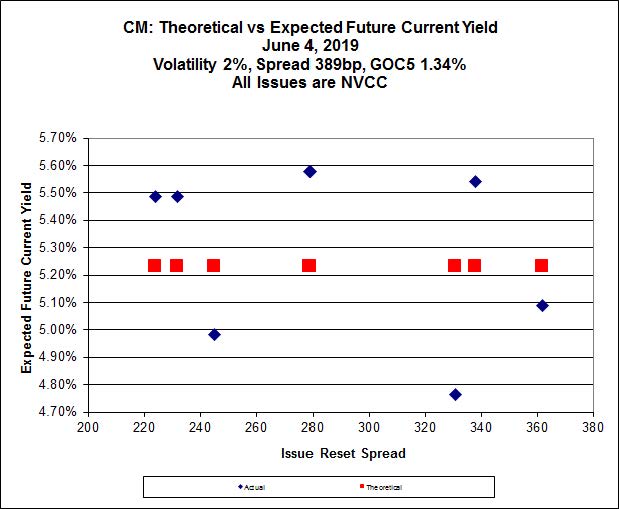
The new issue is so ridiculously expensive that we don’t even need fancy-pants Implied Volatility Analysis to prove it, but here’s the chart anyway:

impvol_ry_181105
Click for Big

According to this analysis, the fair value of the new issue on November 5 is 22.61, down $1.16 from the October 26 estimate of 23.77.

But, as I say, we don’t need this – even though the issue is, amusingly, trading more in line with NVCC non-compliant issues than the compliant ones. Let’s look at RY.PR.H, a FixedReset, 3.90%+226, that commenced trading 2014-6-3 after being announced 2014-5-23. This issue resets 2019-8-24, which is only three dividends away. The total dividend difference between RY.PR.H and RY.PR.S until then is therefore (4.80% – 3.90%) * 25 * 3/4 = $0.17. So for a reasonable comparison, take the actual November 5 bid of 22.20 for RY.PR.H and add seventeen cents to it to reflect the dividend difference. RY.PR.H has a projected dividend of (GOC5 + IRS) * 25 = (2.44% + 2.26%) * 25 = 4.70% * 25 = 1.175 p.a., which, at a notional price of 22.37, gives us an Expected Future Current Yield of 5.25%.

At the current bid of 24.69 and an expected future dividend of 1.205, RY.PR.S has an Expected Future Current Yield of 4.88%. Need I say more?

The ludicrously high figure of Implied Volatility is something I take to mean that the underlying assumption of the Black-Scholes model, that of no directionality of prices, is not accepted by the market; the market seems to be taking the view that since things seem rosy now, they will always be rosy and everything will trade near par in the future.

I balk at ascribing a 100% probability to the ‘all issues will be called, or at least exhibit price stability’ hypothesis. There may still be a few old geezers amongst the Assiduous Readers of this blog who can still (faintly) remember the Great Bear Market of 2014-16, in which quite a few similar assumptions made earlier turned out to be slightly inaccurate. The extra cushion implied by an Issue Reset Spread that is well over the market spread is worth something, even if nothing gets called. Or, to put it another way, one can buy a whole lot of downside protection for very little extra money, relative to this issue.

Issue Comments

MFC et al. Bailed Out by Regulators Again!

Some will recall that Muddy Waters / Carson Block have shorted Manulife shares in a move that looks prescient regardless of the details:

Muddy Waters has found its latest target: Canadian insurer Manulife Financial Corp.

Short seller Carson Block, who runs Muddy Waters, announced a short position in the firm Thursday, and said its life-insurance subsidiary just concluded a trial with a hedge fund that could lead to billions in losses. Block expects a verdict this year. Manulife said in a statement that it disagrees with Block’s conclusions.

In a report, Muddy Waters said it believes investors aren’t aware of the material risks to Manulife posed by the trial. The insurer was taken to court by hedge fund Mosten Investment LP, which claims it should be allowed to deposit unlimited amounts of capital with Manulife and earn at least 4 per cent in annual interest based on a 1997 universal life insurance policy it owns.

The trial concluded recently:

In an era of higher interest rates in the late 1990s, two predecessor companies of Industrial Alliance Insurance and Financial Services Inc. and Manulife Financial Corp. issued life insurance policies that allowed holders to invest in side accounts that guaranteed rates of up to five per cent and four per cent, respectively.

These side accounts did not contain an explicit limit on the size of investment, which means in today’s low-rate environment they are potentially lucrative for their holders and a significant liability for the companies that wrote them.

At least three limited partnerships purchased such policies several years ago in Saskatchewan, one of only four Canadian provinces that permit the purchase of insurance policies from their original holders. These investors are in court in Saskatoon to force the insurers to accept their money.

So it looks potentially dangerous, eh? But Manulife was defiant:

The Muddy Waters report is a short seller’s attempt to profit at the expense of our shareholders, and we disagree with its conclusions. Manulife continues to believe that Mosten’s position is legally unfounded. We firmly believe that the consumers purchasing universal life policies, and the insurers issuing these policies, never intended to have the policies function as deposit or securities contracts. We have a sound, highly rated global franchise. We expect we will prevail with respect to this matter and that it will not affect our business operations or our ability to meet obligations to our customers, vendors and other key stakeholders.

as were others:

Industrial Alliance Insurance and Financial Services Inc. (iA Financial Group) is responding to media reports regarding litigation involving Ituna Investment LP (Ituna). As part of this litigation, Ituna is seeking to make unlimited deposits into a universal life insurance contract that it purchased from a policyholder. The life insurance contract was originally issued by National Life, a company acquired by iA Financial Group in 1988.

The application was heard by the Court of Queen’s Bench in Saskatoon (Saskatchewan) in September 2018 and the parties now await the court’s decision.

iA Financial Group believes that the position taken by Ituna is legally unfounded. Ituna’s position would result in life insurance contracts being used as deposit accounts or commercial paper, purposes that are unrelated to life insurance and for which they were never intended. Ituna’s interpretation is contrary to the language of the life insurance contract and the legislative framework that governs insurance in Canada. iA Financial Group believes its legal position in this matter is strong and expects that it will be successful in its defence.

But remember – this is Canada! Future employment possibilities for ex-regulators are limited and must be cherished, as we found out in 2008 when Manulife’s grossly incompetent investment strategy nearly left it bust:

On Sept. 30, the head of Canada’s regulator, the Office of the Superintendent of Financial Institutions, wrote an e-mail to various OSFI officials. “D’Alessandro just called and asked that we try to meet next week with the company to discuss capital,” Julie Dickson wrote, noting that the meeting would replace one that had been arranged for November. Mr. D’Alessandro wanted to discuss the capital requirements for the variable-annuity, or segregated funds, business, other e-mails show.

Discussions took place in October in which he laid out why he felt the rules were too onerous, and OSFI officials had a flurry of internal discussions. On Oct. 28, the rules were changed.

OSFI consulted with more than one insurer that month, but the changes were most important to Manulife.

Federal lobbyist records show that Mr. D’Alessandro also met with Prime Minister Stephen Harper on Nov. 6 to discuss “financial institutions.” It is not known what was discussed at the meeting with Mr. D’Alessandro.

So now the cavalry has arrived again!

A trio of lawsuits against three Canadian life insurers face new hurdles after the government of Saskatchewan updated its insurance regulations, instituting changes that could materially impact the ongoing court cases – as well as a short seller’s high-profile campaign against Manulife Financial Corp.

All parties are waiting for the judge to rule, and the decision is expected to take some time to come out. But late Monday the government of Saskatchewan added a new dimension to the litigation by updating its insurance regulations, inserting new language that limits how much money can be deposited in insurance policies and their related accounts.

Manulife’s share price rose about 6 per cent on the Toronto Stock Exchange in early trading on Tuesday.

In an amendment to the Saskatchewan Insurance Regulations, the province added new language that states “no licensed insurer shall receive or accept for deposit funds or payments in excess of the amount required to pay the life insurance premium for the eligible period.”

Manulife crows:

The Saskatchewan regulations, published yesterday on the website of the Financial and Consumer Affairs Authority of Saskatchewan, limit the amount of premiums a life insurer may receive or accept for deposit in life insurance policies and associated side accounts. The basis of the claims by Mosten Investment LP (“Mosten”) against Manulife has been that life insurers can be compelled to accept unlimited premium payments. In effect, Mosten is seeking to use insurance policies to invest sizeable sums that have no connection to the insurance coverage.

Given the new Saskatchewan regulations, Manulife and the other life insurers involved in similar matters plan to make submissions to the court, asking it to dismiss the claims that life insurers can be compelled to accept unlimited premium payments. Manulife believes these regulations should accelerate the resolution, in its favour, of the principal matters in the Mosten litigation in Saskatchewan. With respect to any possible remaining ancillary matters in the litigation, Manulife continues to believe that it will prevail and that those matters are insignificant in any event.

Because the public policy concern addressed in Saskatchewan is equally relevant across Canada, the Canadian Life and Health Insurance Association, which intervened in the litigation on behalf of the industry, plans to request other provincial and territorial governments to take comparable regulatory steps to avoid unnecessary, costly litigation in other jurisdictions.

… and, of course, other potential future employers of regulatory personnel voiced their support:

Industrial Alliance Insurance and Financial Services Inc. (iA Financial Group) welcomes the recent publication of Saskatchewan regulations limiting the amount of premiums a life insurer may receive or accept for deposit in life insurance policies and associated side accounts.

Explicitly affected issues are (other lifecos may have been affected by this as well):

MFC.PR.B, MFC.PR.C, MFC.PR.F, MFC.PR.G, MFC.PR.H, MFC.PR.I, MFC.PR.J, MFC.PR.K, MFC.PR.L, MFC.PR.M, MFC.PR.N, MFC.PR.O, MFC.PR.P, MFC.PR.Q and MFC.PR.R

IAG.PR.A, IAG.PR.G and IAG.PR.I