Category: Issue Comments

Issue Comments

FFH: Outlook Positive, says S&P

Standard & Poor’s has announced:

  • •Fairfax Financial Holdings Ltd. and its subsidiaries’ (collectively, FFH)
    operating earnings outlook is improving as the company redeploys its substantial cash and short-term holdings.

  • •Our view of its competitive position has strengthened in the past few years due to the addition of strong operating assets that complement FFH’s insurance platform.
  • •We are revising our outlook on FFH to positive from stable, and affirming all of our ratings.
  • •The positive outlook means that we could upgrade FFH by one notch during the next 24 months if the group improves its fixed charge coverage, supported by a stable-to-declining trend in financial leverage, and maintains very strong capitalization redundant at the ‘AA’ level.


The positive outlook reflects the expansion of operating earnings primarily driven by an increase in investment earnings that should lead to steady improvement in debt serviceability and support prospective capitalization in the next two-to-three years. In addition, we expect FFH to build on its competitive position, leveraging further the strength of its combined insurance operating platform. We also expect group enterprise risk management (ERM) practices to continue to develop reflective of a large and complex organization.

Affected issues are FFH.PR.C, FFH.PR.D, FFH.PR.E, FFH.PR.F, FFH.PR.G, FFH.PR.H, FFH.PR.I, FFH.PR.J, FFH.PR.K and FFH.PR.M.

Issue Comments

IFC.PR.G Holds Its Own on Modest Volume

Intact Financial Corporation has announced:

that it has closed its previously announced bought deal offering (the “Offering”) of Non-cumulative Rate Reset Class A Shares, Series 7 (the “Series 7 Preferred Shares”) underwritten by a syndicate of underwriters (the “Underwriters”) led by TD Securities Inc. together with BMO Capital Markets, CIBC Capital Markets and National Bank Financial, resulting in aggregate gross proceeds (including the proceeds resulting from the exercise of their option) to IFC of $250 million. The net proceeds from the Offering will be used by IFC for general corporate purposes.

The holders of Series 7 Preferred Shares will be entitled to receive fixed non-cumulative preferential cash dividends, as and when declared by the Board of Directors of IFC, on a quarterly basis (with the first quarterly dividend, covering the period from issuance to September 30, 2018, to be paid on September 28, 2018), for the initial fixed rate period ending on June 30, 2023, based on an annual rate of 4.90%. The dividend rate will be reset on June 30, 2023 and every five years thereafter at a rate equal to the 5-year Government of Canada bond yield plus 2.55%.

Holders of the Series 7 Preferred Shares will have the right, at their option, to convert their Series 7 Preferred Shares into Non-cumulative Floating Rate Class A Shares, Series 8 (the “Series 8 Preferred Shares”), subject to certain conditions, on June 30, 2023 and on June 30 every five years thereafter. The holders of Series 8 Preferred Shares will be entitled to receive floating rate non-cumulative preferential cash dividends, as and when declared by the Board of Directors of IFC, at a rate equal to the 90-day Canadian Treasury Bill rate plus 2.55%.

DBRS Limited has assigned a rating of Pfd-2 with a Stable trend for the Series 7 Preferred Shares.

The Series 7 Preferred Shares will commence trading on the Toronto Stock Exchange on May 29, 2018 under the symbol IFC.PR.G.

IFC.PR.G is a FixedReset, 4.90%+255, announced 2018-5-17. It will be tracked by HIMIPref™ and has been assigned to the FixedReset subindex.

As this issue is not NVCC compliant, it will be analyzed as having a Deemed Retraction – that is, a “DeemedMaturity” on 2025-1-31 will be assumed. This date may change in the future. Note, however, that this carries more uncertainty than it does with most other insurers because Intact is a P&C insurer, not a life company.

The issue traded 463,145 shares today in a range of 24.70-92 before closing at 24.80-82. Vital statistics are:

IFC.PR.G FixedReset YTW SCENARIO
Maturity Type : Hard Maturity
Maturity Date : 2025-01-31
Maturity Price : 25.00
Evaluated at bid price : 24.78
Bid-YTW : 5.09 %

The TXPR price index is down 1.45% since the close prior to announcement (that is, from the close on May 16 until the close May 29), so the issue held its own against the overall market.

Issue Comments

ENB.PR.F: No Conversion to FloatingReset

p> Enbridge Inc. has announced :

that none of Enbridge’s outstanding Cumulative Redeemable Preference Shares, Series F (Series F Shares) will be converted into Cumulative Redeemable Preference Shares, Series G of Enbridge (Series G Shares) on June 1, 2018.

After taking into account all conversion notices received from holders of its outstanding Series F Shares by the May 17, 2018 deadline for the conversion of the Series F Shares into Series G Shares, less than the 1,000,000 Series F Shares required to give effect to conversions into Series G Shares were tendered for conversion.

It will be recalled that ENB.PR.F will reset to 4.689% effective 2018-6-1 and will hence be referred to as a FixedReset, 4.689%+251.

ENB.PR.F commenced trading 2012-1-18 after being announced 2012-1-9. It is tracked by HIMIPref™ but relegated to the Scraps subindex on credit concerns.

It will be further recalled that I recommended against conversion.

Issue Comments

FTN.PR.A To Get Bigger

Quadravest Capital Management has announced:

Financial 15 Split Corp. (the “Company”) is pleased to announce it will undertake an offering of Preferred Shares and Class A Shares of the Company. The offering will be co-led by National Bank Financial Inc., CIBC World Markets Inc., Scotia Capital Inc. and RBC Capital Markets, and will also include BMO Capital Markets, Canaccord Genuity Corp., Industrial Alliance Securities Inc., Echelon Wealth Partners, GMP Securities L.P., Raymond James Ltd., Desjardins Securities Inc., Mackie Research Capital Corporation, and Manulife
Securities Incorporated.

The Preferred Shares will be offered at a price of $9.90 per Preferred Share to yield 5.6% and the Class A Shares will be offered at a price of $10.30 per Class A Share to yield 14.6%.

The closing price on the TSX of each of the Preferred Shares and the Class A Shares on May 22, 2018 was $10.13 and $10.49, respectively.

Since inception of the Company, the aggregate dividends paid on the Preferred Shares have been $7.60 per share and the aggregate dividends paid on the Class A Shares have been $17.89 per share, for a combined total of $25.49. All distributions to date have been made in tax advantage eligible Canadian dividends or capital gains dividends.

The net proceeds of the offering will be used by the Company to invest in an actively managed, high quality portfolio consisting of 15 financial services companies made up of Canadian and U.S. issuers as follows:

Bank of Montreal National Bank of Canada Bank of America Corp.
The Bank of Nova Scotia Manulife Financial Corporation Citigroup Inc.
Canadian Imperial Bank of Commerce Sun Life Financial Services of Canada Inc. Goldman Sachs Group Inc.
Royal Bank of Canada Great-West Lifeco Inc. JP Morgan Chase & Co.
The Toronto-Dominion Bank CI Financial Corp. Wells Fargo & Co.

The Company’s investment objectives are:
Preferred Shares:
i. to provide holders of the Preferred Shares with fixed, cumulative preferential monthly cash dividends currently in the amount of 5.50% annually, to be set by the Board of Directors annually subject to a minimum of 5.25% until
2020; and
ii. on or about the termination date, currently December 1, 2020 (subject to further 5 year extensions thereafter), to pay the holders of the Preferred Shares $10.00 per Preferred Share.

Class A Shares:
i. to provide holders of the Class A Shares with regular monthly cash dividends in an amount to be determined by the Board of the Directors; and
ii. to permit holders to participate in all growth in the net asset value of the Company above $10 per Unit, by paying holders on or about the termination date of December 1, 2020 (subject to further 5 year extensions thereafter) such amounts as remain in the Company after paying $10 per Preferred Share

The sales period of this overnight offering will end at 9:00 a.m. EST on May 24, 2018. The offering is expected to close on or about May 31, 2018 and is subject to certain closing conditions including approval by the TSX.

So Whole Units are being offered for 20.20 and the NAVPU as of May 15 was 17.76! That’s a premium of a little under 14%! Holy smokes, but it’s a nice business when it works, eh?

Update, 2018-5-26: The offering was successful:

Financial 15 Split Corp. (the “Company”) is pleased to announce it has completed the overnight marketing of up to 5,159,000 Preferred Shares and up to 5,159,000 Class A Shares of the Company. Total proceeds of the offering are expected to be approximately $104.2 million.

Issue Comments

New Issue: EMA FixedReset 4.90%+254M490

Emera Incorporated has announced:

that it will issue 12,000,000 Cumulative Minimum Rate Reset First Preferred Shares, Series H (the “Series H Preferred Shares”) at a price of $25.00 per share and at an initial annual dividend rate of 4.90 per cent, for aggregate gross proceeds of $300 million on a bought deal basis to a syndicate of underwriters in Canada led by Scotiabank, CIBC Capital Markets, RBC Capital Markets and TD Securities Inc. Emera has granted to the underwriters an option, exercisable at any time up to 48 hours prior to the closing of the offering, to purchase up to an additional 2,000,000 Series H Preferred Shares at a price of $25.00 per share (the “Underwriters Option”). If the Underwriters Option is exercised in full, the aggregate gross proceeds to Emera will be $350 million.

The holders of the Series H Preferred Shares will be entitled to receive fixed cumulative preferential cash dividends at an annual rate of $1.225 per share, payable quarterly, as and when declared by the board of directors of Emera, yielding 4.90 per cent per annum, for the initial period ending on August 15, 2023. The first of such dividends, if declared, shall be payable on August 15, 2018, and shall be $0.25507 per Series H Preferred Share, based on the anticipated closing of the offering on May 31, 2018. The dividend rate will be reset on August 15, 2023 and every five years thereafter at a rate equal to the sum of the then five-year Government of Canada bond yield plus 2.54 per cent, provided that, in any event, such rate shall not be less than 4.90 per cent per annum. The Series H Preferred Shares are redeemable by Emera, at its option, on August 15, 2023 and on August 15 of every fifth year thereafter.

The holders of Series H Preferred Shares will have the right to convert their shares into Cumulative Floating Rate First Preferred Shares, Series I (the “Series I Preferred Shares”), subject to certain conditions, on August 15, 2023 and on August 15 of every fifth year thereafter. The holders of the Series I Preferred Shares will be entitled to receive quarterly floating rate cumulative preferential cash dividends, as and when declared by the board of directors of Emera, at a rate equal to the sum of the then 90-day Government of Canada treasury bill rate plus 2.54 per cent.

The offering is subject to the receipt of all necessary regulatory and stock exchange approvals. The net proceeds of the offering will be used for general corporate purposes.

This issue was announced almost simultaneously with a new issue from Intact Financial Corporation, a FixedReset 4.90%+255. Barry Critchley remarks:

While the two deals shared similar terms, investors treated them differently. By early afternoon only Intact’s order was completely filled. But sources indicated investors could still post expressions of interest for the Emera offering. On TD Investing’s website, the offering is indicated as open.

This seems quite rational, since the new issue is ridiculously expensive.

according to Implied Volatility Analysis:

impvol_ema_180517
Click for Big

According to the analysis above, the fair value is a bit under $24.00 … note, however, that complainers will triumphantly point out that this assigns a value of zero to the Floor Rate Guarantee. But as I stated in the February, 2018, edition of PrefLetter:

It is often asserted that a horrific fall of FixedReset prices is a completely logical expectation; that the 2014-16 bear market was completely justified; that similar experiences will happen again; and that floor rates are an excellent way to protect investors from the decline in income.

This assertion does not make a lot of sense to me. Suppose an investor holds a FixedReset with a coupon rate of 5% and that a decline in government yields makes a reduction to 4% seem both likely and imminent. If the bear market scenario is to play out, this investor and many like him will be selling to avoid experiencing the reset.

But where is this money to be deployed? Yields are already down in the government market and all other fixed income markets will be affected to some degree; corporate-government spreads increased during the recent episode (see Chart FR-63 ), but corporate yields did decline – they just didn’t decline as much. I see no reason for an expectation that FixedReset yields should magically remain constant if the face of global interest rate declines.

However, any increase in the price of the floor-rate issue is capped by the call price. In the simplest scenario, the non-floor issue will remain priced at par and reset to a 4% distribution, while the floored issue will be called; the investor will then have to reinvest his funds … and find that he is reinvesting at contemporary rates and experiencing transaction costs that are not borne by the investor in the non-floored issue. It’s not much of a win!

In order for the floor rate to have value, both issues must be trading at a discount to par; this will give the floored issue room to rise in price on the secondary market. Such a price rise will be determined by the excess yield to be gained over the next five years until the next reset plus, perhaps, an allowance for the possibility that current conditions will persist and give the holder another chance to reset. The benefit will be capped by the distribution rate difference multiplied by the Modified Duration of the issues (which will normally be in the range of 20 to 25), so a price difference of between 20% and 25% for a one percent decline in government yields. However, this potential gain is capped by the potential for a call, so the issues must already be trading at a 20%-25% discount to par for this maximum to be reached … and to work out the value of this scenario, we must then calculate the probability of such a decline in government yields.

Once we see floor-rate issues trading at large discounts in an environment in which a significant decline in government rates has a reasonable probability, I will revisit my opinion of the value of such guarantees. I’m not holding my breath.

However, even those unimpressed by all that “Implied Volatility” blather and tiresome pettifogging regarding Floor Guarantees should be, at the very least, tempted by EMA.PR.A in preference to the new issue. Sure, it only pays 2.555% at present … but it will reset on 2020-8-15 at GOC-5 + 184, or – given today’s GOC-5 yield of 2.33% – 4.17%. It was quoted today at 19.09-25, an Expected Future Current Yield of 5.46%, which ain’t bad for investment grade!

Issue Comments

ENB.PR.F : Convert or Hold?

It will be recalled that ENB.PR.F will reset at 4.689% effective June 1.

ENB.PR.F is a FixedReset, 4.00%+251, that commenced trading 2012-1-18 after being announced 2012-1-9. It is tracked by HIMIPref™ but relegated to the Scraps subindex on credit concerns.

The most logical way to analyze the question of whether or not to convert is through the theory of Preferred Pairs, for which a calculator is available. Briefly, a Strong Pair is defined as a pair of securities that can be interconverted in the future (e.g., ENB.PR.F and the FloatingReset that will exist if enough holders convert). Since they will be interconvertible on this future date, it may be assumed that they will be priced identically on this date (if they aren’t then holders will simply convert en masse to the higher-priced issue). And since they will be priced identically on a given date in the future, any current difference in price must be offset by expectations of an equal and opposite value of dividends to be received in the interim. And since the dividend rate on one element of the pair is both fixed and known, the implied average rate of the other, floating rate, instrument can be determined. Finally, we say, we may compare these average rates and take a view regarding the actual future course of that rate relative to the implied rate, which will provide us with guidance on which element of the pair is likely to outperform the other until the next interconversion date, at which time the process will be repeated.

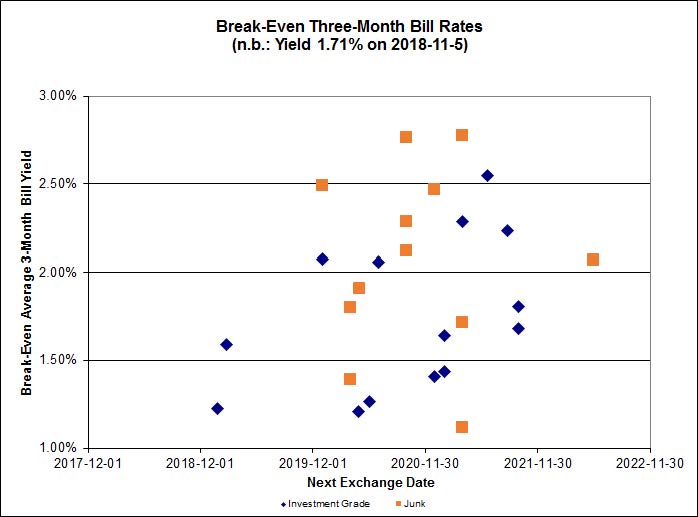
We can show the break-even rates for each FixedReset / FloatingReset Strong Pair graphically by plotting the implied average 3-month bill rate against the next Exchange Date (which is the date to which the average will be calculated).

pairs_fr_180511
Click for Big

The market appears to be relatively uninterested in floating rate product; most of the implied rates until the next interconversion are scattered around the current 3-month bill rate and the averages for investment-grade and junk issues are quite different, at +1.13% and +0.72%, respectively – although these break-even rates are much closer to the market rate than has often been the case! Whatever might be the result of the next few Bank of Canada overnight rate decisions, I suggest that it is unlikely that the average rate over the next five years will be lower than current – but if you disagree, of course, you may interpret the data any way you like.

Since credit quality of each element of the pair is equal to the other element, it should not make any difference whether the pair examined is investment-grade or junk, although we might expect greater variation of implied rates between junk issues on grounds of lower liquidity, and this is just what we see.

If we plug in the current bid price of the ENB.PR.F FixedReset, we may construct the following table showing consistent prices for its soon-may-be-issued FloatingReset counterpart given a variety of Implied Breakeven yields consistent with issues currently trading:

Estimate of FloatingReset (received in exchange for ENB.PR.F) Trading Price In Current Conditions
  Assumed FloatingReset
Price if Implied Bill
is equal to
FixedReset Bid Price Spread 1.75% 1.25% 0.75%
ENB.PR.F 20.29 251bp 19.87 19.38 18.89

Based on current market conditions, I suggest that the FloatingResets that will result from conversion are likely to be cheap and trading below the price of their FixedReset counterparts. Therefore, I recommend that holders of ENB.PR.F continue to hold the issue and not to convert.

If you do wish to convert, note that the deadline for notifying the company is 5:00 p.m. (EST) on May 17, 2018.. Brokerages and other intermediaries will normally set their internal deadlines a few days prior to this, so if you want to convert don’t waste any time! Such intermediaries may accept instructions after their internal deadline (but prior to the company deadline, of course) if you grovel in a sufficiently entertaining fashion, but this will only be done on a ‘best efforts’ basis.

I will note that once the FloatingResets commence trading (if, in fact, they do) it may be a good trade to swap the FixedReset for the FloatingReset in the market once both elements of each pair are trading and you can – presumably, according to this analysis – do it with a reasonably good take-out in price, rather than doing it through the company on a 1:1 basis. But that, of course, will depend on the prices at that time and your forecast for the path of policy rates over the next five years. There are no guarantees – my recommendation is based on the assumption that current market conditions with respect to the pairs will continue until the FloatingResets commence trading and that the relative pricing of the two new pairs will reflect these conditions.

Issue Comments

ENB.PR.F To Reset At 4.689%

Enbridge Inc. has announced (emphasis added):

that it does not intend to exercise its right to redeem its currently outstanding Cumulative Redeemable Preference Shares, Series F (Series F Shares) (TSX: ENB.PR.F) on June 1, 2018. As a result, subject to certain conditions, the holders of the Series F Shares have the right to convert all or part of their Series F Shares on a one-for-one basis into Cumulative Redeemable Preference Shares, Series G of Enbridge (Series G Shares) on June 1, 2018. Holders who do not exercise their right to convert their Series F Shares into Series G Shares will retain their Series F Shares.

The foregoing conversion right is subject to the conditions that: (i) if Enbridge determines that there would be less than 1,000,000 Series F Shares outstanding after June 1, 2018, then all remaining Series F Shares will automatically be converted into Series G Shares on a one-for-one basis on June 1, 2018; and (ii) alternatively, if Enbridge determines that there would be less than 1,000,000 Series G Shares outstanding after June 1, 2018, no Series F Shares will be converted into Series G Shares. There are currently 20,000,000 Series F Shares outstanding.

With respect to any Series F Shares that remain outstanding after June 1, 2018, holders thereof will be entitled to receive quarterly fixed cumulative preferential cash dividends, as and when declared by the Board of Directors of Enbridge. The new annual dividend rate applicable to the Series F Shares for the five-year period commencing on June 1, 2018 to, but excluding, June 1, 2023 will be 4.689 percent, being equal to the five-year Government of Canada bond yield of 2.179 percent determined as of today plus 2.51 percent in accordance with the terms of the Series F Shares.

With respect to any Series G Shares that may be issued on June 1, 2018, holders thereof will be entitled to receive quarterly floating rate cumulative preferential cash dividends, as and when declared by the Board of Directors of Enbridge. The dividend rate applicable to the Series G Shares for the three-month floating rate period commencing on June 1, 2018 to, but excluding, September 1, 2018 will be 0.93764 percent, based on the annual rate on three month Government of Canada treasury bills for the most recent treasury bills auction of 1.21 percent plus 2.51 percent in accordance with the terms of the Series G Shares (the Floating Quarterly Dividend Rate). The Floating Quarterly Dividend Rate will be reset every quarter.

Beneficial holders of Series F Shares who wish to exercise their right of conversion during the conversion period, which runs from May 2, 2018 until 5:00 p.m. (EST) on May 17, 2018, should communicate as soon as possible with their broker or other intermediary for more information. It is recommended that this be done well in advance of the deadline in order to provide the broker or other intermediary time to complete the necessary steps. Any notices received after this deadline will not be valid.

ENB.PR.F is a FixedReset, 4.00%+251, that commenced trading 2012-1-18 after being announced 2012-1-9. It is tracked by HIMIPref™ but relegated to the Scraps subindex on credit concerns.

The most logical way to analyze the question of whether or not to convert is through the theory of Preferred Pairs, for which a calculator is available. Briefly, a Strong Pair is defined as a pair of securities that can be interconverted in the future (e.g., ENB.PR.F and the FloatingReset that will exist if enough holders convert). Since they will be interconvertible on this future date, it may be assumed that they will be priced identically on this date (if they aren’t then holders will simply convert en masse to the higher-priced issue). And since they will be priced identically on a given date in the future, any current difference in price must be offset by expectations of an equal and opposite value of dividends to be received in the interim. And since the dividend rate on one element of the pair is both fixed and known, the implied average rate of the other, floating rate, instrument can be determined. Finally, we say, we may compare these average rates and take a view regarding the actual future course of that rate relative to the implied rate, which will provide us with guidance on which element of the pair is likely to outperform the other until the next interconversion date, at which time the process will be repeated.

We can show the break-even rates for each FixedReset / FloatingReset Strong Pair graphically by plotting the implied average 3-month bill rate against the next Exchange Date (which is the date to which the average will be calculated).

pairs_fr_180502
Click for Big

The market appears to be relatively uninterested in floating rate product; the implied rates until the next interconversion are approximately equal to the current 3-month bill rate and the averages for investment-grade and junk issues reflect this, at +1.21% and +1.08%, respectively. Whatever might be the result of the next few Bank of Canada overnight rate decisions, I suggest that it is unlikely that the average rate over the next five years will be lower than current – but if you disagree, of course, you may interpret the data any way you like.

Since credit quality of each element of the pair is equal to the other element, it should not make any difference whether the pair examined is investment-grade or junk, although we might expect greater variation of implied rates between junk issues on grounds of lower liquidity, and this is just what we see.

If we plug in the current bid price of the ENB.PR.F FixedReset, we may construct the following table showing consistent prices for its soon-may-be-issued FloatingReset counterpart given a variety of Implied Breakeven yields consistent with issues currently trading:

Estimate of FloatingReset (received in exchange for ENB.PR.F) Trading Price In Current Conditions
  Assumed FloatingReset
Price if Implied Bill
is equal to
FixedReset Bid Price Spread 1.50% 1.00% 0.50%
ENB.PR.F 19.55 251bp 18.89 18.40 17.91

Based on current market conditions, I suggest that the FloatingResets that will result from conversion are likely to be cheap and trading below the price of their FixedReset counterparts. Therefore, it seems likely that I will recommend that holders of ENB.PR.F continue to hold the issue and not to convert, but I will wait until it’s closer to the May 17 notification deadline before making a final pronouncement. I will note that once the FloatingResets commence trading (if, in fact, they do) it may be a good trade to swap the FixedReset for the FloatingReset in the market once both elements of each pair are trading and you can – presumably, according to this analysis – do it with a reasonably good take-out in price, rather than doing it through the company on a 1:1 basis. But that, of course, will depend on the prices at that time and your forecast for the path of policy rates over the next five years. There are no guarantees – my recommendation is based on the assumption that current market conditions with respect to the pairs will continue until the FloatingResets commence trading and that the relative pricing of the two new pairs will reflect these conditions.

Issue Comments

TRP Downgraded to P-2(low) by S&P

Standard & Poor’s has announced:

  • •We believe that TransCanada Corp. (TCC) will not achieve adjusted funds from operations (AFFO)-to-debt of 18%, a requirement we set for the ‘A-‘ rating.
  • •In addition, the company has an increasing U.S. asset portfolio that will account for 35%-40% of EBITDA by 2020, and that TCC’s credit measures are
    weaker than many lower-rated diversified U.S. peers.

  • •As a result, we are lowering our ratings on TCC and its subsidiary TransCanada PipeLines Ltd., including our long-term corporate credit rating on each to ‘BBB+’ from ‘A-‘.
  • •The stable outlook reflects our view that, over the next two years, AFFO-to-debt will be in the 15%-17% range, and debt-to-EBITDA will be approximately 4.5x.

S&P Global Ratings today lowered its ratings on TransCanada Corp. (TCC) and its subsidiary TransCanada PipeLines
Ltd., including its long-term corporate credit rating on both to ‘BBB+’ from ‘A-‘. The outlook is stable.

At the same time, we lowered our global and Canadian national scale preferred share ratings to ‘BBB-‘ and ‘P-2(Low)’ from ‘BBB’ and ‘P-2’ respectively. We also lowered our ratings on the senior unsecured debt to ‘BBB+’ from ‘A-‘ and
the junior subordinated debt to ‘BBB-‘ from ‘BBB’.

Finally, we affirmed our short term and commercial paper rating at ‘A-2’.

Affected issues are TRP.PR.A, TRP.PR.B, TRP.PR.C, TRP.PR.D, TRP.PR.E, TRP.PR.F, TRP.PR.G, TRP.PR.H, TRP.PR.I, TRP.PR.J and TRP.PR.K.

Issue Comments

LB Outlook Negative, says S&P

Standard & Poor’s has announced:

  • •On Dec. 5, 2017, Montreal-based Laurentian Bank of Canada disclosed mortgage documentation and client representation issues in connection with mortgages sold to a third-party purchaser, which resulted in some repurchase actions and raised concerns around the rigor of the company’s underwriting procedures and risk control functions.
  • •Since then, the bank has undertaken a sample review of its mortgage portfolio. While the review is still ongoing, company disclosures available so far suggest to us that widespread underwriting lapses or mortgage document falsification issues are unlikely to emerge.
  • •We understand that the documentation issues largely pertain to documentation deficiencies as opposed to intentional client fraud and misrepresentations. We expect the bank’s recent remedial initiatives to enhance its quality control functions and underwriting procedures, and note the company has not recorded any deterioration in loan performance.
  • •We are therefore removing the long- and short-term ratings from CreditWatch negative and affirming them at ‘BBB/A-2’.
  • •The negative outlook primarily reflects LBC’s relatively concentrated position in Canadian residential mortgages and our concern over a potential reduction in the company’s projected risk-adjusted capital ratio.


Our negative outlook, however, incorporates our view that the company continues to be exposed to risks associated with its more concentrated exposure to Canadian residential mortgages relative to peers’, with meaningful exposure to the non-prime segment (approximately 8% of total mortgage loans) at a time when we have concerns around consumer indebtedness (see: “Canada Economic Risk Higher On Elevated House Prices And Household Debt And Mortgage Fraud; No Ratings Affected,” published Feb. 23, 2018, on RatingsDirect). LBC’s total loans, net of allowances, stood at C$36.7 billion as at Jan. 31, 2018, of which C$18.6 billion (or approximately 50.7%) are Canadian residential mortgages (commercial loans make up about 33.5% of the loan book). This concentration in residential mortgages contributes to a meaningfully larger proportion of operating revenues being derived from net interest income (approximately 66.9% in first-quarter 2018) relative to the average of the larger Canadian banks (approximately 51.9% for the same period). LBC’s residential mortgage loans through independent brokers and advisors grew by 19% year-over-year as of first-quarter 2018. We will continue to monitor LBC’s asset quality metrics in a moderating housing market. As well, we note that LBC’s funding and liquidity ratios remain among the weakest of its peer banks, with a customer loans to deposits ratio, stable funding ratio, and broad liquid assets to short-term wholesale funding ratio of 156.4%, 91.82%, and 0.8x, respectively, compared with a peer average of 113.4%, 109.94%, and 1.38x, respectively). However, given the bank’s growth strategy and funding plans, we expect these metrics to improve over time.

In addition, we believe that LBC could experience some changes to its capital planning process as it adopts the advanced internal rating-based (AIRB) approach to credit risk measurement (projected for fiscal 2020), from the current standardized approach. The bank indicated that the implementation of the AIRB approach remains a key initiative of its transformation plan in order to optimize regulatory capital, and because its regulatory ratios are expected to increase (the exact extent is still not known), we believe that capital optimization strategies may negatively affect the risk-adjusted capital (RAC) ratio.

The outlook is negative, largely reflecting our view of LBC’s risks associated with a relatively concentrated position in Canadian residential mortgages consistent with our concerns around elevated house prices, household debt, and mortgage fraud. The negative outlook also reflects a potential reduction in LBC’s projected RAC ratio as a result of its expected transition to the AIRB approach to credit risk measurement, from the current standardized approach, which would likely reduce its regulatory capital requirements.

Affected issues are LB.PR.H and LB.PR.J

Issue Comments

DBRS: Canadian Banks’ Trends Now Stable on Bail-In Approval

DBRS has announced that it has:

changed the trend to Stable from Negative on the Long-Term Issuer Ratings, Senior Debt Ratings and Deposits ratings of the Bank of Montreal, The Bank of Nova Scotia, the Canadian Imperial Bank of Commerce and the National Bank of Canada. These actions result from the publication by the Minister of Finance of the final rules related to the Bank Recapitalization Regime (the Bail-in Regime). DBRS notes that the Stable trends on the long-term ratings of The Toronto-Dominion Bank and Royal Bank of Canada were unaffected. For these domestic systemically important banks (D-SIBs) to which the Bail-in Regime is applicable, DBRS has created a new obligation named Bail-inable Senior Debt. This new obligation rating reflects the senior debt that these banks will begin issuing once the Bail-in Regime goes into effect on September 23, 2018. Lastly, DBRS has downgraded the legacy Subordinated Debt ratings of these D-SIBs by one notch.

The revision of the trend to Stable from Negative for the affected long-term ratings reflects DBRS’s view that a downgrade of existing senior debt for the D-SIBs is now unlikely. It is anticipated that systemic support would still be sufficient to add a notch for such support until the D-SIBs issue adequate amounts of Bail-inable Senior Debt to meet their total loss-absorbing capacity (TLAC) requirements. Once an adequate level of bail-inable debt has been issued, the likelihood of future systemic support would be much lower. Accordingly, the notch of support would then be withdrawn. However, the new Bail-inable Senior Debt creates an additional buffer that better protects all senior obligations that cannot be bailed in under the regulation. Therefore, DBRS does not expect to downgrade any long-term ratings of existing senior obligations of the D-SIBs.

When issued, DBRS will rate the new Bail-inable Senior Debt at the level of each bank’s Intrinsic Assessment (IA), reflecting the risk of a D-SIB being put into resolution.

The downgrades of the legacy Subordinated Debt ratings reflect the structural subordination to the Bail-inable Senior Debt.

This has been telegraphed for a long, long time: