Category: Issue Comments

Issue Comments

BEP.PR.M Settles Firm on Decent Volume

There was no announcement from Brookfield Renewable Partners L.P., but BEP.PR.M closed today.

BEP.PR.M is a FixedReset 5.00%+300M500 ROC announced 2018-01-09. The issue will be tracked by HIMIPref™ but relegated to the Scraps subindex on credit concerns.

The issue traded 437,036 shares today in a range of 24.75-00 before closing at 24.99-00. Vital statistics are:

BEP.PR.M FixedReset YTW SCENARIO
Maturity Type : Limit Maturity
Maturity Date : 2048-01-16
Maturity Price : 23.14
Evaluated at bid price : 24.99
Bid-YTW : 4.92 %

This issue looks quite expensive to me, but quantifying the degree of richness is difficult. According to Implied Volatility Analysis:

impvol_bep_180116
Click for Big

Well, it’s starting to get monotonous, but we see in this chart many of the same features we saw when reviewing the recent BIP new issue as well as last week’s BEP issue, the CM issue and NA issue:

  • The curve is very steep, with Implied Volatility equal to 40% (a ridiculously large figure), and
  • The extant issues are trading relatively near to, or well above par

The ludicrously high figure of Implied Volatility is something I take to mean that the underlying assumption of the Black-Scholes model, that of no directionality of prices, is not accepted by the market; in turn, I suggest that this reflects a rather touching faith that the existence of a minimum rate guarantee on reset also indicates that the issues will never, ever trade below par. There will be a lot of long faces when this test gets failed in the future! All it will take is a spread-widening, whether market-wide or company-specific.

However, for the long term, I suggest that any change in the slope of the curve will be a flattening, with a very high degree of confidence. This will imply that the higher-spread issues will outperform the lower-spread issues.

Complicating the above analysis is a high probability that the three extant issues will each be called at the first opportunity. I will certainly agree that this is likely to happen, but I balk at ascribing a 100% probability to this outcome. There may still be a few old geezers amongst the Assiduous Readers of this blog who can still (faintly) remember the Great Bear Market of 2014-16, in which quite a few similar assumptions made earlier turned out to be slightly inaccurate.

All told, though, I have no hesitation in slapping a ‘Very Expensive’ label on this issue. According to the analysis illustrated by the above chart, the fair price is 23.36.

Update: Demonstration – to prepare the following chart I have constrained Implied Volatility to 10% (a much more reasonable figure, I think) and done a very, very, rough approximation to the error-minimizing Market Spread.

impvol_bep_180116_demonstration
Click for Big

In this calculation, the calculated fair values for the issues BEP.PR.G / I / K / M, with the difference from the actual market price in brackets, are 27.11 (+1.56), 28.23 (+2.48), 25.29 (+0.20) and 22.53 (-2.46). The values for N(d2) are 72%, 88%, 41% and 7%, respectively.

See the comments for the discussion.

Update #2, 2018-1-23: From January’s PrefLetter, here are charts FR-16, FR-31 and FR-37 … the numbering is consistent with the Fixed Reset Review of October 2016 that is referred to in the comments:

pl_180112_app_fr_chart_16
Chart FR-16, 2018-1-12
Click for Big
pl_180112_app_fr_chart_31
Chart FR-31, 2018-1-12
Click for Big
pl_180112_app_fr_chart_37
Chart FR-37, 2018-1-12
Click for Big

See the comments for discussion.

Issue Comments

SBC.PR.A Semi-Annual Report 17H1

Brompton Split Banc Corp. has released its Semi-Annual Report to June 30, 2017.

Figures of interest are:

MER: “The MER per Class A share, excluding Preferred share distributions (which were covered by the portfolio’s dividend income), was 1.64% for the first six months of 2017 compared to 1.77% for 2016. The MER per unit, excluding Preferred share distributions, was 0.94% for the first six months of 2017 and 0.99% for 2016. This ratio is more representative of the ongoing efficiency of the administration of the Fund.”

Average Net Assets: We need this to calculate portfolio yield. The Total Assets of the fund at year end was $172.0-million, compared to $183.1-million on June 30, however “On April 6, 2017, the Fund announced the split of its Class A shares (“Share Split”) and the concurrent private placement of Preferred shares (“Private Placement’) effective April 25, 2017. Pursuant to the Private Placement, 1,382,784 Preferred shares were offered to investors at a price of $10.03 per Preferred share.” So instead of giving equal weight to the beginning and end figures, we’ll assign a two-thirds weight to the year-end figure to arrive at a weighted average of $175.7-million.

Distributions to preferred shareholders were 1,596,090, at a rate of 0.225, so the average preferred shares outstanding was 7,093,733. The Unit Value was 23.10 at year-end, 22.73 on June 30, average 22.92, for average assets of $162.6-million.

Split the difference between the two methods and say average assets were $169.2-million.

Underlying Portfolio Yield: Semi-annual dividends, interest and security lending income received of 3.412-million divided by average net assets of 169.2-million is 4.03% p.a.

Income Coverage: Gross investment income of 3.412-million less expenses of 1.161-million is Net Investment Income of 2.251-million, divided by Preferred Share Distributions of 1.596-million is 141%.

Issue Comments

FFH Upgraded to Pfd-3(high) by DBRS

DBRS has announced that it:

upgraded Fairfax Financial Holdings Limited’s (Fairfax or the Company) Issuer Rating to BBB (high) from BBB, its Senior Unsecured Debt rating to BBB (high) from BBB and its Preferred Shares rating to Pfd-3 (high) from Pfd-3.

The upgrade of Fairfax’s ratings primarily reflects the application of the “Global Insurance Methodology” and the assignment of an FSR of “A” to its operating insurance companies. As the parent holding company, Fairfax’s Issuer Rating of BBB (high) is positioned two notches below this FSR.

In upgrading the Issuer Rating to BBB (high), DBRS takes into account Fairfax’s good franchise strength and risk profile, including its good net earnings, liquidity and capitalization. DBRS also considered the successful completion of the acquisition of Allied World (AWAC), which enhances the Company’s global market share, product offering and geographic reach while strengthening Fairfax’s position in the U.S. Excess & Surplus insurance market, increasing the Company’s rank to within the top five.

Fairfax has eliminated all of its equity index hedges, sold the majority of its long-dated bonds and reduced the duration of its fixed-income portfolios. This is expected to result in more stable investment income and net earnings going forward. Indicative of its franchise strength, the Company is the third-largest commercial property and casualty (P&C) insurer in Canada in terms of market share based on 2016 direct written premiums, and it is one of the top 15 global non-life reinsurers after the acquisition of AWAC.

The Company’s value-based investment strategy, though effective and historically successful, tends to yield volatile results. Consequently, despite historically stable and profitable underwriting results, the earnings volatility from investment income and past hedging activities are affecting fixed-charge coverage ratios that are averaging 3.0 times (x) lower than desired levels for an “A”-rated company. Fairfax’s high cash balances and the subsidiaries’ dividend capacity alleviate concerns about Fairfax’s meeting its capital servicing requirements.

The Stable trend considers the Company’s improving fundamentals, including its expanding global operations and strengthening franchise as well as its ability to adapt to the current challenging operating environment.

RATING DRIVERS

Positive ratings pressure could arise if the Company demonstrates a sustained improvement in profitability through consistently high returns on equity accompanied by well-managed risk exposures with continuous protection of capital, evidenced by strong regulatory capital ratios, along with material reduction in leverage, significantly improved fixed-charge coverage ratios and a material reduction in investment income volatility. Negative ratings pressure could arise through the inadequate monitoring and oversight of assumed risks, resulting in a material deterioration in underwriting results, a sustained material decline in the regulatory capital ratios of the operating subsidiaries, a material reduction in holdco liquidity levels or a sustained significant deterioration in investment income.

Affected issues are FFH.PR.C, FFH.PR.D, FFH.PR.E, FFH.PR.F, FFH.PR.G, FFH.PR.H, FFH.PR.I, FFH.PR.J, FFH.PR.K and FFH.PR.M.

Note that Fairfax Financial Holdings Limited is not regulated by OSFI although Northbridge, its P&C subsidiary, is:

In Canada, property and casualty companies are regulated by the Office of the Superintendent of Financial Institutions on the basis of a minimum supervisory target of 150% of a minimum capital test (‘‘MCT’’) formula. At December 31, 2016 and 2015 Northbridge’s subsidiaries had a weighted average MCT ratio in excess of the 150% minimum supervisory target.

Therefore, I do not consider FFH issues to be subject to the potential DeemedRetraction of insurers.

Issue Comments

ENB Preferreds Downgraded to Ba2 by Moody’s

Moody’s Investor Service has announced:

today downgraded the senior unsecured ratings of Enbridge Inc. (ENB) to Baa3 from Baa2. In addition, Moody’s changed the short term commercial paper rating for Enbridge (US) Inc. to P-3 from P-2 and the subordinate ratings to Ba2 from Ba1. At the same time, Moody’s changed the rating outlook for Enbridge to stable from negative.

The downgrade reflects ongoing high leverage at Enbridge Inc. For example, Moody’s calculates a ratio of debt to EBITDA at 6.4x for the twelve months ended September 2017. Attaining a ratio below 5.5x, for a sustained period of time, is an important threshold to maintain the Baa2 rating. On a prospective basis, taking into consideration the actions announced, the ratio could fall to the 5.3x — 5.5x range, but Moody’s views the execution risks associated with Enbridge’s stated actions to be sufficiently high that achieving those levels in 2018 would be challenging.

Outlook

The change in rating outlook to stable from negative reflects Enbridge’s predictable cash flow generation and large, low business risk asset base. The stable outlook reflects an expectation that Enbridge will follow through on its announced strategic plans, which include some non-core asset divestitures and financing plans that encompasses a balanced mix of both debt and equity. The stable outlook also incorporates a view that Enbridge’s key financial credit metrics, including a ratio of debt to EBITDA, will decline towards 5.5x during 2018, setting a path for further improvements to financial metrics in 2019 and 2020.

Factors that Could Lead to an Upgrade

  • • Moody’s adjusted debt to EBITDA is sustained comfortably below 5.5x.
  • • A large reduction in its organizational complexity and structural subordination

Factors that Could Lead to a Downgrade

  • • Moody’s adjusted debt to EBITDA is sustained well above 6x.
  • • Increases in structural subordination, more aggressive financial policies or a material change in the company’s business risk could also lead to a downgrade.


Pref. Stock Preferred Stock, Downgraded to Ba2 from Ba1

The story attracted notice from the Globe & Mail.

Affected issues are (deep breath) ENB.PF.A, ENB.PF.C, ENB.PF.E, ENB.PF.G, ENB.PF.I, ENB.PF.K, ENB.PR.A, ENB.PR.B, ENB.PR.C, ENB.PR.D, ENB.PR.F, ENB.PR.H, ENB.PR.J, ENB.PR.N, ENB.PR.P, ENB.PR.T and ENB.PR.Y

Issue Comments

BAM.PR.Z : No Conversion to FloatingReset

Brookfield Asset Management Inc. has announced:

that after having taken into account all election notices received by the December 18, 2017 deadline for the conversion of the Cumulative Class A Preference Shares, Series 30 (the “Series 30 Shares”) (TSX:BAM.PR.Z) into Cumulative Class A Preference Shares, Series 31 (the “Series 31 Shares”), the holders of Series 30 Shares are not entitled to convert their Series 30 Shares into Series 31 Shares. There were 119,204 Series 30 Shares tendered for conversion, which is less than the one million shares required to give effect to conversions into Series 31 Shares.

It will be recalled that BAM.PR.Z will reset to 4.685% and that I recommended against conversion.

BAM.PR.Z is a FixedReset, 4.80%+296, that commenced trading 2011-11-2 after being announced 2011-10-24. It is tracked by HIMIPref™ and assigned to the FixedReset subindex.

Issue Comments

NPI.PR.C : No Conversion to FloatingReset

Northland Power Inc. has announced:

that as fewer than one million of its Cumulative Rate Reset Preferred Shares, Series 3 (“Series 3 Shares”) were tendered for conversion into Cumulative Floating Rate Preferred Shares, Series 4 (the “Series 4 Shares”), no Series 3 Shares will be converted into Series 4 Shares. Consequently, effective December 31, 2017, Northland will continue to have 4,800,000 Series 3 Shares and no Series 4 Shares issued and outstanding.

The fixed quarterly dividends on the Series 3 Shares for the period from January 2, 2018 until December 31, 2022 will be paid at an annual rate of 5.08% (Cdn. $0.3175 per share per quarter).

The Series 3 Shares are listed on the Toronto Stock Exchange under the symbol “NPI.PR.C”.

It will be recalled that NPI.PR.C will reset to 5.08% effective January 1 and I recommended against conversion.

NPI.PR.C is a FixedReset, 5.00%+346, that commenced trading 2012-5-24 after being announced 2012-5-14. It is tracked by HIMIPref™ but relegated to the Scraps index on credit concerns.

Issue Comments

LB : CreditWatch Negative, says S&P

S&P Global Ratings has announced:

  • •Montreal-based Laurentian Bank of Canada recently disclosed mortgage documentation and client representation issues, with a sample of mortgage loans sold to third-party purchasers, that have generated some concern, on our part, with respect to the rigor of the company’s underwriting procedures and risk control functions.
  • •While there is currently no evidence of weakened asset quality in the sample or overall mortgage portfolio, we believe aggressive residential loan growth as well as the bank’s exposure to the nonprime residential mortgage segment of the Canadian mortgage market has increased the near-term downside to the risk profile for Laurentian Bank.
  • •We are therefore placing our ratings on Laurentian Bank of Canada on CreditWatch with negative implications.


The CreditWatch placement reflects our view that the bank’s aggressive loan growth could have negative repercussions for LBC’s creditworthiness. Although the bank’s asset-quality metrics remain strong, we believe the recent disclosures around lapses in mortgage documentation based on a sample of mortgages sold to a third-party purchaser (TPP) and inadvertent inclusion of ineligible loans in another third-party transaction suggest the company’s underwriting procedures and risk control functions may be weaker than the assumptions our current ratings incorporate.

As noted in our June 16 report on the bank, we believe that LBC’s ambitious transformation plan, largely focused on growth in commercial lending and increased use of the B2B (via brokers and third-party financial advisers) channel, may negatively affect the bank’s asset-quality profile. In 2017, LBC’s residential mortgage loans were up 10% from last year, reflecting organic growth through independent brokers and advisors.

Specifically, we could lower our ratings on LBC if we see:

  • •Further findings regarding mortgage document falsification that show the problem to be deeper than initially described;
  • •Weakening funding and liquidity profile, such that our stable funding ratio and broad liquid assets as a proportion of short-term wholesale funding for Laurentian Bank meaningfully weaken;
  • •Deterioration in loan performance and asset quality metrics owing to the aforementioned documentation issues or otherwise; or
  • •Legal or regulatory actions affecting the company’s financials or reputation.

We could affirm the ratings, and revise the outlook to negative, if we observe receding near-term risks, including:

  • •The mortgage document falsification proves to be small in impact and largely contained to a minor segment of the portfolio.

Affected issues are LB.PR.H and LB.PR.J.

This move follows coverage by Canadian media:

Laurentian Bank of Canada is trying to calm jittery investors, suggesting shareholders overreacted when they sent its share price tumbling after the bank disclosed problems with some mortgages it issued.

The Montreal-based bank played down documentation gaps and misrepresentation affecting up to $300-million in mortgages as largely a paperwork issue, even as it admitted staff had failed to get necessary documents to verify some loans, while a lesser number of clients had embellished their means to qualify.

Executives at the lender have stressed that it has ample excess cash to repurchase $180-million in problematic loans in the near term, and more if necessary. Audits turned up no evidence that staff did anything intentionally wrong, and found no notable concentration of improper loans coming from any particular mortgage brokers, the bank said. And so far, the loans at issue have performed well.

Issue Comments

IFC.PR.A : No Conversion to FloatingReset

Intact Financial Corporation has announced:

that, after having taken into account all elections received before the December 15, 2017, 5:00 p.m. (ET) conversion deadline, with respect to the Non-cumulative Rate Reset Class A Shares Series 1 of IFC (the “Series 1 Preferred Shares”) tendered for conversion on December 31, 2017 into Non-cumulative Floating Rate Class A Shares Series 2 of IFC (the “Series 2 Preferred Shares”), the holders of Series 1 Preferred Shares are not entitled to convert their shares. There were 181,136 Series 1 Preferred Shares tendered for conversion, which is fewer than the 1,000,000 Series 1 Preferred Shares required for the ability to proceed with the conversion, in accordance with the terms of the Series 1 Preferred Shares.

There are 10,000,000 Series 1 Preferred Shares listed on the Toronto Stock Exchange (“TSX”) under the symbol IFC.PR.A. The annual dividend rate for the Series 1 Preferred Shares for the five-year period from and including December 31, 2017 to but excluding December 31, 2022, will be 3.396%, as determined in accordance with the terms of the Series 1 Preferred Shares.

Subject to certain conditions described in IFC’s prospectus dated July 5, 2011, IFC may redeem the Series 1 Preferred Shares, in whole or in part, on December 31, 2022 and on December 31 every five years thereafter.

For more information on the terms of, and risks associated with an investment in, the Series 1 Preferred Shares, see IFC’s prospectus dated July 5, 2011 which is available on www.sedar.com.

It will be recalled that IFC.PR.A will reset at 3.396% effective December 31, 2017, and I recommended against conversion.

IFC.PR.A is a FixedReset, 4.20%+172, that commenced trading 2011-7-12 after being announced 2011-6-22. The issue is tracked by HIMIPref™ and has been assigned to the FixedReset subindex.

As this issue is not NVCC compliant and it is an insurance issue, it is analyzed as having a Deemed Retraction. Note that I am less certain with respect to this decision than I am with life insurers – it is by no means assured that property and casualty insurers will be treated the same as life insurers once all the regulatory dust settles.

Issue Comments

KML.PR.C Settles Firm On Decent Volume

Kinder Morgan Canada Limited has announced:

that it has completed its previously announced offering of cumulative redeemable minimum rate reset preferred shares, Series 3 (the “Series 3 Preferred Shares”) for aggregate gross proceeds of $250 million. The Company issued 10,000,000 Series 3 Preferred Shares, including 2,000,000 Series 3 shares issued as a result of the full exercise of the underwriter’s option, through a syndicate of underwriters led by CIBC Capital Markets, Scotiabank, RBC Capital Markets and TD Securities.

The Company intends to use the proceeds from the offering to indirectly subscribe for preferred units in Kinder Morgan Canada Limited Partnership, which, in turn, intends to use such proceeds to, directly or indirectly, finance the development, construction and completion of the Trans Mountain Expansion Project and Base Line Terminal project as well as potential future growth opportunities, to repay indebtedness and for general corporate purposes.
The Series 3 Preferred Shares will begin trading today on the TSX under the symbol KML.PR.C. S&P and DBRS have assigned this series a rating of P-3 (High) and Pfd-3 (high), respectively.

Dividends on the Series 3 Preferred Shares are expected to be $1.3000 per share annually, payable quarterly on the 15th day of February, May, August and November, as and when declared by the Board of Directors of the Company, for the initial fixed rate period to but excluding February 15, 2023. The first dividend, if declared, will be payable February 15, 2018, in the amount of $0.22082 per share.

All of the Company’s dividends are designated “eligible dividends” for Canadian income tax purposes.

KML.PR.C is a FixedReset, 5.20%+351M520, announced 2017-12-6. It will be tracked by HIMIPref™ but relegated to the Scraps subindex on credit concerns.

The issue traded 508,130 shares today in a range of 24.94-00 before closing at 24.99-00. Vital statistics are:

KML.PR.C FixedReset YTW SCENARIO
Maturity Type : Limit Maturity
Maturity Date : 2047-12-15
Maturity Price : 23.15
Evaluated at bid price : 24.99
Bid-YTW : 5.13 %
Issue Comments

BAM.PR.Z : Convert or Hold?

It will be recalled that BAM.PR.Z will reset to 4.685% (paid on par) effective January 1.

Holders of BAM.PR.Z have the option to convert to FloatingResets, which will pay 3-month bills plus 296bp on the par value of $25.00, reset quarterly. The deadline for notifying the company of the intent to convert is 5:00 p.m. (Toronto time) on December 18, 2017; but note that this is a company deadline and that brokers will generally set their deadlines a day or two in advance, so there’s not much time to lose if you’re planning to convert! However, if you miss the brokerage deadline they’ll probably do it on a ‘best efforts’ basis if you grovel in a sufficiently entertaining fashion. The ticker for the new FloatingReset, if it is issued, will be BAM.PF.K.

BAM.PR.Z is a FixedReset, 4.80%+296, that commenced trading 2011-11-2 after being announced 2011-10-24. It is tracked by HIMIPref™ and assigned to the FixedReset subindex.

The most logical way to analyze the question of whether or not to convert is through the theory of Preferred Pairs, for which a calculator is available. Briefly, a Strong Pair is defined as a pair of securities that can be interconverted in the future (e.g., BAM.PR.Z and the FloatingReset, BAM.PF.K, that will exist if enough holders convert). Since they will be interconvertible on this future date, it may be assumed that they will be priced identically on this date (if they aren’t then holders will simply convert en masse to the higher-priced issue). And since they will be priced identically on a given date in the future, any current difference in price must be offset by expectations of an equal and opposite value of dividends to be received in the interim. And since the dividend rate on one element of the pair is both fixed and known, the implied average rate of the other, floating rate, instrument can be determined. Finally, we say, we may compare these average rates and take a view regarding the actual future course of that rate relative to the implied rate, which will provide us with guidance on which element of the pair is likely to outperform the other until the next interconversion date, at which time the process will be repeated.

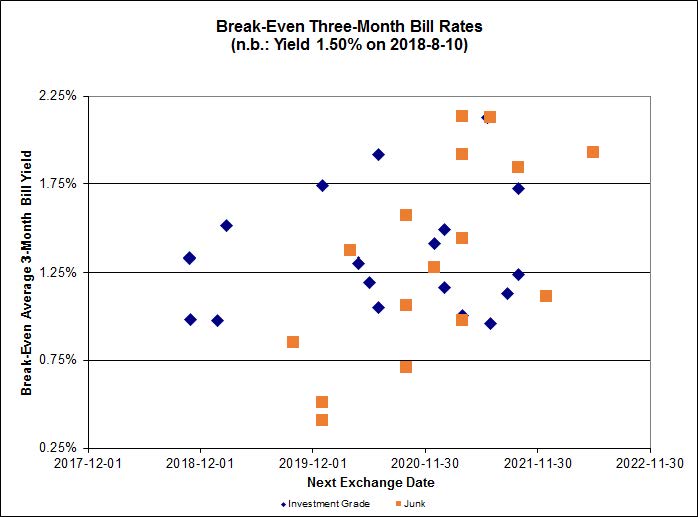
We can show the break-even rates for each FixedReset / FloatingReset Strong Pair graphically by plotting the implied average 3-month bill rate against the next Exchange Date (which is the date to which the average will be calculated).

pairs_fr_171208
Click for Big

The market appears to have a distaste at the moment for floating rate product; most of the implied rates until the next interconversion are lower than the current 3-month bill rate and the averages for investment-grade and junk issues are both well below current market rates, at +0.47% and +0.51%, respectively! Whatever might be the result of the next few Bank of Canada overnight rate decisions, I suggest that it is unlikely that the average rate over the next five years will be lower than current – but if you disagree, of course, you may interpret the data any way you like.

Since credit quality of each element of the pair is equal to the other element, it should not make any difference whether the pair examined is investment-grade or junk, although we might expect greater variation of implied rates between junk issues on grounds of lower liquidity, and this is just what we see.

If we plug in the current bid price of the BAM.PR.Z FixedReset, we may construct the following table showing consistent prices for its maybe-soon-to-be-issued FloatingReset counterpart given a variety of Implied Breakeven yields consistent with issues currently trading:

Estimate of FloatingReset BAM.PF.K (received in exchange for BAM.PR.Z) Trading Price In Current Conditions
  Assumed FloatingReset
Price if Implied Bill
is equal to
FixedReset Bid Price Spread +1.00% +0.50% 0.00%
BAM.PR.Z 24.20 296bp 23.46 22.95 22.45

Based on current market conditions, I suggest that the FloatingResets that will result from conversion are likely to be cheap and trading below the price of their FixedReset counterparts. Therefore, I recommend that holders of BAM.PR.Z continue to hold the issue and not to convert. I will note that, given the apparent cheapness of the FloatingResets, it may be a good trade to swap the FixedReset for the FloatingReset in the market once both elements of each pair are trading and you can – presumably, according to this analysis – do it with a reasonably good take-out in price, rather than doing it through the company on a 1:1 basis. But that, of course, will depend on the prices at that time and your forecast for the path of policy rates over the next five years. There are no guarantees – my recommendation is based on the assumption that current market conditions with respect to the pairs will continue until the FloatingResets commence trading and that the relative pricing of the new pair will reflect these conditions.