Category: MAPF

Indices and ETFs

November 29 Tracking Error

In the discussion of the performance of MAPF in November, I discussed the apparent tracking error of ZPR – which, as an index fund, should have minimal tracking error – and stated:

It will be remembered that I calculate performance using bid prices, while the bums at the Exchange and S&P use closing prices. This difference may well have been important under the current circumstances

So, it looks as if the jump in the index in the last two days is reasonable; and the unchanged NAV of ZPR in the last two days is what was reported by them. The scarcely credible indicated tracking error in the past two days may well be the exact truth; I will wait with bated breath for confirmation from the fund.

So ZPR has now updated its Tracking Error Chart and it looks like this:

ZPRTrackingError_131205
Click for Big

It is plainly apparent that there is a surge in tracking error at the end of the month, but this is better quantified with a chart (prepared from their published raw data) that focuses on the difference of returns:

ZPR_TrackingErrorDifference
Click for Big

This makes it pretty clear that there was a big pop in tracking error on November 29, which was in most part reversed on December 2. ZPR is chugging along with a monthly tracking error of about four and a half basis points, which is what it should be doing.

OK, so what could have caused a huge increase in tracking error like that? One possibility, which I suggested in the initial discussion, is that the fund could have received a large amount of cash at monthend, and either caused distortion in the market when investing it, or simply have been caught underinvested at a time when the market rocketted upwards. The first of these explanations can now be set aside, as the tracking error returned to normal after the explosion; the not consistent with the fairly modest moves in the HIMIPref™ indices on November 29.

That’s all I can think of at the moment as far as “real” fund and market activities are concerned, so we’ll turn to technical explanations that reflect mere reporting, as opposed to actual market activity.

If we obtain the TXPL methodology from the S&P TXPL web page, we find that:

The total return calculation includes stock dividends paid in kind, stock dividends paid with the securities of an issuer other than the issuer declaring such dividend, rights distributions, and cash distributions less than 4% of the underlying stock price based on the last traded board lot.

A dollar value is calculated for the distribution to be used in the total return index calculation.

For details on total return calculations, please refer to S&P Dow Jones Indices’ Index Mathematics Methodology.

If we refer to the S&P Dow Jones Indices’ Index Mathematics Methodology as suggested, we find that:

The total return construction differs from the price index and builds the index from the price index and daily total dividend returns.

This is really cute, because the document does not state explicitly how the price index is constructed. However, there are two references to “closing prices”:

Index maintenance – reflecting changes in shares outstanding, capital actions, addition or deletion of stocks to the index – should not change the level of the index. If the S&P 500 closes at 1250 and one stock is replaced by another, after the market close, the index should open at 1250 the next morning if all of the opening prices are the same as the previous day’s closing prices.

Divisor adjustments are made “after the close” meaning that after the close of trading the closing prices are used to calculate the new divisor based on whatever changes are being made.

There are no meaningful references in the document to “quote”, “quotation” or “VWAP”; it is therefore reasonable to assume that S&P uses the closing price as the basis for its calculations, while the HIMIPref™ indices use the closing bid. It is better procedure, by the way, to use the closing bid: this is consistent with IFRS accounting:

Long positions should be valued at the bid price and short positions should be valued at the asking price. Assets and liabilities with offsetting market risks may be valued at mid-market prices for the offsetting risk positions and at bid or asking prices for net positions as appropriate.

This is particularly the case for illiquid securities such as Canadian preferred shares. The “closing price” – also referred to as the “last sale price” – could refer to a transaction executed in the morning before a big move … or even several weeks before, if it’s really illiquid! Additionally, and especially for a single security, the so-called “fair value” under the “closing price” regime could move by 1% (or even more) simply according to whether the last trade was a hit or a lift. However, only huge companies such as Hymas Investment Management Inc. have the in-house expertise apply this knowledge – small shops like Standard & Poor’s simply can’t compete.

Anyway, it is useful to compare the difference between the two measures for November 28 (chosen more or less arbitrarily as a control date) and November 29. In the following chart, each security for which a close was reported by the Toronto Exchange was analyzed by dividing the close by the last bid, then subtracting one:

HIMIPrefCloseVsBid
Click for Big

Obviously, there’s a big difference – not just in the average, but the entire distribution is skewed on the 29th. This leads us to conclude that a very large proportion of last trades on the 29th were at the asking price – this might be indicative of a big player taking a meaningful position on the last day of the month, while being willing to absorb the costs of the market spread. Or it could be random market fluctuation – but obviously a very rare one, given the reasonableness of the ZPR tracking error over time. The effect is too small and too broad to be anything nefarious, like high-closing … or if it is nefarious, it’s more complex than the usual manipulation!

The existence of the skew leads one to wonder whether the effect was:
(i) confined to a particular credit strata, and/or
(ii) confined to a particular structure.

To investigate this, I have analyzed the BMO-CM “50” index, largely on the grounds that this is easy for me.

BMOCM50_All
Click for Big

The BMO-CM “50” is largely investment-grade (one reason why I like it!) and the effect appears to be proportional to that observed for the universe. The weighted average close/bid factor on the 28th is 1.0021 (that is to say, 21bp), while on the 29th it’s 43bp. This compares to unweighted averages for the universe of 26bp and 41bp; pretty close, I’d say, implying that the effect is much the same in this (mostly) investment-grade sample as it is for the universe.

We can draw more conclusions when we break down the results according to the sectors defined by the BMO-CM 50 analysts:

BMOCM50_Retractable
Click for Big

BMOCM50_FloatingRate
Click for Big

BMOCM50_StraightPerp
Click for Big

BMOCM50_FixedReset
Click for Big

Average last-trade / last-bid factors are:

BMO-CM “50” Sectors
Weighted Average
Last Trade / Last Bid
Difference from Unity
Sector November 28, 2013 November 29, 2013
Retractable 7bp 30bp
Floating Rate 38bp 43bp
Straight Perpetual 19bp 47bp
Fixed Reset 21bp 42bp

So, with the exception of Floating Rate (which is a very small sector; conclusions one way or another are hard to support) we may conclude that the effect is present irrespective of preferred share structure. We also note that volume was very heavy on November 29.

This in turn leads us to believe that there was some very heavy, broadly based buying pressure on November 29; this was probably not from ZPR, which did not have any meaningful jump in tracking error as of December 1 (I have an inquiry into the fund, seeking to veryify that it values itself at the closing bid); it might have been from CPD, which had no meaningful tracking error in November and values itself at the closing price; or it may have been somebody else entirely – index funds aren’t the only indexers!

Note that given the broad base of the buying, the indexer (or index fund) won’t have lost much against the index, but it will have absorbed much of the bid-ask spread; however – and this is the critical bit – the index will have also absorbed much of the bid-ask spread. However, his clients can at least be relieved that he didn’t go nuts; he absorbed the spread, but a reasonable spread, nothing like the CPD / POW.PR.C fiasco in January, 2010.

And, to my heartfelt relief, we may also conclude that MAPF will probably get a boost to its December performance vis a vis the indices (on the order of 60bp, if we can take ZPR as an indicator; or 20-odd bp if the BMO-CM “50” close/bid ratios are indicative), as the close/bid differential (probably!) returns to normal.

Update, 2013-12-6 The plot thickens! My contact at BMO tells me that the valuation of ZPR is at the closing price, not the closing bid, which knocks out the price / bid explanation of the increase in tracking error. He is checking to see if he can determine the source of the discrepency, but in the meantime, here’s another possibility…

Mutual Funds love to inform everybody that trades are reflected in the valuation as of the Trade Date, but I happen to know that this was very often not the case – at least, it was very often not the case back in 2008. Things may have changed in the interim, although I doubt it.

Many clients like to see that their funds are valued by external valuators, because this allows them to tick a box on their due-diligence checklist. However, there is at least one enormous external valuator (very big, and my goodness, they charge the earth for it, which is why I’ve never been a client) that does not actually do this. Reflecting trades on Trade Date would mean that the trade lists wouldn’t be available prior to 4:00pm; and not even then if you insist on including extended hours trading, so the staff wouldn’t be able to go home at five which is the whole point of working for a big company. Instead, trades are reflected in the valuation on date T+1. As I know from personal experience, morons are fond of telling people that this means there’s no point in investing client cash received on day T, but luckily my Assiduous Readers are not morons.

I don’t know who does the valuation for ZPR, because I’m not a B-School grad and therefore don’t make a fetish of ticky-boxes. But it is possible that whoever does the valuation does it in accordance with the delayed reflection of trades explained above.

So it is possible that at least part of the ZPR tracking error is due to this: if they had a big whack of cash to invest on the 29th and invested it towards the close (which distorted the closing price / bid relationship, as we have seen), these trades would not be reflected on their calculated NAV – the portfolio would still have contained the cash for valuation purposes. Readers will recall my earlier discussion of the tracking error problem:

The fund has been able to attract assets of about $912.8-million in the year-odd since inception; a huge gain of $75-million in November. I feel that the flows into and out of this fund are very important in determining the performance of its constituents. I suspect that the November flows had a strong effect on the performance of FixedResets over the month.

Mind you, this does not even attempt to explain all the error: TXPL gained 45bp on November 29, while the fund’s reported NAV was down 15bp. A 10% cash weight in the (apparent) portfolio would only result in a cash drag of 4-5bp over the single day (which would be recovered on the next valuation on T+1, in which the day T trades would be included). But it could be part of it.

MAPF

MAPF Performance: November 2013

The fund underperformed in November, due to its low weighting in junk FixedResets, which outperformed (as indicated by the performance difference between TXPR (+1.26%) and TXPL (+1.66%)). Low Reset investment-grade issues also did well, exemplified by ENB issues (four issues gaining about +3.25% and another three about about +4.5%) and TRP (average of about +2.5%)

relPerf_131129
Click for Big


relYield_131129
Click for Big

To a certain extent, the (modest, so far) recovery may reflect an acceptance of my belief that the decline in the preferred share market has been overdone; the following table shows the increase in yields since May 22 of some fixed income sectors:

Yield Changes
May 22, 2013
to
October 31, 2013
Sector Yield
May 22
Yield
November 29
Change
Five-Year Canadas 1.38% 1.72% +34bp
Long Canadas 2.57% 3.14% +57bp
Long Corporates 4.15% 4.75% +60bp
FixedResets
Investment Grade
(Interest Equivalent)
3.51% 4.24% +73bp
Perpetual-Discounts
Investment Grade
(Interest Equivalent)
6.34% 7.23% +89bp
The change in yield of PerpetualDiscounts is understated due a massive influx of issues from the PerpetualPremium sub-index over the period, which improved credit quality. When the four issues that comprised the PerpetualDiscount sub-index as of May 22 are evaluated as of November 29, the interest-equivalent yield is 7.90% and thus the change is +156bp.

ZPR, is a relatively new ETF comprised of FixedResets and Floating Rate issues and a very high proportion of junk issues, returned +1.02% for the month, and +0.07% over the past three months (according to my calculations from the fund’s NAV data and distribution data; the figure for the past year is -1.89%), versus returns for the TXPL index of +1.66%, +0.76% and -0.53%, respectively. The fund has been able to attract assets of about $912.8-million in the year-odd since inception; a huge gain of $75-million in November. I feel that the flows into and out of this fund are very important in determining the performance of its constituents. I suspect that the November flows had a strong effect on the performance of FixedResets over the month.

The degree of underperformance of ZPR versus its index that I calculate above is very large and must be considered suspect until more data are published: tracking error of 64bp in a month for an index fund is not to be sneezed at; particularly since their published data indicate underperformance of just over 3bp in the month to November 22. I am therefore asking you to believe that tracking error in the last week of November was in the neighborhood of 60bp.

Having purchased (at great expense, I might add; the things I do for you guys!) the last two weeks of daily TXPL data, I find that:

  • My purchased data agrees exactly with their published index data for the week of November 18-22; and
  • There was a hell of a pop in the last two days of the month – TXPL gained just a hair under 60bp on November 28/29; and
  • ZPR was flat for the last two days – up about 15bp on the 28th, erased on the 29th.

Is the indicated index performance reasonable? Sure it is: of the 299 issues currently tracked by HIMIPref™, 49 had performance over the last two days in excess of +0.60%; for the last two days of the month, the distribution of returns looks like:

lastTwoDaysReturns
Click for Big

It will be remembered that I calculate performance using bid prices, while the bums at the Exchange and S&P use closing prices. This difference may well have been important under the current circumstances.

So, it looks as if the jump in the index in the last two days is reasonable; and the unchanged NAV of ZPR in the last two days is what was reported by them. The scarcely credible indicated tracking error in the past two days may well be the exact truth; I will wait with bated breath for confirmation from the fund. I regret to say that I do not have daily figures for the Assets Under Management of ZPR, but it may be that a lot of their $75-million AUM increase came close to month-end. In order for new assets to enter the fund, it needs to issue units for a consideration; according to the prospectus:

For each Prescribed Number of Units issued, a Designated Broker or Underwriter must deliver payment consisting of, in the Manager‘s discretion: (i) one Basket of Securities and cash in an amount sufficient so that the value of the securities and the cash received is equal to the NAV of the Units next determined following the receipt of the subscription order; (ii) cash in an amount equal to the NAV of the Units next determined following the receipt of the subscription order; or (iii) a combination of securities and cash, as determined by the Manager, in an amount sufficient so that the value of the securities and cash received is equal to the NAV of the Units next determined following the receipt of the subscription order.

So, one way of explaining the tracking error of ZPR over the last week of November (if in fact the discrepency in returns survives panicky recalculation by management) is that they got a LOT of cash in the door and distorted the market in a major way while investing it. But we will see!

TXPR had returns over one- and three-months of +1.26% and +1.68%, respectively. Regrettably, there is not enough information on CPD’s site to allow me to make a precise calculation of returns for that index fund, so I’ll just have to wait a bit.

Returns for the HIMIPref™ investment grade sub-indices for October were as follows:

HIMIPref™ Indices
Performance to November, 2013
Sub-Index 1-Month 3-month
Ratchet N/A N/A
FixFloat -1.85% +0.72%
Floater +2.91% -2.98%
OpRet +0.93% +1.68%
SplitShare +1.12% +1.05%
Interest N/A N/A
PerpetualPremium +0.61% +2.90%
PerpetualDiscount -0.73% +2.72%
FixedReset +1.59% +1.72%
DeemedRetractible +0.71% +3.89%
FloatingReset +0.39 N/A

Malachite Aggressive Preferred Fund’s Net Asset Value per Unit as of the close November 29, 2013, was 10.1600.

Returns to November 29, 2013
Period MAPF BMO-CM “50” Index TXPR
Total Return
CPD – according to Blackrock
One Month +0.52% +1.29% +1.26% +1.20%
Three Months +2.19% +2.01% +1.68% +1.52%
One Year -1.52% +1.33% -0.21% -0.61%
Two Years (annualized) +5.28% +3.68% +2.82% N/A
Three Years (annualized) +3.68% +4.51% +3.32% +2.81%
Four Years (annualized) +7.21% +6.41% +4.93% N/A
Five Years (annualized) +20.42% +11.60% +10.12% +9.39%
Six Years (annualized) +13.82% +5.37% +4.06%  
Seven Years (annualized) +10.92% +3.58%    
Eight Years (annualized) +10.37% +3.68%    
Nine Years (annualized) +9.92% +3.80%    
Ten Years (annualized) +10.41% +4.03%    
Eleven Years (annualized) +12.11% +4.35%    
Twelve Years (annualized) +10.90% +4.20%    
MAPF returns assume reinvestment of distributions, and are shown after expenses but before fees.
CPD Returns are for the NAV and are after all fees and expenses.
* CPD does not directly report its two- or four-year returns.
Figures for Omega Preferred Equity (which are after all fees and expenses) for 1-, 3- and 12-months are +1.16%, +2.20% and +1.01%, respectively, according to Morningstar after all fees & expenses. Three year performance is +3.79%; five year is +10.16%
Figures for Jov Leon Frazer Preferred Equity Fund Class I Units (which are after all fees and expenses) for 1-, 3- and 12-months are +1.22%, +1.03% and -1.03% respectively, according to Morningstar. Three Year performance is +1.27%
Figures for Manulife Preferred Income Fund (formerly AIC Preferred Income Fund) (which are after all fees and expenses) for 1-, 3- and 12-months are +0.80%, +0.30% & -4.15%, respectively. Three Year performance is +1.47%
Figures for Horizons AlphaPro Preferred Share ETF (which are after all fees and expenses) for 1-, 3- and 12-months are +1.33%, +2.25% & +1.33%, respectively. Three year performance is +4.38%
Figures for Altamira Preferred Equity Fund are +1.05%, +1.09% and -1.25% for one-, three- and twelve months, respectively.
The figure for BMO S&P/TSX Laddered Preferred Share Index ETF is +1.61%, +0.66% and -0.97% for one-, three- and twelve-months, respectively.

MAPF returns assume reinvestment of dividends, and are shown after expenses but before fees. Past performance is not a guarantee of future performance. You can lose money investing in Malachite Aggressive Preferred Fund or any other fund. For more information, see the fund’s main page. The fund is available either directly from Hymas Investment Management or through a brokerage account at Odlum Brown Limited.

A problem that has bedevilled the market over the past two years has been the OSFI decision not to grandfather Straight Perpetuals as Tier 1 bank capital, and their continued foot-dragging regarding a decision on insurer Straight Perpetuals has segmented the market to the point where trading has become much more difficult. The fund occasionally finds an attractive opportunity to trade between GWO issues, which have a good range of annual coupons (but in which trading is now hampered by the fact that the low-coupon issues are trading near par and are callable at par in the near term), but is “stuck” in the MFC and SLF issues, which have a much narrower range of coupon, while the IAG DeemedRetractibles are quite illiquid. Until the market became so grossly segmented, this was not so much of a problem – but now banks are not available to swap into (because they are so expensive) and non-regulated companies are likewise deprecated (because they are not DeemedRetractibles; they should not participate in the increase in value that will follow the OSFI decision I anticipate and, in addition, are analyzed as perpetuals). The fund’s portfolio is, in effect ‘locked in’ to the MFC & SLF issues due to projected gains from a future OSFI decision, to the detriment of trading gains particularly in May, 2013, when the three lowest-coupon SLF DeemedRetractibles (SLF.PR.C, SLF.PR.D and SLF.PR.E) were the worst performing DeemedRetractibles in the sub-index, and in June, 2013, when the insurance-issued DeemedRetractibles behaved like PerpetualDiscounts in a sharply negative market.

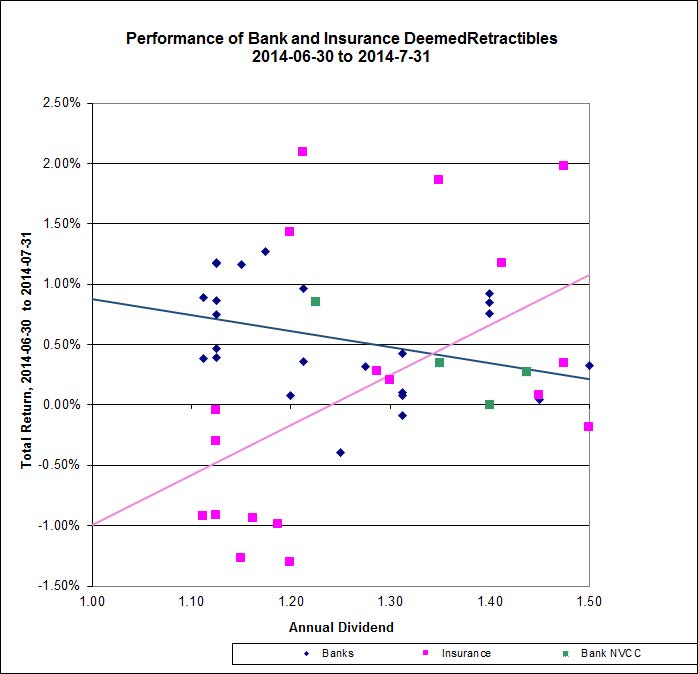
DeemedRetractibles had relatively uncorrelated performances in November, with bank issues and insurance issues performing similarly overall:

DeemedRetPerf_1311
Click for Big

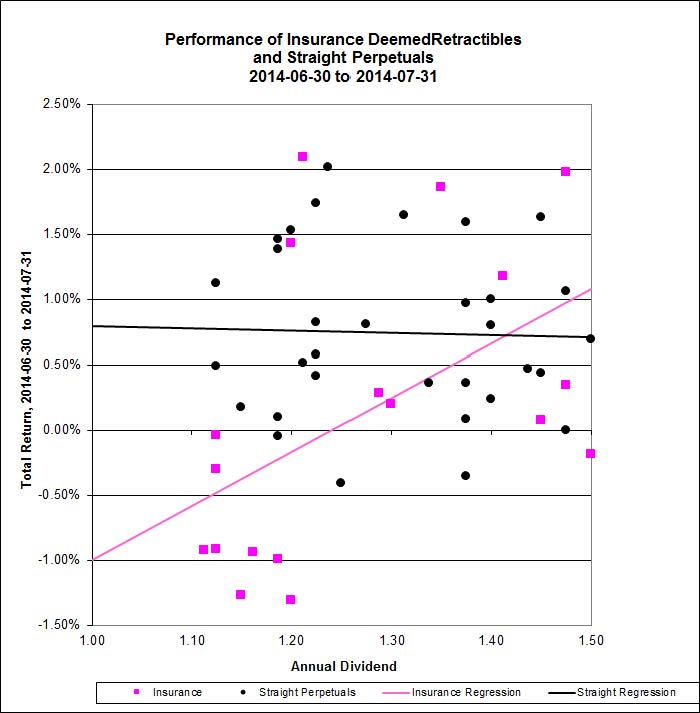
And Straight Perpetuals underperformed:

straightPerf_1311
Click for Big

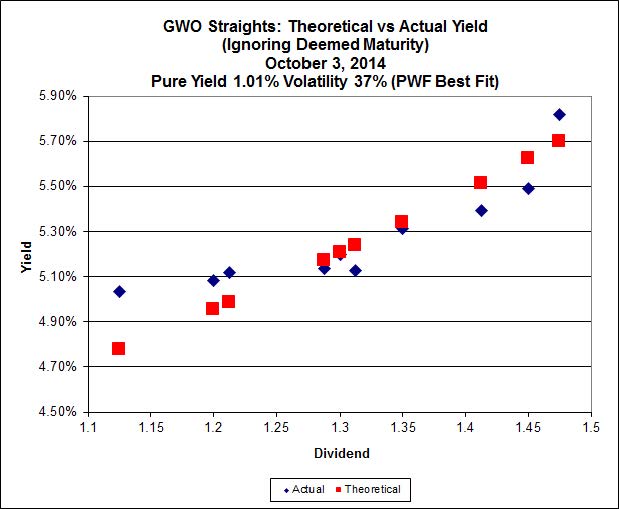
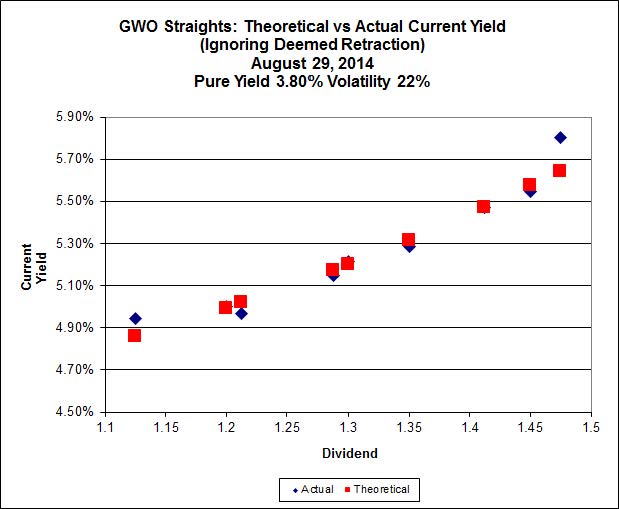
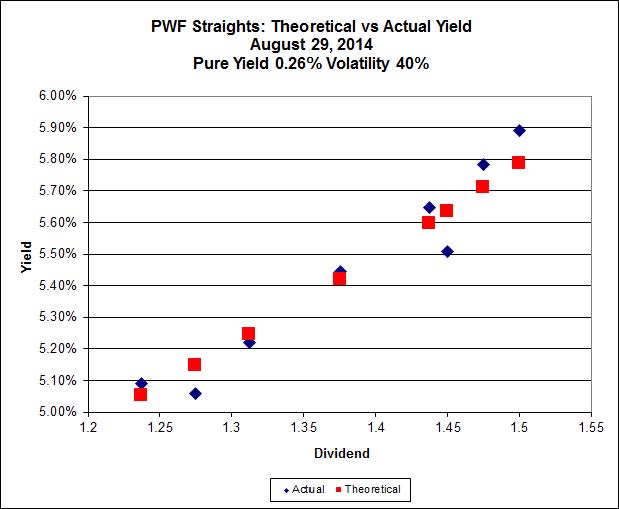
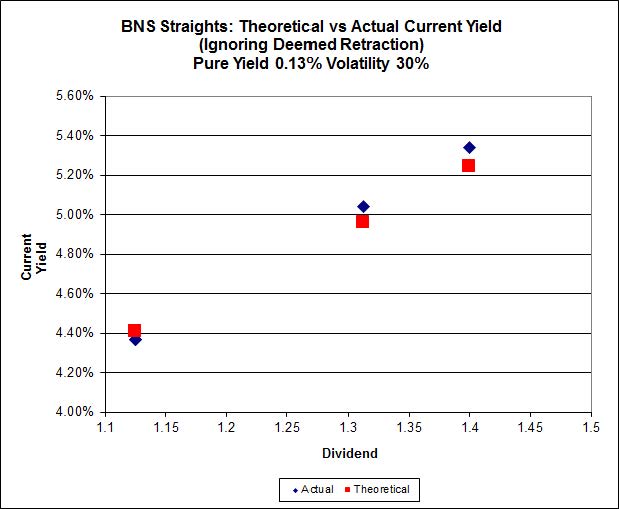
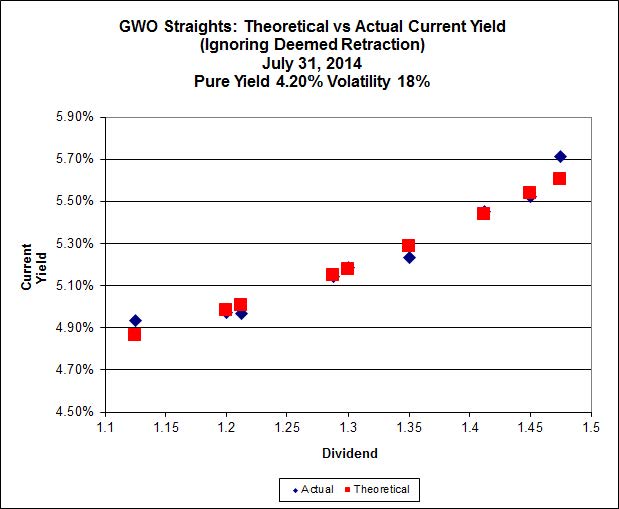
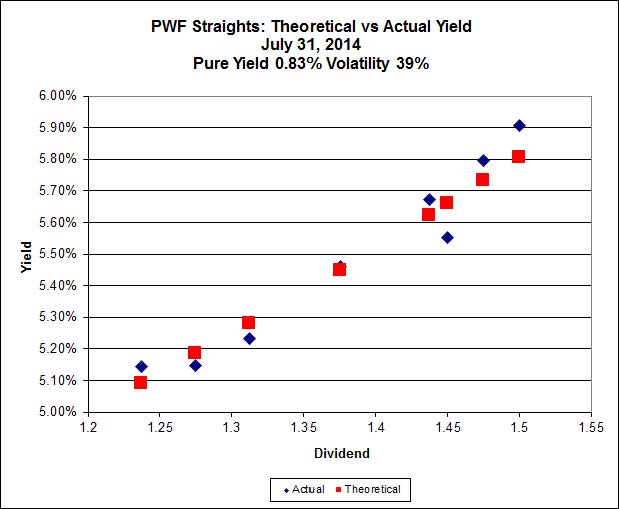
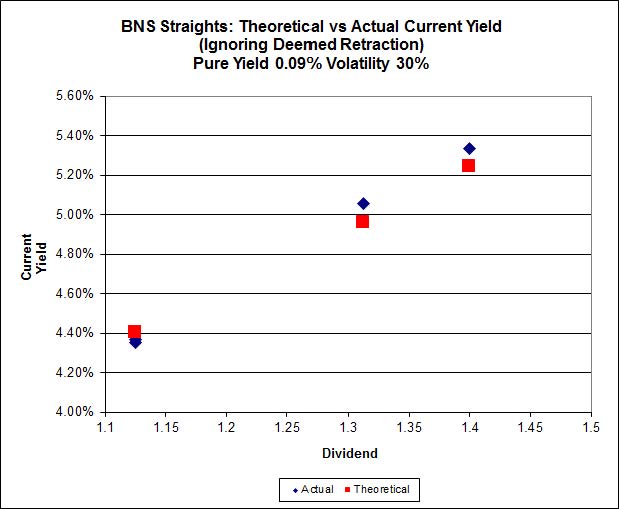
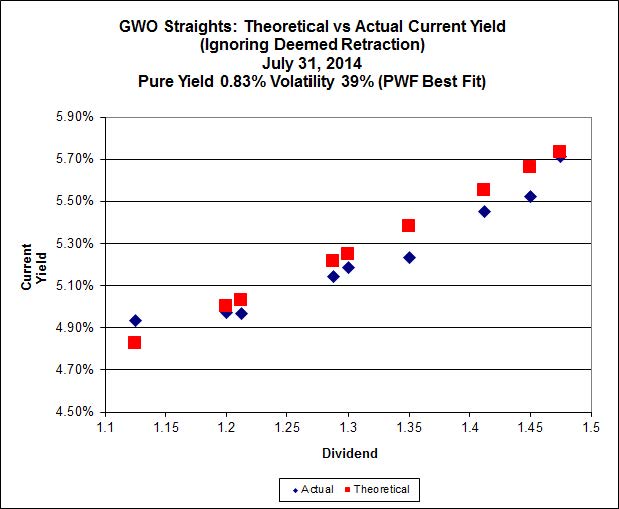
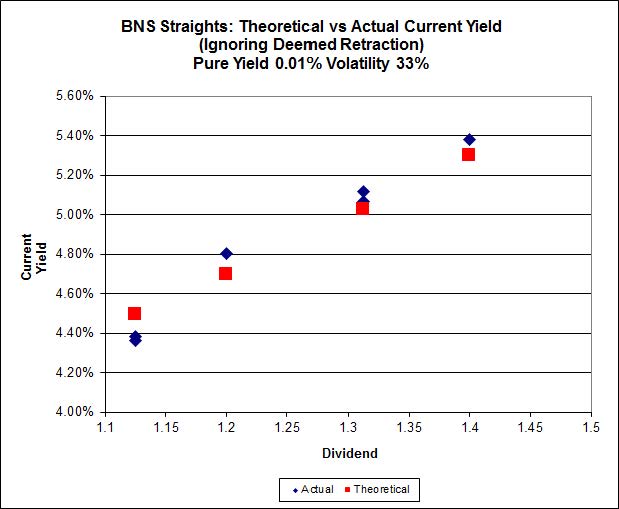
A side effect of the downdraft has been the return of measurable Implied Volatility (all Implied Volatility calculations use bids from November 1):

impVol_GWO_131129
Click for Big

impVol_PWF_131129
Click for Big

impVol_BNS_131129
Click for Big

Implied Volatility of
Three Series of Straight Perpetuals
September, 2013
Issuer Pure Yield Implied Volatility
GWO 3.18% (-1.32) 32% (+11)
PWF 4.34% (+0.74) 24% (-6)
BNS 0.01% (0) 40% (0)
Bracketted figures are changes since October month-end

So we are now seeing a market evaluation of call probabilities such that GWO is now considered to have more of a directional bias than PWF.

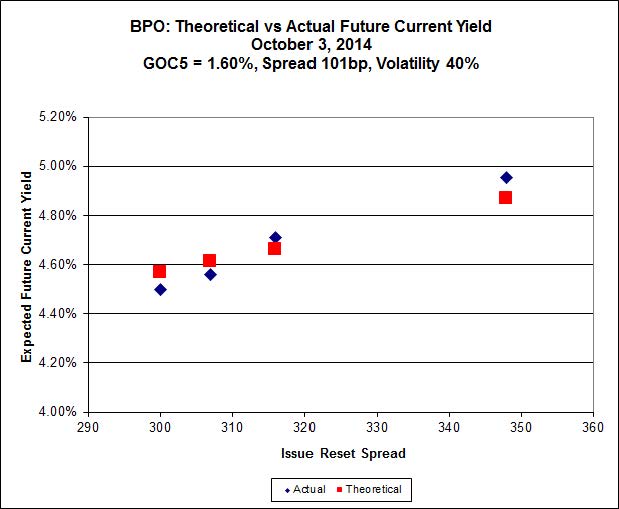
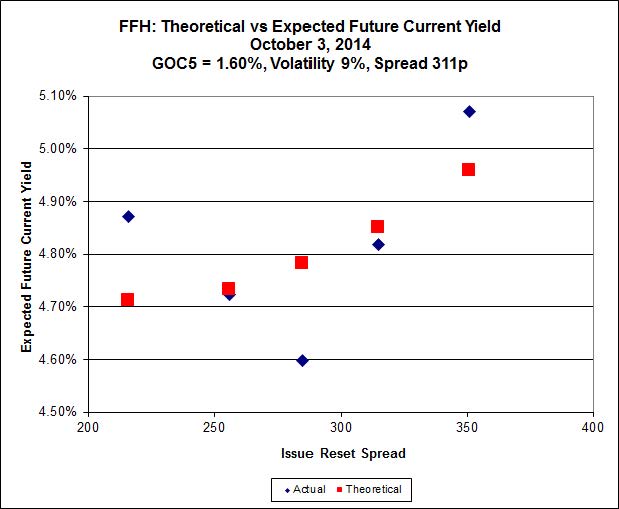
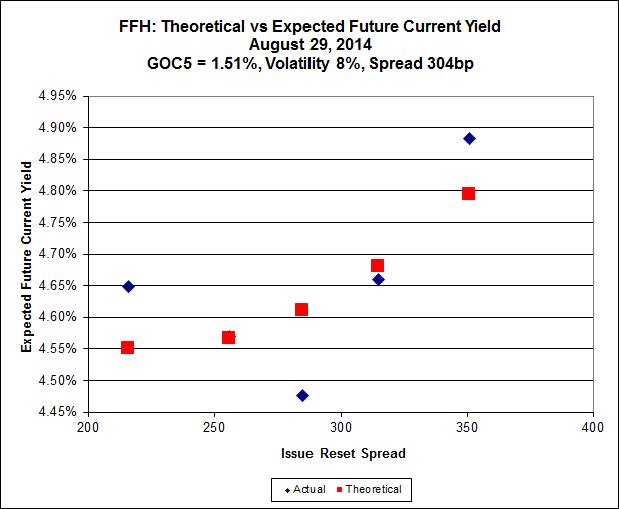
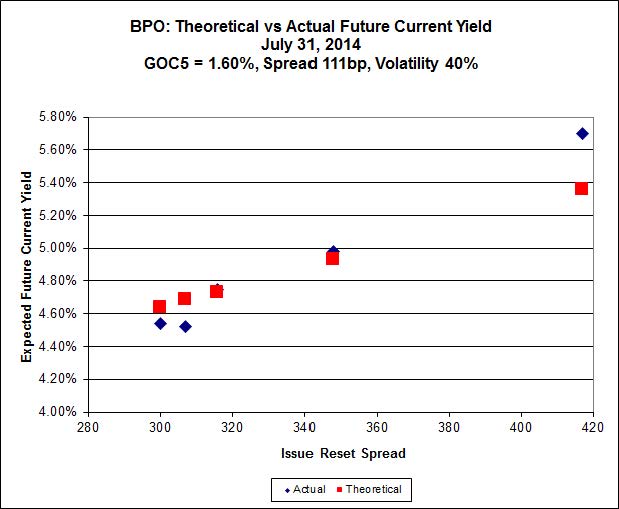
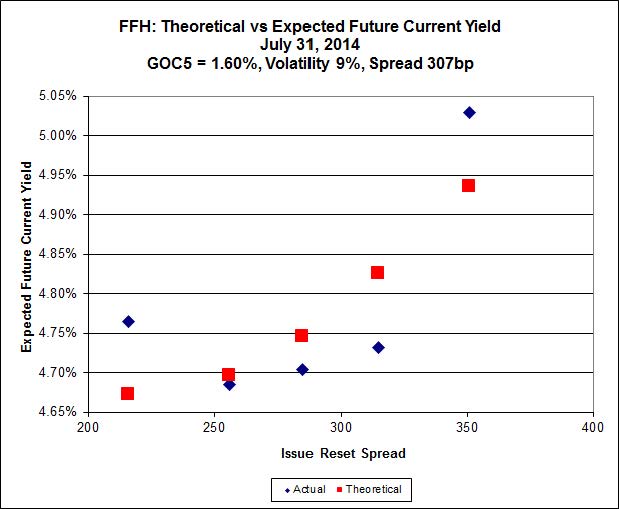
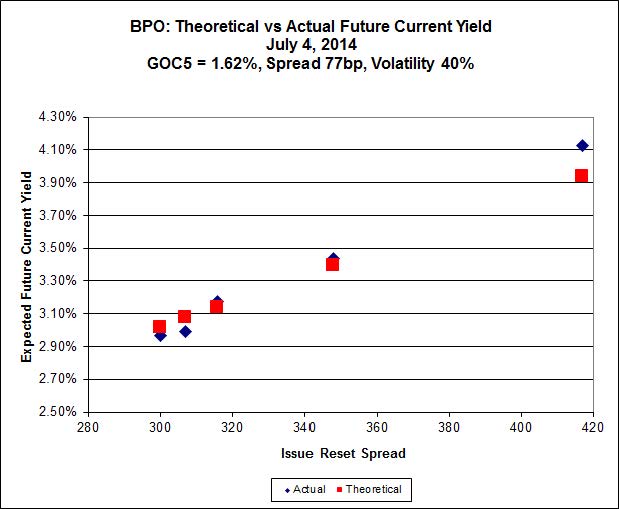
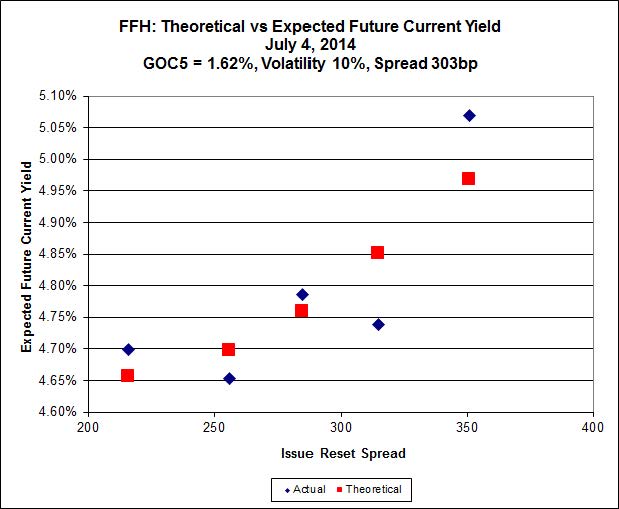
In the September, 2013, edition of PrefLetter, I extended the theory of Implied Volatility to FixedResets – relating the option feature of the Issue Reset Spreads to a theoretical non-callable Market Spread.

impVol_BPO_131129
Click for Big

impVol_FFH_131129
Click for Big

Implied Volatility of
Two Series of FixedResets
November 29, 2013
Issuer Market Reset Spread
(Non-Callable)
Implied Volatility
BPO 75bp (-9) 40% (0)
FFH 341bp (+11) 0%
Bracketted figures are changes since Octoberber month-end

These are very interesting results: The BPO issues are trading as if calls are a certainty, while FFH issues are trading as if calls are nonexistent.

Those of you who have been paying attention will remember that in a “normal” market (which we have not seen in well over a year) the slope of this line is related to the implied volatility of yields in Black-Scholes theory, as discussed in the January, 2010, edition of PrefLetter. As has been previously noted, very high levels of Implied Volatility (in the 40% range) imply a very strong expectation of directionality in future prices – i.e, an expectation that all issues will be redeemed at par.

It is significant that the preferred share market knows no moderation. I suggest that a good baseline estimate for Volatility over a three year period is 15% but the observed figure is generally higher in a rising market and lower in a declining one … with, of course, a period of adjustment in between, which I suspect we are currently experiencing.

Sometimes everything works … sometimes it’s 50-50 … sometimes nothing works. The fund seeks to earn incremental return by selling liquidity (that is, taking the other side of trades that other market participants are strongly motivated to execute), which can also be referred to as ‘trading noise’ – although for quite some time, noise trading has taken a distant second place to the sectoral play on insurance DeemedRetractibles. There were a lot of strongly motivated market participants during the Panic of 2007, generating a lot of noise! Unfortunately, the conditions of the Panic may never be repeated in my lifetime … but the fund will simply attempt to make trades when swaps seem profitable, without worrying about the level of monthly turnover.

There’s plenty of room for new money left in the fund. I have shown in PrefLetter that market pricing for FixedResets is very often irrational and I have lots of confidence – backed up by my bond portfolio management experience in the markets for Canadas and Treasuries, and equity trading on the NYSE & TSX – that there is enough demand for liquidity in any market to make the effort of providing it worthwhile (although the definition of “worthwhile” in terms of basis points of outperformance changes considerably from market to market!) I will continue to exert utmost efforts to outperform but it should be borne in mind that there will almost inevitably be periods of underperformance in the future.

The yields available on high quality preferred shares remain elevated, which is reflected in the current estimate of sustainable income.

Calculation of MAPF Sustainable Income Per Unit
Month NAVPU Portfolio
Average
YTW
Leverage
Divisor
Securities
Average
YTW
Capital
Gains
Multiplier
Sustainable
Income
per
current
Unit
June, 2007 9.3114 5.16% 1.03 5.01% 1.3240 0.3524
September 9.1489 5.35% 0.98 5.46% 1.3240 0.3773
December, 2007 9.0070 5.53% 0.942 5.87% 1.3240 0.3993
March, 2008 8.8512 6.17% 1.047 5.89% 1.3240 0.3938
June 8.3419 6.034% 0.952 6.338% 1.3240 $0.3993
September 8.1886 7.108% 0.969 7.335% 1.3240 $0.4537
December, 2008 8.0464 9.24% 1.008 9.166% 1.3240 $0.5571
March 2009 $8.8317 8.60% 0.995 8.802% 1.3240 $0.5872
June 10.9846 7.05% 0.999 7.057% 1.3240 $0.5855
September 12.3462 6.03% 0.998 6.042% 1.3240 $0.5634
December 2009 10.5662 5.74% 0.981 5.851% 1.1141 $0.5549
March 2010 10.2497 6.03% 0.992 6.079% 1.1141 $0.5593
June 10.5770 5.96% 0.996 5.984% 1.1141 $0.5681
September 11.3901 5.43% 0.980 5.540% 1.1141 $0.5664
December 2010 10.7659 5.37% 0.993 5.408% 1.0298 $0.5654
March, 2011 11.0560 6.00% 0.994 5.964% 1.0298 $0.6403
June 11.1194 5.87% 1.018 5.976% 1.0298 $0.6453
September 10.2709 6.10%
Note
1.001 6.106% 1.0298 $0.6090
December, 2011 10.0793 5.63%
Note
1.031 5.805% 1.0000 $0.5851
March, 2012 10.3944 5.13%
Note
0.996 5.109% 1.0000 $0.5310
June 10.2151 5.32%
Note
1.012 5.384% 1.0000 $0.5500
September 10.6703 4.61%
Note
0.997 4.624% 1.0000 $0.4934
December, 2012 10.8307 4.24% 0.989 4.287% 1.0000 $0.4643
March, 2013 10.9033 3.87% 0.996 3.886% 1.0000 $0.4237
June 10.3261 4.81% 0.998 4.80% 1.0000 $0.4957
September 10.0296 5.62% 0.996 5.643% 1.0000 $0.5660
November, 2013 10.1600 5.65% 0.999 5.656% 1.0000 $0.5746
NAVPU is shown after quarterly distributions of dividend income and annual distribution of capital gains.
Portfolio YTW includes cash (or margin borrowing), with an assumed interest rate of 0.00%
The Leverage Divisor indicates the level of cash in the account: if the portfolio is 1% in cash, the Leverage Divisor will be 0.99
Securities YTW divides “Portfolio YTW” by the “Leverage Divisor” to show the average YTW on the securities held; this assumes that the cash is invested in (or raised from) all securities held, in proportion to their holdings.
The Capital Gains Multiplier adjusts for the effects of Capital Gains Dividends. On 2009-12-31, there was a capital gains distribution of $1.989262 which is assumed for this purpose to have been reinvested at the final price of $10.5662. Thus, a holder of one unit pre-distribution would have held 1.1883 units post-distribution; the CG Multiplier reflects this to make the time-series comparable. Note that Dividend Distributions are not assumed to be reinvested.
Sustainable Income is the resultant estimate of the fund’s dividend income per current unit, before fees and expenses. Note that a “current unit” includes reinvestment of prior capital gains; a unitholder would have had the calculated sustainable income with only, say, 0.9 units in the past which, with reinvestment of capital gains, would become 1.0 current units.
DeemedRetractibles are comprised of all Straight Perpetuals (both PerpetualDiscount and PerpetualPremium) issued by BMO, BNS, CM, ELF, GWO, HSB, IAG, MFC, NA, RY, SLF and TD, which are not exchangable into common at the option of the company (definition refined in May, 2011). These issues are analyzed as if their prospectuses included a requirement to redeem at par on or prior to 2022-1-31 (banks) or 2025-1-31 (insurers and insurance holding companies), in addition to the call schedule explicitly defined. See OSFI Does Not Grandfather Extant Tier 1 Capital, CM.PR.D, CM.PR.E, CM.PR.G: Seeking NVCC Status and the January, February, March and June, 2011, editions of PrefLetter for the rationale behind this analysis.
Yields for September, 2011, to January, 2012, were calculated by imposing a cap of 10% on the yields of YLO issues held, in order to avoid their extremely high calculated yields distorting the calculation and to reflect the uncertainty in the marketplace that these yields will be realized. From February to September 2012, yields on these issues have been set to zero. All YLO issues held were sold in October 2012.

Significant positions were held in DeemedRetractible, SplitShare and FixedReset issues on July 31; all of these currently have their yields calculated with the presumption that they will be called by the issuers at par prior to 2022-1-31 (banks) or 2025-1-31 (insurers and insurance holding companies). This presents another complication in the calculation of sustainable yield. The fund also holds positions in various SplitShare issues which also have their yields calculated with the expectation of a maturity at par.

I no longer show calculations that assume the conversion of the entire portfolio into PerpetualDiscounts, as the fund has only a very small position in these issues.

I will also note that the sustainable yield calculated above is not directly comparable with any yield calculation currently reported by any other preferred share fund as far as I am aware. The Sustainable Yield depends on:
i) Calculating Yield-to-Worst for each instrument and using this yield for reporting purposes;
ii) Using the contemporary value of Five-Year Canadas (set at 1.72% for the October 31 calculation) to estimate dividends after reset for FixedResets.

Most funds report Current Yield. For instance, ZPR reports a “Portfolio Yield” of 4.94% as of November 22, 2013 and notes:

Portfolio yield is calculated as the most recent income received by the ETF in the form of dividends interest and other income annualized based on the payment frequently divided by the current market value of ETFs investments.

In other words – it’s the Current Yield, a meaningless number. The Current Yield of MAPF is 5.14% as of November 29, but I will neither report that with any degree of prominence nor take any great pleasure in the fact that it’s a little higher than the ZPR number. It’s meaningless; to accord it any prominence in portfolio reporting is misleading.

It should be noted that the concept of this Sustainable Income calculation was developed when the fund’s holdings were overwhelmingly PerpetualDiscounts – see, for instance, the bottom of the market in November 2008. It is easy to understand that for a PerpetualDiscount, the technique of multiplying yield by price will indeed result in the coupon – a PerpetualDiscount paying $1 annually will show a Sustainable Income of $1, regardless of whether the price is $24 or $17.

Things are not quite so neat when maturity dates and maturity prices that are different from the current price are thrown into the mix. If we take a notional Straight Perpetual paying $5 annually, the price is $100 when the yield is 5% (all this ignores option effects). As the yield increases to 6%, the price declines to 83.33; and 83.33 x 6% is the same $5. Good enough.

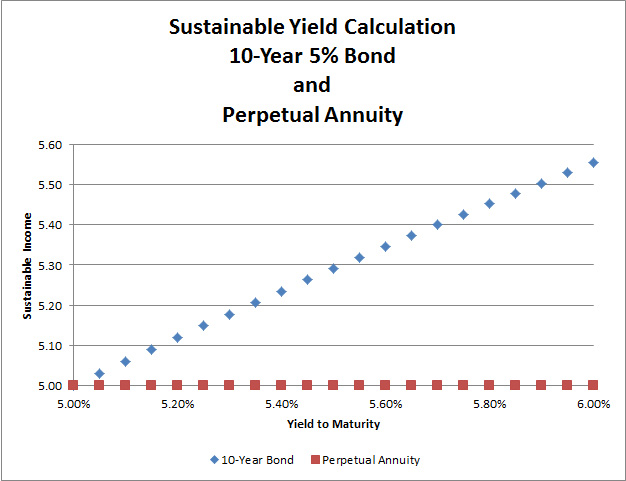
But a ten year bond, priced at 100 when the yield is equal to its coupon of 5%, will decline in price to 92.56; and 92.56 x 6% is 5.55; thus, the calculated Sustainable Income has increased as the price has declined as shown in the graph:


Click for Big

The difference is because the bond’s yield calculation includes the amortization of the discount; therefore, so does the Sustainable Income estimate.

Different assumptions lead to different results from the calculation, but the overall positive trend is apparent. I’m very pleased with the long-term results! It will be noted that if there was no trading in the portfolio, one would expect the sustainable yield to be constant (before fees and expenses). The success of the fund’s trading is showing up in

  • the very good performance against the index
  • the long term increases in sustainable income per unit

As has been noted, the fund has maintained a credit quality equal to or better than the index; outperformance is due to exploitation of trading anomalies.

Again, there are no predictions for the future! The fund will continue to trade between issues in an attempt to exploit market gaps in liquidity, in an effort to outperform the index and keep the sustainable income per unit – however calculated! – growing.

MAPF

MAPF Portfolio Composition: November, 2013

Turnover remained reasonable in November, at about 9%.

There is extreme segmentation in the marketplace, with OSFI’s NVCC rule changes in February 2011 having had the effect of splitting the formerly relatively homogeneous Straight Perpetual class of preferreds into three parts:

  • Unaffected Straight Perpetuals
  • DeemedRetractibles explicitly subject to the rules (banks)
  • DeemedRetractibles considered by me, but not (yet!) by the market, to be likely to be explicitly subject to the rules in the future (insurers and insurance holding companies)

This segmentation, and the extreme valuation differences between the segments, has cut down markedly on the opportunities for trading. Another trend that hasn’t helped was the migration of PerpetualDiscounts into PerpetualPremiums (due to price increases) earlier in the year – many of the PerpetualPremiums had negative Yields-to-Worst and those that don’t aren’t particularly thrilling; speaking very generally, PerpetualPremiums are to be avoided, not traded! This effect has caused the first of the three segments noted above to be untradeable for most practical purposes. The summer’s downdraft reversed the trend and resulted in a large pool of PerpetualDiscounts, but due to their long term they are still, as a class, inferior to DeemedRetractibles. Lately, there has been a trickle of migration from PerpetualDiscounts into PerpetualPremiums, but this trickle is a long way from reversing the deluge of June.

To make this more clear, it used to be that there were 70-odd Straight Perpetuals and I was more or less indifferent as to which ones I owned (subject, of course, to issuer concentration concerns and other risk management factors). Thus, if any one of these 70 were to go down in price by – say – $0.25, I would quite often have something in inventory that I’d be willing to swap for it. The segmentation means that I am no longer indifferent; in addition to checking the valuation of a potential buy to its peers, I also have to check its peer group. This cuts down on the potential for trading.

There is no real hope that this situation will be corrected in the near-term. OSFI has indicated that the long-promised “Draft Definition of Capital” for insurers will not be issued “for public consultation in late 2012 or early 2013”, as they fear that it might encourage speculation in the marketplace. It is not clear why OSFI is so afraid of informed speculation, since the constant speculation in the marketplace is currently less informed than it would be with a little bit of regulatory clarity.

As a result of this delay, I have extended the Deemed Maturity date for insurers and insurance holding companies by three years (to 2025-1-31), in the expectation that when OSFI finally does provide clarity, they will allow the same degree of lead-in time for these companies as they did for banks. This has obviously had a major effect on the durations of preferred shares subject to the change but, fortunately, not much on their calculated yields as most of these issues are either trading near par or were trading at sufficient premium that a par call was expected on economic grounds. However, with the declines in the market over the past two months, the expected capital gain on redemption of the insurance-issued DeemedRetractibles has become an important component of the calculated yield.

Due to further footdragging by OSFI, I will be extending the DeemedMaturity date for insurance issues by another two years in the near future.

Sectoral distribution of the MAPF portfolio on November 29 was as follows:

MAPF Sectoral Analysis 2013-11-29
HIMI Indices Sector Weighting YTW ModDur
Ratchet 0% N/A N/A
FixFloat 0% N/A N/A
Floater 0% N/A N/A
OpRet 0% N/A N/A
SplitShare 18.9% (+0.5) 4.67% 6.15
Interest Rearing 0% N/A N/A
PerpetualPremium 0.0% (0) N/A N/A
PerpetualDiscount 10.1% (0) 5.41% 14.85
Fixed-Reset 6.3% (-1.2) 3.96% 7.11
Deemed-Retractible 55.2% (+0.9) 6.04% 8.52
Scraps (Various) 9.4% (0) 6.86% 11.45
Cash +0.1% (-0.2) 0.00% 0.00
Total 100% 5.65% 8.89
Totals and changes will not add precisely due to rounding. Bracketted figures represent change from October month-end. Cash is included in totals with duration and yield both equal to zero.
DeemedRetractibles are comprised of all Straight Perpetuals (both PerpetualDiscount and PerpetualPremium) issued by BMO, BNS, CM, ELF, GWO, HSB, IAG, MFC, NA, RY, SLF and TD, which are not exchangable into common at the option of the company. These issues are analyzed as if their prospectuses included a requirement to redeem at par on or prior to 2022-1-31 (banks) or 2025-1-3 (insurers and insurance holding companies), in addition to the call schedule explicitly defined. See OSFI Does Not Grandfather Extant Tier 1 Capital, CM.PR.D, CM.PR.E, CM.PR.G: NVCC Status Confirmed and the January, February, March and June, 2011, editions of PrefLetter for the rationale behind this analysis. (all recent editions have a short summary of the argument included in the “DeemedRetractible” section)

Note that the estimate for the time this will become effective for insurers and insurance holding companies was extended by three years in April 2013, due to the delays in OSFI’s providing clarity on the issue.

The “total” reflects the un-leveraged total portfolio (i.e., cash is included in the portfolio calculations and is deemed to have a duration and yield of 0.00.). MAPF will often have relatively large cash balances, both credit and debit, to facilitate trading. Figures presented in the table have been rounded to the indicated precision.

Credit distribution is:

MAPF Credit Analysis 2013-11-29
DBRS Rating Weighting
Pfd-1 0 (0)
Pfd-1(low) 37.0% (-0.5)
Pfd-2(high) 43.4% (+0.4)
Pfd-2 0% (-2.2)
Pfd-2(low) 10.1% (+0.2)
Pfd-3(high) 1.0% (0)
Pfd-3 4.3% (-0.3)
Pfd-3(low) 2.1% (+0.5)
Pfd-4(high) 0% (0)
Pfd-4 0% (0)
Pfd-4(low) 0.8% (0)
Pfd-5(high) 1.2% (-0.1)
Cash 0.1% (-0.2)
Totals will not add precisely due to rounding. Bracketted figures represent change from October month-end.
A position held in NPI.PR.A is not rated by DBRS, but has been included as “Pfd-3(high)” in the above table on the basis of its S&P rating of P-3(high).

Liquidity Distribution is:

MAPF Liquidity Analysis 2013-11-29
Average Daily Trading Weighting
<$50,000 0.0% (0)
$50,000 – $100,000 26.4% (+9.1)
$100,000 – $200,000 14.5% (-3.9)
$200,000 – $300,000 42.1% (+1.6)
>$300,000 16.9% (-6.5)
Cash 0.1% (-0.2)
Totals will not add precisely due to rounding. Bracketted figures represent change from October month-end.

Changes in liquidity were driven largely by migration of issues between classes; e.g., CGI.PR.D now has an average daily trading value of $86,511, compared to $116,335 last month.

MAPF is, of course, Malachite Aggressive Preferred Fund, a “unit trust” managed by Hymas Investment Management Inc. Further information and links to performance, audited financials and subscription information are available the fund’s web page. The fund may be purchased either directly from Hymas Investment Management or through a brokerage account at Odlum Brown Limited. A “unit trust” is like a regular mutual fund, but is sold by offering memorandum rather than prospectus. This is cheaper, but means subscription is restricted to “accredited investors” (as defined by the Ontario Securities Commission) or those who subscribe for $150,000+. Fund past performances are not a guarantee of future performance. You can lose money investing in MAPF or any other fund.

A similar portfolio composition analysis has been performed on the Claymore Preferred Share ETF (symbol CPD) (and other funds) as of August 31, 2012, and published in the October (mainly methodology), November (most funds), and December (ZPR) 2012, PrefLetter. While direct comparisons are difficult due to the introduction of the DeemedRetractible class of preferred share (see above) it is fair to say:

  • MAPF credit quality is better
  • MAPF liquidity is a lower
  • MAPF Yield is higher
  • Weightings in
    • MAPF is much more exposed to DeemedRetractibles
    • MAPF is much less exposed to Operating Retractibles
    • MAPF is much more exposed to SplitShares
    • MAPF is less exposed to FixFloat / Floater / Ratchet
    • MAPF weighting in FixedResets is much lower
MAPF

MAPF Performance, October 2013

The fund outperformed in October, due to its low weighting in junk FixedResets, which underperformed (as indicated by the performance difference between TXPR (-0.07%) and TXPL (-0.78%)). The fund’s returns were also helped along by superior performance from its holdings of insurance-issued DeemedRetractibles.


Click for Big


Click for Big

To a certain extent, the (modest, so far) recovery may reflect an acceptance of my belief that the decline in the preferred share market has been overdone; the following table shows the increase in yields since May 22 of some fixed income sectors:

Yield Changes
May 22, 2013
to
October 31, 2013
Sector Yield
May 22
Yield
October 31
Change
Five-Year Canadas 1.38% 1.71% +33bp
Long Canadas 2.57% 3.01% +44bp
Long Corporates 4.15% 4.7% +55bp
FixedResets
Investment Grade
(Interest Equivalent)
3.51% 4.74% +123bp
Perpetual-Discounts
Investment Grade
(Interest Equivalent)
6.34% 7.14% +80bp
The change in yield of PerpetualDiscounts is understated due a massive influx of issues from the PerpetualPremium sub-index over the period, which improved credit quality. When the four issues that comprised the PerpetualDiscount sub-index as of May 22 are evaluated as of October 31, the interest-equivalent yield is 7.64% and thus the change is +130bp.

ZPR, is a relatively new ETF comprised of FixedResets and Floating Rate issues, with a very high proportion of junk issues, which returned -0.75% for the month, and -1.74% over the past three months (according to my calculations from the fund’s NAV data and distribution data; our regulators are hard at work protecting you from performance data since the fund has been extant for less than a year), versus returns for the TXPL index of -0.78% and -1.67%, respectively. The fund has been able to attract assets of about $837.8-million in the eleven and a half months since inception; a gain of $11.9-million in October despite losing approximately $6.2-million due to performance. This indicates that an inflow of funds occurred in October – perhaps implying a (very modest!) return of confidence among retail investors. I feel that the flows into and out of this fund are very important in determining the performance of its constituents.

TXPR had returns over one- and three-months of +0.48% and -1.57%, respectively

Returns for the HIMIPref™ investment grade sub-indices for October were as follows:

HIMIPref™ Indices
Performance to October 31, 2013
Sub-Index 1-Month 3-month
Ratchet N/A N/A
FixFloat +4.30% -0.97%
Floater -2.70% -6.31%
OpRet +0.26% +0.31%
SplitShare +0.51% -0.03%
Interest N/A N/A
PerpetualPremium +1.16% 0.65%
PerpetualDiscount +0.95% -0.50%
FixedReset -0.10% -0.55%
DeemedRetractible +1.40% +1.88%
FloatingReset N/A N/A

Malachite Aggressive Preferred Fund’s Net Asset Value per Unit as of the close October 31, 2013, was 10.1070.

Returns to October 31, 2013
Period MAPF BMO-CM “50” Index TXPR
Total Return
CPD – according to Blackrock
One Month +0.77% +0.19% -0.07% -0.12%
Three Months +0.77% -0.15% -0.67% -0.75%
One Year -1.22% +0.32% -1.28% -1.66%
Two Years (annualized) +4.80% +3.23% +2.28% N/A
Three Years (annualized) +3.98% +4.29% +2.99% +2.49%
Four Years (annualized) +8.05% +6.70% +5.19% N/A
Five Years (annualized) +17.98% +8.82% +7.28% +6.60%
Six Years (annualized) +13.66% +5.00% +3.64%  
Seven Years (annualized) +11.11% +3.52%    
Eight Years (annualized) +10.50% +3.71%    
Nine Years (annualized) +10.04% +3.75%    
Ten Years (annualized) +10.57% +3.93%    
Eleven Years (annualized) +11.92% +4.24%    
Twelve Years (annualized) +10.77% +4.18%    
MAPF returns assume reinvestment of distributions, and are shown after expenses but before fees.
CPD Returns are for the NAV and are after all fees and expenses.
* CPD does not directly report its two- or four-year returns.
Figures for Omega Preferred Equity (which are after all fees and expenses) for 1-, 3- and 12-months are +0.29%, -0.04% and -0.06%, respectively, according to Morningstar after all fees & expenses. Three year performance is +3.49%; five year is +7.60%
Figures for Jov Leon Frazer Preferred Equity Fund Class I Units (which are after all fees and expenses) for 1-, 3- and 12-months are -0.21%, -1.60% and -2.24% respectively, according to Morningstar. Three Year performance is +0.82%
Figures for Manulife Preferred Income Fund (formerly AIC Preferred Income Fund) (which are after all fees and expenses) for 1-, 3- and 12-months are -0.70%, -2.59% & -4.74%, respectively. Three Year performance is +1.20%
Figures for Horizons AlphaPro Preferred Share ETF (which are after all fees and expenses) for 1-, 3- and 12-months are +0.77%, -0.53% & +0.43%, respectively.
Figures for Altamira Preferred Equity Fund are -0.21%, -1.09% and -2.47% for one-, three- and twelve months, respectively.
The figure for BMO S&P/TSX Laddered Preferred Share Index ETF is -0.75% and -1.74% for one- and three-months. [calculation by JH; I am happy that next month the fund will have been around for over a year and the regulators will stop protecting me from the evils of fund performance calculations]

MAPF returns assume reinvestment of dividends, and are shown after expenses but before fees. Past performance is not a guarantee of future performance. You can lose money investing in Malachite Aggressive Preferred Fund or any other fund. For more information, see the fund’s main page. The fund is available either directly from Hymas Investment Management or through a brokerage account at Odlum Brown Limited.

A problem that has bedevilled the market over the past two years has been the OSFI decision not to grandfather Straight Perpetuals as Tier 1 bank capital, and their continued foot-dragging regarding a decision on insurer Straight Perpetuals has segmented the market to the point where trading has become much more difficult. The fund occasionally finds an attractive opportunity to trade between GWO issues, which have a good range of annual coupons (but in which trading is now hampered by the fact that the low-coupon issues are trading near par and are callable at par in the near term), but is “stuck” in the MFC and SLF issues, which have a much narrower range of coupon, while the IAG DeemedRetractibles are quite illiquid. Until the market became so grossly segmented, this was not so much of a problem – but now banks are not available to swap into (because they are so expensive) and non-regulated companies are likewise deprecated (because they are not DeemedRetractibles; they should not participate in the increase in value that will follow the OSFI decision I anticipate and, in addition, are analyzed as perpetuals). The fund’s portfolio is, in effect ‘locked in’ to the MFC & SLF issues due to projected gains from a future OSFI decision, to the detriment of trading gains particularly in May, 2013, when the three lowest-coupon SLF DeemedRetractibles (SLF.PR.C, SLF.PR.D and SLF.PR.E) were the worst performing DeemedRetractibles in the sub-index, and in June, 2013, when the insurance-issued DeemedRetractibles behaved like PerpetualDiscounts in a sharply negative market.

DeemedRetractibles had relatively uncorrelated performances in October:


Click for Big

And Straight Perpetuals were indistinguishable from DeemedRetractibles:


Click for Big

A side effect of the downdraft has been the return of measurable Implied Volatility (all Implied Volatility calculations use bids from November 1):


Click for Big


Click for Big


Click for Big

Implied Volatility of
Three Series of Straight Perpetuals
September, 2013
Issuer Pure Yield Implied Volatility
GWO 4.50% (+0.38) 21% (-6)
PWF 3.60% (-1.18) 30% (+10)
BNS 0.01% (0) 40% (0)
Bracketted figures are changes since September month-end

In the September, 2013, edition of PrefLetter, I extended the theory of Implied Volatility to FixedResets – relating the option feature of the Issue Reset Spreads to a theoretical non-callable Market Spread.


Click for Big


Click for Big
Implied Volatility of
Two Series of FixedResets
September, 2013
Issuer Market Reset Spread
(Non-Callable)
Implied Volatility
BPO 84bp (-104) 40% (-22)
FFH 330bp (+35) 16%
Bracketted figures are changes since September month-end

These are very interesting results: the BPO issues were, on average, flat over the month although the average concealed a lot of variance: BPO.PR.P (Issue Reset Spread = 300bp) was down 2.44% while BPO.PR.N (IRS = 307bp) gained 1.04% and BPO.PR.T (IRS = 316) was up 1.43%. The higher-IRS issues BPO.PR.L (IRS = 417; Return +0.04%) and BPO.PR.R (IRS = 348bp, Return +0.36%) merely held their own. In all, though, it appears that the BPO issues are trading as if redemption is more likely that one would think from fundamentals.

As for FFH, the two higher-IRS issues (FFH.PR.C, IRS=315bp, and FFH.PRK, IRS=351bp) are extremely expensive relative to their peers, to the point where the Implied Volatility calculation doesn’t mean much.

Those of you who have been paying attention will remember that in a “normal” market (which we have not seen in well over a year) the slope of this line is related to the implied volatility of yields in Black-Scholes theory, as discussed in the January, 2010, edition of PrefLetter. As has been previously noted, very high levels of Implied Volatility (in the 40% range) imply a very strong expectation of directionality in future prices – i.e, an expectation that all issues will be redeemed at par.

It is significant that the preferred share market knows no moderation. I suggest that a good baseline estimate for Volatility over a three year period is 15% but the observed figure is generally higher in a rising market and lower in a declining one … with, of course, a period of adjustment in between, which I suspect we are currently experiencing.

Sometimes everything works … sometimes it’s 50-50 … sometimes nothing works. The fund seeks to earn incremental return by selling liquidity (that is, taking the other side of trades that other market participants are strongly motivated to execute), which can also be referred to as ‘trading noise’ – although for quite some time, noise trading has taken a distant second place to the sectoral play on insurance DeemedRetractibles. There were a lot of strongly motivated market participants during the Panic of 2007, generating a lot of noise! Unfortunately, the conditions of the Panic may never be repeated in my lifetime … but the fund will simply attempt to make trades when swaps seem profitable, without worrying about the level of monthly turnover.

There’s plenty of room for new money left in the fund. I have shown in PrefLetter that market pricing for FixedResets is very often irrational and I have lots of confidence – backed up by my bond portfolio management experience in the markets for Canadas and Treasuries, and equity trading on the NYSE & TSX – that there is enough demand for liquidity in any market to make the effort of providing it worthwhile (although the definition of “worthwhile” in terms of basis points of outperformance changes considerably from market to market!) I will continue to exert utmost efforts to outperform but it should be borne in mind that there will almost inevitably be periods of underperformance in the future.

The yields available on high quality preferred shares remain elevated, which is reflected in the current estimate of sustainable income.

Calculation of MAPF Sustainable Income Per Unit
Month NAVPU Portfolio
Average
YTW
Leverage
Divisor
Securities
Average
YTW
Capital
Gains
Multiplier
Sustainable
Income
per
current
Unit
June, 2007 9.3114 5.16% 1.03 5.01% 1.3240 0.3524
September 9.1489 5.35% 0.98 5.46% 1.3240 0.3773
December, 2007 9.0070 5.53% 0.942 5.87% 1.3240 0.3993
March, 2008 8.8512 6.17% 1.047 5.89% 1.3240 0.3938
June 8.3419 6.034% 0.952 6.338% 1.3240 $0.3993
September 8.1886 7.108% 0.969 7.335% 1.3240 $0.4537
December, 2008 8.0464 9.24% 1.008 9.166% 1.3240 $0.5571
March 2009 $8.8317 8.60% 0.995 8.802% 1.3240 $0.5872
June 10.9846 7.05% 0.999 7.057% 1.3240 $0.5855
September 12.3462 6.03% 0.998 6.042% 1.3240 $0.5634
December 2009 10.5662 5.74% 0.981 5.851% 1.1141 $0.5549
March 2010 10.2497 6.03% 0.992 6.079% 1.1141 $0.5593
June 10.5770 5.96% 0.996 5.984% 1.1141 $0.5681
September 11.3901 5.43% 0.980 5.540% 1.1141 $0.5664
December 2010 10.7659 5.37% 0.993 5.408% 1.0298 $0.5654
March, 2011 11.0560 6.00% 0.994 5.964% 1.0298 $0.6403
June 11.1194 5.87% 1.018 5.976% 1.0298 $0.6453
September 10.2709 6.10%
Note
1.001 6.106% 1.0298 $0.6090
December, 2011 10.0793 5.63%
Note
1.031 5.805% 1.0000 $0.5851
March, 2012 10.3944 5.13%
Note
0.996 5.109% 1.0000 $0.5310
June 10.2151 5.32%
Note
1.012 5.384% 1.0000 $0.5500
September 10.6703 4.61%
Note
0.997 4.624% 1.0000 $0.4934
December, 2012 10.8307 4.24% 0.989 4.287% 1.0000 $0.4643
March, 2013 10.9033 3.87% 0.996 3.886% 1.0000 $0.4237
June 10.3261 4.81% 0.998 4.80% 1.0000 $0.4957
September 10.0296 5.62% 0.996 5.643% 1.0000 $0.5660
October, 2013 10.1070 5.62% 0.997 5.637% 1.0000 $0.5697
NAVPU is shown after quarterly distributions of dividend income and annual distribution of capital gains.
Portfolio YTW includes cash (or margin borrowing), with an assumed interest rate of 0.00%
The Leverage Divisor indicates the level of cash in the account: if the portfolio is 1% in cash, the Leverage Divisor will be 0.99
Securities YTW divides “Portfolio YTW” by the “Leverage Divisor” to show the average YTW on the securities held; this assumes that the cash is invested in (or raised from) all securities held, in proportion to their holdings.
The Capital Gains Multiplier adjusts for the effects of Capital Gains Dividends. On 2009-12-31, there was a capital gains distribution of $1.989262 which is assumed for this purpose to have been reinvested at the final price of $10.5662. Thus, a holder of one unit pre-distribution would have held 1.1883 units post-distribution; the CG Multiplier reflects this to make the time-series comparable. Note that Dividend Distributions are not assumed to be reinvested.
Sustainable Income is the resultant estimate of the fund’s dividend income per current unit, before fees and expenses. Note that a “current unit” includes reinvestment of prior capital gains; a unitholder would have had the calculated sustainable income with only, say, 0.9 units in the past which, with reinvestment of capital gains, would become 1.0 current units.
DeemedRetractibles are comprised of all Straight Perpetuals (both PerpetualDiscount and PerpetualPremium) issued by BMO, BNS, CM, ELF, GWO, HSB, IAG, MFC, NA, RY, SLF and TD, which are not exchangable into common at the option of the company (definition refined in May, 2011). These issues are analyzed as if their prospectuses included a requirement to redeem at par on or prior to 2022-1-31 (banks) or 2025-1-31 (insurers and insurance holding companies), in addition to the call schedule explicitly defined. See OSFI Does Not Grandfather Extant Tier 1 Capital, CM.PR.D, CM.PR.E, CM.PR.G: Seeking NVCC Status and the January, February, March and June, 2011, editions of PrefLetter for the rationale behind this analysis.
Yields for September, 2011, to January, 2012, were calculated by imposing a cap of 10% on the yields of YLO issues held, in order to avoid their extremely high calculated yields distorting the calculation and to reflect the uncertainty in the marketplace that these yields will be realized. From February to September 2012, yields on these issues have been set to zero. All YLO issues held were sold in October 2012.

Significant positions were held in DeemedRetractible, SplitShare and FixedReset issues on July 31; all of these currently have their yields calculated with the presumption that they will be called by the issuers at par prior to 2022-1-31 (banks) or 2025-1-31 (insurers and insurance holding companies). This presents another complication in the calculation of sustainable yield. The fund also holds positions in various SplitShare issues which also have their yields calculated with the expectation of a maturity at par.

I no longer show calculations that assume the conversion of the entire portfolio into PerpetualDiscounts, as the fund has only a very small position in these issues.

I will also note that the sustainable yield calculated above is not directly comparable with any yield calculation currently reported by any other preferred share fund as far as I am aware. The Sustainable Yield depends on:
i) Calculating Yield-to-Worst for each instrument and using this yield for reporting purposes;
ii) Using the contemporary value of Five-Year Canadas (set at 1.72% for the October 31 calculation) to estimate dividends after reset for FixedResets.

Most funds report Current Yield. For instance, ZPR reports a “Portfolio Yield” of 5.03% as of October 25, 2013 and notes:

Portfolio yield is calculated as the most recent income received by the ETF in the form of dividends interest and other income annualized based on the payment frequently divided by the current market value of ETFs investments.

In other words – it’s the Current Yield, a meaningless number. The Current Yield of MAPF is 5.08% as of September 30, but I will neither report that with any degree of prominence nor take any great pleasure in the fact that it’s a little higher than the ZPR number. It’s meaningless; to accord it any prominence in portfolio reporting is misleading.

It should be noted that the concept of this Sustainable Income calculation was developed when the fund’s holdings were overwhelmingly PerpetualDiscounts – see, for instance, the bottom of the market in November 2008. It is easy to understand that for a PerpetualDiscount, the technique of multiplying yield by price will indeed result in the coupon – a PerpetualDiscount paying $1 annually will show a Sustainable Income of $1, regardless of whether the price is $24 or $17.

Things are not quite so neat when maturity dates and maturity prices that are different from the current price are thrown into the mix. If we take a notional Straight Perpetual paying $5 annually, the price is $100 when the yield is 5% (all this ignores option effects). As the yield increases to 6%, the price declines to 83.33; and 83.33 x 6% is the same $5. Good enough.

But a ten year bond, priced at 100 when the yield is equal to its coupon of 5%, will decline in price to 92.56; and 92.56 x 6% is 5.55; thus, the calculated Sustainable Income has increased as the price has declined as shown in the graph:

Click for Big

The difference is because the bond’s yield calculation includes the amortization of the discount; therefore, so does the Sustainable Income estimate.

Different assumptions lead to different results from the calculation, but the overall positive trend is apparent. I’m very pleased with the long-term results! It will be noted that if there was no trading in the portfolio, one would expect the sustainable yield to be constant (before fees and expenses). The success of the fund’s trading is showing up in

  • the very good performance against the index
  • the long term increases in sustainable income per unit

As has been noted, the fund has maintained a credit quality equal to or better than the index; outperformance is due to exploitation of trading anomalies.

Again, there are no predictions for the future! The fund will continue to trade between issues in an attempt to exploit market gaps in liquidity, in an effort to outperform the index and keep the sustainable income per unit – however calculated! – growing.
MAPF

MAPF Portfolio Composition: October 2013

Turnover remained reasonable in October, at about 10%.

There is extreme segmentation in the marketplace, with OSFI’s NVCC rule changes in February 2011 having had the effect of splitting the formerly relatively homogeneous Straight Perpetual class of preferreds into three parts:

  • Unaffected Straight Perpetuals
  • DeemedRetractibles explicitly subject to the rules (banks)
  • DeemedRetractibles considered by me, but not (yet!) by the market, to be likely to be explicitly subject to the rules in the future (insurers and insurance holding companies)

This segmentation, and the extreme valuation differences between the segments, has cut down markedly on the opportunities for trading. Another trend that hasn’t helped was the migration of PerpetualDiscounts into PerpetualPremiums (due to price increases) earlier in the year – many of the PerpetualPremiums had negative Yields-to-Worst and those that don’t aren’t particularly thrilling; speaking very generally, PerpetualPremiums are to be avoided, not traded! This effect has caused the first of the three segments noted above to be untradeable for most practical purposes. The summer’s downdraft reversed the trend and resulted in a large pool of PerpetualDiscounts, but due to their long term they are still, as a class, inferior to DeemedRetractibles. In October there was a small migration back into PerpetualPremiums.

To make this more clear, it used to be that there were 70-odd Straight Perpetuals and I was more or less indifferent as to which ones I owned (subject, of course, to issuer concentration concerns and other risk management factors). Thus, if any one of these 70 were to go down in price by – say – $0.25, I would quite often have something in inventory that I’d be willing to swap for it. The segmentation means that I am no longer indifferent; in addition to checking the valuation of a potential buy to its peers, I also have to check its peer group. This cuts down on the potential for trading.

There is no real hope that this situation will be corrected in the near-term. OSFI has indicated that the long-promised “Draft Definition of Capital” for insurers will not be issued “for public consultation in late 2012 or early 2013”, as they fear that it might encourage speculation in the marketplace. It is not clear why OSFI is so afraid of informed speculation, since the constant speculation in the marketplace is currently less informed than it would be with a little bit of regulatory clarity.

As a result of this delay, I have extended the Deemed Maturity date for insurers and insurance holding companies by three years (to 2025-1-31), in the expectation that when OSFI finally does provide clarity, they will allow the same degree of lead-in time for these companies as they did for banks. This has obviously had a major effect on the durations of preferred shares subject to the change but, fortunately, not much on their calculated yields as most of these issues are either trading near par or were trading at sufficient premium that a par call was expected on economic grounds. However, with the declines in the market over the past two months, the expected capital gain on redemption of the insurance-issued DeemedRetractibles has become an important component of the calculated yield.

Sectoral distribution of the MAPF portfolio on October 31 was as follows:

MAPF Sectoral Analysis 2013-10-31
HIMI Indices Sector Weighting YTW ModDur
Ratchet 0% N/A N/A
FixFloat 0% N/A N/A
Floater 0% N/A N/A
OpRet 0% N/A N/A
SplitShare 18.4% (0) 4.87% 6.13
Interest Rearing 0% N/A N/A
PerpetualPremium 0.0% (0) N/A N/A
PerpetualDiscount 10.1% (+0.5) 5.38% 14.81
Fixed-Reset 7.5% (-0.6) 3.99% 7.19
Deemed-Retractible 54.3% (+0.2) 6.04% 8.48
Scraps (Various) 9.4% (+0.1) 6.40% 12.76
Cash +0.3% (-0.1) 0.00% 0.00
Total 100% 5.62% 8.97
Totals and changes will not add precisely due to rounding. Bracketted figures represent change from September month-end. Cash is included in totals with duration and yield both equal to zero.
DeemedRetractibles are comprised of all Straight Perpetuals (both PerpetualDiscount and PerpetualPremium) issued by BMO, BNS, CM, ELF, GWO, HSB, IAG, MFC, NA, RY, SLF and TD, which are not exchangable into common at the option of the company. These issues are analyzed as if their prospectuses included a requirement to redeem at par on or prior to 2022-1-31 (banks) or 2025-1-3 (insurers and insurance holding companies), in addition to the call schedule explicitly defined. See OSFI Does Not Grandfather Extant Tier 1 Capital, CM.PR.D, CM.PR.E, CM.PR.G: NVCC Status Confirmed and the January, February, March and June, 2011, editions of PrefLetter for the rationale behind this analysis. (all recent editions have a short summary of the argument included in the “DeemedRetractible” section)

Note that the estimate for the time this will become effective for insurers and insurance holding companies was extended by three years in April 2013, due to the delays in OSFI’s providing clarity on the issue.

The “total” reflects the un-leveraged total portfolio (i.e., cash is included in the portfolio calculations and is deemed to have a duration and yield of 0.00.). MAPF will often have relatively large cash balances, both credit and debit, to facilitate trading. Figures presented in the table have been rounded to the indicated precision.

Credit distribution is:

MAPF Credit Analysis 2013-10-31
DBRS Rating Weighting
Pfd-1 0 (0)
Pfd-1(low) 37.5% (+1.5)
Pfd-2(high) 43.0% (+0.8)
Pfd-2 0% (-2.2)
Pfd-2(low) 9.9% (0)
Pfd-3(high) 1.0% (0)
Pfd-3 4.6% (-0.1)
Pfd-3(low) 1.6% (0)
Pfd-4(high) 0% (0)
Pfd-4 0% (0)
Pfd-4(low) 0.8% (0)
Pfd-5(high) 1.3% (+0.1)
Cash 0..3% (-0.1)
Totals will not add precisely due to rounding. Bracketted figures represent change from August month-end.
A position held in NPI.PR.A is not rated by DBRS, but has been included as “Pfd-3” in the above table on the basis of its S&P rating of P-3.

Changes in credit quality were driven largely by the swap of the position held in HSB.PR.E (FixedReset, Pfd-2) to purchase BNS.PR.Y, BNS.PR.Z (FixedReset, Pfd-1(low)) and CU.PR.G (PerpetualDiscount, Pfd-2(high)).

Liquidity Distribution is:

MAPF Liquidity Analysis 2013-10-31
Average Daily Trading Weighting
<$50,000 0.0% (-0.6)
$50,000 – $100,000 17.3% (+0.6)
$100,000 – $200,000 18.4% (-10.0)
$200,000 – $300,000 40.5% (-2.2)
>$300,000 23.4% (+12.3)
Cash 0.3% (-0.1)
Totals will not add precisely due to rounding. Bracketted figures represent change from September month-end.

MAPF is, of course, Malachite Aggressive Preferred Fund, a “unit trust” managed by Hymas Investment Management Inc. Further information and links to performance, audited financials and subscription information are available the fund’s web page. The fund may be purchased either directly from Hymas Investment Management or through a brokerage account at Odlum Brown Limited. A “unit trust” is like a regular mutual fund, but is sold by offering memorandum rather than prospectus. This is cheaper, but means subscription is restricted to “accredited investors” (as defined by the Ontario Securities Commission) or those who subscribe for $150,000+. Fund past performances are not a guarantee of future performance. You can lose money investing in MAPF or any other fund.

A similar portfolio composition analysis has been performed on the Claymore Preferred Share ETF (symbol CPD) (and other funds) as of August 31, 2012, and published in the October (mainly methodology), November (most funds), and December (ZPR) 2012, PrefLetter. While direct comparisons are difficult due to the introduction of the DeemedRetractible class of preferred share (see above) it is fair to say:

  • MAPF credit quality is better
  • MAPF liquidity is a lower
  • MAPF Yield is higher
  • Weightings in
    • MAPF is much more exposed to DeemedRetractibles
    • MAPF is much less exposed to Operating Retractibles
    • MAPF is much more exposed to SplitShares
    • MAPF is less exposed to FixFloat / Floater / Ratchet
    • MAPF weighting in FixedResets is much lower
MAPF

MAPF Performance, September 2013

The fund outperformed in September, due to its low weighting in junk FixedResets, which underperformed (as indicated by the performance difference between TXPR (+0.48%) and TXPL (-0.10%)).

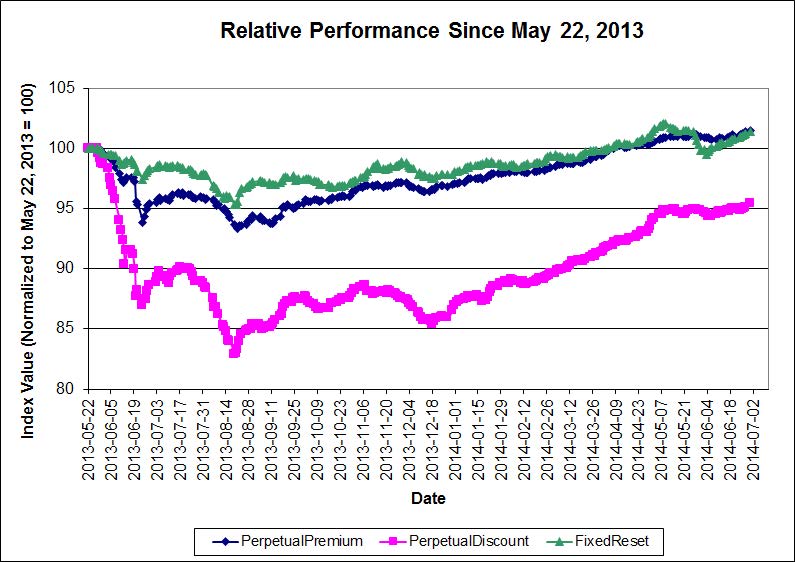
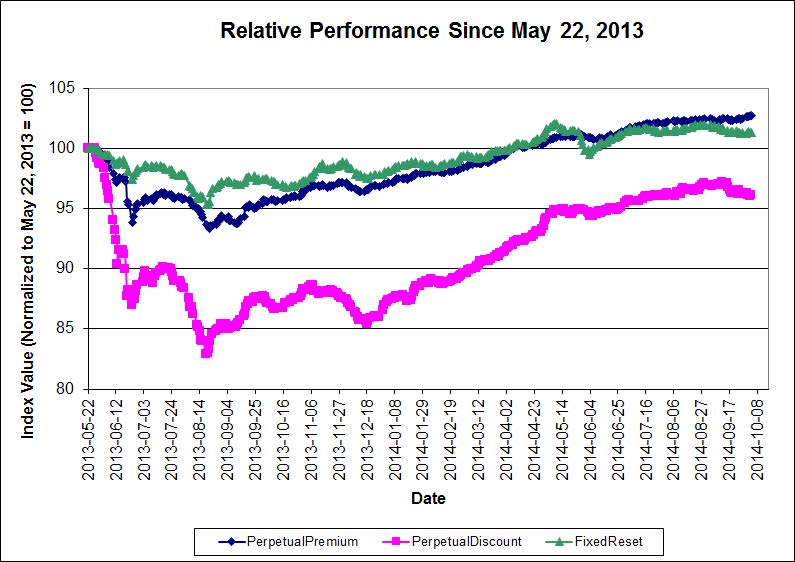
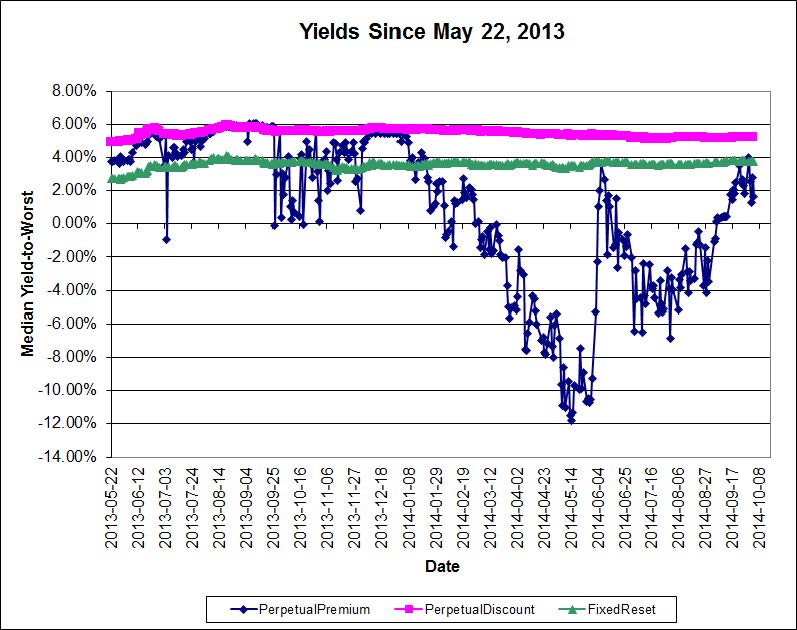
There was a modest recovery in the Canadian preferred share market in September, but there was a sharp turnaround commencing with seven consecutive gains commencing August 22 and still continuing, as shown in the following charts:


Click for Big


Click for Big

To a certain extent, the (modest, so far) recovery may reflect an acceptance of my belief that the decline in the preferred share market has been overdone; the following table shows the increase in yields since May 22 of some fixed income sectors:

Yield Changes
May 22, 2013
to
September 30, 2013
Sector Yield
May 22
Yield
October 2
Change
Five-Year Canadas 1.38% 1.86% +48bp
Long Canadas 2.57% 3.09% +52bp
Long Corporates 4.15% 4.8% +65bp
FixedResets
Investment Grade
(Interest Equivalent)
3.51% 4.78% +127bp
Perpetual-Discounts
Investment Grade
(Interest Equivalent)
6.34% 7.23% +89bp
The change in yield of PerpetualDiscounts is understated due a massive influx of issues from the PerpetualPremium sub-index over the period, which improved credit quality. When the four issues that comprised the PerpetualDiscount sub-index as of May 22 are evaluated as of September 30, the interest-equivalent yield is 7.66% and thus the change is +132bp.

ZPR, is a relatively new ETF comprised of FixedResets and Floating Rate issues, with a very high proportion of junk issues, which returned -0.29% for the month, and -2.46% over the past three months (according to my calculations from the fund’s NAV data and distribution data; our regulators are hard at work protecting you from performance data since the fund has been extant for less than a year), versus returns for the TXPL index of -0.10% and -2.30%, respectively. The fund has been able to attract assets of about $825.9-million in the ten and a half months since inception; a gain of $3.0-million in September despite losing approximately $0.8-million due to performance. This indicates that a (very modest!) inflow of funds occurred in September – perhaps implying a (very modest!) return of confidence among retail investors. I feel that the flows into and out of this fund are very important in determining the performance of its constituents.

TXPR had returns over one- and three-months of +0.48% and -1.57%, respectively

Returns for the HIMIPref™ investment grade sub-indices for September were as follows:

HIMIPref™ Indices
Performance to September 30, 2013
Sub-Index 1-Month 3-month
Ratchet N/A N/A
FixFloat -1.61% -2.35%
Floater -3.11% -2.00%
OpRet +0.49% +0.90%
SplitShare -0.57% -0.64%
Interest N/A N/A
PerpetualPremium +1.11% 0.00%
PerpetualDiscount +2.50% -1.26%
FixedReset +0.23% -0.89%
DeemedRetractible +1.73% -0.16%

Malachite Aggressive Preferred Fund’s Net Asset Value per Unit as of the close September 30, 2013, was 10.0296 after a distribution of 0.137064 per unit.

Returns to September 30, 2013
Period MAPF BMO-CM “50” Index TXPR
Total Return
CPD – according to Blackrock
One Month +0.87% +0.52% +0.48% +0.43%
Three Months -1.54% -0.82% -1.57% -1.61%
One Year -1.17% +0.51% -0.96% -1.43%
Two Years (annualized) +5.52% +3.44% +2.70% N/A
Three Years (annualized) +4.61% +4.92% +3.55% +3.01%
Four Years (annualized) +7.23% +6.15% +4.88% N/A
Five Years (annualized) +16.44% +6.95% +5.70% +5.04%
Six Years (annualized) +12.80% +4.55% +3.28%  
Seven Years (annualized) +11.06% +3.59%    
Eight Years (annualized) +10.41% +3.64%    
Nine Years (annualized) +10.04% +3.82%    
Ten Years (annualized) +10.57% +3.94%    
Eleven Years (annualized) +12.36% +4.23%    
Twelve Years (annualized) +10.82% +4.15%    
MAPF returns assume reinvestment of distributions, and are shown after expenses but before fees.
CPD Returns are for the NAV and are after all fees and expenses.
* CPD does not directly report its two- or four-year returns.
Figures for Omega Preferred Equity (which are after all fees and expenses) for 1-, 3- and 12-months are +0.73%, -0.52% and +0.12%, respectively, according to Morningstar after all fees & expenses. Three year performance is +3.88%; five year is +5.89%
Figures for Jov Leon Frazer Preferred Equity Fund Class I Units (which are after all fees and expenses) for 1-, 3- and 12-months are +0.02%, -1.85% and -1.80% respectively, according to Morningstar. Three Year performance is +1.28%
Figures for Manulife Preferred Income Fund (formerly AIC Preferred Income Fund) (which are after all fees and expenses) for 1-, 3- and 12-months are +0.21%, -2.76% & -3.70%, respectively. Three Year performance is +1.77%
Figures for Horizons AlphaPro Preferred Share ETF (which are after all fees and expenses) for 1-, 3- and 12-months are +0.77%, -0.53% & +0.43%, respectively.
Figures for Altamira Preferred Equity Fund are +0.25% and -1.99% for one- and three- months, respectively.
The figure for BMO S&P/TSX Laddered Preferred Share Index ETF is -0.29% and -2.46% for one- and three-months. [calculation by JH]

MAPF returns assume reinvestment of dividends, and are shown after expenses but before fees. Past performance is not a guarantee of future performance. You can lose money investing in Malachite Aggressive Preferred Fund or any other fund. For more information, see the fund’s main page. The fund is available either directly from Hymas Investment Management or through a brokerage account at Odlum Brown Limited.

A problem that has bedevilled the market over the past two years has been the OSFI decision not to grandfather Straight Perpetuals as Tier 1 bank capital, and their continued foot-dragging regarding a decision on insurer Straight Perpetuals has segmented the market to the point where trading has become much more difficult. The fund occasionally finds an attractive opportunity to trade between GWO issues, which have a good range of annual coupons (but in which trading is now hampered by the fact that the low-coupon issues are trading near par and are callable at par in the near term), but is “stuck” in the MFC and SLF issues, which have a much narrower range of coupon, while the IAG DeemedRetractibles are quite illiquid. Until the market became so grossly segmented, this was not so much of a problem – but now banks are not available to swap into (because they are so expensive) and non-regulated companies are likewise deprecated (because they are not DeemedRetractibles; they should not participate in the increase in value that will follow the OSFI decision I anticipate and, in addition, are analyzed as perpetuals). The fund’s portfolio is, in effect ‘locked in’ to the MFC & SLF issues due to projected gains from a future OSFI decision, to the detriment of trading gains particularly in May, 2013, when the three lowest-coupon SLF DeemedRetractibles (SLF.PR.C, SLF.PR.D and SLF.PR.E) were the worst performing DeemedRetractibles in the sub-index!

DeemedRetractibles had relatively uncorrelated performances in September:

Click for Big

Oddly, Straight Perpetuals did a little better than DeemedRetractibles in September.


Click for Big

A side effect of the downdraft has been the return of measurable Implied Volatility:


Click for Big


Click for Big


Click for Big

Implied Volatility of
Three Series of Straight Perpetuals
September, 2013
Issuer Pure Yield Implied Volatility
GWO 4.12% (-0.58) 27% (+4)
PWF 4.78% (-0.44) 20% (+2)
BNS 0.01% (0) 40% (0)
Bracketted figures are changes since August month-end

In the September, 2013, edition of PrefLetter, I extended the theory of Implied Volatility to FixedResets – relating the option feature of the Issue Reset Spreads to a theoretical non-callable Market Spread.


Click for Big


Click for Big

Implied Volatility of
Two Series of FixedResets
September, 2013
Issuer Market Reset Spread
(Non-Callable)
Implied Volatility
BPO 188bp 18%
FFH 295bp 16%

Those of you who have been paying attention will remember that in a “normal” market (which we have not seen in well over a year) the slope of this line is related to the implied volatility of yields in Black-Scholes theory, as discussed in the January, 2010, edition of PrefLetter. As has been previously noted, very high levels of Implied Volatility (in the 40% range) imply a very strong expectation of directionality in future prices – i.e, an expectation that all issues will be redeemed at par. The decline in Implied Volatility – which is still at elevated levels – implies more uncertainty regarding this prediction.

It is significant that the preferred share market knows no moderation. I suggest that a good baseline estimate for Volatility over a three year period is 15% but the observed figure is generally higher in a rising market and lower in a declining one … with, of course, a period of adjustment in between, which I suspect we are currently experiencing.

Sometimes everything works … sometimes it’s 50-50 … sometimes nothing works. The fund seeks to earn incremental return by selling liquidity (that is, taking the other side of trades that other market participants are strongly motivated to execute), which can also be referred to as ‘trading noise’ – although for quite some time, noise trading has taken a distant second place to the sectoral play on insurance DeemedRetractibles. There were a lot of strongly motivated market participants during the Panic of 2007, generating a lot of noise! Unfortunately, the conditions of the Panic may never be repeated in my lifetime … but the fund will simply attempt to make trades when swaps seem profitable, without worrying about the level of monthly turnover.

There’s plenty of room for new money left in the fund. I have shown in PrefLetter that market pricing for FixedResets is very often irrational and I have lots of confidence – backed up by my bond portfolio management experience in the markets for Canadas and Treasuries, and equity trading on the NYSE & TSX – that there is enough demand for liquidity in any market to make the effort of providing it worthwhile (although the definition of “worthwhile” in terms of basis points of outperformance changes considerably from market to market!) I will continue to exert utmost efforts to outperform but it should be borne in mind that there will almost inevitably be periods of underperformance in the future.

The yields available on high quality preferred shares remain elevated, which is reflected in the current estimate of sustainable income.

Calculation of MAPF Sustainable Income Per Unit
Month NAVPU Portfolio
Average
YTW
Leverage
Divisor
Securities
Average
YTW
Capital
Gains
Multiplier
Sustainable
Income
per
current
Unit
June, 2007 9.3114 5.16% 1.03 5.01% 1.3240 0.3524
September 9.1489 5.35% 0.98 5.46% 1.3240 0.3773
December, 2007 9.0070 5.53% 0.942 5.87% 1.3240 0.3993
March, 2008 8.8512 6.17% 1.047 5.89% 1.3240 0.3938
June 8.3419 6.034% 0.952 6.338% 1.3240 $0.3993
September 8.1886 7.108% 0.969 7.335% 1.3240 $0.4537
December, 2008 8.0464 9.24% 1.008 9.166% 1.3240 $0.5571
March 2009 $8.8317 8.60% 0.995 8.802% 1.3240 $0.5872
June 10.9846 7.05% 0.999 7.057% 1.3240 $0.5855
September 12.3462 6.03% 0.998 6.042% 1.3240 $0.5634
December 2009 10.5662 5.74% 0.981 5.851% 1.1141 $0.5549
March 2010 10.2497 6.03% 0.992 6.079% 1.1141 $0.5593
June 10.5770 5.96% 0.996 5.984% 1.1141 $0.5681
September 11.3901 5.43% 0.980 5.540% 1.1141 $0.5664
December 2010 10.7659 5.37% 0.993 5.408% 1.0298 $0.5654
March, 2011 11.0560 6.00% 0.994 5.964% 1.0298 $0.6403
June 11.1194 5.87% 1.018 5.976% 1.0298 $0.6453
September 10.2709 6.10%
Note
1.001 6.106% 1.0298 $0.6090
December, 2011 10.0793 5.63%
Note
1.031 5.805% 1.0000 $0.5851
March, 2012 10.3944 5.13%
Note
0.996 5.109% 1.0000 $0.5310
June 10.2151 5.32%
Note
1.012 5.384% 1.0000 $0.5500
September 10.6703 4.61%
Note
0.997 4.624% 1.0000 $0.4934
December, 2012 10.8307 4.24% 0.989 4.287% 1.0000 $0.4643
March, 2013 10.9033 3.87% 0.996 3.886% 1.0000 $0.4237
June 10.3261 4.81% 0.998 4.80% 1.0000 $0.4957
September, 2013 10.0296 5.62% 0.996 5.643% 1.0000 $0.5660
NAVPU is shown after quarterly distributions of dividend income and annual distribution of capital gains.
Portfolio YTW includes cash (or margin borrowing), with an assumed interest rate of 0.00%
The Leverage Divisor indicates the level of cash in the account: if the portfolio is 1% in cash, the Leverage Divisor will be 0.99
Securities YTW divides “Portfolio YTW” by the “Leverage Divisor” to show the average YTW on the securities held; this assumes that the cash is invested in (or raised from) all securities held, in proportion to their holdings.
The Capital Gains Multiplier adjusts for the effects of Capital Gains Dividends. On 2009-12-31, there was a capital gains distribution of $1.989262 which is assumed for this purpose to have been reinvested at the final price of $10.5662. Thus, a holder of one unit pre-distribution would have held 1.1883 units post-distribution; the CG Multiplier reflects this to make the time-series comparable. Note that Dividend Distributions are not assumed to be reinvested.
Sustainable Income is the resultant estimate of the fund’s dividend income per current unit, before fees and expenses. Note that a “current unit” includes reinvestment of prior capital gains; a unitholder would have had the calculated sustainable income with only, say, 0.9 units in the past which, with reinvestment of capital gains, would become 1.0 current units.
DeemedRetractibles are comprised of all Straight Perpetuals (both PerpetualDiscount and PerpetualPremium) issued by BMO, BNS, CM, ELF, GWO, HSB, IAG, MFC, NA, RY, SLF and TD, which are not exchangable into common at the option of the company (definition refined in May, 2011). These issues are analyzed as if their prospectuses included a requirement to redeem at par on or prior to 2022-1-31 (banks) or 2025-1-31 (insurers and insurance holding companies), in addition to the call schedule explicitly defined. See OSFI Does Not Grandfather Extant Tier 1 Capital, CM.PR.D, CM.PR.E, CM.PR.G: Seeking NVCC Status and the January, February, March and June, 2011, editions of PrefLetter for the rationale behind this analysis.
Yields for September, 2011, to January, 2012, were calculated by imposing a cap of 10% on the yields of YLO issues held, in order to avoid their extremely high calculated yields distorting the calculation and to reflect the uncertainty in the marketplace that these yields will be realized. From February to September 2012, yields on these issues have been set to zero. All YLO issues held were sold in October 2012.

Significant positions were held in DeemedRetractible, SplitShare and FixedReset issues on July 31; all of these currently have their yields calculated with the presumption that they will be called by the issuers at par prior to 2022-1-31 (banks) or 2025-1-31 (insurers and insurance holding companies). This presents another complication in the calculation of sustainable yield. The fund also holds positions in various SplitShare issues which also have their yields calculated with the expectation of a maturity at par.

I no longer show calculations that assume the conversion of the entire portfolio into PerpetualDiscounts, as the fund has only a very small position in these issues.

I will also note that the sustainable yield calculated above is not directly comparable with any yield calculation currently reported by any other preferred share fund as far as I am aware. The Sustainable Yield depends on:
i) Calculating Yield-to-Worst for each instrument and using this yield for reporting purposes;
ii) Using the contemporary value of Five-Year Canadas (set at 1.87% for the September 30 calculation) to estimate dividends after reset for FixedResets.

Most funds report Current Yield. For instance, ZPR reports a “Portfolio Yield” of 4.49% as of September 30, 2013 and notes:

Portfolio yield is calculated as the most recent income received by the ETF in the form of dividends interest and other income annualized based on the payment frequently divided by the current market value of ETFs investments.

In other words – it’s the Current Yield, a meaningless number. The Current Yield of MAPF is 5.17% as of September 30, but I will neither report that with any degree of prominence nor take any great pleasure in the fact that it’s higher than the ZPR number. It’s meaningless; to accord it any prominence in portfolio reporting is misleading.

It should be noted that the concept of this Sustainable Income calculation was developed when the fund’s holdings were overwhelmingly PerpetualDiscounts – see, for instance, the bottom of the market in November 2008. It is easy to understand that for a PerpetualDiscount, the technique of multiplying yield by price will indeed result in the coupon – a PerpetualDiscount paying $1 annually will show a Sustainable Income of $1, regardless of whether the price is $24 or $17.

Things are not quite so neat when maturity dates and maturity prices that are different from the current price are thrown into the mix. If we take a notional Straight Perpetual paying $5 annually, the price is $100 when the yield is 5% (all this ignores option effects). As the yield increases to 6%, the price declines to 83.33; and 83.33 x 6% is the same $5. Good enough.

But a ten year bond, priced at 100 when the yield is equal to its coupon of 5%, will decline in price to 92.56; and 92.56 x 6% is 5.55; thus, the calculated Sustainable Income has increased as the price has declined as shown in the graph:


Click for Big

The difference is because the bond’s yield calculation includes the amortization of the discount; therefore, so does the Sustainable Income estimate.

Different assumptions lead to different results from the calculation, but the overall positive trend is apparent. I’m very pleased with the long-term results! It will be noted that if there was no trading in the portfolio, one would expect the sustainable yield to be constant (before fees and expenses). The success of the fund’s trading is showing up in

  • the very good performance against the index
  • the long term increases in sustainable income per unit

As has been noted, the fund has maintained a credit quality equal to or better than the index; outperformance is due to exploitation of trading anomalies.

Again, there are no predictions for the future! The fund will continue to trade between issues in an attempt to exploit market gaps in liquidity, in an effort to outperform the index and keep the sustainable income per unit – however calculated! – growing.

MAPF

MAPF Portfolio Composition: September 2013

Turnover remained reasonable in September, at about 9%.

There is extreme segmentation in the marketplace, with OSFI’s NVCC rule changes in February 2011 having had the effect of splitting the formerly relatively homogeneous Straight Perpetual class of preferreds into three parts:

  • Unaffected Straight Perpetuals
  • DeemedRetractibles explicitly subject to the rules (banks)
  • DeemedRetractibles considered by me, but not (yet!) by the market, to be likely to be explicitly subject to the rules in the future (insurers and insurance holding companies)

This segmentation, and the extreme valuation differences between the segments, has cut down markedly on the opportunities for trading. Another trend that hasn’t helped was the migration of PerpetualDiscounts into PerpetualPremiums (due to price increases) earlier in the year – many of the PerpetualPremiums had negative Yields-to-Worst and those that don’t aren’t particularly thrilling; speaking very generally, PerpetualPremiums are to be avoided, not traded! This effect has caused the first of the three segments noted above to be untradeable for most practical purposes. The recent downdraft has reversed the trend and resulted in a large pool of PerpetualDiscounts, but due to their long term they are still, as a class, inferior to DeemedRetractibles.

To make this more clear, it used to be that there were 70-odd Straight Perpetuals and I was more or less indifferent as to which ones I owned (subject, of course, to issuer concentration concerns and other risk management factors). Thus, if any one of these 70 were to go down in price by – say – $0.25, I would quite often have something in inventory that I’d be willing to swap for it. The segmentation means that I am no longer indifferent; in addition to checking the valuation of a potential buy to its peers, I also have to check its peer group. This cuts down on the potential for trading.

There is no real hope that this situation will be corrected in the near-term. OSFI has indicated that the long-promised “Draft Definition of Capital” for insurers will not be issued “for public consultation in late 2012 or early 2013”, as they fear that it might encourage speculation in the marketplace. It is not clear why OSFI is so afraid of informed speculation, since the constant speculation in the marketplace is currently less informed than it would be with a little bit of regulatory clarity.

As a result of this delay, I have extended the Deemed Maturity date for insurers and insurance holding companies by three years (to 2025-1-31), in the expectation that when OSFI finally does provide clarity, they will allow the same degree of lead-in time for these companies as they did for banks. This has obviously had a major effect on the durations of preferred shares subject to the change but, fortunately, not much on their calculated yields as most of these issues are either trading near par or were trading at sufficient premium that a par call was expected on economic grounds. However, with the declines in the market over the past two months, the expected capital gain on redemption of the insurance-issued DeemedRetractibles has become an important component of the calculated yield.

Sectoral distribution of the MAPF portfolio on September 30 was as follows:

MAPF Sectoral Analysis 2013-9-30
HIMI Indices Sector Weighting YTW ModDur
Ratchet 0% N/A N/A
FixFloat 0% N/A N/A
Floater 0% N/A N/A
OpRet 0% N/A N/A
SplitShare 18.4% (-0.6) 4.91% 6.21
Interest Rearing 0% N/A N/A
PerpetualPremium 0.0% (0) N/A N/A
PerpetualDiscount 9.6% (+5.4) 5.30% 14.98
Fixed-Reset 8.1% (-4.8) 3.75% 5.56
Deemed-Retractible 54.1% (+0.7) 6.09% 8.54
Scraps (Various) 9.3% (-0.5) 6.51% 12.79
Cash +0.4% (-0.2) 0.00% 0.00
Total 100% 5.62% 8.85
Totals and changes will not add precisely due to rounding. Bracketted figures represent change from August month-end. Cash is included in totals with duration and yield both equal to zero.
DeemedRetractibles are comprised of all Straight Perpetuals (both PerpetualDiscount and PerpetualPremium) issued by BMO, BNS, CM, ELF, GWO, HSB, IAG, MFC, NA, RY, SLF and TD, which are not exchangable into common at the option of the company. These issues are analyzed as if their prospectuses included a requirement to redeem at par on or prior to 2022-1-31 (banks) or 2025-1-3 (insurers and insurance holding companies), in addition to the call schedule explicitly defined. See OSFI Does Not Grandfather Extant Tier 1 Capital, CM.PR.D, CM.PR.E, CM.PR.G: NVCC Status Confirmed and the January, February, March and June, 2011, editions of PrefLetter for the rationale behind this analysis. (all recent editions have a short summary of the argument included in the “DeemedRetractible” section)

Note that the estimate for the time this will become effective for insurers and insurance holding companies was extended by three years in April 2013, due to the delays in OSFI’s providing clarity on the issue.

The “total” reflects the un-leveraged total portfolio (i.e., cash is included in the portfolio calculations and is deemed to have a duration and yield of 0.00.). MAPF will often have relatively large cash balances, both credit and debit, to facilitate trading. Figures presented in the table have been rounded to the indicated precision.

Credit distribution is:

MAPF Credit Analysis 2013-9-30
DBRS Rating Weighting
Pfd-1 0 (0)
Pfd-1(low) 36.0% (+0.9)
Pfd-2(high) 42.2% (+6.2)
Pfd-2 2.2% (-6.3)
Pfd-2(low) 9.9% (-0.2)
Pfd-3(high) 1.0% (0)
Pfd-3 4.7% (-0.1)
Pfd-3(low) 1.6% (-0.2)
Pfd-4(high) 0% (0)
Pfd-4 0% (0)
Pfd-4(low) 0.8% (0)
Pfd-5(high) 1.2% (-0.1)
Cash 0.4% (-0.2)
Totals will not add precisely due to rounding. Bracketted figures represent change from August month-end.
A position held in NPI.PR.A is not rated by DBRS, but has been included as “Pfd-3” in the above table on the basis of its S&P rating of P-3.

Changes in sectoral distribution and credit quality were driven largely by the swap of most of the position held in HSB.PR.E (FixedReset, Pfd-2) to purchase CU.PR.F and CU.PR.G (PerpetualDiscount, Pfd-2(high).

Liquidity Distribution is:

MAPF Liquidity Analysis 2013-9-30
Average Daily Trading Weighting
<$50,000 0.6% (+0.6)
$50,000 – $100,000 16.7% (-0.6)
$100,000 – $200,000 28.4% (-3.3)
$200,000 – $300,000 42.7% (+7.2)
>$300,000 11.1% (-3.9)
Cash 0.4% (-0.2)
Totals will not add precisely due to rounding. Bracketted figures represent change from August month-end.

MAPF is, of course, Malachite Aggressive Preferred Fund, a “unit trust” managed by Hymas Investment Management Inc. Further information and links to performance, audited financials and subscription information are available the fund’s web page. The fund may be purchased either directly from Hymas Investment Management or through a brokerage account at Odlum Brown Limited. A “unit trust” is like a regular mutual fund, but is sold by offering memorandum rather than prospectus. This is cheaper, but means subscription is restricted to “accredited investors” (as defined by the Ontario Securities Commission) or those who subscribe for $150,000+. Fund past performances are not a guarantee of future performance. You can lose money investing in MAPF or any other fund.

A similar portfolio composition analysis has been performed on the Claymore Preferred Share ETF (symbol CPD) (and other funds) as of August 31, 2012, and published in the October (mainly methodology), November (most funds), and December (ZPR) 2012, PrefLetter. While direct comparisons are difficult due to the introduction of the DeemedRetractible class of preferred share (see above) it is fair to say:

  • MAPF credit quality is better
  • MAPF liquidity is a lower
  • MAPF Yield is higher
  • Weightings in
    • MAPF is much more exposed to DeemedRetractibles
    • MAPF is much less exposed to Operating Retractibles
    • MAPF is much more exposed to SplitShares
    • MAPF is less exposed to FixFloat / Floater / Ratchet
    • MAPF weighting in FixedResets is much lower
MAPF

MAPF Performance: August, 2013

The fund outperformed in August, due to its low weighting in junk FixedResets, which underperformed (as indicated by the performance difference between CPD and ZPR).

The Canadian preferred share market performed poorly in August, but there was a sharp turnaround commencing with seven consecutive gains commencing August 22 and still continuing, as shown in the following charts:


Click for Big


Click for Big

To a certain extent, the (modest, so far) recovery may reflect an acceptance of my belief that the decline in the preferred share market has been overdone; the following table shows the increase in yields since May 22 of some fixed income sectors:

Yield Changes
May 22, 2013
to
August 28, 2013
Sector Yield
May 22
Yield
August 30
Change
Five-Year Canadas 1.38% 1.90% +52bp
Long Canadas 2.57% 3.09% +52bp
Long Corporates 4.15% 4.8% +65bp
FixedResets
Investment Grade
(Interest Equivalent)
3.51% 5.03% +152bp
Perpetual-Discounts
Investment Grade
(Interest Equivalent)
6.34% 7.55% +121bp
The change in yield of PerpetualDiscounts is understated due a massive influx of issues from the PerpetualPremium sub-index over the period, which improved credit quality. When the four issues that comprised the PerpetualDiscount sub-index as of May 22 are evaluated as of August 28, the interest-equivalent yield is 7.68% and thus the change is +134bp.

ZPR, is a relatively new ETF comprised of FixedResets and Floating Rate issues, with a very high proportion of junk issues, which returned -1.18% for the month, and -5.26% over the past three months (according to my calculations from the fund’s NAV data and distribution data; our regulators are hard at work protecting you from performance data since the fund has been extant for less than a year), versus returns for the TXPL index of XXX% and XXX%, respectively. The fund has been able to attract assets of about $822.9-million in the nine and a half months since inception, despite losing $7.9-million in assets in August. The change in assets is roughly equal to the return of the fund, meaning that although ZPR has not yet experienced any redemptions over a full month, the flow of money into the fund has stopped – at least temporarily. I feel that the flows into and out of this fund are very important in determining the performance of its constituents.

TXPR had returns over one- and three-months of XXX% and XXX%, respectively

Returns for the HIMIPref™ investment grade sub-indices for August were as follows:

HIMIPref™ Indices
Performance to August 30, 2013
Sub-Index 1-Month 3-month
Ratchet N/A N/A
FixFloat -3.50% -4.81%
Floater -0.62% +2.23%
OpRet -0.44% +0.08%
SplitShare +0.03% -0.93%
Interest N/A N/A
PerpetualPremium -1.60% -5.20%
PerpetualDiscount -3.85% -13.51%
FixedReset -0.68% -2.39%
DeemedRetractible -1.24% -4.62%

Malachite Aggressive Preferred Fund’s Net Asset Value per Unit as of the close August 30, 2013, was 10.0785.

Returns to August 30, 2013
Period MAPF BMO-CM “50” Index TXPR
Total Return
CPD – according to Blackrock
One Month -0.87% -0.86% -1.07% -1.06%
Three Months -5.96% -2.70% -4.21% -4.23%
One Year -1.02% +0.37% -1.01% -1.43%
Two Years (annualized) +1.58% +3.02% +2.07% N/A
Three Years (annualized) +5.78% +5.57% +4.15% +3.58%
Four Years (annualized) +6.70% +5.74% +4.61% N/A
Five Years (annualized) +15.50% +6.28% +4.98% +4.34%
Six Years (annualized) +12.51% +4.23% +2.99%  
Seven Years (annualized) +11.15% +3.67%    
Eight Years (annualized) +10.49% +3.67%    
Nine Years (annualized) +10.04% +3.81%    
Ten Years (annualized) +10.82% +4.02%    
Eleven Years (annualized) +11.48% +4.23%    
Twelve Years (annualized) +11.12% +4.15%    
MAPF returns assume reinvestment of distributions, and are shown after expenses but before fees.
CPD Returns are for the NAV and are after all fees and expenses.
* CPD does not directly report its two- or four-year returns.
Figures for Omega Preferred Equity (which are after all fees and expenses) for 1-, 3- and 12-months are -1.06%, -3.23% and -0.08%, respectively, according to Morningstar after all fees & expenses. Three year performance is +4.34%; five year is +5.08%
Figures for Jov Leon Frazer Preferred Equity Fund Class I Units (which are after all fees and expenses) for 1-, 3- and 12-months are -1.41%, -3.38% and -1.57% respectively, according to Morningstar. Three Year performance is +1.67%
Figures for Manulife Preferred Income Fund (formerly AIC Preferred Income Fund) (which are after all fees and expenses) for 1-, 3- and 12-months are -2.11%, -6.69% & -3.65%, respectively. Three Year performance is +2.18%
Figures for Horizons AlphaPro Preferred Share ETF (which are after all fees and expenses) for 1-, 3- and 12-months are -0.88%, -3.19% & +0.22%, respectively.
Figures for Altamira Preferred Equity Fund are -1.13% and -4.48% for one- and three- months, respectively.
The figure for BMO S&P/TSX Laddered Preferred Share Index ETF is -1.18% and -5.26% for one- and three-months. [calculation by JH]

MAPF returns assume reinvestment of dividends, and are shown after expenses but before fees. Past performance is not a guarantee of future performance. You can lose money investing in Malachite Aggressive Preferred Fund or any other fund. For more information, see the fund’s main page. The fund is available either directly from Hymas Investment Management or through a brokerage account at Odlum Brown Limited.

A problem that has bedevilled the market over the past two years has been the OSFI decision not to grandfather Straight Perpetuals as Tier 1 bank capital, and their continued foot-dragging regarding a decision on insurer Straight Perpetuals has segmented the market to the point where trading has become much more difficult. The fund occasionally finds an attractive opportunity to trade between GWO issues, which have a good range of annual coupons (but in which trading is now hampered by the fact that the low-coupon issues are trading near par and are callable at par in the near term), but is “stuck” in the MFC and SLF issues, which have a much narrower range of coupon, while the IAG DeemedRetractibles are quite illiquid. Until the market became so grossly segmented, this was not so much of a problem – but now banks are not available to swap into (because they are so expensive) and non-regulated companies are likewise deprecated (because they are not DeemedRetractibles; they should not participate in the increase in value that will follow the OSFI decision I anticipate and, in addition, are analyzed as perpetuals). The fund’s portfolio is, in effect ‘locked in’ to the MFC & SLF issues due to projected gains from a future OSFI decision, to the detriment of trading gains particularly in May, 2013, when the three lowest-coupon SLF DeemedRetractibles (SLF.PR.C, SLF.PR.D and SLF.PR.E) were the worst performing DeemedRetractibles in the sub-index!

Underperformance of insurance issues relative to banks continued in August:


Click for Big

I have pointed out in the past that the market continues to treat regulated insurance issues (SLF, GWO) in much the same way unregulated issues (PWF); this was dramatically illustrated in June and continued in July; fortunately the underperformance vs. non-DeemedRetractible Straight Preferreds reversed itself – at least to a small extent – in August.


Click for Big

As the fund holds a high proportion of insurer-issued DeemedRetractibles, fund performance was hurt by this phenomenon.

A side effect of the downdraft has been the return of measurable Implied Volatility:


Click for Big


Click for Big


Click for Big

Implied Volatility of
Three Series of Issues
August, 2013
Issuer Pure Yield Implied Volatility
GWO 4.70% (+0.85) 23% (-2)
PWF 5.22% (+0.92) 18% (-6)
BNS 0.01% 40%
Bracketted figures are changes since July month-end; not available for BNS

Those of you who have been paying attention will remember that in a “normal” market (which we have not seen in well over a year) the slope of this line is related to the implied volatility of yields in Black-Scholes theory, as discussed in the January, 2010, edition of PrefLetter. As has been previously noted, very high levels of Implied Volatility (in the 40% range) imply a very strong expectation of directionality in future prices – i.e, an expectation that all issues will be redeemed at par. The decline in Implied Volatility – which is still at elevated levels – implies more uncertainty regarding this prediction.

It is significant that the preferred share market knows no moderation. I suggest that a good baseline estimate for Volatility over a three year period is 15% but the observed figure is generally higher in a rising market and lower in a declining one … with, of course, a period of adjustment in between, which I suspect we are currently experiencing.

Sometimes everything works … sometimes it’s 50-50 … sometimes nothing works. The fund seeks to earn incremental return by selling liquidity (that is, taking the other side of trades that other market participants are strongly motivated to execute), which can also be referred to as ‘trading noise’ – although for quite some time, noise trading has taken a distant second place to the sectoral play on insurance DeemedRetractibles. There were a lot of strongly motivated market participants during the Panic of 2007, generating a lot of noise! Unfortunately, the conditions of the Panic may never be repeated in my lifetime … but the fund will simply attempt to make trades when swaps seem profitable, without worrying about the level of monthly turnover.

There’s plenty of room for new money left in the fund. I have shown in recent issues of PrefLetter that market pricing for FixedResets is demonstrably stupid and I have lots of confidence – backed up by my bond portfolio management experience in the markets for Canadas and Treasuries, and equity trading on the NYSE & TSX – that there is enough demand for liquidity in any market to make the effort of providing it worthwhile (although the definition of “worthwhile” in terms of basis points of outperformance changes considerably from market to market!) I will continue to exert utmost efforts to outperform but it should be borne in mind that there will almost inevitably be periods of underperformance in the future.

The yields available on high quality preferred shares remain elevated, which is reflected in the current estimate of sustainable income.

Calculation of MAPF Sustainable Income Per Unit
Month NAVPU Portfolio
Average
YTW
Leverage
Divisor
Securities
Average
YTW
Capital
Gains
Multiplier
Sustainable
Income
per
current
Unit
June, 2007 9.3114 5.16% 1.03 5.01% 1.3240 0.3524
September 9.1489 5.35% 0.98 5.46% 1.3240 0.3773
December, 2007 9.0070 5.53% 0.942 5.87% 1.3240 0.3993
March, 2008 8.8512 6.17% 1.047 5.89% 1.3240 0.3938
June 8.3419 6.034% 0.952 6.338% 1.3240 $0.3993
September 8.1886 7.108% 0.969 7.335% 1.3240 $0.4537
December, 2008 8.0464 9.24% 1.008 9.166% 1.3240 $0.5571
March 2009 $8.8317 8.60% 0.995 8.802% 1.3240 $0.5872
June 10.9846 7.05% 0.999 7.057% 1.3240 $0.5855
September 12.3462 6.03% 0.998 6.042% 1.3240 $0.5634
December 2009 10.5662 5.74% 0.981 5.851% 1.1141 $0.5549
March 2010 10.2497 6.03% 0.992 6.079% 1.1141 $0.5593
June 10.5770 5.96% 0.996 5.984% 1.1141 $0.5681
September 11.3901 5.43% 0.980 5.540% 1.1141 $0.5664
December 2010 10.7659 5.37% 0.993 5.408% 1.0298 $0.5654
March, 2011 11.0560 6.00% 0.994 5.964% 1.0298 $0.6403
June 11.1194 5.87% 1.018 5.976% 1.0298 $0.6453
September 10.2709 6.10%
Note
1.001 6.106% 1.0298 $0.6090
December, 2011 10.0793 5.63%
Note
1.031 5.805% 1.0000 $0.5851
March, 2012 10.3944 5.13%
Note
0.996 5.109% 1.0000 $0.5310
June 10.2151 5.32%
Note
1.012 5.384% 1.0000 $0.5500
September 10.6703 4.61%
Note
0.997 4.624% 1.0000 $0.4934
December, 2012 10.8307 4.24% 0.989 4.287% 1.0000 $0.4643
March, 2013 10.9033 3.87% 0.996 3.886% 1.0000 $0.4237
June 10.3261 4.81% 0.998 4.80% 1.0000 $0.4957
August, 2013 10.0785 5.52% 0.994 5.553% 1.0000 $0.5573
NAVPU is shown after quarterly distributions of dividend income and annual distribution of capital gains.
Portfolio YTW includes cash (or margin borrowing), with an assumed interest rate of 0.00%
The Leverage Divisor indicates the level of cash in the account: if the portfolio is 1% in cash, the Leverage Divisor will be 0.99
Securities YTW divides “Portfolio YTW” by the “Leverage Divisor” to show the average YTW on the securities held; this assumes that the cash is invested in (or raised from) all securities held, in proportion to their holdings.
The Capital Gains Multiplier adjusts for the effects of Capital Gains Dividends. On 2009-12-31, there was a capital gains distribution of $1.989262 which is assumed for this purpose to have been reinvested at the final price of $10.5662. Thus, a holder of one unit pre-distribution would have held 1.1883 units post-distribution; the CG Multiplier reflects this to make the time-series comparable. Note that Dividend Distributions are not assumed to be reinvested.
Sustainable Income is the resultant estimate of the fund’s dividend income per current unit, before fees and expenses. Note that a “current unit” includes reinvestment of prior capital gains; a unitholder would have had the calculated sustainable income with only, say, 0.9 units in the past which, with reinvestment of capital gains, would become 1.0 current units.
DeemedRetractibles are comprised of all Straight Perpetuals (both PerpetualDiscount and PerpetualPremium) issued by BMO, BNS, CM, ELF, GWO, HSB, IAG, MFC, NA, RY, SLF and TD, which are not exchangable into common at the option of the company (definition refined in May, 2011). These issues are analyzed as if their prospectuses included a requirement to redeem at par on or prior to 2022-1-31 (banks) or 2025-1-31 (insurers and insurance holding companies), in addition to the call schedule explicitly defined. See OSFI Does Not Grandfather Extant Tier 1 Capital, CM.PR.D, CM.PR.E, CM.PR.G: Seeking NVCC Status and the January, February, March and June, 2011, editions of PrefLetter for the rationale behind this analysis.
Yields for September, 2011, to January, 2012, were calculated by imposing a cap of 10% on the yields of YLO issues held, in order to avoid their extremely high calculated yields distorting the calculation and to reflect the uncertainty in the marketplace that these yields will be realized. From February to September 2012, yields on these issues have been set to zero. All YLO issues held were sold in October 2012.

Significant positions were held in DeemedRetractible and FixedReset issues on July 31; all of these currently have their yields calculated with the presumption that they will be called by the issuers at par prior to 2022-1-31 (banks) or 2025-1-31 (insurers and insurance holding companies). This presents another complication in the calculation of sustainable yield. The fund also holds positions in various SplitShare issues which also have their yields calculated with the expectation of a maturity at par.

I no longer show calculations that assume the conversion of the entire portfolio into PerpetualDiscounts, as the fund has only a very small position in these issues.

I will also note that the sustainable yield calculated above is not directly comparable with any yield calculation currently reported by any other preferred share fund as far as I am aware. The Sustainable Yield depends on:
i) Calculating Yield-to-Worst for each instrument and using this yield for reporting purposes;
ii) Using the contemporary value of Five-Year Canadas (set at 1.91% for the August 31 calculation) to estimate dividends after reset for FixedResets.

Most funds report Current Yield. For instance, ZPR reports a “Portfolio Yield” of 5.00% as of August 23, 2013 and notes:

Portfolio yield is calculated as the most recent income received by the ETF in the form of dividends interest and other income annualized based on the payment frequently divided by the current market value of ETFs investments.

In other words – it’s the Current Yield, a meaningless number. The Current Yield of MAPF is 5.27%, but I will neither report that with any degree of prominence nor take any great pleasure in the fact that it’s higher than the ZPR number. It’s meaningless; to accord it any prominence in portfolio reporting is misleading.

It should be noted that the concept of this Sustainable Income calculation was developed when the fund’s holdings were overwhelmingly PerpetualDiscounts – see, for instance, the bottom of the market in November 2008. It is easy to understand that for a PerpetualDiscount, the technique of multiplying yield by price will indeed result in the coupon – a PerpetualDiscount paying $1 annually will show a Sustainable Income of $1, regardless of whether the price is $24 or $17.

Things are not quite so neat when maturity dates and maturity prices that are different from the current price are thrown into the mix. If we take a notional Straight Perpetual paying $5 annually, the price is $100 when the yield is 5% (all this ignores option effects). As the yield increases to 6%, the price declines to 83.33; and 83.33 x 6% is the same $5. Good enough.

But a ten year bond, priced at 100 when the yield is equal to its coupon of 5%, will decline in price to 92.56; and 92.56 x 6% is 5.55; thus, the calculated Sustainable Income has increased as the price has declined as shown in the graph:


Click for Big

The difference is because the bond’s yield calculation includes the amortization of the discount; therefore, so does the Sustainable Income estimate.

Different assumptions lead to different results from the calculation, but the overall positive trend is apparent. I’m very pleased with the long-term results! It will be noted that if there was no trading in the portfolio, one would expect the sustainable yield to be constant (before fees and expenses). The success of the fund’s trading is showing up in

  • the very good performance against the index
  • the long term increases in sustainable income per unit

As has been noted, the fund has maintained a credit quality equal to or better than the index; outperformance is due to exploitation of trading anomalies.

Again, there are no predictions for the future! The fund will continue to trade between issues in an attempt to exploit market gaps in liquidity, in an effort to outperform the index and keep the sustainable income per unit – however calculated! – growing.
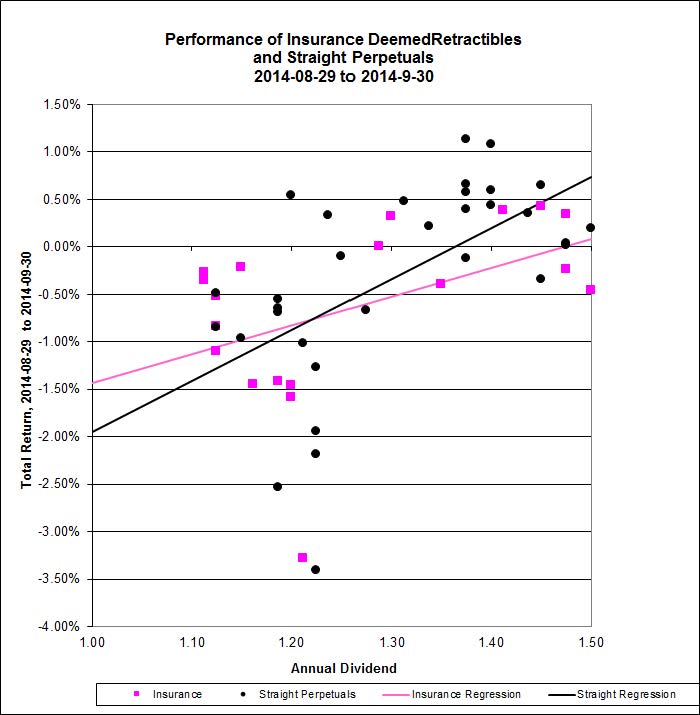
MAPF

MAPF Portfolio Composition: August, 2013

Turnover increased in August, to about 12%.

There is extreme segmentation in the marketplace, with OSFI’s NVCC rule changes in February 2011 having had the effect of splitting the formerly relatively homogeneous Straight Perpetual class of preferreds into three parts:

  • Unaffected Straight Perpetuals
  • DeemedRetractibles explicitly subject to the rules (banks)
  • DeemedRetractibles considered by me, but not (yet!) by the market, to be likely to be explicitly subject to the rules in the future (insurers and insurance holding companies)

This segmentation, and the extreme valuation differences between the segments, has cut down markedly on the opportunities for trading. Another trend that hasn’t helped was the migration of PerpetualDiscounts into PerpetualPremiums (due to price increases) earlier in the year – many of the PerpetualPremiums had negative Yields-to-Worst and those that don’t aren’t particularly thrilling; speaking very generally, PerpetualPremiums are to be avoided, not traded! This effect has caused the first of the three segments noted above to be untradeable for most practical purposes. The recent downdraft has reversed the trend and resulted in a large pool of PerpetualDiscounts, but due to their long term they are still, as a class, inferior to DeemedRetractibles.
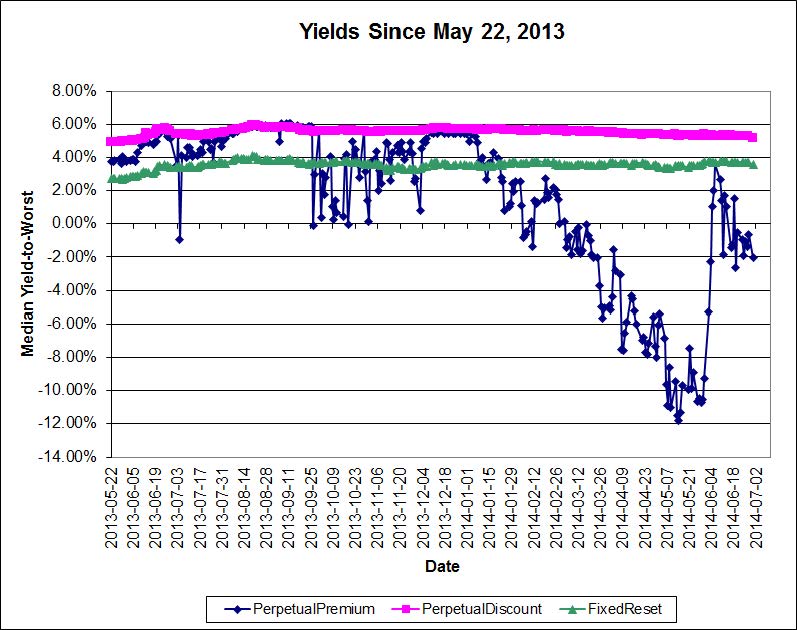
To make this more clear, it used to be that there were 70-odd Straight Perpetuals and I was more or less indifferent as to which ones I owned (subject, of course, to issuer concentration concerns and other risk management factors). Thus, if any one of these 70 were to go down in price by – say – $0.25, I would quite often have something in inventory that I’d be willing to swap for it. The segmentation means that I am no longer indifferent; in addition to checking the valuation of a potential buy to its peers, I also have to check its peer group. This cuts down on the potential for trading.
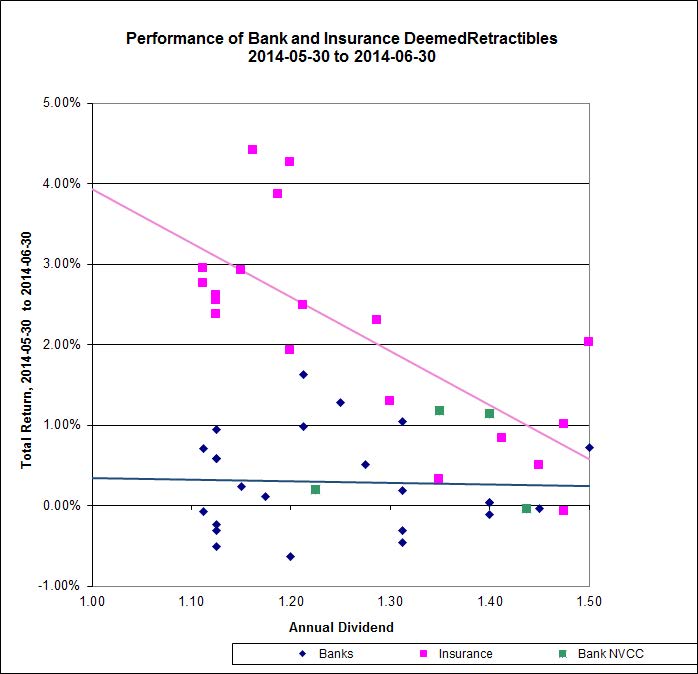
There is no real hope that this situation will be corrected in the near-term. OSFI has indicated that the long-promised “Draft Definition of Capital” for insurers will not be issued “for public consultation in late 2012 or early 2013”, as they fear that it might encourage speculation in the marketplace. It is not clear why OSFI is so afraid of informed speculation, since the constant speculation in the marketplace is currently less informed than it would be with a little bit of regulatory clarity.

As a result of this delay, I have extended the Deemed Maturity date for insurers and insurance holding companies by three years (to 2025-1-31), in the expectation that when OSFI finally does provide clarity, they will allow the same degree of lead-in time for these companies as they did for banks. This has obviously had a major effect on the durations of preferred shares subject to the change but, fortunately, not much on their calculated yields as most of these issues are either trading near par or were trading at sufficient premium that a par call was expected on economic grounds. However, with the declines in the market over the past two months, the expected capital gain on redemption of the insurance-issued DeemedRetractibles has become an important component of the calculated yield.

Sectoral distribution of the MAPF portfolio on August 30 was as follows:

MAPF Sectoral Analysis 2013-8-30
HIMI Indices Sector Weighting YTW ModDur
Ratchet 0% N/A N/A
FixFloat 0% N/A N/A
Floater 0% N/A N/A
OpRet 0% N/A N/A
SplitShare 19.0% (+0.3) 4.49% 6.36
Interest Rearing 0% N/A N/A
PerpetualPremium 0.0% (0) N/A N/A
PerpetualDiscount 4.2% (+3.0) 5.37% 14.92
Fixed-Reset 12.9% (-7.4) 3.59% 3.03
Deemed-Retractible 53.4% (+1.4) 6.26% 8.60
Scraps (Various) 9.8% (+2.1) 6.46% 12.79
Cash +0.6% (+0.6) 0.00% 0.00
Total 100% 5.52% 8.08
Totals and changes will not add precisely due to rounding. Bracketted figures represent change from July month-end. Cash is included in totals with duration and yield both equal to zero.
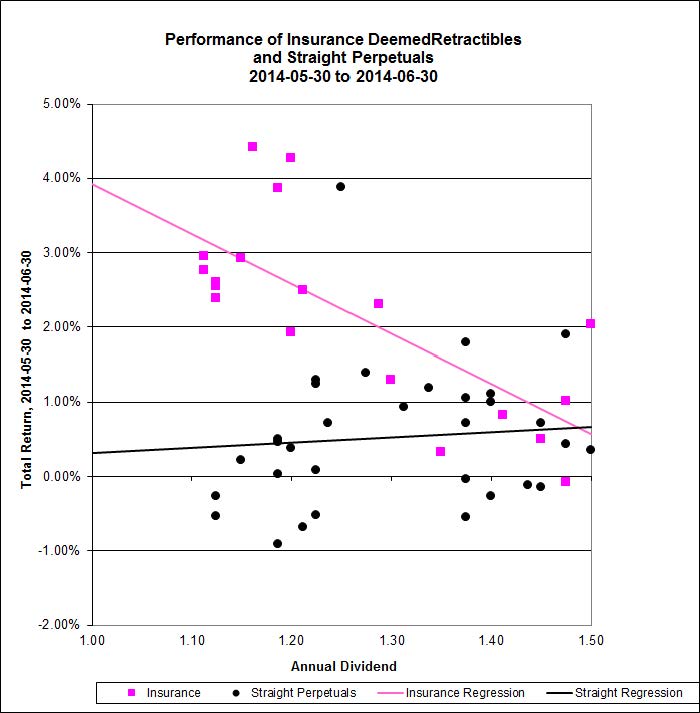
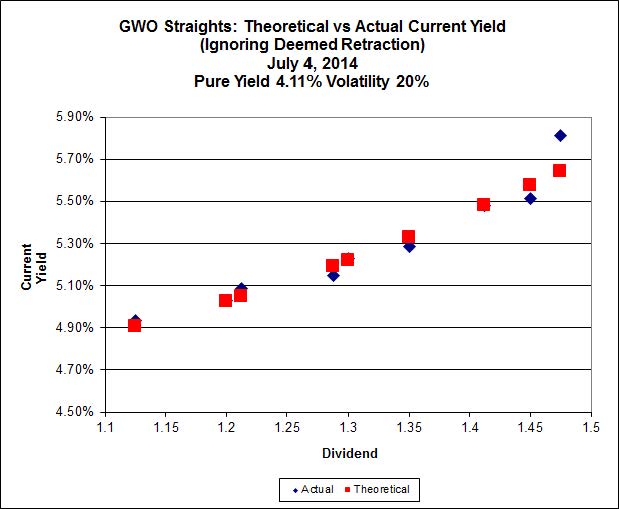
DeemedRetractibles are comprised of all Straight Perpetuals (both PerpetualDiscount and PerpetualPremium) issued by BMO, BNS, CM, ELF, GWO, HSB, IAG, MFC, NA, RY, SLF and TD, which are not exchangable into common at the option of the company. These issues are analyzed as if their prospectuses included a requirement to redeem at par on or prior to 2022-1-31 (banks) or 2025-1-3 (insurers and insurance holding companies), in addition to the call schedule explicitly defined. See OSFI Does Not Grandfather Extant Tier 1 Capital, CM.PR.D, CM.PR.E, CM.PR.G: NVCC Status Confirmed and the January, February, March and June, 2011, editions of PrefLetter for the rationale behind this analysis. (all recent editions have a short summary of the argument included in the “DeemedRetractible” section)

Note that the estimate for the time this will become effective for insurers and insurance holding companies was extended by three years in April 2013, due to the delays in OSFI’s providing clarity on the issue.

The “total” reflects the un-leveraged total portfolio (i.e., cash is included in the portfolio calculations and is deemed to have a duration and yield of 0.00.). MAPF will often have relatively large cash balances, both credit and debit, to facilitate trading. Figures presented in the table have been rounded to the indicated precision.

Credit distribution is:

MAPF Credit Analysis 2013-8-30
DBRS Rating Weighting
Pfd-1 0 (0)
Pfd-1(low) 35.1% (-5.4)
Pfd-2(high) 36.0% (+2.6)
Pfd-2 8.5% (-0.1)
Pfd-2(low) 10.1% (+0.3)
Pfd-3(high) 1.0% (+1.0)
Pfd-3 4.8% (+1.0)
Pfd-3(low) 1.8% (+0.1)
Pfd-4(high) 0% (-0.4)
Pfd-4 0% (-1.0)
Pfd-4(low) 0.8% (0)
Pfd-5(high) 1.3% (+1.3)
Cash 0.6% (+0.6)
Totals will not add precisely due to rounding. Bracketted figures represent change from July month-end.
A position held in NPI.PR.A is not rated by DBRS, but has been included as “Pfd-3” in the above table on the basis of its S&P rating of P-3.

The increase in lower quality issues was due to the fund’s taking small positions in BCE.PR.K and NPI.PR.A, both of which declined sharply during the month (by 2.61% and 10.89%, respectively), and the downgrade of AZP from Pfd-4 to Pfd-5(high).

Liquidity Distribution is:

MAPF Liquidity Analysis 2013-8-30
Average Daily Trading Weighting
<$50,000 0% (-0.4)
$50,000 – $100,000 17.3% (+9.3)
$100,000 – $200,000 31.7% (+10.1)
$200,000 – $300,000 35.5% (-11.6)
>$300,000 15.0% (-8.0)
Cash 0.6% (+0.6)
Totals will not add precisely due to rounding. Bracketted figures represent change from July month-end.

MAPF is, of course, Malachite Aggressive Preferred Fund, a “unit trust” managed by Hymas Investment Management Inc. Further information and links to performance, audited financials and subscription information are available the fund’s web page. The fund may be purchased either directly from Hymas Investment Management or through a brokerage account at Odlum Brown Limited. A “unit trust” is like a regular mutual fund, but is sold by offering memorandum rather than prospectus. This is cheaper, but means subscription is restricted to “accredited investors” (as defined by the Ontario Securities Commission) or those who subscribe for $150,000+. Fund past performances are not a guarantee of future performance. You can lose money investing in MAPF or any other fund.

A similar portfolio composition analysis has been performed on the Claymore Preferred Share ETF (symbol CPD) (and other funds) as of August 31, 2012, and published in the October (mainly methodology), November (most funds), and December (ZPR) 2012, PrefLetter. While direct comparisons are difficult due to the introduction of the DeemedRetractible class of preferred share (see above) it is fair to say:

  • MAPF credit quality is better
  • MAPF liquidity is a lower
  • MAPF Yield is higher
  • Weightings in
    • MAPF is much more exposed to DeemedRetractibles
    • MAPF is much less exposed to Operating Retractibles
    • MAPF is much more exposed to SplitShares
    • MAPF is less exposed to FixFloat / Floater / Ratchet
    • MAPF weighting in FixedResets is much lower
MAPF

MAPF Performance: July 2013

The fund underperformed in June, due largely to being over-weight in DeemedRetractible issues, more particularly insurance DeemedRetractibles which didn’t just underperform – these issues actually underperformed PerpetualDiscounts, something I cannot explain.

The Canadian preferred share market performed poorly in July, with a few new twists.

ZPR, is a relatively new ETF comprised of FixedResets and Floating Rate issues, with a very high proportion of junk issues, which returned -1.48% for the month, and -3.59% over the past three months (according to my calculations from the fund’s NAV data and distribution data; our regulators are hard at work protecting you from performance data since the fund has been extant for less than a year), versus returns for the TXPL index of -1.42% and -3.49%, respectively. The fund has been able to attract assets of about $830.8-million in the eight and a half months since inception, even adding $18.0-million in June despite the market downturn but – and this is important – losing 12.6-million in assets in July. The change in assets is roughly equal to the return of the fund, meaning that although ZPR has not yet experienced any redemptions over a full month, the flow of money into the fund has stopped – at least temporarily. I feel that the flows into and out of this fund are very important in determining the performance of its constituents.

TXPR had returns over one- and three-months of -0.98% and -3.40%, respectively

Returns for the HIMIPref™ investment grade sub-indices for May were as follows:

HIMIPref™ Indices
Performance to July 31, 2013
Sub-Index 1-Month 3-month
Ratchet N/A N/A
FixFloat +2.84% -1.24%
Floater +1.78% +0.35%
OpRet +0.85% +0.59%
SplitShare -0.10% +0.06%
Interest N/A N/A
PerpetualPremium +0.51% -3.98%
PerpetualDiscount +0.19% -11.15%
FixedReset -0.44% -1.64%
DeemedRetractible -0.63% -3.55%

Malachite Aggressive Preferred Fund’s Net Asset Value per Unit as of the close July 31, 2013, was 10.1673.

Returns to July 31, 2013
Period MAPF BMO-CM “50” Index TXPR
Total Return
CPD – according to Blackrock
One Month -1.54% -0.48% -0.98% -0.98%
Three Months -5.06% -2.13% -3.40% -3.48%
One Year +1.95% +1.76% +0.43% -0.08%
Two Years (annualized) +2.39% +3.11% +2.33% N/A
Three Years (annualized) +6.68% +6.34% +4.97% +4.34%
Four Years (annualized) +8.81% +7.21% +5.71% N/A
Five Years (annualized) +17.02% +7.07% +5.74% +5.07%
Six Years (annualized) +12.61% +4.48% +3.26%  
Seven Years (annualized) +11.58% +3.92%    
Eight Years (annualized) +10.68% +3.82%    
Nine Years (annualized) +10.30% +3.96%    
Ten Years (annualized) +11.16% +4.16%    
Eleven Years (annualized) +11.36% +4.35%    
Twelve Years (annualized) +11.36% +4.33%    
MAPF returns assume reinvestment of distributions, and are shown after expenses but before fees.
CPD Returns are for the NAV and are after all fees and expenses.
* CPD does not directly report its two- or four-year returns.
Figures for Omega Preferred Equity (which are after all fees and expenses) for 1-, 3- and 12-months are -0.19%, -2.47% and +1.36%, respectively, according to Morningstar after all fees & expenses. Three year performance is +5.19%; five year is +5.83%
Figures for Jov Leon Frazer Preferred Equity Fund Class I Units (which are after all fees and expenses) for 1-, 3- and 12-months are -0.46%, -2.50% and -0.05% respectively, according to Morningstar. Three Year performance is +2.56%
Figures for Manulife Preferred Income Fund (formerly AIC Preferred Income Fund) (which are after all fees and expenses) for 1-, 3- and 12-months are -0.88%, -5.14% & -1.12%, respectively. Three Year performance is +3.17%
Figures for Horizons AlphaPro Preferred Share ETF (which are after all fees and expenses) for 1-, 3- and 12-months are -0.42%, -2.43% & +1.54%, respectively.
Figures for Altamira Preferred Equity Fund are -1.12% and -3.68% for one- and three- months, respectively.
The figure for BMO S&P/TSX Laddered Preferred Share Index ETF is -1.48% and -3.59% for one- and three-months. [calculation by JH]

MAPF returns assume reinvestment of dividends, and are shown after expenses but before fees. Past performance is not a guarantee of future performance. You can lose money investing in Malachite Aggressive Preferred Fund or any other fund. For more information, see the fund’s main page. The fund is available either directly from Hymas Investment Management or through a brokerage account at Odlum Brown Limited.

A problem that has bedevilled the market over the past two years has been the OSFI decision not to grandfather Straight Perpetuals as Tier 1 bank capital, and their continued foot-dragging regarding a decision on insurer Straight Perpetuals has segmented the market to the point where trading has become much more difficult. The fund occasionally finds an attractive opportunity to trade between GWO issues, which have a good range of annual coupons (but in which trading is now hampered by the fact that the low-coupon issues are trading near par and are callable at par in the near term), but is “stuck” in the MFC and SLF issues, which have a much narrower range of coupon, while the IAG DeemedRetractibles are quite illiquid. Until the market became so grossly segmented, this was not so much of a problem – but now banks are not available to swap into (because they are so expensive) and non-regulated companies are likewise deprecated (because they are not DeemedRetractibles; they should not participate in the increase in value that will follow the OSFI decision I anticipate and, in addition, are analyzed as perpetuals). The fund’s portfolio is, in effect ‘locked in’ to the MFC & SLF issues due to projected gains from a future OSFI decision, to the detriment of trading gains particularly in May, 2013, when the three lowest-coupon SLF DeemedRetractibles (SLF.PR.C, SLF.PR.D and SLF.PR.E) were the worst performing DeemedRetractibles in the sub-index!

I have pointed out in the past that the market continues to treat regulated insurance issues (SLF, GWO) in much the same way unregulated issues (PWF); this was dramatically illustrated in June but the July results are even more dramatic.


Click for Big

Click for Big

The first observation is that insurance issued DeemedRetractibles continued to behave much more like Straight Perpetuals than bank-issued DeemedRetractibles; the second is that the insurance issues actually underperformed Straights in July.

As the fund holds a high proportion of insurer-issued DeemedRetractibles, fund performance was hurt by this phenomenon.

A side effect of the downdraft was the return of measurable Implied Volatility:


Click for Big

Click for Big
Implied Volatility of
Two Series of Issues
July 31, 2013
Issuer Pure Yield Implied Volatility
GWO 3.85% (+0.55) 25% (-3)
PWF 4.30% (+0.30) 24% (-1)
Bracketted figures are changes since June month-end

Those of you who have been paying attention will remember that in a “normal” market (which we have not seen in well over a year) the slope of this line is related to the implied volatility of yields in Black-Scholes theory, as discussed in the January, 2010, edition of PrefLetter. As has been previously noted, very high levels of Implied Volatility (in the 40% range) imply a very strong expectation of directionality in future prices – i.e, an expectation that all issues will be redeemed at par. The decline in Implied Volatility – which is still at very high levels – implies more uncertainty regarding this prediction.

Sometimes everything works … sometimes it’s 50-50 … sometimes nothing works. The fund seeks to earn incremental return by selling liquidity (that is, taking the other side of trades that other market participants are strongly motivated to execute), which can also be referred to as ‘trading noise’ – although for quite some time, noise trading has taken a distant second place to the sectoral play on insurance DeemedRetractibles. There were a lot of strongly motivated market participants during the Panic of 2007, generating a lot of noise! Unfortunately, the conditions of the Panic may never be repeated in my lifetime … but the fund will simply attempt to make trades when swaps seem profitable, without worrying about the level of monthly turnover.

There’s plenty of room for new money left in the fund. I have shown in recent issues of PrefLetter that market pricing for FixedResets is demonstrably stupid and I have lots of confidence – backed up by my bond portfolio management experience in the markets for Canadas and Treasuries, and equity trading on the NYSE & TSX – that there is enough demand for liquidity in any market to make the effort of providing it worthwhile (although the definition of “worthwhile” in terms of basis points of outperformance changes considerably from market to market!) I will continue to exert utmost efforts to outperform but it should be borne in mind that there will almost inevitably be periods of underperformance in the future.

The yields available on high quality preferred shares remain elevated, which is reflected in the current estimate of sustainable income.

Calculation of MAPF Sustainable Income Per Unit
Month NAVPU Portfolio
Average
YTW
Leverage
Divisor
Securities
Average
YTW
Capital
Gains
Multiplier
Sustainable
Income
per
current
Unit
June, 2007 9.3114 5.16% 1.03 5.01% 1.3240 0.3524
September 9.1489 5.35% 0.98 5.46% 1.3240 0.3773
December, 2007 9.0070 5.53% 0.942 5.87% 1.3240 0.3993
March, 2008 8.8512 6.17% 1.047 5.89% 1.3240 0.3938
June 8.3419 6.034% 0.952 6.338% 1.3240 $0.3993
September 8.1886 7.108% 0.969 7.335% 1.3240 $0.4537
December, 2008 8.0464 9.24% 1.008 9.166% 1.3240 $0.5571
March 2009 $8.8317 8.60% 0.995 8.802% 1.3240 $0.5872
June 10.9846 7.05% 0.999 7.057% 1.3240 $0.5855
September 12.3462 6.03% 0.998 6.042% 1.3240 $0.5634
December 2009 10.5662 5.74% 0.981 5.851% 1.1141 $0.5549
March 2010 10.2497 6.03% 0.992 6.079% 1.1141 $0.5593
June 10.5770 5.96% 0.996 5.984% 1.1141 $0.5681
September 11.3901 5.43% 0.980 5.540% 1.1141 $0.5664
December 2010 10.7659 5.37% 0.993 5.408% 1.0298 $0.5654
March, 2011 11.0560 6.00% 0.994 5.964% 1.0298 $0.6403
June 11.1194 5.87% 1.018 5.976% 1.0298 $0.6453
September 10.2709 6.10%
Note
1.001 6.106% 1.0298 $0.6090
December, 2011 10.0793 5.63%
Note
1.031 5.805% 1.0000 $0.5851
March, 2012 10.3944 5.13%
Note
0.996 5.109% 1.0000 $0.5310
June 10.2151 5.32%
Note
1.012 5.384% 1.0000 $0.5500
September 10.6703 4.61%
Note
0.997 4.624% 1.0000 $0.4934
December, 2012 10.8307 4.24% 0.989 4.287% 1.0000 $0.4643
March, 2013 10.9033 3.87% 0.996 3.886% 1.0000 $0.4237
June 10.3261 4.81% 0.998 4.80% 1.0000 $0.4957
July, 2013 10.1673 5.13% 1.000 5.13% 1.0000 $0.5216
NAVPU is shown after quarterly distributions of dividend income and annual distribution of capital gains.
Portfolio YTW includes cash (or margin borrowing), with an assumed interest rate of 0.00%
The Leverage Divisor indicates the level of cash in the account: if the portfolio is 1% in cash, the Leverage Divisor will be 0.99
Securities YTW divides “Portfolio YTW” by the “Leverage Divisor” to show the average YTW on the securities held; this assumes that the cash is invested in (or raised from) all securities held, in proportion to their holdings.
The Capital Gains Multiplier adjusts for the effects of Capital Gains Dividends. On 2009-12-31, there was a capital gains distribution of $1.989262 which is assumed for this purpose to have been reinvested at the final price of $10.5662. Thus, a holder of one unit pre-distribution would have held 1.1883 units post-distribution; the CG Multiplier reflects this to make the time-series comparable. Note that Dividend Distributions are not assumed to be reinvested.
Sustainable Income is the resultant estimate of the fund’s dividend income per current unit, before fees and expenses. Note that a “current unit” includes reinvestment of prior capital gains; a unitholder would have had the calculated sustainable income with only, say, 0.9 units in the past which, with reinvestment of capital gains, would become 1.0 current units.
DeemedRetractibles are comprised of all Straight Perpetuals (both PerpetualDiscount and PerpetualPremium) issued by BMO, BNS, CM, ELF, GWO, HSB, IAG, MFC, NA, RY, SLF and TD, which are not exchangable into common at the option of the company (definition refined in May, 2011). These issues are analyzed as if their prospectuses included a requirement to redeem at par on or prior to 2022-1-31 (banks) or 2025-1-31 (insurers and insurance holding companies), in addition to the call schedule explicitly defined. See OSFI Does Not Grandfather Extant Tier 1 Capital, CM.PR.D, CM.PR.E, CM.PR.G: Seeking NVCC Status and the January, February, March and June, 2011, editions of PrefLetter for the rationale behind this analysis.
Yields for September, 2011, to January, 2012, were calculated by imposing a cap of 10% on the yields of YLO issues held, in order to avoid their extremely high calculated yields distorting the calculation and to reflect the uncertainty in the marketplace that these yields will be realized. From February to September 2012, yields on these issues have been set to zero. All YLO issues held were sold in October 2012.

Significant positions were held in DeemedRetractible and FixedReset issues on July 31; all of these currently have their yields calculated with the presumption that they will be called by the issuers at par prior to 2022-1-31 (banks) or 2025-1-31 (insurers and insurance holding companies). This presents another complication in the calculation of sustainable yield. The fund also holds positions in various SplitShare issues which also have their yields calculated with the expectation of a maturity at par.

I no longer show calculations that assume the conversion of the entire portfolio into PerpetualDiscounts, as the fund has no holdings of these issues.

I will also note that the sustainable yield calculated above is not directly comparable with any yield calculation currently reported by any other preferred share fund as far as I am aware. The Sustainable Yield depends on:
i) Calculating Yield-to-Worst for each instrument and using this yield for reporting purposes;
ii) Using the contemporary value of Five-Year Canadas (set at 1.31% for the May 31 calculation) to estimate dividends after reset for FixedResets.

Most funds report Current Yield. For instance, ZPR reports a “Portfolio Yield” of 4.90% as of July 31, 2013 and notes:

Portfolio yield is calculated as the most recent income received by the ETF in the form of dividends interest and other income annualized based on the payment frequently divided by the current market value of ETFs investments.

In other words – it’s the Current Yield, a meaningless number. The Current Yield of MAPF is 5.32%, but I will neither report that with any degree of prominence nor take any great pleasure in the fact that it’s higher than the ZPR number. It’s meaningless; to accord it any prominence in portfolio reporting is misleading.

It should be noted that the concept of this Sustainable Income calculation was developed when the fund’s holdings were overwhelmingly PerpetualDiscounts – see, for instance, the bottom of the market in November 2008. It is easy to understand that for a PerpetualDiscount, the technique of multiplying yield by price will indeed result in the coupon – a PerpetualDiscount paying $1 annually will show a Sustainable Income of $1, regardless of whether the price is $24 or $17.

Things are not quite so neat when maturity dates and maturity prices that are different from the current price are thrown into the mix. If we take a notional Straight Perpetual paying $5 annually, the price is $100 when the yield is 5% (all this ignores option effects). As the yield increases to 6%, the price declines to 83.33; and 83.33 x 6% is the same $5. Good enough.

But a ten year bond, priced at 100 when the yield is equal to its coupon of 5%, will decline in price to 92.56; and 92.56 x 6% is 5.55; thus, the calculated Sustainable Income has increased as the price has declined as shown in the graph:


Click for Big

The difference is because the bond’s yield calculation includes the amortization of the discount; therefore, so does the Sustainable Income estimate.

Thus, the decline in the MAPF Sustainable Income from $0.5500 per unit in June, 2012, to $0.5216 per unit in July, 2013, should be looked at as a simple consequence of the fund’s holdings; virtually all of which have their yields calculated in a manner closer to bonds than to Perpetual Annuities.

Different assumptions lead to different results from the calculation, but the overall positive trend is apparent. I’m very pleased with the long-term results! It will be noted that if there was no trading in the portfolio, one would expect the sustainable yield to be constant (before fees and expenses). The success of the fund’s trading is showing up in

  • the very good performance against the index
  • the long term increases in sustainable income per unit

As has been noted, the fund has maintained a credit quality equal to or better than the index; outperformance is due to exploitation of trading anomalies.

Again, there are no predictions for the future! The fund will continue to trade between issues in an attempt to exploit market gaps in liquidity, in an effort to outperform the index and keep the sustainable income per unit – however calculated! – growing.