Category: MAPF

MAPF

MAPF Portfolio Composition: January, 2012

Turnover picked up in January, to about 10%.

Portfolio composition changed in several ways this month, but the major effects are due to the sale of nearly the entire ELF.PR.F and ELF.PR.G, with proceeds used to purchase higher-rated, more liquid, lower yielding FixedResets.

Sectoral distribution of the MAPF portfolio on January 31 was as follows:

MAPF Sectoral Analysis 2012-1-31
HIMI Indices Sector Weighting YTW ModDur
Ratchet 0% N/A N/A
FixFloat 0% N/A N/A
Floater 0% N/A N/A
OpRet 0% N/A N/A
SplitShare 10.0% (+0.2) 6.21% 5.78
Interest Rearing 0% N/A N/A
PerpetualPremium 0.0% (0) N/A N/A
PerpetualDiscount 1.4% (-6.5) 5.16% 15.18
Fixed-Reset 19.4% (+6.3) 2.63% 2.20
Deemed-Retractible 58.5% (+2.4) 5.31% 7.77
Scraps (Various) 10.7% (+0.7) 6.80% (see note) 11.21 (see note)
Cash 0.0 (-3.1) 0.00% 0.00
Total 100% 5.04% 6.96
Yields for the YLO preferreds have been set at 10% for calculation purposes, and their durations at 5.00. The extraordinarily low price of these issues has resulted in extremely high calculated yields; I feel that substitution of these values results in a more prudent total indication.
Totals and changes will not add precisely due to rounding. Bracketted figures represent change from December month-end. Cash is included in totals with duration and yield both equal to zero.
DeemedRetractibles are comprised of all Straight Perpetuals (both PerpetualDiscount and PerpetualPremium) issued by BMO, BNS, CM, ELF, GWO, HSB, IAG, MFC, NA, RY, SLF and TD, which are not exchangable into common at the option of the company. These issues are analyzed as if their prospectuses included a requirement to redeem at par on or prior to 2022-1-31, in addition to the call schedule explicitly defined. See OSFI Does Not Grandfather Extant Tier 1 Capital, CM.PR.D, CM.PR.E, CM.PR.G: NVCC Status Confirmed and the January, February, March and June, 2011, editions of PrefLetter for the rationale behind this analysis.

The “total” reflects the un-leveraged total portfolio (i.e., cash is included in the portfolio calculations and is deemed to have a duration and yield of 0.00.). MAPF will often have relatively large cash balances, both credit and debit, to facilitate trading. Figures presented in the table have been rounded to the indicated precision.

Credit distribution is:

MAPF Credit Analysis 2012-1-31
DBRS Rating Weighting
Pfd-1 0 (0)
Pfd-1(low) 51.7% (+4.9)
Pfd-2(high) 26.2% (+4.7)
Pfd-2 0 (0)
Pfd-2(low) 11.3% (-7.4)
Pfd-3(high) 1.1% (-2.0)
Pfd-3 4.8% (+1.8)
Pfd-4 2.5% (+0.2)
Pfd-4(low) 1.8% (+0.1)
Cash 0.0 (-3.1)
Totals will not add precisely due to rounding. Bracketted figures represent change from December month-end.
A position held in ELF preferreds has been assigned to Pfd-2(low)
A position held in CSE preferreds has been assigned to Pfd-3

Liquidity Distribution is:

MAPF Liquidity Analysis 2012-1-31
Average Daily Trading Weighting
<$50,000 1.2% (-1.2)
$50,000 – $100,000 11.0% (-18.0)
$100,000 – $200,000 33.2% (+7.2)
$200,000 – $300,000 36.8% (-0.3)
>$300,000 17.8% (+5.5)
Cash 0.0 (-3.1)
Totals will not add precisely due to rounding. Bracketted figures represent change from December month-end.

MAPF is, of course, Malachite Aggressive Preferred Fund, a “unit trust” managed by Hymas Investment Management Inc. Further information and links to performance, audited financials and subscription information are available the fund’s web page. The fund may be purchased either directly from Hymas Investment Management or through a brokerage account at Odlum Brown Limited. A “unit trust” is like a regular mutual fund, but is sold by offering memorandum rather than prospectus. This is cheaper, but means subscription is restricted to “accredited investors” (as defined by the Ontario Securities Commission) or those who subscribe for $150,000+. Fund past performances are not a guarantee of future performance. You can lose money investing in MAPF or any other fund.

A similar portfolio composition analysis has been performed on the Claymore Preferred Share ETF (symbol CPD) as of August 31, 2011, and published in the October, 2011, PrefLetter. While direct comparisons are difficult due to the introduction of the DeemedRetractible class of preferred share (see above) it is fair to say:

  • MAPF credit quality is better
  • MAPF liquidity is a higher
  • MAPF Yield is higher
  • Weightings in
    • MAPF is much more exposed to DeemedRetractibles
    • MAPF is much less exposed to Operating Retractibles
    • MAPF is much more exposed to SplitShares
    • MAPF is less exposed to FixFloat / Floater / Ratchet
    • MAPF weighting in FixedResets is much lower
MAPF

MAPF Performance: December 2011

The fund probably underperformed in December, although comparators are not yet available.

The fund’s Net Asset Value per Unit as of the close December 30 was $10.0793 after distribution of $0.162247 dividends and $0.299965 capital gains.

Returns to December 30, 2011
Period MAPF Index CPD
according to
Claymore
One Month +0.87% +1.48% +1.35%
Three Months +2.63% +2.50% +2.29%
One Year +1.78% +7.80% +5.23%
Two Years (annualized) +8.80% +8.95% N/A
Three Years (annualized) +25.33% +15.38% +12.29%
Four Years (annualized) +17.29% +6.44%  
Five Years (annualized) +13.24% +3.79%  
Six Years (annualized) +12.15% +3.87%  
Seven Years (annualized) +11.24% +3.87%  
Eight Years (annualized) +11.51% +4.13%  
Nine Years (annualized) +13.77% +4.48%  
Ten Years (annualized) +12.44% +4.47%  
The Index is the BMO-CM “50”
MAPF returns assume reinvestment of distributions, and are shown after expenses but before fees.
CPD Returns are for the NAV and are after all fees and expenses.
* CPD does not directly report its two-year returns.
Figures for Omega Preferred Equity (which are after all fees and expenses) for 1-, 3- and 12-months are +1.13%, +2.19% and +5.55%, respectively, according to Morningstar after all fees & expenses. Three year performance is +13.35%.
Figures for Jov Leon Frazer Preferred Equity Fund Class I Units (which are after all fees and expenses) for 1-, 3- and 12-months are +1.04%, +1.91% and +3.43% respectively, according to Morningstar
Figures for Manulife Preferred Income Fund (formerly AIC Preferred Income Fund) (which are after all fees and expenses) for 1-, 3- and 12-months are +1.22%, +1.80% & +4.66%, respectively
Figures for Horizons AlphaPro Preferred Share ETF (which are after all fees and expenses) for 1-, 3- and 12-months are +1.61%, +2.57% & +6.36%, respectively.

MAPF returns assume reinvestment of dividends, and are shown after expenses but before fees. Past performance is not a guarantee of future performance. You can lose money investing in Malachite Aggressive Preferred Fund or any other fund. For more information, see the fund’s main page. The fund is available either directly from Hymas Investment Management or through a brokerage account at Odlum Brown Limited.

My assumption that the fund underperformed in December is based on the performance of the S&P/TSX Preferred Share Index (TXPR) Total Return Index, for which preliminary figures show a return of +1.37% for the month (although the quarter was OK, with the fund gaining 2.63%, vs. +2.35% for TXPR). However, this return is based on the closing price, not the closing bid, and these figures were significantly different this year.

Closing Prices vs. Last Bid for Some Preferred Share Positions Held by MAPF
Ticker Proportion of MAPF Holdings Last Bid Closing Price
BNA.PR.C 9.9% 21.98 22.10
GWO.PR.H 9.3% 23.70 23.92
MFC.PR.C 8.5% 21.66 21.74
GWO.PR.I 8.5% 22.55 22.56
SLF.PR.D 7.8% 20.81 20.85

In all, the difference in valuation for the whole fund is about $25,000, or about 0.5% of fund value.

Naturally, this is not a full explanation – ideally, we would know what the difference was at November month-end and compare the two differences. I will say, however, that in the course of valuing the fund I was surprised at the size of the discrepency, which is a number I usually just glance at and discard, since it has no real meaning.

Fund returns in December were dragged down by poor performance in low-coupon DeemedRetractibles. SLF, in particular, has been afflicted in recent months by relatively poor financial results and bouts of selling (see Who’s Selling all the SLF Preferreds? and Moody’s puts SLF on Review-Negative) and has not yet shown significant signs of recovery.

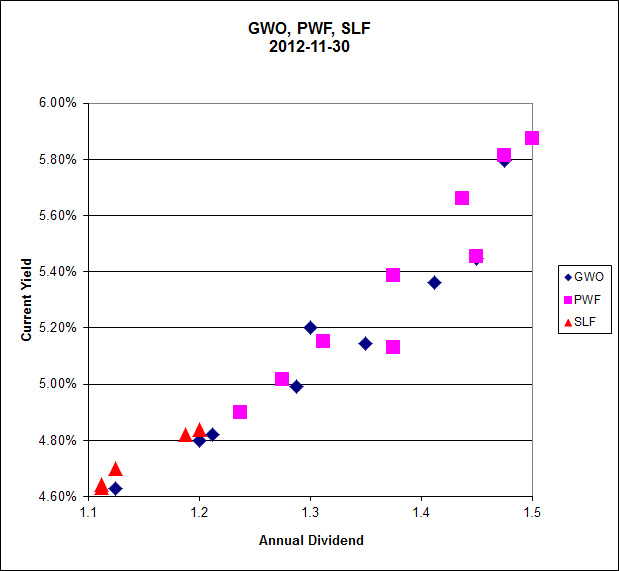
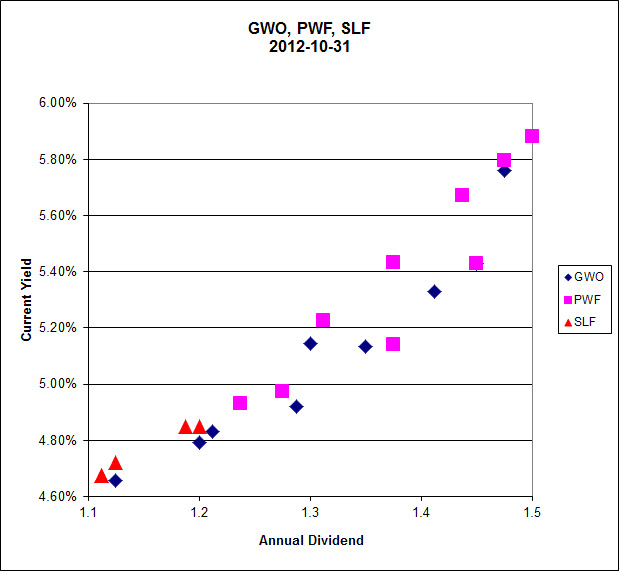
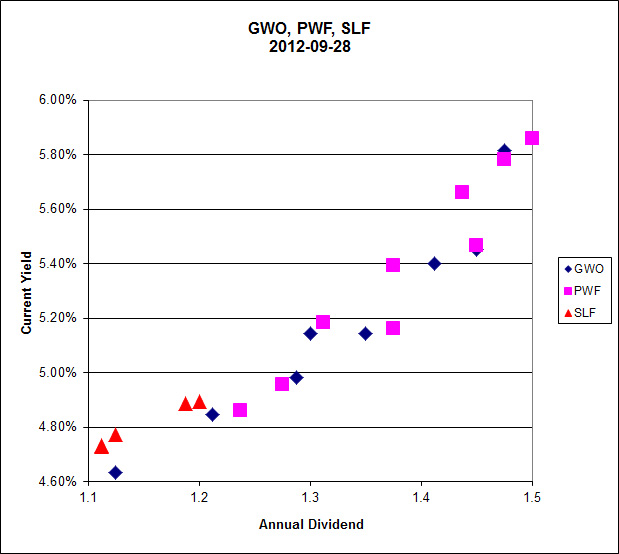
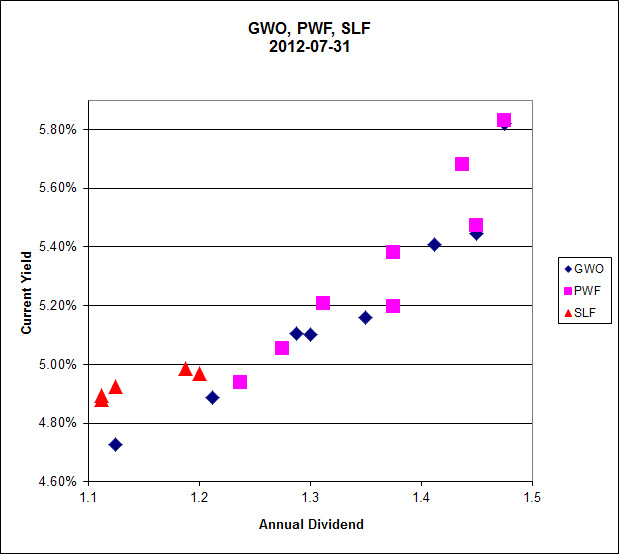
SLF issues may be compared with PWF and GWO:


Click for Big

Click for Big

Now, I certainly agree that GWO is a better credit than SLF and deserves a little bit of premium pricing – but the current situation goes far beyond what I consider reasonable. What is also very interesting is the observation that the market is sharply differentiating between SLF and GWO, but not between GWO and its unregulated parent, PWF.

The import of the above charts becomes more clear when we examine the December performance for the same issues:


Click for Big

While the SLF issues did fairly well when compared against other insurance and insurance-related Straight Perpetuals, there was a clear bias towards higher returns for the higher coupon issues – and the fund is concentrated in the low-coupon issues.

Further, I consider the comparison between SLF and WN to be absolutely fascinating:

SLF vs WN
Straight Perpetuals
2011-12-30
Ticker Dividend Bid Current
Yield
SLF.PR.A 1.1875 22.07 5.38%
SLF.PR.B 1.20 22.20 5.41%
SLF.PR.C 1.1125 20.81 5.35%
SLF.PR.D 1.1125 20.81 5.35%
SLF.PR.E 1.125 21.04 5.35%
WN.PR.A 1.45 25.46 5.70%
WN.PR.C 1.30 25.01 5.20%
WN.PR.D 1.30 24.95 5.21%
WN.PR.E 1.1875 23.93 4.96%

Aside from the outlier WN.PR.A, which is currently redeemable at 25.00, it is clear that the WN issues are trading at lower Current Yields than the SLF issues (there’s minimal jiggery-pokery regarding the next dividend; the SLF issues go ex-dividend on about February 21, while WN.PR.A is at the end of February and the other WN issues go ex in mid-March).

In order to rationalize the relationship between the Current Yields we are asked to believe:

  • That the additional credit quality of SLF is worthless
    • It is possible, of course, to argue that WN is actually a better credit than SLF, or that the scarcity value of a non-financial preferred outweighs the difference in credit. I have not yet heard these arguments being made
  • The option value of the issuer’s call is worthless
    • This can be phrased as ‘The potential capital gain for the SLF issues prior to a call, relative to that of the WN issues, is worthless’
  • The potential of a regulatory inspired call for the SLF issues is worthless
    • the SLF issues are currently Tier 1 Capital at the holding company level, but do not have an NVCC clause

All in all, this is a good indication of what I don’t understand about what the market has been doing this year and a big factor in the fund’s underperformance.

Another factor, for the year and for December, has been the performance of the YLO issues. These performed poorly in December and reduced the fund’s return for the month by about 36bp. I continue to be surprised at just how poorly these issues are surprising: I will certainly agree that YLO was never the best of all possible credits, and will also agree that their financial position has deteriorated over the year – but the company remains significantly profitable (on an operating basis) and cash-flow positive; but the preferreds are trading as if they are on the steps of bankruptcy court.

According to me, the worst-case realistic scenario for YLO is not bankruptcy court, but a reorganization in which the bond holders take over the company. This will be bad news for the common shareholders, and for holders of the two issues which can be converted by the company into common (YLO.PR.A and YLO.PR.B), but the prospects for the two FixedResets (YLO.PR.C and YLO.PR.D) are much less clear even given further financial deterioration and angry bondholders.

Sometimes everything works … sometimes the trading works, but sectoral shifts overwhelm the increment … sometimes nothing works – and in 2011 circumstances were closer to the third possibility than they have generally been in the past. The fund seeks to earn incremental return by selling liquidity (that is, taking the other side of trades that other market participants are strongly motivated to execute), which can also be referred to as ‘trading noise’. There were a lot of strongly motivated market participants during the Panic of 2007, generating a lot of noise! Unfortunately, the conditions of the Panic may never be repeated in my lifetime … but the fund will simply attempt to make trades when swaps seem profitable, without worrying about the level of monthly turnover.

There’s plenty of room for new money left in the fund. I have shown in recent issues of PrefLetter that market pricing for FixedResets is demonstrably stupid and I have lots of confidence – backed up by my bond portfolio management experience in the markets for Canadas and Treasuries, and equity trading on the NYSE & TSX – that there is enough demand for liquidity in any market to make the effort of providing it worthwhile (although the definition of “worthwhile” in terms of basis points of outperformance changes considerably from market to market!) I will continue to exert utmost efforts to outperform but it should be borne in mind that there will almost inevitably be periods of underperformance in the future.

The yields available on high quality preferred shares remain elevated, which is reflected in the current estimate of sustainable income.

Calculation of MAPF Sustainable Income Per Unit
Month NAVPU Portfolio
Average
YTW
Leverage
Divisor
Securities
Average
YTW
Capital
Gains
Multiplier
Sustainable
Income
per
current
Unit
June, 2007 9.3114 5.16% 1.03 5.01% 1.3240 0.3524
September 9.1489 5.35% 0.98 5.46% 1.3240 0.3773
December, 2007 9.0070 5.53% 0.942 5.87% 1.3240 0.3993
March, 2008 8.8512 6.17% 1.047 5.89% 1.3240 0.3938
June 8.3419 6.034% 0.952 6.338% 1.3240 $0.3993
September 8.1886 7.108% 0.969 7.335% 1.3240 $0.4537
December, 2008 8.0464 9.24% 1.008 9.166% 1.3240 $0.5571
March 2009 $8.8317 8.60% 0.995 8.802% 1.3240 $0.5872
June 10.9846 7.05% 0.999 7.057% 1.3240 $0.5855
September 12.3462 6.03% 0.998 6.042% 1.3240 $0.5634
December 2009 10.5662 5.74% 0.981 5.851% 1.1141 $0.5549
March 2010 10.2497 6.03% 0.992 6.079% 1.1141 $0.5593
June 10.5770 5.96% 0.996 5.984% 1.1141 $0.5681
September 11.3901 5.43% 0.980 5.540% 1.1141 $0.5664
December 2010 10.7659 5.37% 0.993 5.408% 1.0298 $0.5654
March, 2011 11.0560 6.00% 0.994 5.964% 1.0298 $0.6403
June 11.1194 5.87% 1.018 5.976% 1.0298 $0.6453
September 10.2709 6.10%
Note
1.001 6.106% 1.0298 $0.6090
December, 2011 10.0793 5.63%
Note
1.031 5.805% 1.0000 $0.5851
NAVPU is shown after quarterly distributions of dividend income and annual distribution of capital gains.
Portfolio YTW includes cash (or margin borrowing), with an assumed interest rate of 0.00%
The Leverage Divisor indicates the level of cash in the account: if the portfolio is 1% in cash, the Leverage Divisor will be 0.99
Securities YTW divides “Portfolio YTW” by the “Leverage Divisor” to show the average YTW on the securities held; this assumes that the cash is invested in (or raised from) all securities held, in proportion to their holdings.
The Capital Gains Multiplier adjusts for the effects of Capital Gains Dividends. On 2009-12-31, there was a capital gains distribution of $1.989262 which is assumed for this purpose to have been reinvested at the final price of $10.5662. Thus, a holder of one unit pre-distribution would have held 1.1883 units post-distribution; the CG Multiplier reflects this to make the time-series comparable. Note that Dividend Distributions are not assumed to be reinvested.
Sustainable Income is the resultant estimate of the fund’s dividend income per current unit, before fees and expenses. Note that a “current unit” includes reinvestment of prior capital gains; a unitholder would have had the calculated sustainable income with only, say, 0.9 units in the past which, with reinvestment of capital gains, would become 1.0 current units.
DeemedRetractibles are comprised of all Straight Perpetuals (both PerpetualDiscount and PerpetualPremium) issued by BMO, BNS, CM, ELF, GWO, HSB, IAG, MFC, NA, RY, SLF and TD, which are not exchangable into common at the option of the company (definition refined in May). These issues are analyzed as if their prospectuses included a requirement to redeem at par on or prior to 2022-1-31, in addition to the call schedule explicitly defined. See OSFI Does Not Grandfather Extant Tier 1 Capital, CM.PR.D, CM.PR.E, CM.PR.G: Seeking NVCC Status and the January, February, March and June, 2011, editions of PrefLetter for the rationale behind this analysis.
Yields for September, 2011, to December, 2011, were calculated by imposing a cap of 10% on the yields of YLO issues held, in order to avoid their extremely high calculated yields distorting the calculation and to reflect the uncertainty in the marketplace that these yields will be realized.

Significant positions were held in DeemedRetractible and FixedReset issues on December 30; all of the former and most of the latter currently have their yields calculated with the presumption that they will be called by the issuers at par prior to 2022-1-31. This presents another complication in the calculation of sustainable yield. The fund also holds a position in SplitShare issues (mainly BNA.PR.C) and an OperatingRetractible Scrap (YLO.PR.B) which also have their yields calculated with the expectation of a maturity at par, a somewhat dubious assumption in the latter case.

However, if the entire portfolio except for the PerpetualDiscounts were to be sold and reinvested in these issues, the yield of the portfolio would be the 5.69% shown in the MAPF Portfolio Composition: December 2011 analysis (which is greater than the 5.12% index yield on November 30). Given such reinvestment, the sustainable yield would be ($10.0793 + 0.162247) * 0.0569 = $0.5827 (note the adjustment for the dividend distribution, which makes the figure more comparable to November’s), down somewhat from the $10.4511 * 0.0579 / 1.0298 = 0.5876 (note the adjustment for capital gains reinvestment) reported for November.

Still, I am pleased that although the market value of the portfolio has not kept up with expectations, the sustainable income per unit (adjusted for capital gains) did increase by $0.02 over the year … do that often enough and eventually market value will reflect the underlying performance!

Different assumptions lead to different results from the calculation, but the overall positive trend is apparent. I’m very pleased with the results! It will be noted that if there was no trading in the portfolio, one would expect the sustainable yield to be constant (before fees and expenses). The success of the fund’s trading is showing up in

  • the very good performance against the index
  • the long term increases in sustainable income per unit

As has been noted, the fund has maintained a credit quality equal to or better than the index; outperformance is due to constant exploitation of trading anomalies.

Again, there are no predictions for the future! The fund will continue to trade between issues in an attempt to exploit market gaps in liquidity, in an effort to outperform the index and keep the sustainable income per unit – however calculated! – growing.
MAPF

MAPF Portfolio Composition: December, 2011

Turnover remained low in December, at about 4%.

Sectoral distribution of the MAPF portfolio on December 30 was as follows:

MAPF Sectoral Analysis 2011-12-30
HIMI Indices Sector Weighting YTW ModDur
Ratchet 0% N/A N/A
FixFloat 0% N/A N/A
Floater 0% N/A N/A
OpRet 0% N/A N/A
SplitShare 9.8% (0) 6.61% 5.90
Interest Rearing 0% N/A N/A
PerpetualPremium 0.0% (0) N/A N/A
PerpetualDiscount 7.9% (-1.2) 5.69% 14.40
Fixed-Reset 13.1% (+1.2) 2.77% 2.71
Deemed-Retractible 56.1% (-3.0) 6.13% 7.81
Scraps (Various) 10.0% (+0.3) 7.27% (see note) 9.22 (see note)
Cash +3.1% (+2.7) 0.00% 0.00
Total 100% 5.63% 7.39
Yields for the YLO preferreds have been set at 10% for calculation purposes, and their durations at 5.00. The extraordinarily low price of these issues has resulted in extremely high calculated yields; I feel that substitution of these values results in a more prudent total indication.
Totals and changes will not add precisely due to rounding. Bracketted figures represent change from November month-end. Cash is included in totals with duration and yield both equal to zero.
DeemedRetractibles are comprised of all Straight Perpetuals (both PerpetualDiscount and PerpetualPremium) issued by BMO, BNS, CM, ELF, GWO, HSB, IAG, MFC, NA, RY, SLF and TD, which are not exchangable into common at the option of the company. These issues are analyzed as if their prospectuses included a requirement to redeem at par on or prior to 2022-1-31, in addition to the call schedule explicitly defined. See OSFI Does Not Grandfather Extant Tier 1 Capital, CM.PR.D, CM.PR.E, CM.PR.G: NVCC Status Confirmed and the January, February, March and June, 2011, editions of PrefLetter for the rationale behind this analysis.

The “total” reflects the un-leveraged total portfolio (i.e., cash is included in the portfolio calculations and is deemed to have a duration and yield of 0.00.). MAPF will often have relatively large cash balances, both credit and debit, to facilitate trading. Figures presented in the table have been rounded to the indicated precision.

The increase in cash is due to client subscriptions for year end which have not yet been invested.

Credit distribution is:

MAPF Credit Analysis 2011-12-30
DBRS Rating Weighting
Pfd-1 0 (0)
Pfd-1(low) 46.8% (-0.6)
Pfd-2(high) 21.5% (-1.1)
Pfd-2 0 (0)
Pfd-2(low) 18.7% (-1.3)
Pfd-3(high) 3.1% (+0.4)
Pfd-3 3.0% (+1.0)
Pfd-4 2.3% (-0.2)
Pfd-4(low) 1.7% (-0.8)
Cash +3.1% (+2.7)
Totals will not add precisely due to rounding. Bracketted figures represent change from November month-end.
A position held in ELF preferreds has been assigned to Pfd-2(low)
A position held in CSE preferreds has been assigned to Pfd-3

Liquidity Distribution is:

MAPF Liquidity Analysis 2011-12-30
Average Daily Trading Weighting
<$50,000 2.4% (-2.9)
$50,000 – $100,000 29.0% (+9.5)
$100,000 – $200,000 26.0% (-3.0)
$200,000 – $300,000 37.1% (-4.7)
>$300,000 2.3% (-1.7)
Cash +3.1% (+2.7)
Totals will not add precisely due to rounding. Bracketted figures represent change from November month-end.

MAPF is, of course, Malachite Aggressive Preferred Fund, a “unit trust” managed by Hymas Investment Management Inc. Further information and links to performance, audited financials and subscription information are available the fund’s web page. The fund may be purchased either directly from Hymas Investment Management or through a brokerage account at Odlum Brown Limited. A “unit trust” is like a regular mutual fund, but is sold by offering memorandum rather than prospectus. This is cheaper, but means subscription is restricted to “accredited investors” (as defined by the Ontario Securities Commission) or those who subscribe for $150,000+. Fund past performances are not a guarantee of future performance. You can lose money investing in MAPF or any other fund.

A similar portfolio composition analysis has been performed on the Claymore Preferred Share ETF (symbol CPD) as of August 31, 2011, and published in the October, 2011, PrefLetter. While direct comparisons are difficult due to the introduction of the DeemedRetractible class of preferred share (see above) it is fair to say:

  • MAPF credit quality is better
  • MAPF liquidity is a higher
  • MAPF Yield is higher
  • Weightings in
    • MAPF is much more exposed to DeemedRetractibles
    • MAPF is much less exposed to Operating Retractibles
    • MAPF is much more exposed to SplitShares
    • MAPF is less exposed to FixFloat / Floater / Ratchet
    • MAPF weighting in FixedResets is much lower
MAPF

MAPF Performance: November 2011

The fund underperformed in November, largely due to a steep decline in the prices of SLF issues, which form a significant part of the fund’s holdings.

The fund’s Net Asset Value per Unit as of the close November 30 was $10.4511.

Returns to November 30, 2011
Period MAPF Index CPD
according to
Claymore
One Month -0.39% +0.41% +0.11%
Three Months -4.87% +0.72% +0.10%
One Year +0.56% +6.19% +3.81%
Two Years (annualized) +9.17% +9.21% N/A
Three Years (annualized) +31.70% +17.22% +14.37%
Four Years (annualized) +18.34% +6.23%  
Five Years (annualized) +13.26% +3.54%  
Six Years (annualized) +12.12% +3.68%  
Seven Years (annualized) +11.28% +3.84%  
Eight Years (annualized) +11.73% +4.11%  
Nine Years (annualized) +13.68% +4.50%  
Ten Years (annualized) +12.05% +4.31%  
The Index is the BMO-CM “50”
MAPF returns assume reinvestment of distributions, and are shown after expenses but before fees.
CPD Returns are for the NAV and are after all fees and expenses.
* CPD does not directly report its two-year returns.
Figures for Omega Preferred Equity (which are after all fees and expenses) for 1-, 3- and 12-months are +0.19%, +0.41% and +4.57%, respectively, according to Morningstar after all fees & expenses. Three year performance is +14.91%.
Figures for Jov Leon Frazer Preferred Equity Fund Class I Units (which are after all fees and expenses) for 1-, 3- and 12-months are +0.32%, +0.46% and ++2.22% respectively, according to Morningstar
Figures for Manulife Preferred Income Fund (formerly AIC Preferred Income Fund) (which are after all fees and expenses) for 1-, 3- and 12-months are +0.17%, +0.28% & +3.53%, respectively
Figures for Horizons AlphaPro Preferred Share ETF (which are after all fees and expenses) for 1-, 3- and 12-months are +0.29%, +0.57% & +4.64%, respectively.

MAPF returns assume reinvestment of dividends, and are shown after expenses but before fees. Past performance is not a guarantee of future performance. You can lose money investing in Malachite Aggressive Preferred Fund or any other fund. For more information, see the fund’s main page. The fund is available either directly from Hymas Investment Management or through a brokerage account at Odlum Brown Limited.

The fund’s returns in November were hurt by a steep decline in the price of SLF preferreds, which have been afflicted in recent months by relatively poor financial results and bouts of selling (see Who’s Selling all the SLF Preferreds? and Moody’s puts SLF on Review-Negative).

For example, the difference in the YTWs of GWO.PR.I and SLF.PR.E (which have the same annual dividend of 1.125) are shown below since the OSFI announcement that extant issues without the NVCC clause would not be grandfathered (note that this announcement applied only to banks; there is still no official word on the status of preferreds issued by insurance holding companies, although I continue to expect that the bank rules will eventually apply).


Click for Big

Similarly, we can look at the difference in prices between the two issues:


Click for Big

The charts Yield Difference and Bid Price Difference are available in PDF format.

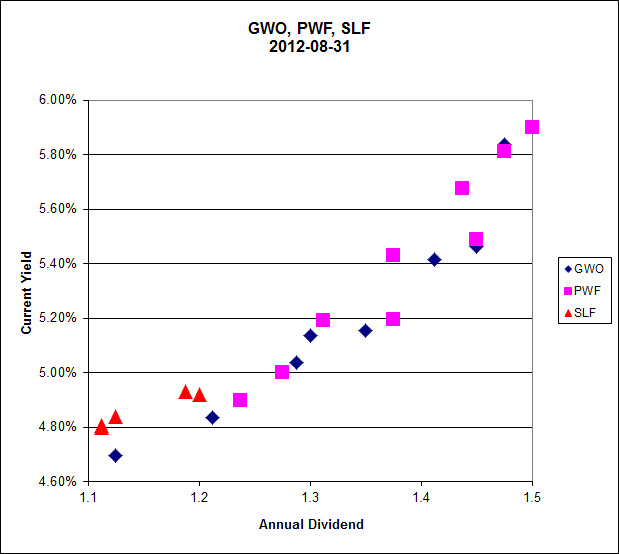
Another way to look at the situation is compare the SLF issues with PWF and GWO, as was done in the post Who’s Selling All the SLF Preferred?.


Click for Big

Click for Big

Now, I certainly agree that GWO is a better credit than SLF and deserves a little bit of premium pricing – but the current situation goes far beyond what I consider reasonable. What is also very interesting is the observation that the market is sharply differentiating between SLF and GWO, but not between GWO and its unregulated parent, PWF.

Sometimes everything works … sometimes the trading works, but sectoral shifts overwhelm the increment … sometimes nothing works. The fund seeks to earn incremental return by selling liquidity (that is, taking the other side of trades that other market participants are strongly motivated to execute), which can also be referred to as ‘trading noise’. There were a lot of strongly motivated market participants during the Panic of 2007, generating a lot of noise! Unfortunately, the conditions of the Panic may never be repeated in my lifetime … but the fund will simply attempt to make trades when swaps seem profitable, without worrying about the level of monthly turnover.

There’s plenty of room for new money left in the fund. I have shown in recent issues of PrefLetter that market pricing for FixedResets is demonstrably stupid and I have lots of confidence – backed up by my bond portfolio management experience in the markets for Canadas and Treasuries, and equity trading on the NYSE & TSX – that there is enough demand for liquidity in any market to make the effort of providing it worthwhile (although the definition of “worthwhile” in terms of basis points of outperformance changes considerably from market to market!) I will continue to exert utmost efforts to outperform but it should be borne in mind that there will almost inevitably be periods of underperformance in the future.

The yields available on high quality preferred shares remain elevated, which is reflected in the current estimate of sustainable income.

Calculation of MAPF Sustainable Income Per Unit
Month NAVPU Portfolio
Average
YTW
Leverage
Divisor
Securities
Average
YTW
Capital
Gains
Multiplier
Sustainable
Income
per
current
Unit
June, 2007 9.3114 5.16% 1.03 5.01% 1.2857 0.3628
September 9.1489 5.35% 0.98 5.46% 1.2857 0.3885
December, 2007 9.0070 5.53% 0.942 5.87% 1.2857 0.4112
March, 2008 8.8512 6.17% 1.047 5.89% 1.2857 0.4672
June 8.3419 6.034% 0.952 6.338% 1.2857 $0.4112
September 8.1886 7.108% 0.969 7.335% 1.2857 $0.4672
December, 2008 8.0464 9.24% 1.008 9.166% 1.2857 $0.5737
March 2009 $8.8317 8.60% 0.995 8.802% 1.2857 $0.6046
June 10.9846 7.05% 0.999 7.057% 1.2857 $0.6029
September 12.3462 6.03% 0.998 6.042% 1.2857 $0.5802
December 2009 10.5662 5.74% 0.981 5.851% 1.0819 $0.5714
March 2010 10.2497 6.03% 0.992 6.079% 1.0819 $0.5759
June 10.5770 5.96% 0.996 5.984% 1.0819 $0.5850
September 11.3901 5.43% 0.980 5.540% 1.0819 $0.5832
December 2010 10.7659 5.37% 0.993 5.408% 1.0000 $0.5822
March, 2011 11.0560 6.00% 0.994 5.964% 1.0000 $0.6594
June 11.1194 5.87% 1.018 5.976% 1.0000 $0.6645
September 10.2709 6.10%
Note
1.001 6.106% 1.0000 $0.6271
November, 2011 10.4511 6.02%
Note
1.004 6.044% 1.0000 $0.6317
NAVPU is shown after quarterly distributions of dividend income and annual distribution of capital gains.
Portfolio YTW includes cash (or margin borrowing), with an assumed interest rate of 0.00%
The Leverage Divisor indicates the level of cash in the account: if the portfolio is 1% in cash, the Leverage Divisor will be 0.99
Securities YTW divides “Portfolio YTW” by the “Leverage Divisor” to show the average YTW on the securities held; this assumes that the cash is invested in (or raised from) all securities held, in proportion to their holdings.
The Capital Gains Multiplier adjusts for the effects of Capital Gains Dividends. On 2009-12-31, there was a capital gains distribution of $1.989262 which is assumed for this purpose to have been reinvested at the final price of $10.5662. Thus, a holder of one unit pre-distribution would have held 1.1883 units post-distribution; the CG Multiplier reflects this to make the time-series comparable. Note that Dividend Distributions are not assumed to be reinvested.
Sustainable Income is the resultant estimate of the fund’s dividend income per current unit, before fees and expenses. Note that a “current unit” includes reinvestment of prior capital gains; a unitholder would have had the calculated sustainable income with only, say, 0.9 units in the past which, with reinvestment of capital gains, would become 1.0 current units.
DeemedRetractibles are comprised of all Straight Perpetuals (both PerpetualDiscount and PerpetualPremium) issued by BMO, BNS, CM, ELF, GWO, HSB, IAG, MFC, NA, RY, SLF and TD, which are not exchangable into common at the option of the company (definition refined in May). These issues are analyzed as if their prospectuses included a requirement to redeem at par on or prior to 2022-1-31, in addition to the call schedule explicitly defined. See OSFI Does Not Grandfather Extant Tier 1 Capital, CM.PR.D, CM.PR.E, CM.PR.G: Seeking NVCC Status and the January, February, March and June, 2011, editions of PrefLetter for the rationale behind this analysis.
Yields for September, 2011, to November, 2011, were calculated by imposing a cap of 10% on the yields of YLO issues held, in order to avoid their extremely high calculated yields distorting the calculation and to reflect the uncertainty in the marketplace that these yields will be realized.

Significant positions were held in DeemedRetractible and FixedReset issues on November 30; all of the former and most of the latter currently have their yields calculated with the presumption that they will be called by the issuers at par prior to 2022-1-31. This presents another complication in the calculation of sustainable yield. The fund also holds a position in a SplitShare (BNA.PR.C) and an OperatingRetractible Scrap (YLO.PR.B) which also have their yields calculated with the expectation of a maturity at par, a somewhat dubious assumption in the latter case.

However, if the entire portfolio except for the PerpetualDiscounts were to be sold and reinvested in these issues, the yield of the portfolio would be the 5.79% shown in the MAPF Portfolio Composition: November 2011 analysis (which is greater than the 5.32% index yield on November 30). Given such reinvestment, the sustainable yield would be $10.4511 * 0.0579 = $0.6051, down from the $10.4924 * 0.0598 = $0.6274 reported for October, but an increase from the $10.2709 * 0.0584 = $0.5998 reported in September.

Different assumptions lead to different results from the calculation, but the overall positive trend is apparent. I’m very pleased with the results! It will be noted that if there was no trading in the portfolio, one would expect the sustainable yield to be constant (before fees and expenses). The success of the fund’s trading is showing up in

  • the very good performance against the index
  • the long term increases in sustainable income per unit

As has been noted, the fund has maintained a credit quality equal to or better than the index; outperformance is due to constant exploitation of trading anomalies.

Again, there are no predictions for the future! The fund will continue to trade between issues in an attempt to exploit market gaps in liquidity, in an effort to outperform the index and keep the sustainable income per unit – however calculated! – growing.
MAPF

MAPF Portfolio Composition: November, 2011

Turnover remained low in November, at about 2%.

Sectoral distribution of the MAPF portfolio on November 30 was as follows:

MAPF Sectoral Analysis 2011-11-30
HIMI Indices Sector Weighting YTW ModDur
Ratchet 0% N/A N/A
FixFloat 0% N/A N/A
Floater 0% N/A N/A
OpRet 0% N/A N/A
SplitShare 9.8% (0) 6.94% 5.96
Interest Rearing 0% N/A N/A
PerpetualPremium 0.0% (0) N/A N/A
PerpetualDiscount 9.1% (-1.5) 5.79% 14.15
Fixed-Reset 11.9% (+1.5) 3.09% 2.80
Deemed-Retractible 59.1% (-0.6) 6.23% 7.79
Scraps (Various) 9.7% (+0.3) 7.87% (see note) 9.01 (see note)
Cash +0.4% (+0.3) 0.00% 0.00
Total 100% 6.02% 7.68
Yields for the YLO preferreds have been set at 10% for calculation purposes, and their durations at 5.00. The extraordinarily low price of these issues has resulted in extremely high calculated yields; I feel that substitution of these values results in a more prudent total indication.
Totals and changes will not add precisely due to rounding. Bracketted figures represent change from October month-end. Cash is included in totals with duration and yield both equal to zero.
DeemedRetractibles are comprised of all Straight Perpetuals (both PerpetualDiscount and PerpetualPremium) issued by BMO, BNS, CM, ELF, GWO, HSB, IAG, MFC, NA, RY, SLF and TD, which are not exchangable into common at the option of the company. These issues are analyzed as if their prospectuses included a requirement to redeem at par on or prior to 2022-1-31, in addition to the call schedule explicitly defined. See OSFI Does Not Grandfather Extant Tier 1 Capital, CM.PR.D, CM.PR.E, CM.PR.G: NVCC Status Confirmed and the January, February, March and June, 2011, editions of PrefLetter for the rationale behind this analysis.

The “total” reflects the un-leveraged total portfolio (i.e., cash is included in the portfolio calculations and is deemed to have a duration and yield of 0.00.). MAPF will often have relatively large cash balances, both credit and debit, to facilitate trading. Figures presented in the table have been rounded to the indicated precision.

Credit distribution is:

MAPF Credit Analysis 2011-11-30
DBRS Rating Weighting
Pfd-1 0 (0)
Pfd-1(low) 47.4% (-0.2)
Pfd-2(high) 22.6% (+1.2)
Pfd-2 0 (0)
Pfd-2(low) 20.0% (-1.5)
Pfd-3(high) 2.7% (+0.3)
Pfd-3 2.0% (-1.7)
Pfd-4 2.5% (+2.5)
Pfd-4(low) 2.5% (-1.2)
Cash +0.4% (+0.3)
Totals will not add precisely due to rounding. Bracketted figures represent change from October month-end.
A position held in ELF preferreds has been assigned to Pfd-2(low)
A position held in CSE preferreds has been assigned to Pfd-3

Liquidity Distribution is:

MAPF Liquidity Analysis 2011-11-30
Average Daily Trading Weighting
<$50,000 5.3% (0)
$50,000 – $100,000 19.5% (-1.2)
$100,000 – $200,000 29.0% (+5.4)
$200,000 – $300,000 41.8% (+10.9)
>$300,000 4.0% (-15.4)
Cash +0.4% (+0.3)
Totals will not add precisely due to rounding. Bracketted figures represent change from Octoberber month-end.

MAPF is, of course, Malachite Aggressive Preferred Fund, a “unit trust” managed by Hymas Investment Management Inc. Further information and links to performance, audited financials and subscription information are available the fund’s web page. The fund may be purchased either directly from Hymas Investment Management or through a brokerage account at Odlum Brown Limited. A “unit trust” is like a regular mutual fund, but is sold by offering memorandum rather than prospectus. This is cheaper, but means subscription is restricted to “accredited investors” (as defined by the Ontario Securities Commission) or those who subscribe for $150,000+. Fund past performances are not a guarantee of future performance. You can lose money investing in MAPF or any other fund.

A similar portfolio composition analysis has been performed on the Claymore Preferred Share ETF (symbol CPD) as of August 31, 2011, and published in the October, 2011, PrefLetter. While direct comparisons are difficult due to the introduction of the DeemedRetractible class of preferred share (see above) it is fair to say:

  • MAPF credit quality is better
  • MAPF liquidity is a higher
  • MAPF Yield is higher
  • Weightings in
    • MAPF is much more exposed to DeemedRetractibles
    • MAPF is much less exposed to Operating Retractibles
    • MAPF is much more exposed to SplitShares
    • MAPF is less exposed to FixFloat / Floater / Ratchet
    • MAPF weighting in FixedResets is much lower
MAPF

MAPF Performance: October, 2011

The fund had a good month in October, making up some of the ground lost in September.

The fund’s Net Asset Value per Unit as of the close October 31 was $10.4924.

Returns to October 31, 2011
Period MAPF Index CPD
according to
Claymore
One Month +2.16% +0.60% +0.82%
Three Months -3.80% -0.39% -0.65%
One Year +2.37% +6.44% +3.72%
Two Years (annualized) +11.41% +10.28% N/A
Three Years (annualized) +27.68% +12.72% +9.95%
Four Years (annualized) +18.37% +5.90%  
Five Years (annualized) +13.74% +3.64%  
Six Years (annualized) +12.47% +3.88%  
Seven Years (annualized) +11.58% +3.90%  
Eight Years (annualized) +12.06% +4.11%  
Nine Years (annualized) +13.57% +4.46%  
Ten Years (annualized) +12.01% +4.37%  
The Index is the BMO-CM “50”
MAPF returns assume reinvestment of distributions, and are shown after expenses but before fees.
CPD Returns are for the NAV and are after all fees and expenses.
* CPD does not directly report its two-year returns.
Figures for Omega Preferred Equity (which are after all fees and expenses) for 1-, 3- and 12-months are +0.85%, -0.52% and +4.67%, respectively, according to Morningstar after all fees & expenses. Three year performance is +10.86%.
Figures for Jov Leon Frazer Preferred Equity Fund Class I Units (which are after all fees and expenses) for 1-, 3- and 12-months are +0.54%, -0.26% and +1.79% respectively, according to Morningstar
Figures for Manulife Preferred Income Fund (formerly AIC Preferred Income Fund) (which are after all fees and expenses) for 1-, 3- and 12-months are +0.40%, -0.30% & +3.36%, respectively
Figures for Horizons AlphaPro Preferred Share ETF are not yet available (inception date 2010-11-23)

MAPF returns assume reinvestment of dividends, and are shown after expenses but before fees. Past performance is not a guarantee of future performance. You can lose money investing in Malachite Aggressive Preferred Fund or any other fund. For more information, see the fund’s main page. The fund is available either directly from Hymas Investment Management or through a brokerage account at Odlum Brown Limited.

The fund’s returns in October were aided by a small bounce in the value of the YLO preferreds:


Click for big

However, there was a drag on performance due to a holding in CZP.PR.A. The bulk of this position was purchased in February and March of this year, when this PerpetualDiscount issue was rated three notches higher than BBD.PR.C, but yielded about the same:

The spread widened in June, 2011, following S&P’s announcemnet that CZP was on review-negative, but gradually returned to more usual levels … until the details of the take-over by Atlantic Power (ATP) were announced! DBRS warned of a three-notch downgrade (which would make the credit ratings of BBD and CZP equal) and … there was a lot of selling in late October.

The problem with the ATP take-over is that it is being structured, effectively, as a complete acquisition, rather than keeping Capital Power as a wholly-owned subsidiary. While the structure retains the wholly-owned subsidiary legal structure, the subsidiary is guaranteeing the senior debt of the holding company (the same way in which the attempted Teachers / BCE deal was structured), so CZP has lost its credit advantage of being “closer to the money” than the holding company.

The position in CZP.PR.A as of October 31 amounted to about 2.6% of fund value. It is my current intention to maintain the position until such time as the yield is again comparable with BBD.PR.C – as it now “should” be, given that a three-notch downgrade will make the credit ratings identical.

Sometimes everything works … sometimes the trading works, but sectoral shifts overwhelm the increment … sometimes nothing works. The fund seeks to earn incremental return by selling liquidity (that is, taking the other side of trades that other market participants are strongly motivated to execute), which can also be referred to as ‘trading noise’. There were a lot of strongly motivated market participants during the Panic of 2007, generating a lot of noise! Unfortunately, the conditions of the Panic may never be repeated in my lifetime … but the fund will simply attempt to make trades when swaps seem profitable, without worrying about the level of monthly turnover.

There’s plenty of room for new money left in the fund. I have shown in recent issues of PrefLetter that market pricing for FixedResets is demonstrably stupid and I have lots of confidence – backed up by my bond portfolio management experience in the markets for Canadas and Treasuries, and equity trading on the NYSE & TSX – that there is enough demand for liquidity in any market to make the effort of providing it worthwhile (although the definition of “worthwhile” in terms of basis points of outperformance changes considerably from market to market!) I will continue to exert utmost efforts to outperform but it should be borne in mind that there will almost inevitably be periods of underperformance in the future.

The yields available on high quality preferred shares remain elevated, which is reflected in the current estimate of sustainable income.

Calculation of MAPF Sustainable Income Per Unit
Month NAVPU Portfolio
Average
YTW
Leverage
Divisor
Securities
Average
YTW
Capital
Gains
Multiplier
Sustainable
Income
per
current
Unit
June, 2007 9.3114 5.16% 1.03 5.01% 1.2857 0.3628
September 9.1489 5.35% 0.98 5.46% 1.2857 0.3885
December, 2007 9.0070 5.53% 0.942 5.87% 1.2857 0.4112
March, 2008 8.8512 6.17% 1.047 5.89% 1.2857 0.4672
June 8.3419 6.034% 0.952 6.338% 1.2857 $0.4112
September 8.1886 7.108% 0.969 7.335% 1.2857 $0.4672
December, 2008 8.0464 9.24% 1.008 9.166% 1.2857 $0.5737
March 2009 $8.8317 8.60% 0.995 8.802% 1.2857 $0.6046
June 10.9846 7.05% 0.999 7.057% 1.2857 $0.6029
September 12.3462 6.03% 0.998 6.042% 1.2857 $0.5802
December 2009 10.5662 5.74% 0.981 5.851% 1.0819 $0.5714
March 2010 10.2497 6.03% 0.992 6.079% 1.0819 $0.5759
June 10.5770 5.96% 0.996 5.984% 1.0819 $0.5850
September 11.3901 5.43% 0.980 5.540% 1.0819 $0.5832
December 2010 10.7659 5.37% 0.993 5.408% 1.0000 $0.5822
March, 2011 11.0560 6.00% 0.994 5.964% 1.0000 $0.6594
June 11.1194 5.87% 1.018 5.976% 1.0000 $0.6645
September 10.2709 6.10%
Note
1.001 6.106% 1.0000 $0.6271
October, 2011 10.4924 6.01%
Note
1.001 6.016% 1.0000 $0.6312
NAVPU is shown after quarterly distributions of dividend income and annual distribution of capital gains.
Portfolio YTW includes cash (or margin borrowing), with an assumed interest rate of 0.00%
The Leverage Divisor indicates the level of cash in the account: if the portfolio is 1% in cash, the Leverage Divisor will be 0.99
Securities YTW divides “Portfolio YTW” by the “Leverage Divisor” to show the average YTW on the securities held; this assumes that the cash is invested in (or raised from) all securities held, in proportion to their holdings.
The Capital Gains Multiplier adjusts for the effects of Capital Gains Dividends. On 2009-12-31, there was a capital gains distribution of $1.989262 which is assumed for this purpose to have been reinvested at the final price of $10.5662. Thus, a holder of one unit pre-distribution would have held 1.1883 units post-distribution; the CG Multiplier reflects this to make the time-series comparable. Note that Dividend Distributions are not assumed to be reinvested.
Sustainable Income is the resultant estimate of the fund’s dividend income per current unit, before fees and expenses. Note that a “current unit” includes reinvestment of prior capital gains; a unitholder would have had the calculated sustainable income with only, say, 0.9 units in the past which, with reinvestment of capital gains, would become 1.0 current units.
DeemedRetractibles are comprised of all Straight Perpetuals (both PerpetualDiscount and PerpetualPremium) issued by BMO, BNS, CM, ELF, GWO, HSB, IAG, MFC, NA, RY, SLF and TD, which are not exchangable into common at the option of the company (definition refined in May). These issues are analyzed as if their prospectuses included a requirement to redeem at par on or prior to 2022-1-31, in addition to the call schedule explicitly defined. See OSFI Does Not Grandfather Extant Tier 1 Capital, CM.PR.D, CM.PR.E, CM.PR.G: Seeking NVCC Status and the January, February, March and June, 2011, editions of PrefLetter for the rationale behind this analysis.
Yields for September, 2011, to October, 2011, were calculated by imposing a cap of 10% on the yields of YLO issues held, in order to avoid their extremely high calculated yields distorting the calculation and to reflect the uncertainty in the marketplace that these yields will be realized.

Significant positions were held in DeemedRetractible and FixedReset issues on August 31; all of the former and most of the latter currently have their yields calculated with the presumption that they will be called by the issuers at par prior to 2022-1-31. This presents another complication in the calculation of sustainable yield. The fund also holds a position in a SplitShare (BNA.PR.C) and an OperatingRetractible Scrap (YLO.PR.B) which also have their yields calculated with the expectation of a maturity at par, a somewhat dubious assumption in the latter case.

However, if the entire portfolio except for the PerpetualDiscounts were to be sold and reinvested in these issues, the yield of the portfolio would be the 5.98% shown in the MAPF Portfolio Composition: October 2011 analysis (which is greater than the 5.37% index yield on October). Given such reinvestment, the sustainable yield would be $10.4924 * 0.0598 = $0.6274, an increase from the $10.2709 * 0.0584 = $0.5998 reported in September.

Different assumptions lead to different results from the calculation, but the overall positive trend is apparent. I’m very pleased with the results! It will be noted that if there was no trading in the portfolio, one would expect the sustainable yield to be constant (before fees and expenses). The success of the fund’s trading is showing up in

  • the very good performance against the index
  • the long term increases in sustainable income per unit

As has been noted, the fund has maintained a credit quality equal to or better than the index; outperformance is due to constant exploitation of trading anomalies.

Again, there are no predictions for the future! The fund will continue to trade between issues in an attempt to exploit market gaps in liquidity, in an effort to outperform the index and keep the sustainable income per unit – however calculated! – growing.
MAPF

MAPF Portfolio Composition: October, 2011

Turnover remained low in October, at about 3%.

Sectoral distribution of the MAPF portfolio on October 31 was as follows:

MAPF Sectoral Analysis 2011-10-31
HIMI Indices Sector Weighting YTW ModDur
Ratchet 0% N/A N/A
FixFloat 0% N/A N/A
Floater 0% N/A N/A
OpRet 0% N/A N/A
SplitShare 9.8% (-0.4) 7.01% 5.96
Interest Rearing 0% N/A N/A
PerpetualPremium 0.0% (0) N/A N/A
PerpetualDiscount 10.6% (+0.6) 5.98% 13.94
Fixed-Reset 10.4% (+1.1) 3.15% 2.96
Deemed-Retractible 59.7% (-2.5) 6.07% 7.92
Scraps (Various) 9.4% (+1.1) 7.99% (see note) 8.66 (see note)
Cash +0.1% (0.0) 0.00% 0.00
Total 100% 6.01% 7.90
Yields for the YLO preferreds have been set at 10% for calculation purposes, and their durations at 5.00. The extraordinarily low price of these issues has resulted in extremely high calculated yields; I feel that substitution of these values results in a more prudent total indication.
Totals and changes will not add precisely due to rounding. Bracketted figures represent change from September month-end. Cash is included in totals with duration and yield both equal to zero.
DeemedRetractibles are comprised of all Straight Perpetuals (both PerpetualDiscount and PerpetualPremium) issued by BMO, BNS, CM, ELF, GWO, HSB, IAG, MFC, NA, RY, SLF and TD, which are not exchangable into common at the option of the company. These issues are analyzed as if their prospectuses included a requirement to redeem at par on or prior to 2022-1-31, in addition to the call schedule explicitly defined. See OSFI Does Not Grandfather Extant Tier 1 Capital, CM.PR.D, CM.PR.E, CM.PR.G: Seeking NVCC Status and the January, February, March and June, 2011, editions of PrefLetter for the rationale behind this analysis.

The “total” reflects the un-leveraged total portfolio (i.e., cash is included in the portfolio calculations and is deemed to have a duration and yield of 0.00.). MAPF will often have relatively large cash balances, both credit and debit, to facilitate trading. Figures presented in the table have been rounded to the indicated precision.

Credit distribution is:

MAPF Credit Analysis 2011-10-31
DBRS Rating Weighting
Pfd-1 0 (0)
Pfd-1(low) 47.6% (-2.5)
Pfd-2(high) 21.4% (0.0)
Pfd-2 0 (0)
Pfd-2(low) 21.5% (+1.4)
Pfd-3(high) 3.0% (+0.1)
Pfd-3 3.7% (-0.4)
Pfd-4(low) 2.7% (+1.4)
Cash +0.1% (0.0)
Totals will not add precisely due to rounding. Bracketted figures represent change from September month-end.
A position held in ELF preferreds has been assigned to Pfd-2(low)
A position held in CSE preferreds has been assigned to Pfd-3

Liquidity Distribution is:

MAPF Liquidity Analysis 2011-10-31
Average Daily Trading Weighting
<$50,000 5.3% (-7.5)
$50,000 – $100,000 20.7% (+4.7)
$100,000 – $200,000 23.6% (+3.2)
$200,000 – $300,000 30.9% (-11.4)
>$300,000 19.4% (+11)
Cash +0.1% (0.0)
Totals will not add precisely due to rounding. Bracketted figures represent change from September month-end.

MAPF is, of course, Malachite Aggressive Preferred Fund, a “unit trust” managed by Hymas Investment Management Inc. Further information and links to performance, audited financials and subscription information are available the fund’s web page. The fund may be purchased either directly from Hymas Investment Management or through a brokerage account at Odlum Brown Limited. A “unit trust” is like a regular mutual fund, but is sold by offering memorandum rather than prospectus. This is cheaper, but means subscription is restricted to “accredited investors” (as defined by the Ontario Securities Commission) or those who subscribe for $150,000+. Fund past performances are not a guarantee of future performance. You can lose money investing in MAPF or any other fund.

A similar portfolio composition analysis has been performed on the Claymore Preferred Share ETF (symbol CPD) as of August 31, 2011, and published in the October, 2011, PrefLetter. While direct comparisons are difficult due to the introduction of the DeemedRetractible class of preferred share (see above) it is fair to say:

  • MAPF credit quality is better
  • MAPF liquidity is a higher
  • MAPF Yield is higher
  • Weightings in
    • MAPF is much more exposed to DeemedRetractibles
    • MAPF is much less exposed to Operating Retractibles
    • MAPF is slightly more exposed to SplitShares
    • MAPF is less exposed to FixFloat / Floater / Ratchet
    • MAPF weighting in FixedResets is much lower
MAPF

MAPF Performance: September 2011

Well, there’s no sense trying to put a gloss on it: the fund had a horrible month in September.

The fund’s Net Asset Value per Unit as of the close September 30 was $10.2709 after a dividend distribution of $0.151168.

Returns to September 30, 2011
Period MAPF Index CPD
according to
Claymore
One Month -6.52% -0.29% -0.82%
Three Months -6.27% -0.13% -0.72%
One Year +2.81% +7.94% +4.56%
Two Years (annualized) +8.96% +8.92% N/A
Three Years (annualized) +24.33% +9.35% +6.95%
Four Years (annualized) +16.63% +5.12%  
Five Years (annualized) +13.36% +3.65%  
Six Years (annualized) +12.09% +3.71%  
Seven Years (annualized) +11.36% +3.93%  
Eight Years (annualized) +11.87% +4.06%  
Nine Years (annualized) +13.94% +4.41%  
Ten Years (annualized) +11.91% +4.30%  
The Index is the BMO-CM “50”
MAPF returns assume reinvestment of distributions, and are shown after expenses but before fees.
CPD Returns are for the NAV and are after all fees and expenses.
* CPD does not directly report its two-year returns.
Figures for Omega Preferred Equity (which are after all fees and expenses) for 1-, 3- and 12-months are -0.63%, -0.63% and +5.29%, respectively, according to Morningstar after all fees & expenses. Three year performance is +7.73%.
Figures for Jov Leon Frazer Preferred Equity Fund Class I Units (which are after all fees and expenses) for 1-, 3- and 12-months are -0.40%, -0.18% and +2.40% respectively, according to Morningstar
Figures for Manulife Preferred Income Fund (formerly AIC Preferred Income Fund) (which are after all fees and expenses) for 1-, 3- and 12-months are -0.29%, -0.03% & +4.34%, respectively
Figures for Horizons AlphaPro Preferred Share ETF are not yet available (inception date 2010-11-23)

MAPF returns assume reinvestment of dividends, and are shown after expenses but before fees. Past performance is not a guarantee of future performance. You can lose money investing in Malachite Aggressive Preferred Fund or any other fund. For more information, see the fund’s main page. The fund is available either directly from Hymas Investment Management or through a brokerage account at Odlum Brown Limited.

The fund’s poor return for the month is basically due to the following:

MAPF Performance Attribution
September, 2011
(Approximate)
Factor Contribution Note
YLO Preferreds -5.0% Topped up during month.
YLO.PR.A -90%
YLO.PR.B -85%
YLO.PR.C -84%
YLO.PR.D -82%
Overall Market -0.8% TXPR Total Return -0.77%
Other
(Mainly underperformance of
Insurance Preferreds)
-0.7% e.g., CM.PR.J +1.20%
GWO.PR.I -0.22%
MFC.PR.C -2.79%
SLF.PR.C -4.20%
Total -6.52%  

The precipituous decline in YLO preferreds may in turn be attributed to their September 28 Press Release (discussed on PrefBlog) in which they announced, among other things:

  • Elimination of the common dividend
  • Stringent new rules for their sharply reduced bank credit line

Reaction from the rating agencies was mixed: DBRS went into hysterics, slashing the preferred rating four notches to Pfd-4(low); S&P merely yawned, maintaining their rating at P-4(high) and stating that they’d be looking forward to the next quarterly report with more interest than usual.

The price of the common and the preferreds, which had been sharply declining, promptly cratered.


Click for Big

I don’t get it. The company still has about $1.5-billion in revenue and estimated free cash flow in excess of $200-million per year. Yes, of course both these figures are going to decline somewhat in the future, and yes, you at the back of the room, I know you haven’t looked at the Yellow Pages in three years, but the question is – how fast?

In the August edition of PrefLetter I made a spreadsheet available at http://www.prefblog.com/xls/YellowMediaProjection.xls which attempted to quantify the effects on cash-flow and debt of various user-specified assumptions regarding the rate of print revenue decline and digital substitution; you have to make some assumptions that I consider quite extreme before you start getting seriously scared. The baseline assumptions – which I consider a little on the gloomy side, if anything – indicate that the targetted Debt:EBITDA ratio falls to 2:1 in about six years. Interestingly, reflecting the elimination of common dividends in the spreadsheet and applying these savings to debt reduction reduces the time for this target to be met to three years.

Is this a guarantee? No, of course, not. Ain’t nothing guaranteed. But my point is that awfully severe assumptions have to be made in order to show a bankrupt company and it is my judgement that these awfully severe assumptions have a low probability.

I had an illuminating conversation over dinner with another investment manager recently. We don’t really talk about investments much, but this time I was bemoaning the horror of the YLO carnage, while he said with satisfaction that he’d just sold his last YLO bonds at forty cents on the dollar. So I said (his paraphrased comments in brackets) something like … “Look, when I look at the company’s financials and apply a 15% annual rate of decline in print revenue forever (‘Could be more.’) and assume a 50% digital substitution rate (‘Could be less.’) at a 40% profit margin (‘Could be less.’), I just don’t understand the hysteria.”

But his comments illustrate, boys and girls, how investment management is usually done. You can project bankruptcy for any company in the world by making your assumptions severe enough – there’s no skill in that. Investment management involves making judgements about the future while at all times remembering that you might be wrong – which is why the fund will no longer top up its YLO holdings (the new credit agreement carries with it a partial loss of access to capital markets). Whatever your “gut reaction”, it can be justified. When I look at YLO, I see a company that is in decline, certainly, but I also see it spinning off cash like crazy in the meantime – much like one of those gold mines that is the latest Big Investment Idea around now – and becoming a smaller digital media company. The company has always made more sense as private equity rather than a public company; and at current prices I wouldn’t be surprised if Google, Microsoft and Yahoo! weren’t wondering if it would be cheaper to buy than build.

We have seen something like this before: in September 2002 the fund underperformed by a stunning 8.01%. Why? Much the same reason – the fund held Bombardier preferreds, which were engulfed by a wave of market sentiment very similar qualitatively to the sentiment which now surrounds Yellow Media. The relative price drop of the BBD preferreds was smaller, but the fund’s holdings were larger.

In the end, BBD recovered and the fund eventually exited its position with a small profit. I can’t, of course, guarantee that the same thing will happen in this episode – but I can’t, at this point, see why not. In the meantime, we will remember one of the ways in which the liquidity premium can be captured:

The spread on corporate bonds over the liquid risk-free rate (for example, government bonds) represents compensation for several different factors:

A Expected default losses
B Unexpected default risk, such as default and recovery rate risk
C Mark-to-market risk, such as the risk of a fall in the market price of the bond
D Liquidity risk, such as the risk of not finding a ready buyer at the theoretical market price.

Investors concerned with the realisable value of their investment in the short-term require compensation for all these risks.

However, investors who can hold bonds to maturity need compensation only for A and B. Such investors can enjoy the premiums for C and D, and we refer to these collectively as a ‘liquidity premium’

Right now we’re seeing mark-to-market risk with a vengeance!

Sometimes everything works … sometimes the trading works, but sectoral shifts overwhelm the increment … sometimes nothing works. The fund seeks to earn incremental return by selling liquidity (that is, taking the other side of trades that other market participants are strongly motivated to execute), which can also be referred to as ‘trading noise’. There were a lot of strongly motivated market participants during the Panic of 2007, generating a lot of noise! Unfortunately, the conditions of the Panic may never be repeated in my lifetime … but the fund will simply attempt to make trades when swaps seem profitable, without worrying about the level of monthly turnover.

There’s plenty of room for new money left in the fund. I have shown in recent issues of PrefLetter that market pricing for FixedResets is demonstrably stupid and I have lots of confidence – backed up by my bond portfolio management experience in the markets for Canadas and Treasuries, and equity trading on the NYSE & TSX – that there is enough demand for liquidity in any market to make the effort of providing it worthwhile (although the definition of “worthwhile” in terms of basis points of outperformance changes considerably from market to market!) I will continue to exert utmost efforts to outperform but it should be borne in mind that there will almost inevitably be periods of underperformance in the future.

The yields available on high quality preferred shares remain elevated, which is reflected in the current estimate of sustainable income.

Calculation of MAPF Sustainable Income Per Unit
Month NAVPU Portfolio
Average
YTW
Leverage
Divisor
Securities
Average
YTW
Capital
Gains
Multiplier
Sustainable
Income
per
current
Unit
June, 2007 9.3114 5.16% 1.03 5.01% 1.2857 0.3628
September 9.1489 5.35% 0.98 5.46% 1.2857 0.3885
December, 2007 9.0070 5.53% 0.942 5.87% 1.2857 0.4112
March, 2008 8.8512 6.17% 1.047 5.89% 1.2857 0.4672
June 8.3419 6.034% 0.952 6.338% 1.2857 $0.4112
September 8.1886 7.108% 0.969 7.335% 1.2857 $0.4672
December, 2008 8.0464 9.24% 1.008 9.166% 1.2857 $0.5737
March 2009 $8.8317 8.60% 0.995 8.802% 1.2857 $0.6046
June 10.9846 7.05% 0.999 7.057% 1.2857 $0.6029
September 12.3462 6.03% 0.998 6.042% 1.2857 $0.5802
December 2009 10.5662 5.74% 0.981 5.851% 1.0819 $0.5714
March 2010 10.2497 6.03% 0.992 6.079% 1.0819 $0.5759
June 10.5770 5.96% 0.996 5.984% 1.0819 $0.5850
September 11.3901 5.43% 0.980 5.540% 1.0819 $0.5832
December 2010 10.7659 5.37% 0.993 5.408% 1.0000 $0.5822
March, 2011 11.0560 6.00% 0.994 5.964% 1.0000 $0.6594
June 11.1194 5.87% 1.018 5.976% 1.0000 $0.6645
September, 2011 10.2709 6.10%
Note
1.001 6.106% 1.0000 $0.6271
NAVPU is shown after quarterly distributions of dividend income and annual distribution of capital gains.
Portfolio YTW includes cash (or margin borrowing), with an assumed interest rate of 0.00%
The Leverage Divisor indicates the level of cash in the account: if the portfolio is 1% in cash, the Leverage Divisor will be 0.99
Securities YTW divides “Portfolio YTW” by the “Leverage Divisor” to show the average YTW on the securities held; this assumes that the cash is invested in (or raised from) all securities held, in proportion to their holdings.
The Capital Gains Multiplier adjusts for the effects of Capital Gains Dividends. On 2009-12-31, there was a capital gains distribution of $1.989262 which is assumed for this purpose to have been reinvested at the final price of $10.5662. Thus, a holder of one unit pre-distribution would have held 1.1883 units post-distribution; the CG Multiplier reflects this to make the time-series comparable. Note that Dividend Distributions are not assumed to be reinvested.
Sustainable Income is the resultant estimate of the fund’s dividend income per current unit, before fees and expenses. Note that a “current unit” includes reinvestment of prior capital gains; a unitholder would have had the calculated sustainable income with only, say, 0.9 units in the past which, with reinvestment of capital gains, would become 1.0 current units.
DeemedRetractibles are comprised of all Straight Perpetuals (both PerpetualDiscount and PerpetualPremium) issued by BMO, BNS, CM, ELF, GWO, HSB, IAG, MFC, NA, RY, SLF and TD, which are not exchangable into common at the option of the company (definition refined in May). These issues are analyzed as if their prospectuses included a requirement to redeem at par on or prior to 2022-1-31, in addition to the call schedule explicitly defined. See OSFI Does Not Grandfather Extant Tier 1 Capital, CM.PR.D, CM.PR.E, CM.PR.G: Seeking NVCC Status and the January, February, March and June, 2011, editions of PrefLetter for the rationale behind this analysis.
Yields for September 30, 2011, were calculated by imposing a cap of 10% on the yields of YLO issues held, in order to avoid their extremely high calculated yields distorting the calculation and to reflect the uncertainty in the marketplace that these yields will be realized.

Significant positions were held in DeemedRetractible and FixedReset issues on August 31; all of the former and most of the latter currently have their yields calculated with the presumption that they will be called by the issuers at par prior to 2022-1-31. This presents another complication in the calculation of sustainable yield. The fund also holds a position in a SplitShare (BNA.PR.C) and an OperatingRetractible Scrap (YLO.PR.B) which also have their yields calculated with the expectation of a maturity at par, a somewhat dubious assumption in the latter case.

However, if the entire portfolio except for the PerpetualDiscounts were to be sold and reinvested in these issues, the yield of the portfolio would be the 5.84% shown in the MAPF Portfolio Composition: September 2011 analysis (which is greater than the 5.35% index yield on September 30). Given such reinvestment, the sustainable yield would be $10.2709 * 0.0584 = $0.5998 a decrease from the $11.1492 * 0.0580 = $0.6467 reported in August.

Different assumptions lead to different results from the calculation, but the overall positive trend is apparent. I’m very pleased with the results! It will be noted that if there was no trading in the portfolio, one would expect the sustainable yield to be constant (before fees and expenses). The success of the fund’s trading is showing up in

  • the very good performance against the index
  • the long term increases in sustainable income per unit

As has been noted, the fund has maintained a credit quality equal to or better than the index; outperformance is due to constant exploitation of trading anomalies.

Again, there are no predictions for the future! The fund will continue to trade between issues in an attempt to exploit market gaps in liquidity, in an effort to outperform the index and keep the sustainable income per unit – however calculated! – growing.

MAPF

MAPF Portfolio Composition: September, 2011

Turnover was virutually non-existent in September, at about 1%.

I lay a lot of the blame for lack of turnover on OSFI, and will illustrate my argument with a graph of the price difference between CM.PR.J and GWO.PR.I, which pay the same annual dividend; the differences in structure of the instruments are negligible, other than the fact that, of course, the issuer is different. However, while the market appears to have incorporated OSFI’s advisory on Non-Viability Contingent Capital to banks, it does not appear to have extrapolated this advisory to insurers and insurance holding companies, which is something I expect to happen in the relatively near future.


Click for big

It will be recalled that OSFI has announced that CM.PR.J (and all other issues of its ilk) will not be eligible for inclusion in Tier 1 Capital to any degree whatsoever after 2022-1-31; that this implies the company will cease to regard it as “cheap equity” and instead consider it “expensive debt”, and that therefore redemption at par is anticipated by 2022 at the latest. My expectation, given the laudable objective of harmonizing insurance and banking regulation to the extent possible, is that this precept will apply, sooner or later, to GWO.PR.I and all other regulated financial issues which do not have an NVCC clause. See my definition of “DeemedRetractibles” for more discussion of this matter.

As I remarked in the September PrefLetter:

Most obvious is the very high price spread between the two issues, but it is also apparent that there is a high degree of volatility in this spread; this spread cannot be explained by fundamental factors, it is a market artifact arising from random fluctuations in supply and demand.

One might think, therefore, that my fund8 would have been frantically trading throughout the year, seeking to exploit these transient pricing differences – that is, after all, what my proprietary valuation software, HIMIPref™, is designed to indicate. This has not been the case and in fact, trading has been significantly lower than usual since the OFSI-derived activity in the first quarter.

The reason for this is the high degree of stratification in the market; while the difference in prices has fluctuated in a very wide range (a variance of about $1.00), taking advantage of these fluctuations implies giving up a great deal of valuation (since the assumption is that two issues are directly comparable). In order to take advantage of the low difference in price (in hopes of making $1 on the trade when the difference is high) it is necessary to sell GWO.PR.I and buy CM.PR.J, giving up $2 in “permanent valuation”.

The software is designed to correct for factors such as this; while one factor assumes that the price difference will return to zero (given that the issues are virtually identical in terms of characteristics), another factor assumes that the price difference will return to its average of about $2.50. In this case, though, the predicted effect from the first factor overwhelms the contribution from the second; GWO.PR.I is always calculated to be cheap relative to CM.PR.J; and the portfolio’s position in the former is maintained. In other words, there would be considerable risk in executing the swap since the probability of losing $2 (if the price difference returns to zero) outweighs the probability of gaining $1 (if the price difference returns to its upper limit).

As I remarked in the February, 2010, edition of this newsletter, the preferred share market has, to a certain extent, become OSFI’s casino, with valuation far more dependent upon potential regulatory decisions and their timing than it should be, with consequent loss of market efficiency – and the trading profits of investors similar to Hymas Investment Management, who seek to eke out excess returns by supplying that efficiency.

Trades were, as ever, triggered by a desire to exploit transient mispricing in the preferred share market (which may be thought of as “selling liquidity”), rather than any particular view being taken on market direction, sectoral performance or credit anticipation.

We can only hope that OSFI makes an announcement regarding the status of Straight Preferreds issued by insurers and insurance holding companies at some point in the near future, one war or the other.

Be that as it may, sectoral distribution of the MAPF portfolio on September 30 was as follows:

MAPF Sectoral Analysis 2011-9-30
HIMI Indices Sector Weighting YTW ModDur
Ratchet 0% N/A N/A
FixFloat 0% N/A N/A
Floater 0% N/A N/A
OpRet 0% N/A N/A
SplitShare 10.2% (+0.4) 7.29% 6.03
Interest Rearing 0% N/A N/A
PerpetualPremium 0.0% (0) N/A N/A
PerpetualDiscount 10.0% (+0.5) 5.84% 14.18
Fixed-Reset 9.3% (+0.5%) 3.45% 2.40
Deemed-Retractible 62.2% 59.4% (+2.8) 6.20% 7.98
Scraps (Various) 8.3% (-3.3) 7.25% (see note) 9.76 (see note)
Cash +0.1% (-0.8) 0.00% 0.00
Total 100% 6.10% 8.02
Yields for the YLO preferreds have been set at 10% for calculation purposes, and their durations at 5.00. The extraordinarily low price of these issues has resulted in extremely high calculated yields; I feel that substitution of these values results in a more prudent total indication.
Totals and changes will not add precisely due to rounding. Bracketted figures represent change from August month-end. Cash is included in totals with duration and yield both equal to zero.
DeemedRetractibles are comprised of all Straight Perpetuals (both PerpetualDiscount and PerpetualPremium) issued by BMO, BNS, CM, ELF, GWO, HSB, IAG, MFC, NA, RY, SLF and TD, which are not exchangable into common at the option of the company. These issues are analyzed as if their prospectuses included a requirement to redeem at par on or prior to 2022-1-31, in addition to the call schedule explicitly defined. See OSFI Does Not Grandfather Extant Tier 1 Capital, CM.PR.D, CM.PR.E, CM.PR.G: Seeking NVCC Status and the January, February, March and June, 2011, editions of PrefLetter for the rationale behind this analysis.

The “total” reflects the un-leveraged total portfolio (i.e., cash is included in the portfolio calculations and is deemed to have a duration and yield of 0.00.). MAPF will often have relatively large cash balances, both credit and debit, to facilitate trading. Figures presented in the table have been rounded to the indicated precision.

Credit distribution is:

MAPF Credit Analysis 2011-8-31
DBRS Rating Weighting
Pfd-1 0 (0)
Pfd-1(low) 50.1% (+2.4)
Pfd-2(high) 21.4% (+1.0)
Pfd-2 0 (0)
Pfd-2(low) 20.1% (+0.3)
Pfd-3(high) 2.9% (+0.2)
Pfd-3 4.1% (-4.3)
Pfd-4(low) 1.3% (+1.3)
Cash +0.1% (-0.8)
Totals will not add precisely due to rounding. Bracketted figures represent change from August month-end.
A position held in ELF preferreds has been assigned to Pfd-2(low)
A position held in CSE preferreds has been assigned to Pfd-3

The increase in Pfd-4(low) holdings at the expense of Pfd-3 is due to the downgrade of YLO.

Liquidity Distribution is:

MAPF Liquidity Analysis 2011-9-30
Average Daily Trading Weighting
<$50,000 12.8% (+6.9)
$50,000 – $100,000 16.0% (-5.2)
$100,000 – $200,000 20.4% (+1.9)
$200,000 – $300,000 42.3% (+17.1)
>$300,000 8.4% (-19.8)
Cash +0.1% (-0.8)
Totals will not add precisely due to rounding. Bracketted figures represent change from August month-end.

The increase in the proportion of issues with an Average Daily Trading Value less than $50,000 is mainly due to the migration of CCS.PR.C and ELF.PR.G. The decrease in those with more than $300,000 is mainly due to the migration of SLF.PR.E, MFC.PR.C and BNS.PR.X.

MAPF is, of course, Malachite Aggressive Preferred Fund, a “unit trust” managed by Hymas Investment Management Inc. Further information and links to performance, audited financials and subscription information are available the fund’s web page. The fund may be purchased either directly from Hymas Investment Management or through a brokerage account at Odlum Brown Limited. A “unit trust” is like a regular mutual fund, but is sold by offering memorandum rather than prospectus. This is cheaper, but means subscription is restricted to “accredited investors” (as defined by the Ontario Securities Commission) or those who subscribe for $150,000+. Fund past performances are not a guarantee of future performance. You can lose money investing in MAPF or any other fund.

A similar portfolio composition analysis has been performed on the Claymore Preferred Share ETF (symbol CPD) as of August 31, 2010, and published in the September, 2010, PrefLetter. While direct comparisons are difficult due to the introduction of the DeemedRetractible class of preferred share (see above) it is fair to say:

  • MAPF credit quality is better
  • MAPF liquidity is a higher
  • MAPF Yield is higher
  • Weightings in
    • MAPF is much more exposed to DeemedRetractibles
    • MAPF is much less exposed to Operating Retractibles
    • MAPF is slightly more exposed to SplitShares
    • MAPF is less exposed to FixFloat / Floater / Ratchet
    • MAPF weighting in FixedResets is much lower
MAPF

MAPF Performance, August 2011

The fund performed well on the month, influenced by the extraordinarily volatile YLO issues. While these fell overall on the month, the fund topped up its holdings following the August 4 release of the 11Q2 financial results, which took prices down to very low levels.

The fund’s Net Asset Value per Unit as of the close August 31 was $11.1492.

Returns to August 31, 2011
Period MAPF Index CPD
according to
Claymore
One Month +0.73% -0.70% -0.64%
Three Months -0.38% +0.14% +0.10%
One Year +14.73% +10.86% +7.66%
Two Years (annualized) +12.08% +8.53% N/A
Three Years (annualized) +25.82% +8.51% +6.20%
Four Years (annualized) +18.41% +4.83%  
Five Years (annualized) +15.23% +3.93%  
Six Years (annualized) +13.63% +3.88%  
Seven Years (annualized) +12.58% +4.04%  
Eight Years (annualized) +13.25% +4.27%  
Nine Years (annualized) +13.81% +4.50%  
Ten Years (annualized) +13.13% +4.38%  
The Index is the BMO-CM “50”
MAPF returns assume reinvestment of distributions, and are shown after expenses but before fees.
CPD Returns are for the NAV and are after all fees and expenses.
* CPD does not directly report its two-year returns.
Figures for Omega Preferred Equity (which are after all fees and expenses) for 1-, 3- and 12-months are -0.74%, -0.03% and +8.13%, respectively, according to Morningstar after all fees & expenses. Three year performance is +6.85%.
Figures for Jov Leon Frazer Preferred Equity Fund Class I Units (which are after all fees and expenses) for 1-, 3- and 12-months are -0.39%, +0.36% and +4.03% respectively, according to Morningstar
Figures for Manulife Preferred Income Fund (formerly AIC Preferred Income Fund) (which are after all fees and expenses) for 1-, 3- and 12-months are -0.41%, +0.26% & +6.16%, respectively
Figures for Horizons AlphaPro Preferred Share ETF are not yet available (inception date 2010-11-23)

MAPF returns assume reinvestment of dividends, and are shown after expenses but before fees. Past performance is not a guarantee of future performance. You can lose money investing in Malachite Aggressive Preferred Fund or any other fund. For more information, see the fund’s main page. The fund is available either directly from Hymas Investment Management or through a brokerage account at Odlum Brown Limited.

Sometimes everything works … sometimes the trading works, but sectoral shifts overwhelm the increment … sometimes nothing works. The fund seeks to earn incremental return by selling liquidity (that is, taking the other side of trades that other market participants are strongly motivated to execute), which can also be referred to as ‘trading noise’. There were a lot of strongly motivated market participants during the Panic of 2007, generating a lot of noise! Unfortunately, the conditions of the Panic may never be repeated in my lifetime … but the fund will simply attempt to make trades when swaps seem profitable, without worrying about the level of monthly turnover.

There’s plenty of room for new money left in the fund. I have shown in recent issues of PrefLetter that market pricing for FixedResets is demonstrably stupid and I have lots of confidence – backed up by my bond portfolio management experience in the markets for Canadas and Treasuries, and equity trading on the NYSE & TSX – that there is enough demand for liquidity in any market to make the effort of providing it worthwhile (although the definition of “worthwhile” in terms of basis points of outperformance changes considerably from market to market!) I will continue to exert utmost efforts to outperform but it should be borne in mind that there will almost inevitably be periods of underperformance in the future.

The yields available on high quality preferred shares remain elevated, which is reflected in the current estimate of sustainable income.

Calculation of MAPF Sustainable Income Per Unit
Month NAVPU Portfolio
Average
YTW
Leverage
Divisor
Securities
Average
YTW
Capital
Gains
Multiplier
Sustainable
Income
per
current
Unit
June, 2007 9.3114 5.16% 1.03 5.01% 1.2857 0.3628
September 9.1489 5.35% 0.98 5.46% 1.2857 0.3885
December, 2007 9.0070 5.53% 0.942 5.87% 1.2857 0.4112
March, 2008 8.8512 6.17% 1.047 5.89% 1.2857 0.4672
June 8.3419 6.034% 0.952 6.338% 1.2857 $0.4112
September 8.1886 7.108% 0.969 7.335% 1.2857 $0.4672
December, 2008 8.0464 9.24% 1.008 9.166% 1.2857 $0.5737
March 2009 $8.8317 8.60% 0.995 8.802% 1.2857 $0.6046
June 10.9846 7.05% 0.999 7.057% 1.2857 $0.6029
September 12.3462 6.03% 0.998 6.042% 1.2857 $0.5802
December 2009 10.5662 5.74% 0.981 5.851% 1.0819 $0.5714
March 2010 10.2497 6.03% 0.992 6.079% 1.0819 $0.5759
June 10.5770 5.96% 0.996 5.984% 1.0819 $0.5850
September 11.3901 5.43% 0.980 5.540% 1.0819 $0.5832
December 2010 10.7659 5.37% 0.993 5.408% 1.0000 $0.5822
March, 2011 11.0560 6.00% 0.994 5.964% 1.0000 $0.6594
June 11.1194 5.87% 1.018 5.976% 1.0000 $0.6645
August, 2011 11.1492 6.31% 1.009 6.367% 1.0000 $0.7099
NAVPU is shown after quarterly distributions of dividend income and annual distribution of capital gains.
Portfolio YTW includes cash (or margin borrowing), with an assumed interest rate of 0.00%
The Leverage Divisor indicates the level of cash in the account: if the portfolio is 1% in cash, the Leverage Divisor will be 0.99
Securities YTW divides “Portfolio YTW” by the “Leverage Divisor” to show the average YTW on the securities held; this assumes that the cash is invested in (or raised from) all securities held, in proportion to their holdings.
The Capital Gains Multiplier adjusts for the effects of Capital Gains Dividends. On 2009-12-31, there was a capital gains distribution of $1.989262 which is assumed for this purpose to have been reinvested at the final price of $10.5662. Thus, a holder of one unit pre-distribution would have held 1.1883 units post-distribution; the CG Multiplier reflects this to make the time-series comparable. Note that Dividend Distributions are not assumed to be reinvested.
Sustainable Income is the resultant estimate of the fund’s dividend income per current unit, before fees and expenses. Note that a “current unit” includes reinvestment of prior capital gains; a unitholder would have had the calculated sustainable income with only, say, 0.9 units in the past which, with reinvestment of capital gains, would become 1.0 current units.
DeemedRetractibles are comprised of all Straight Perpetuals (both PerpetualDiscount and PerpetualPremium) issued by BMO, BNS, CM, ELF, GWO, HSB, IAG, MFC, NA, RY, SLF and TD, which are not exchangable into common at the option of the company (definition refined in May). These issues are analyzed as if their prospectuses included a requirement to redeem at par on or prior to 2022-1-31, in addition to the call schedule explicitly defined. See OSFI Does Not Grandfather Extant Tier 1 Capital, CM.PR.D, CM.PR.E, CM.PR.G: Seeking NVCC Status and the January, February, March and June, 2011, editions of PrefLetter for the rationale behind this analysis.

Significant positions were held in DeemedRetractible and FixedReset issues on August 31; all of the former and most of the latter currently have their yields calculated with the presumption that they will be called by the issuers at par prior to 2022-1-31. This presents another complication in the calculation of sustainable yield. The fund also holds a position in a SplitShare (BNA.PR.C) and an OperatingRetractible Scrap (YLO.PR.B) which also have their yields calculated with the expectation of a maturity at par, a somewhat dubious assumption in the latter case.

However, if the entire portfolio except for the PerpetualDiscounts were to be sold and reinvested in these issues, the yield of the portfolio would be the 5.80% shown in the MAPF Portfolio Composition: August 2011 analysis (which is greater than the 5.34% index yield on August 31). Given such reinvestment, the sustainable yield would be $11.1492 * 0.0580 = $0.6467, an increase from the $11.0683 * 0.0567 = $0.6276 reported in July.

Different assumptions lead to different results from the calculation, but the overall positive trend is apparent. I’m very pleased with the results! It will be noted that if there was no trading in the portfolio, one would expect the sustainable yield to be constant (before fees and expenses). The success of the fund’s trading is showing up in

  • the very good performance against the index
  • the long term increases in sustainable income per unit

As has been noted, the fund has maintained a credit quality equal to or better than the index; outperformance is due to constant exploitation of trading anomalies.

Again, there are no predictions for the future! The fund will continue to trade between issues in an attempt to exploit market gaps in liquidity, in an effort to outperform the index and keep the sustainable income per unit – however calculated! – growing.