Category: MAPF

MAPF

MAPF Statements Delayed Due to Postal Lock-Out

The monthly client statements for Malachite Aggressive Preferred Fund have been ready for a few days now – but the postal service isn’t!

I understand that back to work legislation is contemplated. One way or another, statements will be sent when services is back to normal.

In the interim, copies will be faxed on request. Should the cessation of service continue into July, other arrangements will be made for those clients who receive quarterly payments of their distributions.

The Unit Value of MAPF and the performance in May has been previously discussed.

MAPF

MAPF Performance: May 2011

The fund had a superb month, bouncing back from the underperformance of March and April with a return of +3.84%.

The highly variable nature of the fund’s recent relative return is attributable to uncertainty and ignorance regarding OSFI’s policies concerning capital markets. The NVCC Draft Advisory has not yet been finalized, despite the fact that the deadline for (top secret) comments passed nearly three months ago. In addition, there has been nothing released regarding the potential application of this draft to insurers. Thus, the main question posed to preferred share investors has nothing to do with economics or credit quality or any of that old fashioned guff: the question is “what will OSFI do next?” OSFI may well have its own opinions on the matter but I take the view that this is gross negligence that has caused great damage to the capital markets.

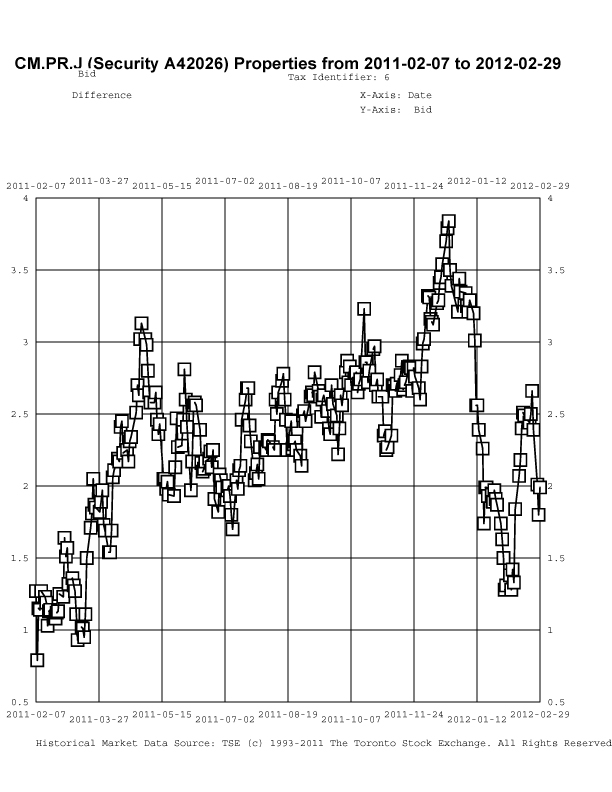
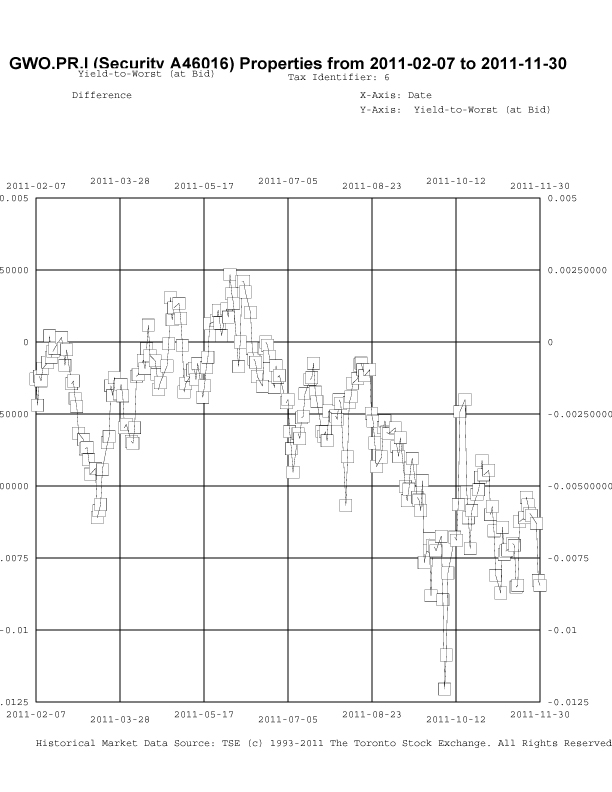
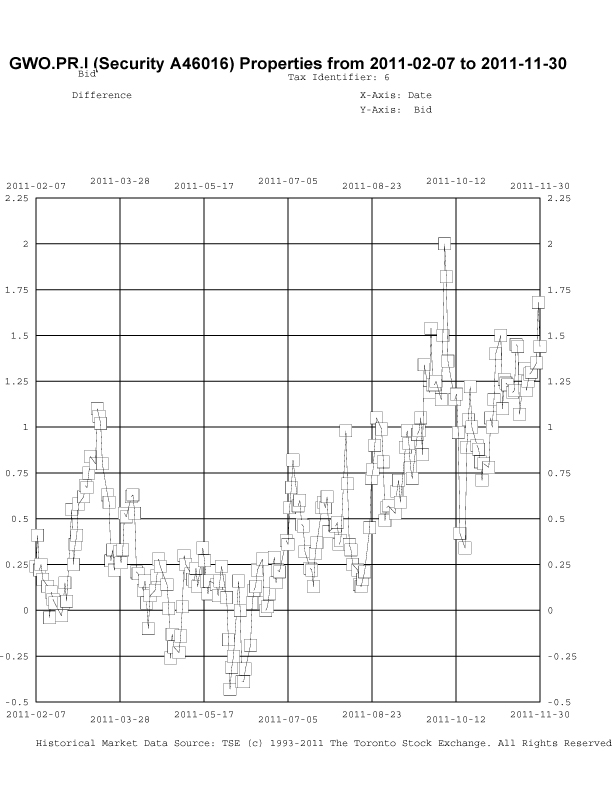
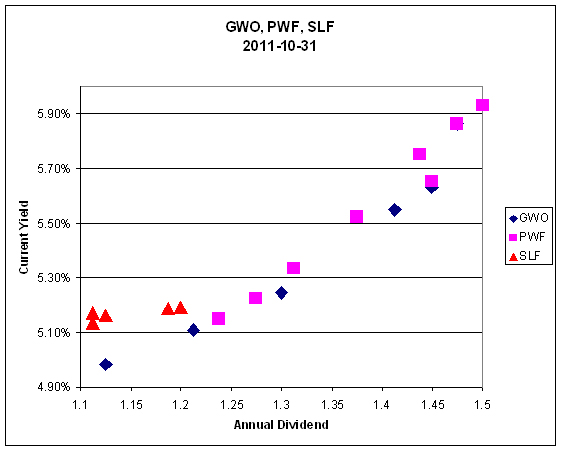
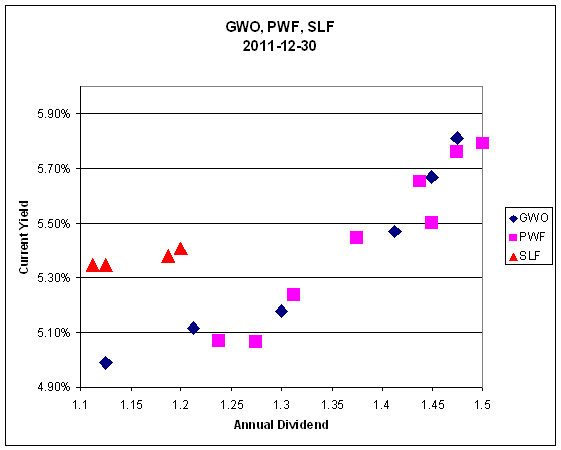
I have uploaded two graphs comparing very similar issues: GWO.PR.I and CM.PR.I, updating the graphs shown last month:

These two issues are both considered to be DeemedRetractibles; I consider it more prudent to assume they will be redeemed on or before 2022-1-31 than to assume otherwise.

The fund’s Net Asset Value per Unit as of the close May 31 was $11.3297.

Returns to May 31, 2011
Period MAPF Index CPD
according to
Claymore
One Month +3.84% +1.82% +1.31%
Three Months +2.02% +2.80% +1.76%
One Year +27.08% +17.53% +13.32%
Two Years (annualized) +23.53% +14.37% N/A
Three Years (annualized) +24.63% +7.46% +4.69%
Four Years (annualized) +18.74% +5.03%  
Five Years (annualized) +15.90% +4.21%  
Six Years (annualized) +14.05% +4.02%  
Seven Years (annualized) +13.49% +4.41%  
Eight Years (annualized) +14.44% +4.38%  
Nine Years (annualized) +13.53% +4.76%  
Ten Years (annualized) +13.81% +4.47%  
The Index is the BMO-CM “50”
MAPF returns assume reinvestment of distributions, and are shown after expenses but before fees.
CPD Returns are for the NAV and are after all fees and expenses.
* CPD does not directly report its two-year returns.
Figures for Omega Preferred Equity (which are after all fees and expenses) for 1-, 3- and 12-months are +1.51%, +1.92% and +14.90%, respectively, according to Morningstar after all fees & expenses. Three year performance is +6.07%.
Figures for Jov Leon Frazer Preferred Equity Fund Class I Units (which are after all fees and expenses) for 1-, 3- and 12-months are +0.82%, +1.17% and +9.47% respectively, according to Morningstar
Figures for Manulife Preferred Income Fund (formerly AIC Preferred Income Fund) (which are after all fees and expenses) for 1-, 3- and 12-months are +1.71%, +1.71% & +11.39%, respectively
Figures for Horizons AlphaPro Preferred Share ETF are not yet available (inception date 2010-11-23)

MAPF returns assume reinvestment of dividends, and are shown after expenses but before fees. Past performance is not a guarantee of future performance. You can lose money investing in Malachite Aggressive Preferred Fund or any other fund. For more information, see the fund’s main page. The fund is available either directly from Hymas Investment Management or through a brokerage account at Odlum Brown Limited.

Sometimes everything works … sometimes the trading works, but sectoral shifts overwhelm the increment … sometimes nothing works. The fund seeks to earn incremental return by selling liquidity (that is, taking the other side of trades that other market participants are strongly motivated to execute), which can also be referred to as ‘trading noise’. There were a lot of strongly motivated market participants during the Panic of 2007, generating a lot of noise! Unfortunately, the conditions of the Panic may never be repeated in my lifetime … but the fund will simply attempt to make trades when swaps seem profitable, without worrying about the level of monthly turnover.

There’s plenty of room for new money left in the fund. I have shown in recent issues of PrefLetter that market pricing for FixedResets is demonstrably stupid and I have lots of confidence – backed up by my bond portfolio management experience in the markets for Canadas and Treasuries, and equity trading on the NYSE & TSX – that there is enough demand for liquidity in any market to make the effort of providing it worthwhile (although the definition of “worthwhile” in terms of basis points of outperformance changes considerably from market to market!) I will continue to exert utmost efforts to outperform but it should be borne in mind that there will almost inevitably be periods of underperformance in the future.

The yields available on high quality preferred shares remain elevated, which is reflected in the current estimate of sustainable income.

Calculation of MAPF Sustainable Income Per Unit
Month NAVPU Portfolio
Average
YTW
Leverage
Divisor
Securities
Average
YTW
Capital
Gains
Multiplier
Sustainable
Income
per
current
Unit
June, 2007 9.3114 5.16% 1.03 5.01% 1.2857 0.3628
September 9.1489 5.35% 0.98 5.46% 1.2857 0.3885
December, 2007 9.0070 5.53% 0.942 5.87% 1.2857 0.4112
March, 2008 8.8512 6.17% 1.047 5.89% 1.2857 0.4672
June 8.3419 6.034% 0.952 6.338% 1.2857 $0.4112
September 8.1886 7.108% 0.969 7.335% 1.2857 $0.4672
December, 2008 8.0464 9.24% 1.008 9.166% 1.2857 $0.5737
March 2009 $8.8317 8.60% 0.995 8.802% 1.2857 $0.6046
June 10.9846 7.05% 0.999 7.057% 1.2857 $0.6029
September 12.3462 6.03% 0.998 6.042% 1.2857 $0.5802
December 2009 10.5662 5.74% 0.981 5.851% 1.0819 $0.5714
March 2010 10.2497 6.03% 0.992 6.079% 1.0819 $0.5759
June 10.5770 5.96% 0.996 5.984% 1.0819 $0.5850
September 11.3901 5.43% 0.980 5.540% 1.0819 $0.5832
December 2010 10.7659 5.37% 0.993 5.408% 1.0000 $0.5822
March, 2011 11.0560 6.00% 0.994 5.964% 1.0000 $0.6594
May, 2011 11.3297 5.75% 1.009 5.802% 1.0000 $0.6573
NAVPU is shown after quarterly distributions of dividend income and annual distribution of capital gains.
Portfolio YTW includes cash (or margin borrowing), with an assumed interest rate of 0.00%
The Leverage Divisor indicates the level of cash in the account: if the portfolio is 1% in cash, the Leverage Divisor will be 0.99
Securities YTW divides “Portfolio YTW” by the “Leverage Divisor” to show the average YTW on the securities held; this assumes that the cash is invested in (or raised from) all securities held, in proportion to their holdings.
The Capital Gains Multiplier adjusts for the effects of Capital Gains Dividends. On 2009-12-31, there was a capital gains distribution of $1.989262 which is assumed for this purpose to have been reinvested at the final price of $10.5662. Thus, a holder of one unit pre-distribution would have held 1.1883 units post-distribution; the CG Multiplier reflects this to make the time-series comparable. Note that Dividend Distributions are not assumed to be reinvested.
Sustainable Income is the resultant estimate of the fund’s dividend income per current unit, before fees and expenses. Note that a “current unit” includes reinvestment of prior capital gains; a unitholder would have had the calculated sustainable income with only, say, 0.9 units in the past which, with reinvestment of capital gains, would become 1.0 current units.
DeemedRetractibles are comprised of all Straight Perpetuals (both PerpetualDiscount and PerpetualPremium) issued by BMO, BNS, CM, ELF, GWO, HSB, IAG, MFC, NA, RY, SLF and TD, which are not exchangable into common at the option of the company (definition refined in May). These issues are analyzed as if their prospectuses included a requirement to redeem at par on or prior to 2022-1-31, in addition to the call schedule explicitly defined. See OSFI Does Not Grandfather Extant Tier 1 Capital, CM.PR.D, CM.PR.E, CM.PR.G: Seeking NVCC Status and the January, February and March, 2011, editions of PrefLetter for the rationale behind this analysis.

Significant positions were held in DeemedRetractible and FixedReset issues on May 31; all of the former and most of the latter currently have their yields calculated with the presumption that they will be called by the issuers at par prior to 2022-1-31. This presents another complication in the calculation of sustainable yield. The fund also holds a position in a SplitShare (BNA.PR.C) and an OperatingRetractible Scrap (YLO.PR.B) which also have their yields calculated with the expectation of a maturity.

However, if the entire portfolio except for the PerpetualDiscounts were to be sold and reinvested in these issues, the yield of the portfolio would be the 5.68% shown in the MAPF Portfolio Composition: May 2011 analysis (which is greater than the 5.52% index yield on May 31). Given such reinvestment, the sustainable yield would be $11.3297 * 0.0568 = $0.6435, an increase from the $10.9105 * 0.0554 = $0.6044 reported in April.

Different assumptions lead to different results from the calculation, but the overall positive trend is apparent. I’m very pleased with the results! It will be noted that if there was no trading in the portfolio, one would expect the sustainable yield to be constant (before fees and expenses). The success of the fund’s trading is showing up in

  • the very good performance against the index
  • the long term increases in sustainable income per unit

As has been noted, the fund has maintained a credit quality equal to or better than the index; outperformance is due to constant exploitation of trading anomalies.

Again, there are no predictions for the future! The fund will continue to trade between issues in an attempt to exploit market gaps in liquidity, in an effort to outperform the index and keep the sustainable income per unit – however calculated! – growing.
MAPF

MAPF Portfolio Composition: May 2011

Turnover increased in May, to about 23%.

Trades were, as ever, triggered by a desire to exploit transient mispricing in the preferred share market (which may be thought of as “selling liquidity”), rather than any particular view being taken on market direction, sectoral performance or credit anticipation.

MAPF Sectoral Analysis 2011-5-31
HIMI Indices Sector Weighting YTW ModDur
Ratchet 0% N/A N/A
FixFloat 0% N/A N/A
Floater 0% N/A N/A
OpRet 0% N/A N/A
SplitShare 9.2% (+4.4) 6.30% 6.34
Interest Rearing 0% N/A N/A
PerpetualPremium 0.0% (0) N/A N/A
PerpetualDiscount 12.5% (+5.7) 5.68% 14.34
Fixed-Reset 10.2% (+2.1) 3.18% 2.75
Deemed-Retractible 57.5% (-12.5) 5.73% 7.99
Scraps (Various) 9.7% (-0.3) 8.70% 9.17
Cash +0.9% (+0.6) 0.00% 0.00
Total 100% 5.75% 8.14
Totals and changes will not add precisely due to rounding. Bracketted figures represent change from April month-end. Cash is included in totals with duration and yield both equal to zero.
DeemedRetractibles are comprised of all Straight Perpetuals (both PerpetualDiscount and PerpetualPremium) issued by BMO, BNS, CM, ELF, GWO, HSB, IAG, MFC, NA, RY, SLF and TD, which are not exchangable into common at the option of the company. These issues are analyzed as if their prospectuses included a requirement to redeem at par on or prior to 2022-1-31, in addition to the call schedule explicitly defined. See OSFI Does Not Grandfather Extant Tier 1 Capital, CM.PR.D, CM.PR.E, CM.PR.G: Seeking NVCC Status and the January, February and March, 2011, editions of PrefLetter for the rationale behind this analysis.

The “total” reflects the un-leveraged total portfolio (i.e., cash is included in the portfolio calculations and is deemed to have a duration and yield of 0.00.). MAPF will often have relatively large cash balances, both credit and debit, to facilitate trading. Figures presented in the table have been rounded to the indicated precision.

Credit distribution is:

MAPF Credit Analysis 2011-5-31
DBRS Rating Weighting
Pfd-1 0 (0)
Pfd-1(low) 47.1% (+3.9)
Pfd-2(high) 22.7% (-4.1)
Pfd-2 0 (0)
Pfd-2(low) 19.6% (-0.1)
Pfd-3(high) 6.5% (0)
Pfd-3 3.2% (-0.3)
Cash +0.9% (+0.6)
Totals will not add precisely due to rounding. Bracketted figures represent change from April month-end.
A position held in ELF preferreds has been assigned to Pfd-2(low)

Liquidity Distribution is:

MAPF Liquidity Analysis 2011-5-31
Average Daily Trading Weighting
<$50,000 6.8% (+6.8)
$50,000 – $100,000 11.0% (-6.9)
$100,000 – $200,000 36.1% (+0.9)
$200,000 – $300,000 15.3% (+0.5)
>$300,000 29.9% (-1.9)
Cash +0.9% (+0.6)
Totals will not add precisely due to rounding. Bracketted figures represent change from April month-end.

MAPF is, of course, Malachite Aggressive Preferred Fund, a “unit trust” managed by Hymas Investment Management Inc. Further information and links to performance, audited financials and subscription information are available the fund’s web page. The fund may be purchased either directly from Hymas Investment Management or through a brokerage account at Odlum Brown Limited. A “unit trust” is like a regular mutual fund, but is sold by offering memorandum rather than prospectus. This is cheaper, but means subscription is restricted to “accredited investors” (as defined by the Ontario Securities Commission) or those who subscribe for $150,000+. Fund past performances are not a guarantee of future performance. You can lose money investing in MAPF or any other fund.

A similar portfolio composition analysis has been performed on the Claymore Preferred Share ETF (symbol CPD) as of August 31, 2010, and published in the September, 2010, PrefLetter. While direct comparisons are difficult due to the introduction of the DeemedRetractible class of preferred share (see above) it is fair to say:

  • MAPF credit quality is better
  • MAPF liquidity is a higher
  • MAPF Yield is higher
  • Weightings in
    • MAPF is much more exposed to DeemedRetractibles
    • MAPF is much less exposed to Operating Retractibles
    • MAPF is slightly more exposed to SplitShares
    • MAPF is less exposed to FixFloat / Floater / Ratchet
    • MAPF weighting in FixedResets is much lower
MAPF

MAPF Performance: April 2011

The fund had a poor month with a return of -1.32%. While comparative index figures are not yet available, the Claymore ETF, CPD, was essentially flat on the month, with its NAV dropping $0.07 after paying a dividend of $0.069.

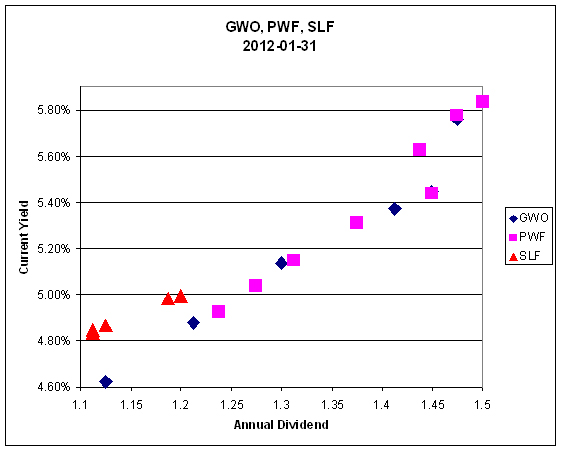
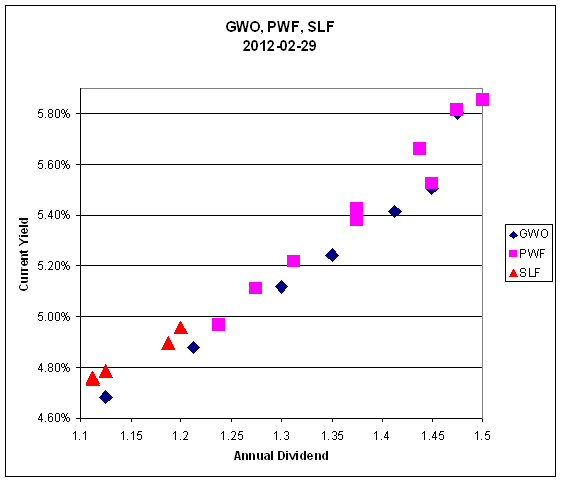
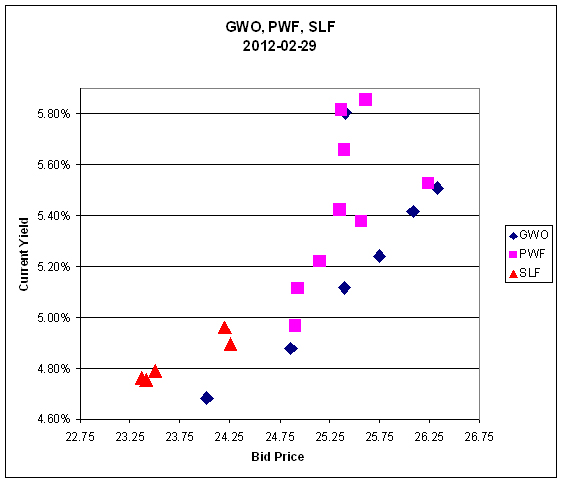
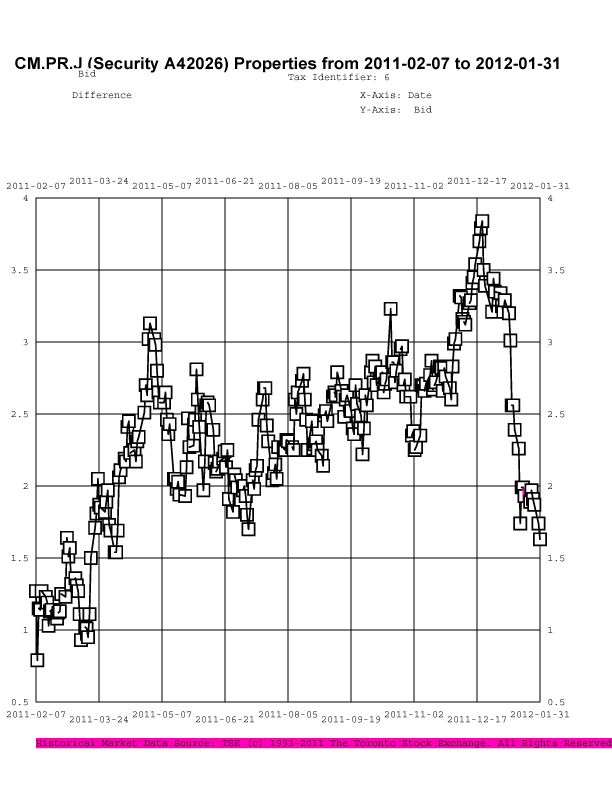
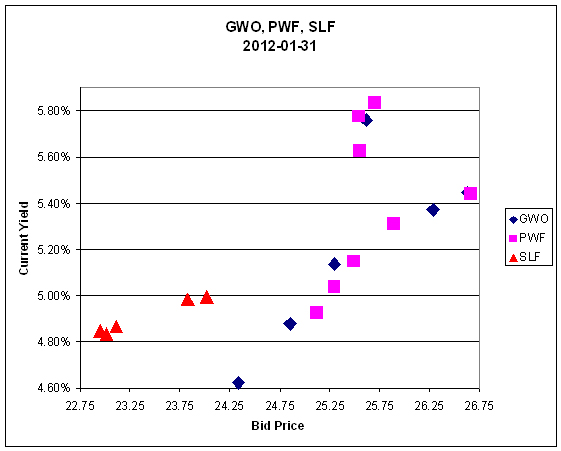
The fund’s poor performance is again attributable to its heavy position in DeemedRetractibles issued by insurers, which did very poorly. To illustrate this, I have uploaded two graphs comparing very similar issues: GWO.PR.I and CM.PR.I:

These two issues are both considered to be DeemedRetractibles; I consider it more prudent to assume they will be redeemed on or before 2022-1-31 than to assume otherwise. However, the market does not presently share my opinion! This is best illustrated by calculating Implied Volatility with the Straight Perpetual Implied Volatility Calculator.


Click for Big


Click for Big

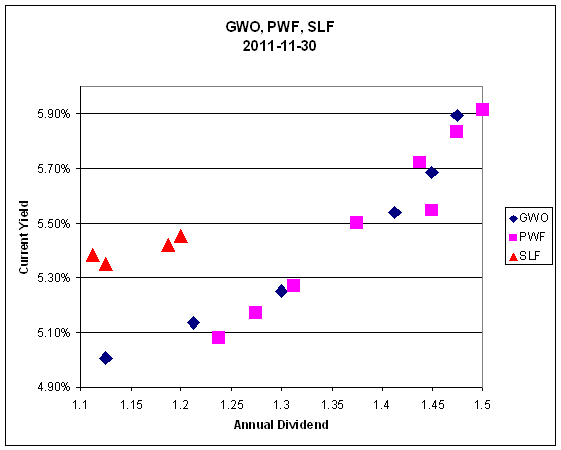
The Implied Volatility for the PWF issues is 26%, while for the GWO issues it is 16%. Note that I consider a reasonable figure for Implied Volatility, in the absence of directional bias, to be in the 15-20% range; a figure outside this range implies some degree of directional bias in the market: lower means that the market believes that eventual redemption is less likely than would be predicted by random chance, a higher figure implies more likely redemption. When the calculation is performed for CM issues, a ludicrously high value is obtained, implying perceived virtual certainty of redemption – which is as it should be.

However, the market is currently pricing the PWF and GWO issues as if it is the former that has some kind of non-economic incentive to redeem, rather than the latter! I do not believe that this conclusion may be justified in any manner whatsoever.

It is in the nature of the preferred share market to behave irrationally from time to time – in the spring of 2010, I noted that the relative prices for these two issues reflected negative Implied Volatility (which cannot actually be calculated because the math blows up). It happens. Sometimes, when the market takes an irrational dislike to a particular issue or set of issues, I am able to exploit the opportunity thus provided; sometimes, as now, I’m already there and have to suffer (another example was June 2008, immortalized in my article The Swoon in June).

I am, of course, disappointed at the second consecutive month of underperformance – but have every reason to believe that this is transient.

The fund’s Net Asset Value per Unit as of the close April 29 was $10.9105.

Returns to April 29, 2011
Period MAPF Index CPD
according to
Claymore
One Month -1.32% +0.36% +0.01%
Three Months -0.57% +1.79% +1.41%
One Year +23.73% +15.78% +12.91%
Two Years (annualized) +25.99% +16.15% N/A
Three Years (annualized) +23.64% +7.28% +4.73%
Four Years (annualized) +17.37% +3.90%  
Five Years (annualized) +15.15% +3.96%  
Six Years (annualized) +13.64% +3.87%  
Seven Years (annualized) +13.08% +4.14%  
Eight Years (annualized) +14.54% +4.41%  
Nine Years (annualized) +13.05% +4.58%  
Ten Years (annualized) +13.36% +4.21%  
The Index is the BMO-CM “50”
MAPF returns assume reinvestment of distributions, and are shown after expenses but before fees.
CPD Returns are for the NAV and are after all fees and expenses.
* CPD does not directly report its two-year returns.
Figures for Omega Preferred Equity (which are after all fees and expenses) for 1-, 3- and 12-months are +0.00%, +1.17% and +13.87%, respectively, according to Morningstar after all fees & expenses. Three year performance is +5.89%.
Figures for Jov Leon Frazer Preferred Equity Fund Class I Units (which are after all fees and expenses) for 1-, 3- and 12-months are -0.15%, +0.56% and +9.26% respectively, according to Morningstar
Figures for Manulife Preferred Income Fund (formerly AIC Preferred Income Fund) (which are after all fees and expenses) for 1-, 3- and 12-months are +0.07%, +0.81% & +9.91%, respectively
Figures for Horizons AlphaPro Preferred Share ETF are not yet available (inception date 2010-11-23)

MAPF returns assume reinvestment of dividends, and are shown after expenses but before fees. Past performance is not a guarantee of future performance. You can lose money investing in Malachite Aggressive Preferred Fund or any other fund. For more information, see the fund’s main page. The fund is available either directly from Hymas Investment Management or through a brokerage account at Odlum Brown Limited.

Sometimes everything works … sometimes the trading works, but sectoral shifts overwhelm the increment … sometimes nothing works. The fund seeks to earn incremental return by selling liquidity (that is, taking the other side of trades that other market participants are strongly motivated to execute), which can also be referred to as ‘trading noise’. There were a lot of strongly motivated market participants during the Panic of 2007, generating a lot of noise! Unfortunately, the conditions of the Panic may never be repeated in my lifetime … but the fund will simply attempt to make trades when swaps seem profitable, without worrying about the level of monthly turnover.

There’s plenty of room for new money left in the fund. I have shown in recent issues of PrefLetter that market pricing for FixedResets is demonstrably stupid and I have lots of confidence – backed up by my bond portfolio management experience in the markets for Canadas and Treasuries, and equity trading on the NYSE & TSX – that there is enough demand for liquidity in any market to make the effort of providing it worthwhile (although the definition of “worthwhile” in terms of basis points of outperformance changes considerably from market to market!) I will continue to exert utmost efforts to outperform but it should be borne in mind that there will almost inevitably be periods of underperformance in the future.

The yields available on high quality preferred shares remain elevated, which is reflected in the current estimate of sustainable income.

Calculation of MAPF Sustainable Income Per Unit
Month NAVPU Portfolio
Average
YTW
Leverage
Divisor
Securities
Average
YTW
Capital
Gains
Multiplier
Sustainable
Income
per
current
Unit
June, 2007 9.3114 5.16% 1.03 5.01% 1.2857 0.3628
September 9.1489 5.35% 0.98 5.46% 1.2857 0.3885
December, 2007 9.0070 5.53% 0.942 5.87% 1.2857 0.4112
March, 2008 8.8512 6.17% 1.047 5.89% 1.2857 0.4672
June 8.3419 6.034% 0.952 6.338% 1.2857 $0.4112
September 8.1886 7.108% 0.969 7.335% 1.2857 $0.4672
December, 2008 8.0464 9.24% 1.008 9.166% 1.2857 $0.5737
March 2009 $8.8317 8.60% 0.995 8.802% 1.2857 $0.6046
June 10.9846 7.05% 0.999 7.057% 1.2857 $0.6029
September 12.3462 6.03% 0.998 6.042% 1.2857 $0.5802
December 2009 10.5662 5.74% 0.981 5.851% 1.0819 $0.5714
March 2010 10.2497 6.03% 0.992 6.079% 1.0819 $0.5759
June 10.5770 5.96% 0.996 5.984% 1.0819 $0.5850
September 11.3901 5.43% 0.980 5.540% 1.0819 $0.5832
December 2010 10.7659 5.37% 0.993 5.408% 1.0000 $0.5822
March, 2011 11.0560 6.00% 0.994 5.964% 1.0000 $0.6594
April, 2011 10.9105 6.20% 1.003 6.219% 1.0000 $0.6785
NAVPU is shown after quarterly distributions of dividend income and annual distribution of capital gains.
Portfolio YTW includes cash (or margin borrowing), with an assumed interest rate of 0.00%
The Leverage Divisor indicates the level of cash in the account: if the portfolio is 1% in cash, the Leverage Divisor will be 0.99
Securities YTW divides “Portfolio YTW” by the “Leverage Divisor” to show the average YTW on the securities held; this assumes that the cash is invested in (or raised from) all securities held, in proportion to their holdings.
The Capital Gains Multiplier adjusts for the effects of Capital Gains Dividends. On 2009-12-31, there was a capital gains distribution of $1.989262 which is assumed for this purpose to have been reinvested at the final price of $10.5662. Thus, a holder of one unit pre-distribution would have held 1.1883 units post-distribution; the CG Multiplier reflects this to make the time-series comparable. Note that Dividend Distributions are not assumed to be reinvested.
Sustainable Income is the resultant estimate of the fund’s dividend income per current unit, before fees and expenses. Note that a “current unit” includes reinvestment of prior capital gains; a unitholder would have had the calculated sustainable income with only, say, 0.9 units in the past which, with reinvestment of capital gains, would become 1.0 current units.
Analysis of yields changed in February 2011 to include the concept of DeemedRetractible issues. DeemedRetractibles are comprised of all Straight Perpetuals (both PerpetualDiscount and PerpetualPremium) issued by BMO, BNS, CM, ELF, GWO, HSB, IAG, MFC, NA, RY, SLF and TD. These issues are analyzed as if their prospectuses included a requirement to redeem at par on or prior to 2022-1-31, in addition to the call schedule explicitly defined. See OSFI Does Not Grandfather Extant Tier 1 Capital and the January & February, 2011, editions of PrefLetter for the rationale behind this analysis. This deemed maturity has a significant effect on calculated yields.

Significant positions were held in DeemedRetractible and FixedReset issues on April 29; all of the former and most of the latter currently have their yields calculated with the presumption that they will be called by the issuers at par prior to 2022-1-31. This presents another complication in the calculation of sustainable yield. The fund also holds a position in a SplitShare (BNA.PR.C) which also has its yield calculated with the expectation of a maturity.

However, if the entire portfolio except for the PerpetualDiscounts were to be sold and reinvested in these issues, the yield of the portfolio would be the 5.54% shown in the MAPF Portfolio Composition: April 2011 analysis (which is slightly below the 5.58% index yield on April 29). Given such reinvestment, the sustainable yield would be $10.9105 * 0.0554 = $0.6044, a slight decline from the $11.0560 * 0.0560 = $0.6191 reported in March.

Different assumptions lead to different results from the calculation, but the overall positive trend is apparent. I’m very pleased with the results! It will be noted that if there was no trading in the portfolio, one would expect the sustainable yield to be constant (before fees and expenses). The success of the fund’s trading is showing up in

  • the very good performance against the index
  • the long term increases in sustainable income per unit

As has been noted, the fund has maintained a credit quality equal to or better than the index; outperformance is due to constant exploitation of trading anomalies.

Again, there are no predictions for the future! The fund will continue to trade between issues in an attempt to exploit market gaps in liquidity, in an effort to outperform the index and keep the sustainable income per unit – however calculated! – growing.
MAPF

MAPF Portfolio Composition: April 2011

Turnover declined dramatically in April, to about 4%. Now that the portfolio has repositioned itself to account for OSFI’s refusal to grandfather extant Tier 1 Capital, we are back to the slow trading of positions based on changes in relative value.

Trades were, as ever, triggered by a desire to exploit transient mispricing in the preferred share market (which may be thought of as “selling liquidity”), rather than any particular view being taken on market direction, sectoral performance or credit anticipation.

MAPF Sectoral Analysis 2011-4-29
HIMI Indices Sector Weighting YTW ModDur
Ratchet 0% N/A N/A
FixFloat 0% N/A N/A
Floater 0% N/A N/A
OpRet 0% N/A N/A
SplitShare 4.8% (+0.6) 6.47% 6.34
Interest Rearing 0% N/A N/A
PerpetualPremium 0.0% (0) N/A N/A
PerpetualDiscount 6.8% (+0.9) 5.54% 14.59
Fixed-Reset 8.1% (-0.3) 3.54% 2.81
Deemed-Retractible 70.0% (-1.9) 6.39% 8.08
Scraps (Various) 10.0% (-0.2) 7.50% 10.23
Cash +0.3% (+0.9) 0.00% 0.00
Total 100% 6.20% 8.20
Totals and changes will not add precisely due to rounding. Bracketted figures represent change from February month-end. Cash is included in totals with duration and yield both equal to zero.
DeemedRetractibles are comprised of all Straight Perpetuals (both PerpetualDiscount and PerpetualPremium) issued by BMO, BNS, CM, ELF, GWO, HSB, IAG, MFC, NA, RY, SLF and TD. These issues are analyzed as if their prospectuses included a requirement to redeem at par on or prior to 2022-1-31, in addition to the call schedule explicitly defined. See OSFI Does Not Grandfather Extant Tier 1 Capital and the January, February and March, 2011, editions of PrefLetter for the rationale behind this analysis.

The “total” reflects the un-leveraged total portfolio (i.e., cash is included in the portfolio calculations and is deemed to have a duration and yield of 0.00.). MAPF will often have relatively large cash balances, both credit and debit, to facilitate trading. Figures presented in the table have been rounded to the indicated precision.

Credit distribution is:

MAPF Credit Analysis 2011-4-29
DBRS Rating Weighting
Pfd-1 0 (0)
Pfd-1(low) 43.2% (+0.1)
Pfd-2(high) 26.8% (-1.2)
Pfd-2 0 (0)
Pfd-2(low) 19.7% (+1.0)
Pfd-3(high) 6.5% (-0.1)
Pfd-3 3.5% (-0.1)
Cash +0.3% (+0.9)
Totals will not add precisely due to rounding. Bracketted figures represent change from March month-end.
A position held in ELF preferreds has been assigned to Pfd-2(low)

Liquidity Distribution is:

MAPF Liquidity Analysis 2011-4-29
Average Daily Trading Weighting
<$50,000 0.0% (0)
$50,000 – $100,000 17.9% (+3.7)
$100,000 – $200,000 35.2% (-4.8)
$200,000 – $300,000 14.8% (+9.0)
>$300,000 31.8% (-8.7)
Cash +0.3% (+0.9)
Totals will not add precisely due to rounding. Bracketted figures represent change from March month-end.

MAPF is, of course, Malachite Aggressive Preferred Fund, a “unit trust” managed by Hymas Investment Management Inc. Further information and links to performance, audited financials and subscription information are available the fund’s web page. The fund may be purchased either directly from Hymas Investment Management or through a brokerage account at Odlum Brown Limited. A “unit trust” is like a regular mutual fund, but is sold by offering memorandum rather than prospectus. This is cheaper, but means subscription is restricted to “accredited investors” (as defined by the Ontario Securities Commission) or those who subscribe for $150,000+. Fund past performances are not a guarantee of future performance. You can lose money investing in MAPF or any other fund.

A similar portfolio composition analysis has been performed on the Claymore Preferred Share ETF (symbol CPD) as of August 31, 2010, and published in the September, 2010, PrefLetter. While direct comparisons are difficult due to the introduction of the DeemedRetractible class of preferred share (see above) it is fair to say:

  • MAPF credit quality is better
  • MAPF liquidity is a higher
  • MAPF Yield is higher
  • Weightings in
    • MAPF is much more exposed to DeemedRetractibles
    • MAPF is much less exposed to Operating Retractibles
    • MAPF is slightly more exposed to SplitShares
    • MAPF is less exposed to FixFloat / Floater / Ratchet
    • MAPF weighting in FixedResets is much lower
MAPF

MAPF Performance: March 2011

The fund had a poor month with a return of -0.44%, underperforming the S&P/TSX Preferred Share Index (TXPR), which returned +0.50%. Figures for the BMO-CM “50” index, which I favour, are not yet available.

The fund’s poor performance is attributable to its heavy position in DeemedRetractibles issued by insurers, which did very poorly.

Well, it has to happen sometimes! Fortunately, the first two months of the quarter were good enough to keep the fund well ahead of the index over the three month period.

The fund’s Net Asset Value per Unit as of the close January 31 was $11.0560 after a distribution of 0.131577.

Returns to March 31, 2011
Period MAPF Index CPD
according to
Claymore
One Month -0.44% +0.60% +0.44%
Three Months +3.92% +3.06% +2.28%
One Year +22.95% +13.11% +10.47%
Two Years (annualized) +33.87% +19.57% N/A
Three Years (annualized) +24.49% +7.18% +4.74%
Four Years (annualized) +17.39% +3.42%  
Five Years (annualized) +14.90% +3.59%  
Six Years (annualized) +13.69% +3.86%  
Seven Years (annualized) +12.55% +3.60%  
Eight Years (annualized) +15.68% +4.49%  
Nine Years (annualized) +13.37% +4.46%  
Ten Years (annualized) +13.64% +4.14%  
The Index is the BMO-CM “50”
MAPF returns assume reinvestment of distributions, and are shown after expenses but before fees.
CPD Returns are for the NAV and are after all fees and expenses.
* CPD does not directly report its two-year returns.
Figures for Omega Preferred Equity (which are after all fees and expenses) for 1-, 3- and 12-months are +0.41%, +2.43% and +11.37%, respectively, according to Morningstar after all fees & expenses. Three year performance is +5.93%.
Figures for Jov Leon Frazer Preferred Equity Fund Class I Units (which are after all fees and expenses) for 1-, 3- and 12-months are +0.50%, +0.87% and +6.54% respectively, according to Morningstar
Figures for Manulife Preferred Income Fund (formerly AIC Preferred Income Fund) (which are after all fees and expenses) for 1-, 3- and 12-months are -0.08%, +1.42% & +6.35%, respectively
Figures for Horizons AlphaPro Preferred Share ETF are not yet available (inception date 2010-11-23)

MAPF returns assume reinvestment of dividends, and are shown after expenses but before fees. Past performance is not a guarantee of future performance. You can lose money investing in Malachite Aggressive Preferred Fund or any other fund. For more information, see the fund’s main page. The fund is available either directly from Hymas Investment Management or through a brokerage account at Odlum Brown Limited.

Sometimes everything works … sometimes the trading works, but sectoral shifts overwhelm the increment … sometimes nothing works. The fund seeks to earn incremental return by selling liquidity (that is, taking the other side of trades that other market participants are strongly motivated to execute), which can also be referred to as ‘trading noise’. There were a lot of strongly motivated market participants during the Panic of 2007, generating a lot of noise! Unfortunately, the conditions of the Panic may never be repeated in my lifetime … but the fund will simply attempt to make trades when swaps seem profitable, whether that implies monthly turnover of 10% or 100%.

There’s plenty of room for new money left in the fund. I have shown in recent issues of PrefLetter that market pricing for FixedResets is demonstrably stupid and I have lots of confidence – backed up by my bond portfolio management experience in the markets for Canadas and Treasuries, and equity trading on the NYSE & TSX – that there is enough demand for liquidity in any market to make the effort of providing it worthwhile (although the definition of “worthwhile” in terms of basis points of outperformance changes considerably from market to market!) I will continue to exert utmost efforts to outperform but it should be borne in mind that there will almost inevitably be periods of underperformance in the future.

The yields available on high quality preferred shares remain elevated, which is reflected in the current estimate of sustainable income.

Calculation of MAPF Sustainable Income Per Unit
Month NAVPU Portfolio
Average
YTW
Leverage
Divisor
Securities
Average
YTW
Capital
Gains
Multiplier
Sustainable
Income
per
current
Unit
June, 2007 9.3114 5.16% 1.03 5.01% 1.2857 0.3628
September 9.1489 5.35% 0.98 5.46% 1.2857 0.3885
December, 2007 9.0070 5.53% 0.942 5.87% 1.2857 0.4112
March, 2008 8.8512 6.17% 1.047 5.89% 1.2857 0.4672
June 8.3419 6.034% 0.952 6.338% 1.2857 $0.4112
September 8.1886 7.108% 0.969 7.335% 1.2857 $0.4672
December, 2008 8.0464 9.24% 1.008 9.166% 1.2857 $0.5737
March 2009 $8.8317 8.60% 0.995 8.802% 1.2857 $0.6046
June 10.9846 7.05% 0.999 7.057% 1.2857 $0.6029
September 12.3462 6.03% 0.998 6.042% 1.2857 $0.5802
December 2009 10.5662 5.74% 0.981 5.851% 1.0819 $0.5714
March 2010 10.2497 6.03% 0.992 6.079% 1.0819 $0.5759
June 10.5770 5.96% 0.996 5.984% 1.0819 $0.5850
September 11.3901 5.43% 0.980 5.540% 1.0819 $0.5832
December 2010 10.7659 5.37% 0.993 5.408% 1.0000 $0.5822
March, 2011 11.0560 6.00% 0.994 5.964% 1.0000 $0.6594
NAVPU is shown after quarterly distributions of dividend income and annual distribution of capital gains.
Portfolio YTW includes cash (or margin borrowing), with an assumed interest rate of 0.00%
The Leverage Divisor indicates the level of cash in the account: if the portfolio is 1% in cash, the Leverage Divisor will be 0.99
Securities YTW divides “Portfolio YTW” by the “Leverage Divisor” to show the average YTW on the securities held; this assumes that the cash is invested in (or raised from) all securities held, in proportion to their holdings.
The Capital Gains Multiplier adjusts for the effects of Capital Gains Dividends. On 2009-12-31, there was a capital gains distribution of $1.989262 which is assumed for this purpose to have been reinvested at the final price of $10.5662. Thus, a holder of one unit pre-distribution would have held 1.1883 units post-distribution; the CG Multiplier reflects this to make the time-series comparable. Note that Dividend Distributions are not assumed to be reinvested.
Sustainable Income is the resultant estimate of the fund’s dividend income per current unit, before fees and expenses. Note that a “current unit” includes reinvestment of prior capital gains; a unitholder would have had the calculated sustainable income with only, say, 0.9 units in the past which, with reinvestment of capital gains, would become 1.0 current units.
Analysis of yields changed in February 2011 to include the concept of DeemedRetractible issues. DeemedRetractibles are comprised of all Straight Perpetuals (both PerpetualDiscount and PerpetualPremium) issued by BMO, BNS, CM, ELF, GWO, HSB, IAG, MFC, NA, RY, SLF and TD. These issues are analyzed as if their prospectuses included a requirement to redeem at par on or prior to 2022-1-31, in addition to the call schedule explicitly defined. See OSFI Does Not Grandfather Extant Tier 1 Capital and the January & February, 2011, editions of PrefLetter for the rationale behind this analysis. This deemed maturity has a significant effect on calculated yields.

Significant positions were held in DeemedRetractible and FixedReset issues on February 28; all of the former and most of the latter currently have their yields calculated with the presumption that they will be called by the issuers at par prior to 2022-1-31. This presents another complication in the calculation of sustainable yield. The fund also holds a position in a SplitShare (BNA.PR.C) which also has its yield calculated with the expectation of a maturity.

However, if the entire portfolio except for the PerpetualDiscounts were to be sold and reinvested in these issues, the yield of the portfolio would be the 5.60% shown in the MAPF Portfolio Composition: March 2011 analysis (which is slightly in excess of the 5.54% index yield on March 31). Given such reinvestment, the sustainable yield would be $11.0560 * 0.0560 = $0.6191, a decline from the $11.2375 * 0.0567 = $0.6371 reported in February, but an increase from the $11.1030 * 0.0546 = $0.6062 reported in January.

Note that there will be a drag on the calculation in up-markets due to presence of shorter-term issues (or, at least, presumed shorter term issues!); the question is whether the positive effect of these issues in down markets will outweight their negative effect in up-markets – all I can say is … that’s what I keep working towards!

Different assumptions lead to different results from the calculation, but the overall positive trend is apparent. I’m very pleased with the results! It will be noted that if there was no trading in the portfolio, one would expect the sustainable yield to be constant (before fees and expenses). The success of the fund’s trading is showing up in

  • the very good performance against the index
  • the long term increases in sustainable income per unit

As has been noted, the fund has maintained a credit quality equal to or better than the index; outperformance is due to constant exploitation of trading anomalies.

Again, there are no predictions for the future! The fund will continue to trade between issues in an attempt to exploit market gaps in liquidity, in an effort to outperform the index and keep the sustainable income per unit – however calculated! – growing.
MAPF

MAPF Portfolio Composition: March 2011

Turnover declined dramatically in March, to about 17%. Now that the portfolio has repositioned itself to account for OSFI’s refusal to grandfather extant Tier 1 Capital, we are back to the slow trading of positions based on changes in relative value.

Trades were, as ever, triggered by a desire to exploit transient mispricing in the preferred share market (which may be thought of as “selling liquidity”), rather than any particular view being taken on market direction, sectoral performance or credit anticipation.

MAPF Sectoral Analysis 2011-3-31
HIMI Indices Sector Weighting YTW ModDur
Ratchet 0% N/A N/A
FixFloat 0% N/A N/A
Floater 0% N/A N/A
OpRet 0% N/A N/A
SplitShare 4.2% (+2.4) 6.28% 6.43
Interest Rearing 0% N/A N/A
PerpetualPremium 0.0% (0) N/A N/A
PerpetualDiscount 5.9% (-5.2) 5.60% 14.54
Fixed-Reset 8.4% (-2) 3.43% 2.86
Deemed-Retractible 71.9% (+6.6) 6.12% 8.18
Scraps (Various) 10.2% (+0.4) 7.06% 10.68
Cash -0.6% (-2.0) 0.00% 0.00
Total 100% 6.00% 8.33
Totals and changes will not add precisely due to rounding. Bracketted figures represent change from February month-end. Cash is included in totals with duration and yield both equal to zero.
DeemedRetractibles are comprised of all Straight Perpetuals (both PerpetualDiscount and PerpetualPremium) issued by BMO, BNS, CM, ELF, GWO, HSB, IAG, MFC, NA, RY, SLF and TD. These issues are analyzed as if their prospectuses included a requirement to redeem at par on or prior to 2022-1-31, in addition to the call schedule explicitly defined. See OSFI Does Not Grandfather Extant Tier 1 Capital and the January, February and March, 2011, editions of PrefLetter for the rationale behind this analysis.

The “total” reflects the un-leveraged total portfolio (i.e., cash is included in the portfolio calculations and is deemed to have a duration and yield of 0.00.). MAPF will often have relatively large cash balances, both credit and debit, to facilitate trading. Figures presented in the table have been rounded to the indicated precision.

Credit distribution is:

MAPF Credit Analysis 2011-3-31
DBRS Rating Weighting
Pfd-1 0 (0)
Pfd-1(low) 43.1% (+3.4)
Pfd-2(high) 28.0% (+1.8)
Pfd-2 0 (0)
Pfd-2(low) 18.7% (-4.1)
Pfd-3(high) 6.6% (+1.5)
Pfd-3 3.6% (+0.3)
Pfd-3(low) 0.0% (-1.6)
Cash -0.6% (-2.0)
Totals will not add precisely due to rounding. Bracketted figures represent change from February month-end.
A position held in ELF preferreds has been assigned to Pfd-2(low)

Liquidity Distribution is:

MAPF Liquidity Analysis 2011-3-31
Average Daily Trading Weighting
<$50,000 0.0% (-1.6)
$50,000 – $100,000 14.2% (-9.3)
$100,000 – $200,000 40.0% (+16.0)
$200,000 – $300,000 5.8% (-7.5)
>$300,000 40.5% (+4.4)
Cash -0.6% (-2.0)
Totals will not add precisely due to rounding. Bracketted figures represent change from February month-end.

MAPF is, of course, Malachite Aggressive Preferred Fund, a “unit trust” managed by Hymas Investment Management Inc. Further information and links to performance, audited financials and subscription information are available the fund’s web page. The fund may be purchased either directly from Hymas Investment Management or through a brokerage account at Odlum Brown Limited. A “unit trust” is like a regular mutual fund, but is sold by offering memorandum rather than prospectus. This is cheaper, but means subscription is restricted to “accredited investors” (as defined by the Ontario Securities Commission) or those who subscribe for $150,000+. Fund past performances are not a guarantee of future performance. You can lose money investing in MAPF or any other fund.

A similar portfolio composition analysis has been performed on the Claymore Preferred Share ETF (symbol CPD) as of August 31, 2010, and published in the September, 2010, PrefLetter. While direct comparisons are difficult due to the introduction of the DeemedRetractible class of preferred share (see above) it is fair to say:

  • MAPF credit quality is better
  • MAPF liquidity is a higher
  • MAPF Yield is higher
  • Weightings in
    • MAPF is much more exposed to DeemedRetractibles
    • MAPF is much less exposed to Operating Retractibles
    • MAPF is slightly more exposed to SplitShares
    • MAPF is less exposed to FixFloat / Floater / Ratchet
    • MAPF weighting in FixedResets is much lower
MAPF

MAPF Performance: February 2011

The fund continued its good start to the year by outperforming its benchmark in February.

The fund’s Net Asset Value per Unit as of the close January 31 was $11.2375.

Returns to February 28, 2011
Period MAPF Index CPD
according to
Claymore
One Month +1.21% +0.82% +0.96%
Three Months +4.01% +2.41% +1.81%
One Year +20.51% +11.69% +9.00%
Two Years (annualized) +36.17% +19.40% N/A
Three Years (annualized) +22.75% +5.96% +3.56%
Four Years (annualized) +17.64% +3.33%  
Five Years (annualized) +15.36% +3.56%  
Six Years (annualized) +13.68% +3.63%  
Seven Years (annualized) +13.03% +3.63%  
Eight Years (annualized) +15.07% +4.39%  
Nine Years (annualized) +13.42% +4.14%  
The Index is the BMO-CM “50”
MAPF returns assume reinvestment of distributions, and are shown after expenses but before fees.
CPD Returns are for the NAV and are after all fees and expenses.
* CPD does not directly report its two-year returns.
Figures for Omega Preferred Equity (which are after all fees and expenses) for 1-, 3- and 12-months are +0.76%, +2.20% and +10.04%, respectively, according to Morningstar after all fees & expenses. Three year performance is +4.95%.
Figures for Jov Leon Frazer Preferred Equity Fund Class I Units (which are after all fees and expenses) for 1-, 3- and 12-months are +0.22%, +0.22% & +5.53% respectively, according to Morningstar
Figures for Manulife Preferred Income Fund (formerly AIC Preferred Income Fund) (which are after all fees and expenses) for 1-, 3- and 12-months are +0.81%, +1.62% & +6.76%, respectively
Figures for Horizons AlphaPro Preferred Share ETF are not yet available (inception date 2010-11-23)

MAPF returns assume reinvestment of dividends, and are shown after expenses but before fees. Past performance is not a guarantee of future performance. You can lose money investing in Malachite Aggressive Preferred Fund or any other fund. For more information, see the fund’s main page. The fund is available either directly from Hymas Investment Management or through a brokerage account at Odlum Brown Limited.

Sometimes everything works … sometimes the trading works, but sectoral shifts overwhelm the increment … sometimes nothing works. The fund seeks to earn incremental return by selling liquidity (that is, taking the other side of trades that other market participants are strongly motivated to execute), which can also be referred to as ‘trading noise’. There were a lot of strongly motivated market participants during the Panic of 2007, generating a lot of noise! Unfortunately, the conditions of the Panic may never be repeated in my lifetime … but the fund will simply attempt to make trades when swaps seem profitable, whether that implies monthly turnover of 10% or 100%.

There’s plenty of room for new money left in the fund. I have shown in recent issues of PrefLetter that market pricing for FixedResets is demonstrably stupid and I have lots of confidence – backed up by my bond portfolio management experience in the markets for Canadas and Treasuries, and equity trading on the NYSE & TSX – that there is enough demand for liquidity in any market to make the effort of providing it worthwhile (although the definition of “worthwhile” in terms of basis points of outperformance changes considerably from market to market!) I will continue to exert utmost efforts to outperform but it should be borne in mind that there will almost inevitably be periods of underperformance in the future.

The yields available on high quality preferred shares remain elevated, which is reflected in the current estimate of sustainable income.

Calculation of MAPF Sustainable Income Per Unit
Month NAVPU Portfolio
Average
YTW
Leverage
Divisor
Securities
Average
YTW
Capital
Gains
Multiplier
Sustainable
Income
per
current
Unit
June, 2007 9.3114 5.16% 1.03 5.01% 1.2857 0.3628
September 9.1489 5.35% 0.98 5.46% 1.2857 0.3885
December, 2007 9.0070 5.53% 0.942 5.87% 1.2857 0.4112
March, 2008 8.8512 6.17% 1.047 5.89% 1.2857 0.4672
June 8.3419 6.034% 0.952 6.338% 1.2857 $0.4112
September 8.1886 7.108% 0.969 7.335% 1.2857 $0.4672
December, 2008 8.0464 9.24% 1.008 9.166% 1.2857 $0.5737
March 2009 $8.8317 8.60% 0.995 8.802% 1.2857 $0.6046
June 10.9846 7.05% 0.999 7.057% 1.2857 $0.6029
September 12.3462 6.03% 0.998 6.042% 1.2857 $0.5802
December 2009 10.5662 5.74% 0.981 5.851% 1.0819 $0.5714
March 2010 10.2497 6.03% 0.992 6.079% 1.0819 $0.5759
June 10.5770 5.96% 0.996 5.984% 1.0819 $0.5850
September 11.3901 5.43% 0.980 5.540% 1.0819 $0.5832
December 2010 10.7659 5.37% 0.993 5.408% 1.0000 $0.5822
February, 2011 11.2375 5.66% 1.014 5.739% 1.0000 $0.6449
NAVPU is shown after quarterly distributions of dividend income and annual distribution of capital gains.
Portfolio YTW includes cash (or margin borrowing), with an assumed interest rate of 0.00%
The Leverage Divisor indicates the level of cash in the account: if the portfolio is 1% in cash, the Leverage Divisor will be 0.99
Securities YTW divides “Portfolio YTW” by the “Leverage Divisor” to show the average YTW on the securities held; this assumes that the cash is invested in (or raised from) all securities held, in proportion to their holdings.
The Capital Gains Multiplier adjusts for the effects of Capital Gains Dividends. On 2009-12-31, there was a capital gains distribution of $1.989262 which is assumed for this purpose to have been reinvested at the final price of $10.5662. Thus, a holder of one unit pre-distribution would have held 1.1883 units post-distribution; the CG Multiplier reflects this to make the time-series comparable. Note that Dividend Distributions are not assumed to be reinvested.
Sustainable Income is the resultant estimate of the fund’s dividend income per current unit, before fees and expenses. Note that a “current unit” includes reinvestment of prior capital gains; a unitholder would have had the calculated sustainable income with only, say, 0.9 units in the past which, with reinvestment of capital gains, would become 1.0 current units.
Analysis of yields changed in February 2011 to include the concept of DeemedRetractible issues. DeemedRetractibles are comprised of all Straight Perpetuals (both PerpetualDiscount and PerpetualPremium) issued by BMO, BNS, CM, ELF, GWO, HSB, IAG, MFC, NA, RY, SLF and TD. These issues are analyzed as if their prospectuses included a requirement to redeem at par on or prior to 2022-1-31, in addition to the call schedule explicitly defined. See OSFI Does Not Grandfather Extant Tier 1 Capital and the January & February, 2011, editions of PrefLetter for the rationale behind this analysis. This deemed maturity has a significant effect on calculated yields.

Significant positions were held in DeemedRetractible and FixedReset issues on February 28; all of the former and most of the latter currently have their yields calculated with the presumption that they will be called by the issuers at par prior to 2022-1-31. This presents another complication in the calculation of sustainable yield. The fund also holds a position in a SplitShare (BNA.PR.C) which also has its yield calculated with the expectation of a maturity.

However, if the entire portfolio except for the PerpetualDiscounts were to be sold and reinvested in these issues, the yield of the portfolio would be the 5.67% shown in the MAPF Portfolio Composition: February 2011 analysis (which is in excess of the 5.62% index yield on February 28). Given such reinvestment, the sustainable yield would be $11.2375 * 0.0567 = $0.6371, a significant increase from the $11.1030 * 0.0546 = $0.6062 reported last month.

Note that there will be a drag on the calculation in up-markets due to presence of shorter-term issues (or, at least, presumed shorter term issues!); the question is whether the positive effect of these issues in down markets will outweight their negative effect in up-markets – all I can say is … that’s what I keep working towards!

Different assumptions lead to different results from the calculation, but the overall positive trend is apparent. I’m very pleased with the results! It will be noted that if there was no trading in the portfolio, one would expect the sustainable yield to be constant (before fees and expenses). The success of the fund’s trading is showing up in

  • the very good performance against the index
  • the long term increases in sustainable income per unit

As has been noted, the fund has maintained a credit quality equal to or better than the index; outperformance is due to constant exploitation of trading anomalies.

Again, there are no predictions for the future! The fund will continue to trade between issues in an attempt to exploit market gaps in liquidity, in an effort to outperform the index and keep the sustainable income per unit – however calculated! – growing.
MAPF

MAPF Portfolio Composition: February 2011

Turnover picked up again in February, to about 70%

Trades were, as ever, triggered by a desire to exploit transient mispricing in the preferred share market (which may be thought of as “selling liquidity”), rather than any particular view being taken on market direction, sectoral performance or credit anticipation.

MAPF Sectoral Analysis 2011-1-31
HIMI Indices Sector Weighting YTW ModDur
Ratchet 0% N/A N/A
FixFloat 0% N/A N/A
Floater 0% N/A N/A
OpRet 0% N/A N/A
SplitShare 1.8% (-0.2) 6.11% 6.53
Interest Rearing 0% N/A N/A
PerpetualPremium 0.0% (-25.5) N/A N/A
PerpetualDiscount 11.2% (-37.1) 5.67% 14.34
Fixed-Reset 10.4% (-9.4) 3.50% 2.94
Deemed-Retractible 65.3% (+65.3) 5.98% 8.21
Scraps (Various) 9.8% (+5.0) 6.59% 9.85
Cash +1.4% (+1.8) 0.00% 0.00
Total 100% 5.66% 8.36
Totals and changes will not add precisely due to rounding. Bracketted figures represent change from January month-end. Cash is included in totals with duration and yield both equal to zero.
DeemedRetractibles are comprised of all Straight Perpetuals (both PerpetualDiscount and PerpetualPremium) issued by BMO, BNS, CM, ELF, GWO, HSB, IAG, MFC, NA, RY, SLF and TD. These issues are analyzed as if their prospectuses included a requirement to redeem at par on or prior to 2022-1-31, in addition to the call schedule explicitly defined. See OSFI Does Not Grandfather Extant Tier 1 Capital and the January & February, 2011, editions of PrefLetter for the rationale behind this analysis.

The “total” reflects the un-leveraged total portfolio (i.e., cash is included in the portfolio calculations and is deemed to have a duration and yield of 0.00.). MAPF will often have relatively large cash balances, both credit and debit, to facilitate trading. Figures presented in the table have been rounded to the indicated precision.

Credit distribution is:

MAPF Credit Analysis 2011-2-28
DBRS Rating Weighting
Pfd-1 0 (0)
Pfd-1(low) 39.7% (-18.7)
Pfd-2(high) 26.2% (+8.2)
Pfd-2 0 (0)
Pfd-2(low) 22.8% (+3.5)
Pfd-3(high) 4.8% (+1.5)
Pfd-3 3.3% (+1.8)
Pfd-3(low) 1.6% (+1.6)
Cash 1.4% (+1.8)
Totals will not add precisely due to rounding. Bracketted figures represent change from January month-end.
A position held in ELF preferreds has been assigned to Pfd-2(low)

Liquidity Distribution is:

MAPF Liquidity Analysis 2011-2-28
Average Daily Trading Weighting
<$50,000 1.6% (+1.6)
$50,000 – $100,000 23.5% (+12.4)
$100,000 – $200,000 24.0% (+10.9)
$200,000 – $300,000 +13.3% (-33.1)
>$300,000 36.1% (+6.3)
Cash 1.4% (+1.8)
Totals will not add precisely due to rounding. Bracketted figures represent change from January month-end.

MAPF is, of course, Malachite Aggressive Preferred Fund, a “unit trust” managed by Hymas Investment Management Inc. Further information and links to performance, audited financials and subscription information are available the fund’s web page. The fund may be purchased either directly from Hymas Investment Management or through a brokerage account at Odlum Brown Limited. A “unit trust” is like a regular mutual fund, but is sold by offering memorandum rather than prospectus. This is cheaper, but means subscription is restricted to “accredited investors” (as defined by the Ontario Securities Commission) or those who subscribe for $150,000+. Fund past performances are not a guarantee of future performance. You can lose money investing in MAPF or any other fund.

A similar portfolio composition analysis has been performed on the Claymore Preferred Share ETF (symbol CPD) as of August 31, 2010, and published in the September, 2010, PrefLetter. When comparing CPD and MAPF:

  • MAPF credit quality is better
  • MAPF liquidity is a higher
  • MAPF Yield is higher
  • Weightings in
    • MAPF is much more exposed to Straight Perpetuals
    • MAPF is much less exposed to Operating Retractibles
    • MAPF is slightly more exposed to SplitShares
    • MAPF is less exposed to FixFloat / Floater / Ratchet
    • MAPF weighting in FixedResets is much lower