Category: MAPF

MAPF

MAPF Performance: February 2010

The fund underperformed in February, weighed down by its lack of holdings in the Floating Rate sector, in which performance continues to astonish.

The fund’s Net Asset Value per Unit as of the close February 26 was $10.6441.

Returns to February 26, 2010
Period MAPF Index CPD
according to
Claymore
One Month -1.09% +0.38% +%
Three Months +2.29% +2.98% +%
One Year +53.87% +27.64% +%
Two Years (annualized) +23.89% +3.21% +% *
Three Years (annualized) +16.70% +0.69%  
Four Years (annualized) +14.10% +1.63%  
Five Years (annualized) +12.37% +2.08%  
Six Years (annualized) +11.83% +2.35%  
Seven Years (annualized) +14.32% +3.39%  
Eight Years (annualized) +12.56% +3.24%  
The Index is the BMO-CM “50”
MAPF returns assume reinvestment of dividends, and are shown after expenses but before fees.
CPD Returns are for the NAV and are after all fees and expenses. CPD returns to February 26, 2010, are not yet available on the Claymore website.
* CPD does not directly report its two-year returns. The figure shown is the product of the current one-year return and the similar figure reported for February 2009.
Figures for Omega Preferred Equity (which are after all fees and expenses) for 1-, 3- and 12-months are +0.2%, +2.5% and +25.6%, respectively, according to Morningstar after all fees & expenses
Figures for Jov Leon Frazer Preferred Equity Fund Class I Units (which are after all fees and expenses) for 1-, 3- and 12-months are +0.5%, +1.3% & +18.4% respectively, according to Morningstar
Figures for AIC Preferred Income Fund (which are after all fees and expenses) for 1-, 3- and 12-months are +0.1%, +1.5% & N/A, respectively

MAPF returns assume reinvestment of dividends, and are shown after expenses but before fees. Past performance is not a guarantee of future performance. You can lose money investing in Malachite Aggressive Preferred Fund or any other fund. For more information, see the fund’s main page.

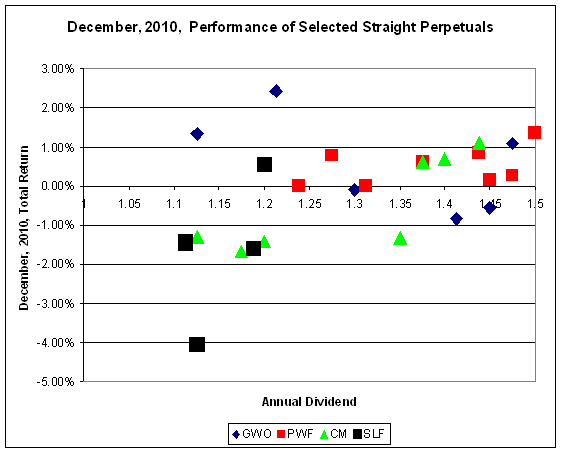
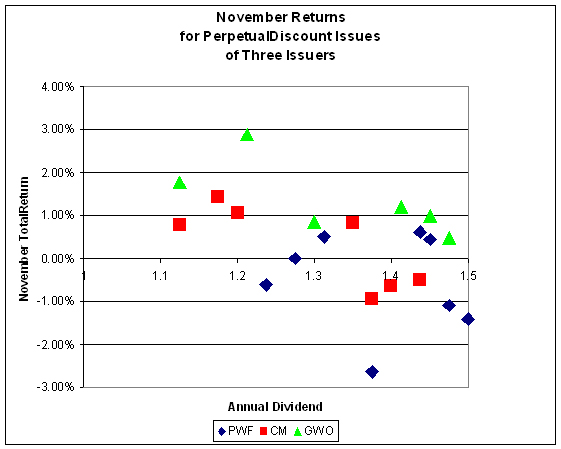
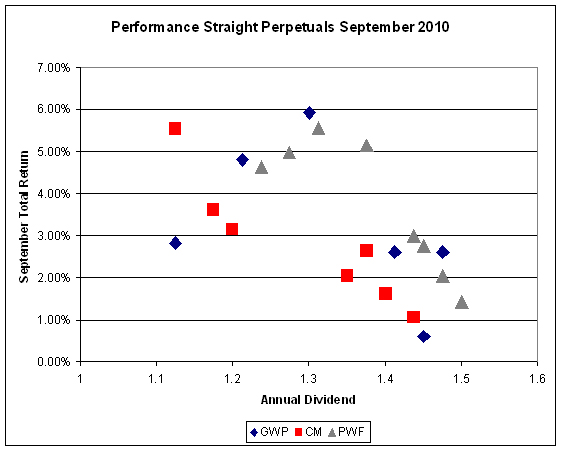
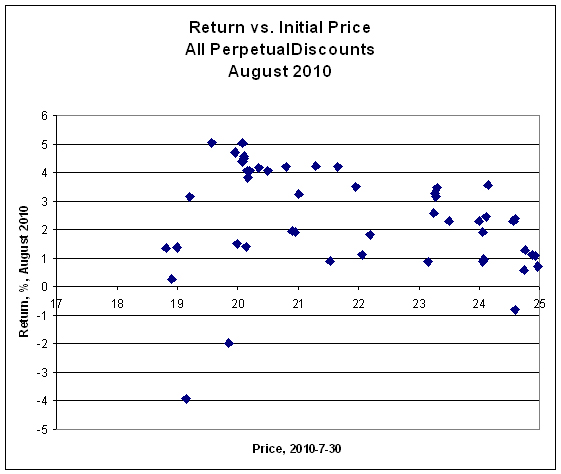
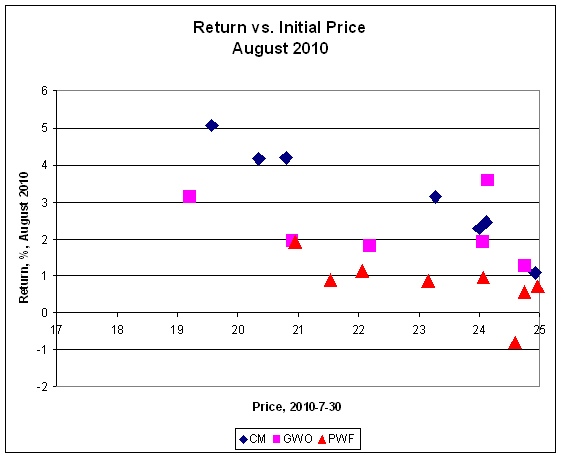
Another factor that hurt the fund’s performance in February was a decline in the implied volatility of PerpetualDiscounts. This had a large effect on performance of the different issues (though not as large as the Swoon in June), as shown in the following chart:


Click for Big

A regression calculation performed on the above data results in a slope of +5.096 +/- 0.92, with R2 = 0.39. Thus, a difference of $0.25 in annual dividend resulted in a difference of +1.27% in return for the month.

This may be compared with the Swoon in June:


Click for Big

which had a slope of +12.7 +/- 2.4 (only Pfd-1 issues, as they were defined at the time), R2 = 0.53. With such a slope, a difference in annual dividend of $0.25 resulted in a difference of 3.18% (absolute) in total return for the partial month.

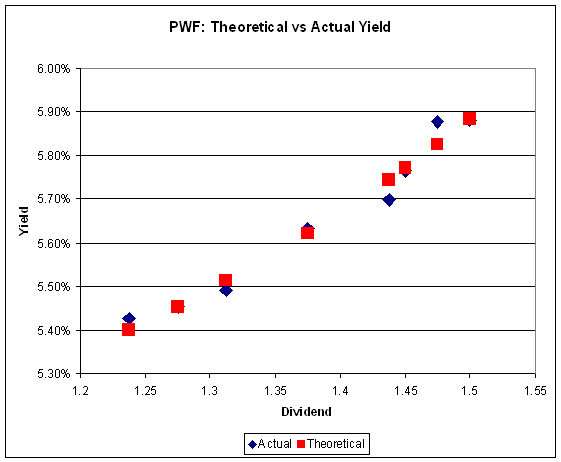
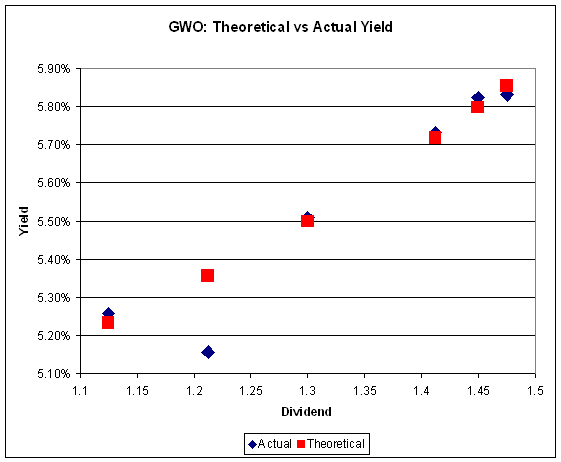
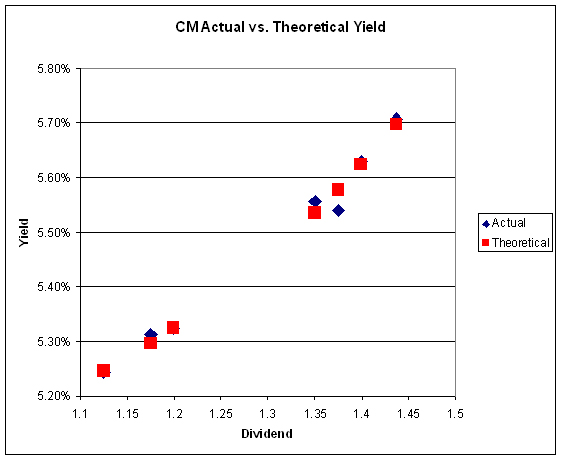
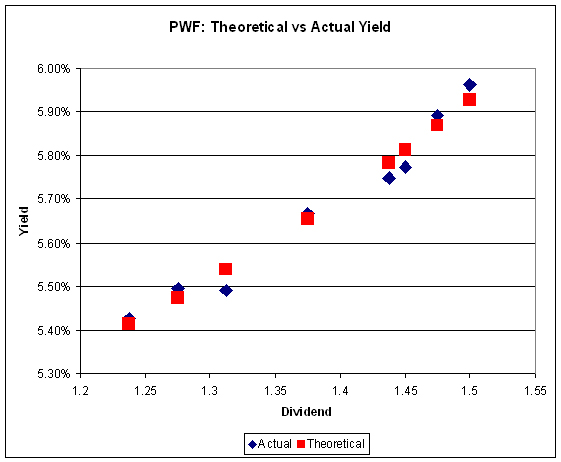
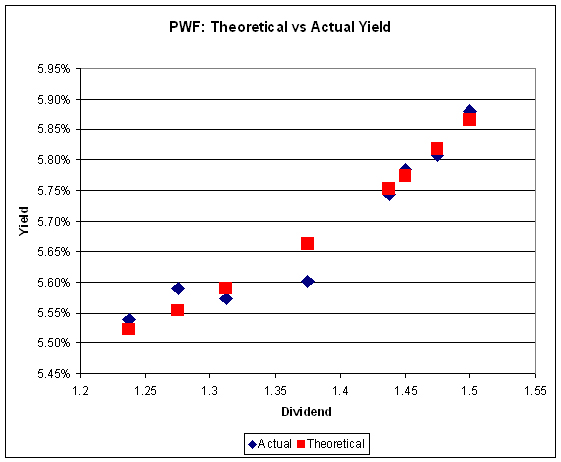
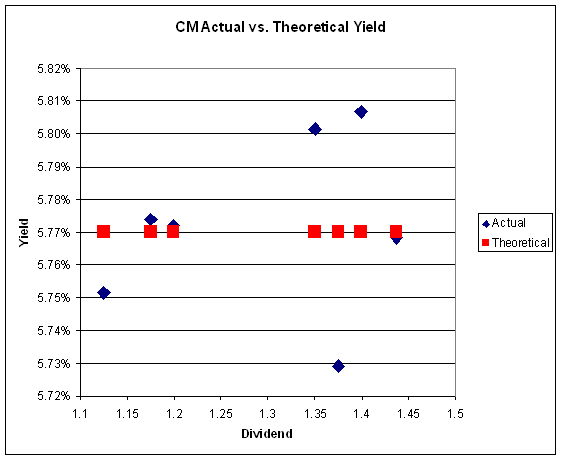
At the end of January, the relationship between annual dividend and yield was:


Click for Big

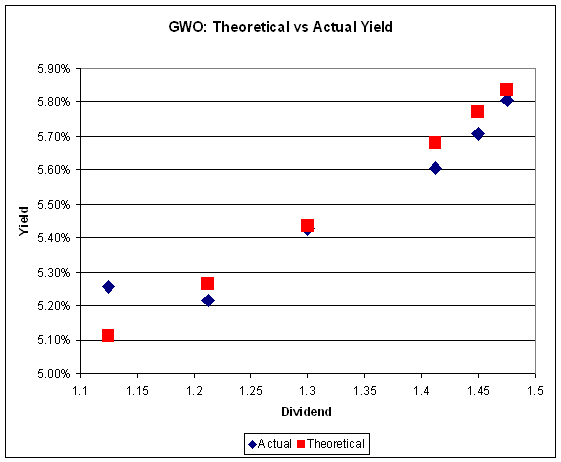
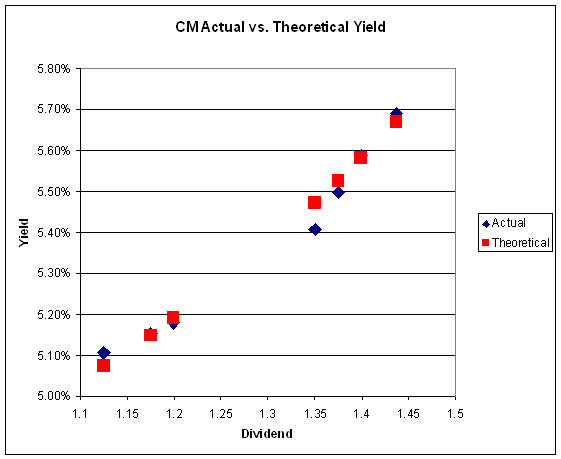
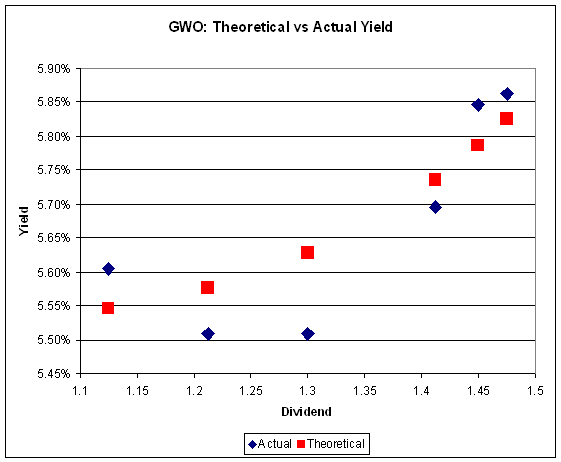
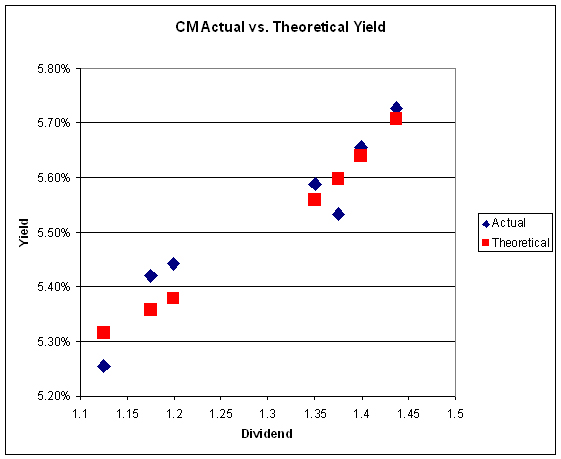
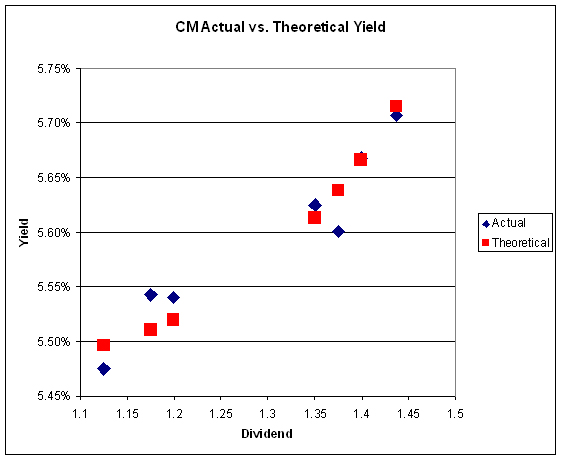
The regression line had a slope of 0.80 +/- 0.17, with R2 = 0.32. This changed during February to:


Click for Big

with a regression line slope of 0.54 +/- 0.18, R2 = 0.17.

Too bad, but it happens – and this shift in the market is one reason why trading volume was down in February. The fund is well positioned for a reversal in this relationship.

I am very pleased with the returns over the past year, but implore Assiduous Readers not to project this level of outperformance for the indefinite future. The year in the preferred share market was filled with episodes of panic and euphoria, together with many new entrants who do not appear to know what they are doing; perfect conditions for a disciplined quantitative approach.

Sometimes everything works … sometimes the trading works, but sectoral shifts overwhelm the increment … sometimes nothing works. The fund seeks to earn incremental return by selling liquidity (that is, taking the other side of trades that other market participants are strongly motivated to execute), which can also be referred to as ‘trading noise’. There have been a lot of strongly motivated market participants in the past year, generating a lot of noise! The conditions of the past year may never be repeated in my lifetime … but the fund will simply attempt to make trades when swaps seem profitable, whether that implies monthly turnover of 10% or 100%.

There’s plenty of room for new money left in the fund. Just don’t expect the current level of outperformance every year, OK? While I will continue to exert utmost efforts to outperform, it should be borne in mind that beating the index by 500bp represents a good year, and there will almost inevitably be periods of underperformance in the future.

The yields available on high quality preferred shares remain elevated, which is reflected in the current estimate of sustainable income.

Calculation of MAPF Sustainable Income Per Unit
Month NAVPU Portfolio
Average
YTW
Leverage
Divisor
Securities
Average
YTW
Capital
Gains
Multiplier
Sustainable
Income
per
current
Unit
June, 2007 9.3114 5.16% 1.03 5.01% 1.1883 0.3926
September 9.1489 5.35% 0.98 5.46% 1.1883 0.4203
December, 2007 9.0070 5.53% 0.942 5.87% 1.1883 0.4448
March, 2008 8.8512 6.17% 1.047 5.89% 1.1883 0.4389
June 8.3419 6.034% 0.952 6.338% 1.1883 $0.4449
September 8.1886 7.108% 0.969 7.335% 1.1883 $0.5054
December, 2008 8.0464 9.24% 1.008 9.166% 1.1883 $0.6206
March 2009 $8.8317 8.60% 0.995 8.802% 1.1883 $0.6423
June 10.9846 7.05% 0.999 7.057% 1.1883 $0.6524
September 12.3462 6.03% 0.998 6.042% 1.1883 $0.6278
December 2009 10.5662 5.74% 0.981 5.851% 1.0000 $0.6182
February 2010 10.6441 5.84% 1.000 5.840% 1.0000 $0.6216
NAVPU is shown after quarterly distributions of dividend income and annual distribution of capital gains.
Portfolio YTW includes cash (or margin borrowing), with an assumed interest rate of 0.00%
The Leverage Divisor indicates the level of cash in the account: if the portfolio is 1% in cash, the Leverage Divisor will be 0.99
Securities YTW divides “Portfolio YTW” by the “Leverage Divisor” to show the average YTW on the securities held; this assumes that the cash is invested in (or raised from) all securities held, in proportion to their holdings.
The Capital Gains Multiplier adjusts for the effects of Capital Gains Dividends. On 2009-12-31, there was a capital gains distribution of $1.989262 which is assumed for this purpose to have been reinvested at the final price of $10.5662. Thus, a holder of one unit pre-distribution would have held 1.1883 units post-distribution; the CG Multiplier reflects this to make the time-series comparable. Note that Dividend Distributions are not assumed to be reinvested.
Sustainable Income is the resultant estimate of the fund’s dividend income per current unit, before fees and expenses. Note that a “current unit” includes reinvestment of prior capital gains; a unitholder would have had the calculated sustainable income with only, say, 0.9 units in the past which, with reinvestment of capital gains, would become 1.0 current units.

As has been previously discussed, the fund has a position in the high-yielding split-share BNA.PR.C, about half of which was sold in November in a swap for the slightly lower-yielding PerpetualDiscount BAM.PR.N. . BNA.PR.C is scheduled to mature (or to be retracted) in the future, hence the sustainability of sustainable yield calculated while incorporating their contribution is somewhat suspect, as discussed in August, 2008.

Significant positions were also held in Fixed-Reset issues on February 26; all of which (with the exception of YPG.PR.D) currently have their yields calculated with the presumption that they will be called by the issuers at par at the first possible opportunity. This presents another complication in the calculation of sustainable yield.

However, if the entire portfolio except for the PerpetualDiscounts were to be sold and reinvested in these issues, the yield of the portfolio would be the 6.03% shown in the MAPF Portfolio Composition: February 2010 analysis(which is in excess of the 5.90% index yield on February 26). Given such reinvestment, the sustainable yield would be $10.6441 * 0.0603 = 0.6418 whereas similar calculations for January and December result in $0.6338 and $0.6308, respectively

Different assumptions lead to different results from the calculation, but the overall positive trend is apparent. I’m very pleased with the results! It will be noted that if there was no trading in the portfolio, one would expect the sustainable yield to be constant (before fees and expenses). The success of the fund’s trading is showing up in

  • the very good performance against the index
  • the long term increases in sustainable income per unit

As has been noted, the fund has maintained a credit quality equal to or better than the index; outperformance is due to constant exploitation of trading anomalies.

Again, there are no predictions for the future! The fund will continue to trade between issues in an attempt to exploit market gaps in liquidity, in an effort to outperform the index and keep the sustainable income per unit – however calculated! – growing.

Audited Financial Statements for 2009 and Transactions 2009 are now available and have been linked through the fund’s main page.

MAPF

MAPF Portfolio Composition: February 2010

Turnover declined dramatically in February to about 18%. Such decline in trading happens occasionally – I remember one period of about three month’s duration during which so few trades were done I was afraid the system was broken and spent a lot of time feverishly checking the code and the results. But one of the great constants in financial markets is a demand for liquidity and the fund is ready to meet that demand at a moment’s notice.

Trades were, as ever, triggered by a desire to exploit transient mispricing in the preferred share market (which may the thought of as “selling liquidity”), rather than any particular view being taken on market direction, sectoral performance or credit anticipation.

MAPF Sectoral Analysis 2010-2-26
HIMI Indices Sector Weighting YTW ModDur
Ratchet 0% N/A N/A
FixFloat 0% N/A N/A
Floater 0% N/A N/A
OpRet 0% N/A N/A
SplitShare 4.0% (-0.2) 7.82% 7.04
Interest Rearing 0% N/A N/A
PerpetualPremium 0.0% (0) N/A N/A
PerpetualDiscount 77.5% (+0.8) 6.03% 13.88
Fixed-Reset 13.6% (-0.8) 3.75% 3.84
Scraps (OpRet) 0% (-2.4) N/A N/A
Scraps (FixedReset) 4.8% (+2.3) 7.17% 12.18
Cash 0.0% (+0.1) 0.00% 0.00
Total 100% 5.84% 12.15
Totals and changes will not add precisely due to rounding. Bracketted figures represent change from January month-end. Cash is included in totals with duration and yield both equal to zero.

The “total” reflects the un-leveraged total portfolio (i.e., cash is included in the portfolio calculations and is deemed to have a duration and yield of 0.00.). MAPF will often have relatively large cash balances, both credit and debit, to facilitate trading. Figures presented in the table have been rounded to the indicated precision.

The most significant change was a swap from YPG.PR.B to YPG.PR.D, completing the process mentioned in the January performance report. The latter issue yields less, but is cheaper relative to other FixedResets than the former is cheap to OperatingRetractibles – although, mind you, both issues are pretty cheap according to me!

Credit distribution is:

MAPF Credit Analysis 2010-2-26
DBRS Rating Weighting
Pfd-1 0 (0)
Pfd-1(low) 75.7% (0)
Pfd-2(high) 9.3% (-0.5)
Pfd-2 0 (0)
Pfd-2(low) 10.1% (+0.3)
Pfd-3(high) 4.8% (-0.1)
Cash 0.0% (+0.1)
Totals will not add precisely due to rounding. Bracketted figures represent change from January month-end.

Liquidity Distribution is:

MAPF Liquidity Analysis 2010-2-26
Average Daily Trading Weighting
<$50,000 0.0% (0)
$50,000 – $100,000 0.0% (0)
$100,000 – $200,000 24.0% (-2.6)
$200,000 – $300,000 42.7% (+11.7)
>$300,000 33.3% (-9.2)
Cash 0.0% (+0.1)
Totals will not add precisely due to rounding. Bracketted figures represent change from January month-end.

MAPF is, of course, Malachite Aggressive Preferred Fund, a “unit trust” managed by Hymas Investment Management Inc. Further information and links to performance, audited financials and subscription information are available the fund’s web page. A “unit trust” is like a regular mutual fund, but is sold by offering memorandum rather than prospectus. This is cheaper, but means subscription is restricted to “accredited investors” (as defined by the Ontario Securities Commission) and those who subscribe for $150,000+. Fund past performances are not a guarantee of future performance. You can lose money investing in MAPF or any other fund.

A similar portfolio composition analysis has been performed on the Claymore Preferred Share ETF (symbol CPD) as of August 17 and published in the September PrefLetter. When comparing CPD and MAPF:

  • MAPF credit quality is better
  • MAPF liquidity is a little better
  • MAPF Yield is higher
  • Weightings in
    • MAPF is much more exposed to PerpetualDiscounts
    • MAPF is much less exposed to Operating Retractibles
    • MAPF is more exposed to SplitShares
    • MAPF is less exposed to FixFloat / Floater / Ratchet
    • MAPF weighting in FixedResets is much lower
MAPF

MAPF Transaction Costs (TER)

A potential investor in MAPF writes in and says:

I wonder if you could answer a few questions for me.

I should start by saying that I am far from being an accountant. I would have my accountant offer an opinion if I decide to proceed, but in the meantime I apologize if any my questions are simplistic. Clearly being an accredited investor does not make one an investment professional.

On p. 2 of your 2008 statements (Statement of Operations) you show net investment income for the year as 58 989 as well as transaction costs of 45 617 and net realized losses of 58 725.

On p.3 (Changes in Net Assets) you show distiributions to unitholders of 58 989, i.e. all of the net investment income.

On p. 7 of the statement under “Unitholder’s Equity” you show “distributions in excess of income” of 104 342, which is the sum of transaction costs and net realized losses on p. 2.

Am I therefore correct that the net investment income from your fund exceeded the transactions costs by 13 372? Although unitholders would have received a larger distribution, the NAV of the fund would have decreased to reflect the transaction costs. (The NAV would have also decreased to reflect the capital losses, of course, but that is to be expected whether realized or not.) If I am correct, then a significant proportion (77% in this year) of the net investment income from your fund is “consumed” by transaction costs and 79% of the dividends are “consumed” by costs (after the costs you absorb). An investor would be largely relying on capital appreciation (i.e. increased NAV) to realize a return. Am I correct in understanding your investment strategy?

I also notice that transaction costs do not appear until 2007 on your financial statements. Why is this?

Finally, for the returns posted on your website, are those returns before or after transaction costs and other expenses (eg. audit)? I understand that they do not include management fees.

The question refers to Malachite Aggressive Preferred Fund (MAPF); further information regarding the fund can be found on the fund’s main page. Past performance is not a guarantee of future returns. You can lose money investing in MAPF or any other fund.

You are entirely correct in your analysis that transaction costs were large in 2008 compared to investment income, but there is no direct relationship between the two figures.

If, for instance, the fund was being run as a passive index fund, transaction costs would have been negligible but, to a first approximation, investment income would have been unaffected. However, the fund is run in accordance with the principles discussed in my statement of Investment Philosophy.

Markets can move around significantly in the absence of a “real” change in the valuation of a security, as incoming orders are filled. To achieve superior long term gains on an investment portfolio, the key is to sell when others are buying and to buy when others are selling. To this end, Hymas Investment Management focuses its research efforts on the analysis of a market price into it’s “fair” and “liquidity” components, to achieve superior investment returns by “selling” liquidity to the market, taking advantage of mispricing while at all times keeping the client’s tax and commission considerations in view.

In a year like 2008, when there were repeated waves of panic selling and euphoric buying (more of the former than the latter!) there were many opportunities to swap very similar instruments at very dissimilar prices. The statement of transactions for 2008 shows a huge number of trades which, alas, achieved a cumulative loss of just over $104,000 (including transaction costs).

However, this trading was highly profitable, although it was not enough to outweigh the effect of a rotten year in the market.

You will observe from the statement of annualized returns that the fund returned -3.85% (after expenses but before fees) compared to an index return of -16.42%.

If the fund had been run as an index fund, it is fair to assume – as an approximation for illustrative purposes – that its return for the year would be about -16.85% (the index return less an allowance of 43bp for fees), but in fact it lost much less.

We may conclude that the fund’s trading had a positive impact on the fund’s return of +13.00% (actual return of -3.85% less the notional return of -16.85%) and that this positive impact is net of the costs of performing the transactions.

If we take a simple average of the fund’s beginning and ending NAV, then we find that this 15% net impact of trading was worth, in dollar figures, about $117,000. Transaction costs, as you note, were about $46,000 so the following arithmetic is reasonably valid:

MAPF
2008 Approximate Trading Impact
Gross transaction profit
Relative to Benchmark
$163,000
Cost of transactions (46,000)
Net transaction profit $117,000

The words “Relative to Benchmark” should be carefully noted when examining the above table! The benchmark was so horribly negative that all the trading was able to accomplish was a reduction of the realized and unrealized capital loss that would otherwise have been experienced.

Thus – and again making an approximation – about one-quarter of the gross transaction profit was eaten up by commission. Or to put it another way, I saw repeated opportunities through the year to buy a dollar for twenty-five cents.

Note, however, that it isn’t quite as straightforward as that! Some of those twenty-five cent trades made two dollars, not just one … others lost money on top of transaction charges! All I can do is identify anomalies that “should” make some money and leave the rest up to statistics. The success of the fund will depend on my ability to identify potentially profitable trades accurately – and the results since inception show that I have been quite successful identifying these anomalies in the past.

The draft financials for 2009 – the auditor has not yet signed off on the statements – have a much nicer look to them, since in 2009 I was not trying to swim up a waterfall:

MAPF
Extract from Unaudited
Statement of Operations
Net realized gains, 2009 479,095
Net change in unrealized gains, 2009 75,229
Transaction costs (17,862)

The decline in transaction costs is largely due to a change in brokers that took place in late 2008.

So, your first major question, a significant proportion (77% in this year) of the net investment income from your fund is “consumed” by transaction costs and 79% of the dividends are “consumed” by costs (after the costs you absorb). An investor would be largely relying on capital appreciation (i.e. increased NAV) to realize a return. Am I correct in understanding your investment strategy? implicitly assumes that transaction costs should be applied against dividends. I consider it much more reasonable for analytical purposes to apply them against (hopefully excess) capital gains.

In answer to your second question: transaction costs do not appear on the pre-2007 financials because they were not required by the accounting rules of the time. Rules have changed and they are now required to be broken out instead of “buried” in the statement of capital gains and losses. If you want to see the transaction costs, I report them in the Transaction Statements for each half- and full-year, which are available on the fund’s main page.

With respect to your third question: all the returns reported are after everything except fees.

Update: My interlocuter responds, in part:

I understand your argument and it makes sense. At the end of the day, there is only really a total return which consists of distributions plus capital appreciation of the units. What you are saying is that the transaction costs (and audit and management costs, for that matter) should be judged by the extent to which they increase (or mitigate a decrease) in the value of the portfolio compared to a passive alternative, and on that score your fund was successful even after management fees.

It still seems to me, though, that the trading costs are a significant percentage of the dividend component of the return. That implies that your trading costs must be offset by either (1) an increase in the NAV of the fund compared to a passive index or (2) a richer long-term dividend stream compared to not making a trade if the market “fails to realize” the mispricing of the preferreds that you have bought. In a nutshell, the return of the fund is highly dependent on your continued success as a
trader. If your trading is simply neutral with regard to these factors, then the costs (trading, audit and management) will consume a significant element of the return compared to a passive alternative. Clearly, you have had some success in this regard, but it implies to me a high degree of model risk. If your model were to fail then the dividends would not bail an investor out as an alternative source of returns. I contrast this to either a passive model or an active model where the trading costs are a lower percentage of the dividend stream; or even the segregated accounts you offer.

None of this is intended as criticism. I’m just trying to understand the nature of the fund, its risks and its strategy. Do you think these are fair comments?

These are indeed fair comments.

Clearly, you have had some success in this regard, but it implies to me a high degree of model risk. Yes, this is correct. All I can say is that the model is constantly being evaluated and is based on the fundamentals of fixed income investing. I cannot conceive of any circumstance in which liquidity ceases to have any value in any marketplace – there are liqudity premia on US Treasuries, the most liquid market in the world – so it’s just a matter of finding it.

While liquidity premia can rise and fall relative to other components of price and markets can change, all I can say is that throughout my career I have been able to deliver returns to clients that have been significantly above benchmark – even when running $1.7-billion in Canadian goverment bonds – and continue to work at understanding the changing markets so that I may continue to do so.

I contrast this to either a passive model or an active model where the trading costs are a lower percentage of the dividend stream;

You must realize that passive models are not immune to liquidity costs. For example, moronic trading in POW.PR.C triggered by index rebalancing, was a large factor in CPD’s large tracking error in January 2010. Commissions are only one part of trading costs!

I will also note that you are still comparing trading costs to the dividend stream. It should be noted that these are not constant costs – if I don’t see opportunities, I don’t trade. For example, portfolio turnover in January 2010 was a mere 40%, compared to nearly 170% in November 2008 when the market collapsed.

Additionally, if you compare the 1H09 Transaction Report (particularly towards the end of the period) to the 2008 Transaction Report, you will see that unit trading costs have declined dramatically. This is also apparent in the extract from the unaudited 2009 Financial Statements, above, which shows commission costs for the whole of 2009 declining to $17,862 from approximately $46,000 in 2008.

I contrast this to either a passive model or an active model where the trading costs are a lower percentage of the dividend stream; or even the segregated accounts you offer.

I wouldn’t take a segregated account mandate that included a directive to minimize trading costs; I would be unable to add much – if any! – value net of very, very tiny fees. My product for ‘long-term buy-and-hold investors’ is PrefLetter; after setting up a portfolio, such investors can compare what they hold with the monthly recommendations and decide for themselves whether the investment characteristics of what’s available are sufficiently superior to what they hold to justify a trade. This approach could be combined with periodic consultations.

MAPF

MAPF Performance: January 2010

The fund performed well in January, outperforming the indices and the closed end funds by a most satisfactory margin.

The fund’s Net Asset Value per Unit as of the close January 29 was $10.7610.

Returns to January 29, 2010
Period MAPF Index CPD
according to
Claymore
One Month +1.84% +0.61% +%
Three Months +7.27% +5.05% +%
One Year +53.33% +25.22% +%
Two Years (annualized) +26.80% +3.87% +% *
Three Years (annualized) +17.39% +0.71%  
Four Years (annualized) +14.31% +1.58%  
Five Years (annualized) +12.55% +1.96%  
Six Years (annualized) +12.40% +2.39%  
Seven Years (annualized) +14.40% +3.26%  
Eight Years (annualized) +12.88% +3.21%  
The Index is the BMO-CM “50”
MAPF returns assume reinvestment of dividends, and are shown after expenses but before fees.
CPD Returns are for the NAV and are after all fees and expenses. CPD returns to January 29, 2010, are not yet available on the Claymore website.
* CPD does not directly report its two-year returns. The figure shown is the product of the current one-year return and the similar figure reported for January 2009.
Figures for Omega Preferred Equity (which are after all fees and expenses) for 1-, 3- and 12-months are +0.8%, +4.7% and +23.3%, respectively, according to Morningstar after all fees & expenses
Figures for Jov Leon Frazer Preferred Equity Fund Class I Units (which are after all fees and expenses) for 1-, 3- and 12-months are +0.46%, +3.93 & N/A, respectively, according to Morningstar and the Globe and Mail
Figures for AIC Preferred Income Fund (which are after all fees and expenses) for 1-, 3- and 12-months are +-0.1%, +3.1% & N/A, respectively

MAPF returns assume reinvestment of dividends, and are shown after expenses but before fees. Past performance is not a guarantee of future performance. You can lose money investing in Malachite Aggressive Preferred Fund or any other fund. For more information, see the fund’s main page.

I am very pleased with the returns over the past year, but implore Assiduous Readers not to project this level of outperformance for the indefinite future. The year in the preferred share market was filled with episodes of panic and euphoria, together with many new entrants who do not appear to know what they are doing; perfect conditions for a disciplined quantitative approach.

Sometimes everything works … sometimes the trading works, but sectoral shifts overwhelm the increment … sometimes nothing works. The fund seeks to earn incremental return by selling liquidity (that is, taking the other side of trades that other market participants are strongly motivated to execute), which can also be referred to as ‘trading noise’. There have been a lot of strongly motivated market participants in the past year, generating a lot of noise! The conditions of the past year may never be repeated in my lifetime … but the fund will simply attempt to make trades when swaps seem profitable, whether that implies monthly turnover of 10% or 100%.

There’s plenty of room for new money left in the fund. Just don’t expect the current level of outperformance every year, OK? While I will continue to exert utmost efforts to outperform, it should be borne in mind that beating the index by 500bp represents a good year, and there will almost inevitably be periods of underperformance in the future.

The yields available on high quality preferred shares remain elevated, which is reflected in the current estimate of sustainable income.

Calculation of MAPF Sustainable Income Per Unit
Month NAVPU Portfolio
Average
YTW
Leverage
Divisor
Securities
Average
YTW
Capital
Gains
Multiplier
Sustainable
Income
per
current
Unit
June, 2007 9.3114 5.16% 1.03 5.01% 1.1883 0.3926
September 9.1489 5.35% 0.98 5.46% 1.1883 0.4203
December, 2007 9.0070 5.53% 0.942 5.87% 1.1883 0.4448
March, 2008 8.8512 6.17% 1.047 5.89% 1.1883 0.4389
June 8.3419 6.034% 0.952 6.338% 1.1883 $0.4449
September 8.1886 7.108% 0.969 7.335% 1.1883 $0.5054
December, 2008 8.0464 9.24% 1.008 9.166% 1.1883 $0.6206
March 2009 $8.8317 8.60% 0.995 8.802% 1.1883 $0.6423
June 10.9846 7.05% 0.999 7.057% 1.1883 $0.6524
September 12.3462 6.03% 0.998 6.042% 1.1883 $0.6278
December 2009 10.5662 5.74% 0.981 5.851% 1.0000 $0.6182
January 2010 10.7610 5.81% 1.001 5.804% 1.0000 $0.6246
NAVPU is shown after quarterly distributions of dividend income and annual distribution of capital gains.
Portfolio YTW includes cash (or margin borrowing), with an assumed interest rate of 0.00%
The Leverage Divisor indicates the level of cash in the account: if the portfolio is 1% in cash, the Leverage Divisor will be 0.99
Securities YTW divides “Portfolio YTW” by the “Leverage Divisor” to show the average YTW on the securities held; this assumes that the cash is invested in (or raised from) all securities held, in proportion to their holdings.
The Capital Gains Multiplier adjusts for the effects of Capital Gains Dividends. On 2009-12-31, there was a capital gains distribution of $1.989262 which is assumed for this purpose to have been reinvested at the final price of $10.5662. Thus, a holder of one unit pre-distribution would have held 1.1883 units post-distribution; the CG Multiplier reflects this to make the time-series comparable. Note that Dividend Distributions are not assumed to be reinvested.
Sustainable Income is the resultant estimate of the fund’s dividend income per current unit, before fees and expenses. Note that a “current unit” includes reinvestment of prior capital gains; a unitholder would have had the calculated sustainable income with only, say, 0.9 units in the past which, with reinvestment of capital gains, would become 1.0 current units.

As has been previously discussed, the fund has a position in the high-yielding split-share BNA.PR.C, about half of which was sold in November in a swap for the slightly lower-yielding PerpetualDiscount BAM.PR.N. Additionally, the fund has a position in the high-yielding Operating Retractible YPG.PR.B, about half of which was swapped into the lower-yielding YPG.PR.D in January. Both BNA.PR.C and YPG.PR.B are scheduled to mature (or to be retracted) in the future, hence the sustainability of sustainable yield calculated while incorporating their contribution is somewhat suspect, as discussed in August, 2008.

Significant positions were also held in Fixed-Reset issues on January 29; all of which currently have their yields calculated with the presumption that they will be called by the issuers at par at the first possible opportunity. This presents another complication in the calculation of sustainable yield.

However, if the entire portfolio except for the PerpetualDiscounts were to be sold and reinvested in these issues, the yield of the portfolio would be the 5.89% shown in the MAPF Portfolio Composition: January 2010 analysis(which is in excess of the 5.81% index yield on January 29). Given such reinvestment, the sustainable yield would be $10.7610 * 0.0589 = $0.6338 whereas a similar calculation for December results in $10.5662 * 0.0597 = $0.6308.

Different assumptions lead to different results from the calculation, but the overall positive trend is apparent. I’m very pleased with the results! It will be noted that if there was no trading in the portfolio, one would expect the sustainable yield to be constant (before fees and expenses). The success of the fund’s trading is showing up in

  • the very good performance against the index
  • the long term increases in sustainable income per unit

As has been noted, the fund has maintained a credit quality equal to or better than the index; outperformance is due to constant exploitation of trading anomalies.

Again, there are no predictions for the future! The fund will continue to trade between issues in an attempt to exploit market gaps in liquidity, in an effort to outperform the index and keep the sustainable income per unit – however calculated! – growing.

MAPF

MAPF Portfolio Composition: January 2010

Turnover stayed constant in January at about 40%. This is yet another indication that things are slowly returning to normal – although I still think that spreads to bonds are elevated!

Trades were, as ever, triggered by a desire to exploit transient mispricing in the preferred share market (which may the thought of as “selling liquidity”), rather than any particular view being taken on market direction, sectoral performance or credit anticipation.

MAPF Sectoral Analysis 2010-1-29
HIMI Indices Sector Weighting YTW ModDur
Ratchet 0% N/A N/A
FixFloat 0% N/A N/A
Floater 0% N/A N/A
OpRet 0% N/A N/A
SplitShare 4.2% (0) 8.09% 6.99
Interest Rearing 0% N/A N/A
PerpetualPremium 0.0% (-0.5) N/A N/A
PerpetualDiscount 76.7% (+4.0) 5.89% 14.07
Fixed-Reset 14.4% (-2.2) 3.83% 3.88
Scraps (OpRet) 2.4% (-2.2) 9.64% 5.85
Scraps (FixedReset) 2.5% (+2.5) 7.22% 12.03
Cash -0.1% (-2.0) 0.00% 0.00
Total 100% 5.81% 12.08
Totals and changes will not add precisely due to rounding. Bracketted figures represent change from December month-end. Cash is included in totals with duration and yield both equal to zero.

The “total” reflects the un-leveraged total portfolio (i.e., cash is included in the portfolio calculations and is deemed to have a duration and yield of 0.00.). MAPF will often have relatively large cash balances, both credit and debit, to facilitate trading. Figures presented in the table have been rounded to the indicated precision.

Credit distribution is:

MAPF Credit Analysis 2010-1-29
DBRS Rating Weighting
Pfd-1 0 (0)
Pfd-1(low) 75.7% (-6.8)
Pfd-2(high) 9.8% (+9.7)
Pfd-2 0 (-1.1)
Pfd-2(low) 9.8% (+0.1)
Pfd-3(high) 4.9% (+0.3)
Cash -0.1% (-2.0)
Totals will not add precisely due to rounding. Bracketted figures represent change from December month-end.

The increase in holdings of issues rated Pfd-2(high) was due largely to the purchase of HSB.PR.E, a reversal of last month’s highlighted trading.:

MAPF & HSB.PR.E & RY.PR.X
Date HSB.PR.E RY.PR.X
12/23 Sold
28.05
Bot
27.95
12/31
Bid
28.10 28.06
1/14 Bot
28.02
Sold
28.23
1/29
Bid
27.96 27.75
Dividends   1/22
Missed
0.390625
This table attempts to present fairly the larger elements of a series of trades. Full disclosure of the 1H10 trades will be made at the time the unaudited 1H10 Financials are published.

Liquidity Distribution is:

MAPF Liquidity Analysis 2010-1-29
Average Daily Trading Weighting
<$50,000 0.0% (0)
$50,000 – $100,000 0.0% (0)
$100,000 – $200,000 26.6% (+7.7)
$200,000 – $300,000 31.0% (-14.1)
>$300,000 42.5% (+8.5)
Cash -0.1% (-2.0)
Totals will not add precisely due to rounding. Bracketted figures represent change from December month-end.

MAPF is, of course, Malachite Aggressive Preferred Fund, a “unit trust” managed by Hymas Investment Management Inc. Further information and links to performance, audited financials and subscription information are available the fund’s web page. A “unit trust” is like a regular mutual fund, but is sold by offering memorandum rather than prospectus. This is cheaper, but means subscription is restricted to “accredited investors” (as defined by the Ontario Securities Commission) and those who subscribe for $150,000+. Fund past performances are not a guarantee of future performance. You can lose money investing in MAPF or any other fund.

A similar portfolio composition analysis has been performed on the Claymore Preferred Share ETF (symbol CPD) as of August 17 and published in the September PrefLetter. When comparing CPD and MAPF:

  • MAPF credit quality is better
  • MAPF liquidity is a little better
  • MAPF Yield is higher
  • Weightings in
    • MAPF is much more exposed to PerpetualDiscounts
    • MAPF is much less exposed to Operating Retractibles
    • MAPF is more exposed to SplitShares
    • MAPF is less exposed to FixFloat / Floater / Ratchet
    • MAPF weighting in FixedResets is much lower
MAPF

MAPF Performance: December 2009

The fund performed well in December, but probably underperformed CPD which has a much higher weighting the Floating Rate issues which performed very well this month. MAPF’s performance increment over the PerpetualDiscount and FixedReset sectors (in which it is it is 85%+ weighted) was satisfactory.

The fund’s Net Asset Value per Unit as of the close December 31 was $10.5662 after giving effect to a Capital Gains Distribution of $1.989262 and a Dividend Distribution of $0.154071.

Returns to December 31, 2009
Period MAPF Index CPD
according to
Claymore
One Month +1.55% +1.97% +%
Three Months +2.94% +2.46% +%
One Year +66.29% +29.41% +%
Two Years (annualized) +26.45% +4.00% +% *
Three Years (annualized) +16.30% +0.49%  
Four Years (annualized) +13.87% +1.42%  
Five Years (annualized) +12.23% +1.90%  
Six Years (annualized) +12.43% +2.58%  
Seven Years (annualized) +15.23% +3.24%  
Eight Years (annualized) +13.37% +3.39%  
The Index is the BMO-CM “50”
MAPF returns assume reinvestment of dividends, and are shown after expenses but before fees.
CPD Returns are for the NAV and are after all fees and expenses.
* CPD does not directly report its two-year returns. The figure shown is the product of the current one-year return and the similar figure reported for December 2008
Figures for Omega Preferred Equity (which are after all fees and expenses) for 1-, 3- and 12-months are +1.5%, +2.3% and +26.6%, respectively, according to Morningstar after all fees & expenses
Figures for Jov Leon Frazer Preferred Equity Fund (which are after all fees and expenses) for 1-, 3- and 12-months are N/A, N/A & N/A, respectively, according to Morningstar and the Globe and Mail
Figures for AIC Preferred Income Fund (which are after all fees and expenses) for 1-, 3- and 12-months are +1.5%, +2.1% & N/A, respectively

MAPF returns assume reinvestment of dividends, and are shown after expenses but before fees. Past performance is not a guarantee of future performance. You can lose money investing in Malachite Aggressive Preferred Fund or any other fund. For more information, see the fund’s main page.

I am very pleased with the returns over the past year, but implore Assiduous Readers not to project this level of outperformance for the indefinite future. The year in the preferred share market was filled with episodes of panic and euphoria, together with many new entrants who do not appear to know what they are doing; perfect conditions for a disciplined quantitative approach.

Sometimes everything works … sometimes the trading works, but sectoral shifts overwhelm the increment … sometimes nothing works. The fund seeks to earn incremental return by selling liquidity (that is, taking the other side of trades that other market participants are strongly motivated to execute), which can also be referred to as ‘trading noise’. There have been a lot of strongly motivated market participants in the past year, generating a lot of noise! The conditions of the past year may never be repeated in my lifetime … but the fund will simply attempt to make trades when swaps seem profitable, whether that implies monthly turnover of 10% or 100%.

There’s plenty of room for new money left in the fund. Just don’t expect the current level of outperformance every year, OK? While I will continue to exert utmost efforts to outperform, it should be borne in mind that beating the index by 500bp represents a good year, and there will almost inevitably be periods of underperformance in the future.

On the one hand, I’m a bit relieved that the fourth quarter of 2009 was so normal – in terms of trading volume, index performance and performance increment. The problem with beating the index by thousands of beeps is that many people will simply assume the fund is taking enormous risks in low-quality issues – which is not the case – and not look any further to determine the truth. On the other hand … well, that’s a nice kind of problem to have!

The yields available on high quality preferred shares remain elevated, which is reflected in the current estimate of sustainable income.

Calculation of MAPF Sustainable Income Per Unit
Month NAVPU Portfolio
Average
YTW
Leverage
Divisor
Securities
Average
YTW
Capital
Gains
Multiplier
Sustainable
Income
per
current
Unit
June, 2007 9.3114 5.16% 1.03 5.01% 1.1883 0.3926
September 9.1489 5.35% 0.98 5.46% 1.1883 0.4203
December, 2007 9.0070 5.53% 0.942 5.87% 1.1883 0.4448
March, 2008 8.8512 6.17% 1.047 5.89% 1.1883 0.4389
June 8.3419 6.034% 0.952 6.338% 1.1883 $0.4449
September 8.1886 7.108% 0.969 7.335% 1.1883 $0.5054
December, 2008 8.0464 9.24% 1.008 9.166% 1.1883 $0.6206
March 2009 $8.8317 8.60% 0.995 8.802% 1.1883 $0.6423
June 10.9846 7.05% 0.999 7.057% 1.1883 $0.6524
September 12.3462 6.03% 0.998 6.042% 1.1883 $0.6278
December 2009 10.5662 5.74% 0.981 5.851% 1.0000 $0.6182
NAVPU is shown after quarterly distributions of dividend income and annual distribution of capital gains.
Portfolio YTW includes cash (or margin borrowing), with an assumed interest rate of 0.00%
The Leverage Divisor indicates the level of cash in the account: if the portfolio is 1% in cash, the Leverage Divisor will be 0.99
Securities YTW divides “Portfolio YTW” by the “Leverage Divisor” to show the average YTW on the securities held; this assumes that the cash is invested in (or raised from) all securities held, in proportion to their holdings.
The Capital Gains Multiplier adjusts for the effects of Capital Gains Dividends. On 2009-12-31, there was a capital gains distribution of $1.989262 which is assumed for this purpose to have been reinvested at the final price of $10.5662. Thus, a holder of one unit pre-distribution would have held 1.1883 units post-distribution; the CG Multiplier reflects this to make the time-series comparable. Note that Dividend Distributions are not assumed to be reinvested.
Sustainable Income is the resultant estimate of the fund’s dividend income per current unit, before fees and expenses. Note that a “current unit” includes reinvestment of prior capital gains; a unitholder would have had the calculated sustainable income with only, say, 0.9 units in the past which, with reinvestment of capital gains, would become 1.0 current units.

As discussed in the post MAPF Portfolio Composition: November 2009, the fund has a position in the high-yielding split-share BNA.PR.C, about half of which was sold in November in a swap for the slightly lower-yielding PerpetualDiscount BAM.PR.N. Additionally, the fund has a position in the high-yielding Operating Retractible YPG.PR.B. Both BNA.PR.C and YPG.PR.B are scheduled to mature (or to be retracted) in the future, hence the sustainability of sustainable yield calculated while incorporating their contribution is somewhat suspect, as discussed in August, 2008.

Significant positions were also held in Fixed-Reset issues on December 31; all of which currently have their yields calculated with the presumption that they will be called by the issuers at par at the first possible opportunity. This presents another complication in the calculation of sustainable yield.

However, if the entire portfolio except for the PerpetualDiscounts were to be sold and reinvested in these issues, the yield of the portfolio would be the 5.97% shown in the MAPF Portfolio Composition: December 2009 analysis(which is in excess of the 5.85% index yield on December 31). Given such reinvestment, the sustainable yield would be $10.5662 * 0.0597 = $0.6308 whereas a similar calculation for November results in 12.5153 * 0.0601 / 1.1883 = 0.6330. Note that the November figure has had to be adjusted to reflect the Capital Gains Multiplier. The slight decrease is partly due to the dividend distribution (in November the fund was earning income on the dividends earned but not yet distributed) and partly due to minor effects such as the improvement in credit quality over the month.

The equivalent calculation for December 2008 is $8.0464 [NAVPU] * 0.0749 [Yield on PerpetualDiscounts] / 1.1883 [Capital Gains Multiplier] = 0.5072, which shows that progress is indeed being made! The portfolio yield in the table is severely skewed by the presence of very high-yielding, short-term split shares in the December 2008 Portfolio.

Different assumptions lead to different results from the calculation, but the overall positive trend is apparent. I’m very pleased with the results! It will be noted that if there was no trading in the portfolio, one would expect the sustainable yield to be constant (before fees and expenses). The success of the fund’s trading is showing up in

  • the very good performance against the index
  • the long term increases in sustainable income per unit

As has been noted, the fund has maintained a credit quality equal to or better than the index; outperformance is due to constant exploitation of trading anomalies.

Again, there are no predictions for the future! The fund will continue to trade between issues in an attempt to exploit market gaps in liquidity, in an effort to outperform the index and keep the sustainable income per unit – however calculated! – growing.

Update 2010-1-3: Thanks to Assiduous Reader AS for pointing out a typo in the first paragraph. It has been corrected.

MAPF

MAPF Portfolio Composition: December 2009

Turnover declined somewhat in December to about 40%. This is yet another indication that things are slowly returning to normal – although I still think that spreads to bonds are elevated!

Trades were, as ever, triggered by a desire to exploit transient mispricing in the preferred share market (which may the thought of as “selling liquidity”), rather than any particular view being taken on market direction, sectoral performance or credit anticipation.

MAPF Sectoral Analysis 2009-12-31
HIMI Indices Sector Weighting YTW ModDur
Ratchet 0% N/A N/A
FixFloat 0% N/A N/A
Floater 0% N/A N/A
OpRet 0% N/A N/A
SplitShare 4.2% (-0.1) 8.34% 7.05
Interest Rearing 0% N/A N/A
PerpetualPremium 0.0% (-0.5) N/A N/A
PerpetualDiscount 72.7% (+0.1) 5.97% 13.98
Fixed-Reset 16.6% (-1.6) 3.62% 3.89
Scraps (OpRet) 4.6% (+0.1) 9.77% 5.92
Cash 1.9% (+2.1) 0.00% 0.00
Total 100% 5.74% 11.38
Totals and changes will not add precisely due to rounding. Bracketted figures represent change from November month-end. Cash is included in totals with duration and yield both equal to zero.

The “total” reflects the un-leveraged total portfolio (i.e., cash is included in the portfolio calculations and is deemed to have a duration and yield of 0.00.). MAPF will often have relatively large cash balances, both credit and debit, to facilitate trading. Figures presented in the table have been rounded to the indicated precision.

Credit distribution is:

MAPF Credit Analysis 2009-12-31
DBRS Rating Weighting
Pfd-1 0 (0)
Pfd-1(low) 82.5% (+4.2)
Pfd-2(high) 0.1% (-4.8)
Pfd-2 1.1% (-1.3)
Pfd-2(low) 9.7% (-0.4)
Pfd-3(high) 4.6% (-0.1)
Cash +1.9% (+2.1)
Totals will not add precisely due to rounding. Bracketted figures represent change from November month-end.

The decline in holdings of issues rated Pfd-2(high) was due largely to the sale of HSB.PR.E:

MAPF & HSB.PR.E
Date HSB.PR.E NA.PR.P RY.PR.X RY.PR.R CM.PR.L
11/30
Bid
Bid YTW
28.06
4.02%
27.80
3.86%
27.70
3.85%
27.62
3.68%
27.86
3.88%
12/8 Bot More
28.12
Sold
27.99
     
12.23 Sold
28.05
  Bot
27.95
   
12/24 Sold
28.12
    Bot
27.98
 
12/29 Sold
28.15
      Bot
27.88
12/31
Bid
Bid YTW
28.10
3.71%
28.06
3.72%
28.06
3.63%
28.07
3.35%
27.92
3.55%
Dividends 12/11
Earned
0.4125
      12/23
Missed
0.40625
This table attempts to present fairly the larger elements of a series of trades. Full disclosure of the 2009 trades will be made at the time the audited 2009 Financials are published.

Liquidity Distribution is:

MAPF Liquidity Analysis 2009-12-31
Average Daily Trading Weighting
<$50,000 0.0% (0)
$50,000 – $100,000 0.0% (-5.0)
$100,000 – $200,000 18.9% (+12.0)
$200,000 – $300,000 45.1% (-12.8)
>$300,000 34.0% (+3.5)
Cash +1.9% (+2.1)
Totals will not add precisely due to rounding. Bracketted figures represent change from November month-end.

MAPF is, of course, Malachite Aggressive Preferred Fund, a “unit trust” managed by Hymas Investment Management Inc. Further information and links to performance, audited financials and subscription information are available the fund’s web page. A “unit trust” is like a regular mutual fund, but is sold by offering memorandum rather than prospectus. This is cheaper, but means subscription is restricted to “accredited investors” (as defined by the Ontario Securities Commission) and those who subscribe for $150,000+. Fund past performances are not a guarantee of future performance. You can lose money investing in MAPF or any other fund.

A similar portfolio composition analysis has been performed on the Claymore Preferred Share ETF (symbol CPD) as of August 17 and published in the September PrefLetter. When comparing CPD and MAPF:

  • MAPF credit quality is better
  • MAPF liquidity is a little better
  • MAPF Yield is higher
  • Weightings in
    • MAPF is much more exposed to PerpetualDiscounts
    • MAPF is much less exposed to Operating Retractibles
    • MAPF is more exposed to SplitShares
    • MAPF is less exposed to FixFloat / Floater / Ratchet
    • MAPF weighting in FixedResets is much lower
MAPF

MAPF Performance: November 2009

The fund performaned very well in November, helped by its relatively high concentration in PerpetualDiscount issues but assisted by the usually liquidity-inspired trades between issues.

The fund’s Net Asset Value per Unit as of the close November 30 was $12.5153.

Returns to November 30, 2009
Period MAPF Index CPD
according to
Claymore
One Month +3.72% +2.40% +2.19%
Three Months +0.25% -0.52% +0.33%
One Year +91.67% +35.03% +32.54%
Two Years (annualized) +28.27% +3.33% +2.33% *
Three Years (annualized) +16.06% -0.07%  
Four Years (annualized) +13.62% +1.03%  
Five Years (annualized) +12.14% +1.76%  
Six Years (annualized) +12.59% +2.47%  
Seven Years (annualized) +15.00% +3.20%  
Eight Years (annualized) +12.79% +3.12%  
The Index is the BMO-CM “50”
MAPF returns assume reinvestment of dividends, and are shown after expenses but before fees.
CPD Returns are for the NAV and are after all fees and expenses.
* CPD does not directly report its two-year returns. The figure shown is the product of the current one-year return and the similar figure reported for November 2008
Figures for Omega Preferred Equity (which are after all fees and expenses) for 1-, 3- and 12-months are +2.3%, +0.1% and +31.4%, respectively, according to Morningstar after all fees & expenses
Figures for Jov Leon Frazer Preferred Equity Fund (which are after all fees and expenses) for 1-, 3- and 12-months are N/A, N/A & N/A, respectively, according to Morningstar and the Globe and Mail
Figures for AIC Preferred Income Fund (which are after all fees and expenses) for 1-, 3- and 12-months are +1.7%, -0.4% & N/A, respectively

MAPF returns assume reinvestment of dividends, and are shown after expenses but before fees. Past performance is not a guarantee of future performance. You can lose money investing in Malachite Aggressive Preferred Fund or any other fund. For more information, see the fund’s main page.

I am very pleased with the returns over the past year, but implore Assiduous Readers not to project this level of outperformance for the indefinite future. The year in the preferred share market was filled with episodes of panic and euphoria, together with many new entrants who do not appear to know what they are doing; perfect conditions for a disciplined quantitative approach.

Sometimes everything works … sometimes the trading works, but sectoral shifts overwhelm the increment … sometimes nothing works. The fund seeks to earn incremental return by selling liquidity (that is, taking the other side of trades that other market participants are strongly motivated to execute), which can also be referred to as ‘trading noise’. There have been a lot of strongly motivated market participants in the past year, generating a lot of noise! The conditions of the past year may never be repeated in my lifetime … but the fund will simply attempt to make trades when swaps seem profitable, whether that implies monthly turnover of 10% or 100%.

There’s plenty of room for new money left in the fund. Just don’t expect the current level of outperformance every year, OK? While I will continue to exert utmost efforts to outperform, it should be borne in mind that beating the index by 500bp represents a good year, and there will almost inevitably be periods of underperformance in the future.

The yields available on high quality preferred shares remain elevated, which is reflected in the current estimate of sustainable income.

Calculation of MAPF Sustainable Income Per Unit
Month NAVPU Portfolio
Average
YTW
Leverage
Divisor
Securities
Average
YTW
Sustainable
Income
June, 2007 9.3114 5.16% 1.03 5.01% 0.4665
September 9.1489 5.35% 0.98 5.46% 0.4995
December, 2007 9.0070 5.53% 0.942 5.87% 0.5288
March, 2008 8.8512 6.17% 1.047 5.89% 0.5216
June 8.3419 6.034% 0.952 6.338% $0.5287
September 8.1886 7.108% 0.969 7.335% $0.6006
December, 2008 8.0464 9.24% 1.008 9.166% $0.7375
March 2009 $8.8317 8.60% 0.995 8.802% $0.7633
June 10.9846 7.05% 0.999 7.057% $0.7752
September 12.3462 6.03% 0.998 6.042% $0.7460
November 2009 12.5153 5.92% 1.002 5.908% $0.7394
NAVPU is shown after quarterly distributions.
“Portfolio YTW” includes cash (or margin borrowing), with an assumed interest rate of 0.00%
“Securities YTW” divides “Portfolio YTW” by the “Leverage Divisor” to show the average YTW on the securities held; this assumes that the cash is invested in (or raised from) all securities held, in proportion to their holdings.
“Sustainable Income” is the resultant estimate of the fund’s dividend income per unit, before fees and expenses.

As discussed in the post MAPF Portfolio Composition: November 2009, the fund has a position in the high-yielding split-share BNA.PR.C, about half of which was sold during the month in a swap for the slightly lower-yielding PerpetualDiscount BAM.PR.N. Additionally, the fund has a position in the high-yielding Operating Retractible YPG.PR.B. Both BNA.PR.C and YPG.PR.B are scheduled to mature (or to be retracted) in the future, hence the sustainability of sustainable yield calculated while incorporating their contribution is somewhat suspect, as discussed in August, 2008.

Significant positions were also held in Fixed-Reset issues on November 30; all of which currently have their yields calculated with the presumption that they will be called by the issuers at par at the first possible opportunity. This presents another complication in the calculation of sustainable yield.

However, if the entire portfolio except for the PerpetualDiscounts were to be sold and reinvested in these issues, the yield of the portfolio would be the 6.01% shown in the MAPF Portfolio Composition: November 2009 analysis(which is in excess of the 5.90% index yield on November 30). Given such reinvestment, the sustainable yield would be 12.5153 * 0.0601 = 0.7522 a significant increase from the $0.7433 derived by a similar calculation last month.

Different assumptions lead to different results from the calculation, but the overall positive trend is apparent. I’m very pleased with the results! It will be noted that if there was no trading in the portfolio, one would expect the sustainable yield to be constant (before fees and expenses). The success of the fund’s trading is showing up in

  • the very good performance against the index
  • the long term increases in sustainable income per unit

As has been noted, the fund has maintained a credit quality equal to or better than the index; outperformance is due to constant exploitation of trading anomalies.

Again, there are no predictions for the future! The fund will continue to trade between issues in an attempt to exploit market gaps in liquidity, in an effort to outperform the index and keep the sustainable income per unit – however calculated! – growing.

MAPF

MAPF Portfolio Composition: November 2009

Turnover remained steady in November at about 48%. While activity both this month and last has been much lower than normal throughout the Credit Crunch – particularly since the Lehman bankruptcy brought chaos to the market – it at least marks a return to normalcy.

Trades were, as ever, triggered by a desire to exploit transient mispricing in the preferred share market (which may the thought of as “selling liquidity”), rather than any particular view being taken on market direction, sectoral performance or credit anticipation.

MAPF Sectoral Analysis 2009-11-30
HIMI Indices Sector Weighting YTW ModDur
Ratchet 0% N/A N/A
FixFloat 0% N/A N/A
Floater 0% N/A N/A
OpRet 0% N/A N/A
SplitShare 4.3% (-4.6) 7.90% 7.17
Interest Rearing 0% N/A N/A
PerpetualPremium 0.5% (0) 4.74% 0.57
PerpetualDiscount 72.6% (+5.3) 6.01% 13.90
Fixed-Reset 18.2% (+2.9) 3.90% 3.99
Scraps (OpRet) 4.5% (-0.1) 10.70% 5.84
Cash -0.2% (-3.3) 0.00% 0.00
Total 100% 5.92% 11.39
Totals and changes will not add precisely due to rounding. Bracketted figures represent change from October month-end. Cash is included in totals with duration and yield both equal to zero.

The “total” reflects the un-leveraged total portfolio (i.e., cash is included in the portfolio calculations and is deemed to have a duration and yield of 0.00.). MAPF will often have relatively large cash balances, both credit and debit, to facilitate trading. Figures presented in the table have been rounded to the indicated precision.

Of interest during the month was a swap out of BNA.PR.C into BAM.PR.N, at a take-out of approximately $2.00, executed in numerous small pieces. Approximately half of the position was swapped. This is a lazy little swap that goes back and forth from time to time; the last time was reported in August 2008. The format of the trade analysis at that time will be retained:

Post Mortem: BNA.PR.C / BAM.PR.N Swaps
Date BNA.PR.C BAM.PR.N
August 2008
Trade
Bought
17.25
Sold
16.85
November 2009
Trade
Sold
19.55
Bought
17.60
Dividends Earned about 2/3 of August ’08; Nov ’08; Feb, May, Aug & about 2/3 of Nov; Total ~$1.45 Missed Sep & Dec 08; Missed Mar, Jun, Sep 09; Total ~$1.48
The August ’08 trades were executed in pieces that spanned the BNA.PR.C ex-dividend date; dividends were earned on about 2/3 of the final position
The November ’09 trades were executed in pieces that spanned the BNA.PR.C ex-dividend date; dividends were earned on about 2/3 of the final position
This table attempts to present fairly the aggregate effect of a series of trades. Full disclosure of the 2008 trades is available on the Fund’s main page; full disclosure of the 2009 trades will be made at the time the audited 2009 Financials are published.

As can be seen, the swap has proved immensely profitable, but the long time-span of the holding masks a great deal of excitement! When market movements reduced the portfolio weight of BNA.PR.C to a lower than anticipated number, the position was topped up in December 2008 at 8.65.

Credit distribution is:

MAPF Credit Analysis 2009-11-30
DBRS Rating Weighting
Pfd-1 0 (0)
Pfd-1(low) 78.3% (+4.4)
Pfd-2(high) 4.9% (-0.5)
Pfd-2 2.4% (-0.5)
Pfd-2(low) 10.1% (+0.3)
Pfd-3(high) 4.5% (-0.1)
Cash -0.2% (-3.3)
Totals will not add precisely due to rounding. Bracketted figures represent change from October month-end.

Liquidity Distribution is:

MAPF Liquidity Analysis 2009-10-30
Average Daily Trading Weighting
<$50,000 0.0% (0)
$50,000 – $100,000 5.0% (-3.9)
$100,000 – $200,000 6.9% (-2.2)
$200,000 – $300,000 57.9% (+4.1)
>$300,000 30.5% (+6.2)
Cash -0.2% (-3.3)
Totals will not add precisely due to rounding. Bracketted figures represent change from October month-end.

MAPF is, of course, Malachite Aggressive Preferred Fund, a “unit trust” managed by Hymas Investment Management Inc. Further information and links to performance, audited financials and subscription information are available the fund’s web page. A “unit trust” is like a regular mutual fund, but is sold by offering memorandum rather than prospectus. This is cheaper, but means subscription is restricted to “accredited investors” (as defined by the Ontario Securities Commission) and those who subscribe for $150,000+. Fund past performances are not a guarantee of future performance. You can lose money investing in MAPF or any other fund.

A similar portfolio composition analysis has been performed on the Claymore Preferred Share ETF (symbol CPD) as of August 17 and published in the September PrefLetter. When comparing CPD and MAPF:

  • MAPF credit quality is better
  • MAPF liquidity is a little better
  • MAPF Yield is higher
  • Weightings in
    • MAPF is much more exposed to PerpetualDiscounts
    • MAPF is much less exposed to Operating Retractibles
    • MAPF is more exposed to SplitShares
    • MAPF is less exposed to FixFloat / Floater / Ratchet
    • MAPF weighting in FixedResets is much lower
MAPF

MAPF Performance: October, 2009

The fund had sub-par performance in October, affected by its relatively high concentration in PerpetualDiscount issues backed by insurers. However, the month was certainly no disaster, as the fund outperformed DPS.UN and the fund’s trading back and forth between similar issues (see the example in MAPF Portfolio Composition: October 2008) continued to show the value of of selling liquidity.

The fund’s Net Asset Value per Unit as of the close October was $12.0660.

Returns to October 30, 2009
Period MAPF Index CPD
according to
Claymore
One Month -2.27% -1.87% -1.27%
Three Months +3.61% +1.77% +1.20%
One Year +67.71% +17.76% +15.36%
Two Years (annualized) +25.78% +1.69%  
Three Years (annualized) +15.32% -0.57%  
Four Years (annualized) +13.00% +0.81%  
Five Years (annualized) +11.66% +1.44%  
Six Years (annualized) +12.27% +2.13%  
Seven Years (annualized) +14.20% +2.86%  
Eight Years (annualized) +12.16% +2.94%  
The Index is the BMO-CM “50”
MAPF returns assume reinvestment of dividends, and are shown after expenses but before fees.
CPD Returns are for the NAV and are after all fees and expenses.
Figures for Omega Preferred Equity (which are after all fees and expenses) for 1-, 3- and 12-months are -1.4%%, +1.4% and +15.6%, respectively, according to Morningstar after all fees & expenses
Figures for Jov Leon Frazer Preferred Equity Fund (which are after all fees and expenses) for 1-, 3- and 12-months are N/A, N/A & N/A, respectively, according to Morningstar and the Globe and Mail
Figures for AIC Preferred Income Fund (which are after all fees and expenses) for 1-, 3- and 12-months are -1.0%, +0.7% & N/A, respectively

MAPF returns assume reinvestment of dividends, and are shown after expenses but before fees. Past performance is not a guarantee of future performance. You can lose money investing in Malachite Aggressive Preferred Fund or any other fund. For more information, see the fund’s main page.

I am very pleased with the returns over the past year, but implore Assiduous Readers not to project this level of outperformance for the indefinite future. The year in the preferred share market was filled with episodes of panic and euphoria, together with many new entrants who do not appear to know what they are doing; perfect conditions for a disciplined quantitative approach.

Sometimes everything works … sometimes the trading works, but sectoral shifts overwhelm the increment … sometimes nothing works. The fund seeks to earn incremental return by selling liquidity (that is, taking the other side of trades that other market participants are strongly motivated to execute), which can also be referred to as ‘trading noise’. There have been a lot of strongly motivated market participants in the past year, generating a lot of noise! Things won’t always be this good … but for as long as it lasts the fund will attempt to make hay while the sun shines.

There’s plenty of room for new money left in the fund. Just don’t expect the current level of outperformance every year, OK? While I will continue to exert utmost efforts to outperform, it should be borne in mind that beating the index by 500bp represents a good year, and there will almost inevitably be periods of underperformance in the future.

October’s results were impacted by the overweighting in PerpetualDiscounts, as noted earlier. See the post Index Performance: October 2009 for a review of the performance of the different indices; it will be noted that the pre-tax interest-equivalent spread of PerpetualDiscounts over Long Corporates increased to 250bp on October 30 from 215bp on September 30, indicating at the very least that the broader bond market does not share any concerns preferred share investors might have about the future. 250bp is a very large spread, unheard of in the ten years prior to the Credit Crunch, during which the normal range was 100-150bp. In the October edition of PrefLetter, I used some conservative assumptions to demonstrate my belief that 45bp amply covers any excess default risk and that the excess interest-equivalent yield on PerpetualDiscounts covers inflation risk.

The other factor negatively impacting fund performance was the overweighting within the PerpetualDiscount class on insurers. If we look at the change in yields in the sector for the major issuers, we find:

Yield Range Changes
PerpetualDiscounts
October 2009
Issuer Bid-YTW
Range
10/31
Bid-YTW
Range
9/30
Change
(Mid-Mid)
BMO 5.77-96% 5.49-78% +23bp
BNS 5.68-84% 5.46-62% +20bp
CM 5.94-11% 5.76-82% +24bp
GWO 6.07-25% 5.85-93% +27bp
MFC 6.11-14% 5.87-95% +22bp
POW 6.10-39% 5.84-04% +31bp
PWF 5.95-27% 5.77-90% +27bp
RY 5.79-88% 5.47-64% +18bp
SLF 6.08-15% 5.89-02% +16bp
TD 5.77-92% 5.52-72% +23bp

The difference between the two classes of issuer was much smaller in October than it was in September, but is still there. Throughout the month the fund largely maintained its weightings to MFC, SLF and the GWO/PWF/POW group, although there was a certain amount of intra-issuer trading.

The yields available on high quality preferred shares remain elevated, which is reflected in the current estimate of sustainable income.

Calculation of MAPF Sustainable Income Per Unit
Month NAVPU Portfolio
Average
YTW
Leverage
Divisor
Securities
Average
YTW
Sustainable
Income
June, 2007 9.3114 5.16% 1.03 5.01% 0.4665
September 9.1489 5.35% 0.98 5.46% 0.4995
December, 2007 9.0070 5.53% 0.942 5.87% 0.5288
March, 2008 8.8512 6.17% 1.047 5.89% 0.5216
June 8.3419 6.034% 0.952 6.338% $0.5287
September 8.1886 7.108% 0.969 7.335% $0.6006
December, 2008 8.0464 9.24% 1.008 9.166% $0.7375
March 2009 $8.8317 8.60% 0.995 8.802% $0.7633
June 10.9846 7.05% 0.999 7.057% $0.7752
September 12.3462 6.03% 0.998 6.042% $0.7460
October 2009 12.0660 6.06% 0.969 6.254% $0.7546
NAVPU is shown after quarterly distributions.
“Portfolio YTW” includes cash (or margin borrowing), with an assumed interest rate of 0.00%
“Securities YTW” divides “Portfolio YTW” by the “Leverage Divisor” to show the average YTW on the securities held; this assumes that the cash is invested in (or raised from) all securities held, in proportion to their holdings.
“Sustainable Income” is the resultant estimate of the fund’s dividend income per unit, before fees and expenses.

As discussed in the post MAPF Portfolio Composition: September 2009, the fund has positions in splitShares (almost all BNA.PR.C) and an operating retractible (YPG.PR.B), both of which have high yields that are not sustainable: at some point they will be called or mature (or default!) and the funds will have to be reinvested. Therefore, both of these positions skew the calculation upwards.. Since the yield on these positions is higher than that of the perpetuals despite the fact that the term is limited, the sustainability of the calculated “sustainable yield” is suspect, as discussed in August, 2008.

Significant positions were also held in Fixed-Reset issues on October 30; all of which currently have their yields calculated with the presumption that they will be called by the issuers at par at the first possible opportunity. This presents another complication in the calculation of sustainable yield.

However, if the entire portfolio except for the PerpetualDiscounts were to be sold and reinvested in these issues, the yield of the portfolio would be the 6.16% shown in the October 30 Portfolio Composition analysis (which is in excess of the 6.04% index yield on October 30). Given such reinvestment, the sustainable yield would be 12.0660 * 0.0616 = 0.7433, a significant increase from the $0.7297 derived by a similar calculation last month.

Different assumptions lead to different results from the calculation, but the overall positive trend is apparent. I’m very pleased with the results! It will be noted that if there was no trading in the portfolio, one would expect the sustainable yield to be constant (before fees and expenses). The success of the fund’s trading is showing up in

  • the very good performance against the index
  • the long term increases in sustainable income per unit

As has been noted, the fund has maintained a credit quality equal to or better than the index; outperformance is due to constant exploitation of trading anomalies.

Again, there are no predictions for the future! The fund will continue to trade between issues in an attempt to exploit market gaps in liquidity, in an effort to outperform the index and keep the sustainable income per unit – however calculated! – growing.