Category: Market Action

Market Action

March 10, 2015

The feds’ buddies at the IMF have proposed a new Canadian civil service expansion plan:

Two key steps are worth considering.

First, providing a mandate for macroprudential oversight of the financial system as a whole to a single entity would strengthen accountability and reinforce policymakers’ ability to identify and respond to future potential crises. Such a body should have participation broad enough to “connect the dots” and form a complete and integrated view of systemic risks with powers to collect the required data.

Second, putting in place a coordination framework to support timely decision-making and test the capacity of both federal and provincial authorities to respond to crisis scenarios would benefit crisis preparedness. Extending the institutional arrangements and frameworks along these lines can help support both the capacity and willingness to act, especially at times of financial stress, and strengthen Canada’s financial system and economy.

The loonie had a rough ride today:

The loonie has touched a high point of 79.37 cents (U.S.) and a low of 78.85 cents today, edging closer to its most recent low of 78.22 cents and, arguably, to the 75-cent level that [chief currency strategist of Bank of Nova Scotia] Ms. [Camilla] Sutton and others expect later this year.

By late afternoon, it stood at 78.87 cents.

The U.S. dollar, in turn, is on a roll, spurred on by stronger economic readings that suggest the Federal Reserve will launch its first interest rate hike soon, possibly in June.

Feeding into that were the uncertainties of Europe, specifically the fears over whether Greece could default on its hefty debts or even leave the euro zone.

And equities got hit:

A looming rate hike from the U.S. Federal Reserve is taking its toll on stocks, currencies and commodities. Markets were a sea of red on Tuesday as the Dow Jones industrial average shed more than 333 points, or 1.8 per cent, the S&P 500 fell 1.7 per cent and the S&P/TSX Composite index gave back more than 200 points, or 1.4 per cent.

The U.S. dollar index rose to its highest level since September, 2003, as the euro continued to crumble and the Canadian dollar retreated below 79 cents (U.S.). The U.S. dollar is soaring as investors anticipate the Fed will begin hiking rates some time this year amid consistently strong readings on the country’s labour market.

But the greenback’s surge is raising concerns about the bottom line for corporate America. A strong U.S. dollar poses a headwind for major U.S. multinational companies that generate a substantial portion of their revenues overseas.

My new favourite SEC Commissioner Daniel M. Gallagher really screwed up when talking about the bond markets today:

With a record notional amount of outstanding corporate debt and dealers unable to commit capital and hold significant inventories, there is a real liquidity crisis brewing. The significant risk is that when the Fed starts to hike interest rates, which some tea leaves tell us could happen as early as this June[13] — investors may rush to exit their positions in high yielding and less liquid debt and may have severe difficulty in doing so.

Interestingly, while the biggest banks have cut back on their positions in more risky debt, insurance companies and mutual funds have increased their positions in those assets.[14] These firms have boosted their holdings of corporate and foreign bonds to $5.1 trillion, a 65% increase since the end of 2008.[15] This has offset the $800 billion decline in holdings at banks and securities firms in the same period.[16] Rather than banks holding the inventory, there are now “ballooning bond funds that own more and more risky debt,” and it is unclear how institutional asset managers and their clients will react when interest rates rise.[17]

Although the SEC may not have a silver bullet to address these issues, there are some discrete steps the agency can take to address the liquidity risks that plague the debt markets. For example, the Commission should be looking at all options for facilitating electronic and on-exchange transactions of these products.

Electronic and on-exchange transactions of these products will harm liquidity, not help it; how many times does this need to be pointed out? Exchange trading leads to thinner, more brittle markets; if Gallagher is seeking to find ways in which a 1994-style bond bear market can be experienced in an orderly fashion, he needs to think more about how to encourage bond salesmen, dark markets and deep pools of opportunistic capital.

While this potential liquidity crisis is a serious risk that warrants serious attention, there is a more discrete and addressable issue in the fixed income markets, an issue that disproportionately impacts retail investors. That issue is the lack of transparency. Retail participation in the municipal and corporate bond market is very high: over 70% in the municipal markets and 40% in the corporate markets.[21] And yet, these markets are incredibly opaque to retail investors.

Footnote [21] See Fed Flow of Funds.

It’s not entirely clear where he gets his 40% figure from. If we examine Table L.212 in the Fed Flow of Funds, December 2014 we see that the Fed estimates there are $11,441.4-billion in Corporate and Foreign Bonds outstanding at the end of 14Q3. Classes of holder that might reasonably be classified as retail are:

  • Household, 919.2
  • Money market mutual funds, 71.1
  • Mutual funds, 2,232.3
  • Closed-end funds, 77.8
  • Exchange-traded funds, 194.4

The total is $3,494.8-billion, which is 30.5% of the total. Maybe he’s also counting

  • Private pension funds, 582.5
  • State and local govt. retirement funds, 433.4
  • Federal government retirement funds, 6.9

This would bring the total to $4,517.6-billion, or 39.5%, which agrees well with his figure.

Regrettably, if he is getting to his 40% figure like that and weeping hysterically over the poor sweet innocent retail investor ravaged by the evil secretive dealers, his argument isn’t even internally consistent. Only the Household holdings, of 919.2-billion, less than 10% of the total outstanding, are being traded by retail; all the rest enjoys the (sometimes dubious!) benefits of professional management and it really doesn’t matter whether or not the finer details of the market are opaque to retail.

I will also point out that share of holdings is by no means equivalent to share of trading. My guess is that retail turnover is lower than institutional turnover, but we’ll leave that question for another day.

If we repeat the exercise for Table L.211, Municipal Securities and Loans, we get a total of $3,631.1-billion, of which:

  • Household, 1,557.6
  • Money market mutual funds, 278.7
  • Mutual funds, 645.4
  • Closed-end funds, 84.2
  • Exchange-traded funds, 13.4
  • Private pension funds, 0
  • State and local govt. retirement funds, 0
  • Federal government retirement funds, 0

Total $2,579.3-billion, or 71.0%, against his claim of “over 70%”, so I suspect I’ve been able to reproduce his calculation.

Well, fine. Maybe the purpose of the corporate and municipal bond markets is, in fact, not the transfer of investment capital from savers to investors, as I have always (perhaps naively) thought. Maybe the purpose of these markets is “to be fair to Granny”. If this is the case, then the idea of exchange trading makes more sense – but let’s be explicit about this in advance of any rule-making, and let us continually bear in mind that changing the system to favour one group will act to the disadvantage of another group. The loss of liquidity and greater volatility that will result from a greater emphasis on exchange trading will result in increased yields; these increased yields will knock some issuers out of the market by rendering marginally profitable investment opportunities economically unfeasible.

Can we please think about what we’re doing, why we’re doing it, what we want to accomplish and just plain think things through a bit?

He redeems himself somewhat with a jab against FSOC, the Financial Stability Oversight Council:

The SEC is also bringing cases against state and local entities — San Diego, New Jersey, Illinois, and most recently Kansas — for making misleading disclosures about the funding of their pension plans. The failure by municipal issuers to provide adequate disclosures of underfunded pension plans is an unpardonable sin. Politically-powerful state workers’ unions, and state constitutional protections for benefits, make the reduction of these liabilities extremely difficult. The failure to set aside adequate funds to cover these liabilities creates a material risk that future payments to bondholders would need to be sacrificed. This risk is not merely theoretical; we have seen it play out already in Detroit’s bankruptcy.[30] Pension liabilities are a true systemic risk, but don’t hold your breath waiting for FSOC to address it. They are probably too busy with Stage 3 assessments of lemonade stands anyway![31]

Footnote [31] I’ll spare you the suspense. Lemonade stands will be designated as systemically important. Expert forecasts of global warming’s effects on summer temperatures create a risk that the sudden withdrawal of sweet, tangy liquid relief from the U.S. financial system could cause a sudden collapse. If you doubt me, this is at least as plausible as FSOC’s designation of insurance companies.

TransAlta Corporation, proud issuer of TA.PR.D, TA.PR.F, TA.PR.H and TA.PR.J, was confirmed at Pfd-3 by DBRS today:

DBRS Limited (DBRS) has today confirmed the Issuer Rating and Unsecured Debt/Medium-Term Notes rating of TransAlta Corporation (TAC or the Company) at BBB and the Preferred Shares rating at Pfd-3, all with Stable trends. The confirmations are based on DBRS’s expectation that TAC will further improve its relatively constrained key credit metrics over the near term to be more in line with the current rating category. Moreover, DBRS notes that TAC’s ratings reflect its high level of contracted output, strong position in the Alberta (the Province) market and reasonable level of geographic and fuel diversification, while also factoring in unplanned outage risks, the challenging wholesale market conditions over the next several years and TAC’s merchant exposure (including post-2020 power purchase agreement expiries in Alberta).

It was a poor day for the Canadian preferred share market, with PerpetualDiscounts losing 38bp, FixedResets down 12bp and DeemedRetractibles off 5bp. The Performance Highlights table is relatively short (by recent standards), with losing Floaters being prominent. Volume was above average.

For as long as the FixedReset market is so violently unsettled, I’ll keep publishing updates of the more interesting and meaningful series of FixedResets’ Implied Volatilities. This doesn’t include Enbridge because although Enbridge has a large number of issues outstanding, all of which are quite liquid, the range of Issue Reset Spreads is too small for decent conclusions. The low is 212bp (ENB.PR.H; second-lowest is ENB.PR.D at 237bp) and the high is a mere 268 for ENB.PF.G.

Remember that all rich /cheap assessments are:
» based on Implied Volatility Theory only
» are relative only to other FixedResets from the same issuer
» assume constant GOC-5 yield
» assume constant Implied Volatility
» assume constant spread

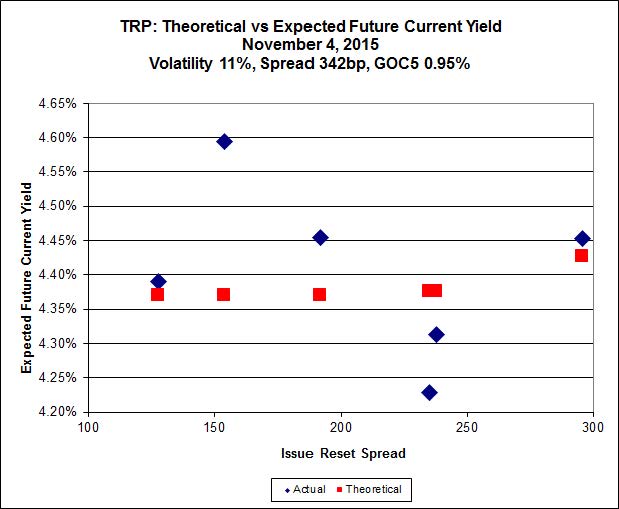
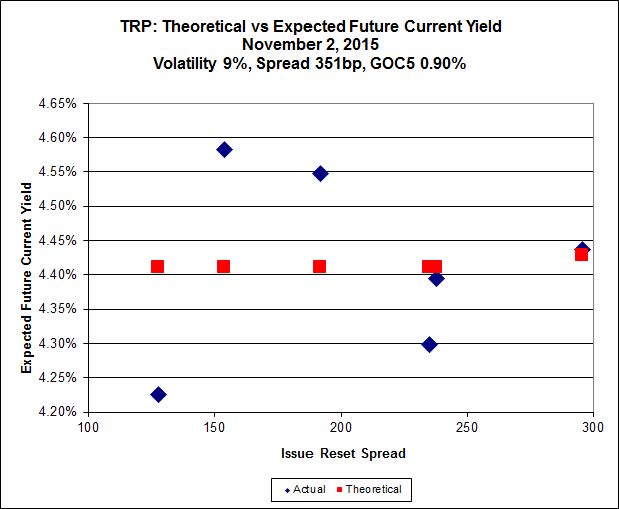
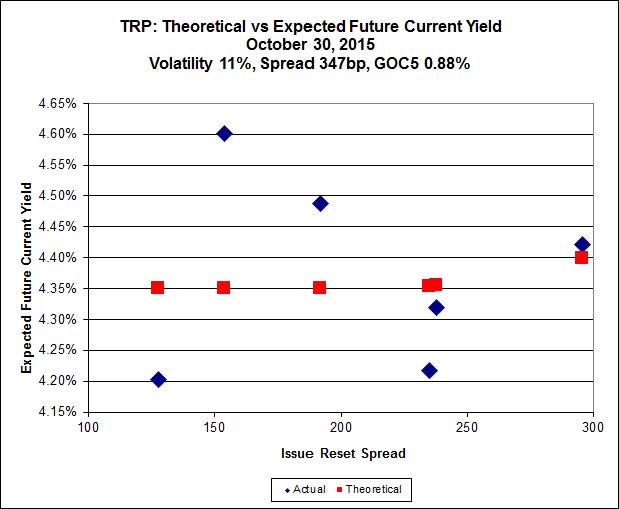
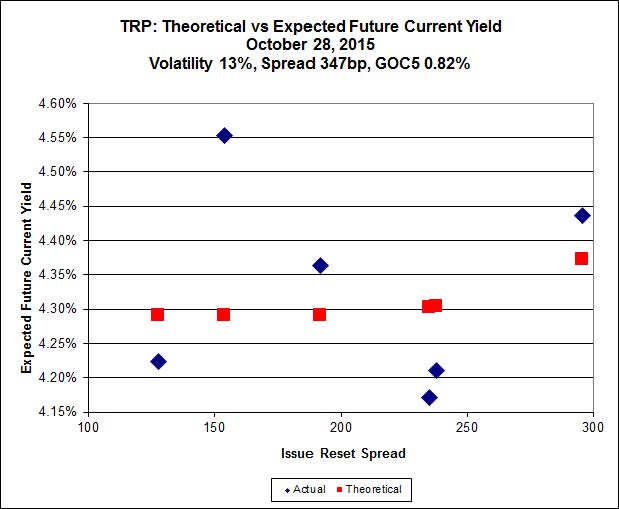
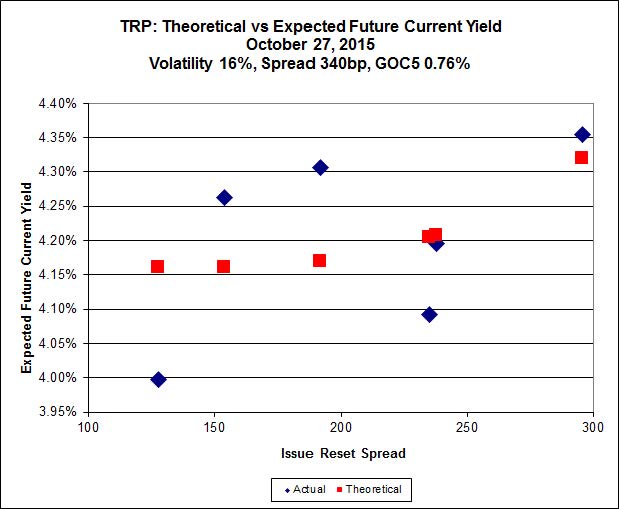
Here’s TRP:

impVol_TRP_150310A

TRP.PR.E, which resets 2019-10-30 at +235, is bid at 24.05 to be $1.12 rich, while TRP.PR.G, resetting 2020-11-30 at +296, is $1.11 cheap at its bid price of 24.72.

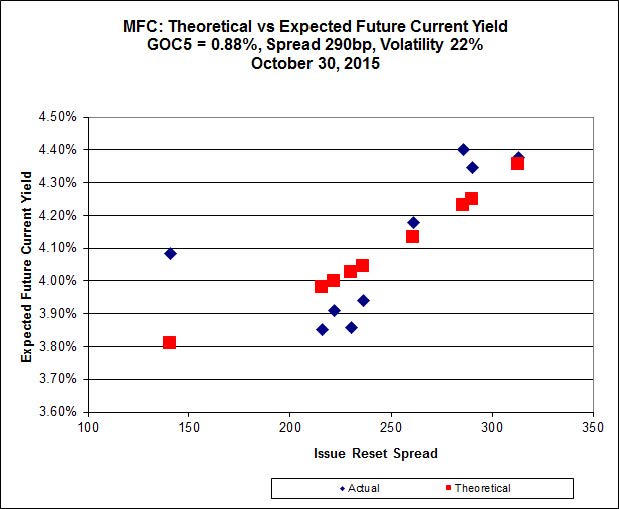
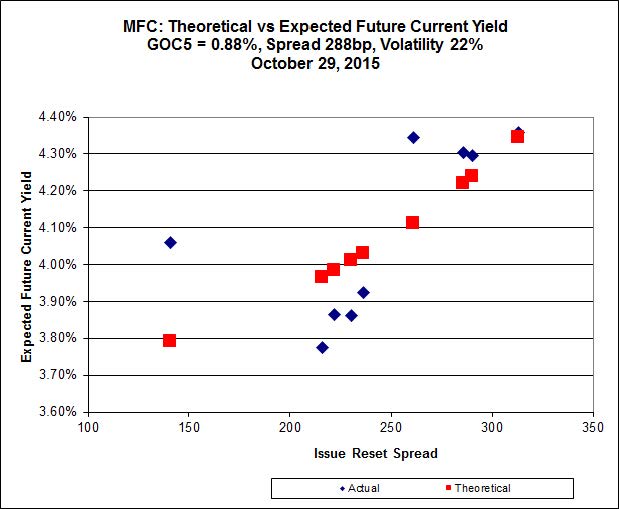
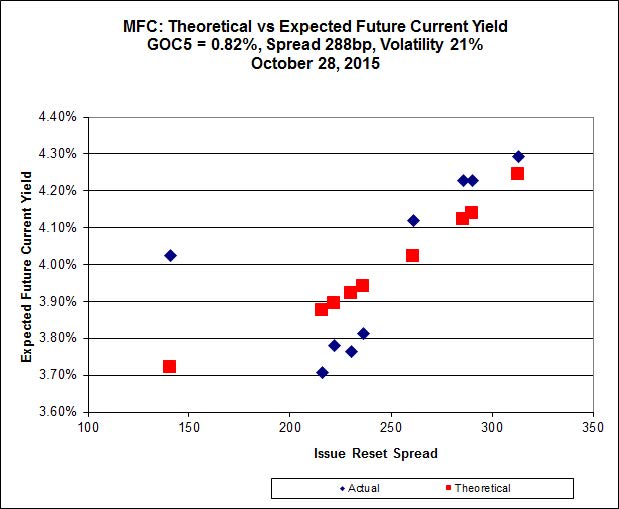
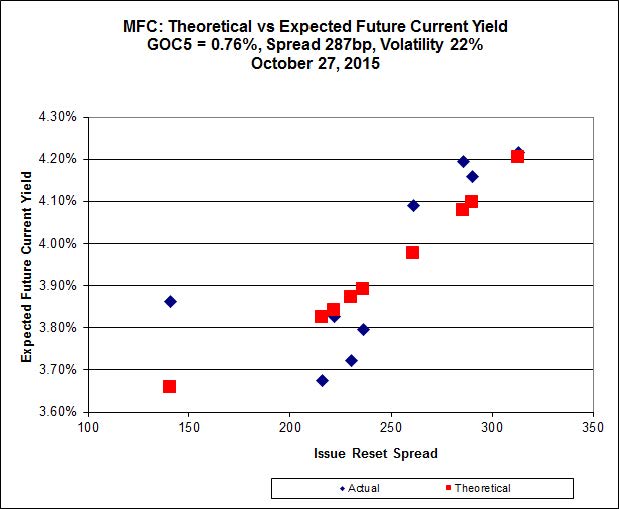
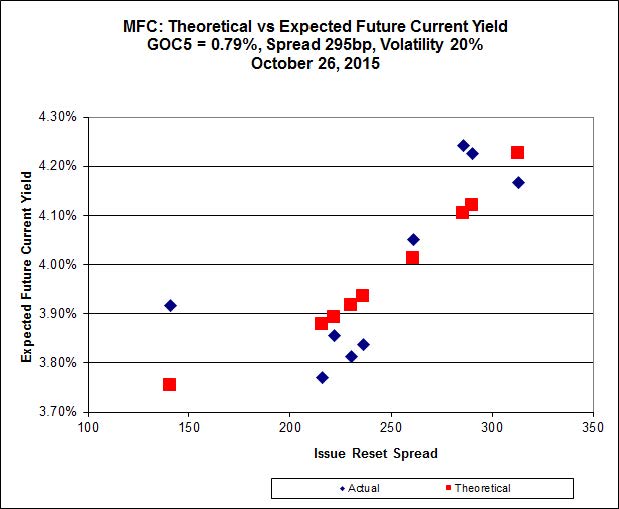
impVol_MFC_150310
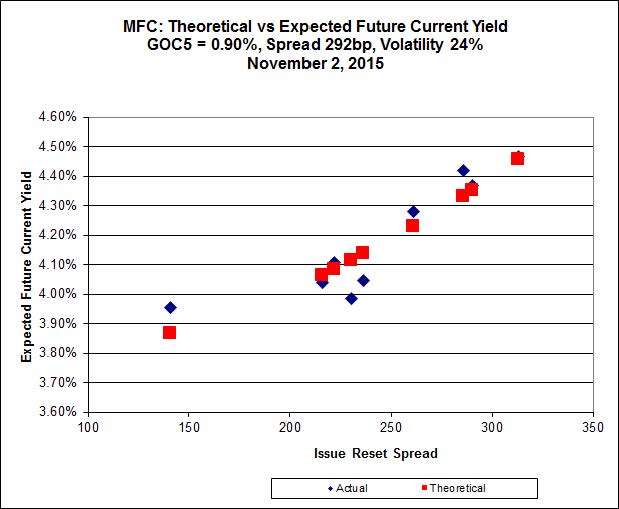
Click for Big

Another excellent fit, but the numbers are perplexing. Implied Volatility for MFC continues to be a conundrum, although it declined substantially today. It is still too high if we consider that NVCC rules will never apply to these issues; it is still too low if we consider them to be NVCC non-compliant issues (and therefore with Deemed Maturities in the call schedule).

Most expensive is MFC.PR.L, resetting at +216 on 2019-6-19, bid at 24.05 to be $0.50 rich, while MFC.PR.H, resetting at +313bp on 2017-3-19, is bid at 25.75 to be $0.51 cheap.

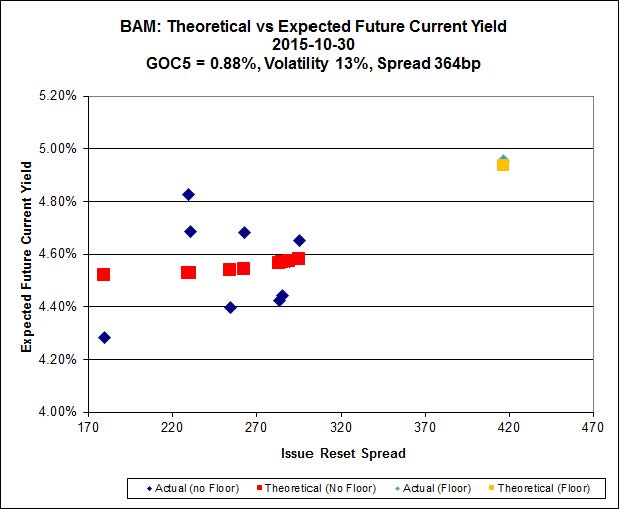
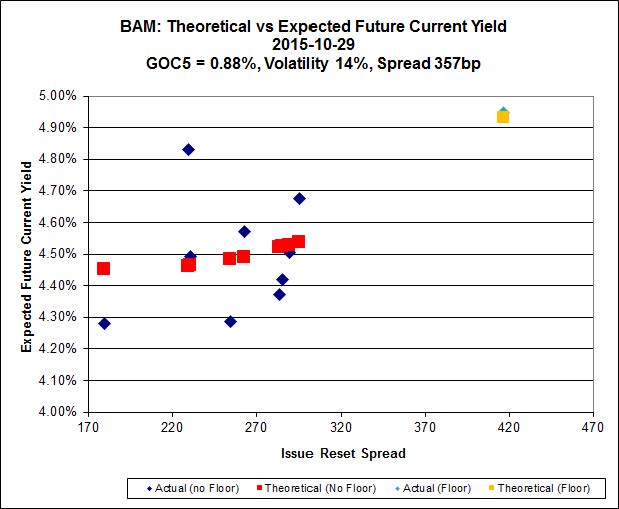
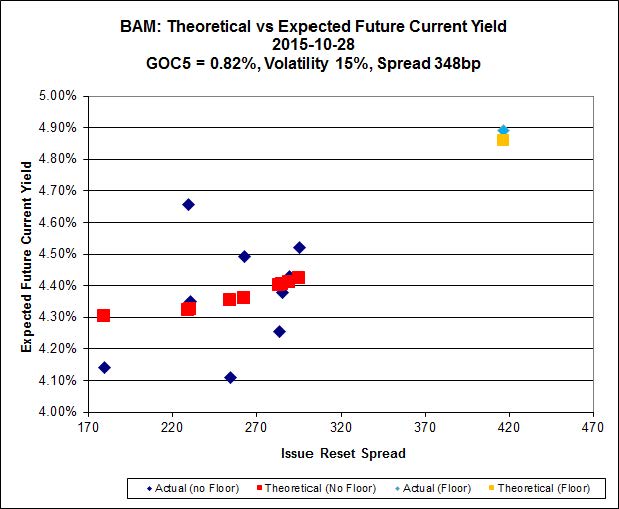
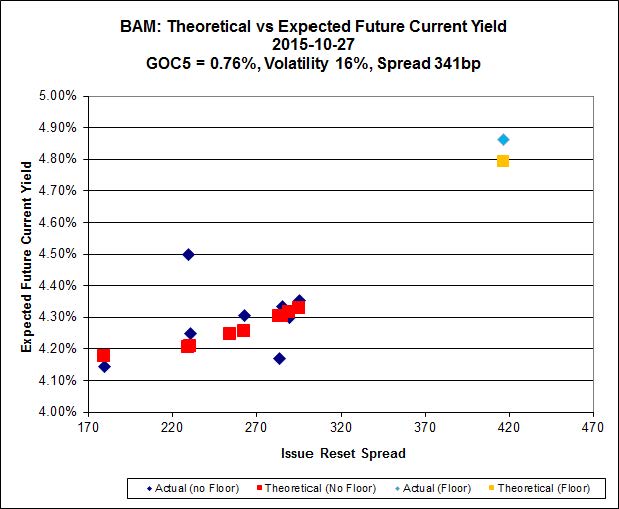
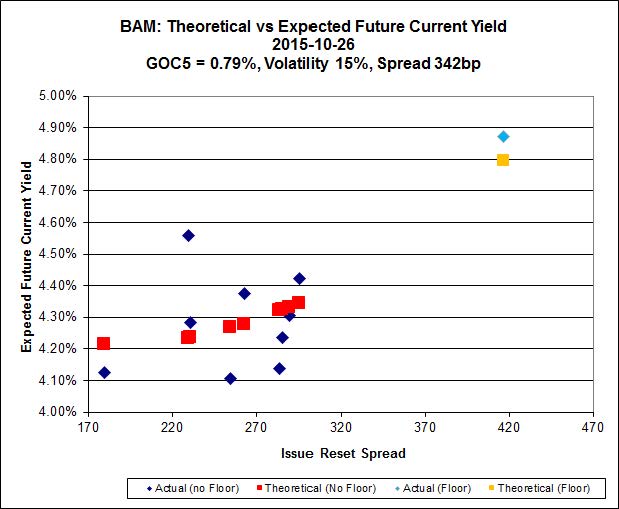
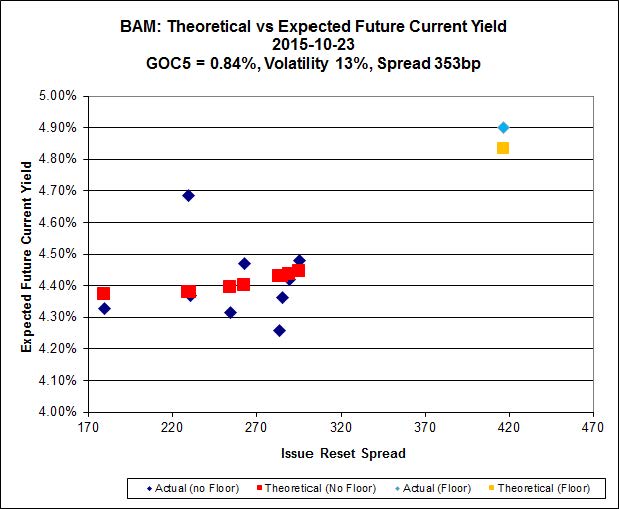
impVol_BAM_150310
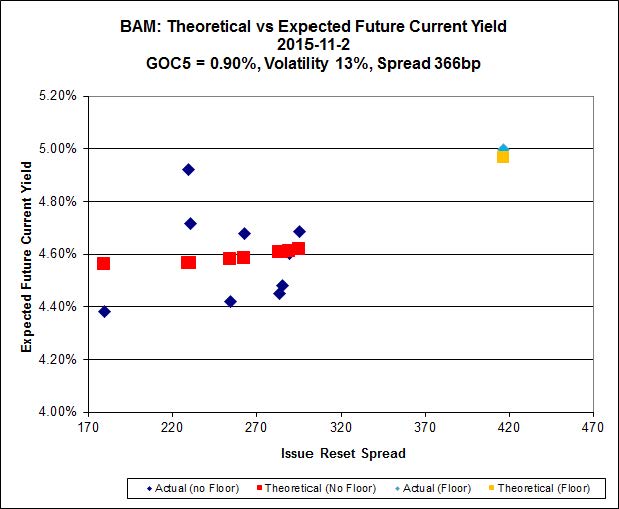
Click for Big

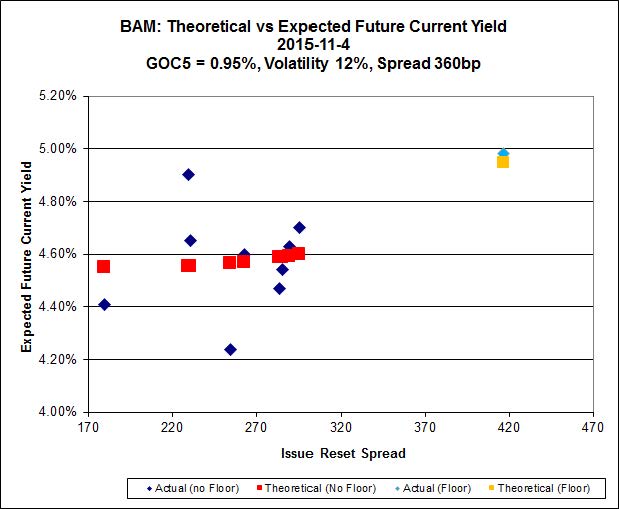
The fit on this series is actually quite reasonable – it’s the scale that makes it look so weird.

The cheapest issue relative to its peers is BAM.PR.R, resetting at +230bp on 2016-6-30, bid at 21.89 to be $0.36 cheap. BAM.PF.E, resetting at +255bp 2020-3-31 is bid at 24.20 and appears to be $0.49 rich.

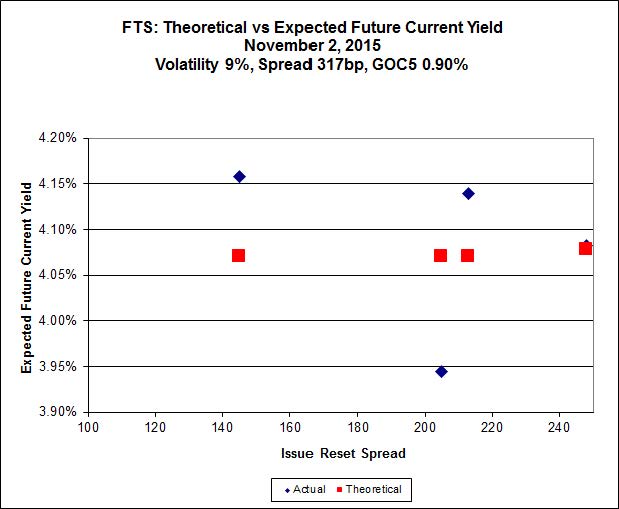
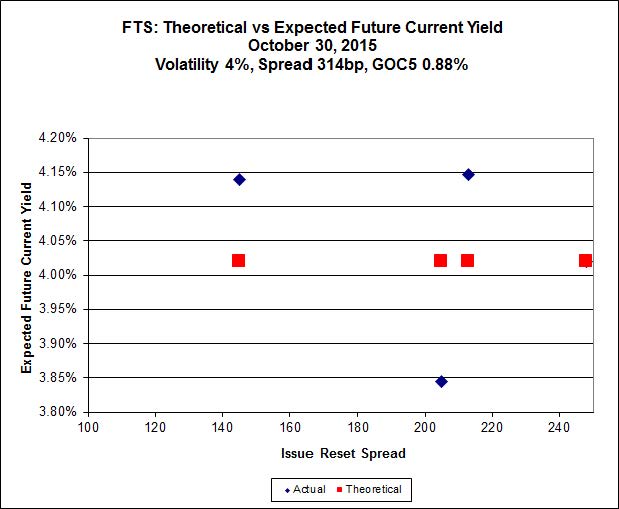
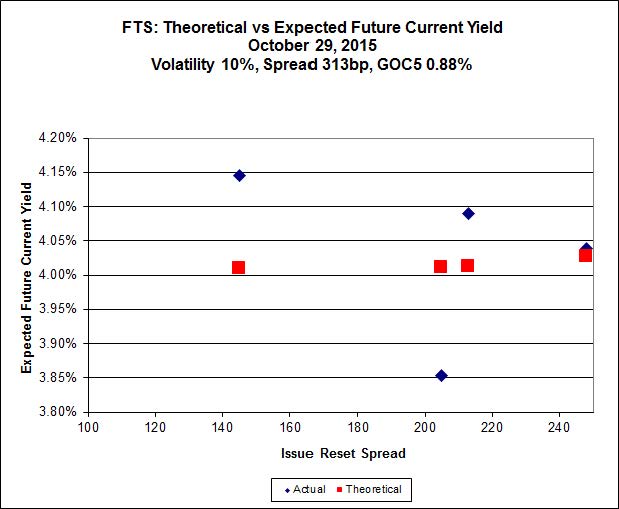
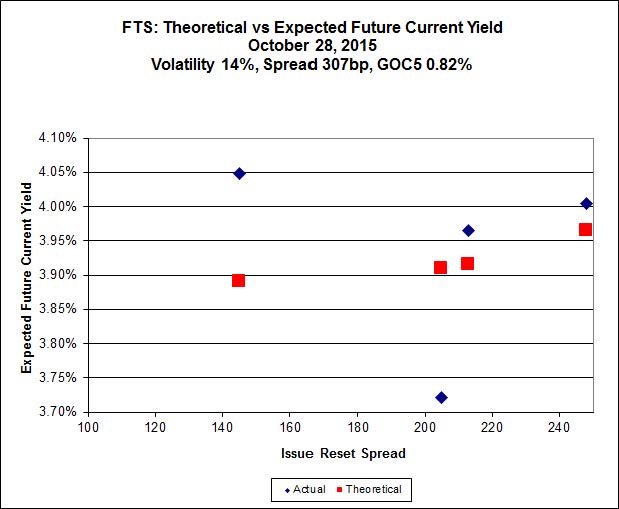
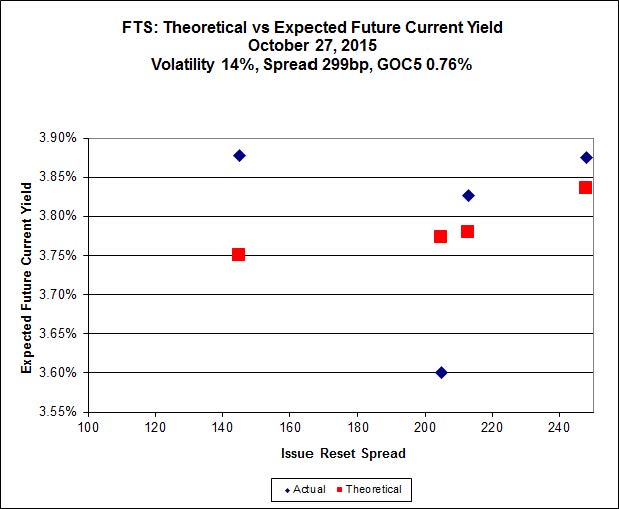
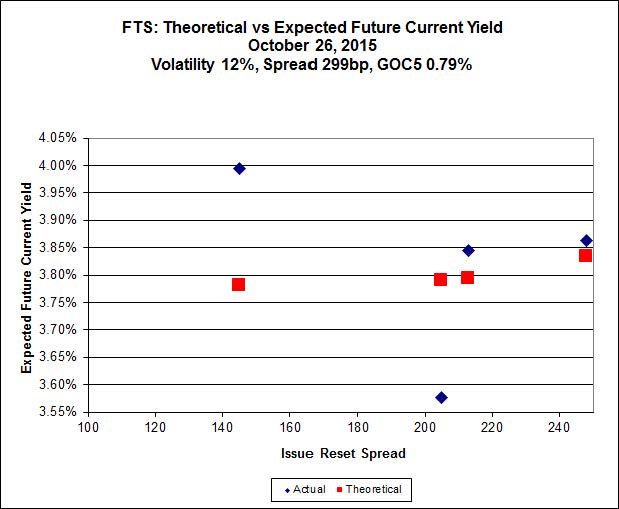
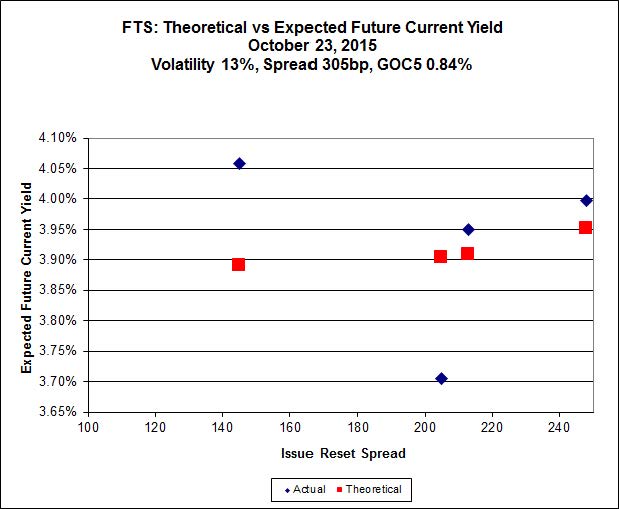
impVol_FTS_150310
Click for Big

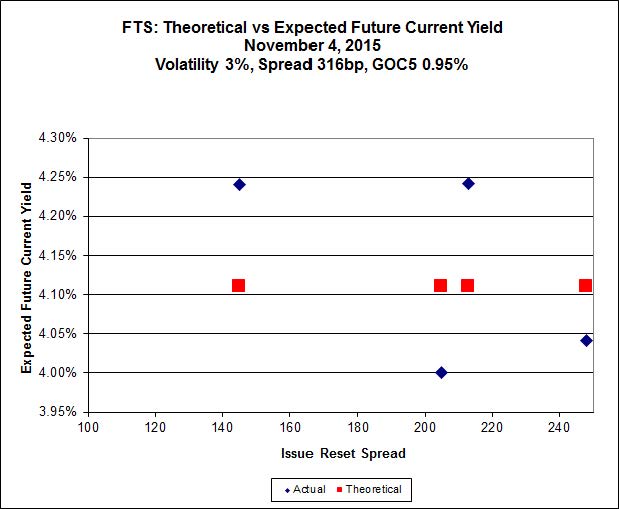
This is just weird because the middle is expensive and the ends are cheap but anyway … FTS.PR.H, with a spread of +145bp, and bid at 16.36, looks $1.68 cheap and resets 2015-6-1. FTS.PR.K, with a spread of +205bp and resetting 2019-3-1, is bid at 23.71 and is $1.13 rich.

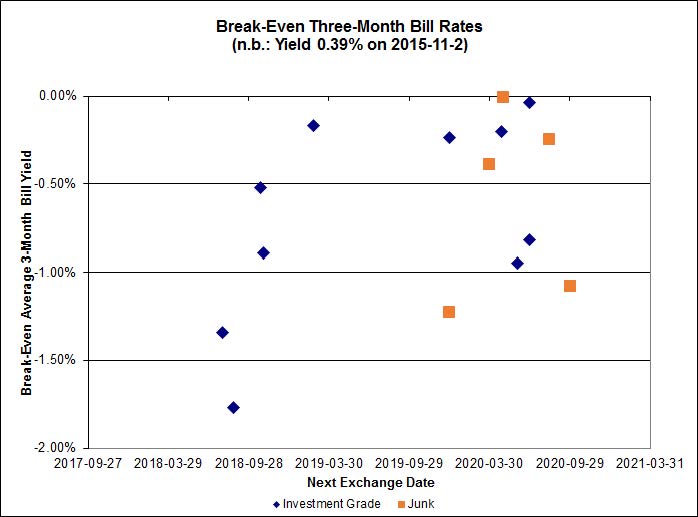
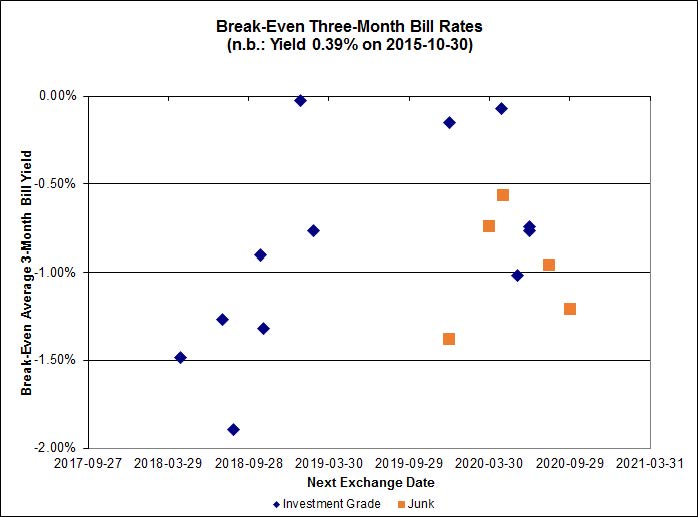
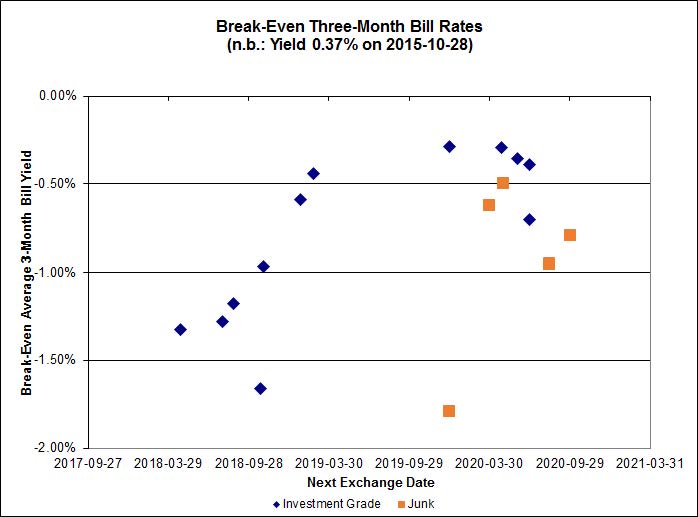
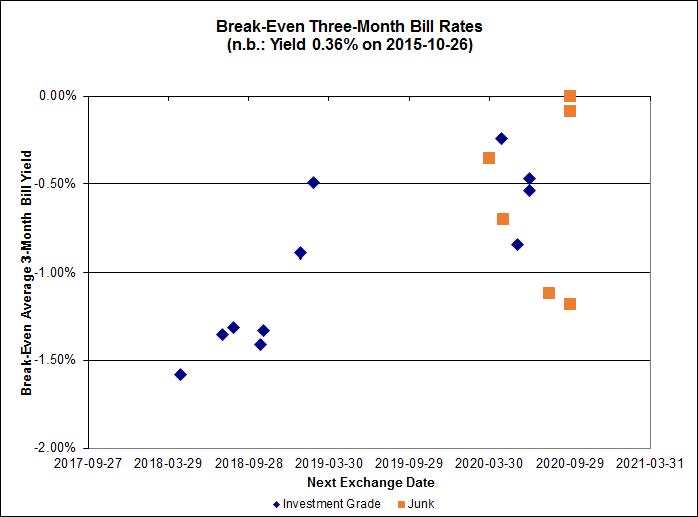
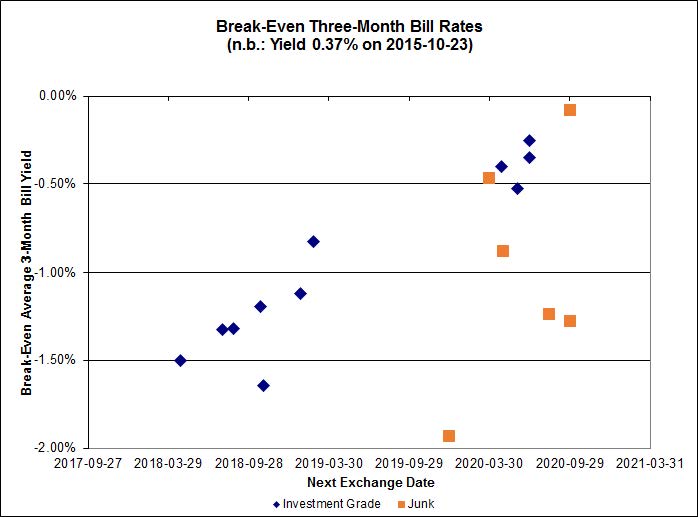
pairs_FR_150310
Click for Big

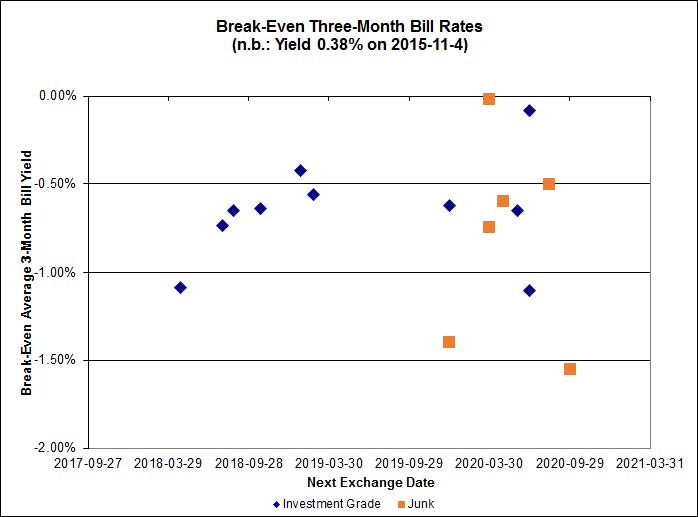
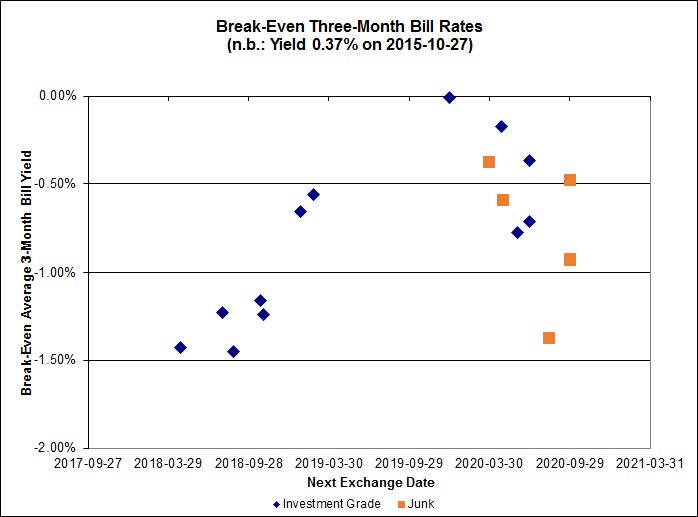
The cancellation of the previously announced deflationary environment had an immediate effect on the implied three month bill rate, with investment-grade pairs predicting an average over the next five years of a whopping 0.10%

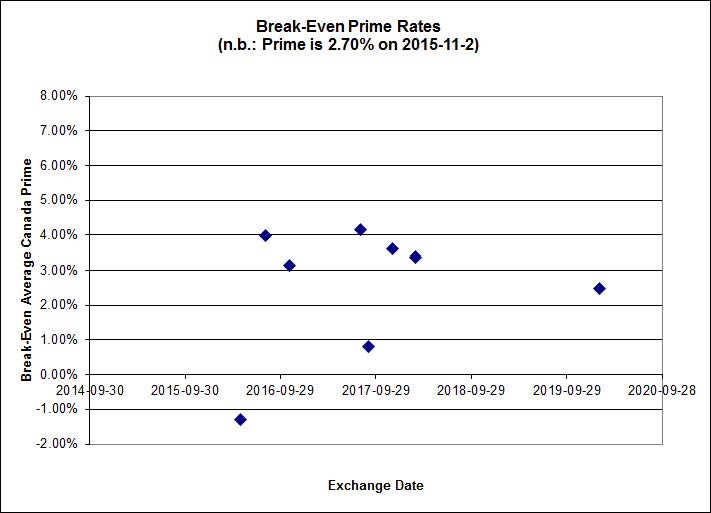
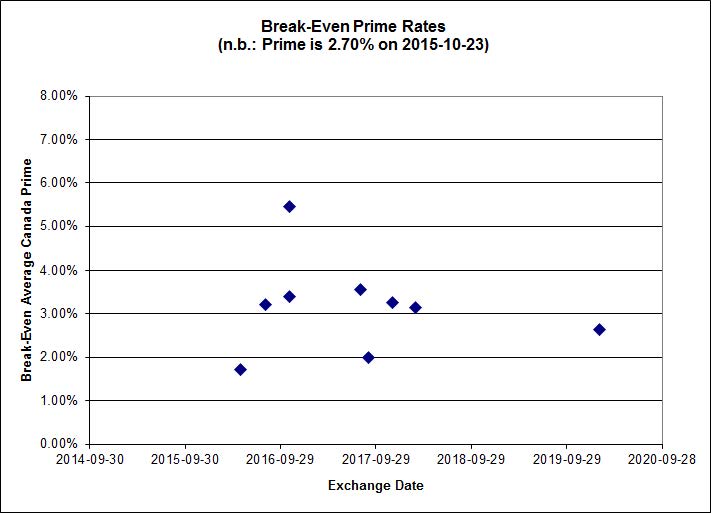
pairs_FF_150310
Click for Big

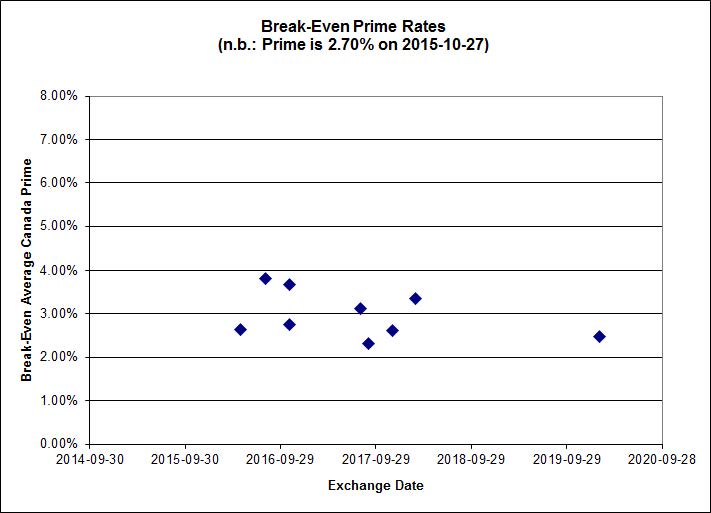
Shall we just say that this exhibits a high level of confidence in the continued rapacity of Canadian banks?

HIMIPref™ Preferred Indices
These values reflect the December 2008 revision of the HIMIPref™ Indices

Values are provisional and are finalized monthly
Index Mean
Current
Yield
(at bid)
Median
YTW
Median
Average
Trading
Value
Median
Mod Dur
(YTW)
Issues Day’s Perf. Index Value
Ratchet 0.00 % 0.00 % 0 0.00 0 -3.4850 % 2,324.8
FixedFloater 0.00 % 0.00 % 0 0.00 0 -3.4850 % 4,064.7
Floater 3.24 % 3.22 % 72,163 19.11 3 -3.4850 % 2,471.4
OpRet 4.07 % 0.98 % 106,820 0.28 1 -0.0397 % 2,764.8
SplitShare 4.48 % 4.62 % 56,197 4.45 5 -0.0359 % 3,206.5
Interest-Bearing 0.00 % 0.00 % 0 0.00 0 -0.0397 % 2,528.1
Perpetual-Premium 5.29 % 0.84 % 56,545 0.08 25 -0.0391 % 2,519.9
Perpetual-Discount 4.98 % 5.02 % 154,748 15.40 9 -0.3764 % 2,793.8
FixedReset 4.41 % 3.65 % 233,337 16.51 81 -0.1167 % 2,421.1
Deemed-Retractible 4.91 % 0.14 % 106,338 0.14 37 -0.0491 % 2,655.2
FloatingReset 2.54 % 2.98 % 85,831 6.32 8 -0.2352 % 2,329.9
Performance Highlights
Issue Index Change Notes
BAM.PR.K Floater -6.75 % Not real. The closing bid was 14.79, compared to a day’s range of 15.56-03, so the reported bid is about 5% below the day’s low. It is not clear whether this is due to inadequate Toronto Stock Exchange reporting or inadequate Toronto Stock Exchange supervision of market-makers.
YTW SCENARIO
Maturity Type : Limit Maturity
Maturity Date : 2045-03-10
Maturity Price : 14.79
Evaluated at bid price : 14.79
Bid-YTW : 3.41 %
BAM.PR.C Floater -1.88 % YTW SCENARIO
Maturity Type : Limit Maturity
Maturity Date : 2045-03-10
Maturity Price : 15.65
Evaluated at bid price : 15.65
Bid-YTW : 3.22 %
BAM.PR.B Floater -1.86 % YTW SCENARIO
Maturity Type : Limit Maturity
Maturity Date : 2045-03-10
Maturity Price : 15.81
Evaluated at bid price : 15.81
Bid-YTW : 3.19 %
FTS.PR.H FixedReset -1.80 % YTW SCENARIO
Maturity Type : Limit Maturity
Maturity Date : 2045-03-10
Maturity Price : 16.36
Evaluated at bid price : 16.36
Bid-YTW : 3.66 %
BAM.PR.N Perpetual-Discount -1.25 % YTW SCENARIO
Maturity Type : Limit Maturity
Maturity Date : 2045-03-10
Maturity Price : 22.66
Evaluated at bid price : 23.00
Bid-YTW : 5.24 %
BAM.PF.A FixedReset -1.09 % YTW SCENARIO
Maturity Type : Limit Maturity
Maturity Date : 2045-03-10
Maturity Price : 23.41
Evaluated at bid price : 25.34
Bid-YTW : 3.82 %
BAM.PR.R FixedReset -1.04 % YTW SCENARIO
Maturity Type : Limit Maturity
Maturity Date : 2045-03-10
Maturity Price : 21.53
Evaluated at bid price : 21.89
Bid-YTW : 3.90 %
CIU.PR.C FixedReset 5.78 % A rebound from yesterday’s poor reported performance. There was also a problem on March 2 / March 3. This nonsense is brought to you courtesy of the Toronto Stock Exchange.
YTW SCENARIO
Maturity Type : Limit Maturity
Maturity Date : 2045-03-10
Maturity Price : 16.65
Evaluated at bid price : 16.65
Bid-YTW : 3.58 %
Volume Highlights
Issue Index Shares
Traded
Notes
TD.PF.D FixedReset 777,595 New issue settled today.
YTW SCENARIO
Maturity Type : Limit Maturity
Maturity Date : 2045-03-10
Maturity Price : 23.12
Evaluated at bid price : 24.95
Bid-YTW : 3.57 %
BMO.PR.S FixedReset 93,075 TD crossed 30,000 at 24.97; RBC crossed 49,200 at 24.95.
YTW SCENARIO
Maturity Type : Limit Maturity
Maturity Date : 2045-03-10
Maturity Price : 23.19
Evaluated at bid price : 24.89
Bid-YTW : 3.31 %
RY.PR.Z FixedReset 59,122 Scotia crossed 50,000 at 24.85.
YTW SCENARIO
Maturity Type : Limit Maturity
Maturity Date : 2045-03-10
Maturity Price : 23.14
Evaluated at bid price : 24.75
Bid-YTW : 3.23 %
ENB.PR.P FixedReset 53,541 TD crossed 25,000 at 20.65.
YTW SCENARIO
Maturity Type : Limit Maturity
Maturity Date : 2045-03-10
Maturity Price : 20.68
Evaluated at bid price : 20.68
Bid-YTW : 4.32 %
CM.PR.P FixedReset 47,505 TD crossed 35,000 at 24.55.
YTW SCENARIO
Maturity Type : Limit Maturity
Maturity Date : 2045-03-10
Maturity Price : 23.01
Evaluated at bid price : 24.55
Bid-YTW : 3.23 %
BMO.PR.T FixedReset 47,178 TD crossed 30,000 at 24.67.
YTW SCENARIO
Maturity Type : Limit Maturity
Maturity Date : 2045-03-10
Maturity Price : 23.07
Evaluated at bid price : 24.63
Bid-YTW : 3.27 %
There were 39 other index-included issues trading in excess of 10,000 shares.
Wide Spread Highlights
Issue Index Quote Data and Yield Notes
BAM.PR.K Floater Quote: 14.79 – 15.90
Spot Rate : 1.1100
Average : 0.6382

YTW SCENARIO
Maturity Type : Limit Maturity
Maturity Date : 2045-03-10
Maturity Price : 14.79
Evaluated at bid price : 14.79
Bid-YTW : 3.41 %

TRP.PR.F FloatingReset Quote: 18.65 – 19.39
Spot Rate : 0.7400
Average : 0.5073

YTW SCENARIO
Maturity Type : Limit Maturity
Maturity Date : 2045-03-10
Maturity Price : 18.65
Evaluated at bid price : 18.65
Bid-YTW : 3.33 %

MFC.PR.M FixedReset Quote: 24.20 – 24.60
Spot Rate : 0.4000
Average : 0.2528

YTW SCENARIO
Maturity Type : Hard Maturity
Maturity Date : 2025-01-31
Maturity Price : 25.00
Evaluated at bid price : 24.20
Bid-YTW : 4.00 %

GWO.PR.I Deemed-Retractible Quote: 24.00 – 24.50
Spot Rate : 0.5000
Average : 0.3542

YTW SCENARIO
Maturity Type : Hard Maturity
Maturity Date : 2025-01-31
Maturity Price : 25.00
Evaluated at bid price : 24.00
Bid-YTW : 5.01 %

BAM.PR.N Perpetual-Discount Quote: 23.00 – 23.34
Spot Rate : 0.3400
Average : 0.2297

YTW SCENARIO
Maturity Type : Limit Maturity
Maturity Date : 2045-03-10
Maturity Price : 22.66
Evaluated at bid price : 23.00
Bid-YTW : 5.24 %

MFC.PR.H FixedReset Quote: 25.75 – 26.05
Spot Rate : 0.3000
Average : 0.2051

YTW SCENARIO
Maturity Type : Call
Maturity Date : 2017-03-19
Maturity Price : 25.00
Evaluated at bid price : 25.75
Bid-YTW : 3.01 %

Market Action

March 9, 2015

There’s a bit more colour about the effect of the US jobs number, discussed March 6 on the treasury long bond:

Since hitting an all-time low of 2.22 percent on Jan. 30, Treasury 30-year bond yields have posted the biggest five-week jump in six years as better-than-forecast employment growth led investors to pull forward wagers for the Federal Reserve to raise interest rates.

The 30-year bond yield rose 25 basis points, or 0.25 percentage point, this week to 2.84 percent, according to Bloomberg Bond Trader prices.

That pushed the yield increase to 62 basis points since January. The move is the biggest since a 1 percentage point rise in the five weeks ended Jan. 30, 2009, after the Fed said it was considering buying Treasuries to help stimulate economic growth.

Yields soared March 6 after the Labor Department reported the U.S. added 295,000 jobs last month, compared with a forecast for a 235,000 gain in a Bloomberg survey. The unemployment rate fell to 5.5 percent, an almost seven-year low, from 5.7 percent.

It was 12th straight month payrolls have increased by at least 200,000, the best run since March 1995. Payrolls rose 3.1 million in 2014, the most in 15 years.

And some colour on the effect of the suspension of Canadian forward guidance:

Pacific Investment Management Co.’s Ed Devlin is getting out of Canadian government bonds, and Bank of Canada Governor Stephen Poloz is the reason why.

Mr. Devlin, who oversees about $17-billion (U.S.), including the Canadian portfolios for the world’s biggest manager of bond funds, said higher yields are needed to compensate for the risk of buying debt whipsawed by Mr. Poloz’s policy pronouncements.

“Investors should require a bigger risk premium to invest in these bonds,” Mr. Devlin said by phone from Los Angeles on Friday. “If you don’t know what they’re going to do, you should get paid more money to invest in them than if they were fairly predictable.”

And there are the usual arguments about this:

Gluskin-Sheff chief economist David Rosenberg said last week the confusion was putting the Bank of Canada’s credibility at risk.

“The fact that they decided to stop offering guidance and start serving up confusion makes me gun-shy about making a call,” Rosenberg told Bloomberg. “If you’re trying to promote economic growth, you probably don’t want to generate too much volatility in the financial markets to achieve that goal.”

But [Dominion Lending Centres Chief Economist Sherry] Cooper says Bay Street should spend more time watching the data, instead of obsessing about what the bank will do.

“What caused this hissy fit on Bay Street was the economists were wrong,” Cooper wrote in a note. “No one expected the rate cut, so caught with their proverbial pants down, the pundits dumped on Poloz for having misled them.”

Cooper said not only was Poloz right to cut rates, but she also sees no reason why the central bank should “telegraph rate moves in advance.”

“The lamentation over the loss of ‘forward guidance’ is pathetic .… Everyone knows that central bank action is data dependent. When the data surprise, all bets are off,” she wrote.

It was a mixed day for the Canadian preferred share market, with PerpetualDiscounts off 15bp, FixedResets down 21bp and DeemedRetractibles gaining 3bp. Volatility was down from the levels we’ve generally seen for the past three months. Volume was low.

For as long as the FixedReset market is so violently unsettled, I’ll keep publishing updates of the more interesting and meaningful series of FixedResets’ Implied Volatilities. This doesn’t include Enbridge because although Enbridge has a large number of issues outstanding, all of which are quite liquid, the range of Issue Reset Spreads is too small for decent conclusions. The low is 212bp (ENB.PR.H; second-lowest is ENB.PR.D at 237bp) and the high is a mere 268 for ENB.PF.G.

Remember that all rich /cheap assessments are:
» based on Implied Volatility Theory only
» are relative only to other FixedResets from the same issuer
» assume constant GOC-5 yield
» assume constant Implied Volatility
» assume constant spread

Here’s TRP:

impVol_TRP_150309
Click for Big

TRP.PR.E, which resets 2019-10-30 at +235, is bid at 24.14 to be $1.20 rich, while TRP.PR.G, resetting 2020-11-30 at +296, is $1.07 cheap at its bid price of 24.75.

impVol_MFC_150309
Click for Big

Another excellent fit, but the numbers are perplexing. Implied Volatility for MFC continues to be a conundrum, although it declined substantially today. It is still too high if we consider that NVCC rules will never apply to these issues; it is still too low if we consider them to be NVCC non-compliant issues (and therefore with Deemed Maturities in the call schedule).

Most expensive is MFC.PR.L, resetting at +216 on 2019-6-19, bid at 23.91 to be $0.34 rich, while MFC.PR.H, resetting at +313bp on 2017-3-19, is bid at 25.91 to be $0.38 cheap.

impVol_BAM_150309
Click for Big

The fit on this series is actually quite reasonable – it’s the scale that makes it look so weird.

The cheapest issue relative to its peers is BAM.PR.Z, resetting at +296bp on 2017-12-31, bid at 25.26 to be $0.45 cheap. BAM.PF.E, resetting at +255bp 2020-3-31 is bid at 24.42 and appears to be $0.61 rich.

impVol_FTS_150309
Click for Big

This is just weird because the middle is expensive and the ends are cheap but anyway … FTS.PR.H, with a spread of +145bp, and bid at 16.66, looks $1.56 cheap and resets 2015-6-1. FTS.PR.K, with a spread of +205bp and resetting 2019-3-1, is bid at 23.77 and is $1.04 rich.

pairs_FR_150309
Click for Big

The cancellation of the previously announced deflationary environment had an immediate effect on the implied three month bill rate, with investment-grade pairs predicting an average over the next five years of a whopping 0.10%.

Not shown is the DC.PR.B / DC.PR.D pair, which implies an average rate of negative 1.77% until its exchange date 2019-9-30.

pairs_FF_150309
Click for Big

Shall we just say that this exhibits a high level of confidence in the continued rapacity of Canadian banks?

HIMIPref™ Preferred Indices
These values reflect the December 2008 revision of the HIMIPref™ Indices

Values are provisional and are finalized monthly
Index Mean
Current
Yield
(at bid)
Median
YTW
Median
Average
Trading
Value
Median
Mod Dur
(YTW)
Issues Day’s Perf. Index Value
Ratchet 0.00 % 0.00 % 0 0.00 0 -0.4777 % 2,408.7
FixedFloater 0.00 % 0.00 % 0 0.00 0 -0.4777 % 4,211.5
Floater 3.12 % 3.16 % 73,188 19.26 3 -0.4777 % 2,560.6
OpRet 4.07 % 0.83 % 105,283 0.28 1 0.0000 % 2,765.8
SplitShare 4.48 % 4.60 % 56,172 4.45 5 0.0080 % 3,207.6
Interest-Bearing 0.00 % 0.00 % 0 0.00 0 0.0000 % 2,529.1
Perpetual-Premium 5.29 % -0.36 % 56,628 0.08 25 -0.0454 % 2,520.9
Perpetual-Discount 4.96 % 5.03 % 154,171 15.08 9 -0.1531 % 2,804.3
FixedReset 4.42 % 3.64 % 233,557 16.51 80 -0.2081 % 2,423.9
Deemed-Retractible 4.90 % 0.02 % 105,071 0.14 37 0.0277 % 2,656.5
FloatingReset 2.53 % 2.91 % 87,195 6.33 8 -0.0854 % 2,335.4
Performance Highlights
Issue Index Change Notes
CIU.PR.C FixedReset -4.61 % YTW SCENARIO
Maturity Type : Limit Maturity
Maturity Date : 2045-03-09
Maturity Price : 15.74
Evaluated at bid price : 15.74
Bid-YTW : 3.79 %
BAM.PR.Z FixedReset -1.71 % YTW SCENARIO
Maturity Type : Limit Maturity
Maturity Date : 2045-03-09
Maturity Price : 23.50
Evaluated at bid price : 25.26
Bid-YTW : 3.92 %
TRP.PR.A FixedReset -1.21 % YTW SCENARIO
Maturity Type : Limit Maturity
Maturity Date : 2045-03-09
Maturity Price : 19.62
Evaluated at bid price : 19.62
Bid-YTW : 3.76 %
PWF.PR.P FixedReset -1.01 % YTW SCENARIO
Maturity Type : Limit Maturity
Maturity Date : 2045-03-09
Maturity Price : 18.65
Evaluated at bid price : 18.65
Bid-YTW : 3.53 %
VNR.PR.A FixedReset 1.11 % YTW SCENARIO
Maturity Type : Limit Maturity
Maturity Date : 2045-03-09
Maturity Price : 23.30
Evaluated at bid price : 24.61
Bid-YTW : 3.84 %
BAM.PR.X FixedReset 1.93 % YTW SCENARIO
Maturity Type : Limit Maturity
Maturity Date : 2045-03-09
Maturity Price : 19.04
Evaluated at bid price : 19.04
Bid-YTW : 3.95 %
Volume Highlights
Issue Index Shares
Traded
Notes
CM.PR.G Perpetual-Premium 352,980 Called for redemption 2015-4-30
YTW SCENARIO
Maturity Type : Call
Maturity Date : 2015-04-08
Maturity Price : 25.00
Evaluated at bid price : 25.28
Bid-YTW : -1.38 %
RY.PR.W Perpetual-Premium 85,708 Nesbitt crossed 85,000 at 25.30.
YTW SCENARIO
Maturity Type : Call
Maturity Date : 2015-04-08
Maturity Price : 25.00
Evaluated at bid price : 25.24
Bid-YTW : -4.58 %
OSP.PR.A SplitShare 66,500 Recent new issue.
YTW SCENARIO
Maturity Type : Hard Maturity
Maturity Date : 2020-03-31
Maturity Price : 10.00
Evaluated at bid price : 10.21
Bid-YTW : 4.60 %
RY.PR.A Deemed-Retractible 35,817 YTW SCENARIO
Maturity Type : Call
Maturity Date : 2015-04-08
Maturity Price : 25.25
Evaluated at bid price : 25.56
Bid-YTW : -8.38 %
RY.PR.J FixedReset 33,480 YTW SCENARIO
Maturity Type : Limit Maturity
Maturity Date : 2045-03-09
Maturity Price : 23.14
Evaluated at bid price : 24.98
Bid-YTW : 3.55 %
BAM.PR.X FixedReset 30,317 YTW SCENARIO
Maturity Type : Limit Maturity
Maturity Date : 2045-03-09
Maturity Price : 19.04
Evaluated at bid price : 19.04
Bid-YTW : 3.95 %
There were 20 other index-included issues trading in excess of 10,000 shares.
Wide Spread Highlights
Issue Index Quote Data and Yield Notes
CIU.PR.C FixedReset Quote: 15.74 – 16.64
Spot Rate : 0.9000
Average : 0.5670

YTW SCENARIO
Maturity Type : Limit Maturity
Maturity Date : 2045-03-09
Maturity Price : 15.74
Evaluated at bid price : 15.74
Bid-YTW : 3.79 %

ENB.PF.G FixedReset Quote: 22.21 – 22.70
Spot Rate : 0.4900
Average : 0.3279

YTW SCENARIO
Maturity Type : Limit Maturity
Maturity Date : 2045-03-09
Maturity Price : 21.77
Evaluated at bid price : 22.21
Bid-YTW : 4.31 %

SLF.PR.G FixedReset Quote: 17.95 – 18.42
Spot Rate : 0.4700
Average : 0.3253

YTW SCENARIO
Maturity Type : Hard Maturity
Maturity Date : 2025-01-31
Maturity Price : 25.00
Evaluated at bid price : 17.95
Bid-YTW : 6.20 %

PWF.PR.P FixedReset Quote: 18.65 – 18.98
Spot Rate : 0.3300
Average : 0.2528

YTW SCENARIO
Maturity Type : Limit Maturity
Maturity Date : 2045-03-09
Maturity Price : 18.65
Evaluated at bid price : 18.65
Bid-YTW : 3.53 %

TRP.PR.A FixedReset Quote: 19.62 – 19.90
Spot Rate : 0.2800
Average : 0.2046

YTW SCENARIO
Maturity Type : Limit Maturity
Maturity Date : 2045-03-09
Maturity Price : 19.62
Evaluated at bid price : 19.62
Bid-YTW : 3.76 %

PVS.PR.C SplitShare Quote: 25.07 – 25.30
Spot Rate : 0.2300
Average : 0.1589

YTW SCENARIO
Maturity Type : Hard Maturity
Maturity Date : 2017-12-10
Maturity Price : 25.00
Evaluated at bid price : 25.07
Bid-YTW : 4.77 %

Market Action

March 6, 2015

Jobs, jobs, jobs!

The U.S. job-creation machine kept exceeding expectations in February. Wages continued to disappoint.

Employers added 295,000 workers to payrolls last month, more than forecast, and the unemployment rate dropped to 5.5 percent, the lowest in almost seven years, figures from the Labor Department showed Friday in Washington. Hourly earnings rose less than forecast.

A lingering appetite to boost headcounts comes as increased purchasing power from cheaper fuel helps drive consumer spending. The jobless rate has now reached the Federal Reserve’s range for what it considers full employment, keeping policy makers on course to raise interest rates this year as persistent job growth sets the stage for a pickup in wages.

The median forecast in a Bloomberg survey of economists called for a 235,000 advance in February payrolls. Estimates ranged from 150,000 to 370,000. Employment in January climbed 239,000. The drop in the unemployment rate was also bigger than projected, and down from 5.7 percent in January.

Average hourly earnings rose 0.1 percent from the prior month after advancing 0.5 percent in January, which was the most since November 2008. The median forecast called for a 0.2 percent gain. Earnings were up 2 percent over the past year, also less than projected and matching the increase on average since the expansion began in mid-2009.

So the previously scheduled deflation has been cancelled:

U.S. stocks fell, with the Standard & Poor’s 500 Index tumbling the most in two months, as better-than-forecast jobs data fueled speculation the Federal Reserve is moving closer to raising interest rates.

The S&P 500 fell 1.4 percent, the most since Jan. 5, to 2,071.26 at 4 p.m. in New York. The equity gauge lost 1.6 percent for the week. The Dow retreated 278.94 points, or 1.5 percent, to 17,856.78 for its worst drop in five weeks. The Nasdaq Composite Index slipped 1.1 percent. More than 7.4 billion shares changed hands on U.S. exchanges, 7.2 percent above the 30-day average.

Utility companies in the S&P 500 tumbled 3.1 percent. Selling picked up in the industry as the rate on 10-year Treasury notes spiked 13 basis points to 2.25 percent, the highest this year. The group’s dividend yield of 3.7 percent is the second-highest in the index.

AllBanc Split Corp., proud issuer of ABK.PR.C, was confirmed at Pfd-2 by DBRS:

Since the last rating action in March 2014, the net asset value of the Company has been slightly volatile, mirroring the performance of Canadian banks over the past year. However, downside protection rose from 60.1% on February 20, 2014, to 62.6% as of February 26, 2015. As a result, the rating of the Class C Preferred Shares has been confirmed at Pfd-2.

It was a mixed day for the Canadian preferred share market, with PerpetualDiscounts off 9bp, FixedResets gaining 26bp and DeemedRetractibles down 15bp. The Performance Highlights table is its usual lengthy self. Volume was high.

For as long as the FixedReset market is so violently unsettled, I’ll keep publishing updates of the more interesting and meaningful series of FixedResets’ Implied Volatilities. This doesn’t include Enbridge because although Enbridge has a large number of issues outstanding, all of which are quite liquid, the range of Issue Reset Spreads is too small for decent conclusions. The low is 212bp (ENB.PR.H; second-lowest is ENB.PR.D at 237bp) and the high is a mere 268 for ENB.PF.G.

Remember that all rich /cheap assessments are:
» based on Implied Volatility Theory only
» are relative only to other FixedResets from the same issuer
» assume constant GOC-5 yield
» assume constant Implied Volatility
» assume constant spread

Here’s TRP:

impVol_TRP_150306
Click for Big

TRP.PR.E, which resets 2019-10-30 at +235, is bid at 24.14 to be $1.18 rich, while TRP.PR.G, resetting 2020-11-30 at +296, is $1.10 cheap at its bid price of 24.71.

impVol_MFC_150306
Click for Big

Another excellent fit, but the numbers are perplexing. Implied Volatility for MFC continues to be a conundrum, although it declined substantially today. It is still too high if we consider that NVCC rules will never apply to these issues; it is still too low if we consider them to be NVCC non-compliant issues (and therefore with Deemed Maturities in the call schedule).

Most expensive is MFC.PR.L, resetting at +216 on 2019-6-19, bid at 24.91 to be $0.30 rich, while MFC.PR.H, resetting at +313bp on 2017-3-19, is bid at 25.88 to be $0.47 cheap.

impVol_BAM_150306
Click for Big

The fit on this series is actually quite reasonable – it’s the scale that makes it look so weird.

The cheapest issue relative to its peers is BAM.PF.X, resetting at +188bp on 2017-6-30, bid at 18.68 to be $0.17 cheap. BAM.PF.E, resetting at +255bp 2020-3-31 is bid at 24.45 and appears to be $0.68 rich.

impVol_FTS_150306
Click for Big

This is just weird because the middle is expensive and the ends are cheap but anyway … FTS.PR.H, with a spread of +145bp, and bid at 16.70, looks $1.51 cheap and resets 2015-6-1. FTS.PR.K, with a spread of +205bp and resetting 2019-3-1, is bid at 23.80 and is $1.13 rich.

pairs_FR_150306
Click for Big

The cancellation of the previously announced deflationary environment had an immediate effect on the implied three month bill rate, with investment-grade pairs predicting an average over the next five years of a whopping 0.10%.

pairs_FF_150306
Click for Big

Shall we just say that this exhibits a high level of confidence in the continued rapacity of Canadian banks?

HIMIPref™ Preferred Indices
These values reflect the December 2008 revision of the HIMIPref™ Indices

Values are provisional and are finalized monthly
Index Mean
Current
Yield
(at bid)
Median
YTW
Median
Average
Trading
Value
Median
Mod Dur
(YTW)
Issues Day’s Perf. Index Value
Ratchet 0.00 % 0.00 % 0 0.00 0 0.9857 % 2,420.3
FixedFloater 0.00 % 0.00 % 0 0.00 0 0.9857 % 4,231.7
Floater 3.11 % 3.14 % 75,974 19.31 3 0.9857 % 2,572.9
OpRet 4.07 % 0.80 % 106,402 0.29 1 0.0794 % 2,765.8
SplitShare 4.48 % 4.54 % 56,213 4.46 5 0.0080 % 3,207.4
Interest-Bearing 0.00 % 0.00 % 0 0.00 0 0.0794 % 2,529.1
Perpetual-Premium 5.29 % -0.78 % 54,523 0.08 25 0.0360 % 2,522.1
Perpetual-Discount 4.95 % 5.03 % 155,274 15.09 9 -0.0927 % 2,808.6
FixedReset 4.41 % 3.43 % 236,285 16.83 80 0.2630 % 2,429.0
Deemed-Retractible 4.90 % -0.16 % 105,040 0.15 37 -0.1502 % 2,655.8
FloatingReset 2.50 % 2.88 % 90,150 6.34 8 -0.1440 % 2,337.4
Performance Highlights
Issue Index Change Notes
TRP.PR.F FloatingReset -3.04 % YTW SCENARIO
Maturity Type : Limit Maturity
Maturity Date : 2045-03-06
Maturity Price : 18.81
Evaluated at bid price : 18.81
Bid-YTW : 3.26 %
SLF.PR.H FixedReset -1.41 % YTW SCENARIO
Maturity Type : Hard Maturity
Maturity Date : 2025-01-31
Maturity Price : 25.00
Evaluated at bid price : 22.38
Bid-YTW : 4.40 %
MFC.PR.B Deemed-Retractible -1.14 % YTW SCENARIO
Maturity Type : Hard Maturity
Maturity Date : 2025-01-31
Maturity Price : 25.00
Evaluated at bid price : 24.32
Bid-YTW : 5.01 %
BNS.PR.Z FixedReset 1.08 % YTW SCENARIO
Maturity Type : Hard Maturity
Maturity Date : 2022-01-31
Maturity Price : 25.00
Evaluated at bid price : 23.30
Bid-YTW : 3.51 %
IAG.PR.G FixedReset 1.21 % YTW SCENARIO
Maturity Type : Call
Maturity Date : 2017-06-30
Maturity Price : 25.00
Evaluated at bid price : 25.92
Bid-YTW : 2.53 %
ENB.PR.H FixedReset 1.25 % YTW SCENARIO
Maturity Type : Limit Maturity
Maturity Date : 2045-03-06
Maturity Price : 18.63
Evaluated at bid price : 18.63
Bid-YTW : 4.17 %
BAM.PR.C Floater 1.26 % YTW SCENARIO
Maturity Type : Limit Maturity
Maturity Date : 2045-03-06
Maturity Price : 16.05
Evaluated at bid price : 16.05
Bid-YTW : 3.14 %
MFC.PR.K FixedReset 1.27 % YTW SCENARIO
Maturity Type : Hard Maturity
Maturity Date : 2025-01-31
Maturity Price : 25.00
Evaluated at bid price : 24.00
Bid-YTW : 3.79 %
ENB.PR.B FixedReset 1.47 % YTW SCENARIO
Maturity Type : Limit Maturity
Maturity Date : 2045-03-06
Maturity Price : 19.31
Evaluated at bid price : 19.31
Bid-YTW : 4.25 %
HSE.PR.A FixedReset 1.48 % YTW SCENARIO
Maturity Type : Limit Maturity
Maturity Date : 2045-03-06
Maturity Price : 17.78
Evaluated at bid price : 17.78
Bid-YTW : 3.73 %
BMO.PR.Q FixedReset 1.53 % YTW SCENARIO
Maturity Type : Hard Maturity
Maturity Date : 2022-01-31
Maturity Price : 25.00
Evaluated at bid price : 23.25
Bid-YTW : 3.53 %
CM.PR.P FixedReset 1.55 % YTW SCENARIO
Maturity Type : Limit Maturity
Maturity Date : 2045-03-06
Maturity Price : 23.02
Evaluated at bid price : 24.59
Bid-YTW : 3.09 %
PWF.PR.P FixedReset 1.84 % YTW SCENARIO
Maturity Type : Limit Maturity
Maturity Date : 2045-03-06
Maturity Price : 18.84
Evaluated at bid price : 18.84
Bid-YTW : 3.28 %
MFC.PR.F FixedReset 2.58 % YTW SCENARIO
Maturity Type : Hard Maturity
Maturity Date : 2025-01-31
Maturity Price : 25.00
Evaluated at bid price : 19.90
Bid-YTW : 5.10 %
IFC.PR.A FixedReset 3.38 % YTW SCENARIO
Maturity Type : Hard Maturity
Maturity Date : 2025-01-31
Maturity Price : 25.00
Evaluated at bid price : 20.78
Bid-YTW : 5.37 %
Volume Highlights
Issue Index Shares
Traded
Notes
RY.PR.J FixedReset 105,427 TD bought blocks of 12,600 and 11,400 from anonymous, both at 25.05. Nesbitt bought 10,000 from anonymous at 25.03.
YTW SCENARIO
Maturity Type : Limit Maturity
Maturity Date : 2045-03-06
Maturity Price : 23.15
Evaluated at bid price : 25.02
Bid-YTW : 3.42 %
ENB.PR.B FixedReset 74,341 TD crossed 50,000 at 19.20.
YTW SCENARIO
Maturity Type : Limit Maturity
Maturity Date : 2045-03-06
Maturity Price : 19.31
Evaluated at bid price : 19.31
Bid-YTW : 4.25 %
TRP.PR.G FixedReset 49,200 Recent new issue.
YTW SCENARIO
Maturity Type : Limit Maturity
Maturity Date : 2045-03-06
Maturity Price : 23.02
Evaluated at bid price : 24.71
Bid-YTW : 3.69 %
BNS.PR.Y FixedReset 48,813 To be extended.
YTW SCENARIO
Maturity Type : Hard Maturity
Maturity Date : 2022-01-31
Maturity Price : 25.00
Evaluated at bid price : 22.40
Bid-YTW : 3.58 %
RY.PR.A Deemed-Retractible 31,651 RBC crossed 11,500 at 25.59.
YTW SCENARIO
Maturity Type : Call
Maturity Date : 2015-04-05
Maturity Price : 25.25
Evaluated at bid price : 25.50
Bid-YTW : -6.04 %
BAM.PR.X FixedReset 29,945 RBC bought 17,900 from TD at 18.79.
YTW SCENARIO
Maturity Type : Limit Maturity
Maturity Date : 2045-03-06
Maturity Price : 18.68
Evaluated at bid price : 18.68
Bid-YTW : 3.83 %
There were 44 other index-included issues trading in excess of 10,000 shares.
Wide Spread Highlights
Issue Index Quote Data and Yield Notes
MFC.PR.F FixedReset Quote: 19.90 – 20.48
Spot Rate : 0.5800
Average : 0.3639

YTW SCENARIO
Maturity Type : Hard Maturity
Maturity Date : 2025-01-31
Maturity Price : 25.00
Evaluated at bid price : 19.90
Bid-YTW : 5.10 %

PWF.PR.S Perpetual-Discount Quote: 25.13 – 25.58
Spot Rate : 0.4500
Average : 0.2779

YTW SCENARIO
Maturity Type : Limit Maturity
Maturity Date : 2045-03-06
Maturity Price : 24.70
Evaluated at bid price : 25.13
Bid-YTW : 4.81 %

RY.PR.F Deemed-Retractible Quote: 25.53 – 26.08
Spot Rate : 0.5500
Average : 0.4084

YTW SCENARIO
Maturity Type : Call
Maturity Date : 2015-05-24
Maturity Price : 25.25
Evaluated at bid price : 25.53
Bid-YTW : -0.16 %

FTS.PR.J Perpetual-Premium Quote: 25.05 – 25.37
Spot Rate : 0.3200
Average : 0.2125

YTW SCENARIO
Maturity Type : Limit Maturity
Maturity Date : 2045-03-06
Maturity Price : 24.62
Evaluated at bid price : 25.05
Bid-YTW : 4.75 %

BAM.PF.A FixedReset Quote: 25.60 – 25.91
Spot Rate : 0.3100
Average : 0.2094

YTW SCENARIO
Maturity Type : Limit Maturity
Maturity Date : 2045-03-06
Maturity Price : 23.49
Evaluated at bid price : 25.60
Bid-YTW : 3.63 %

ENB.PR.H FixedReset Quote: 18.63 – 18.92
Spot Rate : 0.2900
Average : 0.1991

YTW SCENARIO
Maturity Type : Limit Maturity
Maturity Date : 2045-03-06
Maturity Price : 18.63
Evaluated at bid price : 18.63
Bid-YTW : 4.17 %

Market Action

March 5, 2015

Canadians are loading up on debt:

Canadians have taken on $80-billion worth of mortgages, personal loans and credit card debt in the past year, Royal Bank of Canada found, with much of that growth coming in the past three months. Household debt totalled $1.82-trillion in January, eclipsing the country’s GDP, which stood at an annualized $1.65-trillion in December.

Most of the growth came from new residential mortgages, which rose 5.4 per cent in January compared to a year earlier, to nearly $1.3-trillion.

Homeowners weren’t the only ones taking on new debt. Business credit jumped 8.3 per cent in January, the fastest rate of expansion since 2007 as worries over the oil sector pushed more companies toward short-term loans, RBC said.

With all that, it’s a good thing we’ve all got good jobs!

Several reports have concluded that the country’s job market is not as strong as it looks and now a study from Canadian Imperial Bank of Commerce paints an even worse picture. According to the bank’s analysis, job quality has fallen to its lowest level in more than two decades. A CIBC index that measures 25 years worth of data on part-time versus full-time work, paid versus self-employment and compensation trends, has fallen to its lowest level on record.

One notable shift is that a smaller portion of the labour market now has higher bargaining power, or high-paying jobs, while a larger segment has lower bargaining power, [Benjamin Tal, CIBC’s deputy chief economist,] said. “This is the main reason why the income gap is rising, which I believe is the number one economic, social issue facing the country in this decade.”

The CIBC index tracks three components, all of which are showing a deterioration. The first indicated that the number of part-time positions has risen “much faster” than that of full-time jobs since the 1980s. (Over the past year, though, some of this has reversed as full-time jobs rose faster). Self-employment is another measure, as economists tend to view it as less stable and, on average, lower paying than salaried employment. The number of self-employed workers has been on a “steeper incline” over the past 25 years, and in the past year grew four times faster than the number of paid employees, the CIBC report said.

On compensation, the bank said low-paying full-time jobs have risen faster than mid-paying jobs over much of the past two decades, which in turn have risen more quickly than high-paying jobs. And in the past year “the job-creation gap between low- and high-paying jobs has widened,” with low-wage full-time paid positions rising at twice the pace of high-paying jobs.

Mark Cuban may not be the most academic of sources, but he probably knows more than I do about the problems of angel investors:

For those who can’t figure out how to be Angels. You can sign up to be part of the new excitement called Equity Crowd Funding. Equity Crowd Funding allows you to join the masses to chase investments with as little as 5k dollars. Oh the possibilities !!

I have absolutely not doubt in my mind that most of these individual Angels and crowd funders are currently under water in their investments. Absolutely none. I say most. The percentage could be higher

Why ?

Because there is ZERO liquidity for any of those investments. None. Zero. Zip.

All those Angel investments in all those apps and startups. All that crowdfunded equity. All in search of their unicorn because the only real salvation right now is an exit or cash pay out from operations. The SEC made sure that there is no market for any of these companies to go public and create liquidity for their Angels. The market for sub 25mm dollar raises is effectively dead. DOA . Gone. Thanks SEC. And with the new Equity CrowdFunding rules yet to be finalized, there is no reason to believe that the SEC will be smart enough to create some form of liquidity for all those widows and orphans who will put their $5k into the dream only to realize they can’t get any cash back when they need money to fix their car.

Longevity risk has been a fascination of mine over the past few years; it was briefly mentioned yesterday. But there are interesting wrinkles with respect to women:

Black women have a much higher mortality rate, but it has declined significantly—23 percent since 1999. Hispanic women also posted declines. (Hispanics of all age groups, both men and women, have lower mortality rates than average, a demographic phenomenon known as the Hispanic paradox.)

Part of the jump in the death rate for whites is explained by the epidemic of prescription painkiller abuse and overdoses that disproportionately affected whites. But that accounts for only half the total increase, according to the report. Other causes of death on the rise include suicide and respiratory disease. Some declined, including traffic deaths, homicides, and the cancers most closely linked to smoking.

The pattern may reflect “a systematic reversal in the long-term trend of mortality decline” for white women, according to the Urban Institute paper. Such a shift could be linked to social and economic circumstances. Poorer people generally have poorer health for a variety of reasons, and growing inequality could be weighing on death rates.

“It’s possible that as this group of women ages, there could be a reversal of a very long-term decline in the death rate,” said Nan Marie Astone, a senior fellow at the Urban Institute and the lead author of the report. America isn’t really used to the idea of declining life expectancy. The next few decades might change that.

whiteWomenMortality
Click for Big


allWomenMortality
Click for Big

It was a quiet, mixed day for the Canadian preferred share market, with PerpetualDiscounts off 7bp, FixedResets down 8bp and DeemedRetractibles gaining 1bp. Enbridge FixedResets were prominent in the bad part of the Performance Highlights table. Volume was quite high, with eight issues breaking the 100,000 barrier.

For as long as the FixedReset market is so violently unsettled, I’ll keep publishing updates of the more interesting and meaningful series of FixedResets’ Implied Volatilities. This doesn’t include Enbridge because although Enbridge has a large number of issues outstanding, all of which are quite liquid, the range of Issue Reset Spreads is too small for decent conclusions. The low is 212bp (ENB.PR.H; second-lowest is ENB.PR.D at 237bp) and the high is a mere 268 for ENB.PF.G.

Remember that all rich /cheap assessments are:
» based on Implied Volatility Theory only
» are relative only to other FixedResets from the same issuer
» assume constant GOC-5 yield
» assume constant Implied Volatility
» assume constant spread

Here’s TRP:

impVol_TRP_150305
Click for Big

TRP.PR.E, which resets 2019-10-30 at +235, is bid at 24.37 to be $1.38 rich, while TRP.PR.G, resetting 2020-11-30 at +296, is $1.16 cheap at its bid price of 24.70.

impVol_MFC_150305
Click for Big

Another excellent fit, but the numbers are perplexing. Implied Volatility for MFC continues to be a conundrum, although it declined substantially today. It is still too high if we consider that NVCC rules will never apply to these issues; it is still too low if we consider them to be NVCC non-compliant issues (and therefore with Deemed Maturities in the call schedule).

Most expensive is MFC.PR.M, resetting at +236 on 2019-12-19, bid at 24.61 to be $0.34 rich, while MFC.PR.H, resetting at +313bp on 2017-3-19, is bid at 25.85 to be $0.55 cheap.

impVol_BAM_150305
Click for Big

The fit on this series is actually quite reasonable – it’s the scale that makes it look so weird.

The cheapest issue relative to its peers is BAM.PF.F, resetting at +286bp on 2019-9-30, bid at 25.117 to be $0.26 cheap. BAM.PF.E, resetting at +255bp 2020-3-31 is bid at 24.30 and appears to be $0.54 rich.

impVol_FTS_150305
Click for Big

This is just weird because the middle is expensive and the ends are cheap but anyway … FTS.PR.H, with a spread of +145bp, and bid at 16.74, looks $1.48 cheap and resets 2015-6-1. FTS.PR.K, with a spread of +205bp and resetting 2019-3-1, is bid at 23.79 and is $1.06 rich.

pairs_FR_150305
Click for Big

This is rather odd – the investment grade break-even rates are clustered around zero, with one outlier: the TRP.PR.A / TRP.PR.F pair, clocking in at more realistic 1.04%.

pairs_FF_150305
Click for Big

Shall we just say that this exhibits a high level of confidence in the continued rapacity of Canadian banks?

HIMIPref™ Preferred Indices
These values reflect the December 2008 revision of the HIMIPref™ Indices

Values are provisional and are finalized monthly
Index Mean
Current
Yield
(at bid)
Median
YTW
Median
Average
Trading
Value
Median
Mod Dur
(YTW)
Issues Day’s Perf. Index Value
Ratchet 0.00 % 0.00 % 0 0.00 0 -0.2093 % 2,396.6
FixedFloater 0.00 % 0.00 % 0 0.00 0 -0.2093 % 4,190.4
Floater 3.14 % 3.18 % 76,141 19.22 3 -0.2093 % 2,547.8
OpRet 4.07 % 1.07 % 107,355 0.29 1 0.0397 % 2,763.7
SplitShare 4.48 % 4.59 % 56,421 4.46 5 0.1638 % 3,207.1
Interest-Bearing 0.00 % 0.00 % 0 0.00 0 0.0397 % 2,527.1
Perpetual-Premium 5.29 % -2.04 % 56,570 0.08 25 -0.0219 % 2,521.2
Perpetual-Discount 4.95 % 5.02 % 156,320 15.09 9 -0.0695 % 2,811.2
FixedReset 4.42 % 3.50 % 238,534 16.75 80 -0.0803 % 2,422.6
Deemed-Retractible 4.90 % 0.02 % 106,692 0.09 37 0.0085 % 2,659.8
FloatingReset 2.50 % 2.92 % 90,513 6.35 8 -0.3666 % 2,340.7
Performance Highlights
Issue Index Change Notes
ENB.PF.G FixedReset -2.18 % YTW SCENARIO
Maturity Type : Limit Maturity
Maturity Date : 2045-03-05
Maturity Price : 21.89
Evaluated at bid price : 22.40
Bid-YTW : 4.12 %
TRP.PR.F FloatingReset -2.02 % YTW SCENARIO
Maturity Type : Limit Maturity
Maturity Date : 2045-03-05
Maturity Price : 19.40
Evaluated at bid price : 19.40
Bid-YTW : 3.16 %
ENB.PF.A FixedReset -1.72 % YTW SCENARIO
Maturity Type : Limit Maturity
Maturity Date : 2045-03-05
Maturity Price : 21.89
Evaluated at bid price : 22.35
Bid-YTW : 4.08 %
ENB.PF.C FixedReset -1.63 % YTW SCENARIO
Maturity Type : Limit Maturity
Maturity Date : 2045-03-05
Maturity Price : 21.87
Evaluated at bid price : 22.33
Bid-YTW : 4.08 %
TRP.PR.E FixedReset -1.54 % YTW SCENARIO
Maturity Type : Limit Maturity
Maturity Date : 2045-03-05
Maturity Price : 22.96
Evaluated at bid price : 24.37
Bid-YTW : 3.38 %
IFC.PR.A FixedReset -1.52 % YTW SCENARIO
Maturity Type : Hard Maturity
Maturity Date : 2025-01-31
Maturity Price : 25.00
Evaluated at bid price : 20.10
Bid-YTW : 5.79 %
BAM.PR.T FixedReset -1.20 % YTW SCENARIO
Maturity Type : Limit Maturity
Maturity Date : 2045-03-05
Maturity Price : 21.75
Evaluated at bid price : 22.23
Bid-YTW : 3.65 %
PWF.PR.T FixedReset -1.20 % YTW SCENARIO
Maturity Type : Limit Maturity
Maturity Date : 2045-03-05
Maturity Price : 23.19
Evaluated at bid price : 24.80
Bid-YTW : 3.26 %
ENB.PF.E FixedReset -1.19 % YTW SCENARIO
Maturity Type : Limit Maturity
Maturity Date : 2045-03-05
Maturity Price : 21.93
Evaluated at bid price : 22.44
Bid-YTW : 4.09 %
BAM.PF.A FixedReset 1.11 % YTW SCENARIO
Maturity Type : Limit Maturity
Maturity Date : 2045-03-05
Maturity Price : 23.47
Evaluated at bid price : 25.55
Bid-YTW : 3.64 %
GWO.PR.N FixedReset 1.37 % YTW SCENARIO
Maturity Type : Hard Maturity
Maturity Date : 2025-01-31
Maturity Price : 25.00
Evaluated at bid price : 18.50
Bid-YTW : 5.64 %
TRP.PR.B FixedReset 1.62 % YTW SCENARIO
Maturity Type : Limit Maturity
Maturity Date : 2045-03-05
Maturity Price : 15.09
Evaluated at bid price : 15.09
Bid-YTW : 3.41 %
SLF.PR.G FixedReset 2.14 % YTW SCENARIO
Maturity Type : Hard Maturity
Maturity Date : 2025-01-31
Maturity Price : 25.00
Evaluated at bid price : 18.13
Bid-YTW : 5.89 %
BAM.PR.X FixedReset 2.37 % YTW SCENARIO
Maturity Type : Limit Maturity
Maturity Date : 2045-03-05
Maturity Price : 18.54
Evaluated at bid price : 18.54
Bid-YTW : 3.86 %
TRP.PR.C FixedReset 3.81 % YTW SCENARIO
Maturity Type : Limit Maturity
Maturity Date : 2045-03-05
Maturity Price : 17.71
Evaluated at bid price : 17.71
Bid-YTW : 3.41 %
Volume Highlights
Issue Index Shares
Traded
Notes
TD.PR.R Deemed-Retractible 443,286 Called for redemption 2015-4-30.
YTW SCENARIO
Maturity Type : Call
Maturity Date : 2015-04-30
Maturity Price : 25.50
Evaluated at bid price : 25.80
Bid-YTW : 0.94 %
RY.PR.J FixedReset 392,232 Scotia crossed blocks of 25,000 and 200,000, both at 25.03. TD crossed 10,000 at 25.06. Nesbitt crossed 55,800 at 25.03; RBC crossed 25,000 at the same price.
YTW SCENARIO
Maturity Type : Limit Maturity
Maturity Date : 2045-03-05
Maturity Price : 23.15
Evaluated at bid price : 25.00
Bid-YTW : 3.42 %
TRP.PR.B FixedReset 218,647 RBC crossed 176,300 at 15.19.
YTW SCENARIO
Maturity Type : Limit Maturity
Maturity Date : 2045-03-05
Maturity Price : 15.09
Evaluated at bid price : 15.09
Bid-YTW : 3.41 %
SLF.PR.G FixedReset 206,510 RBC crossed 177,200 at 18.40.
YTW SCENARIO
Maturity Type : Hard Maturity
Maturity Date : 2025-01-31
Maturity Price : 25.00
Evaluated at bid price : 18.13
Bid-YTW : 5.89 %
TRP.PR.G FixedReset 182,740 Recent new issue.
YTW SCENARIO
Maturity Type : Limit Maturity
Maturity Date : 2045-03-05
Maturity Price : 23.02
Evaluated at bid price : 24.70
Bid-YTW : 3.69 %
CU.PR.C FixedReset 146,811 RBC crossed 131,300 at 24.10.
YTW SCENARIO
Maturity Type : Limit Maturity
Maturity Date : 2045-03-05
Maturity Price : 23.09
Evaluated at bid price : 23.98
Bid-YTW : 3.34 %
GWO.PR.N FixedReset 118,601 RBC crossed 100,000 at 18.70.
YTW SCENARIO
Maturity Type : Hard Maturity
Maturity Date : 2025-01-31
Maturity Price : 25.00
Evaluated at bid price : 18.50
Bid-YTW : 5.64 %
MFC.PR.N FixedReset 106,500 Desjardins crossed 100,000 at 24.50.
YTW SCENARIO
Maturity Type : Hard Maturity
Maturity Date : 2025-01-31
Maturity Price : 25.00
Evaluated at bid price : 24.29
Bid-YTW : 3.81 %
There were 45 other index-included issues trading in excess of 10,000 shares.
Wide Spread Highlights
Issue Index Quote Data and Yield Notes
ENB.PF.C FixedReset Quote: 22.33 – 22.79
Spot Rate : 0.4600
Average : 0.3158

YTW SCENARIO
Maturity Type : Limit Maturity
Maturity Date : 2045-03-05
Maturity Price : 21.87
Evaluated at bid price : 22.33
Bid-YTW : 4.08 %

BNS.PR.B FloatingReset Quote: 23.89 – 24.24
Spot Rate : 0.3500
Average : 0.2467

YTW SCENARIO
Maturity Type : Hard Maturity
Maturity Date : 2022-01-31
Maturity Price : 25.00
Evaluated at bid price : 23.89
Bid-YTW : 2.92 %

PWF.PR.E Perpetual-Premium Quote: 25.49 – 25.78
Spot Rate : 0.2900
Average : 0.2017

YTW SCENARIO
Maturity Type : Call
Maturity Date : 2015-04-04
Maturity Price : 25.00
Evaluated at bid price : 25.49
Bid-YTW : -11.95 %

CU.PR.C FixedReset Quote: 23.98 – 24.44
Spot Rate : 0.4600
Average : 0.3818

YTW SCENARIO
Maturity Type : Limit Maturity
Maturity Date : 2045-03-05
Maturity Price : 23.09
Evaluated at bid price : 23.98
Bid-YTW : 3.34 %

BNS.PR.P FixedReset Quote: 25.40 – 25.64
Spot Rate : 0.2400
Average : 0.1656

YTW SCENARIO
Maturity Type : Hard Maturity
Maturity Date : 2022-01-31
Maturity Price : 25.00
Evaluated at bid price : 25.40
Bid-YTW : 2.88 %

ELF.PR.F Perpetual-Premium Quote: 25.15 – 25.36
Spot Rate : 0.2100
Average : 0.1406

YTW SCENARIO
Maturity Type : Limit Maturity
Maturity Date : 2045-03-05
Maturity Price : 24.92
Evaluated at bid price : 25.15
Bid-YTW : 5.34 %

Market Action

March 4, 2015

The effect of shareholder-friendly actions on creditworthiness was discussed in the post Rating Agencies Unhappy With Enbridge (particularly in the comments!). Nowadays, shareholders are really feeling the love:

Stock buybacks, which along with dividends eat up sums of money equal to almost all the Standard & Poor’s 500 Index’s earnings, vaulted to a record in February, with chief executive officers announcing $104.3 billion in planned repurchases. That’s the most since TrimTabs Investment Research began tracking the data in 1995 and almost twice the $55 billion bought a year earlier.

Even with 10-year Treasury yields holding below 2.1 percent, economic growth trailing forecasts and earnings estimates deteriorating, the stock market snapped back last month as companies announced an average of more than $5 billion in buybacks each day. That’s enough to cover about 2 percent of the value of shares traded on U.S. exchanges, data compiled by Bloomberg show.

Companies in the S&P 500 have spent more than $2 trillion on their own stock since 2009, underpinning an equity rally in which the index has more than tripled. They were on pace to spend a sum equal to 95 percent of their earnings on repurchases and dividends in 2014, data compiled in October showed.

The BoC took no action on yields today:

The Bank of Canada today announced that it is maintaining its target for the overnight rate at 3/4 per cent. The Bank Rate is correspondingly 1 per cent and the deposit rate is 1/2 per cent.

Total CPI inflation in Canada has fallen as expected, reflecting the significant drop in oil prices. Core inflation remains close to 2 per cent and continues to be temporarily boosted by the pass-through effects of the lower Canadian dollar, as well as sector-specific factors.

Financial conditions in Canada have eased materially since January, in response to the Bank’s recent monetary policy action and to global financial developments. This easing is reflected across the yield curve and in a wide range of asset prices, including the Canadian dollar. These conditions will mitigate the negative effects of the oil price shock, further boosting growth through stronger non-energy exports and investment.

In light of these developments, the risks around the inflation profile are now more balanced and financial stability risks are evolving as expected in January. At present, we judge that the current degree of monetary policy stimulus is still appropriate and the target for the overnight rate remains at 3/4 per cent.

To some extent, this was foreshadowed by the GDP numbers released yesterday:

The Canadian dollar rose the most in two weeks after a report showed the economy grew at a faster rate than estimated with policy makers meeting Wednesday to consider further monetary stimulus.

The GDP report showed consumers boosted spending and businesses built up stockpiles of unsold goods. Gross domestic product expanded at a 2.4 percent annual pace, higher than the Bloomberg News forecast for a 2 percent gain.

The government also raised third-quarter growth to 3.2 percent, from an initially reported 2.8 percent.

But clearly this foreshadowing was incomplete:

As expected, the Bank of Canada maintained the overnight rate at 0.75 per cent, sending the Canadian dollar and short-term yields higher.

The Canadian dollar was trading below 79.8 cents (U.S.) against the greenback prior to the announcement, and proceeded to spike by more than half a cent.

Meanwhile, the yield on the two-year Government of Canada bond rose by 10 basis points to 0.6 per cent. On Feb. 23, the yield bottomed out at 0.386 per cent.

To adapt a tagline from Lay’s potato chips, the market was, prior to this announcement, back to betting that the Bank of Canada can’t just cut rates once. Nearly one full cut was fully priced in by the September announcement, with 10 per cent odds of the central bank being at the zero lower bound by its final meeting of the year.

Traders pared their bets on the likelihood of more stimulus following this statement; as of 10:15 a.m. ET, just over 25 basis points of easing are expected by the end of 2015.

Longevity risk and the impact of new actuarial tables on companies with pension plans was discussed on February 9. Now Sun Life and BCE have done a pension risk-transfer deal:

Sun Life Financial Inc., Canada’s third-largest life insurer, agreed to take on a C$5 billion ($4 billion) pension liability from telecommunications company BCE Inc.

BCE, known by its brand name Bell, will pay monthly premiums to the Toronto-based insurer, the companies said today in a statement that didn’t disclose terms.

BCE is joining large employers such as New York-based Verizon Communications Inc. in turning to insurers to cap liabilities that can increase if retirees live longer than expected or bond yields remain near record-low levels. Verizon in 2012 struck a deal to transfer about $7.5 billion in pension obligations to Prudential Financial Inc.

My new favourite SEC Commissioner Daniel M. Gallagher has some interesting things to say about boosting micro-cap liquidity:

Second, the Committee will examine secondary market trading of small company shares, particularly through Venture Exchanges. I believe Venture Exchanges are a vital bookend to our JOBS Act rulemaking on Regulation A+.[2] In thinking about these entities, I’ve been envisioning them as national securities exchanges, with full state law preemption, but with tailored periodic reporting and listing requirements that are more appropriate for small businesses.[3] They would be exempt from the National Market System rules and Unlisted Trading Privileges requirements, so as to concentrate liquidity in the listing venue, and would be free to structure trading however they see fit (e.g., periodic auctions instead of continuous trading). I believe these principles would create liquidity in Regulation A+ shares. Moreover, these same principles could be extended to the shares of the smallest public companies, currently traded over-the-counter, to facilitate liquidity for them as well. We must embrace change. We must depart from the failed policies and feeble ideas of the past, in order to pursue critically-needed innovation like Venture Exchanges. I believe this Commission has the courage and leadership to do so.

It’s nice to see some acknowledgement that the National Market System rules, which incorporate the National Best Bid and Offer rules have some effect beyond being fairsy-wairsy to Granny.

A Pew Research study recently awarded India a better-than-awful grade on religious freedom, while noting a very high level of social hostilities. They may want to review the ‘freedom’ part:

A prime filet mignon at New York’s Old Homestead Steakhouse will set you back $56. Wolfgang Puck’s Cut in London charges as much as $210 for a ribeye. In Tokyo, a sirloin can top $250.

But nowhere is a juicy piece of beef as dear as in Mumbai, where it can now cost you five years in prison.

The government of the state of Maharashtra this week banned possession of beef and its byproducts and the slaughtering of cows, bulls and bullocks. The prohibition marks a victory for hardline Hindu groups that have sought to protect an animal their religion considers holy.

It was a positive day for the Canadian preferred share market, with PerpetualDiscounts gaining 3bp, FixedResets up 8bp and DeemedRetractibles winning 12bp. Beneath the placid surface, however, there continued to be a lot of churn in the market, with the Performance Highlights table relatively lengthy and dominated by winning FixedResets (although HSE.PR.C was a loser, hurt by today’s new issue announcement). Volume was above average.

PerpetualDiscounts now yield 5.03%, equivalent to 6.54% interest at the standard equivalency factor of 1.3x. Long corporates now yield about 3.75%, so the pre-tax interest-equivalent spread (in this context, the “Seniority Spread”) is now about 280bp, a slight (and perhaps spurious) widening from the 275bp reported February 25.

For as long as the FixedReset market is so violently unsettled, I’ll keep publishing updates of the more interesting and meaningful series of FixedResets’ Implied Volatilities. This doesn’t include Enbridge because although Enbridge has a large number of issues outstanding, all of which are quite liquid, the range of Issue Reset Spreads is too small for decent conclusions. The low is 212bp (ENB.PR.H; second-lowest is ENB.PR.D at 237bp) and the high is a mere 268 for ENB.PF.G.

Remember that all rich /cheap assessments are:
» based on Implied Volatility Theory only
» are relative only to other FixedResets from the same issuer
» assume constant GOC-5 yield
» assume constant Implied Volatility
» assume constant spread

Here’s TRP:

impVol_TRP_150304
Click for Big

TRP.PR.E, which resets 2019-10-30 at +235, is bid at 24.75 to be $1.72 rich, while TRP.PR.G, resetting 2020-11-30 at +296, is $1.18 cheap at its bid price of 24.83.

impVol_MFC_150304
Click for Big

Another excellent fit, but the numbers are perplexing. Implied Volatility for MFC continues to be a conundrum, although it declined substantially today. It is still too high if we consider that NVCC rules will never apply to these issues; it is still too low if we consider them to be NVCC non-compliant issues (and therefore with Deemed Maturities in the call schedule).

Most expensive is MFC.PR.L, resetting at +216 on 2019-6-19, bid at 23.71 to be $0.28 rich, while MFC.PR.H, resetting at +313bp on 2017-3-19, is bid at 25.85 to be $0.52 cheap.

impVol_BAM_150304
Click for Big

The fit on this series is actually quite reasonable – it’s the scale that makes it look so weird.

The cheapest issue relative to its peers is BAM.PR.X, resetting at +180bp on 2017-6-30, bid at 18.11 to be $0.66 cheap. BAM.PF.E, resetting at +255bp 2020-3-31 is bid at 24.34 and appears to be $0.63 rich.

impVol_FTS_150304
Click for Big

This is just weird because the middle is expensive and the ends are cheap but anyway … FTS.PR.H, with a spread of +145bp, and bid at 16.69, looks $1.46 cheap and resets 2015-6-1. FTS.PR.K, with a spread of +205bp and resetting 2019-3-1, is bid at 23.80 and is $1.09 rich.

pairs_FR_150304
Click for Big

This is rather odd – the investment grade break-even rates are clustered just below zero, with one outlier: the TRP.PR.A / TRP.PR.F pair, clocking in at more aggressive 1.45%.

pairs_FF_150304The market’s distaste for product linked to Money Market rates does not extend to prime, as shown by the FixedFloater/RatchetRate pairs:

Click for Big

Shall we just say that this exhibits a high level of confidence in the continued rapacity of Canadian banks?

HIMIPref™ Preferred Indices
These values reflect the December 2008 revision of the HIMIPref™ Indices

Values are provisional and are finalized monthly
Index Mean
Current
Yield
(at bid)
Median
YTW
Median
Average
Trading
Value
Median
Mod Dur
(YTW)
Issues Day’s Perf. Index Value
Ratchet 0.00 % 0.00 % 0 0.00 0 0.9081 % 2,401.7
FixedFloater 0.00 % 0.00 % 0 0.00 0 0.9081 % 4,199.2
Floater 3.13 % 3.15 % 76,995 19.29 3 0.9081 % 2,553.1
OpRet 4.07 % 1.20 % 111,004 0.29 1 0.1193 % 2,762.6
SplitShare 4.48 % 4.61 % 54,247 4.46 5 -0.5403 % 3,201.9
Interest-Bearing 0.00 % 0.00 % 0 0.00 0 0.1193 % 2,526.1
Perpetual-Premium 5.29 % -1.76 % 57,249 0.08 25 -0.0172 % 2,521.7
Perpetual-Discount 4.94 % 5.03 % 156,616 15.14 9 0.0324 % 2,813.2
FixedReset 4.41 % 3.54 % 233,329 16.81 80 0.0820 % 2,424.5
Deemed-Retractible 4.90 % -0.63 % 107,551 0.15 37 0.1173 % 2,659.5
FloatingReset 2.49 % 2.83 % 87,528 6.35 8 0.5234 % 2,349.4
Performance Highlights
Issue Index Change Notes
SLF.PR.H FixedReset -2.16 % YTW SCENARIO
Maturity Type : Hard Maturity
Maturity Date : 2025-01-31
Maturity Price : 25.00
Evaluated at bid price : 22.60
Bid-YTW : 4.28 %
HSE.PR.C FixedReset -1.62 % YTW SCENARIO
Maturity Type : Limit Maturity
Maturity Date : 2045-03-04
Maturity Price : 23.12
Evaluated at bid price : 24.84
Bid-YTW : 4.03 %
CGI.PR.D SplitShare -1.13 % YTW SCENARIO
Maturity Type : Soft Maturity
Maturity Date : 2023-06-14
Maturity Price : 25.00
Evaluated at bid price : 25.31
Bid-YTW : 3.58 %
BAM.PR.T FixedReset 1.12 % YTW SCENARIO
Maturity Type : Limit Maturity
Maturity Date : 2045-03-04
Maturity Price : 22.22
Evaluated at bid price : 22.50
Bid-YTW : 3.62 %
BAM.PF.B FixedReset 1.12 % YTW SCENARIO
Maturity Type : Limit Maturity
Maturity Date : 2045-03-04
Maturity Price : 22.98
Evaluated at bid price : 24.30
Bid-YTW : 3.62 %
PWF.PR.P FixedReset 1.21 % YTW SCENARIO
Maturity Type : Limit Maturity
Maturity Date : 2045-03-04
Maturity Price : 18.42
Evaluated at bid price : 18.42
Bid-YTW : 3.36 %
MFC.PR.F FixedReset 1.32 % YTW SCENARIO
Maturity Type : Hard Maturity
Maturity Date : 2025-01-31
Maturity Price : 25.00
Evaluated at bid price : 19.25
Bid-YTW : 5.50 %
SLF.PR.G FixedReset 1.37 % YTW SCENARIO
Maturity Type : Hard Maturity
Maturity Date : 2025-01-31
Maturity Price : 25.00
Evaluated at bid price : 17.75
Bid-YTW : 6.13 %
IFC.PR.A FixedReset 1.54 % YTW SCENARIO
Maturity Type : Hard Maturity
Maturity Date : 2025-01-31
Maturity Price : 25.00
Evaluated at bid price : 20.41
Bid-YTW : 5.59 %
BAM.PR.K Floater 1.55 % YTW SCENARIO
Maturity Type : Limit Maturity
Maturity Date : 2045-03-04
Maturity Price : 15.74
Evaluated at bid price : 15.74
Bid-YTW : 3.20 %
TRP.PR.F FloatingReset 2.06 % YTW SCENARIO
Maturity Type : Limit Maturity
Maturity Date : 2045-03-04
Maturity Price : 19.80
Evaluated at bid price : 19.80
Bid-YTW : 3.09 %
TRP.PR.B FixedReset 2.63 % YTW SCENARIO
Maturity Type : Limit Maturity
Maturity Date : 2045-03-04
Maturity Price : 14.85
Evaluated at bid price : 14.85
Bid-YTW : 3.46 %
Volume Highlights
Issue Index Shares
Traded
Notes
PWF.PR.T FixedReset 260,300 Nesbitt crossed one block of 156,400 shares and two of 50,000 each, all at 25.05.
YTW SCENARIO
Maturity Type : Limit Maturity
Maturity Date : 2045-03-04
Maturity Price : 23.29
Evaluated at bid price : 25.10
Bid-YTW : 3.21 %
TRP.PR.G FixedReset 209,020 Recent new issue.
YTW SCENARIO
Maturity Type : Limit Maturity
Maturity Date : 2045-03-04
Maturity Price : 23.06
Evaluated at bid price : 24.83
Bid-YTW : 3.66 %
GWO.PR.H Deemed-Retractible 129,040 Desjardins bought 112,900 from anonymous at 24.95.
YTW SCENARIO
Maturity Type : Hard Maturity
Maturity Date : 2025-01-31
Maturity Price : 25.00
Evaluated at bid price : 24.90
Bid-YTW : 4.88 %
GWO.PR.N FixedReset 120,730 Desjardins crossed 50,000 at 18.35.
YTW SCENARIO
Maturity Type : Hard Maturity
Maturity Date : 2025-01-31
Maturity Price : 25.00
Evaluated at bid price : 18.25
Bid-YTW : 5.79 %
OSP.PR.A SplitShare 87,500 Recent new issue.
YTW SCENARIO
Maturity Type : Hard Maturity
Maturity Date : 2020-03-31
Maturity Price : 10.00
Evaluated at bid price : 10.20
Bid-YTW : 4.61 %
MFC.PR.M FixedReset 73,937 Nesbitt crossed 50,000 at 24.50 and 19,800 at 24.45.
YTW SCENARIO
Maturity Type : Hard Maturity
Maturity Date : 2025-01-31
Maturity Price : 25.00
Evaluated at bid price : 24.44
Bid-YTW : 3.79 %
There were 36 other index-included issues trading in excess of 10,000 shares.
Wide Spread Highlights
Issue Index Quote Data and Yield Notes
CGI.PR.D SplitShare Quote: 25.31 – 26.00
Spot Rate : 0.6900
Average : 0.5335

YTW SCENARIO
Maturity Type : Soft Maturity
Maturity Date : 2023-06-14
Maturity Price : 25.00
Evaluated at bid price : 25.31
Bid-YTW : 3.58 %

PWF.PR.F Perpetual-Premium Quote: 25.49 – 25.88
Spot Rate : 0.3900
Average : 0.2577

YTW SCENARIO
Maturity Type : Call
Maturity Date : 2015-04-03
Maturity Price : 25.00
Evaluated at bid price : 25.49
Bid-YTW : -12.59 %

IFC.PR.C FixedReset Quote: 24.84 – 25.25
Spot Rate : 0.4100
Average : 0.3056

YTW SCENARIO
Maturity Type : Hard Maturity
Maturity Date : 2025-01-31
Maturity Price : 25.00
Evaluated at bid price : 24.84
Bid-YTW : 3.74 %

MFC.PR.N FixedReset Quote: 24.12 – 24.59
Spot Rate : 0.4700
Average : 0.3671

YTW SCENARIO
Maturity Type : Hard Maturity
Maturity Date : 2025-01-31
Maturity Price : 25.00
Evaluated at bid price : 24.12
Bid-YTW : 3.89 %

IFC.PR.A FixedReset Quote: 20.41 – 21.14
Spot Rate : 0.7300
Average : 0.6273

YTW SCENARIO
Maturity Type : Hard Maturity
Maturity Date : 2025-01-31
Maturity Price : 25.00
Evaluated at bid price : 20.41
Bid-YTW : 5.59 %

TRP.PR.F FloatingReset Quote: 19.80 – 20.35
Spot Rate : 0.5500
Average : 0.4485

YTW SCENARIO
Maturity Type : Limit Maturity
Maturity Date : 2045-03-04
Maturity Price : 19.80
Evaluated at bid price : 19.80
Bid-YTW : 3.09 %

Market Action

March 3, 2015

Daniel M. Gallagher has just become my favourite SEC commissioner:

During a fireside chat at today’s Institute of International Bankers’ 26th Annual Washington Conference, I expressed my concern about the number and aggregate impact of regulations that have been imposed on U.S. financial services firms since the enactment of the Dodd-Frank Act in 2010. These regulations come from an alphabet soup of domestic regulators, including the SEC, and many are related to the edicts of non-accountable international bodies such as the Financial Stability Board. Unfortunately, in promulgating many of these myriad regulations, a robust cost-benefit analysis was not required—and therefore none was performed. Even where a cost-benefit analysis was performed (an exercise for the most part limited to rules adopted by the SEC or CFTC, either independently or jointly with other regulators, given their statutory mandate for cost-benefit analysis), such analysis encompassed only the incremental effects of the rule being considered for adoption. No regulator, as far as I know, has considered the overall regulatory burden on financial services firms when determining whether to impose additional costly regulations. We as regulators are, when it comes to the possibility that our rules are causing death by a thousand cuts, the proverbial ostrich—head firmly entrenched in the sand.

There is yet another rate cut:

India’s central bank lowered interest rates in an unscheduled move for the second time this year, a sign of approval for Prime Minister Narendra Modi’s first full-year budget.

Governor Raghuram Rajan cut the benchmark repurchase rate to 7.5 percent from 7.75 percent, the Reserve Bank of India said in a statement on Wednesday. The central bank acted due to weakness in the economy and after it agreed upon a formal inflation target with the government, Rajan said.

“This makes explicit what was implicit before –- that the government and the Reserve Bank have common objectives and that fiscal and monetary policy will work in a complementary way,” Rajan said in the statement, referring to the monetary policy framework agreement. “In sum, then, the government intends to compensate for the delay in fiscal consolidation with a commitment to an improvement in the quality of adjustment.”

The decision came four days after Modi pushed back deficit targets to spur economic growth through corporate tax cuts and increased spending on infrastructure. More than a dozen central banks from Turkey to China have eased policy in 2015 as a slide in oil prices damps inflation.

It was a fine day for the Canadian preferred share market, with both PerpetualDiscounts and FixedResets up 39bp, while DeemedRetractibles gained 17bp. The Performance Highlights table is dominated by FixedReset winners. Volume was average.

For as long as the FixedReset market is so violently unsettled, I’ll keep publishing updates of the more interesting and meaningful series of FixedResets’ Implied Volatilities. This doesn’t include Enbridge because although Enbridge has a large number of issues outstanding, all of which are quite liquid, the range of Issue Reset Spreads is too small for decent conclusions. The low is 212bp (ENB.PR.H; second-lowest is ENB.PR.D at 237bp) and the high is a mere 268 for ENB.PF.G.

Remember that all rich /cheap assessments are:
» based on Implied Volatility Theory only
» are relative only to other FixedResets from the same issuer
» assume constant GOC-5 yield
» assume constant Implied Volatility
» assume constant spread

Here’s TRP:

impVol_TRP_150303
Click for Big

TRP.PR.E, which resets 2019-10-30 at +235, is bid at 24.65 to be $1.67 rich, while TRP.PR.G, resetting 2020-11-30 at +296, is $1.21 cheap at its bid price of 24.83.

impVol_MFC_150303
Click for Big

Another excellent fit, but the numbers are perplexing. Implied Volatility for MFC continues to be a conundrum, although it declined substantially today. It is still too high if we consider that NVCC rules will never apply to these issues; it is still too low if we consider them to be NVCC non-compliant issues (and therefore with Deemed Maturities in the call schedule).

Most expensive is MFC.PR.L, resetting at +216 on 2019-6-19, bid at 23.84 to be $0.39 rich, while MFC.PR.H, resetting at +313bp on 2017-3-19, is bid at 25.89 to be $0.57 cheap.

impVol_BAM_150303
Click for Big

The fit on this series is actually quite reasonable – it’s the scale that makes it look so weird.

The cheapest issue relative to its peers is BAM.PR.X, resetting at +180bp on 2017-6-30, bid at 18.15 to be $0.39 cheap. BAM.PF.E, resetting at +255bp 2020-3-31 is bid at 24.38 and appears to be $0.75 rich.

impVol_FTS_150303
Click for Big

This is just weird because the middle is expensive and the ends are cheap but anyway … FTS.PR.H, with a spread of +145bp, and bid at 16.63, looks $1.36 cheap and resets 2015-6-1. FTS.PR.K, with a spread of +205bp and resetting 2019-3-1, is bid at 23.80 and is $1.09 rich.

pairs_FR_150303
Click for Big

This is rather odd – the investment grade break-even rates are clustered around negative 20bp, with one outlier: the TRP.PR.A / TRP.PR.F pair, clocking in at more reasonable 1.24%.

The market’s distaste for product linked to Money Market rates does not extend to prime, as shown by the FixedFloater/RatchetRate pairs:

pairs_FF_150303
Click for Big

Shall we just say that this exhibits a high level of confidence in the continued rapacity of Canadian banks?

HIMIPref™ Preferred Indices
These values reflect the December 2008 revision of the HIMIPref™ Indices

Values are provisional and are finalized monthly
Index Mean
Current
Yield
(at bid)
Median
YTW
Median
Average
Trading
Value
Median
Mod Dur
(YTW)
Issues Day’s Perf. Index Value
Ratchet 0.00 % 0.00 % 0 0.00 0 1.4136 % 2,380.0
FixedFloater 0.00 % 0.00 % 0 0.00 0 1.4136 % 4,161.4
Floater 3.16 % 3.17 % 77,523 19.25 3 1.4136 % 2,530.2
OpRet 4.08 % 1.59 % 110,955 0.29 1 0.1195 % 2,759.3
SplitShare 4.46 % 4.36 % 54,631 4.46 5 0.2589 % 3,219.3
Interest-Bearing 0.00 % 0.00 % 0 0.00 0 0.1195 % 2,523.1
Perpetual-Premium 5.29 % -2.23 % 56,555 0.08 25 0.2210 % 2,522.1
Perpetual-Discount 4.95 % 5.06 % 157,544 15.10 9 0.3907 % 2,812.3
FixedReset 4.42 % 3.43 % 229,811 16.80 80 0.3893 % 2,422.6
Deemed-Retractible 4.90 % 0.79 % 106,008 0.16 37 0.1715 % 2,656.4
FloatingReset 2.50 % 2.92 % 88,523 6.35 8 0.1230 % 2,337.1
Performance Highlights
Issue Index Change Notes
TRP.PR.A FixedReset -1.27 % YTW SCENARIO
Maturity Type : Limit Maturity
Maturity Date : 2045-03-03
Maturity Price : 19.51
Evaluated at bid price : 19.51
Bid-YTW : 3.62 %
PWF.PR.P FixedReset -1.14 % YTW SCENARIO
Maturity Type : Limit Maturity
Maturity Date : 2045-03-03
Maturity Price : 18.20
Evaluated at bid price : 18.20
Bid-YTW : 3.40 %
CU.PR.C FixedReset -1.11 % YTW SCENARIO
Maturity Type : Limit Maturity
Maturity Date : 2045-03-03
Maturity Price : 23.17
Evaluated at bid price : 24.13
Bid-YTW : 3.31 %
HSE.PR.A FixedReset -1.07 % YTW SCENARIO
Maturity Type : Limit Maturity
Maturity Date : 2045-03-03
Maturity Price : 17.56
Evaluated at bid price : 17.56
Bid-YTW : 3.77 %
PWF.PR.T FixedReset 1.00 % YTW SCENARIO
Maturity Type : Limit Maturity
Maturity Date : 2045-03-03
Maturity Price : 23.34
Evaluated at bid price : 25.25
Bid-YTW : 3.18 %
NA.PR.S FixedReset 1.01 % YTW SCENARIO
Maturity Type : Limit Maturity
Maturity Date : 2045-03-03
Maturity Price : 23.24
Evaluated at bid price : 25.05
Bid-YTW : 3.22 %
MFC.PR.B Deemed-Retractible 1.02 % YTW SCENARIO
Maturity Type : Hard Maturity
Maturity Date : 2025-01-31
Maturity Price : 25.00
Evaluated at bid price : 24.75
Bid-YTW : 4.78 %
SLF.PR.H FixedReset 1.05 % YTW SCENARIO
Maturity Type : Hard Maturity
Maturity Date : 2025-01-31
Maturity Price : 25.00
Evaluated at bid price : 23.10
Bid-YTW : 4.01 %
GWO.PR.N FixedReset 1.11 % YTW SCENARIO
Maturity Type : Hard Maturity
Maturity Date : 2025-01-31
Maturity Price : 25.00
Evaluated at bid price : 18.20
Bid-YTW : 5.83 %
BAM.PR.Z FixedReset 1.15 % YTW SCENARIO
Maturity Type : Limit Maturity
Maturity Date : 2045-03-03
Maturity Price : 23.58
Evaluated at bid price : 25.51
Bid-YTW : 3.72 %
POW.PR.G Perpetual-Premium 1.16 % YTW SCENARIO
Maturity Type : Call
Maturity Date : 2017-04-15
Maturity Price : 26.00
Evaluated at bid price : 26.95
Bid-YTW : 3.94 %
MFC.PR.C Deemed-Retractible 1.17 % YTW SCENARIO
Maturity Type : Hard Maturity
Maturity Date : 2025-01-31
Maturity Price : 25.00
Evaluated at bid price : 24.29
Bid-YTW : 4.86 %
VNR.PR.A FixedReset 1.25 % YTW SCENARIO
Maturity Type : Limit Maturity
Maturity Date : 2045-03-03
Maturity Price : 23.18
Evaluated at bid price : 24.31
Bid-YTW : 3.75 %
ENB.PR.N FixedReset 1.40 % YTW SCENARIO
Maturity Type : Limit Maturity
Maturity Date : 2045-03-03
Maturity Price : 20.99
Evaluated at bid price : 20.99
Bid-YTW : 4.23 %
MFC.PR.K FixedReset 1.42 % YTW SCENARIO
Maturity Type : Hard Maturity
Maturity Date : 2025-01-31
Maturity Price : 25.00
Evaluated at bid price : 23.61
Bid-YTW : 3.98 %
IFC.PR.C FixedReset 1.43 % YTW SCENARIO
Maturity Type : Hard Maturity
Maturity Date : 2025-01-31
Maturity Price : 25.00
Evaluated at bid price : 24.85
Bid-YTW : 3.73 %
HSE.PR.C FixedReset 1.53 % YTW SCENARIO
Maturity Type : Limit Maturity
Maturity Date : 2045-03-03
Maturity Price : 23.25
Evaluated at bid price : 25.25
Bid-YTW : 3.94 %
MFC.PR.M FixedReset 1.62 % YTW SCENARIO
Maturity Type : Hard Maturity
Maturity Date : 2025-01-31
Maturity Price : 25.00
Evaluated at bid price : 24.46
Bid-YTW : 3.78 %
BAM.PR.B Floater 1.66 % YTW SCENARIO
Maturity Type : Limit Maturity
Maturity Date : 2045-03-03
Maturity Price : 15.95
Evaluated at bid price : 15.95
Bid-YTW : 3.16 %
TRP.PR.F FloatingReset 2.11 % YTW SCENARIO
Maturity Type : Limit Maturity
Maturity Date : 2045-03-03
Maturity Price : 19.40
Evaluated at bid price : 19.40
Bid-YTW : 3.16 %
TRP.PR.B FixedReset 2.55 % YTW SCENARIO
Maturity Type : Limit Maturity
Maturity Date : 2045-03-03
Maturity Price : 14.47
Evaluated at bid price : 14.47
Bid-YTW : 3.55 %
BAM.PR.C Floater 2.58 % YTW SCENARIO
Maturity Type : Limit Maturity
Maturity Date : 2045-03-03
Maturity Price : 15.90
Evaluated at bid price : 15.90
Bid-YTW : 3.17 %
CIU.PR.C FixedReset 3.01 % YTW SCENARIO
Maturity Type : Limit Maturity
Maturity Date : 2045-03-03
Maturity Price : 16.45
Evaluated at bid price : 16.45
Bid-YTW : 3.38 %
Volume Highlights
Issue Index Shares
Traded
Notes
TRP.PR.G FixedReset 365,122 Recent new issue.
YTW SCENARIO
Maturity Type : Limit Maturity
Maturity Date : 2045-03-03
Maturity Price : 23.06
Evaluated at bid price : 24.83
Bid-YTW : 3.66 %
RY.PR.J FixedReset 175,280 RBC crossed two blocks of 25,000 each, both at 25.00. Scotia crossed two blocks of 20,000 each and one of 10,000, all at 25.00. Scotia sold two blocks of 10,000 each to RBC at 25.00.
YTW SCENARIO
Maturity Type : Limit Maturity
Maturity Date : 2045-03-03
Maturity Price : 23.15
Evaluated at bid price : 25.00
Bid-YTW : 3.42 %
CM.PR.G Perpetual-Premium 107,624 Called for redemption April 30.
YTW SCENARIO
Maturity Type : Call
Maturity Date : 2015-04-02
Maturity Price : 25.00
Evaluated at bid price : 25.28
Bid-YTW : -2.44 %
BAM.PR.Z FixedReset 51,285 Desjardins crossed 50,000 at 25.60.
YTW SCENARIO
Maturity Type : Limit Maturity
Maturity Date : 2045-03-03
Maturity Price : 23.58
Evaluated at bid price : 25.51
Bid-YTW : 3.72 %
ENB.PR.D FixedReset 47,246 TD crossed 25,000 at 19.23.
YTW SCENARIO
Maturity Type : Limit Maturity
Maturity Date : 2045-03-03
Maturity Price : 19.19
Evaluated at bid price : 19.19
Bid-YTW : 4.29 %
TD.PF.B FixedReset 42,861 Desjardins crossed 27,100 at 24.75.
YTW SCENARIO
Maturity Type : Limit Maturity
Maturity Date : 2045-03-03
Maturity Price : 23.08
Evaluated at bid price : 24.63
Bid-YTW : 3.14 %
There were 34 other index-included issues trading in excess of 10,000 shares.
Wide Spread Highlights
Issue Index Quote Data and Yield Notes
RY.PR.F Deemed-Retractible Quote: 25.30 – 26.00
Spot Rate : 0.7000
Average : 0.4517

YTW SCENARIO
Maturity Type : Call
Maturity Date : 2016-05-24
Maturity Price : 25.00
Evaluated at bid price : 25.30
Bid-YTW : 3.54 %

FTS.PR.G FixedReset Quote: 23.66 – 24.30
Spot Rate : 0.6400
Average : 0.4465

YTW SCENARIO
Maturity Type : Limit Maturity
Maturity Date : 2045-03-03
Maturity Price : 22.75
Evaluated at bid price : 23.66
Bid-YTW : 3.16 %

BAM.PF.B FixedReset Quote: 24.03 – 24.60
Spot Rate : 0.5700
Average : 0.4019

YTW SCENARIO
Maturity Type : Limit Maturity
Maturity Date : 2045-03-03
Maturity Price : 22.86
Evaluated at bid price : 24.03
Bid-YTW : 3.67 %

BAM.PR.T FixedReset Quote: 22.25 – 22.73
Spot Rate : 0.4800
Average : 0.3125

YTW SCENARIO
Maturity Type : Limit Maturity
Maturity Date : 2045-03-03
Maturity Price : 21.76
Evaluated at bid price : 22.25
Bid-YTW : 3.64 %

BAM.PR.K Floater Quote: 15.50 – 15.99
Spot Rate : 0.4900
Average : 0.3247

YTW SCENARIO
Maturity Type : Limit Maturity
Maturity Date : 2045-03-03
Maturity Price : 15.50
Evaluated at bid price : 15.50
Bid-YTW : 3.25 %

RY.PR.L FixedReset Quote: 26.34 – 26.77
Spot Rate : 0.4300
Average : 0.2707

YTW SCENARIO
Maturity Type : Call
Maturity Date : 2019-02-24
Maturity Price : 25.00
Evaluated at bid price : 26.34
Bid-YTW : 2.87 %

Market Action

March 2, 2015

The latest hot new financial indicator is: How much European sovereign debt trades at negative yields?:

The European Central Bank’s imminent bond-buying plan has left $1.9 trillion of the euro region’s government securities with negative yields.

Germany sold five-year notes at an average yield of minus 0.08 percent on Wednesday, a euro-area record, meaning investors buying the securities will get less back than they paid when the debt matures in April 2020.

By the next day, German notes with a maturity out to seven years had sub-zero yields, while rates on seven other euro-area nations’ debt were also negative. While some bonds had such yields as far back as 2012, the phenomenon has gathered pace since the ECB’s decision to cut its deposit rate to below zero last year.

And there are more global rate cuts:

The dollar rallied with gold as the yuan slipped to a two-year low after China cut interest rates for the second time in three months. Oil retreated following its first monthly gain since June.

The Bloomberg Dollar Spot Index increased 0.2 percent at 1:22 p.m. in Hong Kong as China’s currency traded at its weakest level since October 2012 and the euro slipped 0.2 percent.

China’s second rate cut in 14 weeks was the latest in a wave of global easing that underscores diverging economic outlooks for the U.S. versus the rest of the world. A private measure of factory activity in Asia’s largest economy showed a faster-than-estimated expansion Monday as lawmakers prepare to meet in Beijing. The euro area updates on consumer prices and U.S. private spending data are due.

The People’s Bank of China announced a benchmark lending and deposit rate cut of a quarter percentage point Saturday. A day later, a government factory gauge for February signaled contraction for a second month, underscoring the scope for looser policy.

The yuan traded at 6.2732 per dollar after the central bank reduced its reference rate to the weakest since November today. Today’s purchasing managers index from HSBC Holdings Plc and Markit Economics came in at 50.7, beating economists’ estimates for it to hold steady from a preliminary reading of 50.1. Readings above 50 denote expansion.

The Bloomberg gauge of dollar strength traded at 1,174.11, less than one point from its highest level in at least 10 years. The greenback was stronger against 13 of 16 major peers, advancing 0.5 percent against the Australian and New Zealand currencies. The euro bought $1.1179.

There are more worries about corporate bond liquidity:

Investors have a fickle relationship with credit mutual funds lately, pouring cash in one year and yanking it out the next.

As a result, the world’s biggest mutual-fund firms are preparing for when sentiment sours for a prolonged period. They’re increasing the amount of cash in their portfolio and boosting their holdings of corporate-bond exchange-traded fund shares — which trade like stocks instead of the antiquated, telephone-based system of buying and selling debt.

Up to 10 percent of some corporate-debt funds’ holdings now consist of ETFs, a proportion that’s been rising for the past two years, according to Tabb Group research.

The potential for big outflows from U.S. bonds is all the scarier now because trading volumes have failed to keep pace with the 21 percent growth in outstanding debt since 2007. While taxable bond funds have received $932 billion of deposits since the end of 2007, Wall Street’s biggest banks have cut holdings of the debt previously used to facilitate trading.

“There has, indeed, been a meaningful deterioration in the ability to trade corporate bonds from the pre- to post-crisis period,” Barclays Plc analysts led by Jeffrey Meli and Bradley Rogoff wrote in a Feb. 27 report. “This has resulted in increased investor reliance on products such as ETFs” to manage liquidity.

Of course, there are some questions about how well ETFs will work as a liquidity tool in a downturn, too. There’s the potential for ETF shares to move away from the underlying market in a time of stress, forcing fire sales of assets that don’t trade as often.

The fragile new equilibrium stems from “liquidity mismatches between the assets themselves and the instruments being used to manage daily liquidity needs,” Barclays analysts wrote. Well-intentioned regulations and “a growing demand for liquidity may have led to increased instability and fire-sale risk in corporate debt markets.”

This has even attracted the attention of one of the well-intentioned regulators:

A lack of liquidity in corporate-bond markets could pose a “systemic risk” to the economy when interest rates rise, U.S. Securities and Exchange Commission member Daniel Gallagher said.

Gallagher, a Republican, warned that the Financial Stability Oversight Council, a group of U.S. regulators that monitors emerging systemic risks, hasn’t paid enough attention to the $7.3 trillion corporate-bond market, which has ballooned over the past seven years amid low interest rates. He made the remarks Monday at a banking conference in Washington.

The SEC last year began testing whether fixed-income mutual funds could withstand a possible sell-off during a period of financial stress, people with knowledge of the matter have said. The agency hasn’t made its findings public, but some large money managers have warned the market is primed for failure when the Federal Reserve starts raising interest rates.

I’ve said it before … I’ll say it again … it’s one thing to say that the banks’ pool of capital may not be used to inventory corporates, but that pool has to be replaced. The logical replacement source is hedge funds, pension funds and insurance companies starting to act as traders but – given that fantasies of creating liquidity through exchange-like electronic marketplaces is nothing more than the psychedelic dream of morons with no knowledge of the market whatsoever – that means they’ll have to have SEC clearance to act as traders. That is, with a Salesforce (that’s expensive!) and no moronic whimpering about fairness to clients. I’m not going to hold my breath. Instead, I’ll continue to be fearful of what will happen when what happened to sub-prime paper during the Credit Crunch happens to corporate debt in the next crisis, which will kill the market for a few years and do massive damage to the economy. There might be a few bargains, though, for those with dry ammunition and permission from our wise masters at the regulatory agencies to invest in fire-sale corporate debt.

Ian McGugan in the Globe writes a piece titled Why decades of inflationary pressure may be ahead of us which drew my attention to a BIS working paper by Mikael Juselius and Elod Takats titled Can Demography Affect Inflation and Monetary Policy?:

Several countries are concurrently experiencing historically low inflation rates and ageing populations. Is there a connection, as recently suggested by some senior central bankers? We undertake a comprehensive test of this hypothesis in a panel of 22 countries over the 1955-2010 period. We find a stable and significant correlation between demography and low-frequency inflation. In particular, a larger share of dependents (ie young and old) is correlated with higher inflation, while a larger share of working age cohorts is correlated with lower inflation. The results are robust to different country samples, time periods, control variables and estimation techniques. We also find a significant, albeit unstable, relationship between demography and monetary policy.

Given these developments, some senior central bankers have suggested an alternative to the “pure mistake” view, arguing that low-frequency inflation may be linked to demographic change. Governor Shirakawa of the Bank of Japan (2011a, 2011b, 2012 and 2013) has argued that population ageing can lead to deflationary pressures by lowering expectations of future economic growth. While people might ignore the implications of an ageing population for a while, they revise their expectations when they recognise the extent of the economic impact. The resulting loss of demand and investment might not be easily offset by monetary policy, especially if inflation is already low and policy rates are close to the zero lower bound. President Bullard of the St Louis Federal Reserve Bank has suggested a different explanation focusing on the political economy of central banking. Bullard et al (2012) argue that the old might prefer lower inflation than the young due to the redistributive effects of inflation. Thus, to the degree their policies reflect voter preference, central banks might engineer lower inflation when populations age.

The potential connection between demography and inflation has also sparked interest from researchers at policy institutions such as the International Monetary Fund. Motivated by the experience of Japan, for example, Anderson et al (2014) find that ageing causes deflationary pressures, mainly via slowing growth. Imam (2013) finds that it can weaken monetary transmission. Yoon et al (2014) find, based on a panel regression, that ageing is deflationary.

According to our estimates, demography accounts for around one-third of the variation in inflation and for the bulk of the deceleration between the late 1970s and early 1990s. Furthermore, our estimates reveal a stable U-shaped pattern: a larger share of dependents (ie young and old) is correlated with higher inflation, and a larger share of working age cohorts is correlated with lower inflation.

It was a mixed day for the Canadian preferred share market, with PerpetualDiscounts off 6bp, FixedResets up 43bp and DeemedRetractibles gaining 1bp. There is a lengthy Performance Highlights table, suitably dominated by winning FixedResets. Volume was very high.

For as long as the FixedReset market is so violently unsettled, I’ll keep publishing updates of the more interesting and meaningful series of FixedResets’ Implied Volatilities. This doesn’t include Enbridge because although Enbridge has a large number of issues outstanding, all of which are quite liquid, the range of Issue Reset Spreads is too small for decent conclusions. The low is 212bp (ENB.PR.H; second-lowest is ENB.PR.D at 237bp) and the high is a mere 268 for ENB.PF.G.

Remember that all rich /cheap assessments are:
» based on Implied Volatility Theory only
» are relative only to other FixedResets from the same issuer
» assume constant GOC-5 yield
» assume constant Implied Volatility
» assume constant spread

Here’s TRP:

impVol_TRP_150302
Click for Big

The new issue, TRP.PR.G has caused a large change in the curve-fitting for the TRP series of FixedResets. TRP.PR.E, which resets 2019-10-30 at +235, is bid at 24.44 to be $1.47 rich, while TRP.PR.G, resetting 2020-11-30 at +296, is $1.22 cheap at its bid price of 24.83.

impVol_MFC_150302
Click for Big

Another excellent fit, but the numbers are perplexing. Implied Volatility for MFC continues to be a conundrum, although it declined substantially today. It is still too high if we consider that NVCC rules will never apply to these issues; it is still too low if we consider them to be NVCC non-compliant issues (and therefore with Deemed Maturities in the call schedule).

Most expensive is MFC.PR.L, resetting at +216 on 2019-6-19, bid at 23.70 to be $0.42 rich, while MFC.PR.H, resetting at +313bp on 2017-3-19, is bid at 25.71 to be $0.56 cheap.

impVol_BAM_150302
Click for Big

The fit on this series is actually quite reasonable – it’s the scale that makes it look so weird.

The cheapest issue relative to its peers is BAM.PR.Z, resetting at +296bp on 2017-12-31, bid at 25.22 to be $0.43 cheap. BAM.PF.E, resetting at +255bp 2020-3-31 is bid at 24.25 and appears to be $0.74 rich.

impVol_FTS_150302
Click for Big

This is just weird because the middle is expensive and the ends are cheap but anyway … FTS.PR.H, with a spread of +145bp, and bid at 16.65, looks $1.28 cheap and resets 2015-6-1. FTS.PR.K, with a spread of +205bp and resetting 2019-3-1, is bid at 23.68 and is $0.99 rich.

pairs_FR_150302
Click for Big

The investment grade break-even rates average close to zero.

On the other hand, the market’s distaste for product linked to Money Market rates does not extend to prime, as shown by the FixedFloater/RatchetRate pairs:

pairs_FF_150302
Click for Big

Shall we just say that this exhibits a high level of confidence in the continued rapacity of Canadian banks?

HIMIPref™ Preferred Indices
These values reflect the December 2008 revision of the HIMIPref™ Indices

Values are provisional and are finalized monthly
Index Mean
Current
Yield
(at bid)
Median
YTW
Median
Average
Trading
Value
Median
Mod Dur
(YTW)
Issues Day’s Perf. Index Value
Ratchet 0.00 % 0.00 % 0 0.00 0 1.9210 % 2,346.9
FixedFloater 0.00 % 0.00 % 0 0.00 0 1.9210 % 4,103.4
Floater 3.20 % 3.25 % 78,183 19.05 3 1.9210 % 2,494.9
OpRet 4.08 % 1.98 % 112,355 0.30 1 -0.0398 % 2,756.0
SplitShare 4.47 % 4.58 % 53,344 4.49 5 -0.0239 % 3,211.0
Interest-Bearing 0.00 % 0.00 % 0 0.00 0 -0.0398 % 2,520.1
Perpetual-Premium 5.30 % -1.19 % 56,512 0.08 25 0.0141 % 2,516.6
Perpetual-Discount 4.97 % 5.06 % 146,066 15.33 9 -0.0558 % 2,801.3
FixedReset 4.44 % 3.53 % 233,061 16.91 80 0.4292 % 2,413.2
Deemed-Retractible 4.93 % 0.07 % 101,561 0.16 39 0.0142 % 2,651.9
FloatingReset 2.50 % 2.90 % 89,933 6.35 8 0.3219 % 2,334.2
Performance Highlights
Issue Index Change Notes
CIU.PR.C FixedReset -5.78 % Not real: this is simply another example either of the Exchange’s shoddy reporting or their inability to enforce market-making responsibilities. The day’s low was 16.78, VWAP was 16.90. Volume was 1,156 shares (consolidated exchanges), which probably overwhelmed the systems, poor little dears, on nine trades including four odd lots. A fine way to welcome CIU.PR.C on the first day of its return from the Scraps index, where it had been relegated on volume concerns!
YTW SCENARIO
Maturity Type : Limit Maturity
Maturity Date : 2045-03-02
Maturity Price : 15.97
Evaluated at bid price : 15.97
Bid-YTW : 3.49 %
VNR.PR.A FixedReset -1.76 % YTW SCENARIO
Maturity Type : Limit Maturity
Maturity Date : 2045-03-02
Maturity Price : 23.04
Evaluated at bid price : 24.01
Bid-YTW : 3.81 %
ENB.PR.D FixedReset 1.05 % YTW SCENARIO
Maturity Type : Limit Maturity
Maturity Date : 2045-03-02
Maturity Price : 19.25
Evaluated at bid price : 19.25
Bid-YTW : 4.27 %
HSE.PR.A FixedReset 1.08 % YTW SCENARIO
Maturity Type : Limit Maturity
Maturity Date : 2045-03-02
Maturity Price : 17.75
Evaluated at bid price : 17.75
Bid-YTW : 3.73 %
TRP.PR.C FixedReset 1.20 % YTW SCENARIO
Maturity Type : Limit Maturity
Maturity Date : 2045-03-02
Maturity Price : 16.90
Evaluated at bid price : 16.90
Bid-YTW : 3.58 %
PWF.PR.T FixedReset 1.21 % YTW SCENARIO
Maturity Type : Limit Maturity
Maturity Date : 2045-03-02
Maturity Price : 23.26
Evaluated at bid price : 25.00
Bid-YTW : 3.22 %
BNS.PR.P FixedReset 1.30 % YTW SCENARIO
Maturity Type : Call
Maturity Date : 2018-04-25
Maturity Price : 25.00
Evaluated at bid price : 25.65
Bid-YTW : 2.58 %
BAM.PR.C Floater 1.37 % YTW SCENARIO
Maturity Type : Limit Maturity
Maturity Date : 2045-03-02
Maturity Price : 15.50
Evaluated at bid price : 15.50
Bid-YTW : 3.25 %
TRP.PR.D FixedReset 1.44 % YTW SCENARIO
Maturity Type : Limit Maturity
Maturity Date : 2045-03-02
Maturity Price : 22.81
Evaluated at bid price : 23.94
Bid-YTW : 3.41 %
FTS.PR.G FixedReset 1.44 % YTW SCENARIO
Maturity Type : Limit Maturity
Maturity Date : 2045-03-02
Maturity Price : 22.86
Evaluated at bid price : 23.89
Bid-YTW : 3.12 %
ENB.PF.C FixedReset 1.47 % YTW SCENARIO
Maturity Type : Limit Maturity
Maturity Date : 2045-03-02
Maturity Price : 22.16
Evaluated at bid price : 22.80
Bid-YTW : 3.98 %
TRP.PR.E FixedReset 1.54 % YTW SCENARIO
Maturity Type : Limit Maturity
Maturity Date : 2045-03-02
Maturity Price : 22.98
Evaluated at bid price : 24.44
Bid-YTW : 3.36 %
ENB.PR.F FixedReset 1.56 % YTW SCENARIO
Maturity Type : Limit Maturity
Maturity Date : 2045-03-02
Maturity Price : 20.12
Evaluated at bid price : 20.12
Bid-YTW : 4.25 %
BNS.PR.Z FixedReset 1.58 % YTW SCENARIO
Maturity Type : Hard Maturity
Maturity Date : 2022-01-31
Maturity Price : 25.00
Evaluated at bid price : 23.16
Bid-YTW : 3.60 %
SLF.PR.H FixedReset 1.60 % YTW SCENARIO
Maturity Type : Hard Maturity
Maturity Date : 2025-01-31
Maturity Price : 25.00
Evaluated at bid price : 22.86
Bid-YTW : 4.14 %
CU.PR.C FixedReset 1.67 % YTW SCENARIO
Maturity Type : Limit Maturity
Maturity Date : 2045-03-02
Maturity Price : 23.29
Evaluated at bid price : 24.40
Bid-YTW : 3.26 %
BNS.PR.Y FixedReset 1.69 % YTW SCENARIO
Maturity Type : Hard Maturity
Maturity Date : 2022-01-31
Maturity Price : 25.00
Evaluated at bid price : 22.22
Bid-YTW : 3.71 %
BAM.PR.B Floater 1.82 % YTW SCENARIO
Maturity Type : Limit Maturity
Maturity Date : 2045-03-02
Maturity Price : 15.69
Evaluated at bid price : 15.69
Bid-YTW : 3.21 %
MFC.PR.F FixedReset 1.88 % YTW SCENARIO
Maturity Type : Hard Maturity
Maturity Date : 2025-01-31
Maturity Price : 25.00
Evaluated at bid price : 19.00
Bid-YTW : 5.65 %
TRP.PR.F FloatingReset 2.15 % YTW SCENARIO
Maturity Type : Limit Maturity
Maturity Date : 2045-03-02
Maturity Price : 19.00
Evaluated at bid price : 19.00
Bid-YTW : 3.23 %
IFC.PR.A FixedReset 2.19 % YTW SCENARIO
Maturity Type : Hard Maturity
Maturity Date : 2025-01-31
Maturity Price : 25.00
Evaluated at bid price : 20.05
Bid-YTW : 5.81 %
IAG.PR.G FixedReset 2.20 % YTW SCENARIO
Maturity Type : Call
Maturity Date : 2017-06-30
Maturity Price : 25.00
Evaluated at bid price : 25.98
Bid-YTW : 2.41 %
ENB.PF.A FixedReset 2.56 % YTW SCENARIO
Maturity Type : Limit Maturity
Maturity Date : 2045-03-02
Maturity Price : 22.19
Evaluated at bid price : 22.82
Bid-YTW : 3.98 %
BAM.PR.K Floater 2.58 % YTW SCENARIO
Maturity Type : Limit Maturity
Maturity Date : 2045-03-02
Maturity Price : 15.50
Evaluated at bid price : 15.50
Bid-YTW : 3.25 %
Volume Highlights
Issue Index Shares
Traded
Notes
TRP.PR.G FixedReset 1,351,456 New issue settled today.
YTW SCENARIO
Maturity Type : Limit Maturity
Maturity Date : 2045-03-02
Maturity Price : 23.06
Evaluated at bid price : 24.83
Bid-YTW : 3.66 %
RY.PR.J FixedReset 182,598 TD crossed 50,000 at 24.98; RBC crossed 49,500 at 24.99.
YTW SCENARIO
Maturity Type : Limit Maturity
Maturity Date : 2045-03-02
Maturity Price : 23.13
Evaluated at bid price : 24.96
Bid-YTW : 3.43 %
CU.PR.C FixedReset 157,914 RBC crossed 150,000 at 23.92.
YTW SCENARIO
Maturity Type : Limit Maturity
Maturity Date : 2045-03-02
Maturity Price : 23.29
Evaluated at bid price : 24.40
Bid-YTW : 3.26 %
ENB.PR.P FixedReset 118,389 TD crossed 10,900 at 20.38; RBC crossed 98,400 at 20.57.
YTW SCENARIO
Maturity Type : Limit Maturity
Maturity Date : 2045-03-02
Maturity Price : 20.42
Evaluated at bid price : 20.42
Bid-YTW : 4.21 %
TRP.PR.E FixedReset 104,106 Scotia crossed 100,000 at 24.25.
YTW SCENARIO
Maturity Type : Limit Maturity
Maturity Date : 2045-03-02
Maturity Price : 22.98
Evaluated at bid price : 24.44
Bid-YTW : 3.36 %
NA.PR.Q FixedReset 83,250 RBC crossed 76,700 at 25.25.
YTW SCENARIO
Maturity Type : Hard Maturity
Maturity Date : 2022-01-31
Maturity Price : 25.00
Evaluated at bid price : 25.25
Bid-YTW : 3.32 %
There were 52 other index-included issues trading in excess of 10,000 shares.
Wide Spread Highlights
Issue Index Quote Data and Yield Notes
IFC.PR.A FixedReset Quote: 20.05 – 20.78
Spot Rate : 0.7300
Average : 0.4651

YTW SCENARIO
Maturity Type : Hard Maturity
Maturity Date : 2025-01-31
Maturity Price : 25.00
Evaluated at bid price : 20.05
Bid-YTW : 5.81 %

CIU.PR.C FixedReset Quote: 15.97 – 17.00
Spot Rate : 1.0300
Average : 0.7693

YTW SCENARIO
Maturity Type : Limit Maturity
Maturity Date : 2045-03-02
Maturity Price : 15.97
Evaluated at bid price : 15.97
Bid-YTW : 3.49 %

MFC.PR.K FixedReset Quote: 23.28 – 23.81
Spot Rate : 0.5300
Average : 0.3282

YTW SCENARIO
Maturity Type : Hard Maturity
Maturity Date : 2025-01-31
Maturity Price : 25.00
Evaluated at bid price : 23.28
Bid-YTW : 4.15 %

MFC.PR.J FixedReset Quote: 25.10 – 25.66
Spot Rate : 0.5600
Average : 0.3676

YTW SCENARIO
Maturity Type : Hard Maturity
Maturity Date : 2025-01-31
Maturity Price : 25.00
Evaluated at bid price : 25.10
Bid-YTW : 3.53 %

MFC.PR.H FixedReset Quote: 25.71 – 26.10
Spot Rate : 0.3900
Average : 0.2356

YTW SCENARIO
Maturity Type : Call
Maturity Date : 2017-03-19
Maturity Price : 25.00
Evaluated at bid price : 25.71
Bid-YTW : 3.06 %

BAM.PF.A FixedReset Quote: 25.27 – 25.65
Spot Rate : 0.3800
Average : 0.2443

YTW SCENARIO
Maturity Type : Limit Maturity
Maturity Date : 2045-03-02
Maturity Price : 23.39
Evaluated at bid price : 25.27
Bid-YTW : 3.70 %

Market Action

February 27, 2015

European deflation is significant:

Spanish consumer prices plunged for a second month in February, encapsulating the threat facing Mario Draghi as the European Central Bank prepares to unleash quantitative easing.

Prices fell 1.2 percent from a year earlier after a 1.5 percent decline in January, which was the biggest since 1997. The inflation rate was probably also negative in Italy and Germany, economists said before data due later on Friday.

Plunging oil costs have damped inflation across the globe, including in the U.S., where consumer prices posted their first annual decline in more than five years last month. In a positive sign, Spain’s February decline was less than economists had forecast and, with oil rising from its recent low, may indicate the worst of the inflation slump is passing.

However, some some parts of some economies are doing well:

Shares of South Korea’s leading condom maker soared for a second day after the country’s Constitutional Court decriminalized adultery in a ruling that ended a decades-old anti-cheating law.

Unidus Corp. was up 11 percent to 3,475 won at 12:55 p.m. Friday in Seoul. The stock rose 15 percent yesterday, leaving it up almost 30 percent since the ruling. Hyundai Pharmaceutical Co., a maker of morning-after pills, rose 10 percent yesterday to the highest in more than five years. The shares slid 7 percent Friday.

It has been a while since I complained about the ridiculous and economically counter-productive cost of education in the States (especially), so why don’t I complain about the ridiculous and economically counter-productive cost of education in the States (especially)?

Switching one of their dead-tree texts out for an open-source one—a book available for free online or to print at a minimal cost—saves students an average of $128 per course every semester, said the Student Public Interest Research Groups in a report (pdf) published Tuesday.

The Student PIRGs, a group of state student advocacy organizations, crunched data from five colleges that have introduced open textbook programs to estimate how much students save by using open books. With more than 11 million full-time undergraduates in the U.S., and upwards of 160 open textbooks on the market, the group says students would save $1 billion a year if they all replaced a single book with its open-source alternative.

The report, titled OPEN TEXTBOOKS: THE BILLION-DOLLAR SOLUTION, makes an interesting point:

With oft-exceeding $200 price tags, the cost of textbooks has become a serious barrier to college access and a negative impact on student success. A 2014 Student PIRGs studyiv found that 65% of students had skipped buying or renting a textbook because it was too expensive, and 94% of those students felt that doing so would hurt their grade in a course. Additionally, nearly half of students said the cost of textbooks impacted how many courses they were able to take.

textbookCost_150227
Click for Big

Now, I think the analysis regarding potential savings is optimistic to the point of being simplistic. The proposed replacement is ‘Open Textbooks’, which are described as:

Open textbooks are faculty-written, peer-reviewed textbooks that are published under an open license – meaning that they are available free online, they are free to download, and print copies are available at $10-40, or approximately the cost of printing.

So they’re not including any allowance for paying the authors or the reviewers or the editors; there’s also no accounting made for kickbacks to administrators, professors or the institution for choosing and approving the book; there’s no accounting for elegant dinner parties with hot saleschicks from the publisher; and there’s no accounting for the creation and maintenance of the very popular ‘test-banks’, whereby questions and answers for tests are maintained by the publisher so that lazy instructors don’t have to do any work. All these things are vital to the education of young minds, who represent our hope for the future, and regrettably these things require significant investment if they’re going to be done right. So it’s an optimistic analysis, but I find it very difficult to believe that more than a fraction of the charted increase in price since my day is due to quality improvements in second-year organic chemistry or first year calculus texts!

Pembina Pipelines, proud issuer of PPL.PR.A, PPL.PR.C, PPL.PR.E and PPL.PR.G, was confirmed at Pfd-3 by DBRS:

DBRS Limited (DBRS) has today confirmed the Issuer Rating and Senior Unsecured Notes of Pembina Pipeline Corporation (Pembina or the Company) at BBB, and the Preferred Shares at Pfd-3. The trends remain Stable. The confirmation largely reflects DBRS’s view that the Company’s exposure to fractionation (frac) spreads and seasonal pricing differentials has lowered since the closing of the Provident acquisition (the Acquisition) in 2012 and has been maintained at a manageable level. The confirmation also reflects DBRS’s expectation that Pembina will continue to prudently manage its project expansion risk and to finance its expansion with appropriate debt and equity to maintain its debt-to-capital ratio at around 40% and cash flow-to-debt ratio at or above 25%. However, the rating trends could be changed to Positive if the Company successfully and substantially completes its current major expansion projects (backed by long-term take-or-pay or fee for service (FFS) contracts) while maintaining its credit metrics at or near the current level.

Allbanc Split Corp. II, proud issuer of ALB.PR.B, was confirmed at Pfd-2 by DBRS:

Since the last rating action in February 2014, the performance of the Company has been volatile. The trend seen in the net asset value, however, is in line with the movement seen in the volatile share prices of Canadian banks. Downside protection increased steadily to 64.1% on February 12, 2015, from 60.9% on February 13, 2014, while increases in dividend distributions from underlying banks helped boost the dividend coverage ratio.

It was a positive day for the Canadian preferred share market, with PerpetualDiscounts winning 25bp, FixedResets gaining 5bp and DeemedRetractibles up 6bp. The Performance Highlights table was quite lengthy with the credit-dubious ENB issues prominent on the winning side. Volume was very high.

For as long as the FixedReset market is so violently unsettled, I’ll keep publishing updates of the more interesting and meaningful series of FixedResets’ Implied Volatilities. This doesn’t include Enbridge because although Enbridge has a large number of issues outstanding, all of which are quite liquid, the range of Issue Reset Spreads is too small for decent conclusions. The low is 212bp (ENB.PR.H; second-lowest is ENB.PR.D at 237bp) and the high is a mere 268 for ENB.PF.G.

Remember that all rich /cheap assessments are:
» based on Implied Volatility Theory only
» are relative only to other FixedResets from the same issuer
» assume constant GOC-5 yield
» assume constant Implied Volatility
» assume constant spread

Here’s TRP:

impVol_TRP_150227A
Click for Big

The new issue has caused a large change in the curve-fitting for the TRP series of FixedResets, which is discussed at greater length on the post announcing the new issue. TRP.PR.E, which resets 2019-10-30 at +235, is bid at 24.07 to be $1.18 rich, while the new issue, resetting 2020-11-30 at +296, is $1.02 cheap at its issue price of 25.00.

impVol_MFC_150227
Click for Big

Another excellent fit, but the numbers are perplexing. Implied Volatility for MFC continues to be a conundrum, although it declined substantially today. It is still too high if we consider that NVCC rules will never apply to these issues; it is still too low if we consider them to be NVCC non-compliant issues (and therefore with Deemed Maturities in the call schedule).

Most expensive is MFC.PR.L, resetting at +216 on 2019-6-19, bid at 23.55 to be $0.43 rich, while MFC.PR.H, resetting at +313bp on 2017-3-19, is bid at 25.73 to be $0.47 cheap.

impVol_BAM_150227
Click for Big

The fit on this series is actually quite reasonable – it’s the scale that makes it look so weird.

The cheapest issue relative to its peers is BAM.PR.Z, resetting at +296bp on 2017-12-31, bid at 25.05 to be $0.52 cheap. BAM.PF.E, resetting at +255bp 2020-3-31 is bid at 24.44 and appears to be $0.95 rich.

impVol_FTS_150227
Click for Big

This is just weird because the middle is expensive and the ends are cheap but anyway … FTS.PR.H, with a spread of +145bp, and bid at 16.64, looks $1.09 cheap and resets 2015-6-1. FTS.PR.K, with a spread of +205bp and resetting 2019-3-1, is bid at 23.50 and is $0.97 rich.

pairs_FR_150227A
Click for Big

The investment grade break-even rates average close to zero.

On the other hand, the market’s distaste for product linked to Money Market rates does not extend to prime, as shown by the FixedFloater/RatchetRate pairs:

pairs_FF_150227
Click for Big

Shall we just say that this exhibits a high level of confidence in the continued rapacity of Canadian banks?

One way or another, that’s it for another month!

HIMIPref™ Preferred Indices
These values reflect the December 2008 revision of the HIMIPref™ Indices

Values are provisional and are finalized monthly
Index Mean
Current
Yield
(at bid)
Median
YTW
Median
Average
Trading
Value
Median
Mod Dur
(YTW)
Issues Day’s Perf. Index Value
Ratchet 0.00 % 0.00 % 0 0.00 0 0.3781 % 2,302.6
FixedFloater 4.39 % 3.53 % 18,581 18.35 1 -0.3683 % 4,026.1
Floater 3.13 % 3.27 % 63,901 19.01 4 0.3781 % 2,447.9
OpRet 4.08 % 1.80 % 110,194 0.31 1 -0.1193 % 2,757.1
SplitShare 4.41 % 4.29 % 28,777 3.55 6 -0.2581 % 3,211.7
Interest-Bearing 0.00 % 0.00 % 0 0.00 0 -0.1193 % 2,521.1
Perpetual-Premium 5.32 % -2.66 % 56,585 0.08 24 0.0359 % 2,516.2
Perpetual-Discount 4.94 % 4.87 % 106,451 15.13 10 0.2546 % 2,802.9
FixedReset 4.45 % 3.44 % 219,731 16.91 78 0.0453 % 2,402.9
Deemed-Retractible 4.93 % 0.18 % 104,873 0.16 39 0.0567 % 2,651.5
FloatingReset 2.43 % 2.85 % 96,501 6.38 7 0.0062 % 2,326.8
Performance Highlights
Issue Index Change Notes
SLF.PR.H FixedReset -4.90 % YTW SCENARIO
Maturity Type : Hard Maturity
Maturity Date : 2025-01-31
Maturity Price : 25.00
Evaluated at bid price : 22.50
Bid-YTW : 4.21 %
TRP.PR.B FixedReset -2.15 % YTW SCENARIO
Maturity Type : Limit Maturity
Maturity Date : 2045-02-27
Maturity Price : 14.11
Evaluated at bid price : 14.11
Bid-YTW : 3.43 %
CGI.PR.D SplitShare -1.52 % YTW SCENARIO
Maturity Type : Soft Maturity
Maturity Date : 2023-06-14
Maturity Price : 25.00
Evaluated at bid price : 25.31
Bid-YTW : 3.57 %
FTS.PR.H FixedReset -1.30 % YTW SCENARIO
Maturity Type : Limit Maturity
Maturity Date : 2045-02-27
Maturity Price : 16.64
Evaluated at bid price : 16.64
Bid-YTW : 3.18 %
MFC.PR.M FixedReset -1.28 % YTW SCENARIO
Maturity Type : Hard Maturity
Maturity Date : 2025-01-31
Maturity Price : 25.00
Evaluated at bid price : 23.95
Bid-YTW : 3.98 %
PWF.PR.T FixedReset -1.20 % YTW SCENARIO
Maturity Type : Limit Maturity
Maturity Date : 2045-02-27
Maturity Price : 23.15
Evaluated at bid price : 24.70
Bid-YTW : 3.17 %
SLF.PR.G FixedReset -1.14 % YTW SCENARIO
Maturity Type : Hard Maturity
Maturity Date : 2025-01-31
Maturity Price : 25.00
Evaluated at bid price : 17.30
Bid-YTW : 6.28 %
VNR.PR.A FixedReset -1.05 % YTW SCENARIO
Maturity Type : Limit Maturity
Maturity Date : 2045-02-27
Maturity Price : 23.23
Evaluated at bid price : 24.44
Bid-YTW : 3.61 %
BAM.PF.B FixedReset 1.00 % YTW SCENARIO
Maturity Type : Limit Maturity
Maturity Date : 2045-02-27
Maturity Price : 22.95
Evaluated at bid price : 24.24
Bid-YTW : 3.52 %
ENB.PR.T FixedReset 1.00 % YTW SCENARIO
Maturity Type : Limit Maturity
Maturity Date : 2045-02-27
Maturity Price : 20.20
Evaluated at bid price : 20.20
Bid-YTW : 4.15 %
BAM.PR.R FixedReset 1.07 % YTW SCENARIO
Maturity Type : Limit Maturity
Maturity Date : 2045-02-27
Maturity Price : 21.43
Evaluated at bid price : 21.76
Bid-YTW : 3.60 %
FTS.PR.G FixedReset 1.07 % YTW SCENARIO
Maturity Type : Limit Maturity
Maturity Date : 2045-02-27
Maturity Price : 22.69
Evaluated at bid price : 23.55
Bid-YTW : 3.08 %
BAM.PR.T FixedReset 1.19 % YTW SCENARIO
Maturity Type : Limit Maturity
Maturity Date : 2045-02-27
Maturity Price : 21.70
Evaluated at bid price : 22.16
Bid-YTW : 3.53 %
ENB.PR.B FixedReset 1.28 % YTW SCENARIO
Maturity Type : Limit Maturity
Maturity Date : 2045-02-27
Maturity Price : 18.92
Evaluated at bid price : 18.92
Bid-YTW : 4.20 %
ENB.PR.P FixedReset 1.30 % YTW SCENARIO
Maturity Type : Limit Maturity
Maturity Date : 2045-02-27
Maturity Price : 20.26
Evaluated at bid price : 20.26
Bid-YTW : 4.12 %
ENB.PR.D FixedReset 1.33 % YTW SCENARIO
Maturity Type : Limit Maturity
Maturity Date : 2045-02-27
Maturity Price : 19.05
Evaluated at bid price : 19.05
Bid-YTW : 4.18 %
ENB.PR.N FixedReset 1.38 % YTW SCENARIO
Maturity Type : Limit Maturity
Maturity Date : 2045-02-27
Maturity Price : 20.62
Evaluated at bid price : 20.62
Bid-YTW : 4.19 %
MFC.PR.C Deemed-Retractible 1.40 % YTW SCENARIO
Maturity Type : Hard Maturity
Maturity Date : 2025-01-31
Maturity Price : 25.00
Evaluated at bid price : 23.94
Bid-YTW : 5.04 %
ENB.PF.G FixedReset 1.56 % YTW SCENARIO
Maturity Type : Limit Maturity
Maturity Date : 2045-02-27
Maturity Price : 22.11
Evaluated at bid price : 22.75
Bid-YTW : 3.95 %
ENB.PR.Y FixedReset 1.66 % YTW SCENARIO
Maturity Type : Limit Maturity
Maturity Date : 2045-02-27
Maturity Price : 19.57
Evaluated at bid price : 19.57
Bid-YTW : 4.18 %
ENB.PR.F FixedReset 2.11 % YTW SCENARIO
Maturity Type : Limit Maturity
Maturity Date : 2045-02-27
Maturity Price : 19.81
Evaluated at bid price : 19.81
Bid-YTW : 4.19 %
TRP.PR.C FixedReset 2.39 % YTW SCENARIO
Maturity Type : Limit Maturity
Maturity Date : 2045-02-27
Maturity Price : 16.70
Evaluated at bid price : 16.70
Bid-YTW : 3.44 %
ENB.PF.E FixedReset 2.63 % YTW SCENARIO
Maturity Type : Limit Maturity
Maturity Date : 2045-02-27
Maturity Price : 22.03
Evaluated at bid price : 22.60
Bid-YTW : 3.95 %
BAM.PR.X FixedReset 4.35 % YTW SCENARIO
Maturity Type : Limit Maturity
Maturity Date : 2045-02-27
Maturity Price : 17.99
Evaluated at bid price : 17.99
Bid-YTW : 3.82 %
Volume Highlights
Issue Index Shares
Traded
Notes
TD.PR.S FixedReset 110,811 YTW SCENARIO
Maturity Type : Hard Maturity
Maturity Date : 2022-01-31
Maturity Price : 25.00
Evaluated at bid price : 25.20
Bid-YTW : 2.75 %
ENB.PR.N FixedReset 86,411 YTW SCENARIO
Maturity Type : Limit Maturity
Maturity Date : 2045-02-27
Maturity Price : 20.62
Evaluated at bid price : 20.62
Bid-YTW : 4.19 %
RY.PR.J FixedReset 83,900 YTW SCENARIO
Maturity Type : Limit Maturity
Maturity Date : 2045-02-27
Maturity Price : 23.13
Evaluated at bid price : 24.95
Bid-YTW : 3.33 %
TD.PF.A FixedReset 64,674 YTW SCENARIO
Maturity Type : Limit Maturity
Maturity Date : 2045-02-27
Maturity Price : 23.04
Evaluated at bid price : 24.59
Bid-YTW : 3.05 %
BMO.PR.S FixedReset 58,669 YTW SCENARIO
Maturity Type : Limit Maturity
Maturity Date : 2045-02-27
Maturity Price : 23.17
Evaluated at bid price : 24.85
Bid-YTW : 3.07 %
NA.PR.W FixedReset 57,425 YTW SCENARIO
Maturity Type : Limit Maturity
Maturity Date : 2045-02-27
Maturity Price : 23.06
Evaluated at bid price : 24.70
Bid-YTW : 3.04 %
There were 51 other index-included issues trading in excess of 10,000 shares.
Wide Spread Highlights
Issue Index Quote Data and Yield Notes
SLF.PR.H FixedReset Quote: 22.50 – 23.24
Spot Rate : 0.7400
Average : 0.4519

YTW SCENARIO
Maturity Type : Hard Maturity
Maturity Date : 2025-01-31
Maturity Price : 25.00
Evaluated at bid price : 22.50
Bid-YTW : 4.21 %

TRP.PR.E FixedReset Quote: 24.07 – 24.50
Spot Rate : 0.4300
Average : 0.2757

YTW SCENARIO
Maturity Type : Limit Maturity
Maturity Date : 2045-02-27
Maturity Price : 22.83
Evaluated at bid price : 24.07
Bid-YTW : 3.33 %

TRP.PR.F FloatingReset Quote: 18.60 – 19.25
Spot Rate : 0.6500
Average : 0.5039

YTW SCENARIO
Maturity Type : Limit Maturity
Maturity Date : 2045-02-27
Maturity Price : 18.60
Evaluated at bid price : 18.60
Bid-YTW : 3.20 %

BNS.PR.C FloatingReset Quote: 23.83 – 24.14
Spot Rate : 0.3100
Average : 0.1960

YTW SCENARIO
Maturity Type : Hard Maturity
Maturity Date : 2022-01-31
Maturity Price : 25.00
Evaluated at bid price : 23.83
Bid-YTW : 3.07 %

HSE.PR.A FixedReset Quote: 17.56 – 17.99
Spot Rate : 0.4300
Average : 0.3274

YTW SCENARIO
Maturity Type : Limit Maturity
Maturity Date : 2045-02-27
Maturity Price : 17.56
Evaluated at bid price : 17.56
Bid-YTW : 3.60 %

ENB.PF.A FixedReset Quote: 22.25 – 22.59
Spot Rate : 0.3400
Average : 0.2452

YTW SCENARIO
Maturity Type : Limit Maturity
Maturity Date : 2045-02-27
Maturity Price : 21.82
Evaluated at bid price : 22.25
Bid-YTW : 4.00 %

Market Action

February 26, 2015

Assiduous Reader DW brings to my attention a piece titled BXF no longer a strip tease, which points out:

When First Asset created Canada’s first strip bond ETF in 2013, they claimed that the ETF was expected to be more tax-efficient than other short term bond products currently available in the marketplace.

With a full tax year behind us, and armed with a new methodology for calculating the after-tax returns of ETFs, we can put First Asset’s claim to the test. Spoiler alert: the results are not only impressive, but they make you wonder why other firms haven’t followed suit by offering their own brand of strip bond ETFs.

The results above should not be considered a fluke – as long as the other bond ETFs continue to have an average coupon that is significantly higher than their yield-to-maturity, BXF will be expected to outperform these plain-vanilla ETFs on an after-tax basis (for more information on this concept, please read Why Use a Strip Bond ETF? by Dan Bortolotti).

This has previously been an issue in the preferred share world – see the article Beware the tax trap of these tempting preferreds and the post Tax Impact on FixedResetPremium Yields. Remember the good old days, when FixedResets traded at a premium?

Strips are generally too expensive to hold in any account, let alone a taxable one, but the fact that they are treated as par bonds as of the purchase date is a very useful wrinkle. Regrettably, most strips are governments and to a large extent the tax savings will be offset by the liquidity premium – which retail shouldn’t pay for, because the ability to transact $50-million in one ‘phone call without moving the market isn’t exactly an attribute that should be of much interest to retail.

I have advised many clients in the past to open accounts at full-service brokers with the sole objective of gaining access to current coupon corporate new issues. This has worked out OK for them – the biggest problem is putting the fear of God into the broker so he never calls unless he’s got a new issue that meets pre-defined standards!

US brokers are attempting to whip up some fear-inspired trading in bonds:

While the Federal Reserve considers raising overnight borrowing costs from about zero, where they’ve been since 2008, central banks in Europe are dropping deposit rates into negative territory.

This backdrop has pushed a measure of expected Treasury price swings to levels that are about 40 percent higher this year than in the same period in 2014, according to Bank of America Merrill Lynch’s Option Volatility Estimate MOVE index.

“The risk in bonds has gone up,” Francesco Garzarelli, London-based co-head of macro and markets research at Goldman Sachs Group Inc., said in a Bloomberg Television interview Thursday. “The sensitivity to small changes in yield expectations from here will command very sizable price swings, and I just think that makes fixed income a very dangerous asset class.”

While the biggest banks have cut back on their positions in risky, speculative-grade debt, it’s steadily migrated to large institutions, insurance companies and mutual funds. Such firms have boosted their holdings of corporate and foreign bonds to $5.1 trillion, a 65 percent increase since the end of 2008, according to data compiled by UBS.

This has more than offset the $800 billion decline in holdings at banks and securities firms in the period, a regulator-prompted retrenchment that was intended to reinforce the financial system, UBS analysts Matthew Mish and Stephen Caprio wrote in a Feb. 26 report.

What we’re left with instead — ballooning bond funds that own more and more risky debt — may be a less bad option, but one that still threatens to wreak havoc in credit markets.

Rob Carrick highlights a TD publication in his piece What if interest rates never return to ‘normal’?:

I’m on record as having warned many times about rising rates, but I’m now in adjustment mode. What has me reconsidering is the kind of thinking found in a new report by TD Economics titled The New Normal: Low Rates in Advanced Economies for the Long Run. It argues that rates are low today because of weak global economic growth, and that they will move higher as the economy improves. However, rates will not return to levels we used to consider “neutral.” The reason: Aging, and in some cases, shrinking populations across the industrial world. They’ll keep a lid on growth in economic productivity and thereby reduce the need to crank rates higher.

The TD report THE NEW NORMAL: LOW RATES IN ADVANCED ECONOMIES FOR THE LONG RUN forecasts modest rates for years to come:

  • • Trend economic growth is likely to remain slower than it has been historically throughout advanced economies. The two key determinants, labor force and labor productivity growth, have been slowing nearly everywhere.
  • • Record low interest rates in many advanced economies is a result of both cyclical and structural factors. However, even once they begin to normalize, lower potential GDP growth will keep the long-term equilibrium level of interest rates lower than in the past. By extension, bond yields are also slated to be lower across the maturity spectrum.
  • • The equilibrium level of interest rates in the UK is set to be relatively similar to Canada’s and slightly below that of the US. In the euro area, the equilibrium level will be a notch below the UK’s, while it will be substantially lower in Japan.
  • • In the near term, it is perfectly clear that interest rates are set to remain far lower than their expected neutral level. Nonetheless, for long-term investors, such as pension funds, investing over multiple business cycles, lower neutral rates will make for a particular challenge.


In a recent paper, TD Economics estimated the long-run neutral level of the federal funds rate to be 3.25%, relative to a 1992-2007 average of 4.10%, and the long-run neutral Bank of Canada overnight rate to be 3.00%, compared to an average of 4.20% over the same time frame. This decline reflects slower labor force growth and modest productivity growth. A central question is whether this is a global phenomenon? In this paper, we explore the long-run neutral level of interest rates for the UK, euro area and Japan. Our conclusion is that across the advanced world, the long-term equilibrium level of interest rates will be lower than in the past.

And the paper referenced in the quoted paragraph is DIVERGENT VIEWS ON NEUTRAL INTEREST RATES

  • • With the Fed signaling an end to QE in October, financial markets are now debating both the timing of future rate hikes and, more importantly, the level to which interest rates will ultimately rise. The latter requires an understanding of the neutral level of interest rates.
  • • Disagreement over how high rates will rise in the future seems to be embedded in different timeframes under discussion. The view of a ‘new neutral’ real fed funds rate of close to zero (2.00% in nominal terms) is usually grounded in a shorter timeframe that is not consistent with the long-run level of rates of an economy in equilibrium – growing at a trend pace with stable inflation.
  • • TD Economics believes that the long-run neutral level of the fed funds rate is around 3.25% (1.25% real) and the neutral level of 10-year Treasury yields is close to 4.00% (2.00% real). However, the Fed is expected to reach those points slowly, over the course of more than three years, assuming the economic recovery remains on track. The result is that our real fed funds rate averages -0.5% from 2015 to 2017.


For some time, TD Economics has viewed the future long-run neutral level of rates as lower than the pre-recession experience. We forecast a neutral level of interest rates in a range of 3.00% to 3.50% (equal to 1.00%-1.50% real), and we use the middle of that range (3.25%) to anchor our long term interest rate projection.

Meanwhile, preferred share investors are contemplating inspirational public art:

scaffold
Click for Big

It was a rough day for the Canadian preferred share markets, with PerpetualDiscounts down 18bp, FixedResets losing 40bp and DeemedRetractibles off 10bp. MFC issues of all types are notable on the bad side of a lengthy Performance Highlights table, while ENB issues made an appearance on the good side. Volume was high.

For as long as the FixedReset market is so violently unsettled, I’ll keep publishing updates of the more interesting and meaningful series of FixedResets’ Implied Volatilities. This doesn’t include Enbridge because although Enbridge has a large number of issues outstanding, all of which are quite liquid, the range of Issue Reset Spreads is too small for decent conclusions. The low is 212bp (ENB.PR.H; second-lowest is ENB.PR.D at 237bp) and the high is a mere 268 for ENB.PF.G.

Remember that all rich /cheap assessments are:
» based on Implied Volatility Theory only
» are relative only to other FixedResets from the same issuer
» assume constant GOC-5 yield
» assume constant Implied Volatility
» assume constant spread

Here’s TRP:

impVol_TRP_150226
Click for Big

The new issue has caused a large change in the curve-fitting for the TRP series of FixedResets, which is discussed at greater length on the post announcing the new issue. TRP.PR.E, which resets 2019-10-30 at +235, is bid at 24.07 to be $1.24 rich, while the new issue, resetting 2020-11-30 at +296, is $0.87 cheap at its issue price of 25.00.

impVol_MFC_150226
Click for Big

Another excellent fit, but the numbers are perplexing. Implied Volatility for MFC continues to be a conundrum, although it declined substantially today. It is still too high if we consider that NVCC rules will never apply to these issues; it is still too low if we consider them to be NVCC non-compliant issues (and therefore with Deemed Maturities in the call schedule).

Most expensive is MFC.PR.N, resetting at +230 on 2020-3-19, bid at 24.18 to be $0.38 rich, while MFC.PR.H, resetting at +313bp on 2017-3-19, is bid at 25.80 to be $0.46 cheap.

impVol_BAM_150226
Click for Big

The fit on this series is actually quite reasonable – it’s the scale that makes it look so weird.

The cheapest issue relative to its peers is BAM.PR.X, resetting at +180bp on 2017-6-30, bid at 17.24 to be $0.84 cheap. BAM.PF.E, resetting at +255bp 2020-3-31 is bid at 24.39 and appears to be $1.03 rich.

impVol_FTS_150226
Click for Big

This is just weird because the middle is expensive and the ends are cheap but anyway … FTS.PR.H, with a spread of +145bp, and bid at 16.86, looks $0.83 cheap and resets 2015-6-1. FTS.PR.K, with a spread of +205bp and resetting 2019-3-1, is bid at 23.51 and is $0.94 rich.

pairs_FR_150226
Click for Big

Most of the investment grade break-even rates are close to zero.

On the other hand, the market’s distaste for product linked to Money Market rates does not extend to prime, as shown by the FixedFloater/RatchetRate pairs:

pairs_FF_150226
Click for Big

Shall we just say that this exhibits a high level of confidence in the continued rapacity of Canadian banks?

HIMIPref™ Preferred Indices
These values reflect the December 2008 revision of the HIMIPref™ Indices

Values are provisional and are finalized monthly
Index Mean
Current
Yield
(at bid)
Median
YTW
Median
Average
Trading
Value
Median
Mod Dur
(YTW)
Issues Day’s Perf. Index Value
Ratchet 0.00 % 0.00 % 0 0.00 0 0.1262 % 2,294.0
FixedFloater 4.37 % 3.52 % 18,699 18.38 1 1.0233 % 4,041.0
Floater 3.14 % 3.29 % 64,663 18.94 4 0.1262 % 2,438.6
OpRet 4.08 % 1.39 % 110,236 0.31 1 0.0000 % 2,760.4
SplitShare 4.40 % 4.28 % 28,352 3.55 6 0.2370 % 3,220.0
Interest-Bearing 0.00 % 0.00 % 0 0.00 0 0.0000 % 2,524.1
Perpetual-Premium 5.33 % -0.17 % 55,716 0.08 24 0.0049 % 2,515.3
Perpetual-Discount 4.95 % 4.92 % 106,817 15.65 10 -0.1791 % 2,795.8
FixedReset 4.45 % 3.41 % 213,018 16.83 78 -0.3973 % 2,401.8
Deemed-Retractible 4.92 % 0.11 % 100,920 0.17 39 -0.0989 % 2,650.0
FloatingReset 2.43 % 2.85 % 94,896 6.38 7 0.1022 % 2,326.6
Performance Highlights
Issue Index Change Notes
MFC.PR.C Deemed-Retractible -2.64 % YTW SCENARIO
Maturity Type : Hard Maturity
Maturity Date : 2025-01-31
Maturity Price : 25.00
Evaluated at bid price : 23.61
Bid-YTW : 5.22 %
MFC.PR.L FixedReset -2.42 % YTW SCENARIO
Maturity Type : Hard Maturity
Maturity Date : 2025-01-31
Maturity Price : 25.00
Evaluated at bid price : 23.42
Bid-YTW : 4.09 %
PWF.PR.P FixedReset -2.15 % YTW SCENARIO
Maturity Type : Limit Maturity
Maturity Date : 2045-02-26
Maturity Price : 18.20
Evaluated at bid price : 18.20
Bid-YTW : 3.23 %
SLF.PR.H FixedReset -2.03 % YTW SCENARIO
Maturity Type : Hard Maturity
Maturity Date : 2025-01-31
Maturity Price : 25.00
Evaluated at bid price : 23.66
Bid-YTW : 3.61 %
ENB.PR.F FixedReset -2.02 % YTW SCENARIO
Maturity Type : Limit Maturity
Maturity Date : 2045-02-26
Maturity Price : 19.40
Evaluated at bid price : 19.40
Bid-YTW : 4.28 %
TRP.PR.C FixedReset -1.75 % YTW SCENARIO
Maturity Type : Limit Maturity
Maturity Date : 2045-02-26
Maturity Price : 16.31
Evaluated at bid price : 16.31
Bid-YTW : 3.52 %
BAM.PR.X FixedReset -1.54 % YTW SCENARIO
Maturity Type : Limit Maturity
Maturity Date : 2045-02-26
Maturity Price : 17.24
Evaluated at bid price : 17.24
Bid-YTW : 4.00 %
BAM.PF.G FixedReset -1.42 % YTW SCENARIO
Maturity Type : Limit Maturity
Maturity Date : 2045-02-26
Maturity Price : 23.14
Evaluated at bid price : 25.00
Bid-YTW : 3.67 %
CU.PR.G Perpetual-Discount -1.38 % YTW SCENARIO
Maturity Type : Limit Maturity
Maturity Date : 2045-02-26
Maturity Price : 23.29
Evaluated at bid price : 23.62
Bid-YTW : 4.77 %
TRP.PR.E FixedReset -1.35 % YTW SCENARIO
Maturity Type : Limit Maturity
Maturity Date : 2045-02-26
Maturity Price : 22.83
Evaluated at bid price : 24.07
Bid-YTW : 3.33 %
PWF.PR.A Floater -1.33 % YTW SCENARIO
Maturity Type : Limit Maturity
Maturity Date : 2045-02-26
Maturity Price : 17.76
Evaluated at bid price : 17.76
Bid-YTW : 2.82 %
MFC.PR.N FixedReset -1.31 % YTW SCENARIO
Maturity Type : Hard Maturity
Maturity Date : 2025-01-31
Maturity Price : 25.00
Evaluated at bid price : 24.18
Bid-YTW : 3.80 %
VNR.PR.A FixedReset -1.20 % YTW SCENARIO
Maturity Type : Limit Maturity
Maturity Date : 2045-02-26
Maturity Price : 23.33
Evaluated at bid price : 24.70
Bid-YTW : 3.55 %
MFC.PR.M FixedReset -1.14 % YTW SCENARIO
Maturity Type : Hard Maturity
Maturity Date : 2025-01-31
Maturity Price : 25.00
Evaluated at bid price : 24.26
Bid-YTW : 3.82 %
MFC.PR.B Deemed-Retractible -1.10 % YTW SCENARIO
Maturity Type : Hard Maturity
Maturity Date : 2025-01-31
Maturity Price : 25.00
Evaluated at bid price : 24.30
Bid-YTW : 5.00 %
TRP.PR.D FixedReset -1.05 % YTW SCENARIO
Maturity Type : Limit Maturity
Maturity Date : 2045-02-26
Maturity Price : 22.63
Evaluated at bid price : 23.56
Bid-YTW : 3.37 %
MFC.PR.I FixedReset -1.04 % YTW SCENARIO
Maturity Type : Call
Maturity Date : 2017-09-19
Maturity Price : 25.00
Evaluated at bid price : 25.63
Bid-YTW : 3.28 %
BAM.PR.G FixedFloater 1.02 % YTW SCENARIO
Maturity Type : Limit Maturity
Maturity Date : 2045-02-26
Maturity Price : 21.90
Evaluated at bid price : 21.72
Bid-YTW : 3.52 %
TRP.PR.B FixedReset 1.17 % YTW SCENARIO
Maturity Type : Limit Maturity
Maturity Date : 2045-02-26
Maturity Price : 14.42
Evaluated at bid price : 14.42
Bid-YTW : 3.35 %
ENB.PF.A FixedReset 1.23 % YTW SCENARIO
Maturity Type : Limit Maturity
Maturity Date : 2045-02-26
Maturity Price : 21.77
Evaluated at bid price : 22.17
Bid-YTW : 4.01 %
BAM.PR.K Floater 1.47 % YTW SCENARIO
Maturity Type : Limit Maturity
Maturity Date : 2045-02-26
Maturity Price : 15.20
Evaluated at bid price : 15.20
Bid-YTW : 3.31 %
ENB.PF.G FixedReset 1.50 % YTW SCENARIO
Maturity Type : Limit Maturity
Maturity Date : 2045-02-26
Maturity Price : 21.89
Evaluated at bid price : 22.40
Bid-YTW : 4.02 %
ENB.PF.C FixedReset 1.55 % YTW SCENARIO
Maturity Type : Limit Maturity
Maturity Date : 2045-02-26
Maturity Price : 21.81
Evaluated at bid price : 22.25
Bid-YTW : 3.99 %
CGI.PR.D SplitShare 1.58 % YTW SCENARIO
Maturity Type : Soft Maturity
Maturity Date : 2023-06-14
Maturity Price : 25.00
Evaluated at bid price : 25.70
Bid-YTW : 3.35 %
Volume Highlights
Issue Index Shares
Traded
Notes
RY.PR.J FixedReset 144,700 Recent new issue.
YTW SCENARIO
Maturity Type : Limit Maturity
Maturity Date : 2045-02-26
Maturity Price : 23.15
Evaluated at bid price : 25.02
Bid-YTW : 3.32 %
OSP.PR.A SplitShare 110,207 Recent new issue.
YTW SCENARIO
Maturity Type : Hard Maturity
Maturity Date : 2020-03-31
Maturity Price : 10.00
Evaluated at bid price : 10.12
Bid-YTW : 4.77 %
CM.PR.O FixedReset 73,930 TD crossed 50,000 at 24.70.
YTW SCENARIO
Maturity Type : Limit Maturity
Maturity Date : 2045-02-26
Maturity Price : 23.09
Evaluated at bid price : 24.67
Bid-YTW : 3.11 %
ENB.PR.F FixedReset 65,111 RBC bought 10,100 from Scotia at 19.80.
YTW SCENARIO
Maturity Type : Limit Maturity
Maturity Date : 2045-02-26
Maturity Price : 19.40
Evaluated at bid price : 19.40
Bid-YTW : 4.28 %
ENB.PR.N FixedReset 63,458 Scotia crossed 14,000 at 20.30.
YTW SCENARIO
Maturity Type : Limit Maturity
Maturity Date : 2045-02-26
Maturity Price : 20.34
Evaluated at bid price : 20.34
Bid-YTW : 4.24 %
BMO.PR.S FixedReset 49,288 Scotia crossed blocks of 17,600 and 25,000, both at 24.95.
YTW SCENARIO
Maturity Type : Limit Maturity
Maturity Date : 2045-02-26
Maturity Price : 23.20
Evaluated at bid price : 24.93
Bid-YTW : 3.05 %
There were 41 other index-included issues trading in excess of 10,000 shares.
Wide Spread Highlights
Issue Index Quote Data and Yield Notes
MFC.PR.C Deemed-Retractible Quote: 23.61 – 24.34
Spot Rate : 0.7300
Average : 0.4221

YTW SCENARIO
Maturity Type : Hard Maturity
Maturity Date : 2025-01-31
Maturity Price : 25.00
Evaluated at bid price : 23.61
Bid-YTW : 5.22 %

MFC.PR.L FixedReset Quote: 23.42 – 24.25
Spot Rate : 0.8300
Average : 0.6360

YTW SCENARIO
Maturity Type : Hard Maturity
Maturity Date : 2025-01-31
Maturity Price : 25.00
Evaluated at bid price : 23.42
Bid-YTW : 4.09 %

RY.PR.F Deemed-Retractible Quote: 25.50 – 25.91
Spot Rate : 0.4100
Average : 0.2356

YTW SCENARIO
Maturity Type : Call
Maturity Date : 2015-05-24
Maturity Price : 25.25
Evaluated at bid price : 25.50
Bid-YTW : 0.35 %

BAM.PF.G FixedReset Quote: 25.00 – 25.39
Spot Rate : 0.3900
Average : 0.2405

YTW SCENARIO
Maturity Type : Limit Maturity
Maturity Date : 2045-02-26
Maturity Price : 23.14
Evaluated at bid price : 25.00
Bid-YTW : 3.67 %

BAM.PR.N Perpetual-Discount Quote: 23.28 – 23.65
Spot Rate : 0.3700
Average : 0.2318

YTW SCENARIO
Maturity Type : Limit Maturity
Maturity Date : 2045-02-26
Maturity Price : 22.86
Evaluated at bid price : 23.28
Bid-YTW : 5.16 %

ENB.PR.F FixedReset Quote: 19.40 – 19.85
Spot Rate : 0.4500
Average : 0.3197

YTW SCENARIO
Maturity Type : Limit Maturity
Maturity Date : 2045-02-26
Maturity Price : 19.40
Evaluated at bid price : 19.40
Bid-YTW : 4.28 %

Market Action

February 25, 2015

There are many revolving doors in the world … this one is minor:

Michelle Choi, an analyst for Moody’s Investors Service, gave a credit rating to bonds issued by a New Jersey town in September. In October, she switched sides and started working for the town’s underwriter, Morgan Stanley.

Choi is one of hundreds of employees at Moody’s and other credit-rating companies, including Standard & Poor’s and Fitch Ratings, who’ve gone to work for Wall Street since the 2008 financial crisis exposed the conflicts at the heart of the ratings business.

While there’s no evidence that Choi’s job-hunting influenced the grade she gave Evesham Township’s debt, the rising number of job changes in the industry raises a question: can credit analysts be impartial about grading bonds while looking for employment at banks that underwrite them?

The ratings companies say the answer is yes. An academic study by longtime industry observers suggests otherwise.

Meanwhile, the SEC proudly trumpeted its compliance results:

Each year, the BSA Review Group makes hundreds of referrals based on information gleaned initially from SAR reporting. Some statistics drive home the usefulness of the information we receive through SARs:
• In the last six months or so we have been averaging around one temporary restraining order or asset freeze per month that was initiated based upon SARs reviewed by that group.
• In the last year or so, the SEC has brought actions against seven alleged Ponzi or pyramid schemes collectively involving over $100 million, and has opened a number of investigations or examinations into other possible Ponzi schemes, based on information we first obtained from SARs.
• Also in the last year or so, we’ve charged eight people with insider trading in cases where we allege they collectively earned well over $10 million – again based on information we first obtained from SAR reporting.
• Over the past three and a half years, the SEC has initiated hundreds of exams and investigations based on the leads generated by the group from SARs and other BSA reports.
• And the number of investigations or exams that the SEC has opened based on information first discovered in SARs has essentially doubled each of the past two years.

I share these statistics to illustrate the important point that the AML programs you oversee are critical in helping to expose fraud, the exploitation of vulnerable investors, and other misconduct. The quality of the reporting, and the industry expertise that you lend to your reports, often makes it possible for us to act more quickly than we otherwise could. And it increases the chance that we will be able to hold wrongdoers responsible and, we hope, recover investor losses.

It doesn’t sound like much to justify $7-billion in annual costs and the impetus given to terrorists, does it? And, of course, the whole programme was portrayed as an anti-terror weapon, since that is a more popular idea than just another intrusive “crime detection” programme.

And here’s a little more evidence that compliance costs are out of control:

Costs remain a challenge for the [HSBC] Group, with adjusted operating expenditure up by USD 2.2 billion, due to higher regulatory and compliance costs as well as inflationary pressures. Reporting a cost-income ratio of 67% in 2014 (59.6% in 2013), the Group has moved away from its previous target of a cost-income ratio in the mid-50s and is now just aiming to achieve positive jaws on an adjusted basis.

Who cares if any business gets done, as long as regulators are employed?

Here’s a view that the bond market doesn’t care much about the Fed:

Traders are taking the Federal Reserve chair’s comments over the past two days — labor market market isn’t fully healed and inflation is too low — as confirmation that the Fed is very unlikely to raise interest rates in the first half of the year. Economists including UBS Group AG’s Drew Matus and JPMorgan Chase & Co.’s Michael Feroli saw in her message reasons to reaffirm their calls for the first increase to come by June.

But there’s a third view about how Yellen’s testimony applies to the bond market, as expressed by Jim Bianco, the founder of Bianco Research LLC in Chicago: It doesn’t really matter.

In his alternative scenario, “everybody’s right,” Bianco said, in that the Fed could start raising its benchmark rate from near zero, like economists predict, and yields remain low, like traders seem to be anticipating.

With almost $2 trillion of sovereign debt in Europe offering negative yields, demand for U.S. fixed-income assets is unlikely to evaporate regardless of what the Fed does. That demand — coming in part from overseas — will ensure that bond prices remain high and yields low.

It was a mixed day for the Canadian preferred share market, with PerpetualDiscounts gaining 13bp, FixedResets off 7bp and DeemedRetractibles down 10bp. The Performance Highlights table is lengthy, dominated by FixedResets on both sides of the fence. Volume was high.

PerpetualDiscounts now yield 4.93%, equivalent to 6.41% interest at the standard equivalency factor of 1.3x. Long corporates now yield about 3.65%, so the pre-tax interest-equivalent spread (in this context, the “Seniority Spread”) is now about 275bp, a sharp widening from the 260bp reported February 18.

For as long as the FixedReset market is so violently unsettled, I’ll keep publishing updates of the more interesting and meaningful series of FixedResets’ Implied Volatilities. This doesn’t include Enbridge because although Enbridge has a large number of issues outstanding, all of which are quite liquid, the range of Issue Reset Spreads is too small for decent conclusions. The low is 212bp (ENB.PR.H; second-lowest is ENB.PR.D at 237bp) and the high is a mere 268 for ENB.PF.G.

Remember that all rich /cheap assessments are:
» based on Implied Volatility Theory only
» are relative only to other FixedResets from the same issuer
» assume constant GOC-5 yield
» assume constant Implied Volatility
» assume constant spread

Here’s TRP:

impVol_TRP_150225
Click for Big

The new issue has caused a large change in the curve-fitting for the TRP series of FixedResets, which is discussed at greater length on the post announcing the new issue. TRP.PR.E, which resets 2019-10-30 at +235, is bid at 24.40 to be $1.36 rich, while the new issue, resetting 2020-11-30 at +296, is $1.03 cheap at its issue price of 25.00.

impVol_MFC_150225
Click for Big

Another excellent fit, but the numbers are perplexing. Implied Volatility for MFC continues to be a conundrum, although it declined substantially today. It is still too high if we consider that NVCC rules will never apply to these issues; it is still too low if we consider them to be NVCC non-compliant issues (and therefore with Deemed Maturities in the call schedule).

Most expensive is MFC.PR.L, resetting at +216 on 2019-6-19, bid at 24.00 to be $0.57 rich, while MFC.PR.H, resetting at +313bp on 2017-3-19, is bid at 25.92 to be $0.57 cheap.

impVol_BAM_150225
Click for Big

The fit on this series is actually quite reasonable – it’s the scale that makes it look so weird.

The cheapest issue relative to its peers is BAM.PR.X, resetting at +180bp on 2017-6-30, bid at 17.51 to be $0.67 cheap. BAM.PF.E, resetting at +255bp 2020-3-31 is bid at 24.63 and appears to be $1.11 rich.

impVol_FTS_150225
Click for Big

This is just weird because the middle is expensive and the ends are cheap but anyway … FTS.PR.H, with a spread of +145bp, and bid at 16.90, looks $0.80 cheap and resets 2015-6-1. FTS.PR.K, with a spread of +205bp and resetting 2019-3-1, is bid at 23.63 and is $1.01 rich.

pairs_FR_140225
Click for Big

Most of the investment grade break-even rates are a little below zero.

On the other hand, the market’s distaste for product linked to Money Market rates does not extend to prime, as shown by the FixedFloater/RatchetRate pairs:

pairs_FF_140225
Click for Big

Shall we just say that this exhibits a high level of confidence in the continued rapacity of Canadian banks?

HIMIPref™ Preferred Indices
These values reflect the December 2008 revision of the HIMIPref™ Indices

Values are provisional and are finalized monthly
Index Mean
Current
Yield
(at bid)
Median
YTW
Median
Average
Trading
Value
Median
Mod Dur
(YTW)
Issues Day’s Perf. Index Value
Ratchet 0.00 % 0.00 % 0 0.00 0 -1.7968 % 2,291.1
FixedFloater 4.42 % 3.57 % 18,906 18.30 1 -1.1494 % 4,000.0
Floater 3.15 % 3.29 % 65,511 18.96 4 -1.7968 % 2,435.6
OpRet 4.08 % 1.38 % 110,211 0.31 1 0.0000 % 2,760.4
SplitShare 4.41 % 4.20 % 28,416 3.55 6 0.4648 % 3,212.4
Interest-Bearing 0.00 % 0.00 % 0 0.00 0 0.0000 % 2,524.1
Perpetual-Premium 5.33 % -0.55 % 56,589 0.08 24 0.0768 % 2,515.2
Perpetual-Discount 4.94 % 4.93 % 142,172 15.64 10 0.1293 % 2,800.8
FixedReset 4.42 % 3.37 % 212,278 16.79 79 -0.0655 % 2,411.3
Deemed-Retractible 4.91 % 0.17 % 102,710 0.17 39 -0.0961 % 2,652.6
FloatingReset 2.43 % 2.86 % 93,221 6.39 7 -0.0861 % 2,324.2
Performance Highlights
Issue Index Change Notes
BAM.PR.K Floater -2.16 % YTW SCENARIO
Maturity Type : Limit Maturity
Maturity Date : 2045-02-25
Maturity Price : 14.98
Evaluated at bid price : 14.98
Bid-YTW : 3.36 %
BAM.PR.C Floater -2.14 % YTW SCENARIO
Maturity Type : Limit Maturity
Maturity Date : 2045-02-25
Maturity Price : 15.12
Evaluated at bid price : 15.12
Bid-YTW : 3.33 %
ENB.PF.C FixedReset -1.66 % YTW SCENARIO
Maturity Type : Limit Maturity
Maturity Date : 2045-02-25
Maturity Price : 21.57
Evaluated at bid price : 21.91
Bid-YTW : 4.06 %
BAM.PR.X FixedReset -1.63 % YTW SCENARIO
Maturity Type : Limit Maturity
Maturity Date : 2045-02-25
Maturity Price : 17.51
Evaluated at bid price : 17.51
Bid-YTW : 3.93 %
BAM.PR.B Floater -1.61 % YTW SCENARIO
Maturity Type : Limit Maturity
Maturity Date : 2045-02-25
Maturity Price : 15.30
Evaluated at bid price : 15.30
Bid-YTW : 3.29 %
ENB.PF.E FixedReset -1.61 % YTW SCENARIO
Maturity Type : Limit Maturity
Maturity Date : 2045-02-25
Maturity Price : 21.67
Evaluated at bid price : 22.06
Bid-YTW : 4.06 %
MFC.PR.F FixedReset -1.59 % YTW SCENARIO
Maturity Type : Hard Maturity
Maturity Date : 2025-01-31
Maturity Price : 25.00
Evaluated at bid price : 18.55
Bid-YTW : 5.81 %
ENB.PF.A FixedReset -1.48 % YTW SCENARIO
Maturity Type : Limit Maturity
Maturity Date : 2045-02-25
Maturity Price : 21.58
Evaluated at bid price : 21.90
Bid-YTW : 4.07 %
PWF.PR.A Floater -1.37 % YTW SCENARIO
Maturity Type : Limit Maturity
Maturity Date : 2045-02-25
Maturity Price : 18.00
Evaluated at bid price : 18.00
Bid-YTW : 2.78 %
SLF.PR.G FixedReset -1.25 % YTW SCENARIO
Maturity Type : Hard Maturity
Maturity Date : 2025-01-31
Maturity Price : 25.00
Evaluated at bid price : 17.41
Bid-YTW : 6.20 %
BAM.PR.G FixedFloater -1.15 % YTW SCENARIO
Maturity Type : Limit Maturity
Maturity Date : 2045-02-25
Maturity Price : 21.79
Evaluated at bid price : 21.50
Bid-YTW : 3.57 %
MFC.PR.M FixedReset -1.05 % YTW SCENARIO
Maturity Type : Hard Maturity
Maturity Date : 2025-01-31
Maturity Price : 25.00
Evaluated at bid price : 24.54
Bid-YTW : 3.68 %
MFC.PR.N FixedReset -1.01 % YTW SCENARIO
Maturity Type : Hard Maturity
Maturity Date : 2025-01-31
Maturity Price : 25.00
Evaluated at bid price : 24.50
Bid-YTW : 3.64 %
ENB.PR.F FixedReset 1.02 % YTW SCENARIO
Maturity Type : Limit Maturity
Maturity Date : 2045-02-25
Maturity Price : 19.80
Evaluated at bid price : 19.80
Bid-YTW : 4.19 %
MFC.PR.L FixedReset 1.05 % YTW SCENARIO
Maturity Type : Hard Maturity
Maturity Date : 2025-01-31
Maturity Price : 25.00
Evaluated at bid price : 24.00
Bid-YTW : 3.79 %
PVS.PR.B SplitShare 1.09 % YTW SCENARIO
Maturity Type : Hard Maturity
Maturity Date : 2019-01-10
Maturity Price : 25.00
Evaluated at bid price : 25.12
Bid-YTW : 4.20 %
TRP.PR.A FixedReset 1.28 % YTW SCENARIO
Maturity Type : Limit Maturity
Maturity Date : 2045-02-25
Maturity Price : 19.85
Evaluated at bid price : 19.85
Bid-YTW : 3.49 %
MFC.PR.I FixedReset 1.33 % YTW SCENARIO
Maturity Type : Call
Maturity Date : 2017-09-19
Maturity Price : 25.00
Evaluated at bid price : 25.90
Bid-YTW : 2.84 %
TRP.PR.C FixedReset 1.53 % YTW SCENARIO
Maturity Type : Limit Maturity
Maturity Date : 2045-02-25
Maturity Price : 16.60
Evaluated at bid price : 16.60
Bid-YTW : 3.46 %
FTS.PR.H FixedReset 1.99 % YTW SCENARIO
Maturity Type : Limit Maturity
Maturity Date : 2045-02-25
Maturity Price : 16.90
Evaluated at bid price : 16.90
Bid-YTW : 3.13 %
CU.PR.C FixedReset 2.49 % YTW SCENARIO
Maturity Type : Limit Maturity
Maturity Date : 2045-02-25
Maturity Price : 23.25
Evaluated at bid price : 24.33
Bid-YTW : 3.16 %
Volume Highlights
Issue Index Shares
Traded
Notes
TD.PF.A FixedReset 118,915 TD crossed blocks of 12,000 at 24.80 and 25,000 at 24.77, sold 11,900 to Desjardins at 24.80 and 25,800 to anonymous at 24.82. Nesbitt crossed 40,000 at 24.80.
YTW SCENARIO
Maturity Type : Limit Maturity
Maturity Date : 2045-02-25
Maturity Price : 23.10
Evaluated at bid price : 24.75
Bid-YTW : 3.02 %
BMO.PR.S FixedReset 113,266 Scotia crossed blocks of 25,000 and 50,000, both at 25.00. TD crossed 15,000 at the same price.
YTW SCENARIO
Maturity Type : Limit Maturity
Maturity Date : 2045-02-25
Maturity Price : 23.20
Evaluated at bid price : 24.92
Bid-YTW : 3.06 %
OSP.PR.A SplitShare 78,932 Recent new issue.
YTW SCENARIO
Maturity Type : Hard Maturity
Maturity Date : 2020-03-31
Maturity Price : 10.00
Evaluated at bid price : 10.10
Bid-YTW : 4.81 %
BMO.PR.T FixedReset 75,733 RBC crossed 20,000 at 24.70. TD crossed blocks of 25,000 and 15,000 at the same price.
YTW SCENARIO
Maturity Type : Limit Maturity
Maturity Date : 2045-02-25
Maturity Price : 23.05
Evaluated at bid price : 24.57
Bid-YTW : 3.04 %
RY.PR.E Deemed-Retractible 62,900 Nesbitt crossed 60,000 at 25.53.
YTW SCENARIO
Maturity Type : Call
Maturity Date : 2015-03-27
Maturity Price : 25.25
Evaluated at bid price : 25.49
Bid-YTW : -6.80 %
SLF.PR.G FixedReset 44,686 YTW SCENARIO
Maturity Type : Hard Maturity
Maturity Date : 2025-01-31
Maturity Price : 25.00
Evaluated at bid price : 17.41
Bid-YTW : 6.20 %
There were 43 other index-included issues trading in excess of 10,000 shares.
Wide Spread Highlights
Issue Index Quote Data and Yield Notes
PWF.PR.T FixedReset Quote: 25.04 – 25.59
Spot Rate : 0.5500
Average : 0.3383

YTW SCENARIO
Maturity Type : Limit Maturity
Maturity Date : 2045-02-25
Maturity Price : 23.27
Evaluated at bid price : 25.04
Bid-YTW : 3.11 %

NEW.PR.D SplitShare Quote: 32.43 – 33.43
Spot Rate : 1.0000
Average : 0.8380

YTW SCENARIO
Maturity Type : Call
Maturity Date : 2015-06-26
Maturity Price : 32.07
Evaluated at bid price : 32.43
Bid-YTW : 2.94 %

BAM.PR.G FixedFloater Quote: 21.50 – 21.99
Spot Rate : 0.4900
Average : 0.3745

YTW SCENARIO
Maturity Type : Limit Maturity
Maturity Date : 2045-02-25
Maturity Price : 21.79
Evaluated at bid price : 21.50
Bid-YTW : 3.57 %

CM.PR.P FixedReset Quote: 24.42 – 24.75
Spot Rate : 0.3300
Average : 0.2150

YTW SCENARIO
Maturity Type : Limit Maturity
Maturity Date : 2045-02-25
Maturity Price : 22.96
Evaluated at bid price : 24.42
Bid-YTW : 3.09 %

MFC.PR.B Deemed-Retractible Quote: 24.57 – 24.94
Spot Rate : 0.3700
Average : 0.2720

YTW SCENARIO
Maturity Type : Hard Maturity
Maturity Date : 2025-01-31
Maturity Price : 25.00
Evaluated at bid price : 24.57
Bid-YTW : 4.86 %

MFC.PR.G FixedReset Quote: 25.54 – 25.77
Spot Rate : 0.2300
Average : 0.1541

YTW SCENARIO
Maturity Type : Call
Maturity Date : 2016-12-19
Maturity Price : 25.00
Evaluated at bid price : 25.54
Bid-YTW : 3.02 %