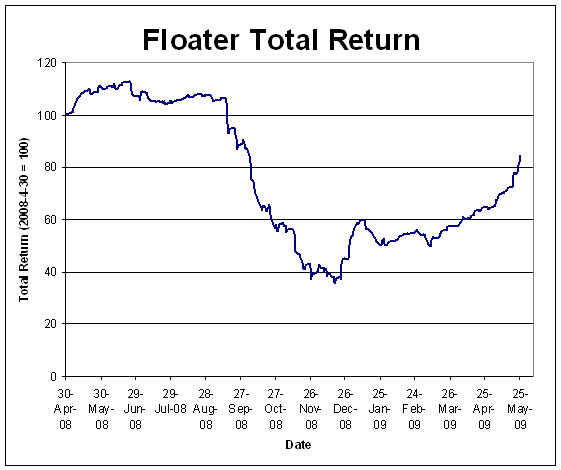
Category: Market Action

Market Action

September 24, 2008

Interesting news on the CDS market today … it isn’t as big as we thought:

The credit-default swap market, used to hedge against bond losses and speculate on corporate credit risk, shrank for the first time as efforts to eliminate duplicate trades cut contracts outstanding by 12 percent.

The volume of outstanding trades fell to $54.6 trillion from $62 trillion in the first half, the International Swaps and Derivatives Association said in a statement today. It was the first decline since ISDA started surveying traders in 2001.

After the March collapse of securities firm Bear Stearns Cos., 17 banks that handle about 90 percent of the trading in credit derivatives agreed to a list of initiatives to curb market risks. That included tearing up trades that offset each other, which cuts down on the day-to-day payments, paperwork and monitoring by bank staffs and reduces the potential for errors. It also may reduce the amount of capital that commercial banks are required to hold against the trades on their books.

The first stage of compression, completed Aug. 27, with the participation of 14 dealers, reduced contracts submitted on North American telecommunications companies by 56 percent, Markit Group Ltd. and Creditex Group Inc., which are processing the tear-ups, said this month. The second stage, completed Sept. 4, with 15 dealers, cut contracts on European telecommunications companies by 53 percent.

Well, PerpetualDiscount yields were recently higher (6.22% on September 18), but today’s closing bid-YTW of 6.20% was otherwise last seen on August 11 (when falling) and July 7 (6.23%, when rising). A fair bit of sloppy action today, especially with BAM.PR.K falling out of bed!

Note that these indices are experimental; the absolute and relative daily values are expected to change in the final version. In this version, index values are based at 1,000.0 on 2006-6-30.
The Fixed-Reset index was added effective 2008-9-5 at that day’s closing value of 1,119.4 for the Fixed-Floater index.
Index Mean Current Yield (at bid) Mean YTW Mean Average Trading Value Mean Mod Dur (YTW) Issues Day’s Perf. Index Value
Ratchet N/A N/A N/A N/A 0 N/A N/A
Fixed-Floater 4.69% 4.77% 81,889 15.77 6 +0.0023% 1,090.7
Floater 5.29% 5.30% 49,671 15.00 2 -5.1597% 759.9
Op. Retract 5.00% 4.90% 126,977 3.60 14 -0.2403% 1,044.9
Split-Share 5.54% 6.78% 51,274 4.31 14 -0.1431% 1,012.0
Interest Bearing 6.58% 7.53% 52,674 5.18 2 +0.1075% 1,082.7
Perpetual-Premium 6.15% 5.52% 55,613 2.18 1 +1.1952% 1,008.9
Perpetual-Discount 6.12% 6.20% 179,642 13.60 70 -0.2049% 872.4
Fixed-Reset 5.07% 4.94% 1,326,864 14.25 10 -0.0397% 1,118.1
Major Price Changes
Issue Index Change Notes
BAM.PR.K Floater -10.2353% Whoosh! Definitely not a money market vehicle! Only two trades today, 700 at 17.00 and 200 at 17.01 (looks like it was the same order on one side) and closed at the Toronto Market Maker Special Deal of 15.26-16.94, 5×2.
MFC.PR.C PerpetualDiscount -2.7979% Now with a pre-tax bid-YTW of 6.05% based on a bid of 18.76 and a limitMaturity.
IAG.PR.A PerpetualDiscount -2.4523% Now with a pre-tax bid-YTW of 6.47% based on a bid of 17.90 and a limitMaturity.
ELF.PR.G PerpetualDiscount -2.1084% Now with a pre-tax bid-YTW of 7.49% based on a bid of 16.25 and a limitMaturity.
BAM.PR.I OpRet -1.9592% Now with a pre-tax bid-YTW of 6.41% based on a bid of 24.02 and softMaturity 2013-12-30 at 25.00. Compare with BAM.PR.H (6.75% to 2012-3-30), BAM.PR.J (6.28% to 2018-3-30) and BAM.PR.O (8.18% to 2013-6-30).
BMO.PR.J PerpetualDiscount -1.8240% Now with a pre-tax bid-YTW of 6.23% based on a bid of 18.30 and a limitMaturity.
SLF.PR.E PerpetualDiscount -1.7838% Now with a pre-tax bid-YTW of 6.23% based on a bid of 18.17 and a limitMaturity.
FTN.PR.A SplitShare -1.5152% Asset coverage of just under 2.2:1 as of September 15 according to the company. Now with a pre-tax bid-YTW of 5.78% based on a bid of 9.75 and a limitMaturity.
CM.PR.A OpRet -1.5116% Now with a pre-tax bid-YTW of 5.03% based on a bid of 25.41 and a softMaturity 2011-7-30 at 25.00.
BNA.PR.A SplitShare -1.3821% Asset coverage of 3.2+:1 as of August 31 according to the company. Coverage now of 2.6+:1 based on BAM.A at 27.40 and 2.4 BAM.A held per preferred. Now with a pre-tax bid-YTW of 8.10% based on a bid of 24.26 and a hardMaturity 2010-9-30 at 25.00. Compare with BNA.PR.B (9.70% to 2016-3-25) and BNA.PR.C (10.57% to 2019-1-10).
SLF.PR.C PerpetualDiscount -1.2931% Now with a pre-tax bid-YTW of 6.11% based on a bid of 18.32 and a limitMaturity.
SLF.PR.D PerpetualDiscount -1.2500% Now with a pre-tax bid-YTW of 6.16% based on a bid of 18.17 and a limitMaturity.
TD.PR.O PerpetualDiscount -1.1893% Now with a pre-tax bid-YTW of 5.94% based on a bid of 20.77 and a limitMaturity.
SLF.PR.A PerpetualDiscount -1.1651% Now with a pre-tax bid-YTW of 6.13% based on a bid of 19.51 and a limitMaturity.
BNA.PR.C SplitShare -1.1465% See BNA.PR.A, above.
SLF.PR.B PerpetualDiscount -1.1039% Now with a pre-tax bid-YTW of 6.13% based on a bid of 19.71 and a limitMaturity.
BAM.PR.M PerpetualDiscount +1.8622% Now with a pre-tax bid-YTW of 7.29% based on a bid of 16.41 and a limitMaturity.
FFN.PR.A SplitShare +2.0408% Asset coverage of just under 1.8:1 as of September 15 according to the company. Now with a pre-tax bid-YTW of 6.35% based on a bid of 9.50 and a hardMaturity 2014-12-1 at 10.00.
CM.PR.P PerpetualDiscount +2.0659% Now with a pre-tax bid-YTW of 6.76% based on a bid of 20.75 and a limitMaturity.
Volume Highlights
Issue Index Volume Notes
BAM.PR.O SplitShare 285,143 CIBC crossed 213,600 at 21.90, bought 16,300 at that price from Nesbitt, then another 40,000 at the same price from anonymous. See BAM.PR.I, above.
RY.PR.B PerpetualDiscount 268,630 Nesbitt crossed 260,000 at 19.45. Now with a pre-tax bid-YTW of 6.14% based on a bid of 19.40 and a limitMaturity.
GWO.PR.G PerpetualDiscount 205,750 Nesbitt crossed 200,000 at 21.50. Now with a pre-tax bid-YTW of 6.09% based on a bid of 21.50 and a limitMaturity.
PWF.PR.G PerpetualDiscount 181,800 TD crossed 180,000 at 24.50. Now with a pre-tax bid-YTW of 6.14% based on a bid of 24.40 and a limitMaturity.
NA.PR.K PerpetualDiscount 109,170 Nesbitt crossed 107,000 at 23.75. Now with a pre-tax bid-YTW of 6.25% based on a bid of 23.71 and a limitMaturity.

There were twenty-two other index-included $25-pv-equivalent issues trading over 10,000 shares today

Market Action

September 23, 2008

The drive to send the CDS market to London and Dubai continues, with Christopher Cox of the SEC jumping on the bandwagon:

U.S. Securities and Exchange Commission Chairman Christopher Cox said Congress should grant authority to regulate the credit-default swaps market amid concern the bets are helping fuel the global financial crisis.

Lawmakers should “provide in statute the authority to regulate these products to enhance investor protection and ensure the operation of fair and orderly markets,” Cox told the Senate Banking Committee today at a hearing in Washington.

Cox today said investors who buy swaps without owning the underlying debt may be similar to naked short sellers who sell stocks they don’t own or borrow. Such short sales can flood the market and illegally drive down stocks.

Similar to naked shorts of stocks? Well … hasn’t that been obvious from the beginning? The mechanics of CDSs have been discussed on PrefBlog; Mr. Cox’s full remarks have been posted at the SEC site.

The theory that Sarbanes-Oxley makes the US capital markets less attractive is one to which I subscribe; but there is a column on VoxEU by Craig Doidge, George Andrew Karolyi and Rene M. Stulz that takes the opposite view:

In a recent paper, we examined the 59 firms that deregistered in the six months after Rule 12h-6 was adopted.1 Our analysis shows that deregistering firms have poor growth opportunities and experienced poor stock return performance over a number of years before deregistration. Compared to other foreign firms cross-listed on US exchanges, deregistering firms also have a significantly lower “cross-listing premium”, the valuation difference between cross-listed firms and their home-market counterparts, and this lower cross-listing premium cannot be explained by an adverse impact of Sarbanes-Oxley.

Overall, the evidence supports the hypothesis that foreign firms list shares in the US in order to raise capital at the lowest possible cost to finance growth opportunities and that, when those opportunities disappear, a US listing becomes less valuable to corporate insiders, so such firms are more likely to deregister and go home.

I’m not sure that the Sarbanes-Oxley is as easily excused as all that. I quite agree that companies will – in general – make a rational investment choice when listing in the US and will leave when the costs outweigh the benefits. If Sarbanes-Oxley is a cost, however, a decision to leave becomes more likely. More insidiously, and much harder to examine in an academically satisfactory way, is the initial decision to list.

For example, Marsh Carter of the NYSE stated in 2006:

Finally, foreign companies are unquestionably concerned about the costs and added regulatory burdens associated with the U.S. regulation, including Sarbanes-Oxley.

Indeed, one of the underlying motivations for companies listing in the U.S. is the increase in value – which averages about 30 percent — that accrues as a result of adhering to the high standards of governance that the U.S. markets demand. But companies are increasingly viewing the costs associated with these regulatory requirements, as well as their impact on the speed with which they can reach the market, as outweighing the valuation premium they offer. The way that the requirements of Section 404 were implemented is perceived to have resulted in substantial cost and duplication of effort that has caused international companies to conclude that the additional costs of our regulatory structure outweigh the benefits.

When the London Stock Exchange surveyed 80 international companies that conduced IPOs on its market, it reported that 90 percent of the companies that had listed on the LSE felt that the demands of U.S. corporate governance rules made listing in London more attractive. The Wall Street Journal recently reported that small U.S. companies are turning to London’s small-cap market, AIM, for a variety of reasons, including the regulatory costs of going public. The article noted that “one of the reasons most commonly cited is the strain of Sarbanes-Oxley regulations in the [United S]tates.”

Also in VoxEU, Jeffrey Frankel wants a piece of the bank action, not just Bagehot:

What Mallaby calls the core insight is also the crux of Krugman’s logic (“Cash for Trash”):

“…the financial system needs more capital. And if the government is going to provide capital to financial firms, it should get what people who provide capital are entitled to – a share in ownership, so that all the gains if the rescue plan works don’t go to the people who made the mess in the first place.”

This follows a call by Charles W. Calomiris for preferred stock buys rather than loans:

Instead of buying toxic assets, the US government should buy preferred stock capital in ailing banks that could raise matching private sector equity. This would avoid the intractable problems of how the government should value the toxic assets and directly address the banks’ immediate problem – a lack of bank capital.

I like that idea a lot better. Look, a lot of the problem here is simply that sub-prime paper is not being rationally priced and the owners are being forced to mark to market. I recently noted that Moody’s is projecting a 22% loss on 2006 vintage mortgages. As I have discussed at length, the AAA portion of subprime debt is subordinated by roughly 20% (the precise amount will depend on the deal). So, OK, the mezzanine and equity portions have been wiped out … but the AAA tranches are only a little impaired. But as was noted by the OECD paper previously discussed, the mark-to-market on these things is a discount of 14%!

I suggest that banks do not want to sell paper worth $98 for only $86. They want to hoard their cash, let the paper run off gradually, and get their $98. So they won’t want to sell to Treasury at “market price” and Treasury will not – politically – be able to come close to “intrinsic value”. Stand off. To fix the problem in a Bagehotish sort of way, allow the banks term financing at Fed Funds + 100bp … which is the old discount window + 50bp, and the new discount window + 75bp. This is similar to the preferred stock idea of Calomiris, but gets the capital threat to Treasury more deeply subordinated, particularly if there’s a nice stiff haircut in the loan value.

CEBS has released a rather bureaucratic Statement on the Current Crisis Situation with the main points (bolded in the original):

  • In our view, banks’ exposures to Lehman Brothers are manageable and mostly non-material, compared to the banks’ total assets and capital base.
  • With respect to EU banks’ exposures on AIG: given the US government support provided to AIG, EU bank supervisors view that this counterparty risk can be sufficiently mitigated for the moment.

So we can all sleep better at night. C-EBS has spoken!

James Hamilton of Econbrowser makes an interesting point regarding Monday’s spike in oil prices:

The most striking thing about yesterday’s oil prices was the disparity between different futures contracts. The October contract, which expired yesterday, did indeed settle at $120.92, up more than $16. But oil for delivery in November closed at $109.27, an increase of only $6.62, and longer-forward contracts saw an even more modest increase. Unquestionably what was going on was a short squeeze, in which traders who had sold the October contract short were scrambling to close out their positions before expiration, and having a hard time finding people willing to take the other side.

I’m guessing that part of the answer must be that some of these operators were following rules of thumb which usually work just fine in a properly functioning market, and weren’t alert to the profit opportunities at hand. I certainly would not expect a discrepancy of this magnitude to persist for as long as 24 hours.

But another possibility that suggests itself is some degree of local monopoly power in the Cushing market. If you’re selling that $121 October oil, you might not be anxious to cook the golden goose by bringing any extra oil to the temporarily thirsty market. This might be a reasonable case for the FTC and CFTC to investigate the mechanics of exactly what happened yesterday.

PerpetualDiscounts were off a bit today on average volume. The excitement of the day was Nesbitt’s crosses of BCE issues – some of them usually very sleepy traders.

Note that these indices are experimental; the absolute and relative daily values are expected to change in the final version. In this version, index values are based at 1,000.0 on 2006-6-30.
The Fixed-Reset index was added effective 2008-9-5 at that day’s closing value of 1,119.4 for the Fixed-Floater index.
Index Mean Current Yield (at bid) Mean YTW Mean Average Trading Value Mean Mod Dur (YTW) Issues Day’s Perf. Index Value
Ratchet N/A N/A N/A N/A 0 N/A N/A
Fixed-Floater 4.69% 4.77% 77,965 15.78 6 -0.1530% 1,090.7
Floater 5.00% 5.01% 48,092 15.49 2 -1.3746% 801.2
Op. Retract 4.99% 4.68% 122,680 3.42 14 +0.0718% 1,047.4
Split-Share 5.53% 6.72% 51,553 4.32 14 -0.4710% 1,013.4
Interest Bearing 6.59% 7.55% 53,596 5.18 2 -1.0366% 1,081.5
Perpetual-Premium 6.23% 6.06% 57,480 2.17 1 +0.1996% 997.0
Perpetual-Discount 6.11% 6.18% 180,055 13.62 70 -0.1222% 874.2
Fixed-Reset 5.06% 4.93% 1,361,337 14.26 10 +0.0202% 1,118.5
Major Price Changes
Issue Index Change Notes
BAM.PR.B Floater -2.8144%  
BSD.PR.A InterestBearing -2.7778% Asset coverage of just under 1.5:1 as of September 19 according to Brookfield Funds. Now with a pre-tax bid-YTW of 8.64% based on a bid of 8.75 and a hardMaturity 2015-3-31 at 10.00.
POW.PR.D PerpetualDiscount -2.5373% Now with a pre-tax bid-YTW of 6.40% based on a bid of 19.59 and a limitMaturity.
BNA.PR.B SplitShare -2.2564% Asset coverage of 3.2+:1 as of August 31 according to the company. Coverage now of just under 2.7:1 based on BAM.A at 27.84 and 2.4 BAM.A held per preferred. Now with a pre-tax bid-YTW of 9.56% based on a bid of 19.06 and a hardMaturity 2016-3-25 at 25.00. Compare with BNA.PR.A (7.33% to 2010-9-30) and BNA.PR.C (10.41% to 2019-1-10).
BCE.PR.Z FixFloat -2.1658%  
BNA.PR.C SplitShare -1.8750% See BNA.PR.B, above.
IAG.PR.A PerpetualDiscount -1.6086% Now with a pre-tax bid-YTW of 6.31% based on a bid of 18.35 and a limitMaturity.
HSB.PR.C PerpetualDiscount -1.2683% Now with a pre-tax bid-YTW of 6.34% based on a bid of 20.24 and a limitMaturity.
CIU.PR.A PerpetualDiscount -1.2339% Now with a pre-tax bid-YTW of 6.06% based on a bid of 19.21 and a limitMaturity.
DFN.PR.A SplitShare -1.0132% Asset coverage of just under 2.3:1 as of September 15, according to the company. Now with a pre-tax bid-YTW of 5.80% based on a bid of 9.77 and a hardMaturity 2014-12-1 at 10.00.
GWO.PR.I PerpetualDiscount +1.0609% Now with a pre-tax bid-YTW of 6.26% based on a bid of 18.10 and a limitMaturity.
BMO.PR.H PerpetualDiscount +1.4520% Now with a pre-tax bid-YTW of 6.20% based on a bid of 21.66 and a limitMaturity.
BCE.PR.R FixFloat +1.5833%  
Volume Highlights
Issue Index Volume Notes
BCE.PR.D Scraps (would be Ratchet but there are volume concerns) 405,000 Nesbitt crossed 395,000 at 25.50.
BCE.PR.B Scraps (would be Ratchet but there are volume concerns) 326,500 Nesbitt crossed 325,500 at 24.99.
BCE.PR.R FixFloat 200,800 Nesbitt crossed 200,000 at 24.38
BCE.PR.Y Ratchet 60,278 Nesbitt crossed 59,000 at 24.80.
BCE.PR.A FixFloat 56,425 Nesbitt crossed 47,500 at 24.65
BAM.PR.O OpRet 55,400 CIBC crossed 40,400 at 22.00. Now with a pre-tax bid-YTW of 8.40% based on a bid of 21.75 and optionCertainty 2013-6-30 at 25.00. Compare with BAM.PR.H (6.74% to 2012-3-30), BAM.PR.I (5.97% to 2013-12-30) and BAM.PR.J (6.28% to 2018-3-30).
RY.PR.I FixedReset 53,398  

There were twenty-two other index-included $25-pv-equivalent issues trading over 10,000 shares today

Market Action

September 22, 2008

Morgan Stanley and Goldman Sachs are turning into banks; on September 16 I said:

I suspect that all this will change; in ten years, says I, all the global Large Complex Financial Institutions will be banks with access to multiple discount windows.

Sometimes things move faster than you think! The Bank of England published a list of their selected LCFIs … all banks now, or bust, every one. Although some of those players might no longer qualify as sufficiently large for the A list!

Accrued Interest calls for more regulation of CDSs, repeating his call for exchange trading, standardizing contracts and increasing margin requirements. While I agree that margin requirements are in order – with the regulators demanding that such-and-such margin be put up, or the equivalent is deducted from capital – I’m not entirely sure he’s right about the implications:

Increasing collateral requirements would force protection buyers to be more judicious about which names they short.

Now, it seems to me that if I buy protection with a five-year CDS at 500bp, my maximum loss is 25% of notional, and that’s in gross dollars, not present value. If I sell protection, my maximum loss is 100% of notional. It seems to me that any rational margining requirement is going to force protection sellers to be more judicious about which names they go long; the same will also work out relative to current reality, since a large part of the problem is that protection buyers have been relatively powerless hedge funds, while sellers have been insurers – who were enabled to put on massive leverage due the their policy of not doing the deal if they had to put up collateral.

Naked Capitalism reprints a report that New York State is moving into CDS regulation, presumably in an effort to drive all the business to London or Dubai.

A quiet day, although there were a few violent price moves. PerpetualDiscounts eked out a small gain.

Note that these indices are experimental; the absolute and relative daily values are expected to change in the final version. In this version, index values are based at 1,000.0 on 2006-6-30.
The Fixed-Reset index was added effective 2008-9-5 at that day’s closing value of 1,119.4 for the Fixed-Floater index.
Index Mean Current Yield (at bid) Mean YTW Mean Average Trading Value Mean Mod Dur (YTW) Issues Day’s Perf. Index Value
Ratchet N/A N/A N/A N/A 0 N/A N/A
Fixed-Floater 4.69% 4.75% 76,525 15.79 6 +0.4252% 1,092.4
Floater 4.93% 4.93% 47,936 15.62 2 -0.1479% 812.4
Op. Retract 4.99% 4.74% 121,316 3.42 14 -0.1266% 1,046.7
Split-Share 5.50% 6.64% 51,489 4.33 14 -0.6815% 1,018.2
Interest Bearing 6.52% 7.35% 54,023 5.20 2 -0.3172% 1,092.8
Perpetual-Premium 6.24% 6.15% 57,941 2.18 1 +0.0000% 995.0
Perpetual-Discount 6.10% 6.17% 181,364 13.63 70 +0.0474% 875.2
Fixed-Reset 5.07% 4.93% 1,392,623 14.26 9 +0.0402% 1,118.3
Major Price Changes
Issue Index Change Notes
ELF.PR.F PerpetualDiscount -3.5676% Now with a pre-tax bid-YTW of 7.50% based on a bid of 18.11 and a limitMaturity.
BMO.PR.H PerpetualDiscount -2.7778% Now with a pre-tax bid-YTW of 6.29% based on a bid of 21.35 and a limitMaturity.
FFN.PR.A SplitShare -2.3109% Asset coverage of just under 1.8:1 as of September 15, according to the company. Now with a pre-tax bid-YTW of 6.76% based on a bid of 9.30 and a hardMaturity 2014-12-1 at 10.00.
WFS.PR.A SplitShare -2.1164% Asset coverage of just under 1.6:1 as of September 11 according to Mulvihill. Now with a pre-tax bid-YTW of 8.36% based on a bid of 9.25 and a hardMaturity 2011-6-30 at 10.00.
LBS.PR.A SplitShare -1.5000% Asset coverage of just under 2.0:1 as of September 18, according to Brompton Group. Now with a pre-tax bid-YTW of 5.85% based on a bid of 9.85 and a hardMaturity 2013-11-29 at 10.00.
ELF.PR.G PerpetualDiscount -1.4793% Now with a pre-tax bid-YTW of 7.30% based on a bid of 16.95 and a limitMaturity.
LFE.PR.A SplitShare -1.1964% Asset coverage of 2.3+:1 as of September 15 according to the company. Now with a pre-tax bid-YTW of 5.60% based on a bid of 9.91 and a hardMaturity 2012-12-1 at 10.00.
BAM.PR.J OpRet -1.0526% Now with a pre-tax bid-YTW of 6.27% based on a bid of 23.50 and a softMaturity 2018-3-30 at 25.00. Compare with BAM.PR.H (6.73% to 2012-3-30), BAM.PR.I (5.89% to 2013-12-30) and BAM.PR.O (8.49% to 2013-6-30).
DFN.PR.A SplitShare -1.0030% Asset coverage of just under 2.3:1 as of September 15, according to the company. Now with a pre-tax bid-YTW of 5.60% based on a bid of 9.87 and a hardMaturity 2014-12-1 at 10.00.
PWF.PR.E PerpetualDiscount +1.1739% Now with a pre-tax bid-YTW of 5.97% based on a bid of 23.27 and a limitMaturity.
HSB.PR.C PerpetualDiscount +1.4349% Now with a pre-tax bid-YTW of 6.26% based on a bid of 20.50 and a limitMaturity.
CIU.PR.A PerpetualDiscount +2.3684% Now with a pre-tax bid-YTW of 5.98% based on a bid of 19.45 and a limitMaturity.
BCE.PR.Z FixFloat +2.8266%  
IAG.PR.A PerpetualDiscount +5.0704% Now with a pre-tax bid-YTW of 6.20% based on a bid of 18.65 and a limitMaturity. You know, in HIMIPref™ I calculate a value named flatBidPriceVolatility. This issue has the highest such value of any index-included issue, second only to HPF.PR.B in the universe. I’d love to know who the market maker is, but the TSX keeps this information secret.
Volume Highlights
Issue Index Volume Notes
BNS.PR.M PerpetualDiscount 55,800 National Bank crossed 50,000 at 19.77. Now with a pre-tax bid-YTW of 5.79% based on a bid of 19.76 and a limitMaturity.
NA.PR.L PerpetualDiscount 39,500 National Bank crossed 20,000 at 20.10, then another 15,000 at 20.12. Now with a pre-tax bid-YTW of 6.14% based on a bid of 20.06 and a limitMaturity.
RY.PR.I FixedReset 34,218  
BNS.PR.R FixedReset 29,660  
BCE.PR.A FixedFloater 22,655 CIBC crossed 20,400 at 24.76.

There were twelve other index-included $25-pv-equivalent issues trading over 10,000 shares today.

Market Action

September 19, 2008

The previously scheduled end of the world has been postponed.

Accrued Interest foresees a period of intense confusion:

Bonds are highly illiquid right now. Even Treasuries are showing unusual bid/ask spreads. There are many many many players who are going to be caught on the wrong side of this thing.

Some hedge funds are going to get crushed. I mean, anyone who was leveraged short financials may wind up getting busted out. That will result in some weird trading in seemingly unrelated instruments.

The Reserve Primary Fund buck-breaking has caused a huge onslaught of MMF redemptions:

Confidence in money-market funds was shaken this week when Reserve Primary Fund became the first in 14 years that failed to repay investors in full because of losses on debt issued by Lehman Brothers Holdings Inc. Investors responded by pulling a record $89.2 billion from funds on Sept. 17, according to data compiled by the Money Fund Report, a newsletter based in Westborough, Massachusetts. That equaled 2.6 percent of industry assets.

… and so Treasury is writing CDSs on Money Market Instruments:

The U.S. Treasury Department today announced the establishment of a temporary guaranty program for the U.S. money market mutual fund industry. For the next year, the U.S. Treasury will insure the holdings of any publicly offered eligible money market mutual fund – both retail and institutional – that pays a fee to participate in the program.

This is wild. I’m going to have to think about it a little more … but will this lead to a new financial industry? In which CP that’s issued will not only have bank-lines guaranteeing liquidity, but CDSs guaranteeing credit? Maybe this will be a good replacement business for the currently unfashionable municipal bond insurance game!

The American Bankers’ Association is upset because the Treasury move undercuts their FDIC advantage:

“Today’s action will undermine the role of banks during this current crisis and has the potential to have an extremely negative impact,” [ABA CEO Edward] Yingling said in the statement. “Our bankers are, understandably, very upset.”

Banks compete with money funds by offering accounts that are already covered by the Federal Deposit Insurance Corp. The extra margin of safety gives banks a competitive advantage with some consumers who want to avoid any chance of losses. Money- market funds hold about $3.35 trillion in assets.

Maybe that’s what will happen … MMFs will have to sign up with the FDIC / CDIC and all the other deposit guarantors, fill out all those forms and pay the insurance fees, and hire ex-regulators at fat salaries (only the smartest and most knowledgable ones, of course). Maybe they’ll even have to keep some capital with the fund to absorb losses and maintain capital and leverage ratios – and show the MER as a P&L item. Investor advocates will doubtless consider this a step forward. Because then everybody will get free money, right? Extra return without the slightest scrap of risk or necessity of thought is a fundamental human right, isn’t it?

Mind you, I’m not disagreeing with the Treasury move. Clearly, redemptions on the scale reported will have a long term negative effect and a short-term horrific effect … all the usual sales conduits busted, liquidity guarantees exercised, bank balance sheets bloating, the discount window getting a workout to finance the bloat … the move seems to me to be the lesser of the two evils.

And – as I have often said – the ultimate cause of the credit crunch is that there is a lot more demand for short-term investments than there is supply; which has led the industry to create pretend-short-term paper. Heightened uncertainty about the long-term ability to finance short-term will have effects that I’m going to have to think through carefully, but are guaranteed to be … interesting.

Sorry this report is late. I was up all night typing up the list of big winners! … No, I cannot tell a lie. I went home early and was asleep by 9pm and am now bright-eyed, bushy-tailed and eager to find out who goes bust next week.

Note that these indices are experimental; the absolute and relative daily values are expected to change in the final version. In this version, index values are based at 1,000.0 on 2006-6-30.
The Fixed-Reset index was added effective 2008-9-5 at that day’s closing value of 1,119.4 for the Fixed-Floater index.
Index Mean Current Yield (at bid) Mean YTW Mean Average Trading Value Mean Mod Dur (YTW) Issues Day’s Perf. Index Value
Ratchet N/A N/A N/A N/A 0 N/A N/A
Fixed-Floater 4.70% 4.77% 76,082 15.77 6 +1.0160% 1,087.8
Floater 4.93% 4.93% 48,709 15.64 2 +0.8445% 813.6
Op. Retract 4.98% 4.67% 122,328 3.43 14 +0.2857% 1,048.0
Split-Share 5.46% 6.44% 51,752 4.34 14 +2.6135% 1,025.2
Interest Bearing 6.50% 7.28% 54,209 5.21 2 +2.5011% 1,096.3
Perpetual-Premium 6.24% 6.13% 58,889 2.18 1 +0.2000% 995.0
Perpetual-Discount 6.09% 6.17% 182,722 13.63 70 +0.6906% 874.8
Fixed-Reset 5.07% 4.93% 1,429,945 14.27 9 +0.2524% 1,117.8
Major Price Changes
Issue Index Change Notes
IAG.PR.A PerpetualDiscount -2.5261% Now with a pre-tax bid-YTW of 6.52% based on a bid of 17.75 and a limitMaturity.
CM.PR.E PerpetualDiscount +1.0427% Now with a pre-tax bid-YTW of 6.69% based on a bid of 21.32 and a limitMaturity.
SLF.PR.B PerpetualDiscount +1.1687% Now with a pre-tax bid-YTW of 6.06% based on a bid of 19.91 and a limitMaturity.
CM.PR.P PerpetualDiscount +1.1840% Now with a pre-tax bid-YTW of 6.84% based on a bid of 20.51 and a limitMaturity.
SLF.PR.C PerpetualDiscount 1.3767% Now with a pre-tax bid-YTW of 6.08% based on a bid of 18.41 and a limitMaturity.
W.PR.J PerpetualDiscount +1.4178% Now with a pre-tax bid-YTW of 6.67% based on a bid of 21.46 and a limitMaturity.
CM.PR.I PerpetualDiscount +1.4221% Now with a pre-tax bid-YTW of 6.72% based on a bid of 17.83 and a limitMaturity.
SLF.PR.E PerpetualDiscount +1.4803% Now with a pre-tax bid-YTW of 6.11% based on a bid of 18.51 and a limitMaturity.
SLF.PR.D PerpetualDiscount +1.5470% Now with a pre-tax bid-YTW of 6.09% based on a bid of 18.38 and a limitMaturity.
GWO.PR.I PerpetualDiscount +1.5954% Now with a pre-tax bid-YTW of 6.35% based on a bid of 17.83 and a limitMaturity.
CM.PR.H PerpetualDiscount +1.6375% Now with a pre-tax bid-YTW of 6.80% based on a bid of 18.00 and a limitMaturity.
ENB.PR.A PerpetualDiscount +1.6724% Now with a pre-tax bid-YTW of 5.85% based on a bid of 23.71 and a limitMaturity.
BAM.PR.K Floater +1.7303%  
ELF.PR.G PerpetualDiscount +1.8072% Now with a pre-tax bid-YTW of 7.19% based on a bid of 16.90 and a limitMaturity.
HSB.PR.C PerpetualDiscount +2.0192% Now with a pre-tax bid-YTW of 6.34% based on a bid of 20.21 and a limitMaturity.
FBS.PR.B SplitShare +2.0364% Asset coverage of 1.5+:1 as of September 18, according to TD Securities. Now with a pre-tax bid-YTW of 6.48% based on a bid of 9.52 and a hardMaturity 2011-12-15 at 10.00.
BCE.PR.R FixFloat +2.1277%  
FIG.PR.A InterestBearing +2.1762% Asset coverage of just under 1.9:1 as of September 18, according to Faircourt. Now with a pre-tax bid-YTW of 6.54% (mostly as interest) based on a bid of 9.86 and a hardMaturity 2014-12-31 at 10.00.
BAM.PR.J OpRet +2.1945% Now with a pre-tax bid-YTW of 6.12% based on a bid of 23.75 and a softMaturity 2018-3-30 at 25.00. Compare with BAM.PR.H (6.72% to 2012-3-30), BAM.PR.I (5.86% to 2013-12-30) and BAM.PR.O (8.66% to 2013-6-30).
RY.PR.W PerpetualDiscount +2.2299% Now with a pre-tax bid-YTW of 6.01% based on a bid of 20.63 and a limitMaturity.
DFN.PR.A SplitShare +2.2564% Asset coverage of just under 2.3:1 as of September 15, according to the company. Now with a pre-tax bid-YTW of 5.39% based on a bid of 9.97 and a hardMaturity 2014-12-1 at 10.00.
CM.PR.D PerpetualDiscount +2.3721% Now with a pre-tax bid-YTW of 6.64% based on a bid of 22.01 and a limitMaturity.
SBC.PR.A SplitShare +2.3760% Asset coverage of just under 2.0:1 as of September 18 according to Brompton Group. Now with a pre-tax bid-YTW of 5.79% based on a bid of 9.91 and a limitMaturity.
LBS.PR.A SplitShare +2.4590% Asset coverage of just under 2.0:1 as of September 18, according to Brompton Group. Now with a pre-tax bid-YTW of 5.50% based on a bid of 10.00 and a hardMaturity 2013-11-29 at 10.00.
BSD.PR.A InterestBearing +2.8571% Asset coverage of just under 1.5:1 as of September 12, according to Brookfield Funds. Now with a pre-tax bid-YTW of 8.08% (mostly as interest) based on a bid of 9.00 and a hardMaturity 2015-3-31 at 10.00.
BAM.PR.K Floater +2.8221%  
PWF.PR.E PerpetualDiscount +2.8623% Now with a pre-tax bid-YTW of 6.04% based on a bid of 23.00 and a limitMaturity.
POW.PR.C PerpetualDiscount +2.9320% Now with a pre-tax bid-YTW of 6.38% based on a bid of 23.17 and a limitMaturity.
BCE.PR.G FixFloat +2.9601%  
CM.PR.G PerpetualDiscount +2.9728% Now with a pre-tax bid-YTW of 6.85% based on a bid of 20.09 and a limitMaturity.
POW.PR.A PerpetualDiscount +3.5895% Now with a pre-tax bid-YTW of 6.34% based on a bid of 22.51 and a limitMaturity.
ELF.PR.F PerpetualDiscount +4.1020% Now with a pre-tax bid-YTW of 7.22% based on a bid of 18.78 and a limitMaturity.
FFN.PR.A SplitShare +4.5005% Asset coverage of just under 1.8:1 as of September 15, according to the company. Now with a pre-tax bid-YTW of 6.29% based on a bid of 9.52 and a hardMaturity 2014-12-1 at 10.00.
ALB.PR.A SplitShare +4.6067% Asset coverage of 1.6+:1 as of September 18, according to Scotia. Now with a pre-tax bid-YTW of 6.04% based on a bid of 24.07 and a hardMaturity 2011-2-28 at 25.00.
WFS.PR.A SplitShare +4.8835% Asset coverage of just under 1.6:1 as of September 11 according to Mulvihill. Now with a pre-tax bid-YTW of 7.15% based on a bid of 9.45 and a hardMaturity 2011-6-30 at 10.00.
BNA.PR.C SplitShare +5.5227% Asset coverage of 3.2+:1 as of August 29 according to the company. Now with a pre-tax bid-YTW of 10.10% based on a bid of 16.05 and a hardMaturity 2019-1-10 at 25.00. Compare with BNA.PR.A (7.48% to 2010-9-30) and BNA.PR.B (9.15% to 2019-1-10). Note that, given 2.4 shares of BAM.A per BNA preferred and a price of 28.63 on BAM.A, asset coverage is now 2.7+:1.
BNA.PR.B SplitShare +6.7908% See BNA.PR.C, above
Volume Highlights
Issue Index Volume Notes
RY.PR.I FixedReset 64,551 CIBC bought 20,00 from Nesbitt at 24.95.
PWF.PR.H PerpetualDiscount 98,969 CIBC crossed 41,700 at 24.22. Now with a pre-tax bid-YTW of 6.04% based on a bid of 24.16 and a limitMaturity.
BNS.PR.M PerpetualDiscount 29,486 Anonymous bought 18,600 from TD at 19.76. Now with a pre-tax bid-YTW of 5.79% based on a bid of 19.76 and a limitMaturity.
NA.PR.K PerpetualDiscount 27,366 Now with a pre-tax bid-YTW of 6.22% based on a bid of 23.80 and a limitMaturity.
SLF.PR.A PerpetualDiscount 22,480 Anonymous bought 16,100 from Nesbitt at 19.75. Now with a pre-tax bid-YTW of 6.05% based on a bid of 19.74 and a limitMaturity.

There were sixteen other index-included $25-pv-equivalent issues trading over 10,000 shares today.

Market Action

September 18, 2008

The FDIC is working a bit of overtime sorting out the situation with bank holdings of FannieFreddie prefs:

The Federal Deposit Insurance Corporation (FDIC) will work with the limited number of institutions that have significant holdings of common or perpetual preferred shares in Fannie Mae and Freddie Mac to develop Capital Restoration Plans pursuant to federal regulations. These equity investments should be reported as available-for-sale equity securities, if not held for trading purposes, and any net unrealized losses should be deducted from regulatory capital. Attached is the FDIC’s “Statement on Investments in Fannie Mae and Freddie Mac Equity Securities.”

There’s rather a disturbing quote from John McCain:

LAUER: So if we get to the point middle of the week as we heard in that report where AIG might have to file for bankruptcy, they’re on their own?
McCAIN: Well…quote, “on their own”…we have to – we cannot have the taxpayers bail out AIG or anybody else…this is something we’re gonna have to work through — there’s too much corruption, there’s too much access, we can fix it, I believe in America – we can have a 9/11 commission such as we had after 9/11, ’cause this is a huge crisis and we can come up with fixes and we can make sure that every American has a safer future and that is to make them know that their bank deposits are safe and insured.

The disturbing part is “corruption”. “Corruption” implies criminality. There is a huge difference between ‘investments that didn’t work out’ and ‘incompetence and recklessness’ and ‘corruption’. If the next President approaches the issue of regulation of the financial sector with the idea that it was – somewhere, perhaps unprovable, but somewhere – widescale criminality that caused the current crunch, the economy’s in trouble. Sarbanes-Oxley has had a bad enough effect; a reprise will simply accellerate the slow erosion of New York as the world’s premier financial centre.

Reserve Primary Fund broke the buck on September 16; related events and reverberations are wild. State Street & BONY Mellon got hammered:

State Street Corp. fell as much as 55 percent and Federated Investors Inc. and Bank of New York Mellon Corp. declined in New York trading on concerns that money-market funds will be hit by a wave of losses.

The stocks plunged after BNY Mellon said a $22 billion institutional fund suffered losses on debt issued by bankrupt Lehman Brothers Holdings Inc. While not a money-market fund, BNY Mellon’s $22 billion Institutional Cash Reserves was designed to work like one.

.
Dealbreaker is amused.

And Putnam is closing down a huge fund:

Putnam Investments LLC closed its $12.3 billion institutional Putnam Prime Money Market Fund yesterday and plans to return all cash to investors.

The fund, which was valued yesterday at $1 a share, experienced “significant redemption pressure,” the Boston- based company said in a statement. A drop below $1 a share, known as breaking the buck, would have exposed investors to losses.

I discussed this issue – a bit – in my essay A Collateral Proposal, but I’m still having some trouble understanding it. Money market funds invest in commercial paper, not just T-Bills. This is because Commercial Paper pays more. It pays more due to both liquidity concerns and credit concerns. Credit Concerns! Occasionally, there will be a loss. If the Portfolio Manager is doing his job right, these losses will be few and far between; but there will be losses. That’s why you get paid extra!

So a loss of 1-2% on a money market fund is unpleasant, sure, but I’m afraid I just don’t understand why it’s the end of the world.

Another crummy day for prefs, and we can no longer talk about a yield curve. It’s more of a yield smudge, a yield Rorschach (pronounced “Raw-Shock”). Today’s closing average bid-YTW of 6.22% was seen on August 8 (moving down) and July 7 (moving up). The peak, remember, was 6.63%.

Note that these indices are experimental; the absolute and relative daily values are expected to change in the final version. In this version, index values are based at 1,000.0 on 2006-6-30.
The Fixed-Reset index was added effective 2008-9-5 at that day’s closing value of 1,119.4 for the Fixed-Floater index.
Index Mean Current Yield (at bid) Mean YTW Mean Average Trading Value Mean Mod Dur (YTW) Issues Day’s Perf. Index Value
Ratchet N/A N/A N/A N/A 0 N/A N/A
Fixed-Floater 4.75% 4.83% 76,269 15.71 6 -0.4182% 1,076.8
Floater 4.97% 4.97% 49,469 15.57 2 +1.4430% 806.8
Op. Retract 5.00% 4.73% 124,324 3.43 14 -0.1633% 1,045.0
Split-Share 5.60% 7.10% 51,046 4.32 14 -1.4028% 999.1
Interest Bearing 6.66% 7.75% 54,179 5.19 2 -0.3681% 1,069.6
Perpetual-Premium 6.25% 6.21% 57,419 2.19 1 +0.0000% 993.0
Perpetual-Discount 6.14% 6.22% 184,479 13.57 70 -0.4421% 868.8
Fixed-Reset 5.08% 4.94% 1,472,524 14.24 9 -0.1792% 1,115.0
Major Price Changes
Issue Index Change Notes
BNA.PR.C
BNA.PR.B
SplitShare +10.2813%
-6.3590%
Asset coverage of 3.2+:1 as of August 29 according to the company. Now with a pre-tax bid-YTW of 10.28% based on a bid of 18.26 and a hardMaturity 2016-3-25 at 25.00. Compare with BNA.PR.A (7.71% to 2010-9-30) and BNA.PR.C (10.82% to 2019-1-10). Note that, given 2.4 shares of BAM.A per BNA preferred and a price of 28.50 on BAM.A (up 3.60% from yesterday), asset coverage is now 2.7+:1. Today’s volume was 14,200 shares in a range 19.45-75. The last trade was at 2:33pm; the closing quote was 18.26-19.98, 5×5, with the market maker apparently out for coffee.
POW.PR.A PerpetualDiscount -5.5628% Now with a pre-tax bid-YTW of 6.57% based on a bid of 21.73 and a limitMaturity.
POW.PR.C PerpetualDiscount -5.2211% Now with a pre-tax bid-YTW of 6.57% based on a bid of 22.51 and a limitMaturity. Closing quote of 22.51-23.70 … another example of market-making, Toronto-style.
ALB.PR.A SplitShare -4.3243% Asset coverage of 1.7+:1 as of September 11, according to Scotia. Now with a pre-tax bid-YTW of 8.04% based on a bid of 23.01 and a hardMaturity 2011-2-28 at 25.00. Traded 12,923 shares in a range of (sit down) 21.53-24.00. Closing quote was another Toronto Special, 23.01-24.24, 2×1.
SBC.PR.A SplitShare -3.7948% Asset coverage of just under 2.1:1 as of September 11, according to Brompton Group. Now with a pre-tax bid-YTW of 6.43% based on a bid of 9.68 and a hardMaturity 2012-11-30 at 10.00.
GWO.PR.I PerpetualDiscount -3.0922% Now with a pre-tax bid-YTW of 6.45% based on a bid of 17.55 and a limitMaturity.
CM.PR.I PerpetualDiscount -2.4417% Now with a pre-tax bid-YTW of 6.81% based on a bid of 17.58 and a limitMaturity.
FFN.PR.A SplitShare -2.1482% Asset coverage of just under 1.8:1 as of September 15 according to the company. Now with a pre-tax bid-YTW of 7.15% based on a bid of 9.11 and a hardMaturity 2014-12-1 at 10.00.
BCE.PR.Z FixFloat -2.0632%  
SLF.PR.E PerpetualDiscount -2.0408% Now with a pre-tax bid-YTW of 6.20% based on a bid of 18.24 and a limitMaturity.
BCE.PR.G FixFloat -1.8526%  
FBS.PR.B SplitShare -1.7895% Asset coverage of just under 1.6:1 as of September 11, according to TD Securities. Now with a pre-tax bid-YTW of 7.16% based on a bid of 9.33 and a hardMaturity 2011-12-15 at 10.00.
POW.PR.D PerpetualDiscount -1.6859% Now with a pre-tax bid-YTW of 6.25% based on a bid of 21.50 and a limitMaturity.
CM.PR.G PerpetualDiscount -1.5144% Now with a pre-tax bid-YTW of 7.06% based on a bid of 19.51 and a limitMaturity.
HSB.PR.C PerpetualDiscount -1.4918% Now with a pre-tax bid-YTW of 6.47% based on a bid of 19.81 and a limitMaturity.
BSD.PR.A InterestBearing -1.4640% Now with a pre-tax bid-YTW of 8.62% (mostly as interest) based on a bid of 8.75 and a hardMaturity 2015-3-31 at 10.00.
PWF.PR.E PerpetualDiscount -1.3239% Now with a pre-tax bid-YTW of 6.23% based on a bid of 22.36 and a limitMaturity.
PWF.PR.K PerpetualDiscount -1.3158% Now with a pre-tax bid-YTW of 6.22% based on a bid of 20.25 and a limitMaturity.
SLF.PR.D PerpetualDiscount -1.2009% Now with a pre-tax bid-YTW of 6.18% based on a bid of 18.10 and a limitMaturity.
ELF.PR.G PerpetualDiscount -1.1905% Now with a pre-tax bid-YTW of 7.32% based on a bid of 16.60 and a limitMaturity.
RY.PR.D PerpetualDiscount -1.1579% Now with a pre-tax bid-YTW of 6.07% based on a bid of 18.78 and a limitMaturity.
TD.PR.P PerpetualDiscount -1.0725% Now with a pre-tax bid-YTW of 5.78% based on a bid of 23.06 and a limitMaturity.
RY.PR.B PerpetualDiscount -1.0204% Now with a pre-tax bid-YTW of 6.13% based on a bid of 19.40 and a limitMaturity.
GWO.PR.E OpRet -1.0133% Now with a pre-tax bid-YTW of 4.02% based on a bid of 25.40 and a call 2011-4-30 at 25.00.
CM.PR.P PerpetualDiscount +1.2488% Now with a pre-tax bid-YTW of 6.92% based on a bid of 20.27 and a limitMaturity.
BAM.PR.N PerpetualDiscount +1.7024% Now with a pre-tax bid-YTW of 7.41% based on a bid of 16.13 and a limitMaturity.
CM.PR.I PerpetualDiscount -1.4223% Now with a pre-tax bid-YTW of 6.64% based on a bid of 18.02 and a limitMaturity.
BCE.PR.R FixFloat +2.1739%  
BAM.PR.K Floater +2.8221%  
IAG.PR.A PerpetualDiscount +5.5041% Now with a pre-tax bid-YTW of 6.35% based on a bid of 18.21 and a limitMaturity.
Volume Highlights
Issue Index Volume Notes
NTL.PR.F Scraps (Would be ratchet, but there are credit concerns) 260,000 CIBC crossed blocks of 20,000 and 150,000, both at 6.00. Whoosh! Down 14.81%!
TD.PR.M OpRet 251,200 CIBC crossed 250,000 at 26.05. Now with a pre-tax bid-YTW of 4.19% based on a bid of 25.76 and a softMaturity 2013-10-30.
NTL.PR.G Scraps (would be Ratchet, but there are credit concerns) -22.0741% CIBC crossed 150,000 at 5.75. Whoooosh! Down 22.0741%!
MFC.PR.A OpRet 157,970 CIBC crossed 150,000 at 24.90. Now with a pre-tax bid-YTW of 4.05% based on a bid of 25.11 and a softMaturity 2015-12-18 at 25.00.
CM.PR.I PerpetualDiscount 123,000 Nesbitt crossed 100,000 at 17.80. Now with a pre-tax bid-YTW of 6.81% based on a bid of 17.58 and a limitMaturity.
TD.PR.O PerpetualDiscount 109,900 CIBC crossed 100,000 at 21.05. Now with a pre-tax bid-YTW of 5.86% based on a bid of 21.02 and a limitMaturity.
BMO.PR.J PerpetualDiscount 64,460 Nesbitt crossed 50,000 at 18.60. Now with a pre-tax bid-YTW of 6.12% based on a bid of 18.60 and a limitMaturity.

There were twenty-eight other index-included $25-pv-equivalent issues trading over 10,000 shares today.

Market Action

September 17, 2008

The market shows infinite capacity to surprise! We are told that today’s horror was due to credit concerns, which seems like a reasonable conclusion to draw. Most data seem consistent with this hypothesis.

So why did Fixed-Resets do so well relative to Perpetuals? Regardless of how wonderful – or not – the structure is, it addresses term risk only. Credit risk is not addressed. You have to make an awfully convoluted argument before you conclude that the relative performance of these two preferred share sub-classes is right and proper.

On the other hand, Floaters didn’t do very well. It’s a lousy sample – only two issues and both backed by BAM – but they are not money market instruments. The market always makes sense eventually. Just not right away and not all at the same time.

After today’s carnage, PerpetualDiscounts yield an average 6.18%, back to where it was on August 8 (when yields were falling; three days since the yield-trough of September 12 has undone a month of price-gains) and July 4 (when yields were rising). At the standard 1.4x equivalency factor, this is equal to 8.65% interest. Long corporates now yield 6.3%, so the pre-tax interest-equivalent spread is now about 235bp.

Note that these indices are experimental; the absolute and relative daily values are expected to change in the final version. In this version, index values are based at 1,000.0 on 2006-6-30.
The Fixed-Reset index was added effective 2008-9-5 at that day’s closing value of 1,119.4 for the Fixed-Floater index.
Index Mean Current Yield (at bid) Mean YTW Mean Average Trading Value Mean Mod Dur (YTW) Issues Day’s Perf. Index Value
Ratchet N/A N/A N/A N/A 0 N/A N/A
Fixed-Floater 4.73% 4.79% 73,960 15.74 6 -0.5447% 1,081.3
Floater 5.04% 5.04% 49,315 15.45 2 -5.5873% 795.3
Op. Retract 4.99% 4.61% 123,883 3.30 14 -0.3258% 1,046.7
Split-Share 5.52% 6.68% 49,875 4.33 14 -0.9015% 1,013.3
Interest Bearing 6.63% 7.68% 52,803 5.20 2 +0.2558% 1,073.5
Perpetual-Premium 6.25% 6.20% 57,935 2.19 1 +0.3613% 993.0
Perpetual-Discount 6.11% 6.18% 184,303 13.62 70 -0.9394% 872.7
Fixed-Reset 5.07% 4.92% 1,501,971 14.25 9 -0.1501% 1,117.0
Major Price Changes
Issue Index Change Notes
BAM.PR.K Floater -9.4444% Traded 500 shares in a range of 18.00-19.24 … but the closing quote was 16.30-18.99, 10×3. Way to go on the market making, guys!
BCE.PR.R FixFloat -4.1208% Financing jitters? See main text.
BAM.PR.K Floater -3.7948% Closing quote 18.00-69, 2×3. 1600 shares traded in the range 18.00-01 between 1:40pm and 2:18pm.
ELF.PR.F PerpetualDiscount -6.9251% Now with a pre-tax bid-YTW of 7.53% based on a bid of 18.01 and a limitMaturity.
IAG.PR.A PerpetualDiscount -6.4499% Now with a pre-tax bid-YTW of 6.70% based on a bid of 17.26 and a limitMaturity.
CM.PR.G PerpetualDiscount -4.6221% Now with a pre-tax bid-YTW of 6.95% based on a bid of 19.81 and a limitMaturity.
CM.PR.P PerpetualDiscount -4.5303% Now with a pre-tax bid-YTW of 7.00% based on a bid of 20.02 and a limitMaturity.
HSB.PR.C PerpetualDiscount -4.0553% Now with a pre-tax bid-YTW of 6.37% based on a bid of 20.11 and a limitMaturity.
CM.PR.H PerpetualDiscount -3.1488% Now with a pre-tax bid-YTW of 6.86% based on a bid of 17.84 and a limitMaturity.
DFN.PR.A SplitShare -3.0663% Asset coverage of just under 2.3:1 as of September 15, according to the company. Now with a pre-tax bid-YTW of 5.72% based on a bid of 9.80 and a hardMaturity 2014-12-1 at 10.00.
GWO.PR.I PerpetualDiscount -3.0514% Now with a pre-tax bid-YTW of 6.24% based on a bid of 18.11 and a limitMaturity.
CM.PR.D PerpetualDiscount -2.9783% Now with a pre-tax bid-YTW of 6.82% based on a bid of 21.50 and a limitMaturity.
BAM.PR.N PerpetualDiscount -2.8781% Now with a pre-tax bid-YTW of 7.54% based on a bid of 15.86 and a limitMaturity.
RY.PR.W PerpetualDiscount -2.3775% Now with a pre-tax bid-YTW of 6.17% based on a bid of 20.12 and a limitMaturity.
BAM.PR.O OpRet -2.2989% Now with a pre-tax bid-YTW of 8.94% based on a bid of 21.25 and optionCertainty 2013-6-30 at 25.00. Compare with BAM.PR.H (6.52% to 2012-3-30), BAM.PR.I (5.86% to 2013-12-30) and BAM.PR.J (6.34% to 2018-3-30).
POW.PR.B PerpetualDiscount -2.1442% Now with a pre-tax bid-YTW of 6.37% based on a bid of 21.45 and a limitMaturity.
BCE.PR.R FixFloat -2.1277%  
FFN.PR.A SplitShare -2.1030% Asset coverage of just under 1.8:1 as of September 15, 2008, according to the company. Now with a pre-tax bid-YTW of 6.72% based on a bid of 9.31 and a limitMaturity.
FBS.PR.B SplitShare -2.0619% Asset coverage of just under 1.6:1 as of September 11, according to TD Securities. Now with a pre-tax bid-YTW of 6.54% based on a bid of 9.50 and a hardMaturity 2011-12-15 at 10.00.
CM.PR.E PerpetualDiscount -2.0314% Now with a pre-tax bid-YTW of 6.72% based on a bid of 21.22 and a limitMaturity.
CM.PR.J PerpetualDiscount -1.9031% Now with a pre-tax bid-YTW of 6.74% based on a bid of 17.01 and a limitMaturity.
BAM.PR.B Floater -1.8225%  
MFC.PR.B PerpetualDiscount -1.8040% Now with a pre-tax bid-YTW of 5.81% based on a bid of 20.14 and a limitMaturity.
HSB.PR.D PerpetualDiscount -1.7292% Now with a pre-tax bid-YTW of 6.32% based on a bid of 19.89 and a limitMaturity.
BAM.PR.M PerpetualDiscount -1.6980% Now with a pre-tax bid-YTW of 7.37% based on a bid of 16.21 and a limitMaturity.
ELF.PR.G PerpetualDiscount -1.5240% Now with a pre-tax bid-YTW of 7.23% based on a bid of 16.80 and a limitMaturity.
CM.PR.I PerpetualDiscount -1.4223% Now with a pre-tax bid-YTW of 6.64% based on a bid of 18.02 and a limitMaturity.
MFC.PR.C PerpetualDiscount -1.3761% Now with a pre-tax bid-YTW of 5.85% based on a bid of 19.35 and a limitMaturity.
BNA.PR.B SplitShare -1.2658% Now with a pre-tax bid-YTW of 9.14% based on a bid of 19.50 and a hardMaturity 2016-3-25 at 25.00. See BNA.PR.C, below.
ENB.PR.A PerpetualDiscount -1.2600% Now with a pre-tax bid-YTW of 5.89% based on a bid of 23.51 and a limitMaturity.
RY.PR.A PerpetualDiscount -1.2208% Now with a pre-tax bid-YTW of 6.05% based on a bid of 18.61 and a limitMaturity.
NA.PR.N FixedReset -1.2205%  
BCE.PR.I FixedFloat -1.2097%  
PWF.PR.E PerpetualDiscount -1.1775% Now with a pre-tax bid-YTW of 6.14% based on a bid of 22.66 and a limitMaturity.
BAM.PR.J OpRet -1.1008% Now with a pre-tax bid-YTW of 6.34% based on a bid of 23.36 and a softMaturity 2018-3-30 at 25.00. See BAM.PR.O, above.
PWF.PR.G PerpetualDiscount -1.0604% Now with a pre-tax bid-YTW of 6.17% based on a bid of 24.26 and a limitMaturity.
SLF.PR.C PerpetualDiscount -1.0371% Now with a pre-tax bid-YTW of 6.17% based on a bid of 18.13 and a limitMaturity.
GWO.PR.H PerpetualDiscount +1.0350% Now with a pre-tax bid-YTW of 5.94% based on a bid of 20.50 and a limitMaturity.
TCA.PR.Y PerpetualDiscount +1.6344% Now with a pre-tax bid-YTW of 5.97% based on a bid of 47.26 and a limitMaturity.
BNA.PR.C SplitShare +5.8906% Asset coverage of 3.2+:1 as of August 29 according to the company. Now with a pre-tax bid-YTW of 10.92% based on a bid of 15.10 and a hardMaturity 2019-1-10 at 25.00. Compare with BNA.PR.A (7.26% to 2010-9-30) and BNA.PR.B (9.14% to 2016-3-25). Note that, given 2.4 shares of BAM.A per BNA preferred and a price of 27.51 on BAM.A (down 4.35% from yesterday), asset coverage is now 2.6+:1. Today’s volume was 1,500 shares in a range 15.50-75.
Volume Highlights
Issue Index Volume Notes
RY.PR.I FixedReset 187,370 RBC bought a total of 64,400 shares in six blocks from various dealers in a range of 24.95-97. New issue settled yesterday.
TD.PR.P PerpetualDiscount 169,675 National Bank crossed 100,000 at 23.40, then Nesbitt crossed 65,000 at the same price. Now with a pre-tax bid-YTW of 5.71% based on a bid of 23.31 and a limitMaturity.
BNS.PR.M PerpetualDiscount 127,100 Anonymous bought 10,000 from Nesbitt at 19.75, then National crossed 80,000 at the same price. Now with a pre-tax bid-YTW of 5.83% based on a bid of 19.63 and a limitMaturity.
RY.PR.G PerpetualDiscount 75,050 (Not necessarily the same) anonymous bought five blocks of 10,000 shares each from Scotia (virtually simultaneously), then another 10,000 from Nesbitt at 19.12. Now with a pre-tax bid-YTW of 5.99% based on a bid of 19.01 and a limitMaturity.
CU.PR.B PerpetualDiscount 50,500 Nesbitt crossed 50,000 at 24.90. Now with a pre-tax bid-YTW of 6.05% based on a bid of 25.00 and a limitMaturity.

There were twenty-nine other index-included $25-pv-equivalent issues trading over 10,000 shares today.

Market Action

September 16, 2008

Covered bonds were mentioned in a speech Trichet delivered in Nice:

Another aspect I would underline in this context relates to the issuance of covered bonds. Indeed, the performance of covered bonds proved up to now to be relatively resilient to the financial market correction compared to asset-backed securities. Covered bonds are already the most important privately issued bond segment in Europe’s capital markets with over EUR 2 trillion outstanding at the end of 2007. From a financial stability perspective, they have a number of attractive features, not least the fact that the credit risk stays with the originator, which strengthens the incentives for prudent risk management; generally they are also more transparently accounted for in banks’ published accounts than securitisation transactions.

There was a story on Bloomberg about a massive JPMorgan advance to Lehman:

Lehman Brothers Holdings Inc., the securities firm that filed the biggest bankruptcy in history yesterday, was advanced $138 billion this week by JPMorgan Chase & Co. to settle Lehman trades and keep financial markets stable, according to a court filing.

One advance of $87 billion was made on Sept. 15 after the bankruptcy filing, and another of “a comparable amount” was made the following day — both to settle securities transactions with customers of Lehman and its clearance parties, a bankruptcy court filing today said. Lehman said in a statement today that the second amount was $51 billion.

My guess is that these advances were “overcerts” rather than day-loans (or longer!) … often necessary to get the settlement cycle working. Consider a trade in which you buy $100-million bonds and sell them ten minutes later and make $100,000. When settlement day comes, you have to deliver money to the guy you bought them from (and receive the securities) before you can receive money from the guy you sold them to (and deliver the securities). In order to do this you need a bank facility whereby you can certify a cheque without having actually having the funds in your account. Hence, “overcert”.

Back in the day, there was considerable thought expended on minimizing overcert charges on a minute by minute basis, particularly on settlement days for Treasury bill auctions when money flies around like crazy. Nowadays, electronics and net-settlement sessions has taken over … but I’m guessing the need for overcerts is still there and still with Lehman.

The nascent CDS ClearingHouse has been previously discussed on PrefBlog. Lehman’s bankruptcy has heightened the anticipation, but apparent bureaucratic games-playing by the Fed has lengthened the wait:

In July the 17 dealers agreed to form a clearinghouse, create a system to better manage the collateral that protects trading partners from losses and tear up offsetting contracts to reduce the number of positions that banks have to oversee.

The clearinghouse may fall behind schedule, delaying completion until next year, said a person familiar with the process who asked not to be identified last week because the discussions weren’t made public. The development was postponed after the Fed pushed Chicago-based Clearing Corp. to obtain a banking license, which would place it under the central bank’s watch, the person said.

In the Interesting Factoids Department is news from Across the Curve that non-financial commercial paper is trading way through LIBOR:

Here are a couple of examples. BMW one month CP trades libor less 65 at 2.10percent.

John Deere trades libor less 55 at 2.20 percent in the one month sector.

One month Pfizer CP trades at libor less 65 at 2.10

Must be some kind of record!

Defying the skeptics, Goldman Sachs has vowed independence:

Goldman Sachs Group Inc.’s success avoiding losses during the global credit crisis shows the firm doesn’t need to combine with a bank, Chief Financial Officer David Viniar said today.

“We think our business model works because our business works,” Viniar, 53, said in an interview after the New York- based firm disclosed a 70 percent drop in third-quarter profit. “I don’t think this is a model question. I think this is a performance question. Performance speaks for itself and will continue to speak for itself.”

I suspect that all this will change; in ten years, says I, all the global Large Complex Financial Institutions will be banks with access to multiple discount windows. Another long-back alma mater of mine was saying the same thing as Goldman some time ago and look what happened:

A decade back, after Royal Bank bought investment dealer Richardson Greenshields, CEO Chuck Winograd was asked if clients were leaving now the big bad bank had snapped up the feisty independent.

Mr. Winograd, who took justified pride in how close his Rich Green advisors were to clients, gave a funny smile and explained the opposite was true.

He said long-time customers, including a great many rural investors, were cracking open the vaults to hand their Rich Green stockbrokers even more of their savings, now the dealer enjoyed the backing of familiar, safe Royal Bank. It was a little humbling, admitted Mr. Winograd, now the head of Royal Bank’s investment dealer arm.

Reserve Primary Fund has a long history:

  • The Primary Fund is the world’s first and longest running money fund
  • The Primary Fund is the fourth largest rated money fund in the nation according to Crane Data as of December 2007

    And now it has broken the buck:

    Reserve Primary Fund, a money-market mutual fund with $64.8 billion in assets as of Aug. 31, fell below $1 a share in net asset value because of losses on debt issued by Lehman Brothers Holdings Inc.

    Investor redemptions will be delayed as long as seven days, the fund’s owner, New York-based Reserve Management Corp., said today in a statement. Withdrawals requested before 3 p.m. New York time today will be paid at $1 a share.

    The fund held $785 million in Lehman Brothers commercial paper and medium-term notes. The fund’s board revalued the Lehman holdings as worthless effective at 4 p.m. New York time. Lehman filed for bankruptcy protection yesterday.

    The Lehman paper constituted about 1.2% of their holdings; by no means an extraordinarily aggressive amount, although there will be many who say otherwise. At the very least, it can’t have broken the buck by much! I was a bit puzzled by the “Medium Term Notes” reference, but their Annual Report dated 2008-5-31 discloses:

    250,000,000 Lehman Brothers, 3.11%, 3/20/09

    Which is an entirely reasonable thing for them to hold term-wise, however one might second-guess the decision credit-wise.

    On a cheerier note, Morgan Stanley’s earnings were well above estimate:

    Morgan Stanley, the second-largest U.S. securities firm, said third-quarter profit fell 3 percent, less than estimated, as revenue from investment banking and fixed-income trading declined.

    We can look forward to the possibility of a McCain victory in the US Presidential race! If he wins, it will be illegal to lose money on the markets:

    “Too many people on Wall Street have been recklessly wagering instead of making the sound investments we expected of them,” McCain told a crowd today in Tampa, Florida. “If I am president, we are not going to tolerate that anymore.”

    In other news, it looks … likely? possible? … that Barclays will impose its own good bank/bad bank solution on Lehman by buying just the good bits:

    Barclays Plc, the U.K.’s third- biggest bank, struck a deal to acquire the U.S. trading and investment banking business of bankrupt Lehman Brothers Holdings Inc., a person with knowledge of the matter said.

    Trading in Lehman shares was halted by the New York Stock Exchange at 3:04 p.m. Barclays’s agreement to buy the Lehman units may be announced as soon as this evening, the person said, declining to be identified because the talks were private. The Wall Street Journal reported that Barclays would seek bankruptcy court approval for the deal at 5 p.m.

    Flash!: As I go to press, the deal is done:

    Barclays Plc, the U.K.’s third- biggest bank, will acquire the North American investment-banking business of bankrupt Lehman Brothers Holdings Inc. for $1.75 billion, two days after abandoning plans to buy the entire firm.

    Barclays is paying $250 million in cash for the Lehman businesses and $1.5 billion for the securities firm’s New York headquarters and two data centers, the London-based bank said in a statement on its Web site today. The operations employ about 10,000 people.

    And AIG might get its money:

    American International Group Inc., the biggest U.S. insurer by assets, may get an $85 billion bridge loan from the Federal Reserve and cede an 80 percent stake, the New York Times reported, citing unnamed people briefed on the negotiations.

    Banks led by Goldman Sachs Group Inc. and JPMorgan Chase & Co. couldn’t arrange emergency funding by today, resulting in the planned U.S. intervention, the Times said.

    Flash! Just as I go to press, the “might” has become a fact.

    Wham BAM! Scare stories about Brookfield crushed their prefs – and their dependent structures:

    Commercial real estate could be next on the economic hit list because of Wall Street’s falling fortunes.

    U.S. and Canadian property firms, such as Brookfield Asset Management Inc., own many of the buildings in Manhattan and across the United States where the investment firms are housed.

    Lehman’s bankruptcy, for example, could result in more offices on the rental market in a time when the U.S. economy is demonstrably slowing.

    That situation will hurt property management firms, [BMO Financial Group Inc. chief economist Sherry] Cooper said.

    As I have pointed out before, on several occasions, most of Brookfields scary-looking debt is non-recourse. I have not yet seen an analysis done of the Doomsday Scenario in which Brookfield just mails the keys to all its New York property to the bond-holders, walking away from its current investment … but I’ll bet the company survives! Anybody who feels like doing that work, let me know!

    The BCE Crush looks a bit more reasonable … Lehman cancelled its fire sale:

    Lehman Brothers Holdings Inc., the securities firm that filed for bankruptcy yesterday, canceled an auction of $852 million of high-yield, high-risk loans, according to investors who considered bidding on the debt.

    Bids for the loans, some of which helped finance leveraged buyouts for First Data Corp. and TXU Corp., were due by 2 p.m. today in New York, said the investors, who declined to be identified because the auction was private.

    The sale was scrapped as Barclays Plc moved closer to a bid for the bankrupt firm’s broker-dealer unit. Leveraged loan prices tumbled near record lows in the past week as New York-based Lehman collapsed, stoking concern that other financial companies may fail. The firm has $7.1 billion of high-yield loans and bonds on its books, the bank said Sept. 10.

    “Lehman is probably growing close to a sale of its brokerage business, which prompted the bank to cancel today’s auction,” said Louis Gargour, chief investment officer of LNG Capital, a London-based hedge fund. “Lehman’s leveraged loan book could prove integral to other parts of the business the bank is looking to sell, particularly the brokerage unit.”

    … which may indicate that the LBO book is integral to the busines … or it may indicate that LBO debt is impossible to sell at the moment. Place yer bets, gents, place yer bets! Some BCE holders have decided not to chance it (hat tip: Financial Webring Forum).

    It was a pretty crummy day all ’round, with generally poor performance and average volume. There are no winners on today’s big price moves table. Equities were down only 20bp, which is practically a win considering this morning and yesterday.

    Note that these indices are experimental; the absolute and relative daily values are expected to change in the final version. In this version, index values are based at 1,000.0 on 2006-6-30.
    The Fixed-Reset index was added effective 2008-9-5 at that day’s closing value of 1,119.4 for the Fixed-Floater index.
    Index Mean Current Yield (at bid) Mean YTW Mean Average Trading Value Mean Mod Dur (YTW) Issues Day’s Perf. Index Value
    Ratchet N/A N/A N/A N/A 0 N/A N/A
    Fixed-Floater 4.71% 4.76% 71,664 15.79 6 -1.5373% 1,087.3
    Floater 4.75% 4.75% 48,280 15.97 2 -7.0398% 842.4
    Op. Retract 4.97% 4.48% 123,359 3.31 14 -0.2684% 1,050.2
    Split-Share 5.47% 6.42% 49,246 4.34 14 -1.3459% 1,022.5
    Interest Bearing 6.59% 7.72% 52,818 5.15 2 -2.4669% 1,070.8
    Perpetual-Premium 6.27% 6.29% 56,664 13.51 1 -0.7965% 989.4
    Perpetual-Discount 6.05% 6.12% 183,685 13.70 70 -0.3387% 881.0
    Fixed-Reset 5.06% 4.91% 1,516,127 14.27 9 +0.0134% 1,118.7
    Major Price Changes
    Issue Index Change Notes
    BNA.PR.C SplitShare -13.5758% Asset coverage of 3.2+:1 as of August 29 according to the company. Now with a pre-tax bid-YTW of 11.71% based on a bid of 14.26 and a hardMaturity 2019-1-10 at 25.00. Compare with BNA.PR.A (7.03% to 2010-9-30) and BNA.PR.B (8.92% to 2016-3-25). Note that, given 2.4 shares of BAM.A per BNA preferred and a price of 28.76 on BAM.A, asset coverage is now just under 2.8:1 (BAM.A was actually up a bit on the day). This is truly astounding, but it should be noted that the low for the day was 15.50 … which was a 52-week low, to be sure, but was still well above the closing bid. 2000 shares traded in the last 15 minutes of the day and, it would appear, simply took out the bid in a thin market.
    BAM.PR.B Floater -10.4737% Closing bid 17.01, but in distinction to the BNA.PR.C above, there was actually some trading at that level … 2100 shares traded in the range 17.00-02 from 3:29pm until 3:49pm.
    BCE.PR.R FixFloat -4.1208% Financing jitters? See main text.
    BAM.PR.K Floater -3.7948% Closing quote 18.00-69, 2×3. 1600 shares traded in the range 18.00-01 between 1:40pm and 2:18pm.
    BCE.PR.G FixFloat -2.7038%  
    BSD.PR.A InterestBearing -2.6519% Asset coverage of just under 1.5:1 as of September 12 according to the company. Now with a pre-tax bid-YTW of 8.48% (mostly as interest) based on a bid of 8.81 and a hardMaturity 2015-3-31 at 10.00.
    LBS.PR.A SplitShare -1.3672% Asset coverage of just under 2.1:1 as of September 11, according to Brompton Group. Now with a pre-tax bid-YTW of 5.83% based on a bid of 9.85 and a hardMaturity 2013-11-29 at 10.00.
    BAM.PR.M PerpetualDiscount -2.4260% Now with a pre-tax bid-YTW of 7.24% based on a bid of 16.49 and a limitMaturity.
    FIG.PR.A InterestBearing -2.3000% Asset coverage of 1.9+:1 as of September 15 according to the company. Now with a pre-tax bid-YTW of 7.03% (mostly as interest) based on a bid of 9.77 and a hardMaturity 2014-12-31 at 10.00.
    BAM.PR.O OpRet -2.2472% Now with a pre-tax bid-YTW of 8.36% based on a bid of 21.75 and optionCertainty 2013-6-30 at 25.00. Compare with BAM.PR.H (6.32% to 2012-3-30), BAM.PR.I (5.80% to 2013-12-30) and BAM.PR.J (6.19% to 2018-3-30).
    GWO.PR.H PerpetualDiscount -2.1697% Now with a pre-tax bid-YTW of 6.00% based on a bid of 20.29 and a limitMaturity.
    BCE.PR.C FixFloat -1.8504%  
    LFE.PR.A SplitShare -1.7717% Asset coverage of just under 2.3:1 as of August 31, according to the company. Now with a pre-tax bid-YTW of 5.39% based on a bid of 9.98 and a hardMaturity 2012-12-1 at 10.00
    WFS.PR.A SplitShare -1.7391% Again, I guess on a day like today, something with the name “World Financial … ” is just about an automatic sell! Asset coverage of just under 1.6:1 as of September 4, according to Mulvihill. Now with a pre-tax bid-YTW of 9.23% based on a bid of 9.04 and a hardMaturity 2011-6-30 at 10.00.
    BAM.PR.N PerpetualDiscount -1.6265% Now with a pre-tax bid-YTW of 7.32% based on a bid of 16.33 and a limitMaturity.
    FBS.PR.B SplitShare -1.5228% Asset coverage of just under 1.6:1 as of September 11, according to TD Securities. Now with a pre-tax bid-YTW of 5.82% based on a bid of 9.70 and a hardMaturity 2011-12-15 at 10.00.
    CM.PR.G PerpetualDiscount -1.5173% Now with a pre-tax bid-YTW of 6.62% based on a bid of 20.77 and a limitMaturity.
    CM.PR.I PerpetualDiscount -1.4555% Now with a pre-tax bid-YTW of 6.55% based on a bid of 18.28 and a limitMaturity.
    CM.PR.J PerpetualDiscount -1.3652% Now with a pre-tax bid-YTW of 6.61% based on a bid of 17.34 and a limitMaturity.
    FFN.PR.A SplitShare -1.2461% Asset coverage of just under 1.9:1 as of August 31, according to the company. Now with a pre-tax bid-YTW of 6.30% based on a bid of 9.51 and a hardMaturity 2014-12-1 at 10.00.
    ALB.PR.A SplitShare -1.2341% Asset coverage of 1.7+:1 as of September 11, according to Scotia Managed Companies. Now with a pre-tax bid-YTW of 6.13% based on a bid of 24.01 and a hardMaturity 2011-2-28 at 25.00.
    BCE.PR.A FixFloat -1.2048%  
    CM.PR.P PerpetualDiscount -1.1781% Now with a pre-tax bid-YTW of 6.68% based on a bid of 20.97 and a limitMaturity.
    HSB.PR.C PerpetualDiscount -1.1321% Now with a pre-tax bid-YTW of 6.11% based on a bid of 20.96 and a limitMaturity.
    TCA.PR.Y PerpetualDiscount -1.0849% Now with a pre-tax bid-YTW of 6.08% based on a bid of 46.50 and a limitMaturity.
    BMO.PR.J PerpetualDiscount -1.0604% Now with a pre-tax bid-YTW of 6.10% based on a bid of 18.66 and a limitMaturity.
    Volume Highlights
    Issue Index Volume Notes
    RY.PR.I FixedReset 611,570 Nine blocks, among which was RBC’s cross of 150,000 at 24.95. New issue settled today.
    BMO.PR.J PerpetualDiscount 315,320 Nesbitt crossed 200,000, then 50,000, then another 50,000, all at 18.88. Now with a pre-tax bid-YTW of 6.10% based on a bid of 18.66 and a limitMaturity.
    NTL.PR.G Scraps (Would be Ratchet, but there are credit concerns) 102,510 CIBC crossed 100,000 at 9.55.
    NTL.PR.F Scraps (Would be Ratchet, but there are credit concerns) 102,510 CIBC crossed 100,000 at 9.80.
    BNS.PR.R FixedReset 48,168 RBC bought two lots of 10,000 from Nesbitt, both at 25.00.
    TD.PR.P PerpetualDiscount 48,100 Anonymous bought 20,000 from Nesbitt at 23.40. Now with a pre-tax bid-YTW of 5.69% based on a bid of 23.41 and a limitMaturity.
    CM.PR.K FixedReset 44,675 Nesbitt crossed 10,000 at 24.95.

    There were twenty-five other index-included $25-pv-equivalent issues trading over 10,000 shares today.

    Market Action

    September 15, 2008

    You guys all think I’m going to talk about the Lehman bankruptcy, the scramble for funding by AIG and, given the devil-take-hindmost nature of short attacks on Large Complex Financial Institutions recently, Merrill’s determination not to be hindmost. But I ain’t, except to note in passing that Merrill’s days have been numbered ever since I quit my Operations Assistant Supervisor position with them in a huff about 20 years ago. Serves ’em right.

    All that stuff has been discussed to death; I have no particular insights or comments. Accrued Interest‘s post sounds a little shell-shocked. The Fed turned on the tap full force as the Fed Funds market seemed to lock up:

    The Federal Reserve added $70 billion in reserves to the banking system, the most since the September 2001 terrorist attacks, to keep bank borrowing costs low after the bankruptcy of Leman Brothers Holdings Inc.

    Fed funds traded as high as 6 percent, or 4 percentage points above the central bank’s target rate for overnight loans between banks, according to ICAP Plc, the world’s largest inter- dealer broker. The margin is the greatest since Bloomberg began tracking the data in 1998. The rate dropped to as low as 1.75 percent after the Fed added the temporary reserves.

    “If the fed funds rate closes high today, I would be really worried as it would mean that there really is no money out there to be lent,” said Stan Jonas, who trades interest- rate derivatives at Axiom Management Partners LLC in New York.

    I’m not too sure about that ‘no money available’ line. I suspect that it’s unwillingness rather than inability that drove the spike … but there will doubtless be more data and commentary in the near future.

    There’s a good review piece on VoxEU titled Transmission of liquidity shocks: Evidence from the 2007 subprime crisis:

    The results of a very pronounced interaction between market and funding liquidity are consistent with the emergence of re-enforcing liquidity spirals during the crisis period. On the one side of this liquidity spiral, financial institutions were exposed to refinancing needs in the form of issuing ABCP, a situation where market illiquidity in complex structured products led to funding illiquidity. In this regard, the results also show that increased correlations between the ABCP and Libor spreads reduced the possibilities of funding from the interbank money market, thus highlighting systemic risks. On the other side of this spiral, many European banks that had large exposures to US asset-backed securities had difficulties accessing wholesale funding, inducing subsequent market illiquidity in different market segments. Due to the major importance of the interbank money market, central banks in turn intervened by reducing interest rates and providing additional liquidity to the markets in order to reduce pressures.

    The analysis presented here suggests that innovation, such as structured credit products and banks’ increased ability to move risk off their balance sheets as well as augmented interconnectedness of large complex banks, made market and funding liquidity pressures readily turn into issues of insolvency.

    The full paper, on which the column is based, is available from the IMF. It makes an interesting point not highlighted in the column:

    Finally, increased correlations between returns of differing asset classes due to algorithmic trading, such as by quantitative hedge funds, has heightened the vulnerability with regard to the transmission of illiquidity.

    Which is kind of interesting. The great strength of a quantitative approach is that it allows the quick relative valuation of two assets (whether that relative valuation achieved so quickly is any good or not is another question entirely!) and the great strength of algorithmic trading is that it allows the quick execution of a quantitatively derived plan. Stock market “circuit breakers” were introduced in the wake of the the realization that portfolio insurance had exacerbated the crash of 1987; it is hard to tell how circuit breakers might be implemented across markets, but doubtless some regulator will be jumping up soon to tell us.

    The source paper references a fascinating MIT paper by Khandani & Lo, What Happened to the Quants in August 2007?, which has the abstract:

    During the week of August 6, 2007, a number of high-profile and highly successful quantitative long/short equity hedge funds experienced unprecedented losses. Based on empirical results from TASS hedge-fund data as well as the simulated performance of a specific long/short equity strategy, we hypothesize that the losses were initiated by the rapid unwinding of one or more sizable quantitative equity market-neutral portfolios. Given the speed and price impact with which this occurred, it was likely the result of a sudden liquidation by a multi-strategy fund or proprietary-trading desk, possibly due to margin calls or a risk reduction. These initial losses then put pressure on a broader set of long/short and long-only equity portfolios, causing further losses on August 9th by triggering stop-loss and de-leveraging policies. A significant rebound of these strategies occurred on August 10th, which is also consistent with the sudden liquidation hypothesis. This hypothesis suggests that the quantitative nature of the losing strategies was incidental, and the main driver of the losses in August 2007 was the firesale liquidation of similar portfolios that happened to be quantitatively constructed. The fact that the source of dislocation in long/short equity portfolios seems to lie elsewhere – apparently in a completely unrelated set of markets and instruments – suggests that systemic risk in the hedge-fund industry may have increased in recent years.

    This paper looks like it has a good chance of being interesting enough to highlight … I’m working through it!

    Following a press release regarding its holdings, there has been some press commentary on SunLife’s exposure to Lehman:

    RBC Capital Markets analyst Andre-Philippe Hardy said he expects Sun Life to take a pre-tax charge of $167-million, assuming a 50 per cent recovery rate on Lehman exposure.

    Most unpleasant, but they earn about $500-million per quarter. So, unless this relatively small exposure (about 0.3% of their investments) is a precursor of Bad Things to Come, this is a non-event for credit. They’ve got $5.2-billion in equities on the books as of June 30 … their mark-to-market losses for today alone will be comparable to their Lehman exposure.

    A gory day for PerpetualDiscounts – the worst since July 16, in fact, the infamous nadir of the market – but not as bad as for stocks. Names that will be familiar in the Price Changes section below (hint: they’re all negative) include:

    Brookfield Properties dropped 16 percent to C$18.99, the most since August 1993. Brookfield was cut to “market perform” by BMO Capital Markets analyst Karine MacIndoe, who said that the company may face “what is likely to be an accelerated deterioration of fundamentals” in its “core Manhattan market.”

    Parent company Brookfield Asset Management Inc. slid 11 percent to C$28.49, the most since the Sept. 11, 2001, attacks on the U.S.

    Canadian Imperial Bank of Commerce, which accounted for two-thirds of total Canadian writedowns, fell the most since July 24, losing 4.8 percent to C$61.11. CIBC Chief Executive Officer Richard Nesbitt said at a conference that his bank expects a loss of about C$25 million from Lehman.

    Update: Inspired by a thread on Financial Webring Forum, I will post a link to Across the Curve‘s closing commentary for today. The Canadian Market saw massive steepening, but not as much action as the US; two year yield down 28bp to 2.82%; five year down 21bp to 3.09%; ten year down 15bp to 3.60%; thirty-year down 8bp to 4.05%. Bets on an easing run rampant!

    Note that these indices are experimental; the absolute and relative daily values are expected to change in the final version. In this version, index values are based at 1,000.0 on 2006-6-30.
    The Fixed-Reset index was added effective 2008-9-5 at that day’s closing value of 1,119.4 for the Fixed-Floater index.
    Index Mean Current Yield (at bid) Mean YTW Mean Average Trading Value Mean Mod Dur (YTW) Issues Day’s Perf. Index Value
    Ratchet N/A N/A N/A N/A 0 N/A N/A
    Fixed-Floater 4.63% 4.67% 67,806 15.92 6 -0.7416% 1,104.2
    Floater 4.41% 4.41% 47,451 16.62 2 -0.2373% 906.1
    Op. Retract 4.96% 4.34% 124,632 3.31 14 -0.2642% 1,053.0
    Split-Share 5.39% 6.12% 48,769 4.37 14 -0.9792% 1,036.5
    Interest Bearing 6.43% 7.22% 51,633 5.18 2 -0.1048% 1,097.9
    Perpetual-Premium 6.22% 5.99% 56,654 2.20 1 -0.5151% 997.4
    Perpetual-Discount 6.03% 6.10% 183,186 13.74 70 -0.5709% 884.0
    Fixed-Reset 5.07% 4.92% 1,410,445 14.14 9 -0.1897% 1,118.6
    Major Price Changes
    Issue Index Change Notes
    WFS.PR.A SplitShare -4.5643% I guess on a day like today, something with the name “World Financial … ” is just about an automatic sell! Asset coverage of just under 1.6:1 as of September 4, according to Mulvihill. Now with a pre-tax bid-YTW of 8.51% based on a bid of 9.20 and a hardMaturity 2011-6-30 at 10.00.
    ELF.PR.G PerpetualDiscount -2.8361% Now with a pre-tax bid-YTW of 7.08% based on a bid of 17.13 and a limitMaturity.
    BNA.PR.C SplitShare -2.6549% Asset coverage of 3.2+:1 as of August 29 according to the company. Now with a pre-tax bid-YTW of 9.71% based on a bid of 16.50 and a hardMaturity 2019-1-10 at 25.00. Compare with BNA.PR.A (7.02% to 2010-9-30) and BNA.PR.B (8.92% to 2016-3-25). Note that, given 2.4 shares of BAM.A per BNA preferred and a price of 28.49 on BAM.A (see above), asset coverage is now 2.7+:1.
    BCE.PR.Z FixFloater -2.4280%  
    W.PR.J PerpetualDiscount +1.0348% Now with a pre-tax bid-YTW of 6.65% based on a bid of 21.48 and a limitMaturity.
    SLF.PR.D PerpetualDiscount -1.9334% Now with a pre-tax bid-YTW of 6.12% based on a bid of 18.26 and a limitMaturity.
    GWO.PR.G PerpetualDiscount -1.9284% Now with a pre-tax bid-YTW of 6.11% based on a bid of 21.36 and a limitMaturity.
    BAM.PR.N PerpetualDiscount -1.8913% Now with a pre-tax bid-YTW of 7.19% based on a bid of 16.60 and a limitMaturity.
    CM.PR.P PerpetualDiscount -1.8047% Now with a pre-tax bid-YTW of 6.60% based on a bid of 21.22 and a limitMaturity.
    POW.PR.C PerpetualDiscount -1.6632% Now with a pre-tax bid-YTW of 6.24% based on a bid of 23.65 and a limitMaturity.
    PWF.PR.G PerpetualDiscount -1.5663% Now with a pre-tax bid-YTW of 6.10% based on a bid of 24.51 and a limitMaturity.
    GWO.PR.I PerpetualDiscount -1.4768% Now with a pre-tax bid-YTW of 6.05% based on a bid of 18.68 and a limitMaturity.
    IAG.PR.A PerpetualDiscount -1.4400% Now with a pre-tax bid-YTW of 6.25% based on a bid of 18.48 and a limitMaturity.
    LBS.PR.A PerpetualDiscount -1.3672% Asset coverage of just under 2.1:1 as of September 11, according to Brompton Group. Now with a pre-tax bid-YTW of 5.26% based on a bid of 10.10 and a hardMaturity 2013-11-29 at 10.00.
    CM.PR.D PerpetualDiscount -1.3274% Now with a pre-tax bid-YTW of 6.56% based on a bid of 22.30 and a limitMaturity.
    BNS.PR.J PerpetualDiscount -1.3203% Now with a pre-tax bid-YTW of 5.71% based on a bid of 23.17 and a limitMaturity.
    SLF.PR.E PerpetualDiscount -1.3186% Now with a pre-tax bid-YTW of 6.04% based on a bid of 18.71 and a limitMaturity.
    CM.PR.G PerpetualDiscount -1.2640% Now with a pre-tax bid-YTW of 6.52% based on a bid of 21.09 and a limitMaturity.
    BNA.PR.A SplitShare -1.2395% See BNA.PR.C, above.
    FFN.PR.A SplitShare -1.2308% Asset coverage of just under 1.9:1 as of August 31, according to the company. Now with a pre-tax bid-YTW of 6.05% based on a bid of 9.63 and a hardMaturity 2014-12-1 at 10.00.
    CM.PR.H PerpetualDiscount -1.1740% Now with a pre-tax bid-YTW of 6.60% based on a bid of 18.52 and a limitMaturity.
    SLF.PR.B PerpetualDiscount -1.0929% Now with a pre-tax bid-YTW of 6.06% based on a bid of 19.91 and a limitMaturity.
    NA.PR.M PerpetualDiscount -1.0835% Now with a pre-tax bid-YTW of 6.16% based on a bid of 24.65 and a limitMaturity.
    PWF.PR.K PerpetualDiscount -1.0521% Now with a pre-tax bid-YTW of 6.08% based on a bid of 20.69 and a limitMaturity.
    SBN.PR.A SplitShare -1.0081% Asset coverage of 2.1+:1 as of September 4, according to Mulvihill. Now with a pre-tax bid-YTW of 5.61% based on a bid of 9.82 and a hardMaturity 2014-12-1 at 10.00.
    PWF.PR.J OpRet -1.0066% Now with a pre-tax bid-YTW of 4.34% based on a bid of 25.57 and a softMaturity 2013-7-30 at 25.00.
    Volume Highlights
    Issue Index Volume Notes
    BCE.PR.T Scraps (Would be FixFloat but there are volume concerns) 154,220 Desjardins crossed 144,900 at 24.70.
    BMO.PR.J PerpetualDiscount 104,140 Nesbitt crossed two blocks of 50,000, both at 18.88. Now with a pre-tax bid-YTW of 6.03% based on a bid of 18.86 and a limitMaturity.
    BNS.PR.R FixedReset 86,125 Scotia bought 17,600 from anonymous at 25.05, then another 14,500 from a possibly different anonymous at the same price, and finally 12,000 from Nesbitt at 25.04.
    CM.PR.D PerpetualDiscount 60,182 CIBC crossed 50,000 at 22.40. Now with a pre-tax bid-YTW of 6.56% based on a bid of 22.30 and a limitMaturity.
    TD.PR.A FixedReset 52,660  
    CM.PR.K FixedReset 48,750  

    There were seventeen other index-included $25-pv-equivalent issues trading over 10,000 shares today.

    Market Action

    September 12, 2008

    Treasury has released FAQs regarding the FNM/FRE Preferred Stock Purchase Agreement.

    Naked Capitalism reprints an article in the Financial Times claiming that a consortium including BofA is looking at Lehman. Who knows? We could be having yet another Sunday Special!

    Moody’s has cut Washington Mutual’s senior unsecured rating to junk:

    Moody’s Investors Service downgraded the long-term deposit and issuer ratings of Washington Mutual Bank to Baa3 from Baa2. The bank’s financial strength rating was downgraded to D+ from C-, base line credit assessment (BCA) to Ba1 from Baa2, and short term rating to Prime-3 from Prime-2. Washington Mutual Inc.’s senior unsecured rating was downgraded to Ba2 from Baa3. The rating action concludes the review that was initiated on July 22, 2008. The outlook is negative.

    Moody’s also expects WaMu to report future quarters of large losses. This could exacerbate negative market sentiment and lead to franchise impairment.

    Washington Mutual Inc.’s preferred stock was downgraded to B2 from Ba2, reflecting Moody’s view that the risk of a suspension of dividends on these instruments has risen materially.

    The Auction Rate Securities shakedown in the States continues, with Fidelity close to a $300-million buy-back:

    Fidelity Investments is close to a settlement with New York Attorney General Andrew Cuomo to buy back $300 million in auction-rate securities, according to a person familiar with the negotiations.

    If there was misrepresentation of the product, or if clients were given grossly unsuitable advice, then somebody should be losing their license. After public hearings. If there was no such fraudulent misrepresentation, if the only problem was that investments didn’t work out as hoped, then nobody should be doing anything. Attorney General Andrew Cuomo would be well advised to look back at his schoolbooks, under “Rule of Law”. This whole business of negotiated settlements in regulatory matters is an affront to civilized values.

    Hard on the heels of my speculation yesterday that the BoE was preparing the ground for a more punitive rate for its liquidity operations comes the news that the Fed’s discount window is working overtime:

    Borrowing from the Fed’s discount window hit record levels in six of the past eight weeks, and reached $23.5 billion as of Sept. 10, Fed data show. By comparison, lending averaged just $779 million a week in the three months after New York Fed President Timothy Geithner urged banks to use the program.

    The increasing use of the funds risks delaying banks’ disposal of nonperforming assets and capital raising. It also may make it tough to restore the rate on the loans to the historical 1 percentage point premium over overnight funds, analysts said. The Fed has lowered the rate nine times since August 2007.

    The data comes from the Federal Reserve Statistical Release H.4.1. Bloomberg has a neat graph:

    Nine times in twelve months! There is even some speculation that that the next move move might be a loosening:

    Inflation looks likely to ebb, thanks to falling commodity prices and contained labor costs. The U.S. economy, meanwhile, may be set to take another lurch down as consumer spending gives way and the credit crunch intensifies with the plunge in Lehman Brothers Holdings Inc.’s shares.

    San Francisco Fed President Janet Yellen left open the possibility of a rate cut in comments to reporters after a Sept. 4 speech in Salt Lake City. “There is some chance” of easing credit “if things start going seriously wrong,” she said.

    Well … in and of itself, Yellen’s comment doesn’t mean anything. Of course there’s always the possibility of easing. There is also the possibility of … well, just about anything!

    Including Lehman’s survival! They have reportedly received some serious bids for their Asset Management business:

    Lehman Brothers Holdings Inc. received bids for its asset-management unit from private-equity firms including Bain Capital LLC and Clayton Dubilier & Rice Inc., as the investment bank seeks offers for the entire firm.

    The bids value the unit, which includes the Neuberger Berman fund-management business, private-equity funds and a brokerage firm serving wealthy individuals, at about $5 billion, according to people familiar with the auction who asked not to be named because the process is private.

    A very good day for the PerpetualDiscount sector on decent volume.

    Note that these indices are experimental; the absolute and relative daily values are expected to change in the final version. In this version, index values are based at 1,000.0 on 2006-6-30.
    The Fixed-Reset index was added effective 2008-9-5 at that day’s closing value of 1,119.4 for the Fixed-Floater index.
    Index Mean Current Yield (at bid) Mean YTW Mean Average Trading Value Mean Mod Dur (YTW) Issues Day’s Perf. Index Value
    Ratchet N/A N/A N/A N/A 0 N/A N/A
    Fixed-Floater 4.60% 4.62% 65,314 15.99 6 +0.0270% 1,112.5
    Floater 4.40% 4.40% 47,807 16.65 2 -0.1245% 908.3
    Op. Retract 4.94% 4.21% 126,651 3.08 14 -0.0328% 1,055.8
    Split-Share 5.34% 5.82% 48,684 4.38 14 +0.0620% 1,046.7
    Interest Bearing 6.42% 7.19% 51,097 5.19 2 -0.1568% 1,099.0
    Perpetual-Premium 6.19% 5.73% 56,778 2.21 1 -0.4339% 1,002.5
    Perpetual-Discount 5.99% 6.06% 183,803 13.62 70 +0.4551% 889.0
    Fixed-Reset 5.06% 4.89% 1,425,073 14.16 9 +0.0600% 1,120.7
    Major Price Changes
    Issue Index Change Notes
    BNA.PR.C SplitShare -1.1662% Asset coverage of 3.2+:1 as of August 29 according to the company. Now with a pre-tax bid-YTW of 9.34% based on a bid of 16.95 and a hardMaturity 2019-1-10 at 25.00. Compare with BNA.PR.A (6.33% to 2010-9-30) and BNA.PR.B (8.85% to 2016-3-25).
    POW.PR.C PerpetualDiscount +1.0080% Now with a pre-tax bid-YTW of 6.13% based on a bid of 24.05 and a limitMaturity.
    W.PR.J PerpetualDiscount +1.0348% Now with a pre-tax bid-YTW of 6.65% based on a bid of 21.48 and a limitMaturity.
    BMO.PR.K PerpetualDiscount +1.0565% Now with a pre-tax bid-YTW of 6.03% based on a bid of 22.00 and a limitMaturity.
    BNS.PR.N PerpetualDiscount +1.0818% Now with a pre-tax bid-YTW of 5.70% based on a bid of 23.36 and a limitMaturity.
    ELF.PR.F PerpetualDiscount +1.1856% Now with a pre-tax bid-YTW of 6.89% based on a bid of 19.63 and a limitMaturity.
    SLF.PR.E PerpetualDiscount +1.3904% Now with a pre-tax bid-YTW of 5.96% based on a bid of 18.96 and a limitMaturity.
    SLF.PR.B PerpetualDiscount +1.4106% Now with a pre-tax bid-YTW of 5.99% based on a bid of 20.13 and a limitMaturity.
    HSB.PR.D PerpetualDiscount +1.5347% Now with a pre-tax bid-YTW of 6.12% based on a bid of 20.51 and a limitMaturity.
    SLF.PR.D PerpetualDiscount +1.5821% Now with a pre-tax bid-YTW of 6.00% based on a bid of 18.62 and a limitMaturity.
    IAG.PR.A PerpetualDiscount +1.8468% Now with a pre-tax bid-YTW of 6.16% based on a bid of 18.75 and a limitMaturity.
    GWO.PR.I PerpetualDiscount +2.0452% Now with a pre-tax bid-YTW of 5.96% based on a bid of 18.96 and a limitMaturity.
    ELF.PR.G PerpetualDiscount +2.4404% Now with a pre-tax bid-YTW of 6.88% based on a bid of 17.63 and a limitMaturity.
    Volume Highlights
    Issue Index Volume Notes
    TD.PR.A FixedReset 908,645 New issue settled today.
    TD.PR.M OpRet 107,700 Now with a pre-tax bid-YTW of 3.94% based on a bid of 26.04 and a softMaturity 2013-10-30 at 25.00.
    BNS.PR.L PerpetualDiscount 88,725 Now with a pre-tax bid-YTW of 5.76% based on a bid of 19.85 and a limitMaturity.
    CM.PR.K FixedReset 84,315 New issue settled Wednesday.
    SLF.PR.A PerpetualDiscount 62,400 Now with a pre-tax bid-YTW of 5.99% based on a bid of 19.90 and a limitMaturity.

    There were twenty-six other index-included $25-pv-equivalent issues trading over 10,000 shares today.

    Market Action

    September 11, 2008

    A Bloomberg story pointed me towards remarks by Mervyn King of the BoE regarding long- and short-term bank funding:

    we will also set out arrangements to ensure the banking system as a whole will continue to be able to access liquidity insurance from the Bank of England from October 22nd.

    The objective of the new facility will be to provide short-term liquidity insurance to smooth the adjustment of financial institutions hit by unexpected shocks. The facility will be an important part of the contribution which the Bank can make to enhance the stability of the banking system. But it is not the purpose of central bank liquidity insurance to provide a source of long-term funding to the financial system – indeed it cannot do that. Only private savers or taxpayers via the government can provide such funds. So I hope everyone will understand that the proposals to be published next week, important though they are, will not and cannot solve the shortage of funding to finance bank lending, including mortgage lending.

    So there’s a warning shot! I suspect that the touted new facility – the Special Liquidity Scheme (SLS) will not make new loans after October 21 – will follow Bagehot and include a far more penalizing rate for liquidity injections. The SLS fee is minimal:

    Banks will be required to pay a fee to borrow the Treasury Bills. The fee charged will be the spread between the 3-month London Interbank interest rate (Libor) and the 3-month interest rate for borrowing against the security of government bonds, subject to a floor of 20 basis points.

    Meanwhile there is the chance that Fannie & Freddie debt might be explicitly nationalized:

    The federal takeover of the government-sponsored enterprises, or GSEs, on Sept. 7 failed to address whether the debt of Fannie and Freddie should be included in the budget, or whether it carries an explicit government guarantee. In an interview this week, Treasury Secretary Henry Paulson cited the “incongruities” in the law and said “we should be clear, is there a government guarantee or isn’t there?”

    Any decision to add Fannie and Freddie to the budget wouldn’t automatically translate into an explicit government backing for the companies’ combined $1.7 trillion in unsecured debt and $3.5 trillion of mortgage guarantees. Granting the full faith and credit of the U.S. would require an act of Congress to change the companies’ legal status.

    This would bring the Fannie/Freddie debt into a position resembling CMHC mortgage bonds:

    CMHC’S GUARANTEE OF CANADA MORTGAGE BONDS CARRIES THE FULL FAITH AND CREDIT OF CANADA, AND CONSTITUTES A DIRECT, UNCONDITIONAL OBLIGATION OF CANADA

    CMB have been given Canada’s S&P AAA/Moody’s Aaa credit rating and a 0% capital weighting under the BIS guidelines. CMB are not subject to withholding tax by Canada.

    and its direct debt:

    CMHC’S DEBT OBLIGATIONS CARRY THE FULL FAITH AND CREDIT OF CANADA, AND CONSTITUTE DIRECT, UNCONDITIONAL OBLIGATIONS OF AND BY CANADA.

    Canada credit and a 0% capital weighting under the BIS guidelines

    Though mind you, the CMHC is virtually invisible to retail-level Canadians – they buy their mortgages wholesale from the banks, except for those made in order to help cities build slums. The FannieFreddieFiasco has politicized foreclosures in an election year:

    U.S. Senate Banking Committee members urged Fannie Mae and Freddie Mac, the mortgage companies placed under federal control this week, to freeze foreclosures on loans in their portfolios for at least 90 days.

    “This action would provide immediate relief to many homeowners” and let the companies “turn these non-performing loans into performing assets to minimize losses,” Senators Charles Schumer, Robert Menendez and other panel Democrats said today in a letter to the companies and the Federal Housing Finance Agency, which is overseeing them under the government conservatorship. The companies also should ease their policies on modifying mortgages, the senators wrote.

    I guess, if you squint, you can put this politicization in the “unintended consequences” category, together with the Municipal Ratings Mess I posted about today. I just can’t resist noting another unintended consequence of feel-good politics that I learned about today: European Universities get paid for granting diplomas:

    Indeed, with the notable exception of the UK, European universities display a poor performance in most international education rankings. According to both the Times Higher Education Supplement and the Shanghai Jiao Tong university rankings, only four institutions in continental Europe would rank among the top 50 universities in the world.

    More precisely, the funds allocated to a university [in Italy] increase with the total number of full-time equivalent students (FTE), which is defined as the ratio between the number of exams passed and the number of exams that students should have taken.

    The evidence suggests that a financing scheme that was meant to reward universities that produce higher value added is, instead, favouring universities with lower standards.

    Surprise, surprise! It reminds me of Communist Russia’s Five Year Plans … tractor factory heads had to meet a production quota measured by weight of shipped products … and responded by building the world’s heaviest tractors.

    Lehman continues to twist in the wind and is looking – urgently – for a buyer. The Bank of America has been mentioned. Why not? They’ve warmed up with Countrywide:

    “This deal is so rancid and unpredictable,” said Christopher Whalen, managing director at the consulting firm Institutional Risk Analytics. “Bank of America’s executives can’t even articulate what the total liabilities from this deal are.”

    Another possibility is for them simply to sell off their crown jewel, but there are financing problems:

    Lehman Brothers Holdings originally sought to sell as much as 70% of its investment-management division but scaled that back to a sale of a 55% stake thinking that the private-equity firms mulling a bid would have trouble finding the financing for a bigger deal.

    Final bids are due Friday, setting the stage for a weekend of wheeling and dealing if Lehman can fend off today’s brutal market evisceration of its stock, according to people familiar with the matter.

    In a comment completely unrelated to Lehman, Blackstone Group COO Tony James said Wednesday that LBO financing has a hard limit of $5 billion these days.

    A lot of European junk bond product is now classified as distressed:

    More than 30 percent of European high-risk, high-yield bonds are trading at distressed levels, the most in five years, stoking speculation defaults will rise.

    Investors demand an extra yield over government debt of more than 10 percentage points to hold 53 of the 169 bonds in Merrill Lynch & Co.’s Euro High Yield Constrained Index. That’s the biggest proportion of distressed debt since March 2003, in the aftermath of the Sept. 11 terror attacks and the dot-com crisis.

    A surprisingly quiet day on the market, with very few issues trading in substantial size. PerpetualDiscounts eked out a small gain, closing with a pre-tax bid-YTW of 6.09%, equivalent to interest of 8.53% at the standard 1.4x tax-equivalency factor. Long corporates are at 6.20%, so the spread is still a relatively high 233bp.

    Note that these indices are experimental; the absolute and relative daily values are expected to change in the final version. In this version, index values are based at 1,000.0 on 2006-6-30.
    The Fixed-Reset index was added effective 2008-9-5 at that day’s closing value of 1,119.4 for the Fixed-Floater index.
    Index Mean Current Yield (at bid) Mean YTW Mean Average Trading Value Mean Mod Dur (YTW) Issues Day’s Perf. Index Value
    Ratchet N/A N/A N/A N/A 0 N/A N/A
    Fixed-Floater 4.60% 4.62% 66,121 15.99 6 -0.3212% 1,112.2
    Floater 4.39% 4.39% 47,885 16.66 2 +0.3578% 909.4
    Op. Retract 4.94% 4.27% 127,059 3.15 14 +0.2362% 1,056.1
    Split-Share 5.34% 5.84% 49,328 4.39 14 +0.0387% 1,046.1
    Interest Bearing 6.41% 7.15% 51,746 5.19 2 +0.1576% 1,100.7
    Perpetual-Premium 6.16% 5.52% 55,870 2.21 1 -0.0788% 1,006.9
    Perpetual-Discount 6.02% 6.09% 183,203 13.76 70 +0.0156% 885.0
    Fixed-Reset 5.07% 4.89% 1,284,065 13.99 8 +0.0001% 1,120.0
    Major Price Changes
    Issue Index Change Notes
    ELF.PR.G PerpetualDiscount -2.5481% Now with a pre-tax bid-YTW of 7.04% based on a bid of 17.21 and a limitMaturity.
    POW.PR.B PerpetualDiscount -1.0314% Now with a pre-tax bid-YTW of 6.18% based on a bid of 22.07 and a limitMaturity.
    BCE.PR.Z FixFloat -1.0200%  
    FFN.PR.A SplitShare -1.0152% Asset coverage of just under 1.9:1 as of August 31 according to the company. Now with a pre-tax bid-YTW of 5.80% based on a bid of 9.75 and a hardMaturity 2014-12-1 at 10.00.
    PWF.PR.H PerpetualDiscount +1.2073% Now with a pre-tax bid-YTW of 5.99% based on a bid of 24.31 and a limitMaturity.
    BMO.PR.K PerpetualDiscount +1.2087% Now with a pre-tax bid-YTW of 6.09% based on a bid of 21.77 and a limitMaturity.
    BAM.PR.N PerpetualDiscount +1.2219% Now with a pre-tax bid-YTW of 7.08% based on a bid of 16.84 and a limitMaturity.
    BAM.PR.J OpRet +2.2248% Now with a pre-tax bid-YTW of 6.02% based on a bid of 23.90 and a softMaturity 2018-3-30 at 25.00. Compare with BAM.PR.H (5.96% to 2012-3-30), BAM.PR.I (5.69% to 2013-12-30) and BAM.PR.O (7.60% to 2013-6-30).
    BNA.PR.C SplitShare +2.3270% Asset coverage of 3.2+:1 as of August 29 according to the company. Now with a pre-tax bid-YTW of 9.18% based on a bid of 17.15 and a hardMaturity 2019-1-10 at 25.00. Compare with BNA.PR.A (6.34% to 2010-9-30) and BNA.PR.B (8.89% to 2016-3-25).
    Volume Highlights
    Issue Index Volume Notes
    ENB.PR.A PerpetualDiscount 201,700 Nesbitt crossed 200,000 at 23.57. Now with a pre-tax bid-YTW of 5.87% based on a bid of 23.57 and a limitMaturity.
    TD.PR.P PerpetualDiscount 201,000 Nesbitt crossed 200,000 at 23.30. Now with a pre-tax bid-YTW of 5.73% based on a bid of 23.23 and a limitMaturity.
    CM.PR.K Fixed-Reset 94,320 New issue settled yesterday. CIBC crossed 50,000 at 24.93.
    BNS.PR.R Fixed-Reset 43,400 New issue settled Tuesday. Scotia bought 19,400 from Nesbitt at 25.10.
    BNS.PR.Q Fixed-Reset 23,445 RBC crossed 20,000 at 25.10.

    There were six other index-included $25-pv-equivalent issues trading over 10,000 shares today.